Draw a circle of radius 3 cm. Mark its centre as C and mark a point P such that CP = 7 cm. Using ruler and compasses only, construct two tangents from P to the circle.
Answer
Steps of construction :
Construct a circle with centre as C and radius = 3 cm.
Mark a point P at a distance of 7 cm from the centre. Join CP. Draw its perpendicular bisector to meet CP at M.
With M as centre and CM (or MP) as radius, draw a circle. Let this circle intersect the circle with C as centre at points A and B.
Join PA and PB.

Hence, PA and PB are tangents to the circle with centre C.
Draw a line AQ = 7 cm. Mark a point P on AQ such that AP = 4 cm. Using ruler and compasses only, construct :
(i) a circle with AP as diameter
(ii) two tangents to the above circle from the point Q.
Answer
(i) Steps of construction :
Draw a line segment AQ = 7 cm. Mark a point P on AQ such that AP = 4 cm.
Draw the perpendicular bisector of AP and let it meet AP at O, so that AO = OP = radius of the circle with centre O.
With O as centre and radius AO draw a circle. This is the circle with AP as diameter.
(ii) Steps of construction :
Join OQ.
Draw perpendicular bisector of OQ to meet OQ at M.
With M as centre and OM (or MQ) as radius, draw a circle. Let this circle intersect the circle with O as centre at points C and D.
Join QC and QD.

Hence, QC and QD are tangents to the circle with centre O from the point Q.
Using ruler and compasses only, construct a triangle ABC having given c = 6 cm, b = 7 cm and ∠A = 30°. Measure side a. Draw the circumcircle of the triangle.
Answer
We know that a = BC, b = AC and c = AB.
Steps of construction :
Draw a line segment AB = 6 cm.
Construct ∠A = 30°. Extend segment from A to point C such that AC = 7 cm and ∠CAB = 30°.
Join C and B. Hence, △ABC is formed.
Draw perpendicular bisectors of AB and BC. Let these meet at O.
Now using O as centre and OA or OB as radius, draw a circle touching all the vertices of triangle ABC. This is the circumcircle of triangle ABC.

On measuring side BC we get, BC = 3.5 cm. Since a = BC,
∴ a = 3.5 cm.
Hence, the length of side a = 3.5 cm.
Using ruler and compasses only, construct an equilateral triangle of height 4 cm and draw its circumcircle.
Answer
Steps of construction :
Draw a line XY and take a point D on it.
At D, draw perpendicular and cut off DA = 4 cm.
From A, draw rays making an angle of 30° on each side of AD meeting the line XY at B and C.
Now draw perpendicular bisector of AB intersecting AD at O.
With centre O and radius OA or OB or OC, draw a circle which will pass through A, B and C.
This is the required circumcircle of △ABC.

Using ruler and compasses only :
(i) Construct a triangle ABC with the following data :
BC = 7 cm, AB = 5 cm and ∠ABC = 45°.
(ii) Draw the inscribed circle to △ABC drawn in part (i).
Answer
(i) Steps of construction :
Draw a line segment BC = 7 cm.
At B draw a ray BX making an angle of 45° and cut off BA = 5 cm.
Join AC.
Hence, the required triangle ABC is formed.
(ii) Steps of construction :
Draw the angle bisectors of ∠B and ∠C intersecting each other at I.
From I draw a perpendicular ID on BC.
With centre as I and radius ID, draw a circle which touches all the sides of △ABC.
This is the required inscribed circle to △ABC.

Draw a triangle ABC, given that BC = 4 cm, ∠C = 75° and that radius of circumcircle of △ABC is 3 cm.
Answer
Steps of construction :
Draw a line segment BC = 4 cm.
Draw the perpendicular bisector of BC.
From B, draw an arc of 3 cm which intersects the perpendicular bisector at O.
Draw a ray CX making an angle of 75°.
With centre O and radius 3 cm draw a circle which intersects the ray CX at A.
Join AB.

Hence, the required triangle ABC is formed.
Draw a regular hexagon of side 3.5 cm. Construct its circumcircle and measure its radius.
Answer
We know that each angle in a regular hexagon = 120°.
Draw a line segment AB = 3.5 cm.
At A and B draw rays making an angle of 120° each and cut off AF = BC = 3.5 cm.
At F and C, draw rays making angle of 120° each and cut off EF = CD = 3.5 cm.
Join ED. Hence, ABCDEF is the required hexagon.
Draw the perpendicular bisector of AB and BC. Let these bisectors meet at the point O.
With O as center and radius equal to OA or OB, draw a circle which passes through the vertices of the hexagon. This is the required circumcircle of hexagon ABCDEF.

On measuring we get OA = 3.5 cm.
Hence, the required hexagon with circumcircle of radius 3.5 cm. is formed.
Construct a triangle ABC with the following data :
AB = 5 cm, BC = 6 cm and ∠ABC = 90°.
(i) Find a point P which is equidistant from B and C and is 5 cm from A. How many such points are there ?
(ii) Construct the inscribed circle of △ABC drawn above.
Answer
(i) Steps of construction :
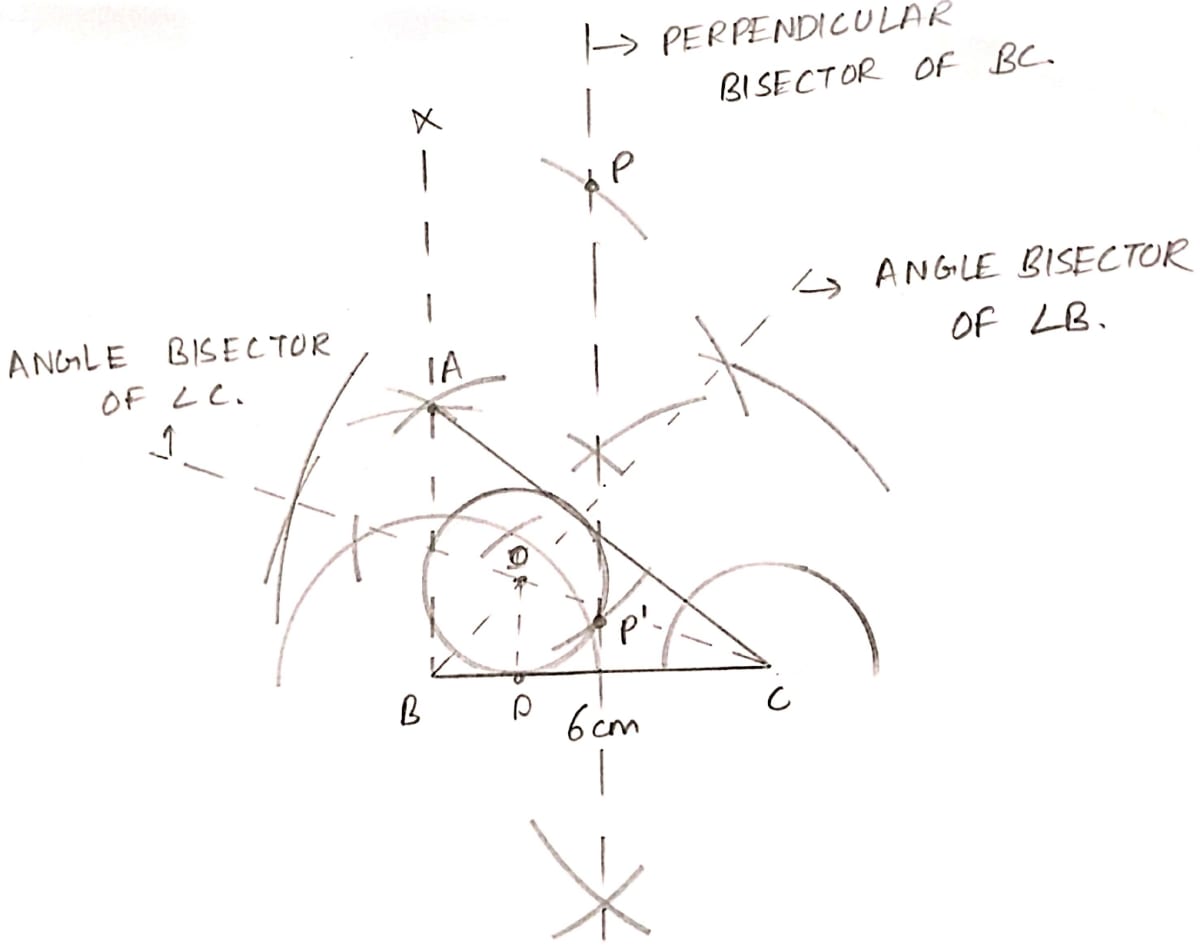
Draw a line segment BC = 6 cm.
At B, draw a ray BX making an angle of 90° and cut off BA = 5 cm.
Join AC.
Draw the perpendicular bisector of BC.
From A with 5 cm radius, draw arc which intersects the perpendicular bisector of BC at P and P'.
There are two points (P and P') equidistant from B and C and at a distance of 5 cm from A.
(ii) Steps of construction :
Draw the angle bisectors of ∠B and ∠C intersecting at O.
From O, draw OD ⊥ BC.
With centre O and radius OD, draw a circle which will touch all the sides of △ABC.
Hence, the required inscribed circle of △ABC is formed.
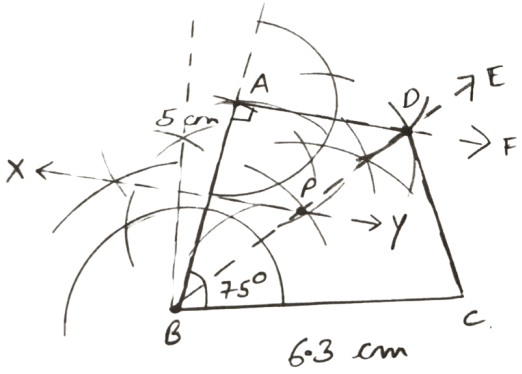
Use ruler and compasses for the following question taking a scale of 10 m = 1 cm.
A park in the city is bounded by straight fences AB, BC, CD and DA.
Given that AB = 50 m, BC = 63 m, ∠ABC = 75°. D is a point equidistant from the fences AB and BC. If ∠BAD = 90°, construct the outline of the park ABCD.
Also locate a point P on the line BD for the flag post which is equidistant from the corners of the park A and B.
Answer
We know that,
The locus of a point equidistant from two intersecting lines is pair of bisectors of the angles between the two lines.
The locus of a point which is equidistant from two given points is actually the perpendicular bisector of the segment that joins the two points.
Given,
Scale : 10 m = 1 cm
BC = 63 m = = 6.3 cm.
AB = 50 m = = 5 cm.
Steps of construction :
Draw a line BC = 6.3 cm.
Draw ∠ABC = 75° such that AB = 5 cm.
Draw BE, angle bisector of ∠ABC.
Construct ∠BAF = 90°, intersecting BE at D.
Join ABCD.
Construct XY, the perpendicular bisector of AB, intersecting BD at P.