
Draw an equilateral triangle of side 4 cm. Draw its circumcircle.
Answer
Steps of construction :
Draw a line segment BC = 4 cm.
With centers B and C, draw two arcs of radius 4 cm which intersect each other at A.
Join AB and AC. Hence, equilateral triangle ABC is formed.
Draw the perpendicular bisectors of AB and BC. Let these bisectors meet at the point O.
With O as center and radius equal to OA, draw a circle. The circle so drawn passes through the points A, B and C, and is the required circumcircle of △ABC.

Using a ruler and a pair of compasses only, construct :
(i) a triangle ABC, given AB = 4 cm, BC = 6 cm and ∠ABC = 90°.
(ii) a circle which passes through the points A, B and C and mark its centre as O.
Answer
(i) Steps of construction :
Draw a line segment BC = 6 cm.
Draw the perpendicular from point B and cut AB from that perpendicular such that AB = 4 cm.
Join points A, B and C.
Hence, the △ABC is formed.
(ii) Steps of construction :
In the above triangle, draw the perpendicular bisector of AB and BC. Let these bisectors meet at the point O.
With O as center and radius equal to OA, draw a circle. The circle so drawn passes through the points A, B and C, and is required circumcircle of △ABC.

Use ruler and compass, construct a triangle ABC where AB = 3 cm, BC = 4 cm and ∠ABC = 90°. Hence, construct a circumcircle circumscribing the triangle ABC. Measure and write down the radius of the circle.
Answer
Steps of construction :
Draw a line segment AB = 3 cm
From B draw a ray BX such that ∠XBA = 90°.
From B draw an arc of 4 cm cutting XB at C.
Join AC. ABC is the required triangle.
Construct perpendicular bisectors of AB and BC, such that they intersect at O.
With O as center and OA as radius draw a circle passing through A, B and C.
Measure OA.
Hence, above is the required circumcircle of triangle ABC.
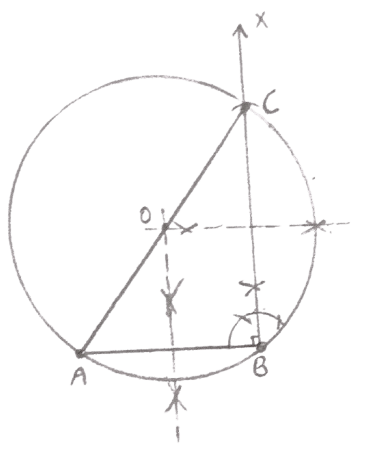
On measuring we get OA = 2.5 cm
Hence, the length of the radius of the circle = 2.5 cm.
Using ruler and compasses only :
(i) Construct a triangle ABC with the following data :
Base AB = 6 cm, AC = 5.2 cm and ∠CAB = 60°.
(ii) In the same diagram, draw a circle which passes through the points A, B and C, and mark its centre O.
Answer
(i) Steps of construction :
Draw a line segment AB = 6 cm.
Cut an arc of 5.2 cm from A.
Draw a line segment from B such that angle between the line and AB = 60°.
Mark the point as C where the arc from A and line segment from B meets.
Join points A, B and C. Hence, the △ABC is formed.
(ii) Steps of construction :
In the above triangle, draw the perpendicular bisector of AB and BC. Let these bisectors meet at the point O.
With O as center and radius equal to OA, draw a circle. The circle so drawn passes through the points A, B and C, and is required circumcircle of △ABC.

Using ruler and compasses only, draw an equilateral triangle of side 5 cm and draw its inscribed circle. Measure the radius of the circle.
Answer
Steps of construction :
Draw a line segment BC = 5 cm.
From B and C cut an arc of 5 cm.
Mark the point as A which is intersection of the two arcs.
Join A, B and C. Hence, the equilateral △ABC is formed.
Draw the (internal) bisectors of ∠B and ∠C. Let these bisectors meet at point I.
From I, draw IN perpendicular to the side BC.
With I as centre and radius equal to IN, draw a circle. The circle so drawn touches all the sides of the △ABC, and is the required incircle of △ABC.

On measuring IN, we get the radius of the incircle.
Hence, the radius of the incircle = 1.5 cm.
Construct a triangle ABC with BC = 6.4 cm, CA = 5.8 cm and ∠ABC = 60°. Draw its incircle. Measure and record the radius of incircle.
Answer
Steps of construction :
Draw a line segment BC = 6.4 cm.
Cut an arc from C of 5.8 cm.
From B construct angle 60° and extend the line and mark the point A where it meets arc from C.
Join A, B and C. Hence, the △ABC is formed.
Draw the (internal) bisectors of ∠B and ∠C. Let these bisectors meet at point I.
From I, draw IN perpendicular to the side BC.
With I as centre and radius equal to IN, draw a circle. The circle so drawn touches all the sides of the △ABC, and is the required incircle of △ABC.

On measuring IN, we get the radius of the incircle.
Hence, the radius of incircle is 1.6 cm.
Construct a △ABC with BC = 6.5 cm, AB = 5.5 cm, AC = 5 cm. Construct the incircle of the triangle. Measure and record the radius of the incircle.
Answer
Steps of construction :
Draw a line segment BC = 6.5 cm.
Cut an arc from C of 5 cm and an arc of 5.5 cm from B.
Mark the point as A where the arcs from B and C intersect.
Join A, B and C. Hence, the △ABC is formed.
Draw the (internal) bisectors of ∠B and ∠C. Let these bisectors meet at point I.
From I, draw IN perpendicular to the side BC.
With I as centre and radius equal to IN, draw a circle. The circle so drawn touches all the sides of the △ABC, and is the required incircle of △ABC.
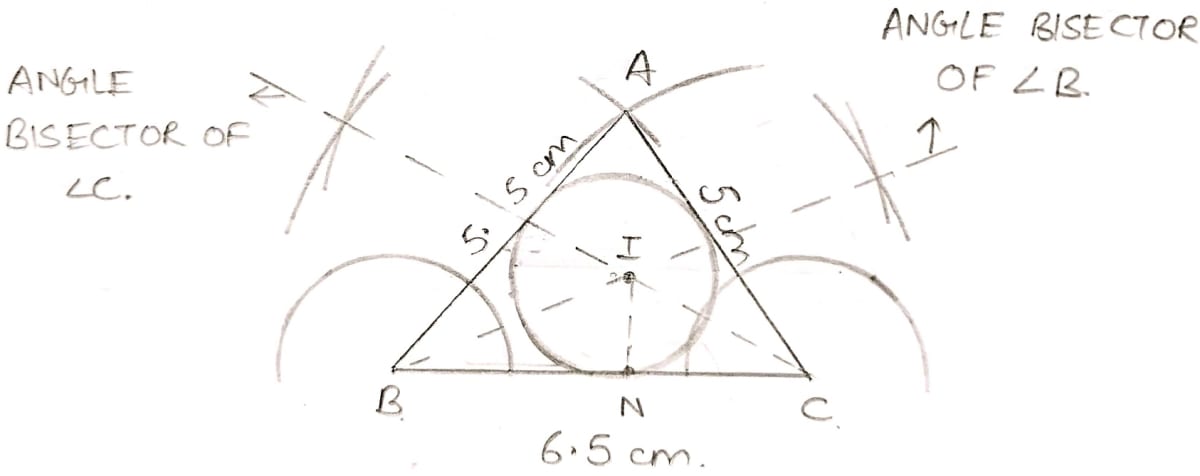
On measuring IN, we get the radius of the incircle.
Hence, the radius of incircle is 1.5 cm.
Using ruler and compasses only, construct a triangle ABC in which BC = 4 cm, ∠ACB = 45° and the perpendicular from A on BC is 2.5 cm. Draw the circumcircle of triangle ABC and measure its radius.
Answer
Steps of construction :
Draw a line segment BC = 4 cm.
At B, draw a perpendicular and cut off BE = 2.5 cm.
From E, draw a line EF parallel to BC.
From C, draw a ray making an angle of 45° which intersects EF at A.
Join AB.
Draw a line AD parallel to BE. This AD is the perpendicular bisector of BC.
Draw the perpendicular bisectors of sides BC and AC intersecting at O.
With centre O and radius OB or OC or OA draw a circle which will pass through A, B and C. This is the circumcircle of △ABC.

On measuring OB we get the radius of the circumcircle.
Hence, the radius of circumcircle = 2 cm.
Using ruler and compasses only, construct a △ABC such that BC = 5 cm, AB = 6.5 cm and ∠ABC = 120°.
(i) Construct a circumcircle of △ABC.
(ii) Construct a cyclic quadrilateral ABCD such that D is equidistant from AB and BC.
Answer
(i) Steps of construction :
Draw a line segment AB = 6.5 cm.
From B construct angle 120° and extend the line such that BC = 5 cm.
Join points A, B and C. Hence, the △ABC is formed.
Draw the perpendicular bisector of AB and BC. Let these bisectors meet at the point O.
With O as center and radius equal to OA, draw a circle. The circle so drawn passes through the points A, B and C, and is required circumcircle of △ABC.
(ii) We know that locus of point equidistant from two sides is the angle bisector of the angle between the lines.
Steps of construction :
Draw the angle bisector of ∠ABC.
Mark the point as D where the angle bisector of ∠ABC meets the circumcircle.
Join AD and CD.
ABCD is the cyclic quadrilateral.

Construct a regular hexagon of side 4 cm. Construct a circle circumscribing the hexagon.
Answer
We know that each angle in a regular hexagon = 120°.
Draw a line segment AB = 4 cm.
At A and B draw rays making an angle of 120° each and cut off AF = BC = 4 cm.
At F and C, draw rays making angle of 120° each and cut off EF = CD = 4 cm.
Join ED. Hence, ABCDEF is the required hexagon.
Draw the perpendicular bisector of AB and BC. Let these bisectors meet at the point O.
With O as center and radius equal to OA or OB draw a circle which passes through the vertices of the hexagon. This is the required circumcircle of hexagon ABCDEF.

Draw a regular hexagon of side 4 cm and construct its incircle.
Answer
We know that each angle in a regular hexagon = 120°.
Draw a line segment AB = 4 cm.
At A and B draw rays making an angle of 120° each and cut off AF = BC = 4 cm.
At F and C, draw rays making angle of 120° each and cut off EF = CD = 4 cm.
Join ED. Hence, ABCDEF is the required hexagon.
Draw the angle bisectors of A and B which intersect each other at O.
Draw OL ⊥ AB.
With centre O and radius OL, draw a circle which touches the sides of hexagon. This is the required incircle of hexagon ABCDEF.
