Class - 10 ML Aggarwal Understanding ICSE Mathematics
Chapter Test
Question 1
A cylindrical container is to be made of tin sheet. The height of the container is 1 m and its diameter is 70 cm. If the container is open at the top and the tin sheet costs ₹ 300 per m2, find the cost of the tin for making the container.
Answer
Since, container is open at the top hence total surface area of container (S) = curved surface area + area of base.
Hence, the cost of tin for making the container is ₹ 775.50
Question 2
A cylinder of maximum volume is cut out from a wooden cuboid of length 30 cm and cross section of square of side 14 cm. Find the volume of the cylinder and the volume of wood wasted.
Answer
Largest size of cylinder cut out of the wooden cuboid will be of diameter = 14 cm, radius = 214 = 7 cm and height = 30 cm.
Volume of wooden wasted = Volume of cuboid - Volume of cylinder = 5880 - 4620 = 1260 cm3.
Hence, the volume of cylinder = 4620 cm3 and volume of wooden wasted = 1260 cm3.
Question 3
Find the volume and the total surface area of a cone having slant height 17 cm and base diameter 30 cm. Take π = 3.14
Answer
Radius of cone = 230 = 15 cm.
l = r2+h2
Putting values we get,
⇒17=152+h2⇒172=152+h2⇒289=225+h2⇒h2=289−225⇒h2=64⇒h=64=8 cm.
Volume of cone (V) = 31πr2h
Putting values we get,
V=31×3.14×152×8=33.14×225×8=1884 cm3
Total surface area of cone (S) = πrl+πr2=πr(l+r)
Putting values we get,
S=3.14×15×(17+15)=3.14×15×32=1507.2 cm2
Hence, the volume of cone = 1884 cm3 and surface area of cone = 1507.2 cm2.
Question 4
Find the volume of a cone given that its height is 8 cm and the area of base 156 cm2.
Answer
Height of cone = 8 cm.
Area of base = 156 cm2.
Volume of cone (V) = 31× Area of base × Height
Putting values we get,
V=31×156×8=31248=416 cm3.
Hence, the volume of cone = 416 cm3.
Question 5
The circumference of the edge of a hemispherical bowl is 132 cm. Find the capacity of the bowl.
Answer
Circumference of the edge of bowl = 132 cm.
∴2πr=132⇒2×722×r=132r=22×2132×7r=3×7r=21 cm.
Volume of hemispherical bowl (V) = 32πr3
Putting values we get,
V=32×722×(21)3=212×22×213=2×22×441=19404 cm3.
Hence, the capacity of bowl = 19404 cm3.
Question 6
The volume of a hemisphere is 242521 cm3. Find its curved surface area.
Answer
Let radius of hemisphere be r cm.
Volume of hemisphere (V) = 32πr3
Given, V = 242521=24851.
∴32×722×r3=24851⇒r3=2×22×24851×3×7⇒r3=2×2×2441×3×7⇒r3=89261⇒r3=(221)3⇒r=221 cm.
Curved surface area = 2πr2
=2×722×221×221=2844×441=693 cm2.
Hence, curved surface area of hemisphere = 693 cm2.
Question 7
A solid wooden toy is in the shape of a right circular cone mounted on a hemisphere. If the radius of the hemisphere is 4.2 cm and the total height of the toy is 10.2 cm, find the volume of the toy.
Answer
Given,
The solid wooden toy is in the shape of a right circular cone mounted on a hemisphere.
Radius of hemisphere (r) = 4.2 cm
Total height (h) = 10.2 cm.
Height of conical part (h1) = 10.2 - 4.2 = 6 cm.
Volume of toy (V) = Volume of cone + Volume of hemisphere
A solid is in the form of a cylinder with hemispherical ends. The total height of the solid is 19 cm and the diameter of the cylinder is 7 cm. Find the volume and the total surface area of the solid.
Answer
From figure,
r = Radius of cylinder = Radius of hemisphere = 27.
Height of cylinder (h) = Total height - (2 x Radius of hemisphere)
= 19 - (2×27)
= 19 - 7 = 12 cm.
Total Volume of solid (V) = 2 × Volume of hemisphere + Volume of cylinder
A solid cone of base radius 9 cm and height 10 cm is lowered into a cylindrical jar of radius 10 cm, which contains water sufficient to submerge the cone completely. Find the rise in water level in the jar.
Answer
Radius of cone (r) = 9 cm.
Height of cone (h) = 10 cm.
Volume of water filled in cone = 31πr2h
Let h1 be the rise in height of water in the jar.
Radius of jar (r1) = 10.
Since, cone is submerged completely hence, volume of water level rise = volume of cone.
∴πr12h1=31πr2h⇒π(10)2×h1=31π(9)2×10⇒h1=π×(10)231π×81×10⇒h1=3×π×10×10π×8127×10⇒h1=1027⇒h1=2.7 cm.
Hence, the rise in height of water in jar is 2.7 cm.
Question 12
An iron pillar has some part in the form of a right circular cylinder and the remaining in the form of a right circular cone. The radius of the base of each of cone and cylinder is 8 cm. The cylindrical part is 240 cm high and the conical part is 36 cm high. Find the weight of the pillar if one cu. cm of iron weighs 7.8 grams.
Answer
Radius of base of cone (r) = 8 cm,
Radius of cylinder (r) = 8 cm
Height of cylindrical part (h1) = 240 cm
Height of conical part (h2) = 36 cm.
Volume of pillar (V) = Volume of cylinder + Volume of cone.
∴ Weight of 50688 cm3 of iron = 50688 × 7.8 = 395366.4 g
Converting it into Kg,
395366.4 g = 1000395366.4 Kg
= 395.3664 Kg
Hence, the weight of the pillar is 395.3664 kg.
Question 13
A circus tent is made of canvas and is in the form of right circular cylinder and a right circular cone above it. The diameter and height of cylindrical part of tent are 126 m and 5 m respectively. The total height of the tent is 21 m. Find the total cost of tent if canvas used costs ₹36 per square metre.
Answer
The below figure shows the circus tent:
Diameter of cylindrical part = 126 m.
Radius of cone = Radius of cylinder = r = 2126 = 63 m.
Height of cylindrical part (h1) = 5 m,
Total height of tent = 21 m,
Height of conical part (h) = 21 - 5 = 16 m.
Slant height of cone (l) = r2+h2
=632+162=3969+256=4225=65 m.
Surface area of tent (S) = Surface area of cylinder + Surface area of cone.
The entire surface of a solid cone of base radius 3 cm and height 4 cm is equal to entire surface of a solid right circular cylinder of diameter 4 cm. Find the ratio of their
(i) curved surfaces
(ii) volumes.
Answer
Radius of base of cone (r1) = 3 cm,
Height of cone (h1) = 4 cm.
Slant height of cone (l) = r12+h12
32+42=9+16=25=5 cm.
Let height of cylinder be h2 cm and radius be r2 cm.
r2 = 24 = 2 cm.
Given, total surface area of cylinder = total surface area of cone.
⇒ 2πr(r2 + h2) = πr1(l + r1)
⇒ 2π × 2 × (2 + h2) = π × 3 × (5 + 3)
⇒ π(8 + 4h2) = 24π
Dividing both sides by π,
⇒ 4h2 = 24 - 8
⇒ 4h2 = 16
⇒ h2 = 4 cm.
(i) Ratio between curved surface area of cone and cylinder (Ratio) = 2πr2hπr1l
Putting values we get,
Curved Surface of CylinderCurved Surface of Cone=2×π×2×4π×3×5=16π15π=15:16.
Hence, the ratio between curved surface area of cone and cylinder 15 : 16.
(ii) Ratio between their volumes = Vol. of CylinderVol. of Cone
Hence, 96 coins are required to form a solid cylinder.
Question 17
A hemisphere of lead of radius 8 cm is cast into a right circular cone of base radius 6 cm. Determine the height of the cone correct to 2 places of decimal.
Answer
Given,
Radius of hemisphere (r) = 8 cm.
Radius of cone (R) = 6 cm.
Let height of cone be h cm.
Since, hemisphere is casted into cone,
Volume of hemisphere = Volume of cone.
∴32πr3=31πR2h⇒2r3=R2h⇒h=R22r3⇒h=622×83⇒h=361024⇒h=28.44 cm.
Hence, the height of the cone is 28.44 cm.
Question 18
A vessel in the form of a hemispherical bowl is full of water. The contents are emptied into a cylinder. The internal radii of the bowl and cylinder are respectively 6 cm and 4 cm. Find the height of water in the cylinder.
Answer
Radius of hemispherical bowl (r) = 6 cm.
Radius of cylinder (R) = 4 cm.
Let h be the height of water in cylinder.
Volume of hemispherical bowl = Volume of water in cylinder.
⇒32πr3=πR2h⇒32r3=R2h⇒32×63=42×h⇒2×2×36=16h⇒h=16144⇒h=9 cm.
Hence, the height of water in cylinder is 9 cm.
Question 19
A sphere of diameter 6 cm is dropped into a right circular cylinder vessel partly filled with water. The diameter of the cylindrical vessel is 12 cm. If the sphere is completely submerged in water, by how much will the level of water rise in the cylindrical vessel ?
Answer
Radius of sphere (r) = 26 = 3 cm.
Radius of cylinder (R) = 212 = 6 cm.
Let height of water raised be h cm.
Volume of sphere = Volume of water rise in cylinder
34πr3=πR2h34×33=62×h4×32=62×hh=3636=1 cm.
Hence, the height of water raised is 1 cm.
Question 20
A solid sphere of radius 6 cm is melted into a hollow cylinder of uniform thickness. If the external radius of the base of the cylinder is 5 cm and its height is 32 cm, find the uniform thickness of the cylinder.
Answer
Radius of solid sphere (r1) = 6 cm
Volume of solid sphere (V) = 34πr13
=34π×63=4π×2×62=288π cm3
External radius of cylinder (R) = 5 cm, height (h) = 32 cm.
Let r be inner radius of cylinder.
Volume of cylinder = Volume of sphere.
∴V=π(R2−r2)h⇒288π=π(52−r2)×32⇒288=32(25−r2)⇒32288=25−r2⇒9=25−r2⇒r2=25−9⇒r2=16⇒r=4 cm.
Thickness of hollow cylinder = R - r = 5 - 4 = 1 cm.
Hence, the thickness of the cylinder = 1 cm.
Question 21
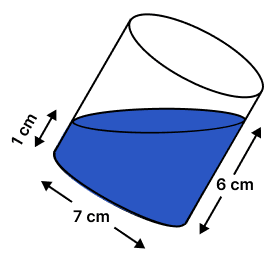
In the adjoining diagram, a tilted right circular cylindrical vessel with base diameter 7 cm contains a liquid. When placed vertically, the height of the liquid in the vessel is the mean of two heights shown in the diagram. Find the area of wet surface, when the cylinder is placed vertically on a horizontal surface. (Use π=722 )
Answer
When vertically placed,
Height of liquid (h) = 21+6=27 cm
Diameter of base = 7 cm
Radius (r) = 27 cm
Area of wet surface=πr2+2πrh=πr(r+2h)=722×27(27+2×27)=11×(3.5+7)=11×10.5=115.5 cm2.
Hence, area of wet surface = 115.5 cm2.
Question 22
A manufacturing company prepares spherical ball bearings, each of radius 7 mm and mass 4 g. These ball bearings are packed into boxes. Each box can have maximum of 2156 cm3 of ball bearings. Find the :
(a) maximum number of ball bearings that each box can have.
(b) mass of each box of ball bearings in kg.
(use π=722)
Answer
(a) Given,
Radius of ball bearings = 7 mm
Volume of box = 2156 cm3 = 2156 × 103 mm3
Number of ball bearings that each box can have (N)