
An electric pole is 10 metres high. If its shadow is metres in length, find the elevation of the sun.
Answer
Let the angle of elevation be θ as shown in the figure below:

Consider △ABC, AB be the height of electric pole and BC be the shadow. Since pole and it's shadow are perpendicular, ∠ABC = 90°.
From △ABC, we get
Hence, the elevation of the sun is 30°.
The angle of elevation of the top of a tower, from a point on the ground and at a distance of 150 m from its foot, is 30°. Find the height of the tower correct to one place of decimal.
Answer
Let MP be the tower of height h metres and O be the point on the ground 150 m away from the foot of the tower.
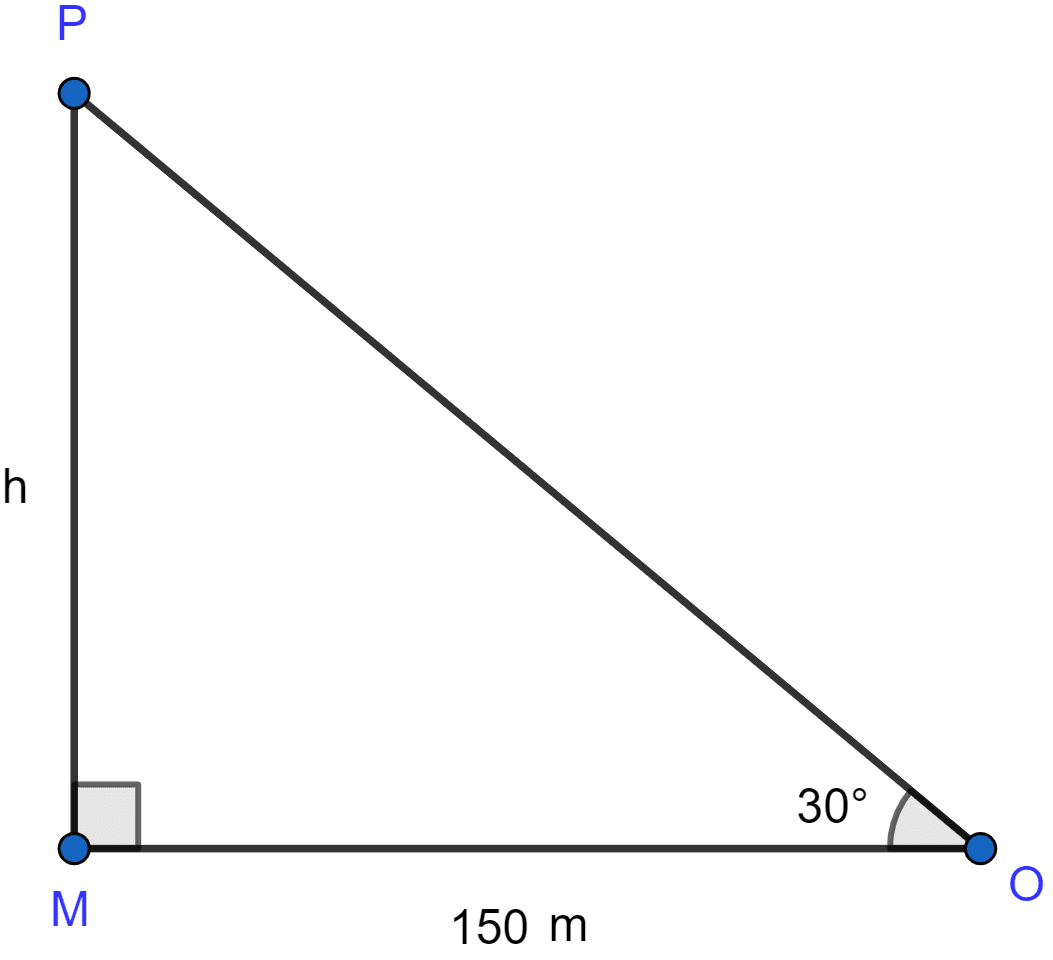
Then, the angle of elevation = ∠MOP = ∠30° (given).
In △OMP, ∠OMP = 90°.
From △OMP, we get
Hence, the height of the tower = 86.6 m.
A ladder is placed against a wall such that it just reaches the top of the wall. The foot of the ladder is 1.5 metres away from the wall and the ladder is inclined at an angle of 60° with the ground. Find the height of the wall.
Answer
Let MP be the wall of height h metres and O be the point on the ground 1.5 m away from the foot of the wall.
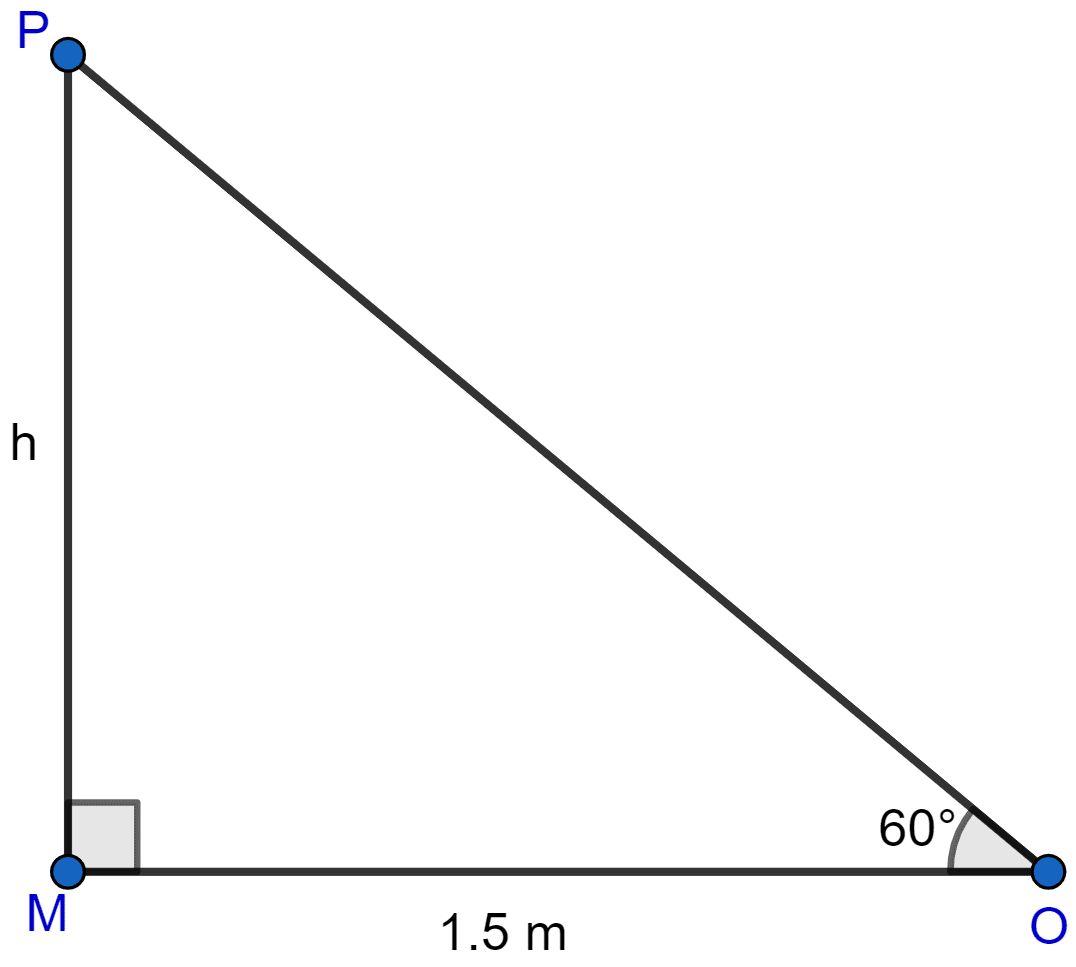
Then, the angle of elevation = ∠MOP = ∠60° (given).
In △OMP, ∠OMP = 90°.
From △OMP, we get
Hence, the height of the wall = 2.6 m.
What is the angle of elevation of sun when the length of shadow of a vertical pole is equal to its height?
Answer
Let MP be the height of pole and OM be the length of shadow of pole.

Given, height of pole (MP) = shadow of pole (OM) = h metres.
Let the angle of elevation be θ
In △OMP, ∠OMP = 90°.
From △OMP, we get
Hence, the angle of elevation of sun is 45°.
From a point P on level ground, the angle of elevation of the top of a tower is 30°. If the tower is 100m high, how far is P from the foot of the tower ?
Answer
Let MO be the tower with O being the foot of tower.

Given, angle of elevation of the top of a tower is 30° and height of tower is 100m.
∴ ∠MPO = 30° and OM = 100 m.
In △POM, ∠POM = 90°.
From △POM, we get
Hence, the point P is at a distance of 173.2 metres from the foot of the tower.
From the top of a cliff 92 m high, the angle of depression of a buoy is 20°. Calculate to the nearest metre, the distance of the buoy from the foot of the cliff.
Answer
Let MP be the cliff and O be the buoy.
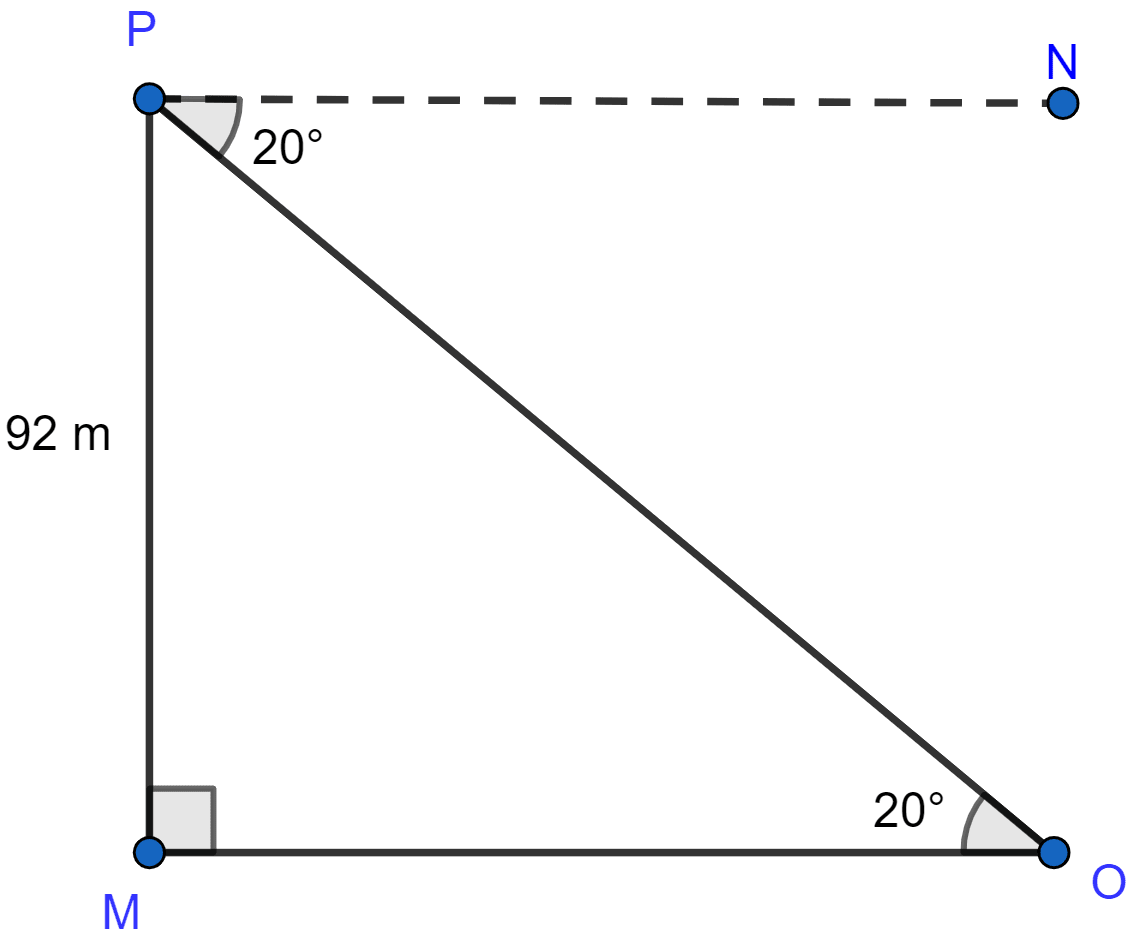
From figure,
Given angle of depression of a buoy is 20°.
∴ ∠POM = ∠OPN = 20° (Alternate angles are equal).
In △POM, ∠PMO = 90°.
From △POM, we get
Hence, the distance of buoy from the foot of cliff is 253 metres.
A boy is flying a kite with a string of length 100 m. If the string is tight and the angle of elevation of the kite is 26° 32', find the height of the kite correct to one decimal place (ignore the height of the boy).
Answer
Suppose boy is at point O and the kite is at point P.

Considering △POM,
∠PMO = 90°, ∠POM = 26° 32', OP = 100 m and MP = height of kite.
From △POM, we get
Hence, the height of the kite is 44.7 metres.
An electric pole is 10 m high. A steel wire tied to the top of the pole is affixed at a point on the ground to keep the pole upright. If the wire makes an angle of 45° with the horizontal through the foot of the pole, find the length of the wire.
Answer
Let MP be the pole and string is tied from point P on the pole to point O on the ground.

Considering △POM,
∠PMO = 90°, ∠POM = 45° (given) and MP = 10 m.
From △POM, we get
Hence, the length of wire is 14.14 metres.
A vertical tower is 20 m high. A man standing at some distance from the tower knows that the cosine of the angle of elevation of the top of the tower is 0.53. How far is he standing from the foot of the tower ?
Answer
Let θ be the angle of elevation,
Given, cos θ = 0.53
∴ cos θ = cos 58°
⇒ θ = 58°
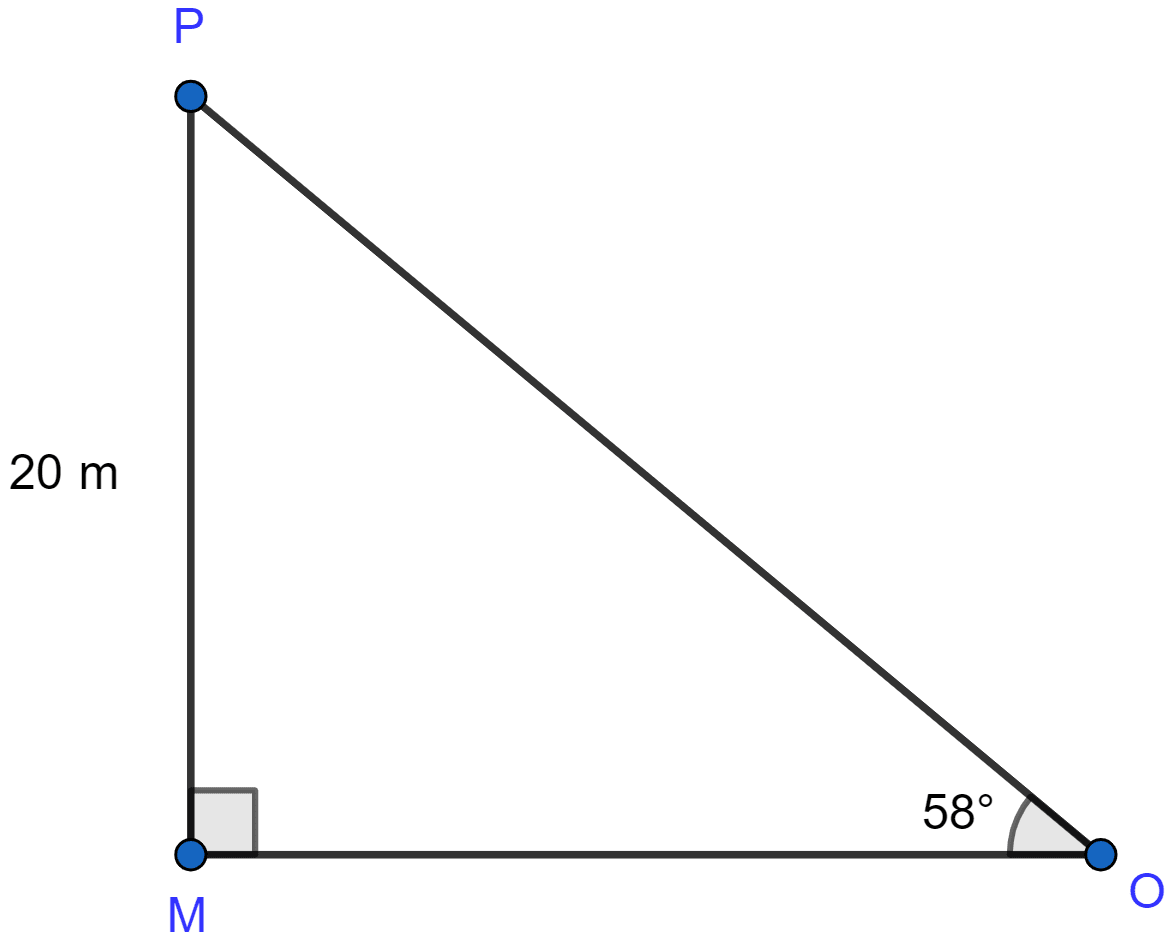
Let MP be the vertical tower and the man be standing at point O.
Considering △POM,
∠PMO = 90°, ∠POM = 58° and MP = 20 m.
From △POM, we get
Hence, the man is at a distance of 12.5 metres from the foot of tower.
The upper part of a tree broken by wind, falls to the ground without being detached. The top of the broken part touches the ground at an angle of 38° 30' at a point 6 m from the foot of the tree. Calculate :
(i) the height at which the tree is broken.
(ii) the original height of the tree correct to two decimal places.
Answer
(i) Let ACB be the tree. When broken at point C by the storm, let its top A touch the ground so that ∠CAB = 38° 30' and AB = 6 m.
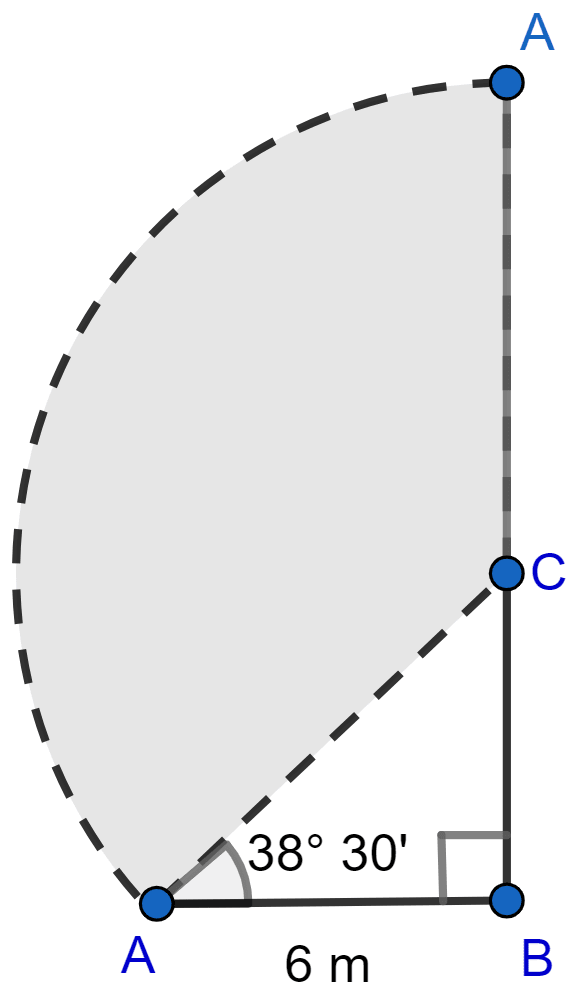
From right angled △ABC, we get
Hence, the tree is broken at a height of 4.77 m
(ii) From right angled △ABC, we get
∴ The height of the tree = BC + AC = 4.77 + 7.67 = 12.44
Hence, the original height of the tree is 12.44 metres.
An observer 1.5 m tall is 20.5 meters away from a tower 22 metres high. Determine the angle of elevation of the top of the tower from the eye of the observer.
Answer
Let CD be an observer of height 1.5 m which is 20.5 m away from a tower AB of height 22 m.
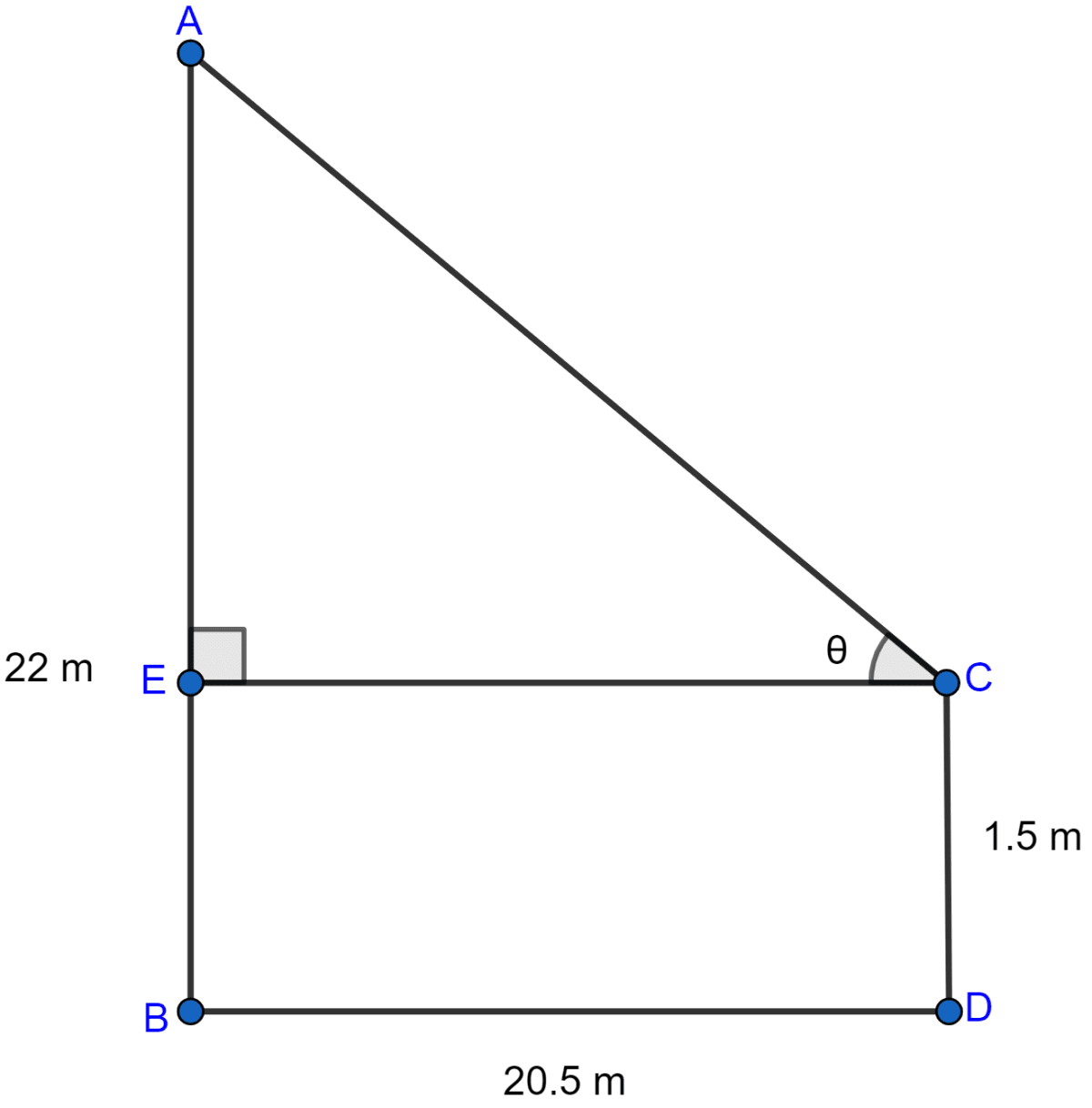
CD = 1.5 m and DB = 20.5 m
From C, draw CE ⊥ AB, then CDBE is a rectangle.
AE = AB - BE = AB - CD = 22 - 1.5 = 20.5 m
CE = DB = 20.5 m.
Let angle of elevation be θ,
From right angled △ACE, we get
Hence, the angle of elevation of the top of the tower from the eye of the observer is 45°.
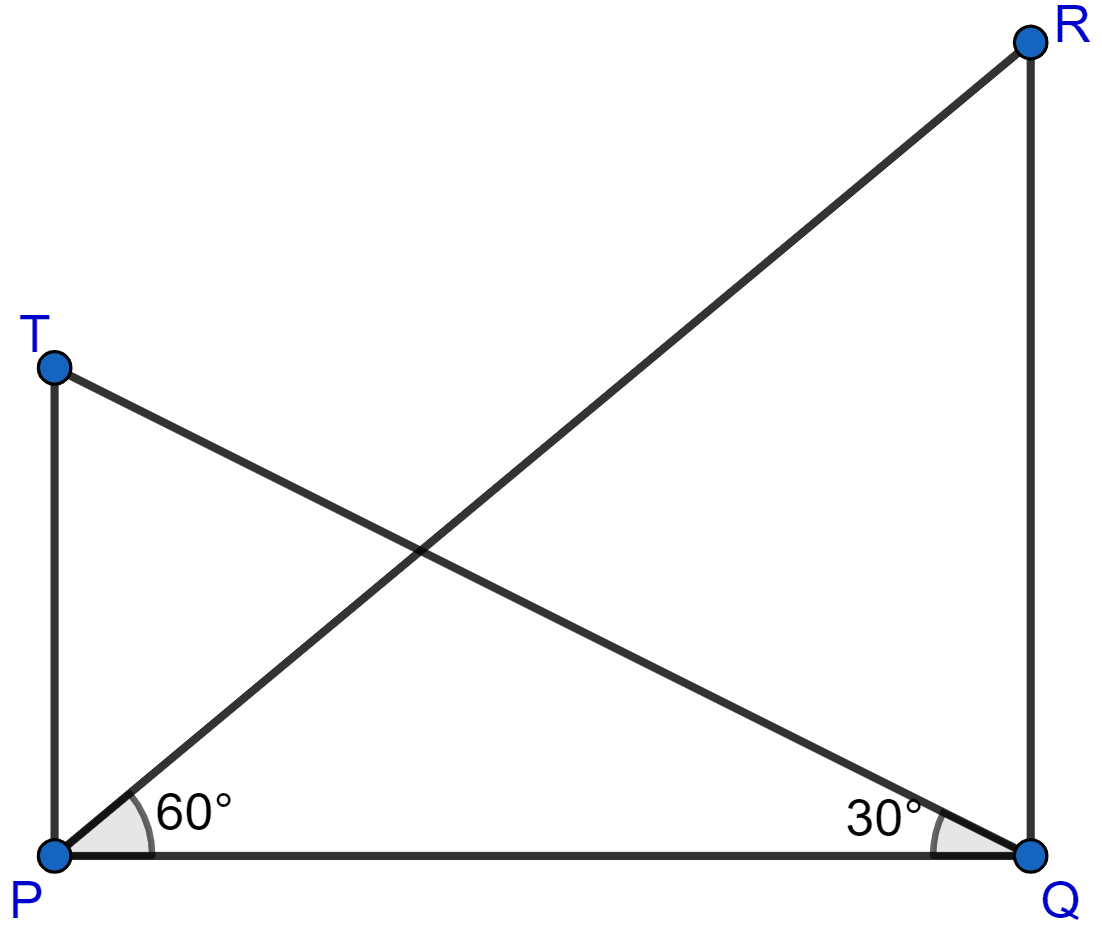
In the adjoining figure, the angle of elevation from a point P of the top of a tower QR, 50 m high is 60° and that of the tower PT from a point Q is 30°. Find the height of the tower PT, correct to the nearest metre.
Answer
Let height of tower PT be h meters.
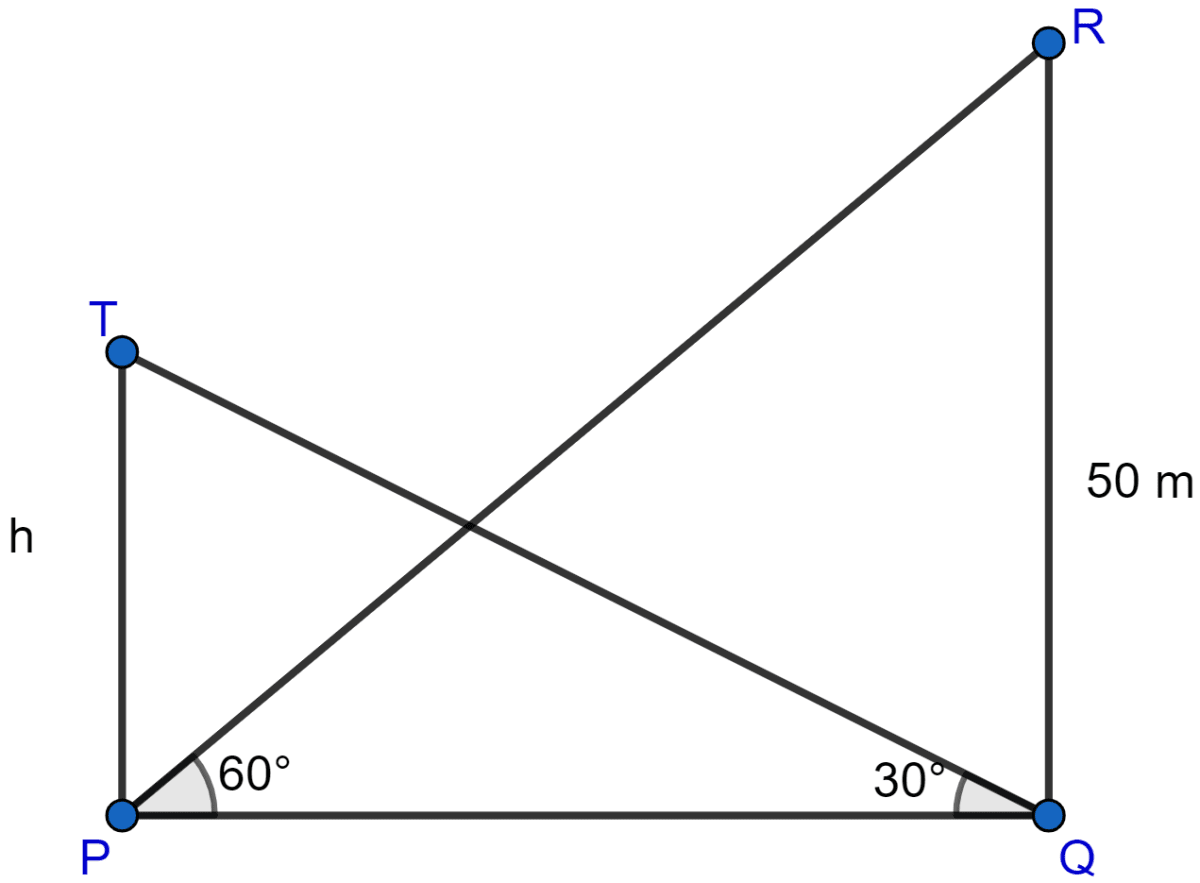
Considering right angled △PQR, we get
Now considering right angled △PQT, we get
On correcting to nearest meter, h = 17 m.
Hence, the height of the tower PT = 17 m.
From a point P on the ground, the angle of elevation of the top of a 10 m tall building and a helicopter, hovering over the top of the building are 30° and 60° respectively. Find the height of the helicopter above the ground.
Answer
Let QR be the tall building and S be the point at which helicopter is present.
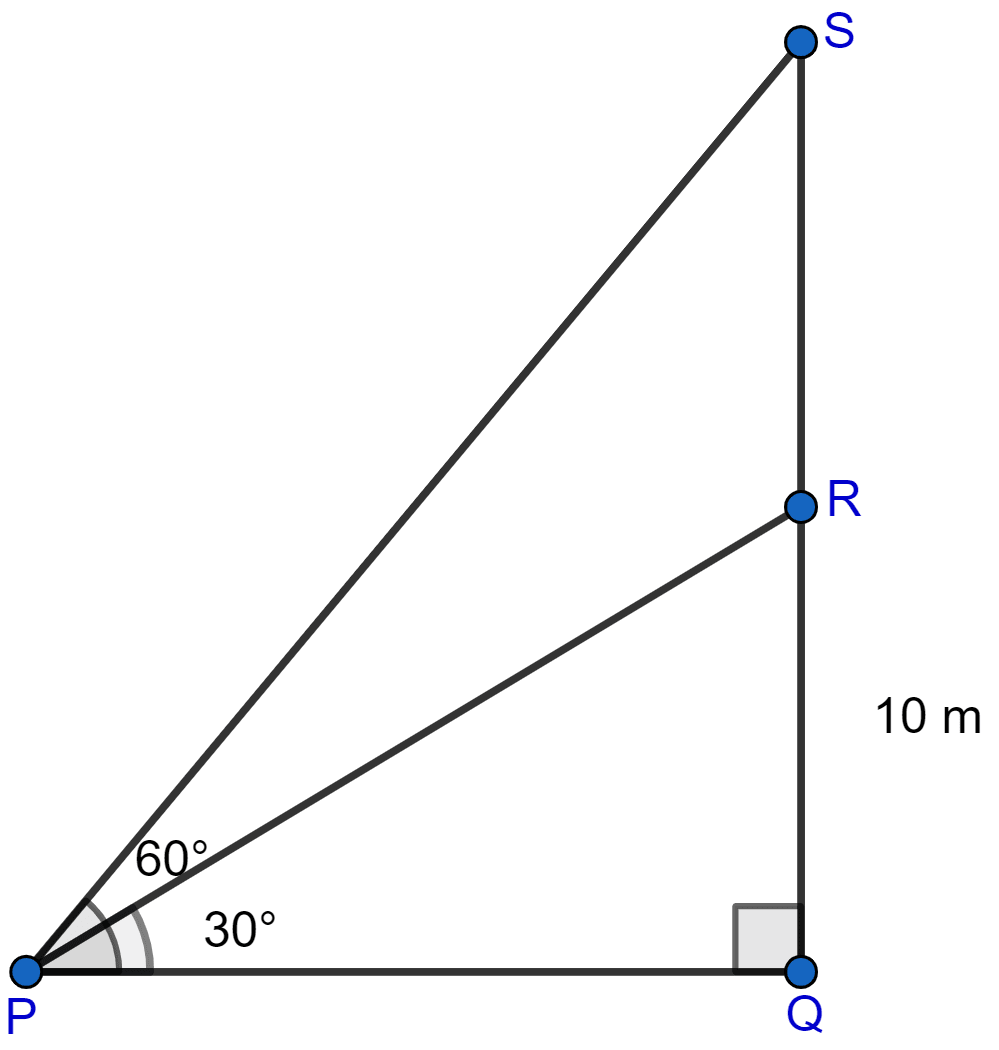
Considering right angled △PQR, we get
Now considering right angled △PQS, we get
Hence, the height of helicopter above the ground is 30 m.
An aeroplane when flying at a height of 3125 m from the ground passes vertically below another plane at an instant when the angles of elevation of the two planes from the same point on the ground are 30° and 60° respectively. Find the distance between the two planes at the instant.
Answer
Let the aeroplane at a height of 3125 m be at a point R and the plane above be at point S.
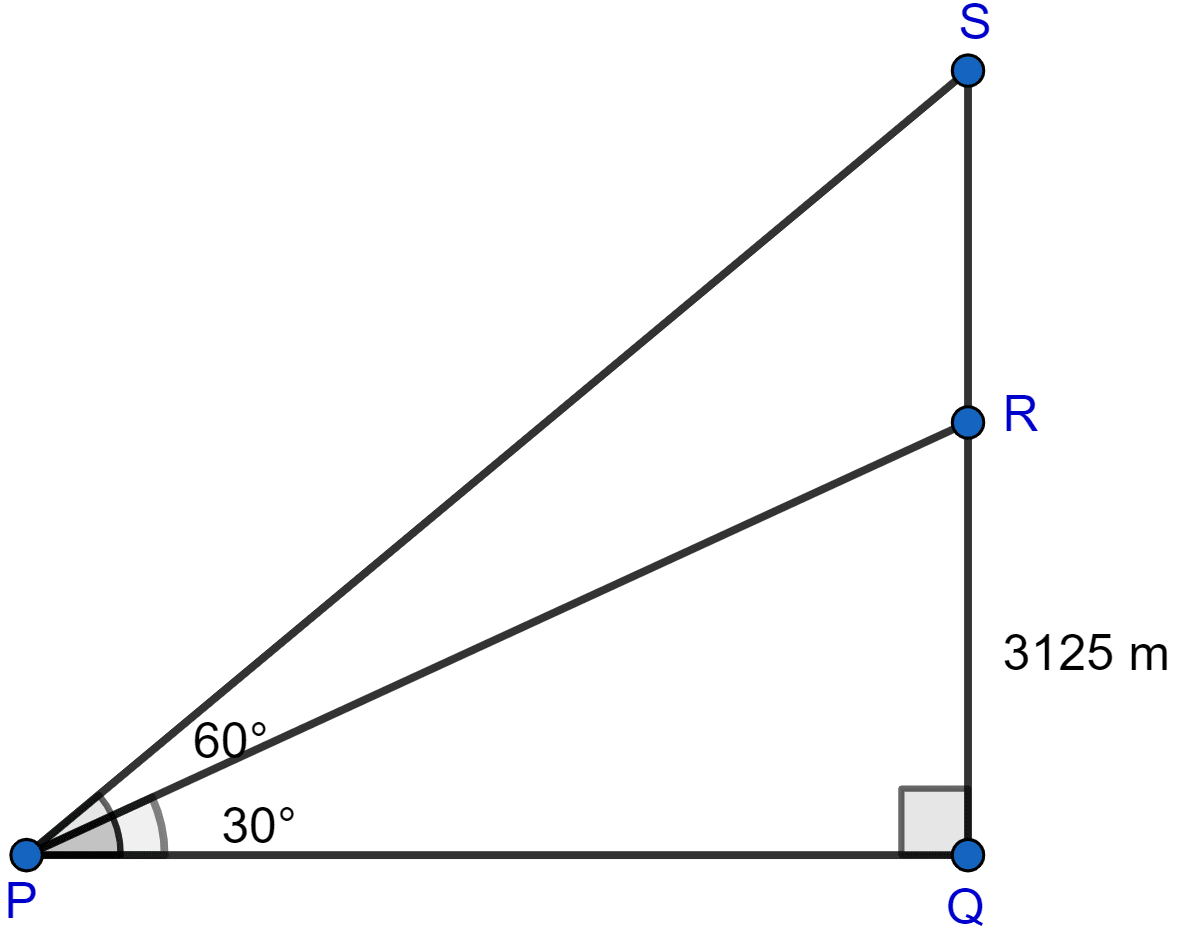
Considering right angled △PQR, we get
Now considering right angled △PQS, we get
Distance between two aeroplanes = QS - QR = 9375 - 3125 = 6250 m.
Hence, the distance between two planes = 6250 m.
A man observes the angle of elevation of the top of a tower to be 45°. He walks towards it in a horizontal line through its base. On covering 20 m, the angle of elevation changes to be 60°. Find the height of the tower correct to 2 significant figures.
Answer
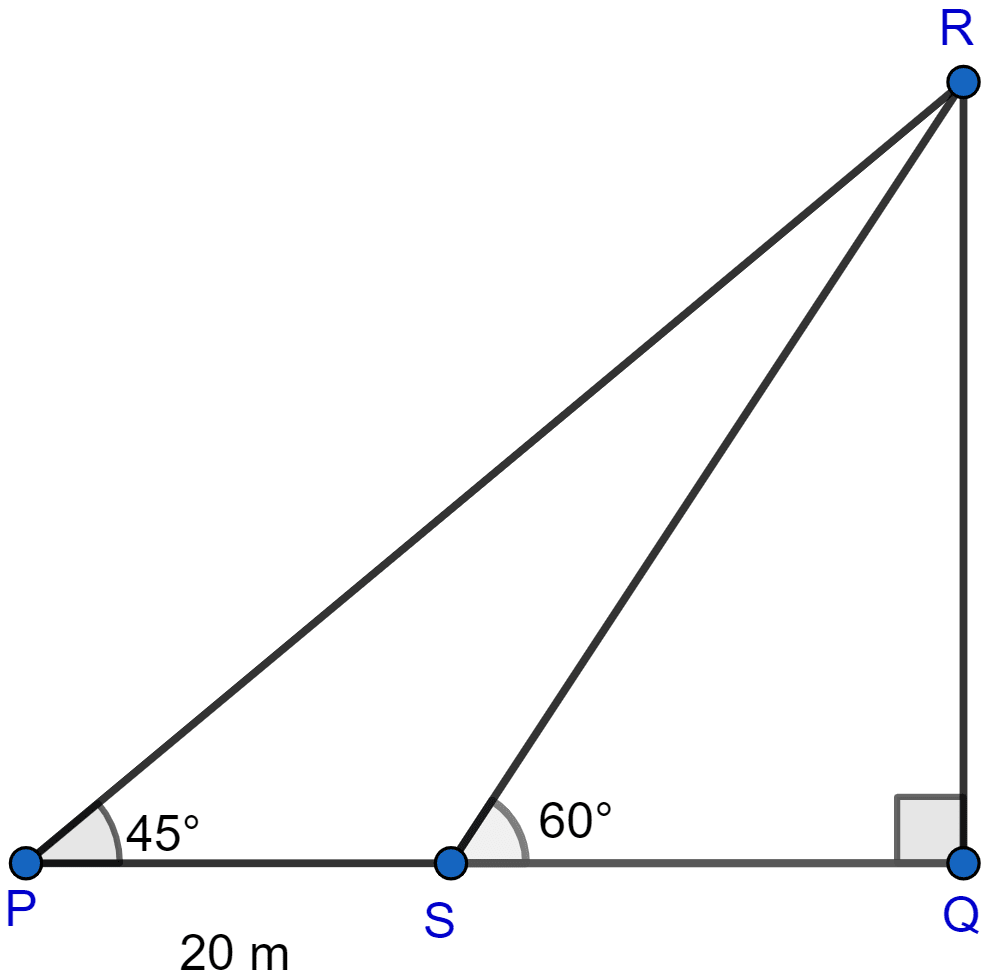
Let tower be QR and initial position of man be P, since the initial angle of elevation is 45°, considering right angled △PQR we get,
After covering 20 m let the man be at point S, so PS = 20 m and SQ = PQ - PS = PQ - 20 = QR - 20.
Now considering right angled △SQR we get,
On correcting to 2 significant figures QR = 47.
Hence, the height of the tower is 47 m.
The shadow of a vertical tower on a level ground increases by 10 m when the altitude of the sun changes from 45° to 30°. Find the height of the tower, correct to two decimal places.
Answer
Let the height of the tower BD be h metres and the length of its shadow be d metres when the sun's altitude is 45°. When the sun's altitude is 30°, then the length of shadow of tower is 10 m longer,
i.e., BD = h meters, AB = d meters and CA = 10 metres.
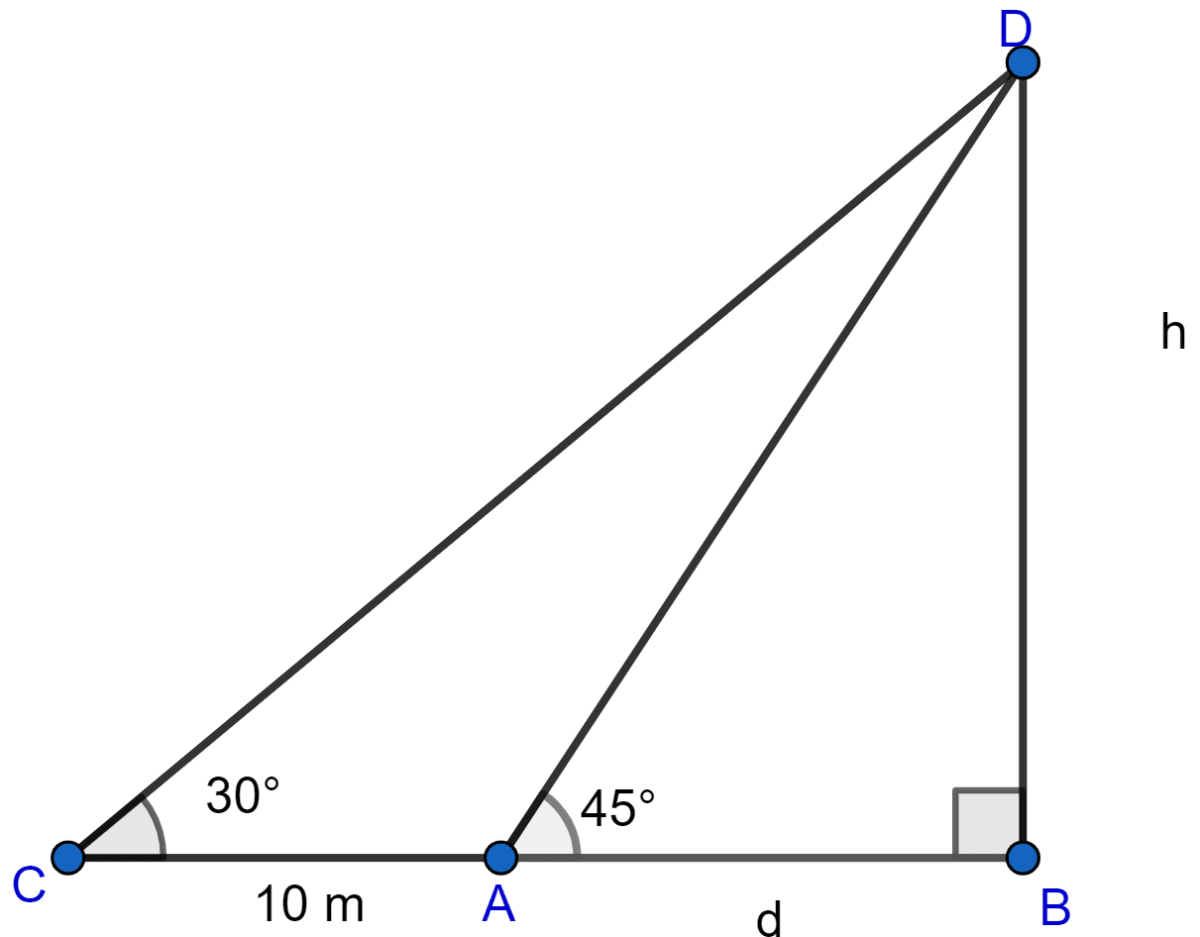
From right angled △ABD, we get
From right angled △BCD, we get
Hence, the height of the tower is 13.66 meters.
From the top of a hill, the angles of depression of two consecutive kilometer stones, due east are found to be 30° and 45° respectively. Find the distance of two stones from the foot of the hill.
Answer
Let R be the top of the tower and Q the foot. P and T be two consecutive kilometer stones with depression angles 30° and 45° respectively.
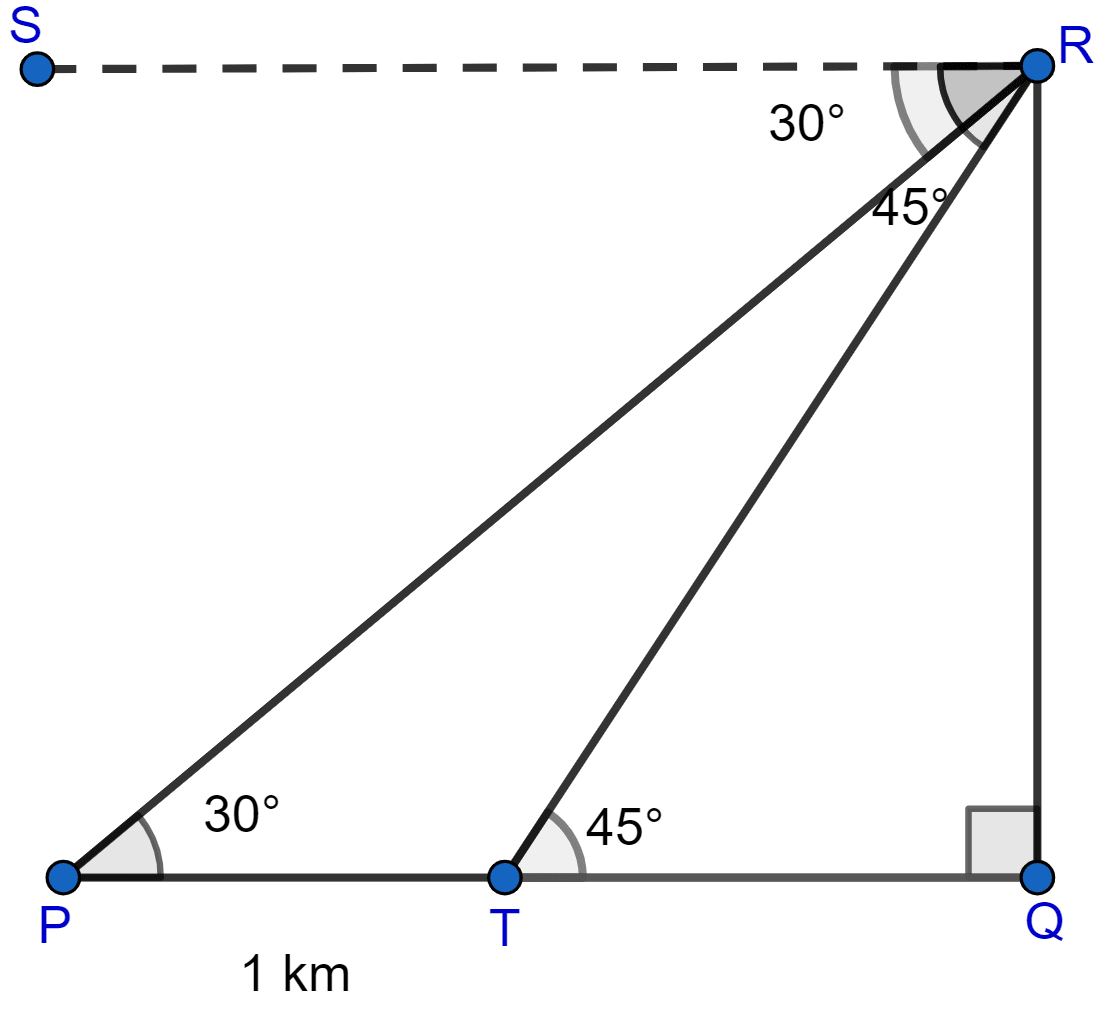
Since stones are consecutive kilometer stones hence distance between them = 1 km.
From figure,
∠RPQ = ∠SRP = 30° (Alternate angles are equal)
∠RTQ = ∠SRT = 45° (Alternate angles are equal)
PT = 1 km
TQ = PQ - PT = PQ - 1 (Eq 1)
From right angled △PQR, we get
From right angled △TQR, we get
Using Eq 1,
TQ = PQ - 1 = 2.366 - 1 = 1.366.
Hence, the distance of two kilometer stones from hill are 1.366 km and 2.366 km.
A man observes the angle of elevation of the top of a building to be 30°. He walks towards it in a horizontal line through its base. On covering 60 m, the angle of elevation changes to 60°. Find the height of the building correct to the nearest metre.
Answer
Let QR be the tower and man be initially at point P after moving 60 m let it reach point S.
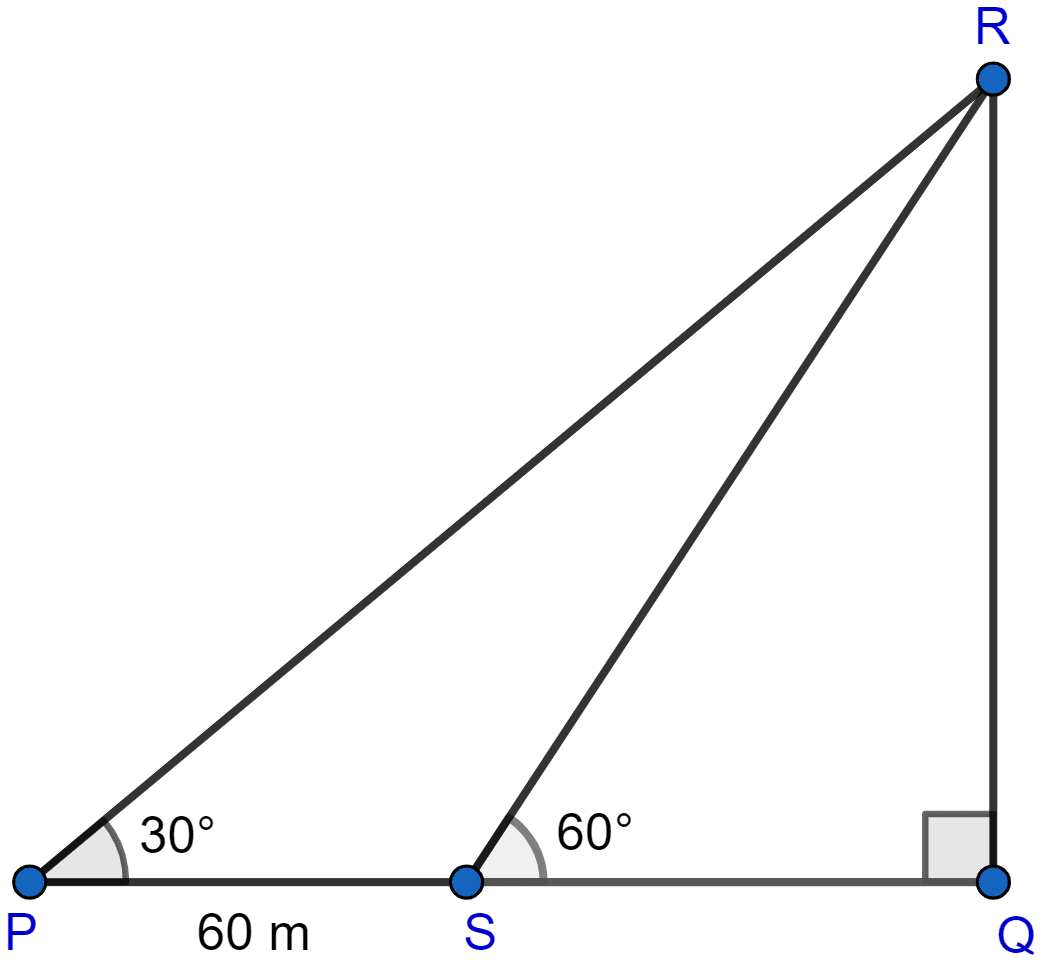
PS = 60 m
From figure,
PQ = PS + SQ = (SQ + 60) m. (Eq 1)
Considering right angled △SQR, we get
Considering right angled △PQR, we get
Putting value of QR from Eq 2, in Eq 3 we get,
From Eq 2,
Correcting upto nearest meter QR = 52.
Hence, the height of building is 52 meters.
At a point on level ground, the angle of elevation of a vertical tower is found to be such that its tangent is . On walking 192 m towards the tower, the tangent of the angle is found to be . Find the height of the tower.
Answer
Let the height of tower QR be h meters and the angle of elevation be θ1 and θ2 at points P and S respectively.
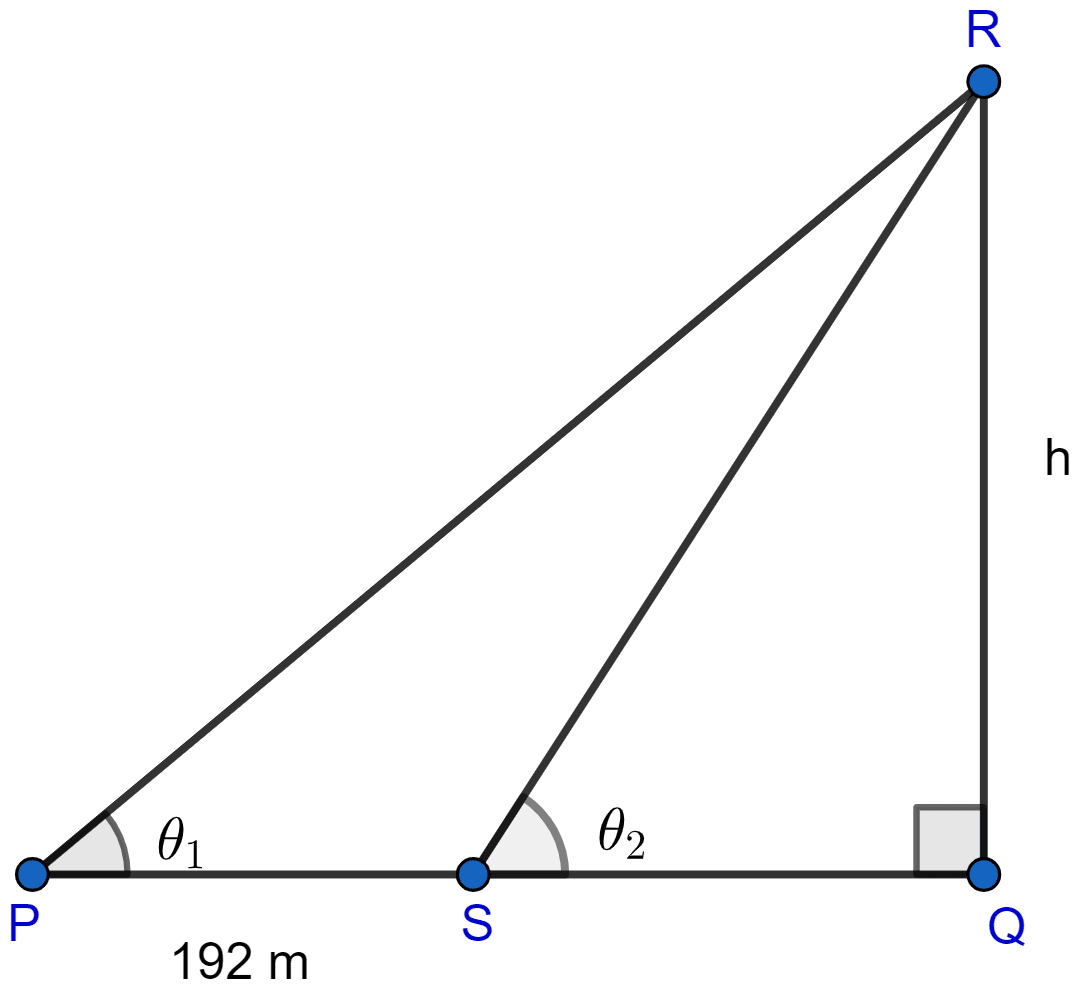
So,
From figure,
QR = h meters
PQ = PS + QS = (192 + QS) meters.
Considering right angled △PQR, we get
Considering right angled △SQR, we get
Putting value of QS from Eq 2 in Eq 1 we get,
Hence, the height of the tower is 180 meters.
In the figure, not drawn to scale, TF is a tower. The elevation of T from A is x° where tan x = and AF = 200 m. The elevation of T from B, where AB = 80 m, is y°. Calculate :
(i) the height of the tower TF.
(ii) the angle y, correct to the nearest degree.
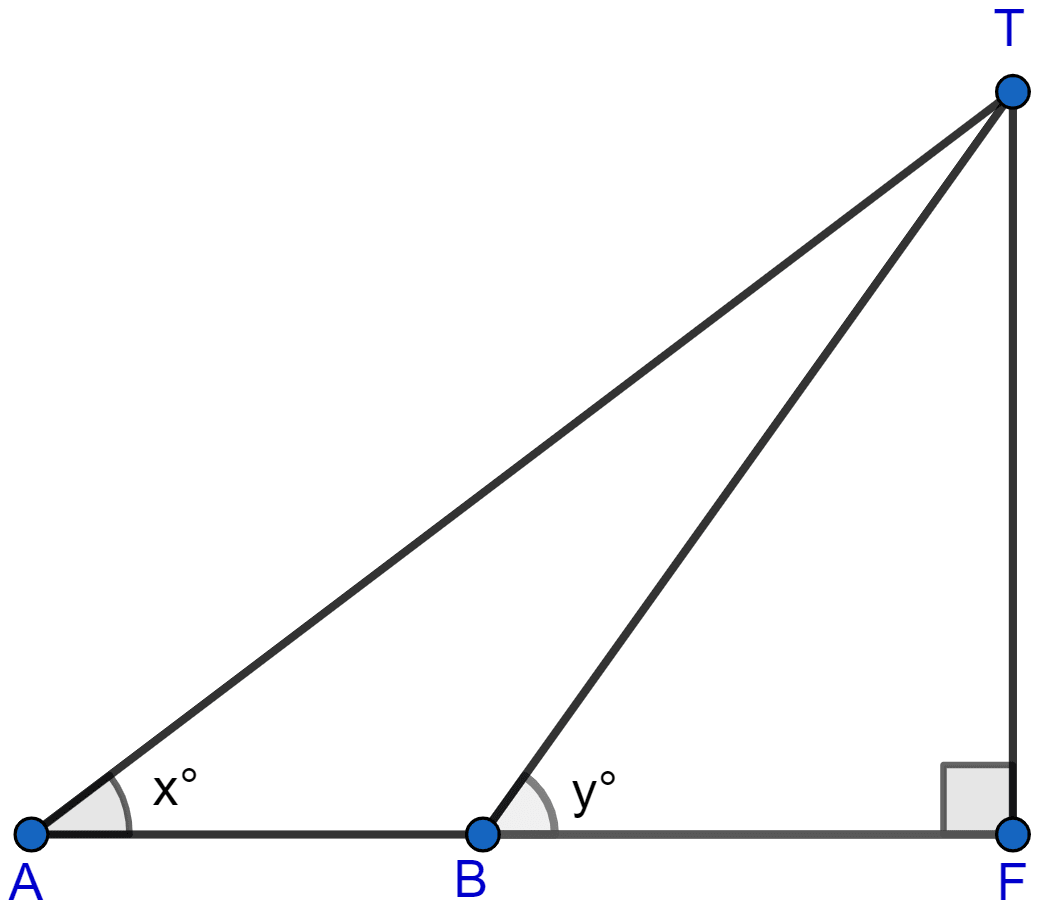
Answer
(i) From figure,
Considering right angled △AFT, we get
Hence, the height of the tower is 80 meters.
(ii) From figure,
BF = AF - AB = 200 - 80 = 120 meters.
Considering right angled △BFT, we get
Rounding off to nearest degree, y = 34°.
Hence, angle y = 34°.
In the adjoining figure, not drawn to the scale, AB is a tower and two objects C and D are located on the ground, on the same side of AB. When observed from the top A of the tower, their angles of depression are 45° and 60°. Find the distance between the two objects, if the height of the tower is 300 m. Give your answer to the nearest meter.

Answer
From figure,

∠ACB = ∠EAC = 45° (Alternate angles are equal)
∠ADB = ∠EAD = 60° (Alternate angles are equal)
Considering right angled △ABC, we get
Considering right angled △ADB, we get
Distance between two objects (CD) = CB - DB = 300 - 173.2 = 126.8.
Rounding off to nearest meter CD = 127 m.
Hence, the distance between two objects = 127 meters.
The horizontal distance between two towers is 140 m. The angle of elevation of the top of the first tower, when seen from the top of the second tower is 30°. If the height of the second tower is 60 m, find the height of the first tower.
Answer
Let AB be the first tower and CD be the second tower. From C draw a line parallel to AD and perpendicular to AB meeting AB at point E.

Now ADCE forms a rectangle,
EC = AD = 140
AE = DC = 60.
Considering right angled △BCE, we get
From figure,
AB = AE + BE = 60 + 80.83 = 140.83
Hence, the height of the first tower is 140.83 meters.
As observed from the top of a 80 m tall light house, the angles of depression of two ships on the same side of the light house in horizontal line with its base are 30° and 40° respectively. Find the distance between the two ships. Give your answer correct to nearest meter.
Answer
Let AB be the tower of length 80 m and the ships be at point C and D.
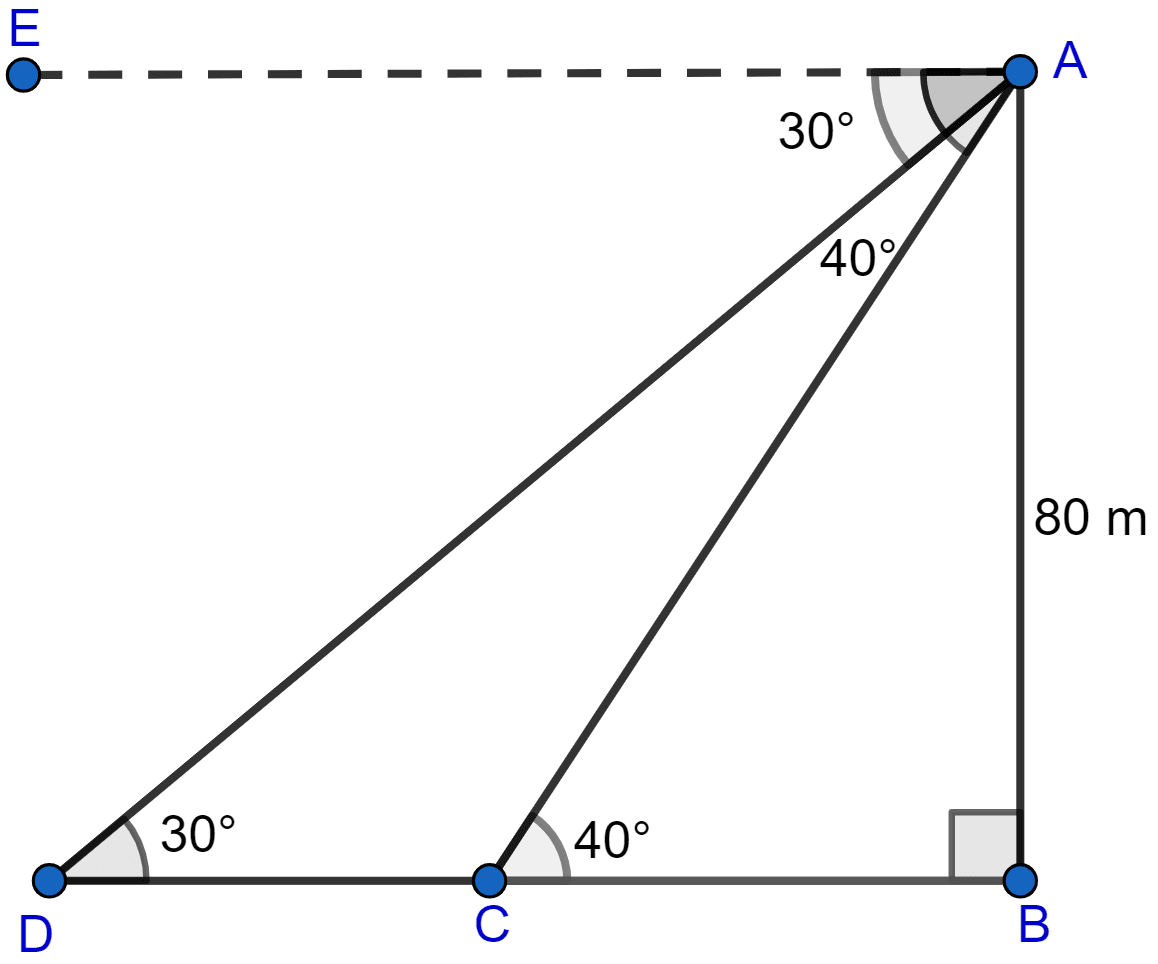
From figure,
∠ADB = ∠EAD = 30° (Alternate angles are equal)
∠ACB = ∠EAC = 40° (Alternate angles are equal)
Considering right angled △ADB, we get
Considering right angled △ACB, we get
Distance between two ships (DC) = DB - BC = 138.56 - 95.34 = 43.22 meters.
Rounding off to nearest meter DC = 43 meters.
Hence, the distance between two ships is 43 meters.
The angle of elevation of a pillar from a point A on the ground is 45° and from a point B diametrically opposite to A and on the other side of the pillar is 60°. Find the height of the pillar, given that the distance between A and B is 15 m.
Answer
Let the height of pillar (CD) be h meters.

Considering right angled △ACD, we get
From figure,
BC = AB - AC = (15 - h) meters
Considering right angled △BCD, we get
Hence, the height of the pillar is 9.51 meters.
From two points A and B on the same side of a building, the angles of elevation of the top of the building are 30° and 60° respectively. If the height of the building is 10 m, find the distance between A and B correct to two decimal places.
Answer
From figure,
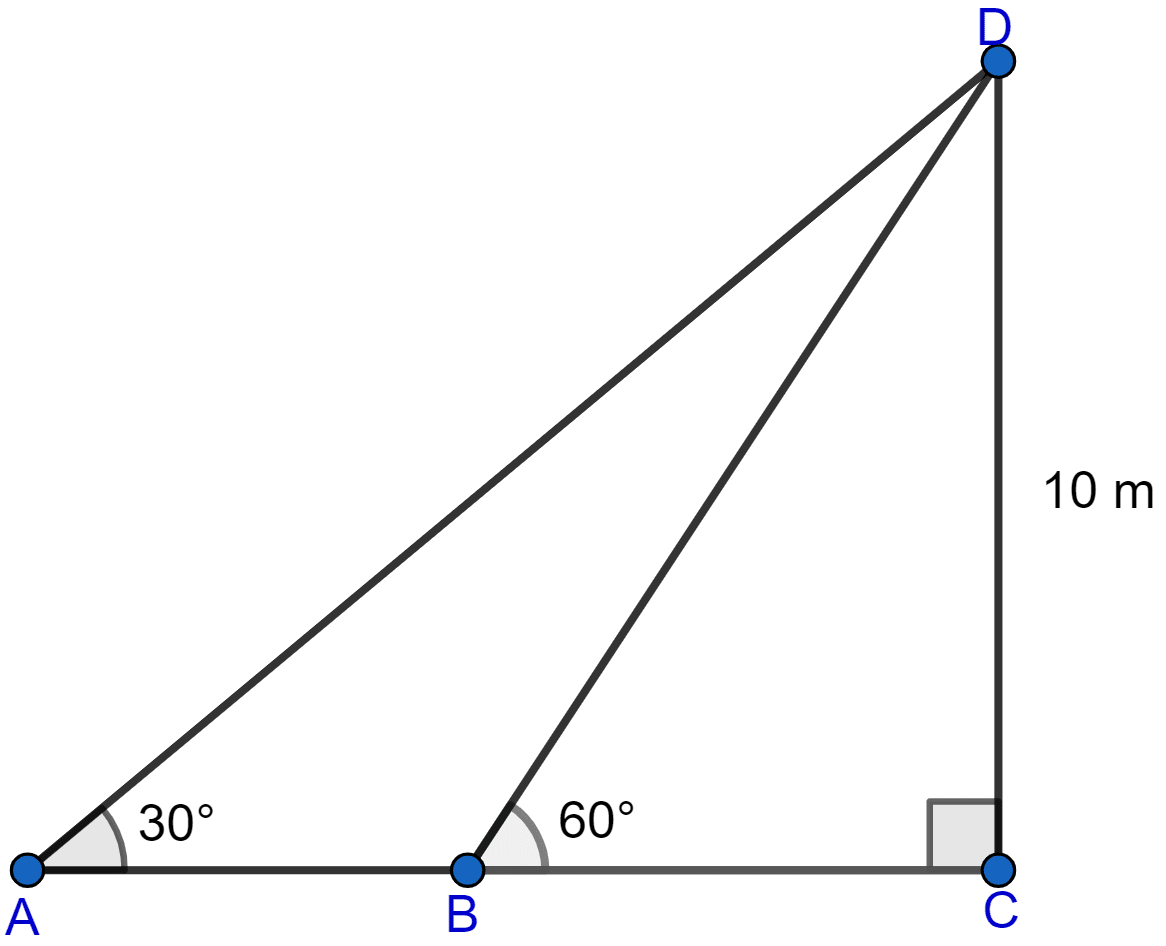
Considering right angled △ACD, we get
Considering right angled △BCD, we get
AB = AC - BC = 17.32 - 5.77 = 11.55 meters.
Hence, the distance between A and B = 11.55 meters.
The angles of depression of two ships A and B as observed from the top of a light house 60 m high are 60° and 45° respectively. If the two ships are on the opposite sides of the light house, find the distance between the two ships. Give your answer correct to the nearest whole number.
Answer
Let CD be the light house, 60 m tall and ships at point A and B.
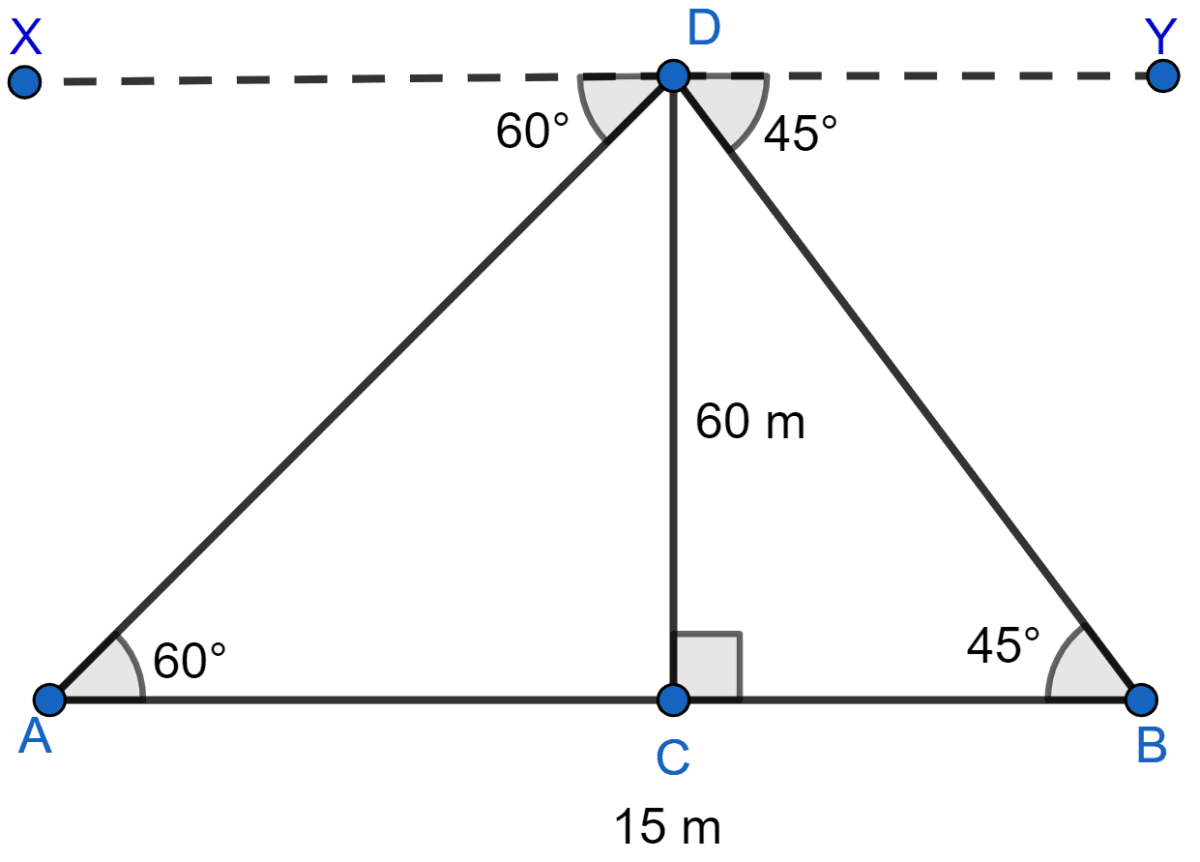
From figure,
∠DAC = ∠XDA = 60° (Alternate angles are equal)
∠DBC = ∠YDB = 45° (Alternate angles are equal)
Considering right angled △ACD, we get
Considering right angled △BCD, we get
Distance between two ships (AB) = AC + BC = 34.64 + 60 = 94.64 meters.
Rounding off to nearest meter, AB = 95 meters.
Hence, the distance between two ships is 95 meters.
An aeroplane at an altitude of 250 m observes the angle of depression of two boats on the opposite banks of a river to be 45° and 60° respectively. Find the width of the river. Write the answer correct to the nearest whole number.
Answer
Let aeroplane be at point D and boats be at point A and B. Since, aeroplane is at an altitude of 250 m therefore,
∴ CD = 250 m.
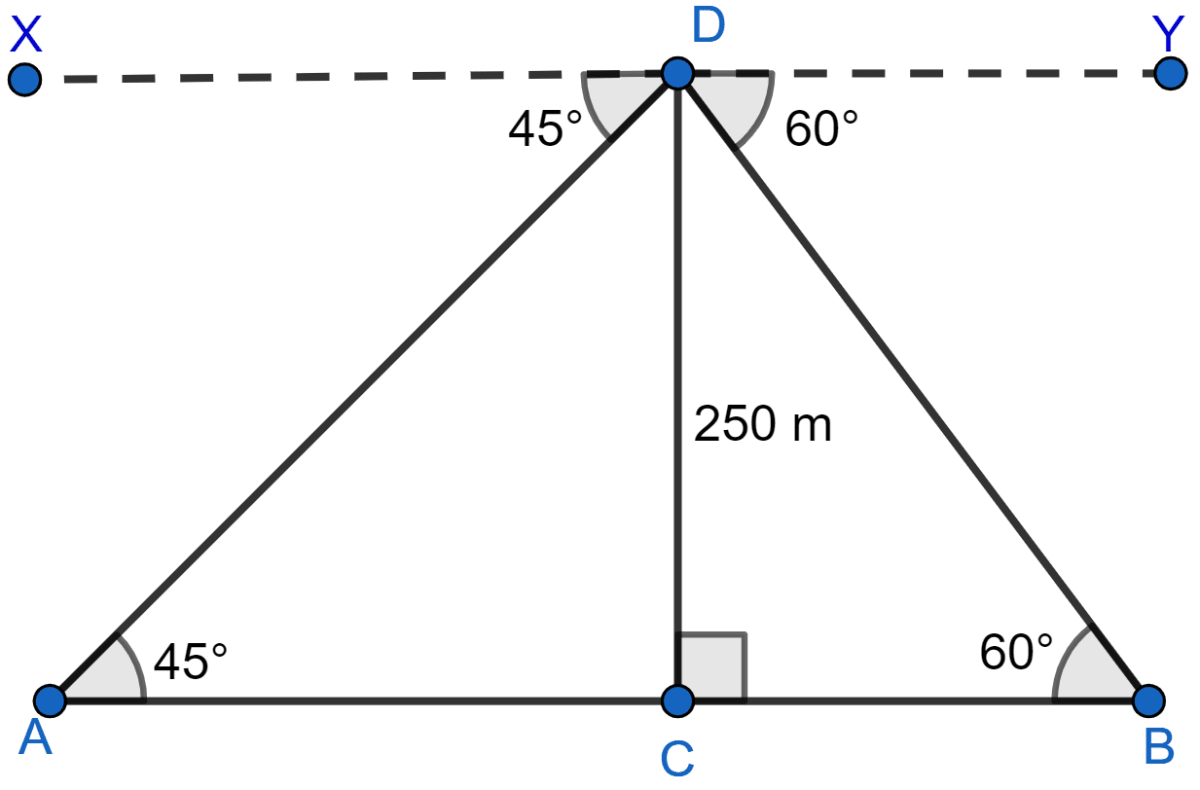
From figure,
∠DAC = ∠XDA = 45° (Alternate angles are equal)
∠DBC = ∠YDB = 60° (Alternate angles are equal)
Considering right angled △BCD, we get
Considering right angled △ACD, we get
Width of the river (AB) = AC + BC = 144.34 + 250 = 394.34 meters.
Rounding off to nearest meter AB = 394 meters.
Hence, the width of the river is 394 meters.
From a tower 126 m high, the angles of depression of two rocks which are in a horizontal line through the base of the tower are 16° and 12° 20'. Find the distance between the rocks if they are on
(i) the same side of the tower
(ii) the opposite sides of the tower.
Answer
(i) Let the rocks be at point A and D.
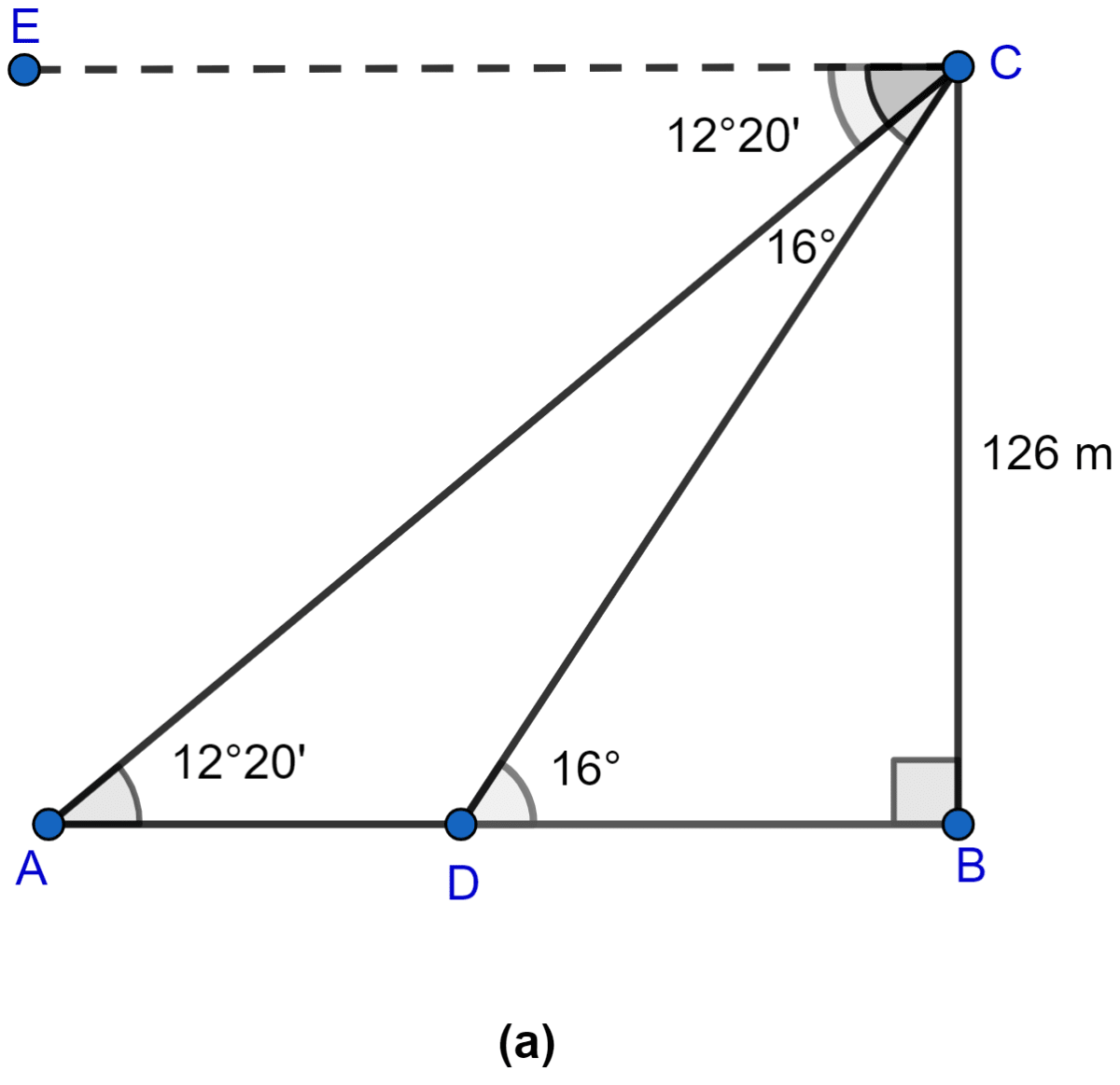
From figure a,
∠CAB = ∠ECA = 12° 20' (Alternate angles are equal)
∠CDB = ∠ECD = 16° (Alternate angles are equal)
Considering right angled △ABC, we get
Considering right angled △BCD, we get
Distance between two rocks (AD) = AB - BD = 576.29 - 439.48 = 136.81
Hence, the distance between two rocks when they are on same side of the tower is 136.81 meters.
(ii) Let the rocks be at point A and B.
From figure b,
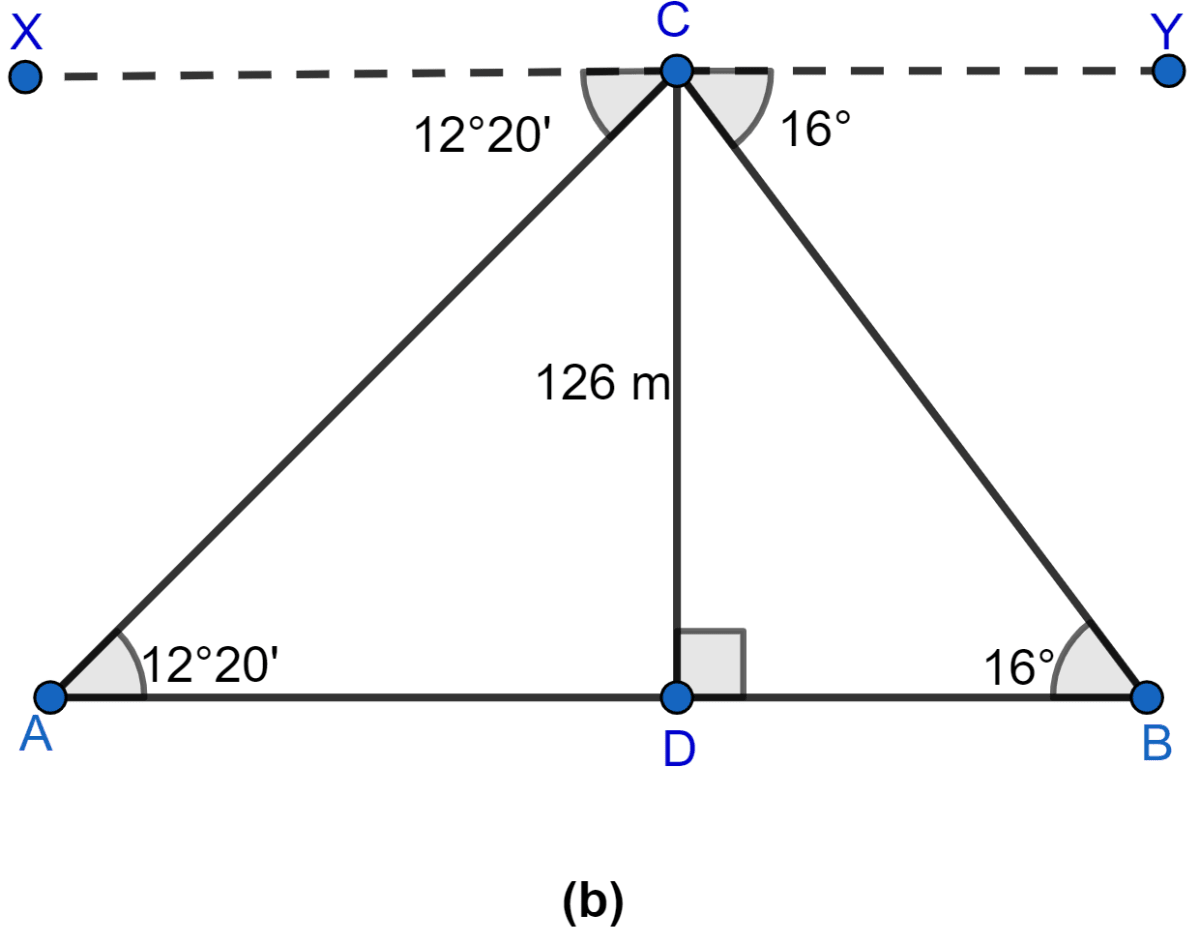
∠CAD = ∠XCA = 12° 20' (Alternate angles are equal)
∠CBD = ∠YCB = 16° (Alternate angles are equal)
Considering right angled △ADC, we get
Considering right angled △BCD, we get
Distance between two rocks (AB) = AD + DB = 576.29 + 439.48 = 1015.7
Hence, the distance between two rocks when they are on opposite sides of the tower is 1015.7 meters.
A man 1.8 m high stands at a distance of 3.6 m from a lamp post and casts a shadow of 5.4 m on the ground. Find the height of the lamp post.
Answer
Let AB be the lamp post and CD the height of man.
BD is the distance of man from the foot of the lamp and FD is the shadow of man.
CE || DB.
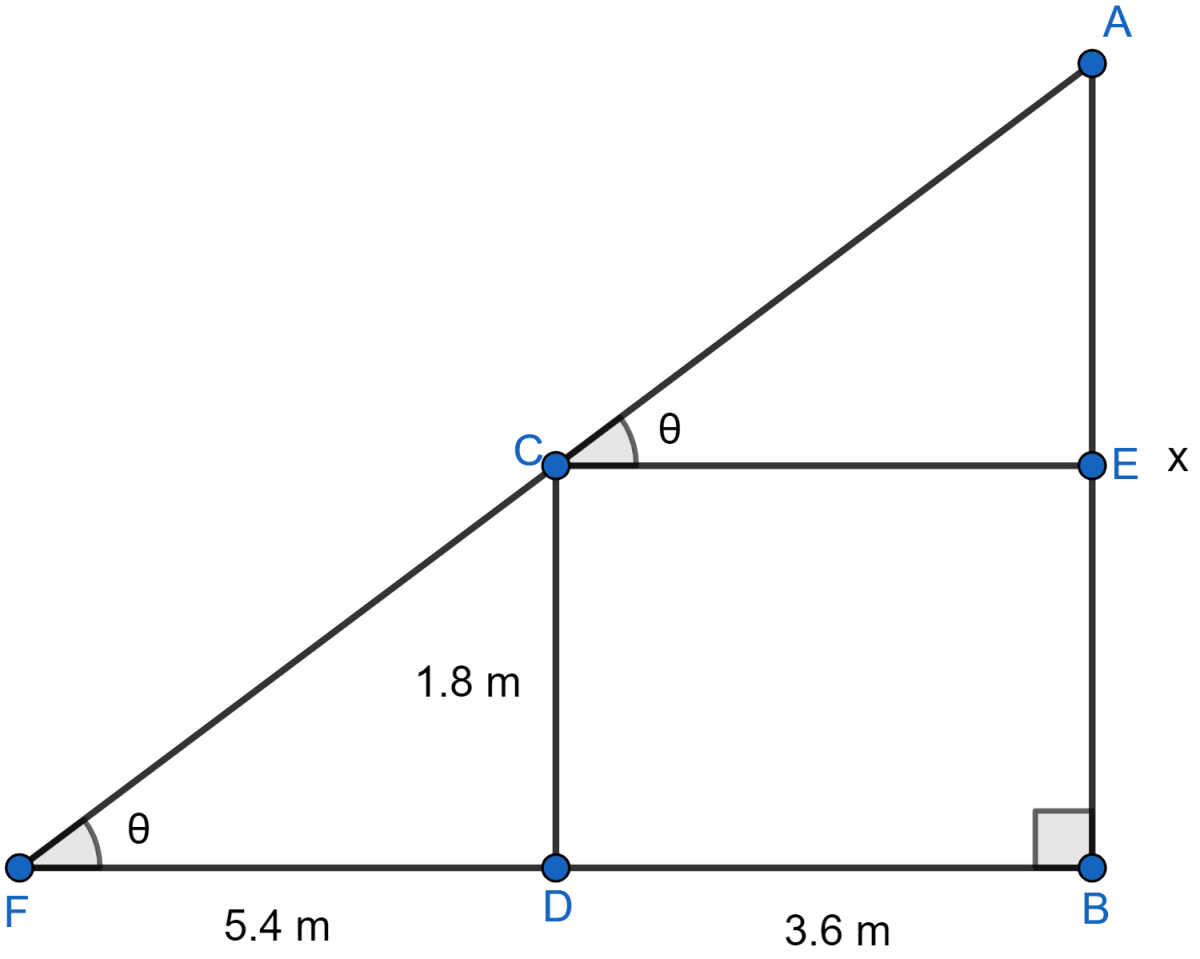
Take AB = x and CD = 1.8 m
EB = CD = 1.8 m
CE = DB = 3.6 m
AE = (x - 1.8) m
Shadow (FD) = 5.4 m
Considering right angled △ACE, we get
Considering right angled △CFD, we get
Comparing Eq 1 and Eq 2 we get,
Hence, the height of the lamp post is 3 meters.
From top of a cliff, angle of depression of the top and bottom of a tower observed to be 45° and 60° respectively. If the height of the tower is 20 m. Find:
(i) the height of the cliff.
(ii) the distance between the cliff and the tower.
Answer
(i) Let AB be the cliff and CD be the tower.
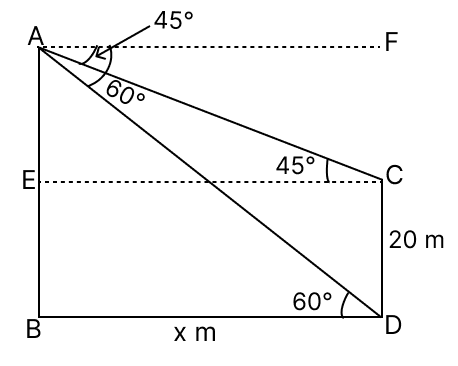
From figure,
∠ACE = ∠FAC = 45° (Alternate angles are equal)
∠ADB = ∠FAD = 60° (Alternate angles are equal)
Let BD = x meters.
From figure,
EC = BD = x meters.
EB = CD = 20 meters.
In △ AEC,
⇒ tan 45° =
⇒ 1 =
⇒ AE = x meters.
In △ ABD,
⇒ tan 60° =
From figure,
Height of cliff (AB) = AE + EB
= x + 20
= 27.32 + 20
= 47.32 meters.
Hence, the height of cliff = 47.32 meters.
(ii) From figure,
Distance between cliff and tower (BD) = x meters = 27.32 meters.
Hence, distance between cliff and tower = 27.32 meters.
A pole of height 5 m is fixed on the top of a tower. The angle of elevation of the top of pole as observed from a point A on the ground is 60° and the angle of depression of the point A from the top of the tower is 45°. Find the height of the tower. (Take )
Answer
Let the height of tower (BC) be h meters and BD be the pole of height 5 meters above it.
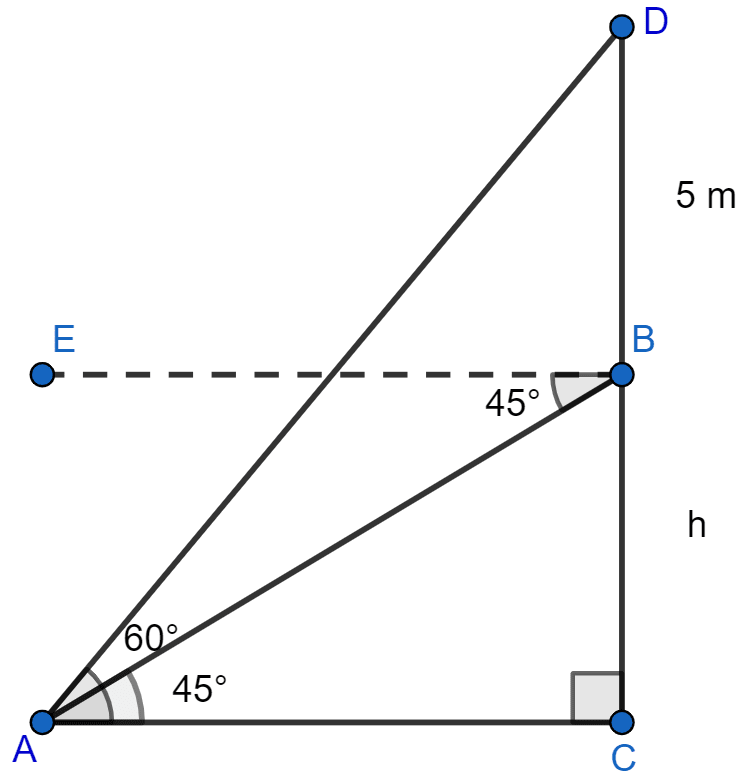
From figure,
∠BAC = ∠EBA = 45° (Alternate angles are equal)
DC = DB + BC = 5 + h.
Considering right angled △BCA, we get
Considering right angled △DCA, we get
Putting value of AC from Eq 1 in above equation we get,
Hence, the height of the tower is 6.83 meters.
A vertical pole and a vertical tower are on the same level ground. From the top of the pole, the angle of elevation of the top of the tower is 60° and the angle of depression of the foot of tower is 30°. Find the height of the tower if the height of the pole is 20 m.
Answer
Let AB be the pole and CD be the tower. Let length of tower (CD) be h metres.
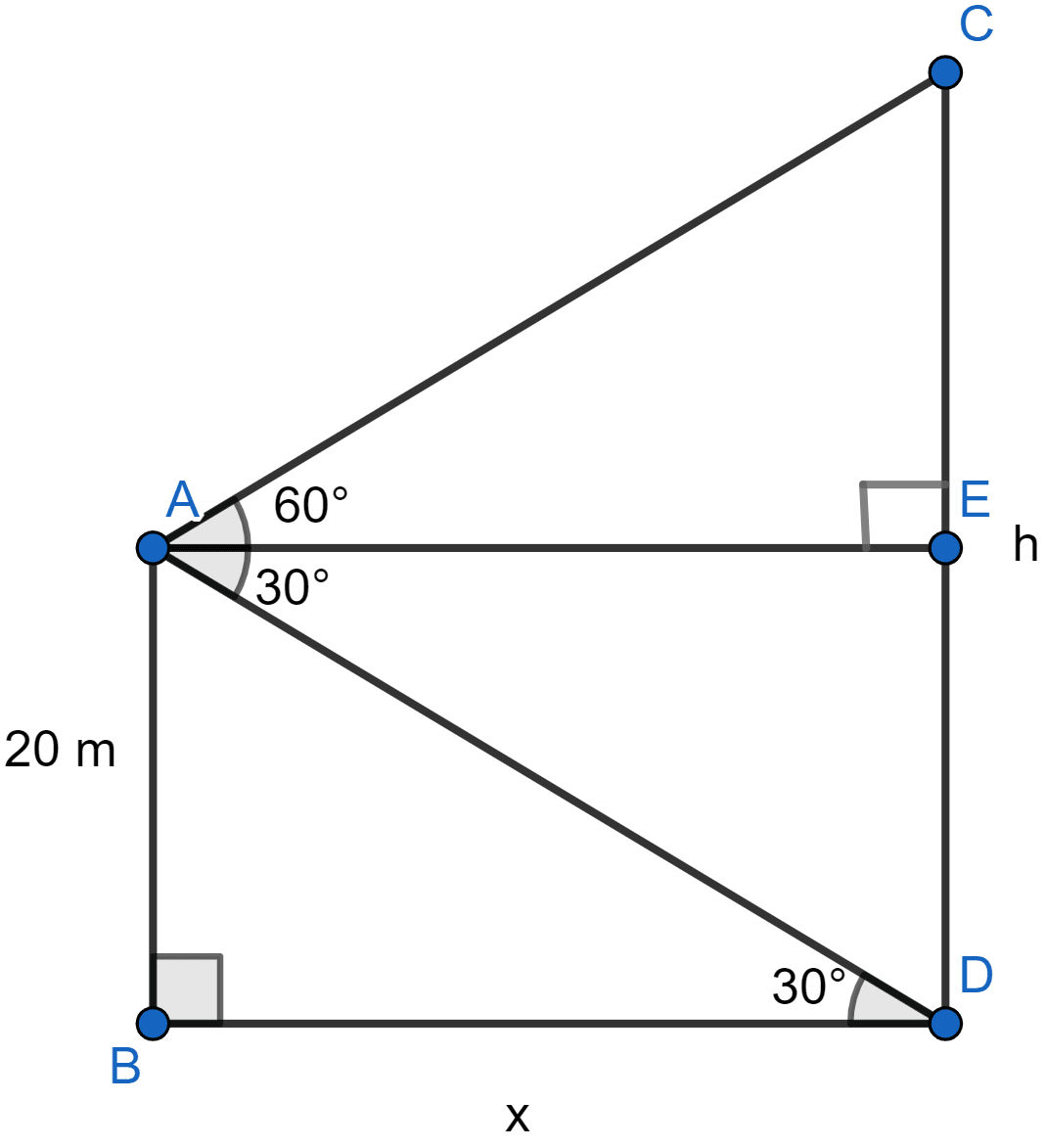
Let distance between pole and tower (BD) be x meters.
From figure,
ABDE is a rectangle so,
DE = AB = 20 meters
AE = BD = x meters
CE = CD - DE = (h - 20) meters
∠EAD = ∠ADB = 30° (Alternate angles are equal)
Considering right angled △ABD we get,
Considering right angled △ACE we get,
Hence, the height of the tower is 80 meters.
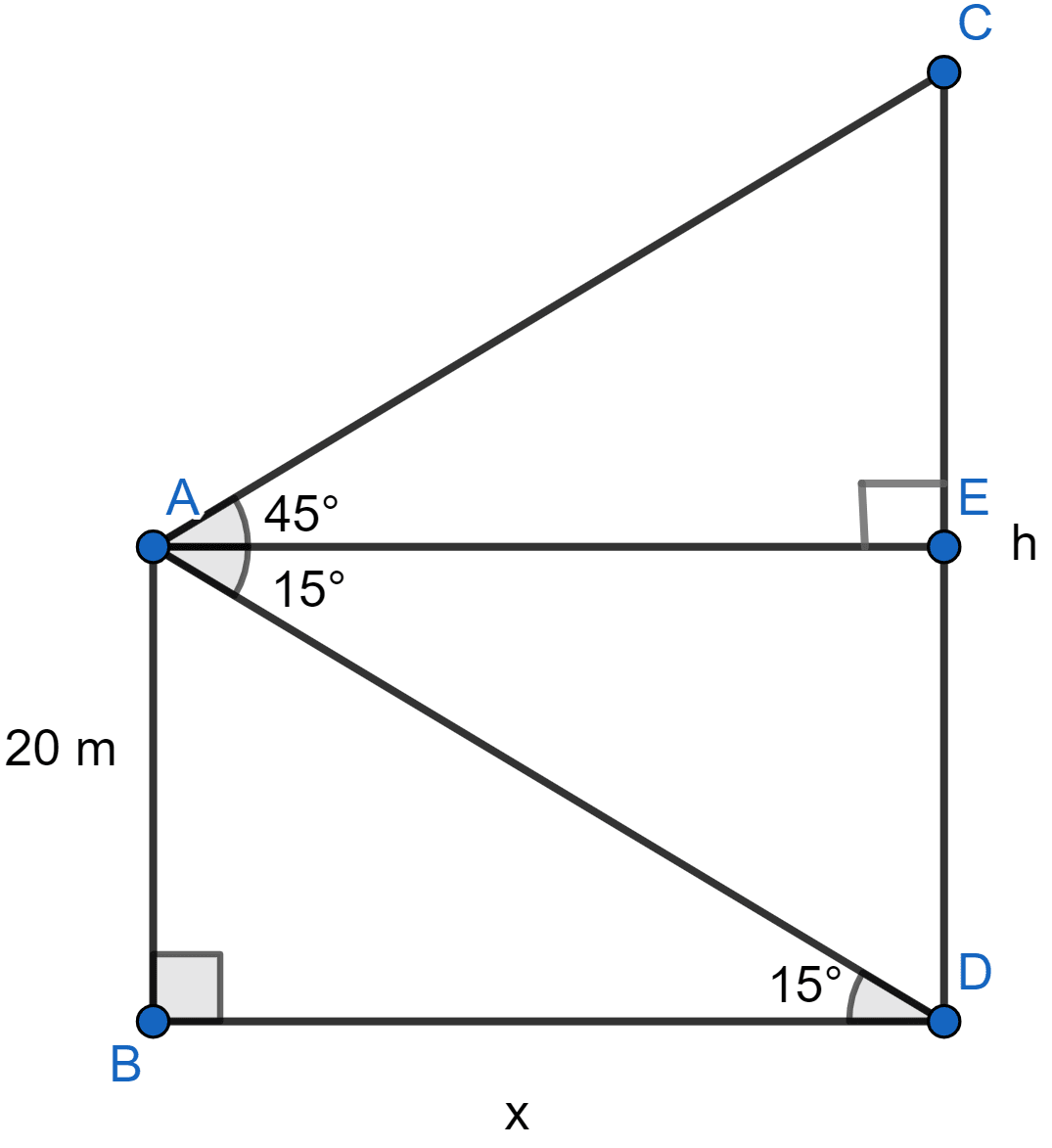
From the top of a building 20 m high, the angle of elevation of the top of a monument is 45° and the angle of depression of its foot is 15°. Find the height of the monument.
Answer
Let AB be the building and CD be the monument. Let length of monument (CD) be h metres.
Let distance between building and monument (BD) be x meters.
From figure,
ABDE is a rectangle so,
DE = AB = 20 meters
AE = BD = x meters
CE = CD - DE = (h - 20) meters
∠EAD = ∠ADB = 15°
Considering right angled △ABD we get,
Considering right angled △ACE we get,
Hence, the height of the monument is 94.65 meters.
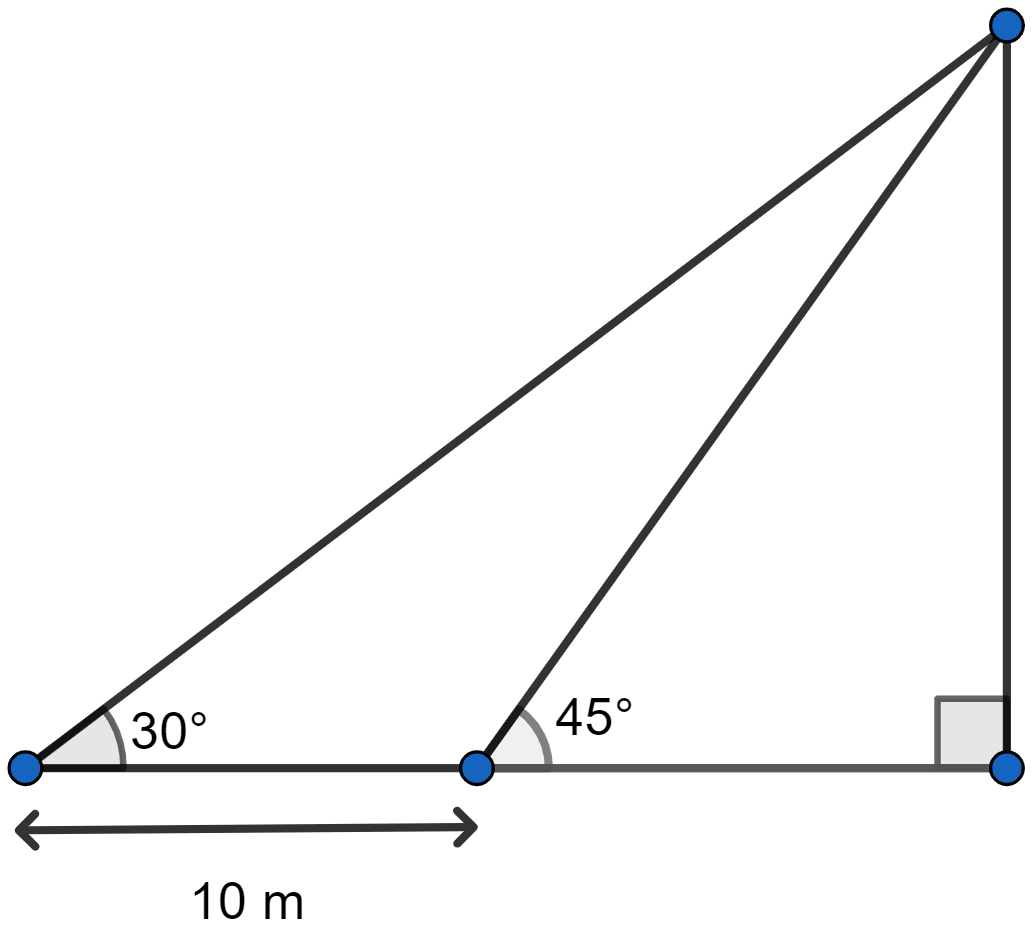
In the adjoining figure, the shadow of a vertical tower on the level ground increases by 10 m, when the altitude of the sun changes from 45° to 30°. Find the height of the tower and give your answer, correct to of a metre.
Answer
Let the initial length of shadow be x meters and height of tower be h meters.
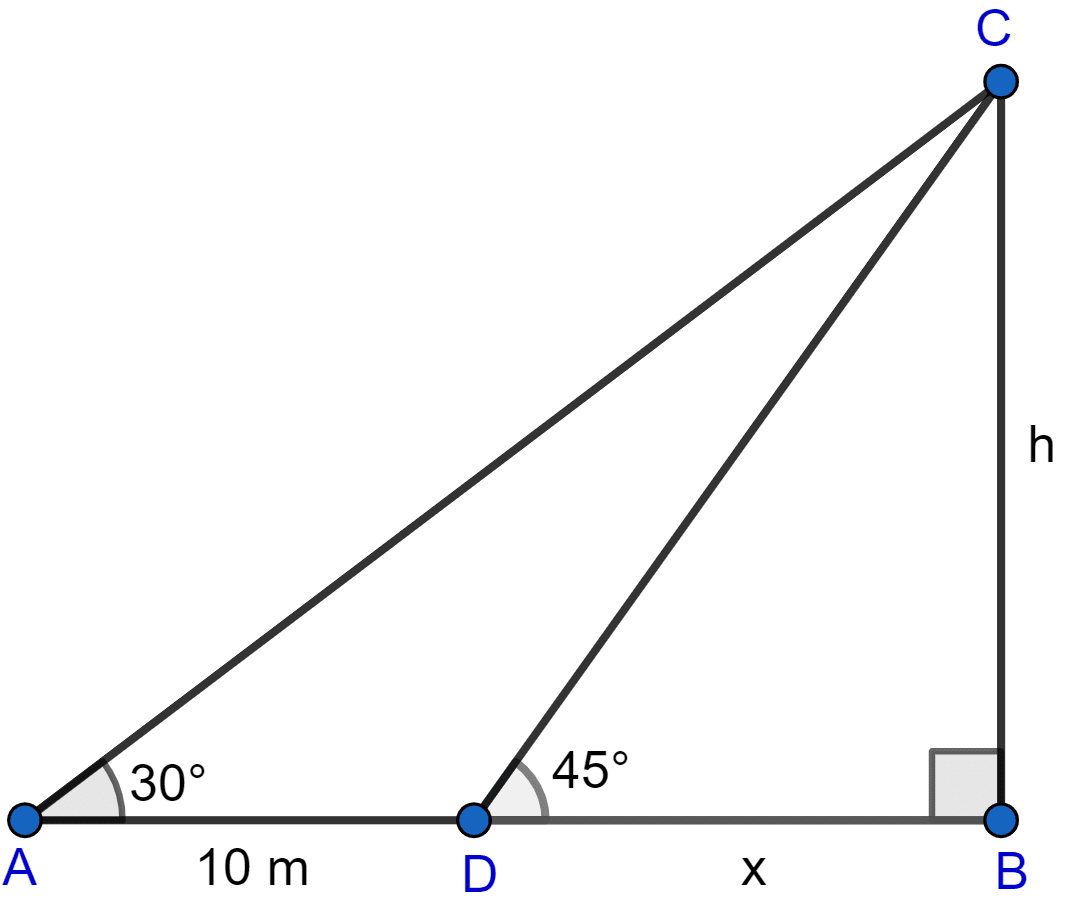
Considering right angled △DBC, we get
Considering right angled △ABC we get,
Hence, the height of tower is 13.7 meters.
An aircraft is flying at a constant height with a speed of 360 km/h. From a point on the ground, the angle of elevation of the aircraft at an instant was observed to be 45°. After 20 seconds, the angle of elevation was observed to be 30°. Determine the height at which the aircraft is flying (use = 1.732).
Answer
Speed of aircraft = 360 km/h
Distance covered in 20 seconds = km
Let aeroplane be flying at a height of h km.
E is the fixed point on ground and A is the initial position of aircraft and C is the position after 20 seconds.
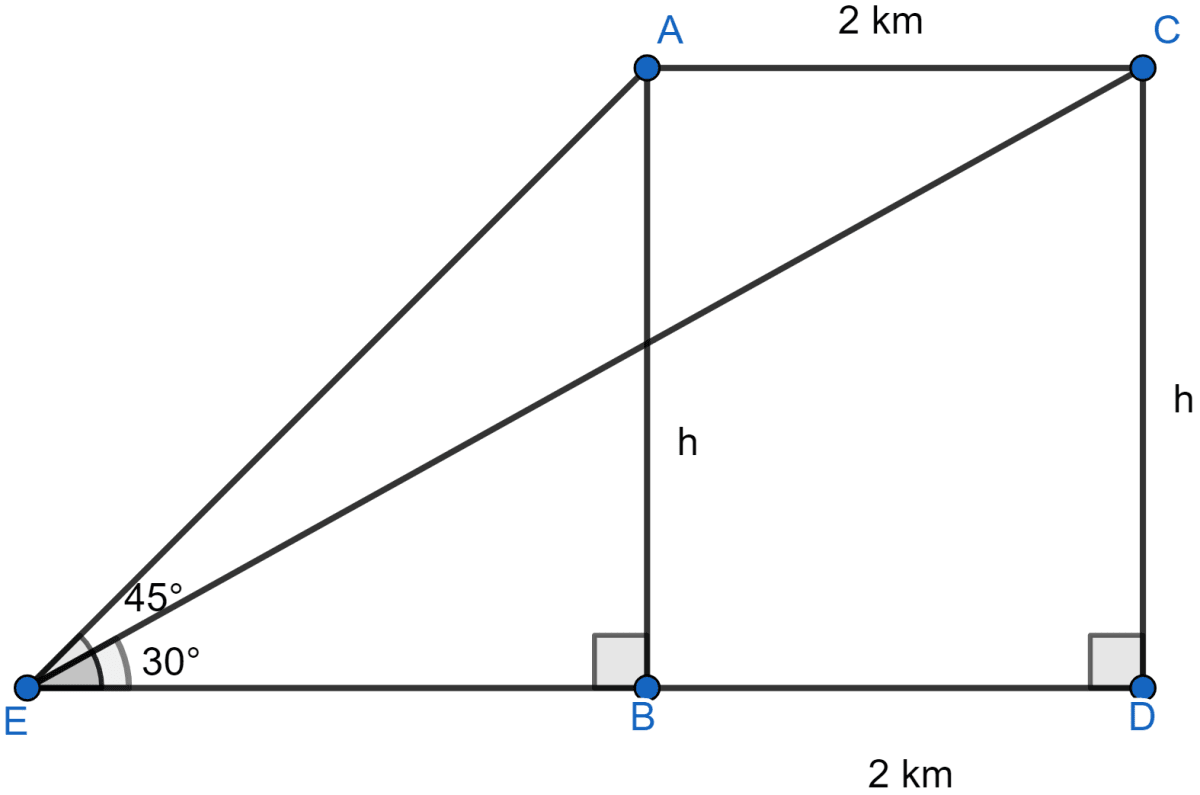
Considering right angled △EDC we get,
From figure,
Considering right angled △AEB we get,
Comparing Eq 1 and Eq 2 we get,
Hence, the aircraft is flying at a height of 2732 meters.
The angles of depression of two ships A and B on opposite sides of a light house of height 100 m are respectively 42° and 54°. The line joining the two ships passes through the foot of the light house.
(a) Find the distance between the two ships A and B.
(b) Give your final answer correct to the nearest whole number.
(Use mathematical tables for this question)

Answer
Let ∠BCP = α and ∠ACP = β

From figure,
⇒ α + 54° = 90°
⇒ α = 90° - 54° = 36°.
⇒ β + 42° = 90°
⇒ β = 90° - 42° = 48°.
⇒ tan α =
⇒ tan 36° =
⇒ 0.7265 =
⇒ BP = 0.7265 × 100 = 72.65 m
⇒ tan β =
⇒ tan 48° =
⇒ 1.1106 =
⇒ AP = 1.1106 × 100 = 111.06 m
(a) From figure,
AB = AP + BP = 72.65 + 111.06 = 183.71 m
Hence, the distance between two ships = 183.71 m.
(b) On rounding off,
AB = 184 m.
Hence, the distance between two ships = 184 m.
The angles of elevation of the top of a 100 m high tree from two points A and B on the opposite side of the tree are 52° and 45° respectively. Find the distance AB, to the nearest metre.

Answer
From figure,
⇒ tan 52° =
⇒ 1.28 =
⇒ AC = = 78.125 m
⇒ tan 45° =
⇒ 1 =
⇒ BC = 100 m
⇒ AB = AC + BC = 78.125 + 100 = 178.125 m
Hence, AB = 178 m, to the nearest metre.