
The point P(4, -7) on reflection in x-axis is mapped onto P'. Then P' on reflection in the y-axis is mapped onto P''. Find the coordinates of P' and P''. Write down a single transformation that maps P onto P''.
Answer
We know that,
Rule to find reflection of a point in x-axis :
- Retain the abscissa i.e. x-coordinate.
- Change the sign of ordinate i.e. y-coordinate.
∴ Coordinates of point P(4, -7) on reflection in x-axis is P'(4, 7).
We know that,
Rule to find reflection of a point in y-axis :
- Change the sign of abscissa i.e. x-coordinate.
- Retain the ordinate i.e. y-coordinate.
∴ Coordinates of point P'(4, 7) on reflection in y-axis is P''(-4, 7).
The single transformation that maps P(4, -7) onto P''(-4, 7) is reflection in the origin.
The point P(a, b) is first reflected in the origin and then reflected in the y-axis to P'. If P' has coordinates (3, -4), evaluate a, b.
Answer
We know that,
Rules to find the reflection of a point in the origin :
- Change the sign of abscissa i.e. x-coordinate.
- Change the sign of ordinate i.e. y-coordinate.
∴ Coordinates of point P(a, b) on reflection in origin is (-a, -b).
We know that,
Rule to find reflection of a point in y-axis :
- Change the sign of abscissa i.e. x-coordinate.
- Retain the ordinate i.e. y-coordinate.
∴ Coordinates of point (-a, -b) on reflection in y-axis is (a, -b).
According to question after reflection in y-axis the point is P'(3, -4).
∴ (3, -4) = (a, -b) or, a = 3 and b = 4.
Hence, the value of a = 3, b = 4.
A point P(a, b) become (-2, c) after reflection in the x-axis, and P becomes (d, 5) after reflection in the origin. Find the values of a, b, c and d.
Answer
We know that,
Rule to find reflection of a point in x-axis :
- Retain the abscissa i.e. x-coordinate.
- Change the sign of ordinate i.e. y-coordinate.
∴ Coordinates of point P(a, b) on reflection in x-axis is P'(a, -b).
According to question after reflection in x-axis P becomes (-2, c).
∴ (a, -b) = (-2, c) or,
⇒ a = -2
⇒ -b = c or b = -c.
We know that,
Rules to find the reflection of a point in the origin :
- Change the sign of abscissa i.e. x-coordinate.
- Change the sign of ordinate i.e. y-coordinate.
∴ Coordinates of point P(a, b) on reflection in origin is (-a, -b).
According to question after reflection in origin P becomes (d, 5).
∴ (-a, -b) = (d, 5) or,
⇒ -a = d or d = -(-2) = 2.
⇒ -b = 5 or b = -5.
Since, b = -c = -5, so, c = 5.
Hence, the value of a = -2, b = -5, c = 5 and d = 2.
A(4, -1), B(0, 7) and C(-2, 5) are the vertices of a triangle. △ABC is reflected in the y-axis and then reflected in the origin. Find the coordinates of the final images of the vertices.
Answer
The graph for this problem is shown below:
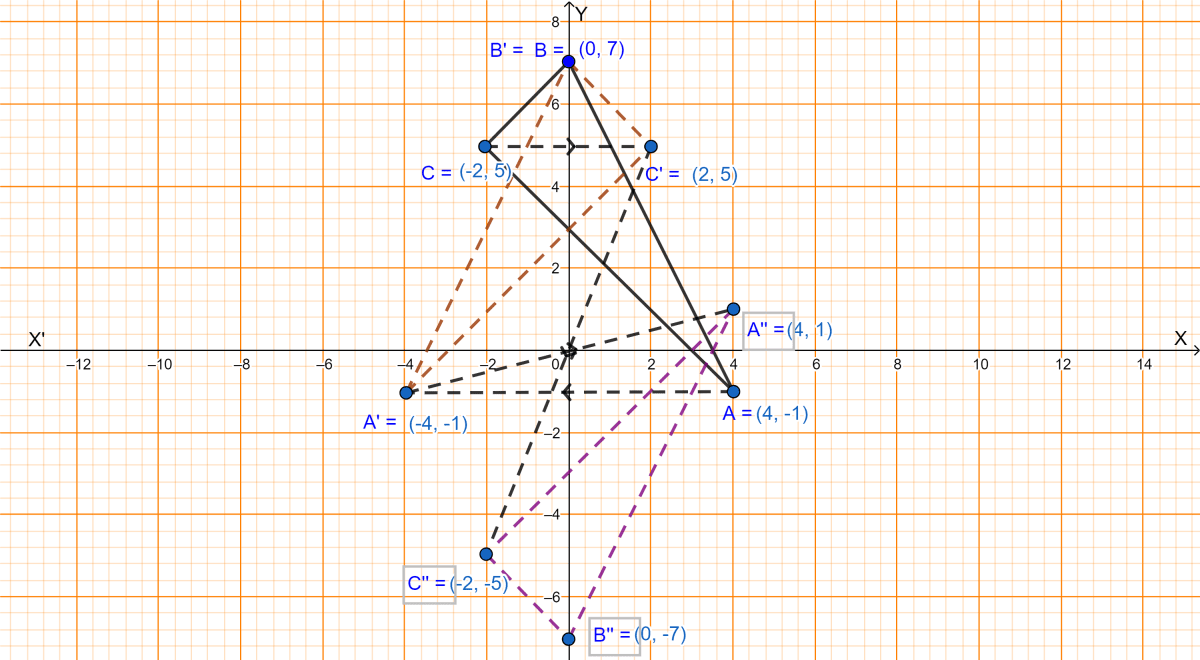
First the triangle is reflected in y-axis.
We know that,
Rule to find reflection of a point in y-axis :
- Change the sign of abscissa i.e. x-coordinate.
- Retain the ordinate i.e. y-coordinate.
∴ Coordinates of
⇒ A(4, -1) on reflection in y-axis becomes A'(-4, -1).
⇒ B(0, 7) on reflection in y-axis becomes B'(0, 7).
⇒ C(-2, 5) on reflection in y-axis becomes C'(2, 5).
Now the triangle is reflected in origin.
We know that,
Rules to find the reflection of a point in the origin :
- Change the sign of abscissa i.e. x-coordinate.
- Change the sign of ordinate i.e. y-coordinate.
∴ Coordinates of
⇒ A'(-4, -1) on reflection in y-axis becomes A''(4, 1).
⇒ B'(0, 7) on reflection in y-axis becomes B''(0, -7).
⇒ C'(2, 5) on reflection in y-axis becomes C''(-2, -5).
Hence, the coordinates of the final images of the vertices are (4, 1), (0, -7) and (-2, -5) respectively.
The points A(4, -11), B(5, 3), C(2, 15) and D(1, 1) are the vertices of a parallelogram. If the parallelogram is reflected in the y-axis and then in the origin, find the coordinates of the final images. Check whether it remains a parallelogram. Write down a single transformation that brings the above change.
Answer
The graph for this problem is shown below:
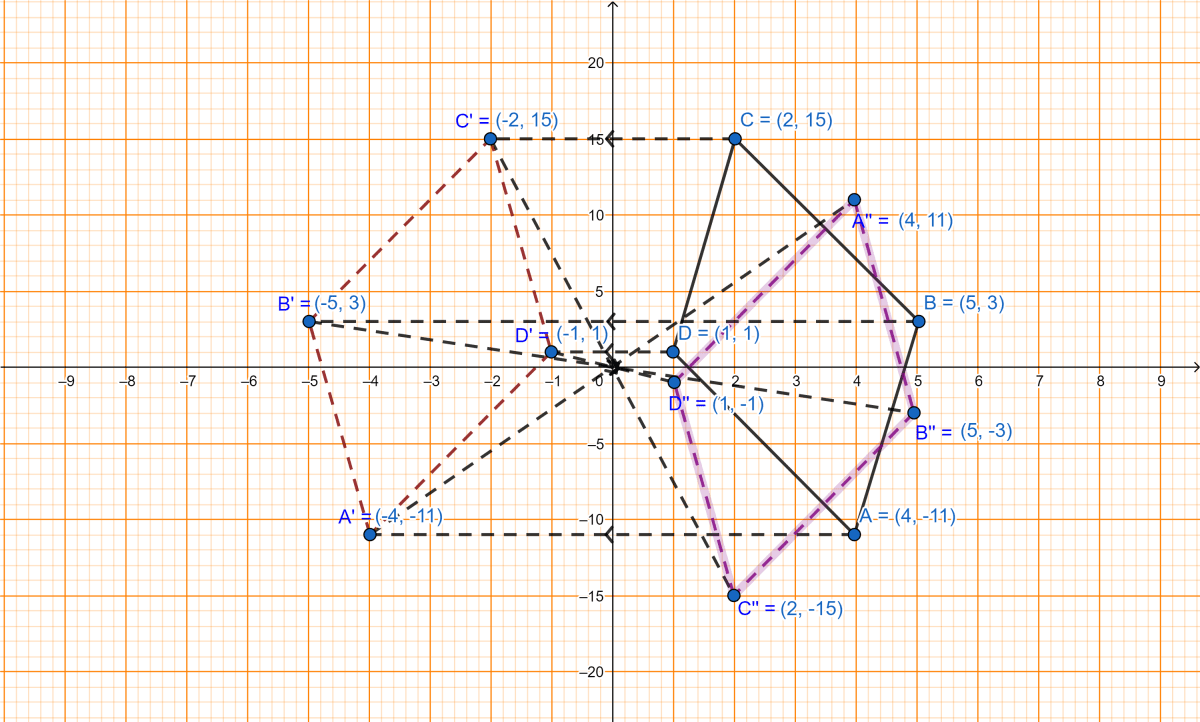
First the parallelogram is reflected in y-axis.
We know that,
Rule to find reflection of a point in y-axis :
- Change the sign of abscissa i.e. x-coordinate.
- Retain the ordinate i.e. y-coordinate.
∴ Coordinates of
⇒ A(4, -11) on reflection in y-axis becomes A'(-4, -11).
⇒ B(5, 3) on reflection in y-axis becomes B'(-5, 3).
⇒ C(2, 15) on reflection in y-axis becomes C'(-2, 15).
⇒ D(1, 1) on reflection in y-axis becomes D'(-1, 1).
We know that,
Rules to find the reflection of a point in the origin :
- Change the sign of abscissa i.e. x-coordinate.
- Change the sign of ordinate i.e. y-coordinate.
∴ Coordinates of
⇒ A'(-4, -11) on reflection in origin becomes A''(4, 11).
⇒ B'(-5, 3) on reflection in origin becomes B''(5, -3).
⇒ C'(-2, 15) on reflection in origin becomes C''(2, -15).
⇒ D'(-1, 1) on reflection in origin becomes D''(1, -1)
From graph we can see that A"B"C"D" is also a parallelogram.
The single transformation that marks the following changes i.e.
A(4, -11) ⇒ A"(4, 11)
B(5, 3) ⇒ B"(5, -3)
C(2, 15) ⇒ C"(2, -15)
D(1, 1) ⇒ D"(1, -1), is reflection in x-axis.
Hence,
- The coordinates of the final images of the vertices are (4, 11), (5, -3), (2, -15) and (1, -1) respectively.
- These new images still form parallelogram.
- The single transformation from ABCD ⇒ A"B"C"D" can be achieved by reflection in x-axis.
Use a graph paper for this question (take 2 cm = 1 unit on both x and y axes).
(i) Plot the following points : A(0, 4), B(2, 3), C(1, 1) and D(2, 0).
(ii) Reflect points B, C, D on y-axis and write down their coordinates. Name the images as B', C', D' respectively.
(iii) Join points A, B, C, D, D', C', B' and A in order, so as to form a closed figure. Write down the equation of line of symmetry of the figure formed.
Answer
(i) The point A(0, 4), B(2, 3), C(1, 1) and D(2, 0) are plotted on the graph below:
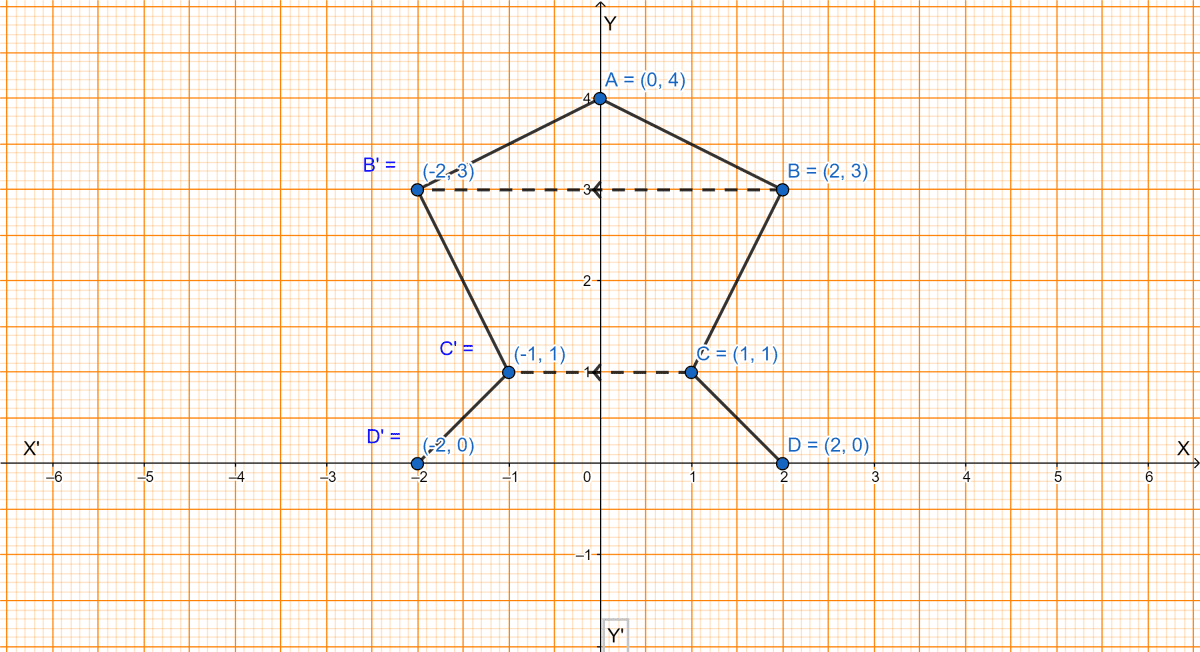
(ii) From graph, on reflecting B, C, D on y-axis we get,
B(2, 3) ⇒ B'(-2, 3)
C(1, 1) ⇒ C'(-1, 1)
D(2, 0) ⇒ D'(-2, 0).
(iii) From graph we see that the figure is divided into two symmetrical parts by y-axis. Hence, the equation of line of symmetry is x = 0.
The triangle OAB is reflected in the origin O to triangle OA'B'. A' and B' have coordinates (-3, -4) and (0, -5) respectively.
(i) Find the coordinates of A and B.
(ii) Draw a diagram to represent the given information.
(iii) What kind of figure is the quadrilateral ABA'B'?
(iv) Find the coordinates of A'', the reflection of A in the origin followed by reflection in the y-axis.
(v) Find the coordinates of B'', the reflection of B in the x-axis followed by the reflection in the origin.
Answer
The graph showing the given information is drawn below:
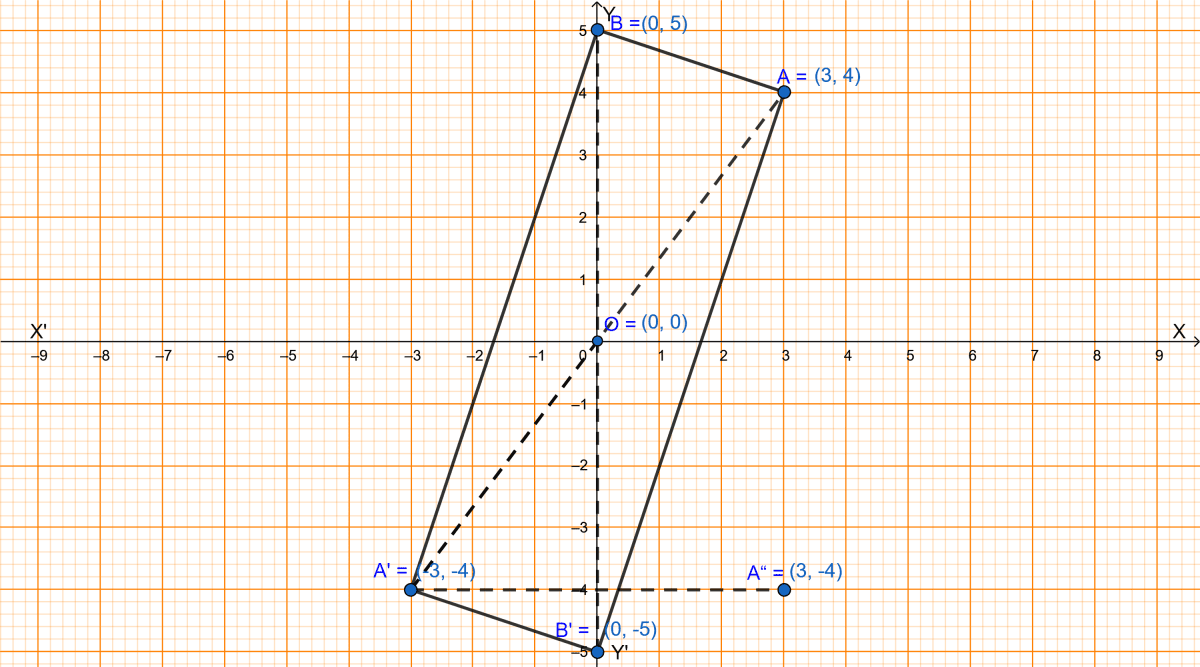
(i) Since, on reflection in the origin A becomes A'(-3, -4) and B becomes B'(0, -5) thus,
A = (3, 4) and B = (0, 5).
(iii) The quadrilateral ABA'B' represents a rectangle.
(iv) From graph we get,
The coordinates of A" is (3, -4).
(v) From graph we get,
The coordinates of B" is (0, 5).
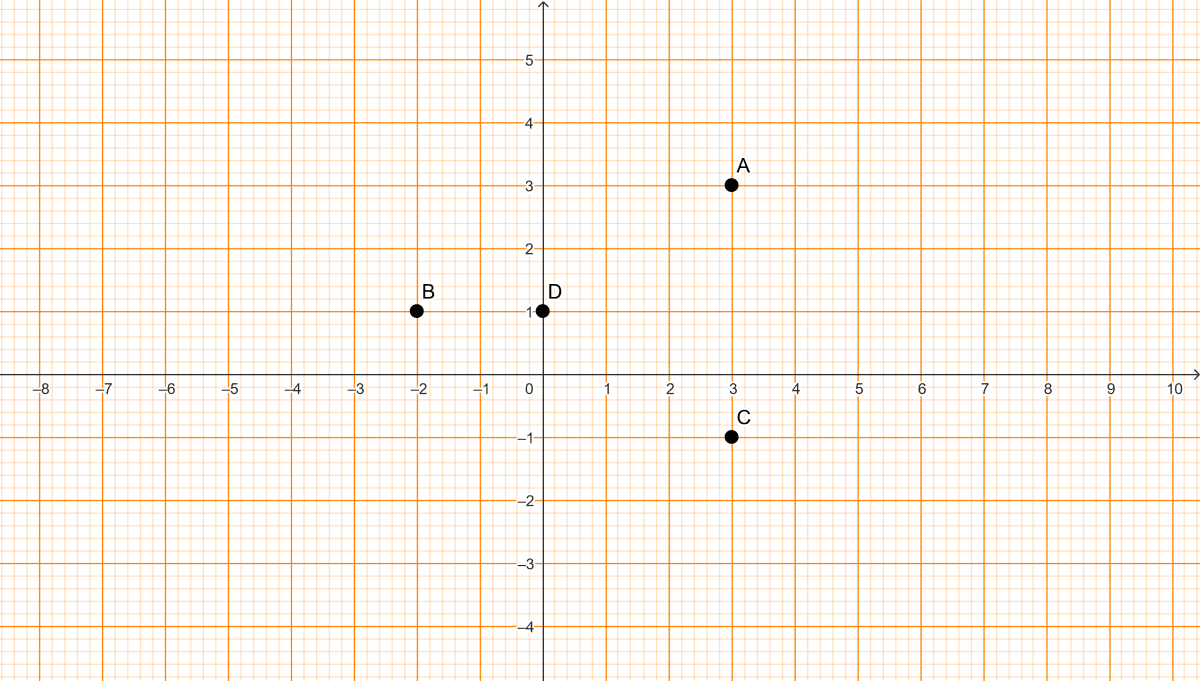
Study the graph and answer each of the following :
(a) Write the coordinates of points A, B, C and D.
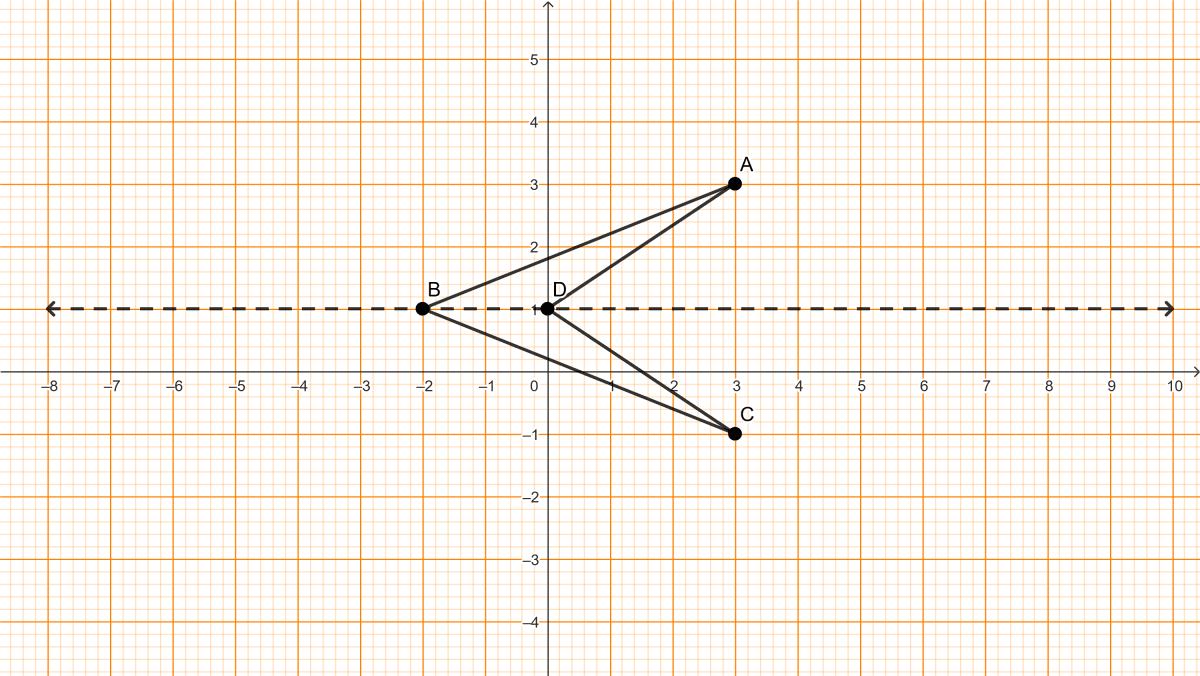
(b) Given that, point C is the image of point A. Name and write the equation of the line of reflection.
(c) Write the coordinates of the image of the point D under reflection in y-axis.
(d) What is the name given to a point whose image is the point itself ?
(e) On joining the points A, B, C, D and A in order, a figure is formed. Name the closed figure.
Answer
(a) From graph,
Coordinates of A = (3, 3), B = (-2, 1), C = (3, -1) and D = (0, 1).
(b) From graph,
C is the image of point A in the line y = 1.
Hence, the line is BD and its equation is y = 1.
(c) Since, point D lies on y-axis, thus it is invariant under reflection in y-axis.
Hence, coordinates of point D on reflection in y-axis is (0, 1).
(d) A point whose image is the point itself is called invariant point.
(e) On joining the points A, B, C, D and A in order the figure formed is a concave quadrilateral or arrowhead.