
The adjoining figure shows a cuboidal block of wood through which a circular cylindrical hole of the biggest size is drilled. Find the volume of the wood left in the block.

Answer
From figure,

Diameter of the biggest hole = 30 cm.
Radius (r) = cm.
Height = 70 cm.
Volume of cuboidal block = l x b x h.
Putting values we get,
Volume of cuboidal block = 70 × 30 × 30 = 63000 cm3.
Volume of cylinder = πr2h.
Putting values we get,
Volume of wood left in the block = Volume of cuboidal block - Volume of cylindrical hole = 63000 - 49500 = 13500 cm3.
Hence, the volume of wood left in the block is 13500 cm3.
The adjoining figure shows a solid trophy made of shining glass. If one cubic centimeter of glass costs ₹ 0.75, find the cost of the glass for making the trophy.

Answer
From figure,

Edge of cubical part = 28 cm.
Diameter of cylindrical part = 28 cm
radius =
= = 14 cm.
Height of cylinder = 28 cm.
Volume of cube = (side)3 = (28)3 = 21952 cm3.
Volume of cylinder = πr2h.
Putting values we get,
Total volume of trophy = Volume of cube + Volume of cylinder
= 21952 + 17248 = 39200 cm3.
Cost of 1 cm3 of glass = ₹0.75
Total cost of glass = 39200 × 0.75 = ₹29400.
Hence, the cost of making the trophy is ₹29400.
From a cube of edge 14 cm, a cone of maximum size is carved out. Find the volume of the remaining material.
Answer
Edge of a cube = 14 cm.
Volume = (side)3 = (14)3 = 2744 cm3.
Cone of maximum size is carved out as shown in figure,
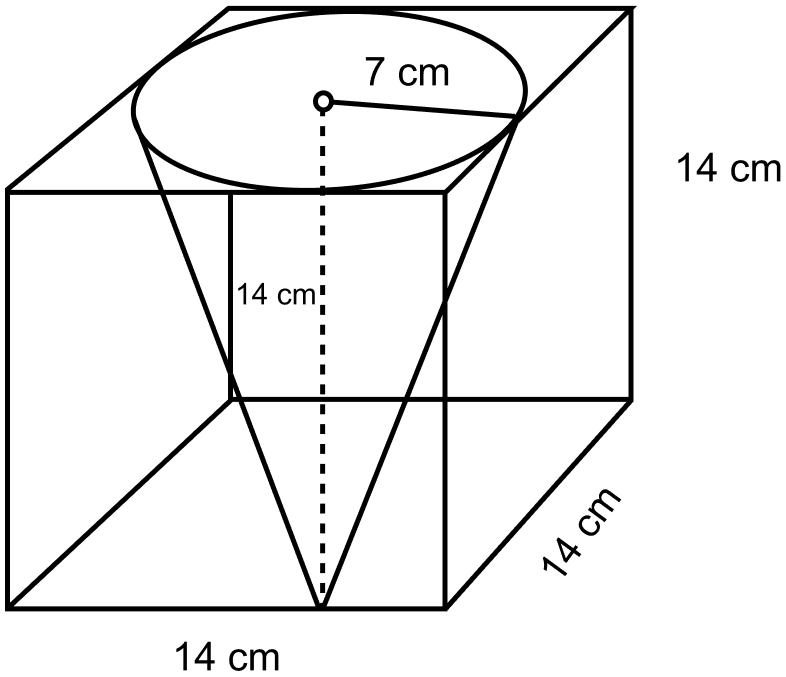
Diameter of the cone cut out from it = 14 cm.
Radius =
= = 7 cm.
Volume of cone =
Height = 14 cm.
Putting values we get,
Volume of the remaining material = Volume of the cube - Volume of the cone.
Volume of remaining material =
Hence, the volume of the remaining material is .
A cone of maximum volume is carved out of a block of wood of size 20 cm × 10 cm × 10 cm. Find the volume of the remaining wood.
Answer
Volume of block of wood = 20 cm × 10 cm × 10 cm = 2000 cm3.
Diameter of the cone for maximum volume = 10 cm.
Cone of maximum volume is carved out as shown in figure,
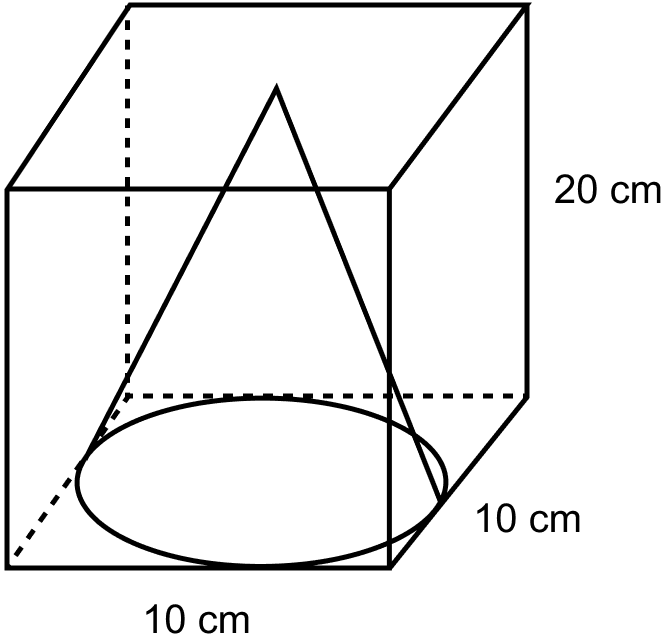
Radius =
= = 5 cm.
Height of the cone for maximum volume = 20 cm.
Volume of the cone =
Putting values we get,
Volume of cone =
Volume of the remaining wood = Volume of block of wood - Volume of the cone.
Volume of remaining wood =
Hence, the volume of the remaining wood is cm3.
16 glass spheres each of radius 2 cm are packed in a cuboidal box of internal dimensions 16 cm × 8 cm × 8 cm and then the box is filled with water. Find the volume of the water filled in the box.
Answer
Volume of the box = 16 cm × 8 cm × 8 cm = 1024 cm3.
Radius of the glass sphere, r = 2 cm.
Volume of the sphere =
Volume of sphere =
Volume of 16 spheres = 16 .
Volume of water filled in box = Volume of the box - Volume of 16 spheres = 1024 - 536.38 = 487.62 cm3.
Hence, the volume of the water filled in the box is approximately 487.6 cm3.
A cubical block of side 7 cm is surmounted by a hemisphere. What is the greatest diameter that the hemisphere can have ? Also, find the surface area of the solid.
Answer
Cuboidal block of side 7 cm is surmounted by a hemisphere as shown in figure below:
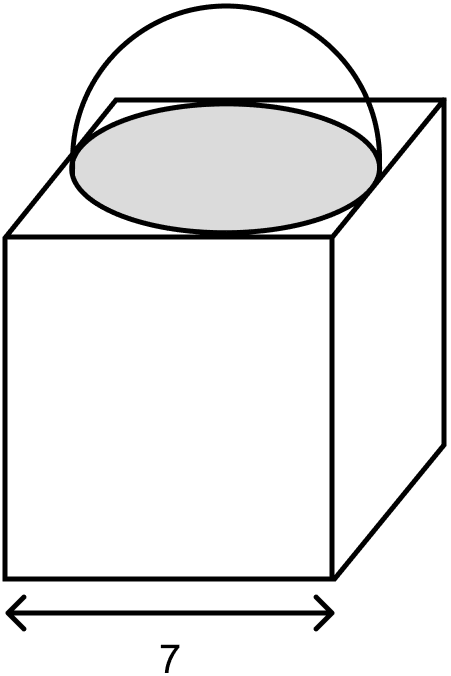
Side of cuboidal block = 7 cm.
Greatest diameter of hemisphere = 7 cm.
Radius =
= = 3.5 cm.
Surface area of the hemisphere = .
Putting values we get,
Surface area of the hemisphere =
Surface area of the cube = 6a2 = 6 x 72 = 6 × 49 = 294 cm2.
Surface area of base of hemisphere = πr2.
Putting values we get,
Surface area of base of hemisphere =
Surface area of solid = Surface area of cube + Surface area of hemisphere - Surface area of base of hemisphere = 294 + 77 - 38.5 = 332.5 cm2.
Hence, the greatest diameter that the hemisphere can have is 7 cm and surface area of the solid is 332.5 cm2.
A wooden article was made by scooping out a hemisphere from each end of a solid cylinder (as shown in the adjoining figure). If the height of the cylinder is 10 cm and its base is of radius 3.5 cm, find the total surface area of the article.

Answer
Height of the cylinder = 10 cm
Radius of the cylinder= 3.5 cm

Total surface area (T) = Curved surface area of cylinder + 2 × curved surface area of hemisphere
T = 2πrh + 2 × 2πr2
T = 2πr(h + 2r)
Putting values we get,
Hence, the total surface area of the article is 374 cm2.
From a solid wooden cylinder of height 28 cm and diameter 6 cm, two conical cavities are hollowed out. The diameters of the cone are also of 6 cm and height 10.5 cm.
Taking π = , find the volume of remaining solid.
Answer
Given,
Diameter of solid wooden cylinder (D) = 6 cm
Radius of solid wooden cylinder (R) = cm = 3 cm
Height of solid wooden cylinder (H) = 28 cm
Diameter of cone (d) = 6 cm
Radius of cone (r) = cm = 3 cm
Height of cone (h) = 10.5 cm
Volume of cylinder (V) = πr2h
Volume of single cone (v) = πR2H
Volume of two conical cavities = 2 x 99 = 198 cm2
Volume of remaining solid = Volume of cylinder - Volume of 2 conical cavities = 792 - 198 = 594 cm2.
Hence, volume of remaining solid = 594 cm2.
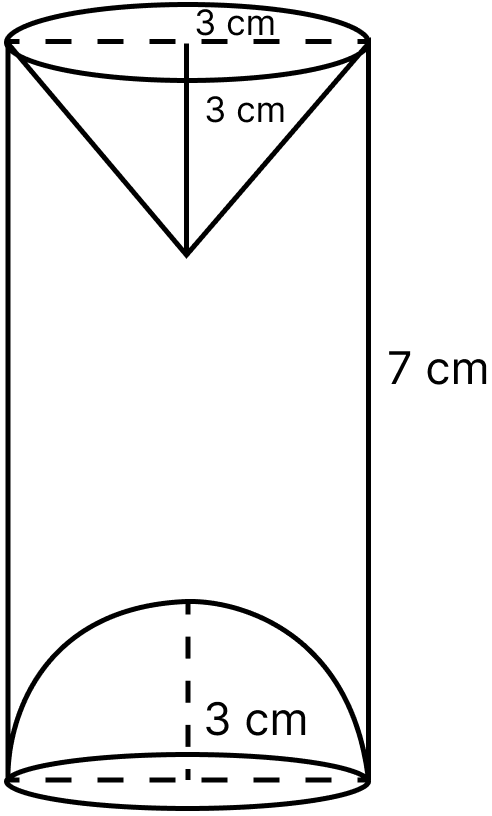
A hemispherical and conical hole are scooped out of a solid wooden cylinder. Find the volume of the remaining solid where the measurements are as follows :
The height of the cylinder is 7 cm, radius of each hemisphere, cone and cylinder is 3 cm. Height of cone is 3 cm. Give your answer correct to nearest whole number. Take π =
Answer
Given,
Height of cone (h1) = 3 cm.
Height of cylinder = 7 cm.
From figure,
Volume of remaining solid = Volume of cylinder - Volume of cone - Volume of hemisphere.
∴ Volume of remaining solid =
Hence, the volume of the remaining solid correct to nearest whole number is 113 cm3.
A toy is in form of a cone of radius 3.5 cm mounted on a hemisphere of same radius. If the total height of the toy is 15.5 cm, find the total surface area and volume of the toy, giving your answer correct to one decimal place.
Answer
The figure of the toy in the form of a cone surmounted on a hemisphere of same radius is shown below:

Total height of the toy = 15.5 cm
Radius of the base of the conical part (r) = 3.5 cm.
Height of the cone = 15.5 - 3.5 = 12 cm.
Slant height of the cone = l.
l =
Total surface area of the toy (T) = Curved surface area of cone + Curved surface area of hemisphere.
Hence, the total surface area of the toy is 214.5 cm2.
A circus tent is in the shape of a cylinder surmounted by a cone. The diameter of the cylindrical portion is 24 m and its height is 11 m. If the vertex of the cone is 16 m above the ground, find the area of the canvas used to make the tent.
Answer
The figure of the circus tent is shown below:
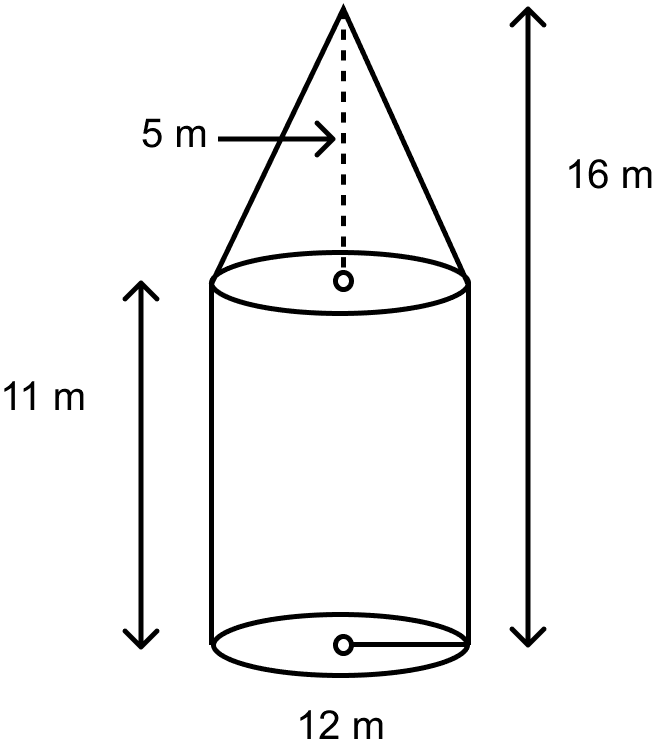
Diameter of cylindrical portion = 24 m
Radius of cylindrical portion (r) =
= = 12 m.
Height of the cylindrical part, H = 11 m.
Since vertex of cone is 16 m above the ground, height of cone, h = 16 - 11 = 5 m.
h = 5 m.
Radius of cone = 12 m.
∴ Radius of cone is also equal to r.
Slant height of the cone, l = .
l = m.
Area of canvas used to make the tent = Curved surface area of the cylindrical part + Curved surface area of the cone.
Area of the canvas used to make the tent = 2πrH + πrl = πr(2H + l).
Putting values we get,
Area of the canvas =
Hence, the area of the canvas used to make the tent is 1320 m2.
An exhibition tent is in the form of a cylinder surmounted by a cone. The height of the tent above the ground is 85 m and the height of the cylindrical part is 50 m. If the diameter of the base is 168 m, find the quantity of canvas required to make the tent. Allow 20% extra for folds and stitching. Give your answers to the nearest m2.
Answer
Total height of the tent = 85 m.
Height of the cylindrical part (h1) = 50 m.
From figure,
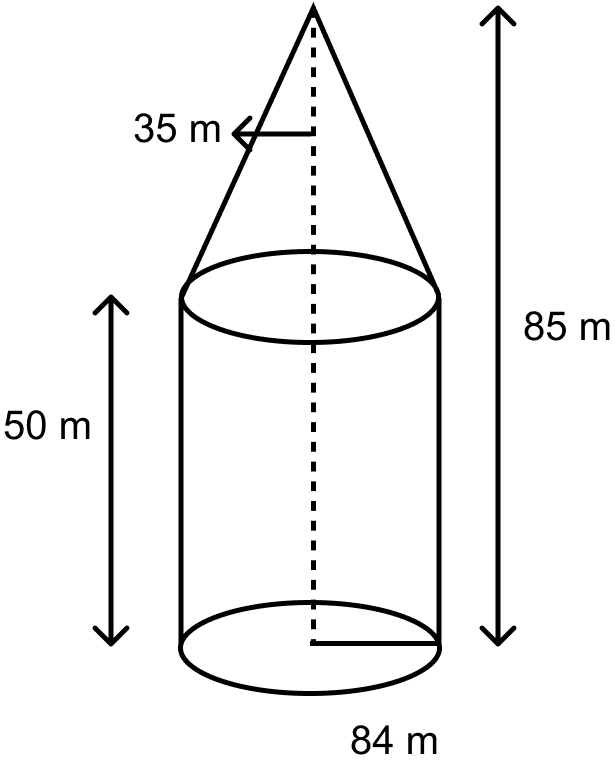
Height of cone (h2) = 85 - 50 = 35 m.
Diameter of the base, d = 168 m.
Radius of the base of cylindrical part, r = m.
Slant height of the cone, l = .
l = m.
Surface area of tent (S) = Curved surface area of cylinder + Curved surface area of cone
Putting values we get,
Adding 20% for folds and stitches,
Area of canvas = 50424 + 20% of 50424
Hence, the quantity of canvas required to make the tent is 60509 m2.
From a solid cylinder of height 30 cm and radius 7 cm, a conical cavity of height 24 cm and of base radius 7 cm is drilled out. Find the volume and the total surface of the remaining solid.
Answer
The figure is shown below:
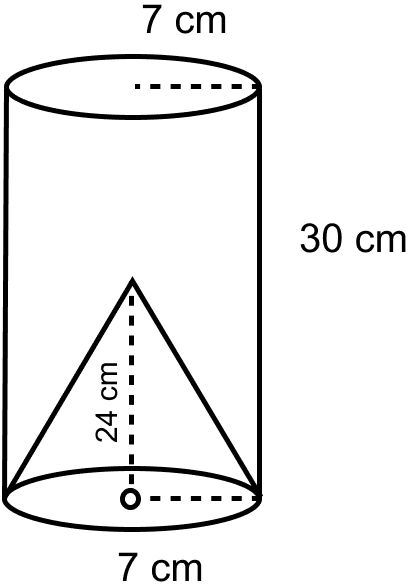
Radius of the solid cylinder = Radius of cone = r = 7 cm.
Height of the cylinder, H = 30 cm
Height of cone, h = 24 cm.
Slant height of cone, l = .
Putting values we get,
l = m.
Volume of the remaining solid (V) = Volume of the cylinder - Volume of the cone.
Total surface area of the remaining solid (S) = Curved surface area of cylinder + Area of base of cylinder + Curved surface area of cone.
Hence, the volume of the remaining solid = 3388 cm3 and surface area = 2024 cm2.
A buoy is made in the form of a hemisphere surmounted by a right cone whose circular base coincides with the plane surface of the hemisphere. The radius of the base of the cone is 3.5 metres and its volume is of the hemisphere. Calculate the height of the cone and the surface area of the buoy correct to 2 places of decimal.
Answer
The figure of the buoy made by surmounting a right cone on a hemisphere is shown below:
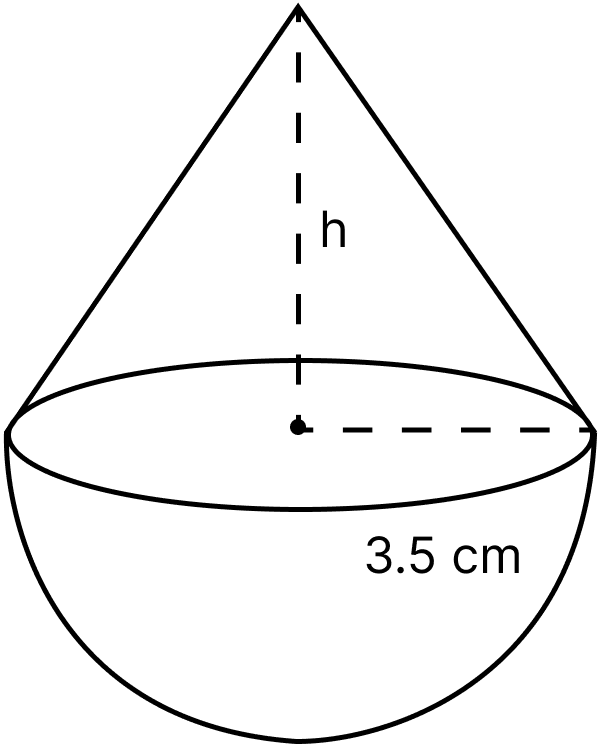
Radius of base of hemisphere = Radius of cone = 3.5 m.
Volume of hemisphere (V) =
Putting values,
Volume of cone = Volume of hemisphere.
∴ Volume of cone =
Volume of cone = .
Slant height of cone = l =
Putting values we get,
Surface area of the buoy = Curved Surface area of cone + Curved Surface area of hemisphere = πrl + 2πr2.
∴ Surface area of buoy =
Hence, the height of cone = 4.67 m and surface area of buoy is 141.17 m2.
A building is in the form of a cylinder surmounted by a hemisphere valted dome and contains of air. If the internal diameter of dome is equal to the total height of the building, find the height of the building.
Answer
The below figure shows the building in the form of a cylinder surmounted by a hemisphere valted dome:
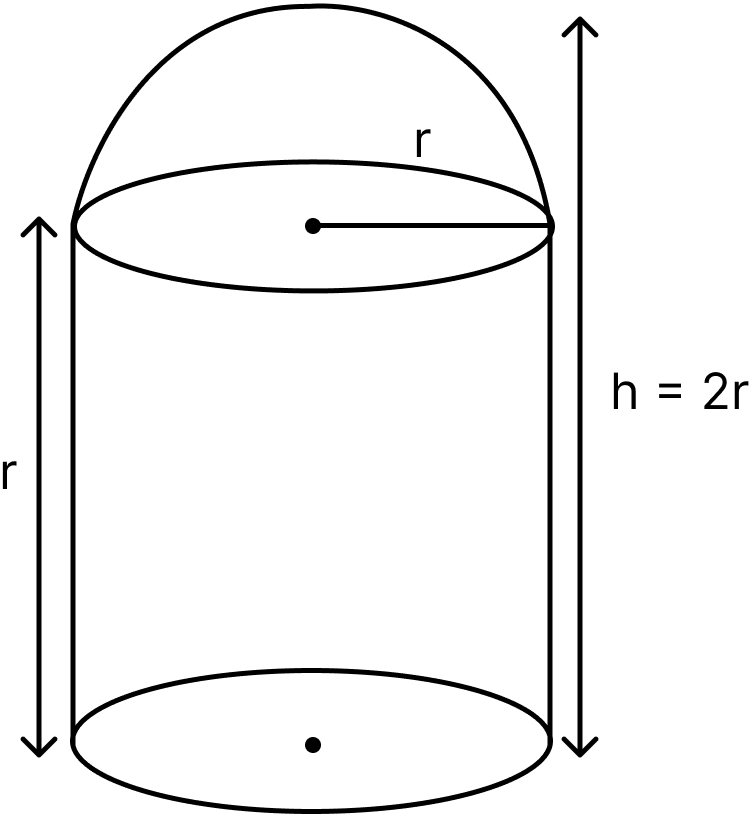
Let the radius of the dome be r.
∴ Internal diameter = 2r.
Given, internal diameter is equal to height.
∴ Height of building (h) = 2r.
Height of hemispherical area = r.
So, height of cylindrical area, h1 = 2r - r = r.
Volume of building (V) = Volume of cylindrical area + Volume of hemispherical area.
Given, V =
h = 2r = 2(2) = 4 m.
Hence, the height of the building is 4 m.
A rocket is in the form of a right circular cylinder closed at the lower end and surmounted by a cone with the same radius as that of the cylinder. The diameter and the height of the cylinder are 6 cm and 12 cm respectively. If the slant height of the conical portion is 5 cm, find the total surface area and the volume of the rocket. (Use π = 3.14).
Answer
The below figure shows the rocket:
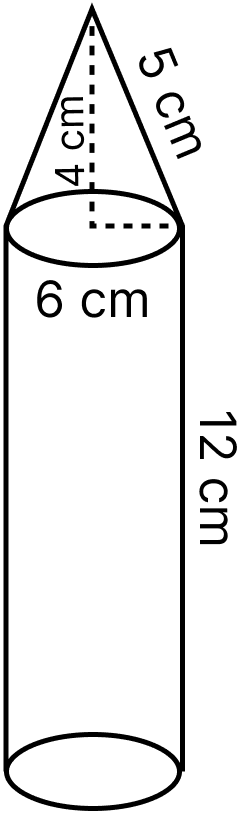
Given,
Height of cylindrical portion (H) = 12 cm.
Radius of cylinder and cone = = 3 cm.
Slant height of cone (l) = 5 cm.
⇒ h2 = l2 - r2
⇒ h2 = 52 - 32
⇒ h2 = 25 - 9
⇒ h2 = 16
⇒ h = = 4 cm.
Total surface area of rocket (S) = Curved surface area of cylinder + Base area of cylinder + Curved surface area of cone.
Volume of the rocket (V) = Volume of cone + Volume of cylinder.
Hence, the total surface area of rocket is 301.44 cm2 and volume is 376.8 cm3.
The adjoining figure represents a solid consisting of a right circular cylinder with a hemisphere at one end and a cone at the other. Their common radius is 7 cm. The height of the cylinder and the cone are each of 4 cm. Find the volume of the solid.

Answer
Given, common radius (r) = 7 cm,
Height of cone (h) = 4 cm,
Height of cylinder (H) = 4 cm.
Volume of solid (V) = Volume of cone + Volume of cylinder + Volume of hemisphere.
Hence, the volume of solid = 1540 cm3.
A solid is in the form of a right circular cylinder with a hemisphere at one end and a cone at the other end. Their common diameter is 3.5 cm and the height of the cylindrical and conical portions are 10 cm and 6 cm respectively. Find the volume of the solid. (Take π = 3.14)
Answer
The solid in the form of a right circular cylinder with a hemisphere at one end and a cone at the other end is shown in the figure below:
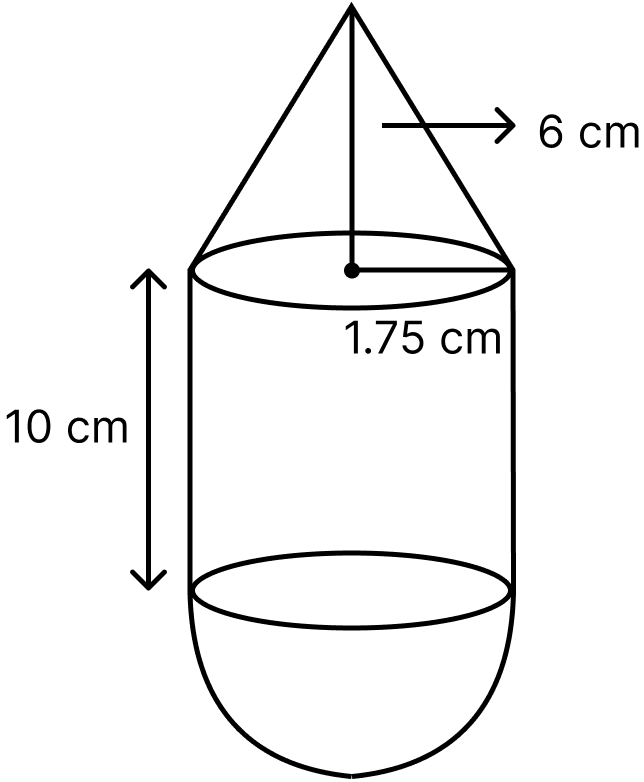
Given,
Common Diameter = 3.5 cm,
Common Radius = = 1.75 cm.
Height of cylindrical part (h1) = 10 cm.
Height of conical part (h2) = 6 cm.
Volume of solid (V) = Volume of cone + Volume of cylinder + Volume of hemisphere
Hence, the volume of the solid is 126.62 cm3.
A toy is in the shape of a right circular cylinder with a hemisphere on one end and a cone on the other. The height and radius of the cylindrical part are 13 cm and 5 cm respectively. The radii of the hemispherical and conical parts are the same as that of the cylindrical part. Calculate the surface area of the toy if the height of the conical part is 12 cm.
Answer
The toy is shown in the figure below:
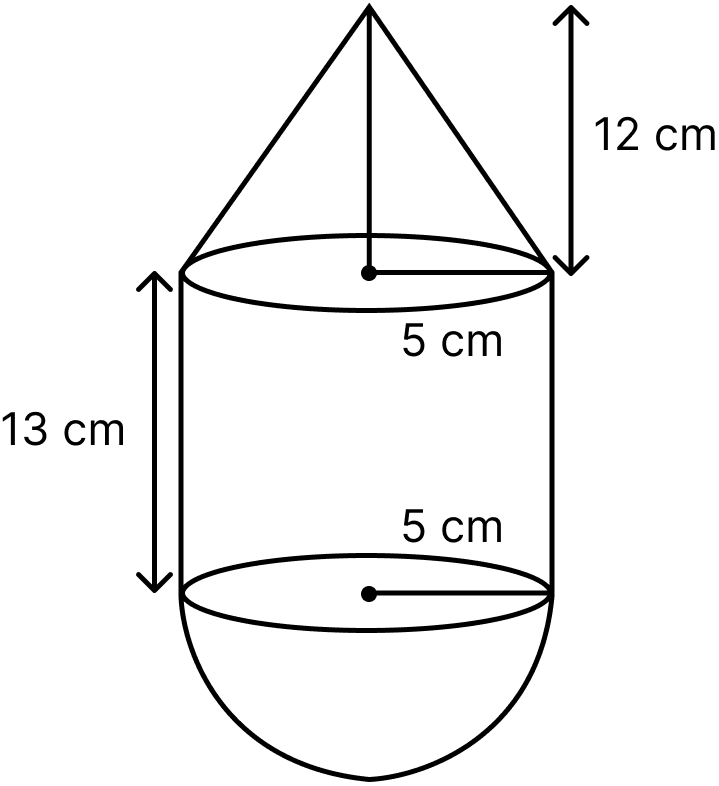
Height of the cylindrical part (H) = 13 cm.
Radius = 5 cm.
Radius of cone (r) = 5 cm
Height of cone (h) = 12 cm.
Slant height of cone, l =
Putting values we get,
Surface area of toy(S) = Curved surface area of cylinder + Curved surface area of hemisphere + Curved surface area of cone.
Hence, the surface area of the toy is 770 cm2.
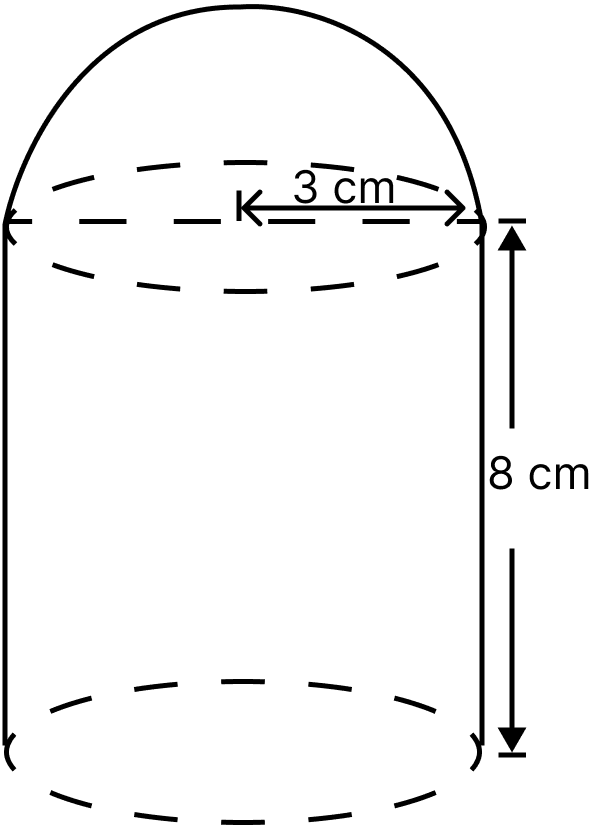
The adjoining figure shows a model of a solid consisting of a cylinder surmounted by a hemisphere at one end. If the model is drawn to a scale of 1 : 200, find
(i) the total surface area of the solid in π m2.
(ii) the volume of the solid in π litres.
Answer
(i) In the given figure,
Height of cylindrical portion (H) = 8 cm.
Radius of cylindrical portion = radius of hemispherical portion = (r) = 3 cm.
Scale = 1 : 200
∴ k = 200.
Total surface area (S) = Curved surface area of hemisphere + Curved surface area of cylinder + Area of base of cylinder
= 2πr2 + 2πrH + πr2
= 3πr2 + 2πrH
= πr(3r + 2H)
= 3π(3 × 3 + 2 × 8)
= 3π(9 + 16)
= 3π × 25
= 75π cm2.
∴ Surface area of solid = 75π × k2
= 75π × (200)2
= 75π × 40000 cm2
= 75π × m2
= 300π m2.
Hence, the surface area of solid = 300π m2.
(ii) Volume (V) = Volume of hemisphere + Volume of cylinder
= .
Substituting values we get :
∴ Volume of solid = 90π × k3
= 90π × (200)3
= 90π × 8000000
= 720000000π cm3
= m3
= 720π m3.
As, 1 m3 = 1000 litres
∴ Volume of solid = 720π × 1000 = 720000π litres.
Hence, the volume of solid = 720000π litres.
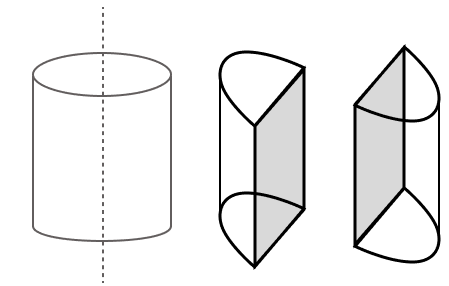
A solid metallic cylinder is cut into two identical halves along its height. The diameter of the cylinder is 7 cm and the height is 10 cm. Find :
(a) The total surface area (both the halves).
(b) The total cost of painting the two halves at the rate of ₹ 30 per cm2.
Answer
(a) Given,
Diameter of cylinder (d) = 7 cm
Radius of cylinder (r) = = 3.5 cm
Height of cylinder (h) = 10 cm
Total surface area (both the halves) = Total surface area of cylinder + Area of two rectangles
= [2πr(h + r)] + [2 × (l × b)]
= [2πr(h + r)] + [2 × (h × d)]
=
= (2 × 22 × 0.5 × 13.5) + 140
= 297 + 140
= 437 cm2.
Hence, total surface area of both the halves = 437 cm2.
(b) Total cost of painting the two halves = Total surface area × Rate
= 437 × 30
= ₹ 13,110.
Hence, total cost of painting the two halves = ₹ 13,110.
Oil is stored in a spherical vessel occupying of its full capacity. Radius of this spherical vessel is 28 cm. This oil is then poured into a cylindrical vessel with a radius of 21 cm. Find the height of the oil in the cylindrical vessel (correct to the nearest cm).
Take

Answer
Given,
Radius of spherical vessel (r) = 28 cm
Volume of spherical vessel (v) =
Volume of oil in vessel =
Substituting values we get :
Radius of cylindrical vessel (R) = 21 cm
Let height of oil in cylindrical vessel be h cm.
Volume of oil = Volume of cylinder upto which oil is filled (πR2h)
Hence, height of the oil in the cylindrical vessel = 50 cm.