
The diameter of a metallic sphere is 6 cm. The sphere is melted and drawn into a wire of uniform cross-section. If the length of the wire is 36 m, find its radius.
Answer
Let the wire's radius be a.
Given, sphere is melted into the wire.
The wire formed is a cylinder, hence the volume of wire will be equal to the volume of sphere.
Radius of sphere (r) =
= = 3 cm.
Volume of sphere (V) =
Putting values we get,
Given, length of wire = 36 m.
So, height of cylinder = 36 m = 3600 cm.
Volume of cylinder = V = 36π cm3.
Hence, the radius of the wire is 1 mm.
A solid metallic sphere of radius 6 cm is melted and made into a solid cylinder of height 32 cm. Find the :
(i) radius of the cylinder
(ii) curved surface area of the cylinder. Take π = 3.1
Answer
(i) Radius of metallic sphere (R) = 6 cm
Height of cylinder (h) = 32 cm
Volume of cylinder = Volume of metallic sphere (As sphere is melted and formed into a cylinder).
Let radius of cylinder = r cm.
Hence, the radius of the cylinder = 3 cm.
(ii) Curved surface area of cylinder = 2πrh
Putting values we get,
Curved surface area of cylinder = 2 × 3.1 × 3 × 32 = 595.2 cm2.
Hence, curved surface area of cylinder = 595.2 cm2.
A solid metallic hemisphere of radius 8 cm is melted and recasted into right circular cone of base radius 6 cm. Determine the height of the cone.
Answer
Radius of solid hemisphere (r) = 8 cm.
Volume of the hemisphere (V) =
Radius of cone (R) = 6 cm.
Let height of cone = h cm.
Volume of cone =
Since, hemisphere is melted and recasted into a cone, the volume remains the same.
Hence, the height of the cone is cm.
A rectangular water tank of base 11 m × 6 m contains water upto a height of 5 m. If the water in the tank is transferred to a cylindrical tank of radius 3.5 m, find the height of water level in the tank.
Answer
Base of water tank = 11 m × 6 m
Height of water level in rectangular water tank = 5 m
Volume of water in tank = lbh = 11 m × 6 m × 5 m = 330 m3.
Let water come upto height H in cylindrical tank.
Radius = 3.5 m
Volume of cylindrical tank = πr2H.
Hence, the height of water level in cylindrical tank = m.
The volume of a cone is the same as that of the cylinder whose height is 9 cm and diameter 40 cm. Find the radius of the base of the cone if its height is 108 cm.
Answer
Diameter of the cylinder = 40 cm.
Radius (r) = cm.
Height (h) = 9 cm.
∴ Volume of cylinder = πr2h = π × 20 × 20 × 9 = 3600π cm3.
Height of cone (H) = 108 cm.
Let radius of cone = R.
Volume of cone =
Given, volume of cone = volume of cylinder.
Hence, the radius of the cone is 10 cm.
Solid spherical ball of radius 6 cm is melted and recast into 64 identical spherical marble. Find the radius of each marble.
Answer
Given,
Radius of larger metallic sphere (R) = 6 cm
Let radius of each smaller sphere be r cm.
Given,
A solid metallic sphere of radius 6 cm is melted and recast into 64 identical solid spheres.
∴ Volume of larger metallic sphere = 64 × Volume of smaller metallic sphere
Hence, radius of each marble = 1.5 cm.
A hemispherical bowl of diameter 7.2 cm is filled completely with chocolate sauce. This sauce is poured into an inverted cone of radius 4.8 cm. Find the height of the cone.
Answer
Diameter of hemispherical bowl = 7.2 cm
Radius of hemispherical bowl (r) = 3.6 cm
Volume of hemispherical bowl = .
Radius of cone (R) = 4.8 cm.
Let height of cone = h cm.
Volume of cone = .
Volume of cone = Volume of hemispherical bowl.
Hence, the height of the cone is 4.05 cm.
Two spheres of the same metal weigh 1 kg and 7 kg. The radius of the smaller sphere is 3 cm. The two spheres are melted to form a single big sphere. Find the diameter of the big sphere.
Answer
Radius of the smaller sphere = r = 3 cm.
Let R be the radius of a larger new sphere.
Mass of small sphere (m1) = 1 kg.
Mass of bigger sphere (m2) = 7 kg.
The spheres are melted to form a new sphere.
So, the mass of the new sphere (M) = 1 + 7 = 8 kg.
Density of smaller sphere = Density of new sphere.
Let v be volume of small sphere and V be volume of new bigger sphere.
Given, radius of smaller sphere, r = 3 cm.
Volume of smaller sphere = v = πr3
= π(3)3
= 36π cm3.
Volume of new sphere = V = πR3
Putting these values in (i),
Diameter = 2 × 6 = 12 cm.
Hence, the diameter of the new bigger sphere = 12 cm.
A hollow copper pipe of inner diameter 6 cm and outer diameter 10 cm is melted and changed into a solid circular cylinder of the same height as that of the pipe. Find the diameter of the solid cylinder.
Answer
Given,
Internal radius (r) = = 3 cm.
Outer radius (R) = = 5 cm.
Given, height of the old hollow and new solid cylinder is equal let it be h.
Let the radius of new solid cylinder be r1.
Since, old hollow cylinder is recasted into solid cylinder hence, their volume will be equal.
Dividing both sides by π and h,
Diameter = 2 × Radius = 2 × 4 = 8 cm.
Hence, the diameter of solid cylinder = 8 cm.
A hollow sphere of internal and external diameters 4 cm and 8 cm respectively, is melted into a cone of base diameter 8 cm. Find the height of the cone.
Answer
For sphere,
Internal radius (r) = = 2 cm,
External radius (R) = = 4 cm.
For cone,
Base radius (r1) = = 4 cm
Height = h.
Since, the hollow sphere is recasted into cone hence their volume will be equal.
Multiplying both sides by 3 and dividing by π we get,
Hence, the height of the cone = 14 cm.
A well with inner diameter 6 m is dug 22 m deep. Soil taken out of it has been spread evenly all round it to a width of 5 m to form an embankment. Find the height of the embankment.
Answer
Inner diameter of well = 6 m
Radius of well, r = = 3 m.
Depth (h) = 22 m.
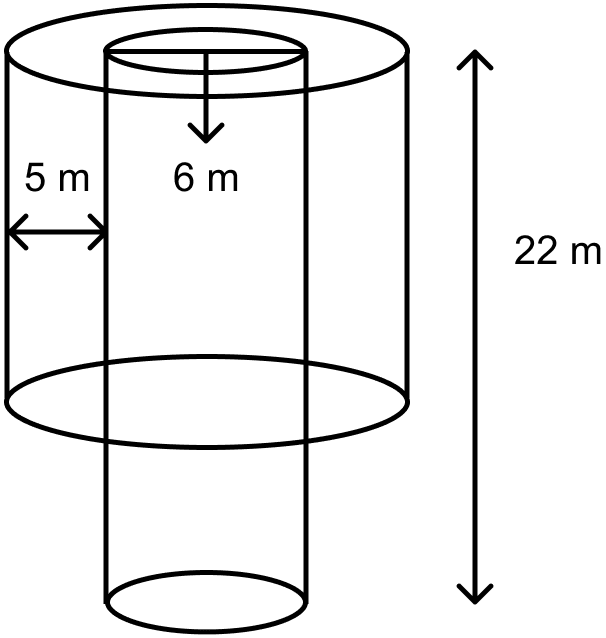
Volume of soil dug out of well = πr2h = π × 32 × 22 = 198π m3.
Width of embankment = 5 m.
Inner radius of embankment = Inner radius of well = r = 3 m.
Outer radius of embankment (R) = inner radius + width = 3 + 5 = 8 m.
Let H be the height of soil embankment.
Volume of soil embankment (V) = π(R2 - r2)H
Volume of soil dug out = Volume of soil embankment.
∴ 198π = 55πH
⇒ 55H = 198 (Dividing both sides by π)
⇒ H = = 3.6 m
Hence, the height of the soil embankment is 3.6 m.
A cylindrical can of internal diameter 21 cm contains water. A solid sphere whose diameter is 10.5 cm is lowered into the cylindrical can. The sphere is completely immersed in water. Calculate the rise in water level, assuming that no water overflows.
Answer
Internal diameter of cylindrical can = 21 cm.
Radius (R) = cm.
Diameter of sphere = 10.5 cm = cm.
Radius of sphere (r) = cm.
Let the rise in water level be h.
Rise in volume of water = Volume of sphere immersed.
Hence, the rise in water level is 1.75 cm.
There is water to a height of 14 cm in a cylindrical glass jar of radius 8 cm. Inside the water there is a sphere of diameter 12 cm completely immersed. By what height will the water go down when the sphere is removed ?
Answer
Given, radius of glass jar = R = 8 cm
Diameter of sphere = 12 cm
Radius of sphere = r = = 6 cm.
When the sphere is removed from the jar, volume of water decreases.
Let h be the height by which water level decrease.
Volume of water decreased = Volume of sphere.
Hence, the height by which water level rises is 4.5 cm.
A vessel in the form of an inverted cone is filled with water to the brim. Its height is 20 cm and diameter is 16.8 cm. Two equal solid cones are dropped in it so that they are fully submerged. As a result, one third of the water in the original cone overflows. What is the volume of each of the solid cone submerged ?
Answer
Height of cone (h) = 20 cm.
Radius of cone (r) = = 8.4 cm.
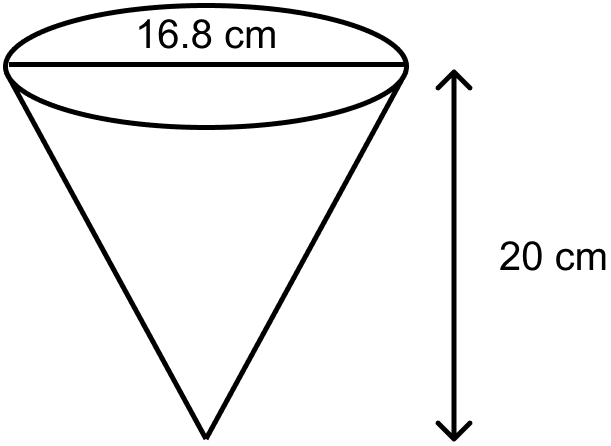
Volume of water in vessel =
Given,
Volume of water overflown = One-third of the volume of water in the vessel = cm3.
Volume of water overflown = Volume of two equal solid cones dropped into the vessel.
Volume of two equal solid cones dropped into the vessel = 492.8 cm3
Volume of one solid cone = cm3.
Hence, the volume of each of the solid cone submerged is 246.4 cm3.
A solid metallic circular cylinder of radius 14 cm and height 12 cm is melted and recast into small cubes of edge 2 cm. How many such cubes can be made from the solid cylinder ?
Answer
Radius of a solid cylinder (r) = 14 cm,
Height (h) = 12 cm.
Edge of cube (a) = 2 cm.
Let the no. of small cubes formed be n.
Volume of cylinder = n × Volume of each cubes.
Hence, the number of cubes formed are 924.
How many shots each having diameter 3 cm can be made from a cuboidal lead solid of dimensions 9 cm × 11 cm × 12 cm ?
Answer
Shot is in the shape of sphere.
Radius of sphere (r) = = 1.5 cm.
Let the number of sphere formed = n.
Volume of cuboidal lead solid = n × Volume of each shot
Hence, the number of shots made from cuboidal lead of solid is 84.
A solid metal cylinder of radius 14 cm and height 21 cm is melted down and recast into spheres of radius 3.5 cm. Calculate the number of spheres that can be made.
Answer
Radius of a solid metallic cylinder (r) = 14 cm,
Height (h) of cylinder = 21 cm.
Radius of sphere (R) = 3.5 cm.
Let the number of spheres formed be n.
Volume of metal cylinder = n × Volume of each sphere.
Hence, the number of spheres that can be made from solid cylinder are 72.
A solid cone of radius 5 cm and height and height 9 cm is melted and made into small cylinders of radius 0.5 cm and height 1.5 cm. Find the number of cylinders so formed.
Answer
Let number of small cylinders formed be n.
Given,
Radius of cone (R) = 5 cm,
Height of cone (H) = 9 cm,
Radius of cylinder (r) = 0.5 cm,
Height of cylinder (h) = 1.5 cm
Since, cone is melted and recasted into n cylinders.
∴ Volume of cone = n × Volume of sphere
Hence, number of cylinders formed = 200.
A metallic sphere of radius 10.5 cm is melted and then recast into small cones, each of radius 3.5 cm and height 3 cm. Find the number of cones thus obtained.
Answer
Radius of sphere (r) = 10.5 cm
Let the number of cones formed by recasting metallic sphere = n.
Radius of cone (R) = 3.5 cm
Height (h) = 3 cm.
Volume of sphere = n × Volume of each cone.
Dividing both sides by π and multiplying by 3,
Hence, the number of cones obtained from metallic sphere are 126.
A certain number of metallic cones each of radius 2 cm and height 3 cm are melted and recast in a solid sphere of radius 6 cm. Find the number of cones.
Answer
Radius of each cone (r) = 2 cm
Height of cone (h) = 3 cm.
Let the number of cones required to be recast into a solid sphere of radius (R) = 6 cm be n.
n × Volume of each cone = Volume of sphere.
On dividing both sides by π and multiplying by 3,
Hence, the number of cones required to make a solid sphere of radius 4 cm are 72.
A vessel is in the form of an inverted cone. Its height is 11 cm and the radius of its top, which is open, is 2.5 cm. It is filled with water upto the rim. When some lead shots, each of which is a sphere of radius 0.25 cm, are dropped into the vessel, of the water flows out. Find the number of lead shots dropped into the vessel.
Answer
Radius of the top of the inverted cone (R) = 2.5 cm.
Height of cone (H) = 11 cm.
Radius of lead sphere (r) = 0.25 cm.
When lead shots are dropped into vessel, of water flows out.
∴ Volume of water flown out (V) = Volume of cone.
Let the number of spheres be n.
∴ Volume of water flown out (V) = n × Volume of each lead shot.
Hence, the number of lead shots are 440.
The surface area of a solid metallic sphere is 616 cm2. It is melted and recast into smaller spheres of diameter 3.5 cm. How many such spheres can be obtained ?
Answer
Surface area of a metallic sphere = 616 cm2.
Let the radius of this sphere be R.
Given, big spheres are converted into smaller spheres of diameter = 3.5 cm or radius = .
Let the number of smaller spheres formed be n.
Volume of big sphere = n × Volume of each small sphere .
Dividing both sides by 4π and multiplying by 3 we get,
Hence, 64 small spheres can be formed.
The surface area of a solid metallic sphere is 1256 cm2. It is melted and recast into solid right circular cones of radius 2.5 cm and height 8 cm. Calculate
(i) the radius of the solid sphere.
(ii) the number of cones recast. (Use π = 3.14).
Answer
(i) Surface area of a metallic sphere = 1256 cm2.
Let the radius of this sphere be R.
Hence, the radius of sphere = 10 cm.
(ii) Let the number of cones formed by recasting sphere be n.
Radius of cone (r) = 2.5 cm
Height of cone (h) = 8 cm.
Volume of sphere = n × Volume of each cone.
Multiplying both sides by 3 and dividing by π.
Hence, the number of cones formed by recasting sphere are 80.
A cylindrical can whose base is horizontal and of radius 3.5 cm contains sufficient water so that when a sphere is placed in the can, the water just covers the sphere. Given that the sphere just fits into the can, calculate :
(i) the total surface area of the can in contact with water when the sphere is in it.
(ii) the depth of the water in the can before the sphere was put into the can. Given your answer as proper fractions.
Answer
(i) Radius of a cylindrical can (r) = 3.5 cm
Radius of sphere (R) = r = 3.5 cm
Height of water level in can = 7 cm.
Height of cylinder (h) = 7 cm.
Total surface area of can in contact with water (T) = Curved surface area of cylinder + base area of cylinder.
Hence, the surface area of can in contact with water is 192.5 cm2.
(ii) Let the depth of the water before the sphere was put be d.
Volume of cylindrical can = Volume of sphere + Volume of water.
Hence, the depth of water before sphere was put was cm.