Find the equation of a line whose inclination is 60° and y-intercept is -4.
Answer
Given, θ = 60° and c = -4.
We know that m = tan θ = tan 60° = 3 \sqrt{3} 3
Putting values of m and c in equation y = mx + c.
⇒ y = 3 x − 4. \Rightarrow y = \sqrt{3}x - 4. ⇒ y = 3 x − 4.
Hence, the equation of the required line is y = 3 x − 4. y = \sqrt{3}x - 4. y = 3 x − 4.
Write down the gradient and the intercept on the y-axis of the line 3y + 2x = 12.
Answer
Given, 3y + 2x = 12
⇒ 3y = -2x + 12
⇒ y = − 2 3 x + 4 -\dfrac{2}{3}x + 4 − 3 2 x + 4
Comparing the above equation with y = mx + c we get,
m = − 2 3 -\dfrac{2}{3} − 3 2
Hence, the gradient and intercept on the y-axis of the line 3y + 2x = 12 is − 2 3 -\dfrac{2}{3} − 3 2
If the equation of a line is y = 3 x + 1 \sqrt{3}x + 1 3 x + 1
Answer
Comparing the equation y = 3 x + 1 \sqrt{3}x + 1 3 x + 1
m = 3 \sqrt{3} 3
We know that m = tan θ.
∴ tan θ = 3 \sqrt{3} 3
Hence, the inclination of the line y = 3 \sqrt{3} 3
If the line y = mx + c passes through the points (2, -4) and (-3, 1), determine the values of m and c.
Answer
Equation of line passing through (2, -4) and (-3, 1) i.e. two points can be given by two-point formula i.e.
⇒ y − y 1 = y 2 − y 1 x 2 − x 1 ( x − x 1 ) ∴ y − ( − 4 ) = 1 − ( − 4 ) − 3 − 2 ( x − 2 ) ⇒ y + 4 = 5 − 5 ( x − 2 ) ⇒ y + 4 = − 1 ( x − 2 ) ⇒ y + 4 = − x + 2 ⇒ y = − x − 2. \Rightarrow y - y_1 = \dfrac{y_2 - y_1}{x_2 - x_1}(x - x_1) \\[1em] \therefore y - (-4) = \dfrac{1 - (-4)}{-3 - 2}(x - 2) \\[1em] \Rightarrow y + 4 = \dfrac{5}{-5}(x - 2) \\[1em] \Rightarrow y + 4 = -1(x - 2) \\[1em] \Rightarrow y + 4 = -x + 2 \\[1em] \Rightarrow y = -x - 2. ⇒ y − y 1 = x 2 − x 1 y 2 − y 1 ( x − x 1 ) ∴ y − ( − 4 ) = − 3 − 2 1 − ( − 4 ) ( x − 2 ) ⇒ y + 4 = − 5 5 ( x − 2 ) ⇒ y + 4 = − 1 ( x − 2 ) ⇒ y + 4 = − x + 2 ⇒ y = − x − 2.
Comparing the above equation with y = mx + c we get,
m = -1 and c = -2.
Hence, the value of m is -1 and c is -2.
If the points (1, 4), (3, -2) and (p, -5) lie on a line, find the value of p.
Answer
Equation of line passing through (1, 4) and (3, -2) i.e two points can be given by two-point formula i.e.
⇒ y − y 1 = y 2 − y 1 x 2 − x 1 ( x − x 1 ) ∴ y − 4 = − 2 − 4 3 − 1 ( x − 1 ) ⇒ y − 4 = − 6 2 ( x − 1 ) ⇒ y − 4 = − 3 ( x − 1 ) ⇒ y − 4 = − 3 x + 3 ⇒ y = − 3 x + 7. \Rightarrow y - y_1 = \dfrac{y_2 - y_1}{x_2 - x_1}(x - x_1) \\[1em] \therefore y - 4 = \dfrac{-2 - 4}{3 - 1}(x - 1) \\[1em] \Rightarrow y - 4 = \dfrac{-6}{2}(x - 1) \\[1em] \Rightarrow y - 4 = -3(x - 1) \\[1em] \Rightarrow y - 4 = -3x + 3 \\[1em] \Rightarrow y = -3x + 7. ⇒ y − y 1 = x 2 − x 1 y 2 − y 1 ( x − x 1 ) ∴ y − 4 = 3 − 1 − 2 − 4 ( x − 1 ) ⇒ y − 4 = 2 − 6 ( x − 1 ) ⇒ y − 4 = − 3 ( x − 1 ) ⇒ y − 4 = − 3 x + 3 ⇒ y = − 3 x + 7.
Since (p, -5) lies on the line it will satisfy it. Putting the values,
⇒ -5 = -3p + 7
Hence, the value of p is 4.
Find the inclination of the line joining the points P(4, 0) and Q(7, 3).
Answer
Slope of the line joining P and Q i.e two points is given by,
⇒ y 2 − y 1 x 2 − x 1 ∴ 3 − 0 7 − 4 = 3 3 = 1. \Rightarrow \dfrac{y_2 - y_1}{x_2 - x_1} \\[1em] \therefore \dfrac{3 - 0}{7 - 4} \\[1em] = \dfrac{3}{3} \\[1em] = 1. ⇒ x 2 − x 1 y 2 − y 1 ∴ 7 − 4 3 − 0 = 3 3 = 1.
We know that, m = tan θ. Since m = 1.
⇒ tan θ = tan 45° ⇒ θ = 45 ° . \Rightarrow \text{tan θ} = \text{tan 45°} \\[1em] \Rightarrow \text{θ} = 45°. ⇒ tan θ = tan 45° ⇒ θ = 45°.
Hence, the inclination of the line is 45°.
Find the equation of the line passing through the point of intersection of the lines 2x + y = 5 and x - 2y = 5 and having y-intercept equal to − 3 7 -\dfrac{3}{7} − 7 3
Answer
Equation of the lines are
Multiplying (i) by 2, we get
Adding (iii) and (ii) we get,
Substituting the values of x in (i)
∴ Coordinates of point of intersection are (3, -1).
Hence, line passes through (3, -1). So it will satisfy y = mx + c.
Given, y-intercept is − 3 7 -\dfrac{3}{7} − 7 3 − 3 7 . -\dfrac{3}{7}. − 7 3 .
⇒ -1 = 3m + ( − 3 7 ) \Big(-\dfrac{3}{7}\Big) ( − 7 3 )
⇒ -7 = 21m - 3
⇒ -7 + 3 = 21m
⇒ -4 = 21m
⇒ m = − 4 21 . -\dfrac{4}{21}. − 21 4 .
Putting value of m and c in y = mx + c,
⇒ y = − 4 21 x + ( − 3 7 ) ⇒ y = − 4 x − 3 × 3 21 ⇒ 21 y = − 4 x − 9 ⇒ 4 x + 21 y + 9 = 0. \Rightarrow y = -\dfrac{4}{21}x + \Big(-\dfrac{3}{7}\Big) \\[1em] \Rightarrow y = \dfrac{-4x - 3 \times 3}{21} \\[1em] \Rightarrow 21y = -4x - 9 \\[1em] \Rightarrow 4x + 21y + 9 = 0. ⇒ y = − 21 4 x + ( − 7 3 ) ⇒ y = 21 − 4 x − 3 × 3 ⇒ 21 y = − 4 x − 9 ⇒ 4 x + 21 y + 9 = 0.
Hence, the equation of the line is 4x + 21y + 9 = 0.
If the lines x 3 + y 4 = 7 \dfrac{x}{3} + \dfrac{y}{4} = 7 3 x + 4 y = 7
Answer
Given, x 3 + y 4 = 7 \dfrac{x}{3} + \dfrac{y}{4} = 7 3 x + 4 y = 7
Converting x 3 + y 4 = 7 \dfrac{x}{3} + \dfrac{y}{4} = 7 3 x + 4 y = 7
⇒ 4 x + 3 y 12 = 7 ⇒ 4 x + 3 y = 84 ⇒ 3 y = − 4 x + 84 ⇒ y = − 4 3 x + 28. \Rightarrow \dfrac{4x + 3y}{12} = 7 \\[1em] \Rightarrow 4x + 3y = 84 \\[1em] \Rightarrow 3y = -4x + 84 \\[1em] \Rightarrow y = -\dfrac{4}{3}x + 28. ⇒ 12 4 x + 3 y = 7 ⇒ 4 x + 3 y = 84 ⇒ 3 y = − 4 x + 84 ⇒ y = − 3 4 x + 28.
Comparing above equation with y = mx + c we get slope (m1 ),
m 1 = − 4 3 m_1 = -\dfrac{4}{3} m 1 = − 3 4
Converting 3x + ky = 11 in the form of y = mx + c.
⇒ 3 x + k y = 11 ⇒ k y = − 3 x + 11 ⇒ y = − 3 k x + 11 k . \Rightarrow 3x + ky = 11 \\[1em] \Rightarrow ky = -3x + 11 \\[1em] \Rightarrow y = -\dfrac{3}{k}x + \dfrac{11}{k}. ⇒ 3 x + k y = 11 ⇒ k y = − 3 x + 11 ⇒ y = − k 3 x + k 11 .
Comparing above equation with y = mx + c we get slope,
m 2 = − 3 k m_2 = -\dfrac{3}{k} m 2 = − k 3
Given two lines are perpendicular,
∴ m1 × m2 = -1.
⇒ − 4 3 × − 3 k = − 1 ⇒ 4 k = − 1 ⇒ k = − 4. \Rightarrow -\dfrac{4}{3} \times -\dfrac{3}{k} = -1 \\[1em] \Rightarrow \dfrac{4}{k} = -1 \\[1em] \Rightarrow k = -4. ⇒ − 3 4 × − k 3 = − 1 ⇒ k 4 = − 1 ⇒ k = − 4.
Hence, the value of k is -4.
Write down the equation of a line parallel to x - 2y + 8 = 0 and passing through the point (1, 2).
Answer
Given equation of line,
x - 2y + 8 = 0.
Converting in the form of y = mx + c,
⇒ 2y = x + 8
⇒ y = 1 2 x + 4 \dfrac{1}{2}x + 4 2 1 x + 4
Comparing we get,
Slope = 1 2 \dfrac{1}{2} 2 1
Line parallel to x - 2y + 8 = 0 will have the same slope.
Equation of the line having slope 1 2 \dfrac{1}{2} 2 1
⇒ y − y 1 = m ( x − x 1 ) ⇒ y − 2 = 1 2 ( x − 1 ) ⇒ 2 ( y − 2 ) = x − 1 ⇒ 2 y − 4 = x − 1 ⇒ x − 2 y + 3 = 0. \Rightarrow y - y_1 = m(x - x_1) \\[1em] \Rightarrow y - 2 = \dfrac{1}{2}(x - 1) \\[1em] \Rightarrow 2(y - 2) = x - 1 \\[1em] \Rightarrow 2y - 4 = x - 1 \\[1em] \Rightarrow x - 2y + 3 = 0. ⇒ y − y 1 = m ( x − x 1 ) ⇒ y − 2 = 2 1 ( x − 1 ) ⇒ 2 ( y − 2 ) = x − 1 ⇒ 2 y − 4 = x − 1 ⇒ x − 2 y + 3 = 0.
Hence, the equation of the required line is x - 2y + 3 = 0.
Write down the equation of the line passing through (-3, 2) and perpendicular to the line 3y = 5 - x.
Answer
Given equation of the line is,
⇒ 3y = 5 - x
⇒ y = − 1 3 x + 5 3 . -\dfrac{1}{3}x + \dfrac{5}{3}. − 3 1 x + 3 5 .
Comparing with y = mx + c we get,
Slope (m1 ) = − 1 3 -\dfrac{1}{3} − 3 1
Let slope of the line perpendicular to the given line be m2 .
∴ m1 × m2 = -1.
⇒ − 1 3 × m 2 = − 1 ⇒ m 2 = 3. \Rightarrow -\dfrac{1}{3} \times m_2 = -1 \\[1em] \Rightarrow m_2 = 3. ⇒ − 3 1 × m 2 = − 1 ⇒ m 2 = 3.
Equation of the line having slope 3 and passing through (-3, 2) can be given by point-slope form i.e.,
⇒ y − y 1 = m ( x − x 1 ) ⇒ y − 2 = 3 ( x − ( − 3 ) ) ⇒ y − 2 = 3 ( x + 3 ) ⇒ y − 2 = 3 x + 9 ⇒ 3 x − y + 11 = 0. \Rightarrow y - y_1 = m(x - x_1) \\[1em] \Rightarrow y - 2 = 3(x - (-3)) \\[1em] \Rightarrow y - 2 = 3(x + 3) \\[1em] \Rightarrow y - 2 = 3x + 9 \\[1em] \Rightarrow 3x - y + 11 = 0. ⇒ y − y 1 = m ( x − x 1 ) ⇒ y − 2 = 3 ( x − ( − 3 )) ⇒ y − 2 = 3 ( x + 3 ) ⇒ y − 2 = 3 x + 9 ⇒ 3 x − y + 11 = 0.
Hence, the equation of the required line is 3x - y + 11 = 0.
Find the equation of the line perpendicular to the line joining the points A(1, 2) and B(6, 7) and passing through the point which divides the line segment AB in the ratio 3 : 2.
Answer
Let the slope of line joining A(1, 2) and B(6, 7) be s1 . Slope of two points is given by,
s 1 = y 2 − y 1 x 2 − x 1 = 7 − 2 6 − 1 = 5 5 = 1. s_1 = \dfrac{y_2 - y_1}{x_2 - x_1} \\[1em] = \dfrac{7 - 2}{6 - 1} \\[1em] = \dfrac{5}{5} \\[1em] = 1. s 1 = x 2 − x 1 y 2 − y 1 = 6 − 1 7 − 2 = 5 5 = 1.
Let slope of perpendicular line be s2 . So,
⇒ s 1 × s 2 = − 1 ⇒ 1 × s 2 = − 1 ⇒ s 2 = − 1. \Rightarrow s_1 \times s_2 = -1 \\[1em] \Rightarrow 1 \times s_2 = -1 \\[1em] \Rightarrow s_2 = -1. ⇒ s 1 × s 2 = − 1 ⇒ 1 × s 2 = − 1 ⇒ s 2 = − 1.
Given, the new line passes through the point which divides the line segment AB in the ratio 3 : 2. By section formula coordinates are,
= ( m 1 x 2 + m 2 x 1 m 1 + m 2 , m 1 y 2 + m 2 y 1 m 1 + m 2 ) = ( 3 × 6 + 2 × 1 3 + 2 , 3 × 7 + 2 × 2 3 + 2 ) = ( 18 + 2 5 , 21 + 4 5 ) = ( 20 5 , 25 5 ) = ( 4 , 5 ) . = \Big(\dfrac{m_1x_2 + m_2x_1}{m_1 + m_2}, \dfrac{m_1y_2 + m_2y_1}{m_1 + m_2}\Big) \\[1em] = \Big(\dfrac{3 \times 6 + 2 \times 1}{3 + 2}, \dfrac{3 \times 7 + 2 \times 2}{3 + 2} \Big) \\[1em] = \Big(\dfrac{18 + 2}{5}, \dfrac{21 + 4}{5}\Big) \\[1em] = \Big(\dfrac{20}{5}, \dfrac{25}{5}\Big) \\[1em] = (4, 5). = ( m 1 + m 2 m 1 x 2 + m 2 x 1 , m 1 + m 2 m 1 y 2 + m 2 y 1 ) = ( 3 + 2 3 × 6 + 2 × 1 , 3 + 2 3 × 7 + 2 × 2 ) = ( 5 18 + 2 , 5 21 + 4 ) = ( 5 20 , 5 25 ) = ( 4 , 5 ) .
Equation of the line having slope -1 and passing through (4, 5) can be given by point-slope form i.e.,
⇒ y − y 1 = m ( x − x 1 ) ⇒ y − 5 = − 1 ( x − 4 ) ⇒ y − 5 = − x + 4 ⇒ x + y − 9 = 0. \Rightarrow y - y_1 = m(x - x_1) \\[1em] \Rightarrow y - 5 = -1(x - 4) \\[1em] \Rightarrow y - 5 = -x + 4 \\[1em] \Rightarrow x + y - 9 = 0. ⇒ y − y 1 = m ( x − x 1 ) ⇒ y − 5 = − 1 ( x − 4 ) ⇒ y − 5 = − x + 4 ⇒ x + y − 9 = 0.
Hence, the equation of the required line is x + y - 9 = 0.
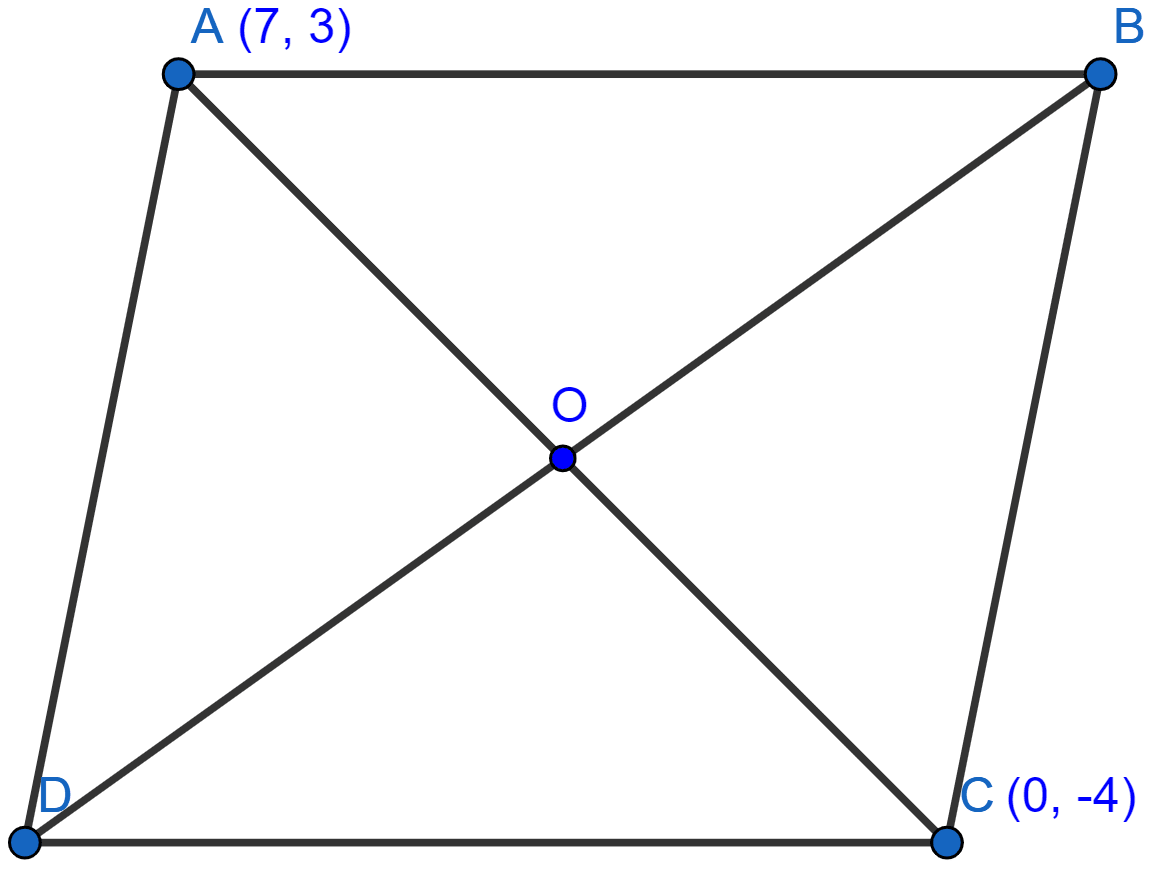
The points A(7, 3) and C(0, -4) are two opposite vertices of a rhombus ABCD. Find the equation of the diagonal BD.
Answer
Rhombus ABCD with A(7, 3) and C(0, -4) as the two opposite vertices is shown in the figure below:
Slope of the line AC (m1 ),
= y 2 − y 1 x 2 − x 1 = − 4 − 3 0 − 7 = − 7 − 7 = 1. = \dfrac{y_2 - y_1}{x_2 - x_1} \\[1em] = \dfrac{-4 - 3}{0 - 7} \\[1em] = \dfrac{-7}{-7} \\[1em] = 1. = x 2 − x 1 y 2 − y 1 = 0 − 7 − 4 − 3 = − 7 − 7 = 1.
Diagonals of rhombus bisect each other at right angles.
∴ BD is perpendicular to AC. Let slope of BD be m2 .
∴ m 1 × m 2 = − 1 1 × m 2 = − 1 ⇒ m 2 = − 1. \therefore m_1 \times m_2 = -1 \\[1em] 1 \times m_2 = -1 \\[1em] \Rightarrow m_2 = -1. ∴ m 1 × m 2 = − 1 1 × m 2 = − 1 ⇒ m 2 = − 1.
Let O be the mid-point of diagonals. It's coordinates are given by,
= ( x 1 + x 2 2 , y 1 + y 2 2 ) = ( 7 + 0 2 , 3 + ( − 4 ) 2 ) = ( 7 2 , − 1 2 ) . = \Big(\dfrac{x_1 + x_2}{2}, \dfrac{y_1 + y_2}{2}\Big) \\[1em] = \Big(\dfrac{7 + 0}{2}, \dfrac{3 + (-4)}{2}\Big) \\[1em] = \Big(\dfrac{7}{2}, -\dfrac{1}{2}\Big). = ( 2 x 1 + x 2 , 2 y 1 + y 2 ) = ( 2 7 + 0 , 2 3 + ( − 4 ) ) = ( 2 7 , − 2 1 ) .
Equation of BD can be given by point slope form i.e.,
⇒ y − y 1 = m ( x − x 1 ) ⇒ y − ( − 1 2 ) = − 1 ( x − ( 7 2 ) ) ⇒ y + 1 2 = − x + 7 2 ⇒ 2 y + 1 2 = − 2 x + 7 2 ⇒ 2 y + 1 = − 2 x + 7 ⇒ 2 y + 2 x − 6 = 0 ⇒ 2 ( y + x − 3 ) = 0 ⇒ x + y − 3 = 0. \Rightarrow y - y_1 = m(x - x_1) \\[1em] \Rightarrow y - \Big(-\dfrac{1}{2}\Big) = -1(x - \Big(\dfrac{7}{2}\Big)) \\[1em] \Rightarrow y + \dfrac{1}{2} = -x + \dfrac{7}{2} \\[1em] \Rightarrow \dfrac{2y + 1}{2} = \dfrac{-2x + 7}{2} \\[1em] \Rightarrow 2y + 1 = -2x + 7 \\[1em] \Rightarrow 2y + 2x - 6 = 0 \\[1em] \Rightarrow 2(y + x - 3) = 0 \\[1em] \Rightarrow x + y - 3 = 0. ⇒ y − y 1 = m ( x − x 1 ) ⇒ y − ( − 2 1 ) = − 1 ( x − ( 2 7 ) ) ⇒ y + 2 1 = − x + 2 7 ⇒ 2 2 y + 1 = 2 − 2 x + 7 ⇒ 2 y + 1 = − 2 x + 7 ⇒ 2 y + 2 x − 6 = 0 ⇒ 2 ( y + x − 3 ) = 0 ⇒ x + y − 3 = 0.
Hence, the equation of the required line is x + y - 3 = 0.
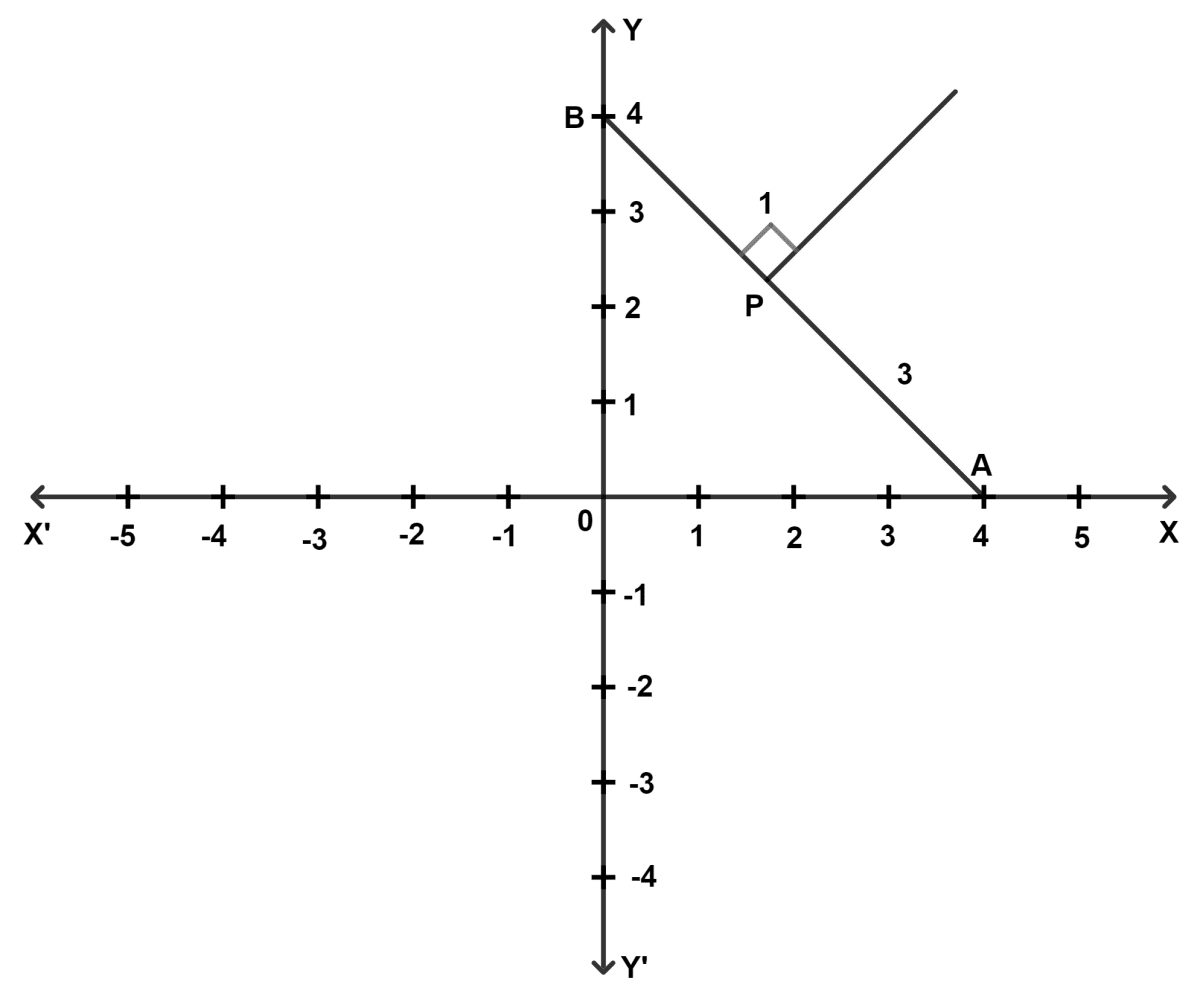
A and B are two points on the x-axis and y-axis respectively.
(a) Write down the co-ordinates of A and B.
(b) P is a point on AB such that AP : PB = 3 : 1. Using section formula find the coordinates of point P.
(c) Find the equation of a line passing through P and perpendicular to AB.
Answer
(a) From figure,
A = (4, 0) and B = (0, 4).
(b) Let coordinates of P be (x, y).
By section formula,
(x, y) = ( m 1 x 2 + m 2 x 1 m 1 + m 2 , m 1 y 2 + m 2 y 1 m 1 + m 2 ) \Big(\dfrac{m_1x_2 + m_2x_1}{m_1 + m_2}, \dfrac{m_1y_2 + m_2y_1}{m_1 + m_2}\Big) ( m 1 + m 2 m 1 x 2 + m 2 x 1 , m 1 + m 2 m 1 y 2 + m 2 y 1 )
Substituting values we get :
⇒ ( x , y ) = ( 3 × 0 + 1 × 4 3 + 1 , 3 × 4 + 1 × 0 3 + 1 ) = ( 0 + 4 4 , 12 + 0 4 ) = ( 4 4 , 12 4 ) = ( 1 , 3 ) . \Rightarrow (x, y) = \Big(\dfrac{3 \times 0 + 1 \times 4}{3 + 1}, \dfrac{3 \times 4 + 1 \times 0}{3 + 1}\Big) \\[1em] = \Big(\dfrac{0 + 4}{4}, \dfrac{12 + 0}{4}\Big) \\[1em] = \Big(\dfrac{4}{4}, \dfrac{12}{4}\Big) \\[1em] = (1, 3). ⇒ ( x , y ) = ( 3 + 1 3 × 0 + 1 × 4 , 3 + 1 3 × 4 + 1 × 0 ) = ( 4 0 + 4 , 4 12 + 0 ) = ( 4 4 , 4 12 ) = ( 1 , 3 ) .
Hence, coordinates of P = (1, 3).
(c) By formula,
Slope = y 2 − y 1 x 2 − x 1 \dfrac{y_2 - y_1}{x_2 - x_1} x 2 − x 1 y 2 − y 1
Substituting values we get :
Slope of AB = 4 − 0 0 − 4 = 4 − 4 \dfrac{4 - 0}{0 - 4} = \dfrac{4}{-4} 0 − 4 4 − 0 = − 4 4
We know that,
Product of slope of perpendicular lines = -1.
∴ Slope of AB × Slope of line perpendicular to AB = -1
⇒ -1 × Slope of line perpendicular to AB = -1
⇒ Slope of line perpendicular to AB = − 1 − 1 \dfrac{-1}{-1} − 1 − 1
Line passing through P and perpendicular to AB :
⇒ y - y1 = m(x - x1 )
⇒ y - 3 = 1(x - 1)
⇒ y - 3 = x - 1
⇒ y = x - 1 + 3
⇒ y = x + 2.
Hence, required equation is y = x + 2.
A straight line passes through P(2, 1) and cuts the axes in points A, B. If BP : PA = 3 : 1.
Find :
(i) the coordinates of A and B.
(ii) the equation of the line AB.
Answer
A lies on x-axis and B lies on y-axis. Let coordinates of A be (x, 0) and B be (0, y) and P(2, 1) divides BA in the ratio 3 : 1.
By section formula,
x-coordinate = m 1 x 2 + m 2 x 1 m 1 + m 2 ⇒ 2 = 3 x + 0 3 + 1 ⇒ 2 = 3 x 4 ⇒ x = 8 3 . \text{x-coordinate } = \dfrac{m_1x_2 + m_2x_1}{m_1 + m_2} \\[1em] \Rightarrow 2 = \dfrac{3x + 0}{3 + 1} \\[1em] \Rightarrow 2 = \dfrac{3x}{4} \\[1em] \Rightarrow x = \dfrac{8}{3}. x-coordinate = m 1 + m 2 m 1 x 2 + m 2 x 1 ⇒ 2 = 3 + 1 3 x + 0 ⇒ 2 = 4 3 x ⇒ x = 3 8 .
Similarly,
y-coordinate = m 1 y 2 + m 2 y 1 m 1 + m 2 ⇒ 1 = 3 × 0 + 1 × y 3 + 1 ⇒ 1 = y 4 ⇒ y = 4. \text{y-coordinate } = \dfrac{m_1y_2 + m_2y_1}{m_1 + m_2} \\[1em] \Rightarrow 1 = \dfrac{3 \times 0 + 1 \times y}{3 + 1} \\[1em] \Rightarrow 1 = \dfrac{y}{4} \\[1em] \Rightarrow y = 4. y-coordinate = m 1 + m 2 m 1 y 2 + m 2 y 1 ⇒ 1 = 3 + 1 3 × 0 + 1 × y ⇒ 1 = 4 y ⇒ y = 4.
Hence, coordinates of A are ( 8 3 , 0 ) \Big(\dfrac{8}{3}, 0\Big) ( 3 8 , 0 )
(ii) By two point formula equation of AB will be,
⇒ y − y 1 = y 2 − y 1 x 2 − x 1 ( x − x 1 ) ⇒ y − 0 = 4 − 0 0 − 8 3 ( x − 8 3 ) ⇒ y = 4 × 3 − 8 ( 3 x − 8 3 ) ⇒ y = 3 x − 8 − 2 ⇒ − 2 y = 3 x − 8 ⇒ 3 x + 2 y − 8 = 0. \Rightarrow y - y_1 = \dfrac{y_2 - y_1}{x_2 - x_1}(x - x_1) \\[1em] \Rightarrow y - 0 = \dfrac{4 - 0}{0 - \dfrac{8}{3}}(x - \dfrac{8}{3}) \\[1em] \Rightarrow y = \dfrac{4 \times 3}{-8}\Big(\dfrac{3x - 8}{3}\Big) \\[1em] \Rightarrow y = \dfrac{3x - 8}{-2} \\[1em] \Rightarrow -2y = 3x - 8 \\[1em] \Rightarrow 3x + 2y - 8 = 0. ⇒ y − y 1 = x 2 − x 1 y 2 − y 1 ( x − x 1 ) ⇒ y − 0 = 0 − 3 8 4 − 0 ( x − 3 8 ) ⇒ y = − 8 4 × 3 ( 3 3 x − 8 ) ⇒ y = − 2 3 x − 8 ⇒ − 2 y = 3 x − 8 ⇒ 3 x + 2 y − 8 = 0.
Hence, the equation of the required line is 3x + 2y = 8.
A straight line makes on the coordinate axes positive intercepts whose sum is 7. If the line passes through the point (-3, 8), find its equation.
Answer
Let the line make intercept a and b with the x-axis and y-axis respectively. Let line intersect x-axis at A and y-axis at B.
Coordinates of A will be (a, 0) and B will be (0, b).
Given, sum of intercepts = 7.
∴ a + b = 7 or b = 7 - a.
Equation of AB can be given by two point formula i.e.,
⇒ y − y 1 = y 2 − y 1 x 2 − x 1 ( x − x 1 ) ⇒ y − 0 = b − 0 0 − a ( x − a ) ⇒ y = b − a ( x − a ) ⇒ − a y = b x − b a ⇒ b x + a y − a b = 0 . . . . . ( i ) \Rightarrow y - y_1 = \dfrac{y_2 - y_1}{x_2 - x_1}(x - x_1) \\[1em] \Rightarrow y - 0 = \dfrac{b - 0}{0 - a}(x - a) \\[1em] \Rightarrow y = \dfrac{b}{-a}(x - a) \\[1em] \Rightarrow -ay = bx - ba \\[1em] \Rightarrow bx + ay - ab = 0 \space .....(i) ⇒ y − y 1 = x 2 − x 1 y 2 − y 1 ( x − x 1 ) ⇒ y − 0 = 0 − a b − 0 ( x − a ) ⇒ y = − a b ( x − a ) ⇒ − a y = b x − ba ⇒ b x + a y − ab = 0 ..... ( i )
Since, line passes through (-3, 8) it will satisfy the above equation. Also, putting b = 7 - a.
⇒ ( 7 − a ) ( − 3 ) + 8 a − a ( 7 − a ) = 0 ⇒ − 21 + 3 a + 8 a − 7 a + a 2 = 0 ⇒ a 2 + 4 a − 21 = 0 ⇒ a 2 + 7 a − 3 a − 21 = 0 ⇒ a ( a + 7 ) − 3 ( a + 7 ) = 0 ⇒ ( a − 3 ) ( a + 7 ) = 0 ⇒ a = 3 or a = − 7. \Rightarrow (7 - a)(-3) + 8a - a(7 - a) = 0 \\[1em] \Rightarrow -21 + 3a + 8a - 7a + a^2 = 0 \\[1em] \Rightarrow a^2 + 4a - 21 = 0 \\[1em] \Rightarrow a^2 + 7a - 3a - 21 = 0 \\[1em] \Rightarrow a(a + 7) - 3(a + 7) = 0 \\[1em] \Rightarrow (a - 3)(a + 7) = 0 \\[1em] \Rightarrow a = 3 \text{ or } a = -7. ⇒ ( 7 − a ) ( − 3 ) + 8 a − a ( 7 − a ) = 0 ⇒ − 21 + 3 a + 8 a − 7 a + a 2 = 0 ⇒ a 2 + 4 a − 21 = 0 ⇒ a 2 + 7 a − 3 a − 21 = 0 ⇒ a ( a + 7 ) − 3 ( a + 7 ) = 0 ⇒ ( a − 3 ) ( a + 7 ) = 0 ⇒ a = 3 or a = − 7.
Since, only positive intercepts are made hence a ≠ -7.
b = 7 - a = 7 - 3 = 4.
Putting value of b and a in (i) we get,
⇒ 4x + 3y - 12 = 0.
Hence, the equation of the required line is 4x + 3y = 12.
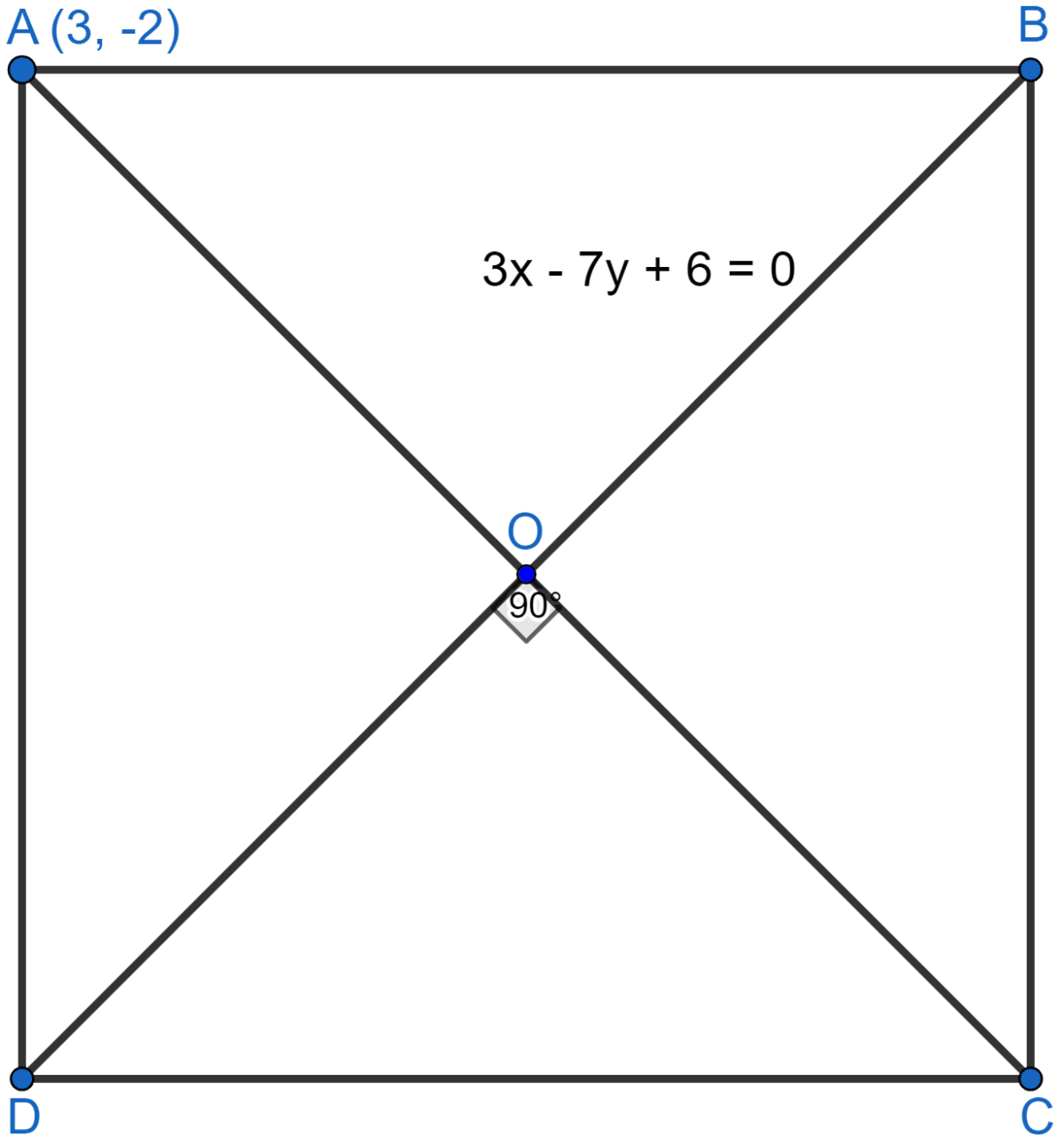
If the coordinates of the vertex A of a square ABCD are (3, -2) and the equation of diagonal BD is 3x - 7y + 6 = 0, find the equation of the diagonal AC. Also find the coordinates of the centre of the square.
Answer
Diagonals AC and BD of the square ABCD bisect each other at right angle at O.
∴ O is the mid-point of AC and BD.
Equation of BD is 3x - 7y + 6 = 0
⇒ 7y = 3x + 6
⇒ y = 3 7 x + 6 7 \dfrac{3}{7}x + \dfrac{6}{7} 7 3 x + 7 6
∴ Slope of BD = m1 = 3 7 \dfrac{3}{7} 7 3
Let slope of AC be m2 . Since, BD and AC are perpendicular,
∴ m 1 × m 2 = − 1 ⇒ 3 7 m 2 = − 1 ⇒ m 2 = − 7 3 . \therefore m_1 \times m_2 = -1 \\[1em] \Rightarrow \dfrac{3}{7}m_2 = -1 \\[1em] \Rightarrow m_2 = -\dfrac{7}{3}. ∴ m 1 × m 2 = − 1 ⇒ 7 3 m 2 = − 1 ⇒ m 2 = − 3 7 .
Equation of AC will be
⇒ y − y 1 = m ( x − x 1 ) ⇒ y − ( − 2 ) = − 7 3 ( x − 3 ) ⇒ 3 ( y + 2 ) = − 7 ( x − 3 ) ⇒ 3 y + 6 = − 7 x + 21 ⇒ 7 x + 3 y = 15 \Rightarrow y - y_1 = m(x - x_1) \\[1em] \Rightarrow y - (-2) = -\dfrac{7}{3}(x - 3) \\[1em] \Rightarrow 3(y + 2) = -7(x - 3) \\[1em] \Rightarrow 3y + 6 = -7x + 21 \\[1em] \Rightarrow 7x + 3y = 15 ⇒ y − y 1 = m ( x − x 1 ) ⇒ y − ( − 2 ) = − 3 7 ( x − 3 ) ⇒ 3 ( y + 2 ) = − 7 ( x − 3 ) ⇒ 3 y + 6 = − 7 x + 21 ⇒ 7 x + 3 y = 15
Now we will find the coordinates of O, the points of intersection of AC and BD
⇒ 3x - 7y = -6 ....(i)
Multiplying (i) by 3 and (ii) by 7, we get,
⇒ 9x - 21y = -18 ....(iii)
Adding (iii) and (iv) we get,
⇒ 9x + 49x - 21y + 21y = -18 + 105
⇒ 58x = 87
⇒ x = 87 58 = 3 2 . \dfrac{87}{58} = \dfrac{3}{2}. 58 87 = 2 3 .
Putting value of x in (i) we get,
⇒ 3 × 3 2 − 7 y = − 6 ⇒ 9 2 − 7 y = − 6 ⇒ 9 2 + 6 = 7 y ⇒ 9 + 12 2 = 7 y ⇒ 21 2 = 7 y ⇒ y = 3 2 . \Rightarrow 3 \times \dfrac{3}{2} - 7y = -6 \\[1em] \Rightarrow \dfrac{9}{2} - 7y = -6 \\[1em] \Rightarrow \dfrac{9}{2} + 6 = 7y \\[1em] \Rightarrow \dfrac{9 + 12}{2} = 7y \\[1em] \Rightarrow \dfrac{21}{2} = 7y \\[1em] \Rightarrow y = \dfrac{3}{2}. ⇒ 3 × 2 3 − 7 y = − 6 ⇒ 2 9 − 7 y = − 6 ⇒ 2 9 + 6 = 7 y ⇒ 2 9 + 12 = 7 y ⇒ 2 21 = 7 y ⇒ y = 2 3 .
Hence, the equation of AC is 7x + 3y - 15 = 0 and coordinates of the center are ( 3 2 , 3 2 ) \Big(\dfrac{3}{2}, \dfrac{3}{2}\Big) ( 2 3 , 2 3 )
If the lines kx - y + 4 = 0 and 2y = 6x + 7 are perpendicular to each other, find the value of k.
Answer
1st equation :
⇒ kx - y + 4 = 0
⇒ y = kx + 4
Slope (s1 ) : k
2nd equation :
⇒ 2y = 6x + 7
⇒ y = 6 2 x + 7 2 \dfrac{6}{2}x + \dfrac{7}{2} 2 6 x + 2 7
⇒ y = 3x + 7 2 \dfrac{7}{2} 2 7
Slope (s2 ) : 3
We know that,
Product of slope of perpendicular lines = -1
⇒ k × 3 = -1
⇒ k = − 1 3 -\dfrac{1}{3} − 3 1
Hence, k = − 1 3 -\dfrac{1}{3} − 3 1
Find the equation of a line parallel to 2y = 6x + 7 and passing through (-1, 1)
Answer
We know that,
Slope of parallel lines are equal.
Slope of line parallel to line 2y = 6x + 7 is 3.
By point-slope form :
⇒ y - y1 = m(x - x1 )
⇒ y - 1 = 3[x - (-1)]
⇒ y - 1 = 3[x + 1]
⇒ y - 1 = 3x + 3
⇒ y = 3x + 3 + 1
⇒ y = 3x + 4.
Hence, equation of line parallel to 2y = 6x + 7 and passing through (–1, 1) is y = 3x + 4.
A line segment joining P (2, -3) and Q (0, -1) is cut by the x-axis at the point R. A line AB cuts the y-axis at T(0, 6) and is perpendicular to PQ at S. Find the :
(a) equation of line PQ
(b) equation of line AB
(c) coordinates of points R and S.
Answer
(a) By formula,
Slope of line = ( y 2 − y 1 x 2 − x 1 ) \Big(\dfrac{y_2 - y_1}{x_2 - x_1}\Big) ( x 2 − x 1 y 2 − y 1 )
Substituting values we get :
Slope of line PQ = ( − 1 − ( − 3 ) 0 − 2 ) = − 1 + 3 − 2 = 2 − 2 = − 1. \text{Slope of line PQ} = \Big(\dfrac{-1 - (-3)}{0 - 2}\Big) \\[1em] = \dfrac{-1 + 3}{-2} \\[1em] = \dfrac{2}{-2} \\[1em] = -1. Slope of line PQ = ( 0 − 2 − 1 − ( − 3 ) ) = − 2 − 1 + 3 = − 2 2 = − 1.
Equation of line :
⇒ y - y1 = m(x - x1 )
⇒ y - (-3) = -1(x - 2)
⇒ y + 3 = -x + 2
⇒ x + y + 3 - 2 = 0
⇒ x + y + 1 = 0.
Hence, equation of line PQ is x + y + 1 = 0.
(b) We know that,
Product of slope of perpendicular lines = -1.
∴ Slope of PQ × Slope of AB = -1
⇒ -1 × Slope of AB = -1
⇒ Slope of AB = − 1 − 1 \dfrac{-1}{-1} − 1 − 1
Equation of line :
⇒ y - y1 = m(x - x1 )
Equation of line AB :
⇒ y - 6 = 1(x - 0)
⇒ y - 6 = x
⇒ x - y + 6 = 0
Hence, equation of line AB is x - y + 6 = 0.
(c) Given,
Line PQ cuts x-axis at point R.
Let R = (a, 0)
Equation of line PQ = x + y + 1 = 0
Since, point R lies on line PQ,
⇒ a + 0 + 1 = 0
⇒ a + 1 = 0
⇒ a = -1.
R = (a, 0) = (-1, 0)
Given,
AB is perpendicular to PQ at point S.
∴ Point S is the intersection point of AB and PQ.
PQ : x + y + 1 = 0
AB : y - x = 6 or y = x + 6
Substituting value of y from equation AB in equation PQ, we get :
⇒ x + (x + 6) + 1 = 0
⇒ 2x + 7 = 0
⇒ 2x = -7
⇒ x = − 7 2 -\dfrac{7}{2} − 2 7
Substituting value of x in equation AB, we get :
y = − 7 2 + 6 = − 7 + 12 2 = 5 2 -\dfrac{7}{2} + 6 = \dfrac{-7 + 12}{2} = \dfrac{5}{2} − 2 7 + 6 = 2 − 7 + 12 = 2 5
S = ( − 7 2 , 5 2 ) \Big(-\dfrac{7}{2}, \dfrac{5}{2}\Big) ( − 2 7 , 2 5 )
Hence, coordinates of R = (-1, 0) and S = ( − 7 2 , 5 2 ) \Big(-\dfrac{7}{2}, \dfrac{5}{2}\Big) ( − 2 7 , 2 5 )
Find the coordinates of the centroid P of the △ ABC, whose vertices are A(-1, 3), B(3, -1) and C(0, 0). Hence, find the equation of a line passing through P and parallel to AB.
Answer
By formula,
Centroid of triangle = ( x 1 + x 2 + x 3 3 , y 1 + y 2 + y 3 3 ) \Big(\dfrac{x_1 + x_2 + x_3}{3}, \dfrac{y_1 + y_2 + y_3}{3}\Big) ( 3 x 1 + x 2 + x 3 , 3 y 1 + y 2 + y 3 )
Substituting values we get :
⇒ Centroid of △ ABC = ( − 1 + 3 + 0 3 , 3 + ( − 1 ) + 0 3 ) ⇒ P = ( 2 3 , 2 3 ) . \Rightarrow \text{Centroid of △ ABC} = \Big(\dfrac{-1 + 3 + 0}{3}, \dfrac{3 + (-1) + 0}{3}\Big) \\[1em] \Rightarrow P = \Big(\dfrac{2}{3}, \dfrac{2}{3}\Big). ⇒ Centroid of △ ABC = ( 3 − 1 + 3 + 0 , 3 3 + ( − 1 ) + 0 ) ⇒ P = ( 3 2 , 3 2 ) .
By formula,
Slope = y 2 − y 1 x 2 − x 1 \dfrac{y_2 - y_1}{x_2 - x_1} x 2 − x 1 y 2 − y 1
Substituting values we get :
Slope of AB = − 1 − 3 3 − ( − 1 ) = − 4 4 = − 1. \text{Slope of AB} = \dfrac{-1 - 3}{3 - (-1)} \\[1em] = \dfrac{-4}{4} \\[1em] = -1. Slope of AB = 3 − ( − 1 ) − 1 − 3 = 4 − 4 = − 1.
We know that,
Slope of parallel lines are equal.
By point-slope form,
Equation of line : y - y1 = m(x - x1 )
Substituting values we get :
Equation of line passing through P and parallel to AB :
⇒ y − 2 3 = − 1 ( x − 2 3 ) ⇒ 3 y − 2 3 = − 1 × 3 x − 2 3 ⇒ 3 y − 2 = − 1 ( 3 x − 2 ) ⇒ 3 y − 2 = − 3 x + 2 ⇒ 3 y + 3 x = 2 + 2 ⇒ 3 y + 3 x = 4. \Rightarrow y - \dfrac{2}{3} = -1\Big(x - \dfrac{2}{3}\Big) \\[1em] \Rightarrow \dfrac{3y - 2}{3} = -1 \times \dfrac{3x - 2}{3} \\[1em] \Rightarrow 3y - 2 = -1(3x - 2) \\[1em] \Rightarrow 3y - 2 = -3x + 2 \\[1em] \Rightarrow 3y + 3x = 2 + 2 \\[1em] \Rightarrow 3y + 3x = 4. ⇒ y − 3 2 = − 1 ( x − 3 2 ) ⇒ 3 3 y − 2 = − 1 × 3 3 x − 2 ⇒ 3 y − 2 = − 1 ( 3 x − 2 ) ⇒ 3 y − 2 = − 3 x + 2 ⇒ 3 y + 3 x = 2 + 2 ⇒ 3 y + 3 x = 4.
Hence, required equation is 3x + 3y = 4.