2x – 7 < 4, x ∈ {1, 2, 3, 4, 5, 6, 7}
Answer
Given,
⇒ 2x – 7 < 4
⇒ 2x < 7 + 4
⇒ 2x < 11
⇒ x <
⇒ x < 5.5
Since, x ∈ {1, 2, 3, 4, 5, 6, 7}
Hence, solution set = {1, 2, 3, 4, 5}.
Solution on the number line is :

2x – 3 > 3, x ∈ {1, 2, 3, 4, 5, 6}
Answer
Given,
⇒ 2x – 3 > 3
⇒ 2x > 3 + 3
⇒ 2x > 6
⇒ x >
⇒ x > 3
Since, x ∈ {1, 2, 3, 4, 5, 6}.
Hence, solution set = {4, 5, 6}.
Solution on the number line is :

9 ≤ 1 - 2x, x ∈ {-3, -4, -5, -6}
Answer
Given,
⇒ 9 ≤ 1 – 2x
⇒ 1 - 2x ≥ 9
⇒ -2x ≥ 9 - 1
⇒ -2x ≥ 8
Dividing by -2 on both sides we get,
⇒ x ≤ -4 (As on dividing by negative no. the sign reverses.)
Since, x ∈ {-3, -4, -5, -6}.
Hence, solution set = {-4, -5, -6}.
Solution on the number line is :

, x ∈ {0, 1, 2, 3, 4, 5, 6}
Answer
Given,
⇒
⇒ 3x - 5 >
⇒ 3x - 5 > 3
⇒ 3x > 3 + 5
⇒ 3x > 8
⇒ x >
⇒ x > 2.67
Since, x ∈ {0, 1, 2, 3, 4, 5, 6}
Hence, solution set = {3, 4, 5, 6}.
Solution on the number line is :

7x - 4(3 - x) ≥ 3(2x - 5), x ∈ {-3, -2, -1, 0, 1, 2, 3}
Answer
⇒ 7x - 4(3 - x) ≥ 3(2x - 5)
⇒ 7x - (12 - 4x) ≥ (6x - 15)
⇒ 7x + 4x - 12 ≥ 6x - 15
⇒ 11x - 6x ≥ -15 + 12
⇒ 5x ≥ -3
⇒ x ≥
⇒ x ≥ -0.6
Since, x ∈ {-3, -2, -1, 0, 1, 2, 3}
Hence, solution set = {0, 1, 2, 3}.
Solution on the number line is :

4 - 3x ≥ 3x - 14, x ∈ N
Answer
Given,
⇒ 4 - 3x ≥ 3x - 14
⇒ -3x - 3x ≥ -14 - 4
⇒ -6x ≥ -18
Dividing by -6 on both sides we get,
⇒ x ≤ 3 (As on dividing by negative no. the sign reverses.)
Since, x ∈ N
Hence, solution set = {1, 2, 3}.
Solution on the number line is :

6 - 5x > 3 - 4x, x ∈ W
Answer
⇒ 6 - 5x > 3 - 4x
⇒ -4x + 5x < 6 - 3
⇒ x < 3
Since, x ∈ W
Hence, solution set = {0, 1, 2}.
Solution on the number line is :

Answer
Multiplying by 15 on both sides we get,
⇒ 9x - 5(2x - 1) > 15
⇒ 9x - 10x + 5 > 15
⇒ -x + 5 > 15
⇒ x < 5 - 15
⇒ x < -10.
Since, x ∈ I.
Hence, solution set = {-11, -12, -13,...}.
Solution on the number line is :

Answer
Given,
Multiplying by 6 on both sides we get,
⇒ 12x + 21 > 10x + 18
⇒ 12x - 10x > 18 - 21
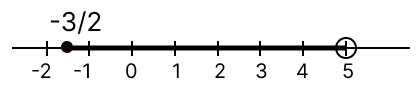
⇒ 2x > -3
⇒ x >
⇒ x > -1.5
Since, x ∈ I
Hence, solution set = {-1, 0, 1, 2, 3,....}.
Solution on the number line is :

2x + 3 ≤ 3x + 1, x ∈ R
Answer
⇒ 2x + 3 ≤ 3x + 1
⇒ 3x - 2x ≥ 3 - 1
⇒ x ≥ 2
Since, x ∈ R
Hence, solution set = {x : x ≥ 2, x ∈ R}.
Solution on the number line is :

, x ∈ R
Answer
Given,
⇒
Multiplying by 6 on both sides we get,
⇒
⇒ 2(5x - 8) ≥ 3(4x - 7)
⇒ 10x - 16 ≥ 12x - 21
⇒ 10x - 12x ≥ -21 + 16
⇒ -2x ≥ -5
Dividing by -2 on both sides we get,
⇒ x ≤ (As on dividing by negative number the sign reverses.)
Since, x ∈ R
Hence, solution set = {x : x ≤ , x ∈ R}.
Solution on the number line is :

-3 < 2x - 1 < x + 4, x ∈ I
Answer
Given,
⇒ -3 < 2x - 1 < x + 4
Solving L.H.S. of the inequation,
⇒ -3 < 2x – 1
⇒ 2x – 1 > -3
⇒ 2x > -3 + 1
⇒ 2x > -2
⇒ x >
⇒ x > -1 ....(1)
Solving R.H.S. of the inequation,
⇒ 2x - 1 < x + 4
⇒ 2x - x < 4 + 1
⇒ x < 5 .....(2)
From (1) and (2) we get,
⇒ -1 < x < 5
Since, x ∈ I.
Hence, solution set = {0, 1, 2, 3, 4}.
Solution on the number line is :

2 + 4x < 2x - 5 < 3x, x ∈ I
Answer
Given,
⇒ 2 + 4x < 2x - 5 < 3x
Solving L.H.S. of the inequation,
⇒ 2 + 4x < 2x - 5
⇒ 4x - 2x < -5 - 2
⇒ 2x < -7
⇒ x <
⇒ x < -3.5 ..........(1)
Solving R.H.S. of the inequation,
⇒ 2x - 5 < 3x
⇒ 3x - 2x > -5
⇒ x > -5 .........(2)
From (1) and (2) we get,
-5 < x < -3.5
Since, x ∈ I.
Hence, solution set = {-4}.
Solution on the number line is :

2 ≤ 2x - 3 ≤ 5, x ∈ R
Answer
Given,
⇒ 2 ≤ 2x - 3 ≤ 5
Solving L.H.S. of the inequation,
⇒ 2 ≤ 2x – 3
⇒ 2x - 3 ≥ 2
⇒ 2x ≥ 2 + 3
⇒ 2x ≥ 5
⇒ x ≥
⇒ x ≥ .........(1)
Solving R.H.S. of the inequation,
⇒ 2x - 3 ≤ 5
⇒ 2x ≤ 5 + 3
⇒ 2x ≤ 8
⇒ x ≤
⇒ x ≤ 4 ............(2)
From (1) and (2) we get,
≤ x ≤ 4
Since, x ∈ R
Hence, solution set = {x : ≤ x ≤ 4, x ∈ R}.
Solution on the number line is :

–1 ≤ 3 + 4x < 23, x ∈ R
Answer
Solving L.H.S. of the inequation,
⇒ –1 ≤ 3 + 4x
⇒ 3 + 4x ≥ -1
⇒ 4x ≥ -1 - 3
⇒ 4x ≥ -4
⇒ x ≥
⇒ x ≥ -1 .....(1)
Solving R.H.S. of the inequation,
⇒ 3 + 4x < 23
⇒ 4x < 23 - 3
⇒ 4x < 20
⇒ x <
⇒ x < 5 .........(2)
From (1) and (2) we get,
-1 ≤ x < 5
Since, x ∈ R
Hence, solution set = {x : -1 ≤ x < 5, x ∈ R}.
Solution on the number line is :

x ∈ I
Answer
Solving L.H.S. of the inequation,
Multiplying by -6 on both sides we get,
⇒ 4x ≤ 15 (As on multiplying by negative number the sign reverses.)
⇒ x ≤
⇒ x ≤ 3.75 .............(1)
Solving R.H.S. of the inequation,
Dividing both sides by -2, we get :
⇒ x > -2 (As on dividing by negative number the sign reverses.) ......(2)
From (1) and (2) we get,
-2 > x ≤ 3.75
Since, x ∈ I
Hence, solution set = {-1, 0, 1, 2, 3}.
Solution on the number line is :

Answer
Solving L.H.S. of the inequation,
Solving R.H.S. of the inequation,
From (1) and (2) we get,
-5 < x ≤ -1
Since, x ∈ R
Hence, solution set = {x : -5 < x ≤ -1, x ∈ R}.
Solution on the number line is :

2x – 5 ≤ 5x + 4 < 11, x ∈ R
Answer
Given,
⇒ 2x – 5 ≤ 5x + 4 < 11
Solving L.H.S. of the inequation,
⇒ 2x – 5 ≤ 5x + 4
⇒ 5x + 4 ≥ 2x – 5
⇒ 5x - 2x ≥ -5 - 4
⇒ 3x ≥ -9
⇒ x ≥
⇒ x ≥ -3 .........(1)
Solving R.H.S. of the inequation,
⇒ 5x + 4 < 11
⇒ 5x < 11 - 4
⇒ 5x < 7
⇒ x <
⇒ x < 1.4 ..........(2)
From (1) and (2) we get,
-3 ≤ x < 1.4
Since, x ∈ R
Hence, solution set = {x : -3 ≤ x < 1.4, x ∈ R}.
Solution on the number line is :

1 ≥ 15 – 7x > 2x – 27, x ∈ N
Answer
Given,
⇒ 1 ≥ 15 – 7x > 2x – 27
Solving L.H.S. of the inequation,
⇒ 1 ≥ 15 – 7x
⇒ 7x ≥ -1 + 15
⇒ 7x ≥ 14
⇒ x ≥
⇒ x ≥ 2 .........(1)
Solving R.H.S. of the inequation,
⇒ 15 – 7x > 2x – 27
⇒ 2x – 27 < 15 – 7x
⇒ 2x + 7x < 15 + 27
⇒ 9x < 42
⇒ x <
⇒ x < .......(2)
From (1) and (2) we get,
2 ≤ x <
Since, x ∈ N
Hence, solution set = {2, 3, 4}.
Solution on the number line is :

, x ∈ I
Answer
Given,
Solving L.H.S. of the inequation,
Solving R.H.S. of the inequation,
Dividing by -4 on both sides we get,
⇒ x ≥ -2 (As on dividing by negative number the sign reverses.)
⇒ x ≥ -2 .....(2)
From (1) and (2) we get,
-2 ≤ x < 2
Since, x ∈ I
Hence, solution set = {-2, -1, 0, 1}.
Solution on the number line is :

, x ∈ R
Answer
Solving L.H.S. of the inequation,
Solving R.H.S. of the inequation,
From (1) and (2) we get,
-3 ≤ x < 3
Since, x ∈ R
Hence, solution set = {x : -3 ≤ x < 3, x ∈ R}.
Solution on the number line is :

5x - 11 ≤ 7x - 5 < 9, x ∈ R
Answer
Solving L.H.S. of the inequation,
⇒ 5x - 11 ≤ 7x - 5
⇒ 7x - 5 ≥ 5x - 11
⇒ 7x - 5x ≥ -11 + 5
⇒ 2x ≥ -6
⇒ x ≥
⇒ x ≥ -3 ........(1)
Solving R.H.S. of the inequation,
⇒ 7x - 5 < 9
⇒ 7x < 9 + 5
⇒ 7x < 14
⇒ x <
⇒ x < 2 ....(2)
From (1) and (2) we get,
-3 ≤ x < 2
Since, x ∈ R
Hence, solution set = {x : -3 ≤ x < 2, x ∈ R}.
Solution on the number line is :

, x ∈ R
Answer
Given,
Solving L.H.S. of the inequation,
Solving R.H.S. of the inequation,
From (1) and (2) we get,
x ≥
Hence, solution set = {x : x ≥ , x ∈ R}.
Solution on the number line is :

,x ∈ I
Answer
Given,
Solving L.H.S. of the inequation,
Dividing by -5 on both sides we get,
⇒ x ≥ -3 (As on dividing by negative number the sign reverses) ........(1)
Solving R.H.S. of the inequation,
From (1) and (2) we get,
-3 ≤ x ≤ 4
Since, x ∈ I
Hence, solution set = {-3, -2, -1, 0, 1, 2, 3, 4}.
Solution on the number line is :

, x ∈ W
Answer
Given,
Solving L.H.S. of the inequation,
Solving R.H.S. of the inequation,
Multiplying both sides by , we get :
From (1) and (2) we get,
-2.25 ≤ x < 5,
Since, x ∈ W
Hence, solution set = {0, 1, 2, 3, 4}.
Solution on the number line is :

-5(x - 9) ≥ 17 - 9x > x + 2, x ∈ R
Answer
Given,
⇒ -5(x - 9) ≥ 17 - 9x > x + 2
Solving L.H.S. of the inequation,
⇒ -5(x - 9) ≥ 17 - 9x
⇒ -5x + 45 ≥ 17 - 9x
⇒ -5x + 9x ≥ 17 - 45
⇒ 4x ≥ 17 - 45
⇒ 4x ≥ -28
⇒ x ≥
⇒ x ≥ -7 .........(1)
Solving R.H.S. of the inequation,
⇒ 17 - 9x > x + 2
⇒ x + 2 < 17 - 9x
⇒ x + 9x < 17 - 2
⇒ 10x < 15
⇒ x <
⇒ x < .......(2)
From (1) and (2) we get,
⇒ -7 ≤ x <
Since, x ∈ R
Hence, solution set = {x : -7 ≤ x < , x ∈ R}.
Solution on the number line is :

, x ∈ R
Answer
Given,
Solving L.H.S. of the inequation,
Solving R.H.S. of the inequation,
From (1) and (2) we get,
⇒ 1.6 ≤ x < 3
Since, x ∈ R
Hence, solution set = {x : 1.6 ≤ x < 3, x ∈ R}.
Solution on the number line is :

, x ∈ R
Answer
Given,
Solving L.H.S. of the inequation,
Solving R.H.S. of the inequation,
Dividing by -2 on both sides we get,
⇒ x ≥ -4 (As on dividing by negative number the sign reverses.) .............(2)
From (1) and (2) we get,
⇒ -4 ≤ x < 5
Since, x ∈ R
Hence, solution set = {x : -4 ≤ x < 5, x ∈ R}.
Solution on the number line is :

2y - 3 < y + 1 ≤ 4y + 7, y ∈ R
Answer
Given,
⇒ 2y - 3 < y + 1 ≤ 4y + 7
Solving L.H.S. of the inequation,
⇒ 2y - 3 < y + 1
⇒ 2y - y < 1 + 3
⇒ y < 4 ..........(1)
Solving R.H.S. of the inequation,
⇒ y + 1 ≤ 4y + 7
⇒ 4y + 7 ≥ y + 1
⇒ 4y - y ≥ 1 - 7
⇒ 3y ≥ -6
Dividing by 3 on both sides we get,
⇒ y ≥ -2 ...........(2)
From (1) and (2) we get,
⇒ -2 ≤ y < 4
Since, y ∈ R
Hence, solution set = {y : -2 ≤ y < 4, y ∈ R}.
Solution on the number line is :

-2 + 10x ≤ 13x + 10 < 24 + 10x, x ∈ Z
Answer
Given,
⇒ -2 + 10x ≤ 13x + 10 < 24 + 10x
Solving L.H.S. of the inequation,
⇒ -2 + 10x ≤ 13x + 10
⇒ 13x + 10 ≥ -2 + 10x
⇒ 13x - 10x ≥ -2 - 10
⇒ 3x ≥ -12
⇒ x ≥
⇒ x ≥ -4 .......(1)
Solving R.H.S. of the inequation,
⇒ 13x + 10 < 24 + 10x
⇒ 13x - 10x < 24 - 10
⇒ 3x < 14
⇒ x <
⇒ x < 4.6 ............(2)
From (1) and (2) we get,
⇒ -4 ≤ x < 4.6
Since, x ∈ Z
Hence, solution set = {-4, -3, -2, -1, 0, 1, 2, 3, 4}.
Solution on the number line is :

Solve the following inequality and write down the solution set :
11x - 4 < 15x + 4 ≤ 13x + 14, x ∈ W
Represent the solution set on a real number line.
Answer
Given,
⇒ 11x - 4 < 15x + 4 ≤ 13x + 14
Solving L.H.S. of the inequation,
⇒ 11x - 4 < 15x + 4
⇒ 15x + 4 > 11x - 4
⇒ 15x - 11x > -4 - 4
⇒ 4x > -8
⇒ x >
⇒ x > -2 ..........(1)
Solving R.H.S. of the inequation,
⇒ 15x + 4 ≤ 13x + 14
⇒ 15x - 13x ≤ 14 - 4
⇒ 2x ≤ 10
⇒ x ≤
⇒ x ≤ 5 .......(2)
From (1) and (2) we get,
-2 < x ≤ 5
Since, x ∈ W
Hence, solution set = {0, 1, 2, 3, 4, 5}.
Solution on the number line is :

Given : P = {x : 5 < 2x - 1 ≤ 11, x ∈ R} and Q = {x : -1 ≤ 3 + 4x < 23, x ∈ I}. Represent P and Q on the number line. Find P ∩ Q.
Answer
Given,
P = {x : 5 < 2x - 1 ≤ 11, x ∈ R}
Solving L.H.S. of the inequation,
⇒ 5 < 2x - 1
⇒ 2x - 1 > 5
⇒ 2x > 5 + 1
⇒ 2x > 6
⇒ x >
⇒ x > 3 ........(1)
Solving R.H.S. of the inequation,
⇒ 2x - 1 ≤ 11
⇒ 2x ≤ 11 + 1
⇒ 2x ≤ 12
⇒ x ≤
⇒ x ≤ 6 .........(2)
From (1) and (2) we get,
3 < x ≤ 6
Since, x ∈ R
P = {x : 3 < x ≤ 6, x ∈ R}

Given,
Q = {x : -1 ≤ 3 + 4x < 23, x ∈ I}.
Solving L.H.S. of the inequation,
⇒ -1 ≤ 3 + 4x
⇒ 3 + 4x ≥ -1
⇒ 4x ≥ -1 - 3
⇒ 4x ≥ -4
⇒ x ≥
⇒ x ≥ -1 .........(3)
Solving R.H.S. of the inequation,
⇒ 3 + 4x < 23
⇒ 4x < 23 - 3
⇒ 4x < 20
⇒ x <
⇒ x < 5 ...........(4)
From (3) and (4) we get,
-1 ≤ x < 5
Since, x ∈ I
Q = {-1, 0, 1, 2, 3, 4}

P ∩ Q = Numbers common between P and Q = {4}
Hence, P ∩ Q = {4}.
Let A = {x ∈ R : 11x - 5 > 7x + 3} and B = {x ∈ R : 8x - 9 ≥ 15 + 2x}. Find A ∩ B and represent it on the number line.
Answer
Given,
A = {x ∈ R : 11x - 5 > 7x + 3}
⇒ 11x - 5 > 7x + 3
⇒ 11x - 7x > 3 + 5
⇒ 4x > 8
⇒ x >
⇒ x > 2
Since, x ∈ R,
A = {x : x > 2, x ∈ R}
Given,
B = {x ∈ R : 8x - 9 ≥ 15 + 2x}
⇒ 8x - 9 ≥ 15 + 2x
⇒ 8x - 2x ≥ 15 + 9
⇒ 6x ≥ 24
⇒ x ≥
⇒ x ≥ 4
Since, x ∈ R
B = {x : x ≥ 4, x ∈ R}
A ∩ B = Numbers common between A and B = {x : x ≥ 4, x ∈ R}
Hence, A ∩ B = {x : x ≥ 4, x ∈ R}.
Solution on the number line is :


Which of the following is not a linear inequation?
3x - 8 > 5 + 2x
Answer
Solving, option 4 :
Case 1 : If x is positive,
Case 2 : If x is negative,
Since, the highest power of x is 2.
is not linear.
Hence, Option 4 is the correct option.
Which of the following is a linear inequation?
x2 + 3 ≥ 2x - 7
Answer
In the above inequation the highest power of x will be 1 so it is a linear inequation.
Hence, Option 3 is the correct option.
Which of the following is not a general form of a linear inequation?
ax + b > c
+ b ≥ c
ax + b ≤ c
ax2 + b < c
Answer
ax2 + b < c is not a general form of a linear inequation, as here the hightest power of x is 2, while in linear inequation the highest power should be 1.
Hence, Option 4 is the correct option.
Which of the following is reducible to a linear inequation?
7 - x2 ≤ 5x + 3
Answer
Solving option 2,
The above is a linear inequation.
Hence, Option 2 is the correct option.
Which of following is not reducible to a linear inequation ?
Answer
Solving option 3,
Case 1 : If x is positive,
Case 2 : If x is negative,
Since, the highest power of x is 2 in both the cases,
is not reducible to linear inequation.
Hence, Option 3 is the correct option.
Which of the following is not true for the linear inequations ?
Adding the same number to each side of an inequation does not change the inequality.
Multiplying each side of an inequation by the same positive number reverses the inequality.
Multiplying each side of an inequation by the same negative number reverses the inequality.
Dividing each side of an inequation by the same positive number does not change the inequality.
Answer
We know that,
Multiplying each side of an inequation by the same negative number reverses the inequality, but there is no change on multiplying with positive number.
Hence, Option 2 is the correct option.
Which of the following is not true?
p > q ⇔ q > p
p < q ⇔ q > p
p ≥ q ⇔ q ≤ p
p ≤ q ⇔ q ≥ p
Answer
The greater than relation > is asymmetric, meaning :
If p > q, then q < p.
It is not the case in, p > q ⇔ q > p.
So, p > q ⇔ q > p it is incorrect
Hence, Option 1 is the correct option.
Which of the following is the solution set of x ≤ 7 when the replacement set is the set of natural numbers?
{1, 2, 3, 4, 5, 6, 7}
{0, 1, 2, 3, 4, 5, 6, 7}
{1, 2, 3, 4, 5, 6}
{0, 1, 2, 3, 4, 5, 6}
Answer
The natural numbers start at 1.
Since, x ≤ 7
Solution set = {1, 2, 3, 4, 5, 6, 7}
Hence, Option 1 is the correct option.
Which of the following is the solution set of x < 0 when the replacement set is the set of whole numbers?
{0}
{....-3, -2, -1, }
{.......,-3, -2, -1, 0}
Null set
Answer
Whole numbers include 0 and all positive integers, but not any negative numbers.
For x < 0 and x ∈ W
Solution set will be a null set.
Hence, Option 4 is the correct option.
Which of the following is the solution set of x ≤ 3 when the replacement set is the set of integers?
{0, 1, 2, 3}
{......,-2,-1, 0, 1, 2}
{...........,-2,-1, 0, 1, 2, 3}
{.....,-2,-1, 1, 2, 3 }
Answer
For x ≤ 3 and x ∈ I
Solution set = {3, 2, 1, 0, -1, -2, .........}
Hence, Option 3 is the correct option.
Which of the following statements is not true ? (r is a positive integer)
If p < q then p - r < q - r
If p ≥ q then -pr ≥ -qr
If p > q, then
If p ≤ q then p + r ≤ q + r
Answer
⇒ p ≥ q
Since, r is positive so -r will be negative.
Multiplying by -r on both sides we get,
⇒ -pr ≤ -qr (As on multiplying by negative number the sign reverses.)
∴ -pr ≥ -qr is not true.
Hence, Option 2 is the correct option.
Which of the following statements is true? (r is a positive integer)
If p ≥ q, then
If p ≤ q then pr ≥ qr
If p > q, then -pr > -qr
If p < q then p - r > q - r
Answer
⇒ p ≥ q
Since, r is positive so -r will be negative.
Dividing by -r on both sides we get,
(As on dividing by negative number the sign reverses.)
is true.
Hence, Option 1 is the correct option.
Graphical representation of following inequation on the number line is {x : -3 < x < 2, x ∈ I}
1.

2.

3.

4.

Answer
For -3 < x < 2 and x ∈ I
Solution set = {-2, -1, 0, 1}
Hence, Option 3 is the correct option.
Which of the following is the correct graphical representation of {x : x < 1, x ∈ I} on the number line?
1.

2.

3.

4.

Answer
For, x < 1 and x ∈ I
Solution set = {0, -1, -2, ...........}
Hence, Option 1 is the correct option.
Which of the following is the correct graphical representation of {x : -4 < x ≤ 2, x ∈ R} on the number line?
1.

2.

3.

4.

Answer
Given,
-4 < x ≤ 2 and x ∈ R
It contains all the numbers between -4 and 2 excluding -4 and including 2.
Hence, Option 3 is the correct option.
The solution set of 4x - 3 ≤ 5, where x ∈ N, is :

{1}
{1, 2}
{0, 1, 3}
none of these
Answer
Given,
⇒ 4x - 3 ≤ 5
⇒ 4x ≤ 5 + 3
⇒ 4x ≤ 8
⇒ x ≤
⇒ x ≤ 2
Since, x ∈ N
⇒ Solution set = {1, 2}
Hence, Option 2 is the correct option.
The solution set of 3x + 1 > 5x - 7, where x ∈ R, is :

{x : x < 4, x ∈ R}
{x : x > 4, x ∈ R}
{x : x < 8, x ∈ R}
{x : x > -4, x ∈ R}
Answer
Given,
⇒ 3x + 1 > 5x - 7
⇒ 5x - 3x < 7 + 1
⇒ 2x < 8
⇒ x <
⇒ x < 4
Since, x ∈ R
⇒ Solution set = {x : x < 4, x ∈ R}
Hence, Option 1 is the correct option.
The solution set of 4x - 9 ≥ 7, where x ∈ {1, 2, 3, 4, 5, 6, 7, 8}, is :

{1, 2, 3, 4}
{4, 5, 6, 7, 8}
{1, 2, 3}
{5, 6, 7, 8}
Answer
⇒ 4x - 9 ≥ 7
⇒ 4x ≥ 7 + 9
⇒ 4x ≥ 16
⇒ x ≥
⇒ x ≥ 4
Since, x ∈ {1, 2, 3, 4, 5, 6, 7, 8}
Solution set = {4, 5, 6, 7, 8}.
Hence, Option 2 is the correct option.
Find the values of x in the inequation 3x - 2 > 9x - 16, where x ∈ I.
{-2, -1, 0, 1, 2}
{2, 3, 4, 5, ......}
{......, -2, -1, 0, 1, 2}
{......, -2, -1, 0, 1, 2, 3}
Answer
Given,
⇒ 3x - 2 > 9x - 16
⇒ 9x - 16 < 3x - 2
⇒ 9x - 3x < -2 + 16
⇒ 6x < 14
⇒ x <
⇒ x < 2.33
Since, x ∈ I
⇒ Solution set = {2, 1, 0, -1, ......}
Hence, Option 3 is the correct option.
The largest value of x for which, 3(x - 2) ≤ 6 - x, where x ∈ W, is :
3
4
6
none of these
Answer
Given,
⇒ 3(x - 2) ≤ 6 - x
⇒ 3x - 6 ≤ 6 - x
⇒ 3x + x ≤ 6 + 6
⇒ 4x ≤ 12
⇒ x ≤
⇒ x ≤ 3
So, the largest whole number value of x = 3.
Hence, Option 1 is the correct option.
If x is a negative integer, then find the solution set of 3 + 2(x + 1) > -1.
{-3, -2, -1}
{-2, -1}
{-1}
none of these
Answer
Given,
⇒ 3 + 2(x + 1) > -1
⇒ 3 + 2x + 2 > -1
⇒ 2x + 5 > -1
⇒ 2x > -1 - 5
⇒ 2x > -6
Dividing 2 on both sides we get,
⇒ x > -3
Since, x is a negative integer
⇒ Solution set = {-2, -1}.
Hence, Option 2 is the correct option.
Find the smallest value of x in the following inequation.
3(x + 4) ≤ 5(x - 1) + 4 and x ∈ N
5
6
7
8
Answer
⇒ 3(x + 4) ≤ 5(x - 1) + 4
⇒ 3x + 12 ≤ 5x - 5 + 4
⇒ 3x + 12 ≤ 5x - 1
⇒ 5x - 3x ≥ 12 + 1
⇒ 2x ≥ 13
⇒ x ≥
⇒ x ≥
Since, x ∈ N.
The smallest value of x is 7.
Hence, Option 3 is the correct option.
What is the smallest value of x in the following inequation?
20 - 5x < 5(x + 8) and x ∈ I
-1
0
1
cannot be determined
Answer
⇒ 20 - 5x < 5(x + 8)
⇒ 20 - 5x < 5x + 40
⇒ 5x + 40 > 20 - 5x
⇒ 5x + 5x > 20 - 40
⇒ 10x > 20 - 40
⇒ 10x > -20
⇒ x >
⇒ x > -2
Since, x ∈ I and x > -2
⇒ Smallest value of x in following inequation = -1.
Hence, Option 1 is the correct option.
What is the solution set for the inequation represented by the following number line?

{x ∈ R : -3 < x ≤ 4}
{x ∈ R : -3 < x < 4}
{x ∈ R : -3 ≤ x < 4}
{x ∈ R : -3 ≤ x ≤ 4}
Answer
The number line represents a solution set = {x ∈ R : -3 < x ≤ 4}
Hence, Option 1 is the correct option.
The solution set of the inequation x - 3 ≥ -5, x ∈ R is :
{x : x > -2, x ∈ R}
{x : x ≤ -2, x ∈ R}
{x : x ≥ -2, x ∈ R}
{-2, -1, 0, 1, 2}
Answer
Given,
⇒ x - 3 ≥ -5
⇒ x ≥ -5 + 3
⇒ x ≥ -2
⇒ Solution set = {x : x ≥ -2, x ∈ R}
Hence, Option 3 is the correct option.
Find the greatest integer which is such that if 7 is added to its double, then the resulting number is greater than three times the integer.
7
8
6
none of these
Answer
Let the integer be x.
According to question,
⇒ 7 + 2x > 3x
⇒ 7 > 3x - 2x
⇒ 7 > x
⇒ x < 7
Let's try x = 6,
⇒ 7 + 2x
⇒ 7 + 2(6)
⇒ 19, which is greater than 3 times the number (i.e. 3x or 18).
Hence, Option 3 is the correct option.
The solution set for the inequation 2x + 4 ≤ 14, x ∈ W is :
{1, 2, 3, 4, 5}
{0, 1, 2, 3, 4, 5}
{1, 2, 3, 4}
{0, 1, 2, 3, 4}
Answer
Given,
⇒ 2x + 4 ≤ 14
⇒ 2x ≤ 14 - 4
⇒ 2x ≤ 10
⇒ x ≤
⇒ x ≤ 5
Since, x ∈ W
⇒ Solution set = {0, 1, 2, 3, 4, 5}.
Hence, Option 2 is the correct option.
Case Study I
Shivam's father is a building contractor. One day Shivam got his father’s measuring tape. He used it to find the dimensions of the kitchen garden in his home. He found that the length of the garden is one metre more than twice its breadth. He told his friend Akhil that the perimeter of the garden is more than or equal to 110 m and is less than or equal to 140 m.
Based on this information, answer the following questions:
1. If breadth of the garden is x m, then the algebraic representation of the given information is:
140 ≤ 6x + 2 ≤ 110, x ∈ R
110 ≤ 6x + 2 ≤ 140, x ∈ R
110 ≤ 4x + 2 ≤ 140, x ∈ R
110 ≤ 2x + 1 ≤ 140, x ∈ R
2. The solution set for the breadth of the garden is:
{x ∈ R : 18 ≤ x ≤ 23}
{x ∈ R : 16 ≤ x ≤ 24}
{x ∈ R : 18 ≤ x ≤ 24}
{x ∈ R : 20 ≤ x ≤ 28}
3. The greatest possible value of the breadth of the garden is:
18 m
20 m
22 m
23 m
4. What is the least possible length of the garden?
34 m
36 m
37 m
none of these
5. What is the greatest possible length of the garden?
47 m
51 m
46 m
none of these
Answer
1. The breadth of garden is x m. Length = 2x + 1
By formula,
Perimeter of garden = P = 2(L + B)
= 2[(2x + 1) + x]
= (3x + 1) × 2
= 6x + 2
Given,
The perimeter of the garden is more than or equal to 110 m and is less than or equal to 140 m.
∴ 110 ≤ 6x + 2 ≤ 140
Hence, Option 2 is the correct option.
2. Solving
⇒ 110 ≤ 6x + 2 ≤ 140
Solving L.H.S of inequation,
⇒ 110 ≤ 6x + 2
⇒ 6x + 2 ≥ 110
⇒ 6x ≥ 110 - 2
⇒ 6x ≥ 108
⇒ x ≥
⇒ x ≥ 18 ...........(1)
Solving R.H.S of inequation,
⇒ 6x + 2 ≤ 140
⇒ 6x ≤ 140 - 2
⇒ 6x ≤ 138
⇒ x ≤
⇒ x ≤ 23. ..........(2)
From (1) and (2) we get,
∴ 18 ≤ x ≤ 23
Since x ∈ R,
Solution set = {x ∈ R : 18 ≤ x ≤ 23}
Hence, Option 1 is the correct option.
3. Greatest possible value of the breadth of garden is the maximum value in the interval : 18 ≤ x ≤ 23 that is 23 m.
Hence, Option 4 is the correct option.
4. Least possible value of the breadth of garden is the minimum value in the interval : 18 ≤ x ≤ 23 that is 18.
Length = 2x + 1
Least possible value of length of garden will be if x = 18,
Length = 2(18) + 1 = 36 + 1 = 37.
The least possible length of the garden is 37 m.
Hence, Option 3 is the correct option.
5. Greatest possible value of the breadth of garden is 23 m.
Length = 2x + 1
= 2(23) + 1
= 46 + 1
= 47 m.
The Greatest possible length of the garden is 47 m.
Hence, Option 1 is the correct option.
Case Study II
A few countries such as the USA officially use Fahrenheit as a unit for measuring temperature. Other countries prefer Celsius over Fahrenheit. The two different scales are related by the linear equation, . A scientist wants to store an experimental solution between a temperature range of 68°F and 77°F.
Based on the above information, answer the following questions:
1. The algebraic representation of the given information in degree Celsius is :
68 < + 32 ≤ 77, C ∈ R
68 ≤ − 32 ≤ 77, C ∈ R
68 ≤ − 32 < 77, C ∈ R
68 < + 32 < 77, C ∈ R
2. The solution set for the temperature in degree Celsius is:
{C ∈ R : 18 < C < 23}
{C ∈ R : 20 < C < 25}
{C ∈ R : 22 < C < 27}
{C ∈ R : 25 < C < 30}
3. What is the range of the temperature in degree Celsius?
between 20°C and 25°C
between 25°C and 30°C
between 18°C and 23°C
between 22°C and 27°C
4. Which of the following is the graphical representation of the temperature in degree Celsius?
a.

b.

c.

d.

5. If the minimum temperature that can be maintained in a particular refrigerator is 0°C, what is the possible temperature range of the refrigerator on a Fahrenheit scale?
F >
F <
F > 32
F < 32
Answer
1. Given,
Given,
A scientist wants to store an experimental solution between a temperature range of 68°F and 77°F.
Hence, Option 4 is the correct option.
2. Solving,
⇒ 68 < + 32 < 77
Solving L.H.S of inequation,
⇒ 68 < + 32
⇒ + 32 > 68
⇒ > 68 - 32
⇒ > 36
⇒ 9C > 36 × 5
⇒ 9C > 180
⇒ C >
⇒ C > 20 .........(1)
Solving R.H.S of inequation,
⇒ + 32 < 77
⇒ < 77 - 32
⇒ < 45
⇒ 9C < 45 × 5
⇒ 9C < 225
⇒ C <
⇒ C < 25 ........(2)
From (1) and (2) we get,
∴ 20 < C < 25
Since C ∈ R
Solution set = {C ∈ R : 20 < C < 25 }
Hence, Option 2 is the correct option.
3. The solution set for the temperature in degree Celsius is: {C ∈ R : 20 < C < 25}
Hence, Option 1 is the correct option.
4. Solution set = {C ∈ R : 20 < C < 25}

Hence, Option a is the correct option.
5. Given,
Minimum temperature that can be maintained = 0°C
⇒ F =
Minimum temperature that can be maintained in term of Fahrenheit scale :
⇒ F = = 32.
⇒ F > 32
Hence, Option 3 is the correct option.
Case Study III
In drilling world’s deepest hole, the Kola Superdeep Borehole, the deepest man made hole on the earth, it was found that the temperature T in degree Celsius, x km below the earth’s surface was given by, T = 30 + 25(x - 3) and 3 ≤ x ≤ 15. If the temperature lies between 180° C to 330° C, then based on this information, answer the following questions.
1. The linear inequation for the depth of the hole is:
180 < 30 + 25(x − 3) < 330
180 ≤ 30 + 25(x − 3) ≤ 330
330 < 30 + 25(x − 3) ≤ 180
330 < 30 + 25(x − 3) < 180
2. The solution set for the depth is :
{x ∈ R : 6 ≤ x ≤ 12}
{x ∈ R : 9 ≤ x ≤ 12}
{x ∈ R : 3 ≤ x ≤ 15}
{x ∈ R : 9 ≤ x ≤ 15}
3. The minimum possible depth of the hole for the given temperature range is:
3 km
6 km
9 km
cannot be determined
4. The maximum possible depth of the hole for the given temperature range is:
9 km
12 km
15 km
None of these
5. Which of the following is the graphical representation of the solution set for the depth of the hole for the given temperature range?
a.

b.

c.

d.

Answer
1. Given,
T = 30 + 25(x - 3)
The temperature lies between 180° C to 330° C.
⇒ 180 ≤ 30 + 25(x − 3) ≤ 330
Hence, Option 2 is the correct option.
2. Solving,
⇒ 180 ≤ 30 + 25(x − 3) ≤ 330
Solving L.H.S of inequation,
⇒ 180 ≤ 30 + 25(x − 3)
⇒ 30 + 25(x − 3) ≥ 180
⇒ 30 + 25x - 75 ≥ 180
⇒ 25x - 45 ≥ 180
⇒ 25x ≥ 180 + 45
⇒ 25x ≥ 225
⇒ x ≥
⇒ x ≥ 9 ........(1)
Solving R.H.S of inequation,
⇒ 30 + 25(x − 3) ≤ 330
⇒ 30 + 25x - 75 ≤ 330
⇒ 25x - 45 ≤ 330
⇒ 25x ≤ 330 + 45
⇒ 25x ≤ 375
⇒ x ≤
⇒ x ≤ 15 ........(2)
From (1) and (2) we get,
⇒ 9 ≤ x ≤ 15
Since x ∈ R
Solution set = {x ∈ R : 9 ≤ x ≤ 15}
Hence, Option 4 is the correct option.
3. The minimum possible depth of the hole for the given temperature range is the minimum value in the interval 9 ≤ x ≤ 15 that is 9 km.
Hence, Option 3 is the correct option.
4. The maximum possible depth of the hole for the given temperature range is the maximum value in the interval 9 ≤ x ≤ 15 that is 15 km.
Hence, Option 3 is the correct option.
5. Solution set for depth of hole = {x ∈ R : 9 ≤ x ≤ 15}

Hence, Option a is the correct option.
Assertion (A) : If 8 < 5(x + 1) - 2 ≤ 18, x ∈ R, then the smallest integer value of x is 0.
Reason (R) : Multiplying each side of an inequation by the same integer does not change inequality.
A is true, R is false
A is false, R is true
Both A and R are true
Both A and R are false
Answer
Given,
⇒ 8 < 5(x + 1) - 2 ≤ 18
Solving L.H.S of inequation,
⇒ 8 < 5(x + 1) - 2
⇒ 5(x + 1) - 2 > 8
⇒ 5x + 5 - 2 > 8
⇒ 5x + 3 > 8
⇒ 5x > 8 - 3
⇒ 5x > 5
⇒ x >
⇒ x > 1 ..........(1)
Solving R.H.S of inequation,
⇒ 5(x + 1) -2 ≤ 18
⇒ 5x + 5 - 2 ≤ 18
⇒ 5x + 3 ≤ 18
⇒ 5x ≤ 18 - 3
⇒ 5x ≤ 15
⇒ x ≤
⇒ x ≤ 3 ..........(2)
From (1) and (2), we get :
⇒ 1 < x ≤ 3, x ∈ R
∴ The smallest integer value of x is 2.
∴ Assertion (A) is false.
Multiplying each side of an inequation by the same positive integer does not change inequality, while the inequality changes if multiplied by negative integer.
∴ Reason (R) is false.
Hence, Option 4 is the correct option.
Assertion (A) : For the inequation -12 < 3 - 4x ≤ 11, x ∈ N, the solution set is {1, 2, 3, 4}.
Reason (R) : The set of all those values of x from the replacement set which satisfy the given in equation is called the solution set of inequation.
A is true, R is false
A is false, R is true
Both A and R are true
Both A and R are false
Answer
Given,
⇒ -12 < 3 - 4x ≤ 11
Solving L.H.S of inequation,
⇒ -12 < 3 - 4x
⇒ 4x < 3 + 12
⇒ 4x < 15
⇒ x <
⇒ x < 3.75 ........(1)
Solving R.H.S of inequation,
⇒ 3 - 4x ≤ 11
⇒ 11 ≥ 3 - 4x
⇒ 4x ≥ 3 - 11
⇒ 4x ≥ -8
Dividing by 4 on both sides we get,
⇒ x ≥ -2 ..........(2)
From (1) and (2) we get,
⇒ -2 ≤ x < 3.75
Since x ∈ N
Solution set = {1, 2, 3}
∴ Assertion (A) is false.
We know that,
The set of all those values of x from the replacement set which satisfy the given in equation is called the solution set of inequation.
∴ Reason (R) is true.
Hence, Option 2 is the correct option.
Assertion (A) : If 2x - 5 ≤ 5x + 4 < 11, x ∈ I, then greatest value of x is 1.
Reason (R) : Adding or subtracting a negative integer to each side of an inequation does not change the inequality.
A is true, R is false
A is false, R is true
Both A and R are true
Both A and R are false
Answer
Given,
⇒ 2x - 5 ≤ 5x + 4 < 11
Solving L.H.S of inequation,
⇒ 2x - 5 ≤ 5x + 4
⇒ 5x + 4 ≥ 2x - 5
⇒ 5x - 2x ≥ -5 - 4
⇒ 3x ≥ -9
⇒ x ≥
⇒ x ≥ -3
Solving R.H.S of inequation,
⇒ 5x + 4 < 11
⇒ 5x < 11 - 4
⇒ 5x < 7
⇒ x <
⇒ x < 1.4
From (1) and (2) we get,
⇒ -3 ≤ x < 1.4
Since x ∈ I
Solution set = {-3, -2, -1, 0, 1}
The greatest value of x is 1.
∴ Assertion (A) is true.
We know that,
Adding or subtracting a negative integer to each side of an inequation does not change the inequality.
∴ Reason (R) is true.
Hence, Option 3 is the correct option.