The areas of two similar triangles are 48 cm2 and 75 cm2 respectively. If the altitude of the first triangle is 3.6 cm, find the corresponding altitude of the other.
Answer
Let the length of altitude of other triangle be x cm
We know that, the ratio of the areas of two similar triangles is equal to the ratio of the square of their corresponding altitudes.
∴Area of second ΔArea of first Δ=(Altitude of second ΔAltitude of first Δ)2⇒7548=(x3.6)2⇒2516=(x3.6)2⇒2516=x3.6⇒54=x3.6⇒x=418⇒x=4.5 cm.
Hence, the length of altitude of other triangle = 4.5 cm.
Question 4
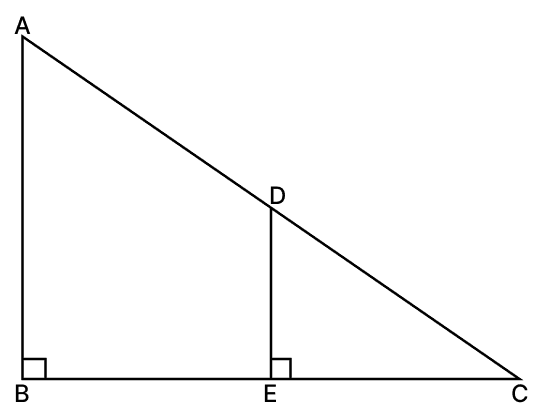
In the given figure, AB ⟂ BC and DE ⟂ BC. If AB = 9 cm, DE = 3 cm and AC = 24 cm, calculate AD.
Answer
Given,
AB ⟂ BC and DE ⟂ BC
Thus AB ∥ DE.
∠ABC = ∠DEC [Given]
∠ACB = ∠DCE [Common angle in both triangles]
∴ ΔABC ∼ ΔDEC (By A.A. axiom)
From figure,
DC = AC - AD = 24 - AD
We know that,
Corresponding sides of similar triangles are proportional.
∴ABDE=ACDC⇒93=2424−AD⇒24−AD=93×24⇒24−AD=972⇒24−AD=8⇒AD=24−8⇒AD=16 cm.
Hence, AD = 16 cm.
Question 5
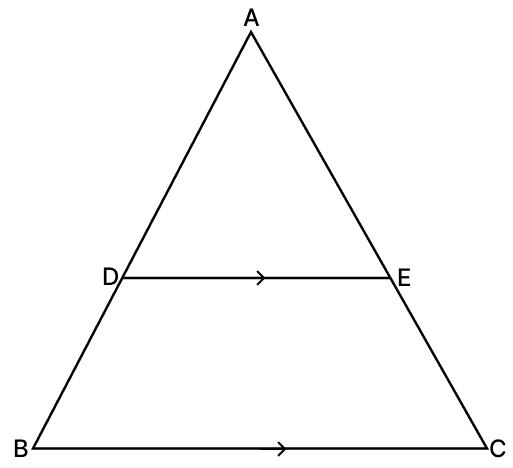
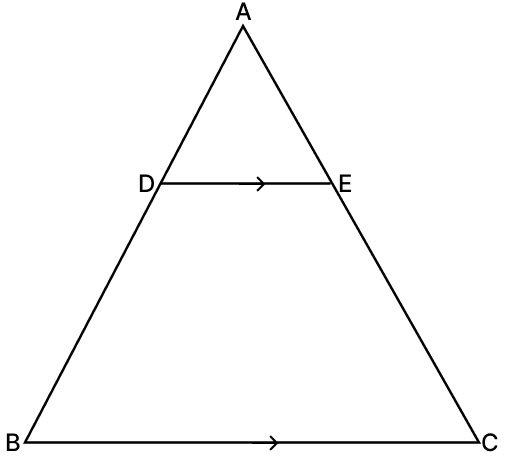
In the given figure, DE || BC. If DE = 4 cm, BC = 6 cm and ar(ΔADE) = 20 cm2, find the area of ΔABC.
Answer
Considering ΔADE and ΔABC,
∠A = ∠A [Common angles]
∠ADE = ∠ABC [Corresponding angles are equal]
∴ ΔADE ∼ ΔABC (By A.A. axiom)
We know that,
The ratio of the areas of two similar triangles is equal to the ratio of the square of their corresponding sides.
Let the area of ΔABC be x cm2.
∴Area of ΔABCArea of ΔADE=(BCDE)2⇒Area of ΔABCArea of ΔADE=BC2DE2⇒x20=6242⇒x20=3616⇒x=1620×36⇒x=16720⇒x=45 cm2
Hence, area of ΔABC = 45 cm2.
Question 6
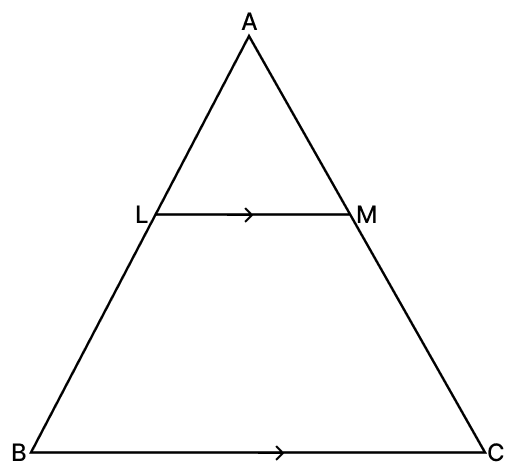
In the given figure, LM ∥ BC. If AB = 6 cm, AL = 2 cm and AC = 9 cm, calculate :
(i) the length of CM,
(ii) Find the value of ar(trap. LBCM)ar(ΔALM).
Answer
(i) Given,
AB = 6 cm
AL = 2 cm
LB = AB - AL = 6 - 2 = 4 cm
AC = AM + MC
AM = AC - MC
AM = 9 - MC
In ΔAML and ΔABC,
∠AML = ∠ACB [Corresponding angles are equal]
∠LAM = ∠BAC [Common angle]
ΔAML ∼ ΔABC [By AA similarity]
We know that,
Corresponding sides of similar triangles are proportional.
∴LBAL=MCAM⇒42=MC9−MC⇒2MC=4(9−MC)⇒2MC=36−4MC⇒2MC+4MC=36⇒6MC=36⇒MC=636⇒MC=6 cm.
Hence, CM = 6 cm.
(ii) Given
In ΔALM and ΔABC,
∠AML = ∠ACB [Corresponding angles are equal]
∠LAM = ∠BAC [Common angle]
ΔAML ∼ ΔABC [By AA similarity]
We know that,
The ratio of the areas of two similar triangles is equal to the ratio of the square of their corresponding sides.
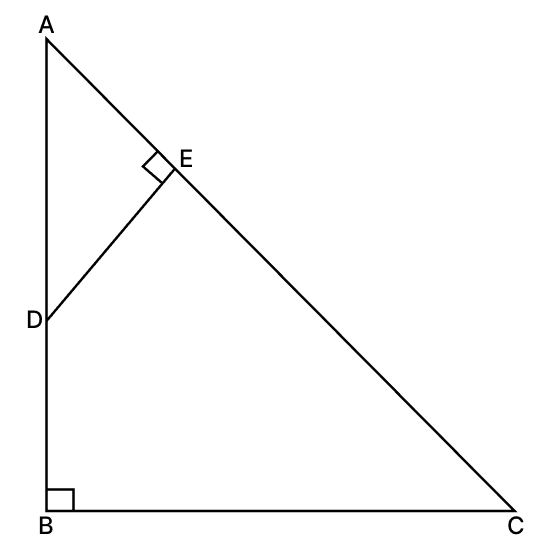
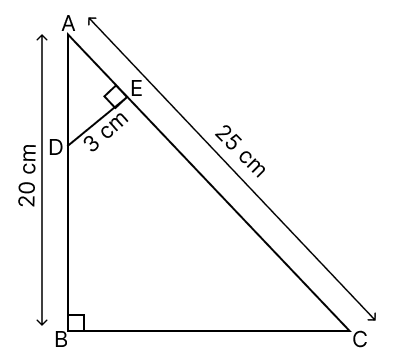
In ΔABC, it is given that AB = 12 cm, ∠B = 90° and AC = 15 cm. If D and E are points on AB and AC respectively such that ∠AED = 90° and DE = 3 cm, prove that :
(i) ΔABC ∼ ΔAED.
(ii) ar(ΔAED) = 6 cm2.
(iii) ar(quad BCED) : ar(ΔABC) = 8 : 9.
Answer
(i) Given,
∠ABC = ∠AED = 90° [Given]
∠BAC = ∠DAE [Common angle]
∴ ΔABC ∼ ΔAED (By A.A. axiom)
Hence, proved that ΔABC ∼ ΔAED.
(ii) ΔABC is right-angled triangle, applying pythagoras theorem,
⇒ AC2 = AB2 + BC2
⇒ BC2 = AC2 - AB2
⇒ BC2 = (15)2 - (12)2
⇒ BC2 = 225 - 144
⇒ BC2 = 81
⇒ BC = 81
⇒ BC = 9 cm
Area of ΔABC = 21 × Base × height
= 21 × 12 × 9
= 54 cm2
Since, ΔABC ∼ ΔAED,
We know that,
The ratio of the areas of two similar triangles is equal to the square of the ratio of their corresponding sides.
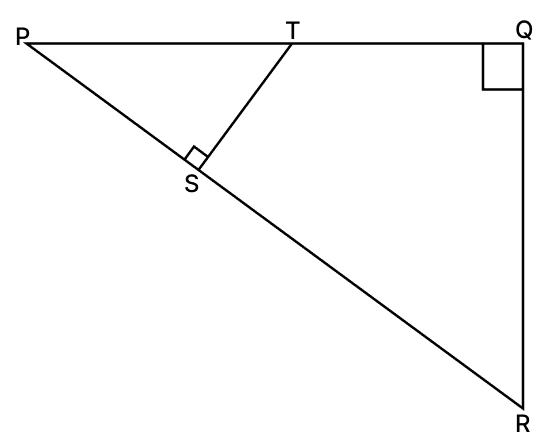
In the given figure, ∠PQR = ∠PST = 90°, PQ = 5 cm and PS = 2 cm.
(i) Prove that ΔPQR ∼ ΔPST.
(ii) Find area of ΔPQR : Area of quadrilateral SRQT.
Answer
(i) Considering ΔPQR and ΔPST.
∠P = ∠P [Common angles]
∠PQR = ∠PST [Both are equal to 90°]
∴ ΔPQR ∼ ΔPST (By A.A. axiom)
Hence, proved that ΔPQR ∼ ΔPST.
(ii) We know that,
The ratio of the areas of two similar triangles is equal to the square of the ratio of their corresponding sides.
⇒Area of ΔPSTArea of ΔPQR=PS2PQ2⇒Area of ΔPSTArea of ΔPQR=2252⇒Area of ΔPQR−Area of SRQTArea of ΔPQR=425⇒4 Area of ΔPQR=25( Area of ΔPQR−Area of SRQT)⇒4 Area of ΔPQR=25 Area of ΔPQR−25Area of SRQT⇒25Area of SRQT=25 Area of ΔPQR−4 Area of ΔPQR⇒25Area of SRQT=21 Area of ΔPQR⇒Area of SRQTArea of ΔPQR=2125.
Hence, area of ΔPQR : Area of quadrilateral SRQT = 25 : 21.
Question 9
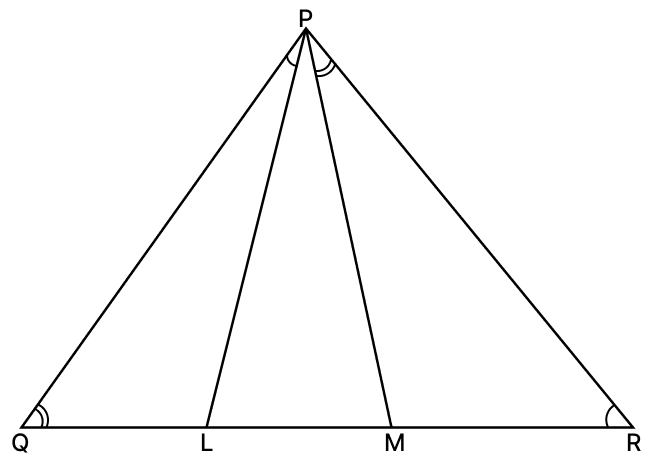
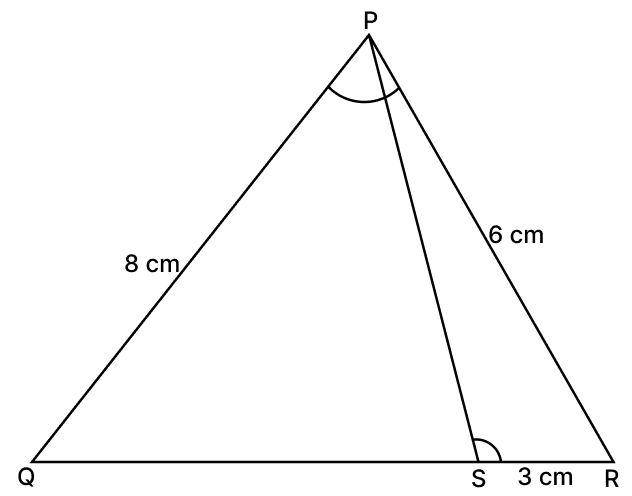
In a ΔPQR, L and M are two points on the base QR such that ∠LPQ = ∠QRP and ∠RPM = ∠QRP. Prove that
(i) ΔPQL ∼ ΔRPM.
(ii) QL × RM = PL × PM.
(iii) PQ2 = QL × QR.
Answer
(i) In ΔPQL and ΔRPM
∠LPQ = ∠MRP [Given]
∠LQP = ∠RPM [Given]
∴ ΔPQL ∼ ΔRPM (y A.A. axiom)
Hence, proved that ΔPQL ∼ ΔRPM.
(ii) Since, ΔPQL ∼ ΔRPM and corresponding sides of similar triangle are proportional to each other.
∴PMQL=RMPL⇒QL×RM=PL×PM.
Hence, proved that QL × RM = PL × PM.
(iii) In ΔPQL and ΔRQP
∠LPQ = ∠QRP [Given]
∠Q = ∠Q [Common]
∴ ΔPQL ∼ ΔRQP (By A.A. axiom)
Since, corresponding sides of similar triangle are proportional to each other.
∴RQPQ=QPQL⇒PQ2=QR×QL.
Hence, proved that PQ2 = QR x QL.
Question 10
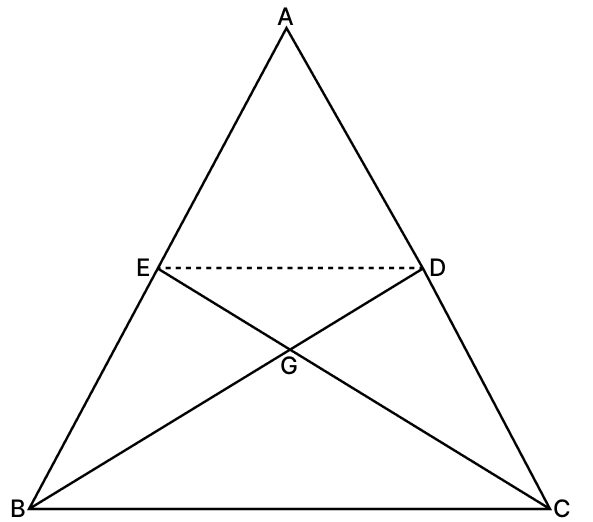
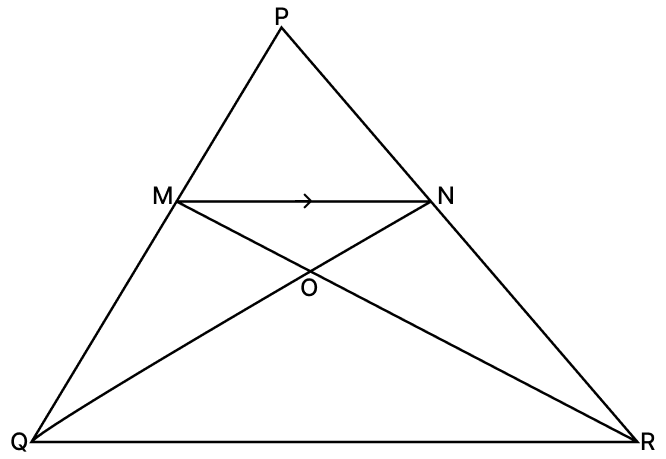
In the adjoining figure, the medians BD and CE of a ΔABC meet at G. Prove that :
(i) ΔEGD ∼ ΔCGB.
(ii) BG = 2 × GD.
Answer
(i) Since, BD and CE are medians.
So, E is mid-point of AB and D is mid-point of AC.
By mid-point theorem,
ED ∥ BC and ED = 21 BC [By mid-point theorem]
⇒BCED=21
⇒EDBC=2 .....(1)
In triangle EGD and BGC,
∠EGD = ∠BGC [Vertically opposite angles are equal]
∠DEG = ∠GCB [Alternate angles are equal]
∴ ΔEGD ∼ ΔCGB by (By A.A. axiom)
Hence, proved that ΔEGD ∼ ΔCGB.
(ii) Since, corresponding sides of similar triangle are proportional to each other.
⇒GDBG=EDBC⇒GDBG=2.....(From 1)⇒BG=2GD.
Hence, proved that BG = 2GD.
Question 11
In the given diagram ∆ADB and ∆ACB are two right angled triangles with ∠ADB = ∠BCA = 90°. If AB = 10 cm, AD = 6 cm, BC = 2.4 cm and DP = 4.5 cm
(i) Prove that ∆APD ∼ ∆BPC.
(ii) Find the length of BD and PB
(iii) Hence, find the length of PA
(iv) Find area ∆APD : area ∆BPC
Answer
(i) In ∆APD and ∆BPC,
⇒ ∠APD = ∠BPC (Vertically opposite angles are equal)
⇒ ∠ADP = ∠BCP (Both equal to 90°)
Hence, proved that ∆APD ∼ ∆BPC.
(ii) In ∆ADB,
By pythagoras theorem,
⇒ AB2 = AD2 + BD2
⇒ 102 = 62 + BD2
⇒ BD2 = 100 - 36
⇒ BD2 = 64
⇒ BD = 64 = 8 cm.
⇒ PB = BD - PD = 8 - 4.5 = 3.5 cm
Hence, BD = 8 cm and PB = 3.5 cm.
(iii) In ∆APD,
By pythagoras theorem,
⇒ AP2 = AD2 + DP2
⇒ AP2 = 62 + (4.5)2
⇒ AP2 = 36 + 20.25
⇒ AP2 = 56.25
⇒ AP = 56.25 = 7.5 cm
Hence, length of AP = 7.5 cm.
(iv) We know that,
Ratio of area of similar triangles is equal to the square of the corresponding sides.
∴Area of △BPCArea of △APD=BC2AD2=(2.4)262=2.4×2.46×6=0.4×0.41×1=4×410×10=16100=425=25:4.
Hence, area ∆APD : area ∆BPC = 25 : 4.
Question 12
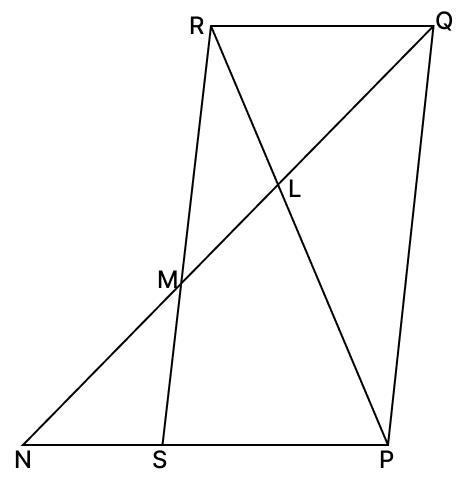
In the adjoining figure, PQRS is a parallelogram with PQ = 15 cm and RQ = 10 cm. If L is a point on RP such that RL : PL = 2 : 3 and QL produced meets RS at M and PS produced at N, find the lengths of PN and RM.
Answer
In ΔRLQ and ΔPLN,
⇒ ∠RLQ = ∠PLN [Vertically opposite angles are equal]
⇒ ∠LRQ = ∠LPN [Alternate angles are equal]
∴ ΔRLQ ∼ ΔPLN (By A.A. axiom)
Since, corresponding sides of similar triangles are proportional we have :
⇒LPRL=PNRQ⇒32=PN10⇒PN=230=15 cm.
In ΔRLM and ΔPLQ,
⇒ ∠RLM = ∠PLQ [Vertically opposite angles are equal]
⇒ ∠LRM = ∠LPQ [Alternate angles are equal]
∴ ΔRLM ∼ ΔPLQ (By A.A. axiom)
Since, corresponding sides of similar triangles are proportional we have :
⇒PQRM=LPRL⇒15RM=32⇒RM=330⇒RM=10 cm.
Hence, PN = 15 cm and RM = 10 cm.
Question 13
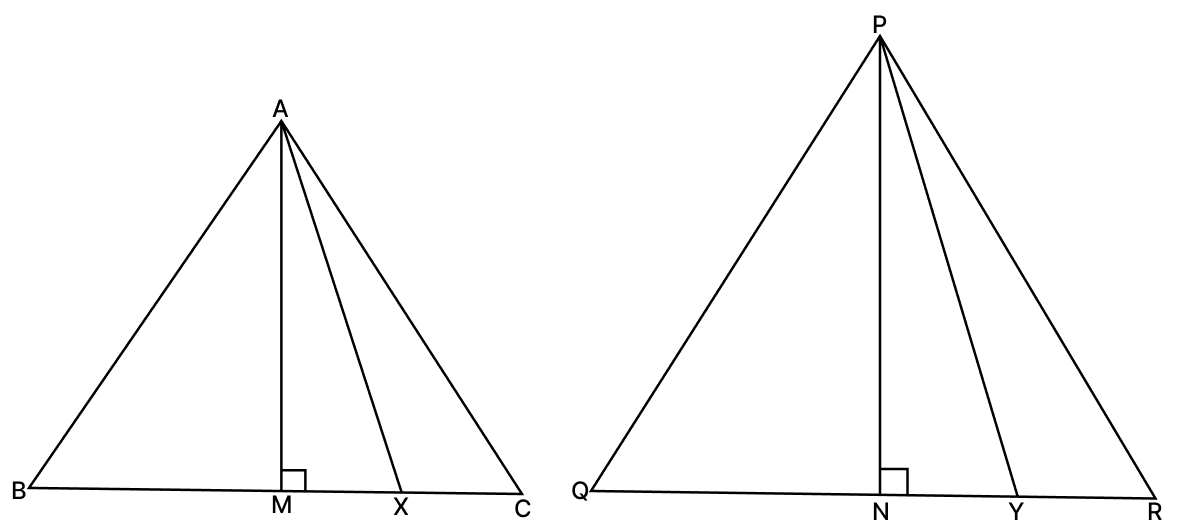
In the given figure, ΔABC ∼ ΔPQR, AM and PN are altitudes, whereas AX and PY are medians. Prove that PNAM=PYAX.
Answer
Since ΔABC ∼ ΔPQR
So, their respective sides will be in proportion
PQAB=PRAC=QRBC
Also, ∠A = ∠P, ∠B = ∠Q, ∠C = ∠R
In ΔABM and ΔPQN,
∠ABM = ∠PQN [Since, ABC and PQR are similar]
∠AMB = ∠PNQ = 90° [Given ]
∴ ΔΑΒΜ ∼ ΔPQN by AA similarity
PNAM=PQAB .....(1)
Since, AX and PY are medians so they will divide their opposite sides.
BX = 2BC and QY = 2QR
Therefore, we have:
PQAB=QYBX
∠ABC = ∠PQR
So, we had observed that two respective sides are in same proportion in both triangles and also angle included between them is respectively equal.
Hence, ∆ABX ∼ ∆PQY (by SAS similarity rule).So,
PQAM=PYAX .....(2)
From (1) and (2),
PNAM=PYAX
Hence, proved that PNAM=PYAX
Question 14
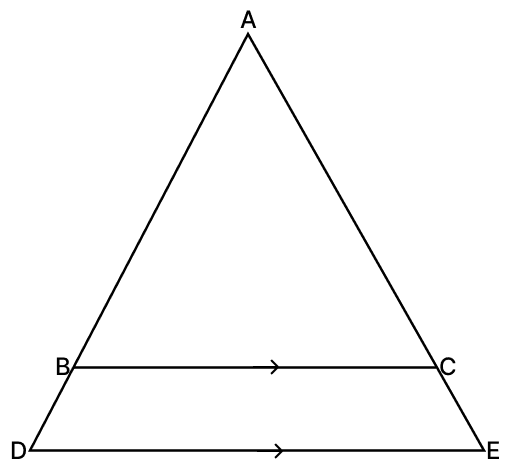
In the given figure, BC ∥ DE, area (ΔABC) = 25 cm2, area (trap. BCED) = 24 cm2 and DE = 14 cm. Calculate the length of BC.
Answer
Area of ΔADE = Area of ΔABC + Area of trapezium BCED = 25 + 24 = 49 cm2.
Given,
BC ∥ DE.
In ΔABC and ΔADE,
∠ABC = ∠ADE [Corresponding angles are equal]
∠ACB = ∠AED [Corresponding angles are equal]
∴ ΔABC ∼ ΔADE by (By A.A. axiom)
We know that,
The ratio of the areas of two similar triangles is equal to the ratio of squares of their corresponding sides.
∴Area of ΔADEArea of ΔABC=DE2BC2⇒4925=142BC2⇒BC2=4925×196⇒BC2=100⇒BC=10 cm.
Hence, BC = 10 cm.
Question 15
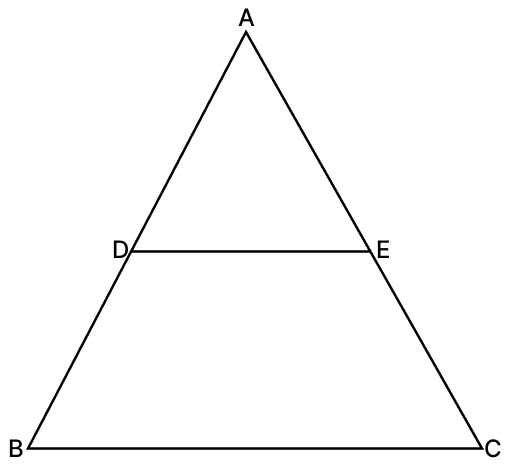
In the given figure, DE ∥ BC and DE : BC = 3 : 5. alculate ar(ΔADE) : ar(trap. BCED).
Answer
It is given that DE ∥ BC.
∠ADE = ∠ABC [Corresponding angles are equal]
∠AED = ∠ACB [Corresponding angles are equal]
∴ ΔADE ∼ ΔАВС (By A.A. axiom)
We know that,
The ratio of the areas of two similar triangles is equal to the square of the ratio of their corresponding sides.