KnowledgeBoat Logo
|
OPEN IN APP

Chapter 16

Similarity of Triangles

Class - 10 RS Aggarwal Mathematics Solutions


Exercise 16A

Question 1

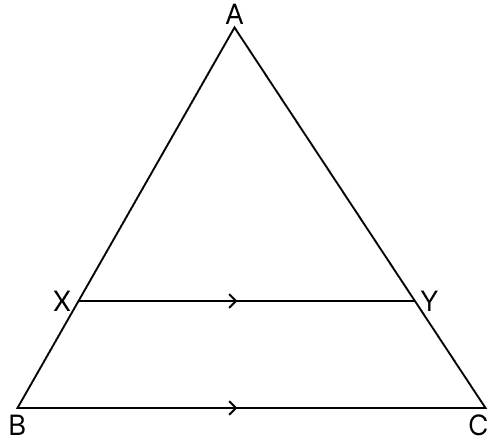
In the given figure, XY || BC. Given that AX = 3 cm, XB = 1.5 cm and BC = 6 cm.

(i) Calculate AYYC\dfrac{AY}{YC}.

(ii) Calculate XY.

In the given figure, XY || BC. Given that AX = 3 cm, XB = 1.5 cm and BC = 6 cm. Similarity of Triangles, RSA Mathematics Solutions ICSE Class 10.

Answer

(i) By basic proportionality theorem,

A line drawn parallel to a side of triangle divides the other two sides proportionally.

Since, XY || BC

AYYC=AXXB=31.5=21.\therefore \dfrac{AY}{YC} = \dfrac{AX}{XB} \\[1em] = \dfrac{3}{1.5} \\[1em] = \dfrac{2}{1}.

Hence, AYYC=21\dfrac{AY}{YC} = \dfrac{2}{1}.

(ii) In ΔAXY and ΔABC,

∠AXY = ∠ABC [Corresponding angles are equal]

∠XAY = ∠BAC [Common ]

∴ ΔAXY ∼ ΔABC.

Since, corresponding sides of similar triangle are proportional to each other.

AXAB=XYBCAXAX+XB=XYBC33+1.5=XY634.5=XY6XY=34.5×6XY=4 cm.\Rightarrow \dfrac{AX}{AB} = \dfrac{XY}{BC} \\[1em] \Rightarrow \dfrac{AX}{AX + XB} = \dfrac{XY}{BC} \\[1em] \Rightarrow \dfrac{3}{3 + 1.5} = \dfrac{XY}{6} \\[1em] \Rightarrow \dfrac{3}{4.5} = \dfrac{XY}{6} \\[1em] \Rightarrow XY = \dfrac{3}{4.5} \times 6 \\[1em] \Rightarrow XY = 4 \text{ cm.}

Hence, XY = 4 cm.

Question 2

In the given figure, DE || BC.

(i) If AD = 3.6 cm, AB = 9 cm and AE = 2.4 cm, find EC.

(ii) If ADDB=35\dfrac{AD}{DB} = \dfrac{3}{5} and AC = 5.6 cm, find AE.

(iii) If AD = x cm, DB = (x − 2) cm, AE = (x + 2) cm and EC = (x − 1) cm, find the value of x.
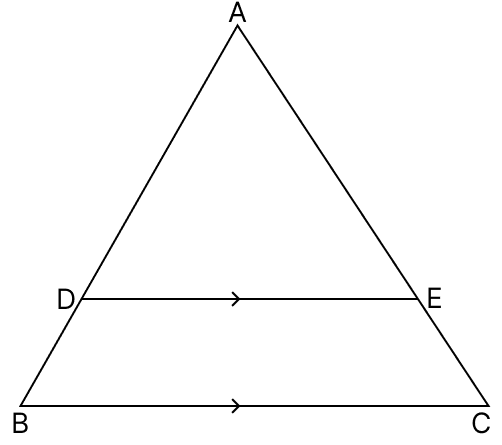
In the given figure, DE || BC. Similarity of Triangles, RSA Mathematics Solutions ICSE Class 10.

Answer

By basic proportionality theorem,

A line drawn parallel to a side of triangle divides the other two sides proportionally.

(i) Given,

AD = 3.6 cm

AB = 9 cm

AE = 2.4 cm

Since, DE || BC by basic proportionality theorem,

ADDB=AEECADABAD=AEEC3.693.6=2.4EC3.65.4=2.4ECEC=5.4×2.43.6EC=3.6 cm.\Rightarrow \dfrac{AD}{DB} = \dfrac{AE}{EC} \\[1em] \Rightarrow \dfrac{AD}{AB - AD} = \dfrac{AE}{EC} \\[1em] \Rightarrow \dfrac{3.6}{9 - 3.6} = \dfrac{2.4}{EC}\\[1em] \Rightarrow \dfrac{3.6}{5.4} = \dfrac{2.4}{EC}\\[1em] \Rightarrow EC = \dfrac{5.4 \times 2.4}{3.6}\\[1em] \Rightarrow EC = 3.6 \text{ cm.}

Hence, EC = 3.6 cm.

(ii) Given,

ADDB=35\dfrac{AD}{DB} = \dfrac{3}{5}

AC = 5.6 cm

Since, DE || BC by basic proportionality theorem,

ADDB=AEECADDB=AEACAE35=AE5.6AE3×(5.6AE)=5AE16.83AE=5AE5AE+3AE=16.88AE=16.8AE=16.88AE=2.1 cm.\Rightarrow \dfrac{AD}{DB} = \dfrac{AE}{EC} \\[1em] \Rightarrow \dfrac{AD}{DB} = \dfrac{AE}{AC - AE} \\[1em] \Rightarrow \dfrac{3}{5} = \dfrac{AE}{5.6 - AE}\\[1em] \Rightarrow 3 \times (5.6 - AE) = 5AE \\[1em] \Rightarrow 16.8 - 3AE = 5AE \\[1em] \Rightarrow 5AE + 3AE = 16.8 \\[1em] \Rightarrow 8AE = 16.8 \\[1em] \Rightarrow AE = \dfrac{16.8}{8} \\[1em] \Rightarrow AE = 2.1 \text{ cm.}

Hence, AE = 2.1 cm.

(iii) Given,

AD = x cm

DB = (x − 2) cm

AE = (x + 2) cm

EC = (x − 1) cm

Since, DE || BC by basic proportionality theorem,

ADDB=AEECx(x2)=(x+2)(x1)x(x1)=(x+2)(x2)x2x=(x2(2)2)x2x=x24x2xx2+4=0x+4=0x=4 cm.\Rightarrow \dfrac{AD}{DB} = \dfrac{AE}{EC} \\[1em] \Rightarrow \dfrac{x}{(x - 2)} = \dfrac{(x + 2)}{(x - 1)} \\[1em] \Rightarrow x(x - 1) = (x + 2) (x - 2) \\[1em] \Rightarrow x^2 - x = (x^2 - (2)^2) \\[1em] \Rightarrow x^2 - x = x^2 - 4 \\[1em] \Rightarrow x^2 - x - x^2 + 4 = 0 \\[1em] \Rightarrow - x + 4 = 0 \\[1em] \Rightarrow x = 4 \text{ cm.}

Hence, x = 4 cm.

Question 3

D and E are points on the sides AB and AC respectively of ΔABC. For each of the following cases, state whether DE ∥ BC :

(i) AD = 5.7 cm, BD = 9.5 cm, AE = 3.6 cm and EC = 6 cm.

(ii) AB = 5.6 cm, AD = 1.4 cm, AC = 9.6 cm and EC = 2.4 cm.

(iii) AB = 11.7 cm, BD = 5.2 cm, AE = 4.4 cm and AC = 9.9 cm.

(iv) AB = 10.8 cm, BD = 4.5 cm, AC = 4.8 cm and AE = 2.8 cm.

Answer

By basic proportionality theorem,

A line drawn parallel to a side of triangle divides the other two sides proportionally.

(i) Given,

AD = 5.7 cm

BD = 9.5 cm

AE = 3.6 cm

EC = 6 cm.

Check for proportionality,

ADDB=5.79.5ADDB=35=0.6AEEC=3.66.0AEEC=35=0.6ADDB=AEEC.\Rightarrow \dfrac{AD}{DB} = \dfrac{5.7}{9.5} \\[1em] \Rightarrow \dfrac{AD}{DB} = \dfrac{3}{5} = 0.6 \\[1em] \Rightarrow \dfrac{AE}{EC} = \dfrac{3.6}{6.0} \\[1em] \Rightarrow \dfrac{AE}{EC} = \dfrac{3}{5} = 0.6 \\[1em] \therefore \dfrac{AD}{DB} = \dfrac{AE}{EC}.

We conclude that DE is parallel to BC

Hence, DE is parallel to BC.

(ii) Given,

AB = 5.6 cm

AD = 1.4 cm

AC = 9.6 cm

EC = 2.4 cm.

From figure,

DB = AB - AD = 5.6 - 1.4 = 4.2 cm

AE = AC - EC = 9.6 - 2.4 = 7.2 cm

Check for proportionality,

ADDB=1.44.2ADDB=13AEEC=7.22.4AEEC=3ADDBAEEC.\Rightarrow \dfrac{AD}{DB} = \dfrac{1.4}{4.2} \\[1em] \Rightarrow \dfrac{AD}{DB} = \dfrac{1}{3} \\[1em] \Rightarrow \dfrac{AE}{EC} = \dfrac{7.2}{2.4} \\[1em] \Rightarrow \dfrac{AE}{EC} = 3 \\[1em] \therefore \dfrac{AD}{DB} \ne \dfrac{AE}{EC}.

We conclude that DE is not parallel to BC

Hence, DE is not parallel to BC.

(iii) Given,

AB = 11.7 cm

BD = 5.2 cm

AE = 4.4 cm

AC = 9.9 cm.

From figure,

AD = AB - BD = 11.7 - 5.2 = 6.5 cm

EC = AC - AE = 9.9 - 4.4 = 5.5 cm

Check for proportionality,

ADDB=6.55.2ADDB=54=1.25AEEC=4.45.5AEEC=45=0.8ADDBAEEC.\Rightarrow \dfrac{AD}{DB} = \dfrac{6.5}{5.2} \\[1em] \Rightarrow \dfrac{AD}{DB} = \dfrac{5}{4} = 1.25 \\[1em] \Rightarrow \dfrac{AE}{EC} = \dfrac{4.4}{5.5} \\[1em] \Rightarrow \dfrac{AE}{EC} = \dfrac{4}{5} = 0.8 \\[1em] \therefore \dfrac{AD}{DB} \ne \dfrac{AE}{EC}.

We conclude that DE is not parallel to BC

Hence, DE is not parallel to BC.

(iv) Given,

AB = 10.8 cm

BD = 4.5 cm

AC = 4.8 cm

AE = 2.8 cm.

AD = AB - BD = 10.8 - 4.5 = 6.3 cm

EC = AC - AE = 4.8 - 2.8 = 2 cm

Check for proportionality,

ADDB=6.34.5ADDB=75=1.4AEEC=2.82.0AEEC=75=1.4ADDB=AEEC.\Rightarrow \dfrac{AD}{DB} = \dfrac{6.3}{4.5} \\[1em] \Rightarrow \dfrac{AD}{DB} = \dfrac{7}{5} = 1.4 \\[1em] \Rightarrow \dfrac{AE}{EC} = \dfrac{2.8}{2.0} \\[1em] \Rightarrow \dfrac{AE}{EC} = \dfrac{7}{5} = 1.4 \\[1em] \therefore \dfrac{AD}{DB} = \dfrac{AE}{EC}.

We conclude that DE is parallel to BC

Hence, DE is parallel to BC.

Question 4

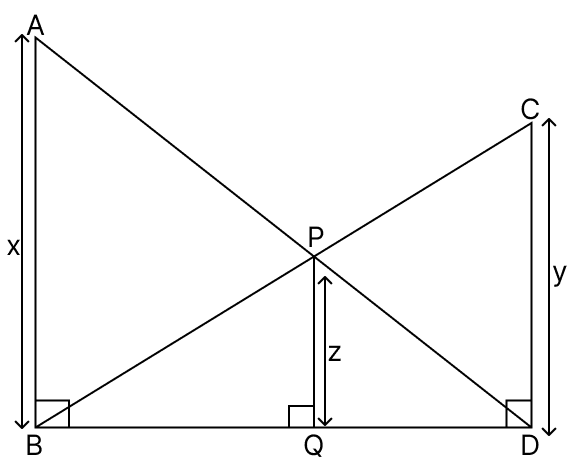
In the given figure, it is given that ∠ABD = ∠CDB = ∠PQB = 90°. If AB = x units, CD = y units and PQ = z units, prove that 1x+1y=1z\dfrac{1}{x} + \dfrac{1}{y} = \dfrac{1}{z}.

In the given figure, it is given that ∠ABD = ∠CDB = ∠PQB = 90°. If AB = x units, CD = y units and PQ = z units Similarity of Triangles, RSA Mathematics Solutions ICSE Class 10.

Answer

In ΔPQD and ΔABD,

∠ABD = ∠PQD = 90° [From figure]

∠ADB = ∠PDQ [Common angles]

∴ ΔPQD ∼ ΔABD (By A.A. axiom)

Corresponding sides of similar triangles are proportional.

PQAB=QDBDzx=QDBD .....(1)\Rightarrow \dfrac{PQ}{AB} = \dfrac{QD}{BD} \\[1em] \Rightarrow \dfrac{z}{x} = \dfrac{QD}{BD} \text{ .....(1)}

In ΔPQB and ΔCDB,

∠CDB = ∠PQB = 90° [Given]

∠CBD = ∠PBQ [Common angles]

∴ ΔPQB ∼ ΔCDB (By A.A. axiom)

Corresponding sides of similar triangles are proportional.

PQCD=BQBDzy=BQBD ....(2)\Rightarrow \dfrac{PQ}{CD} = \dfrac{BQ}{BD} \\[1em] \Rightarrow \dfrac{z}{y} = \dfrac{BQ}{BD} \text{ ....(2)}

Add equations (1) and (2) we get,

zx+zy=QDBD+BQBDz(1x+1y)=BDBDz(1x+1y)=11x+1y=1z.\Rightarrow \dfrac{z}{x} + \dfrac{z}{y} = \dfrac{QD}{BD} + \dfrac{BQ}{BD} \\[1em] \Rightarrow z \Big(\dfrac{1}{x} + \dfrac{1}{y}\Big) = \dfrac{BD}{BD} \\[1em] \Rightarrow z \Big(\dfrac{1}{x} + \dfrac{1}{y}\Big) = 1 \\[1em] \Rightarrow \dfrac{1}{x} + \dfrac{1}{y} = \dfrac{1}{z}.

Hence, proved that 1x+1y=1z\dfrac{1}{x} + \dfrac{1}{y} = \dfrac{1}{z}.

Question 5

In ΔABC, AD is the bisector of ∠A. If BC = 10 cm, BD = 6 cm and AC = 6 cm, find AB.
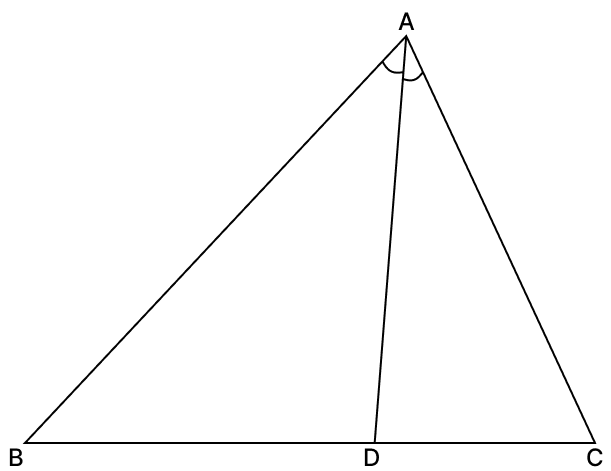
In ΔABC, AD is the bisector of ∠A. If BC = 10 cm, BD = 6 cm and AC = 6 cm, find AB. Similarity of Triangles, RSA Mathematics Solutions ICSE Class 10.

Answer

Construction: Draw a line through C parallel to AD, meeting BA produced at E.
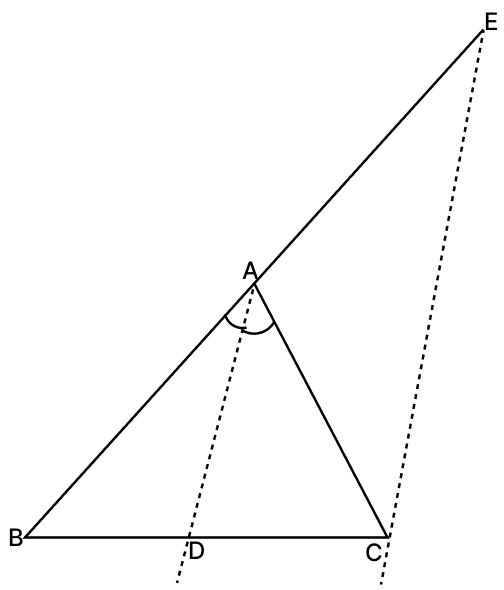
In ΔABC, AD is the bisector of ∠A. If BC = 10 cm, BD = 6 cm and AC = 6 cm, find AB. Similarity of Triangles, RSA Mathematics Solutions ICSE Class 10.

In ΔBCE,

Since AD ∥ CE, by Basic Proportionality Theorem:

BDDC=ABAE\dfrac{BD}{DC} = \dfrac{AB}{AE} ...(i)

Also, since AD ∥ CE:

∠BAD = ∠AEC [Corresponding angles are equal]

∠DAC = ∠ACE [Alternate interior angles are equal]

Since AD is bisector of ∠A, ∠BAD = ∠DAC.

Therefore, ∠AEC = ∠ACE.

In ΔACE, sides opposite to equal angles are equal:

AE = AC ...(ii)

Substitute (ii) into (i):

BDDC=ABAC\dfrac{BD}{DC} = \dfrac{AB}{AC}

Given,

AC = 6 cm

BC = 10 cm

BD = 6 cm

DC = BC - BD [from figure]

DC = 10 - 6 = 4 cm

Let length of AB be x,

BDDC=ABAC64=x632=x632×6=xx=9.\Rightarrow \dfrac{BD}{DC} = \dfrac{AB}{AC} \\[1em] \Rightarrow \dfrac{6}{4} = \dfrac{x}{6} \\[1em] \Rightarrow \dfrac{3}{2} = \dfrac{x}{6} \\[1em] \Rightarrow \dfrac{3}{2} \times 6 = x \\[1em] \Rightarrow x = 9.

Hence, length of AB is 9 cm.

Question 6

In the given figure, AC ∥ DE ∥ BF. If AC = 24 cm, EG = 8 cm, GB = 16 cm, BF = 30 cm.

(i) Prove that ΔGED ∼ ΔGBF.

(ii) Find DE.

(iii) Find DB : AB.
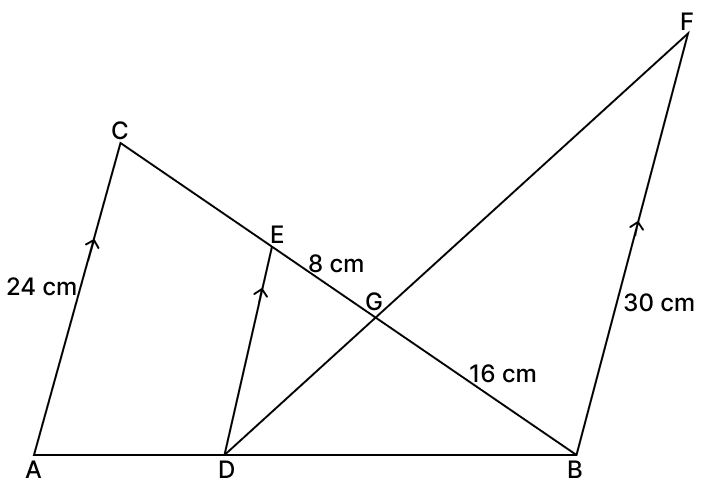
In the given figure, AC ∥ DE ∥ BF. If AC = 24 cm, EG = 8 cm, GB = 16 cm, BF = 30 cm. Similarity of Triangles, RSA Mathematics Solutions ICSE Class 10.

Answer

(i) In ΔGED and ΔGBF,

∠DGE = ∠BGF [Vertically opposite angles are equal]

∠GED = ∠GBF [Alternate angles are equal]

∴ ΔGED ∼ ΔGBF (By A.A. axiom)

Hence, proved ΔGED ∼ ΔGBF.

(ii) We know that,

Corresponding sides of similar triangles are proportional.

DEBF=EGGBDE30=816DE30=12DE=12×30DE=15 cm.\Rightarrow \dfrac{DE}{BF} = \dfrac{EG}{GB} \\[1em] \Rightarrow \dfrac{DE}{30} = \dfrac{8}{16} \\[1em] \Rightarrow \dfrac{DE}{30} = \dfrac{1}{2} \\[1em] \Rightarrow DE = \dfrac{1}{2} \times 30 \\[1em] \Rightarrow DE = 15 \text{ cm}.

Hence, DE = 15 cm.

(iii) In ΔDBE and ΔABC,

∠EBD = ∠CBA [Common angles]

∠BDE = ∠BAC [Corresponding angles are equal, Since AC ∥ DE]

ΔDBE ∼ ΔABC (By A.A. axiom)

Corresponding sides of similar triangles are proportional.

DBAB=DEACDBAB=1524DBAB=58.\Rightarrow \dfrac{DB}{AB} = \dfrac{DE}{AC} \\[1em] \Rightarrow \dfrac{DB}{AB} = \dfrac{15}{24} \\[1em] \Rightarrow \dfrac{DB}{AB} = \dfrac{5}{8}.

Hence, DB : AB = 5 : 8.

Question 7

In the adjoining figure, ABCD is a parallelogram, P is a point on side BC and DP when produced meets AB produced at L. Prove that :

(i) DP : PL = DC : BL.

(ii) DL : DP = AL : DC.
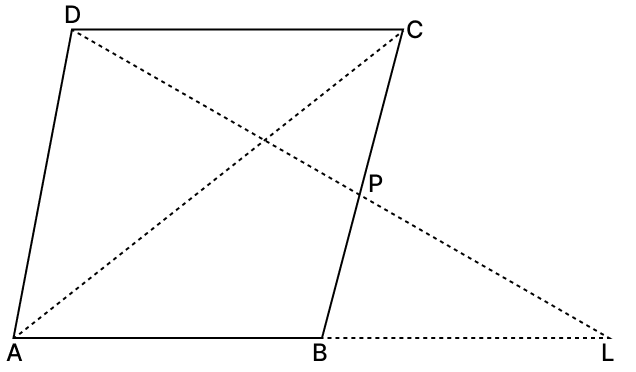
In the adjoining figure, ABCD is a parallelogram, P is a point on side BC and DP when produced meets AB produced at L. Prove that :  Similarity of Triangles, RSA Mathematics Solutions ICSE Class 10.

Answer

(i) Given,

ABCD is a parallelogram.

∴ AB || DC and AD || BC

In ΔDPC and ΔLPB,

∠PDC = ∠PLB [Alternate angles are equal]

∠DPC = ∠LPB [Vertically opposite angles are equal]

∴ ΔDPC ∼ ΔLPB (By A.A. axiom)

Corresponding sides of similar triangles are proportional.

DPLP=DCLB\dfrac{DP}{LP} = \dfrac{DC}{LB}

DP : PL = DC : BL

Hence, proved DP : PL = DC : BL.

(ii) In ΔALD and ΔCPD,

∠ALD = ∠PDC [Alternate interior angles, AB || DC]

∠DAL = ∠PCD [Opposite angles of a parallelogram are equal]

∴ ΔLAD ∼ ΔDCP (By A.A. axiom)

Corresponding sides of similar triangles are proportional.

DLDP=ALDC\dfrac{DL}{DP} = \dfrac{AL}{DC}

DL : DP = AL : DC

Hence, proved DL : DP = AL : DC.

Question 8

In the given figure, ABCD is a parallelogram, E is a point on BC and the diagonal BD intersects AE at F.

Prove that DF × FE = FB × FA.
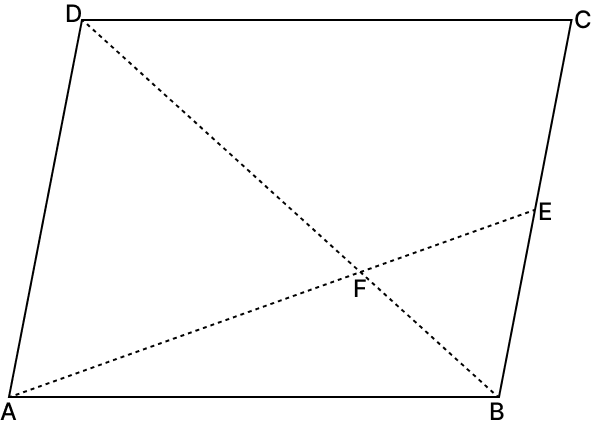
In the given figure, ABCD is a parallelogram, E is a point on BC and the diagonal BD intersects AE at F. Similarity of Triangles, RSA Mathematics Solutions ICSE Class 10.

Answer

Since, ABCD is a || gm

∴ AD || BC

In ΔADF and ΔEBF,

∠ADF = ∠EBF [Alternate angles are equal]

∠AFD = ∠EFB [Vertically opposite angles are equal]

∴ ΔADF ∼ ΔEBF (By A.A. axiom)

Corresponding sides of similar triangles are proportional.

DFFB=FAFE\dfrac{DF}{FB} = \dfrac{FA}{FE}

DF × FE = FB × FA

Hence, proved that DF × FE = FB × FA.

Question 9

In the adjoining figure (not drawn to scale), PS = 4 cm, SR = 2 cm, PT = 3 cm and QT = 5 cm.

(i) Show that ΔPQR ∼ ΔPST.

(ii) Calculate ST, if QR = 5.8 cm.
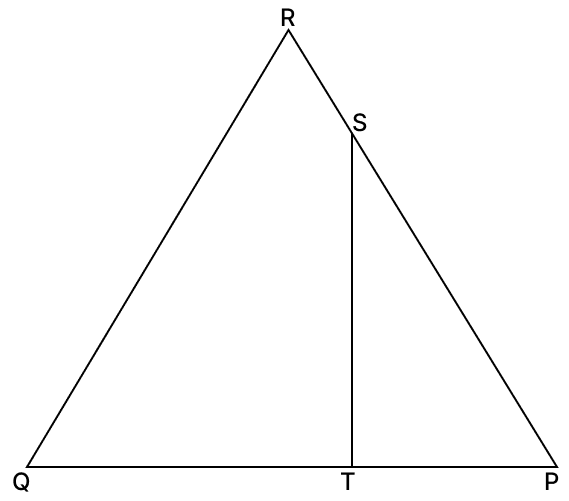
In the adjoining figure (not drawn to scale), PS = 4 cm, SR = 2 cm, PT = 3 cm and QT = 5 cm. Similarity of Triangles, RSA Mathematics Solutions ICSE Class 10.

Answer

(i) Given,

PS = 4 cm, SR = 2 cm, PT = 3 cm and QT = 5 cm.

PR = PS + SR = 4 + 2 = 6 cm

PQ = PT + TQ = 3 + 5 = 8 cm

In ΔPQR and ΔPST,

PQPS=84=2PRPT=63=2PQPS=PRPT\Rightarrow \dfrac{PQ}{PS} = \dfrac{8}{4} = 2 \\[1em] \Rightarrow \dfrac{PR}{PT} = \dfrac{6}{3} = 2 \\[1em] \therefore \dfrac{PQ}{PS} = \dfrac{PR}{PT}

∠QPR = ∠SPT [Common angle]

∴ ΔPQR ∼ ΔPST [By S.A.S. axiom]

Hence, ΔPQR ∼ ΔPST.

(ii) We know that,

Corresponding sides of similar triangles are proportional.

QRST=PQPS5.8ST=84ST=5.82ST=2.9 cm.\Rightarrow \dfrac{QR}{ST} = \dfrac{PQ}{PS} \\[1em] \Rightarrow \dfrac{5.8}{ST} = \dfrac{8}{4} \\[1em] \Rightarrow ST = \dfrac{5.8}{2} \\[1em] \Rightarrow ST = 2.9 \text{ cm.}

Hence, ST = 2.9 cm.

Question 10

In the adjoining figure, ABCD is a parallelogram in which AB = 16 cm, BC = 10 cm and L is a point on AC such that CL : LA = 2 : 3. If BL produced meets CD at M and AD produced at N, prove that :

(i) ΔCLB ∼ ΔALN.

(ii) ΔCLM ∼ ΔALB.
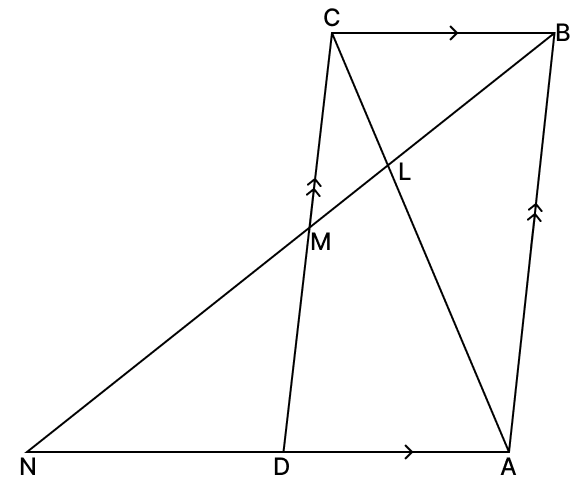
In the adjoining figure, ABCD is a parallelogram in which AB = 16 cm, BC = 10 cm and L is a point on AC such that CL : LA = 2 : 3. If BL produced meets CD at M and AD produced at N, prove that : Similarity of Triangles, RSA Mathematics Solutions ICSE Class 10.

Answer

(i) In ΔCLB and ΔALN,

∠CBL = ∠ANL [Alternate angles are equal]

∠CLB = ∠ALN [Vertically opposite angles are equal]

∴ ΔCLB ∼ ΔALN (By A.A. axiom)

Hence, proved that ΔCLB ∼ ΔALN.

(ii) In ΔCLM and ΔALB,

∠LMC = ∠LAB [Alternate angles, since CM ∥ AB, transversal LM]

∠CLM = ∠ALB [Vertically opposite angles are equal]

∴ ΔCLM ∼ ΔALB (By A.A. axiom)

Hence, proved that ΔCLM ∼ ΔALB.

Question 11

In the given figure, AB ∥ PQ and AC ∥ PR. Prove that BC ∥ QR.
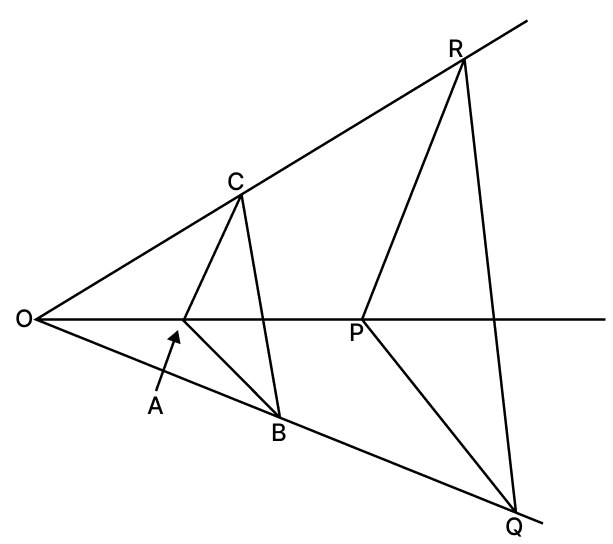
In the given figure, AB ∥ PQ and AC ∥ PR. Prove that BC ∥ QR. Similarity of Triangles, RSA Mathematics Solutions ICSE Class 10.

Answer

In ΔOPQ,

AB ∥ PQ [Given]

By Basic Proportionality Theorem,

OAAP=OBBQ\dfrac{OA}{AP} = \dfrac{OB}{BQ} .... (i)

In ΔOPR,

AC ∥ PR [Given]

By Basic Proportionality Theorem,

OAAP=OCCR\dfrac{OA}{AP} = \dfrac{OC}{CR} .... (ii)

From (i) and (ii), we get:

OBBQ=OCCR\dfrac{OB}{BQ} = \dfrac{OC}{CR}

In ΔOQR,

Since OBBQ=OCCR\dfrac{OB}{BQ} = \dfrac{OC}{CR}

By Converse of Basic Proportionality Theorem,

BC ∥ QR

Hence, proved that BC ∥ QR.

Question 12

In the given figure, medians AD and BE of ΔABC meet at G and DF ∥ BE. Prove that :

(i) EF = FC.

(ii) AG : GD = 2 : 1.
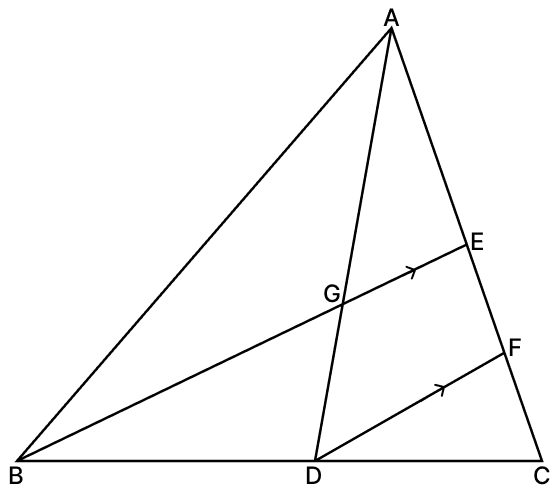
In the given figure, medians AD and BE of ΔABC meet at G and DF ∥ BE. Prove that : Similarity of Triangles, RSA Mathematics Solutions ICSE Class 10.

Answer

(i) In ∆CFD and ∆CEB,

∠CDF = ∠CBE [Corresponding angles are equal]

∠FCD = ∠ECB [Common]

∴ ∆CFD ∼ ∆CEB (By A.A. axiom)

Since, corresponding sides of similar triangles are proportional.

CFCE=CDCBCFCE=12 [∵ D is the mid-point of BC]CE=2CF.\Rightarrow \dfrac{CF}{CE} = \dfrac{CD}{CB} \\[1em] \Rightarrow \dfrac{CF}{CE} = \dfrac{1}{2} \text{ [∵ D is the mid-point of BC]} \Rightarrow CE = 2CF.

From figure,

⇒ CE = CF + FE

⇒ 2CF = CF + FE

⇒ CF = FE.

Hence, proved that EF = FC.

(ii) In ∆AFD,

GE ∥ DF

By basic proportionality theorem we have,

AEEF=AGGD\dfrac{AE}{EF} = \dfrac{AG}{GD} .....(1)

Now, AE = EC [∵ BE is media,n so E is the mid-point of AC]

As, AE = EC = 2EF [As, EF = FC].

Substituting value of AE in (1) we get,

AGGD=2EFEF=21.\dfrac{AG}{GD} = \dfrac{2EF}{EF} = \dfrac{2}{1}.

Hence, proved that AG : GD = 2 : 1.

Question 13

In the given figure, DE ∥ BC and BD = DC.

(i) Prove that DE bisects ∠ADC.

(ii) If AD = 4.5 cm, AE = 3.9 cm and DC = 7.5 cm, find CE.

(iii) Find the ratio AD : DB.
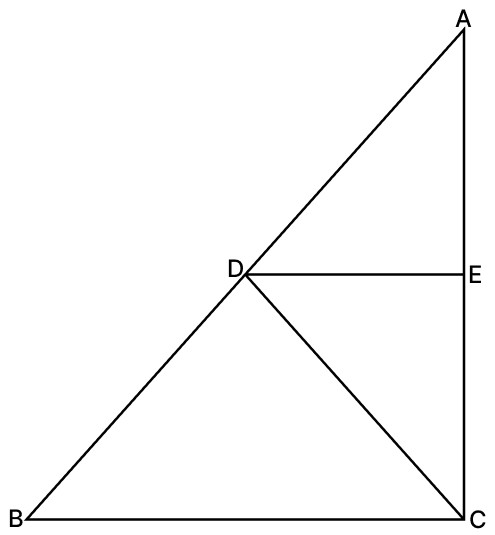
In the given figure, DE ∥ BC and BD = DC. Similarity of Triangles, RSA Mathematics Solutions ICSE Class 10.

Answer

(i) Given, DE ∥ BC.

⇒ ∠ADE = ∠DBC [Corresponding angles are equal] ... (1)

⇒ ∠EDC = ∠DCB [Alternate interior angles are equal] ... (2)

Given, BD = DC.

⇒ ∠DBC = ∠DCB [Angles opposite to equal sides are equal] ... (3)

From (1), (2), and (3), we get:

∠ADE = ∠EDC

Thus, DE bisects ∠ADC.

Hence, DE bisects ∠ADC.

(ii) Given,

AD = 4.5 cm, AE = 3.9 cm, DC = 7.5 cm

Given,

BD = DC = 7.5 cm

By basic proportionality theorem we have,

ADDB=AEEC4.57.5=3.9EC4.5×EC=3.9×7.54.5×EC=29.25EC=29.254.5EC=6.5 cm.\Rightarrow \dfrac{AD}{DB} = \dfrac{AE}{EC} \\[1em] \Rightarrow \dfrac{4.5}{7.5} = \dfrac{3.9}{EC} \\[1em] \Rightarrow 4.5 \times EC = 3.9 \times 7.5 \\[1em] \Rightarrow 4.5 \times EC = 29.25 \\[1em] \Rightarrow EC = \dfrac{29.25}{4.5} \\[1em] \Rightarrow EC = 6.5 \text{ cm.}

Hence, CE = 6.5 cm.

(iii) By basic proportionality theorem,

ADDB=AEECADDB=3.96.5ADDB=35.\Rightarrow \dfrac{AD}{DB} = \dfrac{AE}{EC} \\[1em] \Rightarrow \dfrac{AD}{DB} = \dfrac{3.9}{6.5} \\[1em] \Rightarrow \dfrac{AD}{DB} = \dfrac{3}{5}.

Hence, the ratio AD : DB is 3 : 5.

Question 14

In the given figure, BA ∥ DC. Show that ΔOAB ∼ ΔODC. If AB = 4 cm, CD = 3 cm, OC = 5.7 cm and OD = 3.6 cm, find OA and OB.
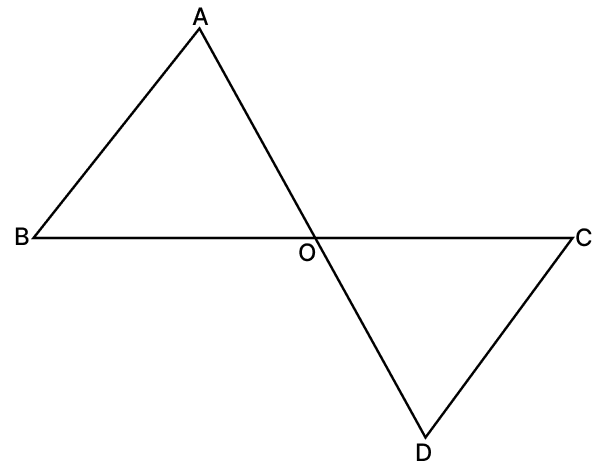
In the given figure, BA ∥ DC. Show that ΔOAB ∼ ΔODC. If AB = 4 cm, CD = 3 cm, OC = 5.7 cm and OD = 3.6 cm, find OA and OB. Similarity of Triangles, RSA Mathematics Solutions ICSE Class 10.

Answer

Considering ΔAOB and ΔDOC,

∠AOB = ∠COD [Vertically opposite angles are equal]

∠A = ∠D [Alternate angles are equal]

∴ ΔAOB ∼ ΔDOC (By A.A. axiom)

We know that,

Corresponding sides of similar triangles are proportional.

OAOD=OBOC=ABDC\Rightarrow \dfrac{OA}{OD} = \dfrac{OB}{OC} = \dfrac{AB}{DC}

Considering,

ABDC=OAOD43=OA3.6OA=4×3.63OA=14.43OA=4.8 cm.\Rightarrow \dfrac{AB}{DC} = \dfrac{OA}{OD} \\[1em] \Rightarrow \dfrac{4}{3} = \dfrac{OA}{3.6} \\[1em] \Rightarrow OA = \dfrac{4 \times 3.6}{3} \\[1em] \Rightarrow OA = \dfrac{14.4}{3} \\[1em] \Rightarrow OA = 4.8 \text{ cm}.

Considering,

ABDC=OBOC43=OB5.7OB=4×5.73OB=22.83OB=7.6 cm.\Rightarrow \dfrac{AB}{DC} = \dfrac{OB}{OC} \\[1em] \Rightarrow \dfrac{4}{3} = \dfrac{OB}{5.7} \\[1em] \Rightarrow OB = \dfrac{4 \times 5.7}{3} \\[1em] \Rightarrow OB = \dfrac{22.8}{3} \\[1em] \Rightarrow OB = 7.6 \text{ cm}.

Hence, OA = 4.8 cm and OB = 7.6 cm.

Question 15

In the given figure, ∠ABC = 90° and BD ⟂ AC. If AB = 5.7 cm, BD = 3.8 cm and CD = 5.4 cm, find BC.
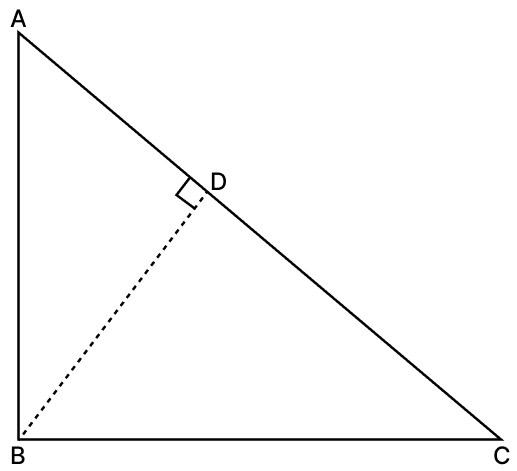
In the given figure, ∠ABC = 90° and BD ⟂ AC. If AB = 5.7 cm, BD = 3.8 cm and CD = 5.4 cm, find BC. Similarity of Triangles, RSA Mathematics Solutions ICSE Class 10.

Answer

We have, ∠ABC = 90° and BD ⟂ AC

In ΔABC and ΔBDC,

∠ABC = ∠BDC [Each 90°]

∠ACB = ∠BCD [Common]

∴ ΔABC ∼ ΔBDC (By A.A. axiom)

We know that,

Corresponding sides of similar triangles are proportional.

ABBD=BCDC5.73.8=BC5.4BC=5.7×5.43.8BC=30.783.8BC=8.1 cm.\therefore \dfrac{AB}{BD} = \dfrac{BC}{DC} \\[1em] \Rightarrow \dfrac{5.7}{3.8} = \dfrac{BC}{5.4} \\[1em] \Rightarrow BC = \dfrac{5.7 \times 5.4}{3.8}\\[1em] \Rightarrow BC = \dfrac{30.78}{3.8}\\[1em] \Rightarrow BC = 8.1 \text{ cm}.

Hence, BC = 8.1 cm.

Exercise 16B

Question 1

In the given figure, DE ∥ BC.

(i) Prove that ΔADE ∼ ΔABC.

(ii) Given that AD = 12\dfrac{1}{2} DB, calculate DE, if BC = 4.5 cm.

(iii) Find ar(ΔADE)ar(ΔABC)\dfrac{\text{ar(ΔADE)}}{\text{ar(ΔABC)}}.

(iv) Find ar(ΔADE)ar(trap. BCED)\dfrac{\text{ar(ΔADE)}}{\text{ar(trap. BCED)}}.

In the given figure, DE ∥ BC.  Similarity of Triangles, RSA Mathematics Solutions ICSE Class 10.

Answer

(i) Considering ΔADE and ΔABC,

∠BAC = ∠DAE [Common angles]

∠ADE = ∠ABC [Corresponding angles are equal]

∴ ΔADE ∼ ΔABC (By A.A. axiom)

Hence, proved that ΔADE ∼ ΔABC.

(ii) Given,

AD=12BDAD=12(ABAD)2AD=ABAD2AD+AD=AB3AD=ABADAB=13AD:AB=1:3.\Rightarrow AD = \dfrac{1}{2} BD \\[1em] \Rightarrow AD = \dfrac{1}{2}(AB - AD) \\[1em] \Rightarrow 2AD = AB - AD \\[1em] \Rightarrow 2AD + AD = AB \\[1em] \Rightarrow 3AD = AB \\[1em] \Rightarrow \dfrac{AD}{AB} = \dfrac{1}{3} \\[1em] \Rightarrow AD : AB = 1 : 3.

Since triangles ADE and ABC are similar so, ratio of their corresponding sides will be equal.

ADAB=DEBC13=DE4.5DE=4.53DE=1.5 cm.\therefore \dfrac{AD}{AB} = \dfrac{DE}{BC} \\[1em] \therefore \dfrac{1}{3} = \dfrac{DE}{4.5} \\[1em] \therefore DE = \dfrac{4.5}{3} \\[1em] \therefore DE = 1.5 \text{ cm}.

Hence, the length of DE = 1.5 cm.

(iii) We know that,

The ratio of the areas of two similar triangles is equal to the square of the ratio of their corresponding sides.

ar(ΔADE)ar(ΔABC)=DE2BC2=(DEBC)2=(13)2=19.\Rightarrow \dfrac{\text{ar(ΔADE)}}{\text{ar(ΔABC)}} = \dfrac{DE^2}{BC^2} \\[1em] = \Big(\dfrac{DE}{BC}\Big)^2 \\[1em] = \Big(\dfrac{1}{3}\Big)^2 \\[1em] = \dfrac{1}{9}.

Hence, ar(ΔADE)ar(ΔABC)=19\dfrac{\text{ar(ΔADE)}}{\text{ar(ΔABC)}} = \dfrac{1}{9}.

(iv) From figure,

Area of trap.(BCED) = area(Δ ABC) - area(Δ ADE)

ar(ΔABC)ar(ΔADE)=91ar(ΔABC)=9[ar(ΔADE)]ar(trap. BCED)=9[ar(ΔADE)]ar(ΔADE)ar(trap. BCED)=8[ar(ΔADE)]ar(ΔADE)ar(trap. BCED)=18.\Rightarrow \dfrac{\text{ar(ΔABC)}}{\text{ar(ΔADE)}} = \dfrac{9}{1} \\[1em] \Rightarrow \text{ar(ΔABC)} = 9[\text{ar(ΔADE)}]\\[1em] \Rightarrow \text{ar(trap. BCED)} = 9[\text{ar(ΔADE)}] - \text{ar(ΔADE)} \\[1em] \Rightarrow \text{ar(trap. BCED)} = 8[\text{ar(ΔADE)}] \\[1em] \Rightarrow \dfrac{\text{ar(ΔADE)}}{\text{ar(trap. BCED)}} = \dfrac{1}{8}.

Hence, ar(ΔADE)ar(trap. BCED)=18\dfrac{\text{ar(ΔADE)}}{\text{ar(trap. BCED)}} = \dfrac{1}{8}.

Question 2

Given that ΔABC ∼ ΔPQR.

(i) If ar(ΔABC) = 49 cm2 and ar(ΔPQR) = 25 cm2 and AB = 5.6 cm, find the length of PQ.

(ii) If ar(ΔABC) = 28 cm2 and ar(ΔPQR) = 63 cm2 and PR = 8.4 cm, find the length of AC.

(iii) If BC = 4 cm, QR = 5 cm and ar(ΔABC) = 32 cm2 determine ar(ΔPQR).

Answer

(i) Given,

ΔABC ∼ ΔPQR

ar(ΔABC) = 49 cm2

ar(ΔPQR) = 25 cm2

AB = 5.6 cm

We know that,

The ratio of the areas of two similar triangles is equal to the square of the ratio of their corresponding sides.

ar(ΔABC)ar(ΔPQR)=(ABPQ)24925=(5.6PQ)24925=5.6PQ75=5.6PQPQ=5×5.67PQ=287PQ=4 cm.\therefore \dfrac{\text{ar(ΔABC)}}{\text{ar(ΔPQR)}} = \Big(\dfrac{AB}{PQ}\Big)^2 \\[1em] \Rightarrow \dfrac{49}{25} = \Big(\dfrac{5.6}{PQ}\Big)^2 \\[1em] \Rightarrow \sqrt{\dfrac{49}{25}} = \dfrac{5.6}{PQ} \\[1em] \Rightarrow \dfrac{7}{5} = \dfrac{5.6}{PQ} \\[1em] \Rightarrow PQ = \dfrac{5 \times 5.6}{7}\\[1em] \Rightarrow PQ = \dfrac{28}{7}\\[1em] \Rightarrow PQ = 4 \text{ cm.}

Hence, PQ = 4 cm.

(ii) Given,

ΔABC ∼ ΔPQR

ar(ΔABC) = 28 cm2

ar(ΔPQR) = 63 cm2

PR = 8.4 cm

We know that,

The ratio of the areas of two similar triangles is equal to the square of the ratio of their corresponding sides.

ar(ΔABC)ar(ΔPQR)=(ACPR)22863=(AC8.4)249=AC8.423=AC8.4AC=2×8.43AC=16.83AC=5.6 cm.\therefore \dfrac{\text{ar(ΔABC)}}{\text{ar(ΔPQR)}} = \Big(\dfrac{AC}{PR}\Big)^2 \\[1em] \Rightarrow \dfrac{28}{63} = \Big(\dfrac{AC}{8.4}\Big)^2 \\[1em] \Rightarrow \sqrt{\dfrac{4}{9}} = \dfrac{AC}{8.4} \\[1em] \Rightarrow \dfrac{2}{3} = \dfrac{AC}{8.4} \\[1em] \Rightarrow AC = \dfrac{2 \times 8.4}{3}\\[1em] \Rightarrow AC = \dfrac{16.8}{3}\\[1em] \Rightarrow AC = 5.6 \text{ cm.}

Hence, AC = 5.6 cm.

(iii) Given,

ΔABC ∼ ΔPQR

BC = 4 cm

QR = 5 cm

ar(ΔABC) = 32 cm2

We know that,

The ratio of the areas of two similar triangles is equal to the square of the ratio of their corresponding sides.

ar(ΔABC)ar(ΔPQR)=(BCQR)232ar(ΔPQR)=(45)232ar(ΔPQR)=1625ar(ΔPQR)=32×2516ar(ΔPQR)=25×2ar(ΔPQR)=50 cm2.\therefore \dfrac{\text{ar(ΔABC)}}{\text{ar(ΔPQR)}} = \Big(\dfrac{BC}{QR}\Big)^2 \\[1em] \Rightarrow \dfrac{32}{\text{ar(ΔPQR)}} = \Big(\dfrac{4}{5}\Big)^2 \\[1em] \Rightarrow \dfrac{32}{\text{ar(ΔPQR)}} = \dfrac{16}{25} \\[1em] \Rightarrow \text{ar(ΔPQR)} = \dfrac{32 \times 25}{16} \\[1em] \Rightarrow \text{ar(ΔPQR)} = 25 \times 2 \\[1em] \Rightarrow \text{ar(ΔPQR)} = 50 \text{ cm}^2.

Hence, ar(ΔPQR) = 50 cm2.

Question 3

The areas of two similar triangles are 48 cm2 and 75 cm2 respectively. If the altitude of the first triangle is 3.6 cm, find the corresponding altitude of the other.

Answer

Let the length of altitude of other triangle be x cm

We know that, the ratio of the areas of two similar triangles is equal to the ratio of the square of their corresponding altitudes.

Area of first ΔArea of second Δ=(Altitude of first ΔAltitude of second Δ)24875=(3.6x)21625=(3.6x)21625=3.6x45=3.6xx=184x=4.5 cm.\therefore \dfrac{\text{Area of first Δ}}{\text{Area of second Δ}} = \Big(\dfrac{\text{Altitude of first Δ}}{\text{Altitude of second Δ}}\Big)^2 \\[1em] \Rightarrow \dfrac{48}{75} = \Big(\dfrac{3.6}{x}\Big)^2 \\[1em] \Rightarrow \dfrac{16}{25} = \Big(\dfrac{3.6}{x}\Big)^2 \\[1em] \Rightarrow \sqrt{\dfrac{16}{25}} = \dfrac{3.6}{x} \\[1em] \Rightarrow \dfrac{4}{5} = \dfrac{3.6}{x} \\[1em] \Rightarrow x = \dfrac{18}{4} \\[1em] \Rightarrow x = 4.5 \text{ cm.}

Hence, the length of altitude of other triangle = 4.5 cm.

Question 4

In the given figure, AB ⟂ BC and DE ⟂ BC. If AB = 9 cm, DE = 3 cm and AC = 24 cm, calculate AD.

In the given figure, AB ⟂ BC and DE ⟂ BC. If AB = 9 cm, DE = 3 cm and AC = 24 cm, calculate AD. Similarity of Triangles, RSA Mathematics Solutions ICSE Class 10.

Answer

Given,

AB ⟂ BC and DE ⟂ BC

Thus AB ∥ DE.

∠ABC = ∠DEC [Given]

∠ACB = ∠DCE [Common angle in both triangles]

∴ ΔABC ∼ ΔDEC (By A.A. axiom)

From figure,

DC = AC - AD = 24 - AD

We know that,

Corresponding sides of similar triangles are proportional.

DEAB=DCAC39=24AD2424AD=3×24924AD=72924AD=8AD=248AD=16 cm.\therefore \dfrac{DE}{AB} = \dfrac{DC}{AC} \\[1em] \Rightarrow \dfrac{3}{9} = \dfrac{24 - AD}{24} \\[1em] \Rightarrow 24 - AD = \dfrac{3 \times 24}{9} \\[1em] \Rightarrow 24 - AD = \dfrac{72}{9} \\[1em] \Rightarrow 24 - AD = 8 \\[1em] \Rightarrow AD = 24 - 8 \\[1em] \Rightarrow AD = 16 \text{ cm.}

Hence, AD = 16 cm.

Question 5

In the given figure, DE || BC. If DE = 4 cm, BC = 6 cm and ar(ΔADE) = 20 cm2, find the area of ΔABC.

In the given figure, DE || BC. If DE = 4 cm, BC = 6 cm and ar(ΔADE) = 20 cm<sup>2</sup>, find the area of ΔABC. Similarity of Triangles, RSA Mathematics Solutions ICSE Class 10.

Answer

Considering ΔADE and ΔABC,

∠A = ∠A [Common angles]

∠ADE = ∠ABC [Corresponding angles are equal]

∴ ΔADE ∼ ΔABC (By A.A. axiom)

We know that,

The ratio of the areas of two similar triangles is equal to the ratio of the square of their corresponding sides.

Let the area of ΔABC be x cm2.

Area of ΔADEArea of ΔABC=(DEBC)2Area of ΔADEArea of ΔABC=DE2BC220x=426220x=1636x=20×3616x=72016x=45 cm2\therefore \dfrac{\text{Area of ΔADE}}{\text{Area of ΔABC}} = \Big(\dfrac{{DE}}{{BC}}\Big)^2 \\[1em] \Rightarrow \dfrac{\text{Area of ΔADE}}{\text{Area of ΔABC}} = \dfrac{{DE}^2}{{BC}^2} \\[1em] \Rightarrow \dfrac{20}{x} = \dfrac{4^2}{6^2} \\[1em] \Rightarrow \dfrac{20}{x} = \dfrac{16}{36} \\[1em] \Rightarrow x = \dfrac{20 \times 36}{16} \\[1em] \Rightarrow x = \dfrac{720}{16} \\[1em] \Rightarrow x = 45 \text{ cm}^2

Hence, area of ΔABC = 45 cm2.

Question 6

In the given figure, LM ∥ BC. If AB = 6 cm, AL = 2 cm and AC = 9 cm, calculate :

(i) the length of CM,

(ii) Find the value of ar(ΔALM)ar(trap. LBCM)\dfrac{\text{ar(ΔALM)}}{\text{ar(trap. LBCM)}}.

In the given figure, LM ∥ BC. If AB = 6 cm, AL = 2 cm and AC = 9 cm, calculate : Similarity of Triangles, RSA Mathematics Solutions ICSE Class 10.

Answer

(i) Given,

AB = 6 cm

AL = 2 cm

LB = AB - AL = 6 - 2 = 4 cm

AC = AM + MC

AM = AC - MC

AM = 9 - MC

In ΔAML and ΔABC,

∠AML = ∠ACB [Corresponding angles are equal]

∠LAM = ∠BAC [Common angle]

ΔAML ∼ ΔABC [By AA similarity]

We know that,

Corresponding sides of similar triangles are proportional.

ALLB=AMMC24=9MCMC2MC=4(9MC)2MC=364MC2MC+4MC=366MC=36MC=366MC=6 cm.\therefore \dfrac{AL}{LB} = \dfrac{AM}{MC} \\[1em] \Rightarrow \dfrac{2}{4} = \dfrac{9 - MC}{MC} \\[1em] \Rightarrow 2MC = 4(9 - MC) \\[1em] \Rightarrow 2MC = 36 - 4MC \\[1em] \Rightarrow 2MC + 4MC = 36 \\[1em] \Rightarrow 6MC = 36 \\[1em] \Rightarrow MC = \dfrac{36}{6} \\[1em] \Rightarrow MC = 6 \text{ cm.}

Hence, CM = 6 cm.

(ii) Given

In ΔALM and ΔABC,

∠AML = ∠ACB [Corresponding angles are equal]

∠LAM = ∠BAC [Common angle]

ΔAML ∼ ΔABC [By AA similarity]

We know that,

The ratio of the areas of two similar triangles is equal to the ratio of the square of their corresponding sides.

ar(ΔALM)ar(ΔABC)=(ALAB)2ar(ΔALM)ar(ΔABC)=(26)2ar(ΔALM)ar(ΔABC)=436ar(ΔALM)ar(ΔABC)=19.\therefore \dfrac{\text{ar(ΔALM)}}{\text{ar(ΔABC)}} = \Big(\dfrac{AL}{AB}\Big)^2 \\[1em] \Rightarrow \dfrac{\text{ar(ΔALM)}}{\text{ar(ΔABC)}} = \Big(\dfrac{2}{6}\Big)^2 \\[1em] \Rightarrow \dfrac{\text{ar(ΔALM)}}{\text{ar(ΔABC)}} = \dfrac{4}{36} \\[1em] \Rightarrow \dfrac{\text{ar(ΔALM)}}{\text{ar(ΔABC)}} = \dfrac{1}{9}.

Let ar(ΔALM) = x, then ar(ΔABC) = 9x.

From figure,

ar(trap. LBCM) = ar(ΔABC) - ar(ΔALM)

= 9x - x

= 8x.

ar(ΔALM)ar(trap. LBCM)=x8x=18\Rightarrow \dfrac{\text{ar(ΔALM)}}{\text{ar(trap. LBCM)}} = \dfrac{x}{8x} = \dfrac{1}{8}.

Hence, ar(ΔALM)ar(trap. LBCM)=18\dfrac{\text{ar(ΔALM)}}{\text{ar(trap. LBCM)}} = \dfrac{1}{8}.

Question 7

In ΔABC, it is given that AB = 12 cm, ∠B = 90° and AC = 15 cm. If D and E are points on AB and AC respectively such that ∠AED = 90° and DE = 3 cm, prove that :

(i) ΔABC ∼ ΔAED.

(ii) ar(ΔAED) = 6 cm2.

(iii) ar(quad BCED) : ar(ΔABC) = 8 : 9.

In ΔABC, it is given that AB = 12 cm, ∠B = 90° and AC = 15 cm. If D and E are points on AB and AC respectively such that ∠AED = 90° and DE = 3 cm, prove that : Similarity of Triangles, RSA Mathematics Solutions ICSE Class 10.

Answer

(i) Given,

∠ABC = ∠AED = 90° [Given]

∠BAC = ∠DAE [Common angle]

∴ ΔABC ∼ ΔAED (By A.A. axiom)

Hence, proved that ΔABC ∼ ΔAED.

(ii) ΔABC is right-angled triangle, applying pythagoras theorem,

⇒ AC2 = AB2 + BC2

⇒ BC2 = AC2 - AB2

⇒ BC2 = (15)2 - (12)2

⇒ BC2 = 225 - 144

⇒ BC2 = 81

⇒ BC = 81\sqrt{81}

⇒ BC = 9 cm

Area of ΔABC = 12\dfrac{1}{2} × Base × height

= 12\dfrac{1}{2} × 12 × 9

= 54 cm2

Since, ΔABC ∼ ΔAED,

We know that,

The ratio of the areas of two similar triangles is equal to the square of the ratio of their corresponding sides.

ar(ΔAED)ar(ΔABC)=ED2BC2ar(ΔAED)ar(ΔABC)=3292ar(ΔAED)ar(ΔABC)=981ar(ΔAED)ar(ΔABC)=19ar(ΔAED)=ar(ΔABC)×19ar(ΔAED)=549ar(ΔAED)=6 cm2\therefore \dfrac{\text{ar(ΔAED)}}{\text{ar(ΔABC)}} = \dfrac{{ED}^2}{{BC}^2} \\[1em] \Rightarrow \dfrac{\text{ar(ΔAED)}}{\text{ar(ΔABC)}} = \dfrac{3^2}{9^2} \\[1em] \Rightarrow \dfrac{\text{ar(ΔAED)}}{\text{ar(ΔABC)}} = \dfrac{9}{81} \\[1em] \Rightarrow \dfrac{\text{ar(ΔAED)}}{\text{ar(ΔABC)}} = \dfrac{1}{9} \\[1em] \Rightarrow \text{ar(ΔAED)} = \text{ar(ΔABC)} \times \dfrac{1}{9} \\[1em] \Rightarrow \text{ar(ΔAED)} = \dfrac{54}{9} \\[1em] \Rightarrow \text{ar(ΔAED)} = 6 \text{ cm}^2

Hence, proved that ar(ΔAED) = 6 cm2.

(iii) From figure,

ar(quad. BCED) = ar(ΔABC) - ar(ΔAED)

ar(quad. BCED) = 54 - 6

ar(quad. BCED) = 48 cm2.

ar(quad. BCED)ar.(ΔABC)=4854=89\Rightarrow \dfrac{\text{ar(quad. BCED)}}{\text{ar.(ΔABC)}} = \dfrac{48}{54} = \dfrac{8}{9}.

Hence, proved that ar(quad BCED) : ar(ΔABC) = 8 : 9.

Question 8

In the given figure, ∠PQR = ∠PST = 90°, PQ = 5 cm and PS = 2 cm.

(i) Prove that ΔPQR ∼ ΔPST.

(ii) Find area of ΔPQR : Area of quadrilateral SRQT.

In the given figure, ∠PQR = ∠PST = 90°, PQ = 5 cm and PS = 2 cm. Similarity of Triangles, RSA Mathematics Solutions ICSE Class 10.

Answer

(i) Considering ΔPQR and ΔPST.

∠P = ∠P [Common angles]

∠PQR = ∠PST [Both are equal to 90°]

∴ ΔPQR ∼ ΔPST (By A.A. axiom)

Hence, proved that ΔPQR ∼ ΔPST.

(ii) We know that,

The ratio of the areas of two similar triangles is equal to the square of the ratio of their corresponding sides.

Area of ΔPQRArea of ΔPST=PQ2PS2Area of ΔPQRArea of ΔPST=5222Area of ΔPQRArea of ΔPQRArea of SRQT=2544 Area of ΔPQR=25( Area of ΔPQRArea of SRQT)4 Area of ΔPQR=25 Area of ΔPQR25Area of SRQT25Area of SRQT=25 Area of ΔPQR4 Area of ΔPQR25Area of SRQT=21 Area of ΔPQRArea of ΔPQRArea of SRQT=2521.\Rightarrow \dfrac{\text{Area of ΔPQR}}{\text{Area of ΔPST}} = \dfrac{{PQ}^2}{{PS}^2} \\[1em] \Rightarrow \dfrac{\text{Area of ΔPQR}}{\text{Area of ΔPST}} = \dfrac{5^2}{2^2} \\[1em] \Rightarrow \dfrac{\text{Area of ΔPQR}}{\text{Area of ΔPQR} - \text{Area of SRQT}} = \dfrac{25}{4} \\[1em] \Rightarrow 4\text{ Area of ΔPQR} = 25 (\text{ Area of ΔPQR} - \text{Area of SRQT}) \\[1em] \Rightarrow 4\text{ Area of ΔPQR} = 25 \text{ Area of ΔPQR} - 25\text{Area of SRQT} \\[1em] \Rightarrow 25\text{Area of SRQT} = 25 \text{ Area of ΔPQR} - 4\text{ Area of ΔPQR}\\[1em] \Rightarrow 25\text{Area of SRQT} = 21 \text{ Area of ΔPQR} \\[1em] \Rightarrow \dfrac{\text{Area of ΔPQR}}{\text{Area of SRQT}} = \dfrac{25}{21}.

Hence, area of ΔPQR : Area of quadrilateral SRQT = 25 : 21.

Question 9

In a ΔPQR, L and M are two points on the base QR such that ∠LPQ = ∠RQP and ∠RPM = ∠RQP. Prove that

(i) ΔPQL ∼ ΔRPM.

(ii) QL × RM = PL × PM.

(iii) PQ2 = QL × QR.

In a ΔPQR, L and M are two points on the base QR such that ∠LPQ = ∠RQP and ∠RPM = ∠RQP. Prove that. Similarity of Triangles, RSA Mathematics Solutions ICSE Class 10.

Answer

(i) In ΔPQL and ΔRPM

∠LPQ = ∠MRP [Given]

∠LQP = ∠RPM [Given]

∴ ΔPQL ∼ ΔRPM (y A.A. axiom)

Hence, proved that ΔPQL ∼ ΔRPM.

(ii) Since, ΔPQL ∼ ΔRPM and corresponding sides of similar triangle are proportional to each other.

QLPM=PLRMQL×RM=PL×PM.\therefore \dfrac{QL}{PM} = \dfrac{PL}{RM} \\[1em] \Rightarrow QL \times RM = PL \times PM.

Hence, proved that QL × RM = PL × PM.

(iii) In ΔPQL and ΔRQP

∠LPQ = ∠QRP [Given ]

∠Q = ∠Q [Common]

∴ ΔPQL ∼ ΔRQP (By A.A. axiom)

Since, corresponding sides of similar triangle are proportional to each other.

PQRQ=QLQPPQ2=QR×QL.\therefore \dfrac{PQ}{RQ} = \dfrac{QL}{QP} \\[1em] \Rightarrow PQ^2 = QR \times QL.

Hence, proved that PQ2 = QR x QL.

Question 10

In the adjoining figure, the medians BD and CE of a ΔABC meet at G. Prove that :

(i) ΔEGD ∼ ΔCGB.

(ii) BG = 2 × GD.

Answer

(i) Since, BD and CE are medians.

So, E is mid-point of AB and D is mid-point of AC.

By mid-point theorem,

ED ∥ BC and ED = 12\dfrac{1}{2} BC [By mid-point theorem]

EDBC=12\Rightarrow \dfrac{ED}{BC} = \dfrac{1}{2}

BCED=2\Rightarrow \dfrac{BC}{ED} = 2 .....(1)

In triangle EGD and BGC,

∠EGD = ∠BGC [Vertically opposite angles are equal]

∠DEG = ∠GCB [Alternate angles are equal]

∴ ΔEGD ∼ ΔCGB by (By A.A. axiom)

Hence, proved that ΔEGD ∼ ΔCGB.

(ii) Since, corresponding sides of similar triangle are proportional to each other.

BGGD=BCEDBGGD=2.....(From 1)BG=2GD.\Rightarrow \dfrac{BG}{GD} = \dfrac{BC}{ED} \\[1em] \Rightarrow \dfrac{BG}{GD} = 2 .....\text{(From 1)} \\[1em] \Rightarrow BG = 2GD.

Hence, proved that BG = 2GD.

Question 11

In the adjoining figure, PQRS is a parallelogram with PQ = 15 cm and RQ = 10 cm. If L is a point on RP such that RL : PL = 2 : 3 and QL produced meets RS at M and PS produced at N, find the lengths of PN and RM.

In the adjoining figure, PQRS is a parallelogram with PQ = 15 cm and RQ = 10 cm. If L is a point on RP such that RL : PL = 2 : 3 and QL produced meets RS at M and PS produced at N, find the lengths of PN and RM. Similarity of Triangles, RSA Mathematics Solutions ICSE Class 10.

Answer

In ΔRLQ and ΔPLN,

⇒ ∠RLQ = ∠PLN [Vertically opposite angles are equal]

⇒ ∠LRQ = ∠LPN [Alternate angles are equal]

∴ ΔRLQ ∼ ΔPLN (By A.A. axiom)

Since, corresponding sides of similar triangles are proportional we have :

RLLP=RQPN23=10PNPN=302=15 cm.\Rightarrow \dfrac{RL}{LP} = \dfrac{RQ}{PN} \\[1em] \Rightarrow \dfrac{2}{3} = \dfrac{10}{PN} \\[1em] \Rightarrow PN = \dfrac{30}{2} = 15 \text{ cm}.

In ΔRLM and ΔPLQ,

⇒ ∠RLM = ∠PLQ [Vertically opposite angles are equal]

⇒ ∠LRM = ∠LPQ [Alternate angles are equal]

∴ ΔRLM ∼ ΔPLQ (By A.A. axiom)

Since, corresponding sides of similar triangles are proportional we have :

RMPQ=RLLPRM15=23RM=303RM=10 cm.\Rightarrow \dfrac{RM}{PQ} = \dfrac{RL}{LP} \\[1em] \Rightarrow \dfrac{RM}{15} = \dfrac{2}{3} \\[1em] \Rightarrow RM = \dfrac{30}{3} \\[1em] \Rightarrow RM = 10 \text{ cm.}

Hence, PN = 15 cm and RM = 10 cm.

Question 12

In the given figure, ΔABC ∼ ΔPQR, AM and PN are altitudes, whereas AX and PY are medians. Prove that AMPN=AXPY\dfrac{AM}{PN} = \dfrac{AX}{PY}.

In the given figure, ΔABC. Similarity of Triangles, RSA Mathematics Solutions ICSE Class 10.

Answer

Since ΔABC ∼ ΔPQR

So, their respective sides will be in proportion

ABPQ=ACPR=BCQR\dfrac{AB}{PQ} = \dfrac{AC}{PR} = \dfrac{BC}{QR}

Also, ∠A = ∠P, ∠B = ∠Q, ∠C = ∠R

In ΔABM and ΔPQN,

∠ABM = ∠PQN [Since, ABC and PQR are similar]

∠AMB = ∠PNQ = 90° [Given ]

∴ ΔΑΒΜ ∼ ΔPQN by AA similarity

AMPN=ABPQ\dfrac{AM}{PN} = \dfrac{AB}{PQ} .....(1)

Since, AX and PY are medians so they will divide their opposite sides.

BX = BC2\dfrac{BC}{2} and QY = QR2\dfrac{QR}{2}

Therefore, we have:

ABPQ=BXQY\dfrac{AB}{PQ} = \dfrac{BX}{QY}

∠ABC = ∠PQR

So, we had observed that two respective sides are in same proportion in both triangles and also angle included between them is respectively equal.

Hence, ∆ABX ∼ ∆PQY (by SAS similarity rule).So,

AMPQ=AXPY\dfrac{AM}{PQ} = \dfrac{AX}{PY} .....(2)

From (1) and (2),

AMPN=AXPY\dfrac{AM}{PN} = \dfrac{AX}{PY}

Hence, proved that AMPN=AXPY\dfrac{AM}{PN} = \dfrac{AX}{PY}

Question 13

In the given figure, BC ∥ DE, area (ΔABC) = 25 cm2, area (trap. BCED) = 24 cm2 and DE = 14 cm. Calculate the length of BC.

In the given figure, BC ∥ DE, area (ΔABC) = 25 cm. Similarity of Triangles, RSA Mathematics Solutions ICSE Class 10.

Answer

Area of ΔADE = Area of ΔABC + Area of trapezium BCED = 25 + 24 = 49 cm2.

Given,

BC ∥ DE.

In ΔABC and ΔADE,

∠ABC = ∠ADE [Corresponding angles are equal]

∠ACB = ∠AED [Corresponding angles are equal]

∴ ΔABC ∼ ΔADE by (By A.A. axiom)

We know that,

The ratio of the areas of two similar triangles is equal to the ratio of squares of their corresponding sides.

Area of ΔABCArea of ΔADE=BC2DE22549=BC2142BC2=2549×196BC2=100BC=10 cm.\therefore \dfrac{\text{Area of ΔABC}}{\text{Area of ΔADE}} = \dfrac{BC^2}{DE^2} \\[1em] \Rightarrow \dfrac{25}{49} = \dfrac{BC^2}{14^2} \\[1em] \Rightarrow BC^2 = \dfrac{25}{49} \times 196 \\[1em] \Rightarrow BC^2 = 100 \\[1em] \Rightarrow BC = 10 \text{ cm.}

Hence, BC = 10 cm.

Question 14

In the given figure, DE ∥ BC and DE : BC = 3 : 5. alculate ar(ΔADE) : ar(trap. BCED).

On a map drawn to a scale of 1 : 25000, a triangular plot LMN of land has the following measurements : Similarity of Triangles, RSA Mathematics Solutions ICSE Class 10.

Answer

It is given that DE ∥ BC.

∠ADE = ∠ABC [Corresponding angles are equal]

∠AED = ∠ACB [Corresponding angles are equal]

∴ ΔADE ∼ ΔАВС (By A.A. axiom)

We know that,

The ratio of the areas of two similar triangles is equal to the square of the ratio of their corresponding sides.

ar(ΔABC)ar(ΔADE)=(BC)2(DE)2\dfrac{\text{ar(ΔABC)}}{\text{ar(ΔADE)}} = \dfrac{(BC)^2}{(DE)^2}

Subtracting 1 from both sides, we get:

ar(ΔABC)ar(ΔADE)1=(5)2(3)21ar(ΔABC)ar(ΔADE)ar(ΔADE)=2591ar(BCED)ar(ΔADE)=2599ar(BCED)ar(ΔADE)=169ar(ΔADE)ar(trap. BCED)=916.\Rightarrow \dfrac{\text{ar(ΔABC)}}{\text{ar(ΔADE)}} - 1 = \dfrac{(5)^2}{(3)^2} - 1 \\[1em] \Rightarrow \dfrac{\text{ar(ΔABC)} - \text{ar(ΔADE)}}{\text{ar(ΔADE)}} = \dfrac{25}{9} - 1 \\[1em] \Rightarrow \dfrac{\text{ar(BCED)}}{\text{ar(ΔADE)}} = \dfrac{25 - 9}{9} \\[1em] \Rightarrow \dfrac{\text{ar(BCED)}}{\text{ar(ΔADE)}} = \dfrac{16}{9} \\[1em] \Rightarrow \dfrac{\text{ar(ΔADE)}}{\text{ar(trap. BCED)}} = \dfrac{9}{16}.

Hence, ar(ΔADE) : ar(trap. BCED) = 9 : 16.

Question 15

In ΔABC, D and E are mid-points of AB and AC respectively.
Find: ar(ΔADE) : ar(ΔABC).

In ΔABC, D and E are mid-points of AB and AC respectively. Similarity of Triangles, RSA Mathematics Solutions ICSE Class 10.

Answer

We know that,

The line segment joining the mid-points of any two sides of a triangle is parallel to the third side and is half of the third side.

Given,

In Δ ABC,

D is mid-point of side AB and E is the mid-point of the side AC.

∴ DE ∥ BC and DE = 12\dfrac{1}{2} BC

D is mid-point of side AB.

∴ AB = 2AD

Let us consider ΔADE and ΔABC

∠DAE = ∠BAC [Common angle]

∠ADE = ∠ABC [Corresponding angle are equal]

∴ ΔADE ∼ ΔABC by AA similarity.

area(ΔADE)area(ΔABC)=AD2AB2area(ΔADE)area(ΔABC)=AD2(2AD)2area(ΔADE)area(ΔABC)=14.\Rightarrow \dfrac{\text{area(ΔADE)}}{\text{area(ΔABC)}} = \dfrac{AD^2}{AB^2} \\[1em] \Rightarrow \dfrac{\text{area(ΔADE)}}{\text{area(ΔABC)}} = \dfrac{AD^2}{(2AD)^2} \\[1em] \Rightarrow \dfrac{\text{area(ΔADE)}}{\text{area(ΔABC)}} = \dfrac{1}{4}.

Hence, ar(ΔADE) : ar(ΔABC) = 1 : 4.

Question 16

In ΔPQR, MN is parallel to QR and PMQM=23\dfrac{PM}{QM} = \dfrac{2}{3}.

(i) Find MNQR\dfrac{MN}{QR}.

(ii) Prove that ΔOMN and ΔORQ are similar.

(iii) Find: Area of ΔOMN : Area of ΔORQ.

On a map drawn to a scale of 1 : 25000, a triangular plot LMN of land has the following measurements : Similarity of Triangles, RSA Mathematics Solutions ICSE Class 10.

Answer

(i) Considering ΔPMN and ΔPQR,

∠P = ∠P [Common angles]

∠PMN = ∠PQR [Corresponding angles are equal]

∴ ΔPMN ∼ ΔPQR by AA similarity.

Given,

PMMQ=23PMPQPM=233PM=2(PQPM)3PM=2PQ2PM3PM+2PM=2PQ5PM=2PQPMPQ=25.\dfrac{PM}{MQ} = \dfrac{2}{3} \\[1em] \Rightarrow \dfrac{PM}{PQ - PM} = \dfrac{2}{3} \\[1em] \Rightarrow 3PM = 2(PQ - PM) \\[1em] \Rightarrow 3PM = 2PQ - 2PM \\[1em] \Rightarrow 3PM + 2PM = 2PQ \\[1em] \Rightarrow 5PM = 2PQ \\[1em] \Rightarrow \dfrac{PM}{PQ} = \dfrac{2}{5}.

Since triangles are similar hence the ratio of the corresponding sides will be equal,

MNQR=PMPQ=25\dfrac{MN}{QR} = \dfrac{PM}{PQ} = \dfrac{2}{5}.

Hence, MNQR=25\dfrac{MN}{QR} = \dfrac{2}{5}

(ii) Considering ΔOMN and ΔORQ,

∠MON = ∠QOR (Vertically opposite angles are equal)

∠OMN = ∠ORQ (Alternate angles are equal)

Hence, by AA similarity ΔOMN ∼ ΔORQ.

(iii) We know that, the ratio of the areas of two similar triangles is equal to the ratio of the square of their corresponding sides.

Area of ΔOMNArea of ΔORQ=MN2QR2Area of ΔOMNArea of ΔORQ=2252Area of ΔOMNArea of ΔORQ=425\therefore \dfrac{\text{Area of ΔOMN}}{\text{Area of ΔORQ}} = \dfrac{MN^2}{QR^2} \\[1em] \Rightarrow \dfrac{\text{Area of ΔOMN}}{\text{Area of ΔORQ}} = \dfrac{2^2}{5^2} \\[1em] \Rightarrow \dfrac{\text{Area of ΔOMN}}{\text{Area of ΔORQ}} = \dfrac{4}{25} \\[1em]

Hence, the ratio of the Area of ΔOMN : Area of ΔORQ = 4 : 25.

Question 17

PQR is a triangle, S is a point on the side QR of ΔPQR such that ∠PSR = ∠QPR. Given QP = 8 cm, PR = 6 cm and SR = 3 cm.

(i) Prove ΔPQR ∼ ΔSPR.

(ii) Find the length of QR and PS.

(iii) Find area of ΔPQRarea of ΔSPR\dfrac{\text{area of ΔPQR}}{\text{area of ΔSPR}}.

PQR is a triangle, S is a point on the side QR of ΔPQR such that ∠PSR = ∠QPR. Given QP = 8 cm, PR = 6 cm and SR = 3 cm. Similarity of Triangles, RSA Mathematics Solutions ICSE Class 10.

Answer

(i) In ΔPQR and ΔSPR,

⇒ ∠PSR = ∠QPR [Given ]

⇒ ∠PRQ = ∠PRS [Common angle]

∴ ΔPQR ∼ ΔSPR by AA similarity.

Hence, proved that ΔPQR ∼ ΔSPR.

(ii) Since, ΔPQR ∼ ΔSPR and corresponding sides of similar triangle are proportional to each other.

QRPR=PRSRQR6=63QR6=363=12 cm.\Rightarrow \dfrac{QR}{PR} = \dfrac{PR}{SR} \\[1em] \Rightarrow \dfrac{QR}{6} = \dfrac{6}{3} \\[1em] \Rightarrow \dfrac{QR}{6} = \dfrac{36}{3} = 12 \text{ cm.}

Also,

PQSP=PRSR8SP=63SP=8×63SP=243=4 cm.\Rightarrow \dfrac{PQ}{SP} = \dfrac{PR}{SR} \\[1em] \Rightarrow \dfrac{8}{SP} = \dfrac{6}{3} \\[1em] \Rightarrow SP = \dfrac{8 \times 6}{3} \\[1em] \Rightarrow SP = \dfrac{24}{3} = 4 \text{ cm.}

Hence, QR = 12 cm and PS = 4 cm.

(iii) We know that,

Ratio of areas of two similar triangles is same as the square of the ratio between their corresponding sides.

Area of ΔPQRArea of ΔPQR=(PQSP)2=(84)2=(2)2=4\therefore \dfrac{\text{Area of ΔPQR}}{\text{Area of ΔPQR}} = \Big(\dfrac{PQ}{SP}\Big)^2 \\[1em] = \Big(\dfrac{8}{4}\Big)^2 \\[1em] = (2)^2 \\[1em] = 4

Hence, Area of ΔPQRArea of ΔPQR=41\dfrac{\text{Area of ΔPQR}}{\text{Area of ΔPQR}} = \dfrac{4}{1}

Multiple Choice Questions

Question 1

If ΔABC and ΔDEF are similar triangles in which ∠A = 47° and ∠E = 83°, then ∠C equals :

  1. 50°

  2. 60°

  3. 70°

  4. 80°

Answer

Given,

ΔABC ∼ ΔDEF.

Thus, corresponding angles are equal.

∠B = ∠E = 83°

We know that, sum of all angles in triangle is equal to 180°.

∠A + ∠B + ∠C = 180°

47° + 83° + ∠C = 180°

130° + ∠C = 180°

∠C = 180° - 130°

∠C = 50°.

Hence, option 1 is the correct option.

Question 2

If ΔABC ∼ ΔQRP, then the corresponding proportional sides are :

  1. ABPQ=BCRP\dfrac{AB}{PQ} = \dfrac{BC}{RP}

  2. ABQR=BCQP\dfrac{AB}{QR} = \dfrac{BC}{QP}

  3. ACQR=BCRP\dfrac{AC}{QR} = \dfrac{BC}{RP}

  4. ABQR=BCRP\dfrac{AB}{QR} = \dfrac{BC}{RP}

Answer

Given,

ΔABC ∼ ΔQRP.

ABQR=BCRP\therefore \dfrac{AB}{QR} = \dfrac{BC}{RP}

Hence, option 4 is the correct option.

Question 3

If in ΔABC and ΔPQR, we have ABQR=BCPR=CAPQ\dfrac{AB}{QR} = \dfrac{BC}{PR} = \dfrac{CA}{PQ}, then:

  1. ΔPQR ∼ ΔCAB

  2. ΔPQR ∼ ΔABC

  3. ΔBCA ∼ ΔPQR

  4. ΔCBA ∼ ΔPQR

Answer

Given,

The two triangles are ΔABC and ΔPQR.

ABQR=BCPR=CAPQ\dfrac{AB}{QR} = \dfrac{BC}{PR} = \dfrac{CA}{PQ}

By SSS similarity criterion, if the sides of one triangle are proportional to the sides of another triangle, then their corresponding angles are equal and the triangles are similar.

To find the correspondence of vertices:

The side AB corresponds to QR. The vertex opposite to AB is C, and opposite to QR is P.

C = P

The side BC corresponds to PR. The vertex opposite to BC is A, and opposite to PR is Q.

A = Q

The side CA corresponds to PQ. The vertex opposite to CA is B, and opposite to PQ is R.

B = R

∴ΔPQR ∼ ΔCAB

Hence, option 1 is the correct option.

Question 4

In the given figure, AB = 24 cm, AC = 18 cm, DE = 12 cm, DF = 9 cm and ∠BAC = ∠EDF. Then ΔABC ∼ ΔEDF by the condition :

  1. AAA

  2. SAS

  3. SSS

  4. AAS

In the given figure, AB = 24 cm, AC = 18 cm, DE = 12 cm, DF = 9 cm and ∠BAC = ∠EDF. Similarity of Triangles, RSA Mathematics Solutions ICSE Class 10.

Answer

ABDE=2412=2\dfrac{AB}{DE} = \dfrac{24}{12} = 2

ACDF=189=2\dfrac{AC}{DF} = \dfrac{18}{9} = 2

Thus,

ABDE=ACDF\dfrac{AB}{DE} = \dfrac{AC}{DF}

∠BAC = ∠EDF [Given ]

∴ ΔABC ∼ ΔEDF (By S.A.S. axiom)

Hence, option 2 is the correct option.

Question 5

If ΔABC and ΔDEF are so related that ABFD=BCDE=CAEF\dfrac{AB}{FD} = \dfrac{BC}{DE} = \dfrac{CA}{EF}, then which of the following is true?

  1. ∠A = ∠E and ∠B = ∠D

  2. ∠B = ∠F and ∠C = ∠D

  3. ∠A = ∠F and ∠B = ∠D

  4. ∠C = ∠F and ∠A = ∠D

Answer

Given,

ABFD=BCDE=CAEF\dfrac{AB}{FD} = \dfrac{BC}{DE} = \dfrac{CA}{EF}

∴ ΔABC ∼ ΔDEF BY SSS theorem.

Side AB corresponds to side FD. Therefore, vertex A corresponds to vertex F and vertex B corresponds to vertex D.

Side BC corresponds to side DE. Therefore, vertex B corresponding to D. It also implies vertex C corresponds to vertex E. 

Since the triangles are similar, the corresponding angles are also similar,

∠A = ∠F and ∠B = ∠D

Hence, option 3 is the correct option.

Question 6

In the given figure, PQ is parallel to TR, then by using condition of similarity:

  1. PQRT=OPOT=OQOR\dfrac{PQ}{RT} = \dfrac{OP}{OT} = \dfrac{OQ}{OR}

  2. PQRT=OPOR=OQOT\dfrac{PQ}{RT} = \dfrac{OP}{OR} = \dfrac{OQ}{OT}

  3. PQRT=OROP=OQOT\dfrac{PQ}{RT} = \dfrac{OR}{OP} = \dfrac{OQ}{OT}

  4. PQRT=OPOR=OTOQ\dfrac{PQ}{RT} = \dfrac{OP}{OR} = \dfrac{OT}{OQ}

In the given figure, PQ is parallel to TR, then by using condition of similarity: Similarity of Triangles, RSA Mathematics Solutions ICSE Class 10.

Answer

Given,

ΔPOQ and ΔROT

∠POQ = ∠TOR [vertically opposite angles are equal]

∠OPQ = ∠ORT [Alternate interior angles are equal]

∴ ΔPOQ ∼ ΔROT (By A.A. axiom)

We know that,

The ratio of corresponding sides in similar triangles are proportional.

PQRT=OPOR=OQOT\dfrac{PQ}{RT} = \dfrac{OP}{OR} = \dfrac{OQ}{OT}

Hence, option 2 is the correct option.

Question 7

D and E are points on the sides AB and AC respectively of ΔABC. In which of the following cases DE ∥ BC?

  1. AD = 3 cm, BD = 8 cm, AC = 8 cm, AE = 3 cm

  2. AD = 5 cm, BD = 6 cm, AE = 6 cm, CE = 5 cm

  3. AB = 18 cm, AD = 8 cm, AE = 12 cm, EC = 15 cm

  4. none of these

Answer

On a map drawn to a scale of 1 : 25000, a triangular plot LMN of land has the following measurements : Similarity of Triangles, RSA Mathematics Solutions ICSE Class 10.

Checking option 3,

Given,

In ΔABC, DE is parallel to BC if and only if it divides the sides AB and AC in the same ratio

From figure,

DB = AB - AD = 18 - 8 = 10 cm

ADDB=810=45\dfrac{AD}{DB} = \dfrac{8}{10} = \dfrac{4}{5}

AEEC=1215=45\dfrac{AE}{EC} = \dfrac{12}{15} = \dfrac{4}{5}

ADDB=AEEC\therefore \dfrac{AD}{DB} = \dfrac{AE}{EC}

AB = 18 cm, AD = 8 cm, AE = 12 cm, EC = 15 cm DE is parallel to BC holds true.

Hence, option 3 is the correct option.

Question 8

In ΔABC, DE ∥ BC such that ADDB=35\dfrac{AD}{DB} = \dfrac{3}{5}. If AC = 5.6 cm, then AE = ?

  1. 2.1 cm

  2. 2.8 cm

  3. 3.1 cm

  4. 4.2 cm

On a map drawn to a scale of 1 : 25000, a triangular plot LMN of land has the following measurements : Similarity of Triangles, RSA Mathematics Solutions ICSE Class 10.

Answer

By basic proportionality theorem,

If a line is drawn parallel to one side of a triangle intersecting the other two sides, it divides those two sides in the same ratio.

Since DE ∥ BC in ΔABC,

ADDB=AEEC35=AEACAE35=AE5.6AE3×(5.6AE)=5AE16.83AE=5AE5AE+3AE=16.88AE=16.8AE=16.88AE=2.1 cm.\Rightarrow \dfrac{AD}{DB} = \dfrac{AE}{EC} \\[1em] \Rightarrow \dfrac{3}{5} = \dfrac{AE}{AC - AE} \\[1em] \Rightarrow \dfrac{3}{5} = \dfrac{AE}{5.6 - AE} \\[1em] \Rightarrow 3 \times (5.6 - AE) = 5AE \\[1em] \Rightarrow 16.8 - 3AE = 5AE \\[1em] \Rightarrow 5AE + 3AE = 16.8 \\[1em] \Rightarrow 8AE = 16.8 \\[1em] \Rightarrow AE = \dfrac{16.8}{8} \\[1em] \Rightarrow AE = 2.1 \text{ cm.}

Hence, option 1 is the correct option.

Question 9

In ΔABC, DE ∥ BC so that AD = (7x − 4) cm, AE = (5x − 2) cm, DB = (3x + 4) cm and EC = (3x) cm.
Then x equals:

  1. 2.5

  2. 3

  3. 4

  4. 5

On a map drawn to a scale of 1 : 25000, a triangular plot LMN of land has the following measurements : Similarity of Triangles, RSA Mathematics Solutions ICSE Class 10.

Answer

By basic proportionality theorem,

If a line is drawn parallel to one side of a triangle intersecting the other two sides, it divides those two sides in the same ratio.

Since DE ∥ BC in ΔABC,

ADDB=AEEC(7x4)(3x+4)=(5x2)3x3x×(7x4)=(5x2)×(3x+4)21x212x=15x2+20x6x821x212x15x220x+6x+8=021x215x212x20x+6x+8=06x226x+8=06x224x2x+8=06x(x4)2(x4)=0(6x2)(x4)=0(6x2)=0 or (x4)=0[Using Zero-product rule]6x=2 or x=4x=26 or x=4x=13 or x=4\Rightarrow \dfrac{AD}{DB} = \dfrac{AE}{EC} \\[1em] \Rightarrow \dfrac{(7x - 4)}{(3x + 4)} = \dfrac{(5x - 2)}{3x} \\[1em] \Rightarrow 3x \times (7x - 4) = (5x - 2) \times (3x + 4) \\[1em] \Rightarrow 21x^2 - 12x = 15x^2 + 20x -6x -8 \\[1em] \Rightarrow 21x^2 - 12x - 15x^2 - 20x + 6x + 8 = 0\\[1em] \Rightarrow 21x^2 - 15x^2 - 12x - 20x + 6x + 8 = 0 \\[1em] \Rightarrow 6x^2 - 26x + 8 = 0 \\[1em] \Rightarrow 6x^2 - 24x - 2x + 8 = 0 \\[1em] \Rightarrow 6x(x - 4) - 2(x - 4) = 0 \\[1em] \Rightarrow (6x - 2)(x - 4) = 0 \\[1em] \Rightarrow (6x - 2) = 0 \text{ or } (x - 4) = 0 \text{[Using Zero-product rule]}\\[1em] \Rightarrow 6x= 2 \text{ or } x = 4 \\[1em] \Rightarrow x= \dfrac{2}{6} \text{ or } x = 4 \\[1em] \Rightarrow x= \dfrac{1}{3} \text{ or } x = 4 \\[1em]

x cannot be 13\dfrac{1}{3} as it yields negative AD and AE values. Therefore x = 4.

Hence, option 3 is the correct option.

Question 10

It is given that ΔABC ∼ ΔDFE. If ∠A = 30°, ∠C = 50°, AB = 5 cm, AC = 8 cm and DF = 7.5 cm, then which of the following is true?

  1. DE = 12 cm, ∠F = 50°

  2. DE = 12 cm, ∠F = 100°

  3. EF = 12 cm, ∠D = 100°

  4. EF = 12 cm, ∠D = 30°

Answer

Given,

∠A = 30°

∠C = 50°

In triangle ABC,

∠A + ∠B + ∠C = 180°

∠B = 180° - (∠A + ∠C)

∠B = 180° - (30° + 50°)

∠B = 180° - 80°

∠B = 100°.

As the triangles are similar, the corresponding angles will be equal.

So, ∠F = ∠B = 100°

Since the triangles are similar, the ratio of corresponding sides is proportional,

ABDF=ACDE=BCFELet’s considerABDF=ACDE57.5=8DEDE=8×7.55DE=605DE=12 cm.\Rightarrow \dfrac{AB}{DF} = \dfrac{AC}{DE} = \dfrac{BC}{FE} \\[1em] \text{Let's consider} \\[1em] \Rightarrow \dfrac{AB}{DF} = \dfrac{AC}{DE} \\[1em] \Rightarrow \dfrac{5}{7.5} = \dfrac{8}{DE} \\[1em] \Rightarrow DE = \dfrac{8 \times 7.5}{5} \\[1em] \Rightarrow DE = \dfrac{60}{5} \\[1em] \Rightarrow DE = 12 \text{ cm.}

DE = 12 cm, ∠F = 100°

Hence, option 2 is the correct option.

Question 11

In ΔDEF and ΔPQR, it is given that ∠D = ∠Q and ∠R = ∠E, then which of the following is not true?

  1. DEPQ=EFRP\dfrac{DE}{PQ} = \dfrac{EF}{RP}

  2. DEQR=DFPQ\dfrac{DE}{QR} = \dfrac{DF}{PQ}

  3. EFPR=DFPQ\dfrac{EF}{PR} = \dfrac{DF}{PQ}

  4. EFRP=DEQR\dfrac{EF}{RP} = \dfrac{DE}{QR}

Answer

Given, in ΔDEF and ΔPQR:

∠D = ∠Q

∠E = ∠R

∴ ΔDEF ∼ ΔQRP by AA similarity.

The ratio of corresponding sides is:

DEQR=DFQP\dfrac{DE}{QR} = \dfrac{DF}{QP}

DEPQ=EFRP\dfrac{DE}{PQ} = \dfrac{EF}{RP} do not hold true.

Hence, option 1 is the correct option.

Question 12

In ΔABC, D and E are points on AB and AC respectively such that DE ∥ BC. If AE = 2 cm, EC = 3 cm and BC = 10 cm, then DE is equal to:

  1. 4 cm

  2. 5 cm

  3. 203\dfrac{20}{3} cm

  4. 15 cm

Answer

In ΔABC, D and E are points on AB and AC respectively such that DE ∥ BC. If AE = 2 cm, EC = 3 cm and BC = 10 cm, then DE is equal to: Similarity of Triangles, RSA Mathematics Solutions ICSE Class 10.

From figure,

AC = AE + EC = 2 + 3 = 5 cm.

In ΔABC and ΔADE,

∠A = ∠A [Common angle]

∠ABC = ∠ADE [Corresponding angles are equal]

∴ ΔABC ∼ ΔADE (By A.A. axiom).

In similar triangles, ratios of corresponding sides are equal.

AEAC=DEBC25=DE10DE=2×10⁵DE=205DE=4 cm.\therefore \dfrac{AE}{AC} = \dfrac{DE}{BC} \\[1em] \Rightarrow \dfrac{2}{5} = \dfrac{DE}{10} \\[1em] \Rightarrow DE = \dfrac{2 \times 10}{5} \\[1em] \Rightarrow DE = \dfrac{20}{5} \\[1em] \Rightarrow DE = 4 \text{ cm.}

Hence, option 1 is the correct option.

Question 13

ΔABC is such that AB = 3 cm, BC = 2 cm and CA = 2.5 cm. ΔDEF ∼ ΔABC. If EF = 4 cm, then the perimeter of ΔDEF is :

  1. 7.5 cm

  2. 15 cm

  3. 22.5 cm

  4. 30 cm

Answer

Given,

ΔDEF ∼ ΔABC

Perimeter of ΔABC = AB + BC + CA = 3 + 2 + 2.5 = 7.5 cm

Since the two triangles are similar, we can write:

Perimeter of ΔABCPerimeter of ΔDEF=BCEF7.5Perimeter of ΔDEF=24Perimeter of ΔDEF=7.5×42Perimeter of ΔDEF=302Perimeter of ΔDEF=15 cm.\Rightarrow \dfrac{\text{Perimeter of ΔABC}}{\text{Perimeter of ΔDEF}} = \dfrac{BC}{EF} \\[1em] \Rightarrow \dfrac{7.5}{\text{Perimeter of ΔDEF}} = \dfrac{2}{4} \\[1em] \Rightarrow \text{Perimeter of ΔDEF} = \dfrac{7.5 \times 4}{2} \\[1em] \Rightarrow \text{Perimeter of ΔDEF} = \dfrac{30}{2} \\[1em] \Rightarrow \text{Perimeter of ΔDEF} = 15 \text{ cm.}

Hence, option 2 is the correct option.

Question 14

In ΔABC, DE is drawn parallel to BC cutting the other two sides at D and E. If AB = 3.6 cm, AC = 2.4 cm and AD = 2.1 cm, then AE is equal to:

  1. 1.05 cm

  2. 1.2 cm

  3. 1.4 cm

  4. 1.8 cm

Answer

In ΔABC, DE is drawn parallel to BC cutting the other two sides at D and E. If AB = 3.6 cm, AC = 2.4 cm and AD = 2.1 cm, then AE is equal to: Similarity of Triangles, RSA Mathematics Solutions ICSE Class 10.

Given,

In ΔABC and ΔADE,

∠A = ∠A [Common angle]

∠ABC = ∠ADE [Corresponding angles are equal]

∴ ΔABC ∼ ΔADE (By A.A. axiom).

We know that,

Corresponding sides of similar triangle are proportional.

ABAD=ACAE3.62.1=2.4AEAE=2.4×2.13.6AE=5.043.6AE=1.4 cm.\Rightarrow \dfrac{AB}{AD} = \dfrac{AC}{AE} \\[1em] \Rightarrow \dfrac{3.6}{2.1} = \dfrac{2.4}{AE} \\[1em] \Rightarrow AE = \dfrac{2.4 \times 2.1}{3.6} \\[1em] \Rightarrow AE = \dfrac{5.04}{3.6} \\[1em] \Rightarrow AE = 1.4 \text{ cm.}

Hence, option 3 is the correct option.

Question 15

In the given figure, ∠BAP = ∠DCP = 70°, PC = 6 cm and CA = 4 cm, then PD : DB is equal to:

  1. 5 : 3

  2. 3 : 5

  3. 3 : 2

  4. 2 : 3

In the given figure, ∠BAP = ∠DCP = 70°, PC = 6 cm and CA = 4 cm, then PD : DB is equal to: Similarity of Triangles, RSA Mathematics Solutions ICSE Class 10.

Answer

Given,

∠BAP = ∠DCP = 70°

From figure,

∠BAP and ∠DCP are corresponding angles and since they are equal.

∴ AB ∥ CD.

By basic proportionality theorm,

PDDB=PCCAPDDB=64PDDB=32PD:DB=3:2.\Rightarrow \dfrac{PD}{DB} = \dfrac{PC}{CA} \\[1em] \Rightarrow \dfrac{PD}{DB} = \dfrac{6}{4} \\[1em] \Rightarrow \dfrac{PD}{DB} = \dfrac{3}{2} \\[1em] \Rightarrow PD : DB = 3 : 2.

Hence, option 3 is the correct option.

Question 16

In the adjoining figure, DE ∥ BC. If AD : DB = 3 : 1 and EA = 3.3 cm, then AC equals:

  1. 1.1 cm

  2. 4 cm

  3. 4.4 cm

  4. 5.5 cm

On a map drawn to a scale of 1 : 25000, a triangular plot LMN of land has the following measurements : Similarity of Triangles, RSA Mathematics Solutions ICSE Class 10.

Answer

Since, DE // BC,

By basic proportionality theorem,

ADDB=AEEC31=3.3ECEC=3.33EC=1.1 cm.\Rightarrow \dfrac{AD}{DB} = \dfrac{AE}{EC} \\[1em] \Rightarrow \dfrac{3}{1} = \dfrac{3.3}{EC} \\[1em] \Rightarrow EC = \dfrac{3.3}{3} \\[1em] \Rightarrow EC = 1.1 \text{ cm.}

From figure,

AC = AE + EC

AC = 3.3 + 1.1 = 4.4 cm.

Hence, option 3 is the correct option.

Question 17

In the adjoining figure, ∠ADE = ∠ABC, AE = 8 cm, EB = 7 cm, BC = 9 cm, AD = 10 cm and DC = 2 cm. Then the length of DE is:

  1. 6 cm

  2. 6.75 cm

  3. 7.8 cm

  4. 13.5 cm

In the adjoining figure, ∠ADE = ∠ABC, AE = 8 cm, EB = 7 cm, BC = 9 cm, AD = 10 cm and DC = 2 cm. Then the length of DE is: Similarity of Triangles, RSA Mathematics Solutions ICSE Class 10.

Answer

From figure,

AB = AE + EB = 8 + 7 = 15 cm

AC = AD + DC = 10 + 2 = 12 cm

In ΔABC and ΔADE

∠BAC = ∠DAE [Common angle]

∠ABC = ∠ADE [Given]

∴ ΔABC ∼ ΔADE (By A.A. axiom).

We know that,

In similar triangles the ratio of corresponding sides are equal.

ADAB=AEAC=DEBCLet’s ConsiderADAB=DEBC1015=DE9DE=10×915DE=9015DE=6 cm.\Rightarrow \dfrac{AD}{AB} = \dfrac{AE}{AC} = \dfrac{DE}{BC} \\[1em] \text{Let's Consider} \\[1em] \Rightarrow \dfrac{AD}{AB} = \dfrac{DE}{BC} \\[1em] \Rightarrow \dfrac{10}{15} = \dfrac{DE}{9} \\[1em] \Rightarrow DE = \dfrac{10 \times 9}{15} \\[1em] \Rightarrow DE = \dfrac{90}{15} \\[1em] \Rightarrow DE = 6 \text{ cm.}

Hence, option 1 is the correct option.

Question 18

In ΔABC, it is given that AB = 9 cm, BC = 6 cm and CA = 7.5 cm. Also ΔDEF is given such that EF = 8 cm and ΔDEF ∼ ΔABC. Then the perimeter of ΔDEF is:

  1. 22.5 cm

  2. 25 cm

  3. 27 cm

  4. 30 cm

Answer

Given,

ΔDEF ∼ ΔABC

Perimeter of ΔABC = AB + BC + CA = 9 + 6 + 7.5 = 22.5 cm.

Since the triangles are similar,

Perimeter of ΔABCPerimeter of ΔDEF=BCEF22.5Perimeter of ΔDEF=68Perimeter of ΔDEF=22.5×86Perimeter of ΔDEF=1806Perimeter of ΔDEF=30 cm.\therefore \dfrac{\text{Perimeter of ΔABC}}{\text{Perimeter of ΔDEF}} = \dfrac{BC}{EF} \\[1em] \Rightarrow \dfrac{22.5}{\text{Perimeter of ΔDEF}} = \dfrac{6}{8} \\[1em] \Rightarrow \text{Perimeter of ΔDEF} = \dfrac{22.5 \times 8}{6} \\[1em] \Rightarrow \text{Perimeter of ΔDEF} = \dfrac{180}{6} \\[1em] \Rightarrow \text{Perimeter of ΔDEF} = 30 \text{ cm.}

Hence, option 4 is the correct option.

Question 19

In a ΔABC, AB = 10 cm, AC = 14 cm and BC = 6 cm. If AD is the internal bisector of ∠A, then CD is equal to:

  1. 3.5 cm

  2. 4.8 cm

  3. 7 cm

  4. 10.5 cm

In a ΔABC, AB = 10 cm, AC = 14 cm and BC = 6 cm. If AD is the internal bisector of ∠A, then CD is equal to: Similarity of Triangles, RSA Mathematics Solutions ICSE Class 10.

Answer

Construction: Draw a line through C parallel to AD, meeting BA produced at E.

In a ΔABC, AB = 10 cm, AC = 14 cm and BC = 6 cm. If AD is the internal bisector of ∠A, then CD is equal to: Similarity of Triangles, RSA Mathematics Solutions ICSE Class 10.

Since AD ∥ EC and BE is the transversal:

∠BAD = ∠AEC [Corresponding angles are equal]

Since AD ∥ EC and AC is the transversal:

∠DAC = ∠ACE [Alternate interior angles]

Given AD is the bisector of ∠A:

∠BAD = ∠DAC

∴ ∠AEC = ∠ACE

In ΔACE, sides opposite to equal angles are equal.

∴ AE = AC = 14 cm

Let DC be x,

Now, in ΔBCE, we have AD ∥ EC. By Basic Proportionality Theorem,

BDDC=ABAEBDDC=1014BDDC=1014BDDC=57\Rightarrow \dfrac{BD}{DC} = \dfrac{AB}{AE} \\[1em] \Rightarrow \dfrac{BD}{DC} = \dfrac{10}{14} \\[1em] \Rightarrow \dfrac{BD}{DC} = \dfrac{10}{14} \\[1em] \Rightarrow \dfrac{BD}{DC} = \dfrac{5}{7} \\[1em]

Let CD = x.

Then BD = BC - CD = 6 - x.

Substituting these values into the ratio:

6xx=577(6x)=5x427x=5x42=5x+7x12x=42x=4212x=3.5 cm.\Rightarrow \dfrac{6 - x}{x} = \dfrac{5}{7} \\[1em] \Rightarrow 7(6 - x) = 5x \\[1em] \Rightarrow 42 - 7x = 5x \\[1em] \Rightarrow 42 = 5x + 7x \\[1em] \Rightarrow 12x = 42 \\[1em] \Rightarrow x = \dfrac{42}{12} \\[1em] \Rightarrow x = 3.5 \text{ cm.}

Thus, CD = 3.5 cm.

Hence, option 1 is the correct option.

Question 20

In the given figure, two line segments AC and BD intersect each other at point P such that PA = 6 cm, PB = 3 cm, PC = 2.5 cm, PD = 5 cm, ∠APB = 50° and ∠CDP = 30°. Then ∠PBA = ?

  1. 30°

  2. 50°

  3. 60°

  4. 100°

In the given figure, two line segments AC and BD intersect each other at point P such that PA = 6 cm, PB = 3 cm, PC = 2.5 cm, PD = 5 cm, ∠APB = 50° and ∠CDP = 30°. Then ∠PBA. Similarity of Triangles, RSA Mathematics Solutions ICSE Class 10.

Answer

Considering ΔAPB and ΔCPD,

APPD=65 and BPCP=32.5=65\dfrac{AP}{PD} = \dfrac{6}{5} \text{ and } \dfrac{BP}{CP} = \dfrac{3}{2.5} = \dfrac{6}{5}

∠APB = ∠CPD [Vertically opposite angles are equal]

∴ ΔAPB ∼ ΔDPC (By SAS similarity)

Hence, ∠PAB = ∠PDC = 30°

⇒ ∠PBA = 180° - (∠PAB + ∠APB)

⇒ ∠PBA = 180° - (30° + 50°)

⇒ ∠PBA = 180° - 80°

⇒ ∠PBA = 100°.

Hence, option 4 is the correct option.

Question 21

ABCD is a trapezium with AB parallel to DC. Then the triangle similar to ΔAOB is:

  1. ΔACB

  2. ΔADB

  3. ΔCOB

  4. ΔCOD

ABCD is a trapezium with AB parallel to DC. Then the triangle similar to ΔAOB is: Similarity of Triangles, RSA Mathematics Solutions ICSE Class 10.

Answer

Given,

Consider ΔAOB and ΔCOD

∠AOB = ∠COD [Vertically opposite angles are equal]

∠OBA = ∠ODC [Alternate angles are equal]

Therefore, by AA rule of similarity ΔAOB ~ ΔCOD.

Hence, option 4 is the correct option.

Question 22

The ratio of the corresponding sides of two similar triangles is 1 : 3. The ratio of their corresponding heights is :

  1. 1 : 3

  2. 1 : 9

  3. 3 : 1

  4. 9 : 1

Answer

Given,

The ratio of corresponding sides be 1 : 3.

Heights are linear measures corresponding to sides, so the ratio of the heights will also be 1 : 3.

Hence, option 1 is the correct option.

Question 23

If in triangles ABC and DEF, ∠A = ∠E = 40°, AB : ED = AC : EF and ∠F = 65°, then ∠B is equal to :

  1. 35°

  2. 65°

  3. 75°

  4. 85°

Answer

Given,

ΔABC and ΔDEF

∠A = ∠E = 40° [Equal angles]

AB : ED = AC : EF [Corresponding sides are equal]

∴ ΔABC ∼ ΔEDF by SAS similarity. Therefore,

⇒ ∠A = ∠E = 40°

⇒ ∠B = ∠D = x

⇒ ∠C = ∠F = 65°

The sum of all the angles in a triangle is 180°:

⇒ ∠A + ∠B + ∠C = 180°

⇒ 40° + x + 65° = 180°

⇒ x = 180° - 40° - 65°

⇒ x = 75°

⇒ ∠B = ∠D = 75°.

Hence, option 3 is the correct option.

Question 24

In the given figure, AB ∥ CD and OA = (2x + 4) cm, OB = (9x − 21) cm, OC = (2x − 1) cm and OD = 3 cm. Then x equals:

  1. 2.1

  2. 3

  3. 4

  4. 6

In the given figure, AB ∥ CD and OA = (2x + 4) cm, OB = (9x − 21) cm, OC = (2x − 1) cm and OD = 3 cm. Then x equals: Similarity of Triangles, RSA Mathematics Solutions ICSE Class 10.

Answer

Given,

OA = (2x + 4) cm

OB = (9x − 21) cm

OC = (2x − 1) cm

OD = 3 cm

In ΔOAB and ΔOCD

∠COD = ∠AOB [Vertically Opposite Angles are equal]

∠OAB = ∠OCD [alternate interior angles are equal]

∴ ΔOAB ∼ ΔOCD by AA similarity. Then ratios of corresponding sides are equal :

OAOC=OBOD(2x+4)(2x1)=(9x21)33×(2x+4)=(2x1)×(9x21)6x+12=18x242x9x+2118x242x9x+216x12=018x242x9x6x+2112=018x257x+9=018x254x3x+9=018x(x3)3(x3)=0(18x3)(x3)=0(18x3)=0 or (x3)=018x=3 or x=3x=318 or x=3x=16 or x=3.\Rightarrow \dfrac{OA}{OC} = \dfrac{OB}{OD} \\[1em] \Rightarrow \dfrac{(2x + 4)}{(2x - 1)} = \dfrac{(9x - 21)}{3} \\[1em] \Rightarrow 3 \times (2x + 4) = (2x - 1) \times (9x - 21) \\[1em] \Rightarrow 6x + 12 = 18x^2 - 42x -9x +21 \\[1em] \Rightarrow 18x^2 - 42x -9x +21 - 6x - 12 = 0\\[1em] \Rightarrow 18x^2 - 42x - 9x - 6x +21 - 12 = 0\\[1em] \Rightarrow 18x^2 - 57x + 9 = 0\\[1em] \Rightarrow 18x^2 - 54x - 3x + 9 = 0\\[1em] \Rightarrow 18x(x - 3) - 3(x - 3) = 0\\[1em] \Rightarrow (18x - 3)(x - 3) = 0\\[1em] \Rightarrow (18x - 3) = 0 \text{ or }(x - 3) = 0 \\[1em] \Rightarrow 18x = 3 \text{ or } x = 3 \\[1em] \Rightarrow x = \dfrac{3}{18} \text{ or } x = 3 \\[1em] \Rightarrow x = \dfrac{1}{6} \text{ or } x = 3.

x cannot be 16\dfrac{1}{6} as it yields negative OB and OC values. Therefore x = 3.

Hence, option 2 is the correct option.

Question 25

The shadow of a 5 m long stick is 2 m long. At the same time the length of the shadow of a 12.5 m high tree is:

  1. 3 m

  2. 3.5 m

  3. 4.5 m

  4. 5 m

Answer

The shadow of a 5 m long stick is 2 m long. At the same time the length of the shadow of a 12.5 m high tree is: Similarity of Triangles, RSA Mathematics Solutions ICSE Class 10.

Given,

Suppose DE is a 5 m long stick and BC is a 12.5 m high tree.

Suppose EA and CA are the shadows of DE and BC respectively.

Now, In ΔABC and ΔADE,

∠ACB = ∠AED = 90°

∠A = ∠A [Common]

∴ ΔABC ∼ ΔADE by AA similarity.Then ratios of corresponding sides are equal:

CAAE=BCDECA2=12.55CA=12.5×25CA=255CA=5 cm.\Rightarrow \dfrac{CA}{AE} = \dfrac{BC}{DE} \\[1em] \Rightarrow \dfrac{CA}{2} = \dfrac{12.5}{5} \\[1em] \Rightarrow CA = \dfrac{12.5 \times 2}{5} \\[1em] \Rightarrow CA = \dfrac{25}{5} \\[1em] \Rightarrow CA = 5 \text{ cm.}

Hence, option 4 is the correct option.

Question 26

In a right-angled ΔABC, right-angled at A, if AD ⟂ BC such that AD = p, BC = a, CA = b and AB = c, then:

  1. pa=pb\dfrac{p}{a} = \dfrac{p}{b}

  2. p2 = b2 + c2

  3. p2 = b2 c2

  4. 1p2=1b2+1c2\dfrac{1}{p^{2}} = \dfrac{1}{b^{2}} + \dfrac{1}{c^{2}}

In a right-angled ΔABC, right-angled at A, if AD ⟂ BC such that AD = p, BC = a, CA = b and AB = c, then: Similarity of Triangles, RSA Mathematics Solutions ICSE Class 10.

Answer

Given,

Area of a right angled triangle = 12× base × height \dfrac{1}{2} \times \text{ base } \times \text{ height }

Area of triangle ABC = 12×AB×AC\dfrac{1}{2} \times AB \times AC

Area of triangle ABC = 12×bc\dfrac{1}{2} \times bc .......(1)

Also,

Area of triangle ABC = 12×BC×AD\dfrac{1}{2} \times BC \times AD

Area of triangle ABC = 12×ap\dfrac{1}{2} \times ap .....(2)

From equation (1) and (2), we get :

12\dfrac{1}{2} bc = 12\dfrac{1}{2} ap

bc = ap

a = bcp\dfrac{bc}{p}

Applying Pythogoras theorem to right-angled triangle ABC:

BC2=AC2+AB2a2=b2+c2(bcp)2=b2+c2b2c2p2=b2+c21p2=b2+c2b2c21p2=b2b2c2+c2b2c21p2=1c2+1b2.\Rightarrow BC^2 = AC^2 + AB^2 \\[1em] \Rightarrow a^2 = b^2 + c^2 \\[1em] \Rightarrow \Big(\dfrac{bc}{p}\Big)^2 = b^2 + c^2 \\[1em] \Rightarrow \dfrac{b^2c^2}{p^2} = b^2 + c^2 \\[1em] \Rightarrow \dfrac{1}{p^2} = \dfrac{b^2 + c^2}{b^2c^2} \\[1em] \Rightarrow \dfrac{1}{p^2} = \dfrac{b^2}{b^2c^2} + \dfrac{c^2}{b^2c^2}\\[1em] \Rightarrow \dfrac{1}{p^2} = \dfrac{1}{c^2} + \dfrac{1}{b^2} .

Hence, option 4 is the correct option.

Question 27

In a right-angled ΔABC in which ∠A = 90°, if AD ⟂ BC, then which of the following statements is correct?

  1. AB = BD × AD

  2. AB2 = BC × BD

  3. AB2 = BD × DC

  4. AB2 = BC × DC

In a right-angled ΔABC, right-angled at A, if AD ⟂ BC such that AD = p, BC = a, CA = b and AB = c, then: Similarity of Triangles, RSA Mathematics Solutions ICSE Class 10.

Answer

Given,

In ΔABC and ΔDBA,

∠ADC = ∠ADB = 90°

∠B = ∠B [Common]

ΔABC ∼ ΔDBA [By AA similarity]

From the similarity ΔABC ∼ ΔDBA, the ratio of corresponding sides is equal:

ABDB=BCBA=ACDA Considering first two terms ABDB=BCBAAB2=BC×BD.\therefore \dfrac{AB}{DB} = \dfrac{BC}{BA} = \dfrac{AC}{DA} \\[1em] \text{ Considering first two terms } \\[1em] \Rightarrow \dfrac{AB}{DB} = \dfrac{BC}{BA} \\[1em] \Rightarrow AB^2 = BC \times BD .

Hence, option 2 is the correct option.

Question 28

In the adjoining figure, XY is parallel to BC. If XY divides the triangle into two equal parts, then AXAB\dfrac{AX}{AB} equals:

  1. 12\dfrac{1}{\sqrt{2}}

  2. 12\dfrac{1}{2}

  3. 2+12\dfrac{\sqrt{2} + 1}{\sqrt{2}}

  4. 212\dfrac{\sqrt{2} - 1}{\sqrt{2}}

In the adjoining figure, XY is parallel to BC. Similarity of Triangles, RSA Mathematics Solutions ICSE Class 10.

Answer

Given,

In ΔABC and ΔAXY

∠BAC = ∠XAY [Common angle]

∠AXY = ∠ABC [Corresponding angles are equal]

∴ ΔABC ∼ ΔAXY (By A.A. axiom)

The ratio of the areas of two similar triangles is equal to the square of the ratio of their corresponding sides.

Area of ΔAXYArea of ΔABC=(AXAB)2\dfrac{\text{Area of ΔAXY}}{\text{Area of ΔABC}} = \Big(\dfrac{AX}{AB}\Big)^2 .....(1)

X and Y divides triangle ABC into two equal parts. Therefore,

Area of ΔAXY = 12\dfrac{1}{2} Area of ΔABC

Area of ΔAXYArea of ΔABC=12\dfrac{\text{Area of ΔAXY}}{\text{Area of ΔABC}} = \dfrac{1}{2} .....(2)

Equating Eqn(1) and Eqn(2) :

12=(AXAB)2AXAB=12.\Rightarrow \dfrac{1}{2} = \Big(\dfrac{AX}{AB}\Big)^2 \\[1em] \Rightarrow \dfrac{AX}{AB} = \dfrac{1}{\sqrt{2}}.

Hence, option 1 is the correct option.

Question 29

Which of the following is true in the given figure, where AD is the altitude to the hypotenuse of a right-angled ΔABC?

(I) ΔABD ∼ ΔCAD

(II) ΔADB ≅ ΔCDA

(III) ΔADB ∼ ΔCAB

  1. I and II

  2. II and III

  3. I and III

  4. I, II and III

Which of the following is true in the given figure, where AD is the altitude to the hypotenuse of a right-angled ΔABC? Similarity of Triangles, RSA Mathematics Solutions ICSE Class 10.

Answer

In ΔABD,

∠B + ∠BAD = 90°

∠BAD = 90° - ∠B ........(1)

In ΔABC,

Since, BC is the hypotenuse, thus angle A = 90°

From figure,

∠DAC = ∠BAC - ∠BAD

∠DAC = 90° - ∠BAD

Substituting value of ∠BAD from equation (1) in above equation, we get :

∠DAC = 90° - (90° - ∠B) = ∠B.

In ΔABD and ΔCAD,

∠DAC = ∠B (Proved above)

∠ADB = ∠ADC (Both equal to 90°)

∴ ΔABD ∼ ΔCAD by AA similarity.

Thus, (I) is true.

or we can say that ΔADB ∼ ΔCDA.

Thus, (II) is true.

In ΔADB and ΔCAB,

∠ADB = ∠CAB = 90°

∠ABD = ∠CBA [Common angle]

∴ ΔADB ∼ ΔCAB by AA similarity.

Thus, (III) is true.

Hence, option 4 is the correct option.

Question 30

The areas of two similar triangles are 49 cm2 and 64 cm2 respectively. The ratio of their corresponding sides is:

  1. 7 : 8

  2. 49 : 64

  3. 8 : 7

  4. 64 : 49

Answer

Given,

Let, A1 and A2 be the areas of two triangle. s1 and s2 be the length of their corresponding sides.

Since the triangles are similar, the ratios of Areas of triangles is equal to squares of corresponding sides.

A1A2=(s1s2)24964=(s1s2)2s1s2=4964s1s2=78.\Rightarrow \dfrac{A_1}{A_2} = \Big(\dfrac{s_1}{s_2}\Big)^2 \\[1em] \Rightarrow \dfrac{49}{64} = \Big(\dfrac{s_1}{s_2}\Big)^2 \\[1em] \Rightarrow \dfrac{s_1}{s_2} = \sqrt{\dfrac{49}{64}} \\[1em] \Rightarrow \dfrac{s_1}{s_2} = \dfrac{7}{8}.

Ratio between sides = 7 : 8.

Hence, option 1 is the correct option.

Question 31

The areas of two similar triangles are 12 cm2 and 48 cm2 respectively. If the height of the smaller one is 2.1 cm, then the corresponding height of the bigger one is:

  1. 0.525 cm

  2. 4.2 cm

  3. 4.41 cm

  4. 8.4 cm

Answer

Given,

Let, A1 and A2 be the areas of two triangle. h1 and h2 be the height of their corresponding sides.

Since the triangles are similar, the ratios of Areas of triangles is equal to squares of corresponding heights.

A1A2=(h1h2)21248=(2.1h2)214=(2.1h2)214=2.1h212=2.1h2h2=2.1×2h2=4.2 cm.\Rightarrow \dfrac{A_1}{A_2} = \Big(\dfrac{h_1}{h_2}\Big)^2 \\[1em] \Rightarrow \dfrac{12}{48} = \Big(\dfrac{2.1}{h_2}\Big)^2 \\[1em] \Rightarrow \dfrac{1}{4} = \Big(\dfrac{2.1}{h_2}\Big)^2 \\[1em] \Rightarrow \sqrt{\dfrac{1}{4}} = \dfrac{2.1}{h_2} \\[1em] \Rightarrow \dfrac{1}{2} = \dfrac{2.1}{h_2} \\[1em] \Rightarrow h_2 = 2.1 \times 2 \\[1em] \Rightarrow h_2 = 4.2 \text{ cm.}

Hence, option 2 is the correct option.

Question 32

The areas of two similar triangles are 81 cm2 and 144 cm2. If the largest side of the smaller triangle is 27 cm, then largest side of the larger triangle is:

  1. 24 cm

  2. 36 cm

  3. 48 cm

  4. none of these

Answer

Given,

Let, A1 and A2 be the areas of two triangle. s1 and s2 be the length of their corresponding sides.

Since the triangles are similar, the ratios of Areas of triangles is equal to squares of corresponding sides.

A1A2=(s1s2)281144=(27s2)281144=27s2912=27s2s2=27×129s2=3249s2=36 cm.\Rightarrow \dfrac{A_1}{A_2} = \Big(\dfrac{s_1}{s_2}\Big)^2 \\[1em] \Rightarrow \dfrac{81}{144} = \Big(\dfrac{27}{s_2}\Big)^2 \\[1em] \Rightarrow \sqrt{\dfrac{81}{144}} = \dfrac{27}{s_2} \\[1em] \Rightarrow \dfrac{9}{12} = \dfrac{27}{s_2} \\[1em] \Rightarrow s_2 = \dfrac{27 \times 12}{9} \\[1em] \Rightarrow s_2 = \dfrac{324}{9} \\[1em] \Rightarrow s_2 = 36 \text{ cm.}

Hence, option 2 is the correct option.

Question 33

ΔABC and ΔDEF are similar to each other. If the ratio of side AB to side DE is (2+1):3(\sqrt{2} + 1) : \sqrt{3}, then the ratio of area of ΔABC to that of ΔDEF is:

  1. (3+22):3(3 + 2\sqrt{2}) : 3

  2. 1:(962)1 : (9 - 6\sqrt{2})

  3. (962):2(9 - 6\sqrt{2}) : 2

  4. (322):3(3 - 2\sqrt{2}) : 3

Answer

Given,

ΔABC and ΔDEF are similar to each other.

Since the triangles are similar, the ratios of Areas of triangles is equal to squares of corresponding sides.

Area of triangle ABCArea of triangle DEF=((2+1)3)2=(2+1)2(3)2=(2)2+(1)2+2×2×13=2+1+223=3+223.\Rightarrow \dfrac{\text{Area of triangle ABC}}{\text{Area of triangle DEF}} = \Big(\dfrac{(\sqrt{2} + 1)}{\sqrt{3}}\Big)^2 \\[1em] = \dfrac{(\sqrt{2} + 1)^2}{(\sqrt{3})^2} \\[1em] = \dfrac{(\sqrt{2})^2 + (1)^2 + 2 \times \sqrt{2} \times 1}{3} \\[1em] = \dfrac{2 + 1 + 2\sqrt{2}}{3} \\[1em] = \dfrac{3 + 2\sqrt{2}}{3}.

Area of triangle ABC : Area of triangle DEF = (3+22):3(3 + 2\sqrt{2}) : 3.

Hence, option 1 is the correct option.

Question 34

If ΔABC ∼ ΔQRP, ar(ΔABC)ar(ΔPQR)=94\dfrac{\text{ar(ΔABC)}}{\text{ar(ΔPQR)}} = \dfrac{9}{4}, AB = 18 cm and BC = 15 cm, then PR = ?

  1. 203\dfrac{20}{3} cm

  2. 8 cm

  3. 10 cm

  4. 12 cm

Answer

Given,

AB = 18 cm

BC = 15 cm

Since the triangles are similar, the ratios of Areas of triangles is equal to the ratio of the squares of corresponding sides.

ar(ΔABC)ar(ΔPQR)=(BCPR)294=(15PR)294=15PR32=15PRPR=15×23PR=303PR=10 cm.\Rightarrow \dfrac{\text{ar(ΔABC)}}{\text{ar(ΔPQR)}} = \Big(\dfrac{BC}{PR}\Big)^2 \\[1em] \Rightarrow \dfrac{9}{4} = \Big(\dfrac{15}{PR}\Big)^2 \\[1em] \Rightarrow \sqrt{\dfrac{9}{4}} = \dfrac{15}{PR} \\[1em] \Rightarrow \dfrac{3}{2} = \dfrac{15}{PR} \\[1em] \Rightarrow PR = \dfrac{15 \times 2}{3} \\[1em] \Rightarrow PR = \dfrac{30}{3} \\[1em] \Rightarrow PR = 10 \text{ cm.}

Hence, option 3 is the correct option.

Question 35

In the given figure, ∠CAB = 90° and AD ⟂ BC. If AC = 75 cm, AB = 1 m and BC = 1.25 m, then AD equals:

  1. 50 cm

  2. 60 cm

  3. 65 cm

  4. 70 cm

In the given figure, ∠CAB = 90° and AD ⟂ BC. If AC = 75 cm, AB = 1 m and BC = 1.25 m, then AD equals: Similarity of Triangles, RSA Mathematics Solutions ICSE Class 10.

Answer

Given,

∠CAB = 90°

AC = 75 cm = 0.75 m

AB = 1 m

BC = 1.25 m

In ΔCAB and ΔADB,

∠CAB = ∠ADB = 90° [AD ⟂ BC]

∠CBA = ∠ABD [Common angle]

∴ ΔCAB ∼ ΔADB by AA similarity. Then ratios of corresponding sides are equal:

ACAD=BCABACBC=ADAB0.751.25=AD1AD=0.751.25AD=0.6 m.\Rightarrow \dfrac{AC}{AD} = \dfrac{BC}{AB} \\[1em] \Rightarrow \dfrac{AC}{BC} = \dfrac{AD}{AB} \\[1em] \Rightarrow \dfrac{0.75}{1.25} = \dfrac{AD}{1} \\[1em] \Rightarrow AD = \dfrac{0.75}{1.25} \\[1em] \Rightarrow AD = 0.6 \text{ m.}

AD = 0.6 m = 60 cm.

Hence, option 2 is the correct option.

Question 36

A street lamp is fixed on a lamp-post at a height of 3.3 m from the ground. A boy 110 cm tall walks away from the base of this lamp post at a speed of 0.8 m/s. The length of the shadow of the boy after 4 seconds is:

  1. 1.1 m

  2. 1.6 m

  3. 2.1 m

  4. 2.6 m

Answer

Let AB = 3.3 m be the lamp post and QP = 1.1 m be the position of boy after 4 seconds.

A street lamp is fixed on a lamp-post at a height of 3.3 m from the ground. A boy 110 cm tall walks away from the base of this lamp post at a speed of 0.8 m/s. The length of the shadow of the boy after 4 seconds is: Similarity of Triangles, RSA Mathematics Solutions ICSE Class 10.

AP is the distance moved in 4s at 0.8m/s = 4(0.8) = 3.2 m

PM is the length of the shadow of boy.

In triangle AMB and PMQ,

∠MAB = ∠MPQ = 90°

∠AMB = ∠PMQ [Common angle]

∴ ΔAMB ∼ ΔPMQ [By AA similarity].

Then ratios of corresponding sides of similar triangles are equal.

AMPM=ABPQAP+PMPM=ABPQ3.2+xx=3.31.13.2+x=3x3.2=2xx=3.22x=1.6 m.\Rightarrow \dfrac{AM}{PM} = \dfrac{AB}{PQ} \\[1em] \Rightarrow \dfrac{AP + PM}{PM} = \dfrac{AB}{PQ} \\[1em] \Rightarrow \dfrac{3.2 + x}{x} = \dfrac{3.3}{1.1} \\[1em] \Rightarrow 3.2 + x = 3x \\[1em] \Rightarrow 3.2 = 2x \\[1em] \Rightarrow x = \dfrac{3.2}{2} \\[1em] \Rightarrow x = 1.6 \text{ m}.

Hence, option 2 is the correct option.

Question 37

The lengths of the sides of triangle P are 3, 4 and 5 units. Another triangle Q, which is similar to P, has one side of length 60 units, what is the smallest possible perimeter of triangle Q?

  1. 120 units

  2. 144 units

  3. 180 units

  4. 240 units

Answer

Given,

Triangle P is similar to triangle Q

Perimeter of Triangle P = 3 + 4 + 5 = 12 units

Since the triangles are similar, the corresponding sides have a scale factor of k . One of the length of side of triangle Q is 60 units. The Corresponding scale factors will be:

Case 1 :

k = 603\dfrac{60}{3} = 20

Case 2 :

k = 604\dfrac{60}{4} = 15

Case 3 :

k = 605\dfrac{60}{5} = 12

Among the three cases, smallest sclae factor = 12.

Smallest possible perimeter of Triangle (Q) = 12 × 12 = 144 units.

Hence, option 2 is the correct option.

Question 38

Which of the following is correct?

  1. If D is a point on side AB of ΔABC such that AD : DB = 5 : 2 and E is a point on BC such that DE ∥ AC, then ar(ΔABC) : ar(ΔDBE) = 9 : 4.

  2. If the areas of two similar triangles are in the ratio 25 : 64, then their perimeters are in the ratio 5 : 8.

In the adjoining figure if AB ∥ CD, then ΔAOB Similarity of Triangles, RSA Mathematics Solutions ICSE Class 10.

In the adjoining figure if AB ∥ CD, then ΔAOB ∼ ΔCOD.

In the adjoining figure, if D and E are the mid-points of AB and AC respectively, then ar(ΔADE) = Similarity of Triangles, RSA Mathematics Solutions ICSE Class 10.

In the adjoining figure, if D and E are the mid-points of AB and AC respectively, then ar(ΔADE) = 12\dfrac{1}{2} × ar(ΔABC).

Answer

Solving option 2,

Since the triangles are similar,

The ratio of the areas of two similar triangles is equal to the square of the ratio of their corresponding sides (or perimeters).

Area1Area2=(Perimeter1Perimeter2)22564=(Perimeter1Perimeter2)22564=Perimeter1Perimeter2Perimeter1Perimeter2=58\Rightarrow \dfrac{Area_1}{Area_2} = \Big(\dfrac{\text{Perimeter}_1}{\text{Perimeter}_2}\Big)^2 \\[1em] \Rightarrow \dfrac{25}{64} = \Big(\dfrac{\text{Perimeter}_1}{\text{Perimeter}_2}\Big)^2 \\[1em] \Rightarrow \sqrt{\dfrac{25}{64}} = \dfrac{\text{Perimeter}_1}{\text{Perimeter}_2} \\[1em] \Rightarrow \dfrac{\text{Perimeter}_1}{\text{Perimeter}_2} =\dfrac{5}{8} \\[1em]

Hence proved.

Hence, option 2 is the correct option.

Question 39

In the given figure, D, E and F are the mid-points of the sides BC, AC and AB respectively of ΔABC. Then which of the following does not hold true?

  1. ΔAFE ∼ ΔABC

  2. ΔFBD ∼ ΔABC

  3. ΔEDC ∼ ΔABC

  4. ΔDFE ∼ ΔABC

In the given figure, D, E and F are the mid-points of the sides BC, AC and AB respectively of ΔABC. Then which of the following does not hold true? Similarity of Triangles, RSA Mathematics Solutions ICSE Class 10.

Answer

Given,

Since D, E, F are midpoints of BC, AC and AB respectively.

According to the Mid-point Theorem, the segment joining the mid-points of two sides of a triangle is parallel to the third side and is half its length.

Thus, by mid-point theorem,

DE ∥ AB

DE = 12\dfrac{1}{2}AB

EF ∥ BC

EF = 12\dfrac{1}{2}BC

FD ∥ AC

DF = 12\dfrac{1}{2}AC

Ratios can be written as,

DFAC=EFBC=DEAB12ACAC=12BCBC=12ABAB12=12=12\Rightarrow \dfrac{DF}{AC} = \dfrac{EF}{BC} = \dfrac{DE}{AB} \\[1em] \Rightarrow \dfrac{\dfrac{1}{2}AC}{AC} = \dfrac{\dfrac{1}{2}BC}{BC} = \dfrac{\dfrac{1}{2}AB}{AB} \\[1em] \Rightarrow \dfrac{1}{2} = \dfrac{1}{2} = \dfrac{1}{2}

∴ ΔDFE ∼ ΔACB is true, but ΔDFE ≁ ΔABC.

Hence, option 4 is the correct option.

Question 40

A triangle with sides 6, 9 and 12 units has area A sq. units. What is the area (in sq. units) of a triangle with sides 8, 12 and 16 units in terms of A?

  1. 32\dfrac{3}{2} A

  2. 43\dfrac{4}{3} A

  3. 169\dfrac{16}{9} A

  4. 2516\dfrac{25}{16} A

Answer

We compare the ratios of the corresponding sides of the first triangle with sides 6, 9, 12 and the second triangle with sides 8, 12, 16.

k = 68=912=1216=34\dfrac{6}{8} = \dfrac{9}{12} = \dfrac{12}{16} = \dfrac{3}{4}.

Therefore, the two triangles are similar with scale factor of k = 34\dfrac{3}{4}. The ratio of Areas of two triangle is equal to square of it's scale factor.

Area1Area2=k2AArea2=(34)2AArea2=916Area2=169A.\Rightarrow \dfrac{\text{Area}_1}{\text{Area}_2} = k^2 \\[1em] \Rightarrow \dfrac{A}{\text{Area}_2} = \Big(\dfrac{3}{4}\Big)^2 \\[1em] \Rightarrow \dfrac{A}{\text{Area}_2} = \dfrac{9}{16} \\[1em] \Rightarrow \text{Area}_2 = \dfrac{16}{9}A.

Hence, option 3 is the correct option.

Directions (Q. 41 to 44): These questions are based on the following information :

In the given figure, ABC is a triangle and PQ is a straight line meeting AB in P and AC in Q.Similarity, RSA Mathematics Solutions ICSE Class 10.

In the given figure, ABC is a triangle and PQ is a straight line meeting AB in P and AC in Q. It is given that AP = 1 cm, PB = 3 cm, AQ = 1.5 cm, QC = 4.5 cm and PQ = 2 cm.

Question 41

The perimeter of ΔABC is:

  1. 12 cm

  2. 16 cm

  3. 18 cm

  4. 24 cm

Answer

From figure,

AB = AP + PB = 1 + 3 = 4 cm

AC = AQ + QC = 1.5 + 4.5 = 6 cm

In ΔAPQ and ΔABC,

APAB=14\Rightarrow \dfrac{AP}{AB} = \dfrac{1}{4}

AQAC=1.56=14\Rightarrow \dfrac{AQ}{AC} = \dfrac{1.5}{6} = \dfrac{1}{4}

∠PAQ = ∠BAC [Common angles]

ΔAPQ ∼ ΔABC [By SAS Similarity]

Since, corresponding sides of similar triangle are proportional to each other.

PQBC=AQACPQBC=142BC=14BC=2×4BC=8 cm.\Rightarrow \dfrac{PQ}{BC} = \dfrac{AQ}{AC} \\[1em] \Rightarrow \dfrac{PQ}{BC} = \dfrac{1}{4} \\[1em] \Rightarrow \dfrac{2}{BC} = \dfrac{1}{4} \\[1em] \Rightarrow BC = 2 \times 4 \\[1em] \Rightarrow BC = 8 \text{ cm}.

Perimeter = AB + AC + BC

= 4 + 6 + 8

= 18 cm.

Hence, option 3 is the correct option.

Question 42

The ratio of the areas of ΔAPQ and ΔABC is:

  1. 1 : 3

  2. 1 : 4

  3. 1 : 9

  4. 1 : 16

Answer

We know that,

The ratio of the areas of two similar triangles is equal to the square of the ratio of their corresponding sides.

 Area(ΔAPQ) Area(ΔABC)=(APAB)2=(14)2=116=1:16.\Rightarrow \dfrac{\text{ Area(ΔAPQ)}}{\text{ Area(ΔABC)}} = \Big(\dfrac{AP}{AB}\Big)^2 \\[1em] = \Big(\dfrac{1}{4}\Big)^2 \\[1em] = \dfrac{1}{16} = 1 : 16.

Hence, option 4 is the correct option.

Question 43

Which of the following holds true?

  1. ΔAPQ ∼ ΔABC

  2. ΔAQP ∼ ΔABC

  3. ΔAPQ ∼ ΔACB

  4. none of these

Answer

In ΔAPQ and ΔABC,

APAB=AQAC=14\dfrac{AP}{AB} = \dfrac{AQ}{AC} = \dfrac{1}{4}

∠PAQ = ∠BAC [Common angles]

∴ ΔAPQ ∼ ΔABC by SAS Similarity.

Hence, option 1 is the correct option.

Question 44

Which axiom of similarity applies in the above case?

  1. AAA

  2. AA

  3. SSS

  4. SAS

Answer

Two pairs of corresponding sides are proportional (APAB=AQAC\dfrac{AP}{AB} = \dfrac{AQ}{AC}) and icluded angle is also equal (angle A).

This is the S.A.S. (Side-Angle-Side) Similarity Axiom.

Hence, option 4 is the correct option.

Directions (Q. 45 to 48): Using the given diagram answer the following questions.

In ΔPQR, AB ∥ QR, QP ∥ CB and AR intersects CB at O. Similarity of Triangles, RSA Mathematics Solutions ICSE Class 10.

In ΔPQR, AB ∥ QR, QP ∥ CB and AR intersects CB at O.

Question 45

The triangle similar to ΔARQ is:

  1. ΔORC

  2. ΔARP

  3. ΔOBR

  4. ΔQRP

Answer

In ΔARQ and ΔORC,

∠BRC = ∠ARQ [Common angle]

∠AQR = ∠BCR [Corresponding angles, AB ∥ QR, BC is the transversal]

ΔARQ ∼ ΔORC [By AA Similarity]

Hence, option 1 is the correct option.

Question 46

ΔPQR ∼ ΔBCR by axiom:

  1. SAS

  2. AAA

  3. SSS

  4. AAS

Answer

In ΔPQR and ΔBCR,

∠PRQ = ∠BRC [Common angle]

∠PQR = ∠BCR [Corresponding angles, CB ∥ QP, BC is the transversal]

ΔPQR ∼ ΔBCR [By AA or AAA similarity]

Hence, option 2 is the correct option.

Question 47

If QC = 6 cm, CR = 4 cm, BR = 3 cm, then the length of RP is:

  1. 4.5 cm

  2. 5 cm

  3. 7.5 cm

  4. 8 cm

Answer

RQ = RC + CQ = 4 + 6 = 10 cm.

RB = 3 cm

RC = 4 cm

From 46 que we have ΔPQR ∼ ΔBCR,

Since, corresponding sides of similar triangle are proportional to each other.

RPRB=RQRCRP3=104RP=52×3RP=7.5 cm.\Rightarrow \dfrac{RP}{RB} = \dfrac{RQ}{RC} \\[1em] \Rightarrow \dfrac{RP}{3} = \dfrac{10}{4} \\[1em] \Rightarrow RP = \dfrac{5}{2} \times 3 \\[1em] \Rightarrow RP = 7.5 \text{ cm.}

Hence, option 3 is the correct option.

Question 48

The ratio PQ : BC is:

  1. 2 : 3

  2. 3 : 2

  3. 2 : 5

  4. 5 : 2

Answer

Using ΔPQR ∼ ΔBCR,

PQBC=RQRC=102=52=5:2\Rightarrow \dfrac{PQ}{BC} = \dfrac{RQ}{RC} \\[1em] = \dfrac{10}{2} \\[1em] = \dfrac{5}{2} = 5:2

Hence, option 4 is the correct option.

Directions (Q. 49 to 52): Answer these questions on the basis of the following information:

Through the mid-point M of the side CD of a ∥gm ABCD, the line BM is drawn, intersecting AC on L and AD produced in E. Similarity of Triangles, RSA Mathematics Solutions ICSE Class 10.

Through the mid-point M of the side CD of a ∥gm ABCD, the line BM is drawn, intersecting AC on L and AD produced in E.

Question 49

Which of the following is true for triangles BMC and EMD ?

I. They are similar to each other.

II. They are congruent to each other.

III. Their areas are equal.

IV. Their perimeters are equal.

  1. I and II

  2. II and III

  3. I and III

  4. I, II, III and IV

Answer

In ΔBMC and ΔEMD,

∠EDM = ∠MCB [Alternate angles are equal]

∠EMD = ∠BMC [Vertically opposite angles are equal]

CM = DM (As M is the mid-point of CD)

ΔBMC ≅ ΔEMD [By A.A. axiom]

Congruent triangles are similar, have equal areas and perimeters.

∴ All statements are correct

Hence, option 4 is the correct option.

Question 50

ΔAEL is similar to:

  1. ΔCBL

  2. ΔCML

  3. ΔDME

  4. ΔBMC

Answer

In ΔAEL and ΔCBL,

∠EAL = ∠BCL[Alternate angles are equal]

∠ALE = ∠CLB [Vertical opposite angles are equal]

ΔAEL ∼ ΔCBL [By A.A. axiom]

Hence, option 1 is the correct option.

Question 51

By which axiom are the above triangles similar?

  1. AA

  2. SSS

  3. SAS

  4. ASA

Answer

The similarity ΔAEL ∼ ΔCBL was established by using two pairs of corresponding angles.

Hence, option 1 is the correct option.

Question 52

EL : BL is equal to :

  1. 1 : 2

  2. 2 : 1

  3. 1 : 3

  4. 3 : 1

Answer

AD = BC [ABCD is a parallelogram]

BC = DE [ΔBMC ≅ ΔEMD]

From figure,

AE = AD + DE

AE = BC + BC

AE = 2BC

Using ΔAEL ∼ ΔCBL,

Since, corresponding sides of similar triangle are proportional to each other.

ELBL=AECBELBL=2BCCBELBL=21EL:BL=2:1.\Rightarrow \dfrac{EL}{BL} = \dfrac{AE}{CB} \\[1em] \Rightarrow \dfrac{EL}{BL} = \dfrac{2BC}{CB} \\[1em] \Rightarrow \dfrac{EL}{BL} = \dfrac{2}{1}\\[1em] \Rightarrow EL : BL = 2 : 1.

Hence, option 2 is the correct option.

Directions (Q. 53 to 56): Study the following diagram carefully and answer the given questions:

In ΔABC, D and E are points on AB and AC respectively such that AD = a, DB = 3a, AE = b and EC = 3b. DQ ∥ EA and EP ∥ DA are drawn. Similarity of Triangles, RSA Mathematics Solutions ICSE Class 10.

In ΔABC, D and E are points on AB and AC respectively such that AD = a, DB = 3a, AE = b and EC = 3b. DQ ∥ EA and EP ∥ DA are drawn. QP is joined.

Question 53

ΔADE is similar to which of the following triangles?

I. ΔABC

II. ΔDAQ

III. ΔADQ

IV. ΔEPA

V. ΔEAP

  1. I, II and IV only

  2. I, III and V only

  3. I, II and V only

  4. I, III and IV only

Answer

In ΔADE and ΔABC,

∠A is common.

ADAB=aa+3a=14\dfrac{AD}{AB} = \dfrac{a}{a + 3a} = \dfrac{1}{4}

AEAC=bb+3b=14\dfrac{AE}{AC} = \dfrac{b}{b + 3b} = \dfrac{1}{4}

By SAS Similarity of Triangles, ΔADE ∼ ΔABC.

In ΔADE and ΔDAQ,

∠DQA = ∠ADE [Corresponding angle]

∠QDA = ∠DAE [Alternate Interior Angle]

∴ ΔADE ∼ ΔDAQ by AA similarity

In ΔADE and ΔEPA,

∠EPA = ∠ADE [Corresponding angle]

∠PEA = ∠DAE [Alternate Interior Angle]

∴ ΔADE ∼ ΔEPA by AA similarity

Hence, option 1 is the correct option.

Question 54

If DE = 2 cm, then BC is equal to:

  1. 4 cm

  2. 6 cm

  3. 7 cm

  4. 8 cm

Answer

Since ΔADE ∼ ΔABC, corresponding sides are proportional.

DEBC=ADAB\dfrac{DE}{BC} = \dfrac{AD}{AB}

Given AD = a and DB = 3a, so AB = 4a.

2BC=a4a2BC=14BC=8 cm.\Rightarrow \dfrac{2}{BC} = \dfrac{a}{4a} \\[1em] \Rightarrow \dfrac{2}{BC} = \dfrac{1}{4}\\[1em] \Rightarrow BC = 8 \text{ cm.}

Hence, option 4 is the correct option.

Question 55

The ratio of the perimeters of ΔADE and ΔABC is:

  1. 1 : 2

  2. 1 : 3

  3. 1 : 4

  4. 1 : 6

Answer

 Perimeter(ΔADE) Perimeter(ΔABC)=ADAB=a4a=14=1:4.\Rightarrow \dfrac{\text{ Perimeter(ΔADE)}}{\text{ Perimeter(ΔABC)}} = \dfrac{AD}{AB} \\[1em] = \dfrac{a}{4a} \\[1em] = \dfrac{1}{4} = 1:4.

Hence, option 3 is the correct option.

Question 56

The ratio of the areas of ΔADE and trapezium DBCE is:

  1. 1 : 8

  2. 1 : 9

  3. 1 : 15

  4. 1 : 16

Answer

 Area(ΔABC) Area(ΔADE)=(ABAD)2 Area(ΔABC) Area(ΔADE)=(4aa)2 Area(ΔABC) Area(ΔADE)=(41)2 Area(ΔABC) Area(ΔADE)=16 Area(ΔABC)=16( Area(ΔADE)) Area quad. DBCE= Area(ΔABC) Area(ΔADE) Area quad. DBCE=16( Area(ΔADE)) Area(ΔADE) Area quad. DBCE=15( Area(ΔADE)) Area(ΔADE) Area quad. DBCE=115\Rightarrow \dfrac{\text{ Area(ΔABC)}}{\text{ Area(ΔADE)}} = \Big(\dfrac{AB}{AD}\Big)^2 \\[1em] \Rightarrow \dfrac{\text{ Area(ΔABC)}}{\text{ Area(ΔADE)}}= \Big(\dfrac{4a}{a}\Big)^2 \\[1em] \Rightarrow \dfrac{\text{ Area(ΔABC)}}{\text{ Area(ΔADE)}}= \Big(\dfrac{4}{1}\Big)^2 \\[1em] \Rightarrow \dfrac{\text{ Area(ΔABC)}}{\text{ Area(ΔADE)}} = 16 \\[1em] \Rightarrow \text{ Area(ΔABC)} = 16 (\text{ Area(ΔADE)}) \\[1em] \Rightarrow \text{ Area quad. DBCE} = \text{ Area(ΔABC)} - \text{ Area(ΔADE)} \\[1em] \Rightarrow \text{ Area quad. DBCE} = 16 (\text{ Area(ΔADE)}) - \text{ Area(ΔADE)} \\[1em] \Rightarrow \text{ Area quad. DBCE} = 15 (\text{ Area(ΔADE)}) \\[1em] \Rightarrow \dfrac{\text{ Area(ΔADE)}}{\text{ Area quad. DBCE}} = \dfrac{1}{15} \\[1em]

Hence, option 3 is the correct option.

Directions (Q. 57 to 60): Study the given information and answer the questions that follow:

In the given figure ABCD is a trapezium in which DC is parallel to AB. AB = 16 cm and DC = 8 cm, OD = 5 cm, OB = (y + 3) cm, OA = 11 cm and OC = (x − 1) cm. Similarity of Triangles, RSA Mathematics Solutions ICSE Class 10.

In the given figure ABCD is a trapezium in which DC is parallel to AB. AB = 16 cm and DC = 8 cm, OD = 5 cm, OB = (y + 3) cm, OA = 11 cm and OC = (x − 1) cm.

Question 57

From the given figure name the pair of similar triangles :

  1. ΔAOD, ΔOBC

  2. ΔCOD, ΔAOB

  3. ΔADB, ΔACB

  4. ΔCOD, ΔCOB

Answer

Given,

In ΔAOB and ΔCOD,

∠AOB = ∠COD [Vertically opposite angle are equal]

∠OAB = ∠OCD [Alternate interior angle are equal]

∴ ΔAOB ∼ ΔCOD (By A.A. axiom)

Hence, option 2 is the correct option.

Question 58

The corresponding proportional sides with respect to the pair of similar triangles obtained above is :

  1. CDAB=OCOA=ODOB\dfrac{CD}{AB} = \dfrac{OC}{OA} = \dfrac{OD}{OB}

  2. ADBC=OCOA=ODOB\dfrac{AD}{BC} = \dfrac{OC}{OA} = \dfrac{OD}{OB}

  3. ADBC=BDAC=ABDC\dfrac{AD}{BC} = \dfrac{BD}{AC} = \dfrac{AB}{DC}

  4. ODOB=CDCB=OCOA\dfrac{OD}{OB} = \dfrac{CD}{CB} = \dfrac{OC}{OA}

Answer

Given,

ΔAOB ∼ ΔCOD.Since the triangles are similar, the ratios of the corresponding sides are equal,

CDAB=OCOA=ODOB\dfrac{CD}{AB} = \dfrac{OC}{OA} = \dfrac{OD}{OB}

Hence, option 1 is the correct option.

Question 59

The ratio of the sides of the pair of similar triangles is:

  1. 1 : 3

  2. 1 : 2

  3. 2 : 3

  4. 3 : 1

Answer

Given,

ΔAOB ∼ ΔCOD. Since the triangles are similar, the ratios the corresponding sides are equal,

Ratio = CDAB=816=12\dfrac{CD}{AB} = \dfrac{8}{16} = \dfrac{1}{2} = 1 : 2.

Hence, option 2 is the correct option.

Question 60

Using the ratio of sides of the pair of similar triangles, the values of x and y are respectively :

  1. x = 4.6, y = 7

  2. x = 7, y = 7

  3. x = 6.5, y = 7

  4. x = 6.5, y = 2

Answer

Given,

ΔAOB ∼ ΔCOD. Since the triangles are similar, the ratios the corresponding sides are equal,

CDAD=OCOA=ODOB=12\dfrac{CD}{AD} = \dfrac{OC}{OA} = \dfrac{OD}{OB} = \dfrac{1}{2}

Solving,

OCOA=12\dfrac{OC}{OA} = \dfrac{1}{2}

Substituting values we get :

(x1)11=122×(x1)=112x2=112x=11+22x=13x=132x=6.5\Rightarrow \dfrac{(x - 1)}{11} = \dfrac{1}{2} \\[1em] \Rightarrow 2 \times (x - 1) = 11 \\[1em] \Rightarrow 2x - 2 = 11 \\[1em] \Rightarrow 2x = 11 + 2 \\[1em] \Rightarrow 2x = 13 \\[1em] \Rightarrow x = \dfrac{13}{2} \\[1em] \Rightarrow x = 6.5

Solving,

ODOB=12\dfrac{OD}{OB} = \dfrac{1}{2}

Substituting values we get :

5(y+3)=122×5=(y+3)10=y+3y=103y=7.\Rightarrow \dfrac{5}{(y + 3)} = \dfrac{1}{2} \\[1em] \Rightarrow 2 \times 5 = (y + 3) \\[1em] \Rightarrow 10 = y + 3 \\[1em] \Rightarrow y = 10 - 3 \\[1em] \Rightarrow y = 7.

x = 6.5, y = 7

Hence, option 3 is the correct option.

Assertion Reason Questions

Question 1

Assertion (A): In the figure, if ∠EDB = ∠ACB, BE = 6 cm, EC = 4 cm and BD = 5 cm, then the length of AB is 12 cm.

Reason (R): If two triangles have two pairs of corresponding angles equal, then the triangles are similar.

  1. A is true, R is false.

  2. A is false, R is true.

  3. Both A and R are true.

  4. Both A and R are false.

In the figure, if ∠EDB = ∠ACB, BE = 6 cm, EC = 4 cm and BD = 5 cm, then the length of AB is 12 cm. Similarity of Triangles, RSA Mathematics Solutions ICSE Class 10.

Answer

In ΔEDB and ΔACB,

∠EDB = ∠ACB (Given)

∠EBD = ∠ABC [Common angles]

∴ ΔEDB ∼ ΔACB [By AA axiom]

From figure,

BC = BE + EC = 6 + 4 = 10 cm.

Since, corresponding sides of similar triangle are proportional to each other.

DBCB=EBAB510=6ABAB=6×2AB=12 cm.\Rightarrow \dfrac{DB}{CB} = \dfrac{EB}{AB} \\[1em] \Rightarrow \dfrac{5}{10} = \dfrac{6}{AB} \\[1em] \Rightarrow AB = 6 \times 2 \\[1em] \Rightarrow AB = 12 \text{ cm}.

So, Assertion (A) is true.

We know that,

If two triangles have two pairs of corresponding angles equal, then the triangles are similar, by A.A. axiom.

Reason (R) is true.

Both A and R are true.

Hence, option 3 is the correct option.

Question 2

Assertion (A): In the figure, if DE ∥ BC, then the value of x is 6 units.

Reason (R): Two similar triangles are always congruent.

  1. A is true, R is false.

  2. A is false, R is true.

  3. Both A and R are true.

  4. Both A and R are false.

In the figure, if DE ∥ BC, then the value of x is 6 units. Similarity of Triangles, RSA Mathematics Solutions ICSE Class 10.

Answer

Given,

DE ∥ BC,

In ΔADE and ΔABC,

∠ADE = ∠ABC (Corresponding angles are equal)

∠DAE = ∠BAC (Common angle)

∴ ΔADE ~ ΔABC

AD = 3 units

DB = 4 units

From figure,

AB = AD + DB = 3 + 4 = 7 units.

We know that,

Corresponding sides of similar triangle are proportional to each other.

ADAB=DEBC37=x14x=3×147x=6.\Rightarrow \dfrac{AD}{AB} = \dfrac{DE}{BC}\\[1em] \Rightarrow \dfrac{3}{7} = \dfrac{x}{14}\\[1em] \Rightarrow x = \dfrac{3 \times 14}{7} \\[1em] \Rightarrow x = 6.

Assertion (A) is true.

Congruent triangles must have all corresponding sides and angles equal.

Similar triangles only require corresponding angles to be equal and corresponding sides to be proportional.

Similar triangles are not always congruent.

Reason (R) is false.

A is true, R is false

Hence, option 1 is the correct option.

Question 3

Assertion (A): In the figure, ∠ABC = ∠BDC = 90°.
If AD = 4 cm, BD = 6 cm, then area of ΔABC is 40 cm2.

Reason (R): Areas of two similar triangles are proportional to the squares of their corresponding sides.

  1. A is true, R is false

  2. A is false, R is true

  3. Both A and R are true

  4. Both A and R are false

Areas of two similar triangles are proportional to the squares of their corresponding sides. Similarity of Triangles, RSA Mathematics Solutions ICSE Class 10.

Answer

In ΔADB and ΔBDC,

∠ADB = ∠BDC = 90°

∠DBA = ∠DCB [Angles complementary to ∠DBC]

∴ ΔADB ∼ ΔBDC [By A.A. axiom]

Since, corresponding sides of similar triangle are proportional to each other.

ADBD=BDDC46=6DC4×DC=36DC=364DC=9 cm.\Rightarrow \dfrac{AD}{BD} = \dfrac{BD}{DC} \\[1em] \Rightarrow \dfrac{4}{6} = \dfrac{6}{DC} \\[1em] \Rightarrow 4 \times DC = 36 \\[1em] \Rightarrow DC = \dfrac{36}{4} \\[1em] \Rightarrow DC = 9 \text{ cm.}

From figure,

AC = AD + DC = 4 + 9 = 13 cm.

Height BD = 6 cm.

Area of ΔABC = 12\dfrac{1}{2} × Base × Height

=12×AC×BD=12×13×6=13×3=39 cm2.= \dfrac{1}{2} \times AC \times BD \\[1em] = \dfrac{1}{2} \times 13 \times 6 \\[1em] = 13 \times 3 \\[1em] = 39 \text{ cm}^2.

The Assertion states Area is 40 cm2, which is incorrect.

So, Assertion (A) is false.

Areas of two similar triangles are proportional to the squares of their corresponding sides.

Reason (R) is true

A is false, R is true.

Hence, option 2 is the correct option.

Question 4

Assertion (A): In ΔABC, if ∠ABC = ∠DAC, AB = 8 cm, AC = 4 cm, AD = 5 cm, then BC = 3.5 cm.

Reason (R): SAS and ASS both are valid criteria for similarity of two triangles.

  1. A is true, R is false

  2. A is false, R is true

  3. Both A and R are true

  4. Both A and R are false

In ΔABC, if ∠ABC = ∠DAC, AB = 8 cm, AC = 4 cm, AD = 5 cm, then BC = 3.5 cm. Similarity of Triangles, RSA Mathematics Solutions ICSE Class 10.

Answer

In ΔABC and ΔDAC,

∠ABC = ∠DAC (Given)

∠BCA = ∠DCA [Common angles]

ΔABC ∼ ΔDAC [By A.A. axiom]

Since, corresponding sides of similar triangle are proportional to each other.

BAAD=BCAC85=BC4BC=85×4BC=6.4 cm.\Rightarrow \dfrac{BA}{AD} = \dfrac{BC}{AC} \\[1em] \Rightarrow \dfrac{8}{5} = \dfrac{BC}{4} \\[1em] \Rightarrow BC = \dfrac{8}{5} \times 4 \\[1em] \Rightarrow BC = 6.4 \text{ cm}.

Assertion (A) is false.

SAS and ASS both are valid criteria for similarity of two triangles.

The SAS (Side-Angle-Side) criterion is a valid test for similarity.

The ASS (Angle-Side-Side) criterion is not a valid test for similarity.

Since the statement claims both are valid

Reason (R) is false.

Both A and R are false.

Hence, option 4 is the correct option.

PrevNext