
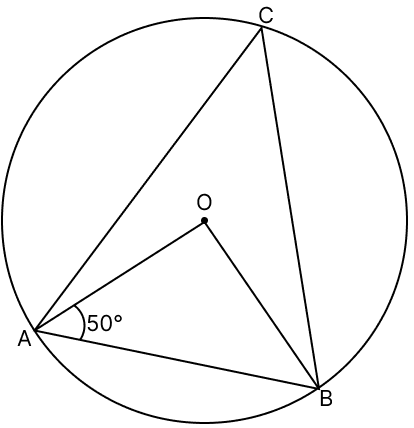
Assertion (A): In the given figure, if O is the centre of the circle, then ∠ACB = 40°.
Reason (R): Angle at the centre is double the angle at the remaining part of the circle.
Both A and R are true, and R is the correct explanation of A.
Both A and R are true, but R is not the correct explanation of A.
A is true, but R is false.
A is false, but R is true.
Answer
From figure,
OA = OB (Radii of same circle)
∠OBA = ∠OAB = 50° (As angles opposite to equal sides in a triangle are equal)
∠OBA + ∠OAB + ∠AOB = 180° [Angle sum property of a triangle]
50° + 50° + ∠AOB = 180°
100° + ∠AOB = 180°
∠AOB = 180° - 100°
∠AOB = 80°.
We know that,
Angle which an arc subtends at the center is double that which it subtends at any point on the remaining part of the circumference.
So, reason (R) is true.
∠AOB = 2∠ACB
∠ACB = = 40°.
So, Assertion (A) is true.
Both A and R are true, and R correctly explains A.
Hence, option 1 is the correct option.
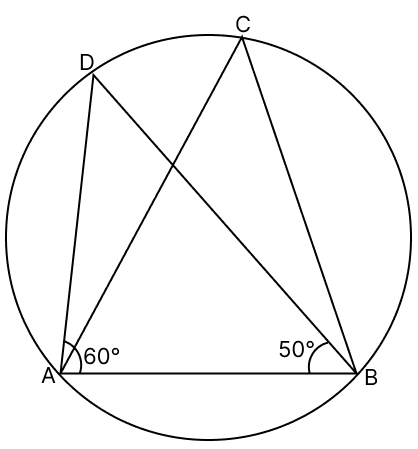
Assertion (A): In the figure, ∠ACB = 70°.
Reason (R): Opposite angles of a cyclic quadrilateral are equal.
Both A and R are true, and R is the correct explanation of A.
Both A and R are true, but R is not the correct explanation of A.
A is true, but R is false.
A is false, but R is true.
Answer
In triangle ABD,
∠DAB = 60°
∠DBA = 50°
From figure,
⇒ ∠DAB + ∠DBA + ∠ADB = 180° [Angle sum property of a triangle]
⇒ 60° + 50° + ∠ADB = 180°
⇒ 110° + ∠ADB = 180°
⇒ ∠ADB = 180° - 110°
⇒ ∠ADB = 70°
Angle in same segment are equal.
∠ADB = ∠ACB = 70°
So, assertion (A) is true.
We know that,
In cyclic quadrilateral opposite angles are supplementary (sum = 180°), not equal.
So, reason (R) is false.
A is true, R is false.
Hence, option 3 is the correct option.
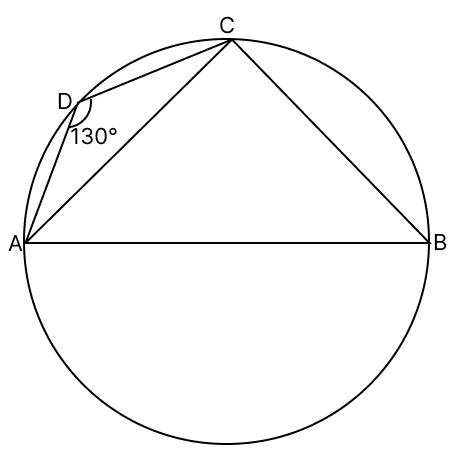
Assertion (A): In the figure, if AB is a diameter of the circle, then ∠BAC = 40°.
Reason (R): Angles in the same segment of a circle are equal.
Both A and R are true, and R is the correct explanation of A.
Both A and R are true, but R is not the correct explanation of A.
A is true, but R is false.
A is false, but R is true.
Answer
In △ABC,
∠ACB = 90° [Angle in a semicircle]
Since ABCD is a cyclic quadrilateral, the sum of its opposite angles is 180°.
⇒ ∠ADC + ∠ABC = 180°
⇒ 130° + ∠ABC = 180°
⇒ ∠ABC = 50°
In △ABC,
⇒ ∠BAC + ∠ABC + ∠ACB = 180° [Angle sum property of a triangle]
⇒ ∠BAC = 180° - (50° + 90°)
⇒ ∠BAC = 40°.
So, Assertion (A) is true.
Angles in the same segment of a circle are equal, so Reason (R) is a true statement. However, ∠BAC = 40° is obtained using the angle in a semicircle together with the cyclic-quadrilateral property, and not by the equality of angles in the same segment. So R is not the correct explanation of A.
Both A and R are true, but R is not the correct explanation of A.
Hence, option 2 is the correct option.
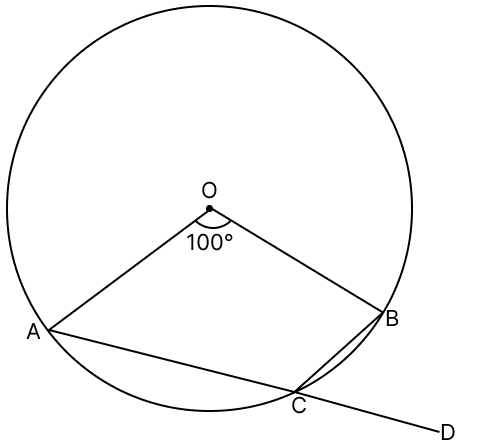
Assertion (A): In the figure, if O is the centre of the circle, then ∠BCD = 80°.
Reason (R): Exterior angle of a cyclic quadrilateral is equal to the interior opposite angle.
Both A and R are true, and R is the correct explanation of A.
Both A and R are true, but R is not the correct explanation of A.
A is true, but R is false.
A is false, but R is true.
Answer
From figure,
The angle subtended by an arc at the center is double the angle subtended by it at any point on the remaining part of the circle.
Reflex AOB = 360° - 100° = 260°
∠ACB = Reflex ∠AOB
∠ACB =
∠ACB = 130°
∠ACB + ∠BCD = 180° [Linear pair]
∠BCD = 180° - 130°
∠BCD = 50°
So assertion (A) is false.
We know that,
In, cyclic quadrilaterals if one side is extended, the exterior angle formed is equal to the interior opposite angle.
So, reason (R) is true.
A is false, R is true
Hence, option 4 is the correct option.