
If an arc of a circle subtends a right angle at any point on the remaining part of the circle, then the arc is a :
minor arc
major arc
semi-circle
none of these
Answer
An angle subtended by an arc at a point on the remaining part of the circle is an angle at the circumference.
An angle in a semicircle is a right angle.
Hence, option 3 is the correct option.
The sum of the opposite angles of a cyclic quadrilateral is :
90°
150°
180°
360°
Answer
The sum of the opposite angles of a cyclic quadrilateral is 180°.
Hence, option 3 is the correct option.
If a pair of opposite angles of a quadrilateral are supplementary, then the quadrilateral is :
a rectangle
a parallelogram
a square
a cyclic quadrilateral
Answer
If a pair of opposite angles of a quadrilateral are supplementary, then the quadrilateral is a cyclic quadrilateral.
Hence, option 4 is the correct option.
The exterior angle of a cyclic quadrilateral is equal to :
90°
the interior opposite angle
the interior adjacent angle
any of the interior angles
Answer
The exterior angle of a cyclic quadrilateral is equal to the interior opposite angle.
Hence, option 2 is the correct option.
Any two angles formed in the same segment of a circle are :
complementary
supplementary
each right angle
equal
Answer
Any two angles formed in the same segment of a circle are equal.
Hence, option 4 is the correct option.
Every cyclic parallelogram is a/an :
square
rhombus
rectangle
isosceles trapezium
Answer
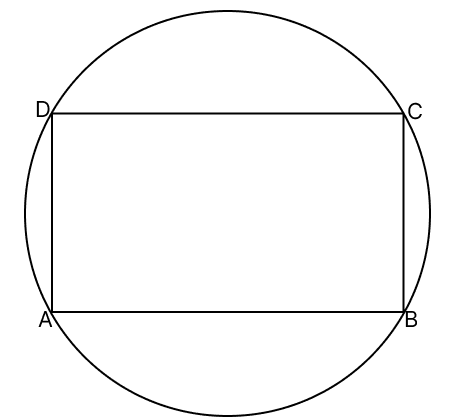
Given,
ABCD is a cyclic parallelogram.
∠ABC = ∠ADC [Opposite angles of parallelogram are equal]
∠ABC + ∠ADC = 180° [Sum of opposite angles of cyclic quadrilateral is 180°]
∠ABC + ∠ABC = 180°
2∠ABC = 180°
∠ABC =
∠ABC = ∠ADC = 90°
A parallelogram one of whose angle is 90° is a rectangle.
Hence, Every cyclic parallelogram is a rectangle.
Hence, option 3 is the correct option.
An isosceles trapezium is always :
a parallelogram
a square
a rectangle
a cyclic quadrilateral
Answer
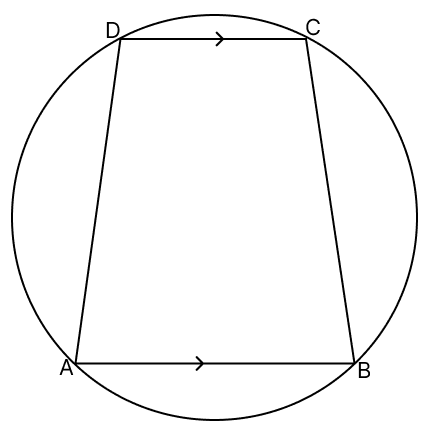
Given,
ABCD is an isosceles trapezium with AB ∥ CD and AD = BC.
∠A + ∠D = 180° [Interior angles on the same side of a transversal are supplementary]
In an isosceles trapezium,
∠A = ∠B and ∠C = ∠D [Base angles are equal]
So,
∠A + ∠C = 180°
Since a pair of opposite angles of quadrilateral ABCD is supplementary,
ABCD is a cyclic quadrilateral.
Hence, an isosceles trapezium is always a cyclic quadrilateral.
Hence, option 4 is the correct option.
Which of the following quadrilaterals is not always a cyclic quadrilateral?
square
rhombus
rectangle
an isosceles trapezium
Answer
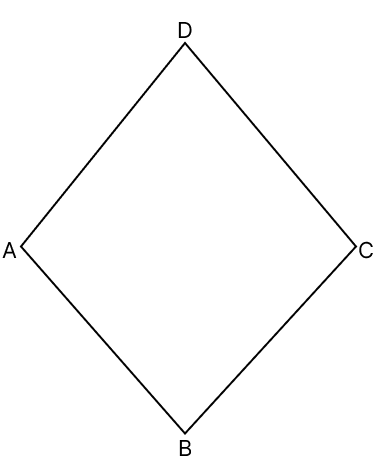
Given,
ABCD is a rhombus.
In a rhombus,
All sides are equal, but angles are not necessarily equal to 90°.
Opposite angles of a rhombus are equal.
So,
∠A = ∠C and ∠B = ∠D
But,
∠A + ∠C ≠ 180° (always)
Hence, opposite angles of a rhombus are not always supplementary.
Therefore, a rhombus is not always a cyclic quadrilateral.
Hence, option 2 is the correct option.
The quadrilateral formed by angle bisectors of a cyclic quadrilateral is :
cyclic
square
rectangle
parallelogram
Answer
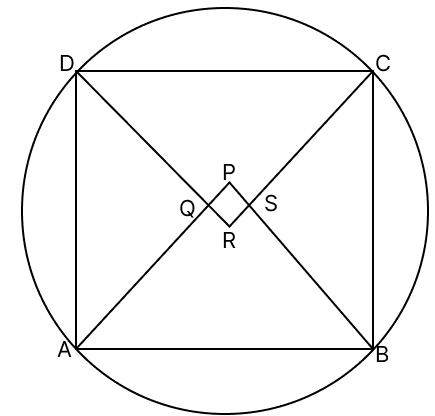
Given,
ABCD is a cyclic quadrilateral in which AP, BP, CR and DR are the angle bisectors of ∠A, ∠B, ∠C and ∠D respectively, forming quadrilateral PQRS.
In ΔPAB,
∠APB + ∠PAB + ∠PBA = 180° [Sum of the angles of a triangle is 180°]
But,
∠PAB = ∠A and ∠PBA = ∠B [AP and BP are angle bisectors]
So,
∠APB + ∠A + ∠B = 180° …(i)
Similarly, in ΔRCD,
∠CRD + ∠RCD + ∠RDC = 180° [Sum of the angles of a triangle is 180°]
But,
∠RCD = ∠C and ∠RDC = ∠D [CR and DR are angle bisectors]
So,
∠CRD + ∠C + ∠D = 180° …(ii)
Adding (i) and (ii),
∠APB + ∠CRD + (∠A + ∠B + ∠C + ∠D) = 360°
But,
∠A + ∠B + ∠C + ∠D = 360° [Sum of angles of a quadrilateral]
So,
∠APB + ∠CRD + × 360° = 360°
∠APB + ∠CRD + 180° = 360°
∠APB + ∠CRD = 180°
Since a pair of opposite angles of quadrilateral PQRS is supplementary,
PQRS is a cyclic quadrilateral.
Hence, option 1 is the correct option.
In the given figure, O is the centre of the circle and ∠ACB = 30°. Then, ∠AOB = ?
15°
30°
60°
90°
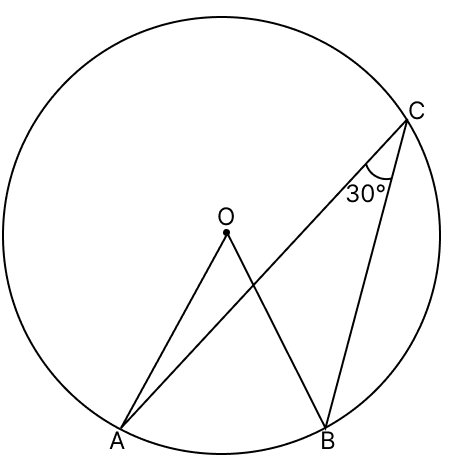
Answer
We know that,
Angle which an arc subtends at the center is double that which it subtends at any point on the remaining part of the circumference.
⇒ ∠AOB = 2∠ACB
⇒ ∠AOB = 2 × 30°
⇒ ∠AOB = 60°.
Hence, option 3 is the correct option.
In the given figure, O is the centre of the circle. If ∠OAB = 35° and C is a point on the circle, then ∠ACB = ?
35°
55°
45°
75°
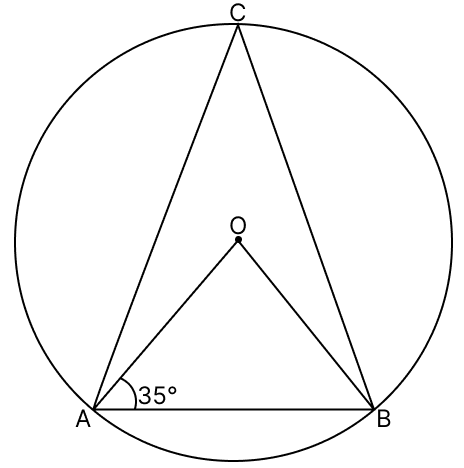
Answer
Given,
Since O is the centre of the circle, OA and OB are both radii. OA = OB Therefore,
∠OBA = ∠OAB = 35° [Angles opposite to equal sides of a triangle are equal]
In ΔAOB,
By angle sum property of triangle,
∠OBA + ∠OAB + ∠AOB = 180°
35° + 35° + ∠AOB = 180°
∠AOB = 180° - 35° - 35°
∠AOB = 110°.
We know that,
Angle which an arc subtends at the center is double that which it subtends at any point on the remaining part of the circumference.
⇒ ∠AOB = 2∠ACB
⇒ 110° = 2∠ACB
⇒ ∠ACB =
⇒ ∠ACB = 55°.
Hence, option 2 is the correct option.
In the given figure, ∠ABC and ∠DBC are inscribed in a circle such that ∠BAC = 60° and ∠DBC = 40°. Then, ∠BCD = ?
60°
40°
100°
80°
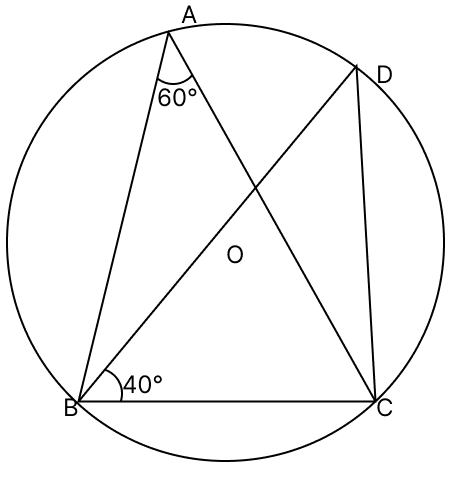
Answer
Given,
Points A and D are on the circle, and both form angles with the chord BC.
∠BDC = ∠BAC = 60° [Angles in same segment are equal]
In ΔBCD,
By angle sum property of triangle,
∠BCD + ∠DBC + ∠BDC = 180°
∠BCD = 180° - ∠DBC - ∠BDC
∠BCD = 180° - 40° - 60°
∠BCD = 80°.
Hence, option 4 is the correct option.
In the given figure, O is the centre of the circle. If ∠OAC = 55°, then ∠OBD = ?
55°
35°
45°
70°
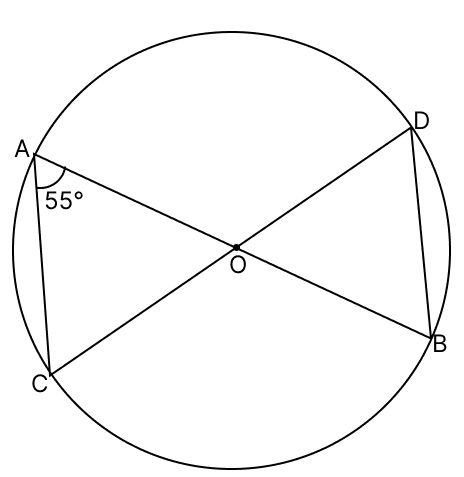
Answer
In ΔOAC,
OA = OC [Radii of same circle]
Since, two sides are equal it is isosceles triangle and opposite sides are also equal:
∠OCA = ∠OAC = 55°
In ΔOBD,
OB = OD [Radii of same circle]
Since, two sides are equal it is isosceles triangle and opposite sides are also equal:
∠OBD = ∠ODB
∠AOC = ∠BOD [vertically opposite angles]
In ΔOAC,
By angle sum property of triangle,
∠AOC + ∠OAC + ∠OCA = 180°
∠AOC + 55° + 55° = 180°
∠AOC + 110° = 180°
∠AOC = 180° - 110°
∠AOC = 70°
∠AOC = ∠BOD = 70°
In ΔOBD,
By angle sum property of triangle,
∠BOD + ∠OBD + ∠ODB = 180°
70° + 2∠OBD = 180°
2∠OBD = 180° - 70°
2∠OBD = 110°
∠OBD =
∠OBD = 55°.
Hence, option 1 is the correct option.
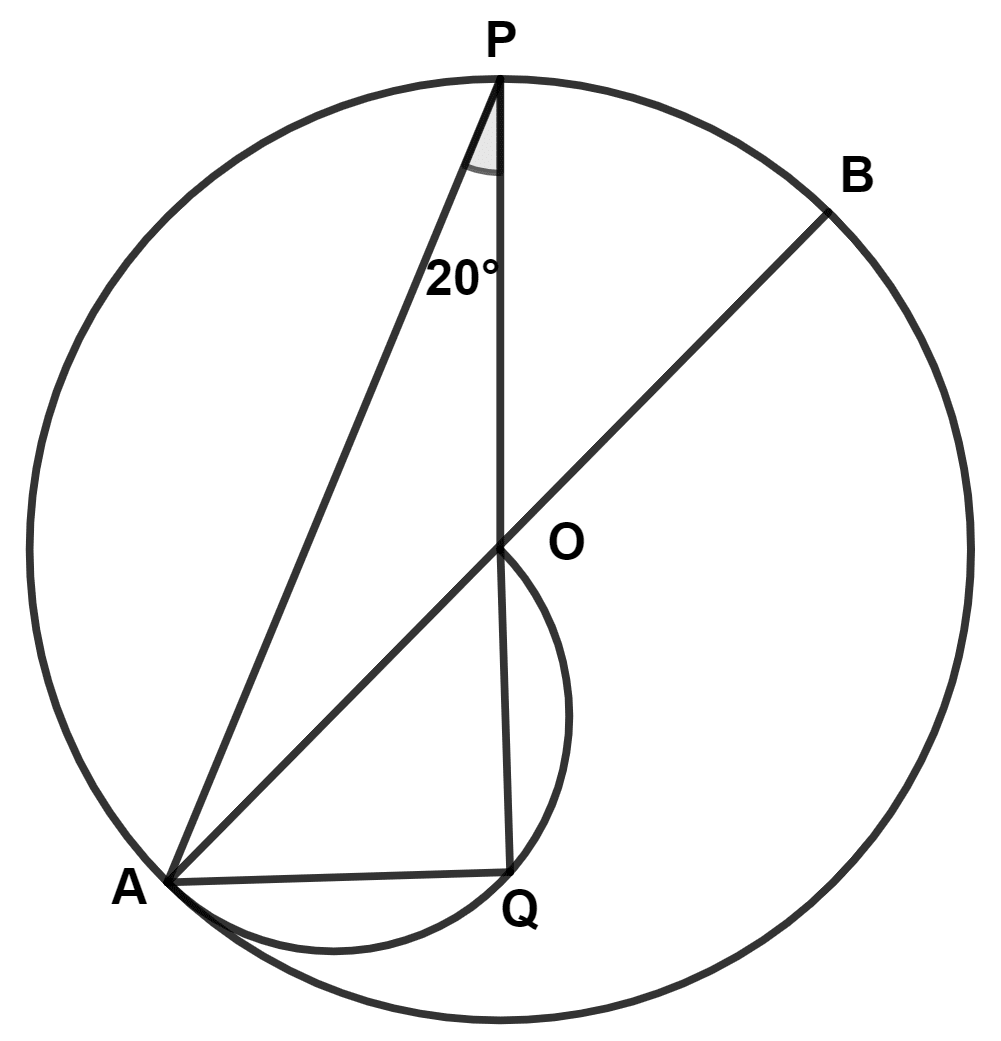
In the adjoining figure, O is the center of the circle, and a semicircle is drawn on OA as the diameter. ∠APQ = 20°. The degree measure of ∠OAQ is :
25°
40°
50°
65°
Answer
We know that,
Angle in a semi-circle is a right angle.
∴ ∠OQA = 90°
In △QAP,
⇒ ∠PQA + ∠QAP + ∠APQ = 180°
⇒ 90° + ∠QAP + 20° = 180°
⇒ ∠QAP = 180° - 90° - 20° = 70°.
In △OPA,
⇒ OA = OP (Radii of same circle)
⇒ ∠OAP = ∠OPA (Angle opposite to equal sides are equal)
⇒ ∠OAP = 20°.
From figure,
⇒ ∠OAQ = ∠QAP - ∠OAP = 70° - 20° = 50°.
Hence, Option 3 is the correct option.
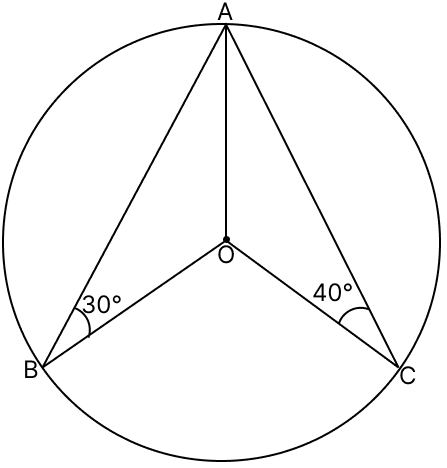
In the given figure, O is the centre of the circle in which ∠OBA = 30° and ∠OCA = 40°. Then, ∠BOC = ?
70°
100°
120°
140°
Answer
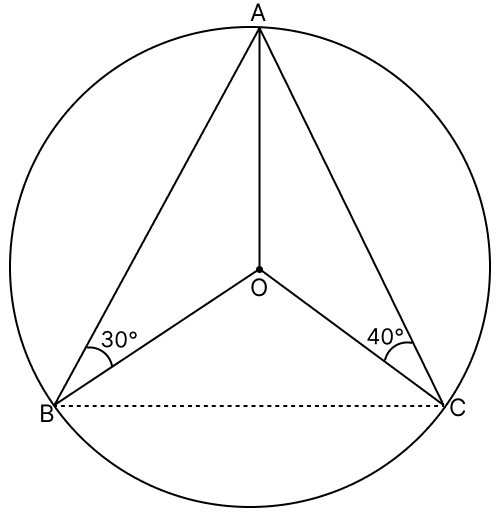
Join BC.
In △BOC,
Since,
OB = OC (Radius of same circle)
∴ ∠OBC = ∠OCB = x (let)
By angle sum property of triangle,
⇒ ∠OBC + ∠OCB + ∠BOC = 180°
⇒ x + x + ∠BOC = 180°
⇒ ∠BOC = 180° - 2x
In △AOC,
By angle sum property of triangle,
⇒ ∠BAC + ∠CBA + ∠ACB = 180°
⇒ ∠BAC + (30° + x) + (40° + x) = 180°
⇒ ∠BAC + 70° + 2x = 180°
⇒ ∠BAC = 180° - 70° - 2x
⇒ ∠BAC = 110° - 2x
We know that,
The angle which an arc subtends at the center is double that which it subtends at any point on the remaining part of the circumference.
∴ ∠BOC = 2∠BAC
⇒ 180° - 2x = 2(110° - 2x)
⇒ 180° - 2x = 220° - 4x
⇒ 4x - 2x = 220° - 180°
⇒ 2x = 40°
⇒ x = = 20°
⇒ ∠BOC = 180° - 2x
⇒ ∠BOC = 180° - 2(20°) = 180° - 40° = 140°.
Hence, option 4 is the correct option.
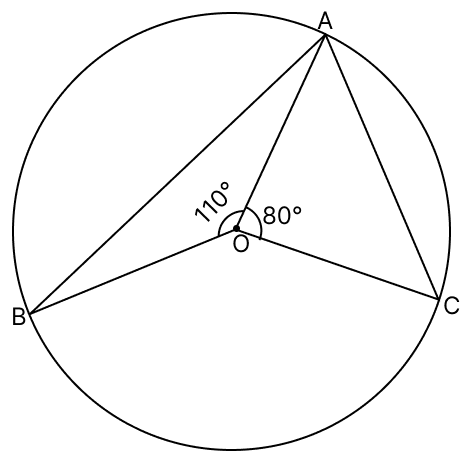
In the given figure, O is the centre of the circle.
If ∠AOB = 110° and ∠AOC = 80°, then ∠BAC = ?
75°
80°
85°
95°
Answer
From figure,
∠BOC = 360° - (∠AOB + ∠AOC)
∠BOC = 360° - (110° + 80°)
= 360° - 190°
= 170°.
We know that,
The angle which an arc subtends at the center is double that which it subtends at any point on the remaining part of the circumference.
∴ BOC = 2∠BAC
∴ ∠BAC = ∠BOC
= = 85°.
Hence, option 3 is the correct option.
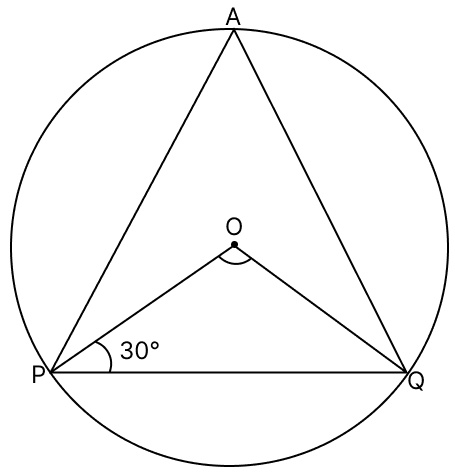
In the given figure, O is the centre of the circle and ∠OPQ = 30°. Then, ∠PAQ = ?
60°
70°
80°
75°
Answer
From figure,
OP = OQ (Radii of same circle)
∠OQP = ∠OPQ = 30° (As angles opposite to equal sides are equal)
In △POQ,
By angle sum property of triangle,
∠POQ + ∠OQP + ∠OPQ = 180°
∠POQ = 180° - ∠OQP - ∠OPQ
∠POQ = 180° - 30° - 30°
∠POQ = 120°.
We know that,
The angle which an arc subtends at the center is double that which it subtends at any point on the remaining part of the circumference.
∴ ∠POQ = 2∠PAQ
∴ ∠PAQ = ∠POQ
= = 60°.
Hence, option 1 is the correct option.
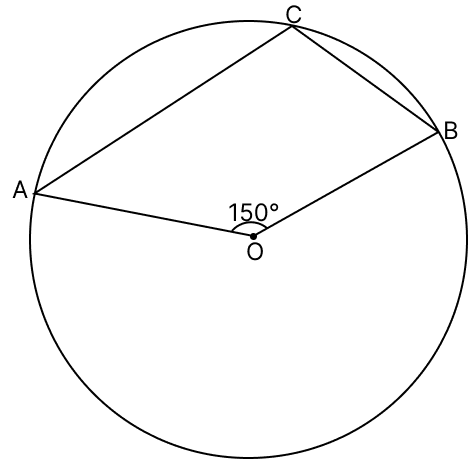
In the given figure, O is the centre of the circle and ∠AOB = 150°. Then, ∠ACB = ?
75°
105°
85°
115°
Answer
We know that,
The angle which an arc subtends at the center is double that which it subtends at any point on the remaining part of the circumference.
∴ ∠ACB = Reflex∠AOB
= = 105°.
Hence, option 2 is the correct option.
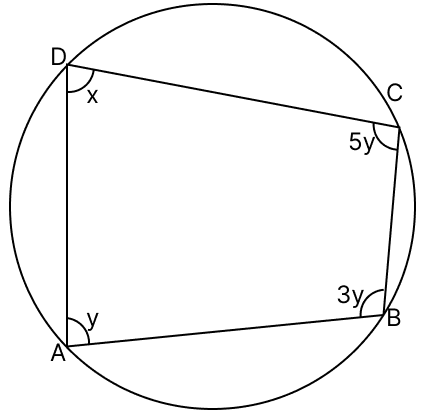
In the given figure, ABCD is a cyclic quadrilateral. The measure of its greatest angle is :
135°
140°
150°
160°
Answer
The sum of the opposite angles of a cyclic quadrilateral is 180°.
∠A + ∠C = 180°
y + 5y = 180°
6y = 180°
y = 30°
∠B + ∠D = 180°
3x + x = 180°
4x = 180°
x = 45°
∠A = y = 30°
∠C = 5y = 150°
∠D = x = 45°
∠B = 3x = 135°
Hence, option 3 is the correct option.
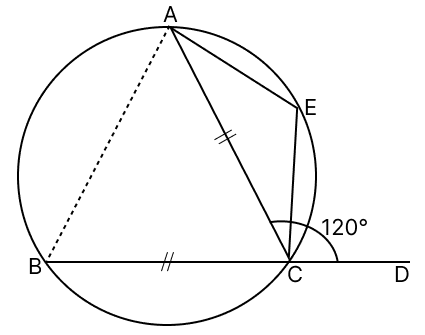
In the given diagram, chords AC and BC are equal. If ∠ACD = 120°, then ∠AEC is:
30°
60°
90°
120°
Answer
From figure,
∠ACD and ∠ACB forms linear pairs [BD is a straight line].
⇒ ∠ACD + ∠ACB = 180°
⇒ 120° + ∠ACB = 180°
⇒ ∠ACB = 180° - 120°
⇒ ∠ACB = 60°.
In ΔABC,
⇒ BC = AC [Given]
⇒ ∠ABC = ∠BAC = x° (let) [Angles opposite to equal sides in triangle are equal]
According to angle sum property in ΔABC,
⇒ ∠ACB + ∠ABC + ∠BAC = 180°
⇒ 60° + x° + x° = 180°
⇒ 2x° = 180° - 60°
⇒ 2x° = 120°
⇒ x° = = 60°.
From figure,
ABCE is cyclic quadrilateral.
We know that,
Opposite angles of cyclic quadrilateral are supplementary.
⇒ ∠ABC + ∠AEC = 180°
⇒ 60° + ∠AEC = 180°
⇒ ∠AEC = 180° - 60°
⇒ ∠AEC = 120°.
Hence, option 4 is the correct option.
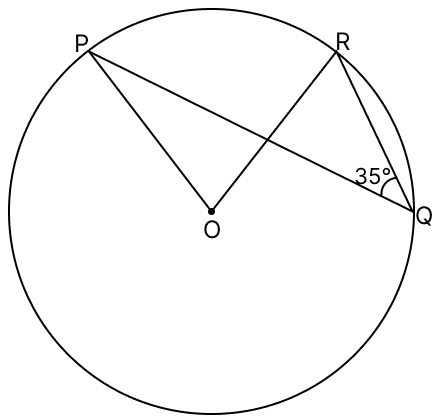
In the given figure, O is the centre of the circle.
If ∠PQR = 35°, then ∠POR is equal to :
17.5°
35°
60°
70°
Answer
We know that,
The angle which an arc subtends at the center is double that which it subtends at any point on the remaining part of the circumference.
∴ ∠POR = 2∠PQR = 2 × 35° = 70°.
Hence, option 4 is the correct option.
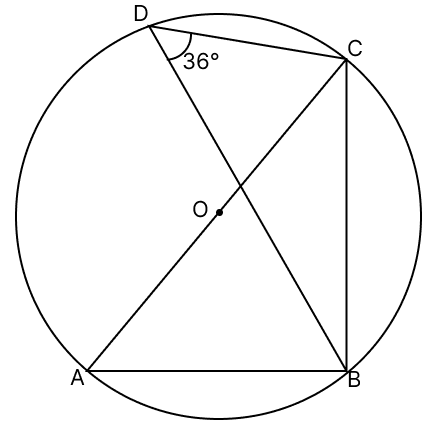
In the given figure, O is the centre of the circle and ∠BDC = 36°. The measure of ∠ACB is :
36°
54°
72°
46°
Answer
We know that,
The angle which an arc subtends at the center is double that which it subtends at any point on the remaining part of the circumference.
∴ ∠BOC = 2∠BDC
∠BOC = 2(36°) = 72°
∠AOB + ∠BOC = 180°
∠AOB = 180° - ∠BOC
∠AOB = 180°- 72° = 108°
∴ ∠ACB = ∠AOB
∠ACB = = 54°.
Hence, option 2 is the correct option.
ABCD is a cyclic quadrilateral such that AC is a diameter of the circle. If ∠BAC = 58° and ∠DAC = 65°, then ∠BCD is equal to :
57°
123°
90°
60°
Answer
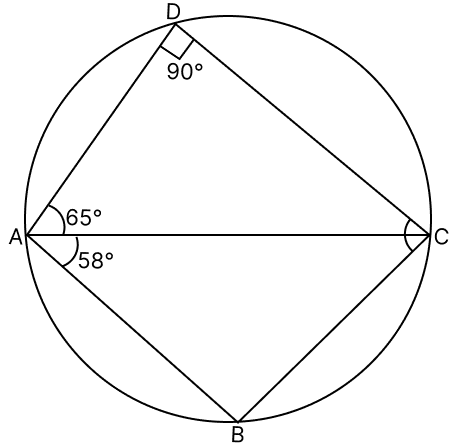
∠ADC = 90° and ∠ADC = 90° [Angle in semicircle is a right angle]
In △ABC,
∠BAC = 58°
∠ABC = 90°
By angle sum property of triangle,
∠BCA + ∠BAC + ∠ABC = 180°
∠BCA = 180° - (∠BAC + ∠ABC)
∠BCA = 180° - (90° + 58°) = 32°
In △ABC :
∠DAC = 65° and ∠ADC = 90°
By angle sum property of triangle,
∠DCA + ∠DAC + ∠ADC = 180°
∠DCA = 180° - (∠DAC + ∠ADC)
∠DCA = 180° - (90° + 65°) = 25°
From figure,
∠BCD = ∠DCA + ∠BCA = 32° + 25° = 57°.
Hence, option 1 is the correct option.
The angle formed in a minor segment of a circle is :
an acute angle
an obtuse angle
a right angle
either an acute or an obtuse angle
Answer
A minor segment is the smaller of the two regions created when a chord divides a circle. The corresponding arc is the minor arc.
The angle formed in a minor segment of a circle is an obtuse angle.
Hence, option 2 is the correct option.
The angle formed in a major segment of a circle is :
an acute angle
an obtuse angle
a right angle
either an acute or an obtuse angle
Answer
A major segment is the larger of the two regions created when a chord divides a circle. The corresponding arc is the major arc.
The angle formed in a major segment of a circle is an acute angle.
Hence, option 1 is the correct option.
An equilateral triangle ABC is inscribed in a circle with centre O. The measure of ∠BOC is :
120°
60°
90°
30°
Answer
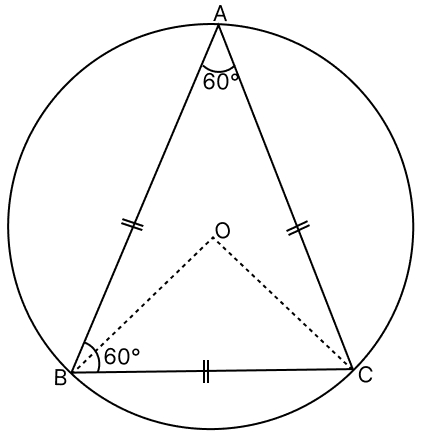
In equilateral triangle ABC,
∠BAC = 60°
We know that,
The angle which an arc subtends at the center is double that which it subtends at any point on the remaining part of the circumference.
∴ ∠BOC = 2∠BAC = 2(60°) = 120°.
Hence, option 1 is the correct option.
If two diameters of a circle intersect each other at right angles, then the quadrilateral formed by joining their end points is a :
rhombus
square
rectangle
parallelogram
Answer
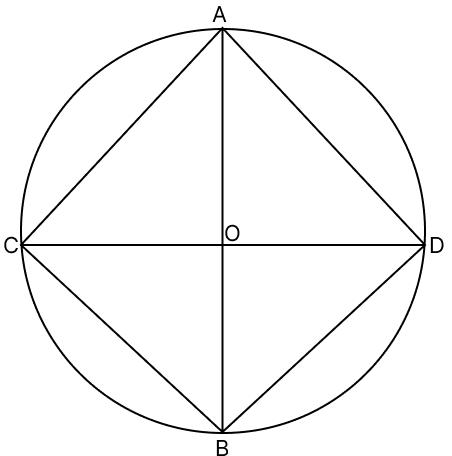
Let the two diameters AB and CD intersect at the centre O at right angles.
The quadrilateral formed by joining the end points in order is ACBD.
In ΔAOC, ΔCOB, ΔBOD, ΔDOA , we have two sides which are radii and an included angles as 90°. Therefore, by SAS theorem, all triangles are congruent.
Thus, all four sides are equal AC = CB = BD = DA.
Each interior angle of the quadrilateral (e.g., ∠ACB) is an angle inscribed in a semicircle. Thus, each interior angle equals to 90°.
A quadrilateral with all sides equal, and all angles equal to 90° is a square.
Hence, option 2 is the correct option.
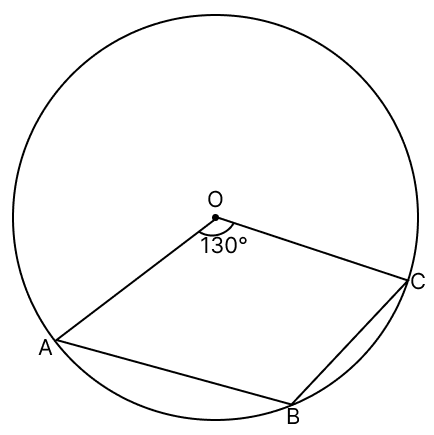
In the given figure, O is the centre of the circle such that ∠AOC = 130°, then ∠ABC is equal to :
65°
90°
105°
115°
Answer
Reflex ∠AOC = 360° - 130° = 230°
We know that,
The angle which an arc subtends at the center is double that which it subtends at any point on the remaining part of the circumference.
∴ ∠ABC = Reflex ∠AOC
∠ABC = = 115°.
Hence, option 4 is the correct option.
A chord of a circle is equal to its radius. The angle subtended by this chord at the minor arc of the circle is :
60°
90°
120°
150°
Answer
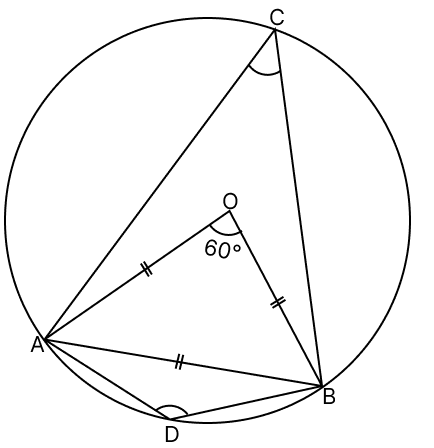
If chord length AB = radius(OA, OB), then the triangle OAB formed by two radii and the chord is equilateral.
Central angle subtended by the chord = ∠AOB = 60°
∠ACB = ∠AOB = (60°) = 30°.
Opposite angles of a cyclic quadrilateral ADBC are supplementary.
∠ACB + ∠ADB = 180°
∠ADB = 180° - 30°
∠ADB = 150°.
Thus, angle subtended by this chord at the minor arc of the circle is 150°.
Hence, option 4 is the correct option.
ABCD is a cyclic quadrilateral such that ∠ADB = 45° and ∠DCA = 55°, then ∠DAB is equal to :
55°
45°
100°
80°
Answer
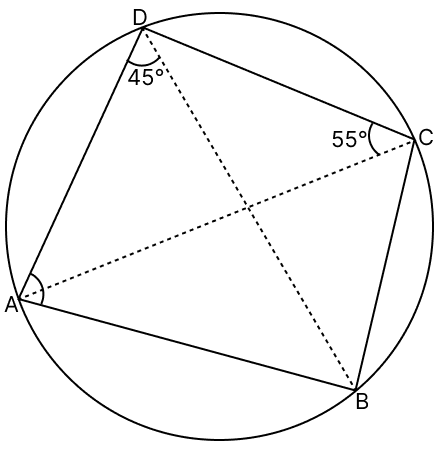
∠ACB = ∠ADB = 45° [Angles in the same segment]
From figure,
∠BCD = ∠ACD + ∠ACB
∠BCD = 55° + 45° = 100°
In a cyclic quadrilateral, the sum of opposite angles is 180°.
∠DAB + ∠BCD = 180°
∠DAB = 180° - ∠BCD
∠DAB = 180° - 100° = 80°.
Hence, option 4 is the correct option.
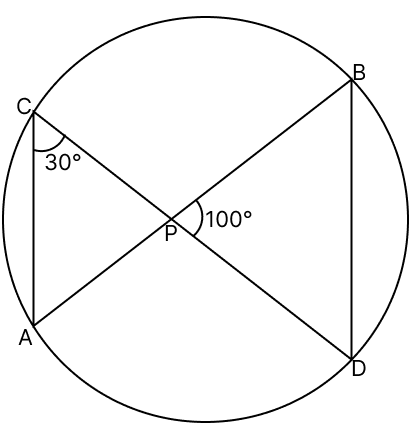
In the given figure, if ∠ACD = 30° and ∠BPD = 100°, then ∠CDB is equal to :
30°
40°
50°
60°
Answer
∠ABD = ∠ACD = 30° [Angles in the same segment]
From figure,
∠PBD = ∠ABD = 30°
In ΔPBD,
By angle sum property,
∠PBD + ∠BPD + ∠PDB = 180°
30° + 100° + ∠PDB = 180°
∠PDB = 180° - 130°
∠PDB = 50°.
From figure,
∠CDB = ∠PDB = 50°.
Hence, option 3 is the correct option.
ABCD is a cyclic quadrilateral such that AB is a diameter of the circle circumscribing it and ∠ADC = 125°, then ∠BAC is equal to :
35°
40°
45°
55°
Answer
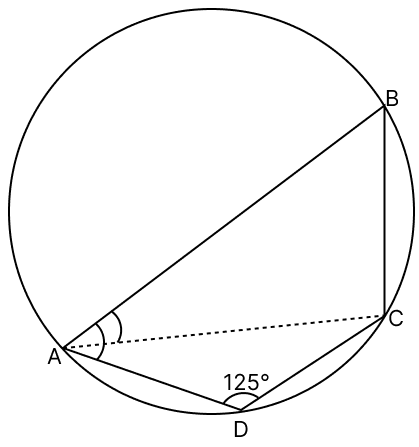
Opposite angles of a cyclic quadrilateral are supplementary.
So,
∠ABC + ∠ADC = 180°
∠ABC = 180° − 125° = 55°.
∠ACB = 90° [Angle in semicircle is a right angle]
In △ABC,
By angle sum property of triangle,
∠BAC + ∠ABC + ∠ACB = 180°
∠BAC + 55° + 90° = 180°
∠BAC = 180° − 145° = 35°.
Hence, option 1 is the correct option.
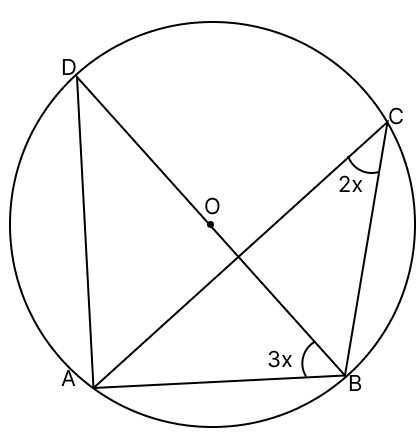
In the given figure, if O is the centre of the circle, then the value of x is :
15°
18°
20°
24°
Answer
From figure,
∠DAB = 90° [Angle in the semicircle is a right angle]
In the figure, both ∠ADB and ∠ACB are subtended by the same arc AB. Therefore:
∠ADB = ∠ACB = 2x
In triangle ADB,
∠DAB + ∠ADB + ∠ABD = 180°
90° + 2x + 3x = 180°
5x = 90°
x = 18°.
Hence, option 2 is the correct option.
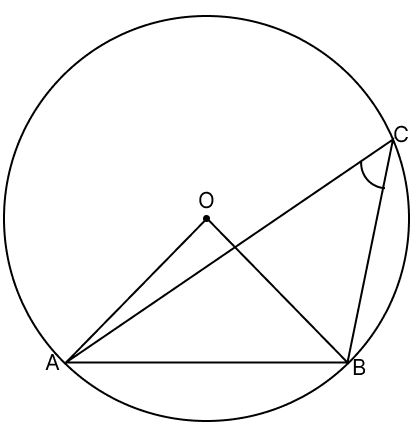
In the given figure, O is the centre of the circle.
If the length of chord AB is equal to the radius of the circle; then ∠ACB is equal to :
30°
45°
60°
40°
Answer
If the length of chord AB is equal to the radius of the circle; then △AOB is equilateral triangle.
∠AOB = 60°
We know that,
The angle which an arc subtends at the center is double that which it subtends at any point on the remaining part of the circumference.
∴ ∠ACB = ∠AOB
∠ACB = = 30°.
Hence, option 1 is the correct option.
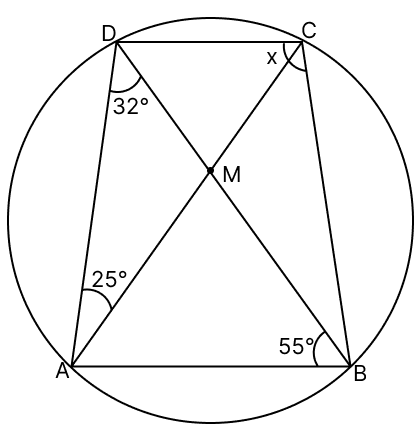
The value of x in the following figure is :
80°
57°
87°
96°
Answer
Arc AD subtends ∠ABD and ∠ACD. Therefore,
∠ABD = ∠ACD = 55° [From Figure]
Arc AB subtends ∠BCA and ∠BDA. Therefore,
∠BCA = ∠BDA = 32° [From Figure]
From figure,
∠BCD = ∠BCA + ∠ACD
∠BCD = 32° + 55°
∠BCD = 87°.
Hence, option 3 is the correct option.
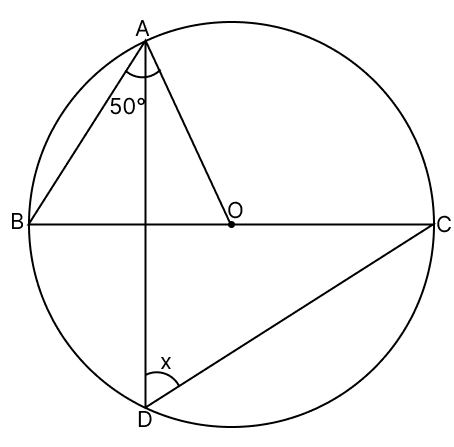
In the given figure, if O is the centre of the circle, then the value of x is :
40°
50°
70°
30°
Answer
Join AC and BD.
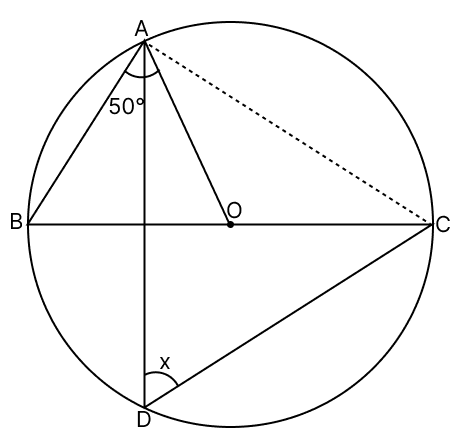
∠BDC = 90° (Angle in semicircle is right angle)
OA = OB (Radii of same circle)
∠OBA = ∠OAB = 50° (Angles opposite to equal sides are equal in a triangle)
In triangle OAB,
∠AOB + ∠OAB + ∠OBA = 180°
∠AOB = 180° - (∠OAB + ∠OBA)
∠AOB = 180° - (50° + 50°)
∠AOB = 80°.
The angle subtended by an arc at the centre is double the angle subtended by it at any point on the remaining part of the circle.
∠ACB = ∠AOB
∠ACB =
∠ACB = 40°
∠ADB = ∠ACB = 40° [Angle in same segment are equal]
From figure,
∠BDC = ∠ADB + x
90° = 40° + x
x = 50°.
Hence, option 2 is the correct option.
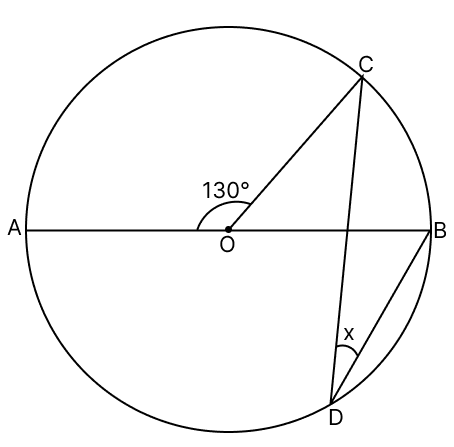
In the given figure, O is centre of the circle.
If ∠AOC = 130°, then the value of x is :
25°
50°
65°
40°
Answer
Join AD.
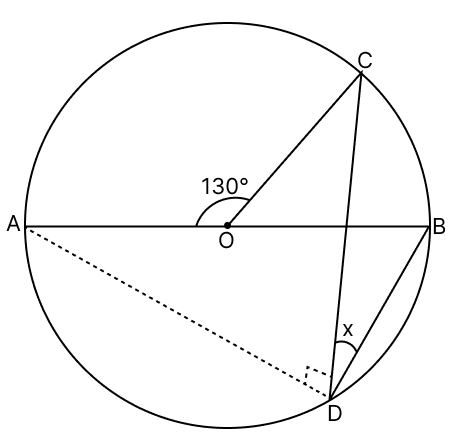
∠AOC = 130°
∠ADB = 90°
We know that,
The angle which an arc subtends at the center is double that which it subtends at any point on the remaining part of the circumference.
∴ ∠ADC = ∠AOC
∠ADC = = 65°
At point D,
∠ADB = ∠ADC + ∠CDB
90° = 65° + x
x = 25°
Hence, option 1 is the correct option.
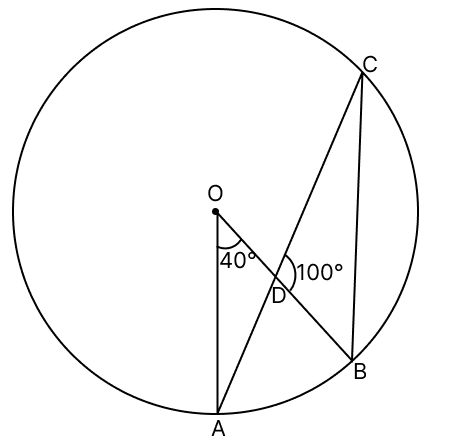
In the given figure, O is the centre of the circle, ∠AOB = 40° and ∠BDC = 100°. The measure of ∠OBC is :
40°
80°
60°
20°
Answer
We know that,
The angle subtended by an arc at the center is double the angle subtended by it at any point on the remaining part of the circle.
∴ ∠ACB = ∠AOB
∠ACB = = 20°
In ΔBDC, the sum of all angles is 180°
∠OBC + ∠BDC + ∠ACB = 180°
∠OBC + 100° + 20° = 180°
∠OBC = 180° - 120°
∠OBC = 60°
Hence, option 3 is the correct option.
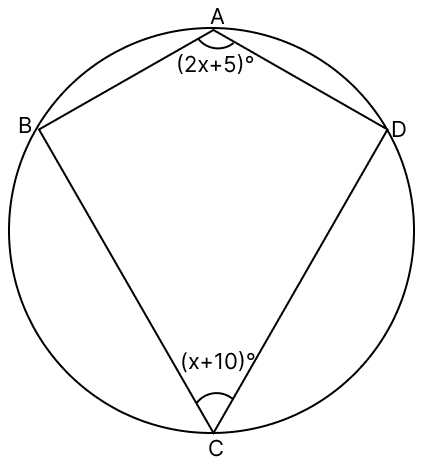
ABCD is a cyclic quadrilateral. If ∠BAD = (2x + 5)° and ∠BCD = (x + 10)°, then x is equal to :
65°
45°
55°
5°
Answer
In a cyclic quadrilateral, opposite angles are supplementary.
Since ∠BAD and ∠BCD are opposite angles,
(2x + 5)° + (x + 10)° = 180°
3x + 15 = 180°
3x = 165°
x = 55°
Hence, option 3 is the correct option.