KnowledgeBoat Logo
|
OPEN IN APP

Chapter 22

Trigonometrical Identities — Multiple Choice Questions

Class - 10 RS Aggarwal Mathematics Solutions


Multiple Choice Questions

Question 1

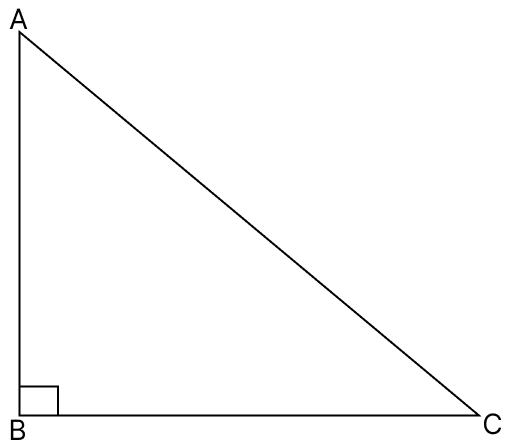
In ΔABC, if AC = 17 m and BC = 8 m, then tan A =

  1. (815)\Big(\dfrac{8}{15}\Big)

  2. (158)\Big(\dfrac{15}{8}\Big)

  3. (817)\Big(\dfrac{8}{17}\Big)

  4. (1517)\Big(\dfrac{15}{17}\Big)

In ΔABC, if AC = 17 m and BC = 8 m, then tan A = Tangent Properties of Circles, RSA Mathematics Solutions ICSE Class 10.

Answer

tan A = oppositeadjacent=BCAB=815\dfrac{\text{opposite}}{\text{adjacent}} = \dfrac{BC}{AB} = \dfrac{8}{15}

Hence, option 1 is the correct option.

Question 2

If sin θ = (513)\Big(\dfrac{5}{13}\Big), then the value of tan θ is:

  1. (512)\Big(\dfrac{5}{12}\Big)

  2. (1213)\Big(\dfrac{12}{13}\Big)

  3. (125)\Big(\dfrac{12}{5}\Big)

  4. (1312)\Big(\dfrac{13}{12}\Big)

Answer

Given,

sin θ = (513)=oppositehypotenuse\Big(\dfrac{5}{13}\Big) = \dfrac{\text{opposite}}{\text{hypotenuse}}

Opposite = 5, Hypotenuse = 13

tan A = oppositeadjacent=512\dfrac{\text{opposite}}{\text{adjacent}} = \dfrac{5}{12}

Hence, option 1 is the correct option.

Question 3

If sec θ = (257)\Big(\dfrac{25}{7}\Big), then the value of cot θ is:

  1. (2524)\Big(\dfrac{25}{24}\Big)

  2. (247)\Big(\dfrac{24}{7}\Big)

  3. (724)\Big(\dfrac{7}{24}\Big)

  4. (2425)\Big(\dfrac{24}{25}\Big)

Answer

sec θ = (257)=hypotenusebase\Big(\dfrac{25}{7}\Big) = \dfrac{\text{hypotenuse}}{\text{base}}

Perpendicular = 25272=576\sqrt{25^2 - 7^2} = \sqrt{576} = 24.

cot θ = Baseperpendicular=(724)\dfrac{\text{Base}}{\text{perpendicular}} = \Big(\dfrac{7}{24}\Big).

Hence, option 3 is the correct option.

Question 4

The value of (1 + tan2θ)(1 − sin θ)(1 + sin θ) is:

  1. 0

  2. 1

  3. sec2θ sin2θ

  4. cot2θ

Answer

Given,

⇒ (1 + tan2θ)(1 − sin θ)(1 + sin θ)

⇒ sec2θ (1 - sin2θ)

⇒ sec2θ cos2θ

⇒ 1

Hence, option 2 is the correct option.

Question 5

Given that sin θ = (ab)\Big(\dfrac{a}{b}\Big), then cos θ is equal to:

  1. (ba)\Big(\dfrac{b}{a}\Big)

  2. (ab2a2)\Big(\dfrac{a}{\sqrt{b^2 - a^2}}\Big)

  3. (bb2a2)\Big(\dfrac{b}{\sqrt{b^2 - a^2}}\Big)

  4. (b2a2b)\Big(\dfrac{\sqrt{b^2 - a^2}}{b}\Big)

Answer

Let ABC be a right angle triangle with ∠B = 90° and ∠C = θ.

By formula,

sinθ=perpendicularhypotenuse\sin \theta = \dfrac{\text{perpendicular}}{\text{hypotenuse}}

Substituting values we get :

ab=ABAC\dfrac{a}{b} = \dfrac{AB}{AC}

Let AB = ak and AC = bk.

In right angle triangle ABC,

⇒ AC2 = AB2 + BC2

⇒ (bk)2 = (ak)2 + BC2

⇒ b2k2 = a2k2 + BC2

⇒ BC2 = b2k2 - a2k2

⇒ BC = kb2a2\sqrt{b^2 - a^2}

By formula,

cosθ=basehypotenuse=BCAC=kb2a2bk=b2a2b.\cos \theta = \dfrac{\text{base}}{\text{hypotenuse}} \\[1em] = \dfrac{BC}{AC} \\[1em] = \dfrac{k\sqrt{b^2 - a^2}}{bk} \\[1em] = \dfrac{\sqrt{b^2 - a^2}}{b} .

Hence, option 4 is the correct option.

Question 6

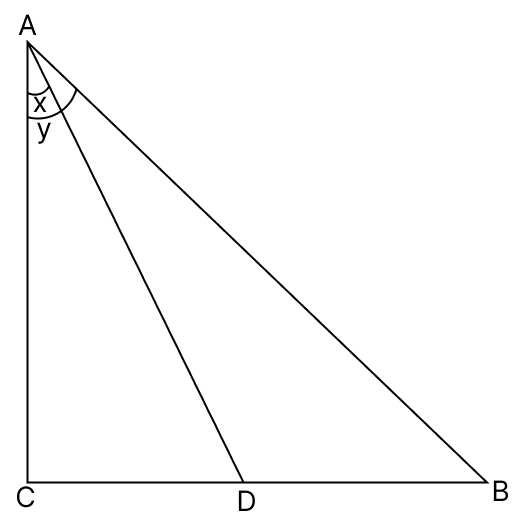
In the adjoining figure, D is the mid-point of BC. Then the value of (cotycotx)\Big(\dfrac{\cot y}{\cot x}\Big) is:

  1. (12)\Big(\dfrac{1}{2}\Big)

  2. (13)\Big(\dfrac{1}{3}\Big)

  3. (14)\Big(\dfrac{1}{4}\Big)

  4. 2

The maximum volume of a cone that can be carved out of a solid hemisphere of radius r. Tangent Properties of Circles, RSA Mathematics Solutions ICSE Class 10.

Answer

We know that,

cotθ=baseperpendicularcotycotx=ACBCACCDcotycotx=CDBCcotycotx=CD2CDcotycotx=12.cot θ = \dfrac{\text{base}}{\text{perpendicular}} \\[1em] \Rightarrow \dfrac{\cot y}{\cot x} = \dfrac{\dfrac{AC}{BC}}{\dfrac{AC}{CD}} \\[1em] \Rightarrow \dfrac{\cot y}{\cot x} = \dfrac{CD}{BC} \\[1em] \Rightarrow \dfrac{\cot y}{\cot x} = \dfrac{CD}{2CD} \\[1em] \Rightarrow \dfrac{\cot y}{\cot x} = \dfrac{1}{2} .

Hence, option 1 is the correct option.

Question 7

If tan A = (512)\Big(\dfrac{5}{12}\Big), then the value of (sin A + cos A) sec A is:

  1. (512)\Big(\dfrac{5}{12}\Big)

  2. (712)\Big(\dfrac{7}{12}\Big)

  3. (1712)\Big(\dfrac{17}{12}\Big)

  4. (513)\Big(\dfrac{5}{13}\Big)

Answer

Given,

(sin A + cos A) sec A

(sinA+cosA)1cosAsinAcosA+cosAcosAtanA+1512+15+12121712.\Rightarrow (\sin A + \cos A)\dfrac{1}{\cos A} \\[1em] \Rightarrow \dfrac{\sin A}{\cos A} + \dfrac{\cos A}{\cos A} \\[1em] \Rightarrow \tan A + 1 \\[1em] \Rightarrow \dfrac{5}{12} + 1 \\[1em] \Rightarrow \dfrac{5 + 12}{12} \\[1em] \Rightarrow \dfrac{17}{12}.

Hence, option 3 is the correct option.

Question 8

If 3 cos θ = 1, then the value of cosec θ is:

  1. 222\sqrt{2}

  2. (322)\Big(\dfrac{3}{2\sqrt{2}}\Big)

  3. (233)\Big(\dfrac{2\sqrt{3}}{3}\Big)

  4. (432)\Big(\dfrac{4}{3\sqrt{2}}\Big)

Answer

Given,

3 cos θ = 1

We know that,

⇒ sin2 θ = 1 - cos2 θ

sin2θ=119sin2θ=919sin2θ=89sinθ=223cosecθ=1sinθ=322.\Rightarrow \sin^2 \theta = 1 - \dfrac{1}{9} \\[1em] \Rightarrow \sin^2 \theta = \dfrac{9 - 1}{9} \\[1em] \Rightarrow \sin^2 \theta = \dfrac{8}{9} \\[1em] \Rightarrow \sin \theta = \dfrac{2\sqrt{2}}{3} \\[1em] \Rightarrow \cosec \theta = \dfrac{1}{\sin \theta} = \dfrac{3}{2\sqrt{2}}.

Hence, option 2 is the correct option.

Question 9

If x cos A = 1 and tan A = y, then x2 − y2 is equal to:

  1. 0

  2. 1

  3. −tan A

  4. tan A

Answer

Given,

x cos A = 1

cos A = 1x\dfrac{1}{x}

⇒ sec A = x

tan A = y

We know that

sec2 A - tan2 A = 1

∴ x2 − y2 = 1

Hence, option 2 is the correct option.

Question 10

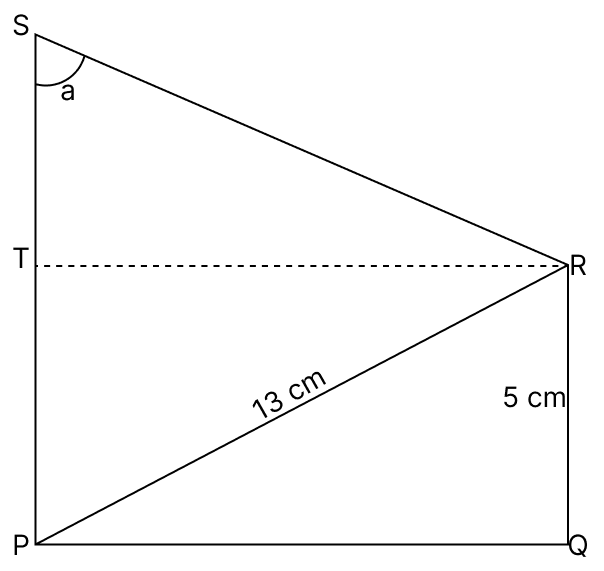
In the adjoining figure, if PS = 14 cm, then the value of tan α is equal to:

  1. (43)\Big(\dfrac{4}{3}\Big)

  2. (53)\Big(\dfrac{5}{3}\Big)

  3. (133)\Big(\dfrac{13}{3}\Big)

  4. (143)\Big(\dfrac{14}{3}\Big)

Draw a ΔABC in which BC = 5.6 cm, ∠B = 45° and the median AD from A to BC is 4.5 cm. Inscribe a circle in it. Tangent Properties of Circles, RSA Mathematics Solutions ICSE Class 10.

Answer

ST = PS − RQ = 14 − 5 = 9 cm

In ΔSTR,

TR=13252=16925=144=12.TR = \sqrt{13^2 - 5^2} = \sqrt{169 - 25} = \sqrt{144} = 12.

We know that,

tanα=oppositeadjacenttanα=TRSTtanα=129tanα=43.\tan \alpha = \dfrac{\text{opposite}}{\text{adjacent}} \\[1em] \tan \alpha = \dfrac{TR}{ST} \\[1em] \tan \alpha = \dfrac{12}{9} \\[1em] \tan \alpha = \dfrac{4}{3}.

Hence, option 1 is the correct option.

Question 11

The value of (1 + tan θ + sec θ)(1 + cot θ − cosec θ) is:

  1. −4

  2. −1

  3. 1

  4. 2

Answer

Given,

(1 + tan θ + sec θ)(1 + cot θ − cosec θ)

(1+sinθcosθ+1cosθ)(1+cosθsinθ1sinθ)(cosθ+sinθ+1cosθ)(sinθ+cosθ1sinθ)(cosθ+sinθ)212cosθsinθcos2θ+sin2θ+2sinθcosθ1cosθsinθ1+2sinθcosθ1cosθsinθ2sinθcosθcosθsinθ2.\Rightarrow \Big(1 + \dfrac{\sin \theta}{\cos \theta} + \dfrac{1}{\cos \theta}\Big) \Big(1 + \dfrac{\cos \theta}{\sin \theta} - \dfrac{1}{\sin \theta}\Big)\\[1em] \Rightarrow \Big( \dfrac{\cos \theta + \sin \theta + 1}{\cos \theta} \Big) \Big(\dfrac{\sin \theta + \cos \theta - 1}{\sin \theta} \Big)\\[1em] \Rightarrow \dfrac{(\cos \theta + \sin \theta)^2 - 1^2}{\cos \theta \sin \theta} \\[1em] \Rightarrow \dfrac{\cos^2 \theta + \sin^2 \theta + 2\sin \theta \cos \theta - 1}{\cos \theta \sin \theta} \\[1em] \Rightarrow \dfrac{1 + 2\sin \theta \cos \theta - 1}{\cos \theta \sin \theta} \\[1em] \Rightarrow \dfrac{ 2\sin \theta \cos \theta}{\cos \theta \sin \theta} \\[1em] \Rightarrow 2.

Hence, option 4 is the correct option.

Question 12

If sin θ = (12)\Big(\dfrac{1}{2}\Big), then the value of (15cot2θ+15)\Big(\dfrac{1}{5} \cot^2\theta + \dfrac{1}{5}\Big) is:

  1. (15)\Big(\dfrac{1}{5}\Big)

  2. (45)\Big(\dfrac{4}{5}\Big)

  3. (1125)\Big(\dfrac{1}{125}\Big)

  4. 25

Answer

Solving,

(15cot2θ+15)15(cot2θ+1)15(cosec2θ).\Rightarrow \Big(\dfrac{1}{5} \cot^2\theta + \dfrac{1}{5}\Big) \\[1em] \Rightarrow \dfrac{1}{5} \Big(\cot^2\theta + 1 \Big) \\[1em] \Rightarrow \dfrac{1}{5} (\cosec^2 \theta).

We know that,

cosecθ=1sinθcosecθ=112=2cosec2θ=22=415cosec2θ15(4)45.\cosec \theta = \dfrac{1}{\sin \theta } \\[1em] \Rightarrow \cosec \theta = \dfrac{1}{\dfrac{1}{2}} = 2\\[1em] \Rightarrow \cosec^2 \theta = 2^2 = 4 \\[1em] \Rightarrow \dfrac{1}{5}\cosec^2 \theta \\[1em] \Rightarrow \dfrac{1}{5}(4) \\[1em] \Rightarrow \dfrac{4}{5}.

Hence, option 2 is the correct option.

Question 13

If cos θ = (23)\Big(\dfrac{2}{3}\Big), then 2 sec2θ + 2 tan2θ − 7 is equal to:

  1. 0

  2. 1

  3. 3

  4. 4

Answer

cos θ = 23\dfrac{2}{3}

sec θ = 32\dfrac{3}{2}

sec2 θ = 94\dfrac{9}{4}

tan2 θ = sec2 θ - 1 = 941=54\dfrac{9}{4} - 1 = \dfrac{5}{4}

Given,

⇒ 2 sec2θ + 2 tan2θ − 7

2(94)+2(54)7(184)+(104)7(284)7770.\Rightarrow 2\Big(\dfrac{9}{4}\Big) + 2\Big(\dfrac{5}{4}\Big) - 7 \\[1em] \Rightarrow \Big(\dfrac{18}{4}\Big) + \Big(\dfrac{10}{4}\Big) - 7 \\[1em] \Rightarrow \Big(\dfrac{28}{4}\Big) - 7 \\[1em] \Rightarrow 7 - 7 \\[1em] \Rightarrow 0.

Hence, option 1 is the correct option.

Question 14

If 24 cot θ = 7, then sin θ is equal to:

  1. (247)\Big(\dfrac{24}{7}\Big)

  2. (2425)\Big(\dfrac{24}{25}\Big)

  3. (725)\Big(\dfrac{7}{25}\Big)

  4. (2524)\Big(\dfrac{25}{24}\Big)

Answer

Given,

24 cot θ = 7

cot θ = 724=adjacentopposite\dfrac{7}{24} = \dfrac{\text{adjacent}}{\text{opposite}}

We know that,

Hypotenuse=opposite2+adjacent2=(24)2+(7)2=576+49=625=25.\Rightarrow \text{Hypotenuse} = \sqrt{\text{opposite}^2 + \text{adjacent}^2 } \\[1em] = \sqrt{(24)^2 + (7)^2} \\[1em] = \sqrt{576 + 49} \\[1em] = \sqrt{625} \\[1em] = 25.

Now,

sin θ = oppositehypotenuse=2425\dfrac{\text{opposite}}{\text{hypotenuse}} = \dfrac{24}{25}

Hence, option 2 is the correct option.

Question 15

If tan θ + cot θ = 2, then tan2θ + cot2θ is equal to:

  1. 1

  2. 2

  3. 4

  4. 8

Answer

Given,

tan θ + cot θ = 2

Square on both sides,

⇒ (tan θ + cot θ)2 = 22

⇒ tan2 θ + cot2 θ + 2 tan θ cot θ = 4

⇒ tan2 θ + cot2 θ + 2 tan θ 1tanθ\dfrac{1}{\tan \theta} = 4

⇒ tan2 θ + cot2 θ + 2 = 4

⇒ tan2 θ + cot2 θ = 4 - 2

⇒ tan2 θ + cot2 θ = 2

Hence, option 2 is the correct option.

Question 16

If cot A + (1cotA)\Big(\dfrac{1}{\cot A}\Big) = 2, then cot2A + (1cot2A)\Big(\dfrac{1}{\cot^2 A}\Big) equals:

  1. 0

  2. 1

  3. 2

  4. 4

Answer

Given,

cot A + (1cotA)\Big(\dfrac{1}{\cot A}\Big) = 2

Square on both sides,

(cotA+1cotA)2=22cot2A+1cot2A+2=4cot2A+1cot2A=42cot2A+1cot2A=2.\Rightarrow \Big(\cot A + \dfrac{1}{\cot A}\Big)^2 = 2^2 \\[1em] \Rightarrow \cot^2 A + \dfrac{1}{\cot^2 A} + 2 = 4 \\[1em] \Rightarrow \cot^2 A + \dfrac{1}{\cot^2 A} = 4 - 2 \\[1em] \Rightarrow \cot^2 A + \dfrac{1}{\cot^2 A} = 2 .

Hence, option 3 is the correct option.

Question 17

If 4 tan θ = 3, then (4sinθ3cosθ4sinθ+3cosθ)\Big(\dfrac{4\sin\theta - 3\cos\theta}{4\sin\theta + 3\cos\theta}\Big) = ?

  1. 0

  2. (13)\Big(\dfrac{1}{3}\Big)

  3. (23)\Big(\dfrac{2}{3}\Big)

  4. (34)\Big(\dfrac{3}{4}\Big)

Answer

tan θ = 34\dfrac{3}{4}

Then,

sin θ = 35\dfrac{3}{5}, cos θ = 45\dfrac{4}{5}

Substitute,

4(35)3(45)4(35)+3(45)(125)(125)(125)+(125)02450.\Rightarrow \dfrac{4\Big(\dfrac{3}{5}\Big) - 3\Big(\dfrac{4}{5}\Big)}{4\Big(\dfrac{3}{5}\Big) + 3\Big(\dfrac{4}{5}\Big)} \\[1em] \Rightarrow \dfrac{\Big(\dfrac{12}{5}\Big) - \Big(\dfrac{12}{5}\Big)}{\Big(\dfrac{12}{5}\Big) + \Big(\dfrac{12}{5}\Big)} \\[1em] \Rightarrow \dfrac{0}{\dfrac{24}{5}} \\[1em] \Rightarrow 0.

Hence, option 1 is the correct option.

Question 18

If tan θ = (17)\Big(\dfrac{1}{\sqrt{7}}\Big), then the value of (cosec2θ+sec2θcosec2θsec2θ)\Big(\dfrac{\cosec^2\theta + \sec^2\theta}{\cosec^2\theta - \sec^2\theta}\Big) is:

  1. (34)\Big(\dfrac{3}{4}\Big)

  2. (43)\Big(\dfrac{4}{3}\Big)

  3. (37)\Big(\dfrac{3}{7}\Big)

  4. (47)\Big(\dfrac{4}{7}\Big)

Answer

Given,

tan θ = (17)\Big(\dfrac{1}{\sqrt{7}}\Big)

tan2 θ = (17)\Big(\dfrac{1}{7}\Big)

We know that,

sec2θ=1+tan2θsec2θ=1+17sec2θ=87.cosec2θ=1+cot2θcosec2θ=1+7cosec2θ=8.\sec^2 \theta = 1 + \tan^2 \theta \\[1em] \sec^2 \theta = 1 + \dfrac{1}{7} \\[1em] \sec^2 \theta = \dfrac{8}{7}. \\[1em] \cosec^2 \theta = 1 + \cot^2 \theta \\[1em] \cosec^2 \theta = 1 + 7 \\[1em] \cosec^2 \theta = 8.

Given expression,

(cosec2θ+sec2θcosec2θsec2θ)8+8788756+8756876448=43.\Rightarrow \Big(\dfrac{\cosec^2\theta + \sec^2\theta}{\cosec^2\theta - \sec^2\theta}\Big) \\[1em] \Rightarrow \dfrac{8 + \dfrac{8}{7}}{8 - \dfrac{8}{7}} \\[1em] \Rightarrow \dfrac{\dfrac{56 + 8}{7}}{\dfrac{56 - 8}{7}} \\[1em] \Rightarrow \dfrac{64}{48} = \dfrac{4}{3}.

Hence, option 2 is the correct option.

Question 19

(1 + sin A)(1 − sin A) is equal to:

  1. cosec2A

  2. sin2A

  3. sec2A

  4. cos2A

Answer

⇒ (1 + sin A)(1 − sin A)

⇒ 1 − sin2 A

⇒ cos2A

Hence, option 4 is the correct option.

Question 20

sin A expressed in terms of cot A is:

  1. (11+cot2A)\Big(\dfrac{1}{\sqrt{1 + \cot^2 A}}\Big)

  2. (1+cot2AcotA)\Big(\dfrac{\sqrt{1 + \cot^2 A}}{\cot A}\Big)

  3. (1+cot2A1)\Big(\dfrac{\sqrt{1 + \cot^2 A}}{1}\Big)

  4. (1cot2AcotA)\Big(\dfrac{\sqrt{1 - \cot^2 A}}{\cot A}\Big)

Answer

1 + cot2 A = cosec2 A

1+cot2A\sqrt{1 + \cot^2 A} = cosec A

sin A = 1cosecA\dfrac{1}{\cosec A}

sin A = 11+cot2A\dfrac{1}{\sqrt{1 + \cot^2 A}}

Hence, option 1 is the correct option.

Question 21

If sec θ = 2x and y tan θ = 2, then the value of 2(x21y2)2\Big(x^2 - \dfrac{1}{y^2}\Big) is:

  1. (12)\Big(\dfrac{1}{2}\Big)

  2. (13)\Big(\dfrac{1}{3}\Big)

  3. (14)\Big(\dfrac{1}{4}\Big)

  4. 1

Answer

sec θ = 2x

x = secθ2\dfrac{\sec \theta}{2}

y tan θ = 2

1y=tanθ2\dfrac{1}{y} = \dfrac{\tan \theta}{2}

We have,

2(x21y2)2(sec2θ4tan2θ4)24(sec2θtan2θ)12(sec2θtan2θ)12.\Rightarrow 2\Big(x^2 - \dfrac{1}{y^2}\Big) \\[1em] \Rightarrow 2\Big(\dfrac{\sec^2 \theta}{4} - \dfrac{\tan^2 \theta}{4}\Big) \\[1em] \Rightarrow \dfrac{2}{4}\Big(\sec^2 \theta - \tan^2 \theta\Big) \\[1em] \Rightarrow \dfrac{1}{2}\Big(\sec^2 \theta - \tan^2 \theta\Big) \\[1em] \Rightarrow \dfrac{1}{2}.

Hence, option 1 is the correct option.

Question 22

Given a = 3 sec2 θ and b = 3 tan2 θ - 2. The value of (a - b) is :

  1. 1

  2. 2

  3. 3

  4. 5

Answer

    a - b = 3 sec2 θ - (3 tan2 θ - 2)

= 3 sec2 θ - 3 tan2 θ + 2

= 3(sec2 θ - tan2 θ) + 2

= 3(1) + 2

= 3 + 2

= 5.

Hence, option 4 is the correct option.

Question 23

(cos4 θ − sin4 θ) is equal to :

  1. 2 cos2 θ + 1

  2. 2 cos2 θ − 1

  3. 2 sin2 θ + 1

  4. 2 sin2 θ − 1

Answer

⇒ (cos4 θ − sin4 θ)

⇒ (cos2 θ − sin2 θ)(cos2 θ + sin2 θ)

⇒ (cos2 θ - sin2 θ)

⇒ (cos2 θ - 1 + cos2 θ)

⇒ (2cos2 θ - 1)

Hence, option 2 is the correct option.

Question 24

If cosec θ − cot θ = 13\dfrac{1}{3}, then the value of cosec θ + cot θ is :

  1. 1

  2. 2

  3. 3

  4. 4

Answer

We know that,

cosec2 θ − cot2 θ = 1

cosec θ − cot θ (cosec θ + cot θ)= 1

13\dfrac{1}{3} (cosec θ + cot θ)= 1

(cosec θ + cot θ)= 3

Hence, option 3 is the correct option.

Question 25

If sin θ − cos θ = 0, then the value of sin θ + cos θ is :

  1. 12\dfrac{1}{\sqrt{2}}

  2. 2\sqrt{2}

  3. 14\dfrac{1}{4}

  4. 34\dfrac{3}{4}

Answer

sin θ = cos θ

Divide both sides by cos θ

sinθcosθ=cosθcosθ\dfrac{\sin \theta}{\cos \theta} = \dfrac{\cos \theta}{\cos \theta}

tan θ = 1

For acute angles, tan θ = 1 when θ = 45°.

⇒ sin 45° + cos 45°

12+12\dfrac{1}{\sqrt2} + \dfrac{1}{\sqrt2}

22\dfrac{2}{\sqrt2}

2\sqrt2

Hence, option 2 is the correct option.

Question 26

If sec θ + tan θ + 1 = 0, then sec θ − tan θ is equal to :

  1. −1

  2. 0

  3. 1

  4. 2

Answer

⇒ sec θ + tan θ + 1 = 0

⇒ sec θ + tan θ = -1

We know that,

⇒ sec2 θ - tan2 θ = 1

⇒ (sec θ + tan θ)(sec θ - tan θ) = 1

⇒ (-1)(sec θ - tan θ) = 1

⇒ sec θ - tan θ = -1

Hence, option 1 is the correct option.

Question 27

If sec θ + tan θ = x, then sec θ is equal to :

  1. x2+1x\dfrac{x^2 + 1}{x}

  2. x21x\dfrac{x^2 − 1}{x}

  3. x2+12x\dfrac{x^2 + 1}{2x}

  4. x212x\dfrac{x^2 − 1}{2x}

Answer

⇒ sec θ + tan θ = x ....(1)

We know that,

⇒ sec2 θ − tan2 θ = 1

⇒ (sec θ + tan θ)(sec θ − tan θ) = 1

⇒ x (sec θ − tan θ) = 1

⇒ sec θ − tan θ = 1x\dfrac{1}{x} ....(2)

Adding eqn (1) and (2):

⇒ sec θ + tan θ + sec θ − tan θ = x + 1x\dfrac{1}{x}

⇒ 2 sec θ = x+1xx + \dfrac{1}{x}

⇒ sec θ = 12(x+1x)\dfrac{1}{2}\Big(x + \dfrac{1}{x}\Big)

⇒ sec θ = 12(x2+1x)\dfrac{1}{2}\Big(\dfrac{x^2 + 1}{x}\Big)

⇒ sec θ = x2+12x\dfrac{x^2 + 1}{2x}

Hence, option 3 is the correct option.

Question 28

If sin θ − cos θ = 0, then the value of (sin4 θ + cos4 θ) is :

  1. 14\dfrac{1}{4}

  2. 12\dfrac{1}{2}

  3. 34\dfrac{3}{4}

  4. 1

Answer

⇒ sin θ − cos θ = 0

⇒ sin θ = cos θ

Divide by cos θ

sinθcosθ\dfrac{sin \theta}{\cos \theta} = 1

tan 45° = 1

Given expression,

(sin4 45° + cos4 45°)

(12)4+(12)4(14)+(14)12.\Rightarrow \Big(\dfrac{1}{\sqrt2}\Big)^4 + \Big(\dfrac{1}{\sqrt2}\Big)^4 \\[1em] \Rightarrow \Big(\dfrac{1}{4}\Big) + \Big(\dfrac{1}{4}\Big) \\[1em] \Rightarrow \dfrac{1}{2}.

Hence, option 2 is the correct option.

Question 29

If a cot θ + b cosec θ = p and b cot θ + a cosec θ = q, then p2 − q2 is equal to :

  1. a2 − b2

  2. b2 − a2

  3. a2 + b2

  4. b − a

Answer

⇒ a cot θ + b cosec θ = p

p2 = (a cot θ + b cosec θ)2

p2 = (a2 cot2 θ + b2 cosec2 θ + 2ab cot θ cosec θ)

⇒ b cot θ + a cosec θ = q

q2 = (b cot θ + a cosec θ)2

q2 = (b2 cot2 θ + a2 cosec2 θ + 2ab cot θ cosec θ)

⇒ p2 − q2 = (a2 cot2 θ + b2 cosec2 θ + 2ab cot θ cosec θ) - (b2 cot2 θ + a2 cosec2 θ + 2ab cot θ cosec θ)

= (a2 cot2 θ + b2 cosec2 θ + 2ab cot θ cosec θ - b2 cot2 θ - a2 cosec2 θ - 2ab cot θ cosec θ)

= (a2 cot2 θ + b2 cosec2 θ - b2 cot2 θ - a2 cosec2 θ )

= a2 (cot2 θ - cosec2) + b2 (cosec2 θ - cot2 θ )

= a2 (-1) + b2 (1)

= b2 - a2.

Hence, option 2 is the correct option.

Question 30

The expression equivalent to sec2 θ + cosec2 θ is :

  1. sec2 θ · cosec2 θ

  2. tan2 θ + cot2 θ

  3. 1sec2θ×cosec2θ\dfrac{1}{\sec^2 θ \times \cosec^2 θ}

  4. 2 sec2 θ + 1

Answer

sec2 θ + cosec2 θ

1cos2θ+1sin2θsin2θ+cos2θcos2θsin2θ1cos2θsin2θsec2θ(cosec2θ)\Rightarrow \dfrac{1}{\cos^2 \theta} + \dfrac{1}{\sin^2 \theta} \\[1em] \Rightarrow \dfrac{\sin^2 \theta + \cos^2 \theta}{\cos^2 \theta\sin^2 \theta} \\[1em] \Rightarrow \dfrac{1}{\cos^2 \theta\sin^2 \theta} \\[1em] \Rightarrow \sec^2 \theta (\cosec^2 \theta)

Hence, option 1 is the correct option.

Question 31

If x = a cos3 θ and y = b sin3 θ, then (xa)23+(yb)23\Big(\dfrac{x}{a}\Big)^{\dfrac{2}{3}} + \Big(\dfrac{y}{b}\Big)^{\dfrac{2}{3}} is equal to :

  1. a

  2. b

  3. 1

  4. 2

Answer

Given,

x = a cos3 θ and y = b sin3 θ

xa=cos3θ(xa)23=cos2θyb=sin3θ(yb)23=sin2θ\Rightarrow \dfrac{x}{a} = \cos^3 θ \\[1em] \Rightarrow \Big(\dfrac{x}{a}\Big)^{\dfrac{2}{3}} = \cos^2 θ \\[1em] \Rightarrow \dfrac{y}{b} = \sin^3 θ \\[1em] \Rightarrow \Big(\dfrac{y}{b}\Big)^{\dfrac{2}{3}} = \sin^2 θ

Add the expressions,

(xa)23+(yb)23\Big(\dfrac{x}{a}\Big)^{\dfrac{2}{3}} + \Big(\dfrac{y}{b}\Big)^{\dfrac{2}{3}} = cos2 θ + sin2 θ

(xa)23+(yb)23\Big(\dfrac{x}{a}\Big)^{\dfrac{2}{3}} + \Big(\dfrac{y}{b}\Big)^{\dfrac{2}{3}} = 1

Hence, option 3 is the correct option.

Question 32

If sin θ + cosec θ = 2, then sin3 θ + cosec3 θ is equal to :

  1. 2

  2. 2 sin θ

  3. −2 sin θ

  4. 2 cos θ

Answer

sin θ + cosec θ = 2

Let,

⇒ sin θ = x

⇒ cosec θ = 1x\dfrac{1}{x}

x+1x=2x2+1x=2x2+1=2xx2+12x=0(x1)2=0x=1\Rightarrow x + \dfrac{1}{x} = 2 \\[1em] \Rightarrow \dfrac{x^2 + 1}{x} = 2 \\[1em] \Rightarrow x^2 + 1 = 2x \\[1em] \Rightarrow x^2 + 1 - 2x = 0 \\[1em] \Rightarrow (x - 1)^2 = 0 \\[1em] \Rightarrow x = 1

Hence,

sin θ = 1 and cosec θ = 1

⇒ sin3 θ + cosec3 θ

⇒ 13 + 13

⇒ 2

Hence, option 1 is the correct option.

Question 33

The expression equivalent to sec x, is :

  1. tanx+sinxsecx\tan x + \dfrac{\sin x}{\sec x}

  2. cosx+tanxcosx\cos x + \dfrac{\tan x}{\cos x}

  3. cos x + tan x sin x

  4. tan x − cos x sin x

Answer

Solving for option 3,

cos x + tan x sin x

cosx+sinxcosx×sinxcosx+sin2xcosxcos2x+sin2xcosx1cosxsecx\Rightarrow \cos x + \dfrac{\sin x}{\cos x} \times \sin x \\[1em] \Rightarrow \cos x + \dfrac{\sin^2 x}{\cos x} \\[1em] \Rightarrow \dfrac{\cos^2 x + \sin^2 x}{\cos x} \\[1em] \Rightarrow \dfrac{1}{\cos x} \\[1em] \Rightarrow \sec x

Hence, option 3 is the correct option.

Question 34

sin4Acos4A1sin2A\dfrac{\sin^4 A − \cos^4 A}{1 − \sin^2 A} is equal to :

  1. cot2 A − 1

  2. tan2 A − 1

  3. 1 − cot2 A

  4. 1 − tan2 A

Answer

sin4Acos4A1sin2A(sin2Acos2A)(sin2A+cos2A)cos2Asin2Acos2Acos2Asin2Acos2A1tan2A1.\Rightarrow \dfrac{\sin^4 A − \cos^4 A}{1 − \sin^2 A} \\[1em] \Rightarrow \dfrac{(\sin^2 A − \cos^2 A)(\sin^2 A + \cos^2 A)}{\cos^2 A} \\[1em] \Rightarrow \dfrac{\sin^2 A − \cos^2 A}{\cos^2 A} \\[1em] \Rightarrow \dfrac{\sin^2 A }{\cos^2 A} - 1 \\[1em] \Rightarrow \tan^2 A - 1 .

Hence, option 2 is the correct option.

Question 35

If sin A + sin2 A = 1, then cos2 A + cos4 A is :

  1. 12\dfrac{1}{2}

  2. 1

  3. 2

  4. 3

Answer

Given,

sin A + sin2 A = 1

It can be written as

sin A = 1 - sin2 A …. (1)

We have to find the value of (cos2 A + cos4 A)

Using the trigonometric identities,

cos2 A = 1 - sin2 A ….. (2)

From both the equations

sin A = cos2 A

Now, (cos2 A + cos4 A) = (cos2 A + (sin A)2)

= cos2 A + sin2A

cos2 A + sin2 A = 1

Therefore, (cos2 A + cos4 A) = 1

Hence, option 2 is the correct option.

Question 36

If cos A + cos2 A = 1, then sin2 A + sin4 A is :

  1. 1

  2. 2

  3. 3

  4. 4

Answer

cos A + cos2 A = 1

⇒ 1 - cos2 A = cos A

⇒ sin2 A = cos A

Given,

⇒ sin2 A + sin4 A

⇒ sin2 A + (sin2 A)2

⇒ sin2 A + cos2 A [∵ sin2 A = cos A]

⇒ 1.

Hence, option 1 is the correct option.

Question 37

(1sinA1+sinA)\sqrt{\Big(\dfrac{1 − \sin A}{1 + \sin A}\Big)} = ?

  1. sec A + tan A

  2. sec A − tan A

  3. sec A tan A

  4. none of these

Answer

Rationalize the expression,

(1sinA1+sinA)(1sinA1+sinA)×1sinA1sinA((1sinA)21sin2A)((1sinA)2cos2A)(1sinA)cosA1cosAsinAcosAsecAtanA\Rightarrow \sqrt{\Big(\dfrac{1 − \sin A}{1 + \sin A}\Big)} \\[1em] \Rightarrow \sqrt{\Big(\dfrac{1 − \sin A}{1 + \sin A}\Big) \times \dfrac{1 - \sin A}{1 - \sin A}} \\[1em] \Rightarrow \sqrt{\Big(\dfrac{(1 − \sin A)^2}{1 - \sin^2 A}\Big)} \\[1em] \Rightarrow \sqrt{\Big(\dfrac{(1 − \sin A)^2}{\cos^2 A}\Big)} \\[1em] \Rightarrow \dfrac{(1 − \sin A)}{\cos A} \\[1em] \Rightarrow \dfrac{1}{\cos A} − \dfrac{\sin A}{\cos A} \\[1em] \Rightarrow \sec A − \tan A

Hence, option 2 is the correct option.

Question 38

Statement 1 : sin2 θ + cos2 θ = 1

Statement 2 : cosec2 θ + cot2 θ = 1

Which of the following is valid ?

  1. only (1)

  2. only (2)

  3. both (1) and (2)

  4. neither (1) nor (2)

Answer

Trigonometry identity :

sin2 θ + cos2 θ = 1

cosec2 θ - cot2 θ = 1

∴ Only statement (i) is correct.

Hence, Option 1 is the correct option.

PrevNext