Analytical and Application Based Questions
In the extract of Survey of India map G43S7, prepared on a scale of 2 cm to 1 km, a child finds the length of the cart track between two settlements is 7.6 cm. Find :
(a) the actual length of the cart track on the ground.
(b) actual area of a grid square, if each has an area of 4 cm2.
Answer
Scale factor (k) = 2 cm to 1 km or 2 cm to 100000 cm = 1000002=500001
(a) Length of cart track on map = k × Length of cart track on ground
7.6=500001 × Length of cart track on ground
Length of cart track on ground = 7.6 × 50000 = 380000 cm = 100000380000 = 3.8 km
Hence, length of actual cart track on ground = 3.8 km
(b) Area of model grid square = k2 × Area of actual grid square
⇒ 4 = (500001)2 × Area of actual grid square
⇒ 4 = (25×1081) × Area of actual grid square
⇒ Area of actual grid square = 4×25×108
⇒ Area of actual grid square = 100 × 108 = 102 × 108 = 1010 cm2
= 10101010 km2 = 1 km2.
Hence, actual area of a grid square = 1 km2.
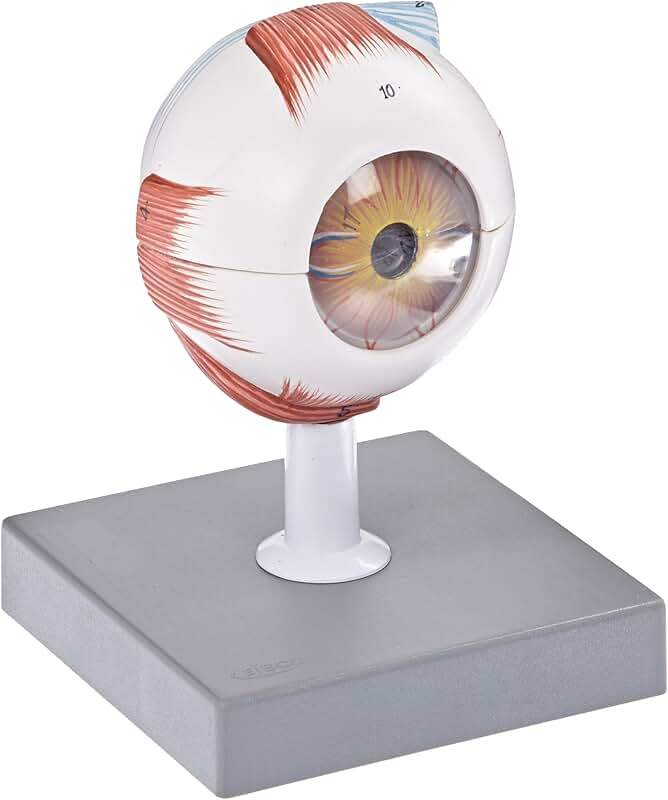
The approximate volume of a human eye is 6.5 cm3. The volume of a laboratory model (excluding base and stand) of the human eye is 1404 cm3.
(a) State whether the scale factor k is less than, equals to or greater than 1.
(b) Calculate the:
(i) value of k
(ii) diameter of the human eye if the radius of the model is 7.2 cm.
(iii) the external surface area of the human eye if the surface area of the model is 651.6 cm2.
Answer
(a) Scale factor is greater than 1 as volume of model is greater than the original eye.
(b)
(i) By formula,
⇒k3=Volume of original human eyeVolume of model⇒k3=6.51404⇒k3=1216⇒k3=63⇒k=6.
Hence, scale factor (k) = 6.
(ii) By formula,
⇒k=Radius of human eyeRadius of model⇒6=Radius of human eye7.2⇒Radius of human eye=67.2=1.2 cm
Diameter of human eye = 1.2 × 2 = 2.4 cm
Hence, diameter of human eye = 2.4 cm.
(iii) By formula,
⇒k2=Surface area of human eyeSurface area of model⇒62=Surface area of human eye651.6⇒Surface area of human eye=62651.6⇒Surface area of human eye=36651.6=18.1 cm2.
Hence, surface area of human eye = 18.1 cm2.