
The inclination of every line parallel to the x-axis is:
0°
90°
180°
none of these
Answer
The angle that a horizontal line makes with the x-axis is 0°.
The angle between the line and the x-axis is 0°.
Hence, option 1 is the correct option.
The inclination of y-axis is:
0°
45°
90°
180°
Answer
A vertical line makes a right angle with the horizontal x-axis.
Therefore, the angle of inclination of the y-axis is 90°.
Hence, option 3 is the correct option.
The slope of a line whose inclination is 30°, is:
1
Answer
The slope (m) of a line is related to its inclination (θ) by the formula:
m = tan θ
m = tan 30° = .
Hence, option 4 is the correct option.
The slope of a horizontal line is:
0
1
2
not defined
Answer
A horizontal line is a line parallel to the x-axis.
Thus θ = 0°
We know that,
m = tan θ
m = tan 0° = 0
Hence, option 1 is the correct option.
The slope of a vertical line is:
0
1
90
not defined
Answer
A vertical line is perpendicular to x-axis.
Thus, θ = 90°.
We know that,
m = tan θ
m = tan 90° = not defined
Hence, option 4 is the correct option.
The slope of a line passing through two given points A(x1, y1) and B(x2, y2) is given by:
Answer
The correct formula for slope is:
Hence, option 4 is the correct option.
Which of the following lines does not have x-intercept?
A horizontal line
A vertical line
An oblique line
None of these
Answer
A horizontal line has equation : y = c.
It does not crosses x-axis at any point, thus x-intercept = 0.
Hence, option 1 is the correct option.
Which of the following lines does not have y-intercept?
A horizontal line
A vertical line
y-axis
A transverse line
Answer
A y-intercept is the point where a line crosses the y-axis.
A vertical line: A vertical line has the equation x = a.
If a = 0 , it has an infinite number of y-intercepts.
If a ≠ 0 , the line is parallel to the y-axis and never crosses it. Therefore, it has no y-intercept.
Hence, option 2 is the correct option.
The equation of x-axis is:
x = 0
y = 0
x = a
y = a
Answer
The equation of x-axis is :
y = 0
Every point on the x-axis has a y-coordinate of 0, regardless of its x-coordinate.
Hence, option 2 is the correct option.
The equation of y-axis is :
x = 0
y = 0
x = a
y = a
Answer
The equation of y-axis is:
x = 0
Every point on the y-axis has an x-coordinate of 0, regardless of its y-coordinate.
Hence, option 1 is the correct option.
The equation of a line parallel to x-axis and at a distance of 5 units below it, is:
x – 5 = 0
x + 5 = 0
y – 5 = 0
y + 5 = 0
Answer
Any line parallel to the x-axis is a horizontal line and has the equation of form y = k.
The distance is 5 units below x-axis, thus the y-coordinate (k) of every point on the line is -5.
y = -5
y + 5 = 0.
Hence, option 4 is the correct option.
The equation of a line parallel to y-axis and at a distance of 8 units to the right of it, is:
x – 8 = 0
x + 8 = 0
y – 5 = 0
y + 5 = 0
Answer
Any line parallel to the y-axis is a vertical line and has the equation form x = k.
The distance is 8 units to the right, thus the x-coordinate (k) of every point on the line is +8.
x = 8
x - 8 = 0
Hence, option 1 is the correct option.
The equation of a line with slope m and y-intercept c is given by:
x = my + c
cy = mx
y = mx + c
none of these
Answer
y = mx + c, is the standard form of a linear equation known as the slope-intercept form.
Hence, option 3 is the correct option.
The slope m of a line whose inclination is α, is given by :
sin α
cos α
tan α
cot α
Answer
The slope (m) of a line is defined as the tangent of its angle of inclination.
m = tan α
Hence, option 3 is the correct option.
The equation of a line with slope m and passing through a point P(a, b), is given by :
(y – a) = m(x – b)
(x – b) = m(y – a)
(x – a) = m(y – b)
(y – b) = m(x – a)
Answer
By point-slope form,
Equation of line :
y - y1 = m (x - x1)
Thus, equation of line passing through (a, b) and slope m is :
y - b = m(x - a)
Hence, option 4 is the correct option.
The equation of a line passing through two points A(x1, y1) and B(x2, y2) is given by:
(x – x1) = (y – y1)
(y – y1) = (x – x1)
(y – y1) = (x – x1)
(y – y1) = (x – x1)
Answer
By two-point formula,
Equation of line :
(y – y1) = (x – x1)
Hence, option 3 is the correct option.
The equation of the line passing through origin and parallel to the line 3x + 4y + 7 = 0 is:
3x + 4y + 5 = 0
4x - 3y - 5 = 0
4x - 3y = 0
3x + 4y = 0
Answer
Given,
⇒ 3x + 4y + 7 = 0
⇒ 4y = -3x - 7
⇒ y =
Comparing above equation with y = mx + c, we get :
m = .
By point-slope formula,
Equation of line : y - y1 = m(x - x1)
Thus, equation of line parallel to 3x + 4y + 7 = 0 and passing through origin (0, 0) is :
⇒ y - 0 = (x - 0)
⇒ y =
⇒ 4y = -3x
⇒ 4y + 3x = 0.
Hence, option 4 is the correct option.
The gradient of the line passing through the points A(–3, 4) and B(2, –6) is:
–
–2
2
Answer
We know that,
Hence, option 2 is the correct option.
The equation of a straight line whose inclination with x-axis is 30° and whose y-intercept is –4, is:
Answer
The slope m is determined by the inclination θ = 30°.
m = tan θ
m = tan 30°
m =
Slope-intercept form:
y = mx + c
Hence, option 3 is the correct option.
The slope of the straight line passing through the points A(3, –2) and B(3, –4) is:
0
1
–2
not defined
Answer
We know that,
Slope =
Slope is not defined.
Hence, option 4 is the correct option.
The inclination of the line y = x – 5 is:
0°
30°
45°
60°
Answer
Comparing equation, y = x – 5 with y = mx + c, we get :
⇒ m =
⇒ tan θ =
⇒ tan θ = tan 60°
⇒ θ = 60°.
Hence, option 4 is the correct option.
If the slope of the line passing through the points (2, 5) and (k, 3) is 2, then the value of k is:
0
–1
1
2
Answer
We know that,
m =
Substitute values we get:
Hence, option 3 is the correct option.
What can be said regarding a straight line if its slope is negative?
Inclination, θ is an acute angle.
Inclination, θ is an obtuse angle.
Either the line is x-axis or it is parallel to the x-axis.
Either the line is y-axis or it is parallel to the y-axis.
Answer
If the slope is negative, then tan θ must be negative.
tan θ < 0
This happens only when the angle θ made with the positive x-axis is between 90° and 180°.
And angles between 90° and 180° are called obtuse angles.
Hence, option 2 is the correct option.
The equation of a straight line passing through the point (–6, 8) and parallel to the x-axis is:
x – 6 = 0
x + 6 = 0
y – 8 = 0
y + 8 = 0
Answer
The equation of horizontal line is of the form y = c.
Since the line must pass through the point (-6, 8), its y-coordinate must be equal to 8.
y = 8
y - 8 = 0.
Hence, option 3 is the correct option.
The slope of the line, 3x – – 4 = 0 is:
Answer
Solving,
Comparing above equation with y = mx + c, we get :
m =
Rationalizing the Denominator,
Hence, option 3 is the correct option.
The equation of the line passing through the points A(4, 3) and B(–2, 6) is :
x + 2y – 10 = 0
x – 2y – 6 = 0
x – 3y + 8 = 0
x + 2y – 6 = 0
Answer
We know that,
By point-slope form :
⇒ y - y1 = m(x - x1)
⇒ y - 3 = (x - 4)
⇒ 2(y - 3) = -1(x - 4)
⇒ 2y - 6 = -x + 4
⇒ x + 2y - 6 - 4 = 0
⇒ x + 2y - 10 = 0.
Hence, option 1 is the correct option.
The equation of a line passing through the point (5, –3) and having the y-intercept of 8 units below the x-axis is:
x + y – 8 = 0
x – y – 8 = 0
2x + y – 4 = 0
x – 2y – 8 = 0
Answer
The line intersects the y-axis 8 units below the x-axis. This means the line intersect y-axis at (0, -8).
Thus, y-intercept of lie (c) = -8
Thus, line passes through (0, -8) and (5, -3).
We know that,
Substitute m = 1 and c = -8 into y = mx + c, we get :
⇒ y = 1.x + (-8)
⇒ y = x - 8
⇒ x - y - 8 = 0.
Hence, option 2 is the correct option.
The value of m such that the points A(5, –2), B(8, –3) and C(m, –12) are collinear, is:
29
33
35
41
Answer
For three points A, B, and C to be collinear.
mAB = mBC
We know that,
m =
Using A(5, -2) and B(8, -3) :
Using B(8, -3) and C(m, -12):
mAB = mBC
⇒
⇒ -1(m - 8) = -9 × 3
⇒ -m + 8 = -27
⇒ -m = -27 - 8
⇒ -m = -35
⇒ m = 35.
Hence, option 3 is the correct option.
The equation of the straight line passing through the point (9, –9) and parallel to the y-axis is:
y – 9 = 0
y + 9 = 0
x + 9 = 0
x – 9 = 0
Answer
The equation of line parallel to y-axis is :
x = c
Since the line must pass through the point (9, -9), its x-coordinate must be x = 9.
x - 9 = 0
Hence, option 4 is the correct option.
Two non-vertical lines with slopes m1 and m2 are parallel to each other, if:
m1m2 = 1
m1m2 = –1
m1 = –m2
m1 = m2
Answer
Two distinct non-vertical lines are parallel if and only if their slopes are equal.
m1 = m2
Hence, option 4 is the correct option.
Two non-vertical lines with slopes m1 and m2 are perpendicular to each other, if:
m1.m2 = 1
m1.m2 = –1
m1 = –m2
m1 = m2
Answer
Two non-vertical lines are perpendicular if and only if the product of their slopes is -1.
m1.m2 = –1
Hence, option 2 is the correct option.
The slope of a line parallel to the line passing through the points A(3, –7) and B(5, –7) is:
2
1
–1
0
Answer
Given, points A(3, –7) and B(5, –7)
Slope =
Substitute values we get,
As, slope of parallel lines are equal.
Thus, slope of line parallel to AB = 0.
Hence, option 4 is the correct option.
The slope of a line perpendicular to the line passing through the points P(3, –4) and Q(1, –8) is:
2
–2
Answer
Slope of the line passing through P(3, –4) and Q(1, –8).
Since the required line is perpendicular to line PQ, the product of their slopes must be -1.
Let slope of required line be m.
⇒ mPQ × m = -1
⇒ 2 × m = -1
⇒ m =
Hence, option 1 is the correct option.
The slope of a line parallel to the line, 3x – 5y + 8 = 0, is:
Answer
Solving,
⇒ 3x - 5y + 8 = 0
⇒ 3x + 8 = 5y
⇒ .
The slope of the given line is .
Since the required line is parallel, its slope must be the same as m.
Let slope of required line be m1,
m1 = m = .
Hence, option 4 is the correct option.
The slope of a line perpendicular to the line, 3x = 4y – 10, is :
Answer
Solving,
⇒ 3x = 4y - 10
⇒ 4y = 3x + 10
.
The slope of the given line is .
Since the required line is perpendicular, the product of the slopes must be -1.
Let slope of required line be a, then :
⇒ m × a = -1
⇒ × a = -1
⇒ a = .
Hence, option 2 is the correct option.
If the lines 2x + 3y = 5 and kx – 6y = 7 are parallel, then the value of k is:
–4
4
–5
Answer
For two lines to be parallel, their slopes must be equal.
Line 1 : 2x + 3y = 5
First, convert the equation 2x + 3y = 5 into the slope-intercept form, y = mx + c, to find its slope, m.
Line 2: kx - 6y = 7
First, convert the equation kx - 6y = 7 into the slope-intercept form, y = mx + c, to find its slope, m.
The slopes of parallel lines are equal:
Hence, option 1 is the correct option.
If the lines x – my + 3 = 0 and 2x + 3y – 7 = 0 are perpendicular to each other, then the value of m is:
Answer
For two lines to be perpendicular, the product of their slopes must be -1.
Line 1: x - my + 3 = 0
First, convert the equation x - my + 3 = 0 into the slope-intercept form, y = mx + c, to find its slope, m.
Line 2: 2x + 3y - 7 = 0
First, convert the equation 2x + 3y - 7 = 0 into the slope-intercept form, y = mx + c, to find its slope, m.
The product of slopes of perpendicular lines is equal to -1:
Hence, option 2 is the correct option.
The equation of the straight line passing through the point (1, 2) and parallel to the line y = 3x + 1, is:
x – 3y + 1 = 0
3x + y + 1 = 0
3x – y – 1 = 0
3x – y + 1 = 0
Answer
The given line is , so its slope is m = 3.
Since the required line is parallel, its slope is also m = 3.
Using the point-slope form y - y1 = m(x - x1) with the point (x1, y1) = (1, 2) and m=3:
y - 2 = 3(x - 1)
y - 2 = 3x - 3
Rearranging the equation to the standard form (Ax + By + C = 0):
0 = 3x - y - 3 + 2
3x - y - 1 = 0
Hence, option 3 is the correct option.
The slope of the line, ax + by + c = 0, is:
Answer
Convert the general linear equation ax + by + c = 0 into the slope-intercept form, y = mx + c, to find the slope, m.
by = -ax - c
The slope, m, is the coefficient of x.
m =
Hence, option 1 is the correct option.
Which of the following equations represents a line equally inclined to the axes?
y = -7
x = 7
x - y = 7
2x - 3y + 7 = 0
Answer
Equation:
⇒ x - y = 7
⇒ y = x - 7
Comparing above equation with y = mx + c, we get :
m = 1.
A line is equally inclined to the axes if slope = 1.
Hence, Option 3 is the correct option.
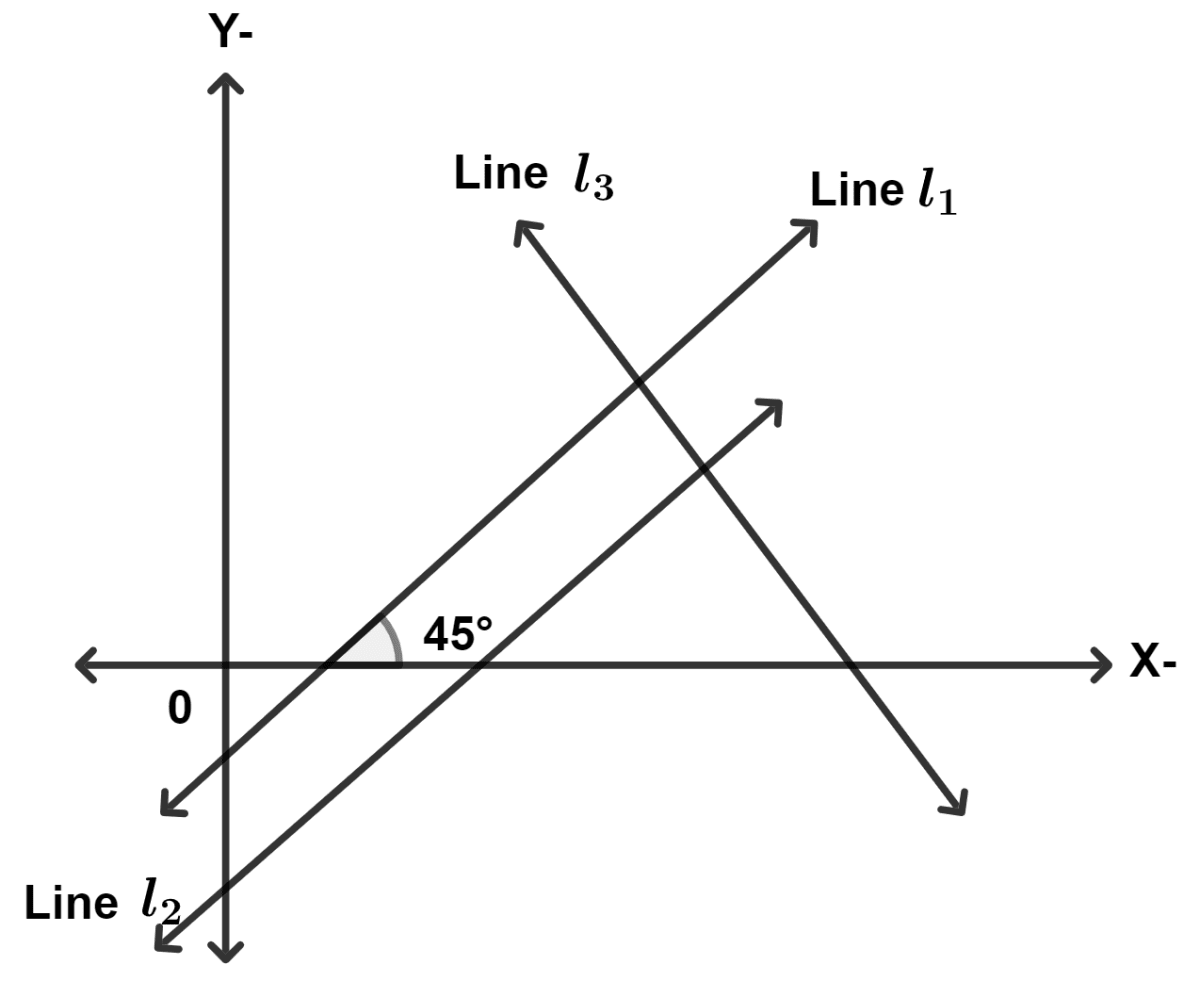
In the given figure line l1 is a parallel to line l2. If line l3 is perpendicular to line l1, then the slopes of lines l2 and l3 respectively are :
1, 1
-1, -1
1, -1
-1, 1
Answer
Slope of line l1 = tan 45° = 1.
We know that,
Slope of parallel lines are equal.
Slope of line l2 = Slope of line l1 = 1.
We know that,
Product of slope of perpendicular lines is equal to -1.
⇒ Slope of line l2 × Slope of line l3 = -1
⇒ 1 × Slope of line l3 = -1
⇒ Slope of line l3 = -1.
Hence, Option 3 is the correct option.
Which of the following lines cut the positive x-axis and positive y-axis at equal distances from the origin?
3x + 3y = 6
5x + 10y = 10
-x + y = 1
10x + 5y = 5
Answer
Substituting x = 0 in first equation,
⇒ 3(0) + 3y = 6
⇒ 3y = 6
⇒ y =
⇒ y = 2.
The line touches y-axis at point (0, 2).
Substituting y = 0 in first equation,
⇒ 3x + 3(0) = 6
⇒ 3x = 6
⇒ x =
⇒ x = 2.
The line touches y-axis at point (2, 0).
∴ Line 3x + 3y = 6 cuts positive x-axis and positive y-axis at equal distance i.e. 2 units form the origin.
Hence, Option 1 is the correct option.
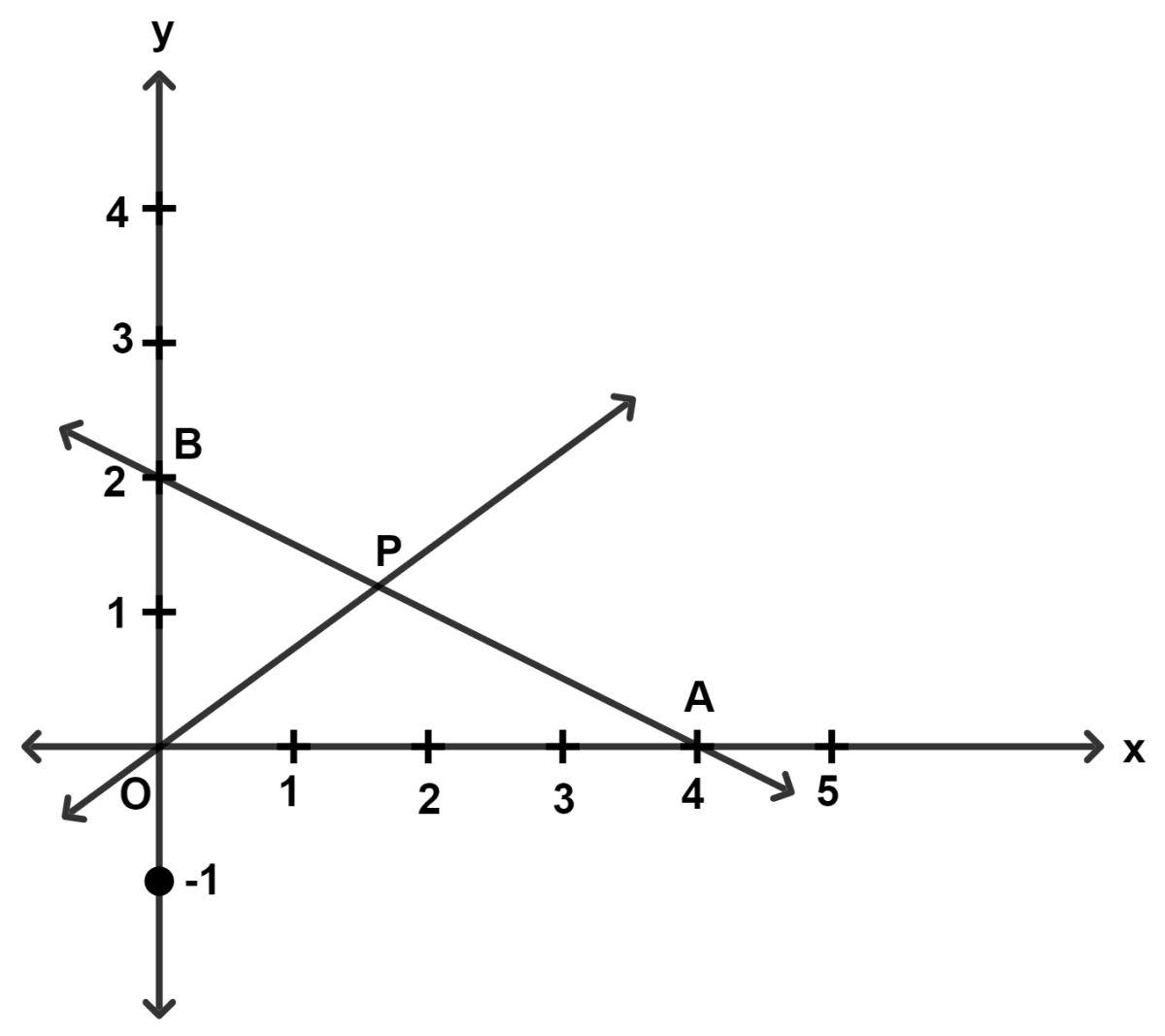
In the given diagram, O is the origin and P is the mid-point of AB. The equation of OP is :
y = x
2y = x
y = 2x
y = -x
Answer
From graph,
A = (4, 0) and B = (0, 2).
Given,
P is the mid-point of AB.
P = = (2, 1).
By two-point form,
⇒ y - y1 =
⇒ y - 1 =
⇒ y - 1 =
⇒ 2(y - 1) = x - 2
⇒ 2y - 2 = x - 2
⇒ 2y = x - 2 + 2
⇒ 2y = x.
Hence, Option 2 is the correct option.