
If A(2, –3), B(–5, 1), C(7, –1) and D(0, k) be four points such that AB is parallel to CD, find the value of k.
Answer
AB is parallel to line segment CD means they must have the same gradient
By using slope formula,
m =
Given, points A(2, –3), B(–5, 1)
Substituting values we get,
Given, points C(7, –1) and D(0, k)
Substituting values we get,
Equate the Gradients:
Hence, value of k = 3.
Show that the lines x + 2y – 5 = 0 and 2x + 4y + 9 = 0 are parallel.
Answer
Given,
⇒ x + 2y – 5 = 0
Converting x + 2y - 5 = 0 in the form y = mx + c we get,
⇒ 2y = -x + 5
⇒ y =
The equation of straight line is given by,
y = mx + c, where m is the slope and c is the y-intercept.
Comparing y = mx + c with y = , we get:
⇒ m1 =
Given,
⇒ 2x + 4y + 9 = 0
Converting 2x + 4y + 9 = 0 in the form y = mx + c we get,
⇒ 4y = -2x - 9
⇒ y =
⇒ y =
Comparing y = mx + c with y = , we get:
⇒ m2 =
Since the gradient of the first line is equal to the gradient of the second line.
The lines are parallel to each other.
Hence, proved that lines are parallel.
Find the value of k for which the lines kx + 2y + 3 = 0 and 8x + ky – 1 = 0 are parallel.
Answer
Since, the lines are parallel they have same gradient.
Given, kx + 2y + 3 = 0
Converting kx + 2y + 3 = 0 in the form y = mx + c, we get :
⇒ 2y = -kx - 3
⇒ y =
The equation of straight line is given by,
y = mx + c, where m is the slope and c is the y-intercept.
Comparing y = mx + c with y = , we get :
⇒ m1 =
Given,
8x + ky - 1 = 0
Converting 8x + ky - 1 = 0 in the form y = mx + c we get,
⇒ ky = -8x + 1
⇒ y =
Comparing y = mx + c with y = , we get :
⇒ m2 =
Since, lines are parallel, equating the gradients :
Hence, value of k = ± 4.
If the lines 2x – by + 5 = 0 and ax + 3y = 2 are parallel, find the relation connecting a and b.
Answer
Converting 2x - by + 5 = 0 in the form y = mx + c we get,
⇒ 2x - by + 5 = 0
⇒ by = 2x + 5
⇒ y =
m1 =
Converting ax + 3y = 2 in the form y = mx + c we get,
⇒ ax + 3y = 2
⇒ 3y = -ax + 2
⇒ y =
m2 =
Given, two lines are parallel so their slopes will be equal,
m1 = m2
⇒
⇒ 3 × 2 = −a × b
⇒ 6 = −ab
⇒ ab + 6 = 0
⇒ ab = −6.
Hence, the relation connecting a and b is ab = -6.
Prove that the line through A(–2, 6) and B(4, 8) is perpendicular to the line through C(8, 12) and D(4, 24).
Answer
The slope of the line passing through two points (x1, y1) and (x2, y2) is given by
Slope =
Slope (m1) of line joining (-2, 6) and (4, 8) is,
=
Slope (m2) of line joining (8, 12) and (4, 24) is,
=
m1 × m2 = = -1.
Product of slopes = -1.
Hence, the lines are perpendicular to each other.
If A(2, –5), B(–2, 5), C(k, 3) and D(1, 1) be four points such that AB and CD are perpendicular to each other, find the value of k.
Answer
By using slope formula,
m =
Given, points A(2, –5), B(–2, 5)
Substituting values we get,
Given, points C(k, 3) and D(1, 1)
Substituting values we get,
Since the lines are perpendicular the product of the gradients is equal to -1:
Hence, value of k = 6.
Prove that the lines 2x + 3y + 8 = 0 and 27x – 18y + 10 = 0 are perpendicular to each other.
Answer
Converting 2x + 3y + 8 = 0 in the form y = mx + c we get,
⇒ 3y = -2x - 8
⇒ y =
Comparing, we get slope of this line : m1 =
Converting 27x – 18y + 10 = 0 in the form y = mx + c we get,
⇒ -18y = -27x - 10
⇒ y =
⇒ y =
Comparing, we get slope of this line : m2 =
Product of Gradients
m1 × m2 =
=
= -1
Since the product of the gradients is -1. The lines are perpendicular to each other.
Hence, proved that lines 2x + 3y + 8 = 0 and 27x – 18y + 10 = 0 are perpendicular to each other.
If the lines y = 3x + 7 and 2y + px = 3 are perpendicular to each other, find the value of p.
Answer
Given lines,
⇒ y = 3x + 7 and 2y + px = 3
⇒ y = 3x + 7 and 2y = -px + 3
⇒ y = 3x + 7 and y =
Comparing above equations with y = mx + c we get,
Slope of 1st line = 3
Slope of 2nd line =
Since,
Product of slopes of perpendicular lines = -1.
Hence, p = .
If the straight lines 3x – 5y = 7 and 4x + ay + 9 = 0 are perpendicular to each other, find the value of a.
Answer
Converting 3x - 5y + 7 = 0 in the form y = mx + c we get,
⇒ 3x - 5y + 7 = 0
⇒ 5y = 3x + 7
⇒ y =
Comparing, we get slope of first line = m1 =
Converting 4x + ay + 9 = 0 in the form y = mx + c we get,
⇒ 4x + ay + 9 = 0
⇒ ay = -4x - 9
⇒ y =
Comparing, we get slope of second line = m2 =
Given, two lines are perpendicular so product of their slopes will be equal to -1,
Hence,the value of a = .
Without using Pythagoras Theorem, prove that the points A(1, 3), B(3, –1) and C(–5, –5) are the vertices of a right-angled triangle.
Answer
By using slope formula,
m =
Given, points A(1, 3), B(3, –1)
Substituting values we get,
Given, points B(3, –1) and C(–5, –5)
Substituting values we get,
Check for perpendicularity,
Since the product of the gradients of AB and BC is -1, the side AB is perpendicular to the side BC.
∠ABC = 90°.
Hence, proved the points A(1, 3), B(3, –1) and C(–5, –5) are the vertices of a right-angled triangle.
Without using distance formula, show that the points A(1, –2), B(3, 6), C(5, 10) and D(3, 2) are the vertices of a parallelogram.
Answer
By using slope formula,
m =
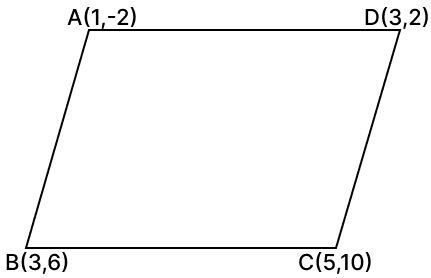
Given, points A(1, –2), B(3, 6)
Substituting values we get,
Given, points C(5, 10) and D(3, 2)
Substituting values we get,
Given, points B(3, 6), C(5, 10)
Substituting values we get,
Given, points A(1, –2), D(3, 2)
Substituting values we get,
mAB = mCD and mBC = mAD
∴ AB is parallel to CD and BC is parallel to AD
Since both pairs of opposite sides are parallel, the quadrilateral ABCD is a parallelogram.
Hence, proved that ABCD is a parallelogram.
Given that A(5, 4), B(–3, –2) and C(1, –8) are the vertices of a ΔABC. Find:
(i) the slope of median AD
(ii) the slope of altitude BM
Answer
(i) Since, AD is median. So, D is the mid-point of BC.
By using formula,
(x, y) =
Substitute values we get,
D =
By using slope formula,
m =
Slope of AD =
Hence, slope of the median AD = .
(ii) The altitude BM is perpendicular to the side AC. Therefore, the product of their slopes is -1.
Slope of AC =
mBM × 3 = -1
mBM =
Hence, slope of the BM = .
Find the equation of the line parallel to the line 3x + 2y = 8 and passing through the point (0, 1).
Answer
Given,
⇒ 3x + 2y = 8
Converting 3x + 2y = 8 in the form y = mx + c we get,
⇒ 2y = -3x + 8
⇒ y =
Comparing above equations with y = mx + c we get,
Slope =
Since, parallel lines have equal slope.
∴ Slope of line parallel to 3x + 2y = 8 is
By point-slope form,
⇒ y - y1 = m(x - x1)
Thus, equation of line with slope and passing through (0, 1) is :
⇒ y - 1 = (x - 0)
⇒ 2(y - 1) = -3x
⇒ 2y - 2 = -3x
⇒ 3x + 2y = 2 .
Hence, equation of the line passing through (0, 1) and parallel to 3x + 2y = 8 is 3x + 2y = 2.
Find the equation of a line parallel to the line 2x + y – 7 = 0 and passing through the intersection of the lines x + y – 4 = 0 and 2x – y = 8.
Answer
Simultaneously solving equations :
⇒ x + y - 4 = 0 …….(1)
⇒ 2x - y = 8 ……..(2)
Solving equation (1), we get :
⇒ x = 4 - y ………..(3)
Substituting value of x from (3) in (2), we get :
⇒ 2(4 - y) - y = 8
⇒ 8 - 2y - y = 8
⇒ 8 - 3y = 8
⇒ 3y = 0
⇒ y = 0.
Substituting value of y in (3), we get :
⇒ x = 4 - 0 = 4.
Point of intersection = (4, 0).
Given,
Equation :
⇒ 2x + y - 7 = 0
⇒ y = -2x + 7
Comparing above equation with y = mx + c, we get :
⇒ m = -2.
We know that,
Slope of parallel lines are equal.
∴ Slope of line parallel to 2x + y - 7 = -2.
By point-slope formula,
Equation of line :
⇒ y - y1 = m(x - x1)
Thus, equation of line with slope = -2 and passing through (4, 0).
⇒ y - 0 = -2(x - 4)
⇒ y = -2x + 8
⇒ 2x + y - 8 = 0.
Hence, the equation of required line is 2x + y - 8 = 0.
A(–1, 3), B(4, 2) and C(3, –2) are the vertices of a triangle.
(i) Find the co-ordinates of the centroid G of the triangle.
(ii) Find the equation of the line through G and parallel to AC.
Answer
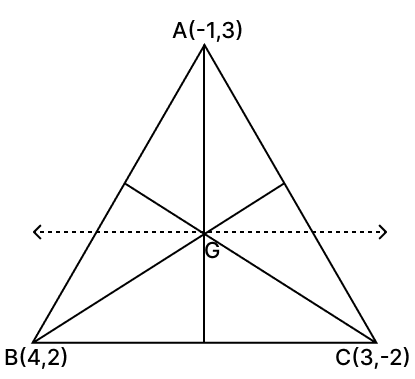
(i) Centroid of the triangle is given by,
Hence, the coordinates of the centroid G of the triangle is (2, 1).
(ii) Slope of AC =
So, the slope of the line parallel to AC is also . and it passes through (2, 1). Hence, its equation can be given by point-slope form i.e.,
⇒ y - y1 = m(x - x1)
⇒ y - 1 = (x - 2)
⇒ 4(y − 1) = −5(x − 2)
⇒ 4y − 4 = −5x + 10
⇒ 4y + 5x = 14
⇒ 5x + 4y − 14 = 0.
Hence, the equation of the required line is 5x + 4y - 14 = 0.
Find the equation of a line passing through the point P(–2, 1) and parallel to the line joining the points A(4, –3) and B(–1, 5).
Answer
Since the required line is parallel to the line segment AB, they must have the same gradient.
Slope of AB =
Using the point-slope form,
⇒ y - y1 = m(x - x1)
⇒ y - 1 = [x - (-2)]
⇒ 5(y - 1) = -8(x + 2)
⇒ 5y - 5 = -8x - 16
⇒ 8x + 5y - 5 + 16 = 0
⇒ 8x + 5y + 11 = 0
Hence, the equation of the required line is 8x + 5y + 11 = 0.
(i) If the lines kx - y + 4 = 0 and 2y = 6x + 7 are perpendicular to each other, find the value of k.
(ii) Find the equation of a line parallel to 2y = 6x + 7 and passing through (-1, 1)
Answer
(i) 1st equation :
⇒ kx - y + 4 = 0
⇒ y = kx + 4
Slope (s1) : k
2nd equation :
⇒ 2y = 6x + 7
⇒ y =
⇒ y = 3x +
Slope (s2) : 3
We know that,
Product of slope of perpendicular lines = -1
⇒ k × 3 = -1
⇒ k =
Hence, k = .
(ii) We know that,
Slope of parallel lines are equal.
Slope of line parallel to line 2y = 6x + 7 is 3.
By point-slope form :
⇒ y - y1 = m(x - x1)
⇒ y - 1 = 3[x - (-1)]
⇒ y - 1 = 3[x + 1]
⇒ y - 1 = 3x + 3
⇒ y = 3x + 3 + 1
⇒ y = 3x + 4.
Hence, equation of line parallel to 2y = 6x + 7 and passing through (–1, 1) is y = 3x + 4.
Find the equation of the line passing through the origin and perpendicular to the line y + 5x = 3.
Answer
Converting y + 5x = 3 in the form y = mx + c we get,
⇒ y = -5x + 3
Comparing above equation with y = mx + c we get, m = -5
For two lines to be perpendicular, the product of their gradients must be -1.
Let slope of required line be m2, then :
⇒ -5 × m2 = -1
⇒ m2 =
⇒ m2 =
Using the slope-intercept form y = mx + c. Since the line passes through the origin, the y-intercept is 0.
⇒ y = x + 0
⇒ 5y = x
⇒ x - 5y = 0.
Hence, the equation of the required line is x - 5y = 0.
Find the equation of a line passing through the origin and parallel to the line 3x – 2y + 4 = 0.
Answer
Converting 3x - 2y + 4 = 0 in the form y = mx + c we get,
⇒ -2y = -3x - 4
⇒ y =
⇒ y = + 2
Comparing above equation with y = mx + c we get, m =
Since the required line is parallel to the given line, they must have the same gradient:
⇒ Slope of parallel line =
Using the slope-intercept form y = mx + c. Since the line passes through the origin, the y-intercept is 0.
⇒ y = x + 0
⇒ 2y = 3x
⇒ 3x - 2y = 0.
Hence, the equation of the required line is 3x - 2y = 0.
Find the equation of the line that has x-intercept –3 and is perpendicular to the line 3x + 5y = 1.
Answer
Let point where line touches x-axis be A. So, A = (-3, 0)
Given equation of line,
⇒ 3x + 5y = 1
⇒ 5y = -3x + 1
⇒ y =
Comparing above equation with y = mx + c we get, m1 =
Let slope of line perpendicular to 3x + 5y = 1 be m2
⇒ m1 × m2 = -1
⇒
⇒
By point-slope form,
Equation of line with slope = and passing through (-3, 0) is :
⇒ y - y1 = m(x - x1)
⇒ y - 0 = [x - (-3)]
⇒ 3y = 5[x + 3]
⇒ 3y = 5x + 15
⇒ 5x - 3y + 15 = 0.
Hence, equation of required line is 5x - 3y + 15 = 0.
Find the equation of the line passing through (2, 4) and perpendicular to x-axis.
Answer
A line perpendicular to the x-axis, has equation x = k.
Since, line passes through (2, 4).
∴ Equation : x = 2.
Hence, equation of required line is x = 2.
Find the equation of the perpendicular dropped from the point (–1, 2) onto the line joining the points (1, 4) and (2, 3).
Answer
Let P = (-1, 2)
Let A and B be the points (1, 4) and (2, 3).
Slope of AB =
We know that,
Product of slope of perpendicular lines is -1.
Let slope of line through P and perpendicular to AB be m.
∴ m × Slope of AB = -1
⇒ m × -1 = -1
⇒ -m = -1
⇒ m = 1.
By point-slope form,
Equation of line through P,
⇒ y - y1 = m(x - x1)
⇒ y - 2 = 1[x - (-1)]
⇒ y - 2 = 1(x + 1)
⇒ y - 2 = x + 1
⇒ y - x = 1 + 2
⇒ y - x = 3
⇒ x - y + 3 = 0.
Hence, equation of the perpendicular dropped from the point (-1, 2) onto the line joining the points (1, 4) and (2, 3) is x - y + 3 = 0.
Find the equation of the line passing through the point of intersection of the lines 5x – 8y + 23 = 0 and 7x + 6y – 71 = 0 and perpendicular to the line 4x – 2y = 3.
Answer
Given line equations are,
⇒ 7x + 6y - 71 = 0
⇒ 7x + 6y = 71 .......(1)
and
⇒ 5x - 8y + 23 = 0
⇒ 5x - 8y = -23 .......(2)
Multiplying (1) by 4, we get :
⇒ 28x + 24y = 284 .......(3)
Multiplying (2) by 3, we get :
⇒ 15x – 24y = -69 .......(4)
On adding (3) and (4), we get :
⇒ 28x + 24y + 15x - 24y = 284 + (-69)
⇒ 28x + 15x + 24y - 24y = 284 - 69
⇒ 43x = 215
⇒ x =
⇒ x = 5.
Substituting value of x in equation (2), we get :
⇒ 5.5 - 8y = -23
⇒ 25 - 8y = -23
⇒ 8y = 25 + 23
⇒ 8y = 48
⇒ y = 6.
Hence, the required line passes through the point (5, 6).
Given,
⇒ 4x – 2y = 3
⇒ 2y = 4x – 3
⇒ y = 2x – .
Comparing above equation with y = mx + c we get,
Slope (m) = 2
Let slope of required line be m1.
As, the lines are perpendicular to each other so product of their slopes = -1.
⇒ m × m1 = -1
⇒ 2 × m1 = -1
⇒ m1 = .
Thus, equation of the line with slope and passing through (5, 6) is :
⇒ y – y1 = m(x – x1)
⇒ y – 6 = (x – 5)
⇒ 2(y – 6) = -1(x - 5)
⇒ 2y - 12 = -x + 5
⇒ 2y + x = 5 + 12
⇒ x + 2y = 17.
Hence, equation of required line is x + 2y = 17.
A line through origin meets the line 2x = 3y + 13 at right angles at point Q. Find the co-ordinates of Q.
Answer
Let the line passing through the origin O(0, 0) be L1 and slope m1, and the given line be L2 : 2x = 3y + 13 and slope be m2.
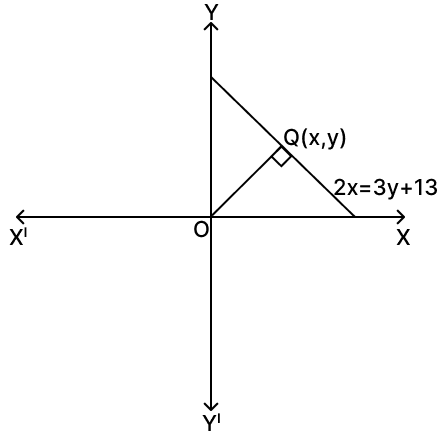
Given equation of line,
⇒ 2x = 3y + 13
⇒ 3y = 2x - 13
⇒ y =
Comparing above equation with y = mx + c we get, Slope (m2) = .
Since L1 is perpendicular to L2, the product of their slopes is -1.
⇒ m1 × m2 = -1
⇒ m1 × = -1
⇒ m1 = .
The equation of the line L1 having slope m1 and passing through the origin can be given by point-slope form i.e.,
⇒ y - y1 = m(x - x1)
⇒ y - 0 = (x - 0)
⇒ y =
⇒ 2y = -3x
⇒ 2y + 3x = 0.
For finding the coordinates of the foot of the perpendicular which is the point of intersection of the lines.
-3y + 2x - 13 = 0 .......(i)
2y + 3x = 0 ..........(ii)
On multiplying equation (i) by 2, we get :
-6y + 4x - 26 = 0 ..........(iii)
On multiplying equation (ii) by 3 we get,
6y + 9x = 0 .........(iv)
Adding (iii) and (iv) we get,
⇒ -6y + 4x - 26 + 6y + 9x = 0
⇒ 13x - 26 = 0
⇒ 13x = 26
⇒ x =
⇒ x = 2.
Substituting value of x in (ii), we get :
⇒ 2y + 3(2) = 0
⇒ 2y + 6 = 0
⇒ 2y = -6
⇒ y =
⇒ y = -3.
∴ Coordinates = (2, -3)
Hence, coordinates of Q = (2, -3).
Find the equation of the perpendicular from the point P(1, –2) on the line 4x – 3y – 5 = 0. Also, find the co-ordinates of the foot of the perpendicular.
Answer
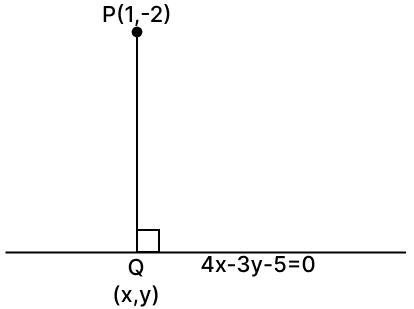
Solving,
⇒ 4x - 3y - 5 = 0
⇒ 3y = 4x - 5
⇒ y =
Comparing above equation with y = mx + c we get, Slope of the line (m1) =
Let the slope of the line perpendicular to 4x - 3y - 5 = 0 be m2.
Then,
The equation of the line having slope m2 and passing through the point (1, -2) can be given by point-slope form i.e.,
⇒ y - y1 = m(x - x1)
⇒ y - (-2) =
⇒ 4(y + 2) = −3(x − 1)
⇒ 4y + 8 = −3x + 3
⇒ 3x + 4y + 5 = 0.
For finding the coordinates of the foot of the perpendicular which is the point of intersection of the lines. Let point of intersection of lines be Q.
4x - 3y - 5 = 0 .......(1)
3x + 4y + 5 = 0 ........(2)
On multiplying equation (1) by 4, we get :
16x - 12y - 20 = 0 ...........(3)
On multiplying equation (2) by 3, we get :
9x + 12y + 15 = 0 ..........(4)
Adding equations (3) and (4) we get,
⇒ 16x - 12y - 20 + 9x + 12y + 15 = 0
⇒ 25x - 5 = 0
⇒ x =
⇒ x = .
Substituting value of x in (1), we get :
∴ Q =
Hence, the equation of the new line is 3x + 4y + 5 = 0 and coordinates of the foot of perpendicular are .
Find the equation of the line which is perpendicular to the line at the point where the given line meets y-axis.
Answer
Let A be the point where the line meets y-axis.
So, x-co-ordinate of point A will be zero.
Substituting x = 0 in equation we get,
A = (0, -b).
The given line equation is,
Comparing above equation with y = mx + c we get,
Slope (m) =
Let slope of perpendicular line be m1.
As product of slope of perpendicular lines is -1,
∴ m × m1 = -1
⇒ × m1 = -1
⇒ m1 =
Equation of line through A (0, -b) and slope = is :
⇒ y - y1 = m(x - x1)
⇒ y - (-b) = (x - 0)
⇒ b(y + b) = -ax
⇒ by + b2 = -ax
⇒ ax + by + b2 = 0
Hence, equation of required line is ax + by + b2 = 0.
Equation of a line AB is x + 2y + 6 = 0. A perpendicular PQ is dropped on AB from the point P(3, -2) meeting AB at Q. Find the:
(i) equation of PQ.
(ii) coordinates of the point Q.
Answer

(i) Given,
⇒ x + 2y + 6 = 0
⇒ 2y = -x - 6
⇒ y =
⇒ y = - - 3
Comparing y = - 3 with y = mx + c, we get :
Slope (mAB) =
Given,
PQ is perpendicular to AB.
∴ Product of their slopes = -1
⇒ mPQ × mAB = -1
⇒ mPQ × = -1
⇒ mPQ = -1 × -2
⇒ mPQ = 2.
By point-slope formula,
Equation of PQ : y - y1 = m(x − x1)
⇒ y - (-2) = 2(x - 3)
⇒ y + 2 = 2x - 6
⇒ y = 2x - 8.
Hence, the equation of PQ is y = 2x - 8.
(ii) The point Q is the intersection of line AB and line PQ.
Equation of AB
⇒ x + 2y + 6 = 0 .....(1)
Equation of PQ
⇒ y = 2x − 8 ....(2)
Substituting the value of y from (2) in (1), we get :
⇒ x + 2(2x - 8) + 6 = 0
⇒ x + 4x - 16 + 6 = 0
⇒ 5x - 10 = 0
⇒ 5x = 10
⇒ x =
⇒ x = 2.
Substituting the value of x in equation (2), we get :
⇒ y = 2x − 8
⇒ y = 2(2) − 8
⇒ y = 4 − 8
⇒ y = -4.
Q = (x, y) = (2, -4).
Hence, the coordinates of the point Q are (2, -4).
The points A(1, 3) and C(6, 8) are two opposite vertices of a square ABCD. Find the equation of the diagonal BD.
Answer
Given,
A(1, 3) and C(6, 8)
We know that diagonal AC is a perpendicular bisector of diagonal BD.
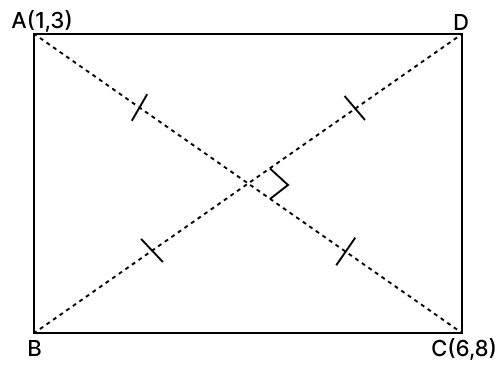
⇒ mAC × mBD = -1
⇒ 1 × mBD = -1
⇒ mBD = -1
Let O be the point of intersection of diagonals, which is the mid-point of both the diagonals.
By point-slope formula equation of AC is
Hence, the equation of the required line is x + y - 9 = 0.
A(1, 4), B(3, 2) and C(7, 5) are the vertices of a ΔABC. Find :
(i) the co-ordinates of the centroid G of ΔABC
(ii) the equation of a line through G and parallel to AB
Answer
(i) By formula,
Centroid of triangle =
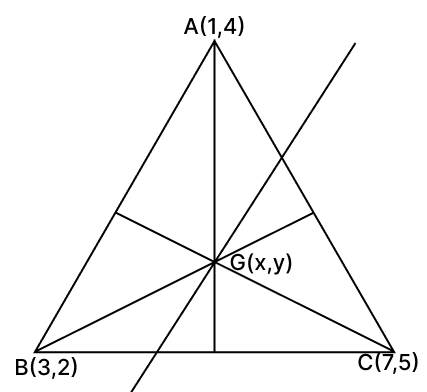
Substituting values we get,
Centroid =
Hence, centroid of triangle = .
(ii) Calculating,
Slope of AB =
Slope of line parallel to AB will also be equal to -1, as slope of parallel lies are equal.
By point-slope form,
Equation of a line, through the centroid and parallel to AB,
⇒ y - y1 = m(x - x1)
⇒ y -
⇒
⇒ 3y − 11 = −1(3x − 11)
⇒ 3y − 11 = −3x + 11
⇒ 3y + 3x = 11 + 11
⇒ 3x + 3y = 22.
Hence, the equation of a line, through the centroid and parallel to AB is 3x + 3y = 22.
A(–4, 2), B(6, 4) and C(2, –2) are the vertices of ΔABC. Find :
(i) the equation of median AD
(ii) the equation of altitude BM
(iii) the equation of right bisector of AB
(iv) the co-ordinates of centroid of ΔABC
Answer
(i) Slope of AD =
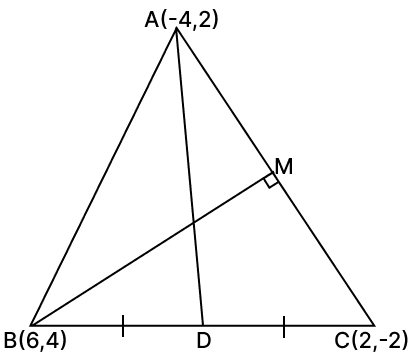
A median joins a vertex to the midpoint of the opposite side. D is the midpoint of BC.
By point-slope form,
Equation of a median AB, given by:
⇒ y - y1 = m(x - x1)
⇒ y - 2 = [x - (-4)]
⇒ 8(y - 2) = -1(x + 4)
⇒ 8y - 16 = -x - 4
⇒ x + 8y - 12 = 0
Hence, the equation of a line AD x + 8y - 12 = 0.
(ii) Slope of AC =
We know that altitude BM is a perpendicular AC.
Let the slope of BM be m1,
⇒ mAC × m2 = -1
⇒ × m1 = -1
⇒ m1 =
Equation of a line BM,
⇒ y - y1 = m(x - x1)
⇒ y - 4 = (x - 6)
⇒ 2(y - 4) = 3(x - 6)
⇒ 2y - 8 = 3x - 18
⇒ 3x - 2y - 10 = 0
Hence, the equation of a line BM 3x - 2y - 10 = 0.
(iii) Slope of AB =
Right bisector of AB is perpendicular to AB
Let the slope of Right bisector of AB be m2,
⇒ mAB × m2 = -1
⇒ × m2 = -1
⇒ m2 = -5
Coordinates of Midpoint of AB
Equation of a line BM,
⇒ y - y1 = m(x - x1)
⇒ y - 3 = -5 (x - 1)
⇒ (y - 3) = -5x + 5
⇒ 5x + y - 8 = 0
Hence, the equation of right bisector of AB 5x + y - 8 = 0.
(iv) Centroid of triangle ABC =
Substitute values we get,
Hence, coordinates of centroid are .
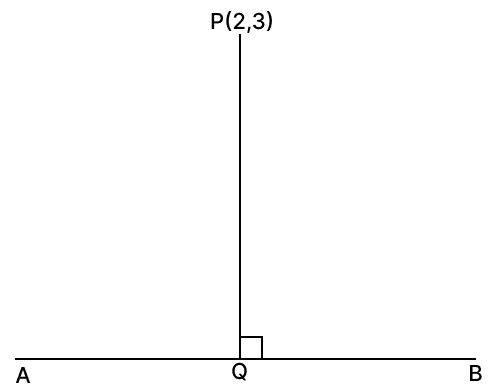
Find the equation of the perpendicular drawn from the point P(2, 3) on the line y = 3x + 4. Find the co-ordinates of the foot of the perpendicular.
Answer
Given line y = 3x + 4...(1)
Comparing above equation with y = mx + c we get m1 = 3
Since line is perpendicular to y = 3x + 4, the product of their gradients must be -1.
Let the slope of required line be m 2
⇒ m1 × m2 = -1
⇒ 3 × m2 = -1
⇒ m2 =
By point slope formula,
Equation of a line,
⇒ y - y1 = m(x - x1)
⇒ y - 3 = (x - 2)
⇒ 3(y - 3) = -1(x - 2)
⇒ 3y - 9 = -x + 2
⇒ x + 3y - 11 = 0...(2)
The equation of the perpendicular drawn from P(2, 3) is x + 3y - 11 = 0.
Substitute y into x + 3y - 11 = 0:
⇒ x + 3(3x + 4) - 11 = 0
⇒ x + 9x + 12 - 11 = 0
⇒ 10x + 1 = 0
⇒ 10x = -1
⇒ x =
Substitute value of x in y = 3x + 4:
⇒ y = 3 + 4
⇒ y =
⇒ y =
Hence, equation of required line is x + 3y - 11 = 0 and coordinates of foot of perpendicular .
A(1, 2), B(2, 3) and C(4, 3) are the vertices of a ΔABC. Find :
(i) the equation of altitude through B
(ii) the equation of altitude through C
(iii) the co-ordinates of the orthocentre of ΔABC
Answer
(i) Slope of AC =
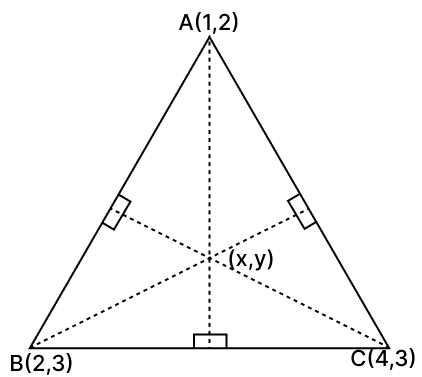
The altitude through B is perpendicular to the side AC.
Let the slope of altitude be m1,
⇒ mAC × m2 = -1
⇒ × m1 = -1
⇒ m1 = -3
By point slope formula,
Equation of altitude B,
⇒ y - 3 = -3(x - 2)
⇒ y - 3 = -3x + 6
⇒ 3x + y - 9 = 0 ...(1)
Hence, the equation of the altitude through B is 3x + y - 9 = 0.
(ii) Slope of AB =
The altitude through C is perpendicular to the side AB.
Let the slope of altitude be m2,
⇒ mAB × m2 = -1
⇒ 1 × m2 = -1
⇒ m2 = -1
By point slope formula,
Equation of altitude B,
⇒ y - y1 = m(x - x1)
⇒ y - 3 = -1(x - 4)
⇒ y - 3 = -x + 4
⇒ x + y - 7 = 0 ...(2)
Hence, the equation of the altitude through C is x + y - 7 = 0.
(iii) Subtract Equation (2) from Equation (1):
⇒ (3x + y - 9) - (x + y - 7) = 0 - 0
⇒ 3x + y - 9 - x - y + 7 = 0 - 0
⇒ 3x - x + y - y - 9 + 7 = 0
⇒ 2x - 2 = 0
⇒ 2x = 2
⇒ x = 1
Substitute x = 1 into Equation (2):
⇒ 1 + y - 7 = 0
⇒ y - 6 = 0
⇒ y = 6.
Hence, the co-ordinates of the orthocentre of ΔABC are (1, 6).
A(1, 2), B(3, –4) and C(5, –6) are the vertices of ΔABC. Find :
(i) the equation of the right bisector of BC
(ii) the equation of the right bisector of CA
(iii) the co-ordinates of the circumcentre of ΔABC
Answer
(i) Slope of BC =
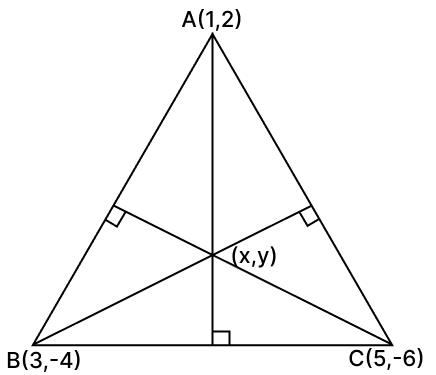
The right bisector is perpendicular to BC.
Let the slope of right bisector be m1,
⇒ mAB × m1 = -1
⇒ -1 × m1 = -1
⇒ m1 = 1
The right bisector (perpendicular bisector) passes through the midpoint of BC
By point slope formula,
Equation of right bisector of BC,
⇒ y - y1 = m(x - x1)
⇒ y - (-5) = 1(x - 4)
⇒ y + 5 = x - 4
⇒ x - y - 9 = 0....(1)
Hence, equation of right bisector of BC is x - y - 9 = 0.
(ii) Slope of CA =
The right bisector is perpendicular to CA.
Let the slope of right bisector of CA be m2,
⇒ mCA × m2 = -1
⇒ -2 × m2 = -1
⇒ m2 =
Midpoint of CA
By point slope formula,
Equation of right bisector of CA,
⇒ y - y1 = m(x - x1)
⇒ y - (-2) = (x - 3)
⇒ 2(y + 2) = (x - 3)
⇒ 2y + 4 = (x - 3)
⇒ x - 2y - 7 = 0 ...(2)
Hence, equation of right bisector of AC is x - 2y - 7 = 0.
(iii) Subtract Equation (2) from Equation (1):
⇒ (x - y) - (x - 2y) = 9 - 7
⇒ x - x - y + 2y = 2
⇒ y = 2.
Substitute y = 2 into Equation (1):
⇒ x - 2 = 9
⇒ x = 11.
Hence, coordinates of the circumcenter are (11, 2).
P is a point on the x-axis which divides the line joining A(-6, 2) and B(9, -4). Find
(i) the ratio in which P divides the line segment AB.
(ii) the coordinates of the point P.
(iii) equation of a line parallel to AB and passing through (-3, -2).
Answer
(i) Let the point P(x, 0) divide the line segment joining A(-6, 2) and B(9, -4) in the ratio m : n.
By section formula,
Substituting the values we get :
Hence, the ratio in which P divides the line segment AB is 1 : 2.
(ii) From part (a),
A (-6, 2) and B (9, - 4)
m : n = 1 : 2
By section-formula,
P = (x, 0) = (-1, 0).
Hence, the coordinates of the point P are (-1, 0).
(iii) By formula,
Substituting values we get :
Line parallel to AB will have the same slope, so the slope of the new line is also m = .
By point-slope formula,
y - y1 = m(x - x1)
Line passing through (-3, -2) and parallel to AB is :
Hence, the equation of the line is 2x + 5y + 16 = 0.
A line segment AB meets x-axis at A and y-axis at B. P(4, –1) divides AB in the ratio 1 : 2.
(i) Find the co-ordinates of A and B.
(ii) Find the equation of the line through P and perpendicular to AB.
Answer
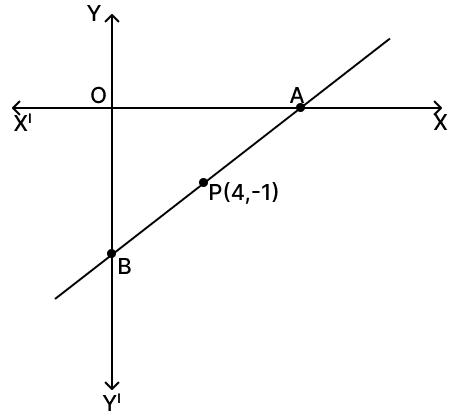
(i) As A lies on x-axis let its co-ordinates be (a, 0) and B lies on y-axis so, co-ordinates = (0, b).
By section-formula,
Hence, A = (6, 0) and B = (0, -3).
(ii) By formula,
Slope of AB =
Let slope of perpendicular line be m.
Since the product of the slopes of perpendicular lines = -1.
⇒ m × Slope of AB = -1
⇒ m × = -1
⇒ m = -2.
By point-slope from,
Equation of line passing through P and slope = -2 is :
⇒ y - y1 = m(x - x1)
⇒ y - (-1) = -2(x - 4)
⇒ y + 1 = -2x + 8
⇒ 2x + y = 7.
Hence, equation of required line is 2x + y = 7.
The vertices of a ΔABC are A(3, 8), B(–1, 2) and C(6, –6). Find :
(i) Slope of BC.
(ii) Equation of a line perpendicular to BC and passing through A.
Answer
(i) Let the slope of BC be m1. Slope of BC is given by,
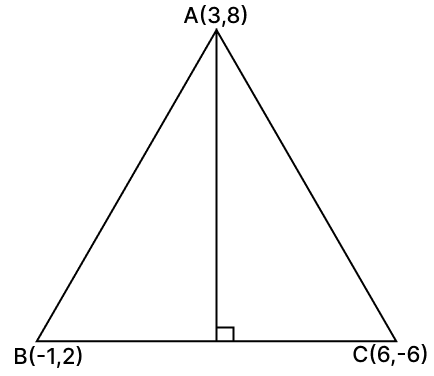
Hence, the slope of BC is .
(ii) Let slope of line perpendicular to BC be m2
So,m1 × m2 = -1
⇒ × m2 = -1
⇒ m2 =
Equation of the line having the slope = and passing through A(3, 8) can be given bu point slope formula i.e.,
⇒ y - y1 = m(x - x1)
⇒ y - 8 = (x - 3)
⇒ 8(y − 8) = 7(x − 3)
⇒ 8y − 64 = 7x − 21
⇒ 7x − 8y − 21 + 64 = 0
⇒ 7x − 8y + 43 = 0.
Hence, the equation of the required line is 7x - 8y + 43 = 0.
Line AB is perpendicular to CD. Coordinates of B, C and D are respectively (4, 0), (0, –1) and (4, 3). Find :
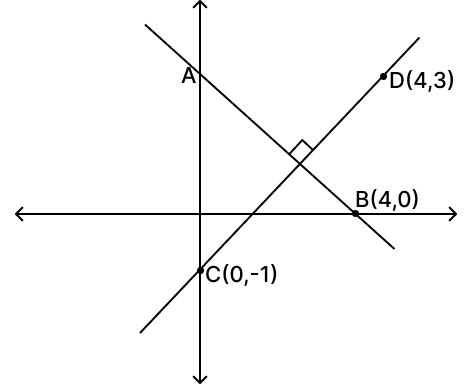
(i) Slope of CD.
(ii) Equation of AB.
Answer
(i) By formula,
Slope of a line =
Substituting values we get :
Slope of CD =
Hence, slope of CD = 1.
(ii) We know that,
The product of slope of two perpendicular lines equals to -1.
∴ Slope of AB × Slope of CD = -1
⇒ Slope of AB × 1 = -1
⇒ Slope of AB = -1.
By point-slope formula,
Equation of line
⇒ y - y1 = m(x - x1)
Equation of AB :
⇒ y - 0 = -1(x - 4)
⇒ y = -x + 4
⇒ x + y = 4.
Hence, equation of AB is x + y = 4.
A and B are two points on the x-axis and y-axis respectively.
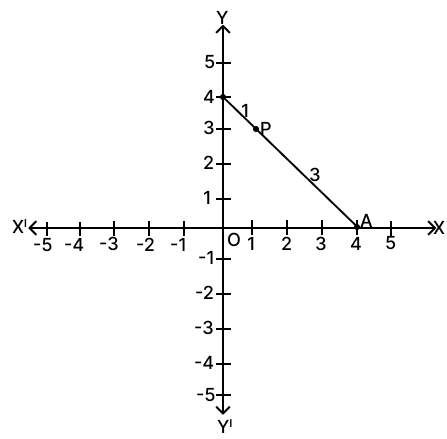
(i) Write down the coordinates of A and B.
(ii) P is a point on AB such that AP : PB = 3 : 1. Using section formula, find the coordinates of point P.
(iii) Find the equation of a line passing through P and perpendicular to AB.
Answer
(i) From figure,
A = (4, 0) and B = (0, 4).
(ii) Let coordinates of P be (x, y).
By section formula,
(x, y) =
Substituting values we get :
Hence, coordinates of P = (1, 3).
(iii) By formula,
Slope =
Substituting values we get :
Slope of AB =
We know that,
Product of slope of perpendicular lines = -1.
∴ Slope of AB × Slope of line perpendicular to AB = -1
⇒ -1 × Slope of line perpendicular to AB = -1
⇒ Slope of line perpendicular to AB =
Line passing through P and perpendicular to AB :
⇒ y - y1 = m(x - x1)
⇒ y - 3 = 1(x - 1)
⇒ y - 3 = x - 1
⇒ y = x - 1 + 3
⇒ x - y + 2 = 0
Hence, required equation is x - y + 2 = 0.
A line segment joining P(2, -3) and Q(0, -1) is cut by the x-axis at the point R. A line AB cuts the y-axis at T(0, 6) and is perpendicular to PQ at S. Find the:
(i) equation of line PQ
(ii) equation of line AB
(iii) coordinates of points R and S
Answer
(i) By formula,
Slope of line =
Substituting values we get :
Equation of line :
⇒ y - y1 = m(x - x1)
⇒ y - (-3) = -1(x - 2)
⇒ y + 3 = -x + 2
⇒ x + y + 3 - 2 = 0
⇒ x + y + 1 = 0.
Hence, equation of line PQ is x + y + 1 = 0.
(ii) We know that,
Product of slope of perpendicular lines = -1.
∴ Slope of PQ × Slope of AB = -1
⇒ -1 × Slope of AB = -1
⇒ Slope of AB = = 1.
Equation of line :
⇒ y - y1 = m(x - x1)
Equation of line AB :
⇒ y - 6 = 1(x - 0)
⇒ y - 6 = x
⇒ x - y + 6 = 0
Hence, equation of line AB is x - y + 6 = 0.
(iii) Given,
Line PQ cuts x-axis at point R.
Let R = (a, 0)
Equation of line PQ = x + y + 1 = 0
Since, point R lies on line PQ,
⇒ a + 0 + 1 = 0
⇒ a + 1 = 0
⇒ a = -1.
R = (a, 0) = (-1, 0)
Given,
AB is perpendicular to PQ at point S.
∴ Point S is the intersection point of AB and PQ.
PQ : x + y + 1 = 0
AB : y - x = 6 or y = x + 6
Substituting value of y from equation AB in equation PQ, we get :
⇒ x + (x + 6) + 1 = 0
⇒ 2x + 7 = 0
⇒ 2x = -7
⇒ x =
Substituting value of x in equation AB, we get :
y = .
S = .
Hence, coordinates of R = (-1, 0) and S = .
In the given graph ABCD is a parallelogram.
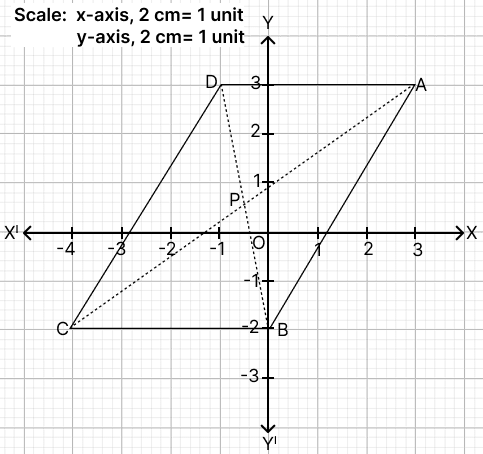
Using the graph, answer the following:
(i) write down the coordinates of A, B, C and D.
(ii) calculate the coordinates of ‘P’, the point of intersection of the diagonals AC and BD.
(iii) find the slope of sides CB and DA and verify that they represent parallel lines.
(iv) find the equation of the diagonal AC.
Answer
(i) From graph,
A(3, 3), B(0, −2), C(−4, −2), D(−1, 3).
Hence, A(3, 3), B(0, −2), C(−4, −2), D(−1, 3).
(ii) Given,
The diagonals of a parallelogram bisect each other.
Hence, the intersection point P is the midpoint of both AC and BD.
By mid-point formula,
Mid-point of AC :
Hence, P = (-0.5, 0.5).
(iii) By formula,
Substituting values for line CB,
Substituting values for line DA,
Since, slope of parallel lines are equal, thus CB || DA.
Hence, proved that CB || DA.
(iv) By formula,
Slope of line =
Slope of AC = .
Using point-slope formula,
y - y1 = m(x - x1)
Equation of AC :
Hence, equation of the diagonal AC is 5x - 7y + 6 = 0.