
Find the image of each of the following points under reflection in x-axis :
(i) (6, 3)
(ii) (7, -5)
(iii) (-4, 3)
(iv) (-2, -4)
(v) (0, 3)
Answer
(i) We know that,
Rule to find reflection of a point in x-axis :
Retain the abscissa i.e. x-coordinate.
Change the sign of ordinate i.e. y-coordinate.
∴ Point (6, -3) is the image of on reflection.
Hence, (6, -3) is the image of the point (6, 3) on reflection in x-axis.
(ii) We know that,
Rule to find reflection of a point in x-axis :
Retain the abscissa i.e. x-coordinate.
Change the sign of ordinate i.e. y-coordinate.
∴ Point (7, 5) is the image on reflection.
Hence, (7, 5) is the image of the point (7, -5) on reflection in x-axis.
(iii) We know that,
Rule to find reflection of a point in x-axis :
Retain the abscissa i.e. x-coordinate.
Change the sign of ordinate i.e. y-coordinate.
∴ Point (-4, -3) is the image on reflection.
Hence, (-4, -3) is the image of the point (-4, 3) on reflection in x-axis.
(iv) We know that,
Rule to find reflection of a point in x-axis :
Retain the abscissa i.e. x-coordinate.
Change the sign of ordinate i.e. y-coordinate.
∴ Point (-2, 4) is the image on reflection.
Hence, (-2, 4) is the image of the point (-2, -4) on reflection in x-axis.
(v) We know that,
Rule to find reflection of a point in x-axis :
Retain the abscissa i.e. x-coordinate.
Change the sign of ordinate i.e. y-coordinate.
∴ Point (0, -3) is the image on reflection.
Hence, (0, -3) is the image of the point (0, 3) on reflection in x-axis.
Find the image of each of the following points under reflection in y-axis :
(i) (2, 6)
(ii) (-3, 8)
(iii) (-5, -3)
(iv) (0, -1)
(v) (4, 0)
Answer
(i) We know that,
Rule to find reflection of a point in y-axis :
Change the sign of abscissa i.e. x-coordinate.
Retain the ordinate i.e. y-coordinate.
∴ Point (-2, 6) is the image on reflection.
Hence, (-2, 6) is the image of the point (2, 6) on reflection in y-axis.
(ii) We know that,
Rule to find reflection of a point in y-axis :
Change the sign of abscissa i.e. x-coordinate.
Retain the ordinate i.e. y-coordinate.
∴ Point (3, 8) is the image on reflection.
Hence, (3, 8) is the image of the point (-3, 8) on reflection in y-axis.
(iii) We know that,
Rule to find reflection of a point in y-axis :
Change the sign of abscissa i.e. x-coordinate.
Retain the ordinate i.e. y-coordinate.
∴ Point (5, -3) is the image on reflection.
Hence, (5, -3) is the image of the point (-5, -3) on reflection in y-axis.
(iv) We know that,
Rule to find reflection of a point in y-axis :
Change the sign of abscissa i.e. x-coordinate.
Retain the ordinate i.e. y-coordinate.
∴ Point (0, -1) is the image on reflection.
Hence, (0, -1) is the image of the point (0, -1) on reflection in y-axis.
(v) We know that,
Rule to find reflection of a point in y-axis :
Change the sign of abscissa i.e. x-coordinate.
Retain the ordinate i.e. y-coordinate.
∴ Point (-4, 0) is the image on reflection.
Hence, (-4, 0) is the image of the point (4, 0) on reflection in y-axis.
Find the image of each of the following points when reflected in the origin :
(i) (-5, 8)
(ii) (-6, -4)
(iii) (7, 4)
(iv) (9, 0)
(v) (0, 7)
Answer
(i) We know that,
Rule to find reflection of a point in origin :
When a point is reflected in the origin, sign of the x-coordinate and y-coordinate both changes.
∴ Point (5, -8) is the image on reflection.
Hence, (5, -8) is the image of the point (-5, 8) on reflection in origin.
(ii) We know that,
Rule to find reflection of a point in origin :
When a point is reflected in the origin, sign of the x-coordinate and y-coordinate both changes.
∴ Point (6, 4) is the image on reflection.
Hence, (6, 4) is the image of the point (-6, -4) on reflection in origin.
(iii) We know that,
Rule to find reflection of a point in origin :
When a point is reflected in the origin, sign of the x-coordinate and y-coordinate both changes.
∴ Point (-7, -4) is the image on reflection.
Hence, (-7, -4) is the image of the point (7, 4) on reflection in origin.
(iv) We know that,
Rule to find reflection of a point in origin :
When a point is reflected in the origin, sign of the x-coordinate and y-coordinate both changes.
∴ Point (-9, 0) is the image on reflection.
Hence, (-9, 0) is the image of the point (9, 0) on reflection in origin.
(v) We know that,
Rule to find reflection of a point in origin :
When a point is reflected in the origin, sign of the x-coordinate and y-coordinate both changes.
∴ Point (0, -7) is the image on reflection.
Hence, (0, -7) is the image of the point (0, 7) on reflection in origin.
Find the image of each of the following points under reflection in the line x = 0 :
(i) (4, 7)
(ii) (-3, -5)
(iii) (-8, 6)
(iv) (5, 0)
(v) (0, -2)
Answer
x = 0 is the equation of y-axis.
Hence, reflection in the line x = 0 means reflection in y-axis.
Reflection in y-axis is given by,
Ry (x, y) = (-x, y).
(i) Thus,
Ry (4, 7) = (-4, 7).
Hence, co-ordinates of (4, 7) under reflection in the line x = 0 are (-4, 7).
(ii) Thus,
Ry (-3, -5) = (3, -5).
Hence, co-ordinates of (-3, -5) under reflection in the line x = 0 are (3, -5).
(iii) Thus,
Ry (-8, 6) = (8, 6).
Hence, co-ordinates of (-8, 6) under reflection in the line x = 0 are (8, 6).
(iv) Thus,
Ry (5, 0) = (-5, 0).
Hence, co-ordinates of (5, 0) under reflection in the line x = 0 are (-5, 0).
(v) Thus,
Ry (0, -2) = (0, -2).
Hence, co-ordinates of (0, -2) under reflection in the line x = 0 are (0, -2).
Find the image of each of the following points under reflection in the line y = 0 :
(i) (6, -7)
(ii) (-8, 4)
(iii) (-3, -8)
(iv) (7, 9)
(v) (0, -6)
Answer
y = 0, is the equation of x-axis.
Hence, reflection in the line y = 0 means reflection in x-axis.
Reflection in x-axis is given by,
Rx (x, y) = (x, -y) ……….(1)
(i) Thus,
Rx (6, -7) = (6, 7).
Hence, co-ordinates of (6, -7) under reflection in the line y = 0 is (6, 7).
(ii) Thus,
Rx (-8, 4) = (-8, -4).
Hence, co-ordinates of (-8, 4) under reflection in the line y = 0 are (-8, -4).
(iii) Thus,
Rx (-3, -8) = (-3, 8).
Hence, co-ordinates of (-3, -8) under reflection in the line y = 0 are (-3, 8).
(iv) Thus,
Rx (7, 9) = (7, -9).
Hence, co-ordinates of (7, 9) under reflection in the line y = 0 are (7, -9).
(v) Thus,
Rx (0, -6) = (0, 6).
Hence, co-ordinates of (0, -6) under reflection in the line y = 0 are (0, 6).
The point P(-6, -3) on reflection in y-axis is mapped on P'. The point P' on reflection in the origin is mapped on P".
(i) Find the co-ordinates of P'.
(ii) Find the co-ordinates of P".
(iii) Write down a single transformation that maps P onto P".
Answer
(i) We know that,
Rule to find reflection of a point in y-axis :
Change the sign of abscissa i.e. x-coordinate.
Retain the ordinate i.e. y-coordinate.
∴ Point P'(6, -3) is the image of point P(-6, -3) on reflection in y-axis.
Hence, P' = (6, -3).
(ii) We know that,
Rule to find reflection of a point in origin :
Change sign of both the x-coordinate and y-coordinate.
∴ Point P"(-6, 3) is the image of point P'(6, -3) on reflection in origin.
Hence, P" = (-6, 3).
(iii) P(-6, -3) ⇒ P"(-6, 3)
A transformation that keeps the x-coordinate the same and changes the sign of the y-coordinate is a reflection in the x-axis.
Hence, single transformation that maps P into P" is reflection in the x-axis.
The point P(4, -7) is reflected in the origin to point P'. The point P' is then reflected in x-axis to the point P".
(i) Find the co-ordinates of P'.
(ii) Find the co-ordinates of P".
(iii) Write down a single transformation that maps P onto P".
Answer
(i) We know that,
Rule to find reflection of a point in origin :
Change the sign of abscissa and ordinate.
∴ Point P'(-4, 7) is the image of point P(4, -7) on reflection in origin.
Hence, P' = (-4, 7).
(ii) We know that,
Rule to find reflection of a point in x-axis :
Change the sign of ordinate i.e. y-coordinate.
Retain the abscissa i.e. x-coordinate.
∴ Point P"(-4, -7) is the image of point P'(-4, 7) on reflection in x-axis.
Hence, P" = (-4, -7).
(iii) P(4, -7) ⇒ P"(-4, -7)
A transformation that keeps the y-coordinate the same and changes the sign of the x-coordinate is a reflection in the y-axis.
Hence, single transformation that maps P into P" is reflection in the y-axis.
The vertices of a Δ ABC are A(2, -3), B(-1, 2) and C(3, 0). This triangle is reflected in x-axis to form ΔA'B'C'. Find the co-ordinates of A', B' and C'. Are the two triangles congruent?
Answer
We know that,
Rule to find reflection of a point in x-axis :
Retain the abscissa i.e. x-coordinate.
Change the sign of ordinate i.e. y-coordinate.
∴ A(2, - 3) ⇒ A'(2, 3)
∴ B(-1, 2) ⇒ B'(-1, -2)
∴ C(3, 0) ⇒ C'(3, 0)
Yes, the two triangles are congruent. A reflection is an isometry, meaning it preserves distance and angle measure.
Therefore, Δ ABC ≅ ΔA'B'C'.
Hence, coordinates of the vertices of ΔA'B'C' are A'(2, 3), B'(-1, -2), C'(3, 0) and Δ ABC and ΔA'B'C' are congruent.
The points P(-2, 4), Q(3, -1) and R(6, 2) are the vertices of a triangle. Δ PQR is reflected in y-axis to form ΔP'Q'R'. Find the co-ordinates of P', Q' and R'.
Answer
We know that,
Rule to find reflection of a point in y-axis :
Retain the ordinate i.e. y-coordinate.
Change the sign of abscissa i.e. x-coordinate.
∴ P(-2, 4) ⇒ P'(2, 4)
∴ Q(3, -1) ⇒ Q'(-3, -1)
∴ R(6, 2) ⇒ R'(-6, 2)
The coordinates of the vertices of ΔP'Q'R' are P'(2, 4), Q'(-3, -1), R'(-6, 2).
Hence, coordinates of the vertices of ΔP'Q'R' are P'(2, 4), Q'(-3, -1), R'(-6, 2).
Use a graph paper for this question (Take 2 cm = 1 unit on both x and y axis).
(i) Plot the following points : A(0, 4), B(2, 3), C(1, 1) and D(2, 0)
(ii) Reflect points B, C, D on the y-axis and write down their co-ordinates. Name the images as B', C', D' respectively.
(iii) Join the points A, B, C, D, D', C', B' and A in order, so as to form a closed figure. Write down the equation of the line of symmetry of the figure formed.
Answer
(i) The point A(0, 4), B(2, 3), C(1, 1) and D(2, 0) are plotted on the graph below:
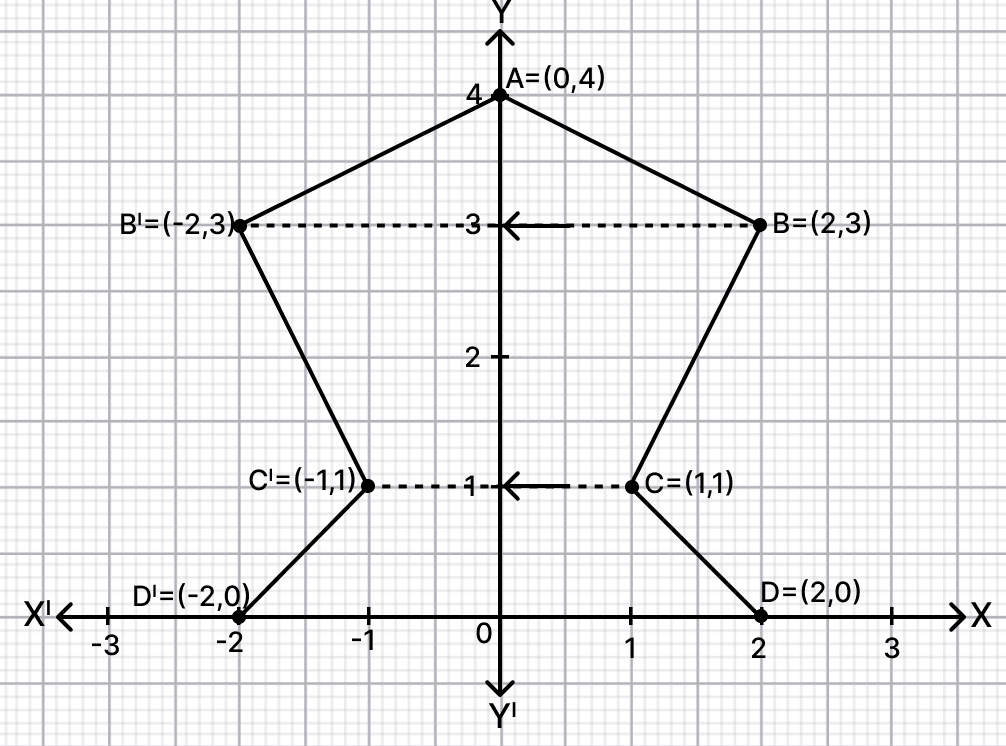
(ii) From graph, on reflecting B, C, D on y-axis we get,
B(2, 3) ⇒ B'(-2, 3)
C(1, 1) ⇒ C'(-1, 1)
D(2, 0) ⇒ D'(-2, 0).
(iii) From graph we see that the figure is divided into two symmetrical parts by y-axis.
Hence, the equation of line of symmetry is x = 0.
(i) Plot the points A(3, 2) and B(5, 4) on a graph paper.
(ii) Reflect A and B in the x-axis to A' and B' respectively. Plot A' and B' on the same graph paper. Write the co-ordinates of A' and B'.
(iii) Write down :
(a) the geometrical name of the figure ABB'A'.
(b) m∠ABB'.
(c) the image A" of A when reflected in the origin.
(d) the single transformation that maps A' to A".
Answer
(i) The graph is shown below:
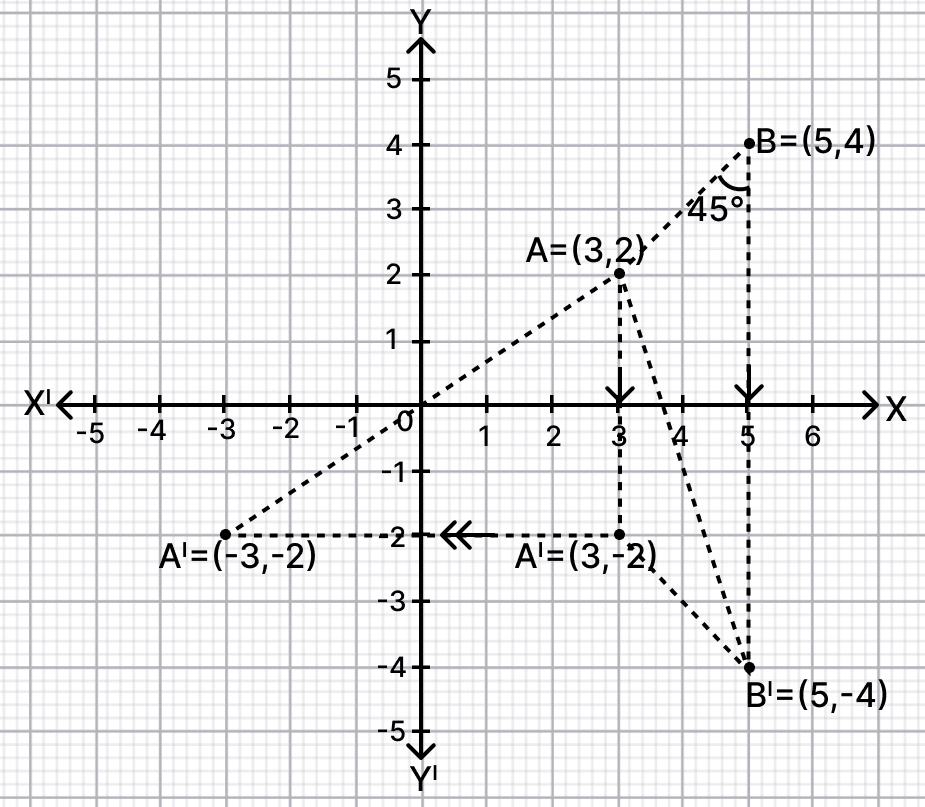
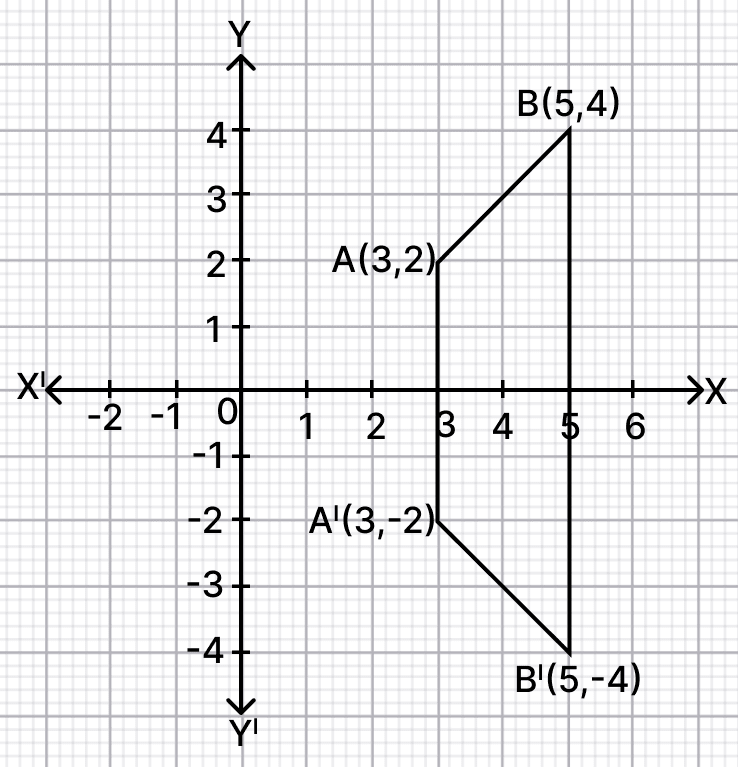
(ii) From graph,
The coordinates of A' = (3, -2) and B' = (5, -4).
(iii) Join points ABB'A'.
(a) On reflection distance between points does not changes.
Thus, AB = A'B'.
Also, AA' // BB' as both are perpendicular to x-axis.
ABB'A' is an isosceles trapezium.
(b) On measuring,
∠ABB' = 45°.
Hence, ∠ABB' = 45°.
(c) From figure,
When A is reflected in origin, from graph
A(3, 2) ⇒ A"(-3, -2).
Hence, co-ordinates of A" = (-3, -2).
(d) From figure,
On reflection in y-axis, point A' becomes A".
Hence, reflection of A' in y-axis maps A' to A".
Points P and Q have co-ordinates (0, 5) and (-2, 4).
(i) P is invariant when reflected in an axis. Name the axis.
(ii) Find the image of Q on reflection in the axis found in (i).
(iii) (0, k) on reflection in the origin is invariant. Write the value of k.
(iv) Write the co-ordinates of the image of Q, obtained by Reflecting it in the origin followed by reflection in the x-axis.
Answer
The graph for the question is shown below:
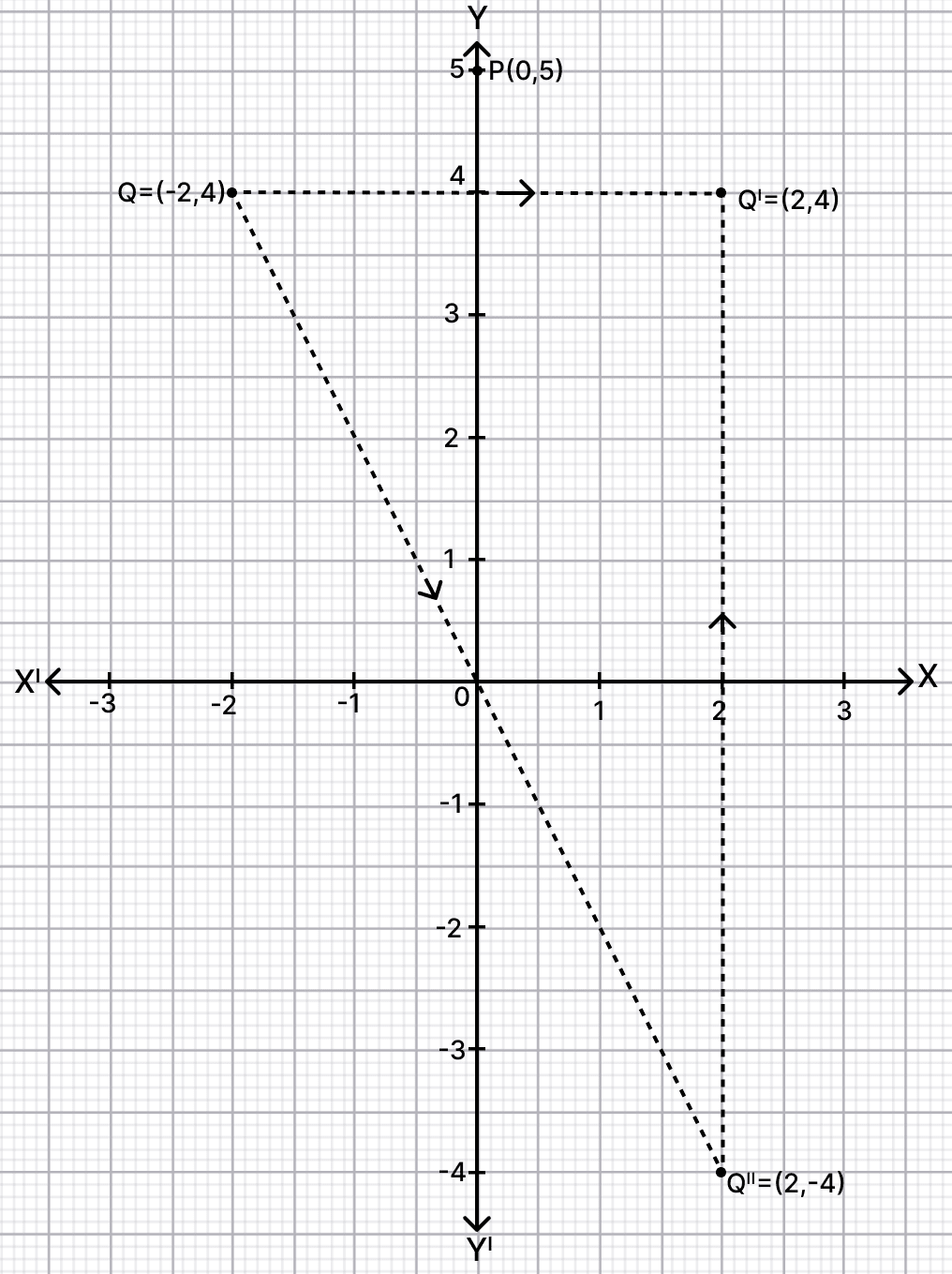
(i) Since, point P lies on y-axis.
Hence, the point P(0, 5) is invariant in y-axis.
(ii) From graph we get,
The image of Q(-2, 4) on reflection in y-axis is Q'(2, 4).
(iii) Given, (0, k) on reflection in the origin is invariant.
A point is invariant on reflection in origin if it lies on it, i.e. point = (0, 0).
Comparing (0, 0) with (0, k) we get : k = 0.
Hence, the value of k = 0.
(iv) From graph we get,
On reflecting in origin,
Q ⇒ Q"
On reflecting in x-axis,
Q" ⇒ Q'
The coordinates of image of Q after reflection in origin and then in x-axis is (2, 4).
Use a graph paper for this question. Plot the points P(3, 2) and Q(-3, -2). From P and Q, draw perpendiculars PM and QN on the x-axis.
(i) Name the image of P on reflection in the origin.
(ii) Assign the special name to the geometrical figure PMQN and find its area.
(iii) Write the co-ordinates of the point to which M is mapped on reflection in
(a) x-axis
(b) y-axis
(c) origin
Answer
The graph for the question is shown below:
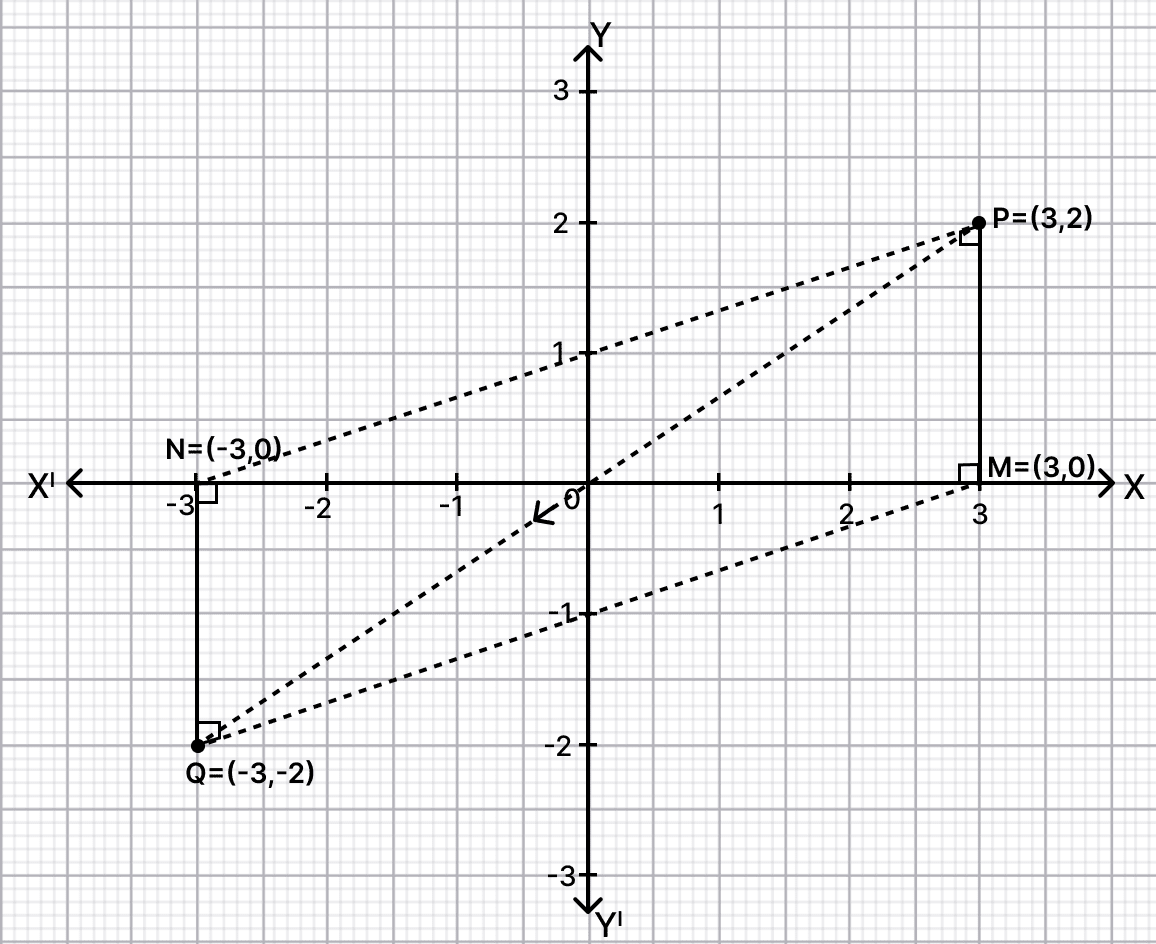
(i) From graph we get,
The coordinates of image of P after reflection in origin is Q(-3, -2).
(ii) From figure,
PMQN is a parallelogram.
Area of parallelogram = Base × Height
= QN × MN
= 2 × 6
= 12 sq.units.
Hence, PMQN is a // gm and area of PMQN = 12 sq. units
(iii) Since, M lies on x-axis it is invariant on reflection in x-axis. Thus, coordinates remain same (3, 0).
From graph,
On reflection in y-axis and origin the coordinates of M becomes (-3, 0).
Hence, coordinates of M on reflection in x-axis, y-axis and origin are (3, 0), (-3, 0), and (-3, 0) respectively.
The point P(3, 4) is reflected to P' in x-axis and O' is the image of O (origin) when reflected in the line PP'.
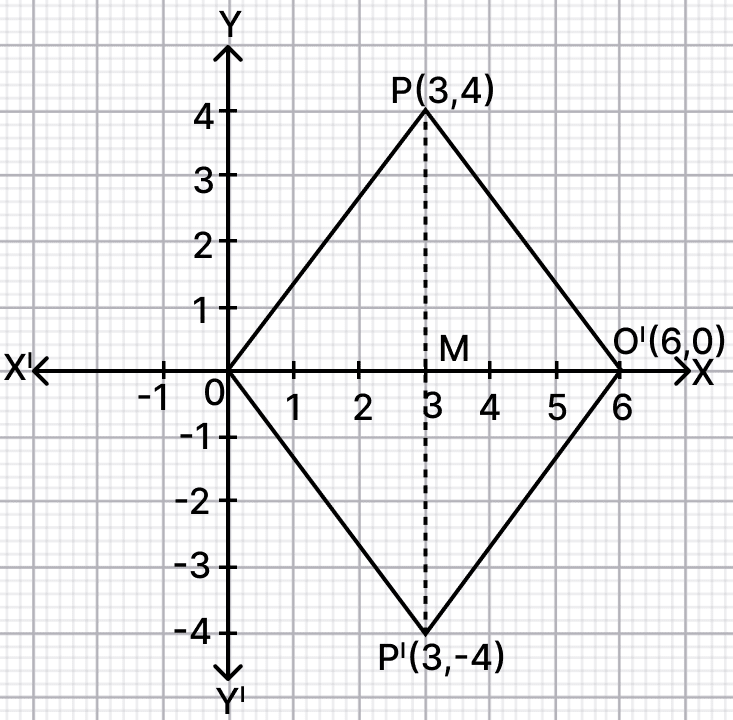
Using graph paper, give :
(i) the co-ordinates of P' and O'.
(ii) the length of the segments PP' and OO'.
(iii) the geometrical name of the figure POP'O'.
(iv) the perimeter of the quadrilateral POP'O'.
Answer
Plot point P(3, 4). Reflect point P in x-axis and origin in the line PP'.
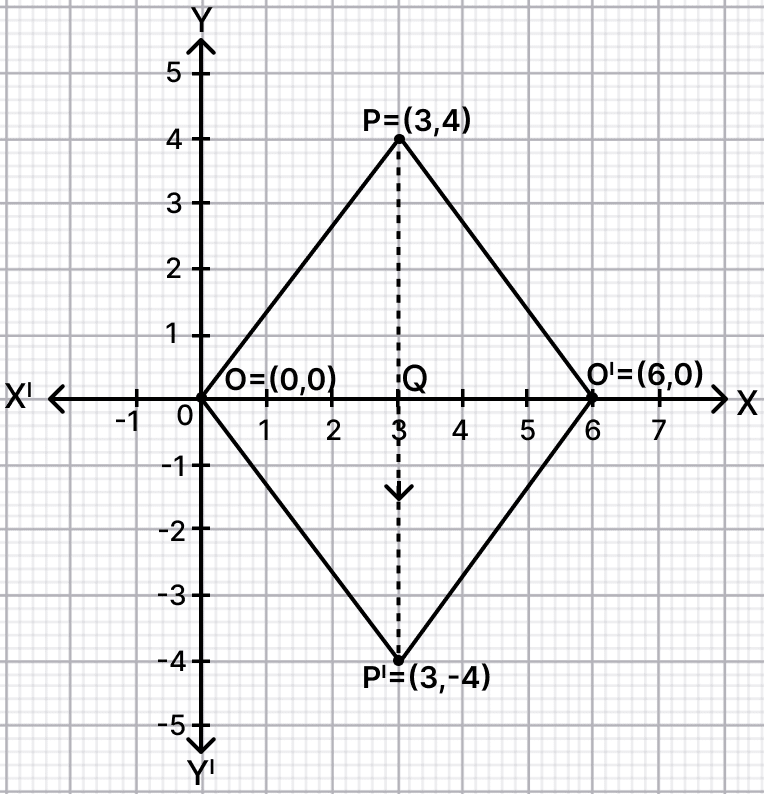
(i) From graph we get,
The coordinates of P' and O' are (3, -4) and (6, 0) respectively.
(ii) From graph we get,
Length of PP' = 8 units and OO' = 6 units.
(iii) Join POP'O'.
POP'O' is a rhombus because all sides are equal (as all sides are hypotenuse with equal bases and height) and parallel but angles of quadrilateral are not right angles.
POP'O' is a rhombus.
(iv) Let point PP' touch axis at point Q.
In right angle triangle OQP,
⇒ OP2 = OQ2 + QP2
⇒ OP2 = 32 + 42
⇒ OP2 = 9 + 16
⇒ OP2 = 25
⇒ OP = = 5 units.
Since, POP'O' is a rhombus, thus :
Perimeter of POP'O' = 4 × side = 4 × OP = 4 × 5 = 20 units.
The perimeter of the quadrilateral POP'O' is 20 units.
Use a graph paper for this question. A(1, 1), B(5, 1), C(4, 2) and D(2, 2) are the vertices of a quadrilateral.
(i) Name the quadrilateral ABCD.
(ii) A, B, C, D are reflected in the origin onto A', B', C' and D' respectively. Locate A', B', C', D' on the graph paper and write their co-ordinates.
(iii) Are D, A, A' and D' collinear?
Answer
The graph is shown below:
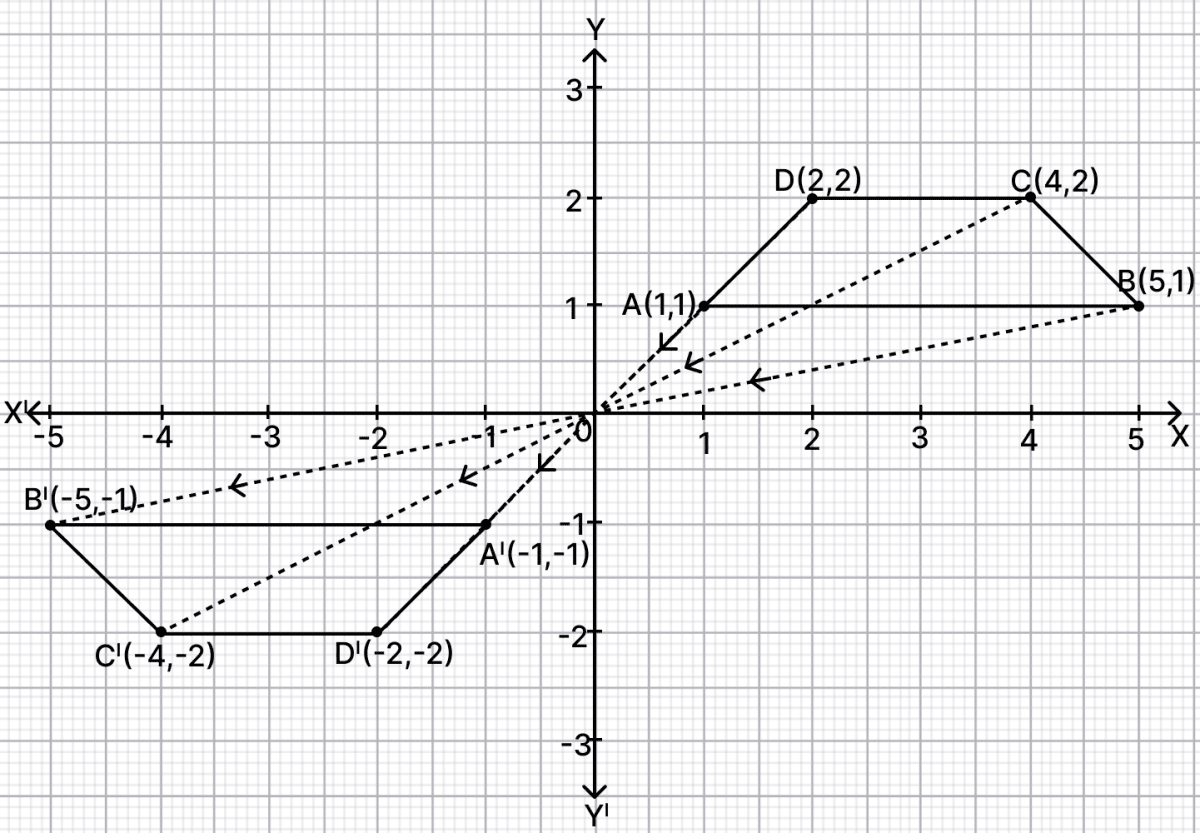
(i) From graph,
ABCD is an isosceles trapezium.
(ii) Reflect points A, B, C and D in origin.
Hence, A' = (-1, -1), B' = (-5, -1), C' = (-4, -2) and D' = (-2, -2).
(iii) From graph,
Points D, A, A' and D' lie on the same line i.e. y = x.
Hence, the points D, A, A' and D' collinear.
A ΔABC with vertices A(1, 2), B(4, 4) and C(3, 7) is first reflected in the line y = 0 onto ΔA'B'C' and then ΔA'B'C' is reflected in the origin onto ΔA"B"C".
Write down the co-ordinates of :
(i) A', B' and C'
(ii) A", B" and C"
Write down the single transformation that maps Δ ABC directly onto ΔA"B"C".
Answer
(i) y = 0 is the equation of x-axis.
We know that,
Rule to find reflection of a point in x-axis :
Retain the abscissa i.e. x-coordinate.
Change the sign of ordinate i.e. y-coordinate.
∴ Point A'(1, -2) is the image of A(1, 2) on reflection in x-axis.
∴ Point B'(4, -4) is the image of B(4, 4) on reflection in x-axis.
∴ Point C'(3, -7) is the image of C(3, 7) on reflection in x-axis.
The coordinates of the vertices of ΔA'B'C' are A'(1, -2), B'(4, -4), C'(3, -7).
(ii) We know that,
Rule to find reflection of a point in origin :
Change the sign of abscissa i.e. x-coordinate and ordinate i.e. y-coordinate.
∴ Point A"(-1, 2) is the image of A'(1, -2) on reflection in origin.
∴ Point B"(-4, 4) is the image of B'(4, -4) on reflection in origin.
∴ Point C"(-3, 7) is the image of C'(3, -7) on reflection in origin.
The coordinates of the vertices of ΔA"B"C" are A"(-1, 2), B"(-4, 4), C"(-3, 7).
(iii) Transformation,
A(1, 2) ⇒ A" (-1, 2)
B(4, 4) ⇒ B"(-4, 4)
C(3, 7) ⇒ C"(-3, 7)
A transformation that changes the sign of the x-coordinate while keeping the y-coordinate the same is a reflection in the y-axis.
The single transformation that maps Δ ABC directly onto ΔA"B"C" is a reflection in the y-axis.
Use graph paper for this question.
The points A(2, 3), B(4, 5) and C(7, 2) are the vertices of ΔABC.
(i) Write down the co-ordinates of A', B', C' if ΔA'B'C' is the image of ΔABC when reflected in the origin.
(ii) Write down the co-ordinates of A", B", C" if ΔA"B"C" is the image of ΔABC when reflected in the x-axis.
(iii) Mention the special name of the quadrilateral BCC"B" and find its area.
Answer
The graph is shown below:
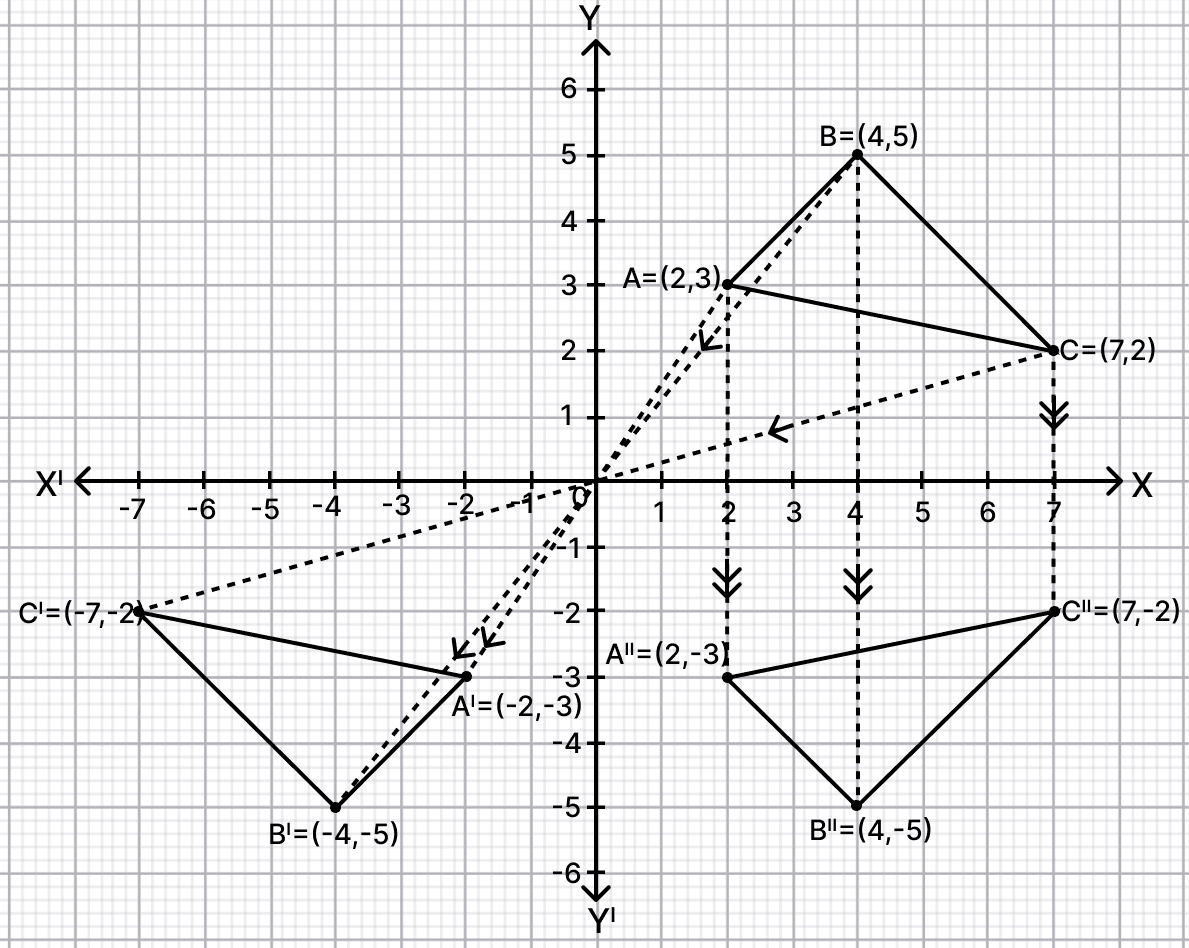
(i) From graph we get,
The coordinates of A', B', C' are (-2, -3), (-4, -5) and (-7, -2) respectively.
(ii) From graph we get,
The coordinates of A", B", C" are (2, -3), (4, -5) and (7, -2) respectively.
(iii) From graph we get,
BB" // CC" and BC = B"C" (As on reflection the length between the points do not changes)
BCC"B" formed is an isosceles trapezium.
We know that,
Hence, BCC"B" formed is an isosceles trapezium and area of BCC"B" = 21 sq.units.
Use graph paper taking 2 cm = 1 unit along both the axes. Plot the points O(0, 0), A(-4, 4), B(-3, 0) and C(0, -3).
(i) Reflect points A and B on y-axis and name them A' and B' respectively. Write down their co-ordinates.
(ii) Name the figure OABCBA'.
(iii) State the line of symmetry of this figure.
Answer
The graph is shown below:
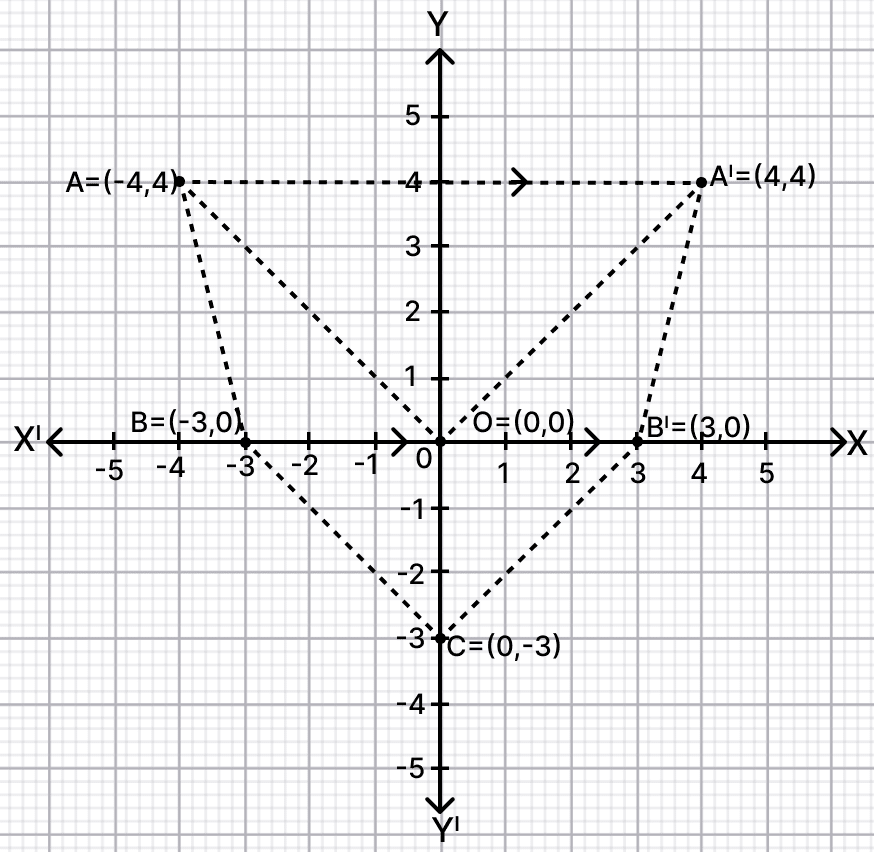
(i) From graph,
The co-ordinates of A' = (4, 4) and B' = (3, 0).
(ii) From graph,
The figure OABCB'A' formed is an arrow head.
(iii) From graph,
The y-axis divides the arrow head into two equal parts.
Hence, y-axis is the line of symmetry.
Use a graph paper for this question taking 1 cm = 1 unit along both x and y axes.
(i) Plot the points A(0, 5), B(2, 5), C(5, 2), D(5, -2), E(2, -5) and F(0, -5).
(ii) Reflect the points B, C, D and E on y-axis and name them respectively as B', C', D' and E'.
(iii) Write the co-ordinate of B', C', D' and E'.
(iv) Name the figure formed by BCDEE'D'C'B'.
(v) Name a line of symmetry for the figure formed.
Answer
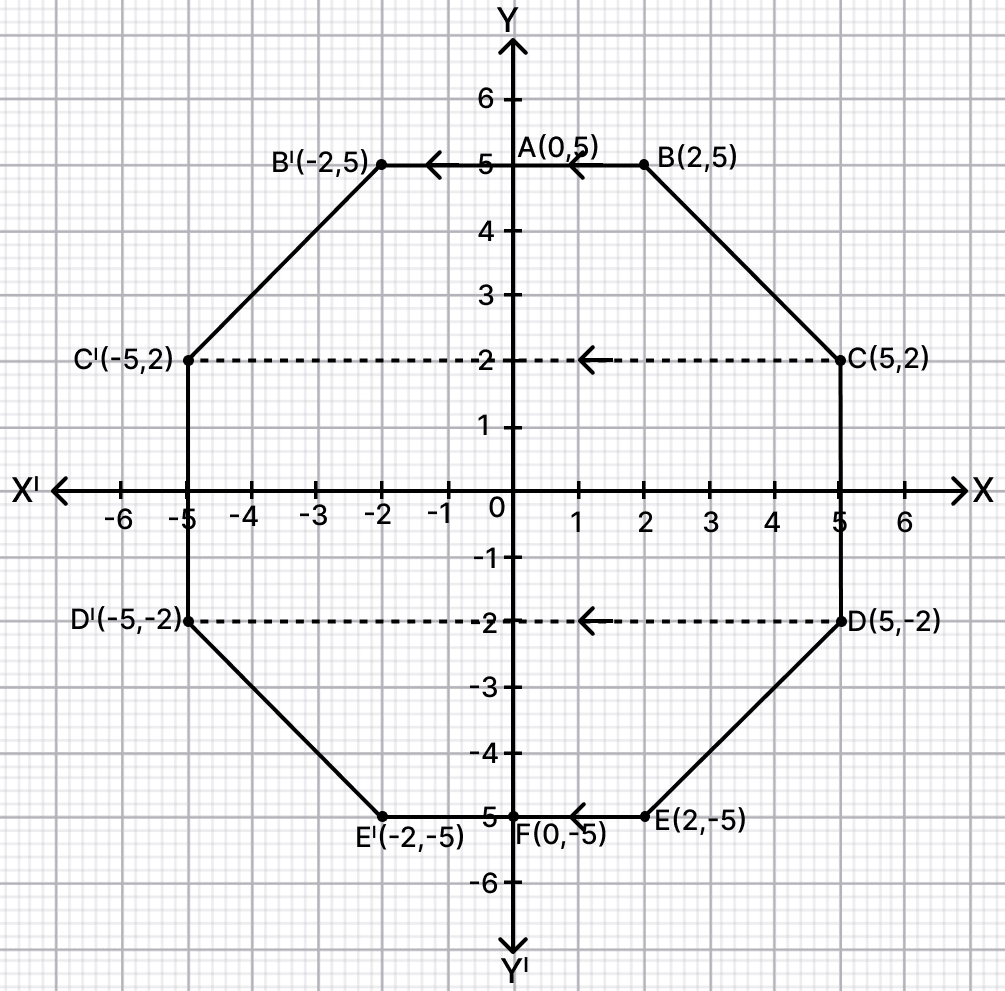
From graph,
Coordinates of B' = (-2, 5), C' = (-5, 2), D' = (-5, -2) and E' = (-2, -5).
The figure, BCDEE'D'C'B' is an octagon.
x-axis and y-axis are the lines of symmetry.
Use graph paper to answer the following questions. (Take 2 cm = 1 unit)
(i) Plot the points A(-4, 2) and B(2, 4).
(ii) A' is the image of A when reflected in the y-axis. Plot it on the graph paper and write the co-ordinates of A'.
(iii) B' is the image of B when reflected in the line AA'. Write the co-ordinates of B'.
(iv) Write the geometric name of the figure ABA'B'.
(v) Name a line of symmetry of the figure formed.
Answer
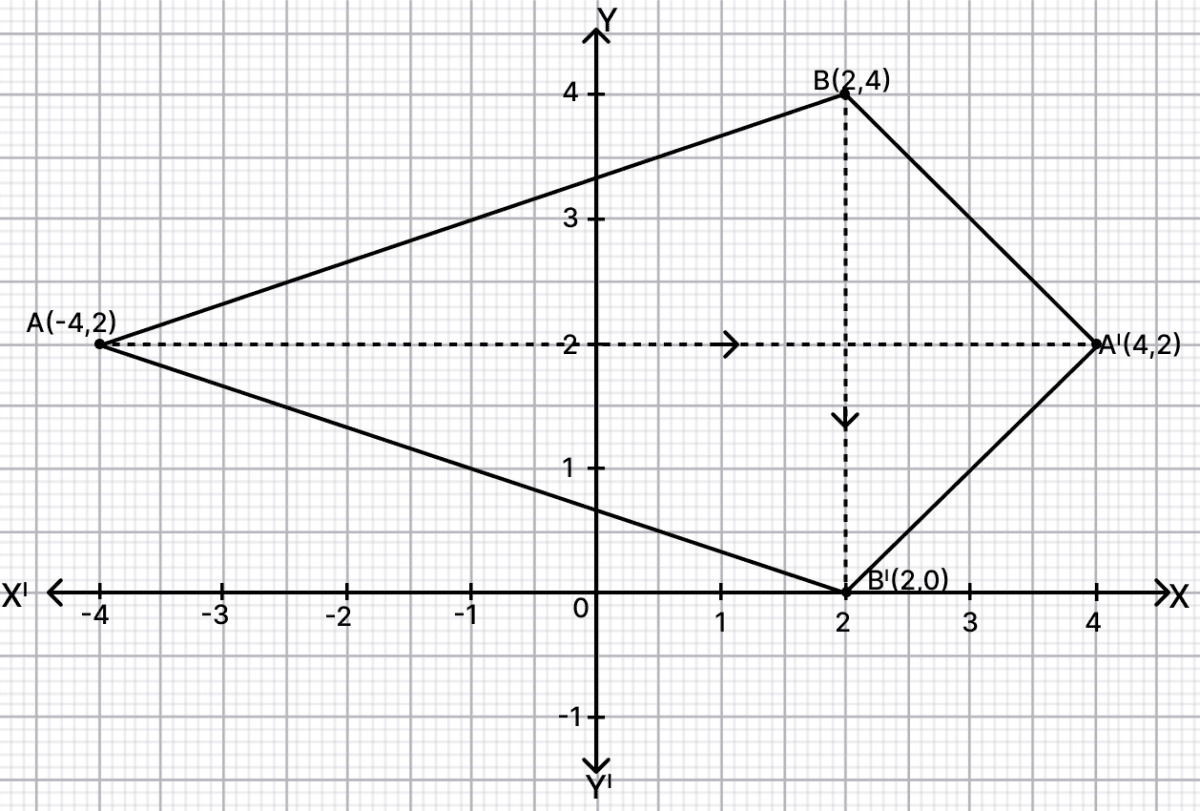
From graph, on reflecting A on y-axis we get,
A(-4, 2) ⇒ A'(4, 2)
From graph, on reflecting B on line AA'we get,
B(2, 4) ⇒ B'(2, 0)
ABA'B' formed is a kite, with AA' as line of symmetry.
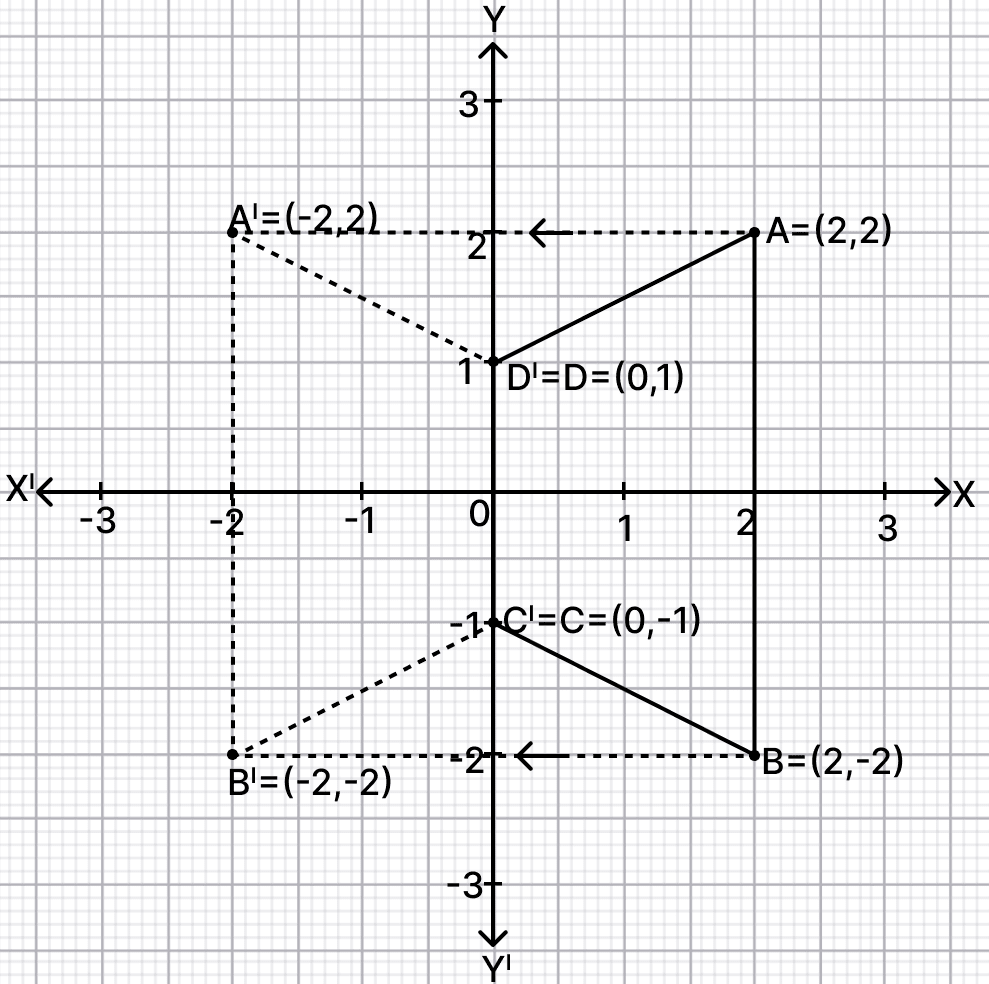
Use graph paper for this question (Take 2 cm = 1 unit along both x and y axis). ABCD is a quadrilateral whose vertices are A(2, 2), B(2, -2), C(0, -1) and D(0, 1).
(i) Reflect quadrilateral ABCD on the y-axis and name it as A'B'C'D'.
(ii) Write down the co-ordinates of A' and B'.
(iii) Name two points which are invariant under the above reflection.
(iv) Name the polygon A'B'C'D'.
Answer
(i) Since, points C and D lie on y-axis, thus they are invariant on reflection in it.
Thus, C' = C = (0, -1) and D' = D = (0, 1).
Reflected quadrilateral A'B'CD is shown in the graph below:
(ii) From graph we get,
The coordinates of A' and B' are (-2, 2) and (-2, -2) respectively.
(iii) From graph we get,
The two points which are invariant under the above reflection are C(0, -1) and D(0, 1).
(iv) From graph we get,
A'B' // D'C' and A'D' = B'C'
The polygon(A'B'C'D') formed is an isosceles trapezium.
Find the image of the following points as directed.
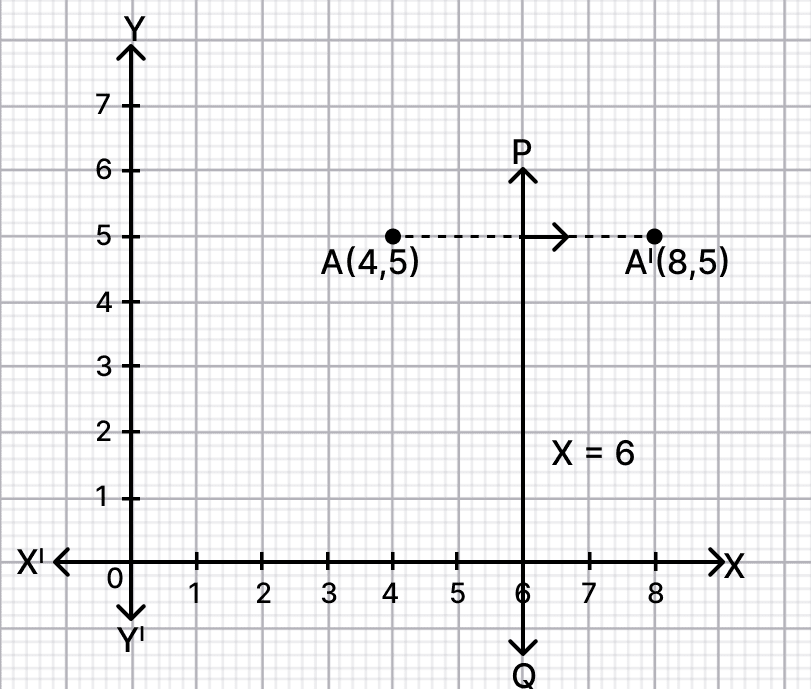
(i) Point A(4, 5) reflected in the line x = 6.
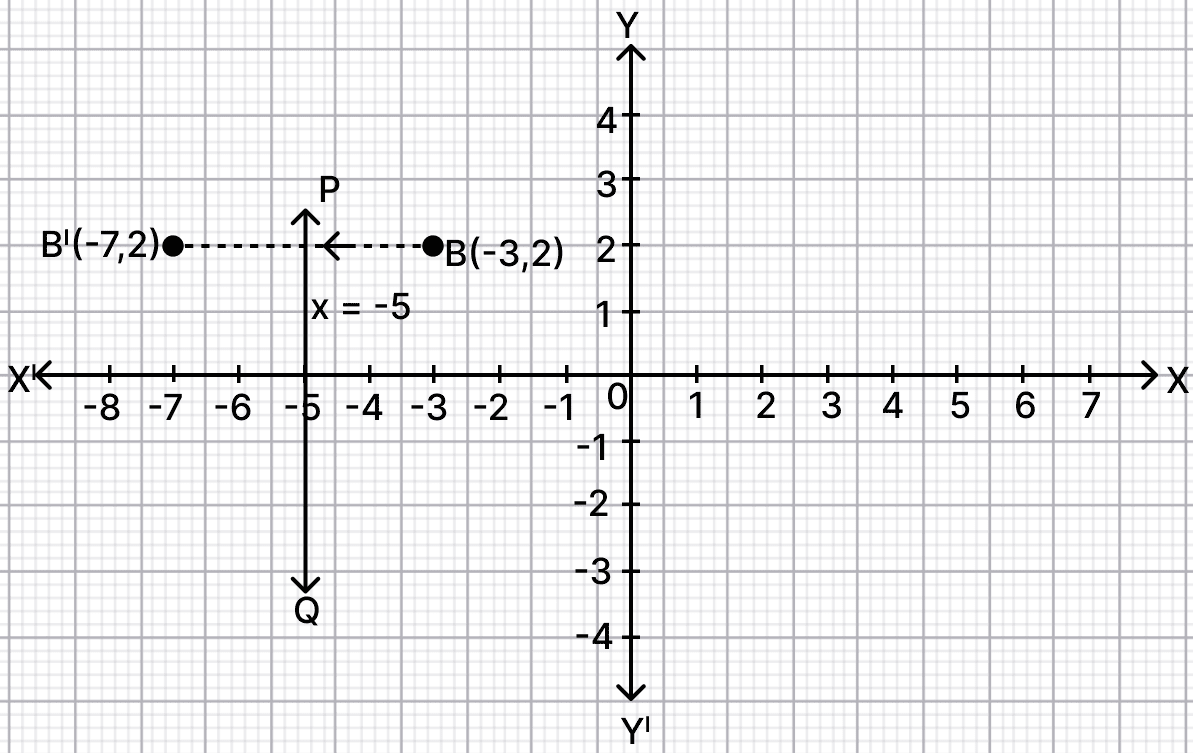
(ii) Point B(-3, 2) reflected in the line x = -5.
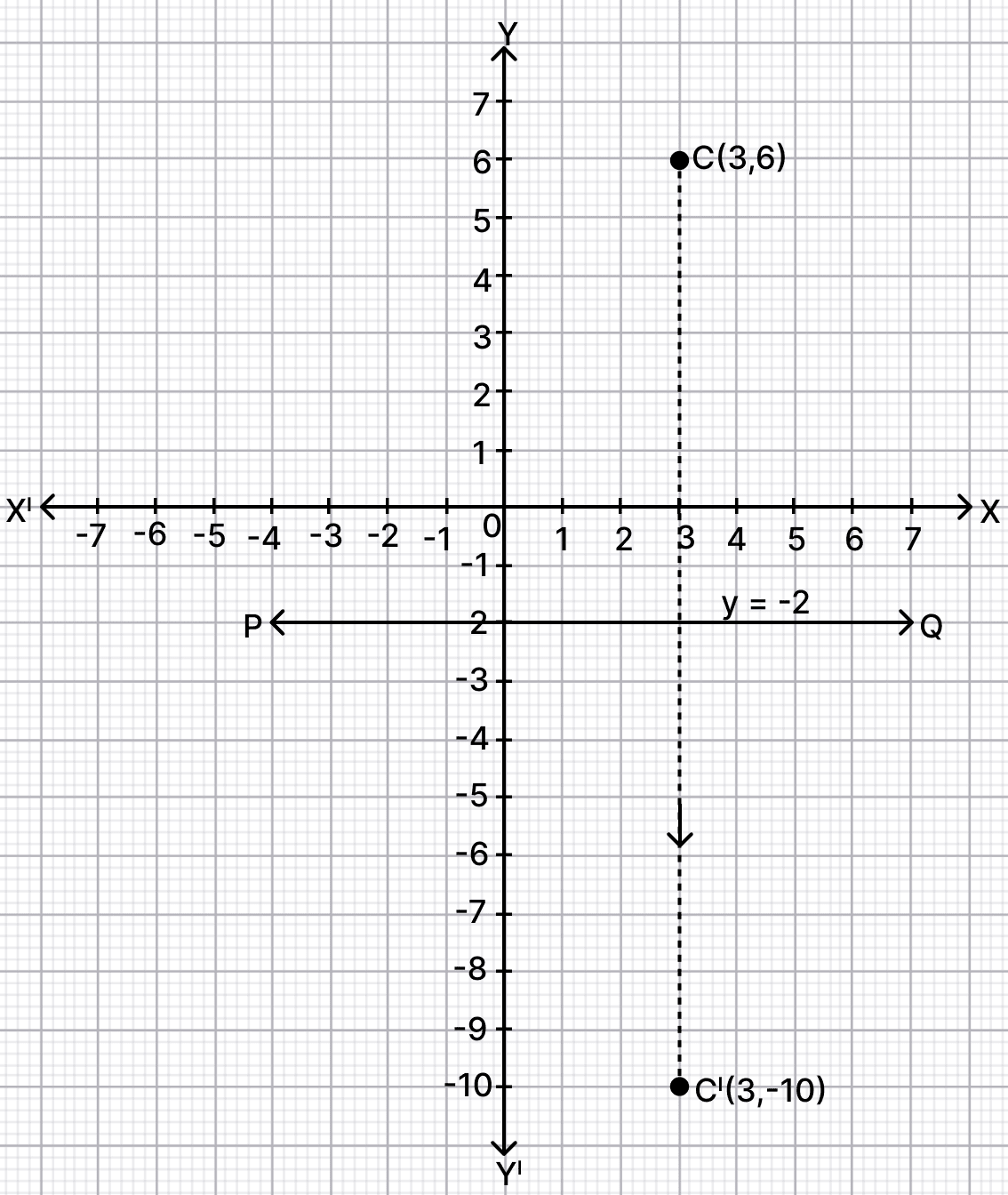
(iii) Point C(3, 6) reflected in the line y = -2.
(iv) Point D(-2, -5) reflected in the line y = 5.
Answer
(i) Since, x = 6 is a straight line parallel to y-axis and at a distance of 6 units from it, therefore in the figure, PQ represents x = 6.
Steps of construction :
Mark A(4, 5)on the graph.
From point A draw a straight line perpendicular to PQ and produce.
On this line mark a point A' which is at same distance behind PQ as A(4, 5) before it.
The graph is shown below:
From graph,
A' = (8, 5).
Hence, co-ordinates of A' = (8, 5).
(ii) Since, x = -5 is a straight line parallel to y-axis and at a distance of 5 units from it, therefore in the figure, PQ represents x = -5.
Steps of construction :
Mark B(-3, 2)on the graph.
From point B draw a straight line perpendicular to PQ and produce.
On this line mark a point B' which is at same distance behind PQ as B(-3, 2) before it.
The graph is shown below:
From graph,
B' = (-7, 2).
Hence, co-ordinates of B' = (-7, 2).
(iii) Since, y = -2 is a straight line parallel to x-axis and at a distance of 2 units from it, therefore in the figure, PQ represents y = -2.
Steps of construction :
Mark C(3, 6)on the graph.
From point C draw a straight line perpendicular to PQ and produce.
On this line mark a point C' which is at same distance behind PQ as C(3, 6) before it.
The graph is shown below:
From graph,
C' = (3, -10).
Hence, co-ordinates of C' = (3, -10).
(iv) Since, y = 5 is a straight line parallel to x-axis and at a distance of 5 units from it, therefore in the figure, PQ represents y = 5.
Steps of construction :
Mark D(-2, -5)on the graph.
From point D draw a straight line perpendicular to PQ and produce.
On this line mark a point D' which is at same distance behind PQ as D(-2, -5) before it.
The graph is shown below:
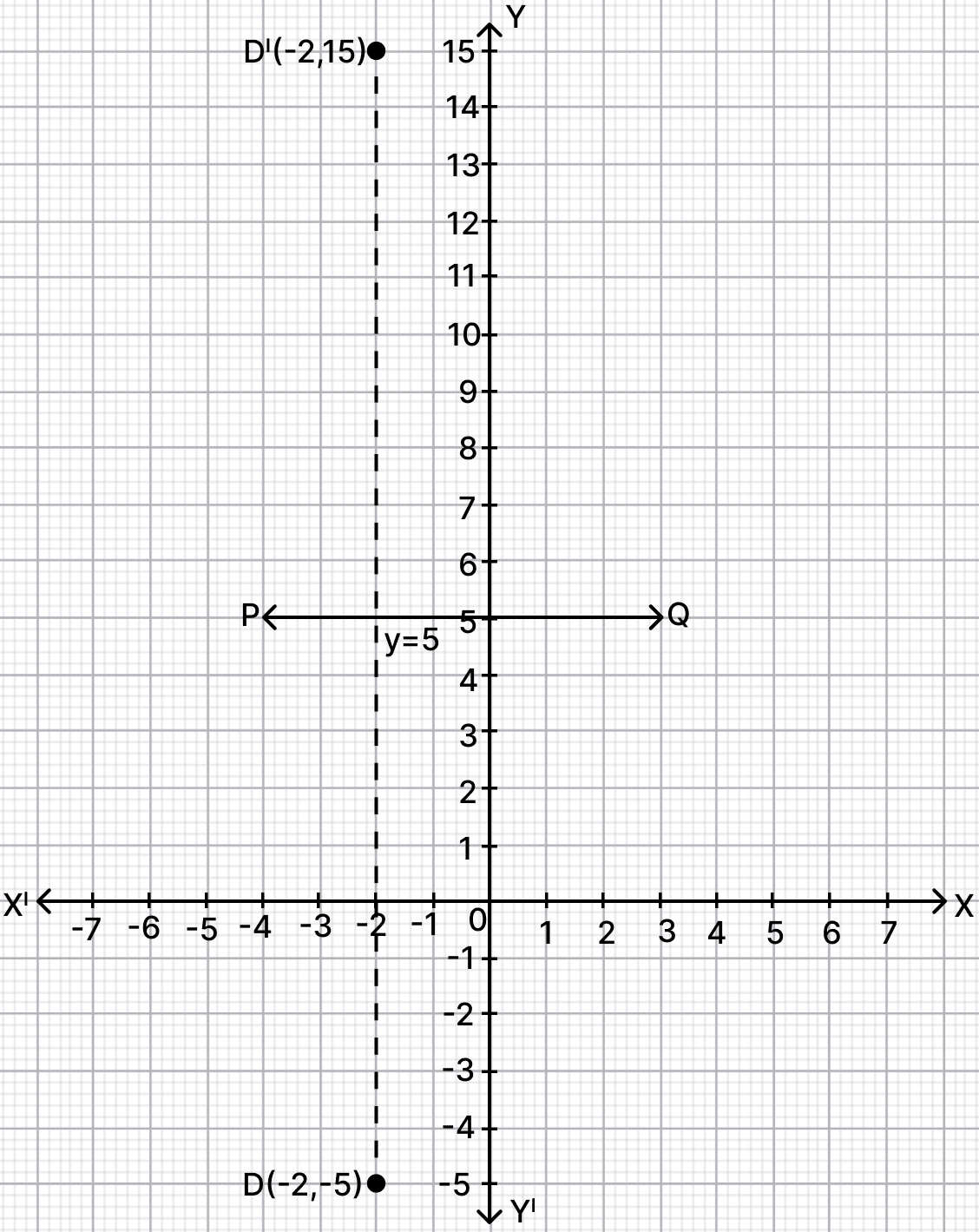
From graph,
D' = (-2, 15).
Hence, co-ordinates of D' = (-2, 15).
Use graph sheet for this question.
(a) Plot A(0, 3), B(2, 1) and C(4, -1).
(b) Reflect point B and C in y-axis and name their images as B' and C' respectively. Plot and write coordinates of the points B' and C'.
(c) Reflect point A in the line BB' and name its images as A'.
(d) Plot and write coordinates of point A'.
(e) Join the points ABA'B' and give the geometrical name of the closed figure so formed.
Answer
From figure,

Coordinates of point A' = (0, -1), B' = (-2, 1) and C' = (-4, -1).
The closed figure ABA'B' is a square.
Use graph paper for this question. Take 1 cm = 1 unit on both x and y axes.
(i) Plot the following points on your graph sheets : A(-4, 0), B(-3, 2), C(0, 4), D(4, 1) and E(7, 3).
(ii) Reflect the points B, C, D and E on the x-axis and name them as B', C', D' and E' respectively.
(iii) Join the points A, B, C, D, E, E', D', C', B' and A in order.
(iv) Name the closed figure formed.
Answer
From graph,
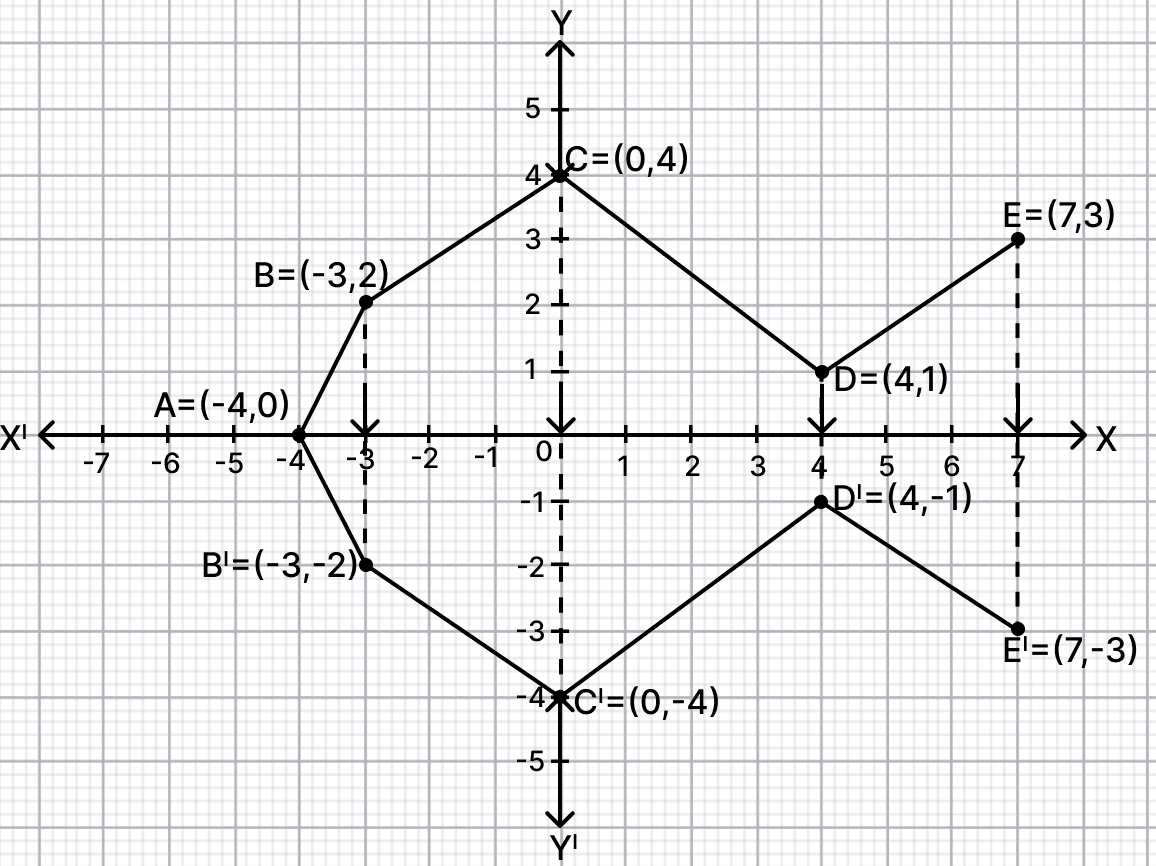
The closed figure formed is a nonagon.
Use a graph paper for this question. Take 2 cm = 1 unit along both the axes.
(i) Plot the points A(0, 4), B(2, 2), C(5, 2) and D(4, 0). E(0, 0) is the origin.
(ii) Reflect B, C, D on the y-axis and name them as B', C' and D' respectively.
(iii) Join the points ABCD D'C'B' and A in order and give a geometrical name to the closed figure.
Answer
(i) The point A(0, 4), B(2, 2), C(5, 2) and D(4, 0), E(0, 0) are plotted on the graph below :
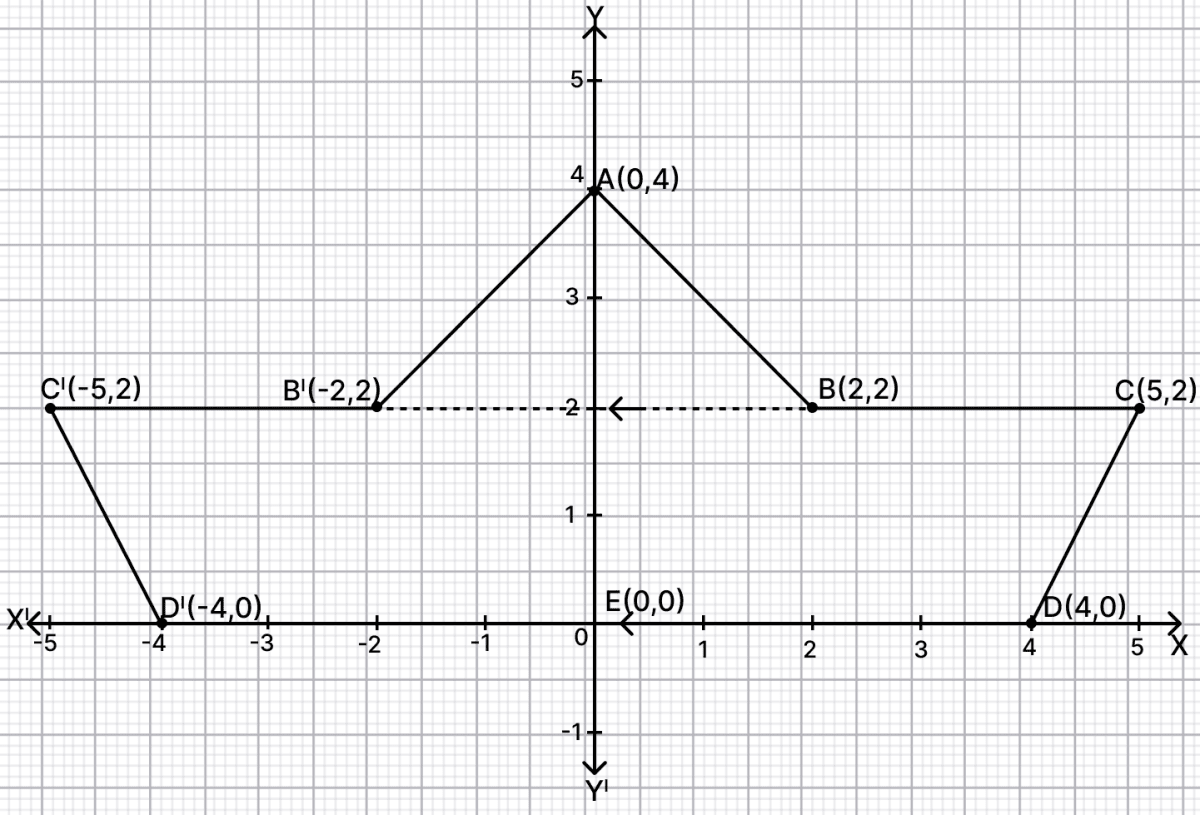
(ii) From graph, on reflecting B, C, D on y-axis we get,
⇒ B(2, 2) ⇒ B'(-2, 2)
⇒ C(5, 2) ⇒ C'(-5, 2)
⇒ D(4, 0) ⇒ D'(-4, 0).
(iii) Join the points ABCD D'C'B'A.
Hence, the figure formed is a boat.
Use a graph sheet for this question. Take 1 cm = 1 unit along both the x and y axis. Plot ABCDE, where A(4, 0), B(4, 2), C(2, 2), D(2, 4) and E(0, 4).
(a) Reflect the points A, B, C and D on the y-axis and name them as F, G, H and I respectively.
(b) Join the points A, B, C, D, E, I, H, G and F in order. Reflect the figure ABCDEIHGF on the x-axis and name it as AMNPQRSTF.
(c) Give the geometrical name of the closed figure AEFQ.
Answer
Steps of Construction:
Plot the points : A(4, 0), B(4, 2), C(2, 2), D(2,4) and E(0, 4).
On reflecting the points A, B, C and D on the y-axis, they become F, G, H and I respectively.
Join the points ABCDEIHGF.
Reflect the figure ABCDEIHGF in x-axis.
On reflecting the points A and F in x-axis, they remain same as they lie on x-axis.
On reflecting points B, C, D, E, I, H and G on the x-axis, they become M, N, P, Q, R, S and T respectively.
Join the points A, E, F and Q.
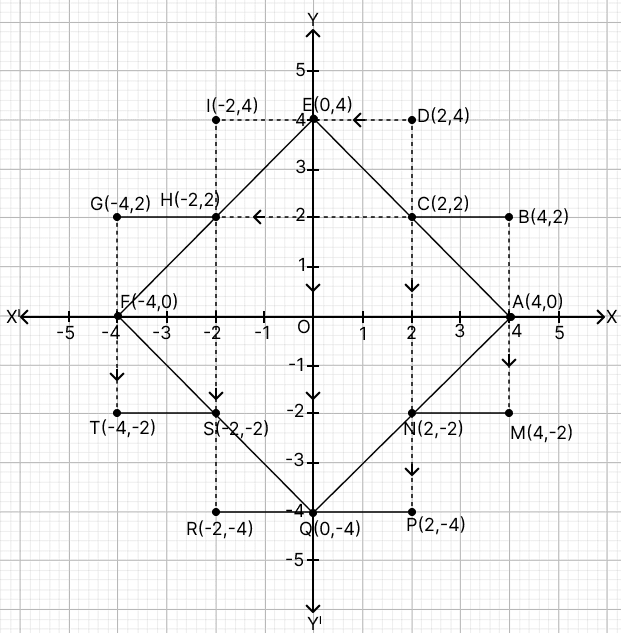
In figure AEFQ,
There are four congruent isosceles right angle triangles.
Thus, all the sides AE, EF, FQ and QA are equal.
Also each interior angle is equal to 90°.
Hence, the figure AEFQ is square.