
ABC is a triangle as shown in the figure below.
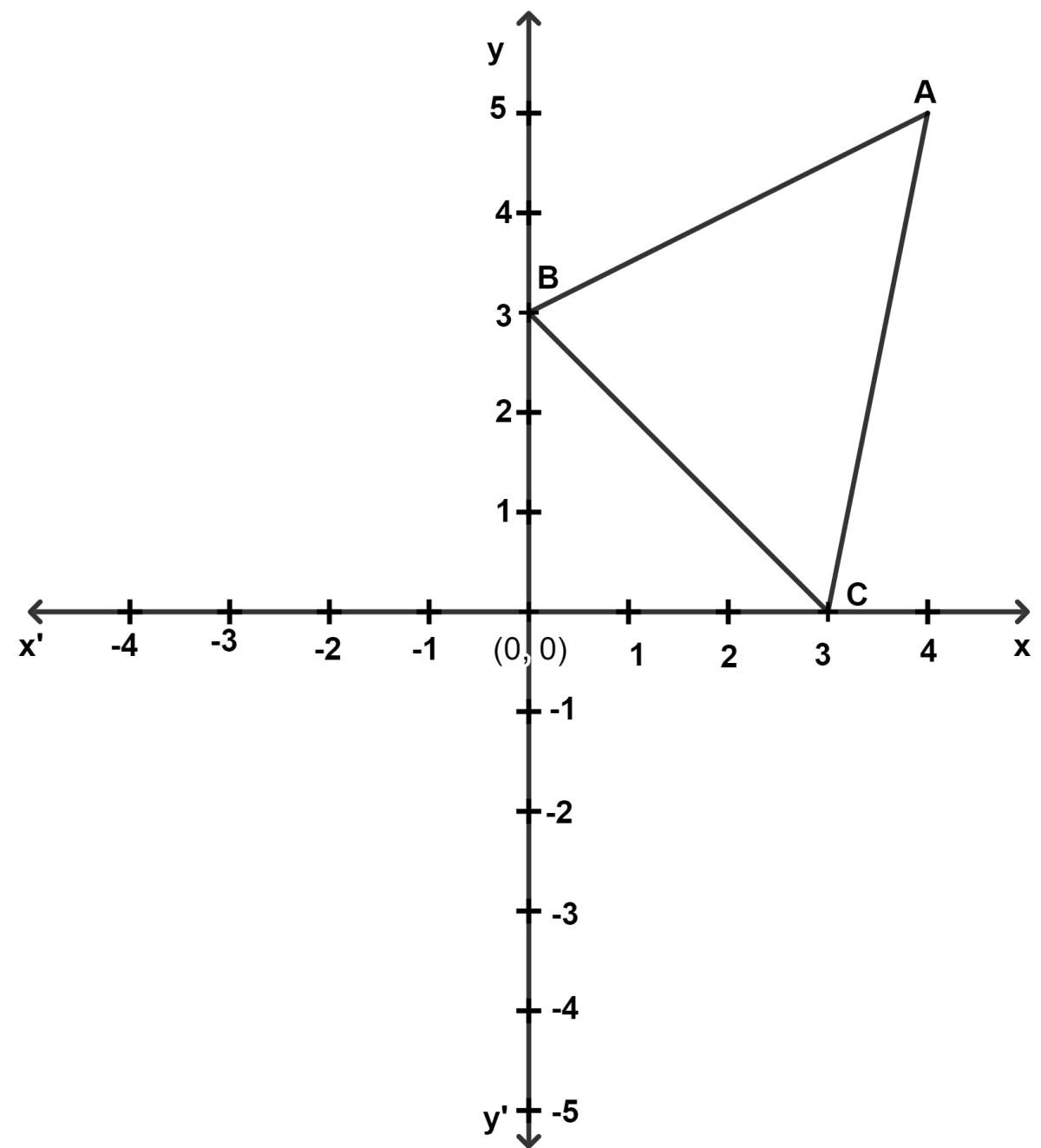
(a) Write down the coordinates of A, B and C on reflecting through the origin.
(b) Write down the coordinates of the point/s which remain invariant on reflecting the triangle ABC on the x-axis and y-axis respectively.
Answer
(a) From figure,
On reflecting in origin A, B and C becomes A', B' and C'.
Coordinates of A' = (-4, -5), B' = (0, -3) and C' = (-3, 0).
Hence, on reflecting A, B and C in origin the coordinates are (-4, -5), (0, -3) and (-3, 0) respectively.
(b) Point C(3, 0) lies on x-axis.
∴ It remains invariant on reflecting in x-axis.
Point B(0, 3) lies on y-axis.
∴ It remains invariant on reflecting in y-axis.
Hence, the invariant point for x-axis is point C and for y-axis is point B.
(a) Point P(2, -3) on reflection becomes P(2, 3). Name the line of reflection (say L1).
(b) Point P' is reflected to P'' along the line (L2), which is perpendicular to the line L1 and passes through the point, which is invariant along both axes. Write the coordinates of P''.
(c) Name and write the coordinates of the point of intersection of the lines L1 and L2.
(d) Point P is reflected to P''' on reflection through the point named in the answer of part I of this question. Write the coordinates of P'''. Comment on the location of the points P'' and P'''.
Answer
(a) P(2, -3) ⇒ P'(2, 3)
Since, sign of y-coordinate changes.
∴ L1 = x-axis
Hence, point P becomes P' on reflection in x-axis.
(b) Origin remains invariant on reflection along both the axes.
L2 is perpendicular to L1.
It means L2 is perpendicular to x-axis and passes through (0, 0).
∴ L2 is y-axis.
P'(2, 3) on reflection in y-axis becomes P''(-2, 3).
Hence, coordinates of P'' = (-2, 3).
(c) x-axis and y-axis intersect at origin.
Hence, coordinates of intersection of lines L1 and L2 is (0, 0).
(d) P(2, -3) on reflection in origin becomes P'''(-2, 3).
Since, P'' and P''' have similar co-ordinates.
Hence, P'' and P''' are coincident points.
Plot points A(0, 3), B(4, 0), C(6, 2) and D(5, 0). Reflect the points as given below and write their coordinates :
(a) Reflect A on x-axis to A’.
(b) Reflect B on y-axis to B’.
(c) Reflect C on x-axis to C’.
(d) D remain invariant when reflected on the line whose equation is …………… .
(e) Join the points A, B, C, D, C’, B, A’, B’ and A to form a closed figure. Name the closed figure BCDC’.
Answer
The graph is shown below:
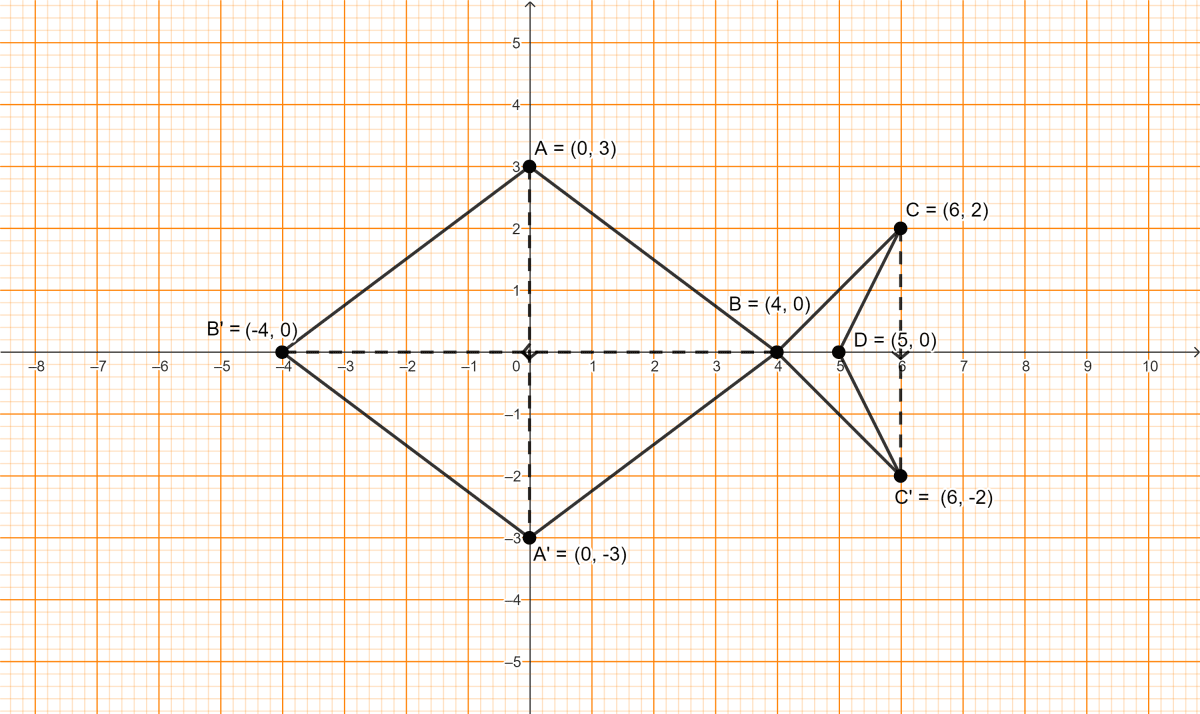
(a) Coordinates of A' = (0, -3).
(b) Coordinates of B' = (-4, 0).
(c) Coordinates of C' = (6, -2).
(d) From graph,
D lies on x-axis.
∴ It is invariant in the line x-axis or y = 0.
D remain invariant when reflected on the line whose equation is y = 0.
(e) From graph,
BCDC' is a concave quadrilateral.
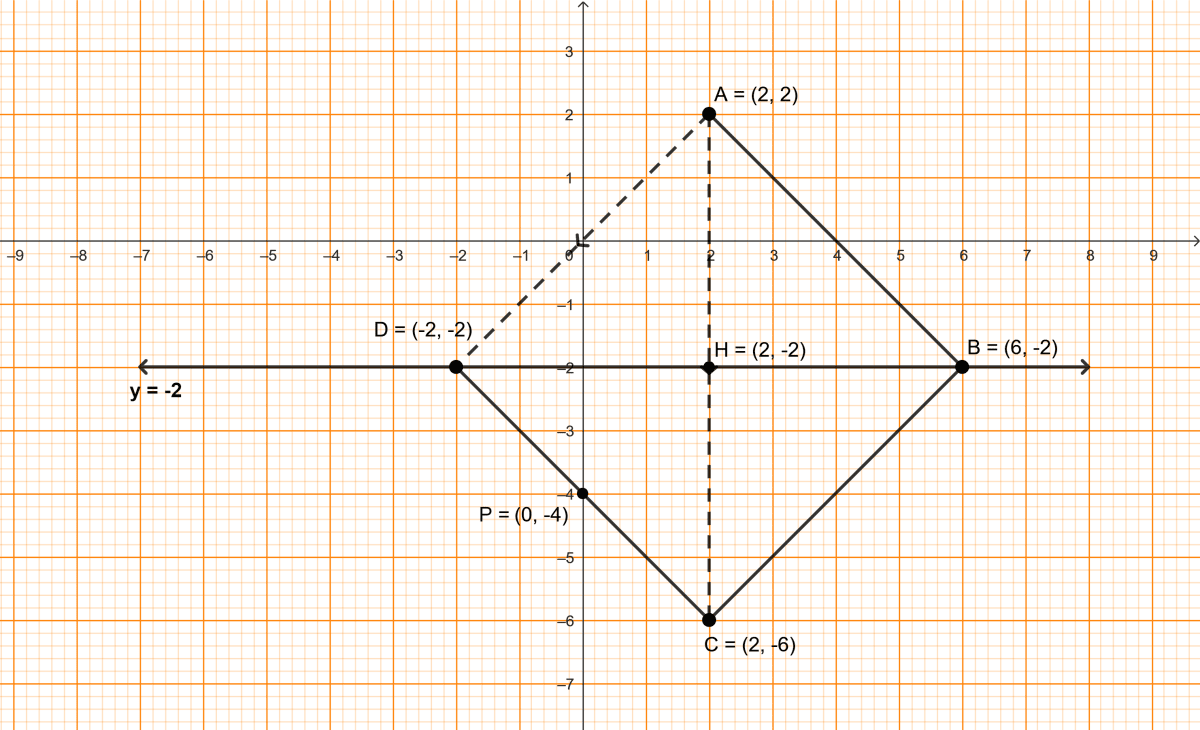
Plot the points A(2, 2) and B(6, -2) in the graph and answer the following :
(a) Reflect points A in origin to point D and write the co-ordinates of point D.
(b) Reflect points A in line y = -2 to point C and write the co-ordinates of point C.
(c) Find a point P on CD which is invariant under reflection in x = 0, write its co-ordinates.
(d) Write the geometrical name of the closed figure ABCD.
(e) Write the co-ordinates of the point of intersection of the diagonals of ABCD.
Answer
The graph is shown below:
(a) From graph,
Co-ordinates of D = (-2, -2).
(b) From graph,
Co-ordinates of C = (2, -6).
(c) Point P(0, -4) lies on y-axis.
∴ It is invariant under reflection in x = 0.
Co-ordinates of P = (0, -4).
(d) From graph,
ABCD is a square.
(e) From graph,
H is the point of intersection of diagonals of ABCD.
Co-ordinates of H = (2, -2).