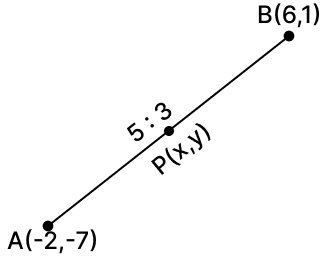
Find the co-ordinates of point P which divides the line segment joining A(-2, -7) and B(6, 1) in the ratio 5 : 3.
Answer
Let point P be (x, y).
Given,
m1 : m2 = 5 : 3
By section-formula,
(x, y) = ( m 1 x 2 + m 2 x 1 m 1 + m 2 , m 1 y 2 + m 2 y 1 m 1 + m 2 ) \Big(\dfrac{m_1x_2 + m_2x_1}{m_1 + m_2}, \dfrac{m_1y_2 + m_2y_1}{m_1 + m_2}\Big) ( m 1 + m 2 m 1 x 2 + m 2 x 1 , m 1 + m 2 m 1 y 2 + m 2 y 1 )
Substituting values we get :
⇒ ( x , y ) = ( 5 × 6 + 3 × − 2 5 + 3 , 5 × 1 + 3 × − 7 5 + 3 ) ⇒ ( x , y ) = ( 30 − 6 8 , 5 − 21 8 ) ⇒ ( x , y ) = ( 24 8 , − 16 8 ) ⇒ ( x , y ) = ( 3 , − 2 ) . \Rightarrow (x, y) = \Big(\dfrac{5 \times 6 + 3 \times -2}{5 + 3}, \dfrac{5 \times 1 + 3 \times -7}{5 + 3}\Big) \\[1em] \Rightarrow (x, y) = \Big(\dfrac{30 - 6}{8}, \dfrac{5 - 21}{8}\Big) \\[1em] \Rightarrow (x, y) = \Big(\dfrac{24}{8}, \dfrac{-16}{8}\Big) \\[1em] \Rightarrow (x, y) = (3, -2). ⇒ ( x , y ) = ( 5 + 3 5 × 6 + 3 × − 2 , 5 + 3 5 × 1 + 3 × − 7 ) ⇒ ( x , y ) = ( 8 30 − 6 , 8 5 − 21 ) ⇒ ( x , y ) = ( 8 24 , 8 − 16 ) ⇒ ( x , y ) = ( 3 , − 2 ) .
Hence, the coordinates of P are (3, -2).
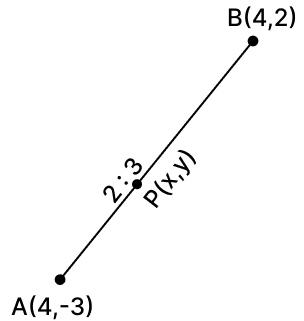
The line segment joining the points A(4, -3) and B(4, 2) is divided by the point P such that AP : AB = 2 : 5. Find the co-ordinates of P.
Answer
Let point P be (x, y).
⇒ A P A B = 2 5 ⇒ A P A P + P B = 2 5 ⇒ 5 A P = 2 A P + 2 P B ⇒ 3 A P = 2 P B ⇒ A P P B = 2 3 ⇒ A P : P B = 2 : 3. \Rightarrow \dfrac{AP}{AB} = \dfrac{2}{5} \\[1em] \Rightarrow \dfrac{AP}{AP + PB} = \dfrac{2}{5} \\[1em] \Rightarrow 5AP = 2AP + 2PB \\[1em] \Rightarrow 3AP = 2PB \\[1em] \Rightarrow \dfrac{AP}{PB} = \dfrac{2}{3} \\[1em] \Rightarrow AP : PB = 2 : 3. ⇒ A B A P = 5 2 ⇒ A P + PB A P = 5 2 ⇒ 5 A P = 2 A P + 2 PB ⇒ 3 A P = 2 PB ⇒ PB A P = 3 2 ⇒ A P : PB = 2 : 3.
m1 : m2 = AP : PB = 2 : 3.
By section-formula,
(x, y) = ( m 1 x 2 + m 2 x 1 m 1 + m 2 , m 1 y 2 + m 2 y 1 m 1 + m 2 ) \Big(\dfrac{m_1x_2 + m_2x_1}{m_1 + m_2}, \dfrac{m_1y_2 + m_2y_1}{m_1 + m_2}\Big) ( m 1 + m 2 m 1 x 2 + m 2 x 1 , m 1 + m 2 m 1 y 2 + m 2 y 1 )
Substituting values we get :
⇒ ( x , y ) = ( 2 × 4 + 3 × 4 2 + 3 , 2 × 2 + 3 × − 3 2 + 3 ) ⇒ ( x , y ) = ( 8 + 12 5 , 4 − 9 5 ) ⇒ ( x , y ) = ( 20 5 , − 5 5 ) ⇒ ( x , y ) = ( 4 , − 1 ) . \Rightarrow (x, y) = \Big(\dfrac{2 \times 4+ 3 \times 4}{2 + 3}, \dfrac{2 \times 2 + 3 \times -3}{2 + 3}\Big) \\[1em] \Rightarrow (x, y) = \Big(\dfrac{8 + 12}{5}, \dfrac{4 - 9}{5}\Big) \\[1em] \Rightarrow (x, y) = \Big(\dfrac{20}{5}, \dfrac{-5}{5}\Big) \\[1em] \Rightarrow (x, y) = (4, -1). ⇒ ( x , y ) = ( 2 + 3 2 × 4 + 3 × 4 , 2 + 3 2 × 2 + 3 × − 3 ) ⇒ ( x , y ) = ( 5 8 + 12 , 5 4 − 9 ) ⇒ ( x , y ) = ( 5 20 , 5 − 5 ) ⇒ ( x , y ) = ( 4 , − 1 ) .
Hence, the coordinates of P are (4, -1).
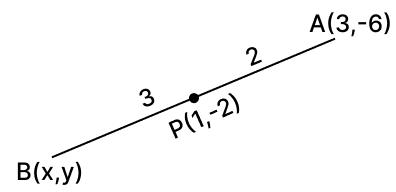
P(1, -2) is a point on the line segment A(3, -6) and B(x, y) such that AP : PB is equal to 2 : 3. Find the co-ordinates of B.
Answer
Given,
m1 : m2 = 2 : 3
By section-formula,
x = ( m 1 x 2 + m 2 x 1 m 1 + m 2 ) \Big(\dfrac{m_1x_2 + m_2x_1}{m_1 + m_2}\Big) ( m 1 + m 2 m 1 x 2 + m 2 x 1 )
Substituting values we get :
⇒ 1 = ( 2 × x + 3 × 3 2 + 3 ) ⇒ 1 = ( 2 x + 9 5 ) ⇒ 5 = 2 x + 9 ⇒ 5 − 9 = 2 x ⇒ − 4 = 2 x ⇒ x = − 4 2 ⇒ x = − 2. \Rightarrow 1 = \Big(\dfrac{2 \times x + 3 \times 3}{2 + 3}\Big) \\[1em] \Rightarrow 1 = \Big(\dfrac{2x + 9}{5}\Big) \\[1em] \Rightarrow 5 = 2x + 9 \\[1em] \Rightarrow 5 - 9 = 2x \\[1em] \Rightarrow -4 = 2x \\[1em] \Rightarrow x = \dfrac{-4}{2} \\[1em] \Rightarrow x = -2. ⇒ 1 = ( 2 + 3 2 × x + 3 × 3 ) ⇒ 1 = ( 5 2 x + 9 ) ⇒ 5 = 2 x + 9 ⇒ 5 − 9 = 2 x ⇒ − 4 = 2 x ⇒ x = 2 − 4 ⇒ x = − 2.
By section-formula,
y = ( m 1 y 2 + m 2 y 1 m 1 + m 2 ) \Big(\dfrac{m_1y_2 + m_2y_1}{m_1 + m_2}\Big) ( m 1 + m 2 m 1 y 2 + m 2 y 1 )
Substituting values we get :
⇒ − 2 = ( 2 × y + 3 × − 6 2 + 3 ) ⇒ − 2 = ( 2 y − 18 5 ) ⇒ − 10 = 2 y − 18 ⇒ − 10 + 18 = 2 y ⇒ 8 = 2 y ⇒ y = 8 2 ⇒ y = 4. \Rightarrow -2 = \Big(\dfrac{2 \times y + 3 \times -6}{2 + 3}\Big) \\[1em] \Rightarrow -2 = \Big(\dfrac{2y - 18}{5}\Big) \\[1em] \Rightarrow -10 = 2y - 18 \\[1em] \Rightarrow -10 + 18 = 2y \\[1em] \Rightarrow 8 = 2y \\[1em] \Rightarrow y = \dfrac{8}{2} \\[1em] \Rightarrow y = 4. ⇒ − 2 = ( 2 + 3 2 × y + 3 × − 6 ) ⇒ − 2 = ( 5 2 y − 18 ) ⇒ − 10 = 2 y − 18 ⇒ − 10 + 18 = 2 y ⇒ 8 = 2 y ⇒ y = 2 8 ⇒ y = 4.
Hence, the coordinates of B are (-2, 4).
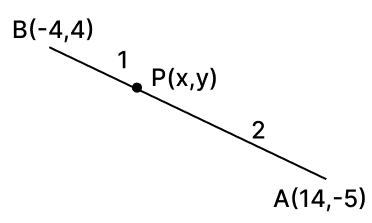
Find a point P on the line segment joining A(14, -5) and B(-4, 4), which is twice as far from A as from B.
Answer
Let point P be (x, y).
Since, point P is twice as far from A as from B.
⇒ AP = 2BP
⇒ A P B P = 2 1 \dfrac{AP}{BP} = \dfrac{2}{1} BP A P = 1 2
⇒ AP : BP = 2 : 1.
⇒ m1 : m2 = AP : PB = 2 : 1
By section-formula,
(x, y) = ( m 1 x 2 + m 2 x 1 m 1 + m 2 , m 1 y 2 + m 2 y 1 m 1 + m 2 ) \Big(\dfrac{m_1x_2 + m_2x_1}{m_1 + m_2}, \dfrac{m_1y_2 + m_2y_1}{m_1 + m_2}\Big) ( m 1 + m 2 m 1 x 2 + m 2 x 1 , m 1 + m 2 m 1 y 2 + m 2 y 1 )
Substituting values we get :
⇒ ( x , y ) = ( 2 × − 4 + 1 × 14 2 + 1 , 2 × 4 + 1 × − 5 2 + 1 ) ⇒ ( x , y ) = ( − 8 + 14 3 , 8 − 5 3 ) ⇒ ( x , y ) = ( 6 3 , 3 3 ) ⇒ ( x , y ) = ( 2 , 1 ) . \Rightarrow (x, y) = \Big(\dfrac{2 \times -4+ 1 \times 14}{2 + 1}, \dfrac{2 \times 4 + 1 \times -5}{2 + 1}\Big) \\[1em] \Rightarrow (x, y) = \Big(\dfrac{-8 + 14}{3}, \dfrac{8 - 5}{3}\Big) \\[1em] \Rightarrow (x, y) = \Big(\dfrac{6}{3}, \dfrac{3}{3}\Big) \\[1em] \Rightarrow (x, y) = (2, 1). ⇒ ( x , y ) = ( 2 + 1 2 × − 4 + 1 × 14 , 2 + 1 2 × 4 + 1 × − 5 ) ⇒ ( x , y ) = ( 3 − 8 + 14 , 3 8 − 5 ) ⇒ ( x , y ) = ( 3 6 , 3 3 ) ⇒ ( x , y ) = ( 2 , 1 ) .
Hence, the coordinates of P are (2, 1).
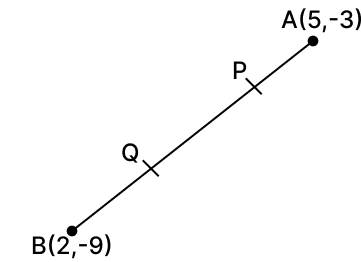
Find the co-ordinates of the points of trisection of the line segment joining the points A(5, -3) and B(2, -9).
Answer
Let point P is the first point of trisection, meaning it divides the segment AB internally in the ratio m1 : m2 = 1 : 2
By section-formula,
(x, y) = ( m 1 x 2 + m 2 x 1 m 1 + m 2 , m 1 y 2 + m 2 y 1 m 1 + m 2 ) \Big(\dfrac{m_1x_2 + m_2x_1}{m_1 + m_2}, \dfrac{m_1y_2 + m_2y_1}{m_1 + m_2}\Big) ( m 1 + m 2 m 1 x 2 + m 2 x 1 , m 1 + m 2 m 1 y 2 + m 2 y 1 )
Substituting values we get :
⇒ P ( x , y ) = ( 1 × 2 + 2 × 5 1 + 2 , 1 × − 9 + 2 × − 3 1 + 2 ) ⇒ P ( x , y ) = ( 2 + 10 3 , − 9 − 6 3 ) ⇒ P ( x , y ) = ( 12 3 , − 15 3 ) ⇒ P ( x , y ) = ( 4 , − 5 ) . \Rightarrow P(x, y) = \Big(\dfrac{1 \times 2 + 2 \times 5}{1 + 2}, \dfrac{1 \times -9 + 2 \times -3}{1 + 2}\Big) \\[1em] \Rightarrow P(x, y) = \Big(\dfrac{2 + 10}{3}, \dfrac{-9 - 6}{3}\Big) \\[1em] \Rightarrow P(x, y) = \Big(\dfrac{12}{3}, \dfrac{-15}{3}\Big) \\[1em] \Rightarrow P(x, y) = (4, -5). ⇒ P ( x , y ) = ( 1 + 2 1 × 2 + 2 × 5 , 1 + 2 1 × − 9 + 2 × − 3 ) ⇒ P ( x , y ) = ( 3 2 + 10 , 3 − 9 − 6 ) ⇒ P ( x , y ) = ( 3 12 , 3 − 15 ) ⇒ P ( x , y ) = ( 4 , − 5 ) .
Let point Q is the second point of trisection, meaning it divides the segment AB internally in the ratio m1 : m2 = 2 : 1
Substituting values we get :
⇒ Q ( a , b ) = ( 2 × 2 + 1 × 5 2 + 1 , 2 × − 9 + 1 × − 3 2 + 1 ) ⇒ Q ( a , b ) = ( 4 + 5 3 , − 18 − 3 3 ) ⇒ Q ( a , b ) = ( 9 3 , − 21 3 ) ⇒ Q ( a , b ) = ( 3 , − 7 ) . \Rightarrow Q(a, b) = \Big(\dfrac{2 \times 2 + 1 \times 5}{2 + 1}, \dfrac{2 \times -9 + 1 \times -3}{2 + 1}\Big) \\[1em] \Rightarrow Q(a, b) = \Big(\dfrac{4 + 5}{3}, \dfrac{-18 - 3}{3}\Big) \\[1em] \Rightarrow Q(a, b) = \Big(\dfrac{9}{3}, \dfrac{-21}{3}\Big) \\[1em] \Rightarrow Q(a, b) = (3, -7). ⇒ Q ( a , b ) = ( 2 + 1 2 × 2 + 1 × 5 , 2 + 1 2 × − 9 + 1 × − 3 ) ⇒ Q ( a , b ) = ( 3 4 + 5 , 3 − 18 − 3 ) ⇒ Q ( a , b ) = ( 3 9 , 3 − 21 ) ⇒ Q ( a , b ) = ( 3 , − 7 ) .
Hence, the coordinates of trisection are P(4, -5) and Q(3, -7).
Find the co-ordinates of the mid-point of the line segment joining :
(i) A(5, 7) and B(-3, -1)
(ii) P(-5, -8) and Q(3, 4)
Answer
(i) Let mid-point of the line segment joining AB be P(x,y).
By using mid-point formula,
(x, y) = ( x 1 + x 2 2 , y 1 + y 2 2 ) \Big(\dfrac{x_1 + x_2}{2}, \dfrac{y_1 + y_2}{2}\Big) ( 2 x 1 + x 2 , 2 y 1 + y 2 )
Substituting values we get :
⇒ ( x , y ) = ( 5 + ( − 3 ) 2 , 7 + ( − 1 ) 2 ) ⇒ ( x , y ) = ( 2 2 , 6 2 ) ⇒ ( x , y ) = ( 1 , 3 ) . \Rightarrow (x, y) = \Big(\dfrac{5 + (-3)}{2}, \dfrac{7 + (-1)}{2}\Big) \\[1em] \Rightarrow (x, y) = \Big(\dfrac{2}{2}, \dfrac{6}{2}\Big) \\[1em] \Rightarrow (x, y) = (1, 3). ⇒ ( x , y ) = ( 2 5 + ( − 3 ) , 2 7 + ( − 1 ) ) ⇒ ( x , y ) = ( 2 2 , 2 6 ) ⇒ ( x , y ) = ( 1 , 3 ) .
Hence, the coordinates of mid-point are (1, 3).
(ii) Let mid-point of the line segment joining PQ be B(x,y).
By using mid-point formula,
(x, y) = ( x 1 + x 2 2 , y 1 + y 2 2 ) \Big(\dfrac{x_1 + x_2}{2}, \dfrac{y_1 + y_2}{2}\Big) ( 2 x 1 + x 2 , 2 y 1 + y 2 )
Substituting values we get :
⇒ ( x , y ) = ( − 5 + 3 2 , − 8 + 4 2 ) ⇒ ( x , y ) = ( − 2 2 , − 4 2 ) ⇒ ( x , y ) = ( − 1 , − 2 ) . \Rightarrow (x, y) = \Big(\dfrac{-5 + 3}{2}, \dfrac{-8 + 4}{2}\Big) \\[1em] \Rightarrow (x, y) = \Big(\dfrac{-2}{2}, \dfrac{-4}{2}\Big) \\[1em] \Rightarrow (x, y) = (-1, -2). ⇒ ( x , y ) = ( 2 − 5 + 3 , 2 − 8 + 4 ) ⇒ ( x , y ) = ( 2 − 2 , 2 − 4 ) ⇒ ( x , y ) = ( − 1 , − 2 ) .
Hence, the coordinates of mid-point are (-1, -2).
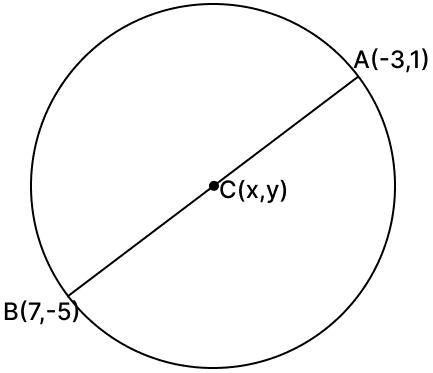
The line segment joining A(-3, 1) and B(7, -5) is a diameter of a circle whose centre is C. Find the co-ordinates of the centre C.
Answer
Since the line segment joining points A and B is the diameter of the circle, the centre of the circle must be the mid-point of the diameter AB.
By using mid-point formula,
(x, y) = ( x 1 + x 2 2 , y 1 + y 2 2 ) \Big(\dfrac{x_1 + x_2}{2}, \dfrac{y_1 + y_2}{2}\Big) ( 2 x 1 + x 2 , 2 y 1 + y 2 )
Substituting values we get :
⇒ C ( x , y ) = ( − 3 + 7 2 , 1 + ( − 5 ) 2 ) ⇒ C ( x , y ) = ( 4 2 , − 4 2 ) ⇒ C ( x , y ) = ( 2 , − 2 ) . \Rightarrow C(x, y) = \Big(\dfrac{-3 + 7}{2}, \dfrac{1 + (-5)}{2}\Big) \\[1em] \Rightarrow C(x, y) = \Big(\dfrac{4}{2}, \dfrac{-4}{2}\Big) \\[1em] \Rightarrow C(x, y) = (2, -2). ⇒ C ( x , y ) = ( 2 − 3 + 7 , 2 1 + ( − 5 ) ) ⇒ C ( x , y ) = ( 2 4 , 2 − 4 ) ⇒ C ( x , y ) = ( 2 , − 2 ) .
Hence, the coordinates of centre (C) are (2, -2).
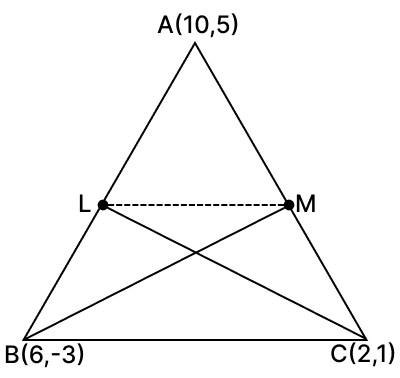
A(10, 5), B(6, -3) and C(2, 1) are the vertices of a ΔABC. L is the mid-point of AB and M is the mid-point of AC. Write down the co-ordinates of L and M. Show that L M = 1 2 B C . LM = \dfrac{1}{2} BC. L M = 2 1 BC .
Answer
By using mid-point formula,
(x, y) = ( x 1 + x 2 2 , y 1 + y 2 2 ) \Big(\dfrac{x_1 + x_2}{2}, \dfrac{y_1 + y_2}{2}\Big) ( 2 x 1 + x 2 , 2 y 1 + y 2 )
L is the mid-point of AB.
Substituting values we get :
⇒ L = ( 10 + 6 2 , 5 + ( − 3 ) 2 ) ⇒ L = ( 16 2 , 2 2 ) ⇒ L = ( 8 , 1 ) . \Rightarrow L = \Big(\dfrac{10 + 6}{2}, \dfrac{5 + (-3)}{2}\Big) \\[1em] \Rightarrow L = \Big(\dfrac{16}{2}, \dfrac{2}{2}\Big) \\[1em] \Rightarrow L = (8, 1). ⇒ L = ( 2 10 + 6 , 2 5 + ( − 3 ) ) ⇒ L = ( 2 16 , 2 2 ) ⇒ L = ( 8 , 1 ) .
Given,
M is the mid-point of AC.
Substituting values we get :
⇒ M = ( 10 + 2 2 , 5 + 1 2 ) ⇒ M = ( 12 2 , 6 2 ) ⇒ M = ( 6 , 3 ) . \Rightarrow M = \Big(\dfrac{10 + 2}{2}, \dfrac{5 + 1}{2}\Big) \\[1em] \Rightarrow M = \Big(\dfrac{12}{2}, \dfrac{6}{2}\Big) \\[1em] \Rightarrow M = (6, 3). ⇒ M = ( 2 10 + 2 , 2 5 + 1 ) ⇒ M = ( 2 12 , 2 6 ) ⇒ M = ( 6 , 3 ) .
By distance formula,
d = ( x 2 − x 1 ) 2 + ( y 2 − y 1 ) 2 \sqrt{(x_2 - x_1)^2 + (y_2 - y_1)^2} ( x 2 − x 1 ) 2 + ( y 2 − y 1 ) 2
Substituting values we get :
L M = ( 6 − 8 ) 2 + ( 3 − 1 ) 2 = ( − 2 ) 2 + ( 2 ) 2 = 4 + 4 = 8 = 2 2 . B C = ( 2 − 6 ) 2 + ( 1 − ( − 3 ) ) 2 = ( − 4 ) 2 + ( 4 ) 2 = 16 + 16 = 32 = 16 × 2 = 4 2 = 2 × 2 2 = 2 × L M . LM = \sqrt{(6 - 8)^2 + (3 - 1)^2} \\[1em] = \sqrt{(-2)^2 + (2)^2} \\[1em] = \sqrt{4 + 4} \\[1em] = \sqrt{8} = 2\sqrt{2}. \\[1em] BC = \sqrt{(2 - 6)^2 + (1 - (-3))^2} \\[1em] = \sqrt{(-4)^2 + (4)^2} \\[1em] = \sqrt{16 + 16} \\[1em] = \sqrt{32} \\[1em] = \sqrt{16 \times 2} \\[1em] = 4\sqrt{2} \\[1em] = 2 \times 2\sqrt{2} \\[1em] = 2 \times LM. L M = ( 6 − 8 ) 2 + ( 3 − 1 ) 2 = ( − 2 ) 2 + ( 2 ) 2 = 4 + 4 = 8 = 2 2 . BC = ( 2 − 6 ) 2 + ( 1 − ( − 3 ) ) 2 = ( − 4 ) 2 + ( 4 ) 2 = 16 + 16 = 32 = 16 × 2 = 4 2 = 2 × 2 2 = 2 × L M .
Thus, BC = 2LM or LM = 1 2 B C . \dfrac{1}{2}BC. 2 1 BC .
Hence, proved that L M = 1 2 B C LM = \dfrac{1}{2}BC L M = 2 1 BC
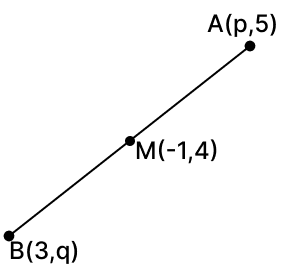
The mid-point of the line segment joining A(p, 5) and B(3, q) is M(-1, 4). Find the values of p and q.
Answer
Given,
Mid-point of the line segment joining A(p, 5) and B(3, q) is M(-1, 4).
By using mid-point formula,
(x, y) = ( x 1 + x 2 2 , y 1 + y 2 2 ) \Big(\dfrac{x_1 + x_2}{2}, \dfrac{y_1 + y_2}{2}\Big) ( 2 x 1 + x 2 , 2 y 1 + y 2 )
Substituting values we get :
⇒ ( − 1 , 4 ) = ( p + 3 2 , 5 + q 2 ) ⇒ ( − 1 , 4 ) = ( p + 3 2 , 5 + q 2 ) ⇒ − 1 = p + 3 2 and 4 = 5 + q 2 ⇒ p + 3 = − 2 and 5 + q = 8 ⇒ p = − 2 − 3 and q = 8 − 5 ⇒ p = − 5 and q = 3. \Rightarrow (-1, 4) = \Big(\dfrac{p + 3}{2}, \dfrac{5 + q}{2} \Big) \\[1em] \Rightarrow (-1, 4) = \Big(\dfrac{p + 3}{2}, \dfrac{5 + q}{2}\Big) \\[1em] \Rightarrow -1 = \dfrac{p + 3}{2} \text{ and } 4 = \dfrac{5 + q}{2} \\[1em] \Rightarrow p + 3 = -2 \text{ and } 5 + q = 8 \\[1em] \Rightarrow p = -2 - 3 \text{ and } q = 8 - 5 \\[1em] \Rightarrow p = -5 \text{ and } q = 3. ⇒ ( − 1 , 4 ) = ( 2 p + 3 , 2 5 + q ) ⇒ ( − 1 , 4 ) = ( 2 p + 3 , 2 5 + q ) ⇒ − 1 = 2 p + 3 and 4 = 2 5 + q ⇒ p + 3 = − 2 and 5 + q = 8 ⇒ p = − 2 − 3 and q = 8 − 5 ⇒ p = − 5 and q = 3.
Hence, p = -5 and q = 3.
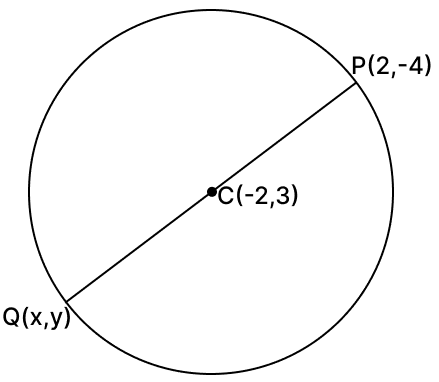
The centre of a circle is C(-2, 3) and one end of a diameter PQ is P(2, -4). Find the co-ordinates of Q.
Answer
Since PQ is the diameter of the circle and C is the center, C must be the mid-point of the segment PQ.
Let coordinates of Q be (x1 , y1 ).
By using mid-point formula,
x-coordinate = ( x 1 + x 2 2 ) \Big(\dfrac{x_1 + x_2}{2}\Big) ( 2 x 1 + x 2 )
Substituting values we get :
⇒ − 2 = ( 2 + x 1 2 ) ⇒ − 4 = 2 + x 1 ⇒ − 4 − 2 = x 1 ⇒ x 1 = − 6. \Rightarrow -2 = \Big(\dfrac{2 + x_1}{2}\Big) \\[1em] \Rightarrow -4 = 2 + x_1 \\[1em] \Rightarrow -4 - 2 = x_1 \\[1em] \Rightarrow x_1 = -6. ⇒ − 2 = ( 2 2 + x 1 ) ⇒ − 4 = 2 + x 1 ⇒ − 4 − 2 = x 1 ⇒ x 1 = − 6.
By using mid-point formula,
y-coordinate = ( y 1 + y 2 2 ) \Big(\dfrac{y_1 + y_2}{2}\Big) ( 2 y 1 + y 2 )
Substituting values we get :
⇒ 3 = ( − 4 + y 1 2 ) ⇒ 6 = − 4 + y 1 ⇒ 6 + 4 = y 1 ⇒ y 1 = 10. \Rightarrow 3 = \Big(\dfrac{-4 + y_1}{2}\Big) \\[1em] \Rightarrow 6 = -4 + y_1 \\[1em] \Rightarrow 6 + 4 = y_1 \\[1em] \Rightarrow y_1 = 10. ⇒ 3 = ( 2 − 4 + y 1 ) ⇒ 6 = − 4 + y 1 ⇒ 6 + 4 = y 1 ⇒ y 1 = 10.
Q = (x1 , y1 ) = (-6, 10).
Hence, coordinates of Q are (-6, 10).
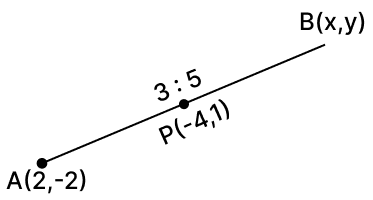
The point P(-4, 1) divides the line segment joining the points A(2, -2) and B in the ratio 3 : 5. Find the co-ordinates of point B.
Answer
Let coordinates of B be (a, b).
Point P(-4, 1) divides the line segment joining A(2, -2) and B(a, b) in the ratio 3 : 5.
By section-formula,
(x, y) = ( m 1 x 2 + m 2 x 1 m 1 + m 2 , m 1 y 2 + m 2 y 1 m 1 + m 2 ) \Big(\dfrac{m_1x_2 + m_2x_1}{m_1 + m_2}, \dfrac{m_1y_2 + m_2y_1}{m_1 + m_2}\Big) ( m 1 + m 2 m 1 x 2 + m 2 x 1 , m 1 + m 2 m 1 y 2 + m 2 y 1 )
Substituting values we get :
⇒ ( − 4 , 1 ) = ( 3 a + 5 ( 2 ) 3 + 5 , 3 b + 5 ( − 2 ) 3 + 5 ) ⇒ ( − 4 , 1 ) = ( 3 a + 10 8 , 3 b − 10 8 ) ⇒ − 4 = ( 3 a + 10 8 ) and 1 = ( 3 b − 10 8 ) ⇒ − 32 = 3 a + 10 and 8 = 3 b − 10 ⇒ − 32 − 10 = 3 a and 8 + 10 = 3 b ⇒ − 42 = 3 a and 18 = 3 b ⇒ a = − 42 3 and b = 18 3 ⇒ a = − 14 and b = 6. \Rightarrow (-4, 1) = \Big(\dfrac{3a + 5(2)}{3 + 5}, \dfrac{3b + 5(-2)}{3 + 5}\Big) \\[1em] \Rightarrow (-4, 1) = \Big(\dfrac{3a + 10}{8}, \dfrac{3b - 10}{8}\Big) \\[1em] \Rightarrow -4 = \Big(\dfrac{3a + 10}{8}\Big) \text{ and } 1 = \Big(\dfrac{3b - 10}{8}\Big) \\[1em] \Rightarrow -32 = 3a + 10 \text{ and } 8 = 3b - 10 \\[1em] \Rightarrow -32 - 10 = 3a \text{ and } 8 + 10 = 3b \\[1em] \Rightarrow -42 = 3a \text{ and } 18 = 3b \\[1em] \Rightarrow a = \dfrac{-42}{3} \text{ and } b = \dfrac{18}{3} \\[1em] \Rightarrow a = -14 \text{ and }b = 6 . ⇒ ( − 4 , 1 ) = ( 3 + 5 3 a + 5 ( 2 ) , 3 + 5 3 b + 5 ( − 2 ) ) ⇒ ( − 4 , 1 ) = ( 8 3 a + 10 , 8 3 b − 10 ) ⇒ − 4 = ( 8 3 a + 10 ) and 1 = ( 8 3 b − 10 ) ⇒ − 32 = 3 a + 10 and 8 = 3 b − 10 ⇒ − 32 − 10 = 3 a and 8 + 10 = 3 b ⇒ − 42 = 3 a and 18 = 3 b ⇒ a = 3 − 42 and b = 3 18 ⇒ a = − 14 and b = 6.
B = (a, b) = (-14, 6).
Hence, coordinates of B(-14, 6).
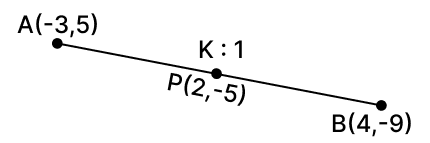
In what ratio does the point P(2, -5) divide the join of A(-3, 5) and B(4, -9)?
Answer
Let the point P(2, -5) divide the line segment AB in the ratio k : 1.
By section-formula,
x-coordinate = ( m 1 x 2 + m 2 x 1 m 1 + m 2 ) \Big(\dfrac{m_1x_2 + m_2x_1}{m_1 + m_2}\Big) ( m 1 + m 2 m 1 x 2 + m 2 x 1 )
Substituting values we get :
⇒ 2 = ( k ( 4 ) + 1 ( − 3 ) k + 1 ) ⇒ 2 ( k + 1 ) = 4 k − 3 ⇒ 2 k + 2 = 4 k − 3 ⇒ 2 + 3 = 4 k − 2 k ⇒ 5 = 2 k ⇒ k = 5 2 ⇒ k : 1 = 5 2 : 1 = 5 : 2. \Rightarrow 2 = \Big(\dfrac{k(4) + 1(-3)}{k + 1}\Big) \\[1em] \Rightarrow 2(k + 1) = 4k - 3 \\[1em] \Rightarrow 2k + 2 = 4k - 3 \\[1em] \Rightarrow 2 + 3 = 4k - 2k \\[1em] \Rightarrow 5 = 2k \\[1em] \Rightarrow k = \dfrac{5}{2} \\[1em] \Rightarrow k : 1 = \dfrac{5}{2} : 1 = 5 : 2. ⇒ 2 = ( k + 1 k ( 4 ) + 1 ( − 3 ) ) ⇒ 2 ( k + 1 ) = 4 k − 3 ⇒ 2 k + 2 = 4 k − 3 ⇒ 2 + 3 = 4 k − 2 k ⇒ 5 = 2 k ⇒ k = 2 5 ⇒ k : 1 = 2 5 : 1 = 5 : 2.
Hence, point P divide AB in the ratio 5 : 2.
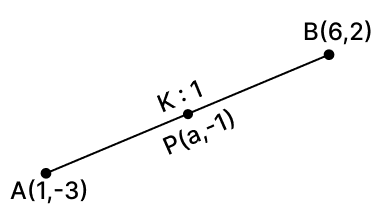
In what ratio does the point P(a, -1) divide the join of A(1, -3) and B(6, 2)? Hence, find the value of a.
Answer
Let the point P(2, -5) divide the segment AB in the ratio k : 1.
By section-formula,
y = ( m 1 y 2 + m 2 y 1 m 1 + m 2 ) \Big(\dfrac{m_1y_2 + m_2y_1}{m_1 + m_2}\Big) ( m 1 + m 2 m 1 y 2 + m 2 y 1 )
Substituting values we get :
⇒ − 1 = ( k ( 2 ) + 1 ( − 3 ) k + 1 ) ⇒ − 1 ( k + 1 ) = 2 k − 3 ⇒ − k − 1 = 2 k − 3 ⇒ − 1 + 3 = 2 k + k ⇒ 3 k = 2 ⇒ k = 2 3 ⇒ k : 1 = 2 3 : 1 = 2 : 3. \Rightarrow -1 = \Big(\dfrac{k(2) + 1(-3)}{k + 1}\Big) \\[1em] \Rightarrow -1(k + 1) = 2k - 3 \\[1em] \Rightarrow -k - 1 = 2k - 3 \\[1em] \Rightarrow -1 + 3 = 2k + k \\[1em] \Rightarrow 3k = 2 \\[1em] \Rightarrow k = \dfrac{2}{3} \\[1em] \Rightarrow k : 1 = \dfrac{2}{3} : 1 = 2 : 3. ⇒ − 1 = ( k + 1 k ( 2 ) + 1 ( − 3 ) ) ⇒ − 1 ( k + 1 ) = 2 k − 3 ⇒ − k − 1 = 2 k − 3 ⇒ − 1 + 3 = 2 k + k ⇒ 3 k = 2 ⇒ k = 3 2 ⇒ k : 1 = 3 2 : 1 = 2 : 3.
By section-formula,
x-coordinate = ( m 1 x 2 + m 2 x 1 m 1 + m 2 ) \Big(\dfrac{m_1x_2 + m_2x_1}{m_1 + m_2}\Big) ( m 1 + m 2 m 1 x 2 + m 2 x 1 )
Substitute values we get:
⇒ a = ( 2 × 6 + 3 × 1 2 + 3 ) = ( 12 + 3 5 ) = 15 5 = 3. \Rightarrow a = \Big(\dfrac{2 \times 6 + 3 \times 1}{2 + 3}\Big) \\[1em] = \Big(\dfrac{12 + 3}{5}\Big) \\[1em] = \dfrac{15}{5} \\[1em] = 3. ⇒ a = ( 2 + 3 2 × 6 + 3 × 1 ) = ( 5 12 + 3 ) = 5 15 = 3.
Hence, point P divide AB in the ratio 2 : 3 and value of a = 3.
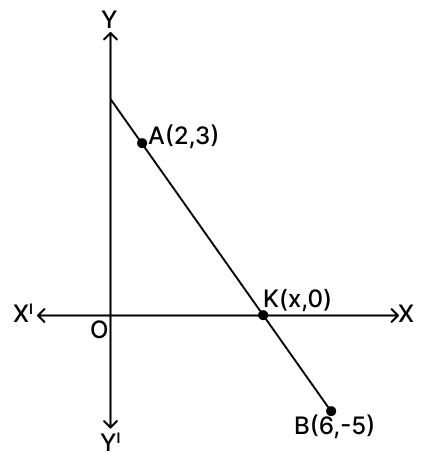
The line segment joining A(2, 3) and B(6, -5) is intercepted by the x-axis at the point k. Find the ratio in which k divides AB. Also, write the co-ordinates of the point k.
Answer
Since the point k lies on the x-axis, its y-coordinate must be 0. Let the coordinates of k be (x, 0).
Let k divide the line segment joining A(2, 3) and B(6, -5) in the ratio m1 :m2
By section-formula,
y = ( m 1 y 2 + m 2 y 1 m 1 + m 2 ) \Big(\dfrac{m_1y_2 + m_2y_1}{m_1 + m_2}\Big) ( m 1 + m 2 m 1 y 2 + m 2 y 1 )
Substituting values we get :
⇒ 0 = ( m 1 ( − 5 ) + m 2 ( 3 ) m 1 + m 2 ) ⇒ − 5 m 1 + 3 m 2 = 0 ⇒ 5 m 1 = 3 m 2 ⇒ m 1 m 2 = 3 5 ⇒ m 1 : m 2 = 3 : 5. \Rightarrow 0 = \Big(\dfrac{m_1(-5) + m_2(3)}{m_1 + m_2}\Big) \\[1em] \Rightarrow -5m_1 + 3m_2 = 0 \\[1em] \Rightarrow 5m_1 = 3m_2 \\[1em] \Rightarrow \dfrac{m_1}{m_2} = \dfrac{3}{5} \\[1em] \Rightarrow m_1 : m_2 = 3 : 5. ⇒ 0 = ( m 1 + m 2 m 1 ( − 5 ) + m 2 ( 3 ) ) ⇒ − 5 m 1 + 3 m 2 = 0 ⇒ 5 m 1 = 3 m 2 ⇒ m 2 m 1 = 5 3 ⇒ m 1 : m 2 = 3 : 5.
By section-formula,
x = ( m 1 x 2 + m 2 x 1 m 1 + m 2 ) \Big(\dfrac{m_1x_2 + m_2x_1}{m_1 + m_2}\Big) ( m 1 + m 2 m 1 x 2 + m 2 x 1 )
Substituting values we get :
⇒ x = ( 3 ( 6 ) + 5 ( 2 ) 3 + 5 ) ⇒ x = ( 18 + 10 8 ) ⇒ x = ( 28 8 ) ⇒ x = 7 2 \Rightarrow x = \Big(\dfrac{3(6) + 5(2)}{3 + 5}\Big) \\[1em] \Rightarrow x = \Big(\dfrac{18 + 10}{8}\Big) \\[1em] \Rightarrow x = \Big(\dfrac{28}{8}\Big) \\[1em] \Rightarrow x = \dfrac{7}{2} ⇒ x = ( 3 + 5 3 ( 6 ) + 5 ( 2 ) ) ⇒ x = ( 8 18 + 10 ) ⇒ x = ( 8 28 ) ⇒ x = 2 7
Hence, ratio in which k divides AB = 3 : 5 and coordinates of the point k are ( 7 2 , 0 ) \Big(\dfrac{7}{2}, 0\Big) ( 2 7 , 0 )
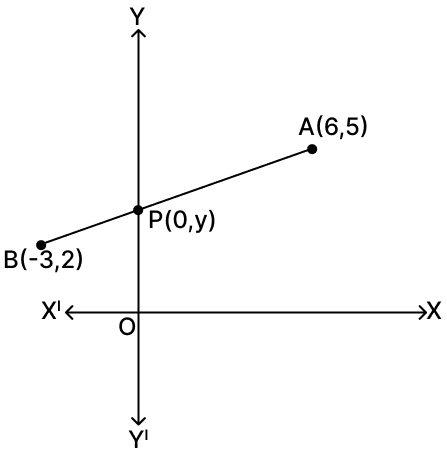
In what ratio is the segment joining the points A(6, 5) and B(-3, 2) divided by the y-axis? Find the point at which the y-axis cuts AB.
Answer
When a point lies on the y-axis, its x-coordinate is always 0. Let the point where the y-axis cuts AB be P(0, y).
Let ratio in which P divides AB be m1 : m2 .
By section-formula,
x = ( m 1 x 2 + m 2 x 1 m 1 + m 2 ) \Big(\dfrac{m_1x_2 + m_2x_1}{m_1 + m_2}\Big) ( m 1 + m 2 m 1 x 2 + m 2 x 1 )
Substituting values we get :
⇒ 0 = ( m 1 ( − 3 ) + m 2 ( 6 ) m 1 + m 2 ) ⇒ 0 = − 3 m 1 + 6 m 2 ⇒ 3 m 1 = 6 m 2 ⇒ m 1 m 2 = 6 3 = 2. \Rightarrow 0 = \Big(\dfrac{m_1(-3) + m_2(6)}{m_1 + m_2}\Big) \\[1em] \Rightarrow 0 = -3m_1 + 6m_2 \\[1em] \Rightarrow 3m_1 = 6m_2 \\[1em] \Rightarrow \dfrac{m_1}{m_2} = \dfrac{6}{3} = 2. ⇒ 0 = ( m 1 + m 2 m 1 ( − 3 ) + m 2 ( 6 ) ) ⇒ 0 = − 3 m 1 + 6 m 2 ⇒ 3 m 1 = 6 m 2 ⇒ m 2 m 1 = 3 6 = 2.
Thus, m1 : m2 = 2 : 1.
By section-formula,
y = ( m 1 y 2 + m 2 y 1 m 1 + m 2 ) \Big(\dfrac{m_1y_2 + m_2y_1}{m_1 + m_2}\Big) ( m 1 + m 2 m 1 y 2 + m 2 y 1 )
Substitute values we get:
⇒ y = ( 2 ( 2 ) + 1 ( 5 ) 2 + 1 ) = ( 4 + 5 3 ) = ( 9 3 ) = 3. \Rightarrow y = \Big(\dfrac{2(2) + 1(5)}{2 + 1}\Big) \\[1em] = \Big(\dfrac{4 + 5}{3}\Big) \\[1em] = \Big(\dfrac{9}{3}\Big) \\[1em] = 3. ⇒ y = ( 2 + 1 2 ( 2 ) + 1 ( 5 ) ) = ( 3 4 + 5 ) = ( 3 9 ) = 3.
P = (0, y) = (0, 3).
Hence, AB is divided in ratio 2 : 1 and point at which the y-axis cuts AB is (0, 3).
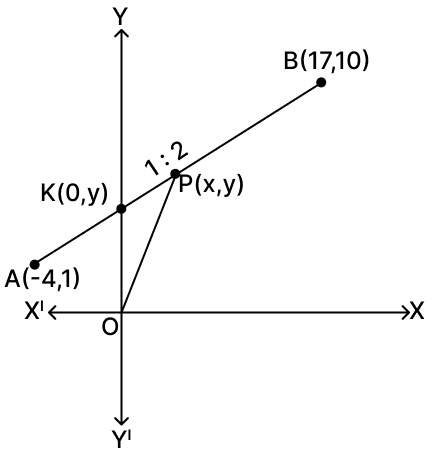
(i) Write down the co-ordinates of the point P that divides the line segment joining A(-4, 1) and B(17, 10) in the ratio 1 : 2.
(ii) Calculate the distance OP, where O is the origin.
(iii) In what ratio does the y-axis divide the line AB?
Answer
(i) The point P divides the line segment joining A(-4, 1) and B(17, 10) in the ratio m1 : m2 = 1 : 2.
Let coordinates of P be (x, y).
By section-formula,
(x, y) = ( m 1 x 2 + m 2 x 1 m 1 + m 2 , m 1 y 2 + m 2 y 1 m 1 + m 2 ) \Big(\dfrac{m_1x_2 + m_2x_1}{m_1 + m_2}, \dfrac{m_1y_2 + m_2y_1}{m_1 + m_2}\Big) ( m 1 + m 2 m 1 x 2 + m 2 x 1 , m 1 + m 2 m 1 y 2 + m 2 y 1 )
Substituting values we get :
⇒ ( x , y ) = ( 1 ( 17 ) + 2 ( − 4 ) 1 + 2 , 1 ( 10 ) + 2 ( 1 ) 1 + 2 ) ⇒ ( x , y ) = ( 17 − 8 3 , 10 + 2 3 ) ⇒ ( x , y ) = ( 9 3 , 12 3 ) ⇒ ( x , y ) = ( 3 , 4 ) . \Rightarrow (x, y) = \Big(\dfrac{1(17) + 2(-4)}{1 + 2}, \dfrac{1(10) + 2(1)}{1 + 2}\Big) \\[1em] \Rightarrow (x, y) = \Big(\dfrac{17 - 8}{3}, \dfrac{10 + 2}{3}\Big) \\[1em] \Rightarrow (x, y) = \Big(\dfrac{9}{3}, \dfrac{12}{3}\Big) \\[1em] \Rightarrow (x, y) = (3, 4). ⇒ ( x , y ) = ( 1 + 2 1 ( 17 ) + 2 ( − 4 ) , 1 + 2 1 ( 10 ) + 2 ( 1 ) ) ⇒ ( x , y ) = ( 3 17 − 8 , 3 10 + 2 ) ⇒ ( x , y ) = ( 3 9 , 3 12 ) ⇒ ( x , y ) = ( 3 , 4 ) .
P = (x, y) = (3, 4)
Hence, coordinates of P = (3, 4).
(ii) Using distance formula,
d = ( x 2 − x 1 ) 2 + ( y 2 − y 1 ) 2 \sqrt{(x_2 - x_1)^2 + (y_2 - y_1)^2} ( x 2 − x 1 ) 2 + ( y 2 − y 1 ) 2
Substitute values we get,
O P = ( 3 − 0 ) 2 + ( 4 − 0 ) 2 = ( 3 ) 2 + ( 4 ) 2 = 9 + 16 = 25 = 5 units . OP = \sqrt{(3 - 0)^2 + (4 - 0)^2} \\[1em] = \sqrt{(3)^2 + (4)^2} \\[1em] = \sqrt{9 + 16} \\[1em] = \sqrt{25} \\[1em] = \text{5 units}. OP = ( 3 − 0 ) 2 + ( 4 − 0 ) 2 = ( 3 ) 2 + ( 4 ) 2 = 9 + 16 = 25 = 5 units .
Hence, distance of OP is 5 units.
(iii) A point on the y-axis has an x-coordinate of 0. Let the y-axis cut AB at K(0, y). let the ratio be k : 1.
By section-formula,
x = ( m 1 x 2 + m 2 x 1 m 1 + m 2 ) \Big(\dfrac{m_1x_2 + m_2x_1}{m_1 + m_2}\Big) ( m 1 + m 2 m 1 x 2 + m 2 x 1 )
Substitute values we get,
⇒ 0 = ( k ( 17 ) + 1 ( − 4 ) k + 1 ) ⇒ 17 k − 4 = 0 ⇒ 17 k = 4 ⇒ k = 4 17 ⇒ k : 1 = 4 17 : 1 = 4 : 17. \Rightarrow 0 = \Big(\dfrac{k(17) + 1(-4)}{k + 1}\Big) \\[1em] \Rightarrow 17k - 4 = 0 \\[1em] \Rightarrow 17k = 4 \\[1em] \Rightarrow k = \dfrac{4}{17} \\[1em] \Rightarrow k : 1 = \dfrac{4}{17} : 1 = 4 : 17. ⇒ 0 = ( k + 1 k ( 17 ) + 1 ( − 4 ) ) ⇒ 17 k − 4 = 0 ⇒ 17 k = 4 ⇒ k = 17 4 ⇒ k : 1 = 17 4 : 1 = 4 : 17.
Hence, y-axis cut line AB in ratio 4 : 17.
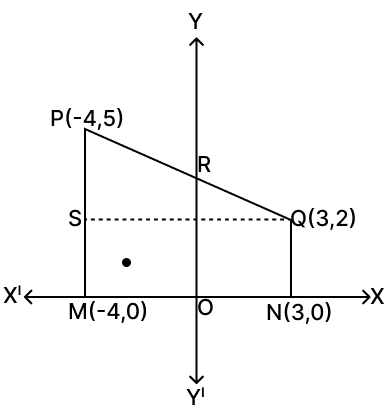
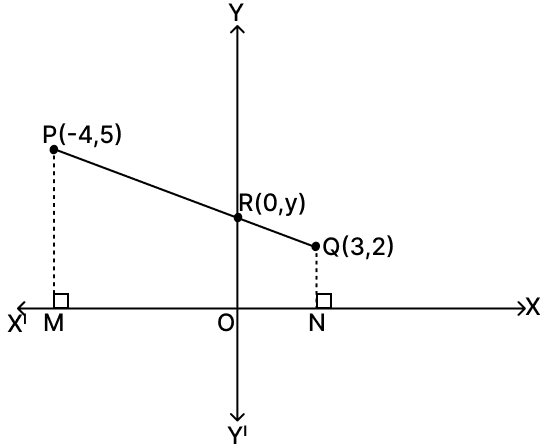
The line segment joining P(-4, 5) and Q(3, 2) intersects the y-axis at R. PM and QN are perpendiculars from P and Q on the x-axis. Find :
(i) the ratio PR : RQ
(ii) the coordinates of R.
(iii) the area of quadrilateral PMNQ.
Answer
(i) The point R lies on the y-axis, so its x-coordinate is 0.
Let R(0, y) divide the line segment PQ in the ratio m1 : m2
By section-formula,
x = ( m 1 x 2 + m 2 x 1 m 1 + m 2 ) \Big(\dfrac{m_1x_2 + m_2x_1}{m_1 + m_2}\Big) ( m 1 + m 2 m 1 x 2 + m 2 x 1 )
Substitute values we get,
⇒ 0 = ( m 1 ( 3 ) + m 2 ( − 4 ) m 1 + m 2 ) ⇒ 0 = 3 m 1 − 4 m 2 ⇒ 3 m 1 = 4 m 2 ⇒ m 1 m 2 = 4 3 . \Rightarrow 0 = \Big(\dfrac{m_1(3) + m_2(-4)}{m_1 + m_2}\Big) \\[1em] \Rightarrow 0 = 3m_1 - 4m_2 \\[1em] \Rightarrow 3m_1 = 4m_2 \\[1em] \Rightarrow \dfrac{m_1}{m_2} = \dfrac{4}{3}. ⇒ 0 = ( m 1 + m 2 m 1 ( 3 ) + m 2 ( − 4 ) ) ⇒ 0 = 3 m 1 − 4 m 2 ⇒ 3 m 1 = 4 m 2 ⇒ m 2 m 1 = 3 4 .
Hence, the ratio PR : RQ = 4 : 3.
(ii) Given,
P(-4, 5) and Q(3, 2)
m1 : m2 = 4 : 3.
By section-formula,
y = ( m 1 y 2 + m 2 y 1 m 1 + m 2 ) \Big(\dfrac{m_1y_2 + m_2y_1}{m_1 + m_2}\Big) ( m 1 + m 2 m 1 y 2 + m 2 y 1 )
Substitute values we get,
⇒ y = ( 4 ( 2 ) + 3 ( 5 ) 4 + 3 ) ⇒ y = ( 8 + 15 7 ) ⇒ y = ( 23 7 ) . \Rightarrow y = \Big(\dfrac{4(2) + 3(5)}{4 + 3}\Big) \\[1em] \Rightarrow y = \Big(\dfrac{8 + 15}{7}\Big) \\[1em] \Rightarrow y = \Big(\dfrac{23}{7}\Big). ⇒ y = ( 4 + 3 4 ( 2 ) + 3 ( 5 ) ) ⇒ y = ( 7 8 + 15 ) ⇒ y = ( 7 23 ) .
Hence, the coordinates of R = ( 0 , 23 7 ) \Big(0, \dfrac{23}{7}\Big) ( 0 , 7 23 )
(iii) From figure,
PQNM is a trapezium, with PM and QN being the parallel sides, as both are perpendicular to x-axis.
From figure,
PM = 5 units, MN = 7 units and QN = 2 units.
The area of a trapezoid is given by :
Area = 1 2 \dfrac{1}{2} 2 1
= 1 2 × ( P M + Q N ) × M N = 1 2 × ( 5 + 2 ) × 7 = 49 2 = 24.5 sq. units = \dfrac{1}{2} \times (PM + QN) \times MN \\[1em] = \dfrac{1}{2} \times (5 + 2) \times 7 \\[1em] = \dfrac{49}{2} \\[1em] = 24.5 \text{ sq. units} = 2 1 × ( PM + QN ) × MN = 2 1 × ( 5 + 2 ) × 7 = 2 49 = 24.5 sq. units
Hence, area of PQNM = 24.5 sq.units.
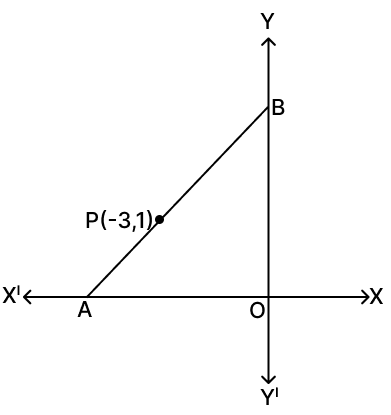
In the given figure, the line segment AB meets x-axis at A and y-axis at B. The point P(-3, 1) on AB divides it in ratio 2 : 3. Find the coordinates of A and B.
Answer
Since, point A and B lies on x-axis and y-axis respectively. Let their coordinates be A(a, 0) and B(0, b).
Given,
The line segment AB be divided by point P(-3, 1) in the ratio AP : PB = 2 : 3.
By section formula,
⇒ ( x , y ) = ( m 1 x 2 + m 2 x 1 m 1 + m 2 , m 1 y 2 + m 2 y 1 m 1 + m 2 ) ⇒ ( − 3 , 1 ) = ( 2 ( 0 ) + 3 ( a ) 2 + 3 , 2 ( b ) + 3 ( 0 ) 2 + 3 ) ⇒ ( − 3 , 1 ) = ( 3 a 5 , 2 b 5 ) ⇒ − 3 = ( 3 a 5 ) , 1 = ( 2 b 5 ) ⇒ − 15 = 3 a , 5 = 2 b ⇒ a = − 15 3 , b = 5 2 ⇒ a = − 5 , b = 5 2 ⇒ A = ( a , 0 ) = ( − 5 , 0 ) ⇒ B = ( 0 , b ) = ( 0 , 5 2 ) . \Rightarrow (x, y) = \Big(\dfrac{m_1x_2 + m_2x_1}{m_1 + m_2}, \dfrac{m_1y_2 + m_2y_1}{m_1 + m_2}\Big) \\[1em] \Rightarrow (-3, 1) = \Big(\dfrac{2(0) + 3(a)}{2 + 3}, \dfrac{2(b) + 3(0)}{2 + 3}\Big) \\[1em] \Rightarrow (-3, 1) = \Big(\dfrac{3a}{5}, \dfrac{2b}{5}\Big) \\[1em] \Rightarrow -3 = \Big(\dfrac{3a}{5}\Big), 1 = \Big(\dfrac{2b}{5}\Big) \\[1em] \Rightarrow -15 = 3a, 5 = 2b \\[1em] \Rightarrow a = \dfrac{-15}{3}, b = \dfrac{5}{2} \\[1em] \Rightarrow a = -5, b = \dfrac{5}{2} \\[1em] \Rightarrow A = (a, 0) = (-5, 0) \\[1em] \Rightarrow B = (0, b) = \Big(0, \dfrac{5}{2}\Big). ⇒ ( x , y ) = ( m 1 + m 2 m 1 x 2 + m 2 x 1 , m 1 + m 2 m 1 y 2 + m 2 y 1 ) ⇒ ( − 3 , 1 ) = ( 2 + 3 2 ( 0 ) + 3 ( a ) , 2 + 3 2 ( b ) + 3 ( 0 ) ) ⇒ ( − 3 , 1 ) = ( 5 3 a , 5 2 b ) ⇒ − 3 = ( 5 3 a ) , 1 = ( 5 2 b ) ⇒ − 15 = 3 a , 5 = 2 b ⇒ a = 3 − 15 , b = 2 5 ⇒ a = − 5 , b = 2 5 ⇒ A = ( a , 0 ) = ( − 5 , 0 ) ⇒ B = ( 0 , b ) = ( 0 , 2 5 ) .
Hence, A(-5, 0) and B ( 0 , 5 2 ) B\Big(0, \dfrac{5}{2}\Big) B ( 0 , 2 5 )
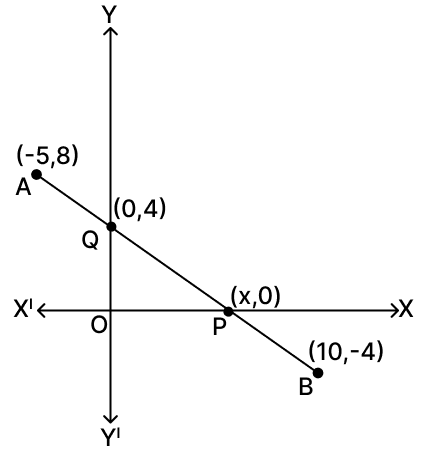
Show that the line segment joining the points A(-5, 8) and B(10, -4) is trisected by the coordinate axes. Also, find the points of trisection of AB.
Answer
Let x-axis divide AB in the ratio k : 1 at the point P(x, 0).
By section-formula,
y = ( m 1 y 2 + m 2 y 1 m 1 + m 2 ) \Big(\dfrac{m_1y_2 + m_2y_1}{m_1 + m_2}\Big) ( m 1 + m 2 m 1 y 2 + m 2 y 1 )
Substituting values we get,
⇒ 0 = ( k ( − 4 ) + 1 ( 8 ) k + 1 ) ⇒ 0 = ( − 4 k + 8 k + 1 ) ⇒ 0 = − 4 k + 8 ⇒ 4 k = 8 ⇒ k = 8 4 = 2. \Rightarrow 0 = \Big(\dfrac{k(-4) + 1(8)}{k + 1}\Big) \\[1em] \Rightarrow 0 = \Big(\dfrac{-4k + 8}{k + 1}\Big) \\[1em] \Rightarrow 0 = -4k + 8 \\[1em] \Rightarrow 4k = 8 \\[1em] \Rightarrow k = \dfrac{8}{4} = 2. ⇒ 0 = ( k + 1 k ( − 4 ) + 1 ( 8 ) ) ⇒ 0 = ( k + 1 − 4 k + 8 ) ⇒ 0 = − 4 k + 8 ⇒ 4 k = 8 ⇒ k = 4 8 = 2.
The x-axis divides AB in the ratio k : 1 = 2 : 1.
Thus, m1 : m2 = 2 : 1.
By section-formula,
x = ( m 1 x 2 + m 2 x 1 m 1 + m 2 ) \Big(\dfrac{m_1x_2 + m_2x_1}{m_1 + m_2}\Big) ( m 1 + m 2 m 1 x 2 + m 2 x 1 )
Substituting values we get,
⇒ x = ( 2 ( 10 ) + 1 ( − 5 ) 2 + 1 ) ⇒ x = ( 20 − 5 3 ) ⇒ x = ( 15 3 ) ⇒ x = 5. \Rightarrow x = \Big(\dfrac{2(10) + 1(-5)}{2 + 1}\Big) \\[1em] \Rightarrow x = \Big(\dfrac{20 - 5}{3}\Big) \\[1em] \Rightarrow x = \Big(\dfrac{15}{3}\Big) \\[1em] \Rightarrow x = 5. ⇒ x = ( 2 + 1 2 ( 10 ) + 1 ( − 5 ) ) ⇒ x = ( 3 20 − 5 ) ⇒ x = ( 3 15 ) ⇒ x = 5.
The coordinates of P = (x, 0) = (5, 0).
Let the y-axis divide AB in the ratio p : 1 at the point Q(0, y).
By section-formula,
x = ( m 1 x 2 + m 2 x 1 m 1 + m 2 ) \Big(\dfrac{m_1x_2 + m_2x_1}{m_1 + m_2}\Big) ( m 1 + m 2 m 1 x 2 + m 2 x 1 )
Substituting values we get,
⇒ 0 = ( p ( 10 ) + 1 ( − 5 ) p + 1 ) ⇒ 0 = ( 10 p − 5 p + 1 ) ⇒ 10 p − 5 = 0 ⇒ 10 p = 5 ⇒ p = 5 10 ⇒ p = 1 2 ⇒ p : 1 = 1 2 : 1 = 1 : 2. \Rightarrow 0 = \Big(\dfrac{p(10) + 1(-5)}{p + 1}\Big) \\[1em] \Rightarrow 0 = \Big(\dfrac{10p - 5}{p + 1}\Big) \\[1em] \Rightarrow 10p - 5 = 0 \\[1em] \Rightarrow 10p = 5 \\[1em] \Rightarrow p = \dfrac{5}{10} \\[1em] \Rightarrow p = \dfrac{1}{2} \\[1em] \Rightarrow p : 1 = \dfrac{1}{2} : 1 = 1 : 2. ⇒ 0 = ( p + 1 p ( 10 ) + 1 ( − 5 ) ) ⇒ 0 = ( p + 1 10 p − 5 ) ⇒ 10 p − 5 = 0 ⇒ 10 p = 5 ⇒ p = 10 5 ⇒ p = 2 1 ⇒ p : 1 = 2 1 : 1 = 1 : 2.
By section-formula,
y = ( m 1 y 2 + m 2 y 1 m 1 + m 2 ) \Big(\dfrac{m_1y_2 + m_2y_1}{m_1 + m_2}\Big) ( m 1 + m 2 m 1 y 2 + m 2 y 1 )
Substitute values we get,
⇒ y = ( 1 × − 4 + 2 × 8 1 + 2 ) = ( − 4 + 16 3 ) = 12 3 = 4. \Rightarrow y = \Big(\dfrac{1 \times -4 + 2 \times 8}{1 + 2}\Big) \\[1em] = \Big(\dfrac{-4 + 16}{3}\Big) \\[1em] = \dfrac{12}{3} \\[1em] = 4. ⇒ y = ( 1 + 2 1 × − 4 + 2 × 8 ) = ( 3 − 4 + 16 ) = 3 12 = 4.
The coordinates of Q = (0, y) = (0, 4).
Hence, points of trisection of AB are Q(5, 0) and P(0, 4).
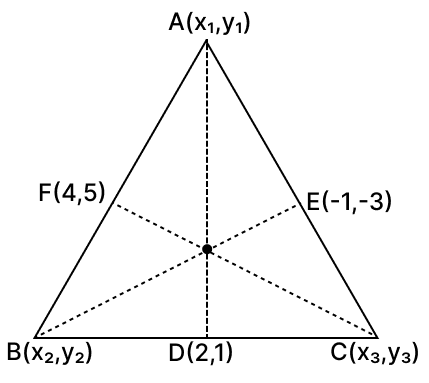
The mid-points of the sides BC, CA and AB of ΔABC are D(2, 1), E(-1, -3) and F(4, 5) respectively. Find the co-ordinates of A, B and C.
Answer
Let the vertices of ΔABC be A(x1 , y1 ), B(x2 , y2 ), and C(x3 , y3 ).
By mid-point formula,
(x, y) = ( x 1 + x 2 2 , y 1 + y 2 2 ) \Big(\dfrac{x_1 + x_2}{2}, \dfrac{y_1 + y_2}{2}\Big) ( 2 x 1 + x 2 , 2 y 1 + y 2 )
Given,
D(2, 1) is the midpoint of BC.
Substitute values we get,
⇒ x 2 + x 3 2 = 2 ⇒ x 2 + x 3 = 4 ....(1) ⇒ y 2 + y 3 2 = 1 ⇒ y 2 + y 3 = 2 ....(2) \Rightarrow \dfrac{x_2 + x_3}{2} = 2 \\[1em] \Rightarrow x_2 + x_3 = 4 \text{ ....(1)} \\[1em] \Rightarrow \dfrac{y_2 + y_3}{2} = 1 \\[1em] \Rightarrow y_2 + y_3 = 2 \text{ ....(2)} ⇒ 2 x 2 + x 3 = 2 ⇒ x 2 + x 3 = 4 ....(1) ⇒ 2 y 2 + y 3 = 1 ⇒ y 2 + y 3 = 2 ....(2)
Given,
E(-1, -3) is the midpoint of CA.
⇒ x 3 + x 1 2 = − 1 ⇒ x 3 + x 1 = − 2 .....(3) ⇒ y 3 + y 1 2 = − 3 ⇒ y 3 + y 1 = − 6 ....(4) \Rightarrow \dfrac{x_3 + x_1}{2} = -1 \\[1em] \Rightarrow x_3 + x_1 = -2 \text{ .....(3)} \\[1em] \Rightarrow \dfrac{y_3 + y_1}{2} = -3 \\[1em] \Rightarrow y_3 + y_1 = -6 \text{ ....(4)} ⇒ 2 x 3 + x 1 = − 1 ⇒ x 3 + x 1 = − 2 .....(3) ⇒ 2 y 3 + y 1 = − 3 ⇒ y 3 + y 1 = − 6 ....(4)
Given,
F(4, 5) is the midpoint of CA.
⇒ x 1 + x 2 2 = 4 ⇒ x 1 + x 2 = 8 ....(5) ⇒ y 1 + y 2 2 = 5 ⇒ y 1 + y 2 = 10 ....(6) \Rightarrow \dfrac{x_1 + x_2}{2} = 4 \\[1em] \Rightarrow x_1 + x_2 = 8 \text{ ....(5)} \\[1em] \Rightarrow \dfrac{y_1 + y_2}{2} = 5 \\[1em] \Rightarrow y_1 + y_2 = 10 \text{ ....(6)} ⇒ 2 x 1 + x 2 = 4 ⇒ x 1 + x 2 = 8 ....(5) ⇒ 2 y 1 + y 2 = 5 ⇒ y 1 + y 2 = 10 ....(6)
Adding the three equations (1), (3) and (5), we get :
⇒ (x2 + x3 ) + (x3 + x1 ) + (x1 + x2 ) = 4 + (-2) + 8
⇒ 2x1 +2x2 + 2x3 = 10
⇒ 2(x1 +x2 + x3 ) = 10
⇒ (x1 +x2 + x3 ) = 10 2 \dfrac{10}{2} 2 10
⇒ (x1 +x2 + x3 ) = 5 .....(7)
Subtract (Eq. 3) from (Eq. 7) :
⇒ (x1 +x2 + x3 ) - ( x2 + x3 ) = 5 - 4
⇒ (x1 +x2 + x3 -x2 - x3 ) = 5 - 4
⇒ x1 = 1.
Subtract (Eq. 2) from (Eq. 7) :
⇒ (x1 +x2 + x3 ) - ( x3 + x1 ) = 5 - (-2)
⇒ (x1 +x2 + x3 -x3 - x1 ) = 5 + 2
⇒ x2 = 7.
Subtract (Eq. 5) from (Eq. 7):
⇒ (x1 +x2 + x3 ) - ( x1 + x2 ) = 5 - 8
⇒ (x1 +x2 + x3 -x1 - x2 ) = -3
⇒ x3 = -3.
Adding equations (2), (4) and (5), we get :
⇒ (y2 + y3 ) + (y3 + y1 ) + (y1 + y2 ) = 2 + (-6) + 10
⇒ 2y1 +2y2 + 2y3 = 6
⇒ 2(y1 +y2 + y3 ) = 6
⇒ (y1 +y2 + y3 ) = 6 2 \dfrac{6}{2} 2 6
⇒ (y1 +y2 + y3 ) = 3 .....(8)
Subtract (Eq. 2) from (Eq. 8):
⇒ (y1 +y2 + y3 ) - ( y2 + y3 ) = 3 - 2
⇒ (y1 +y2 + y3 -y2 - y3 ) = 1
⇒ y1 = 1.
Subtract (Eq. 4) from (Eq. 8):
⇒ (y1 + y2 + y3 ) - ( y3 + y1 ) = 3-(-6)
⇒ (y1 +y2 + y3 -y3 - y1 ) = 3 + 6
⇒ y2 = 9.
Subtract (Eq. 6) from (Eq. 8):
⇒ (y1 + y2 + y3 ) - ( y1 + y2 ) = 3 - 10
⇒ (y1 +y2 + y3 -y1 - y2 ) = -7
⇒ y3 = -7.
⇒ A = (x1 , y1 ) = (1, 1), B = (x2 , y2 ) = (7, 9), C = (x3 , y3 ) = (-3, -7).
Hence, A = (1, 1), B = (7, 9) and C = (-3, -7).
Prove that the points A(-2, -1), B(1, 0), C(4, 3) and D(1, 2) are the vertices of a parallelogram ABCD.
Answer
Given,
A(-2, -1), B(1, 0), C(4, 3) and D(1, 2).
By using mid-point formula,
(x, y) = ( x 1 + x 2 2 , y 1 + y 2 2 ) \Big(\dfrac{x_1 + x_2}{2}, \dfrac{y_1 + y_2}{2}\Big) ( 2 x 1 + x 2 , 2 y 1 + y 2 )
The Midpoint of Diagonal AC :
⇒ M ( A C ) = ( − 2 + 4 2 , − 1 + 3 2 ) ⇒ M ( A C ) = ( 2 2 , 2 2 ) ⇒ M ( A C ) = ( 1 , 1 ) . \Rightarrow M_{(AC)} = \Big(\dfrac{-2 + 4}{2}, \dfrac{-1 + 3}{2}\Big) \\[1em] \Rightarrow M_{(AC)} = \Big(\dfrac{2}{2}, \dfrac{2}{2}\Big) \\[1em] \Rightarrow M_{(AC)} = (1, 1). ⇒ M ( A C ) = ( 2 − 2 + 4 , 2 − 1 + 3 ) ⇒ M ( A C ) = ( 2 2 , 2 2 ) ⇒ M ( A C ) = ( 1 , 1 ) .
The Midpoint of Diagonal BD :
⇒ M ( B D ) = ( 1 + 1 2 , 0 + 2 2 ) ⇒ M ( B D ) = ( 2 2 , 2 2 ) ⇒ M ( B D ) = ( 1 , 1 ) \Rightarrow M_{(BD)} = \Big(\dfrac{1 + 1}{2}, \dfrac{0 + 2}{2}\Big) \\[1em] \Rightarrow M_{(BD)} = \Big(\dfrac{2}{2}, \dfrac{2}{2}\Big) \\[1em] \Rightarrow M_{(BD)} = (1, 1) ⇒ M ( B D ) = ( 2 1 + 1 , 2 0 + 2 ) ⇒ M ( B D ) = ( 2 2 , 2 2 ) ⇒ M ( B D ) = ( 1 , 1 )
Since the midpoint of diagonal AC, MAC (1, 1), is the same as the midpoint of diagonal BD, MBD (1, 1), the diagonals AC and BD bisect each other.
We know that,
A quadrilateral is a parallelogram if its diagonals bisect each other.
Hence, proved that ABCD is a parallelogram.
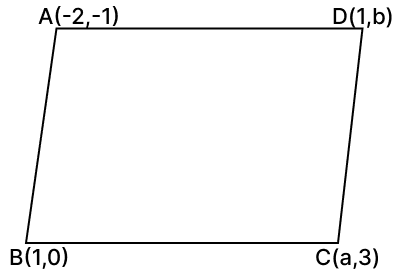
If the points A(-2, -1), B(1, 0), C(a, 3) and D(1, b) form a parallelogram, find the values of a and b.
Answer
We know that,
Diagonals of a parallelogram bisect each other.
Since, ABCD is a // gm.
Thus, Mid-point of AC = Mid-point of BD.
Given,
A(-2, -1), B(1, 0), C(a, 3) and D(1, b)
By using mid-point formula,
(x, y) = ( x 1 + x 2 2 , y 1 + y 2 2 ) \Big(\dfrac{x_1 + x_2}{2}, \dfrac{y_1 + y_2}{2}\Big) ( 2 x 1 + x 2 , 2 y 1 + y 2 )
Mid-point of AC :
⇒ M A C = ( − 2 + a 2 , − 1 + 3 2 ) ⇒ M A C = ( − 2 + a 2 , 2 2 ) ⇒ M A C = ( − 2 + a 2 , 1 ) . \Rightarrow M_{AC} = \Big(\dfrac{-2 + a}{2}, \dfrac{-1 + 3}{2}\Big) \\[1em] \Rightarrow M_{AC} = \Big(\dfrac{-2 + a}{2}, \dfrac{2}{2}\Big) \\[1em] \Rightarrow M_{AC} = \Big(\dfrac{-2 + a}{2}, 1\Big). ⇒ M A C = ( 2 − 2 + a , 2 − 1 + 3 ) ⇒ M A C = ( 2 − 2 + a , 2 2 ) ⇒ M A C = ( 2 − 2 + a , 1 ) .
Midpoint of Diagonal BD :
⇒ M B D = ( 1 + 1 2 , 0 + b 2 ) ⇒ M B D = ( 2 2 , b 2 ) ⇒ M B D = ( 1 , b 2 ) . \Rightarrow M_{BD} = \Big(\dfrac{1 + 1}{2}, \dfrac{0 + b}{2}\Big) \\[1em] \Rightarrow M_{BD} = \Big(\dfrac{2}{2}, \dfrac{b}{2}\Big) \\[1em] \Rightarrow M_{BD} = \Big(1, \dfrac{b}{2}\Big) . ⇒ M B D = ( 2 1 + 1 , 2 0 + b ) ⇒ M B D = ( 2 2 , 2 b ) ⇒ M B D = ( 1 , 2 b ) .
Equating the x-coordinates of mid-points of AC and BD, we get :
⇒ − 2 + a 2 \dfrac{-2 + a}{2} 2 − 2 + a
⇒ -2 + a = 2
⇒ a = 2 + 2
⇒ a = 4.
Equating the y-coordinates:
⇒ 1 = b 2 \dfrac{b}{2} 2 b
⇒ b = 2.
Hence, a = 4 and b = 2.
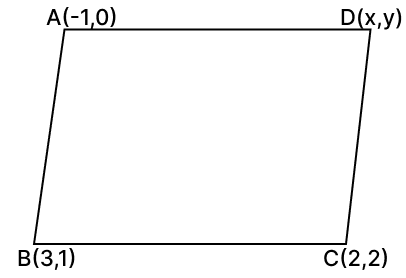
The three vertices of a parallelogram ABCD, taken in order, are A(-1, 0), B(3, 1) and C(2, 2). Find the co-ordinates of the fourth vertex of the parallelogram.
Answer
Let coordinates of D be (x, y).
By using mid-point formula,
(x, y) = ( x 1 + x 2 2 , y 1 + y 2 2 ) \Big(\dfrac{x_1 + x_2}{2}, \dfrac{y_1 + y_2}{2}\Big) ( 2 x 1 + x 2 , 2 y 1 + y 2 )
Mid-point of AC :
⇒ M A C = ( − 1 + 2 2 , 0 + 2 2 ) ⇒ M A C = ( 1 2 , 1 ) . \Rightarrow M_{AC} = \Big(\dfrac{-1 + 2}{2}, \dfrac{0 + 2}{2}\Big) \\[1em] \Rightarrow M_{AC} = \Big(\dfrac{1}{2}, 1\Big). ⇒ M A C = ( 2 − 1 + 2 , 2 0 + 2 ) ⇒ M A C = ( 2 1 , 1 ) .
Midpoint of Diagonal BD :
⇒ M B D = ( 3 + x 2 , 1 + y 2 ) \Rightarrow M_{BD} = \Big(\dfrac{3 + x}{2}, \dfrac{1 + y}{2}\Big) ⇒ M B D = ( 2 3 + x , 2 1 + y )
Since its a parallelogram, the midpoint of diagonal AC must be equal to the midpoint of diagonal BD, as diagonals bisect each other.
Equating the x-coordinates:
⇒ 3 + x 2 = 1 2 \Rightarrow \dfrac{3 + x}{2} = \dfrac{1}{2} ⇒ 2 3 + x = 2 1
⇒ 3 + x = 1
⇒ x = 1 - 3
⇒ x = -2.
Equating the y-coordinates:
⇒ 1 + y 2 = 1 \Rightarrow \dfrac{1 + y}{2} = 1 ⇒ 2 1 + y = 1
⇒ 1 + y = 2
⇒ y = 2 - 1
⇒ y = 1.
Hence, coordinates of D = (-2, 1).
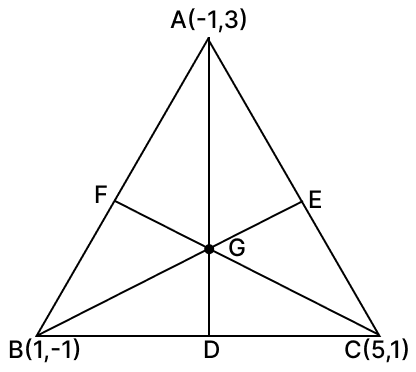
Find the lengths of the medians of a ΔABC whose vertices are A(-1, 3), B(1, -1) and C(5, 1). Also, find the co-ordinates of the centroid of ΔABC.
Answer
Using the Midpoint Formula,
( x , y ) = ( x 1 + x 2 2 , y 1 + y 2 2 ) (x, y) = \Big( \dfrac{x_1 + x_2}{2}, \dfrac{y_1 + y_2}{2} \Big) ( x , y ) = ( 2 x 1 + x 2 , 2 y 1 + y 2 )
Let D be the midpoint of BC.
⇒ D = ( 1 + 5 2 , − 1 + 1 2 ) ⇒ D = ( 6 2 , 0 2 ) ⇒ D = ( 3 , 0 ) . \Rightarrow D = \Big( \dfrac{1 + 5}{2}, \dfrac{-1 + 1}{2} \Big) \\[1em] \Rightarrow D = \Big( \dfrac{6}{2}, \dfrac{0}{2} \Big) \\[1em] \Rightarrow D = (3, 0). ⇒ D = ( 2 1 + 5 , 2 − 1 + 1 ) ⇒ D = ( 2 6 , 2 0 ) ⇒ D = ( 3 , 0 ) .
Let E be the midpoint of AC.
⇒ E = ( − 1 + 5 2 , 3 + 1 2 ) ⇒ E = ( 4 2 , 4 2 ) ⇒ E = ( 2 , 2 ) . \Rightarrow E = \Big( \dfrac{-1 + 5}{2}, \dfrac{3 + 1}{2} \Big) \\[1em] \Rightarrow E = \Big( \dfrac{4}{2}, \dfrac{4}{2} \Big) \\[1em] \Rightarrow E = (2, 2). ⇒ E = ( 2 − 1 + 5 , 2 3 + 1 ) ⇒ E = ( 2 4 , 2 4 ) ⇒ E = ( 2 , 2 ) .
Let F be the midpoint of AB.
⇒ F = ( − 1 + 1 2 , 3 + ( − 1 ) 2 ) ⇒ F = ( 0 2 , 2 2 ) ⇒ F = ( 0 , 1 ) . \Rightarrow F = \Big( \dfrac{-1 + 1}{2}, \dfrac{3 + (-1)}{2} \Big) \\[1em] \Rightarrow F = \Big( \dfrac{0}{2}, \dfrac{2}{2} \Big) \\[1em] \Rightarrow F = (0, 1). ⇒ F = ( 2 − 1 + 1 , 2 3 + ( − 1 ) ) ⇒ F = ( 2 0 , 2 2 ) ⇒ F = ( 0 , 1 ) .
Length of Median AD : A(-1, 3) and D(3, 0)
Using Distance Formula,
D = ( x 2 − x 1 ) 2 + ( y 2 − y 1 ) 2 D = \sqrt{(x_2 - x_1)^2 + (y_2 - y_1)^2} D = ( x 2 − x 1 ) 2 + ( y 2 − y 1 ) 2
Substituting values we get:
A D = ( 3 − ( − 1 ) ) 2 + ( 0 − 3 ) 2 = ( 4 ) 2 + ( − 3 ) 2 = 16 + 9 = 25 = 5 units . AD = \sqrt{(3 - (-1))^2 + (0 - 3)^2} \\[1em] = \sqrt{(4)^2 + (-3)^2} \\[1em] = \sqrt{16 + 9} \\[1em] = \sqrt{25} \\[1em] = 5 \text{ units}. A D = ( 3 − ( − 1 ) ) 2 + ( 0 − 3 ) 2 = ( 4 ) 2 + ( − 3 ) 2 = 16 + 9 = 25 = 5 units .
Length of Median BE:
B(1, -1) and E(2, 2)
B E = ( 2 − 1 ) 2 + ( 2 − ( − 1 ) ) 2 = ( 1 ) 2 + ( 3 ) 2 = 1 + 9 = 10 units . BE = \sqrt{(2 - 1)^2 + (2 - (-1))^2} \\[1em]= \sqrt{(1)^2 + (3)^2} \\[1em] = \sqrt{1 + 9} \\[1em] = \sqrt{10} \text{ units}. BE = ( 2 − 1 ) 2 + ( 2 − ( − 1 ) ) 2 = ( 1 ) 2 + ( 3 ) 2 = 1 + 9 = 10 units .
Length of Median CF:
C(5, 1) and F(0, 1)
C F = ( 0 − 5 ) 2 + ( 1 − 1 ) 2 = ( − 5 ) 2 + ( 0 ) 2 = 25 + 0 = 25 = 5 units . CF = \sqrt{(0 - 5)^2 + (1 - 1)^2} \\[1em] = \sqrt{(-5)^2 + (0)^2} \\[1em] = \sqrt{25 + 0} \\[1em] = \sqrt{25} \\[1em] = 5 \text{ units}. CF = ( 0 − 5 ) 2 + ( 1 − 1 ) 2 = ( − 5 ) 2 + ( 0 ) 2 = 25 + 0 = 25 = 5 units .
Centroid of triangle (G) = ( x 1 + x 2 + x 3 3 , y 1 + y 2 + y 3 3 ) = \Big( \dfrac{x_1 + x_2 + x_3}{3}, \dfrac{y_1 + y_2 + y_3}{3} \Big) = ( 3 x 1 + x 2 + x 3 , 3 y 1 + y 2 + y 3 )
Substituting values we get :
⇒ Centroid = ( − 1 + 1 + 5 3 , 3 + ( − 1 ) + 1 3 ) = ( 5 3 , 3 3 ) = ( 5 3 , 1 ) . \Rightarrow \text{Centroid} = \Big(\dfrac{-1 + 1 + 5}{3}, \dfrac{3 + (-1) + 1}{3}\Big) \\[1em] = \Big(\dfrac{5}{3}, \dfrac{3}{3}\Big) \\[1em] = \Big(\dfrac{5}{3}, 1\Big). ⇒ Centroid = ( 3 − 1 + 1 + 5 , 3 3 + ( − 1 ) + 1 ) = ( 3 5 , 3 3 ) = ( 3 5 , 1 ) .
Hence, AD = 5 units , B E = 10 BE = \sqrt{10} BE = 10 ( 5 3 , 1 ) \Big(\dfrac{5}{3}, 1\Big) ( 3 5 , 1 )
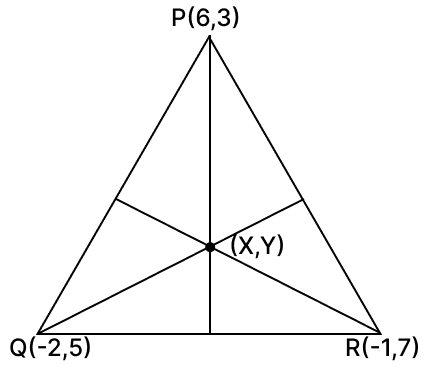
Find the co-ordinates of the centroid of ΔPQR whose vertices are P(6, 3), Q(-2, 5) and R(-1, 7).
Answer
By using the centroid formula,
( x , y ) = ( x 1 + x 2 + x 3 3 , y 1 + y 2 + y 3 3 ) (x, y) = \Big( \dfrac{x_1 + x_2 + x_3}{3}, \dfrac{y_1 + y_2 + y_3}{3} \Big) ( x , y ) = ( 3 x 1 + x 2 + x 3 , 3 y 1 + y 2 + y 3 )
P(6, 3), Q(-2, 5) and R(-1, 7)
Substitute values we get:
⇒ ( x , y ) = ( 6 + ( − 2 ) + ( − 1 ) 3 , 3 + 5 + 7 3 ) ⇒ ( x , y ) = ( 6 − 3 3 , 15 3 ) ⇒ ( x , y ) = ( 3 3 , 15 3 ) ⇒ ( x , y ) = ( 1 , 5 ) . \Rightarrow (x, y) = \Big( \dfrac{6 + (-2) + (-1)}{3}, \dfrac{3 + 5 + 7}{3} \Big) \\[1em] \Rightarrow (x, y) = \Big( \dfrac{6 - 3}{3}, \dfrac{15}{3} \Big) \\[1em] \Rightarrow (x, y) = \Big( \dfrac{3}{3}, \dfrac{15}{3} \Big) \\[1em] \Rightarrow (x, y) = (1, 5). ⇒ ( x , y ) = ( 3 6 + ( − 2 ) + ( − 1 ) , 3 3 + 5 + 7 ) ⇒ ( x , y ) = ( 3 6 − 3 , 3 15 ) ⇒ ( x , y ) = ( 3 3 , 3 15 ) ⇒ ( x , y ) = ( 1 , 5 ) .
Hence, coordinates of centroid of ΔPQR = (1, 5).
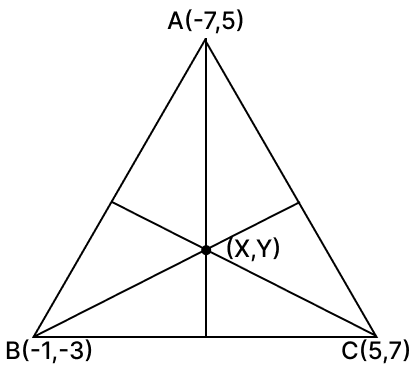
Find the co-ordinates of the point of intersection of the medians of the triangle whose vertices are A(-7, 5), B(-1, -3) and C(5, 7).
Answer
The medians of a triangle intersect at centroid of triangle.
By using the centroid formula,
( x , y ) = ( x 1 + x 2 + x 3 3 , y 1 + y 2 + y 3 3 ) (x, y) = \Big(\dfrac{x_1 + x_2 + x_3}{3}, \dfrac{y_1 + y_2 + y_3}{3} \Big) ( x , y ) = ( 3 x 1 + x 2 + x 3 , 3 y 1 + y 2 + y 3 )
A(-7, 5), B(-1, -3) and C(5, 7)
Substitute values we get:
⇒ ( x , y ) = ( − 7 + ( − 1 ) + 5 3 , 5 + ( − 3 ) + 7 3 ) ⇒ ( x , y ) = ( − 8 + 5 3 , 5 + 4 3 ) ⇒ ( x , y ) = ( − 3 3 , 9 3 ) ⇒ ( x , y ) = ( − 1 , 3 ) . \Rightarrow (x, y) = \Big( \dfrac{-7 + (-1) + 5}{3}, \dfrac{5 + (-3) + 7}{3} \Big) \\[1em] \Rightarrow (x, y) = \Big( \dfrac{-8 + 5}{3}, \dfrac{5 + 4}{3} \Big) \\[1em] \Rightarrow (x, y) = \Big( \dfrac{-3}{3}, \dfrac{9}{3} \Big) \\[1em] \Rightarrow (x, y) = (-1, 3). ⇒ ( x , y ) = ( 3 − 7 + ( − 1 ) + 5 , 3 5 + ( − 3 ) + 7 ) ⇒ ( x , y ) = ( 3 − 8 + 5 , 3 5 + 4 ) ⇒ ( x , y ) = ( 3 − 3 , 3 9 ) ⇒ ( x , y ) = ( − 1 , 3 ) .
Hence, co-ordinates of the point of intersection of the medians = (-1, 3).
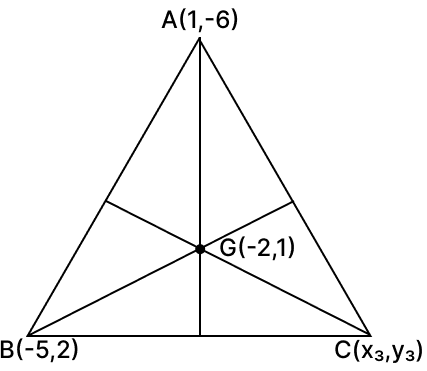
If G(-2, 1) is the centroid of ΔABC, two of whose vertices are A(1, -6) and B(-5, 2), find the third vertex of the triangle.
Answer
Let coordinates of third vertex be C(x3 , y3 ).
By using the centroid formula,
( x , y ) = ( x 1 + x 2 + x 3 3 , y 1 + y 2 + y 3 3 ) (x, y) = \Big( \dfrac{x_1 + x_2 + x_3}{3}, \dfrac{y_1 + y_2 + y_3}{3} \Big) ( x , y ) = ( 3 x 1 + x 2 + x 3 , 3 y 1 + y 2 + y 3 )
Given,
G(-2, 1) is the centroid.
Substituting values we get :
⇒ ( − 2 , 1 ) = ( 1 + ( − 5 ) + x 3 3 , − 6 + 2 + y 3 3 ) ⇒ − 2 = ( 1 + ( − 5 ) + x 3 3 ) , 1 = ( − 6 + 2 + y 3 3 ) ⇒ − 6 = 1 + ( − 5 ) + x 3 , 3 = − 6 + 2 + y 3 ⇒ − 6 = − 4 + x 3 , 3 = − 4 + y 3 ⇒ − 6 + 4 = x 3 , 3 + 4 = y 3 ⇒ x 3 = − 2 , y 3 = 7. \Rightarrow (-2, 1) = \Big( \dfrac{1 + (-5) + x_3}{3}, \dfrac{-6 + 2 + y_3}{3}\Big) \\[1em] \Rightarrow -2 = \Big( \dfrac{1 + (-5) + x_3}{3}\Big), 1 = \Big( \dfrac{-6 + 2 + y_3}{3}\Big) \\[1em] \Rightarrow -6 = 1 + (-5) + x_3, 3 = -6 + 2 + y_3 \\[1em] \Rightarrow -6 = -4 + x_3, 3 = -4 + y_3 \\[1em] \Rightarrow -6 + 4 = x_3, 3 + 4 = y_3 \\[1em] \Rightarrow x_3 = -2, y_3 = 7. ⇒ ( − 2 , 1 ) = ( 3 1 + ( − 5 ) + x 3 , 3 − 6 + 2 + y 3 ) ⇒ − 2 = ( 3 1 + ( − 5 ) + x 3 ) , 1 = ( 3 − 6 + 2 + y 3 ) ⇒ − 6 = 1 + ( − 5 ) + x 3 , 3 = − 6 + 2 + y 3 ⇒ − 6 = − 4 + x 3 , 3 = − 4 + y 3 ⇒ − 6 + 4 = x 3 , 3 + 4 = y 3 ⇒ x 3 = − 2 , y 3 = 7.
Hence, coordinates of third vertex = (-2, 7).
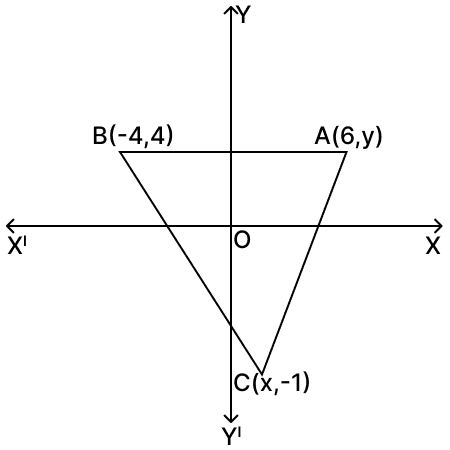
A(6, y), B(-4, 4) and C(x, -1) are the vertices of ΔABC whose centroid is the origin. Calculate the values of x and y.
Answer
By using the centroid formula,
( x , y ) = ( x 1 + x 2 + x 3 3 , y 1 + y 2 + y 3 3 ) (x, y) = \Big( \dfrac{x_1 + x_2 + x_3}{3}, \dfrac{y_1 + y_2 + y_3}{3} \Big) ( x , y ) = ( 3 x 1 + x 2 + x 3 , 3 y 1 + y 2 + y 3 )
Origin (0,0) is the centroid of triangle ABC.
Solving for x-coordinate:
⇒ 0 = ( 6 + ( − 4 ) + x 3 ) ⇒ 0 = 2 + x ⇒ x = − 2. \Rightarrow 0 = \Big(\dfrac{6 + (-4) + x}{3}\Big) \\[1em] \Rightarrow 0 = 2 + x \\[1em] \Rightarrow x = -2. ⇒ 0 = ( 3 6 + ( − 4 ) + x ) ⇒ 0 = 2 + x ⇒ x = − 2.
Solving for y-coordinate:
⇒ 0 = ( y + 4 + ( − 1 ) 3 ) ⇒ 0 = y + 3 ⇒ y = − 3. \Rightarrow 0 = \Big(\dfrac{y + 4 + (-1)}{3}\Big) \\[1em] \Rightarrow 0 = y + 3 \\[1em] \Rightarrow y = -3. ⇒ 0 = ( 3 y + 4 + ( − 1 ) ) ⇒ 0 = y + 3 ⇒ y = − 3.
Hence, x = -2 and y = -3.
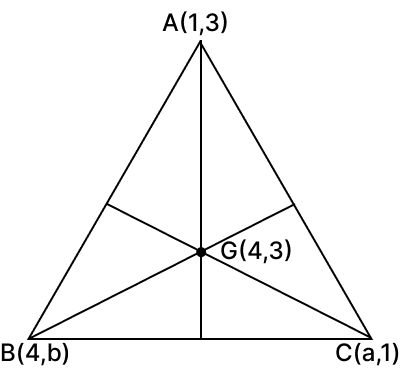
ABC is a triangle and G(4, 3) is its centroid. If A(1, 3), B(4, b) and C(a, 1) be the vertices, find the values of a and b and hence find the length of side BC.
Answer
By using the centroid formula,
( x , y ) = ( x 1 + x 2 + x 3 3 , y 1 + y 2 + y 3 3 ) (x, y) = \Big(\dfrac{x_1 + x_2 + x_3}{3}, \dfrac{y_1 + y_2 + y_3}{3}\Big) ( x , y ) = ( 3 x 1 + x 2 + x 3 , 3 y 1 + y 2 + y 3 )
Given,
A(1, 3), B(4, b) and C(a, 1).
G(4, 3) is the centroid of triangle ABC.
Solving for x-coordinate :
⇒ 4 = 1 + 4 + a 3 ⇒ 12 = 5 + a ⇒ a = 12 − 5 ⇒ a = 7. \Rightarrow 4 = \dfrac{1 + 4 + a}{3} \\[1em] \Rightarrow 12 = 5 + a \\[1em] \Rightarrow a = 12 - 5 \\[1em] \Rightarrow a = 7. ⇒ 4 = 3 1 + 4 + a ⇒ 12 = 5 + a ⇒ a = 12 − 5 ⇒ a = 7.
C = (a, 1) = (7, 1)
Solving for y-coordinate :
⇒ 3 = 3 + b + 1 3 ⇒ 9 = 4 + b ⇒ b = 9 − 4 ⇒ b = 5. \Rightarrow 3 = \dfrac{3 + b + 1}{3} \\[1em] \Rightarrow 9 = 4 + b \\[1em] \Rightarrow b = 9 - 4 \\[1em] \Rightarrow b = 5. ⇒ 3 = 3 3 + b + 1 ⇒ 9 = 4 + b ⇒ b = 9 − 4 ⇒ b = 5.
B = (4, b) = (4, 5)
By using distance formula,
D = ( x 2 − x 1 ) 2 + ( y 2 − y 1 ) 2 D = \sqrt{(x_2 - x_1)^2 + (y_2 - y_1)^2} D = ( x 2 − x 1 ) 2 + ( y 2 − y 1 ) 2
Substituting values we get:
B C = ( 7 − 4 ) 2 + ( 1 − 5 ) 2 = ( 3 ) 2 + ( − 4 ) 2 = 9 + 16 = 25 = 5 units . BC = \sqrt{(7 - 4)^2 + (1 - 5)^2} \\[1em] = \sqrt{(3)^2 + (-4)^2} \\[1em] = \sqrt{9 + 16} \\[1em] = \sqrt{25} \\[1em] = 5 \text{ units}. BC = ( 7 − 4 ) 2 + ( 1 − 5 ) 2 = ( 3 ) 2 + ( − 4 ) 2 = 9 + 16 = 25 = 5 units .
Hence, a = 7 and b = 5, length of BC = 5 units.
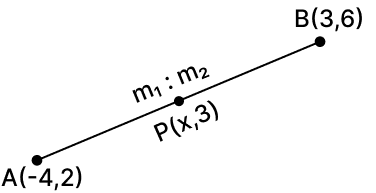
Calculate the ratio in which the line segment joining A(-4, 2) and B(3, 6) is divided by the point P(x, 3). Also, find
(i) x
(ii) length of AP.
Answer
(i) Let the point P(x, 3) divide the line segment joining A(-4, 2) and B(3, 6) in the ratio m1 : m2 .
By section-formula,
(x, y) = ( m 1 x 2 + m 2 x 1 m 1 + m 2 , m 1 y 2 + m 2 y 1 m 1 + m 2 ) \Big(\dfrac{m_1x_2 + m_2x_1}{m_1 + m_2}, \dfrac{m_1y_2 + m_2y_1}{m_1 + m_2}\Big) ( m 1 + m 2 m 1 x 2 + m 2 x 1 , m 1 + m 2 m 1 y 2 + m 2 y 1 )
Substituting values we get :
⇒ 3 = ( m 1 ( 6 ) + m 2 ( 2 ) m 1 + m 2 ) ⇒ 3 ( m 1 + m 2 ) = 6 m 1 + 2 m 2 ⇒ 3 m 1 + 3 m 2 = 6 m 1 + 2 m 2 ⇒ 3 m 2 − 2 m 2 = 6 m 1 − 3 m 1 ⇒ m 2 = 3 m 1 ⇒ m 1 m 2 = 1 3 . \Rightarrow 3 = \Big(\dfrac{m_1(6) + m_2(2)}{m_1 + m_2}\Big) \\[1em] \Rightarrow 3(m_1 + m_2) = {6m_1 + 2m_2} \\[1em] \Rightarrow 3m_1 + 3m_2 = 6m_1 + 2m_2 \\[1em] \Rightarrow 3m_2 - 2m_2 = 6m_1 - 3m_1 \\[1em] \Rightarrow m_2 = 3m_1 \\[1em] \Rightarrow \dfrac{m_1}{m_2} = \dfrac{1}{3}. ⇒ 3 = ( m 1 + m 2 m 1 ( 6 ) + m 2 ( 2 ) ) ⇒ 3 ( m 1 + m 2 ) = 6 m 1 + 2 m 2 ⇒ 3 m 1 + 3 m 2 = 6 m 1 + 2 m 2 ⇒ 3 m 2 − 2 m 2 = 6 m 1 − 3 m 1 ⇒ m 2 = 3 m 1 ⇒ m 2 m 1 = 3 1 .
Solving for x-coordinate with the ratio m 1 = 1 m_1 = 1 m 1 = 1 m 2 = 3 m_2 = 3 m 2 = 3
⇒ x = ( 1 ) ( 3 ) + ( 3 ) ( − 4 ) 1 + 3 = 3 − 12 4 = − 9 4 . \Rightarrow x = \dfrac{(1)(3) + (3)(-4)}{1 + 3} \\[1em] = \frac{3 - 12}{4} \\[1em] = \frac{-9}{4}. ⇒ x = 1 + 3 ( 1 ) ( 3 ) + ( 3 ) ( − 4 ) = 4 3 − 12 = 4 − 9 .
Hence, x = − 9 4 \dfrac{-9}{4} 4 − 9
(ii) Solving length of AP
By using Distance Formula
D = ( x 2 − x 1 ) 2 + ( y 2 − y 1 ) 2 D = \sqrt{(x_2 - x_1)^2 + (y_2 - y_1)^2} D = ( x 2 − x 1 ) 2 + ( y 2 − y 1 ) 2
A(-4, 2) and P ( − 9 4 , 3 ) P\Big(\dfrac{-9}{4}, 3\Big) P ( 4 − 9 , 3 )
A P = ( − 9 4 − ( − 4 ) ) 2 + ( 3 − 2 ) 2 = ( − 9 4 + 16 4 ) 2 + ( 1 ) 2 = ( 7 4 ) 2 + 1 2 = 49 16 + 16 16 = 65 16 = 65 4 units AP = \sqrt{\Big(-\dfrac{9}{4} - (-4)\Big)^2 + (3 - 2)^2} \\[1em] =\sqrt{\Big(-\dfrac{9}{4} + \dfrac{16}{4}\Big)^2 + (1)^2} \\[1em] = \sqrt{\Big(\dfrac{7}{4}\Big)^2 + 1^2} \\[1em] = \sqrt{\dfrac{49}{16} + \dfrac{16}{16}} \\[1em] = \sqrt{\dfrac{65}{16}} \\[1em] = \dfrac{\sqrt{65}}{4} \text{ units} A P = ( − 4 9 − ( − 4 ) ) 2 + ( 3 − 2 ) 2 = ( − 4 9 + 4 16 ) 2 + ( 1 ) 2 = ( 4 7 ) 2 + 1 2 = 16 49 + 16 16 = 16 65 = 4 65 units
Hence, length of AP = 65 4 \dfrac{\sqrt{65}}{4} 4 65
In what ratio is the line joining P(5, 3) and Q(-5, 3) divided by the x-axis? Also, find the co-ordinates of the point of intersection.
Answer
Let point on x-axis dividing PQ be (a, 0).
By section formula,
y = m 1 y 2 + m 2 y 1 m 1 + m 2 \dfrac{m_1y_2 + m_2y_1}{m_1 + m_2} m 1 + m 2 m 1 y 2 + m 2 y 1
Substituting values we get :
⇒ 0 = m 1 × 3 + m 2 × 3 m 1 + m 2 ⇒ 0 = 3 m 1 + 3 m 2 ⇒ 3 m 1 = − 3 m 2 ⇒ m 1 m 2 = − 3 3 ⇒ m 1 m 2 = − 1 1 \Rightarrow 0 = \dfrac{m_1 \times 3 + m_2 \times 3}{m_1 + m_2} \\[1em] \Rightarrow 0 = 3m_1 + 3m_2 \\[1em] \Rightarrow 3m_1 = -3m_2 \\[1em] \Rightarrow \dfrac{m_1}{m_2} = -\dfrac{3}{3} \\[1em] \Rightarrow \dfrac{m_1}{m_2} = -\dfrac{1}{1} ⇒ 0 = m 1 + m 2 m 1 × 3 + m 2 × 3 ⇒ 0 = 3 m 1 + 3 m 2 ⇒ 3 m 1 = − 3 m 2 ⇒ m 2 m 1 = − 3 3 ⇒ m 2 m 1 = − 1 1
The negative ratio shows that the line PQ does not intersects with x-axis.
Hence, the x-axis does not intersect the line PQ, so no ratio or point of intersection exists.
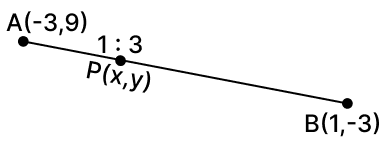
Find a point P which divides internally the line segment joining the points A(-3, 9) and B(1, -3) in the ratio 1 : 3.
Answer
Let Point P divides the line segment joining A(−3, 9) and B(1, −3) internally in the ratio m1 : m2 = 1 : 3.
By using section formula,
P(x, y) = ( m 1 x 2 + m 2 x 1 m 1 + m 2 , m 1 y 2 + m 2 y 1 m 1 + m 2 ) \Big(\dfrac{m_1x_2 + m_2x_1}{m_1 + m_2}, \dfrac{m_1y_2 + m_2y_1}{m_1 + m_2}\Big) ( m 1 + m 2 m 1 x 2 + m 2 x 1 , m 1 + m 2 m 1 y 2 + m 2 y 1 )
Substituting values we get:
P = ( 1 × 1 + 3 × − 3 1 + 3 , 1 × − 3 + 3 × 9 1 + 3 ) = ( 1 − 9 4 , − 3 + 27 4 ) = ( − 8 4 , 24 4 ) = ( − 2 , 6 ) . P = \Big(\dfrac{1 \times 1 + 3 \times -3}{1 + 3}, \dfrac{1 \times -3 + 3 \times 9}{1 + 3}\Big) \\[1em] = \Big(\dfrac{1 - 9}{4}, \dfrac{-3 + 27}{4}\Big) \\[1em] = \Big(\dfrac{-8}{4}, \dfrac{24}{4}\Big) \\[1em] = (-2, 6). P = ( 1 + 3 1 × 1 + 3 × − 3 , 1 + 3 1 × − 3 + 3 × 9 ) = ( 4 1 − 9 , 4 − 3 + 27 ) = ( 4 − 8 , 4 24 ) = ( − 2 , 6 ) .
Hence, coordinates of P = (-2, 6).