
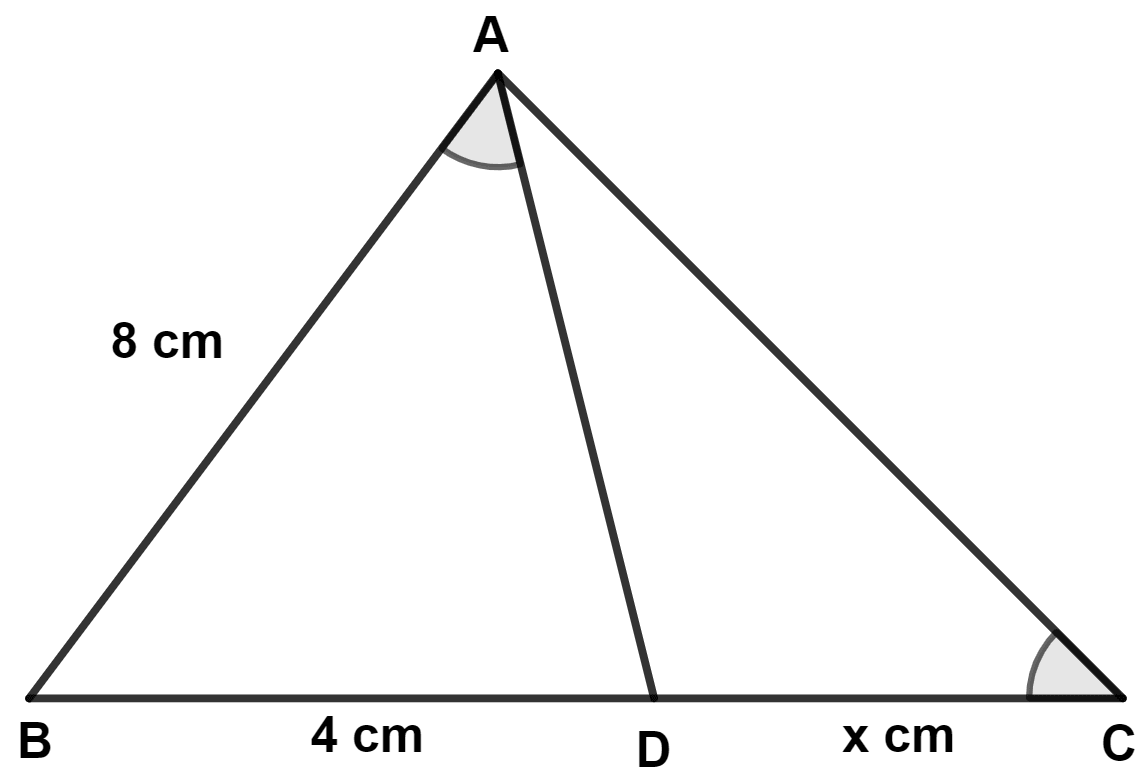
Given a triangle ABC, and D is a point on BC such that BD = 4 cm and DC = x cm. If ∠BAD = ∠C and AB = 8 cm, then,
(a) prove that triangle ABD is similar to triangle CBA.
(b) find the value of 'x'.
Answer
(a) In △ ABD and △ CBA,
⇒ ∠ABD = ∠CBA (Common angle)
⇒ ∠BAD = ∠ACB (Given)
∴ △ ABD ~ △ CBA (By A.A. axiom)
Hence, proved that △ ABD ~ △ CBA.
(b) We know that,
Corresponding sides of similar triangle are proportional.
Hence, x = 12 cm.
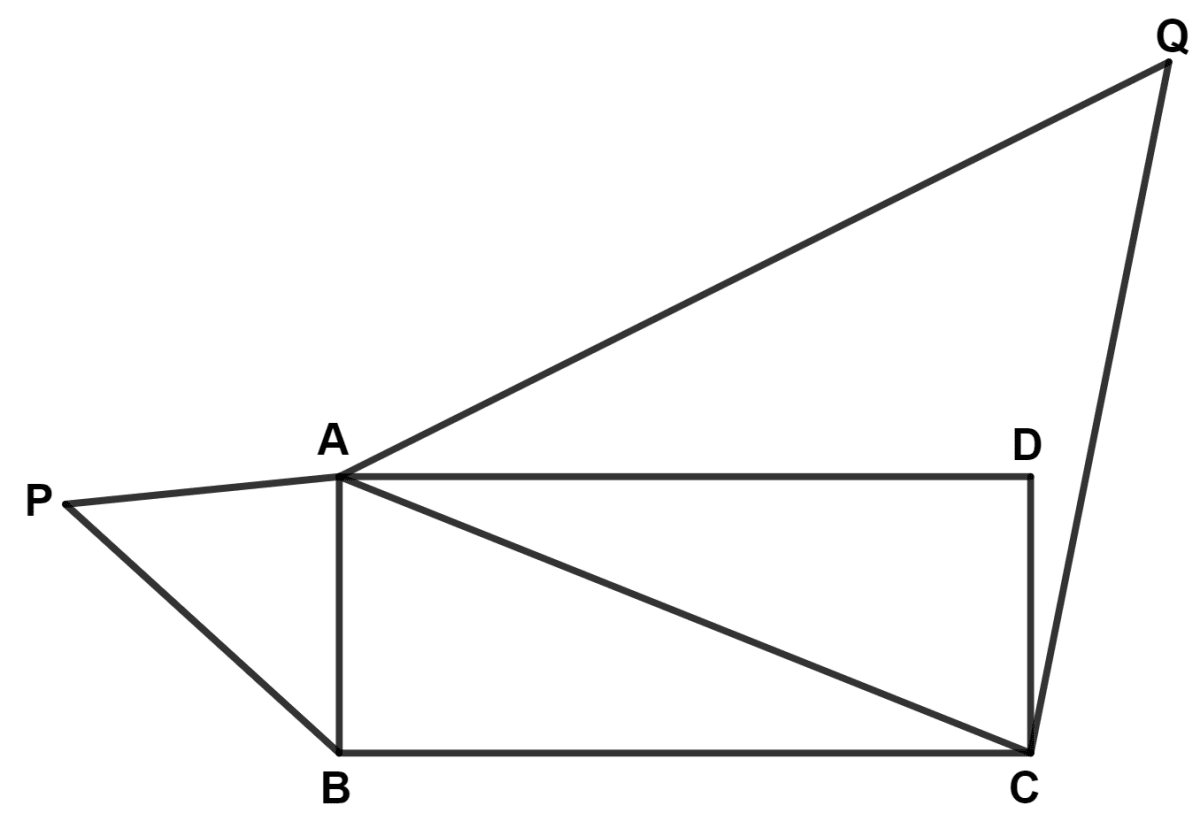
ABCD is a rectangle in which side BC is twice side AB. If △ACQ ~ △BAP, find area of △BAP : area of △ACQ.
Answer
Given,
ABCD is a rectangle where side BC is twice side AB.
⇒ BC = 2AB
In right angled triangle ABC,
By pythagoras theorem,
⇒ AC2 = AB2 + BC2
⇒ AC2 = AB2 + (2AB)2
⇒ AC2 = AB2 + 4AB2
⇒ AC2 = 5AB2
⇒ AC = AB.
We know that,
The ratio of the area of two similar triangles is equal to the square of the ratio of any pair of the corresponding sides of the similar triangles.
Area of △BAP : Area of △ACQ = 1 : 5.
Hence, Area of △BAP : Area of △ACQ = 1 : 5.
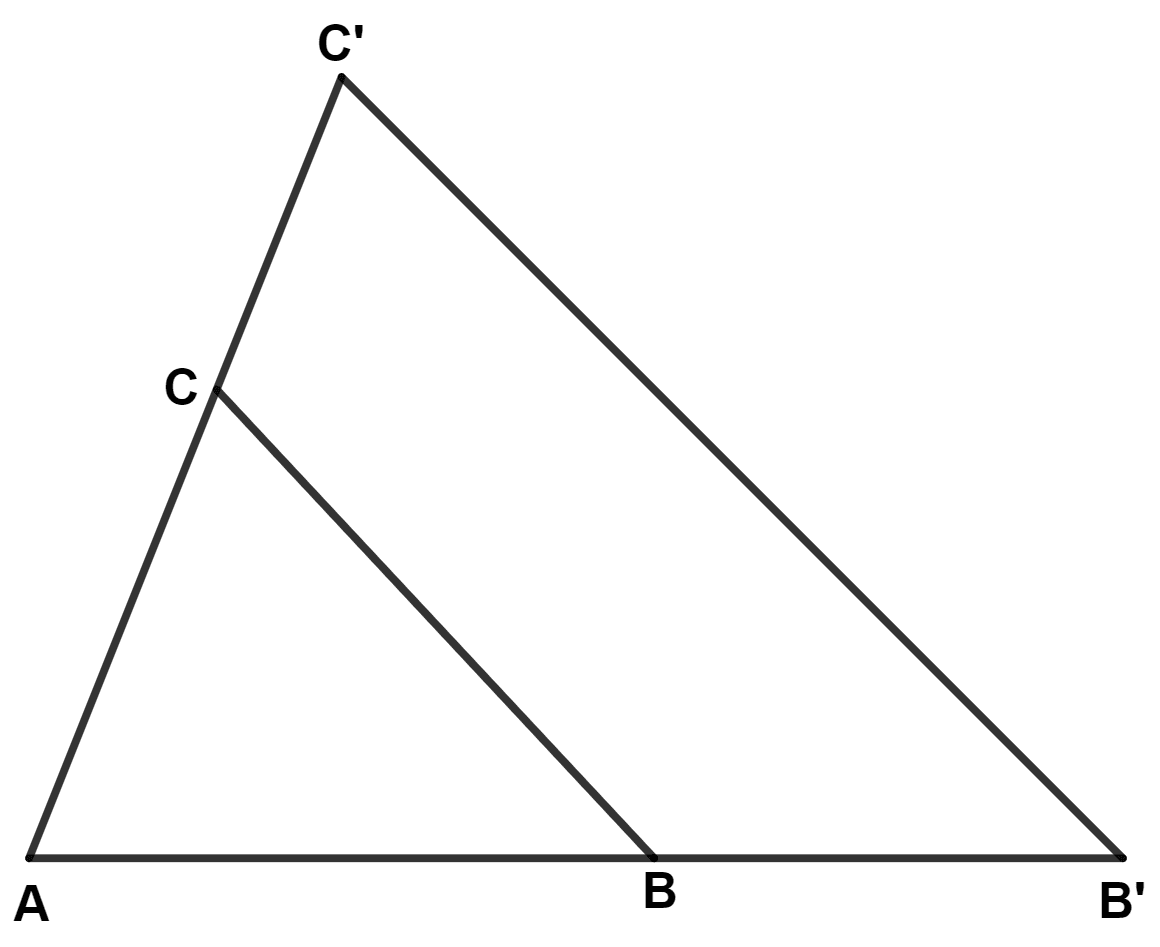
While preparing a PowerPoint presentation, ∆ ABC is enlarged along the side BC to ∆ AB'C', as shown in the diagram, such that BC ∶ B'C' is 3 ∶ 5. Find :
(a) AB ∶ BB'
(b) length AB, if BB' = 4 cm.
(c) Is ∆ ABC ~ ∆ AB'C' ? Justify your answer.
(d) ar (∆ ABC) : ar (quad. BB'C'C).
Answer
Since, ∆ ABC is enlarged along the side BC to ∆ AB'C'.
∴ ∆ ABC and ∆ AB'C' are similar triangles.
(a) We know that,
Ratio of corresponding sides of similar triangles are proportional.
Let AB = 3x and AB' = 5x
From figure,
⇒ AB' = AB + BB'
⇒ 5x = 3x + BB'
⇒ BB' = 5x - 3x = 2x.
⇒ AB : BB' = 3x : 2x = 3 : 2.
Hence, AB : BB' = 3 : 2.
(b) As,
Hence, AB = 6 cm.
(c) Since, ∆ ABC is enlarged along the side BC to ∆ AB'C'.
∴ BC || B'C'
In ∆ ABC and ∆ AB'C',
⇒ ∠BAC = ∠B'AC' (Common angle)
⇒ ∠ABC = ∠AB'C' (Corresponding angle are equal)
∴ ∆ ABC ~ ∆ AB'C' (By A.A. axiom).
Hence, proved that ∆ ABC ~ ∆ AB'C'.
(d) We know that,
The ratio of the areas of two similar triangles is equal to the square of the ratio of their corresponding sides.
Let area of ∆ ABC = 9a and area of ∆ AB'C' = 25a.
Area of quadrilateral BB'C'C = Area of ∆ AB'C' - Area of ∆ ABC = 25a - 9a = 16a.
∴ Area of ∆ ABC : Area of quadrilateral BB'C'C = 9a : 16a = 9 : 16.
Hence, area of ∆ ABC : area of quadrilateral BB'C'C = 9 : 16.
In the given figure (not drawn to scale), BC is parallel to EF, CD is parallel to FG, AE : EB = 2 : 3, ∠BAD = 70°, ∠ACB = 105°, ∠ADC = 40° and AC is bisector of ∠BAD.
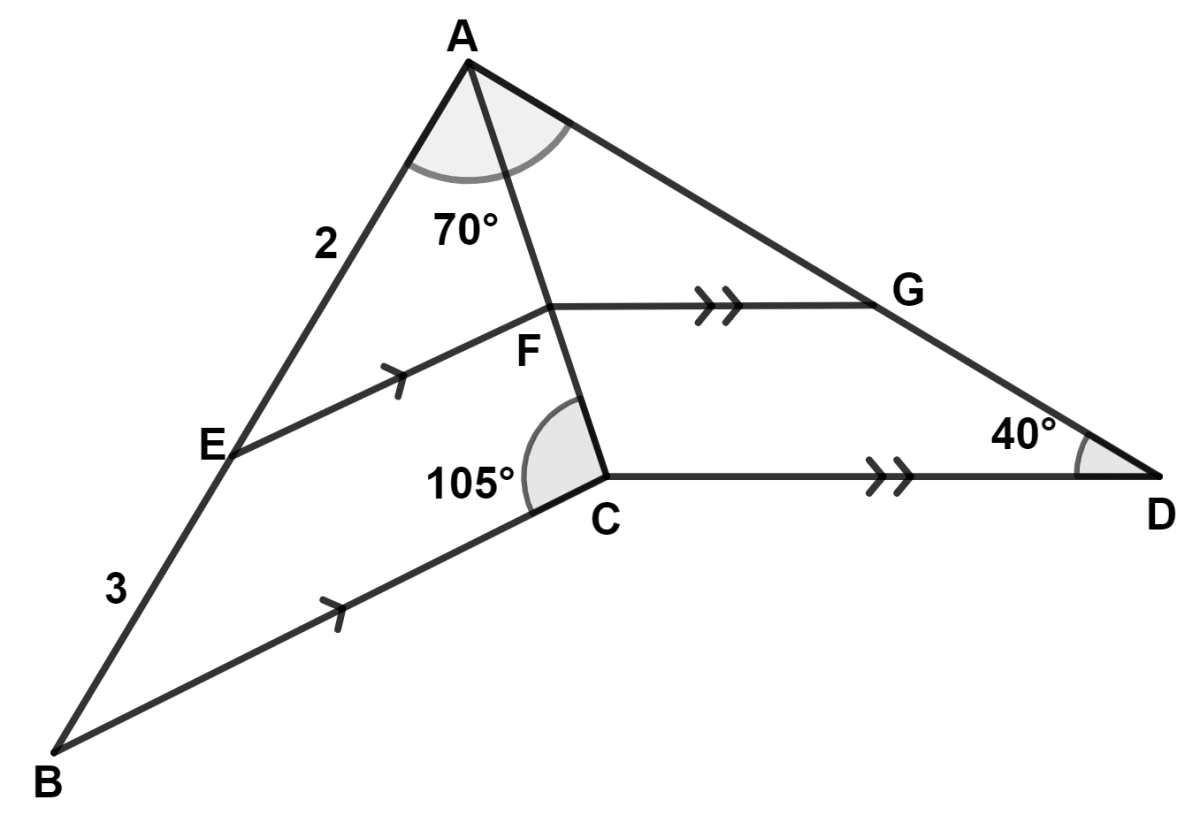
(a) Prove Δ AEF ~ Δ AGF
(b) Find :
(i) AG : AD
(ii) area of Δ ACB: area Δ ACD
(iii) area of quadrilateral ABCD: area of Δ ACB.
Answer
(a) In Δ AFE,
⇒ ∠AFE = ∠ACB = 105° (Corresponding angle are equal)
⇒ ∠EAF = = 35° (AC is the bisector of ∠BAD)
By angle sum property of triangle,
⇒ ∠AFE + ∠EAF + ∠AEF = 180°
⇒ 105° + 35° + ∠AEF = 180°
⇒ 140° + ∠AEF = 180°
⇒ ∠AEF = 180° - 140° = 40°.
∠AGF = ∠ADC = 40° (Corresponding angles are equal)
In Δ AGF,
⇒ ∠GAF = = 35° (AC is the bisector of ∠BAD)
In Δ AEF and Δ AGF,
⇒ ∠EAF = ∠GAF = 35° (AC being the bisector)
⇒ ∠AEF = ∠AGF = 40° (Proved above)
∴ Δ AEF ~ Δ AGF (By A.A. axiom)
Hence, proved that Δ AEF ~ Δ AGF.
(b) In Δ ACD,
⇒ ∠CAD = 35°
⇒ ∠ADC = 40°
By angle sum property of triangle,
⇒ ∠CAD + ∠ADC + ∠DCA = 180°
⇒ 35° + 40° + ∠DCA = 180°
⇒ ∠DCA + 75° = 180°
⇒ ∠DCA = 180° - 75° = 105°.
In Δ ACD and Δ ACB,
⇒ ∠ACB = ∠ACD = 105° (Proved above)
⇒ ∠BAC = ∠DAC = 35° (Proved above)
∴ Δ ACD ~ Δ ACB (By A.A. axiom)
(i) Given,
⇒ AE : EB = 2 : 3
Let AE = 2x and EB = 3x.
∴ AB = AE + EB = 2x + 3x = 5x.
We know that,
Ratio of corresponding sides are proportional.
Hence, AG : AD = 2 : 5.
(ii) In △ ABC and △ ADC,
⇒ ∠BAC = ∠DAC (Both equal to 35°)
⇒ ∠ACB = ∠ACD (Both equal to 105°)
⇒ ∠ABC = ∠ADC (Both equal to 40°)
∴ △ ABC and △ ADC are congruent.
We know that,
Area of congruent triangles are equal.
Let area of △ ABC and area of △ ADC = x.
∴ Area of △ ABC : Area of △ ADC = x : x = 1 : 1.
Hence, area of △ ABC : area of △ ADC = 1 : 1.
(iii) From figure,
Area of quadrilateral ABCD = Area of △ ABC + Area of △ ADC = x + x = 2x.
∴ Area of quadrilateral ABCD : Area of △ ACB = 2x : x = 2 : 1.
Hence, area of quadrilateral ABCD : area of △ ACB = 2 : 1.
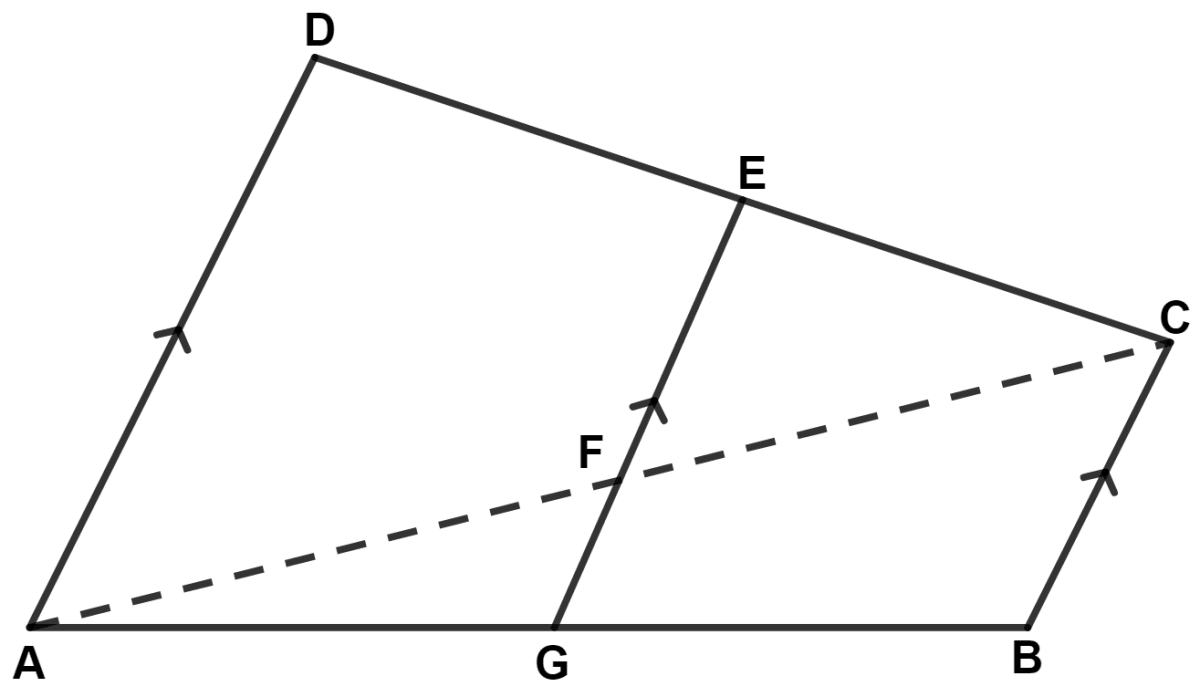
In the figure given below (not drawn to scale), AD ∥ GE ∥ BC, DE = 18 cm, EC = 3 cm, AD = 35 cm. Find :
(a) AF : FC
(b) length of EF
(c) area(trapezium ADEF) : area(Δ EFC)
(d) BC ∶ GF
Answer
(a) In △ ACD and △ FCE,
⇒ ∠ACD = ∠FCE (Common angles)
⇒ ∠ADC = ∠FEC (Corresponding angles are equal)
∴ △ ACD ~ △ FCE (By A.A. axiom)
We know that,
Ratio of corresponding sides of similar triangle are proportional.
Let FC = x and AC = 7x.
From figure,
AF = AC - FC = 7x - x = 6x.
= 6 : 1.
Hence, AF : FC = 6 : 1.
(b) Since, △ ACD ~ △ FCE
Hence, EF = 5 cm.
(c) We know that,
The ratio of the area of two similar triangles is equal to the square of the ratio of any pair of the corresponding sides of the similar triangles.
Let area of △ ADC = 49a and area of △ FCE = a.
Area of trapezium ADEF = Area of △ ADC - Area of △ FCE = 49a - a = 48a.
Hence, area of trapezium ADEF : area of △ EFC = 48 : 1.
(d) In △ AGF and △ ABC,
⇒ ∠AGF = ∠ABC (Corresponding angles are equal)
⇒ ∠GAF = ∠BAC (Common angles)
∴ △ AGF ~ △ ABC (By A.A. axiom)
We know that,
Ratio of corresponding sides of similar triangle are proportional.
From part (a),
⇒ FC = x and AC = 7x
⇒ AF = AC - FC = 7x - x = 6x.
Hence, BC : GF = 7 : 6.