
Assertion (A): In ΔABC and ΔPQR, if ∠BAC = ∠QPR and ∠ABC = ∠PQR, then ΔABC ~ ΔPQR
Reason (R): ΔABC ~ ΔPQR by SSS axiom
options
Both A and R are true, and R is the correct explanation of A.
Both A and R are true, but R is not the correct explanation of A.
A is true, but R is false.
A is false, but R is true.
Answer
In ΔABC and ΔPQR,
⇒ ∠BAC = ∠QPR [Given]
⇒ ∠ABC = ∠PQR [Given]
∴ ΔABC ~ ΔPQR (By A.A. axiom)
So, Assertion (A) is true and reason (R) is false.
Hence, option 3 is the correct option.
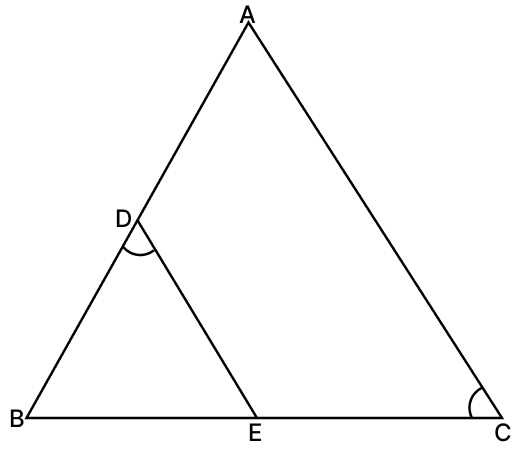
Assertion (A): In the figure, if ∠EDB = ∠ACB, BE = 6 cm, EC = 4 cm and BD = 5 cm, then the length of AB is 12 cm.
Reason (R): If two triangles have two pairs of corresponding angles equal, then the triangles are similar.
options
Both A and R are true, and R is the correct explanation of A.
Both A and R are true, but R is not the correct explanation of A.
A is true, but R is false.
A is false, but R is true.
Answer
In ΔEDB and ΔACB,
∠EDB = ∠ACB (Given)
∠EBD = ∠ABC (Common angle)
∴ ΔEDB ∼ ΔACB (By A.A. axiom)
From figure, BC = BE + EC = 6 + 4 = 10 cm.
Since corresponding sides of similar triangles are proportional,
So, Assertion (A) is true.
If two triangles have two pairs of corresponding angles equal, then the triangles are similar by the AA axiom, and this is exactly the criterion used above to find AB.
So, Reason (R) is true and is the correct explanation of Assertion (A).
Hence, option 1 is the correct option.
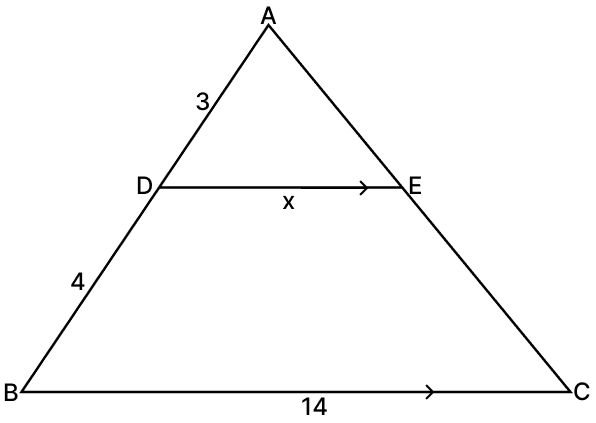
Assertion (A): In the figure, if DE ∥ BC, then the value of x is 6 units.
Reason (R): Two similar triangles are always congruent.
options
Both A and R are true, and R is the correct explanation of A.
Both A and R are true, but R is not the correct explanation of A.
A is true, but R is false.
A is false, but R is true.
Answer
Given, DE ∥ BC.
In ΔADE and ΔABC,
∠ADE = ∠ABC (Corresponding angles are equal)
∠DAE = ∠BAC (Common angle)
∴ ΔADE ∼ ΔABC (By A.A. axiom)
From figure, AD = 3 units, DB = 4 units, so AB = AD + DB = 3 + 4 = 7 units.
Since corresponding sides of similar triangles are proportional,
So, Assertion (A) is true.
Similar triangles only require corresponding angles to be equal and corresponding sides to be proportional; they need not be congruent. So similar triangles are not always congruent.
So, Reason (R) is false.
Hence, option 3 is the correct option.
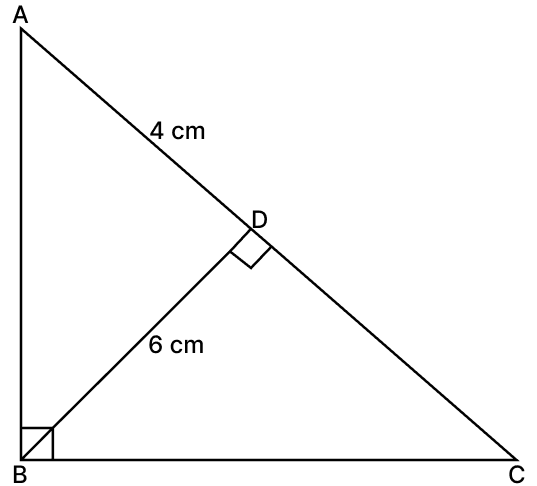
Assertion (A): In the figure, ∠ABC = ∠BDC = 90°. If AD = 4 cm, BD = 6 cm, then area of ΔABC is 40 cm2.
Reason (R): Areas of two similar triangles are proportional to the squares of their corresponding sides.
options
Both A and R are true, and R is the correct explanation of A.
Both A and R are true, but R is not the correct explanation of A.
A is true, but R is false.
A is false, but R is true.
Answer
In ΔADB and ΔBDC,
∠ADB = ∠BDC = 90°
∠DBA = ∠DCB (Angles complementary to ∠DBC)
∴ ΔADB ∼ ΔBDC (By A.A. axiom)
Since corresponding sides of similar triangles are proportional,
From figure, AC = AD + DC = 4 + 9 = 13 cm and height BD = 6 cm.
The Assertion states the area is 40 cm2, which is incorrect (it is 39 cm2).
So, Assertion (A) is false.
Areas of two similar triangles are indeed proportional to the squares of their corresponding sides, which is a true statement.
So, Reason (R) is true.
Hence, option 4 is the correct option.
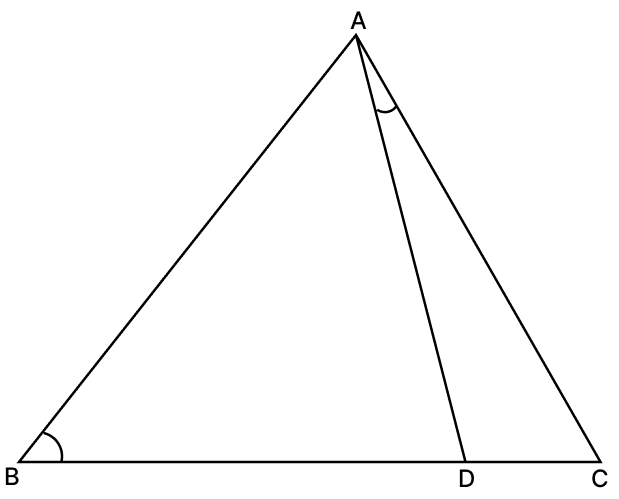
Assertion (A): In ΔABC, if ∠ABC = ∠DAC, AB = 8 cm, AC = 4 cm, AD = 5 cm, then BC = 6.4 cm.
Reason (R): SAS and SSS both are valid criteria for similarity of two triangles.
options
Both A and R are true, and R is the correct explanation of A.
Both A and R are true, but R is not the correct explanation of A.
A is true, but R is false.
A is false, but R is true.
Answer
In ΔABC and ΔDAC,
∠ABC = ∠DAC (Given)
∠BCA = ∠DCA (Common angle)
∴ ΔABC ∼ ΔDAC (By A.A. axiom)
Since corresponding sides of similar triangles are proportional,
So, Assertion (A) is true.
Both the SAS criterion and the SSS criterion are valid tests for the similarity of two triangles, so the Reason is a true statement. However, the similarity above was established using the AA axiom, so the Reason is not the correct explanation of the Assertion.
So, Reason (R) is true but is not the correct explanation of Assertion (A).
Hence, option 2 is the correct option.
Assertion (A): In ΔABC and ΔPQR, if ∠BAC = ∠QPR and ∠ABC = ∠PQR, then ΔABC ~ ΔPQR
Reason (R): ΔABC ~ ΔPQR by SSS axiom
options
Both A and R are true, and R is the correct explanation of A.
Both A and R are true, but R is not the correct explanation of A.
A is true, but R is false.
A is false, but R is true.
Answer
In ΔABC and ΔPQR,
⇒ ∠BAC = ∠QPR [Given]
⇒ ∠ABC = ∠PQR [Given]
∴ ΔABC ~ ΔPQR (By A.A. axiom)
So, Assertion (A) is true and reason (R) is false.
Hence, option 3 is the correct option.