
Square ABCD lies in the third quadrant of a XY plane such that its vertex A is at (-3, -1) and the diagonal DB produced is equally inclined to both the axes. The diagonals AC and BD meet at P(-2, -2). Find the:
(a) slope of BD
(b) equation of AC
Answer
(a) Given,
BD is equally inclined to both axes.
∴ Slope of BD = tan 45° = 1.
Hence, slope of BD = 1.
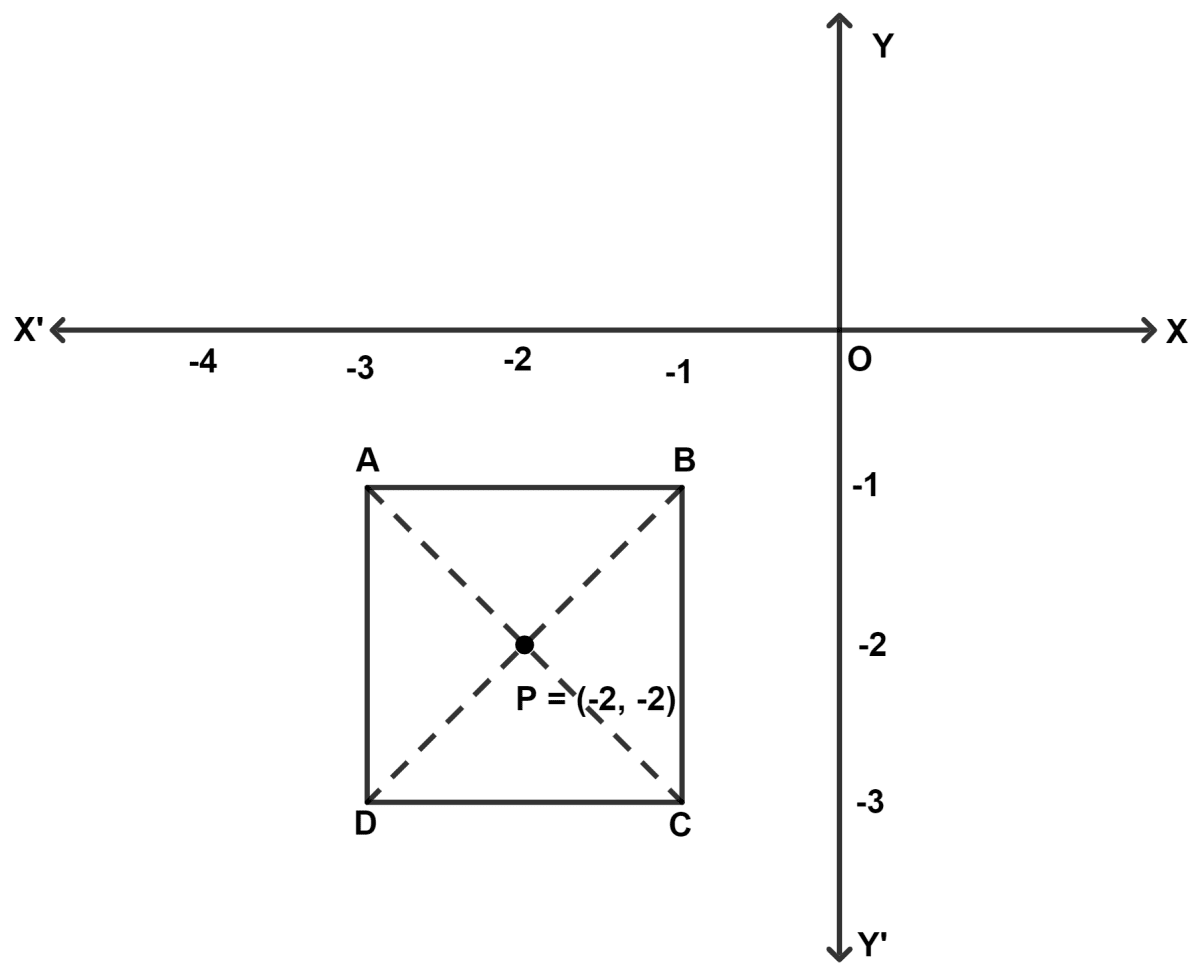
(b) Since, diagonals of a square are perpendicular and product of slope of perpendicular lines equals to -1.
∴ Slope of BD × Slope of AC = -1
⇒ 1 × Slope of AC = -1
⇒ Slope of AC = -1.
Since, diagonals meet at point (-2, -2).
By point-slope form,
⇒ y - y1 = m(x - x1)
⇒ y - (-2) = -1[x - (-2)]
⇒ y + 2 = -1[x + 2]
⇒ y + 2 = -x - 2
⇒ x + y + 2 + 2 = 0
⇒ x + y + 4 = 0.
Hence, equation of AC is x + y + 4 = 0.
Find the equation of the straight line perpendicular to the line x + 2y = 4, which cuts an intercept of 2 units from the positive y-axis. Hence, find the intersection point of the two lines.
Answer
Given,
Equation : x + 2y = 4
⇒ 2y = -x + 4
⇒ y =
Comparing above equation with y = mx + c we get :
⇒ m =
Let slope of line perpendicular to line x + 2y = 4 be m1.
We know that,
Product of slope of perpendicular lines = -1.
Substituting values we get :
⇒ y = mx + c
⇒ y = 2x + 2.
Simultaneously solving equation :
⇒ x + 2y = 4 .........(1)
⇒ y = 2x + 2 .......(2)
Substituting value of y from equation (2) in (1), we get :
⇒ x + 2(2x + 2) = 4
⇒ x + 4x + 4 = 4
⇒ 5x = 4 - 4
⇒ 5x = 0
⇒ x = = 0.
Substituting value of x in equation (2), we get :
⇒ y = 2(0) + 2 = 2.
Hence, equation of required line is y = 2x + 2 and point of intersection = (0, 2).
Given the equations of two straight lines, L1 and L2 are x - y = 1 and x + y = 5 respectively. If L1 and L2 intersect at point Q(3, 2), find:
(a) the equation of line L3 which is parallel to L1 and has y-intercept 3.
(b) the value of k, if the line L3 meets the line L2 at a point P(k, 4).
(c) the coordinates of R and the ratio PQ : QR, if line L2 meets the x-axis at point R.
Answer
(a) (a) L1 : x - y = 1
⇒ y = x - 1
Comparing above equation with y = mx + c, we get :
⇒ m = 1.
We know that,
Slope of parallel lines are equal.
∴ Slope of L3 = 1.
Given,
L3 has y-intercept = 3.
∴ y = mx + c
⇒ y = 1.x + 3
⇒ y = x + 3.
Hence, equation of line L3 : y = x + 3.
(b) L2 : x + y = 5 and L3 : y = x + 3
⇒ x + y = 5 .........(1)
⇒ y = x + 3 .........(2)
Substituting value of y from equation (2) in (1), we get :
⇒ x + (x + 3) = 5
⇒ 2x + 3 = 5
⇒ 2x = 5 - 3
⇒ 2x = 2
⇒ x =
⇒ x = 1.
Substituting value of x in equation (2), we get :
⇒ y = 1 + 3 = 4.
⇒ (x, y) = (1, 4)
∴ P(k, 4) = (1, 4)
Hence, value of k = 1.
(c) Given,
L2 meets x-axis at point R.
At point on x-axis, y-coordinate = 0.
L2 : x + y = 5
⇒ x + 0 = 5
⇒ x = 5
⇒ R = (x, y) = (5, 0).
P = (1, 4), Q = (3, 2) and R = (5, 0)
Let PQ : QR = k : 1
By section formula,
∴ PQ : QR = 1 : 1.
Hence, R = (5, 0) and PQ : QR = 1 : 1.