
Assertion (A): At some time of the day, if the length of the shadow of a tower is equal to its height, then the sun's altitude is 45°.
Reason (R): The angle which the line of sight makes with the horizontal line passing through the observer's eye, when the object is above the observer, is called the angle of elevation.
Both A and R are true, and R is the correct explanation of A.
Both A and R are true, but R is not the correct explanation of A.
A is true, but R is false.
A is false, but R is true.
Answer
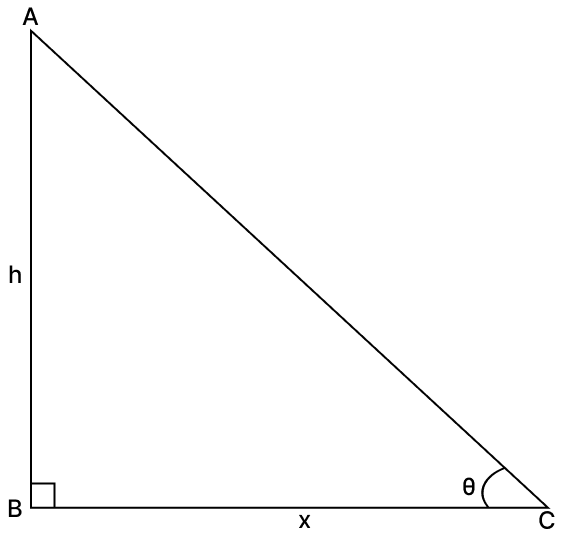
Let the height of the tower be h and the length of its shadow be x, and let the sun's altitude be θ.
. If h = x, then tan θ = 1, so θ = 45°.
∴ Assertion (A) is true.
The angle which the line of sight makes with the horizontal line, when the object is above the observer, is indeed the angle of elevation — this is the correct definition.
∴ Reason (R) is true.
However, the definition of the angle of elevation does not by itself explain why an equal shadow and height give 45°; that follows from tan θ = 1. So R is not the correct explanation of A.
Hence, option 2 is the correct option.
Assertion (A): When observer moves horizontally towards the base of the object, angle of elevation increases.
Reason (R): Angle of elevation = angle of depression.
Both A and R are true, and R is the correct explanation of A.
Both A and R are true, but R is not the correct explanation of A.
A is true, but R is false.
A is false, but R is true.
Answer
As the observer moves horizontally towards the base of the object, the horizontal distance decreases while the height of the object stays the same, so tan (angle of elevation) = increases, and hence the angle of elevation increases.
∴ Assertion (A) is true.
Angle of elevation = angle of depression is actually true in the standard heights-and-distances context, but it does not explain why the angle of elevation increases when the observer moves closer.
∴ Reason (R) is true, but it is not the correct explanation of A.
Hence, option 2 is the correct option.
Assertion (A): If the length of shadow of a person is equal to his height, then the angle of elevation of the sun is 45°.
Reason (R): For any right-angled triangle, tan θ =
Both A and R are true, and R is the correct explanation of A.
Both A and R are true, but R is not the correct explanation of A.
A is true, but R is false.
A is false, but R is true.
Answer
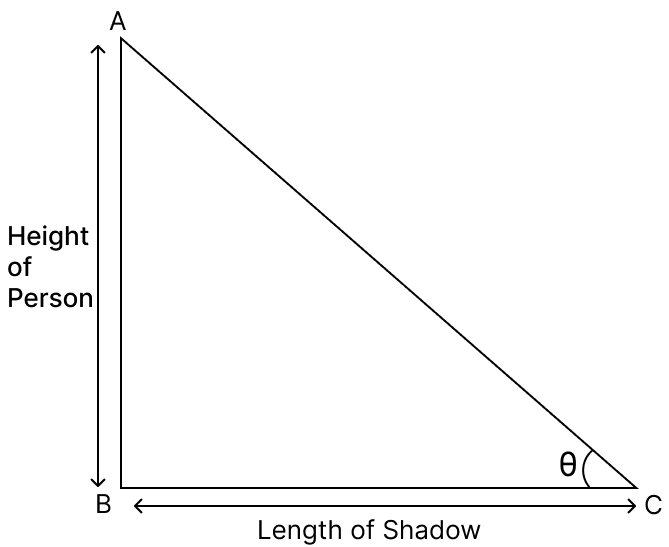
Let AB = Height of person and BC = Length of shadow.
∠ACB = θ (Angle of elevation of sun)
Given,
Length of shadow of a person (BC) = height of person (AB)
⇒ tan θ =
⇒ tan θ =
⇒ tan θ =
⇒ tan θ = 1
⇒ tan θ = tan 45°
⇒ θ = 45°.
∴ Both (A) and (R) are true, and (R) is the correct explanation for (A).
Hence, option 1 is the correct option.