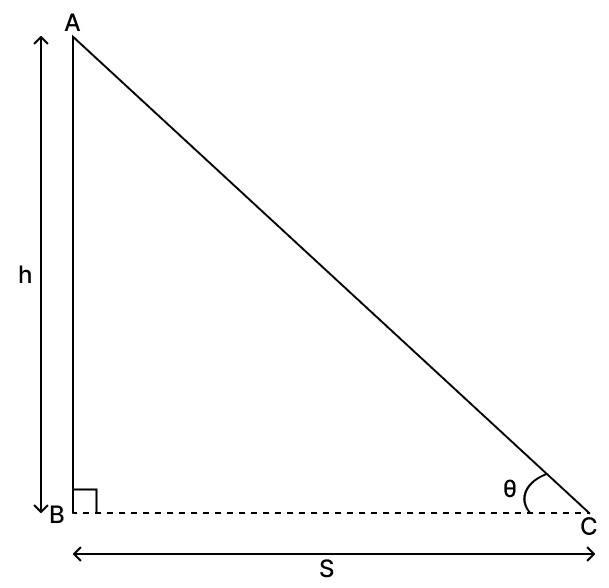
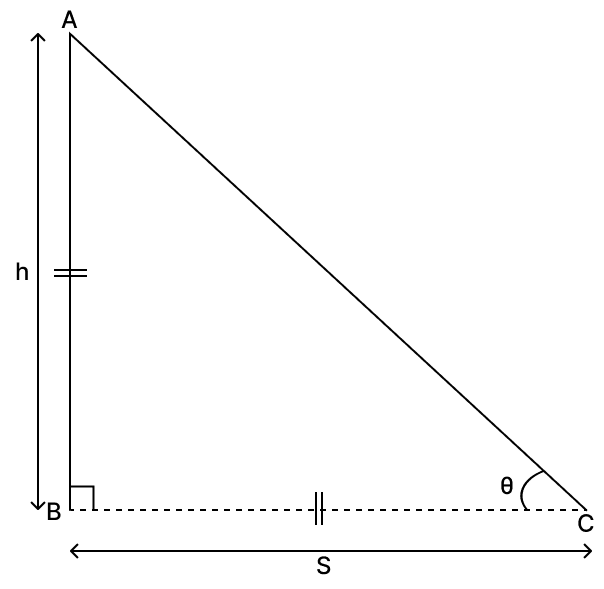
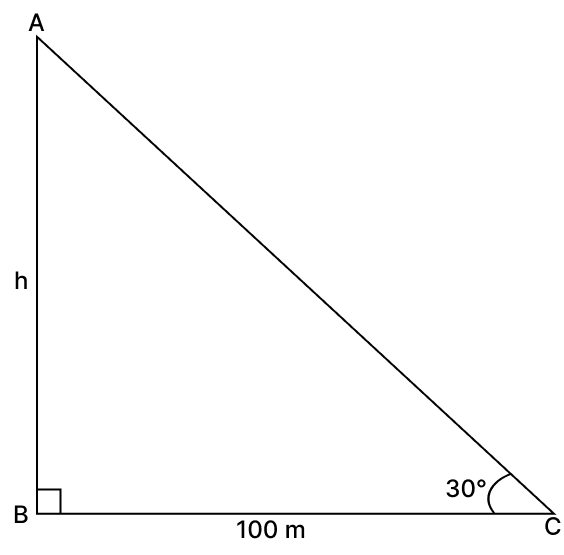
The angle of elevation of a tower from a distance of 100 m from its foot is 30°. The height of the tower is:
(3100) m
503 m
1003 m
(3200) m
Answer
Let the height of tower (AB) be h meters.
Angle of elevation = 30°
⇒tanθ=baseperpendicular⇒tan30∘=100h⇒31=100h⇒h=3100 m.
Hence, option 1 is the correct option.
Question 5
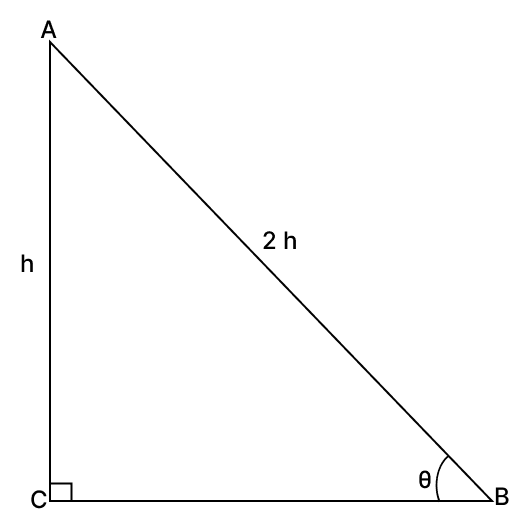
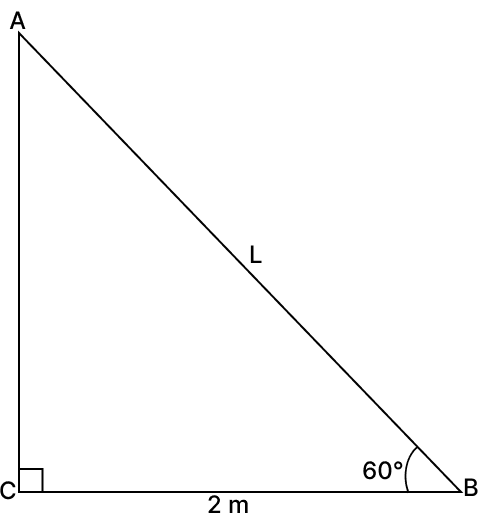
A ladder makes an angle of 60° with the ground when placed against a wall. If the foot of the ladder is 2 m away from the wall, the length of the ladder is:
(34) m
43 m
22 m
4 m
Answer
Let the length of ladder (AB) be L.
Distance (CB) from wall (AC) to the foot of ladder = 2 m
The angle the ladder makes with the ground is 60°.
In triangle ABC,
⇒cosθ=hypotenuseBase⇒cos60∘=L2⇒21=L2⇒L=4 m.
Hence, option 4 is the correct option.
Question 6
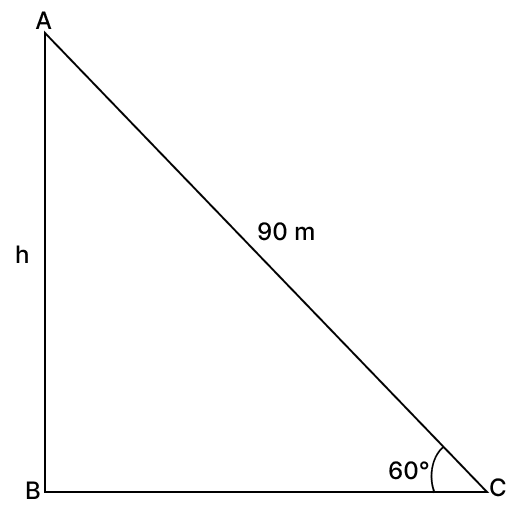
The length of a string between a kite and a point on the ground is 90 m. The string makes an angle of 60° with the level ground. If there is no slack in the string, the height of the kite is:
453 m
45 m
903 m
180 m
Answer
Length of string (AC) = 90 m
Let the height of the kite (AB) = h
The angle the string makes with the ground is 60°.
⇒sinθ=hypotenusePerpendicular⇒sin60∘=90h⇒23=90h⇒23×90=h⇒h=453 m.
Hence, option 1 is the correct option.
Question 7
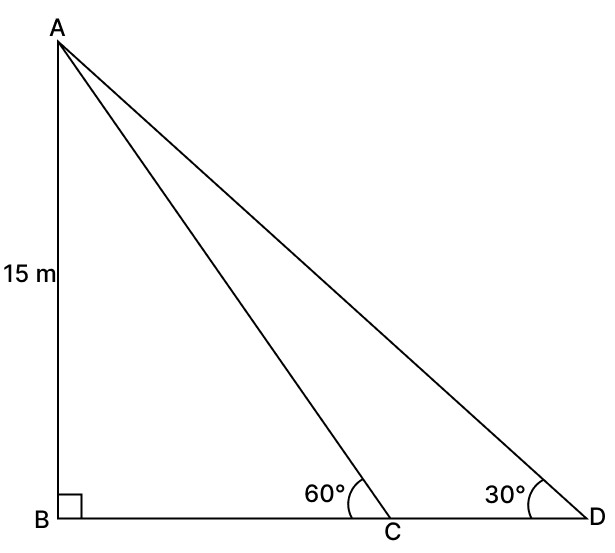
If the elevation of the sun changed from 30° to 60°, then the difference between the lengths of shadows of a pole 15 m high, made at these two positions is:
7.5 m
15 m
53 m
103 m
Answer
Height of pole AB = 15 m
Let D be the position where angle of elevation is 30° and C be the point where angle of elevation is 60°.
In triangle ABC,
We know that,
⇒tan60∘=BasePerpendicular=BCAB⇒3=BC15⇒BC=315⇒BC=315×33⇒BC=3153⇒BC=53 m.
In triangle ABD,
We know that,
⇒tan30∘=BasePerpendiuclar=BDAB⇒31=BD15⇒BD=153 m.
From figure,
CD = BD - BC
CD = 153−53
CD = 103 m.
Hence, option 4 is the correct option.
Question 8
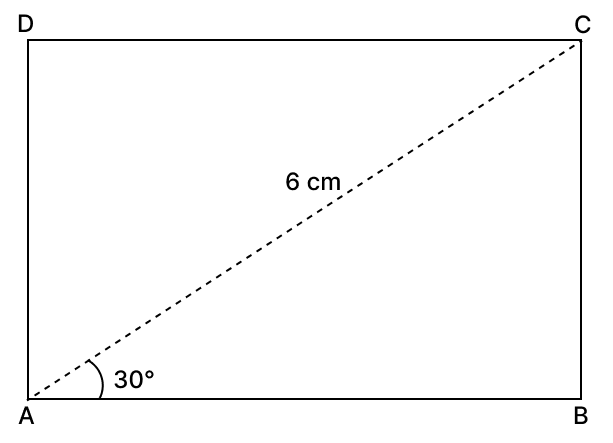
In a rectangle, if the angle between a diagonal and a side is 30° and the length of the diagonal is 6 cm, then the area of the rectangle is :
9 cm2
93 cm2
27 cm2
36 cm2
Answer
Let the base of rectangle be AB and breadth be BC,
Diagonal AC = 6 cm
In triangle ABC,
⇒cos30∘=hypotenusebase=ACAB⇒23=6AB⇒23×6=AB⇒AB=33 cm.
Also,
⇒sin30∘=hypotenusePerpendicular=ACBC⇒21=6BC⇒21×6=BC⇒BC=3 cm.
We know that,
Area of rectangle = length × width
= 33×3
= 93 cm2.
Hence, option 2 is the correct option.
Question 9
The angles of elevation of an aeroplane flying vertically above the ground as observed from two consecutive stones 1 km apart are 45° and 60°. The height of the aeroplane above the ground (in km) is:
(23+1)
(23+3)
3+3
3+1
Answer
Let the position of the aeroplane be A. Let h be the height of the aeroplane above the ground.
Let C and D be the positions of the two consecutive stones on the ground.
Let the distance from the closer stone C to the foot of the perpendicular B be x.
Substituting value of x from equation (2) in (1), we get :
⇒3h+1=h⇒h−3h=1⇒h(1−31)=1⇒h(33−1)=1⇒h=3−13⇒h=(3−1)(3+1)3(3+1)⇒h=(3)2−(1)23+3⇒h=3−13+3⇒h=23+3 km
Hence, option 2 is the correct option.
Question 10
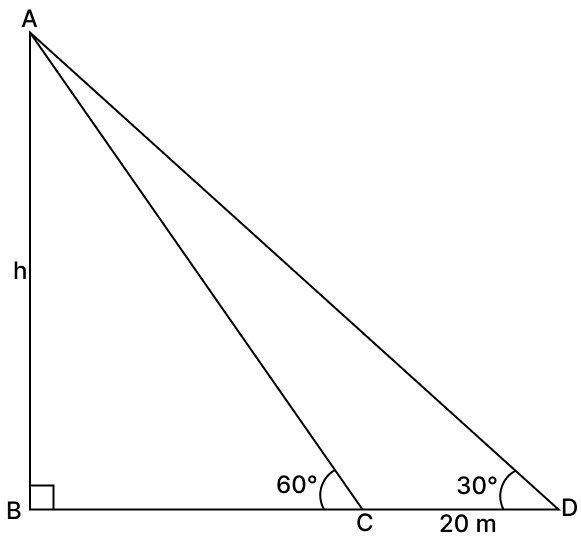
On the level ground, the angle of elevation of a tower is 30°. On moving 20 m nearer, the angle of elevation is 60°. The height of the tower is:
10 m
103 m
15 m
20 m
Answer
Let AB be the tower of height h.
In △ABC,
⇒tan60∘=BCAB⇒3=BCh⇒BC=3h....(1)
In △ABD,
⇒tan30∘=BDAB⇒31=BC+20h⇒BC+20=h3....(2)
Substituting value of BC from equation (1) in (2), we get :
⇒3h+20=h3⇒3h+203=h3⇒h+203=h(3)⇒203=2h⇒h=103 m
Hence, option 2 is the correct option.
Question 11
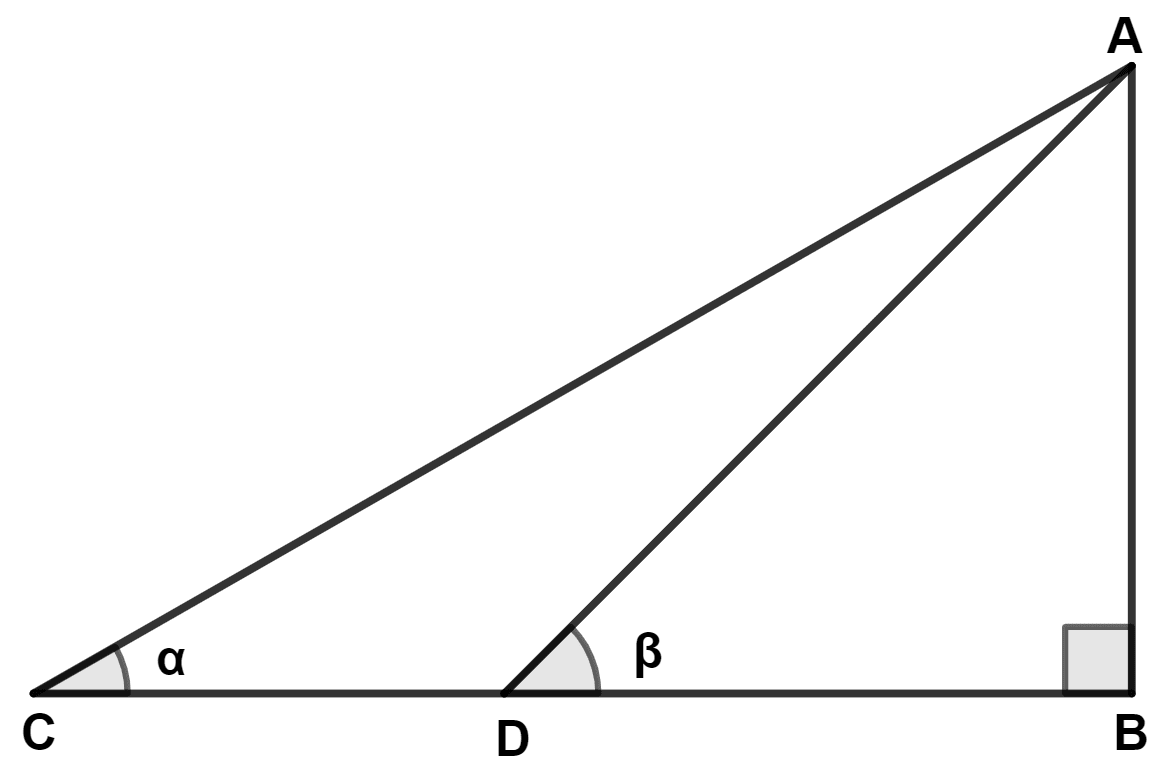
A man standing on a ship approaching the port towards the lighthouse is observing the top of the lighthouse. In 10 minutes, the angle of elevation of the top of the lighthouse changes from α to β. Then :
α > β
α < β
α = β
α ≤ β
Answer
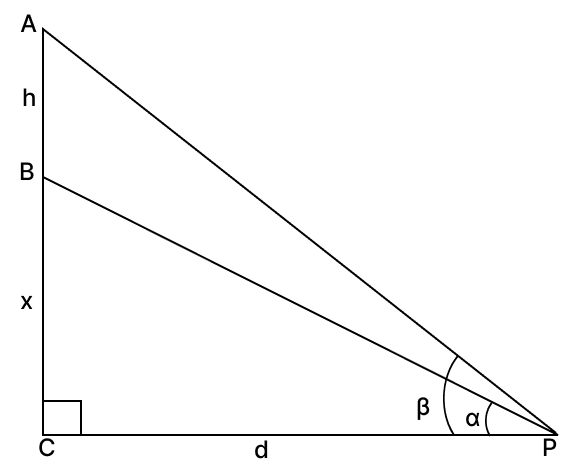
Let A be the top of the lighthouse, C the initial position of ship and D be the position after 10 minutes.
From figure,
tan α = BCAB
tan β = BDAB
Since, BC is greater than BD.
∴ tan α < tan β
⇒ α < β.
Hence, option 2 is the correct option.
Question 12
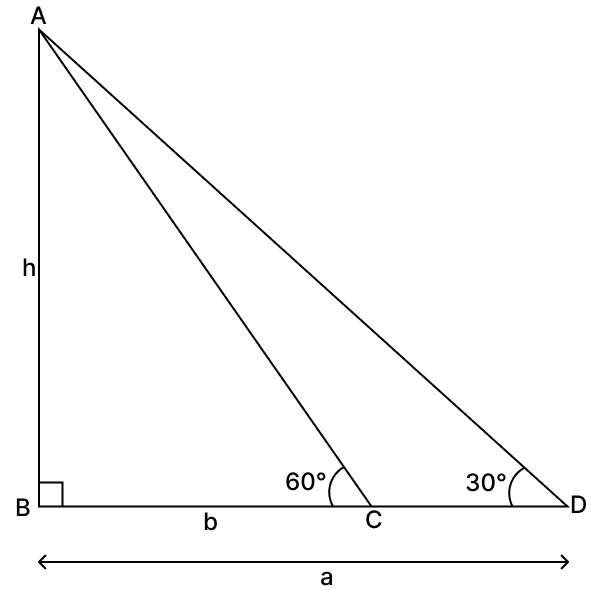
If the angles of elevation of a tower from two points distant a and b (a > b) from its foot and in the same straight line from it and on the same side, are 30° and 60°, then the height of the tower is :
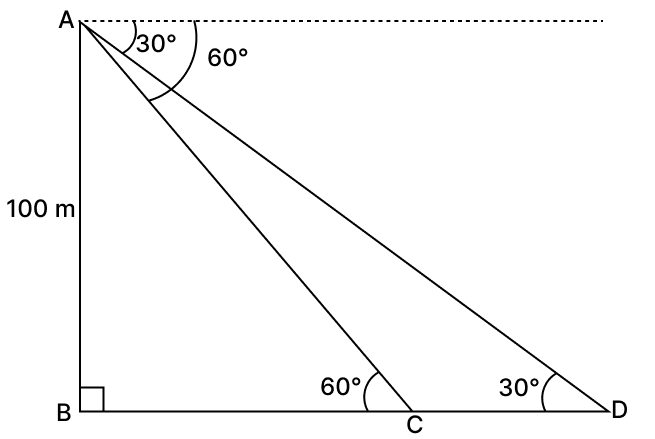
If from the top of a cliff, 100 m high, the angles of depression of two ships at sea are 60° and 30°, then the distance between the ships is approximately :
57.6 m
115.47 m
173 m
346 m
Answer
Let AB be the cliff and two ships be at point C and D.
In triangle ABC,
⇒tan60∘=BCAB⇒3=BC100⇒BC=3100 m
In triangle ABD,
⇒tan30∘=BDAB⇒31=BD100⇒BD=1003 m.
Distance between the ships CD is,
⇒CD=BD−BC⇒CD=1003−3100⇒CD=100(3−31)⇒CD=100(33−1)⇒CD=3200⇒CD=1.732200=115.47 m.
Hence, option 2 is the correct option.
Question 14
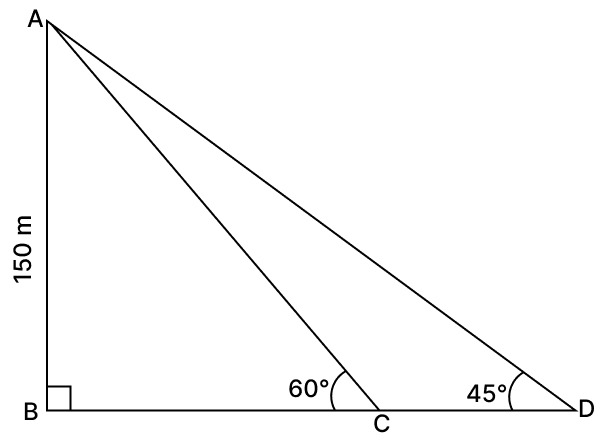
A boat is being rowed away from a cliff, 150 m high. At the top of the cliff, the angle of elevation of the boat changes from 60° to 45° in 2 minutes. The speed of the boat is:
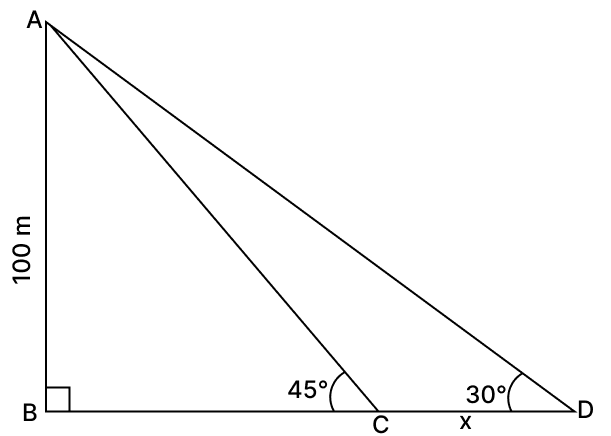
The height of a tower is 100 m. When the angle of elevation of the sun changes from 30° to 45°, the shadow of the tower becomes x metres less. The value of x is :
100
1003
100(3−1)
(3100)
Answer
Height of the tower AB = 100 m
In triangle ABC,
⇒tan45∘=BCAB⇒1=BC100⇒BC=100 m.
In triangle ABD,
⇒tan30∘=BDAB⇒31=BD100⇒BD=1003 m.
The decrease in the shadow's length x = BD - BC
x = 1003 - 100
= 100(3−1) m.
Hence, option 3 is the correct option.
Question 16
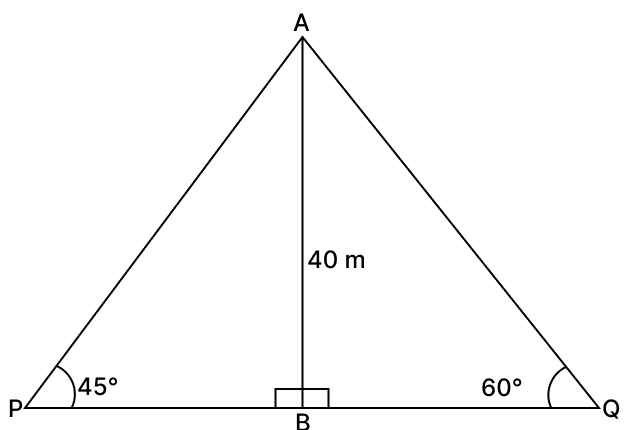
The angles of elevation of the top of a tower, 40 m high, from two points on the level ground on its opposite sides are 45° and 60°. The distance between the two points in nearest metres is :
60 m
61 m
62 m
63 m
Answer
Let AB be the height of tower = 40 m
Let the two points be P and Q on opposite sides of the tower.
In triangle ABP,
⇒tan45∘=BPAB⇒1=BP40⇒BP=40 m.
In triangle ABQ,
⇒tan60∘=BQAB⇒3=BQ40⇒BQ=340⇒BQ=23.09 m.
Distance between the two points = BP + BQ
= 40 + 23.09
= 63.09 = 63 m.
Hence, option 4 is the correct option.
Question 17
Two boats approach a lighthouse in mid-sea from opposite directions. The angles of elevation of the top of the lighthouse from the two boats are 30° and 45° respectively. If the distance between the two boats is 100 m, the height of the lighthouse is:
36.6 m
68.3 m
73.2 m
136.6 m
Answer
Let height of lighthouse (CD) be h meters.
Let A and B be the boats approaching lighthouse.
In triangle ACD,
⇒tan30∘=xh⇒31=xh⇒x=h3.
In triangle BCD,
⇒tan45∘=yh⇒1=yh⇒h=y.
Given,
Distance between the two boats is 100 m.
x + y = 100
⇒h3+h=100⇒h(3+1)=100⇒h=3+1100⇒h=(3+1)(3−1)100(3−1)⇒h=3−1100(3−1)⇒h=2100(3−1)⇒h=50(3−1)⇒h=50(1.732−1)⇒h=50(0.732)⇒h=36.6 m.
Hence, option 1 is the correct option.
Question 18
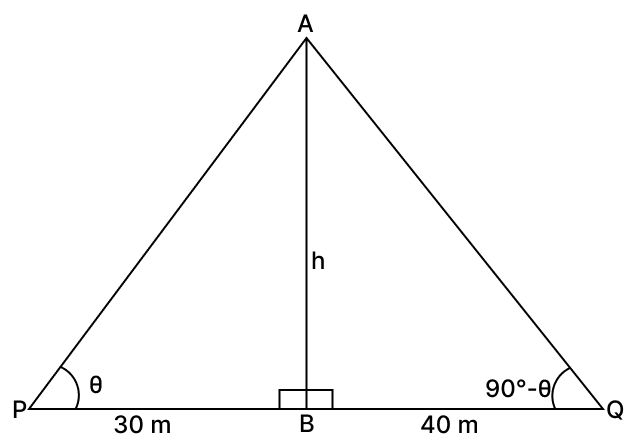
The angles of elevation of the top of a tower from two points distant 30 m and 40 m on either side from the base and in the same straight line with it are complementary. The height of the tower is :
11.54 m
23.09 m
34.64 m
69.28 m
Answer
Let height of the tower (AB) be h meters.
Let P and Q be two points on either sides of the tower.
In triangle ABP,
⇒tanθ=30h....(1)
In triangle ABQ,
⇒tan(90∘−θ)=40h⇒cotθ=40h⇒tanθ1=40h⇒30h1=40h⇒h30=40h⇒h2=1200⇒h=1200⇒h=34.64 m.
Hence, option 3 is the correct option.
Question 19
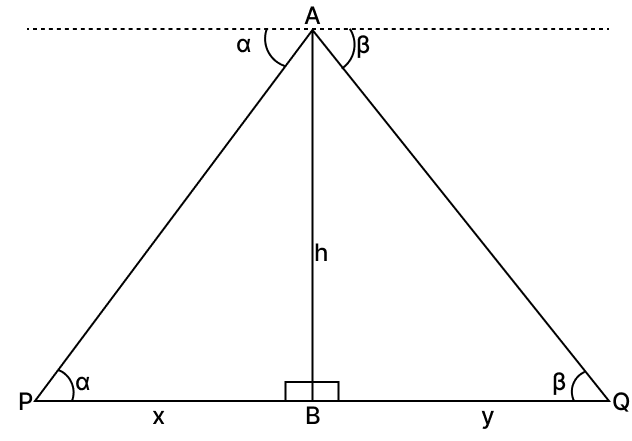
From the top of a lighthouse, the angles of depression of two ships on the opposite sides of it are observed to be α and β. If the height of the lighthouse be h metres and the line joining the ships passes through the foot of the lighthouse, the distance between the ships is:
h(tanα+tanβ)
(tanα+tanβhtanαtanβ)
(tanαtanβh(tanα+tanβ))
(cotαcotβh(cotα+cotβ))
Answer
Let AB(h) be the height of the lighthouse.
Let P and Q be the two ships on opposite sides of the lighthouse.
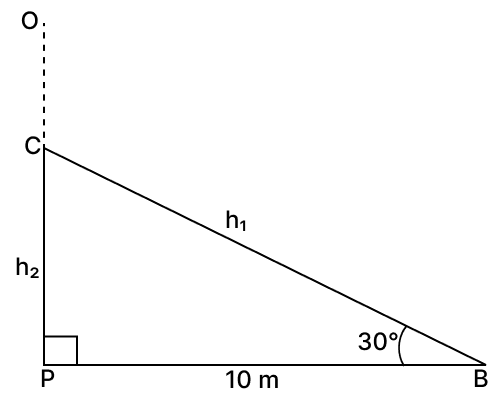
A straight tree breaks due to storm and the broken part bends so that the top of the tree touches the ground making an angle of 30° with the ground. The distance from the foot of the tree to the point where the top touches the ground is 10 metres. The height of the tree is :
10(3+1) m
103 m
10(3−1) m
(310) m
Answer
Let the tree before breaking be OP.
The tree breaks at point C. The top part falls and touches the ground at point B.
Let BC = h1 and CP = h2
In triangle CPB,
⇒tan(30∘)=BPCP⇒31=10h2⇒h2=310 m.
In triangle ABC,
⇒cos(30∘)=BCBP⇒23=h110⇒h1=320 m.
The original height of the tree
=310+320=330=330×33=103.
Hence, option 2 is the correct option.
Question 21
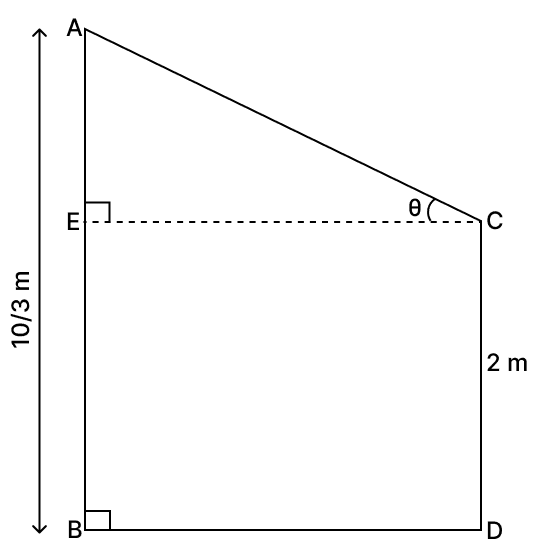
A person of height 2 m wants to get a fruit which is on a pole of height (310) m. If he stands at a distance of (34) m from the foot of the pole, then the angle at which he should throw the stone so that it hits the fruit is:
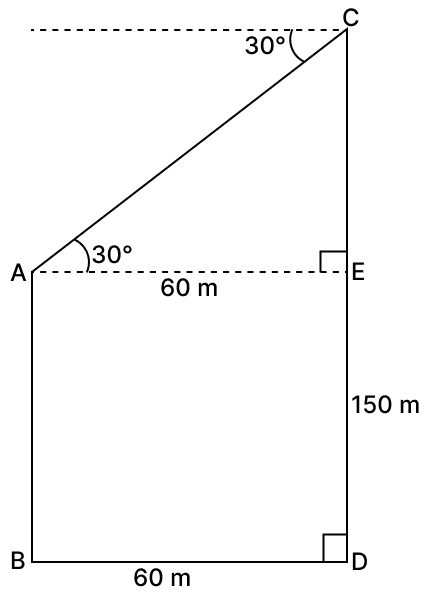
The distance between two multi-storeyed buildings is 60 m. The angle of depression of the first building as seen from the top of the second building, which is 150 m high, is 30°. The height of the first building is :
115.36 m
117.85 m
125.36 m
128.34 m
Answer
Let AB be the height of first building and CD be the height of second building.
The distance between the buildings (BD) = 60 m.
CE is the difference in height between the two buildings.
In triangle AEC,
⇒tan30∘=AECE⇒31=60CE⇒CE=360⇒CE=34.64 m.
Height of first building,
AB = CD - CE
= 150 - 34.64
= 115.36 m.
Hence, option 1 is the correct option.
Question 23
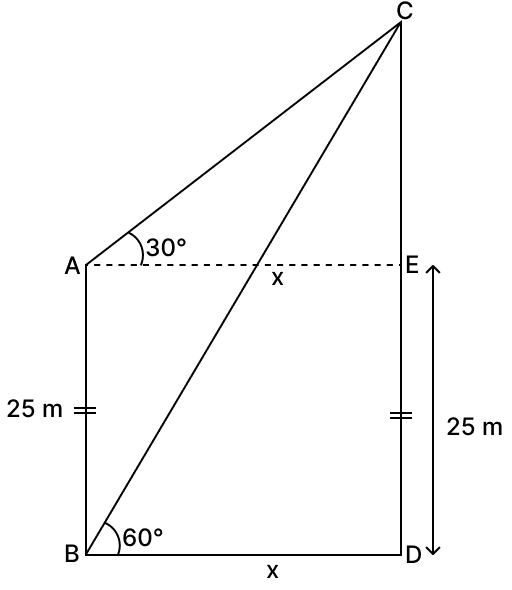
From the foot of a tower, the angle of elevation of the top of a column is 60° and from the top of the tower, which is 25 m high, the angle of elevation is 30°. The height of the column is:
14.4 m
37.5 m
42.5 m
43.3 m
Answer
Let AB be the tower and CD be the column.
Let distance between tower (AB) and column (BD) = x
In triangle CBD,
⇒tan60∘=BDCD⇒3=xCD⇒x=3CD .....(1)
In triangle CAE,
⇒tan30∘=AECE⇒31=xCD−25⇒x=(CD−25)3 .....(2)
From (1) and (2), we get :
3CD=(CD−25)3
CD = (CD - 25)3
CD = 3CD - 75
2CD = 75
CD = 275
CD = 37.5 m
Hence, option 2 is the correct option.
Question 24
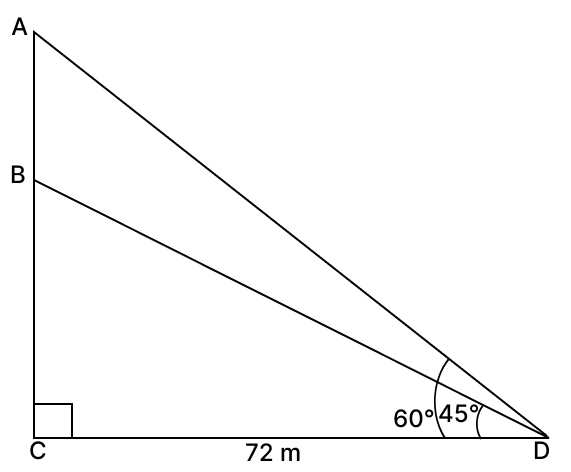
An observer standing 72 m away from a building notices that the angles of elevation of the top and the bottom of a flagstaff on the building are respectively 60° and 45°. The height of the flagstaff is:
52.7 m
73.2 m
98.3 m
124.7 m
Answer
Let BA be the flagstaff and BC be the building.
Let O be the position of observer.
In triangle OCB,
⇒tan45∘=OCBC⇒1=72BC⇒BC=72 m.
In triangle OCA,
⇒tan60∘=OCAC⇒3=72AC⇒AC=723 m.
The height of the flagstaff is
AB = AC - BC
= 72 3 - 72
= 72(3 - 1)
= 72(1.732 - 1)
= 72(0.732)
= 52.7 m.
Hence, option 1 is the correct option.
Question 25
A vertical tower stands on a horizontal plane and is surmounted by a vertical flagstaff of height h. At a point on the plane, the angle of elevation of the bottom of the flagstaff is α and that of the top of the flagstaff is β. The height of the tower is :
(tanβ−tanαhtanβ)
(tanβ−tanαhsinβ)
(cotβ−cotαhcotα)
(tanβ−tanαhtanα)
Answer
Let the height of the tower (BC) be x and the height of the flagstaff (BA) be h.
Let P be the point on ground from foot of tower at distance d.
In triangle PCB,
⇒tanα=dx⇒d=tanαx .....(1)
In triangle PCA,
⇒tanβ=dx+h⇒d=tanβx+h ........(2)
From (1) and (2), we get :
tanαx=tanβx+h
x tan β = (x + h)tan α
x tan β = x tan α + h tan α
h tan α = x tan β - x tan α
h tan α = x(tan β - tan α)
x = tanβ−tanαhtanα
Hence, option 4 is the correct option.
Question 26
A flagstaff of height (51) of the height of a tower is mounted on the top of the tower. If the angle of elevation of the top of the flagstaff as seen from the ground is 45° and the angle of elevation of the top of the tower as seen from the same place is θ, then the value of tan θ is:
54
65
56
653
Answer
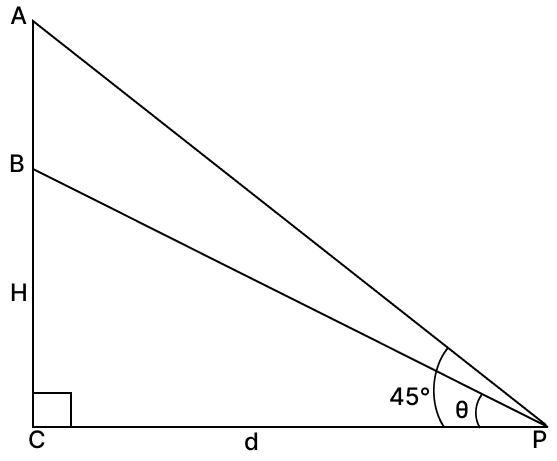
Let the height of the tower (BC) be H and AB be the height of the flag staff = 5H
Total height (AC) = H + 5H=56H
Let P be the point of observation at distance d from tower.
In triangle PCA,
⇒tan45∘=CDAC⇒1=d56H⇒d=56H.
In triangle PCB,
⇒tanθ=dH⇒tanθ=56HH⇒tanθ=561⇒tanθ=65.
Hence, option 2 is the correct option.
Question 27
Two poles of equal heights are standing opposite to each other on either side of a road, which is 30 m wide. From a point between them on the road, the angles of elevation of the tops are 30° and 60°. The height of each pole is:
4.33 m
6.5 m
13 m
15 m
Answer
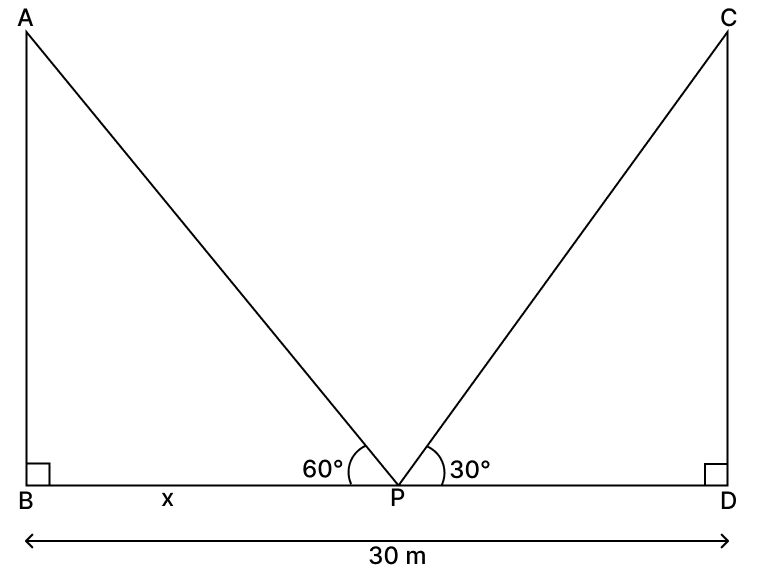
Let AB and CD be two poles of equal height (h).
BD = 30 m
Let BP = x m
In triangle ABP,
⇒tan60∘=BPAB⇒3=xh⇒x=3h
In triangle PCD,
⇒tan30∘=30−xh⇒31=30−xh⇒30−x=h3⇒30−3h=h3⇒3303−h=h3⇒303−h=h3(3)⇒303−h=3h⇒303=3h+h⇒303=4h⇒h=4303⇒h=7.53⇒h=7.5(1.732)⇒h=12.99≈13 m.
Hence, option 3 is the correct option.
Question 28
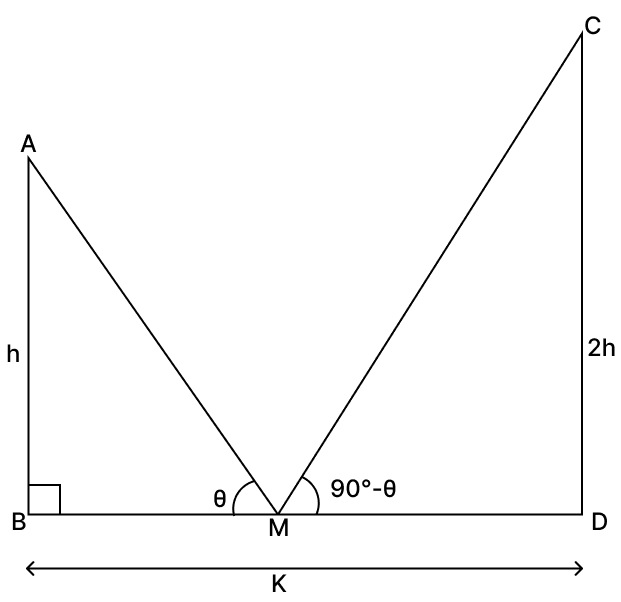
Two posts are k metres apart and the height of one is double that of the other. If from the middle point of the line joining their feet, an observer finds the angular elevations of their tops to be complementary, then the height (in metres) of the shorter post is:
(22k)
(4k)
k2
(2k)
Answer
Let the height of the shorter post (AB) be h meters and the height of the the taller post (CD) be 2h meters..
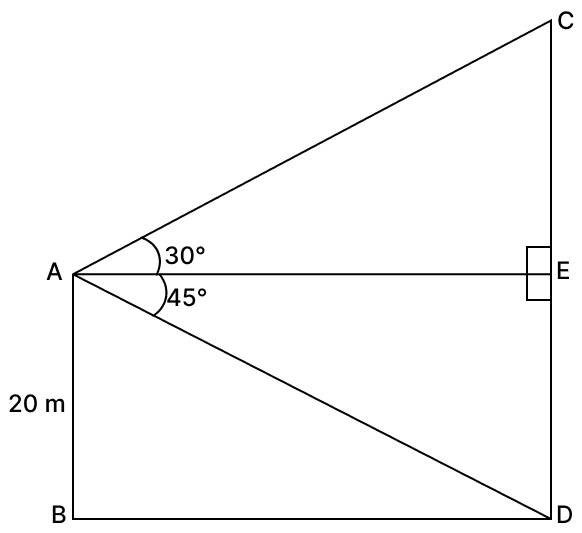
From the top of a pillar of height 20 m, the angles of elevation and depression of the top and bottom of another pillar are 30° and 45° respectively. The height of the second pillar (in metres) is :
(320(3−1))
10
103
(320(3+1))
Answer
Let AB and CD be two pillars.
Draw a line from A to meet CD at point E, AE = x
In triangle ADE,
⇒tan45∘=AEED⇒1=x20⇒x=20 m.
In triangle ACE,
⇒tan30∘=AECE⇒31=20CE⇒CE=320 m.
The total height of the second pillar is,
CD = ED + CE
⇒CD=20+320⇒CD=20(1+31)⇒CD=20(33+1)⇒CD=320(3+1) m.
Hence, option 4 is the correct option.
Question 30
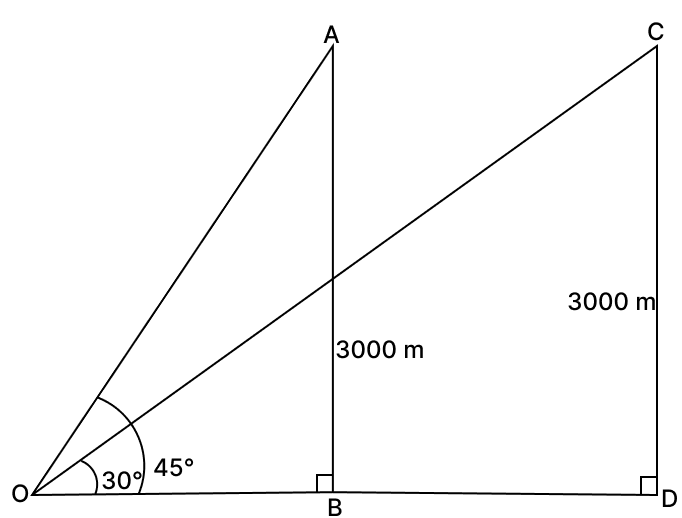
The angle of elevation of an aeroplane from a point on the ground is 45°. After 15 seconds of flight, the elevation changes to 30°. If the aeroplane is flying at a height of 3000 m, the speed of the plane in km per hour is:
152.16
263.5
304.32
527
Answer
Let A be the initial position of aeroplane and height AB = 3000 m, C be the final position and height CD = 3000 m.
O be the point of observation,
In triangle OBA,
⇒tan45∘=OBAB⇒1=OB3000⇒OB=3000 m.
In triangle COD,
⇒tan(30∘)=ODCD⇒31=OD3000⇒OD=30003 m.
The distance the plane flew is,
BD = OD - OB
BD = 3000 3 - 3000
BD = 3000(3 - 1)
BD = 3000(1.732 - 1) = 3000(0.732) = 2196 m.
⇒Speed=TimeDistance⇒Speed=152196⇒Speed=146.4 m/s⇒Speed=146.4×3.6⇒Speed=527.04≈527 km/h.
Hence, option 4 is the correct option.
Question 31 to 34
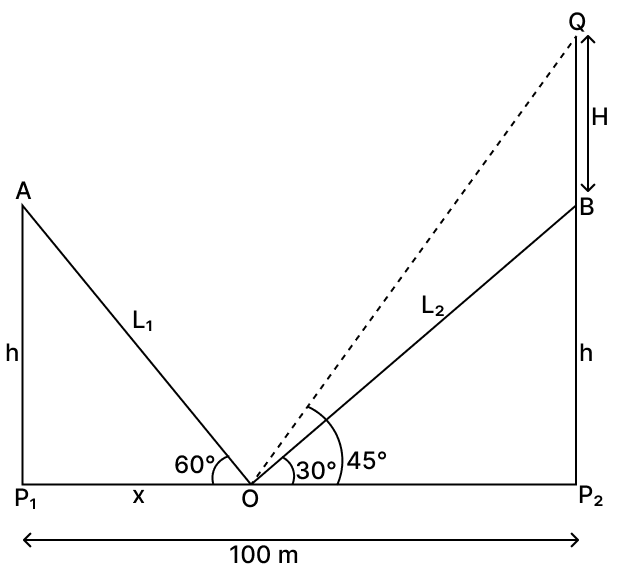
Directions: Two pillars P1 and P2 of equal heights stand on either side of a road which is 100 m wide. At a point on the road between the pillars, the angles of elevation of the tops of the pillars P1 and P2 are 60° and 30° respectively.
Based on this information, answer the following questions:
31. The height of each pillar is: (a) 25 m (b) 36 m (c) 253 m (d) 363 m
32. The location of the point of observation is: (a) 25 m from P1 (b) 25 m from P2 (c) 253 m from P1 (d) 253 m from P2
33. If a hook is fixed at the point of observation and strings are tied from the hook to the tops of both the towers, then the total length of string required is: (a) 43.3 m (b) 86.6 m (c) 68.3 m (d) 136.6 m
34. If a flagstaff is to be erected atop pillar P2 such that the angle of elevation of its top from the point of observation is 45°, then the height of the flagstaff must be: (a) 253 m (b) 50 m (c) 253(3−1) m (d) 25(2−3) m
Answer
31. Let AP1 and BP2 be two pillars of height h.
Let the point of observation be O at distance x from P1.
In triangle OAP1,
⇒tan60∘=xh⇒3=xh⇒x=3h.
In triangle OBP2,
⇒tan(30∘)=100−xh⇒31=100−xh⇒100−x=h3⇒100−3h=h3⇒100=h3+3h⇒100=h(33+1)=34h⇒h=41003=253 m.
Hence, option (c) is the correct option.
32. In triangle OAP1,
⇒tan60∘=xh⇒3=xh⇒x=3h⇒x=3253=25 m
Hence, option (a) is the correct option.
33. Let the length of strings be L1 and L2.
In triangle OAP1,
⇒sin60∘=L1h⇒23=L1253⇒L1=50 m.
In triangle OBP2,
⇒sin(30∘)=L2h⇒21=L2253⇒L2=503=86.6 m.
Total length = 50 + 86.6 = 136.6 m
Hence, option (d) is the correct option.
34. Let H be the height of flagstaff added to P2
Total distance - Distance to P1 = Distance to P2
Distance to P2 = 100 - 25 = 75 m.
Therefore,
⇒tan(45∘)=75H+253⇒1=75H+253⇒75=253+H⇒H=75−253⇒H=253(3−1) m.
Hence, option (c) is the correct option.
Question 35 to 38
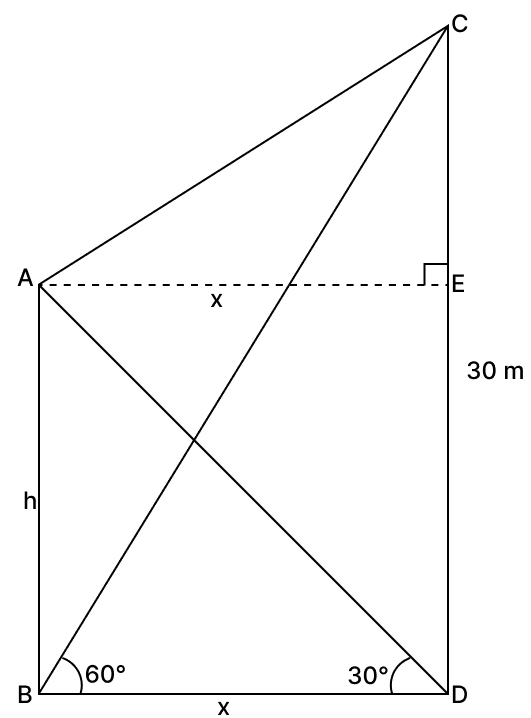
Directions: The angle of elevation of the top of a building from the foot of a tower is 30°. The angle of elevation of the top of the tower from the foot of the building is 60°. The tower is 30 metres high.
Based on this information, answer the following questions:
35.The horizontal distance between the tower and the building is: (a) 10 m (b) 17.3 m (c) 20 m (d) 34.6 m
36.The height of the building is: (a) 10 m (b) 103 m (c) 15 m (d) 153 m
37. The straight line distance between the tops of the tower and the building is: (a) 103 m (b) 105 m (c) 107 m (d) 30 m
38. A bird flew straight from the top of the tower to the foot of the building. What is the distance that the bird flew? (a) 20 m (b) 25 m (c) 203 m (d) 20(3−1) m
Answer
35. Let CD be the height of the tower and h be the height of the building (AB).
Let x (BD) be the horizontal distance between them.
In triangle CDB,
⇒tan60∘=x30⇒3=x30⇒x=330⇒x=3303⇒x=103=17.3 m.
Hence, option (b) is the correct option.
36.In triangle ADB,
⇒tan30∘=xh⇒31=103h⇒h=10 m.
Hence, option (a) is the correct option.
37. In right-angled triangle △AEC at E.
AE = BD = 103 m
CE = CD - AB = 30 - 10 = 20 m
∴ AC2 = AE2 + CE2
AC2 = (103)2 + (20)2
AC2 = 100(3) + 400
AC2 = 300 + 400
AC2 = 700
AC = 700=107 m
Hence, option (c) is the correct option.
38. In triangle CDB,
⇒sin60∘=BCCD⇒23=BC30⇒BC=360⇒BC=3603⇒BC=203 m.
Hence, option (c) is the correct option.
Question 39 to 42
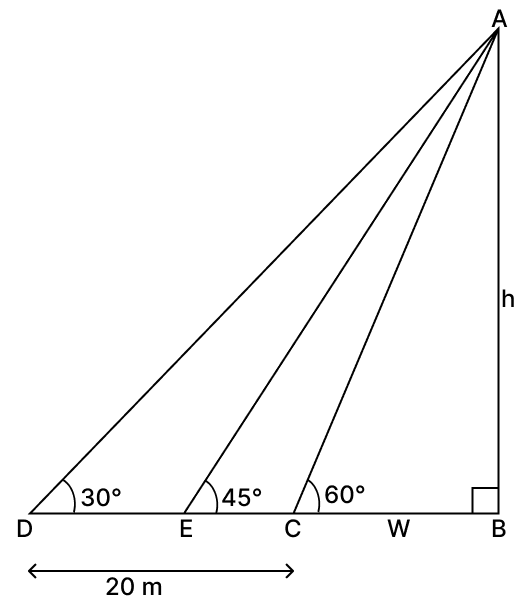
Directions : A TV tower stands vertically on the bank of a canal. From a point on the other bank directly opposite the tower, the angle of elevation of the top of the tower is 60°. From another point 20 m away from this point on the line joining this point to the foot of the tower, the angle of elevation of the top of the tower is 30°.
Based on this information, answer the following questions:
39.The height of the tower is: (a) 10 m (b) 103 m (c) 20 m (d) 203 m
40.The width of the canal is: (a) 10 m (b) 103 m (c) 20 m (d) 203 m
41.The straight line distances of the top of the tower from the two points of observation differ by: (a) 7.32 m (b) 14.64 m (c) 17.32 m (d) 20.64 m
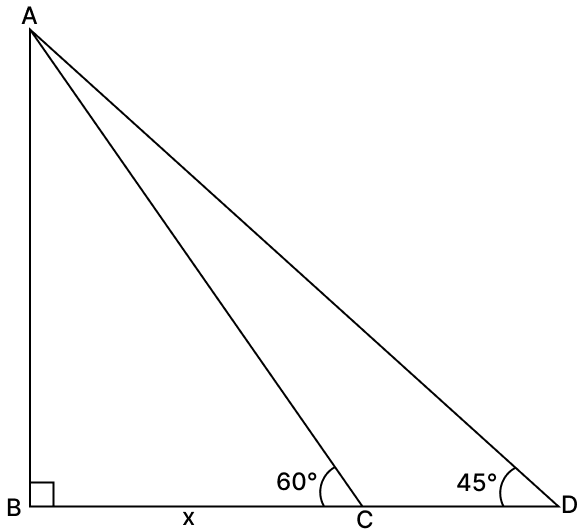
42.How far away from the other bank must the point of observation be, so that the angle of elevation of the top of the tower is 45°? (a) 7.32 m (b) 10 m (c) 14.64 m (d) 27.32 m
Answer
39. Let hbe the height of the tower (AB) and w be width of canal (BC).
Let D be another point 20 m away from C.
In triangle ABC,
⇒tan60∘=wh⇒3=wh⇒w=3h.....(1)
In triangle ADB,
⇒tan30∘=w+20h⇒31=w+20h⇒w+20=h3⇒3h+20=h3⇒3h+203=h3⇒h+203=3h⇒203=2h⇒h=103 m.
Hence, option (b) is the correct option.
40. In triangle ABC,
⇒tan60∘=wh⇒3=wh⇒w=3h⇒w=3103⇒w=10 m.
Hence, option (a) is the correct option.
41. In triangle ABC,
⇒sin60∘=ACh⇒23=AC103⇒AC=20 m.
In triangle ABD,
⇒sin30∘=ADh⇒21=AD103⇒AD=203 m.
The straight line distances of the top of the tower from the two points of observation differ by = AD - AC = 203−20