KnowledgeBoat Logo
|
OPEN IN APP

Chapter 23

Heights & Distances

Class - 10 RS Aggarwal Mathematics Solutions


Exercise 23

Question 1

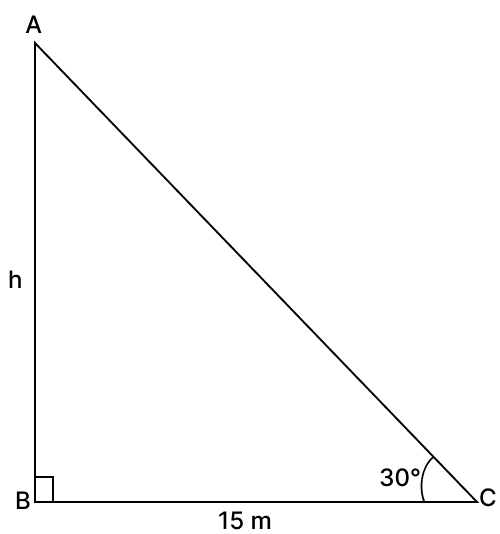
The angle of elevation of the top of a pole from a point on the level ground and 15 m away from the pole is 30°. Find the height of the pole.

Answer

The angle of elevation of the top of a pole from a point on the level ground and 15 m away from the pole is 30°. Find the height of the pole. Volume And Surface Area of solid RSA Mathematics Solutions ICSE Class 10.

Let AB (h) be the height of the pole. Then,

BC = 15 m , ∠ACB = 30°

In triangle ABC,

We know that,

tanθ=Perpendicularbasetan30°=h1513=h15h=153h=151.732h=8.66 m.\Rightarrow \tan \theta = \dfrac{\text{Perpendicular}}{\text{base}} \\[1em] \Rightarrow \tan 30° = \dfrac{h}{15} \\[1em] \Rightarrow \dfrac{1}{\sqrt3} = \dfrac{h}{15} \\[1em] \Rightarrow h = \dfrac{15}{\sqrt3} \\[1em] \Rightarrow h = \dfrac{15}{1.732}\\[1em] \Rightarrow h = 8.66 \text{ m} .

Hence, height of the pole is 8.66 m.

Question 2

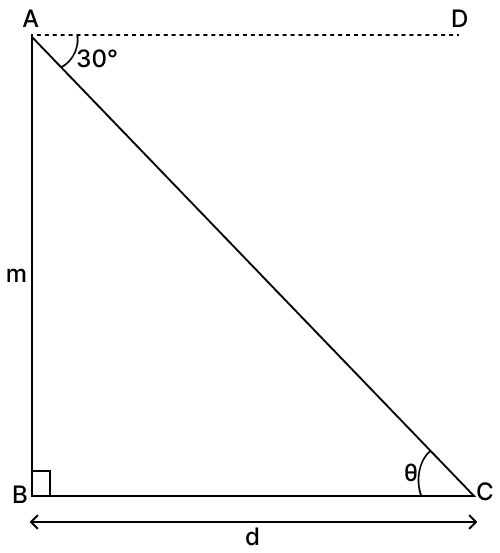
From the top of a cliff, 50 m high, the angle of depression of a buoy is 30°. Calculate to the nearest metre, the distance of the buoy from the foot of the cliff.

Answer

From the top of a cliff, 50 m high, the angle of depression of a buoy is 30°. Calculate to the nearest metre, the distance of the buoy from the foot of the cliff. Volume And Surface Area of solid RSA Mathematics Solutions ICSE Class 10.

Let AB be the cliff.

Let the distance of the buoy from the foot of the cliff be d (BC). Then,

AB (h) = 50 m

From figure,

Angle of Elevation ∠ACB = Angle of Depression ∠CAD = 30° [Alternate interior angles]

In triangle ABC,

We know that,

tanθ=perpendicularbasetan30°=ABBC13=50dd=50×1.732d=86.6 m.\Rightarrow \tan \theta = \dfrac{\text{perpendicular}}{\text{base}} \\[1em] \Rightarrow \tan 30° = \dfrac{AB}{BC} \\[1em] \Rightarrow \dfrac{1}{\sqrt3} = \dfrac{50}{d} \\[1em] \Rightarrow d = 50 \times 1.732 \\[1em] \Rightarrow d = 86.6 \text{ m} .

Hence, the distance of the buoy from the foot of the cliff 86.6 m.

Question 3

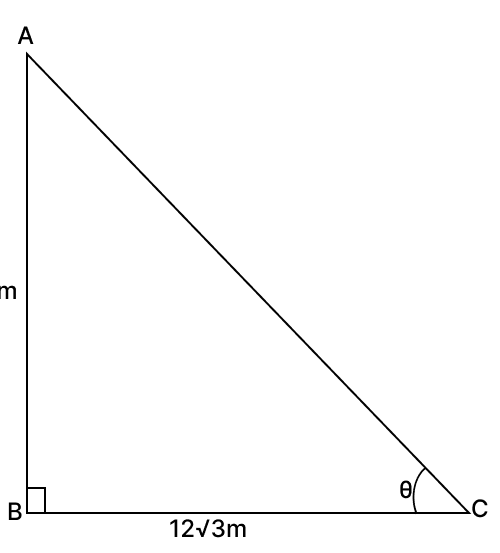
A vertical pole is 12 m high and the length of its shadow is 12312\sqrt{3} m. What is the angle of elevation of the sun?

Answer

A vertical pole is 12 m high and the length of its shadow What is the angle of elevation of the sun?.Volume And Surface Area of solid RSA Mathematics Solutions ICSE Class 10.

Let AB be the height of pole = 12 m.

Length of shadow BC = 12312\sqrt{3} m

In triangle ABC,

tanθ=perpendicularbasetanθ=12123tanθ=13tanθ=tan30°θ=30°.\Rightarrow \tan \theta = \dfrac{\text{perpendicular}}{\text{base}} \\[1em] \Rightarrow \tan \theta = \dfrac{12}{12\sqrt3} \\[1em] \Rightarrow \tan \theta = \dfrac{1}{\sqrt3} \\[1em] \Rightarrow \tan \theta = \tan 30° \\[1em] \Rightarrow \theta = 30°.

Hence, angle of elevation of the sun is 30°.

Question 4

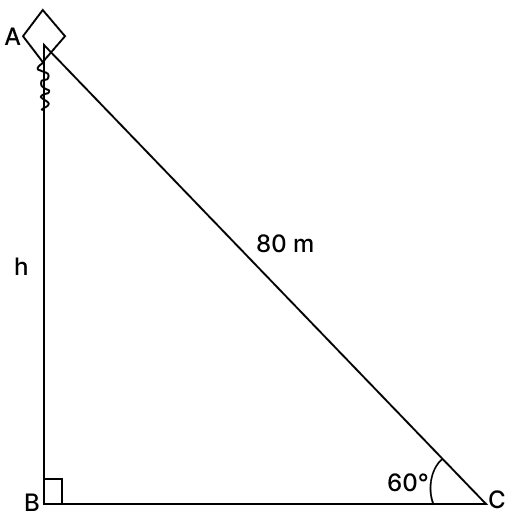
A kite is flying with a thread 80 m long. If the thread is assumed stretched straight and makes an angle of 60° with the horizontal, find the height of the kite above the ground.

Answer

A kite is flying with a thread 80 m long. If the thread is assumed stretched straight and makes an angle of 60° with the horizontal, find the height of the kite above the ground. Volume And Surface Area of solid RSA Mathematics Solutions ICSE Class 10.

Let AC be the length of string = 80 m and height of kite above ground be AB (h).

Angle of elevation = 60°

In triangle ABC,

sinθ=perpendicularhypotenusesin60°=h8032=h80h=80×32h=40×1.732h=69.28 m\Rightarrow \sin \theta = \dfrac{\text{perpendicular}}{\text{hypotenuse}} \\[1em] \Rightarrow \sin 60° = \dfrac{h}{80} \\[1em] \Rightarrow \dfrac{\sqrt3}{2} = \dfrac{h}{80} \\[1em] \Rightarrow h = 80 \times \dfrac{\sqrt3}{2} \\[1em] \Rightarrow h = 40 \times 1.732 \\[1em] \Rightarrow h = 69.28 \text{ m}

Hence, height of the kite above the ground is 69.28 m.

Question 5

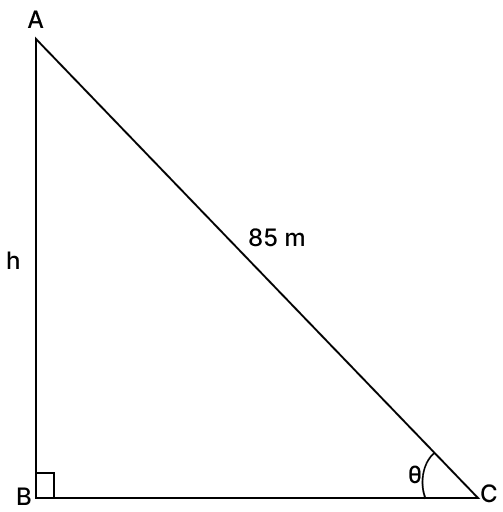
The length of a string between a kite and a point on the ground is 85 m. If the string makes an angle θ with the level ground such that tan θ = (158)\Big(\dfrac{15}{8}\Big), how high is the kite?

Answer

The length of a string between a kite and a point on the ground is 85 m. Volume And Surface Area of solid RSA Mathematics Solutions ICSE Class 10.

Let the required height AB = h metres and length of a string AC = 85 m.

Given,

tan θ = (158)=perpendicularbase\Big(\dfrac{15}{8}\Big) = \dfrac{\text{perpendicular}}{\text{base}}

Let the Height be 15x and Base be 8x.

Hypotenuse = (15x)2+(8x)2\sqrt{(15x)^2 + (8x)^2}

Hypotenuse = 289x2\sqrt{289x^2} = 17x

In triangle ABC,

sinθ=perpendicularhypotenuse=h8515x17x=h851517×85=hh=5×15h=75 m.\Rightarrow \sin \theta = \dfrac{\text{perpendicular}}{\text{hypotenuse}} = \dfrac{h}{85} \\[1em] \Rightarrow \dfrac{15x}{17x} = \dfrac{h}{85} \\[1em] \Rightarrow \dfrac{15}{17} \times 85 = h \\[1em] \Rightarrow h = 5 \times 15 \\[1em] \Rightarrow h = 75 \text{ m}.

Hence, height of kite from ground = 75 m.

Question 6

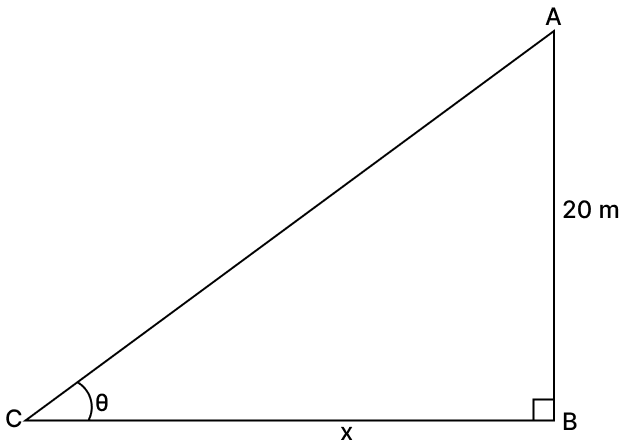
A vertical tower is 20 m high. A man standing at some distance from the tower knows that the cosine of the angle of elevation of the top of the tower is 0.53. How far is he standing from the foot of the tower?

Answer

A vertical tower is 20 m high. A man standing at some distance from the tower knows that the cosine of the angle of elevation of the top of the tower is 0.53. How far is he standing from the foot of the tower? Volume And Surface Area of solid RSA Mathematics Solutions ICSE Class 10.

Given,

cos θ = 0.53

From table of cosines, we have,

θ = 58°

Let AB be the height of tower = 20 m and distance of man form foot of tower be CB = x

In right angled triangle ABC,

tanθ=PerpendicularBasetanθ=(ABCB)tan58°=20x1.6=20xx=201.6x=12.5 m.\Rightarrow \tan \theta = \dfrac{\text{Perpendicular}}{\text{Base}} \\[1em] \Rightarrow \tan \theta = \Big(\dfrac{AB}{CB}\Big) \\[1em] \Rightarrow \tan 58° = \dfrac{20}{x} \\[1em] \Rightarrow 1.6 = \dfrac{20}{x} \\[1em] \Rightarrow x = \dfrac{20}{1.6} \\[1em] \Rightarrow x = 12.5 \text{ m}.

Hence, distance of man form foot of tower is 12.5 m.

Question 7

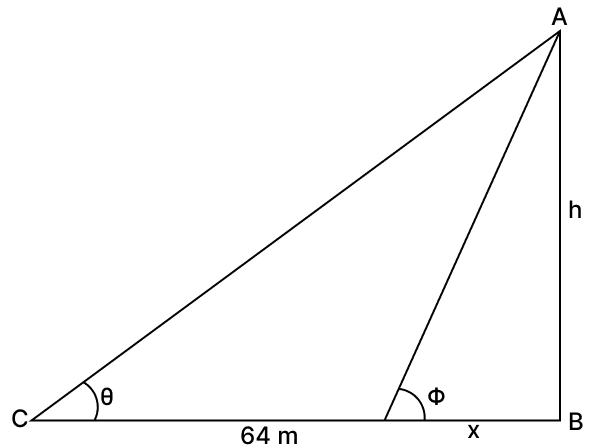
At a point on a level ground, the angle of elevation of the top of a tower is θ such that tan θ = (712)\Big(\dfrac{7}{12}\Big). On walking 64 m towards the tower, the angle of elevation is φ, where tan φ = (34)\Big(\dfrac{3}{4}\Big). Find the height of the tower.

Answer

At a point on a level ground, the angle of elevation of the top of a tower is θ such that tan θ. Volume And Surface Area of solid RSA Mathematics Solutions ICSE Class 10.

Let h be the height of the tower (AB), x be the distance from foot of tower to second observation D,

Since the man walked 64 m towards the tower, the distance from C to the tower is (x + 64) m.

In right angled triangle ABD,

tanϕ=perpendicularbase=hx34=hxx=4h3.\Rightarrow \tan \phi = \dfrac{\text{perpendicular}}{\text{base}} = \dfrac{h}{x} \\[1em] \Rightarrow \dfrac{3}{4} = \dfrac{h}{x} \\[1em] \Rightarrow x = \dfrac{4h}{3}.

In right angled triangle ABC,

tanθ=perpendicularbase=hx+64712=hx+64712=h(4h3)+647×(4h3+64)=12h(28h3+448)=12h28h+1344=36h1344=36h28h1344=8hh=13448h=168 m.\Rightarrow \tan \theta = \dfrac{\text{perpendicular}}{\text{base}} = \dfrac{h}{x + 64} \\[1em] \Rightarrow \dfrac{7}{12} = \dfrac{h}{x + 64} \\[1em] \Rightarrow \dfrac{7}{12} = \dfrac{h}{\Big(\dfrac{4h}{3}\Big) + 64} \\[1em] \Rightarrow 7 \times \Big(\dfrac{4h}{3} + 64\Big) = 12h \\[1em] \Rightarrow \Big(\dfrac{28h}{3} + 448\Big) = 12h \\[1em] \Rightarrow 28h+ 1344 = 36h \\[1em] \Rightarrow 1344 = 36h - 28h \\[1em] \Rightarrow 1344 = 8h \\[1em] \Rightarrow h = \dfrac{1344}{8} \\[1em] \Rightarrow h = 168 \text{ m}.

Hence, height of the tower is 168 m.

Question 8

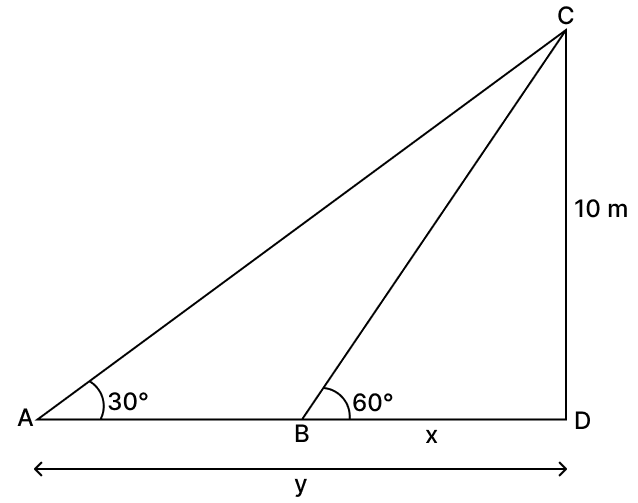
From two points A and B on the same side of a building, the angles of elevation of the top of the building are 30° and 60° respectively. If the height of the building is 10 m, find the distance between A and B, correct to two decimal places.

Answer

From two points A and B on the same side of a building, the angles of elevation of the top of the building are 30° and 60° respectively. If the height of the building is 10 m, find the distance between A and B, correct to two decimal places. Volume And Surface Area of solid RSA Mathematics Solutions ICSE Class 10.

Let the height of the building be CD = 10 m,

Let the distance from the base of the building to point B be x and point A be y.

In right angled triangle CBD,

tanθ=perpendicularbasetan60°=CDBD3=10xx=103.\Rightarrow \tan \theta = \dfrac{\text{perpendicular}}{\text{base}} \\[1em] \Rightarrow \tan 60° = \dfrac{CD}{BD} \\[1em] \Rightarrow \sqrt{3} = \dfrac{10}{x} \\[1em] \Rightarrow x = \dfrac{10}{\sqrt3}.

In right angled triangle CBD,

tan30°=CDAD13=10yy=103.\Rightarrow \tan 30° = \dfrac{CD}{AD} \\[1em] \Rightarrow \dfrac{1}{\sqrt{3}} = \dfrac{10}{y} \\[1em] \Rightarrow y = 10\sqrt{3}.

The distance between the two points is the difference between their distances from the tower (y - x):

AB=yxAB=103103AB=30103AB=203AB=201.732AB=11.54711.55 m.\Rightarrow AB = y - x \\[1em] \Rightarrow AB = 10\sqrt3 - \dfrac{10}{\sqrt3} \\[1em] \Rightarrow AB = \dfrac{30 - 10}{\sqrt3} \\[1em] \Rightarrow AB = \dfrac{20}{\sqrt3} \\[1em] \Rightarrow AB = \dfrac{20}{1.732} \\[1em] \Rightarrow AB = 11.547 \approx 11.55 \text{ m}.

Hence, the distance between A and B is 11.55 m.

Question 9

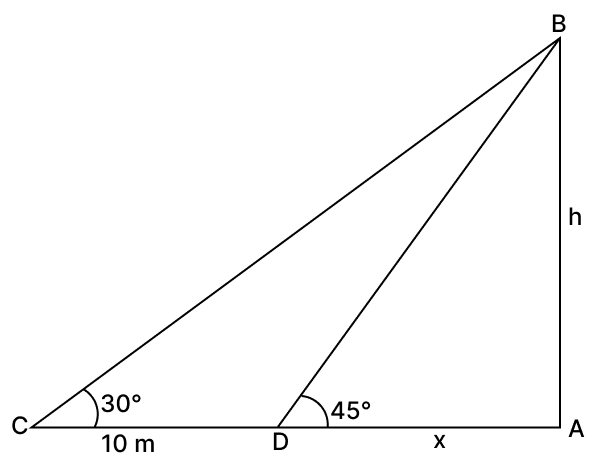
The shadow of a vertical tower AB on level ground is increased by 10 m, when the altitude of the sun changes from 45° to 30°, as shown in the figure. Find the height of the tower and give your answer correct to (110)\Big(\dfrac{1}{10}\Big) of a metre.

The shadow of a vertical tower AB on level ground is increased by 10 m, when the altitude of the sun changes from 45° to 30°, as shown in the figure. Volume And Surface Area of solid RSA Mathematics Solutions ICSE Class 10.

Answer

Given,

The height of the tower AB = h metres and the length of its shadow = x metres when the sun's altitude is 45°. When the sun's altitude is 30°, then the length of shadow of tower is 10 m longer, i.e., BA = h meters, AD = x meters and CD = 10 metres.

From right angled △ABD, we get

tan45°=BAAD1=hxh=x\Rightarrow \tan 45° = \dfrac{BA}{AD} \\[1em] \Rightarrow 1 = \dfrac{h}{x} \\[1em] \Rightarrow h = x

From right angled △BCA, we get

tan30°=BACA13=hCD+AD13=h10+x13=h10+h[h=x]10+h=3h10=3hh10=h(1.7321)10=0.732hh=100.732h=13.6613.7 m.\Rightarrow \tan 30° = \dfrac{BA}{CA} \\[1em] \Rightarrow \dfrac{1}{\sqrt{3}} = \dfrac{h}{CD + AD} \\[1em] \Rightarrow \dfrac{1}{\sqrt{3}} = \dfrac{h}{10 + x} \\[1em] \Rightarrow \dfrac{1}{\sqrt{3}} = \dfrac{h}{10 + h} [\because h = x] \\[1em] \Rightarrow 10 + h = \sqrt3h \\[1em] \Rightarrow 10 = \sqrt3h - h \\[1em] \Rightarrow 10 = h(1.732 - 1) \\[1em] \Rightarrow 10 = 0.732h \\[1em] \Rightarrow h = \dfrac{10}{0.732} \\[1em] \Rightarrow h = 13.66 \approx 13.7 \text{ m}.

Hence, the height of the tower is 13.7 m.

Question 10

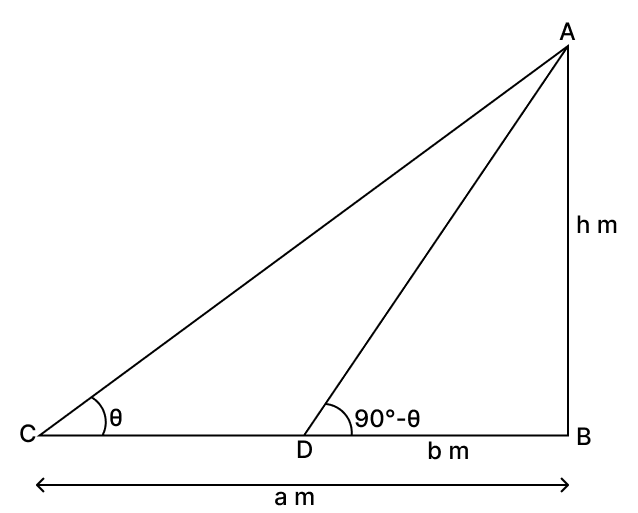
The angles of elevation of the top of a tower from two points on the ground at distances a metres and b metres from the base of the tower and in the same straight line with it are complementary. Prove that the height of the tower is ab\sqrt{ab} metres.

Answer

Given,

AB is the tower of height h meters, BC = a meters and BD = b meters.

The angles of elevation of the top of a tower from two points on the ground at distances a metres and b metres from the base of the tower and in the same straight line with it are complementary. Volume And Surface Area of solid RSA Mathematics Solutions ICSE Class 10.

From figure,

In △ABD,

tan(90°θ)=ABBDtan(90°θ)=hbcotθ=hb....(1) In △ABC,tanθ=perpendicularbasetanθ=ABBCtanθ=ha.....(2)\Rightarrow \tan (90° - \theta) = \dfrac{AB}{BD} \\[1em] \Rightarrow \tan (90° - \theta) = \dfrac{h}{b} \\[1em] \Rightarrow \cot \theta = \dfrac{h}{b}....(1) \\[1em] \text{ In △ABC,} \\[1em] \Rightarrow \tan \theta = \dfrac{\text{perpendicular}}{\text{base}} \\[1em] \Rightarrow \tan \theta = \dfrac{AB}{BC} \\[1em] \Rightarrow \tan \theta = \dfrac{h}{a}.....(2)

Multiplying (1) by (2) we get,

tanθcotθ=ha×hbsinθcosθ×cosθsinθ=h2ab1=h2abh2=abh=ab.\Rightarrow \tan \theta \cot \theta = \dfrac{h}{a} \times \dfrac{h}{b} \\[1em] \Rightarrow \dfrac{\sin \theta}{\cos \theta} \times \dfrac{\cos \theta}{\sin \theta} = \dfrac{h^2}{ab} \\[1em] \Rightarrow 1 = \dfrac{h^2}{ab} \\[1em] \Rightarrow h^2 = ab \\[1em] \Rightarrow h = \sqrt{ab}.

Hence, proved that h = ab\sqrt{ab} meters.

Question 11

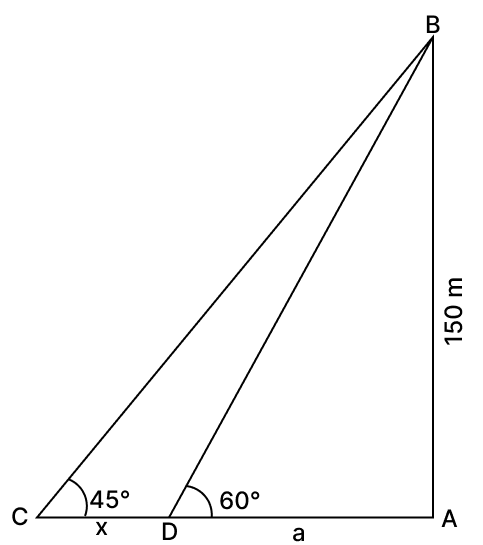
A man in a boat rowing away from a lighthouse, 150 m high, takes 1.5 minutes to change the angle of elevation of the top of the lighthouse from 60° to 45°. Find the speed of the boat.

Answer

Let man in the boat be originally at point D and after 1.5 minutes it reaches the point C and AB be the lighthouse.

A man in a boat rowing away from a lighthouse, 150 m high, takes 1.5 minutes to change the angle of elevation of the top of the lighthouse from 60° to 45°. Find the speed of the boat. Volume And Surface Area of solid RSA Mathematics Solutions ICSE Class 10.

AB = 150 meters.

In △ABD,

tan60°=BAAD3=150aa=1503×33a=15033a=503 meters.\Rightarrow \tan 60° = \dfrac{\text{BA}}{AD} \\[1em] \Rightarrow \sqrt3 = \dfrac{150}{a} \\[1em] \Rightarrow a = \dfrac{150}{\sqrt3} \times \dfrac{\sqrt3}{\sqrt3} \\[1em] \Rightarrow a = \dfrac{150\sqrt3}{3} \\[1em] \Rightarrow a = 50\sqrt3 \text{ meters.}

In △ABC,

tan45°=BAAC1=150a+xa+x=150 meters.\Rightarrow \tan 45° = \dfrac{BA}{AC} \\[1em] \Rightarrow 1 = \dfrac{150}{a + x} \\[1em] \Rightarrow a + x = 150 \text{ meters.}

⇒ x = 150 - a

= 150 - 50 3\sqrt3

= 150 - 86.6

= 63.4 meters.

In 1.5 minutes boat covers 63.4 meters or boat covers 63.4 meters in 90 seconds.

 speed=Distancetime=63.490\text{ speed} = \dfrac{\text{Distance}}{\text{time}} = \dfrac{63.4}{90} = 0.70 m/sec.

Hence, the speed of boat = 0.70 m/sec.

Question 12

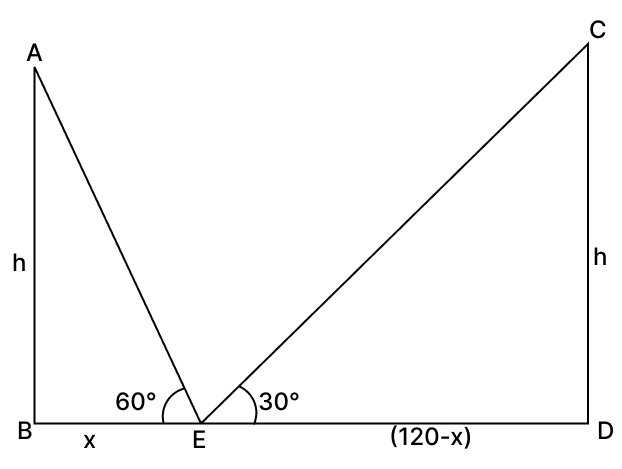
Two pillars of equal heights stand on either side of a roadway, which is 120 m wide. At a point on the road lying between the pillars, the elevations of the pillars are 60° and 30° respectively. Find the height of each pillar and the position of the point.

Answer

Given,

AB and CD are the two towers of height h meters. E is a point in the roadway BD such that BD = 120 m, ∠AEB = 60° and ∠CED = 30°.

Two pillars of equal heights stand on either side of a roadway, which is 120 m wide. At a point on the road lying between the pillars, the elevations of the pillars are 60° and 30° respectively. Find the height of each pillar and the position of the point. Volume And Surface Area of solid RSA Mathematics Solutions ICSE Class 10.

In ∆ABE,

tan60°=ABBE3=hBEBE=h3BE=h3 .....(1)\Rightarrow \tan 60° = \dfrac{AB}{BE} \\[1em] \Rightarrow \sqrt3 = \dfrac{h}{BE} \\[1em] \Rightarrow BE = \dfrac{h}{\sqrt3} \\[1em] \Rightarrow BE = \dfrac{h}{\sqrt3} \text{ .....(1)}

In △CDE,

tan30°=CDED13=CDEDED=3CDED=3h ....(2)\Rightarrow \tan 30° = \dfrac{CD}{ED} \\[1em] \Rightarrow \dfrac{1}{\sqrt3} = \dfrac{CD}{ED} \\[1em] \Rightarrow ED = \sqrt3CD \\[1em] \Rightarrow ED = \sqrt3h \text{ ....(2)}

We know that,

⇒ BD = 120 m

⇒ BE + ED = 120 m

From (1) and (2), we get :

h3+3h=120h+3h3=1204h3=1204h=1203h=120×1.7324h=51.96 meters\Rightarrow \dfrac{h}{\sqrt3} + \sqrt{3}h = 120 \\[1em] \Rightarrow \dfrac{h + 3h}{\sqrt3} = 120 \\[1em] \Rightarrow \dfrac{4h}{\sqrt3} = 120 \\[1em] \Rightarrow 4h = 120\sqrt3 \\[1em] \Rightarrow h = \dfrac{120 \times 1.732}{4} \\[1em] \Rightarrow h = 51.96 \text{ meters}

From equation (1),

BE=h3=51.961.732BE = \dfrac{h}{\sqrt3} = \dfrac{51.96}{1.732} = 30 meters.

Hence, height of each pillar is 51.96 m and the point E is 30 m from the pillar AB.

Question 13

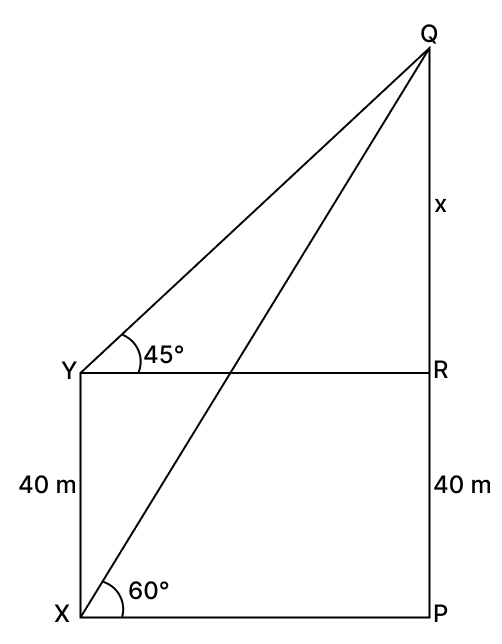
The angle of elevation of the top Q of a vertical tower PQ from a point X on the ground is 60°. At a point Y, 40 m vertically above X, the angle of elevation is 45°. Find the height of tower PQ and the distance XQ.

Answer

Given,

The angle of elevation of the top Q of a vertical tower PQ from a point X on the ground is 60°. At a point Y, 40 m vertically above X, the angle of elevation is 45°. Find the height of tower PQ and the distance XQ. Volume And Surface Area of solid RSA Mathematics Solutions ICSE Class 10.

XY = 40 m

⇒ PQ = h (let)

⇒ ∠PXQ = 60° and ∠RYQ = 45°

⇒ RP = XY = 40 m and RQ = PQ - RP = h - 40

In △RYQ,

tan45°=RQRY1=h40RYRY=h40.\Rightarrow \tan 45° = \dfrac{RQ}{RY} \\[1em] \Rightarrow 1 = \dfrac{h - 40}{RY} \\[1em] \Rightarrow RY = h - 40.

From figure,

PX = RY = h - 40

In △PXQ,

tan60°=PQPX3=hh40h3403=hh3h=403h=403(31)h=403(31)×(3+1)(3+1)h=403(3+1)(31)h=403(3+1)2h=203(3+1)h=60+20×3h=60+20×1.73h=60+34.6h=94.6 m\Rightarrow \tan 60° = \dfrac{PQ}{PX} \\[1em] \Rightarrow \sqrt3 = \dfrac{h}{h - 40} \\[1em] \Rightarrow h\sqrt3 - 40\sqrt3 = h \\[1em] \Rightarrow h\sqrt3 - h = 40\sqrt3 \\[1em] \Rightarrow h = \dfrac{40\sqrt3}{(\sqrt3 - 1)} \\[1em] \Rightarrow h = \dfrac{40\sqrt3}{(\sqrt3 - 1)} \times \dfrac{(\sqrt3 + 1)}{(\sqrt3 + 1)} \\[1em] \Rightarrow h = \dfrac{40\sqrt3(\sqrt3 + 1)}{(3 - 1)} \\[1em] \Rightarrow h = \dfrac{40\sqrt3(\sqrt3 + 1)}{2} \\[1em] \Rightarrow h = 20\sqrt3(\sqrt3 + 1) \\[1em] \Rightarrow h = 60 + 20 \times \sqrt3 \\[1em] \Rightarrow h = 60 + 20 \times 1.73 \\[1em] \Rightarrow h = 60 + 34.6 \\[1em] \Rightarrow h = 94.6 \text{ m}

In △QPX,

sin60°=PQXQ32=PQXQXQ=2PQ3XQ=2h3XQ=2×94.643XQ=189.281.732XQ=109.28 m.\Rightarrow \sin 60° = \dfrac{PQ}{XQ} \\[1em] \Rightarrow \dfrac{\sqrt3}{2} = \dfrac{PQ}{XQ} \\[1em] \Rightarrow XQ = \dfrac{2PQ}{\sqrt{3}} \\[1em] \Rightarrow XQ = \dfrac{2h}{\sqrt{3}} \\[1em] \Rightarrow XQ = \dfrac{2 \times 94.64}{\sqrt3}\\[1em] \Rightarrow XQ = \dfrac{189.28}{1.732}\\[1em] \Rightarrow XQ = 109.28 \text{ m}.

Hence, height of tower PQ is 94.64 and XQ = 109.28 m.

Question 14

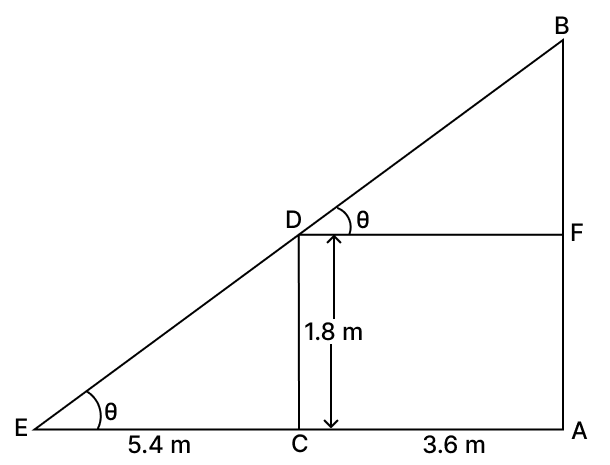
A man 1.8 m tall stands at a distance of 3.6 m from a lamp post and casts a shadow of 5.4 m on the ground. Find the height of the lamp post.

Answer

Given,

A man 1.8 m tall stands at a distance of 3.6 m from a lamp post and casts a shadow of 5.4 m on the ground. Find the height of the lamp post. Volume And Surface Area of solid RSA Mathematics Solutions ICSE Class 10.

AB is the lamp post and CD is the height of man and CE is the shadow of the man.

CE || DB.

Take AB = x and CD = 1.8 m

FA = CD = 1.8 m

DF = CA = 3.6 m

BF = AB - FA = (x - 1.8) m

Shadow (EC) = 5.4 m

Considering right angled △BDF, we get :

tanθ=BFDFtanθ=x1.83.6 ....(1)\Rightarrow \tan \theta = \dfrac{BF}{DF} \\[1em] \Rightarrow \tan \theta = \dfrac{x - 1.8}{3.6} \text{ ....(1)}

Considering right angled △DCE, we get :

tanθ=CDECtanθ=1.85.4=13 ....(2)\Rightarrow \tan \theta = \dfrac{CD}{EC} \\[1em] \Rightarrow \tan \theta = \dfrac{1.8}{5.4} = \dfrac{1}{3} \text{ ....(2)}

Comparing Eq 1 and Eq 2 we get,

x1.83.6=133x5.4=3.63x=5.4+3.63x=9x=3.\Rightarrow \dfrac{x - 1.8}{3.6} = \dfrac{1}{3} \\[1em] \Rightarrow 3x - 5.4 = 3.6 \\[1em] \Rightarrow 3x = 5.4 + 3.6 \\[1em] \Rightarrow 3x = 9 \\[1em] \Rightarrow x = 3.

Hence, the height of the lamp post is 3 meters.

Question 15

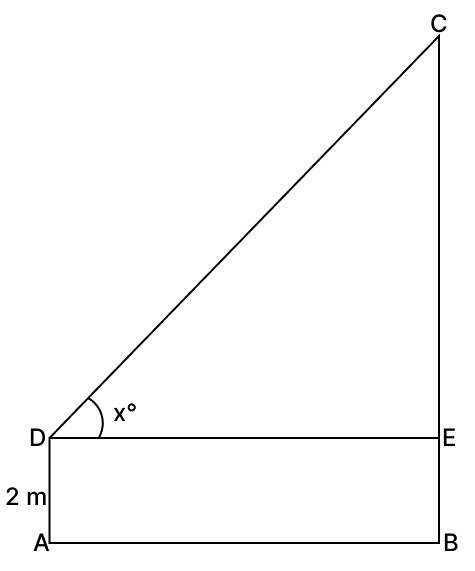
In the adjoining figure, a man stands on the ground at a point A, which is on the same horizontal plane as B, the foot of the vertical pole BC. The height of the pole is 10 m. The man’s eye is 2 m above the ground. He observes the angle of elevation of C, the top of the pole, as x°, where tan x° = (25)\Big(\dfrac{2}{5}\Big). Calculate the distance AB in metres.

In the adjoining figure, a man stands on the ground at a point A, which is on the same horizontal plane as B, the foot of the vertical pole BC. The height of the pole is 10 m. Volume And Surface Area of solid RSA Mathematics Solutions ICSE Class 10.

Answer

Let's take AD to be the height of the man, AD = 2 m.

From figure, BE = AD = 2 m.

Also,

CE = BC - BE = (10 - 2) = 8 m.

In ΔCED,

tanθ=perpendicularbasetanx=CEDE25=8DEDE=8×52DE=402DE=20 m.\Rightarrow \tan \theta = \dfrac{perpendicular}{\text{base}} \\[1em] \Rightarrow \tan x^{\circ} = \dfrac{CE}{DE} \\[1em] \Rightarrow \dfrac{2}{5} = \dfrac{8}{DE} \\[1em] \Rightarrow DE = \dfrac{8 \times 5}{2} \\[1em] \Rightarrow DE = \dfrac{40}{2} \\[1em] \Rightarrow DE = 20 \text{ m.}

From figure,

AB = DE = 20 m.

Hence, AB = 20 m.

Question 16

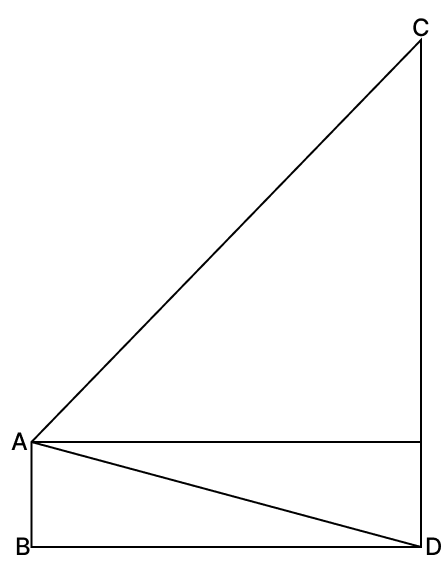
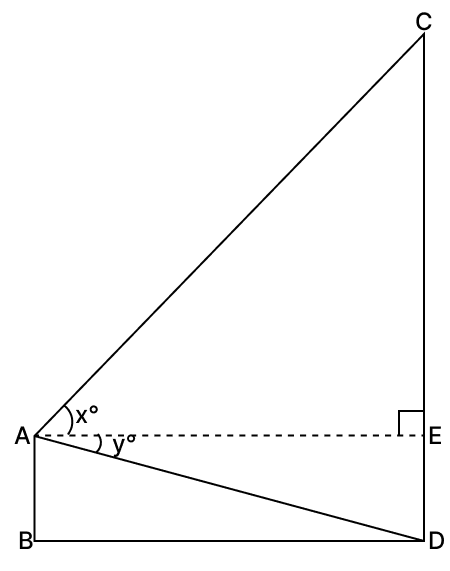
From a window A, 10 m above the ground, the angle of elevation of the top C of a tower is x°, where tan x = (52)\Big(\dfrac{5}{2}\Big) and the angle of depression of the foot D of the tower is y°, where tan y = (14)\Big(\dfrac{1}{4}\Big).

See the figure given alongside. Calculate the height CD of the tower in metres.

From a window A, 10 m above the ground, the angle of elevation of the top C of a tower is x°, where tan x. Volume And Surface Area of solid RSA Mathematics Solutions ICSE Class 10.

Answer

From a window A, 10 m above the ground, the angle of elevation of the top C of a tower is x°, where tan x. Volume And Surface Area of solid RSA Mathematics Solutions ICSE Class 10.

⇒ AB = DE = 10 m.

In ∆AED,

tany=perpendicularbasetany=DEAE14=DEAEAE=4DEAE=4×10AE=40 m.\Rightarrow \tan y^{\circ} = \dfrac{\text{perpendicular}}{\text{base}} \\[1em] \Rightarrow \tan y^{\circ} = \dfrac{DE}{AE} \\[1em] \Rightarrow \dfrac{1}{4} = \dfrac{DE}{AE} \\[1em] \Rightarrow AE = 4DE \\[1em] \Rightarrow AE = 4 \times 10 \\[1em] \Rightarrow AE = 40 \text{ m}.

In ∆AEC,

tanx=perpendicularbasetanx=CEAE52=CEAECE=52AECE=52×40CE=100 m.\Rightarrow \tan x^{\circ} = \dfrac{\text{perpendicular}}{\text{base}} \\[1em] \Rightarrow \tan x^{\circ} = \dfrac{CE}{AE} \\[1em] \Rightarrow \dfrac{5}{2} = \dfrac{CE}{AE} \\[1em] \Rightarrow CE = \dfrac{5}{2}AE \\[1em] \Rightarrow CE = \dfrac{5}{2} \times 40 \\[1em] \Rightarrow CE = 100 \text{ m.}

From figure,

CD = DE + CE = 10 + 100 = 110 m.

Hence, height of tower (CD) = 110 m.

Question 17

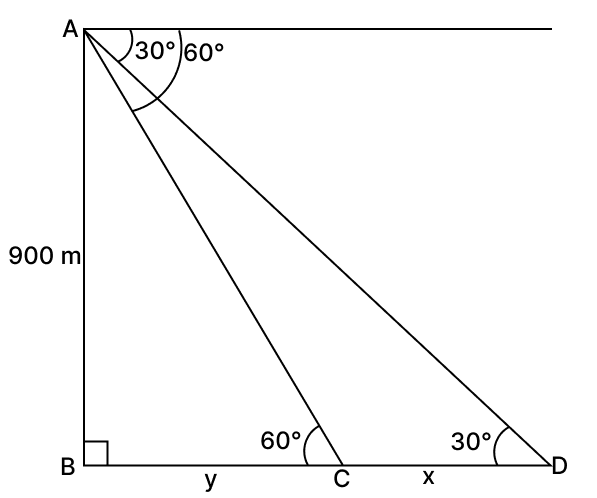
An aeroplane at an altitude of 900 m finds that two ships are sailing towards it in the same direction. The angles of depression of the ships, as observed from the plane, are 60° and 30° respectively. Find the distance between the ships.

Answer

An aeroplane at an altitude of 900 m finds that two ships are sailing towards it in the same direction. The angles of depression of the ships, as observed from the plane, are 60° and 30° respectively. Find the distance between the ships. Volume And Surface Area of solid RSA Mathematics Solutions ICSE Class 10.

Let A be the position of the aeroplane and B be the point on the sea surface vertically below the plane.

Let C and D be the positions of the two ships.

Let AB be the altitude of the aeroplane = 900 m

BC = y meters and CD = x meters

In ∆ABC,

tan60=perpendicularbase=ABBC3=900yy=9003y=9003×33y=3003 m .......(1)\Rightarrow \tan 60^{\circ} = \dfrac{\text{perpendicular}}{\text{base}} = \dfrac{AB}{BC} \\[1em] \Rightarrow \sqrt3 = \dfrac{900}{y} \\[1em] \Rightarrow y = \dfrac{900}{\sqrt3} \\[1em] \Rightarrow y = \dfrac{900}{\sqrt3} \times \dfrac{\sqrt3}{\sqrt3} \\[1em] \Rightarrow y = 300\sqrt3 \text{ m .......(1)}

In ∆ABD,

tan30=perpendicularbase=ABBD13=900x+yx+y=9003 m .............(2)\Rightarrow \tan 30^{\circ} = \dfrac{\text{perpendicular}}{\text{base}} = \dfrac{AB}{BD} \\[1em] \Rightarrow \dfrac{1}{\sqrt3} = \dfrac{900}{x + y} \\[1em] \Rightarrow x + y = 900\sqrt3 \text{ m .............(2)}

Subtracting equation (1) from (2), we get :

(x + y) - y = 90033003900\sqrt3 - 300\sqrt3

x = 6003600\sqrt3

x = 600(1.732)

x = 1039.20 m.

Hence, the distance between the ships = 1039.20 m

Question 18

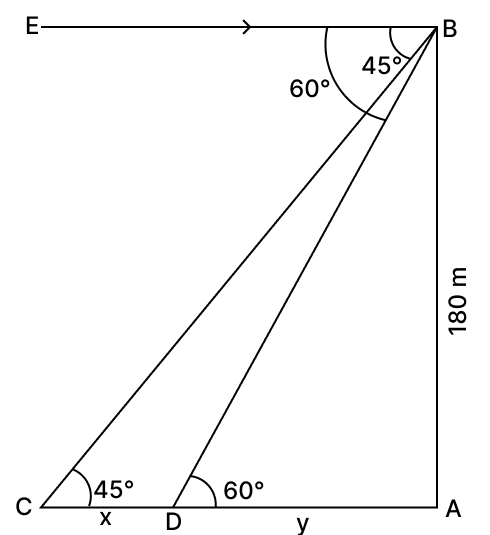
In the given figure, AB is a tower and two objects C and D are located on the ground on the same side of AB. When observed from the top B of the tower, their angles of depression are 45° and 60° respectively. Find the distance between the objects, if the height of the tower is 180 m.

In the given figure, AB is a tower and two objects C and D are located on the ground on the same side of AB. When observed from the top B of the tower, their angles of depression are 45° and 60° respectively. Find the distance between the objects, if the height of the tower is 180 m. Volume And Surface Area of solid RSA Mathematics Solutions ICSE Class 10.

Answer

Considering right angled △ABC, we get

tan45=PerpendicularBase=ABAC1=180ACAC=180 m\Rightarrow \tan 45^{\circ} = \dfrac{\text{Perpendicular}}{\text{Base}} = \dfrac{AB}{AC} \\[1em] \Rightarrow 1 = \dfrac{180}{AC} \\[1em] \Rightarrow AC = 180 \text{ m}

Considering right angled △ADB, we get

tan60=PerpendicularBase=ABAD3=180ADAD=1803AD=103.92 m.\Rightarrow \tan 60^{\circ} = \dfrac{\text{Perpendicular}}{\text{Base}} = \dfrac{AB}{AD} \\[1em] \Rightarrow \sqrt{3} = \dfrac{180}{AD} \\[1em] \Rightarrow AD = \dfrac{180}{\sqrt{3}} \\[1em] \Rightarrow AD = 103.92 \text{ m.}

Distance between two objects (CD) = CA - DA = 180 - 103.92 = 76.08 m

Hence,the distance between two objects = 76.08 meters.

Question 19

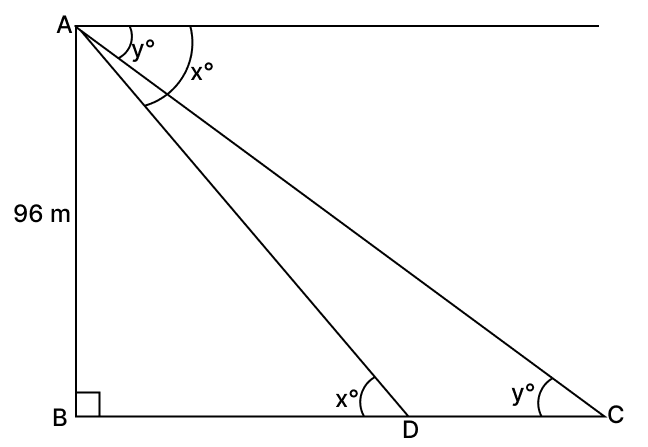
From the top of a church spire 96 m high, the angles of depression of two vehicles on a road, at the same level as the base of the spire and on the same side of it are x° and y°, where tan x° = (14)\Big(\dfrac{1}{4}\Big) and tan y° = (17)\Big(\dfrac{1}{7}\Big). Calculate the distance between the vehicles.

Answer

From the top of a church spire 96 m high, the angles of depression of two vehicles on a road, at the same level as the base of the spire and on the same side of it are x° and y°, where tan x°. Volume And Surface Area of solid RSA Mathematics Solutions ICSE Class 10.

Let AB be the height of church = 96 m.

Hence, the angle of elevation of the first vehicle at position D to the top of the church is x° and that of the second vehicle at position C is y°.

Considering right angled △ABD, we get

tanx=perpendicularbase=ABBD14=96BDBD=96×4BD=384 m.\Rightarrow \tan x^{\circ} = \dfrac{\text{perpendicular}}{\text{base}} = \dfrac{AB}{BD} \\[1em] \Rightarrow \dfrac{1}{4} = \dfrac{96}{BD} \\[1em] \Rightarrow BD = 96 \times 4 \\[1em] \Rightarrow BD = 384 \text{ m.}

Considering right angled △ABC, we get

tany=perpendicularbase=ABBC17=96BCBC=96×7BC=672 m.\Rightarrow \tan y^{\circ} = \dfrac{\text{perpendicular}}{\text{base}} = \dfrac{AB}{BC} \\[1em] \Rightarrow \dfrac{1}{7} = \dfrac{96}{BC} \\[1em] \Rightarrow BC = 96 \times 7 \\[1em] \Rightarrow BC = 672 \text{ m.}

The distance between the vehicles = 672 m - 384 m = 288 m.

Hence, distance between the vehicles is 288 m.

Question 20

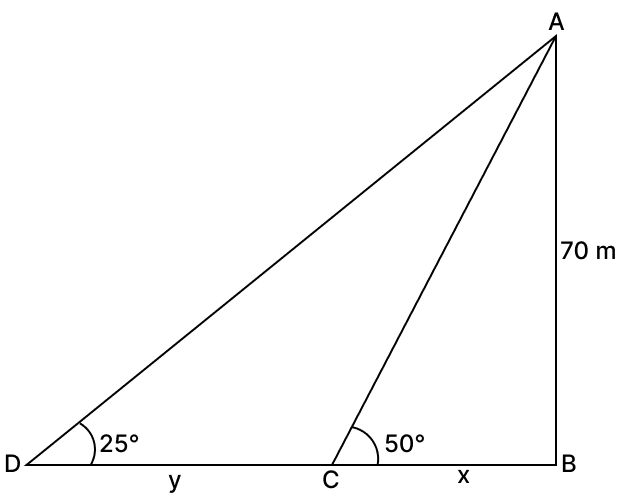
Two men standing on the same side of a tower in a straight line with it, measure the angles of elevation of the top of the tower as 25° and 50° respectively. If the height of the tower is 70 m, find the distance between the two men.

Answer

Two men standing on the same side of a tower in a straight line with it, measure the angles of elevation of the top of the tower as 25° and 50° respectively. If the height of the tower is 70 m, find the distance between the two men. Volume And Surface Area of solid RSA Mathematics Solutions ICSE Class 10.

From figure,

CD is the distance between two persons.

In △ABC, we get

tan50=perpendicularbase=ABBCtan50=70xx=70tan50x=701.1917x=58.74 m.\Rightarrow \tan 50^{\circ} = \dfrac{\text{perpendicular}}{\text{base}} = \dfrac{AB}{BC} \\[1em] \Rightarrow \tan 50^{\circ} = \dfrac{70}{x} \\[1em] \Rightarrow x = \dfrac{70}{\tan 50^{\circ}} \\[1em] \Rightarrow x = \dfrac{70}{1.1917} \\[1em] \Rightarrow x = 58.74 \text{ m.}

In △ABD, we get

tan25=Perpendicularbase=ABBDtan25=70x+yx+y=700.4663x+y=150.12 m.\Rightarrow \tan 25^{\circ} = \dfrac{\text{Perpendicular}}{\text{base}} = \dfrac{AB}{BD} \\[1em] \Rightarrow \tan 25^{\circ} = \dfrac{70}{x + y} \\[1em] \Rightarrow x + y = \dfrac{70}{0.4663} \\[1em] \Rightarrow x + y = 150.12 \text{ m.}

CD = BD - BC = (x + y) - x = 150.12 - 58.74 = 91.38 m.

Hence, distance between the two men is 91.38 m.

Question 21

In the given figure, AB represents a pole and CD represents a 60 m high tower, both of which are standing on the same horizontal plane. From the top of the tower, the angles of depression of the top and the foot of the pole are 30° and 60° respectively. Calculate:

(i) the horizontal distance between the pole and the tower,

(ii) the height of the pole.

Answer

(i) Given,

In the given figure, AB represents a pole and CD represents a 60 m high tower, both of which are standing on the same horizontal plane. From the top of the tower, the angles of depression of the top and the foot of the pole are 30° and 60° respectively. Calculate: Volume And Surface Area of solid RSA Mathematics Solutions ICSE Class 10.

Height of the tower CD = 60 m

Angle of depression to the foot of pole (A) = 60°

Angle of depression to the top of pole (B) = 30°

Let the horizontal distance between the foot of the pole and the foot of the tower be x.

Considering right angled △ACD, we get :

tan60=perpendicularbase=CDAC3=60ACAC=603AC=60×33×3AC=203AC=34.64 m.\Rightarrow \tan 60^{\circ} = \dfrac{\text{perpendicular}}{\text{base}} = \dfrac{CD}{AC} \\[1em] \Rightarrow \sqrt3 = \dfrac{60}{AC} \\[1em] \Rightarrow AC = \dfrac{60}{\sqrt3}\\[1em] \Rightarrow AC = \dfrac{60\times \sqrt3}{\sqrt3 \times \sqrt3}\\[1em] \Rightarrow AC = 20\sqrt3 \\[1em] \Rightarrow AC = 34.64 \text{ m.}

Hence, horizontal distance between pole and tower = 34.64 m.

(ii) In △DEB,

tan30=PerpendicularBase=DEBE13=x2031=x20x=20 m.\Rightarrow \tan 30^{\circ} = \dfrac{\text{Perpendicular}}{\text{Base}} = \dfrac{DE}{BE} \\[1em] \Rightarrow \dfrac{1}{\sqrt3} = \dfrac{x}{20\sqrt3} \\[1em] \Rightarrow 1 = \dfrac{x}{20}\\[1em] \Rightarrow x = 20 \text{ m.}

Height of the pole AB = CE = 60 - DE

= 60 - x

= 60 - 20

= 40 m.

Hence, height of the pole = 40 m.

Question 22

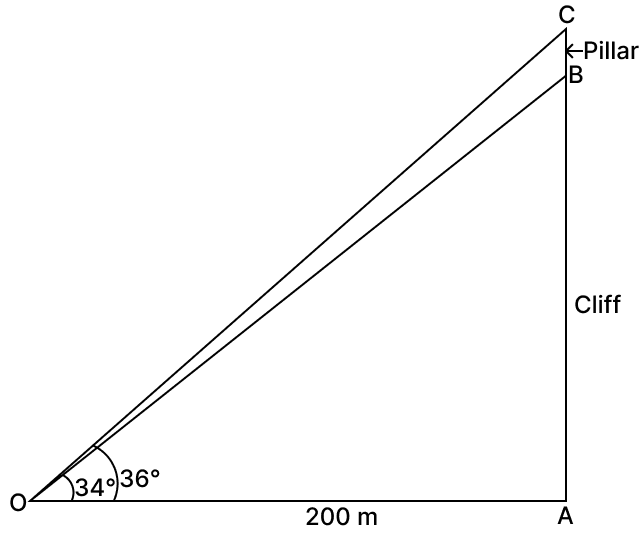
From a boat, 200 m away from a vertical cliff, the angles of elevation of the top and the foot of a vertical pillar at the edge of the cliff are 36° and 34° respectively. Find:

(i) the height of the cliff, and

(ii) the height of the pillar.

Answer

(i) Let AB be the cliff, BC be the pillar and O be the point of observation.

Then, ∠AOB = 34°, ∠AOC = 36° and OA = 200 m

From a boat, 200 m away from a vertical cliff, the angles of elevation of the top and the foot of a vertical pillar at the edge of the cliff are 36° and 34° respectively. Volume And Surface Area of solid RSA Mathematics Solutions ICSE Class 10.

In △AOB,

tan34°=PerpendicularBase=ABOA0.6745=AB200AB=(0.6745×200)AB=134.9 m.\Rightarrow \tan 34° = \dfrac{\text{Perpendicular}}{\text{Base}} = \dfrac{AB}{OA} \\[1em] \Rightarrow 0.6745 = \dfrac{AB}{200} \\[1em] \Rightarrow AB = (0.6745 \times 200) \\[1em] \Rightarrow AB = 134.9 \text{ m.}

Hence, height of the cliff 134.9 m.

(ii) In △AOC,

tan36°=PerpendicularBase=ACOA0.726=AC200AC=(0.726×200)AC=145.2 m.\Rightarrow \tan 36° = \dfrac{\text{Perpendicular}}{\text{Base}} = \dfrac{AC}{OA} \\[1em] \Rightarrow 0.726 = \dfrac{AC}{200} \\[1em] \Rightarrow AC = (0.726 \times 200) \\[1em] \Rightarrow AC = 145.2 \text{ m.}

Height of pillar = AC - AB = 145.2 - 134.9 = 10.3 m

Hence, height of the pillar 10.3 m.
Question 23

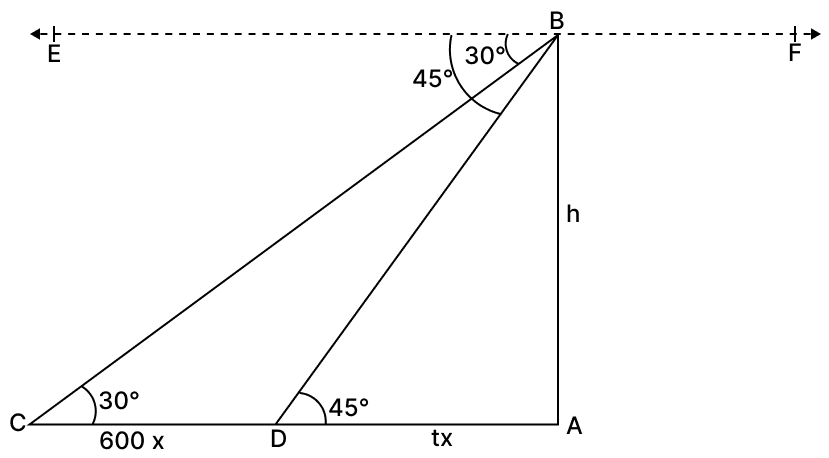
A man on the top of a vertical observation tower observes a car moving at a uniform speed coming directly towards it. If it takes 10 minutes for the angle of depression to change from 30° to 45°, how soon after this will the car reach the observation tower? Give your answer to the nearest second.

Answer

Let the height of the tower AB = h.

Let the speed of the car be x m/s.

Let the time taken to travel from D to A be t seconds.

CD (distance) = speed × time = x m/s × 600 (s) = 600x meters.

DA = (tx) meters.

A man on the top of a vertical observation tower observes a car moving at a uniform speed coming directly towards it. If it takes 10 minutes for the angle of depression to change from 30° to 45°, how soon after this will the car reach the observation tower? Give your answer to the nearest second. Volume And Surface Area of solid RSA Mathematics Solutions ICSE Class 10.

In △ABD,

tan45°=PerpendicularBase=ABAD1=htxh=tx....(1)\Rightarrow \tan 45° = \dfrac{\text{Perpendicular}}{\text{Base}} = \dfrac{AB}{AD} \\[1em] \Rightarrow 1 = \dfrac{h}{tx} \\[1em] \Rightarrow h = tx ....(1)

In △ABC,

tan30°=PerpendicularBase=ABCA13=h600x+txh=600x+tx3....(2)\Rightarrow \tan 30° = \dfrac{\text{Perpendicular}}{\text{Base}} = \dfrac{AB}{CA} \\[1em] \Rightarrow \dfrac{1}{\sqrt3} = \dfrac{h}{600x + tx} \\[1em] \Rightarrow h = \dfrac{600x + tx}{\sqrt3} ....(2)

From (1) and (2), we get :

tx=600x+tx33tx=600x+tx3t=600+t3tt=600t(31)=600t=600(31)t=600(31)×(3+1)(3+1)t=600(3+1)(31)t=600(3+1)2t=300(3+1)=819.6 sec.\Rightarrow tx = \dfrac{600x + tx}{\sqrt3} \\[1em] \Rightarrow \sqrt3tx = 600x + tx \\[1em] \Rightarrow \sqrt3t = 600 + t \\[1em] \Rightarrow \sqrt3t - t = 600 \\[1em] \Rightarrow t(\sqrt3 - 1) = 600 \\[1em] \Rightarrow t = \dfrac{600}{(\sqrt3 - 1)} \\[1em] \Rightarrow t = \dfrac{600}{(\sqrt3 - 1)} \times \dfrac{(\sqrt3 + 1)}{(\sqrt3 + 1)} \\[1em] \Rightarrow t = \dfrac{600(\sqrt3 + 1)}{(3 - 1)} \\[1em] \Rightarrow t = \dfrac{600(\sqrt3 + 1)}{2} \\[1em] \Rightarrow t = 300(\sqrt3 + 1) = 819.6 \text{ sec.}

Time taken to reach = 819.660\dfrac{819.6}{60} = 13.66 mins i.e. 13 min 40 seconds.

Hence, time taken to reach tower is 13 min 40 sec.

Question 24

The angle of elevation of a stationary cloud from a point 25 m above a lake is 30° and the angle of depression of its reflection in the lake is 60°. What is the height of the cloud above the lake-level?

Answer

The angle of elevation of a stationary cloud from a point 25 m above a lake is 30° and the angle of depression of its reflection in the lake is 60°. What is the height of the cloud above the lake-level? Volume And Surface Area of solid RSA Mathematics Solutions ICSE Class 10.

Let C be the position of the cloud, l be the surface of the lake and D be reflection of the cloud.

Let AB be x and CB be h,

In △ABC,

tan30°=PerpendicularBase=BCAB13=hx3h=x....(1)\Rightarrow \tan 30° = \dfrac{\text{Perpendicular}}{\text{Base}} = \dfrac{BC}{AB} \\[1em] \Rightarrow \dfrac{1}{\sqrt3} = \dfrac{h}{x} \\[1em] \Rightarrow \sqrt3h = x ....(1)

In △ABD,

tan60°=PerpendicularBase=BDAB3=25+25+hx3x=50+h....(2)\Rightarrow \tan 60° = \dfrac{\text{Perpendicular}}{\text{Base}} = \dfrac{BD}{AB} \\[1em] \Rightarrow \sqrt3 = \dfrac{25 + 25 + h}{x} \\[1em] \Rightarrow \sqrt3x = 50 + h ....(2)

Substituting value of x from equation (1) in (2), we get :

3(3h)=50+h\Rightarrow \sqrt3(\sqrt3h) = 50 + h

⇒ 3h = 50 + h

⇒ 2h = 50

⇒ h = 25 m.
Height of cloud above lake-level = OC = 25 + h = 25 + 25 = 50 m.
Hence, height of the cloud above lake-level is 50 m.
Question 25(i)

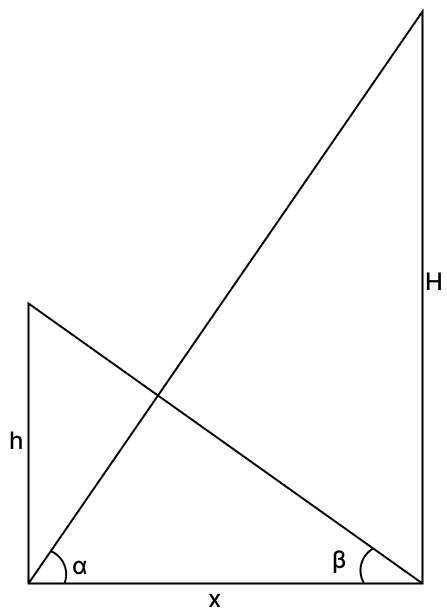
A tower subtends an angle α on the same level as the foot of the tower and at a second point h metres above the first, the depression of the foot of the tower is β. Show that the height of the tower is h tan α cot β.

Answer

Let AB be the tower of height H and C be a point on the same horizontal level as B.

Let D be a point vertically above C such that CD = h.

A tower subtends an angle α on the same level as the foot of the tower and at a second point h metres above the first, the depression of the foot of the tower is β. Show that the height of the tower is h tan α cot β. Volume And Surface Area of solid RSA Mathematics Solutions ICSE Class 10.

Let BC = x.

From right angled ΔABC, we get

cotα=BasePerpendicularcotα=xHx=Hcotα ...(1)\Rightarrow \cot \alpha = \dfrac{\text{Base}}{\text{Perpendicular}} \\[1em] \Rightarrow \cot \alpha = \dfrac{x}{H} \\[1em] \Rightarrow x = H \cot \alpha \text{ ...(1)}

From right angled ΔDBC, we get

cotβ=BasePerpendicularcotβ=xhx=hcotβ ...(2)\Rightarrow \cot \beta = \dfrac{\text{Base}}{\text{Perpendicular}} \\[1em] \Rightarrow \cot \beta = \dfrac{x}{h} \\[1em] \Rightarrow x = h \cot \beta \text{ ...(2)}

From (1) and (2), we have

Hcotα=hcotβH=hcotβ×1cotαH=htanαcotβ\Rightarrow H \cot \alpha = h \cot \beta \\[1em] \Rightarrow H = h \cot \beta \times \dfrac{1}{\cot \alpha} \\[1em] \Rightarrow H = h \tan \alpha \cot \beta

Hence, the height of the tower is h tan α cot β.

Question 25(ii)

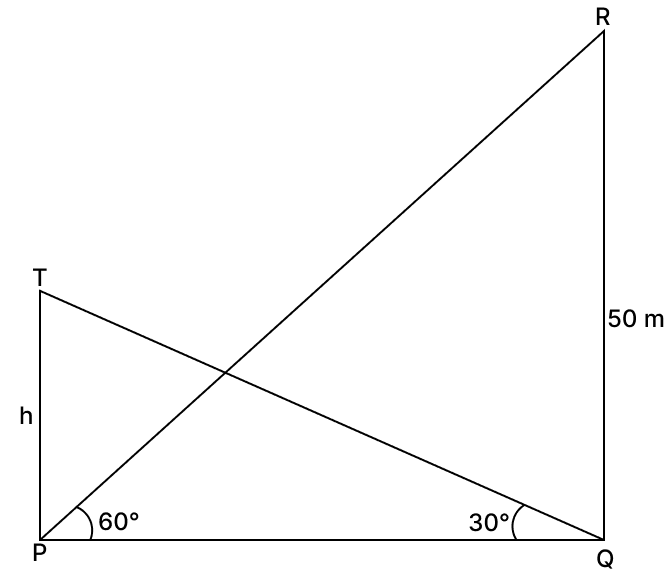
The angle of elevation from a point P of the top of a tower QR, 50 m high, is 60° and that of the tower PT from a point Q is 30°. Find the height of the tower PT, correct to the nearest metre.

Answer

Let height of tower PT be h meters.

The angle of elevation from a point P of the top of a tower QR, 50 m high, is 60° and that of the tower PT from a point Q is 30°. Find the height of the tower PT, correct to the nearest metre. Volume And Surface Area of solid RSA Mathematics Solutions ICSE Class 10.

Considering right angled ΔPQR, we get

tanθ=perpendicularbasetan60=QRPQ3=50PQPQ=503 m.\Rightarrow \tan \theta = \dfrac{\text{perpendicular}}{\text{base}} \\[1em] \Rightarrow \tan 60^{\circ} = \dfrac{QR}{PQ} \\[1em] \Rightarrow \sqrt{3} = \dfrac{50}{PQ} \\[1em] \Rightarrow PQ = \dfrac{50}{\sqrt{3}} \text{ m.}

Now considering right angled ΔPQT, we get

tanθ=perpendicularbasetan30=hPQ13=h50313=3×h50h=503×3h=503h=16.7 m.\Rightarrow \tan \theta = \dfrac{\text{perpendicular}}{\text{base}} \\[1em] \Rightarrow \tan 30^{\circ} = \dfrac{h}{PQ} \\[1em] \Rightarrow \dfrac{1}{\sqrt{3}} = \dfrac{h}{\dfrac{50}{\sqrt{3}}} \\[1em] \Rightarrow \dfrac{1}{\sqrt{3}} = \dfrac{\sqrt{3} \times h}{50} \\[1em] \Rightarrow h = \dfrac{50}{\sqrt{3} \times \sqrt{3}} \\[1em] \Rightarrow h = \dfrac{50}{3} \\[1em] \Rightarrow h = 16.7 \text{ m.}

On correcting to nearest meter, h = 17 m.

Hence, the height of the tower PT = 17 m.

Question 26

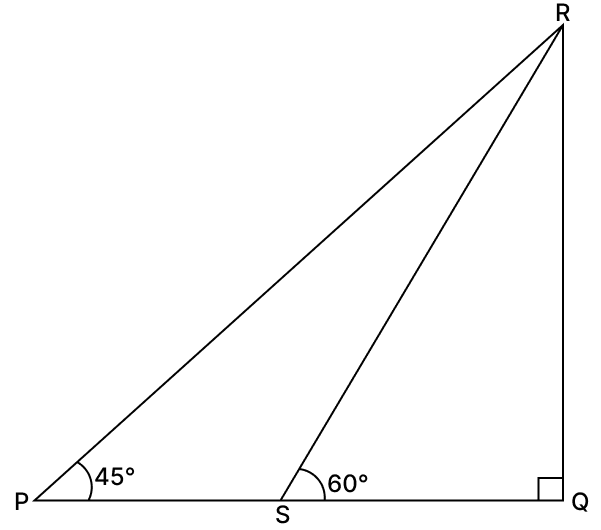
A man observes the angle of elevation of the top of the tower to be 45°. He walks towards it in a horizontal line through its base. On covering 20 m, the angle of elevation changes to 60°. Find the height of the tower correct to 2 significant figures.

Answer

A man observes the angle of elevation of the top of the tower to be 45°. He walks towards it in a horizontal line through its base. On covering 20 m, the angle of elevation changes to 60°. Find the height of the tower correct to 2 significant figures. Volume And Surface Area of solid RSA Mathematics Solutions ICSE Class 10.

Let tower be QR and initial position of man be P, since the initial angle of elevation is 45°, considering right angled △PQR we get,

tan45°=perpendicularbase1=QRPQPQ=QR.\Rightarrow \tan 45° = \dfrac{\text{perpendicular}}{\text{base}} \\[1em] \Rightarrow 1 = \dfrac{QR}{PQ} \\[1em] \Rightarrow PQ = QR.

After covering 20 m let the man be at point S, so PS = 20 m and SQ = PQ - PS = PQ - 20 = QR - 20.

Now considering right angled △SQR we get,

tan60=QRSQ3=QRQR203(QR20)=QRQR3203=QRQR3QR=20(1.732)QR(31)=34.64QR(1.7321)=34.640.732QR=34.64QR=34.640.732QR=47.32.\Rightarrow \tan 60^{\circ} = \dfrac{QR}{SQ} \\[1em] \Rightarrow \sqrt3 = \dfrac{QR}{QR-20} \\[1em] \Rightarrow \sqrt3(QR - 20) = QR \\[1em] \Rightarrow QR\sqrt3 - 20\sqrt3 = QR \\[1em] \Rightarrow QR\sqrt3 - QR = 20(1.732) \\[1em] \Rightarrow QR(\sqrt3 - 1) = 34.64 \\[1em] \Rightarrow QR(1.732 - 1) = 34.64 \\[1em] \Rightarrow 0.732QR = 34.64 \\[1em] \Rightarrow QR = \dfrac{34.64}{0.732} \\[1em] \Rightarrow QR = 47.32.

On correcting to 2 significant figures QR = 47.

Hence, the height of the tower is 47 m.

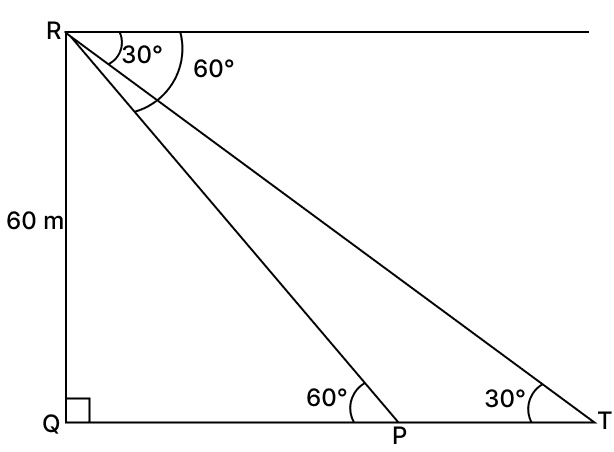
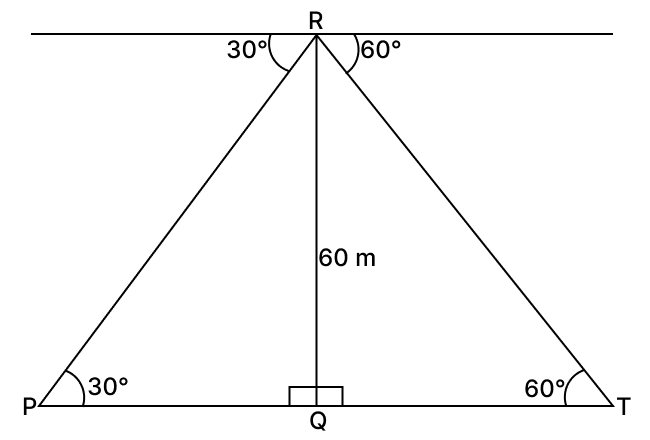
Question 27

From the top of a cliff 60 m high, the angles of depression of two boats are 30° and 60° respectively. Find the distance between the boats, when the boats are:

(i) on the same side of the cliff,

(ii) on the opposite sides of the cliff.

Answer

(i) Let R be the top of the cliff and Q be the foot of the cliff such that RQ = 60 m.

Let P and T be the positions of the two boats such that the angles of depression from R are 30° and 60° respectively.

From the top of a cliff 60 m high, the angles of depression of two boats are 30° and 60° respectively. Find the distance between the boats, when the boats are. Volume And Surface Area of solid RSA Mathematics Solutions ICSE Class 10.

From figure,

∠RPQ = 60° and ∠RTQ = 30°

Boats on the same side of the cliff

From right angled ΔTQR, we get

tanθ=perpendicularbasetan30=RQTQ13=60TQTQ=603\Rightarrow \tan \theta = \dfrac{\text{perpendicular}}{\text{base}} \\[1em] \Rightarrow \tan 30^{\circ} = \dfrac{RQ}{TQ} \\[1em] \Rightarrow \dfrac{1}{\sqrt{3}} = \dfrac{60}{TQ} \\[1em] \Rightarrow TQ = 60\sqrt{3}

From right angled ΔPQR, we get

tanθ=perpendicularbasetan60=RQPQ3=60PQPQ=603\Rightarrow \tan \theta = \dfrac{\text{perpendicular}}{\text{base}} \\[1em] \Rightarrow \tan 60^{\circ} = \dfrac{RQ}{PQ} \\[1em] \Rightarrow \sqrt{3} = \dfrac{60}{PQ} \\[1em] \Rightarrow PQ = \dfrac{60}{\sqrt{3}}

Distance between the boats,

PT=TQPQPT=603603PT=180603PT=1203PT=403PT=69.28 m.\Rightarrow PT = TQ - PQ \\[1em] \Rightarrow PT = 60\sqrt{3} - \dfrac{60}{\sqrt{3}} \\[1em] \Rightarrow PT = \dfrac{180 - 60}{\sqrt{3}} \\[1em] \Rightarrow PT = \dfrac{120}{\sqrt{3}} \\[1em] \Rightarrow PT = 40\sqrt{3} \\[1em] \Rightarrow PT = 69.28 \text{ m.}

Hence, the distance between the boats is 69.28 m when they are on the same side of the cliff

(ii) Let R be the top of the cliff and Q be the foot of the cliff such that RQ = 60 m.

Let P and T be the positions of the two boats on opposite sides of cliff, such that the angles of depression from R are 30° and 60° respectively.

From figure,

∠RPQ = 60° and ∠RTQ = 30°

From the top of a cliff 60 m high, the angles of depression of two boats are 30° and 60° respectively. Find the distance between the boats, when the boats are: Volume And Surface Area of solid RSA Mathematics Solutions ICSE Class 10.

The distance between the boats, when they are on opposite sides of cliff,

PT=TQ+PQPT=603+603PT=180+603PT=2403PT=803PT=138.56 m.\Rightarrow PT = TQ + PQ \\[1em] \Rightarrow PT = 60\sqrt{3} + \dfrac{60}{\sqrt{3}} \\[1em] \Rightarrow PT = \dfrac{180 + 60}{\sqrt{3}} \\[1em] \Rightarrow PT = \dfrac{240}{\sqrt{3}} \\[1em] \Rightarrow PT = 80\sqrt{3} \\[1em] \Rightarrow PT = 138.56 \text{ m.}

Hence, boats are 138.56 m when they are on the opposite sides of the cliff.

Question 28

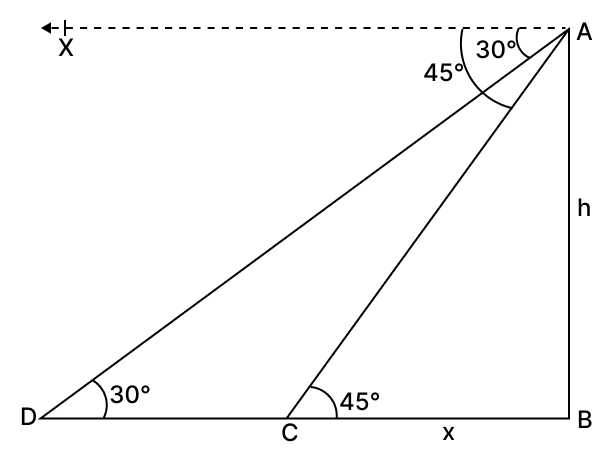
From the top of a hill the angles of depression of two consecutive kilometer stones, due east are found to be 30° and 45° respectively. Find the distance of the two stones from the foot of the hill.

Answer

Given,

A is the top of the tower and B the foot. C and D be two consecutive kilometer stones with depression angles 30° and 45° respectively.

Since stones are consecutive kilometer stones hence distance between them = 1 km.

From the top of a hill the angles of depression of two consecutive kilometer stones, due east are found to be 30° and 45° respectively. Find the distance of the two stones from the foot of the hill. Volume And Surface Area of solid RSA Mathematics Solutions ICSE Class 10.

From figure,

∠XAD = ∠ADB = 30° [Alternate angles are equal]

∠XAC = ∠ACB = 45° [Alternate angles are equal]

CD = 1 km

DB = x + 1

From right angled ΔABC, we get

tanθ=perpendicularbasetan45=ABCB1=hxh=x.\Rightarrow \tan \theta = \dfrac{\text{perpendicular}}{\text{base}} \\[1em] \Rightarrow \tan 45^{\circ} = \dfrac{AB}{CB} \\[1em] \Rightarrow 1 = \dfrac{h}{x} \\[1em] \Rightarrow h = x .

From right angled ΔADB, we get

tanθ=perpendicularbasetan30=ABDB13=hx+113=xx+1x+1=3x3xx=1x(31)=1x=131x=131×3+13+1x=3+1(3)2(1)2x=2.732=1.36 km\Rightarrow \tan \theta = \dfrac{\text{perpendicular}}{\text{base}} \\[1em] \Rightarrow \tan 30^{\circ} = \dfrac{AB}{DB} \\[1em] \Rightarrow \dfrac{1}{\sqrt{3}} = \dfrac{h}{x + 1} \\[1em] \Rightarrow \dfrac{1}{\sqrt{3}} = \dfrac{x}{x + 1} \\[1em] \Rightarrow x + 1 = \sqrt3 x \\[1em] \Rightarrow \sqrt{3}x - x = 1 \\[1em] \Rightarrow x(\sqrt{3} - 1) = 1 \\[1em] \Rightarrow x = \dfrac{1}{\sqrt3 - 1} \\[1em] \Rightarrow x = \dfrac{1}{\sqrt3 - 1} \times \dfrac{\sqrt3 + 1}{\sqrt3 + 1} \\[1em] \Rightarrow x = \dfrac{\sqrt3 + 1}{(\sqrt{3})^2 - (1)^2} \\[1em] \Rightarrow x = \dfrac{2.73}{2} = 1.36 \text{ km}

DB = x + 1 = 1.36 + 1 = 2.36 km.

Hence, the distance of two stones from hill are 1.36 km and 2.36 km.

Question 29

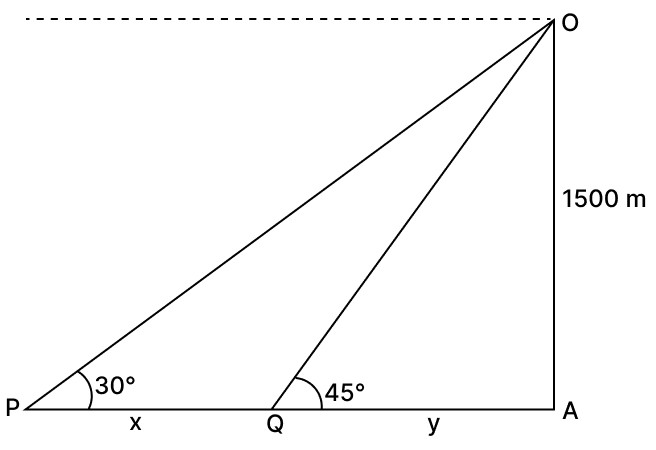
An aeroplane at an altitude of 1500 m finds that two ships are sailing towards it in the same direction. The angles of depression as observed from the aeroplane are 45° and 30° respectively. Find the distance between the two ships.

Answer

From figure,

O is the position of aeroplane and P and Q are the position of ships.

An aeroplane at an altitude of 1500 m finds that two ships are sailing towards it in the same direction. The angles of depression as observed from the aeroplane are 45° and 30° respectively. Find the distance between the two ships. Volume And Surface Area of solid RSA Mathematics Solutions ICSE Class 10.

OA = 1500 m

Let,

AQ = y

QP = x

In right angled ΔOAQ,

tanθ=perpendicularbasetan45=OAAQ1=1500yy=1500 m.\Rightarrow \tan \theta = \dfrac{\text{perpendicular}}{\text{base}} \\[1em] \Rightarrow \tan 45^{\circ} = \dfrac{OA}{AQ} \\[1em] \Rightarrow 1 = \dfrac{1500}{y} \\[1em] \Rightarrow y = 1500 \text{ m.}

In right angled ΔOAP,

tanθ=perpendicularbasetan30=OAAP13=1500AQ+QP13=1500y+xy+x=150031500+x=15003x=150031500x=1500(31)x=1500(1.731)x=1500(0.73)x=1095 m.\Rightarrow \tan \theta = \dfrac{\text{perpendicular}}{\text{base}} \\[1em] \Rightarrow \tan 30^{\circ} = \dfrac{OA}{AP} \\[1em] \Rightarrow \dfrac{1}{\sqrt{3}} = \dfrac{1500}{AQ + QP} \\[1em] \Rightarrow \dfrac{1}{\sqrt{3}} = \dfrac{1500}{y + x} \\[1em] \Rightarrow y + x = 1500\sqrt{3} \\[1em] \Rightarrow 1500 + x = 1500\sqrt{3} \\[1em] \Rightarrow x = 1500\sqrt{3} - 1500 \\[1em] \Rightarrow x = 1500(\sqrt{3} - 1) \\[1em] \Rightarrow x = 1500( 1.73 - 1) \\[1em] \Rightarrow x = 1500( 0.73) \\[1em] \Rightarrow x = 1095 \text{ m.}

AQ = y = 1500 m

PQ = x = 1095 m

Hence, the distance between the two ships = 1095 m.

Question 30

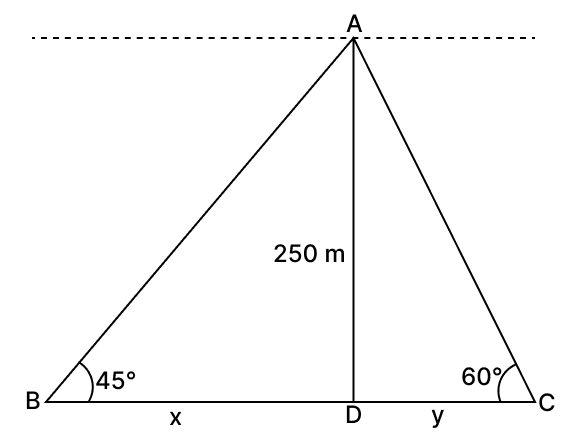
An aeroplane at an altitude of 250 m observes the angle of depression of two boats on the opposite banks of a river to be 45° and 60° respectively. Find the width of the river. Write the answer to the nearest whole number.

Answer

Given,

Aeroplane is at point A and boats are at point B and C. Since, aeroplane is at an altitude of 250 m ,

∴ AD = 250 m.

An aeroplane at an altitude of 250 m observes the angle of depression of two boats on the opposite banks of a river to be 45° and 60° respectively. Find the width of the river. Write the answer to the nearest whole number. Volume And Surface Area of solid RSA Mathematics Solutions ICSE Class 10.

Considering right angled ΔACD, we get

tanθ=perpendicularbasetan60=ADDC3=250yy=2503y=2501.732y=144.34 m.\Rightarrow \tan \theta = \dfrac{\text{perpendicular}}{\text{base}} \\[1em] \Rightarrow \tan 60^{\circ} = \dfrac{AD}{DC} \\[1em] \Rightarrow \sqrt{3} = \dfrac{250}{y} \\[1em] \Rightarrow y = \dfrac{250}{\sqrt{3}} \\[1em] \Rightarrow y = \dfrac{250}{1.732} \\[1em] \Rightarrow y = 144.34 \text{ m.}

Considering right angled ΔABD, we get

tanθ=perpendicularbasetan45=ADBD1=250xx=250 m.\Rightarrow \tan \theta = \dfrac{\text{perpendicular}}{\text{base}} \\[1em] \Rightarrow \tan 45^{\circ} = \dfrac{AD}{BD} \\[1em] \Rightarrow 1 = \dfrac{250}{x} \\[1em] \Rightarrow x = 250 \text{ m.}

Width of the river (BC) = x + y = 144.34 + 250 = 394.34 meters.

Rounding off to nearest meter BC = 394 meters.

Hence, the width of the river is 394 meters.

Question 31

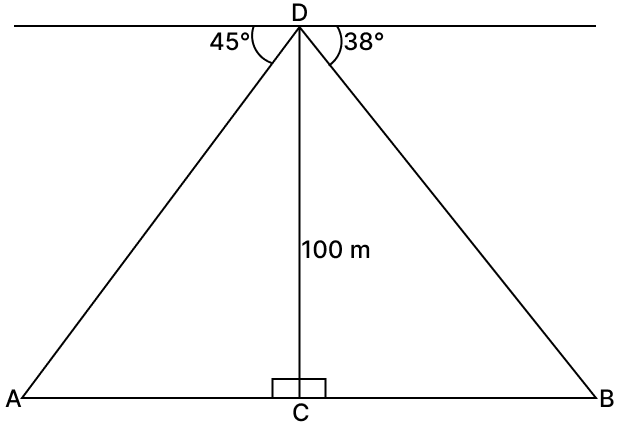
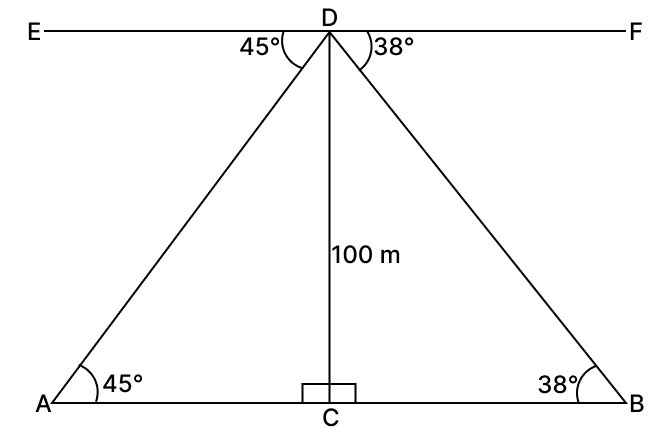
From the top of a tower, 100 m high, a man observes the angles of depression of two ships A and B, on opposite sides of the tower as 45° and 38° respectively. If the foot of the tower and the ships are in the same horizontal line, find the distance between the two ships A and B.

From the top of a tower, 100 m high, a man observes the angles of depression of two ships A and B, on opposite sides of the tower as 45° and 38° respectively. If the foot of the tower and the ships are in the same horizontal line, find the distance between the two ships A and B. Volume And Surface Area of solid RSA Mathematics Solutions ICSE Class 10.

Answer

Let CD be the tower.

From the top of a tower, 100 m high, a man observes the angles of depression of two ships A and B, on opposite sides of the tower as 45° and 38° respectively. If the foot of the tower and the ships are in the same horizontal line, find the distance between the two ships A and B. Volume And Surface Area of solid RSA Mathematics Solutions ICSE Class 10.

From figure,

⇒ ∠A = ∠EDA = 45° (Alternate angles are equal)

⇒ ∠B = ∠FDB = 38° (Alternate angles are equal)

In ΔACD,

tanθ=perpendicularbasetan45=CDAC1=100ACAC=100 m.\Rightarrow \tan \theta = \dfrac{\text{perpendicular}}{\text{base}} \\[1em] \Rightarrow \tan 45^{\circ} = \dfrac{CD}{AC} \\[1em] \Rightarrow 1 = \dfrac{100}{AC} \\[1em] \Rightarrow AC = 100 \text{ m.}

In ΔBCD,

tanθ=perpendicularbasetan38=CDBC0.78=100BCBC=1000.78BC=128.20 m.\Rightarrow \tan \theta = \dfrac{\text{perpendicular}}{\text{base}} \\[1em] \Rightarrow \tan 38^{\circ} = \dfrac{CD}{BC} \\[1em] \Rightarrow 0.78 = \dfrac{100}{BC} \\[1em] \Rightarrow BC = \dfrac{100}{0.78} \\[1em] \Rightarrow BC = 128.20 \text{ m.}

From figure,

The distance between ships A and B = AC + BC

= 100 + 128.20

= 228.20 m.

Hence, the distance between the two ships A and B = 228.20 m.

Question 32

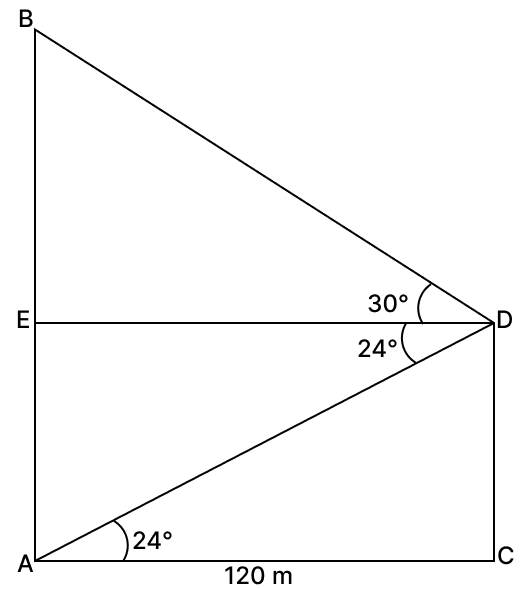
The horizontal distance between two towers is 120 m. The angle of elevation of the top and angle of depression of the bottom of the first tower as observed from the second tower is 30° and 24° respectively. Find the heights of the two towers. Give your answer correct to 3 significant figures.

Answer

From figure,

AB is the first tower and CD is the second tower.

The horizontal distance between two towers is 120 m. The angle of elevation of the top and angle of depression of the bottom of the first tower as observed from the second tower is 30° and 24° respectively. Find the heights of the two towers. Give your answer correct to 3 significant figures. Volume And Surface Area of solid RSA Mathematics Solutions ICSE Class 10.

From figure,

AC = ED = 120 m.

In ΔBED,

tanθ=perpendicularbasetan30=BEED13=BE120BE=1203BE=1201.732BE=69.3 m.\Rightarrow \tan \theta = \dfrac{\text{perpendicular}}{\text{base}} \\[1em] \Rightarrow \tan 30^{\circ} = \dfrac{BE}{ED} \\[1em] \Rightarrow \dfrac{1}{\sqrt{3}} = \dfrac{BE}{120} \\[1em] \Rightarrow BE = \dfrac{120}{\sqrt{3}} \\[1em] \Rightarrow BE = \dfrac{120}{1.732} \\[1em] \Rightarrow BE = 69.3 \text{ m.}

In ΔEDA,

tanθ=perpendicularbasetan24=EAED0.445=EA120EA=120×0.445EA=53.4 m.\Rightarrow \tan \theta = \dfrac{\text{perpendicular}}{\text{base}} \\[1em] \Rightarrow \tan 24^{\circ} = \dfrac{EA}{ED} \\[1em] \Rightarrow 0.445 = \dfrac{EA}{120} \\[1em] \Rightarrow EA = 120 \times 0.445 \\[1em] \Rightarrow EA = 53.4 \text{ m.}

⇒ AB = AE + EB = 53.4 + 69.3 = 122.7 meters.

⇒ CD = EA = 53.4 meters.

Hence, height of two towers = 122.7 meters and 53.4 meters.

Question 33

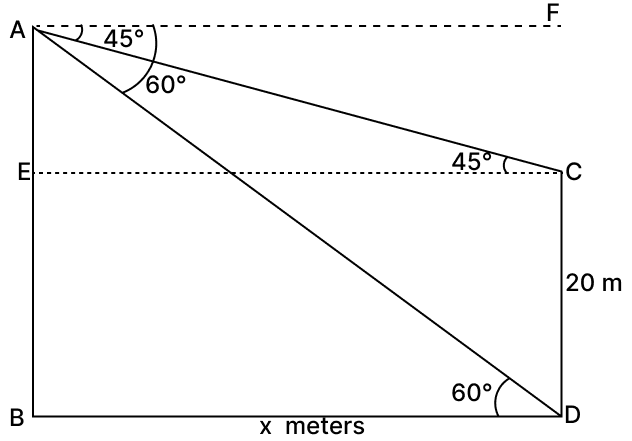
From the top of a cliff, the angle of depression of the top and bottom of a tower are observed to be 45° and 60° respectively. If the height of the tower is 20 m, find:

(i) the height of the cliff,

(ii) the distance between the cliff and the tower.

Answer

From the top of a cliff, the angle of depression of the top and bottom of a tower are observed to be 45° and 60° respectively. If the height of the tower is 20 m, find: Volume And Surface Area of solid RSA Mathematics Solutions ICSE Class 10.

AB is the cliff and CD is the tower.

From figure,

∠ACE = ∠FAC = 45° (Alternate angles are equal)

∠ADB = ∠FAD = 60° (Alternate angles are equal)

Let BD = x.

From figure,

EC = BD = x meters.

EB = CD = 20 meters.

In ΔAEC,

⇒ tan 45° = AEEC\dfrac{AE}{EC}

⇒ 1 = AEx\dfrac{AE}{x}

⇒ AE = x meters

In ΔABD,

tan60=ABBD3=AE+EBx3=x+20x3x=x+203xx=20x(31)=20x=2031x=20(3+1)(31)(3+1)x=20(3+1)31x=20(3+1)2x=10(3+1)=27.32 meters.\Rightarrow \tan 60^{\circ} = \dfrac{AB}{BD} \\[1em] \Rightarrow \sqrt{3} = \dfrac{AE + EB}{x} \\[1em] \Rightarrow \sqrt{3} = \dfrac{x + 20}{x} \\[1em] \Rightarrow \sqrt{3}x = x + 20 \\[1em] \Rightarrow \sqrt{3}x - x = 20 \\[1em] \Rightarrow x(\sqrt{3} - 1) = 20 \\[1em] \Rightarrow x = \dfrac{20}{\sqrt{3} - 1} \\[1em] \Rightarrow x = \dfrac{20(\sqrt{3} + 1)}{(\sqrt{3} - 1)(\sqrt{3} + 1)} \\[1em] \Rightarrow x = \frac{20(\sqrt{3} + 1)}{3 - 1} \\[1em] \Rightarrow x = \frac{20(\sqrt{3} + 1)}{2}\\[1em] \Rightarrow x = 10(\sqrt{3} + 1) = 27.32 \text{ meters}.

From Figure,

Height of cliff (AB) = AE + EB

= x + 20

= 27.32 + 20 = 47.32 meters.

Hence, the height of cliff = 47.32 meters.

(ii) From figure,

Distance between cliff and tower (BD) = x meters = 27.32 meters.

Hence, distance between cliff and tower = 27.32 meters.

Question 34

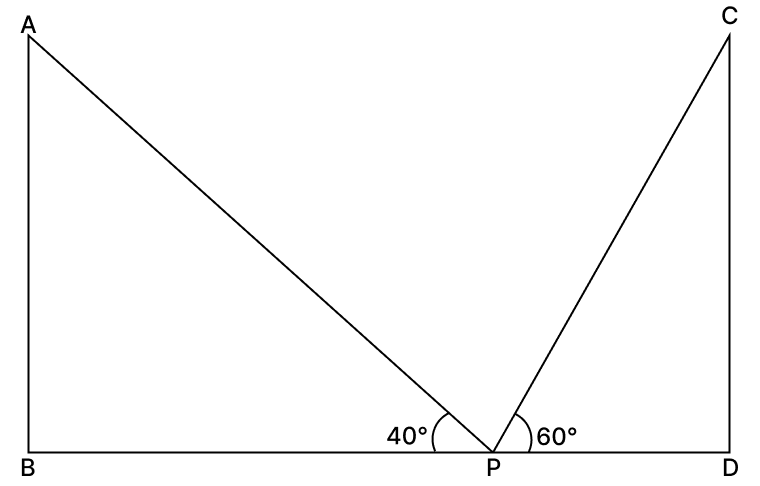
Two lamp posts AB and CD, each of height 100 m, are on either side of the road. P is a point on the road between the two lamp posts. The angles of elevation of the top of the lamp post from the point P are 60° and 40°. Find the distances PB and PD.

Two lamp posts AB and CD, each of height 100 m, are on either side of the road. P is a point on the road between the two lamp posts. The angles of elevation of the top of the lamp post from the point P are 60° and 40°. Find the distances PB and PD. Volume And Surface Area of solid RSA Mathematics Solutions ICSE Class 10.

Answer

Given,

AB = 100 m

CD = 100 m

∠APB = 40°

∠CPD = 60°

Let PB = x and PD = y.

In triangle ABP,

In triangle ABP,

tanθ=perpendicularbasetan40°=ABBPtan40°=100x0.8391=100xx=1000.8391x=119.17 m.\Rightarrow \tan \theta = \dfrac{\text{perpendicular}}{\text{base}} \\[1em] \Rightarrow \tan 40° = \dfrac{AB}{BP} \\[1em] \Rightarrow \tan 40° = \dfrac{100}{x} \\[1em] \Rightarrow 0.8391 = \dfrac{100}{x} \\[1em] \Rightarrow x = \dfrac{100}{0.8391} \\[1em] \Rightarrow x = 119.17 \text{ m.}

PB = x = 119.17 m

In triangle CDP,

We know that,

tanθ=perpendicularbasetan60°=CDPD3=100yy=1003y=1003×33y=10033 m.\Rightarrow \tan \theta = \dfrac{\text{perpendicular}}{\text{base}} \\[1em] \Rightarrow \tan 60° = \dfrac{CD}{PD} \\[1em] \Rightarrow \sqrt{3} = \dfrac{100}{y} \\[1em] \Rightarrow y = \dfrac{100}{\sqrt{3}} \\[1em] \Rightarrow y = \dfrac{100}{\sqrt{3}} \times \dfrac{\sqrt{3}}{\sqrt{3}} \\[1em] \Rightarrow y = \dfrac{100\sqrt{3}}{3} \text{ m.}

PD = y = 10033\dfrac{100\sqrt{3}}{3} m

Hence, the distances are PB = 119.17 m and PD = 10033\dfrac{100\sqrt{3}}{3} m.

Multiple Choice Questions

Question 1

The ratio of the length of a rod and its shadow is 1 : 3\sqrt{3}. The angle of elevation of the sun is:

  1. 30°

  2. 45°

  3. 60°

  4. 90°

Answer

The ratio of the length of a rod and its shadow is 1. Volume And Surface Area of solid RSA Mathematics Solutions ICSE Class 10.

Let the height of the rod AB be h and length of shadow BC be s.

In triangle ABC,

tanθ=perpendicularbasetanθ=hstanθ=13tanθ=tan30θ=30.\Rightarrow \tan \theta = \dfrac{\text{perpendicular}}{\text{base}} \\[1em] \Rightarrow \tan \theta = \dfrac{h}{s} \\[1em] \Rightarrow \tan \theta = \dfrac{1}{\sqrt3} \\[1em] \Rightarrow \tan \theta = \tan 30^{\circ} \\[1em] \Rightarrow \theta = 30^{\circ}.

Hence, option 1 is the correct option.

Question 2

The angle of elevation of the sun when the length of the shadow of a pole is equal to its height, is:

  1. 30°

  2. 45°

  3. 60°

  4. 90°

Answer

The angle of elevation of the sun when the length of the shadow of a pole is equal to its height, is: Volume And Surface Area of solid RSA Mathematics Solutions ICSE Class 10.

Let the height of the pole AB be h and length of shadow BC be s.

Given,

h = s

In triangle ABC,

tanθ=perpendicularbasetanθ=hstanθ=hhtanθ=1tanθ=tan45θ=45.\Rightarrow \tan \theta = \dfrac{\text{perpendicular}}{\text{base}} \\[1em] \Rightarrow \tan \theta = \dfrac{h}{s} \\[1em] \Rightarrow \tan \theta = \dfrac{h}{h} \\[1em] \Rightarrow \tan \theta = 1 \\[1em] \Rightarrow \tan \theta = \tan 45^{\circ} \\[1em] \Rightarrow \theta = 45^{\circ}.

Hence, option 2 is the correct option.

Question 3

If the length of the string of a kite flying in the sky is twice the height of the kite from the ground, then the angle of elevation of the kite is:

  1. 30°

  2. 45°

  3. 60°

  4. none of these

Answer

If the length of the string of a kite flying in the sky is twice the height of the kite from the ground, then the angle of elevation of the kite is: Volume And Surface Area of solid RSA Mathematics Solutions ICSE Class 10.

Let the height of kite (AC) be h.

Length of string (AB) = 2h

In triangle ABC,

sinθ=Perpendicularhypotenusesinθ=h2hsinθ=12sinθ=sin30θ=30.\Rightarrow \sin \theta = \dfrac{\text{Perpendicular}}{\text{hypotenuse}} \\[1em] \Rightarrow \sin \theta = \dfrac{h}{2h} \\[1em] \Rightarrow \sin \theta = \dfrac{1}{2} \\[1em] \Rightarrow \sin \theta = \sin 30^{\circ} \\[1em] \Rightarrow \theta = 30^{\circ}.

Hence, option 1 is the correct option.

Question 4

The angle of elevation of a tower from a distance of 100 m from its foot is 30°. The height of the tower is:

  1. (1003)\Big(\dfrac{100}{\sqrt{3}}\Big) m

  2. 50350\sqrt{3} m

  3. 1003100\sqrt{3} m

  4. (2003)\Big(\dfrac{200}{\sqrt{3}}\Big) m

Answer

The angle of elevation of a tower from a distance of 100 m from its foot is 30°. The height of the tower is: Volume And Surface Area of solid RSA Mathematics Solutions ICSE Class 10.

Let the height of tower (AB) be h meters.

Angle of elevation = 30°

tanθ=perpendicularbasetan30=h10013=h100h=1003 m.\Rightarrow \tan \theta = \dfrac{\text{perpendicular}}{\text{base}} \\[1em] \Rightarrow \tan 30^{\circ} = \dfrac{h}{100} \\[1em] \Rightarrow \dfrac{1}{\sqrt3} = \dfrac{h}{100} \\[1em] \Rightarrow h = \dfrac{100}{\sqrt3} \text{ m}.

Hence, option 1 is the correct option.

Question 5

A ladder makes an angle of 60° with the ground when placed against a wall. If the foot of the ladder is 2 m away from the wall, the length of the ladder is:

  1. (43)\Big(\dfrac{4}{\sqrt{3}}\Big) m

  2. 434\sqrt{3} m

  3. 222\sqrt{2} m

  4. 4 m

Answer

A ladder makes an angle of 60° with the ground when placed against a wall. If the foot of the ladder is 2 m away from the wall, the length of the ladder is: Volume And Surface Area of solid RSA Mathematics Solutions ICSE Class 10.

Let the length of ladder (AB) be L.

Distance (CB) from wall (AC) to the foot of ladder = 2 m

The angle the ladder makes with the ground is 60°.

In triangle ABC,

cosθ=Basehypotenusecos60=2L12=2LL=4 m.\Rightarrow \cos \theta = \dfrac{\text{Base}}{\text{hypotenuse}} \\[1em] \Rightarrow \cos 60^{\circ} = \dfrac{2}{L} \\[1em] \Rightarrow \dfrac{1}{2} = \dfrac{2}{L} \\[1em] \Rightarrow L = 4 \text{ m}.

Hence, option 4 is the correct option.

Question 6

The length of a string between a kite and a point on the ground is 90 m. The string makes an angle of 60° with the level ground. If there is no slack in the string, the height of the kite is:

  1. 45345\sqrt{3} m

  2. 45 m

  3. 90390\sqrt{3} m

  4. 180 m

Answer

The length of a string between a kite and a point on the ground is 90 m. The string makes an angle of 60° with the level ground. If there is no slack in the string, the height of the kite is: Volume And Surface Area of solid RSA Mathematics Solutions ICSE Class 10.

Length of string (AC) = 90 m

Let the height of the kite (AB) = h

The angle the string makes with the ground is 60°.

sinθ=Perpendicularhypotenusesin60=h9032=h9032×90=hh=453 m.\Rightarrow \sin \theta = \dfrac{\text{Perpendicular}}{\text{hypotenuse}} \\[1em] \Rightarrow \sin 60^{\circ} = \dfrac{h}{90} \\[1em] \Rightarrow \dfrac{\sqrt3}{2} = \dfrac{h}{90} \\[1em] \Rightarrow \dfrac{\sqrt3}{2} \times 90 = h \\[1em] \Rightarrow h = 45\sqrt3 \text{ m}.

Hence, option 1 is the correct option.

Question 7

If the elevation of the sun changed from 30° to 60°, then the difference between the lengths of shadows of a pole 15 m high, made at these two positions is:

  1. 7.5 m

  2. 15 m

  3. 535\sqrt{3} m

  4. 10310\sqrt{3} m

Answer

If the elevation of the sun changed from 30° to 60°, then the difference between the lengths of shadows of a pole 15 m high, made at these two positions is: Volume And Surface Area of solid RSA Mathematics Solutions ICSE Class 10.

Height of pole AB = 15 m

Let D be the position where angle of elevation is 30° and C be the point where angle of elevation is 60°.

In triangle ABC,

We know that,

tan60=PerpendicularBase=ABBC3=15BCBC=153BC=153×33BC=1533BC=53 m.\Rightarrow \tan 60^{\circ} = \dfrac{\text{Perpendicular}}{\text{Base}} = \dfrac{AB}{BC} \\[1em] \Rightarrow \sqrt3 = \dfrac{15}{BC} \\[1em] \Rightarrow BC = \dfrac{15}{\sqrt3} \\[1em] \Rightarrow BC = \dfrac{15}{\sqrt{3}} \times \dfrac{\sqrt3}{\sqrt3} \\[1em] \Rightarrow BC = \dfrac{15\sqrt3}{3} \\[1em] \Rightarrow BC = 5\sqrt3 \text{ m.}

In triangle ABD,

We know that,

tan30=PerpendiuclarBase=ABBD13=15BDBD=153 m.\Rightarrow \tan 30^{\circ} = \dfrac{\text{Perpendiuclar}}{\text{Base}} = \dfrac{AB}{BD} \\[1em] \Rightarrow \dfrac{1}{\sqrt3} = \dfrac{15}{BD} \\[1em] \Rightarrow BD = 15\sqrt3 \text{ m.}

From figure,

CD = BD - BC

CD = 1535315\sqrt3 - 5\sqrt3

CD = 103 m.10\sqrt3 \text{ m.}

Hence, option 4 is the correct option.

Question 8

In a rectangle, if the angle between a diagonal and a side is 30° and the length of the diagonal is 6 cm, then the area of the rectangle is :

  1. 9 cm2

  2. 939\sqrt{3} cm2

  3. 27 cm2

  4. 36 cm2

Answer

In a rectangle, if the angle between a diagonal and a side is 30° and the length of the diagonal is 6 cm, then the area of the rectangle is : Volume And Surface Area of solid RSA Mathematics Solutions ICSE Class 10.

Let the base of rectangle be AB and breadth be BC,

Diagonal AC = 6 cm

In triangle ABC,

cos30=basehypotenuse=ABAC32=AB632×6=ABAB=33 cm.\Rightarrow \cos 30^{\circ} = \dfrac{\text{base}}{\text{hypotenuse}} = \dfrac{AB}{AC} \\[1em] \Rightarrow \dfrac{\sqrt3}{2} = \dfrac{AB}{6} \\[1em] \Rightarrow \dfrac{\sqrt3}{2} \times 6 = AB \\[1em] \Rightarrow AB = 3\sqrt3 \text{ cm.}

Also,

sin30=Perpendicularhypotenuse=BCAC12=BC612×6=BCBC=3 cm.\Rightarrow \sin 30^{\circ} = \dfrac{\text{Perpendicular}}{\text{hypotenuse}} = \dfrac{BC}{AC} \\[1em] \Rightarrow \dfrac{1}{2} = \dfrac{BC}{6} \\[1em] \Rightarrow \dfrac{1}{2} \times 6 = BC \\[1em] \Rightarrow BC = 3 \text{ cm.}

We know that,

Area of rectangle = length × width

= 33×33\sqrt3 \times 3

= 939\sqrt3 cm2.

Hence, option 2 is the correct option.

Question 9

The angles of elevation of an aeroplane flying vertically above the ground as observed from two consecutive stones 1 km apart are 45° and 60°. The height of the aeroplane above the ground (in km) is:

  1. (3+12)\Big(\dfrac{\sqrt{3}+1}{2}\Big)

  2. (3+32)\Big(\dfrac{3+\sqrt{3}}{2}\Big)

  3. 3+33+\sqrt{3}

  4. 3+1\sqrt{3}+1

Answer

The angles of elevation of an aeroplane flying vertically above the ground as observed from two consecutive stones 1 km apart are 45° and 60°. The height of the aeroplane above the ground (in km) is. Volume And Surface Area of solid RSA Mathematics Solutions ICSE Class 10.

Let the position of the aeroplane be A. Let h be the height of the aeroplane above the ground.

Let C and D be the positions of the two consecutive stones on the ground.

Let the distance from the closer stone C to the foot of the perpendicular B be x.

Then, CD = x + 1.

In △ABC,

tan60=PerpendicularBase=ABBC3=hxx=h3 .....(1)\Rightarrow \tan 60^{\circ} = \dfrac{\text{Perpendicular}}{\text{Base}} = \dfrac{AB}{BC} \\[1em] \Rightarrow \sqrt3 = \dfrac{h}{x} \\[1em] \Rightarrow x = \dfrac{h}{\sqrt3} \text{ .....(1)}

In △ABD,

tan45=PerpendicularBase=ABBD1=hx+1x+1=h .....(2)\Rightarrow \tan 45^{\circ} = \dfrac{\text{Perpendicular}}{\text{Base}} = \dfrac{AB}{BD} \\[1em] \Rightarrow 1 = \dfrac{h}{x + 1} \\[1em] \Rightarrow x + 1 = h \text{ .....(2)}

Substituting value of x from equation (2) in (1), we get :

h3+1=hhh3=1h(113)=1h(313)=1h=331h=3(3+1)(31)(3+1)h=3+3(3)2(1)2h=3+331h=3+32 km\Rightarrow \dfrac{h}{\sqrt3} + 1 = h \\[1em] \Rightarrow h - \dfrac{h}{\sqrt{3}} = 1 \\[1em] \Rightarrow h \Big(1 - \dfrac{1}{\sqrt{3}} \Big) = 1 \\[1em] \Rightarrow h \Big( \dfrac{\sqrt{3} - 1}{\sqrt{3}} \Big) = 1 \\[1em] \Rightarrow h = \dfrac{\sqrt{3}}{\sqrt{3} - 1} \\[1em] \Rightarrow h = \dfrac{\sqrt{3}(\sqrt{3} + 1)}{(\sqrt{3} - 1)(\sqrt{3} + 1)} \\[1em] \Rightarrow h = \dfrac{3 + \sqrt{3}}{(\sqrt{3})^2 - (1)^2} \\[1em] \Rightarrow h = \dfrac{3 + \sqrt{3}}{3 - 1} \\[1em] \Rightarrow h = \dfrac{3 + \sqrt{3}}{2} \text{ km}

Hence, option 2 is the correct option.

Question 10

On the level ground, the angle of elevation of a tower is 30°. On moving 20 m nearer, the angle of elevation is 60°. The height of the tower is:

  1. 10 m

  2. 10310\sqrt{3} m

  3. 15 m

  4. 20 m

Answer

On the level ground, the angle of elevation of a tower is 30°. On moving 20 m nearer, the angle of elevation is 60°. The height of the tower is: Volume And Surface Area of solid RSA Mathematics Solutions ICSE Class 10.

Let AB be the tower of height h.

In △ABC,

tan60=ABBC3=hBCBC=h3....(1)\Rightarrow \tan 60^\circ = \dfrac{AB}{BC} \\[1em] \Rightarrow \sqrt{3} = \dfrac{h}{BC} \\[1em] \Rightarrow BC = \dfrac{h}{\sqrt{3}} ....(1)

In △ABD,

tan30=ABBD13=hBC+20BC+20=h3....(2)\Rightarrow \tan 30^\circ = \dfrac{AB}{BD} \\[1em] \Rightarrow \dfrac{1}{\sqrt{3}} = \dfrac{h}{BC + 20} \\[1em] \Rightarrow BC + 20 = h\sqrt{3} ....(2)

Substituting value of BC from equation (1) in (2), we get :

h3+20=h3h+2033=h3h+203=h(3)203=2hh=103 m\Rightarrow \dfrac{h}{\sqrt{3}} + 20 = h\sqrt{3} \\[1em] \Rightarrow \dfrac{h + 20\sqrt{3}}{\sqrt{3}} = h\sqrt{3} \\[1em] \Rightarrow h + 20\sqrt{3} = h(3) \\[1em] \\[1em] \Rightarrow 20\sqrt{3} = 2h \\[1em] \Rightarrow h = 10\sqrt{3} \text{ m}

Hence, option 2 is the correct option.

Question 11

If the angles of elevation of a tower from two points distant a and b (a > b) from its foot and in the same straight line from it and on the same side, are 30° and 60°, then the height of the tower is :

  1. a+b\sqrt{a + b}

  2. ab\sqrt{ab}

  3. ab\sqrt{a - b}

  4. (ab)\sqrt{\Big(\dfrac{a}{b}\Big)}

Answer

If the angles of elevation of a tower from two points distant a and b. Volume And Surface Area of solid RSA Mathematics Solutions ICSE Class 10.

Let height of the tower (AB) = h.

Let BC = b and BD = a.

In △ABC,

tan60=ABBCtan60=hb....(1)\Rightarrow \tan 60^\circ = \dfrac{AB}{BC} \\[1em] \Rightarrow \tan 60^\circ = \dfrac{h}{b} ....(1)

In △ABD,

tan30=ABBDtan30=hatan(9060)=hacot60=ha1tan60=ha1hb=ha [From (i)]bh=hah2=abh=ab\Rightarrow \tan 30^\circ = \dfrac{AB}{BD} \\[1em] \Rightarrow \tan 30^\circ = \dfrac{h}{a} \\[1em] \Rightarrow \tan (90^{\circ} - 60^\circ) = \dfrac{h}{a} \\[1em] \Rightarrow \cot 60^\circ = \dfrac{h}{a} \\[1em] \Rightarrow \dfrac{1}{\tan 60^\circ} = \dfrac{h}{a} \\[1em] \Rightarrow \dfrac{1}{\dfrac{h}{b}} = \dfrac{h}{a} \text{ [From (i)]} \\[1em] \Rightarrow \dfrac{b}{h} = \dfrac{h}{a} \\[1em] \Rightarrow h^2 = ab \\[1em] \Rightarrow h = \sqrt{ab}

Hence, option 2 is the correct option.

Question 12

If from the top of a cliff, 100 m high, the angles of depression of two ships at sea are 60° and 30°, then the distance between the ships is approximately :

  1. 57.6 m

  2. 115.47 m

  3. 173 m

  4. 346 m

Answer

If from the top of a cliff, 100 m high, the angles of depression of two ships at sea are 60° and 30°, then the distance between the ships is approximately. Volume And Surface Area of solid RSA Mathematics Solutions ICSE Class 10.

Let AB be the cliff and two ships be at point C and D.

In triangle ABC,

tan60=ABBC3=100BCBC=1003 m\Rightarrow \tan 60^\circ = \dfrac{AB}{BC} \\[1em] \Rightarrow \sqrt3 = \dfrac{100}{BC} \\[1em] \Rightarrow BC = \dfrac{100}{\sqrt3} \text{ m}

In triangle ABD,

tan30=ABBD13=100BDBD=1003 m.\Rightarrow \tan 30^\circ = \dfrac{AB}{BD} \\[1em] \Rightarrow \dfrac{1}{\sqrt3} = \dfrac{100}{BD} \\[1em] \Rightarrow BD = 100\sqrt3 \text{ m}.

Distance between the ships CD is,

CD=BDBCCD=10031003CD=100(313)CD=100(313)CD=2003CD=2001.732=115.47 m.\Rightarrow CD = BD - BC \\[1em] \Rightarrow CD = 100\sqrt{3} - \dfrac{100}{\sqrt{3}} \\[1em] \Rightarrow CD = 100 \Big( \sqrt{3} - \dfrac{1}{\sqrt{3}} \Big) \\[1em] \Rightarrow CD = 100 \Big(\dfrac{3 - 1}{\sqrt{3}}\Big) \\[1em] \Rightarrow CD = \dfrac{200}{\sqrt{3}} \\[1em] \Rightarrow CD = \dfrac{200}{1.732} = 115.47 \text{ m}.

Hence, option 2 is the correct option.

Question 13

A boat is being rowed away from a cliff, 150 m high. At the top of the cliff, the angle of elevation of the boat changes from 60° to 45° in 2 minutes. The speed of the boat is:

  1. 1.9 km/hr

  2. 2 km/hr

  3. 2.4 km/hr

  4. 2.5 km/hr

Answer

A boat is being rowed away from a cliff, 150 m high. At the top of the cliff, the angle of elevation of the boat changes from 60° to 45° in 2 minutes. The speed of the boat is. Volume And Surface Area of solid RSA Mathematics Solutions ICSE Class 10.

Let height of the cliff be (AB) = 150 m.

Let C and D be the positions of the ships.

In triangle ABC,

tan(60)=ABBC3=150BCBC=1503=503 m\Rightarrow \tan(60^\circ) = \dfrac{AB}{BC} \\[1em] \Rightarrow \sqrt3 = \dfrac{150}{BC} \\[1em] \Rightarrow BC = \dfrac{150}{\sqrt3} = 50\sqrt3 \text{ m}

In triangle ABD,

tan(45)=ABBD1=150BDBD=150 m.\Rightarrow \tan(45^\circ) = \dfrac{AB}{BD} \\[1em] \Rightarrow 1 = \dfrac{150}{BD} \\[1em] \Rightarrow BD = 150 \text{ m}.

Distance the ship moved from position C to D,

CD = BD - BC

CD = 150 - 50350\sqrt3

CD = 50(3 - 1.732)

CD = 50(1.268)

CD = 63.4 m

Distance = 63.4 m = 0.0634 km

Time = 2 min = 130\dfrac{1}{30} hr

Speed=DistanceTime=0.0634130=0.0634×30=1.9 km/hr.\Rightarrow \text{Speed} = \dfrac{\text{Distance}}{\text{Time}} \\[1em] = \dfrac{0.0634}{\dfrac{1}{30}} \\[1em] = 0.0634 \times 30 \\[1em] = 1.9 \text{ km/hr}.

Hence, option 1 is the correct option.

Question 14

The height of a tower is 100 m. When the angle of elevation of the sun changes from 30° to 45°, the shadow of the tower becomes x metres less. The value of x is :

  1. 100

  2. 1003100\sqrt{3}

  3. 100(31)100(\sqrt{3} - 1)

  4. (1003)\Big(\dfrac{100}{\sqrt{3}}\Big)

Answer

The height of a tower is 100 m. When the angle of elevation of the sun changes from 30° to 45°, the shadow of the tower becomes x metres less. The value of x is : Volume And Surface Area of solid RSA Mathematics Solutions ICSE Class 10.

Height of the tower AB = 100 m

In triangle ABC,

tan45=ABBC1=100BCBC=100 m.\Rightarrow \tan 45^\circ = \dfrac{AB}{BC} \\[1em] \Rightarrow 1 = \dfrac{100}{BC} \\[1em] \Rightarrow BC = 100 \text{ m}.

In triangle ABD,

tan30=ABBD13=100BDBD=1003 m.\Rightarrow \tan 30^\circ = \dfrac{AB}{BD} \\[1em] \Rightarrow \dfrac{1}{\sqrt3} = \dfrac{100}{BD} \\[1em] \Rightarrow BD = 100\sqrt3 \text{ m}.

The decrease in the shadow's length x = BD - BC

x = 1003100\sqrt3 - 100

= 100(31)100(\sqrt3 - 1) m.

Hence, option 3 is the correct option.

Question 15

The angles of elevation of the top of a tower, 40 m high, from two points on the level ground on its opposite sides are 45° and 60°. The distance between the two points in nearest metres is :

  1. 60 m

  2. 61 m

  3. 62 m

  4. 63 m

Answer

The angles of elevation of the top of a tower, 40 m high, from two points on the level ground on its opposite sides are 45° and 60°. The distance between the two points in nearest metres is. Volume And Surface Area of solid RSA Mathematics Solutions ICSE Class 10.

Let AB be the height of tower = 40 m

Let the two points be P and Q on opposite sides of the tower.

In triangle ABP,

tan45=ABBP1=40BPBP=40 m.\Rightarrow \tan 45^\circ = \dfrac{AB}{BP} \\[1em] \Rightarrow 1 = \dfrac{40}{BP} \\[1em] \Rightarrow BP = 40 \text{ m}.

In triangle ABQ,

tan60=ABBQ3=40BQBQ=403BQ=23.09 m.\Rightarrow \tan 60^\circ = \dfrac{AB}{BQ} \\[1em] \Rightarrow \sqrt3 = \dfrac{40}{BQ} \\[1em] \Rightarrow BQ = \dfrac{40}{\sqrt3} \\[1em] \Rightarrow BQ = 23.09 \text{ m}.

Distance between the two points = BP + BQ

= 40 + 23.09

= 63.09 = 63 m.

Hence, option 4 is the correct option.

Question 16

Two boats approach a lighthouse in mid-sea from opposite directions. The angles of elevation of the top of the lighthouse from the two boats are 30° and 45° respectively. If the distance between the two boats is 100 m, the height of the lighthouse is:

  1. 36.6 m

  2. 68.3 m

  3. 73.2 m

  4. 136.6 m

Answer

Two boats approach a lighthouse in mid-sea from opposite directions. The angles of elevation of the top of the lighthouse from the two boats are 30° and 45° respectively. If the distance between the two boats is 100 m, the height of the lighthouse is: Volume And Surface Area of solid RSA Mathematics Solutions ICSE Class 10.

Let height of lighthouse (CD) be h meters.

Let A and B be the boats approaching lighthouse.

In triangle ACD,

tan30=hx13=hxx=h3.\Rightarrow \tan 30^\circ = \dfrac{h}{x} \\[1em] \Rightarrow \dfrac{1}{\sqrt3} = \dfrac{h}{x} \\[1em] \Rightarrow x = h\sqrt3.

In triangle BCD,

tan45=hy1=hyh=y.\Rightarrow \tan 45^\circ = \dfrac{h}{y} \\[1em] \Rightarrow 1 = \dfrac{h}{y} \\[1em] \Rightarrow h = y.

Given,

Distance between the two boats is 100 m.

x + y = 100

h3+h=100h(3+1)=100h=1003+1h=100(31)(3+1)(31)h=100(31)31h=100(31)2h=50(31)h=50(1.7321)h=50(0.732)h=36.6 m.\Rightarrow h\sqrt3 + h = 100 \\[1em] \Rightarrow h(\sqrt{3} + 1) = 100 \\[1em] \Rightarrow h =\dfrac{100}{\sqrt3 + 1} \\[1em] \Rightarrow h = \dfrac{100(\sqrt{3} - 1)}{(\sqrt{3} + 1)(\sqrt{3} - 1)} \\[1em] \Rightarrow h = \dfrac{100(\sqrt{3} - 1)}{3 - 1} \\[1em] \Rightarrow h = \dfrac{100(\sqrt{3} - 1)}{2} \\[1em] \Rightarrow h = 50(\sqrt{3} - 1) \\[1em] \Rightarrow h = 50(1.732 - 1) \\[1em] \Rightarrow h = 50(0.732) \\[1em] \Rightarrow h = 36.6 \text{ m}.

Hence, option 1 is the correct option.

Question 17

The angles of elevation of the top of a tower from two points distant 30 m and 40 m on either side from the base and in the same straight line with it are complementary. The height of the tower is :

  1. 11.54 m

  2. 23.09 m

  3. 34.64 m

  4. 69.28 m

Answer

The angles of elevation of the top of a tower from two points distant 30 m and 40 m on either side from the base and in the same straight line with it are complementary. The height of the tower is. Volume And Surface Area of solid RSA Mathematics Solutions ICSE Class 10.

Let height of the tower (AB) be h meters.

Let P and Q be two points on either sides of the tower.

In triangle ABP,

tanθ=h30....(1)\Rightarrow \tan \theta = \dfrac{h}{30}....(1)

In triangle ABQ,

tan(90θ)=h40cotθ=h401tanθ=h401h30=h4030h=h40h2=1200h=1200h=34.64 m.\Rightarrow \tan (90^{\circ} - \theta) = \dfrac{h}{40} \\[1em] \Rightarrow \cot \theta = \dfrac{h}{40} \\[1em] \Rightarrow \dfrac{1}{\tan \theta} = \dfrac{h}{40} \\[1em] \Rightarrow \dfrac{1}{\dfrac{h}{30}} = \dfrac{h}{40} \\[1em] \Rightarrow \dfrac{30}{h}= \dfrac{h}{40} \\[1em] \Rightarrow h^2 = 1200 \\[1em] \Rightarrow h = \sqrt{1200} \\[1em] \Rightarrow h = 34.64 \text{ m.}

Hence, option 3 is the correct option.

Question 18

From the top of a lighthouse, the angles of depression of two ships on the opposite sides of it are observed to be α and β. If the height of the lighthouse be h metres and the line joining the ships passes through the foot of the lighthouse, the distance between the ships is:

  1. h(tanα+tanβ)h(\tan \alpha + \tan \beta)

  2. (htanαtanβtanα+tanβ)\Big(\dfrac{h \tan \alpha \tan \beta}{\tan \alpha + \tan \beta}\Big)

  3. (h(tanα+tanβ)tanαtanβ)\Big(\dfrac{h(\tan \alpha + \tan \beta)}{\tan \alpha \tan \beta}\Big)

  4. (h(cotα+cotβ)cotαcotβ)\Big(\dfrac{h(\cot \alpha + \cot \beta)}{\cot \alpha \cot \beta}\Big)

Answer

From the top of a lighthouse, the angles of depression of two ships on the opposite sides of it are observed to be α and β. If the height of the lighthouse be h metres and the line joining the ships passes through the foot of the lighthouse, the distance between the ships is: Volume And Surface Area of solid RSA Mathematics Solutions ICSE Class 10.

Let AB(h) be the height of the lighthouse.

Let P and Q be the two ships on opposite sides of the lighthouse.

Let BP = x meters and BQ = y meters.

In triangle ABP,

tanα=hxx=htanα.\Rightarrow \tan \alpha = \dfrac{h}{x} \\[1em] \Rightarrow x = \dfrac{h}{\tan \alpha}.

In triangle ABQ,

tanβ=hyy=htanβ.\Rightarrow \tan \beta = \dfrac{h}{y} \\[1em] \Rightarrow y = \dfrac{h}{\tan \beta}.

The total distance between the ships is = x + y

=htanα+htanβ=h(1tanα+1tanβ)=h(tanβ+tanαtanαtanβ)=h(tanα+tanβ)tanαtanβ.= \dfrac{h}{\tan \alpha} + \frac{h}{\tan \beta} \\[1em] = h \Big( \dfrac{1}{\tan \alpha} + \dfrac{1}{\tan \beta} \Big) \\[1em] = h \Big( \dfrac{\tan \beta + \tan \alpha}{\tan \alpha \tan \beta} \Big) \\[1em] = \dfrac{h(\tan \alpha + \tan \beta)}{\tan \alpha \tan \beta}.

Hence, option 3 is the correct option.

Question 19

A straight tree breaks due to storm and the broken part bends so that the top of the tree touches the ground making an angle of 30° with the ground. The distance from the foot of the tree to the point where the top touches the ground is 10 metres. The height of the tree is :

  1. 10(3+1)10(\sqrt{3} + 1) m

  2. 10310\sqrt{3} m

  3. 10(31)10(\sqrt{3} - 1) m

  4. (103)\Big(\dfrac{10}{\sqrt{3}}\Big) m

Answer

A straight tree breaks due to storm and the broken part bends so that the top of the tree touches the ground making an angle of 30° with the ground. The distance from the foot of the tree to the point where the top touches the ground is 10 metres. The height of the tree is : Volume And Surface Area of solid RSA Mathematics Solutions ICSE Class 10.

Let the tree before breaking be OP.

The tree breaks at point C. The top part falls and touches the ground at point B.

Let BC = h1 and CP = h2

In triangle CPB,

tan(30)=CPBP13=h210h2=103 m.\Rightarrow \tan(30^\circ) = \dfrac{CP}{BP} \\[1em] \Rightarrow \dfrac{1}{\sqrt3} = \dfrac{h_2}{10} \\[1em] \Rightarrow h_2 = \dfrac{10}{\sqrt3} \text{ m.}

In triangle ABC,

cos(30)=BPBC32=10h1h1=203 m.\Rightarrow \cos(30^\circ) = \dfrac{BP}{BC} \\[1em] \Rightarrow \dfrac{\sqrt3}{2} = \dfrac{10}{h_1} \\[1em] \Rightarrow h_1 = \dfrac{20}{\sqrt3} \text{ m.}

The original height of the tree

=103+203=303=303×33=103.= \dfrac{10}{\sqrt3} + \dfrac{20}{\sqrt3} \\[1em] = \dfrac{30}{\sqrt3} \\[1em] = \dfrac{30}{\sqrt3} \times \dfrac{\sqrt3}{\sqrt3} \\[1em] = 10\sqrt3.

Hence, option 2 is the correct option.

Question 20

A person of height 2 m wants to get a fruit which is on a pole of height (103)\Big(\dfrac{10}{3}\Big) m. If he stands at a distance of (43)\Big(\dfrac{4}{\sqrt{3}}\Big) m from the foot of the pole, then the angle at which he should throw the stone so that it hits the fruit is:

  1. 15°

  2. 30°

  3. 45°

  4. 60°

Answer

A person of height 2 m wants to get a fruit which is on a pole of height. Volume And Surface Area of solid RSA Mathematics Solutions ICSE Class 10.

Height of the pole (AE) = 103\dfrac{10}{3} m

Height of the person (CD) = 2 m

AE = AB - BE

= 1032\dfrac{10}{3} - 2

= 43\dfrac{4}{3} m

Distance of man from pole (BD) = (43)\Big(\dfrac{4}{\sqrt{3}}\Big)

From figure,

CE = BD = (43)\Big(\dfrac{4}{\sqrt{3}}\Big) m

In triangle AEC,

tanθ=AECEtanθ=4343tanθ=13tanθ=tan30θ=30.\Rightarrow \tan \theta = \dfrac{AE}{CE} \\[1em] \Rightarrow \tan \theta = \dfrac{\dfrac{4}{3}}{\dfrac{4}{\sqrt3}} \\[1em] \Rightarrow \tan \theta = \dfrac{1}{\sqrt3} \\[1em] \Rightarrow \tan \theta = \tan 30^{\circ} \\[1em] \Rightarrow \theta = 30^{\circ}.

Hence, option 2 is the correct option.

Question 21

The distance between two multi-storeyed buildings is 60 m. The angle of depression of the first building as seen from the top of the second building, which is 150 m high, is 30°. The height of the first building is :

  1. 115.36 m

  2. 117.85 m

  3. 125.36 m

  4. 128.34 m

Answer

The distance between two multi-storeyed buildings is 60 m. The angle of depression of the first building as seen from the top of the second building, which is 150 m high, is 30°. The height of the first building is : Volume And Surface Area of solid RSA Mathematics Solutions ICSE Class 10.

Let AB be the height of first building and CD be the height of second building.

The distance between the buildings (BD) = 60 m.

CE is the difference in height between the two buildings.

In triangle AEC,

tan30=CEAE13=CE60CE=603CE=34.64 m.\Rightarrow \tan 30^{\circ} = \dfrac{CE}{AE} \\[1em] \Rightarrow \dfrac{1}{\sqrt3} = \dfrac{CE}{60} \\[1em] \Rightarrow CE = \dfrac{60}{\sqrt3} \\[1em] \Rightarrow CE = 34.64 \text{ m}.

Height of first building,

AB = CD - CE

= 150 - 34.64

= 115.36 m.

Hence, option 1 is the correct option.

Question 22

From the foot of a tower, the angle of elevation of the top of a column is 60° and from the top of the tower, which is 25 m high, the angle of elevation is 30°. The height of the column is:

  1. 14.4 m

  2. 37.5 m

  3. 42.5 m

  4. 43.3 m

Answer

From the foot of a tower, the angle of elevation of the top of a column is 60° and from the top of the tower, which is 25 m high, the angle of elevation is 30°. The height of the column is: Volume And Surface Area of solid RSA Mathematics Solutions ICSE Class 10.

Let AB be the tower and CD be the column.

Let distance between tower (AB) and column (BD) = x

In triangle CBD,

tan60=CDBD3=CDxx=CD3 .....(1)\Rightarrow \tan 60^{\circ} = \dfrac{CD}{BD} \\[1em] \Rightarrow \sqrt3 = \dfrac{CD}{x} \\[1em] \Rightarrow x = \dfrac{CD}{\sqrt3} \text{ .....(1)}

In triangle CAE,

tan30=CEAE13=CD25xx=(CD25)3 .....(2)\Rightarrow \tan 30^{\circ} = \dfrac{CE}{AE} \\[1em] \Rightarrow \dfrac{1}{\sqrt3} = \dfrac{CD - 25}{x} \\[1em] \Rightarrow x = (CD - 25)\sqrt3 \text{ .....(2)}

From (1) and (2), we get :

CD3=(CD25)3\dfrac{CD}{\sqrt{3}} = (CD - 25)\sqrt{3}

CD = (CD - 25)3

CD = 3CD - 75

2CD = 75

CD = 752\dfrac{75}{2}

CD = 37.5 m

Hence, option 2 is the correct option.

Question 23

An observer standing 72 m away from a building notices that the angles of elevation of the top and the bottom of a flagstaff on the building are respectively 60° and 45°. The height of the flagstaff is:

  1. 52.7 m

  2. 73.2 m

  3. 98.3 m

  4. 124.7 m

Answer

An observer standing 72 m away from a building notices that the angles of elevation of the top and the bottom of a flagstaff on the building are respectively 60° and 45°. The height of the flagstaff is: Volume And Surface Area of solid RSA Mathematics Solutions ICSE Class 10.

Let BA be the flagstaff and BC be the building.

Let O be the position of observer.

In triangle OCB,

tan45=BCOC1=BC72BC=72 m.\Rightarrow \tan 45^{\circ} = \dfrac{BC}{OC} \\[1em] \Rightarrow 1 = \dfrac{BC}{72} \\[1em] \Rightarrow BC = 72 \text{ m}.

In triangle OCA,

tan60=ACOC3=AC72AC=723 m.\Rightarrow \tan 60^{\circ} = \dfrac{AC}{OC} \\[1em] \Rightarrow \sqrt3 = \dfrac{AC}{72} \\[1em] \Rightarrow AC = 72\sqrt3 \text{ m.}

The height of the flagstaff is

AB = AC - BC

= 72 3\sqrt{3} - 72

= 72(3\sqrt{3} - 1)

= 72(1.732 - 1)

= 72(0.732)

= 52.7 m.

Hence, option 1 is the correct option.

Question 24

A vertical tower stands on a horizontal plane and is surmounted by a vertical flagstaff of height h. At a point on the plane, the angle of elevation of the bottom of the flagstaff is α and that of the top of the flagstaff is β. The height of the tower is :

  1. (htanβtanβtanα)\Big(\dfrac{h \tan \beta}{\tan \beta - \tan \alpha}\Big)

  2. (hsinβtanβtanα)\Big(\dfrac{h \sin \beta}{\tan \beta - \tan \alpha}\Big)

  3. (hcotαcotβcotα)\Big(\dfrac{h \cot \alpha}{\cot \beta - \cot \alpha}\Big)

  4. (htanαtanβtanα)\Big(\dfrac{h \tan \alpha}{\tan \beta - \tan \alpha}\Big)

Answer

A vertical tower stands on a horizontal plane and is surmounted by a vertical flagstaff of height h. At a point on the plane, the angle of elevation of the bottom of the flagstaff is α and that of the top of the flagstaff is β. The height of the tower is. Volume And Surface Area of solid RSA Mathematics Solutions ICSE Class 10.

Let the height of the tower (BC) be x and the height of the flagstaff (BA) be h.

Let P be the point on ground from foot of tower at distance d.

In triangle PCB,

tanα=xdd=xtanα .....(1)\Rightarrow \tan \alpha = \dfrac{x}{d} \\[1em] \Rightarrow d = \dfrac{x}{\tan \alpha} \text{ .....(1)}

In triangle PCA,

tanβ=x+hdd=x+htanβ ........(2)\Rightarrow \tan \beta = \dfrac{x + h}{d} \\[1em] \Rightarrow d = \dfrac{x + h}{\tan \beta} \text{ ........(2)}

From (1) and (2), we get :

xtanα=x+htanβ\dfrac{x}{\tan \alpha} = \dfrac{x + h}{\tan \beta}

x tan β = (x + h)tan α

x tan β = x tan α + h tan α

h tan α = x tan β - x tan α

h tan α = x(tan β - tan α)

x = htanαtanβtanα\dfrac{h \tan \alpha}{\tan \beta - \tan \alpha}

Hence, option 4 is the correct option.

Question 25

A flagstaff of height (15)\Big(\dfrac{1}{5}\Big) of the height of a tower is mounted on the top of the tower. If the angle of elevation of the top of the flagstaff as seen from the ground is 45° and the angle of elevation of the top of the tower as seen from the same place is θ, then the value of tan θ is:

  1. 45\dfrac{4}{5}

  2. 56\dfrac{5}{6}

  3. 65\dfrac{6}{5}

  4. 536\dfrac{5\sqrt{3}}{6}

Answer

A flagstaff of height of the height of a tower is mounted on the top of the tower. If the angle of elevation of the top of the flagstaff as seen from the ground is 45° and the angle of elevation of the top of the tower as seen from the same place is θ, then the value of tan θ is: Volume And Surface Area of solid RSA Mathematics Solutions ICSE Class 10.

Let the height of the tower (BC) be H and AB be the height of the flag staff = H5\dfrac{H}{5}

Total height (AC) = H + H5=6H5\dfrac{H}{5} = \dfrac{6H}{5}

Let P be the point of observation at distance d from tower.

In triangle PCA,

tan45=ACCD1=6H5dd=6H5.\Rightarrow \tan 45^{\circ} = \dfrac{AC}{CD} \\[1em] \Rightarrow 1 = \dfrac{\dfrac{6H}{5}}{d} \\[1em] \Rightarrow d = \dfrac{6H}{5}.

In triangle PCB,

tanθ=Hdtanθ=H6H5tanθ=165tanθ=56.\Rightarrow \tan \theta = \dfrac{H}{d} \\[1em] \Rightarrow \tan \theta = \dfrac{H}{\dfrac{6H}{5}} \\[1em] \Rightarrow \tan \theta = \dfrac{1}{\dfrac{6}{5}} \\[1em] \Rightarrow \tan \theta = \dfrac{5}{6}.

Hence, option 2 is the correct option.

Question 26

Two poles of equal heights are standing opposite to each other on either side of a road, which is 30 m wide. From a point between them on the road, the angles of elevation of the tops are 30° and 60°. The height of each pole is:

  1. 4.33 m

  2. 6.5 m

  3. 13 m

  4. 15 m

Answer

Two poles of equal heights are standing opposite to each other on either side of a road, which is 30 m wide. From a point between them on the road, the angles of elevation of the tops are 30° and 60°. The height of each pole is: Volume And Surface Area of solid RSA Mathematics Solutions ICSE Class 10.

Let AB and CD be two poles of equal height (h).

BD = 30 m

Let BP = x m

In triangle ABP,

tan60=ABBP3=hxx=h3\Rightarrow \tan 60^{\circ} = \dfrac{AB}{BP} \\[1em] \Rightarrow \sqrt3 = \dfrac{h}{x} \\[1em] \Rightarrow x = \dfrac{h}{\sqrt3}

In triangle PCD,

tan30=h30x13=h30x30x=h330h3=h3303h3=h3303h=h3(3)303h=3h303=3h+h303=4hh=3034h=7.53h=7.5(1.732)h=12.9913 m.\Rightarrow \tan 30^{\circ} = \dfrac{h}{30 - x} \\[1em] \Rightarrow \dfrac{1}{\sqrt3} = \dfrac{h}{30 - x} \\[1em] \Rightarrow 30 - x = h\sqrt3 \\[1em] \Rightarrow 30 - \dfrac{h}{\sqrt3} = h\sqrt3 \\[1em] \Rightarrow \dfrac{30\sqrt3 - h}{\sqrt3} = h\sqrt3 \\[1em] \Rightarrow 30\sqrt3 - h = h\sqrt3(\sqrt3) \\[1em] \Rightarrow 30\sqrt3 - h = 3h \\[1em] \Rightarrow 30\sqrt3 = 3h + h \\[1em] \Rightarrow 30\sqrt3 = 4h \\[1em] \Rightarrow h = \dfrac{30\sqrt3}{4} \\[1em] \Rightarrow h = 7.5\sqrt3 \\[1em] \Rightarrow h = 7.5(1.732) \\[1em] \Rightarrow h = 12.99 \approx 13 \text{ m.}

Hence, option 3 is the correct option.

Question 27

Two posts are k metres apart and the height of one is double that of the other. If from the middle point of the line joining their feet, an observer finds the angular elevations of their tops to be complementary, then the height (in metres) of the shorter post is:

  1. (k22)\Big(\dfrac{k}{2\sqrt{2}}\Big)

  2. (k4)\Big(\dfrac{k}{4}\Big)

  3. k2k\sqrt{2}

  4. (k2)\Big(\dfrac{k}{\sqrt{2}}\Big)

Answer

Two posts are k metres apart and the height of one is double that of the other. If from the middle point of the line joining their feet, an observer finds the angular elevations of their tops to be complementary, then the height (in metres) of the shorter post is: Volume And Surface Area of solid RSA Mathematics Solutions ICSE Class 10.

Let the height of the shorter post (AB) be h meters and the height of the the taller post (CD) be 2h meters..

Let the distance between the post be k meters.

Let M be the point of observation,

BM = MD = k2\dfrac{k}{2}

In triangle ABM,

tanθ=hk2tanθ=2hk ....(1)\Rightarrow \tan \theta = \dfrac{h}{\dfrac{k}{2}} \\[1em] \Rightarrow \tan \theta = \dfrac{2h}{k} \text{ ....(1)}

In triangle CDM,

tan(90θ)=2hk2tan(90θ)=4hkcotθ=4hktanθ=k4h ....(2)\Rightarrow \tan (90^{\circ} - \theta) = \dfrac{2h}{\dfrac{k}{2}} \\[1em] \Rightarrow \tan (90^{\circ} - \theta) = \dfrac{4h}{k} \\[1em] \Rightarrow \cot \theta = \dfrac{4h}{k} \\[1em] \Rightarrow \tan \theta = \dfrac{k}{4h} \text{ ....(2)}

From (1) and (2), we get :

2hk=k4h\dfrac{2h}{k} = \dfrac{k}{4h}

8h2=k2h2=k28h=k28h=k4×2h=k22 m\Rightarrow 8h^2 = k^2 \\[1em] \Rightarrow h^2 = \dfrac{k^2}{8} \\[1em] \Rightarrow h = \sqrt{\frac{k^2}{8}} \\[1em] \Rightarrow h = \frac{k}{\sqrt{4 \times 2}} \\[1em] \Rightarrow h = \frac{k}{2\sqrt{2}} \text{ m}

Hence, option 1 is the correct option.

Question 28

From the top of a pillar of height 20 m, the angles of elevation and depression of the top and bottom of another pillar are 30° and 45° respectively. The height of the second pillar (in metres) is :

  1. (20(31)3)\Big(\dfrac{20(\sqrt{3}-1)}{\sqrt{3}}\Big)

  2. 10

  3. 10310\sqrt{3}

  4. (203(3+1))\Big(\dfrac{20}{\sqrt{3}}(\sqrt{3}+1)\Big)

Answer

Let AB and CD be two pillars.

Draw a line from A to meet CD at point E, AE = x

From the top of a pillar of height 20 m, the angles of elevation and depression of the top and bottom of another pillar are 30° and 45° respectively. The height of the second pillar (in metres) is : Volume And Surface Area of solid RSA Mathematics Solutions ICSE Class 10.

In triangle ADE,

tan45=EDAE1=20xx=20 m.\Rightarrow \tan 45^{\circ} = \dfrac{ED}{AE} \\[1em] \Rightarrow 1 = \dfrac{20}{x} \\[1em] \Rightarrow x = 20 \text{ m.}

In triangle ACE,

tan30=CEAE13=CE20CE=203 m.\Rightarrow \tan 30^{\circ} = \dfrac{CE}{AE} \\[1em] \Rightarrow \dfrac{1}{\sqrt3} = \dfrac{CE}{20} \\[1em] \Rightarrow CE = \dfrac{20}{\sqrt3} \text{ m.}

The total height of the second pillar is,

CD = ED + CE

CD=20+203CD=20(1+13)CD=20(3+13)CD=203(3+1) m.\Rightarrow CD = 20 + \dfrac{20}{\sqrt{3}} \\[1em] \Rightarrow CD = 20 \Big(1 + \dfrac{1}{\sqrt{3}} \Big) \\[1em] \Rightarrow CD = 20 \Big( \dfrac{\sqrt{3} + 1}{\sqrt{3}} \Big) \\[1em] \Rightarrow CD = \dfrac{20}{\sqrt{3}}(\sqrt{3} + 1) \text{ m}.

Hence, option 4 is the correct option.

Question 29

The angle of elevation of an aeroplane from a point on the ground is 45°. After 15 seconds of flight, the elevation changes to 30°. If the aeroplane is flying at a height of 3000 m, the speed of the plane in km per hour is:

  1. 152.16

  2. 263.5

  3. 304.32

  4. 527

Answer

Let A be the initial position of aeroplane and height AB = 3000 m, C be the final position and height CD = 3000 m.

O be the point of observation,

The angle of elevation of an aeroplane from a point on the ground is 45°. After 15 seconds of flight, the elevation changes to 30°. If the aeroplane is flying at a height of 3000 m, the speed of the plane in km per hour is: Volume And Surface Area of solid RSA Mathematics Solutions ICSE Class 10.

In triangle OBA,

tan45=ABOB1=3000OBOB=3000 m.\Rightarrow \tan 45^{\circ} = \dfrac{AB}{OB} \\[1em] \Rightarrow 1 = \dfrac{3000}{OB} \\[1em] \Rightarrow OB = 3000 \text{ m.}

In triangle COD,

tan(30)=CDOD13=3000ODOD=30003 m.\Rightarrow \tan (30^{\circ}) = \dfrac{CD}{OD} \\[1em] \Rightarrow \dfrac{1}{\sqrt3} = \dfrac{3000}{OD} \\[1em] \Rightarrow OD = 3000 \sqrt3 \text{ m.}

The distance the plane flew is,

BD = OD - OB

BD = 3000 3\sqrt{3} - 3000

BD = 3000(3\sqrt{3} - 1)

BD = 3000(1.732 - 1) = 3000(0.732) = 2196 m.

Speed=DistanceTimeSpeed=219615Speed=146.4 m/sSpeed=146.4×3.6Speed=527.04527 km/h.\Rightarrow \text{Speed} = \dfrac{\text{Distance}}{\text{Time}} \\[1em] \Rightarrow \text{Speed} = \dfrac{2196}{15} \\[1em] \Rightarrow \text{Speed} = 146.4 \text{ m/s} \\[1em] \Rightarrow \text{Speed} = 146.4 \times 3.6 \\[1em] \Rightarrow \text{Speed} = 527.04 \approx 527 \text{ km/h}.

Hence, option 4 is the correct option.

Directions:

Two pillars P1 and P2 of equal heights stand on either side of a road which is 100 m wide. At a point on the road between the pillars, the angles of elevation of the tops of the pillars P1 and P2 are 60° and 30° respectively.

Based on this information, answer the following questions:

30. The height of each pillar is:
(a) 25 m
(b) 36 m
(c) 25325\sqrt{3} m
(d) 36336\sqrt{3} m

31. The location of the point of observation is:
(a) 25 m from P1
(b) 25 m from P2
(c) 25325\sqrt{3} m from P1
(d) 25325\sqrt{3} m from P2

32. If a hook is fixed at the point of observation and strings are tied from the hook to the tops of both the towers, then the total length of string required is:
(a) 43.3 m
(b) 86.6 m
(c) 68.3 m
(d) 136.6 m

33. If a flagstaff is to be erected atop pillar P2 such that the angle of elevation of its top from the point of observation is 45°, then the height of the flagstaff must be:
(a) 25325\sqrt{3} m
(b) 50 m
(c) 253(31)25\sqrt{3}(\sqrt{3}-1) m
(d) 25(23)25(2-\sqrt{3}) m

Answer

If a flagstaff is to be erected atop pillar P<sub>2</sub> such that the angle of elevation of its top from the point of observation is 45°, then the height of the flagstaff must be: Volume And Surface Area of solid RSA Mathematics Solutions ICSE Class 10.

30. Let AP1 and BP2 be two pillars of height h.

Let the point of observation be O at distance x from P1.

In triangle OAP1,

tan60=hx3=hxx=h3.\Rightarrow \tan 60^{\circ} = \dfrac{h}{x} \\[1em] \Rightarrow \sqrt3 = \dfrac{h}{x} \\[1em] \Rightarrow x = \dfrac{h}{\sqrt3}.

In triangle OBP2,

tan(30)=h100x13=h100x100x=h3100h3=h3100=h3+h3100=h(3+13)=4h3h=10034=253 m.\Rightarrow \tan (30^{\circ}) = \dfrac{h}{100 - x} \\[1em] \Rightarrow \dfrac{1}{\sqrt3} = \dfrac{h}{100 - x} \\[1em] \Rightarrow 100 - x = h\sqrt3 \\[1em] \Rightarrow 100 - \dfrac{h}{\sqrt{3}} = h\sqrt{3} \\[1em] \Rightarrow 100 = h\sqrt{3} + \dfrac{h}{\sqrt{3}} \\[1em] \Rightarrow 100 = h \Big( \frac{3 + 1}{\sqrt{3}} \Big) = \dfrac{4h}{\sqrt{3}} \\[1em] \Rightarrow h = \dfrac{100\sqrt{3}}{4} = 25\sqrt{3} \text{ m}.

Hence, option (c) is the correct option.

31. In triangle OAP1,

tan60=hx3=hxx=h3x=2533=25 m\Rightarrow \tan 60^{\circ} = \dfrac{h}{x} \\[1em] \Rightarrow \sqrt3 = \dfrac{h}{x} \\[1em] \Rightarrow x = \dfrac{h}{\sqrt3} \\[1em] \Rightarrow x = \dfrac{25\sqrt{3}}{\sqrt{3}} = 25 \text{ m}

Hence, option (a) is the correct option.

32. Let the length of strings be L1 and L2.

In triangle OAP1,

sin60=hL132=253L1L1=50 m.\Rightarrow \sin 60^{\circ} = \dfrac{h}{L_1} \\[1em] \Rightarrow \dfrac{\sqrt3}{2} = \dfrac{25\sqrt3}{L_1} \\[1em] \Rightarrow L_1 = 50 \text{ m}.

In triangle OBP2,

sin(30)=hL212=253L2L2=503=86.6 m.\Rightarrow \sin (30^{\circ}) = \dfrac{h}{L_2} \\[1em] \Rightarrow \dfrac{1}{2} = \dfrac{25\sqrt3}{L_2} \\[1em] \Rightarrow L_2 = 50\sqrt3 = 86.6 \text{ m.}

Total length = 50 + 86.6 = 136.6 m

Hence, option (d) is the correct option.

33. Let H be the height of flagstaff added to P2

Total distance - Distance to P1 = Distance to P2

Distance to P2 = 100 - 25 = 75 m.

Therefore,

tan(45)=H+253751=H+2537575=253+HH=75253H=253(31) m.\Rightarrow \tan (45^{\circ}) = \dfrac{H + 25\sqrt3}{75} \\[1em] \Rightarrow 1 = \dfrac{H + 25\sqrt3}{75} \\[1em] \Rightarrow 75 = 25\sqrt3 + H \\[1em] \Rightarrow H = 75 - 25\sqrt3 \\[1em] \Rightarrow H = 25\sqrt{3}(\sqrt{3} - 1) \text{ m.}

Hence, option (c) is the correct option.

Directions:

The angle of elevation of the top of a building from the foot of a tower is 30°. The angle of elevation of the top of the tower from the foot of the building is 60°. The tower is 30 metres high.

Based on this information, answer the following questions:

34.The horizontal distance between the tower and the building is:
(a) 10 m
(b) 17.3 m
(c) 20 m
(d) 34.6 m

35.The height of the building is:
(a) 10 m
(b) 10310\sqrt{3} m
(c) 15 m
(d) 15315\sqrt{3} m

36. The straight line distance between the tops of the tower and the building is:
(a) 10310\sqrt{3} m
(b) 10510\sqrt{5} m
(c) 10710\sqrt{7} m
(d) 30 m

37. A bird flew straight from the top of the tower to the foot of the building. What is the distance that the bird flew?
(a) 20 m
(b) 25 m
(c) 20320\sqrt{3} m
(d) 20(31)20(\sqrt{3}-1) m

Answer

A bird flew straight from the top of the tower to the foot of the building. What is the distance that the bird flew? Volume And Surface Area of solid RSA Mathematics Solutions ICSE Class 10.

34. Let CD be the height of the tower and h be the height of the building (AB).

Let x (BD) be the horizontal distance between them.

In triangle CDB,

tan60=30x3=30xx=303x=3033x=103=17.3 m.\Rightarrow \tan 60^{\circ} = \dfrac{30}{x} \\[1em] \Rightarrow \sqrt3 = \dfrac{30}{x} \\[1em] \Rightarrow x = \dfrac{30}{\sqrt3} \\[1em] \Rightarrow x = \dfrac{30\sqrt3}{3} \\[1em]\Rightarrow x = 10 \sqrt3 = 17.3 \text{ m}.

Hence, option (b) is the correct option.

35.In triangle ADB,

tan30=hx13=h103h=10 m.\Rightarrow \tan 30^{\circ} = \dfrac{h}{x} \\[1em] \Rightarrow \dfrac{1}{\sqrt3} = \dfrac{h}{10\sqrt3} \\[1em] \Rightarrow h = 10 \text{ m}.

Hence, option (a) is the correct option.

36. In right-angled triangle △AEC at E.

AE = BD = 10310\sqrt3 m

CE = CD - AB = 30 - 10 = 20 m

∴ AC2 = AE2 + CE2

AC2 = (10310\sqrt3)2 + (20)2

AC2 = 100(3) + 400

AC2 = 300 + 400

AC2 = 700

AC = 700=107\sqrt{700} = 10 \sqrt7 m

Hence, option (c) is the correct option.

37. In triangle CDB,

sin60=CDBC32=30BCBC=603BC=6033BC=203 m.\Rightarrow \sin 60^{\circ} = \dfrac{CD}{BC} \\[1em] \Rightarrow \dfrac{\sqrt3}{2} = \dfrac{30}{BC} \\[1em] \Rightarrow BC = \dfrac{60}{\sqrt3} \\[1em] \Rightarrow BC = \dfrac{60\sqrt3}{3} \\[1em] \Rightarrow BC = 20\sqrt3 \text{ m.}

Hence, option (c) is the correct option.

Directions :

A TV tower stands vertically on the bank of a canal. From a point on the other bank directly opposite the tower, the angle of elevation of the top of the tower is 60°. From another point 20 m away from this point on the line joining this point to the foot of the tower, the angle of elevation of the top of the tower is 30°.

Based on this information, answer the following questions:

38.The height of the tower is:
(a) 10 m
(b) 10310\sqrt{3} m
(c) 20 m
(d) 20320\sqrt{3} m

39.The width of the canal is:
(a) 10 m
(b) 10310\sqrt{3} m
(c) 20 m
(d) 20320\sqrt{3} m

40.The straight line distances of the top of the tower from the two points of observation differ by:
(a) 7.32 m
(b) 14.64 m
(c) 17.32 m
(d) 20.64 m

41.How far away from the other bank must the point of observation be, so that the angle of elevation of the top of the tower is 45°? (a) 7.32 m
(b) 10 m
(c) 14.64 m
(d) 27.32 m

Answer

A TV tower stands vertically on the bank of a canal. From a point on the other bank directly opposite the tower, the angle of elevation of the top of the tower is 60°. From another point 20 m away from this point on the line joining this point to the foot of the tower, the angle of elevation of the top of the tower is 30°. Volume And Surface Area of solid RSA Mathematics Solutions ICSE Class 10.

38. Let hbe the height of the tower (AB) and w be width of canal (BC).

Let D be another point 20 m away from C.

In triangle ABC,

tan60=hw3=hww=h3.....(1)\Rightarrow \tan 60^{\circ} = \dfrac{h}{w} \\[1em] \Rightarrow \sqrt3 = \dfrac{h}{w} \\[1em] \Rightarrow w = \dfrac{h}{\sqrt3} .....(1)

In triangle ADB,

tan30=hw+2013=hw+20w+20=h3h3+20=h3h+2033=h3h+203=3h203=2hh=103 m.\Rightarrow \tan 30^{\circ} = \dfrac{h}{w + 20} \\[1em] \Rightarrow \dfrac{1}{\sqrt3} = \dfrac{h}{w + 20} \\[1em] \Rightarrow w + 20 = h\sqrt3 \\[1em] \Rightarrow \dfrac{h}{\sqrt3} + 20 = h\sqrt3 \\[1em] \Rightarrow \dfrac{h + 20\sqrt{3}}{\sqrt{3}} = h\sqrt{3} \\[1em] \Rightarrow h + 20\sqrt{3} = 3h \\[1em] \Rightarrow 20\sqrt{3} = 2h \\[1em] \Rightarrow h = 10\sqrt{3} \text{ m}.

Hence, option (b) is the correct option.

39. In triangle ABC,

tan60=hw3=hww=h3w=1033w=10 m.\Rightarrow \tan 60^{\circ} = \dfrac{h}{w} \\[1em] \Rightarrow \sqrt3 = \dfrac{h}{w} \\[1em] \Rightarrow w = \dfrac{h}{\sqrt3} \\[1em] \Rightarrow w = \dfrac{10\sqrt3}{\sqrt3} \\[1em] \Rightarrow w = 10 \text{ m.}

Hence, option (a) is the correct option.

40. In triangle ABC,

sin60=hAC32=103ACAC=20 m.\Rightarrow \sin 60^{\circ} = \dfrac{h}{AC} \\[1em] \Rightarrow \dfrac{\sqrt3}{2} = \dfrac{10\sqrt3}{AC} \\[1em] \Rightarrow AC = 20 \text{ m.}

In triangle ABD,

sin30=hAD12=103ADAD=203 m.\Rightarrow \sin 30^{\circ} = \dfrac{h}{AD} \\[1em] \Rightarrow \dfrac{1}{2} = \dfrac{10\sqrt3}{AD} \\[1em] \Rightarrow AD = 20\sqrt3 \text{ m.}

The straight line distances of the top of the tower from the two points of observation differ by = AD - AC = 2032020\sqrt{3} - 20

= 20(31)20(\sqrt{3} - 1)

= 20(0.732) = 14.64 m.

Hence, option (b) is the correct option.

41. Let E be the new point of observation

In triangle ABE,

tan(45)=hBE1=103BEBE=103 m\Rightarrow \tan(45^\circ) = \dfrac{h}{BE} \\[1em] \Rightarrow 1 = \dfrac{10\sqrt{3}}{BE} \\[1em] \Rightarrow BE = 10\sqrt{3} \text{ m}

Distance from the bank (CE) = BE - BC

CE = 10310\sqrt{3} - 10

CE = 10(3\sqrt{3} - 1)

CE = 10(0.732) = 7.32 m

Hence, option (a) is the correct option.

Assertion–Reason Questions

Question 1

Assertion (A): At some time of the day, the length of the shadow of a tower is equal to its height, then the sun’s altitude is 45°.

Reason (R): The angle which the line of sight makes with the horizontal line passing through the observer’s eye, when the object is above the observer, is called the angle of elevation.

  1. A is true, R is false

  2. A is false, R is true

  3. Both A and R are true

  4. Both A and R are false

Answer

At some time of the day, the length of the shadow of a tower is equal to its height, then the sun’s altitude is 45°. Volume And Surface Area of solid RSA Mathematics Solutions ICSE Class 10.

Let the height of the tower AB be h and the length of the shadow BC be x.

The angle of elevation of the sun is θ.

tanθ=hx\tan \theta = \dfrac{h}{x}

If h = x, then tan θ = 1, which means θ=45\theta = 45^\circ.

Assertion (A) is true.

The angle which the line of sight makes with the horizontal line passing through the observer’s eye, when the object is above the observer, is called the angle of elevation.

This is the standard, correct definition of the angle of elevation.

Reason (R) is True.

Both A and R are true.

Hence, option 3 is the correct option.

Question 2

Assertion (A): When observer moves horizontally towards the base of the object, angle of elevation decreases.

Reason (R): The line joining the observer’s eye and the object is called the horizontal line.

  1. A is true, R is false

  2. A is false, R is true

  3. Both A and R are true

  4. Both A and R are false

Answer

When observer moves horizontally towards the base of the object, angle of elevation increases.

Assertion (A) is false.

The line joining the observer’s eye and the object is called the line of sight.

Reason (R) is false.

Both A and R are false.

Hence, option 4 is the correct option.

PrevNext