KnowledgeBoat Logo
|
OPEN IN APP

Chapter 21

Volume & Surface Area of Solids — Exercise 21(C)

Class - 10 RS Aggarwal Mathematics Solutions


Exercise 21C

Question 1

Find the volume and surface area of a sphere of radius :

(i) 10.5 cm

(ii) 4.2 cm

Answer

(i) Given, r = 10.5 cm

Surface area of sphere = 4πr2

=4×227×10.52=4×227×110.25=97027=1386 cm2.= 4 \times \dfrac{22}{7} \times 10.5^2 \\[1em] = 4 \times \dfrac{22}{7} \times 110.25 \\[1em] = \dfrac{9702}{7} \\[1em] = 1386 \text{ cm}^2.

Volume of sphere = 43\dfrac{4}{3} πr3

=43×227×10.53=43×227×1157.625=10187121=4851 cm3.= \dfrac{4}{3} \times \dfrac{22}{7} \times 10.5^3 \\[1em] = \dfrac{4}{3} \times \dfrac{22}{7} \times 1157.625 \\[1em] = \dfrac{101871}{21} \\[1em] = 4851 \text{ cm}^3.

Hence, volume of the sphere is 4851 cm3 and surface area of a sphere is 1386 cm2.

(ii) Given, r = 4.2 cm

Surface area of sphere = 4πr2

=4×227×4.22=4×227×17.64=1552.327=221.76 cm2.= 4 \times \dfrac{22}{7} \times 4.2^2 \\[1em] = 4 \times \dfrac{22}{7} \times 17.64 \\[1em] = \dfrac{1552.32}{7} \\[1em] = 221.76 \text{ cm}^2.

Volume of sphere = 43\dfrac{4}{3} πr3

=43×227×4.23=43×227×74.088=6519.74421=310.464 cm3.= \dfrac{4}{3} \times \dfrac{22}{7} \times 4.2^3 \\[1em] = \dfrac{4}{3} \times \dfrac{22}{7} \times 74.088 \\[1em] = \dfrac{6519.744}{21} \\[1em] = 310.464 \text{ cm}^3.

Hence, volume of the sphere is 310.464 cm3 and surface area of a sphere is 221.76 cm2.

Question 2

The volume of a sphere is 288 π cm3. Calculate its radius and hence its surface area to nearest cm2.

Answer

Given, volume of a sphere is 288 π cm3.

Let radius be r cm.

Volume of sphere = 43\dfrac{4}{3} πr3

288π=43×π×r3Dividing by π on both sides, we get:288=43×r3r3=288×34r3=8644r3=216r=6 cm.\Rightarrow 288 π = \dfrac{4}{3} \times π \times \text{r}^3 \\[1em] \text{Dividing by π on both sides, we get:} \\[1em] \Rightarrow 288 = \dfrac{4}{3} \times \text{r}^3 \\[1em] \Rightarrow \text{r}^3 = \dfrac{288 \times 3}{4} \\[1em] \Rightarrow \text{r}^3 = \dfrac{864}{4} \\[1em] \Rightarrow \text{r}^3 = 216 \\[1em] \Rightarrow \text{r} = 6 \text{ cm.}

Surface area of sphere = 4πr2

=4×227×62=4×227×36=31687=452.57453 cm2.= 4 \times \dfrac{22}{7} \times 6^2 \\[1em] = 4 \times \dfrac{22}{7} \times 36 \\[1em] = \dfrac{3168}{7} \\[1em] = 452.57 \approx 453 \text{ cm}^2.

Hence, radius is 6 cm and its surface area is 453 cm2.

Question 3

The curved surface area of a sphere is 2826 cm2. Calculate its radius and hence its volume .

(Take π = 3.14)

Answer

Given, curved surface area of a sphere is 2826 cm2

Curved surface area of sphere = 4πr2

2826=4×3.14×r22826=12.56×r2r2=282612.56r2=225r=225r=15 cm.\Rightarrow 2826 = 4 \times 3.14 \times \text{r}^2 \\[1em] \Rightarrow 2826 = 12.56 \times \text{r}^2 \\[1em] \Rightarrow \text{r}^2 = \dfrac{2826}{12.56} \\[1em] \Rightarrow \text{r}^2 = 225 \\[1em] \Rightarrow \text{r} = \sqrt{225} \\[1em] \Rightarrow \text{r} = 15 \text{ cm.}

Volume of sphere = 43\dfrac{4}{3} πr3

=43×3.14×153=43×3.14×3375=423903=14130 cm3.= \dfrac{4}{3} \times 3.14 \times 15^3 \\[1em] = \dfrac{4}{3} \times 3.14 \times 3375 \\[1em] = \dfrac{42390}{3} \\[1em] = 14130 \text{ cm}^3.

Hence, radius is 15 cm and volume of sphere is 14130 cm3.

Question 4

Find the curved surface area and the total surface area of a hemisphere of diameter 10 cm.

Answer

Given, diameter = 10 cm

Radius, r = diameter2=102\dfrac{\text{diameter}}{2} = \dfrac{10}{2} = 5 cm.

Curved surface area of hemisphere = 2πr2

=2×227×52=2×227×25=11007=157.1 cm2.= 2 \times \dfrac{22}{7} \times 5^2 \\[1em] = 2 \times \dfrac{22}{7} \times 25 \\[1em] = \dfrac{1100}{7} \\[1em] = 157.1 \text{ cm}^2.

Total surface area of hemisphere = 3πr2

=3×227×52=3×227×25=16507=235.71 cm2.= 3 \times \dfrac{22}{7} \times 5^2 \\[1em] = 3 \times \dfrac{22}{7} \times 25 \\[1em] = \dfrac{1650}{7} \\[1em] = 235.71 \text{ cm}^2.

Hence, the curved surface area is 157.1 cm2 and the total surface area is 235.71 cm2.

Question 5

(i) How many bullets can be made out of a cube of lead whose edge measures 22 cm, each bullet being 2 cm in diameter?

(ii) How many lead shots each 3 mm in diameter can be made from a cuboid of dimensions 9 cm × 11 cm × 12 cm?

Answer

(i)

Edge of a cube = 22 cm

Volume of cube = side3 = 223 = 10648 cm3.

Bullets are spherical in shape.

Radius of bullet, r = diameter2=22=1cm.\dfrac{\text{diameter}}{2} = \dfrac{2}{2} = 1 \text{cm.}

Volume of each bullet = 43\dfrac{4}{3} πr3

=43×227×13=8821 cm3.= \dfrac{4}{3} \times \dfrac{22}{7} \times 1^3 \\[1em] = \dfrac{88}{21} \text{ cm}^3.

Let the number of bullets formed be n.

∴ Volume of cube = n × Volume of each bullet

10648=n×8821n=10648×2188n=22360888n=2541\Rightarrow 10648 = \text{n} \times \dfrac{88}{21} \\[1em] \Rightarrow \text{n} = \dfrac{10648 \times 21}{88} \\[1em] \Rightarrow \text{n} = \dfrac{223608}{88} \\[1em] \Rightarrow \text{n} = 2541

Hence, 2541 bullets can be made out of a cube of lead.

(ii)

Shots is in the shape of sphere.

(3 mm = 0.3 cm)

Radius of sphere, r = diameter2=0.32=0.15cm.\dfrac{\text{diameter}}{2} = \dfrac{0.3}{2} = 0.15 \text{cm.}

Let the number of sphere formed be n.

Volume of cuboid = n × Volume of each shot

lbh=n×43πr39×11×12=n×43×227×0.1531188=n×43×227×0.0033751188=n×0.29721n=21×11880.297n=249480.297n=84000.\therefore \text{lbh} = \text{n} \times \dfrac{4}{3} π \text{r}^3 \\[1em] \Rightarrow 9 \times 11 \times 12 = \text{n} \times \dfrac{4}{3} \times \dfrac{22}{7} \times 0.15^3 \\[1em] \Rightarrow 1188 = \text{n} \times \dfrac{4}{3} \times \dfrac{22}{7} \times 0.003375 \\[1em] \Rightarrow 1188 = \text{n} \times \dfrac{0.297}{21} \\[1em] \Rightarrow \text{n} = \dfrac{21 \times 1188}{0.297} \\[1em] \Rightarrow \text{n} = \dfrac{24948}{0.297} \\[1em] \Rightarrow \text{n} = 84000.

Hence, there are 84000 lead shots.

Question 6

How many bullets, each of diameter 1.5 cm, can be made by melting a cylinder of lead having radius of the base 5 cm and height 18 cm ?

Answer

Bullet is in shape of sphere.

Radius of bullet, r = diameter2=1.52\dfrac{\text{diameter}}{2} = \dfrac{1.5}{2} = 0.75 cm

Radius of cylinder, R = 5 cm

Height of cylinder, h = 18 cm

Given, bullets are made by melting a cylinder of lead.

∴ Volume of cylinder = n × Volume of each bullet

πR2h=n×43πr3Divide by π on both sides, we get:R2h=n×43r352×18=n×43×0.75325×18=n×43×0.421875450=n×0.5625n=4500.5625n=800.\Rightarrow π \text{R}^2 \text{h} = \text{n} \times \dfrac{4}{3} π \text{r}^3 \\[1em] \text{Divide by π on both sides, we get:} \\[1em] \Rightarrow \text{R}^2 \text{h} = \text{n} \times \dfrac{4}{3} \text{r}^3 \\[1em] \Rightarrow 5^2 \times 18 = \text{n} \times \dfrac{4}{3} \times 0.75^3 \\[1em] \Rightarrow 25 \times 18 = \text{n} \times \dfrac{4}{3} \times 0.421875 \\[1em] \Rightarrow 450 = \text{n} \times 0.5625 \\[1em] \Rightarrow \text{n} = \dfrac{450}{0.5625} \\[1em] \Rightarrow \text{n} = 800.

Hence, 800 bullets are made.

Question 7

How many lead balls, each of radius 1.5 cm can be made by melting a bigger ball of radius 9 cm?

Answer

Given,

Radius of bigger ball, R = 9 cm

Radius of smaller ball, r = 1.5 cm

Let the number of smaller lead balls formed be n.

∴ Volume of big ball = n × Volume of each small ball

43πR3=n×43πr3Dividing both sides by 4π and multiplying by 3, we get :R3=n×r393=n×1.53729=n×3.375n=7293.375n=216.\Rightarrow \dfrac{4}{3}π\text{R}^3 = \text{n} \times \dfrac{4}{3}π\text{r}^3 \\[1em] \text{Dividing both sides by 4π and multiplying by 3, we get :} \\[1em] \Rightarrow \text{R}^3 = \text{n} \times \text{r}^3 \\[1em] \Rightarrow 9^3 = \text{n} \times 1.5^3 \\[1em] \Rightarrow 729 = \text{n} \times 3.375 \\[1em] \Rightarrow \text{n} = \dfrac{729}{3.375} \\[1em] \Rightarrow \text{n} = 216.

Hence, 216 lead balls can be made.

Question 8

A manufacturing company prepares spherical ball bearings, each of radius 7 mm and mass 4 gm. These ball bearings are packed into boxes. Each box can have maximum of 2156 cm3 of ball bearings. Find the :

(i) maximum number of ball bearings that each box can have.

(ii) mass of each box of ball bearings in kg.

(use π=227)\Big(\text{use } \pi = \dfrac{22}{7}\Big)

Answer

(i) Given,

Radius of ball bearings = 7 mm

Volume of box = 2156 cm3 = 2156 × 103 mm3

Number of ball bearings that each box can have (N)

= Volume of boxVolume of each ball\dfrac{\text{Volume of box}}{\text{Volume of each ball}}

Substituting values we get :

N=2156×10343×227×73=2156×103883×72=2156×3×100088×49=64680004312=1500.N = \dfrac{2156 \times 10^3}{\dfrac{4}{3} \times \dfrac{22}{7} \times 7^3} \\[1em] = \dfrac{2156 \times 10^3}{\dfrac{88}{3} \times 7^2} \\[1em] = \dfrac{2156 \times 3 \times 1000}{88 \times 49} \\[1em] = \dfrac{6468000}{4312} \\[1em] = 1500.

Hence, maximum no. of ball bearings in a box = 1500.

(ii) Mass of each box = No. of balls × Mass of each ball

= 1500 × 4 gm

= 6000 gm

= 60001000\dfrac{6000}{1000} = 6 kg.

Hence, mass of each box = 6 kg.

Question 9

A metallic sphere of radius 10.5 cm is melted and then recast into small cones, each of radius 3.5 cm and height 3 cm. Find the number of cones thus obtained.

Answer

Radius of sphere, r = 10.5 cm

Let the number of cones formed by recasting metallic sphere be n.

Radius of cone, R = 3.5 cm

Height, h = 3 cm

Volume of sphere = n × Volume of each cone

43πr3=n×13πR2hDividing both sides by π and multiplying by 3, we get :4r3=n×R2h4×10.53=n×3.52×34×1157.625=n×12.25×34630.5=n×36.75n=4630.536.75n=126.\Rightarrow \dfrac{4}{3}π\text{r}^3 = \text{n} \times \dfrac{1}{3}π\text{R}^2 \text{h} \\[1em] \text{Dividing both sides by π and multiplying by 3, we get :} \\[1em] \Rightarrow 4\text{r}^3 = \text{n} \times \text{R}^2 \text{h} \\[1em] \Rightarrow 4 \times 10.5^3 = \text{n} \times 3.5^2 \times 3 \\[1em] \Rightarrow 4 \times 1157.625 = \text{n} \times 12.25 \times 3 \\[1em] \Rightarrow 4630.5 = \text{n} \times 36.75 \\[1em] \Rightarrow \text{n} = \dfrac{4630.5}{36.75} \\[1em] \Rightarrow \text{n} = 126.

Hence, the number of cones obtained is 126.

Question 10

The surface area of a solid metallic sphere is 616 cm2 . It is melted and recast into smaller spheres of diameter 3.5 cm. How many such spheres can be obtained?

Answer

Surface area of a metallic sphere = 616 cm2

Let the radius of this sphere be R cm.

∴ 4πR2 = 616

4×227×R2=616887×R2=616R2=616×788R2=431288R2=49R=49R=7 cm.\Rightarrow 4 \times \dfrac{22}{7} \times \text{R}^2 = 616 \\[1em] \Rightarrow \dfrac{88}{7} \times \text{R}^2 = 616 \\[1em] \Rightarrow \text{R}^2 = \dfrac{616 \times 7}{88} \\[1em] \Rightarrow \text{R}^2 = \dfrac{4312}{88} \\[1em] \Rightarrow \text{R}^2 = 49 \\[1em] \Rightarrow \text{R} = \sqrt{49} \\[1em] \Rightarrow \text{R} = 7 \text{ cm.}

Given,

Big sphere is melted and recast into smaller spheres of diameter 3.5 cm.

Radius, r = diameter2=3.52\dfrac{\text{diameter}}{2} = \dfrac{3.5}{2} = 1.75 cm

Let the number of smaller spheres formed be n.

Volume of big sphere = n × Volume of each small sphere

43πR3=n×43πr3Dividing both sides by 4π and multiplying by 3, we get :R3=n×r373=n×1.753343=n×5.359375n=3435.359375n=64.\Rightarrow \dfrac{4}{3}π\text{R}^3 = \text{n} \times \dfrac{4}{3}π\text{r}^3 \\[1em] \text{Dividing both sides by 4π and multiplying by 3, we get :} \\[1em] \Rightarrow \text{R}^3 = \text{n} \times \text{r}^3 \\[1em] \Rightarrow 7^3 = \text{n} \times 1.75^3 \\[1em] \Rightarrow 343 = \text{n} \times 5.359375 \\[1em] \Rightarrow \text{n} = \dfrac{343}{5.359375} \\[1em] \Rightarrow \text{n} = 64.

Hence, 64 small spheres can be formed.

Question 11

A copper sphere having a radius of 6 cm is melted and then drawn into a cylindrical wire of radius 2 mm. Calculate the length of the wire.

Answer

Let the length of the wire be h cm

Radius of the sphere, R = 6 cm

Radius of the wire, r = 2 mm = 0.2 cm

Given, copper sphere is melted into wire.

∴ Volume of the wire = Volume of the sphere

πr2h=43πR3r2h=43R30.22×h=43×630.04×h=43×216h=4×2163×0.04h=8640.12h=7200 cm.h=72 m.\Rightarrow π\text{r}^2 \text{h} = \dfrac{4}{3}π\text{R}^3 \\[1em] \Rightarrow \text{r}^2 \text{h} = \dfrac{4}{3}\text{R}^3 \\[1em] \Rightarrow 0.2^2 \times \text{h} = \dfrac{4}{3} \times 6^3 \\[1em] \Rightarrow 0.04 \times \text{h} = \dfrac{4}{3} \times 216 \\[1em] \Rightarrow \text{h} = \dfrac{4 \times 216}{3 \times 0.04} \\[1em] \Rightarrow \text{h} = \dfrac{864}{0.12} \\[1em] \Rightarrow \text{h} = 7200 \text{ cm.} \\[1em] \Rightarrow \text{h} = 72 \text{ m}.

Hence, the length of the wire is 72 m.

Question 12

A hemisphere of lead of radius 12 cm is melted and cast into a right circular cone of height 54 cm. Find the radius of the base of the cone.

Answer

Radius of hemisphere, r = 12 cm

Volume of hemisphere = 23πr3\dfrac{2}{3}π\text{r}^3

Radius of the cone = R cm

Height of the cone, h = 54 cm

Volume of cone = 13πR2h\dfrac{1}{3}π\text{R}^2 \text{h}

Since, hemisphere is melted and recasted into a cone, the volume remains the same.

13πR2h=23πr313R2h=23r3R2=2×33×h×r3R2=2×33×54×123R2=6162×1728R2=10368162R2=64R=64R=8 cm.\therefore \dfrac{1}{3}π\text{R}^2 \text{h} = \dfrac{2}{3}π\text{r}^3 \\[1em] \Rightarrow \dfrac{1}{3}\text{R}^2 \text{h} = \dfrac{2}{3}\text{r}^3 \\[1em] \Rightarrow \text{R}^2 = \dfrac{2 \times 3}{3 \times \text{h}} \times \text{r}^3 \\[1em] \Rightarrow \text{R}^2 = \dfrac{2 \times 3}{3 \times 54} \times 12^3 \\[1em] \Rightarrow \text{R}^2 = \dfrac{6}{162} \times 1728 \\[1em] \Rightarrow \text{R}^2 = \dfrac{10368}{162} \\[1em] \Rightarrow \text{R}^2 = 64 \\[1em] \Rightarrow \text{R} = \sqrt{64} \\[1em] \Rightarrow \text{R} = 8 \text{ cm.}

Hence, the radius of the base of the cone is 8 cm.

Question 13

A spherical metallic ball of radius 3 cm is melted and recast into three spherical balls. The radii of two of these balls are 2.5 cm 2 cm respectively. Find the radius of the third ball.

Answer

Radius of larger spherical metallic ball, R = 3 cm

Radius of smaller spherical balls are 2.5 cm, 2 cm and r cm

Given,

A spherical metallic ball of radius 3 cm is melted and recast into three spherical balls.

∴ Volume of larger spherical ball = Volume of ball of radius 2.5 cm + Volume of ball of radius 2 cm + Volume of ball of radius r cm

43πR3=43π×2.53+43π×23+43πr343πR3=43π(2.53+23+r3)R3=(2.53+23+r3)33=15.625+8+r3r3=2715.6258r3=3.375r=3.3753r=1.5 cm.\Rightarrow \dfrac{4}{3}π\text{R}^3 = \dfrac{4}{3}π \times 2.5^3 + \dfrac{4}{3}π \times 2^3 + \dfrac{4}{3}π\text{r}^3 \\[1em] \Rightarrow \dfrac{4}{3}π\text{R}^3 = \dfrac{4}{3}π(2.5^3 + 2^3 + \text{r}^3) \\[1em] \Rightarrow \text{R}^3 = (2.5^3 + 2^3 + \text{r}^3) \\[1em] \Rightarrow 3^3 = 15.625 + 8 + \text{r}^3 \\[1em] \Rightarrow \text{r}^3 = 27 - 15.625 - 8 \\[1em] \Rightarrow \text{r}^3 = 3.375 \\[1em] \Rightarrow \text{r} = \sqrt[3]{3.375} \\[1em] \Rightarrow \text{r} = 1.5 \text{ cm.}

Hence, the radius of the third ball is 1.5 cm.

Question 14

A solid metallic sphere of radius 6 cm is melted and made into a solid cylinder of height 32 cm. Find the:

(i) radius of the cylinder

(ii) curved surface area of the cylinder

(Take π = 3.1)

Answer

(i) Radius of the metallic sphere, R = 6 cm

Height of the cylinder, h = 32 cm

Volume of cylinder = Volume of metallic sphere (As sphere is melted and formed into a cylinder)

πr2h=43πR3r2=43×R3hr2=43×6332r2=43×21632r2=86496r2=9r=9r=3 cm.\therefore π\text{r}^2\text{h} = \dfrac{4}{3}π\text{R}^3 \\[1em] \Rightarrow \text{r}^2 = \dfrac{4}{3} \times \dfrac{\text{R}^3}{\text{h}} \\[1em] \Rightarrow \text{r}^2 = \dfrac{4}{3} \times \dfrac{6^3}{32} \\[1em] \Rightarrow \text{r}^2 = \dfrac{4}{3} \times \dfrac{216}{32} \\[1em] \Rightarrow \text{r}^2 = \dfrac{864}{96} \\[1em] \Rightarrow \text{r}^2 = 9 \\[1em] \Rightarrow \text{r} = \sqrt{9} \\[1em] \Rightarrow \text{r} = 3 \text{ cm.}

Hence, radius of the cylinder is 3 cm.

(ii) Curved surface area of cylinder = 2πrh

= 2 × 3.1 × 3 × 32

= 595.2 cm2

Hence, curved surface area of the cylinder is 595.2 cm2.

Question 15(i)

Oil is stored in a spherical vessel occupying 34\dfrac{3}{4} of its full capacity. Radius of this spherical vessel is 28 cm. This oil is then poured into a cylindrical vessel with a radius of 21 cm. Find the height of the oil in the cylindrical vessel (correct to the nearest cm).

Take π=227\pi = \dfrac{22}{7}

Oil is stored in a spherical vessel occupying 3/4 of its full capacity. Radius of this spherical vessel is 28 cm. ICSE 2024 Maths Solved Question Paper.

Answer

Given,

Radius of spherical vessel (r) = 28 cm

Volume of spherical vessel (v) = 43πr3\dfrac{4}{3}πr^3

Volume of oil in vessel = 34v\dfrac{3}{4}v

Substituting values we get :

v=43×227×28334v=34×43×227×28334v=227×283.\Rightarrow v = \dfrac{4}{3} \times \dfrac{22}{7} \times 28^3 \\[1em] \Rightarrow \dfrac{3}{4}v = \dfrac{3}{4} \times \dfrac{4}{3} \times \dfrac{22}{7} \times 28^3 \\[1em] \Rightarrow \dfrac{3}{4}v = \dfrac{22}{7} \times 28^3.

Radius of cylindrical vessel (R) = 21 cm

Let height of oil in cylindrical vessel be h cm.

Volume of oil = Volume of cylinder upto which oil is filled (πR2h)

227×283=227×212×h283=212×hh=283212h=21952441h=49.7750 cm.\Rightarrow \dfrac{22}{7} \times 28^3 = \dfrac{22}{7} \times 21^2 \times h \\[1em] \Rightarrow 28^3 = 21^2 \times h \\[1em] \Rightarrow h = \dfrac{28^3}{21^2}\\[1em] \Rightarrow h = \dfrac{21952}{441} \\[1em] \Rightarrow h = 49.77 ≈ 50 \text{ cm}.

Hence, height of the oil in the cylindrical vessel = 50 cm.

Question 15(ii)

A hemispherical bowl of internal diameter 36 cm contains water. This water is to be filled in cylindrical bottles, each of radius 3 cm and height 6 cm. How many bottles are required to empty the bowl?

Answer

Given,

Internal radius of hemispherical bowl, R = diameter2=362\dfrac{\text{diameter}}{2} = \dfrac{36}{2} = 18 cm

Radius of cylindrical bottles, r = 3 cm

Height of the cylindrical bottles, h = 6 cm

Let number of cylindrical bottles needed be n.

∴ Volume of hemispherical bowl = n × Volume of each cylindrical bottle

23πR3=n×πr2h23R3=n×r2h23×183=n×32×623×5832=n×9×6116643=n×54n=116643×54n=11664162n=72\Rightarrow \dfrac{2}{3}π\text{R}^3 = \text{n} \times π\text{r}^2\text{h} \\[1em] \Rightarrow \dfrac{2}{3}\text{R}^3 = \text{n} \times \text{r}^2\text{h} \\[1em] \Rightarrow \dfrac{2}{3} \times 18^3 = \text{n} \times 3^2 \times 6 \\[1em] \Rightarrow \dfrac{2}{3} \times 5832 = \text{n} \times 9 \times 6 \\[1em] \Rightarrow \dfrac{11664}{3} = \text{n} \times 54 \\[1em] \Rightarrow \text{n} = \dfrac{11664}{3 \times 54} \\[1em] \Rightarrow \text{n} = \dfrac{11664}{162} \\[1em] \Rightarrow \text{n} = 72

Hence, 72 bottles are required to empty the bowl.

Question 16

A cylindrical vessel 60 cm in diameter is partially filled with water. A sphere of diameter 36 cm is dropped into it and is fully submerged in water. Find the increase in the level of water in the vessel.

Answer

Radius of the sphere, r = diameter2=362\dfrac{\text{diameter}}{2} = \dfrac{36}{2} = 18 cm

Radius of cylinder, R = diameter2=602\dfrac{\text{diameter}}{2} = \dfrac{60}{2} = 30 cm

Let height of water raised be h cm.

Volume of water rise in cylinder = Volume of sphere

πR2h=43πr3R2h=43r3h=43×r3R2h=43×183302h=43×5832900h=233282700h=8.64 cm.\Rightarrow π\text{R}^2\text{h} = \dfrac{4}{3}π\text{r}^3 \\[1em] \Rightarrow \text{R}^2\text{h} = \dfrac{4}{3}\text{r}^3 \\[1em] \Rightarrow \text{h} = \dfrac{4}{3} \times \dfrac{\text{r}^3}{\text{R}^2} \\[1em] \Rightarrow \text{h} = \dfrac{4}{3} \times \dfrac{18^3}{30^2} \\[1em] \Rightarrow \text{h} = \dfrac{4}{3} \times \dfrac{5832}{900} \\[1em] \Rightarrow \text{h} = \dfrac{23328}{2700} \\[1em] \Rightarrow \text{h} = 8.64 \text{ cm.}

Hence, the height by which water level raised is 8.64 cm.

Question 17

There is water to a height of 16 cm in a cylindrical glass jar of radius 12.5 cm. Inside the water, there is a sphere of diameter 15 cm, completely immersed. By what height will water go down, when the sphere is removed?

Answer

Given, radius of glass jar, R = 12.5 cm

Diameter of sphere = 15 cm

Radius of sphere, r = diameter2=152\dfrac{\text{diameter}}{2} = \dfrac{15}{2} = 7.5 cm

When the sphere is removed from the jar, volume of water decreases.

Let h be the height by which water level decrease.

Volume of water decreased = Volume of sphere

πR2h=43πr3R2h=43r3h=43×r3R2h=43×7.5312.52h=43×421.875156.25h=1687.5468.75h=3.6 cm.\Rightarrow π\text{R}^2\text{h} = \dfrac{4}{3}π\text{r}^3 \\[1em] \Rightarrow \text{R}^2\text{h} = \dfrac{4}{3}\text{r}^3 \\[1em] \Rightarrow \text{h} = \dfrac{4}{3} \times \dfrac{\text{r}^3}{\text{R}^2} \\[1em] \Rightarrow \text{h} = \dfrac{4}{3} \times \dfrac{7.5^3}{12.5^2} \\[1em] \Rightarrow \text{h} = \dfrac{4}{3} \times \dfrac{421.875}{156.25} \\[1em] \Rightarrow \text{h} = \dfrac{1687.5}{468.75} \\[1em] \Rightarrow \text{h} = 3.6 \text{ cm.}

Hence, the height by which water level decrease is 3.6 cm.

Question 18

A cylindrical tub of radius 12 cm contains water upto a depth of 20 cm. A spherical iron ball is dropped into the tub and is fully immersed in it. Thus, the level of water is raised by 6.75 cm. Find the radius of the ball.

Answer

Let the radius of the sphere be r cm.

Radius of cylinder, R = 12 cm

SInce, a spherical iron ball is dropped into the tub and is fully immersed in it.

Height of water raised by 6.75 cm.

∴ h = 6.75 cm.

Volume of water rise in cylinder = Volume of sphere

πR2h=43πr3R2h=43r3r3=34×R2×hr3=34×122×6.75r3=34×144×6.75r3=29164r3=729r=7293r=9 cm.\Rightarrow π\text{R}^2\text{h} = \dfrac{4}{3}π\text{r}^3 \\[1em] \Rightarrow \text{R}^2\text{h} = \dfrac{4}{3}\text{r}^3 \\[1em] \Rightarrow \text{r}^3 = \dfrac{3}{4} \times \text{R}^2 \times \text{h} \\[1em] \Rightarrow \text{r}^3 = \dfrac{3}{4} \times 12^2 \times 6.75 \\[1em] \Rightarrow \text{r}^3 = \dfrac{3}{4} \times 144 \times 6.75 \\[1em] \Rightarrow \text{r}^3 = \dfrac{2916}{4} \\[1em] \Rightarrow \text{r}^3 = 729 \\[1em] \Rightarrow \text{r} = \sqrt[3]{729} \\[1em] \Rightarrow \text{r} = 9 \text{ cm.}

Hence, the radius of the ball is 9 cm.

Question 19

Some lead spheres, each of diameter 6 cm, are dropped into a beaker containing some water and are fully submerged. The diameter of the beaker is 18 cm. Calculate, the number of lead spheres dropped into it, if the water level rises by 40 cm.

Answer

Given,

Diameter of lead spheres = 6 cm

Radius, r = diameter2=62\dfrac{\text{diameter}}{2} = \dfrac{6}{2} = 3 cm

Diameter of beaker = 18 cm

Radius of beaker, R = diameter2=182\dfrac{\text{diameter}}{2} = \dfrac{18}{2} = 9 cm

Increase in water level, h = 40 cm

Let n spheres are dropped.

∴ Volume of water increased in beaker = n × Volume of one sphere

πR2h=n×43πr3Divide by π on both sides, we get:R2h=n×43r392×40=n×43×3381×40=n×43×273240=n×36n=324036n=90.\Rightarrow π\text{R}^2 \text{h} = \text{n} \times \dfrac{4}{3} π\text{r}^3 \\[1em] \text{Divide by π on both sides, we get:} \Rightarrow \text{R}^2 \text{h} = \text{n} \times \dfrac{4}{3} \text{r}^3 \\[1em] \Rightarrow 9^2 \times 40 = \text{n} \times \dfrac{4}{3} \times 3^3 \\[1em] \Rightarrow 81 \times 40 = \text{n} \times \dfrac{4}{3} \times 27 \\[1em] \Rightarrow 3240 = \text{n} \times 36 \\[1em] \Rightarrow \text{n} = \dfrac{3240}{36} \\[1em] \Rightarrow \text{n} = 90.

Hence, the number of lead spheres dropped into the beaker are 90.

Question 20

A vessel is in the form of an inverted cone. Its height is 11 cm and the radius of its top which is open, is 2.5 cm. It is filled with water upto the rim. When lead shots, each of which is a sphere of radius 0.25 cm are dropped into the vessel, 25\dfrac{2}{5} of the water flows out. Find the number of lead shots dropped into the vessel.

Answer

Radius of the top of the inverted cone, R = 2.5 cm

Height of the cone, H = 11 cm

Radius of lead shot, r = 0.25 cm

When lead shots are dropped into vessel, 25\dfrac{2}{5} of water flows out.

∴ Volume of water flown out = 25\dfrac{2}{5} Volume of cone.

=25×13πR2H=215×π×2.52×11=215×π×6.25×11=137.515π= \dfrac{2}{5} \times \dfrac{1}{3}π\text{R}^2 \text{H} \\[1em] = \dfrac{2}{15} \times π\times 2.5^2 \times 11 \\[1em] = \dfrac{2}{15} \times π\times 6.25 \times 11 \\[1em] = \dfrac{137.5}{15} π

Let the number of spheres be n.

∴ Volume of water flown out = n × Volume of each lead shot

137.515π=n×43×πr3Divide by π on both sides, we get:137.515=n×43×0.253137.515=n×43×0.015625137.515=n×0.06253n=137.5×30.0625×15n=412.50.9375n=440.\Rightarrow \dfrac{137.5}{15} π = \text{n} \times \dfrac{4}{3} \times π\text{r}^3 \\[1em] \text{Divide by π on both sides, we get:} \Rightarrow \dfrac{137.5}{15} = \text{n} \times \dfrac{4}{3} \times 0.25^3 \\[1em] \Rightarrow \dfrac{137.5}{15} = \text{n} \times \dfrac{4}{3} \times 0.015625 \\[1em] \Rightarrow \dfrac{137.5}{15} = \text{n} \times \dfrac{0.0625}{3} \\[1em] \Rightarrow \text{n} = \dfrac{137.5 \times 3}{0.0625 \times 15} \\[1em] \Rightarrow \text{n} = \dfrac{412.5}{0.9375} \\[1em] \Rightarrow \text{n} = 440.

Hence, the number of lead shots are 440.

Question 21

A spherical shell of lead whose external and internal diameters are 24 cm and 18 cm, is melted and recast into a right circular cylinder 37 cm high. Find the diameter of the base of the cylinder.

Answer

Given,

Height of the solid right circular cylinder, h = 37 cm

Internal radius of metallic spherical shell, r = diameter2=182\dfrac{\text{diameter}}{2} = \dfrac{18}{2} = 9 cm

External radius of metallic spherical shell, R = diameter2=242\dfrac{\text{diameter}}{2} = \dfrac{24}{2} = 12 cm

Let the radius of cylinder be a cm.

As, metallic spherical shell is recasted into right circular cylinder.

∴ Volume of spherical shell = Volume of cylinder

43π(R3r3)=πa2hDivide by π on both sides, we get:43(R3r3)=a2h43×(12393)=a2×3743×(1728729)=a2×3743×999=a2×37a2=4×9993×37a2=3996111a2=36a=36a=6 cm.\Rightarrow \dfrac{4}{3} π(\text{R}^3 - \text{r}^3) = π\text{a}^2\text{h} \\[1em] \text{Divide by π on both sides, we get:} \Rightarrow \dfrac{4}{3} (\text{R}^3 - \text{r}^3) = \text{a}^2\text{h} \\[1em] \Rightarrow \dfrac{4}{3} \times (12^3 - 9^3) = \text{a}^2 \times 37 \\[1em] \Rightarrow \dfrac{4}{3} \times (1728 - 729) = \text{a}^2 \times 37 \\[1em] \Rightarrow \dfrac{4}{3} \times 999 = \text{a}^2 \times 37 \\[1em] \Rightarrow \text{a}^2 = \dfrac{4 \times 999}{3 \times 37} \\[1em] \Rightarrow \text{a}^2 = \dfrac{3996}{111} \\[1em] \Rightarrow \text{a}^2 = 36 \\[1em] \Rightarrow \text{a} = \sqrt{36} \\[1em] \Rightarrow \text{a} = 6 \text{ cm.}

Diameter = 2a = 2 × 6 = 12 cm.

Hence, diameter of the base of the cylinder is 12 cm.

Question 22

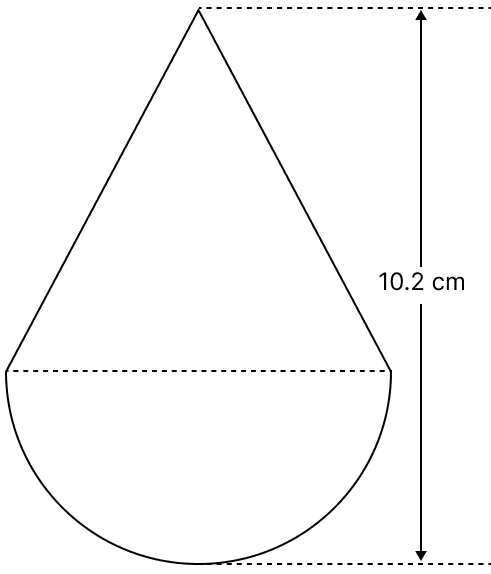
A solid wooden toy is in the form of a cone mounted on a hemisphere. The radii of the hemisphere and the base of the cone are 4.2 cm each and the total height of the toy is 10.2 cm. Calculate :

(i) the volume of wood used in the toy

(ii) the total surface area of the toy, correct to two places of decimal.

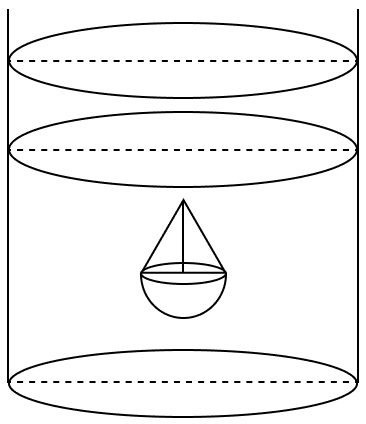
A solid wooden toy is in the form of a cone mounted on a hemisphere. The radii of the hemisphere and the base of the cone are 4.2 cm each and the total height of the toy is 10.2 cm. Calculate. Volume And Surface Area of solid RSA Mathematics Solutions ICSE Class 10.

Answer

Given,

The solid wooden toy is in the shape of a right circular cone mounted on a hemisphere.

Radius of hemisphere, r = 4.2 cm

Total height, h = 10.2 cm

Height of conical part, H = 10.2 - 4.2 = 6 cm

(i) Volume of wood used in toy = Volume of cone + Volume of hemisphere

=13πr2H+23πr3=13×227×4.22×6+23×227×4.23=13×227×17.64×6+23×227×74.088=2328.4821+3259.87221=5588.35221=266.11cm3= \dfrac{1}{3} π\text{r}^2\text{H} + \dfrac{2}{3} π\text{r}^3 \\[1em] = \dfrac{1}{3} \times \dfrac{22}{7} \times 4.2^2 \times 6 + \dfrac{2}{3} \times \dfrac{22}{7} \times 4.2^3 \\[1em] = \dfrac{1}{3} \times \dfrac{22}{7} \times 17.64 \times 6 + \dfrac{2}{3} \times \dfrac{22}{7} \times 74.088 \\[1em] = \dfrac{2328.48}{21} + \dfrac{3259.872}{21} \\[1em] = \dfrac{5588.352}{21} \\[1em] = 266.11 \text{cm}^3

Hence, the volume of wood used in the toy is 266.11 cm3.

(ii) By formula,

l2 = r2 + h2

⇒ l2 = 4.22 + 62

⇒ l2 = 17.64 + 36

⇒ l2 = 53.64

⇒ l = 53.64\sqrt{53.64} = 7.32 cm

Total surface area of toy = Curved surface area of cone + curved surface area of hemisphere

=πrl+2πr2=227×4.2×7.32+2×227×4.22=676.3687+2×227×17.64=676.3687+776.167=676.368+776.167=1452.5287=207.56cm2= π\text{rl} + 2π\text{r}^2 \\[1em] = \dfrac{22}{7} \times 4.2 \times 7.32 + 2 \times \dfrac{22}{7} \times 4.2^2 \\[1em] = \dfrac{676.368}{7} + 2 \times \dfrac{22}{7} \times 17.64 \\[1em] = \dfrac{676.368}{7} + \dfrac{776.16}{7} \\[1em] = \dfrac{676.368 + 776.16}{7} \\[1em] = \dfrac{1452.528}{7} \\[1em] = 207.56 \text{cm}^2

Hence, the total surface area of the toy is 207.56 cm2.

Question 23

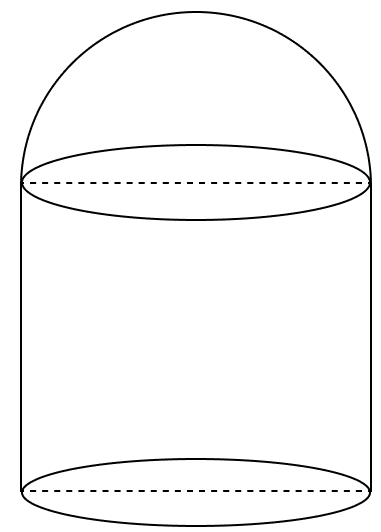
In the given figure, a metal container is in the form of a cylinder surmounted by a hemisphere. The internal height of the cylinder is 7 m and the internal radius is 3.5 m. Calculate:

(i) the total area of the internal surface, excluding the base.

(ii) the internal volume of the container in m3.

Draw a ΔABC in which BC = 5.6 cm, ∠B = 45° and the median AD from A to BC is 4.5 cm. Inscribe a circle in it. Volume And Surface Area of solid RSA Mathematics Solutions ICSE Class 10.

Answer

Given,

Radius of cylindrical portion = Radius of hemispherical portion = r = 3.5 m

Height of cylinder, h = 7 m

(i) Area of internal surface = Surface area of cylinder + Surface area of hemisphere

= 2πrh + 2πr2

= 2πr(h + r)

= 2 × 227\dfrac{22}{7} × 3.5(7 + 3.5)

= 2 × 227\dfrac{22}{7} × 36.75

= 2 × 22 × 5.25

= 231 m2

Hence, the total area of the internal surface, excluding the base is 231 m2.

(ii) Internal volume of container = Volume of hemisphere + Volume of cylinder

=23πr3+πr2h=23×227×3.53+227×3.52×7=23×227×42.875+227×12.25×7=23×22×6.125+269.5=89.83+269.5=359.33=35913m3= \dfrac{2}{3} π\text{r}^3 + π\text{r}^2\text{h} \\[1em] = \dfrac{2}{3} \times \dfrac{22}{7} \times 3.5^3 + \dfrac{22}{7} \times 3.5^2 \times 7 \\[1em] = \dfrac{2}{3} \times \dfrac{22}{7} \times 42.875 + \dfrac{22}{7} \times 12.25 \times 7 \\[1em] = \dfrac{2}{3} \times 22 \times 6.125 + 269.5 \\[1em] = 89.83 + 269.5 \\[1em] = 359.33 \\[1em] = 359 \dfrac{1}{3} \text{m}^3

Hence, the volume of container is 359.33 m3.

Question 24

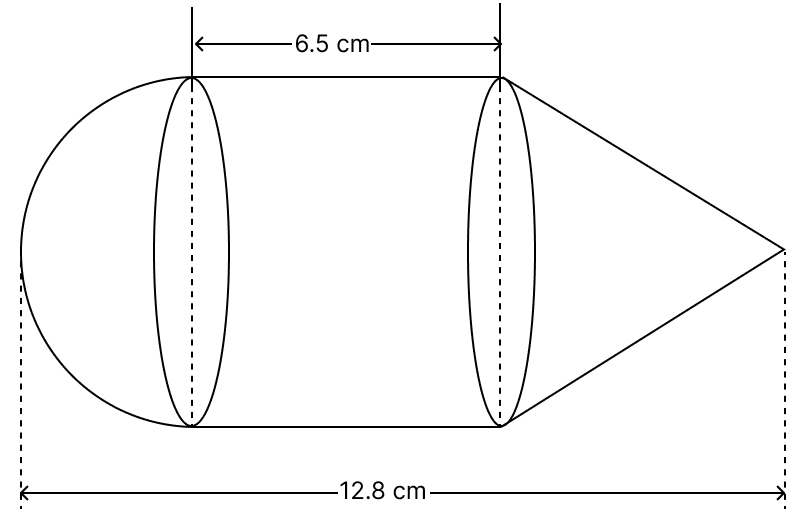
The adjoining figure represents a solid consisting of a cylinder surmounted by a cone at one end and a hemisphere at the other end. Given that, common radius = 3.5 cm, the height of the cylinder = 6.5 cm and the total height = 12.8 cm, calculate the volume of the solid, correct to the nearest integer.

The adjoining figure represents a solid consisting of a cylinder surmounted by a cone at one end and a hemisphere at the other end. Given that, common radius = 3.5 cm, the height of the cylinder = 6.5 cm and the total height = 12.8 cm, calculate the volume of the solid, correct to the nearest integer. Volume And Surface Area of solid RSA Mathematics Solutions ICSE Class 10.

Answer

Given, common radius, r = 3.5 cm

Height of cylinder, H = 6.5 cm

Height of hemisphere = radius of hemisphere = 3.5 cm

Height of cone, h = Total height of the solid - height of cylinder - height of hemisphere = 12.8 - 6.5 - 3.5 = 2.8 cm

Volume of solid = Volume of cone + Volume of cylinder + Volume of hemisphere

=13πr2h+πr2H+23πr3=πr2(13h+H+23r)=227×(3.5)2×(13×2.8+6.5+23×3.5)=227×12.25×(2.83+6.5+73)=22×1.75×(2.8+19.5+73)=38.5×29.33=1128.053=376.02376 cm3.= \dfrac{1}{3} π\text{r}^2\text{h} + π\text{r}^2\text{H} + \dfrac{2}{3} π\text{r}^3 \\[1em] = π\text{r}^2 \Big(\dfrac{1}{3} \text{h} + \text{H} + \dfrac{2}{3} \text{r}\Big) \\[1em] = \dfrac{22}{7} \times (3.5)^2 \times \Big(\dfrac{1}{3} \times 2.8 + 6.5 + \dfrac{2}{3} \times 3.5 \Big) \\[1em] = \dfrac{22}{7} \times 12.25 \times \Big(\dfrac{2.8}{3} + 6.5 + \dfrac{7}{3} \Big) \\[1em] = 22 \times 1.75 \times \Big(\dfrac{2.8 + 19.5 + 7}{3} \Big) \\[1em] = 38.5 \times \dfrac{29.3}{3} \\[1em] = \dfrac{1128.05}{3} \\[1em] = 376.02 \approx 376 \text{ cm}^3.

Hence, volume of solid is 376 cm3.

Question 25

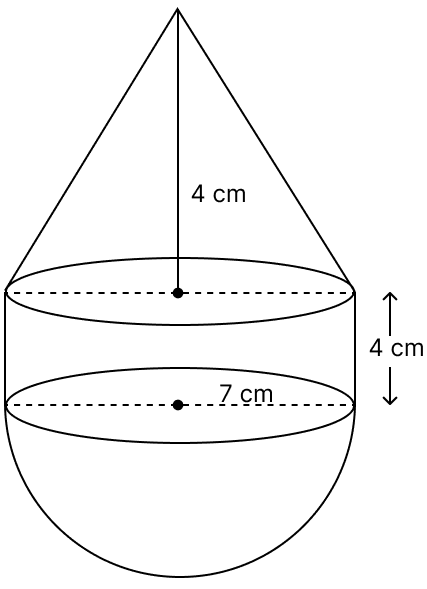
The adjoining figure represents a solid consisting of a right circular cylinder with a hemisphere at one end and a cone at the other. Their common radius is 7 cm. The height of the cylinder and cone each is 4 cm. Find the volume of the solid.

The adjoining figure represents a solid consisting of a right circular cylinder with a hemisphere at one end and a cone at the other. Their common radius is 7 cm. The height of the cylinder and cone each is 4 cm. Find the volume of the solid. Volume And Surface Area of solid RSA Mathematics Solutions ICSE Class 10.

Answer

Given, common radius, r = 7 cm

Height of cone, h = 4 cm

Height of cylinder, H = 4 cm

Volume of solid = Volume of cone + Volume of cylinder + Volume of hemisphere

=13πr2h+πr2H+23πr3=πr2(13h+H+23r)=227×72(13×4+4+23×7)=227×49(43+4+143)=22×7(4+12+143)=154×303=154×10=1540 cm3.= \dfrac{1}{3} π\text{r}^2\text{h} + π\text{r}^2\text{H} + \dfrac{2}{3} π\text{r}^3 \\[1em] = π\text{r}^2 \Big(\dfrac{1}{3} \text{h} + \text{H} + \dfrac{2}{3} \text{r}\Big) \\[1em] = \dfrac{22}{7} \times 7^2 \Big(\dfrac{1}{3} \times 4 + 4 + \dfrac{2}{3} \times 7 \Big) \\[1em] = \dfrac{22}{7} \times 49 \Big(\dfrac{4}{3} + 4 + \dfrac{14}{3} \Big) \\[1em] = 22 \times 7 \Big(\dfrac{4 + 12 + 14}{3} \Big) \\[1em] = 154 \times \dfrac{30}{3} \\[1em] = 154 \times 10 \\[1em] = 1540 \text{ cm}^3.

Hence, volume of solid is 1540 cm3.

Question 26

A solid is in the shape of a hemisphere of radius 7 cm, surmounted by a cone of height 4 cm. The solid is immersed completely in a cylindrical container filled with water to a certain height. If the radius of the cylinder is 14 cm, find the rise in the water.

A solid is in the shape of a hemisphere of radius 7 cm, surmounted by a cone of height 4 cm. The solid is immersed completely in a cylindrical container filled with water to a certain height. If the radius of the cylinder is 14 cm, find the rise in the water. Volume And Surface Area of solid RSA Mathematics Solutions ICSE Class 10.

Answer

Radius of hemisphere, r = 7 cm

Height of cone, h = 4 cm

Radius of cylinder, R = 14 cm

Let the rise in water level be x cm.

∴ Volume of water that rises by x cm in the cylindrical container = Volume of hemisphere submerged + Volume of cone submerged

πR2x=23πr3+13πr2hR2x=13(2r3+r2h)3×142x=2×73+72×43×196x=2×343+49×4588x=686+196588x=882x=882588x=1.5 cm.\Rightarrow π\text{R}^2\text{x} = \dfrac{2}{3} π\text{r}^3 + \dfrac{1}{3} π\text{r}^2\text{h} \\[1em] \Rightarrow \text{R}^2\text{x} = \dfrac{1}{3} (2\text{r}^3 + \text{r}^2\text{h}) \\[1em] \Rightarrow 3 \times 14^2\text{x} = 2 \times 7^3 + 7^2 \times 4 \\[1em] \Rightarrow 3 \times 196 \text{x} = 2 \times 343 + 49 \times 4 \\[1em] \Rightarrow 588 \text{x} = 686 + 196 \\[1em] \Rightarrow 588 \text{x} = 882 \\[1em] \Rightarrow \text{x} = \dfrac{882}{588} \\[1em] \Rightarrow \text{x} = 1.5 \text{ cm.}

Hence, rise in water level is 1.5 cm.

Question 27

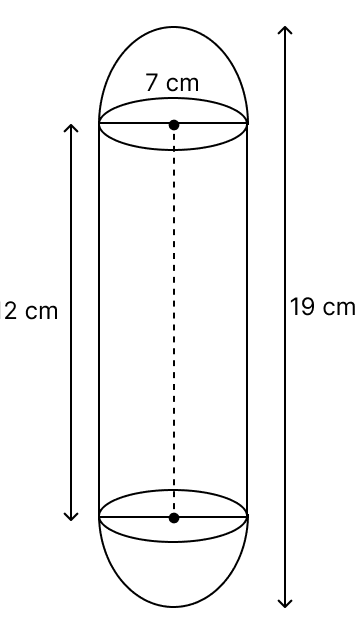
A solid is in the form of a cylinder with hemispherical ends. The total height of the solid is 19 cm and the diameter of the cylinder is 7 cm. Find the volume and the surface area of the solid.

Answer

A solid is in the form of a cylinder with hemispherical ends. The total height of the solid is 19 cm and the diameter of the cylinder is 7 cm. Find the volume and the surface area of the solid. Volume And Surface Area of solid RSA Mathematics Solutions ICSE Class 10.

From figure,

Radius of cylinder = Radius of hemisphere = r = diameter2=72\dfrac{\text{diameter}}{2} = \dfrac{7}{2} = 3.5 cm

Height of cylinder, h = Total height - (2 × Radius of hemisphere)

= 19 - 2 × 3.5

= 19 - 7

= 12 cm.

Total volume of solid = 2 × Volume of hemisphere + Volume of cylinder

=2×23πr3+πr2h=πr2(43r+h)=227×3.52(43×3.5+12)=227×12.25(143+12)=269.57×14+363=269.57×503=1347521=19253=641.67 cm3.= 2 \times \dfrac{2}{3} π\text{r}^3 + π\text{r}^2\text{h} \\[1em] = π\text{r}^2 (\dfrac{4}{3} \text{r} + \text{h}) \\[1em] = \dfrac{22}{7} \times 3.5^2 (\dfrac{4}{3} \times 3.5 + 12) \\[1em] = \dfrac{22}{7} \times 12.25 (\dfrac{14}{3} + 12) \\[1em] = \dfrac{269.5}{7} \times \dfrac{14 + 36}{3} \\[1em] = \dfrac{269.5}{7} \times \dfrac{50}{3} \\[1em] = \dfrac{13475}{21} \\[1em] = \dfrac{1925}{3} \\[1em] = 641.67 \text{ cm}^3.

Surface area of solid = 2 × 2πr2 + 2πrh

= πr(4r + 2h)

=227×3.5(4×3.5+2×12)=22×0.5(14+24)=11×38=418 cm2.= \dfrac{22}{7} \times 3.5 (4 \times 3.5 + 2 \times 12) \\[1em] = 22 \times 0.5 (14 + 24) \\[1em] = 11 \times 38 \\[1em] = 418 \text{ cm}^2.

Hence, the volume of solid is 64123641\dfrac{2}{3} cm3 and surface area of solid is 418 cm2.

Question 28

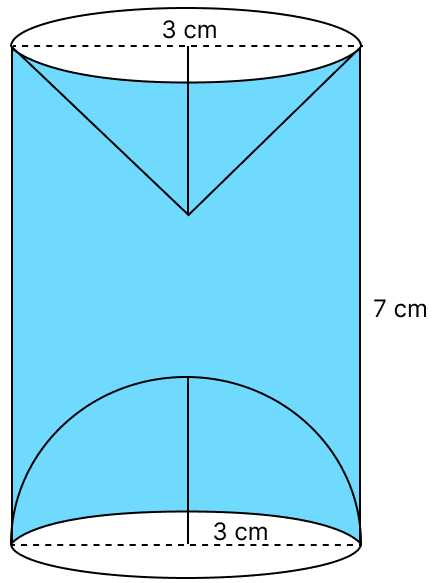
A hemispherical and a conical hole is scooped out of a solid wooden cylinder. Find the volume of the remaining solid where the measurements are as follows :

The height of the solid cylinder is 7 cm, radius of each of hemisphere, cone and cylinder is 3 cm. Height of cone is 3 cm. Give your answer correct to the nearest whole number.

A hemispherical and a conical hole is scooped out of a solid wooden cylinder. Find the volume of the remaining solid where the measurements are as follows. Volume And Surface Area of solid RSA Mathematics Solutions ICSE Class 10.

Answer

Given,

Radius, r = 3 cm

Height of cone, h = 3 cm

Height of cylinder, H = 7 cm

From figure,

Volume of remaining solid = Volume of cylinder - Volume of cone - Volume of hemisphere

∴ Volume of remaining solid = πr2H - 13\dfrac{1}{3} πr2h - 23\dfrac{2}{3} πr3

=πr2(H13h23r)=227×32(713×323×3)=227×9(712)=227×9×4=7927=113.14113 cm3.= π\text{r}^2(\text{H} - \dfrac{1}{3}\text{h} - \dfrac{2}{3} \text{r}) \\[1em] = \dfrac{22}{7} \times 3^2(7 - \dfrac{1}{3} \times 3 - \dfrac{2}{3} \times 3) \\[1em] = \dfrac{22}{7} \times 9(7 - 1 - 2) \\[1em] = \dfrac{22}{7} \times 9 \times 4 \\[1em] = \dfrac{792}{7} \\[1em] = 113.14 \approx 113 \text{ cm}^3.

Hence, the volume of the remaining solid is 113 cm3.

Question 29

A cylinder, a hemisphere and a cone have equal base diameters and have the same height. Prove that their volumes are in the ratio 3 : 2 : 1.

Answer

Let the common radius of shapes be r and height be h.

Ratio of their volumes = Volume of cylinder : Volume of hemisphere : Volume of cone

Since, a cylinder, a hemisphere and a cone have equal base diameters and have the same height.

⇒ They share a same radius r.

For hemisphere, the height is the distance from the centre of its base to its heighest point, which is equal to the radius.

⇒ h = r

=πr2h:23πr3:13πr2h=πr2h:23πr2r:13πr2h=πr2h:23πr2h:13πr2h=1:23:13= π\text{r}^2\text{h} : \dfrac{2}{3} π\text{r}^3 : \dfrac{1}{3} π\text{r}^2\text{h} \\[1em] = π\text{r}^2\text{h} : \dfrac{2}{3} π\text{r}^2 \text{r} : \dfrac{1}{3} π\text{r}^2\text{h} \\[1em] = π\text{r}^2\text{h} : \dfrac{2}{3} π\text{r}^2 \text{h} : \dfrac{1}{3} π\text{r}^2\text{h} \\[1em] = 1 : \dfrac{2}{3} : \dfrac{1}{3}

On multiplying by 3, ratio = 3 : 2 : 1

Hence, proved that their volumes are in the ratio 3 : 2 : 1.

Question 30

The radius of a sphere is doubled. Find the increase per cent in its surface area.

Answer

Let original radius be r units and new radius be R units.

Given, radius of a sphere is doubled.

∴ R = 2 × r = 2r

Let the original surface area be s and new surface area be S.

By formula,

Percentage increase in surface area = S - ss×100\dfrac{\text{S - s}}{\text{s}} \times 100

=4πR24πr24πr2×100=4π(R2r2)4πr2×100=(R2r2)r2×100=((2r)2r2)r2×100=(4r2r2)r2×100=3r2r2×100=300= \dfrac{4 π\text{R}^2 - 4 π\text{r}^2}{4π\text{r}^2} \times 100 \\[1em] = \dfrac{4 π(\text{R}^2 - \text{r}^2)}{4π\text{r}^2} \times 100 \\[1em] = \dfrac{(\text{R}^2 - \text{r}^2)}{\text{r}^2} \times 100 \\[1em] = \dfrac{(\text{(2r)}^2 - \text{r}^2)}{\text{r}^2} \times 100 \\[1em] = \dfrac{(4\text{r}^2 - \text{r}^2)}{\text{r}^2} \times 100 \\[1em] = \dfrac{3\text{r}^2}{\text{r}^2} \times 100 \\[1em] = 300 %.

Hence, percentage increase in surface area is 300%.

Question 31

If the radius of a sphere is increased by 50%, find the increase per cent in its volume.

Answer

Let original radius be r units and new radius be R units.

Given, radius of a sphere is increased by 50%.

∴ R = r + 50100\dfrac{50}{100} × r = r + 12\dfrac{1}{2} r = r + 0.5 r = 1.5 r

Let the original volume be v and new volume be V.

By formula,

Percentage increase in volume = V - vv×100\dfrac{\text{V - v}}{\text{v}} \times 100

=43πR343πr343πr3×100=43π(R3r3)43πr3×100=(R3r3)r3×100=((1.5r)3r3)r3×100=(3.375r3r3)r3×100=2.375r3r3×100=237.5= \dfrac{\dfrac{4}{3} π\text{R}^3 - \dfrac{4}{3} π\text{r}^3}{\dfrac{4}{3} π\text{r}^3} \times 100 \\[1em] = \dfrac{\dfrac{4}{3} π(\text{R}^3 - \text{r}^3)}{\dfrac{4}{3} π\text{r}^3} \times 100 \\[1em] = \dfrac{(\text{R}^3 - \text{r}^3)}{\text{r}^3} \times 100 \\[1em] = \dfrac{(\text{(1.5r)}^3 - \text{r}^3)}{\text{r}^3} \times 100 \\[1em] = \dfrac{(3.375\text{r}^3 - \text{r}^3)}{\text{r}^3} \times 100 \\[1em] = \dfrac{2.375\text{r}^3}{\text{r}^3} \times 100 \\[1em] = 237.5 %

Hence, percentage increase in volume is 237.5%.

Question 32

If the ratio of the volume of two spheres is 1 : 8, find the ratio of their surface areas.

Answer

Given,

Ratio of the volumes of the two spheres is 1 : 8

Volume of sphere 1Volume of sphere 2=1843πR343πr3=18R3r3=1323Rr=12\therefore \dfrac{\text{Volume of sphere 1}}{\text{Volume of sphere 2}} = \dfrac{1}{8} \\[1em] \Rightarrow \dfrac{\dfrac{4}{3} π\text{R}^3}{\dfrac{4}{3} π\text{r}^3} = \dfrac{1}{8} \\[1em] \Rightarrow \dfrac{\text{R}^3}{\text{r}^3} = \dfrac{1^3}{2^3} \\[1em] \Rightarrow \dfrac{\text{R}}{\text{r}} = \dfrac{1}{2}

Surface area of sphere = 4πr2

Surface area of sphere 1Surface area of sphere 2=4πR24πr2=(Rr)2=(12)2=14.\therefore \dfrac{\text{Surface area of sphere 1}}{\text{Surface area of sphere 2}} = \dfrac{4π\text{R}^2}{4π\text{r}^2} \\[1em] = \Big(\dfrac{\text{R}}{\text{r}}\Big)^2 \\[1em] = \Big(\dfrac{1}{2}\Big)^2 \\[1em] = \dfrac{1}{4}.

Hence, the ratio of the surface areas of two spheres is 1 : 4.

Question 33(i)

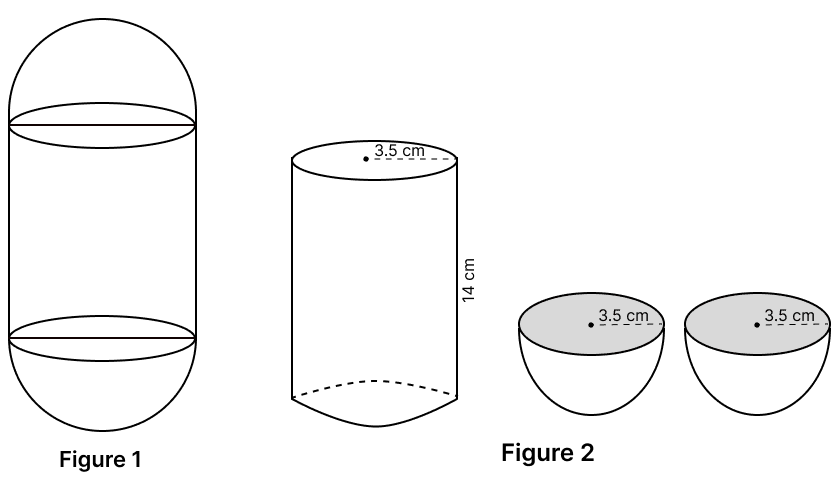
A solid wooden capsule is shown in Figure 1. The capsule is formed of a cylindrical block and two hemispheres.

Find the sum of total surface area of the three parts as shown in Figure 2. Given, the radius of the capsule is 3.5 cm and the length of the cylindrical block is 14 cm.
(Use π=227\pi = \dfrac{22}{7})

A solid wooden capsule is shown in Figure 1. The capsule is formed of a cylindrical block and two hemispheres. ICSE 2025 Maths Solved Question Paper.

Answer

From figure,

Radius of cylindrical block = radius of hemispheres = r = 3.5 cm

Height of cylindrical block = h = 14 cm.

By formula,

Total surface area of cylinder = 2πr(h + r)

Total surface area of a hemisphere = 3πr2

Total surface area = Total surface area of cylinder + Total surface area of 2 hemispheres

= 2πr(h + r) + 2 × 3πr2

= 2πrh + 2πr2 + 6πr2

= 2πrh + 8πr2

= 2πr(h + 4r).

Substituting values, we get :

Total surface area=2×227×3.5×(14+4×3.5)=2×22×0.5×(14+14)=22×28=616 cm2.\text{Total surface area} = 2 \times \dfrac{22}{7} \times 3.5 \times (14 + 4 \times 3.5) \\[1em] = 2 \times 22 \times 0.5 \times (14 + 14) \\[1em] = 22 \times 28 \\[1em] = 616 \text{ cm}^2.

Hence, the total surface area = 616 cm2.

Question 33(ii)

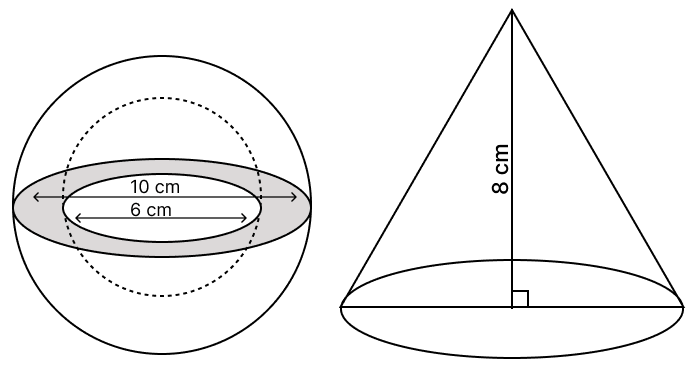
A hollow sphere of external diameter 10 cm and internal diameter 6 cm is melted and made into a solid right circular cone of height 8 cm. Find the radius of the cone so formed.
(Use π=227\pi = \dfrac{22}{7})

A hollow sphere of external diameter 10 cm and internal diameter 6 cm is melted and made into a solid right circular cone of height 8 cm. Find the radius of the cone so formed. ICSE 2025 Maths Solved Question Paper.

Answer

Given,

External radius of hollow sphere (R) = 5 cm, internal radius of hollow sphere (r) = 3 cm, height of cone (h) = 8 cm.

By formula,

Volume of metal in the hollow sphere V = 43π(R3r3)\dfrac{4}{3} \pi (R^3 − r^3)

Substituting values we get :

Vsphere=43×π×(5333)Vsphere=43×π×(12527)Vsphere=43×π×98Vsphere=3923π\Rightarrow V_{\text{sphere}}=\dfrac{4}{3} \times \pi \times \Big(5^{3}-3^{3}\Big) \\[1em] \Rightarrow V_{\text{sphere}} =\dfrac{4}{3} \times \pi \times (125-27) \\[1em] \Rightarrow V_{\text{sphere}} =\dfrac{4}{3} \times \pi \times 98 \\[1em] \Rightarrow V_{\text{sphere}} =\dfrac{392}{3} \pi

By formula,

Volume of cone = 13π×radius2h\dfrac{1}{3} \pi \times \text{radius}^2h

Let radius of cone formed be m cm.

Vcone=13πm2×8=83πm2V_{\text{cone}}=\dfrac{1}{3}\pi m^{2}\times 8=\dfrac{8}{3}\pi m^{2}

Since, the sphere is melted to form, the cone the volume of both objects will be equal.

3923π=83πm2392=8m2m2=3928m2=49m=7 cm.\Rightarrow \dfrac{392}{3}\pi=\dfrac{8}{3}\pi m^{2} \\[1em] \Rightarrow 392 = 8m^{2} \\[1em] \Rightarrow m^2 = \dfrac{392}{8} \\[1em] \Rightarrow m^{2} = 49 \\[1em] \Rightarrow m = 7 \text{ cm}.

Hence, the radius of the cone formed = 7 cm.

PrevNext