KnowledgeBoat Logo
|
OPEN IN APP

Chapter 21

Volume & Surface Area of Solids — Exercise 21(B)

Class - 10 RS Aggarwal Mathematics Solutions


Exercise 21B

Question 1

The height of a right circular cone is 24 cm and the radius of its base is 7 cm. Calculate :

(i) the slant height of the cone

(ii) the lateral surface area of the cone

(iii) the total surface area of the cone

(iv) the volume of the cone

Answer

Given, h = 24 cm and r = 7 cm

(i) Slant height, l = h2+r2=242+72=576+49=625=25 cm.\sqrt{\text{h}^2 + \text{r}^2} = \sqrt{24^2 + 7^2} = \sqrt{576 + 49} = \sqrt{625} = 25 \text{ cm.}

Hence, slant height of the cone is 25 cm.

(ii) Lateral surface area = πrl

=227×7×25=38507=550 cm2= \dfrac{22}{7} \times 7 \times 25 \\[1em] = \dfrac{3850}{7} \\[1em] = 550 \text{ cm}^2

Hence, lateral surface area of the cone is 550 cm2.

(iii) Total surface area = πr(l + r)

=227×7(25+7)=1547×(32)=49287=704 cm2= \dfrac{22}{7} \times 7(25 + 7) \\[1em] = \dfrac{154}{7} \times (32) \\[1em] = \dfrac{4928}{7} \\[1em] = 704 \text{ cm}^2

Hence, total surface area of the cone is 704 cm2.

(iv) Volume of cone = 13\dfrac{1}{3} πr2h

=13×227×72×24=2221×49×24=2587221=1232 cm3= \dfrac{1}{3} \times \dfrac{22}{7} \times 7^2 \times 24 \\[1em] = \dfrac{22}{21} \times 49 \times 24 \\[1em] = \dfrac{25872}{21} \\[1em] = 1232 \text{ cm}^3

Hence, volume of the cone is 1232 cm3.

Question 2

The height of a right circular cone is 8 cm and the diameter of its base is 12 cm. Calculate :

(i) the slant height of the cone

(ii) the total surface area of the cone

(iii) the volume of the cone

Answer

Given, h = 8 cm and r = diameter2=122=6\dfrac{\text{diameter}}{2} = \dfrac{12}{2} = 6 cm

(i) Slant height, l = h2+r2=82+62=64+36=100=10 cm.\sqrt{\text{h}^2 + \text{r}^2} = \sqrt{8^2 + 6^2} = \sqrt{64 + 36} = \sqrt{100} = 10 \text{ cm.}

Hence, slant height of the cone is 10 cm.

(ii) Total surface area = πr(l + r)

=227×6(10+6)=1327×(16)=21127=301.7 cm2= \dfrac{22}{7} \times 6(10 + 6) \\[1em] = \dfrac{132}{7} \times (16) \\[1em] = \dfrac{2112}{7} \\[1em] = 301.7 \text{ cm}^2

Hence, total surface area of the cone is 301.7 cm2.

(iii) Volume of cone = 13\dfrac{1}{3} πr2h

=13×227×62×8=2221×36×8=633621=301.7 cm3= \dfrac{1}{3} \times \dfrac{22}{7} \times 6^2 \times 8 \\[1em] = \dfrac{22}{21} \times 36 \times 8 \\[1em] = \dfrac{6336}{21} \\[1em] = 301.7 \text{ cm}^3

Hence, volume of the cone is 301.7 cm3.

Question 3

The slant height of a cone is 17 cm and the radius of its base is 15 cm. Find:

(i) the height of the cone

(ii) the volume of the cone

(iii) the total surface area of the cone

Answer

Given, slant height, l = 17 cm and radius, r = 15 cm

(i) l2 = r2 + h2

⇒ h2 = l2 - r2

⇒ h2 = 172 - 152

⇒ h2 = 289 - 225

⇒ h2 = 64

⇒ h = 64=8 cm.\sqrt{64} = 8 \text{ cm.}

Hence, height of the cone is 8 cm.

(ii) Volume of cone = 13\dfrac{1}{3} πr2h

=13×227×152×8=2221×225×8=3960021=1885.7 cm3= \dfrac{1}{3} \times \dfrac{22}{7} \times 15^2 \times 8 \\[1em] = \dfrac{22}{21} \times 225 \times 8 \\[1em] = \dfrac{39600}{21} \\[1em] = 1885.7 \text{ cm}^3

Hence, volume of the cone is 1885.7 cm3.

(iii) Total surface area = πr(l + r)

=227×15(17+15)=3307×(32)=105607=1508.6 cm2= \dfrac{22}{7} \times 15(17 + 15) \\[1em] = \dfrac{330}{7} \times (32) \\[1em] = \dfrac{10560}{7} \\[1em] = 1508.6 \text{ cm}^2

Hence, total surface area of the cone is 1508.6 cm2.

Question 4

The volume of a right circular cone is 660 cm3 and diameter of its base is 12 cm. Calculate:

(i) the height of the cone

(ii) the slant height of the cone

(ii) the total surface area of the cone

Answer

Given, radius, r = diameter2=122=6 cm.\dfrac{\text{diameter}}{2} = \dfrac{12}{2} = 6 \text{ cm.}

Volume of cone = 660 cm3

(i) By formula,

Volume of cone = 13\dfrac{1}{3} πr2h

660=13×227×62×h660=2221×36×hh=660×2122×36h=13860792h=17.5 cm.\Rightarrow 660 = \dfrac{1}{3} \times \dfrac{22}{7} \times 6^2 \times \text{h} \\[1em] \Rightarrow 660 = \dfrac{22}{21} \times 36 \times \text{h} \\[1em] \Rightarrow \text{h} = \dfrac{660 \times 21}{22 \times 36} \\[1em] \Rightarrow \text{h} = \dfrac{13860}{792} \\[1em] \Rightarrow \text{h} = 17.5 \text{ cm}.

Hence, the height of the cone is 17.5 cm.

(ii) By formula,

Slant height (l) = h2+r2\sqrt{\text{h}^2 + \text{r}^2}

=(17.5)2+62=306.25+36=342.25=18.5 cm.= \sqrt{(17.5)^2 + 6^2} = \sqrt{306.25 + 36} = \sqrt{342.25} = 18.5 \text{ cm.}

Hence, slant height of the cone is 18.5 cm.

(iii) Total surface area = πr(l + r)

=227×6×(18.5+6)=1327×(24.5)=32347=462 cm2= \dfrac{22}{7} \times 6 \times (18.5 + 6) \\[1em] = \dfrac{132}{7} \times (24.5) \\[1em] = \dfrac{3234}{7} \\[1em] = 462 \text{ cm}^2

Hence, total surface area of the cone is 462 cm2.

Question 5

The total surface of a right circular cone of slant height 20 cm is 384π cm2. Calculate:

(i) its radius in cm

(ii) its volume in cm3, in terms of π

Answer

Given, slant height, l = 20 cm and total surface area of cone = 384π cm2

(i) By formula,

Total surface area = πr(l + r)

⇒ 384π = πr(20 + r)

⇒ 384 = 20r + r2

⇒ r2 + 20r - 384 = 0

⇒ r2 + 32r - 12r - 384 = 0

⇒ r(r + 32) - 12(r + 32) = 0

⇒ (r + 32) = 0 or (r - 12) = 0

⇒ r = - 32 or r = 12

Since, radius cannot be negative.

∴ r = 12 cm.

Hence, radius of the cone is 12 cm.

(ii) l2 = r2 + h2

⇒ h2 = l2 - r2

⇒ h2 = 202 - 122

⇒ h2 = 400 - 144

⇒ h2 = 256

⇒ h = 256=16 cm.\sqrt{256} = 16 \text{ cm.}

Volume of cone = 13\dfrac{1}{3} πr2h

=13×π×122×16=13×π×144×16=23043π=768π cm3= \dfrac{1}{3} \times π \times 12^2 \times 16 \\[1em] = \dfrac{1}{3} \times π \times 144 \times 16 \\[1em] = \dfrac{2304}{3} π \\[1em] = 768 π \text{ cm}^3

Hence, volume of the cone is 768 π cm3.

Question 6

The radius and the height of a right circular cone are in the ratio of 5 : 12 and its volume is 2512 cm3. Find:

(i) the radius and height of the cone

(ii) the curved surface area of the cone

(iii) the total surface area of the cone

(Take π = 3.14)

Answer

Given, radius(r) : height(h) = 5 : 12

(i) Let r = 5x and h = 12x

Volume of cone = 13\dfrac{1}{3} πr2h

2512=13×3.14×(5x)2×12x2512=3.14×25x2×4xx3=25123.14×25×4x3=2512314x3=8x=83x=2\Rightarrow 2512 = \dfrac{1}{3} \times 3.14 \times (5\text{x})^2 \times 12\text{x} \\[1em] \Rightarrow 2512 = 3.14 \times 25\text{x}^2 \times 4\text{x} \\[1em] \Rightarrow \text{x}^3 = \dfrac{2512}{3.14 \times 25 \times 4} \\[1em] \Rightarrow \text{x}^3 = \dfrac{2512}{314} \\[1em] \Rightarrow \text{x}^3 = 8 \\[1em] \Rightarrow \text{x} = \sqrt[3]{8} \\[1em] \Rightarrow \text{x} = 2

⇒ r = 5x = 5 × 2 = 10 cm

⇒ h = 12x = 12 × 2 = 24 cm

Hence, radius of the cone is 10 cm and height of the cone is 24 cm.

(ii) Curved surface area = πrl

l2 = r2 + h2

⇒ l2 = 102 + 242

⇒ l2 = 100 + 576

⇒ l2 = 676

⇒ l = 676\sqrt{676} = 26 cm

=3.14×10×26=816.4 cm2= 3.14 \times 10 \times 26 \\[1em] = 816.4 \text{ cm}^2

Hence, curved surface area of the cone is 816.4 cm2.

(iii) Total surface area = πr(l + r)

=3.14×10(26+10)=3.14×10×36=1130.4 cm2= 3.14 \times 10(26 + 10) \\[1em] = 3.14 \times 10 \times 36 \\[1em] = 1130.4 \text{ cm}^2

Hence, total surface area of the cone is 1130.4 cm2.

Question 7

A right circular cone of radius 20 cm has its volume 8800 cm3. Find its:

(i) height

(ii) curved surface area.

Give your answer to the nearest whole number.

Answer

Let height of cone be h cm.

Given,

Radius of cone (r) = 20 cm

(i) Given,

Volume = 8800 cm3

By formula,

Volume of cone = 13πr2h\dfrac{1}{3}\pi r^2 h

13πr2h=8800\dfrac{1}{3}\pi r^2 h = 8800

13×227×202×h=880013×227×400×h=8800h=8800×7×3400×22h=7×3h=21 cm.\Rightarrow \dfrac{1}{3} \times \dfrac{22}{7} \times 20^2 \times h = 8800 \\[1em] \Rightarrow \dfrac{1}{3} \times \dfrac{22}{7} \times 400 \times h = 8800 \\[1em] \Rightarrow h = \dfrac{8800 \times 7 \times 3}{400 \times 22} \\[1em] \Rightarrow h = 7 \times 3 \\[1em] \Rightarrow h = 21 \text{ cm}.

Hence, height of cone = 21 cm.

(ii) By formula,

Slant Height of cone (l) = (r2+h2)\sqrt{(r^2 + h^2)}

l=(20)2+(21)2=400+441=841=29 cml = \sqrt{(20)^2 + (21)^2} \\[1em] = \sqrt{400 + 441} \\[1em] = \sqrt{841} \\[1em] = 29 \text{ cm}

By formula,

Curved Surface Area of cone = πrl

Curved Surface Area of cone = 227×20×29\dfrac{22}{7} \times 20 \times 29

127607\dfrac{12760}{7}

⇒ 1822.857 ≈ 1823 cm2.

Hence, curved surface area of cone = 1823 cm2.

Question 8

How many metres of canvas 1.25 m will be needed to make a conical tent whose base radius is 17.5 m and height 6 m?

Answer

Given, r = 17.5 m and h = 6 m

l2 = r2 + h2

⇒ l2 = 17.52 + 62

⇒ l2 = 306.25 + 36

⇒ l2 = 342.25

⇒ l = 342.25\sqrt{342.25} = 18.5 m

So, the total curved surface area of the tent = πrl

=227×17.5×18.5=7122.57=1017.5 m2= \dfrac{22}{7} \times 17.5 \times 18.5 \\[1em] = \dfrac{7122.5}{7} \\[1em] = 1017.5 \text{ m}^2

Width of the canvas used = 1.25 m

Length of canvas = area of canvaswidth of canvas=1017.51.25\dfrac{\text{area of canvas}}{\text{width of canvas}} = \dfrac{1017.5}{1.25} = 814 m.

Hence, 814 metres of canvas will be needed to make a conical tent.

Question 9

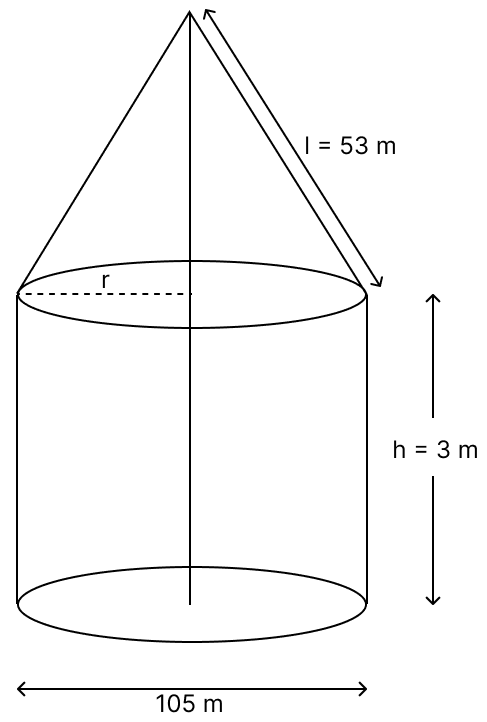
A circus tent is cylindrical to a height of 3 meters and conical above it. If its diameter is 105 m and the slant height of the conical portion is 53 m, calculate the length of the canvas 2.5 m wide to make the required tent.

Answer

From figure,

Radius of conical part = radius of cylindrical part = r.

Radius of the cylindrical part of the tent (r) = diameter2=1052 m\dfrac{\text{diameter}}{2} = \dfrac{105}{2} \text{ m}

Radius of the conical part (r) = 1052 m\dfrac{105}{2} \text{ m}

Slant height (l) = 53 m

A circus tent is cylindrical to a height of 3 meters and conical above it. If its diameter is 105 m and the slant height of the conical portion is 53 m, calculate the length of the canvas 2.5 m wide to make the required tent. Volume And Surface Area of solid RSA Mathematics Solutions ICSE Class 10.

So, the total curved surface area of the tent = 2πrh + πrl

=2×227×1052×3+227×1052×53=1386014+12243014=990+8745=9735 m2.= 2 \times \dfrac{22}{7} \times \dfrac{105}{2} \times 3 + \dfrac{22}{7} \times \dfrac{105}{2} \times 53 \\[1em] = \dfrac{13860}{14} + \dfrac{122430}{14} \\[1em] = 990 + 8745 \\[1em] = 9735 \text{ m}^2.

Width of the canvas used = 2.5 m

Length of canvas = area of canvaswidth of canvas=97352.5\dfrac{\text{area of canvas}}{\text{width of canvas}} = \dfrac{9735}{2.5} = 3894 m.

Hence, length of the canvas required to make tent is 3894 m.

Question 10

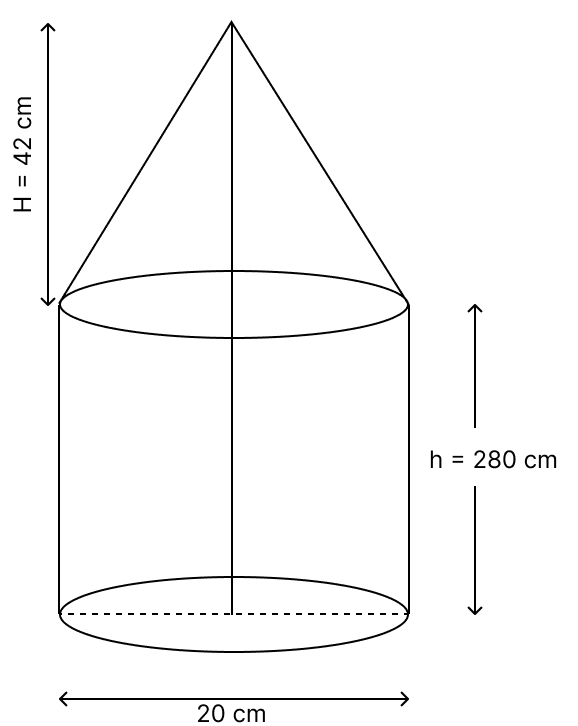
An iron pillar consists of a cylindrical portion, 2.8 m high and 20 cm in diameter and a cone 42 cm high is surrounding it. Find the weight of the pillar, given that 1 cm3 of iron weighs 7.5 g.

Answer

Radius of cylindrical portion, r = diameter2=202\dfrac{\text{diameter}}{2} = \dfrac{20}{2} = 10 cm

Height of the cylindrical portion, h = 2.8 m = 2.8 × 100 = 280 cm

Height of the conical portion, H = 42 cm

An iron pillar consists of a cylindrical portion, 2.8 m high and 20 cm in diameter and a cone 42 cm high is surrounding it. Find the weight of the pillar, given that 1 cm<sup>3</sup> of iron weighs 7.5 g. Volume And Surface Area of solid RSA Mathematics Solutions ICSE Class 10.

From figure,

Radius of the conical part = radius of the cylindrical portion = r = 10 cm

Volume of iron pole = Volume of cylindrical portion + Volume of conical portion

= πr2h + 13\dfrac{1}{3} πr2H

=227×102×280+13×227×102×42=227×100×280+13×227×100×42=227×100×280+227×100×14=6160007+308007=616000+308007=6468007=92400 cm3.= \dfrac{22}{7} \times 10^2 \times 280 + \dfrac{1}{3} \times \dfrac{22}{7} \times 10^2 \times 42 \\[1em] = \dfrac{22}{7} \times 100 \times 280 + \dfrac{1}{3} \times \dfrac{22}{7} \times 100 \times 42 \\[1em] = \dfrac{22}{7} \times 100 \times 280 + \dfrac{22}{7} \times 100 \times 14 \\[1em] = \dfrac{616000}{7} + \dfrac{30800}{7} \\[1em] = \dfrac{616000 + 30800}{7} \\[1em] = \dfrac{646800}{7} \\[1em] = 92400 \text{ cm}^3.

Given,

Weight of 1 cm3 of iron = 7.5 gm.

Total weight = 92400 × 7.5 = 693000 gm = 6930001000\dfrac{693000}{1000} kg = 693 kg.

Hence, the weight of the pillar is 693 kg.

Question 11

Water flows at the rate of 10 m per minute through a cylindrical pipe 5 mm in diameter. How long would it take to fill a conical vessel whose diameter at the base is 40 cm and depth 24 cm?

Answer

Radius of cylindrical pipe, r = diameter2=0.52\dfrac{\text{diameter}}{2} = \dfrac{0.5}{2} = 0.25 cm

Given, water flows at the rate of 10 m per minute.

Length of the cylindrical portion, h = 10 m = 10 × 100 = 1000 cm

Height of the conical portion, H = 24 cm

Radius of conical pipe, R = diameter2=402\dfrac{\text{diameter}}{2} = \dfrac{40}{2} = 20 cm

Volume of water that flows in 1 min = πr2h

=227×(0.25)2×1000=227×0.0625×1000=13757= \dfrac{22}{7} \times (0.25)^2 \times 1000 \\[1em] = \dfrac{22}{7} \times 0.0625 \times 1000 \\[1em] = \dfrac{1375}{7}

Volume of the conical vessel = 13\dfrac{1}{3} πR2H

=13×227×202×24=227×400×8=704007= \dfrac{1}{3} \times \dfrac{22}{7} \times 20^2 \times 24 \\[1em] = \dfrac{22}{7} \times 400 \times 8 \\[1em] = \dfrac{70400}{7}

Required time = Volume of conical vesselVolume of water that flows in 1 min\dfrac{\text{Volume of conical vessel}}{\text{Volume of water that flows in 1 min}}

=70400713757=704007×71375=704001375=51.2 min.= \dfrac{\dfrac{70400}{7}}{\dfrac{1375}{7}} \\[1em] = \dfrac{70400}{7} \times \dfrac{7}{1375} \\[1em] = \dfrac{70400}{1375} \\[1em] = 51.2 \text{ min.}

= 51 min 12 sec.

Hence, time required to fill a conical vessel is 51 min 12 sec.

Question 12(i)

A conical tent is to accommodate 11 persons. Each person must have 4 m2 of the space on the ground and 20m3 of air to breathe. Find the height of the cone.

Answer

Given,

Each person must have 20 m3 of air to breathe.

∴ 11 persons need 11 × 20 m3 = 220 m3

Each person must have 4 m2 of the space on the ground.

∴ 11 persons need 11 × 4 m2 = 44 m2

Base of the conical tent = area of the circle = πr2

44=227×r2r2=7×4422r2=30822r2=14 m.\Rightarrow 44 = \dfrac{22}{7} \times \text{r}^2 \\[1em] \Rightarrow \text{r}^2 = \dfrac{7 \times 44}{22} \\[1em] \Rightarrow \text{r}^2 = \dfrac{308}{22} \\[1em] \Rightarrow \text{r}^2 = 14 \text{ m.}

Let height of the conical tent be h meters.

Since, conical tent needs to accomodate 11 persons, so its volume will be equal to volume of air required for 11 persons.

13πr2h=22013×227×14×h=220h=220×7×322×14h=4620308h=15 m.\Rightarrow \dfrac{1}{3}π \text{r}^2 \text{h} = 220 \\[1em] \Rightarrow \dfrac{1}{3} \times \dfrac{22}{7} \times 14 \times \text{h} = 220 \\[1em] \Rightarrow \text{h} = \dfrac{220 \times 7 \times 3}{22 \times 14} \\[1em] \Rightarrow \text{h} = \dfrac{4620}{308} \\[1em] \Rightarrow \text{h} = 15 \text{ m.}

Hence, height of the tent is 15 m..

Question 12(ii)

A conical tent is to accommodate 77 persons. Each person must have 16 m3 of air to breathe. Given the radius of the tent as 7 m, find the height of the tent and also its curved surface area.

Answer

Given,

Each person must have 16 m3 of air to breathe.

∴ 77 persons need 77 × 16 m3 = 1232 m3

Radius of the tent (r) = 7 m

Let height of the conical tent be h meters.

Since, conical tent needs to accomodate 77 persons, so its volume will be equal to volume of air required for 77 persons.

13πr2h=123213×227×72×h=123213×227×49×h=1232h=1232×7×322×49h=258721078h=24 m.\Rightarrow \dfrac{1}{3}π \text{r}^2 \text{h} = 1232 \\[1em] \Rightarrow \dfrac{1}{3} \times \dfrac{22}{7} \times 7^2 \times \text{h} = 1232 \\[1em] \Rightarrow \dfrac{1}{3} \times \dfrac{22}{7} \times 49 \times \text{h} = 1232 \\[1em] \Rightarrow \text{h} = \dfrac{1232 \times 7 \times 3}{22 \times 49} \\[1em] \Rightarrow \text{h} = \dfrac{25872}{1078} \\[1em] \Rightarrow \text{h} = 24 \text{ m.}

By formula,

l2 = r2 + h2

⇒ l2 = 72 + 242

⇒ l2 = 49 + 576

⇒ l2 = 625

⇒ l = 625\sqrt{625} = 25 m

Curved surface area of the tent = πrl

=227×7×25=22×25=550 m2= \dfrac{22}{7} \times 7 \times 25 \\[1em] = 22 \times 25 \\[1em] = 550 \text{ m}^2

Hence, height of the tent is 24 m and curved surface area of the tent is 550 m2.

Question 13

A right circular cone is 3.6 cm high and the radius of its base is 1.6 cm. It is melted and recast into a right circular cone with radius of its base as 1.2 cm. Find its height.

Answer

Radius of cone, r = 1.6 cm

Height of the cone, h = 3.6 cm

Volume of circular cone = 13\dfrac{1}{3} πr2h

=13×227×(1.6)2×3.6=13×227×2.56×3.6=202.75221= \dfrac{1}{3} \times \dfrac{22}{7} \times (1.6)^2 \times 3.6 \\[1em] = \dfrac{1}{3} \times \dfrac{22}{7} \times 2.56 \times 3.6 \\[1em] = \dfrac{202.752}{21}

Volume of cone of radius (R) = 1.2 cm and height (H)

Volume of circular cone = 13\dfrac{1}{3} πR2H

=13×227×(1.2)2×H=13×227×1.44×H=31.6821H= \dfrac{1}{3} \times \dfrac{22}{7} \times (1.2)^2 \times \text{H} \\[1em] = \dfrac{1}{3} \times \dfrac{22}{7} \times 1.44 \times \text{H} \\[1em] = \dfrac{31.68}{21} \text{H}

Since, cone is melted and recasted into right circular cone of radius 1.2 cm, the volume remains the same.

202.75221=31.6821HH=202.752×2131.68×21H=6.4 cm.\therefore \dfrac{202.752}{21} = \dfrac{31.68}{21} \text{H} \\[1em] \Rightarrow \text{H} = \dfrac{202.752 \times 21}{31.68 \times 21} \\[1em] \Rightarrow \text{H} = 6.4 \text{ cm.}

Hence, height of the cone is 6.4 cm.

Question 14

A solid metallic cylinder of base radius 3 cm and height 5 cm is melted to form cones, each of height 1 cm and base radius 1 mm. Find the number of cones.

Answer

For larger cylinder,

Height (H) = 5 cm

Radius (R) = 3 cm

For smaller cones,

Height (h) = 1 cm

Radius (r) = 1 mm = 0.1 cm

Let no. of smaller cones formed be n.

Volume of larger cylinder = n × Volume of smaller cones

πR2H=n×13πr2h227×(3)2×5=n×13×227×(0.1)2×1227×9×5=n×13×227×0.01×19907=n×0.2221n=990×210.22×7n=207901.54n=13500\Rightarrow π\text{R}^2\text{H} = \text{n} \times \dfrac{1}{3}π\text{r}^2\text{h} \\[1em] \Rightarrow \dfrac{22}{7} \times (3)^2 \times 5 = \text{n} \times \dfrac{1}{3} \times \dfrac{22}{7} \times (0.1)^2 \times 1 \\[1em] \Rightarrow \dfrac{22}{7} \times 9 \times 5 = \text{n} \times \dfrac{1}{3} \times \dfrac{22}{7} \times 0.01 \times 1 \\[1em] \Rightarrow \dfrac{990}{7} = \text{n} \times \dfrac{0.22}{21} \\[1em] \Rightarrow \text{n} = \dfrac{990 \times 21}{0.22 \times 7} \\[1em] \Rightarrow \text{n} = \dfrac{20790}{1.54} \\[1em] \Rightarrow \text{n} = 13500

Hence, the number of cones formed = 13500.

Question 15

A conical vessel, whose internal radius is 12 cm and height 50 cm, is full of liquid. The contents are emptied into a cylindrical vessel with internal radius 10 cm. Find the height to which the liquid rises in the cylindrical vessel.

Answer

For cylindrical vessel,

Let height be H cm

Radius (R) = 10 cm

For conical vessel,

Height (h) = 50 cm

Radius (r) = 12 cm

Since, contents in conical vessel are emptied into a cylindrical vessel, hence there volume will be same.

∴ Volume of cylinder = Volume of conical vessel

πR2H=13πr2hR2H=13r2h102×H=13×122×50100×H=13×144×50H=144×503×100H=7200300H=24 cm.\Rightarrow π\text{R}^2\text{H} = \dfrac{1}{3}π\text{r}^2\text{h} \\[1em] \Rightarrow \text{R}^2\text{H} = \dfrac{1}{3}\text{r}^2\text{h} \\[1em] \Rightarrow 10^2 \times \text{H} = \dfrac{1}{3} \times 12^2 \times 50 \\[1em] \Rightarrow 100 \times \text{H} = \dfrac{1}{3} \times 144 \times 50 \\[1em] \Rightarrow \text{H} = \dfrac{144 \times 50}{3 \times 100} \\[1em] \Rightarrow \text{H} = \dfrac{7200}{300} \\[1em] \Rightarrow \text{H} = 24 \text{ cm.}

Hence, height to which the liquid rises in the cylindrical vessel is 24 cm.

Question 16

The height of a cone is 40 cm. A small cone is cut off at the top by a plane parallel to its base. If its volume be 164\dfrac{1}{64} of the volume of the given cone, at what height above the base is the section cut?

Answer

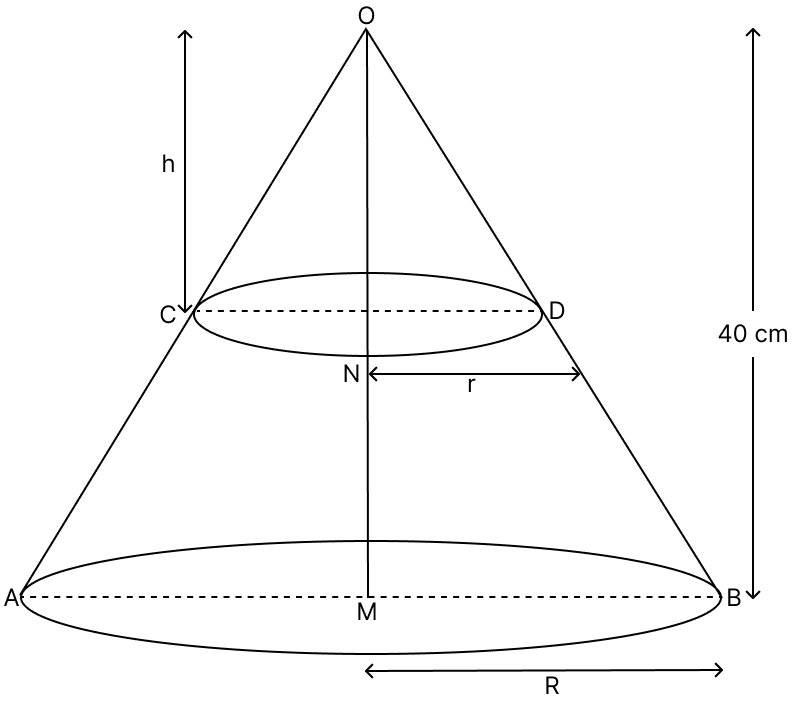
Let OAB be the given cone of height 40 cm and base radius R cm. Let this cone be cut by the plane CND (parallel to the base plane AMB) to obtain cone OCD with height h cm and base radius r cm as shown in the figure below :

The height of a cone is 40 cm. A small cone is cut off at the top by a plane parallel to its base. If its volume be of the volume of the given cone, at what height above the base is the section cut? Volume And Surface Area of solid RSA Mathematics Solutions ICSE Class 10.

From figure,

∠NOD = ∠MOB (Common angle)

∠OND = ∠OMB = 90° (Heights are perpendicular to radii)

∠ODN = ∠OBM (Corresponding angles since ND || MB)

∴ △OND ~ △OMB (By AA similarity)

We know that,

Ratio of corresponding sides of similar triangle are proportional.

rR=h40\dfrac{\text{r}}{\text{R}} = \dfrac{\text{h}}{40} ...(1)

According to given,

Volume of cone OCD = 164\dfrac{1}{64} Volume of cone OAB

13\dfrac{1}{3} πr2h = 164×13\dfrac{1}{64} \times \dfrac{1}{3} πR2 × 40

Dividing both sides by π and multiplying by 3 we get,

r2h=4064×R2r2R2=58h(rR)2=58h\Rightarrow \text{r}^2 \text{h} = \dfrac{40}{64} \times \text{R}^2 \\[1em] \Rightarrow \dfrac{\text{r}^2}{\text{R}^2} = \dfrac{5}{8 \text{h}} \\[1em] \Rightarrow \Big(\dfrac{\text{r}}{\text{R}}\Big)^2 = \dfrac{5}{8 \text{h}} \\[1em]

Using eq.(1),

(h40)2=58hh21600=58hh3=5×16008h3=5×200h3=1000h=10003h=10 cm.\Rightarrow \Big(\dfrac{\text{h}}{40}\Big)^2 = \dfrac{5}{8 \text{h}} \\[1em] \Rightarrow \dfrac{\text{h}^2}{1600} = \dfrac{5}{8 \text{h}} \\[1em] \Rightarrow \text{h}^3 = \dfrac{5 \times 1600}{8} \\[1em] \Rightarrow \text{h}^3 = 5 \times 200 \\[1em] \Rightarrow \text{h}^3 = 1000 \\[1em] \Rightarrow \text{h} = \sqrt[3]{1000} \\[1em] \Rightarrow \text{h} = 10 \text{ cm.}

The height of the cone OCD = 10 cm

∴ The section is cut at the height of 40 - 10 = 30 cm.

Hence, the section is cut above 30 cm from the base.

Question 17

A hollow metallic cylindrical tube has an internal radius of 3 cm and height 21 cm. The thickness of the metal is 0.5 cm. The tube is melted and cast into a right circular cone of height 7 cm. Find the radius of the cone, correct to one decimal place.

Answer

Internal radius (r) = 3 cm

Height (h) = 21 cm

Thickness = External radius (R) - Internal radius

⇒ 0.5 = External radius - 3 cm

⇒ External radius = 0.5 + 3 = 3.5 cm

Volume of hollow cylinder = π(R2 - r2)h,

Putting values we get,

∴ Volume of metal = π(3.52 - 32) × 21

=227×(12.259)×21=22×3.25×3=214.5 cm3= \dfrac{22}{7} \times (12.25 - 9) \times 21 \\[1em] = 22 \times 3.25 \times 3 \\[1em] = 214.5 \text{ cm}^3

Given the tube is melted and cast into a right circular cone of height (H) 7 cm.

So, the volume of metal and volume of cone will be same.

∴ 214.5 = 13\dfrac{1}{3} πr2H

214.5=13×227×r2×7214.5=13×22×r2r2=214.5×322r2=29.25r=29.25r=5.4 cm.\Rightarrow 214.5 = \dfrac{1}{3} \times \dfrac{22}{7} \times \text{r}^2 \times 7 \\[1em] \Rightarrow 214.5 = \dfrac{1}{3} \times 22 \times \text{r}^2 \\[1em] \Rightarrow \text{r}^2 = \dfrac{214.5 \times 3}{22} \\[1em] \Rightarrow \text{r}^2 = 29.25 \\[1em] \Rightarrow \text{r} = \sqrt{29.25} \\[1em] \Rightarrow \text{r} = 5.4 \text{ cm.}

Hence, radius of the cone is 5.4 cm.

Question 18

From a circular cylinder of diameter 10 cm and height 12 cm, a conical cavity of the same base radius and of the same height is hollowed out. Find the volume and the whole surface of the remaining solid. Leave the answer in π

Answer

Given,

Height of the cylinder (H) = 12 cm

Radius of the base of the cylinder (R) = diameter2=102\dfrac{\text{diameter}}{2} = \dfrac{10}{2} = 5 cm

Height of the cone (h) = 12 cm

Radius of the cone (r) = 5 cm

Volume of the remaining part = Volume of cylinder - Volume of cone

= πR2H - 13\dfrac{1}{3} πr2h

=π×52×12π×13×52×12=π(25×1225×4)=π(300100)=200π cm3= π \times 5^2 \times 12 - π \times \dfrac{1}{3} \times 5^2 \times 12 \\[1em] = π(25 \times 12 - 25 \times 4) \\[1em] = π(300 - 100) \\[1em] = 200 π \text{ cm}^3

∴ The volume of the remaining solid is 200 π cm3.

By formula,

l2 = r2 + h2

⇒ l2 = 52 + 122

⇒ l2 = 25 + 144

⇒ l2 = 169

⇒ l = 169\sqrt{169} = 13 cm

Total surface area of remaining solid = Curved surface area of cylinder + curved surface area of cone + base area of cylinder

= 2πRH + πrl + πR2

= π(2RH + rl + R2)

= π(2 × 5 × 12 + 5 × 13 + 52)

= π(120 + 65 + 25)

= 210 π cm2.

Hence, the volume of the remaining solid is 200 π cm3 and total surface area of remaining solid is 210 π cm2.

Question 19

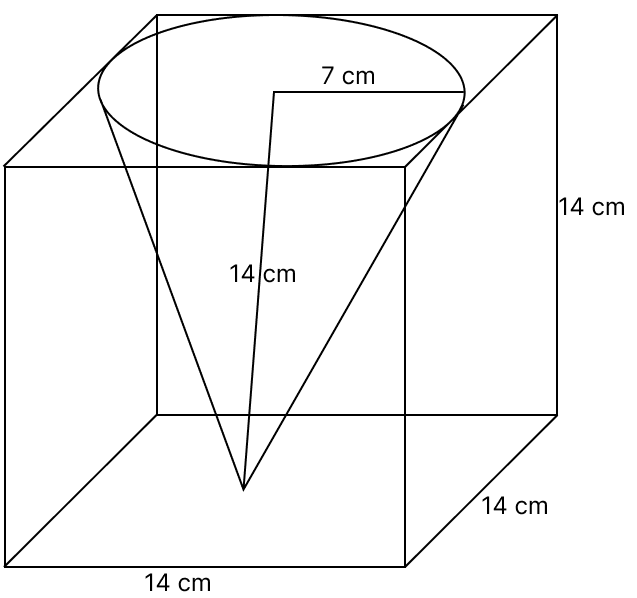
From a cube of edge 14 cm, a cone of maximum size is carved out. Find the volume of the cone and of the remaining material, each correct to one place of decimal.

Answer

Edge of a cube = 14 cm

Volume = side3 = 143 = 2744 cm3.

Cone of maximum size is carved out as shown in figure,

From a cube of edge 14 cm, a cone of maximum size is carved out. Find the volume of the cone and of the remaining material, each correct to one place of decimal. Volume And Surface Area of solid RSA Mathematics Solutions ICSE Class 10.

Diameter of the cone cut out from it = 14 cm

Radius, r = diameter2=142\dfrac{\text{diameter}}{2} = \dfrac{14}{2} = 7 cm

Height, h = 14 cm

Volume of cone = 13\dfrac{1}{3} πr2h

=13×227×72×14=13×22×49×2=21563=718.67 cm3.= \dfrac{1}{3} \times \dfrac{22}{7} \times 7^2 \times 14 \\[1em] = \dfrac{1}{3} \times 22 \times 49 \times 2 \\[1em] = \dfrac{2156}{3} \\[1em] = 718.67 \text{ cm}^3.

Rounding off to one decimal place = 718.8 cm3

Volume of the remaining material = Volume of the cube - Volume of the cone

= 2744 - 718.67

= 2025.33 cm3

Rounding off to one decimal place = 2025.3 cm3

Hence, the volume of the cone is 718.8 cm3 and of the remaining material is 2025.3 cm3.

Question 20

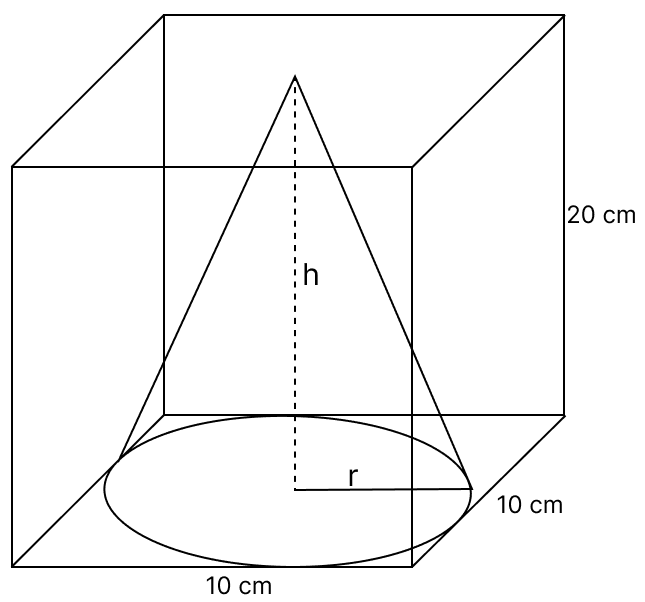
A cone of maximum volume is carved out of a block of wood of size 20 cm × 10 cm × 10 cm. Find the volume of the cone carved out, correct to one decimal place.

Answer

Volume of block of wood = 20 cm × 10 cm × 10 cm = 2000 cm3

Diameter of the cone for maximum volume = 10 cm

Cone of maximum volume is carved out as shown in figure,

A cone of maximum volume is carved out of a block of wood of size 20 cm × 10 cm × 10 cm. Find the volume of the cone carved out, correct to one decimal place. Volume And Surface Area of solid RSA Mathematics Solutions ICSE Class 10.

Radius, r = diameter2=102\dfrac{\text{diameter}}{2} = \dfrac{10}{2} = 5 cm.

Height of the cone for maximum volume, h = 20 cm

Volume of cone = 13\dfrac{1}{3} πr2h

=13×227×52×20=13×227×25×20=1100021=523.8 cm3.= \dfrac{1}{3} \times \dfrac{22}{7} \times 5^2 \times 20 \\[1em] = \dfrac{1}{3} \times \dfrac{22}{7} \times 25 \times 20 \\[1em] = \dfrac{11000}{21} \\[1em] = 523.8 \text{ cm}^3.

Hence, the volume of the cone carved out is 523.8 cm3.

Question 21

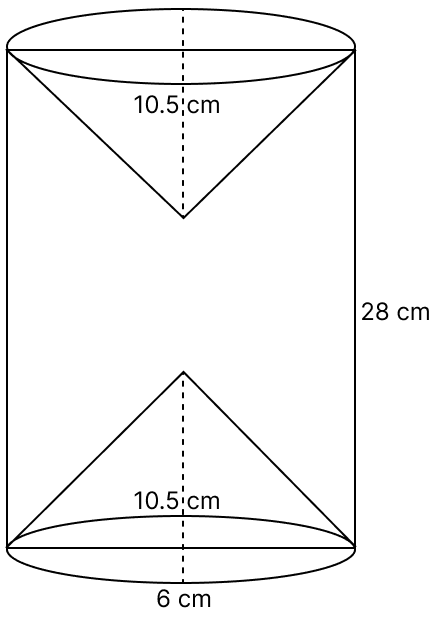
From a solid wooden cylinder of height 28 cm and diameter 6 cm, two conical cavities are hollowed out. The diameters of the cones are also of 6 cm and height 10.5 cm. Find the volume of the remaining solid.

From a solid wooden cylinder of height 28 cm and diameter 6 cm, two conical cavities are hollowed out. The diameters of the cones are also of 6 cm and height 10.5 cm. Find the volume of the remaining solid. Volume And Surface Area of solid RSA Mathematics Solutions ICSE Class 10.

Answer

Given,

Diameter of solid wooden cylinder (D) = 6 cm

Radius of solid wooden cylinder (R) = 62\dfrac{6}{2} = 3 cm

Height of solid wooden cylinder (H) = 28 cm

Diameter of cone (d) = 6 cm

Radius of cone (r) = 62\dfrac{6}{2} = 3 cm

Height of the cone (h) = 10.5 cm

Volume of cylinder = πR2H

=227×32×28=22×9×4=792 cm3.= \dfrac{22}{7} \times 3^2 \times 28 \\[1em] = 22 \times 9 \times 4 \\[1em] = 792 \text{ cm}^3.

Volume of single cone = 13\dfrac{1}{3} πr2h

=13×227×32×10.5=227×9×3.5=6937=99 cm3.= \dfrac{1}{3} \times \dfrac{22}{7} \times 3^2 \times 10.5 \\[1em] = \dfrac{22}{7} \times 9 \times 3.5 \\[1em] = \dfrac{693}{7} \\[1em] = 99 \text{ cm}^3.

Volume of two conical cavities = 2 × 99 = 198 cm3

Volume of remaining solid = Volume of cylinder - Volume of 2 conical cavities

= 792 - 198

= 594 cm3.

Hence, volume of the remaining solid = 594 cm3.

PrevNext