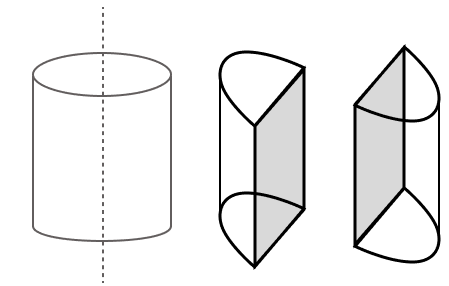
Given, the material of the cylinder weighs 5 grams per cu.cm
⇒ 1 gram = 10001 kg
⇒ 5 gram = 10005 kg
∴ Total weight of the cylinder = 20790 × 10005=1000103950=103.95 kg.
Hence, the weight of a solid cylinder is 103.95 kg.
Question 4
A cylindrical tank has a capacity of 6160 m3. Find its depth, if its radius is 14 m. Also, find the cost of painting its curved surface at ₹ 30 per m2.
Answer
Let radius (r) = 14 m and depth or height = h meters
By formula,
Volume of cylinder = πr2h
⇒6160=722×142×h⇒6160=722×196×h⇒h=22×1966160×7⇒h=431243120⇒h=10 m.
Curved surface area of cylinder = 2πrh
=2×722×14×10=76160=880 m2
Given, the cost of painting its curved surface is ₹ 30 per m2.
⇒ 880 × 30 = ₹ 26,400.
Hence, depth of the cylindrical tank is 10 m and the cost of painting its curved surface is ₹ 26,400.
Question 5
(i) The curved surface area of a cylinder is 4400 cm2 and the circumference of its base is 110 cm. Find the height and the volume of the cylinder.
(ii) The circumference of the base of a cylindrical vessel is 132 cm and its height is 25 cm. Find the radius of the cylinder and also its volume.
Answer
Given, curved surface area of a cylinder = 4400 cm2
Hence, the height of the cylinder is 40 cm and volume of the cylinder = 38500 cm3.
(ii) Given, circumference of base = 132 cm
We know that circumference = 2πr
∴ 2πr = 132
⇒2×722×r=132⇒r=22×2132×7⇒r=44924⇒r=21 cm.
Given, height (h) = 25 cm.
Volume of cylinder = πr2h
Putting values we get,
=722×(21)2×25=722×441×25=7242550=34650 cm3.
Hence, radius of the cylinder is 21 cm and volume of the cylinder is 34650 cm3.
Question 6
The total surface area of a solid cylinder is 462 cm2 and its curved surface area is one-third of its total surface area. Find the volume of the cylinder.
Answer
Given,
Total surface area = 462 cm2
⇒ 2πr(h + r) = 462
⇒ πr(h + r) = 2462
⇒ πr(h + r) = 231 ....(1)
Given, curved surface area is one-third of its total surface area.
Hence, the total surface area of the given hollow cylinder open at both ends is 528 cm2.
Question 10
Water is flowing at the rate of 3 km/hr through a circular pipe of 20 cm internal diameter into a circular cistern of diameter 10 m and depth 2 m. In how much time will the cistern be filled?
Answer
Let the cistern be filled in x hours.
Water column forms a cylinder of radius (r) = 2diameter=220×1001=101 m.
Given, water is flowing at the rate of 3 km/hr through a circular pipe.
= 60×603×1000=65 m/s
Volume of water that flows in 1 second = Area of cross section of pipe × rate of flow of water
= πr2 × rate of flow of water
=722×(101)2×65=722×1001×65=4200110=42011
Given, diameter of cistern = 10 m
Radius (r) = 2diameter=210=5 m
Depth of cistern = 2 m
Volume of cistern = πr2h
=722×52×2=722×25×2=71100
Required time = volume of water flows in 1 secondVolume of cistern
A swimming pool 70 m long, 44 m wide and 3 m deep, is filled by water issuing from a pipe of diameter 35 cm, at 6 m per second. How many hours does it take to fill the pool?
Answer
Volume of the swimming pool = 70 × 44 × 3 = 9240 m3
Radius of the pipe = 2Diameter=235×1001=20035=0.175 m
Volume of water flowing out of the pipe per second = Area of cross section of the pipe × rate of flow of water
Hence, time required to fill the pool is 494 hours.
Question 12
Water is flowing at the rate of 8 m per second through a circular pipe whose internal diameter is 2 cm, into a cylindrical tank, the radius of whose base is 40 cm. Determine the increase in the water level in 30 minutes.
Answer
Internal radius of circular pipe = 2Diameter=22=1 cm.
Volume of water flowing through pipe per second = Area of cross section of pipe × rate of flow of water
= πr2 × 8 m/s
= πr2 × 8 × 100 cm/s
=722×(1)2×800=722×800=717600 cm3/s
Volume of cylindrical tank = πR2h
=722×402×h=722×1600×h=735200×h
Volume of water flowing through pipe in 30 minutes = Volume of cylindrical tank
(1 minute = 60 second so, 30 minutes = 30 × 60 = 1800 s)
⇒1800×717600=735200×h⇒731680000=735200×h⇒h=731680000×352007⇒h=900 cm.⇒h=9 m.
Hence, the increase in the water level in 30 minutes is 9 m.
Question 13
A 20 m deep well with diameter 7 m is dug up and the earth from digging is spread evenly to form a platform 22 m × 14 m. Determine the height of the platform.
Answer
The shape of the deep well will be cylindrical with radius (r) and height (h) = 20 m.
By formula,
Volume of a cylinder = πr2h
r = 2diameter=27=3.5 m.
Let height of platform be H.
Volume of earth is spread evenly to form a rectangular platform (cuboid).
Volume of platform = 22 m × 14 m × height(H)
Volume of earth dug from well = Volume of earth spread evenly to form a platform
⇒πr2 h=22×14×H⇒722×(3.5)2×20=308×H⇒722×12.25×20=308×H⇒7×3085390=H⇒H=21565390⇒H=2.5 m.
Hence, the height of the platform is 2.5 m.
Question 14
Find the mass of a metallic hollow cylindrical pipe 24 cm long with internal diameter 10 cm and made of 5 mm thick metal, if 1 cm3 of the metal weighs 7.5 grams.
Answer
Internal radius of the pipe, r = 2diameter=210=5 cm
Volume of metal = External volume - Internal volume
=715972−713200=715972−13200=72772=396 cm3.
Given, 1 cm3 of the metal weighs 7.5 grams.
(1g = 10001kg)
Total weight of the pipe = 396×7.5×10001=10002970=2.97 kg
Hence, the mass of a metallic hollow cylindrical pipe is 2.97 kg.
Question 15
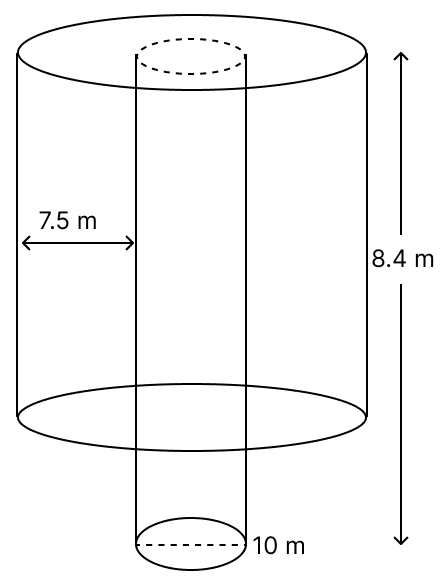
A well with 10 m inside diameter is dug 8.4 m deep. Earth taken out of it is spread all around it to a width of 7.5 m to form an embankment. Find the height of the embankment.
Answer
Radius of the well, r = 2diameter=210=5 m
Depth of the well (h) = 8.4 m
Volume of the earth dug out from the well = πr2h
=722×52×8.4=722×25×8.4=74620=660 m3
External radius, R = radius of the well + 7.5 = 5 + 7.5 = 12.5 m
The embankment forms a hollow cylinder around the well.
Let height of the embankment be H.
∴ Volume of embankment = πR2H - πr2H
= πH(R2 - r2)
=722×H×[(12.5)2−52]=722×H×(156.25−25)=722×H×131.25=72887.5×H=412.5 H m3
Volume of earth dug out = Volume of the embankment
⇒660=412.5H⇒H=412.5660⇒H=1.6 m.
Hence, the height of the embankment is 1.6 m.
Exercise 21B
Question 1
The height of a right circular cone is 24 cm and the radius of its base is 7 cm. Calculate :
(i) the slant height of the cone
(ii) the lateral surface area of the cone
(iii) the total surface area of the cone
(iv) the volume of the cone
Answer
Given, h = 24 cm and r = 7 cm
(i) Slant height, l = h2+r2=242+72=576+49=625=25 cm.
Hence, slant height of the cone is 25 cm.
(ii) Lateral surface area = πrl
=722×7×25=73850=550 cm2
Hence, lateral surface area of the cone is 550 cm2.
(iii) Total surface area = πr(l + r)
=722×7(25+7)=7154×(32)=74928=704 cm2
Hence, total surface area of the cone is 704 cm2.
(iv) Volume of cone = 31 πr2h
=31×722×72×24=2122×49×24=2125872=1232 cm3
Hence, volume of the cone is 1232 cm3.
Question 2
The height of a right circular cone is 8 cm and the diameter of its base is 12 cm. Calculate :
(i) the slant height of the cone
(ii) the total surface area of the cone
(iii) the volume of the cone
Answer
Given, h = 8 cm and r = 2diameter=212=6 cm
(i) Slant height, l = h2+r2=82+62=64+36=100=10 cm.
Hence, slant height of the cone is 10 cm.
(ii) Total surface area = πr(l + r)
=722×6(10+6)=7132×(16)=72112=301.7 cm2
Hence, total surface area of the cone is 301.7 cm2.
(iii) Volume of cone = 31 πr2h
=31×722×62×8=2122×36×8=216336=301.7 cm3
Hence, volume of the cone is 301.7 cm3.
Question 3
The slant height of a cone is 17 cm and the radius of its base is 15 cm. Find:
(i) the height of the cone
(ii) the volume of the cone
(iii) the total surface area of the cone
Answer
Given, slant height, l = 17 cm and radius, r = 15 cm
(i) l2 = r2 + h2
⇒ h2 = l2 - r2
⇒ h2 = 172 - 152
⇒ h2 = 289 - 225
⇒ h2 = 64
⇒ h = 64=8 cm.
Hence, height of the cone is 8 cm.
(ii) Volume of cone = 31 πr2h
=31×722×152×8=2122×225×8=2139600=1885.7 cm3
Hence, volume of the cone is 1885.7 cm3.
(iii) Total surface area = πr(l + r)
=722×15(17+15)=7330×(32)=710560=1508.6 cm2
Hence, total surface area of the cone is 1508.6 cm2.
Question 4
The volume of a right circular cone is 660 cm3 and diameter of its base is 12 cm. Calculate:
(i) the height of the cone
(ii) the slant height of the cone
(ii) the total surface area of the cone
Answer
Given, radius, r = 2diameter=212=6 cm.
Volume of cone = 660 cm3
(i) By formula,
Volume of cone = 31 πr2h
⇒660=31×722×62×h⇒660=2122×36×h⇒h=22×36660×21⇒h=79213860⇒h=17.5 cm.
Hence, the height of the cone is 17.5 cm.
(ii) By formula,
Slant height (l) = h2+r2
=(17.5)2+62=306.25+36=342.25=18.5 cm.
Hence, slant height of the cone is 18.5 cm.
(iii) Total surface area = πr(l + r)
=722×6×(18.5+6)=7132×(24.5)=73234=462 cm2
Hence, total surface area of the cone is 462 cm2.
Question 5
The total surface of a right circular cone of slant height 20 cm is 384π cm2. Calculate:
(i) its radius in cm
(ii) its volume in cm3, in terms of π
Answer
Given, slant height, l = 20 cm and total surface area of cone = 384π cm2
(i) By formula,
Total surface area = πr(l + r)
⇒ 384π = πr(20 + r)
⇒ 384 = 20r + r2
⇒ r2 + 20r - 384 = 0
⇒ r2 + 32r - 12r - 384 = 0
⇒ r(r + 32) - 12(r + 32) = 0
⇒ (r + 32) = 0 or (r - 12) = 0
⇒ r = - 32 or r = 12
Since, radius cannot be negative.
∴ r = 12 cm.
Hence, radius of the cone is 12 cm.
(ii) l2 = r2 + h2
⇒ h2 = l2 - r2
⇒ h2 = 202 - 122
⇒ h2 = 400 - 144
⇒ h2 = 256
⇒ h = 256=16 cm.
Volume of cone = 31 πr2h
=31×π×122×16=31×π×144×16=32304π=768π cm3
Hence, volume of the cone is 768 π cm3.
Question 6
The radius and the height of a right circular cone are in the ratio of 5 : 12 and its volume is 2512 cm3. Find:
How many metres of canvas 1.25 m will be needed to make a conical tent whose base radius is 17.5 m and height 6 m?
Answer
Given, r = 17.5 m and h = 6 m
l2 = r2 + h2
⇒ l2 = 17.52 + 62
⇒ l2 = 306.25 + 36
⇒ l2 = 342.25
⇒ l = 342.25 = 18.5 m
So, the total curved surface area of the tent = πrl
=722×17.5×18.5=77122.5=1017.5 m2
Width of the canvas used = 1.25 m
Length of canvas = width of canvasarea of canvas=1.251017.5 = 814 m.
Hence, 814 metres of canvas will be needed to make a conical tent.
Question 9
A circus tent is cylindrical to a height of 3 meters and conical above it. If its diameter is 105 m and the slant height of the conical portion is 53 m, calculate the length of the canvas 2.5 m wide to make the required tent.
Answer
From figure,
Radius of conical part = radius of cylindrical part = r.
Radius of the cylindrical part of the tent (r) = 2diameter=2105 m
Radius of the conical part (r) = 2105 m
Slant height (l) = 53 m
So, the total curved surface area of the tent = 2πrh + πrl
Length of canvas = width of canvasarea of canvas=2.59735 = 3894 m.
Hence, length of the canvas required to make tent is 3894 m.
Question 10
An iron pillar consists of a cylindrical portion, 2.8 m high and 20 cm in diameter and a cone 42 cm high is surrounding it. Find the weight of the pillar, given that 1 cm3 of iron weighs 7.5 g.
Answer
Radius of cylindrical portion, r = 2diameter=220 = 10 cm
Height of the cylindrical portion, h = 2.8 m = 2.8 × 100 = 280 cm
Height of the conical portion, H = 42 cm
From figure,
Radius of the conical part = radius of the cylindrical portion = r = 10 cm
Volume of iron pole = Volume of cylindrical portion + Volume of conical portion
Total weight = 92400 × 7.5 = 693000 gm = 1000693000 kg = 693 kg.
Hence, the weight of the pillar is 693 kg.
Question 11
Water flows at the rate of 10 m per minute through a cylindrical pipe 5 mm in diameter. How long would it take to fill a conical vessel whose diameter at the base is 40 cm and depth 24 cm?
Answer
Radius of cylindrical pipe, r = 2diameter=20.5 = 0.25 cm
Given, water flows at the rate of 10 m per minute.
Length of the cylindrical portion, h = 10 m = 10 × 100 = 1000 cm
Height of the conical portion, H = 24 cm
Radius of conical pipe, R = 2diameter=240 = 20 cm
Volume of water that flows in 1 min = πr2h
=722×(0.25)2×1000=722×0.0625×1000=71375
Volume of the conical vessel = 31 πR2H
=31×722×202×24=722×400×8=770400
Required time = Volume of water that flows in 1 minVolume of conical vessel
=71375770400=770400×13757=137570400=51.2 min.
= 51 min 12 sec.
Hence, time required to fill a conical vessel is 51 min 12 sec.
Question 12(i)
A conical tent is to accommodate 11 persons. Each person must have 4 m2 of the space on the ground and 20m3 of air to breathe. Find the height of the cone.
Answer
Given,
Each person must have 20 m3 of air to breathe.
∴ 11 persons need 11 × 20 m3 = 220 m3
Each person must have 4 m2 of the space on the ground.
∴ 11 persons need 11 × 4 m2 = 44 m2
Base of the conical tent = area of the circle = πr2
⇒44=722×r2⇒r2=227×44⇒r2=22308⇒r2=14 m.
Let height of the conical tent be h meters.
Since, conical tent needs to accomodate 11 persons, so its volume will be equal to volume of air required for 11 persons.
⇒31πr2h=220⇒31×722×14×h=220⇒h=22×14220×7×3⇒h=3084620⇒h=15 m.
Hence, height of the tent is 15 m..
Question 12(ii)
A conical tent is to accommodate 77 persons. Each person must have 16 m3 of air to breathe. Given the radius of the tent as 7 m, find the height of the tent and also its curved surface area.
Answer
Given,
Each person must have 16 m3 of air to breathe.
∴ 77 persons need 77 × 16 m3 = 1232 m3
Radius of the tent (r) = 7 m
Let height of the conical tent be h meters.
Since, conical tent needs to accomodate 77 persons, so its volume will be equal to volume of air required for 77 persons.
⇒31πr2h=1232⇒31×722×72×h=1232⇒31×722×49×h=1232⇒h=22×491232×7×3⇒h=107825872⇒h=24 m.
By formula,
l2 = r2 + h2
⇒ l2 = 72 + 242
⇒ l2 = 49 + 576
⇒ l2 = 625
⇒ l = 625 = 25 m
Curved surface area of the tent = πrl
=722×7×25=22×25=550 m2
Hence, height of the tent is 24 m and curved surface area of the tent is 550 m2.
Question 13
A right circular cone is 3.6 cm high and the radius of its base is 1.6 cm. It is melted and recast into a right circular cone with radius of its base as 1.2 cm. Find its height.
Answer
Radius of cone, r = 1.6 cm
Height of the cone, h = 3.6 cm
Volume of circular cone = 31 πr2h
=31×722×(1.6)2×3.6=31×722×2.56×3.6=21202.752
Volume of cone of radius (R) = 1.2 cm and height (H)
Volume of circular cone = 31 πR2H
=31×722×(1.2)2×H=31×722×1.44×H=2131.68H
Since, cone is melted and recasted into right circular cone of radius 1.2 cm, the volume remains the same.
∴21202.752=2131.68H⇒H=31.68×21202.752×21⇒H=6.4 cm.
Hence, height of the cone is 6.4 cm.
Question 14
A solid metallic cylinder of base radius 3 cm and height 5 cm is melted to form cones, each of height 1 cm and base radius 1 mm. Find the number of cones.
Answer
For larger cylinder,
Height (H) = 5 cm
Radius (R) = 3 cm
For smaller cones,
Height (h) = 1 cm
Radius (r) = 1 mm = 0.1 cm
Let no. of smaller cones formed be n.
Volume of larger cylinder = n × Volume of smaller cones
A conical vessel, whose internal radius is 12 cm and height 50 cm, is full of liquid. The contents are emptied into a cylindrical vessel with internal radius 10 cm. Find the height to which the liquid rises in the cylindrical vessel.
Answer
For cylindrical vessel,
Let height be H cm
Radius (R) = 10 cm
For conical vessel,
Height (h) = 50 cm
Radius (r) = 12 cm
Since, contents in conical vessel are emptied into a cylindrical vessel, hence there volume will be same.
∴ Volume of cylinder = Volume of conical vessel
⇒πR2H=31πr2h⇒R2H=31r2h⇒102×H=31×122×50⇒100×H=31×144×50⇒H=3×100144×50⇒H=3007200⇒H=24 cm.
Hence, height to which the liquid rises in the cylindrical vessel is 24 cm.
Question 16
The height of a cone is 40 cm. A small cone is cut off at the top by a plane parallel to its base. If its volume be 641 of the volume of the given cone, at what height above the base is the section cut?
Answer
Let OAB be the given cone of height 40 cm and base radius R cm. Let this cone be cut by the plane CND (parallel to the base plane AMB) to obtain cone OCD with height h cm and base radius r cm as shown in the figure below :
From figure,
∠NOD = ∠MOB (Common angle)
∠OND = ∠OMB = 90° (Heights are perpendicular to radii)
∠ODN = ∠OBM (Corresponding angles since ND || MB)
∴ △OND ~ △OMB (By AA similarity)
We know that,
Ratio of corresponding sides of similar triangle are proportional.
∴ Rr=40h ...(1)
According to given,
Volume of cone OCD = 641 Volume of cone OAB
∴ 31 πr2h = 641×31 πR2 × 40
Dividing both sides by π and multiplying by 3 we get,
⇒r2h=6440×R2⇒R2r2=8h5⇒(Rr)2=8h5
Using eq.(1),
⇒(40h)2=8h5⇒1600h2=8h5⇒h3=85×1600⇒h3=5×200⇒h3=1000⇒h=31000⇒h=10 cm.
The height of the cone OCD = 10 cm
∴ The section is cut at the height of 40 - 10 = 30 cm.
Hence, the section is cut above 30 cm from the base.
Question 17
A hollow metallic cylindrical tube has an internal radius of 3 cm and height 21 cm. The thickness of the metal is 0.5 cm. The tube is melted and cast into a right circular cone of height 7 cm. Find the radius of the cone, correct to one decimal place.
Answer
Internal radius (r) = 3 cm
Height (h) = 21 cm
Thickness = External radius (R) - Internal radius
⇒ 0.5 = External radius - 3 cm
⇒ External radius = 0.5 + 3 = 3.5 cm
Volume of hollow cylinder = π(R2 - r2)h,
Putting values we get,
∴ Volume of metal = π(3.52 - 32) × 21
=722×(12.25−9)×21=22×3.25×3=214.5 cm3
Given the tube is melted and cast into a right circular cone of height (H) 7 cm.
So, the volume of metal and volume of cone will be same.
∴ 214.5 = 31 πr2H
⇒214.5=31×722×r2×7⇒214.5=31×22×r2⇒r2=22214.5×3⇒r2=29.25⇒r=29.25⇒r=5.4 cm.
Hence, radius of the cone is 5.4 cm.
Question 18
From a circular cylinder of diameter 10 cm and height 12 cm, a conical cavity of the same base radius and of the same height is hollowed out. Find the volume and the whole surface of the remaining solid. Leave the answer in π
Answer
Given,
Height of the cylinder (H) = 12 cm
Radius of the base of the cylinder (R) = 2diameter=210 = 5 cm
Height of the cone (h) = 12 cm
Radius of the cone (r) = 5 cm
Volume of the remaining part = Volume of cylinder - Volume of cone
Total surface area of remaining solid = Curved surface area of cylinder + curved surface area of cone + base area of cylinder
= 2πRH + πrl + πR2
= π(2RH + rl + R2)
= π(2 × 5 × 12 + 5 × 13 + 52)
= π(120 + 65 + 25)
= 210 π cm2.
Hence, the volume of the remaining solid is 200 π cm3 and total surface area of remaining solid is 210 π cm2.
Question 19
From a cube of edge 14 cm, a cone of maximum size is carved out. Find the volume of the cone and of the remaining material, each correct to one place of decimal.
Answer
Edge of a cube = 14 cm
Volume = side3 = 143 = 2744 cm3.
Cone of maximum size is carved out as shown in figure,
Diameter of the cone cut out from it = 14 cm
Radius, r = 2diameter=214 = 7 cm
Height, h = 14 cm
Volume of cone = 31 πr2h
=31×722×72×14=31×22×49×2=32156=718.67 cm3.
Rounding off to one decimal place = 718.8 cm3
Volume of the remaining material = Volume of the cube - Volume of the cone
= 2744 - 718.67
= 2025.33 cm3
Rounding off to one decimal place = 2025.3 cm3
Hence, the volume of the cone is 718.8 cm3 and of the remaining material is 2025.3 cm3.
Question 20
A cone of maximum volume is carved out of a block of wood of size 20 cm × 10 cm × 10 cm. Find the volume of the cone carved out, correct to one decimal place.
Answer
Volume of block of wood = 20 cm × 10 cm × 10 cm = 2000 cm3
Diameter of the cone for maximum volume = 10 cm
Cone of maximum volume is carved out as shown in figure,
Hence, the volume of the cone carved out is 523.8 cm3.
Question 21
From a solid wooden cylinder of height 28 cm and diameter 6 cm, two conical cavities are hollowed out. The diameters of the cones are also of 6 cm and height 10.5 cm. Find the volume of the remaining solid.
Answer
Given,
Diameter of solid wooden cylinder (D) = 6 cm
Radius of solid wooden cylinder (R) = 26 = 3 cm
Height of solid wooden cylinder (H) = 28 cm
Diameter of cone (d) = 6 cm
Radius of cone (r) = 26 = 3 cm
Height of the cone (h) = 10.5 cm
Volume of cylinder = πR2H
=722×32×28=22×9×4=792 cm3.
Volume of single cone = 31 πr2h
=31×722×32×10.5=722×9×3.5=7693=99 cm3.
Volume of two conical cavities = 2 × 99 = 198 cm3
Volume of remaining solid = Volume of cylinder - Volume of 2 conical cavities
= 792 - 198
= 594 cm3.
Hence, volume of the remaining solid = 594 cm3.
Exercise 21C
Question 1
Find the volume and surface area of a sphere of radius :
How many bullets, each of diameter 1.5 cm, can be made by melting a cylinder of lead having radius of the base 5 cm and height 18 cm ?
Answer
Bullet is in shape of sphere.
Radius of bullet, r = 2diameter=21.5 = 0.75 cm
Radius of cylinder, R = 5 cm
Height of cylinder, h = 18 cm
Given, bullets are made by melting a cylinder of lead.
∴ Volume of cylinder = n × Volume of each bullet
⇒πR2h=n×34πr3Divide by π on both sides, we get:⇒R2h=n×34r3⇒52×18=n×34×0.753⇒25×18=n×34×0.421875⇒450=n×0.5625⇒n=0.5625450⇒n=800.
Hence, 800 bullets are made.
Question 8
How many lead balls, each of radius 1.5 cm can be made by melting a bigger ball of radius 9 cm?
Answer
Given,
Radius of bigger ball, R = 9 cm
Radius of smaller ball, r = 1.5 cm
Let the number of smaller lead balls formed be n.
∴ Volume of big ball = n × Volume of each small ball
⇒34πR3=n×34πr3Dividing both sides by 4π and multiplying by 3, we get :⇒R3=n×r3⇒93=n×1.53⇒729=n×3.375⇒n=3.375729⇒n=216.
Hence, 216 lead balls can be made.
Question 9
A metallic sphere of radius 10.5 cm is melted and then recast into small cones, each of radius 3.5 cm and height 3 cm. Find the number of cones thus obtained.
Answer
Radius of sphere, r = 10.5 cm
Let the number of cones formed by recasting metallic sphere be n.
Radius of cone, R = 3.5 cm
Height, h = 3 cm
Volume of sphere = n × Volume of each cone
⇒34πr3=n×31πR2hDividing both sides by π and multiplying by 3, we get :⇒4r3=n×R2h⇒4×10.53=n×3.52×3⇒4×1157.625=n×12.25×3⇒4630.5=n×36.75⇒n=36.754630.5⇒n=126.
Hence, the number of cones obtained is 126.
Question 10
The surface area of a solid metallic sphere is 616 cm2 . It is melted and recast into smaller spheres of diameter 3.5 cm. How many such spheres can be obtained?
Answer
Surface area of a metallic sphere = 616 cm2
Let the radius of this sphere be R cm.
∴ 4πR2 = 616
⇒4×722×R2=616⇒788×R2=616⇒R2=88616×7⇒R2=884312⇒R2=49⇒R=49⇒R=7 cm.
Given,
Big sphere is melted and recast into smaller spheres of diameter 3.5 cm.
Radius, r = 2diameter=23.5 = 1.75 cm
Let the number of smaller spheres formed be n.
Volume of big sphere = n × Volume of each small sphere
⇒34πR3=n×34πr3Dividing both sides by 4π and multiplying by 3, we get :⇒R3=n×r3⇒73=n×1.753⇒343=n×5.359375⇒n=5.359375343⇒n=64.
Hence, 64 small spheres can be formed.
Question 11
A copper sphere having a radius of 6 cm is melted and then drawn into a cylindrical wire of radius 2 mm. Calculate the length of the wire.
Answer
Let the length of the wire be h cm
Radius of the sphere, R = 6 cm
Radius of the wire, r = 2 mm = 0.2 cm
Given, copper sphere is melted into wire.
∴ Volume of the wire = Volume of the sphere
⇒πr2h=34πR3⇒r2h=34R3⇒0.22×h=34×63⇒0.04×h=34×216⇒h=3×0.044×216⇒h=0.12864⇒h=7200 cm.⇒h=72 m.
Hence, the length of the wire is 72 m.
Question 12
A hemisphere of lead of radius 12 cm is melted and cast into a right circular cone of height 54 cm. Find the radius of the base of the cone.
Answer
Radius of hemisphere, r = 12 cm
Volume of hemisphere = 32πr3
Radius of the cone = R cm
Height of the cone, h = 54 cm
Volume of cone = 31πR2h
Since, hemisphere is melted and recasted into a cone, the volume remains the same.
∴31πR2h=32πr3⇒31R2h=32r3⇒R2=3×h2×3×r3⇒R2=3×542×3×123⇒R2=1626×1728⇒R2=16210368⇒R2=64⇒R=64⇒R=8 cm.
Hence, the radius of the base of the cone is 8 cm.
Question 13
A spherical metallic ball of radius 3 cm is melted and recast into three spherical balls. The radii of two of these balls are 2.5 cm 2 cm respectively. Find the radius of the third ball.
Answer
Radius of larger spherical metallic ball, R = 3 cm
Radius of smaller spherical balls are 2.5 cm, 2 cm and r cm
Given,
A spherical metallic ball of radius 3 cm is melted and recast into three spherical balls.
∴ Volume of larger spherical ball = Volume of ball of radius 2.5 cm + Volume of ball of radius 2 cm + Volume of ball of radius r cm
⇒34πR3=34π×2.53+34π×23+34πr3⇒34πR3=34π(2.53+23+r3)⇒R3=(2.53+23+r3)⇒33=15.625+8+r3⇒r3=27−15.625−8⇒r3=3.375⇒r=33.375⇒r=1.5 cm.
Hence, the radius of the third ball is 1.5 cm.
Question 14
A solid metallic sphere of radius 6 cm is melted and made into a solid cylinder of height 32 cm. Find the:
(i) radius of the cylinder
(ii) curved surface area of the cylinder
(Take π = 3.1)
Answer
(i) Radius of the metallic sphere, R = 6 cm
Height of the cylinder, h = 32 cm
Volume of cylinder = Volume of metallic sphere (As sphere is melted and formed into a cylinder)
∴πr2h=34πR3⇒r2=34×hR3⇒r2=34×3263⇒r2=34×32216⇒r2=96864⇒r2=9⇒r=9⇒r=3 cm.
Hence, radius of the cylinder is 3 cm.
(ii) Curved surface area of cylinder = 2πrh
= 2 × 3.1 × 3 × 32
= 595.2 cm2
Hence, curved surface area of the cylinder is 595.2 cm2.
Question 15
A hemispherical bowl of internal diameter 36 cm contains water. This water is to be filled in cylindrical bottles, each of radius 3 cm and height 6 cm. How many bottles are required to empty the bowl?
Answer
Given,
Internal radius of hemispherical bowl, R = 2diameter=236 = 18 cm
Radius of cylindrical bottles, r = 3 cm
Height of the cylindrical bottles, h = 6 cm
Let number of cylindrical bottles needed be n.
∴ Volume of hemispherical bowl = n × Volume of each cylindrical bottle
A cylindrical vessel 60 cm in diameter is partially filled with water. A sphere of diameter 36 cm is dropped into it and is fully submerged in water. Find the increase in the level of water in the vessel.
Answer
Radius of the sphere, r = 2diameter=236 = 18 cm
Radius of cylinder, R = 2diameter=260 = 30 cm
Let height of water raised be h cm.
Volume of water rise in cylinder = Volume of sphere
⇒πR2h=34πr3⇒R2h=34r3⇒h=34×R2r3⇒h=34×302183⇒h=34×9005832⇒h=270023328⇒h=8.64 cm.
Hence, the height by which water level raised is 8.64 cm.
Question 17
There is water to a height of 16 cm in a cylindrical glass jar of radius 12.5 cm. Inside the water, there is a sphere of diameter 15 cm, completely immersed. By what height will water go down, when the sphere is removed?
Answer
Given, radius of glass jar, R = 12.5 cm
Diameter of sphere = 15 cm
Radius of sphere, r = 2diameter=215 = 7.5 cm
When the sphere is removed from the jar, volume of water decreases.
Let h be the height by which water level decrease.
Volume of water decreased = Volume of sphere
⇒πR2h=34πr3⇒R2h=34r3⇒h=34×R2r3⇒h=34×12.527.53⇒h=34×156.25421.875⇒h=468.751687.5⇒h=3.6 cm.
Hence, the height by which water level decrease is 3.6 cm.
Question 18
A cylindrical tub of radius 12 cm contains water upto a depth of 20 cm. A spherical iron ball is dropped into the tub and is fully immersed in it. Thus, the level of water is raised by 6.75 cm. Find the radius of the ball.
Answer
Let the radius of the sphere be r cm.
Radius of cylinder, R = 12 cm
SInce, a spherical iron ball is dropped into the tub and is fully immersed in it.
Height of water raised by 6.75 cm.
∴ h = 6.75 cm.
Volume of water rise in cylinder = Volume of sphere
⇒πR2h=34πr3⇒R2h=34r3⇒r3=43×R2×h⇒r3=43×122×6.75⇒r3=43×144×6.75⇒r3=42916⇒r3=729⇒r=3729⇒r=9 cm.
Hence, the radius of the ball is 9 cm.
Question 19
Some lead spheres, each of diameter 6 cm, are dropped into a beaker containing some water and are fully submerged. The diameter of the beaker is 18 cm. Calculate, the number of lead spheres dropped into it, if the water level rises by 40 cm.
Answer
Given,
Diameter of lead spheres = 6 cm
Radius, r = 2diameter=26 = 3 cm
Diameter of beaker = 18 cm
Radius of beaker, R = 2diameter=218 = 9 cm
Increase in water level, h = 40 cm
Let n spheres are dropped.
∴ Volume of water increased in beaker = n × Volume of one sphere
⇒πR2h=n×34πr3Divide by π on both sides, we get:⇒R2h=n×34r3⇒92×40=n×34×33⇒81×40=n×34×27⇒3240=n×36⇒n=363240⇒n=90.
Hence, the number of lead spheres dropped into the beaker are 90.
Question 20
A vessel is in the form of an inverted cone. Its height is 11 cm and the radius of its top which is open, is 2.5 cm. It is filled with water upto the rim. When lead shots, each of which is a sphere of radius 0.25 cm are dropped into the vessel, 52 of the water flows out. Find the number of lead shots dropped into the vessel.
Answer
Radius of the top of the inverted cone, R = 2.5 cm
Height of the cone, H = 11 cm
Radius of lead shot, r = 0.25 cm
When lead shots are dropped into vessel, 52 of water flows out.
∴ Volume of water flown out = n × Volume of each lead shot
⇒15137.5π=n×34×πr3Divide by π on both sides, we get:⇒15137.5=n×34×0.253⇒15137.5=n×34×0.015625⇒15137.5=n×30.0625⇒n=0.0625×15137.5×3⇒n=0.9375412.5⇒n=440.
Hence, the number of lead shots are 440.
Question 21
A spherical shell of lead whose external and internal diameters are 24 cm and 18 cm, is melted and recast into a right circular cylinder 37 cm high. Find the diameter of the base of the cylinder.
Answer
Given,
Height of the solid right circular cylinder, h = 37 cm
Internal radius of metallic spherical shell, r = 2diameter=218 = 9 cm
External radius of metallic spherical shell, R = 2diameter=224 = 12 cm
Let the radius of cylinder be a cm.
As, metallic spherical shell is recasted into right circular cylinder.
∴ Volume of spherical shell = Volume of cylinder
⇒34π(R3−r3)=πa2hDivide by π on both sides, we get:⇒34(R3−r3)=a2h⇒34×(123−93)=a2×37⇒34×(1728−729)=a2×37⇒34×999=a2×37⇒a2=3×374×999⇒a2=1113996⇒a2=36⇒a=36⇒a=6 cm.
Diameter = 2a = 2 × 6 = 12 cm.
Hence, diameter of the base of the cylinder is 12 cm.
Question 22
A solid wooden toy is in the form of a cone mounted on a hemisphere. The radii of the hemisphere and the base of the cone are 4.2 cm each and the total height of the toy is 10.2 cm. Calculate :
(i) the volume of wood used in the toy
(ii) the total surface area of the toy, correct to two places of decimal.
Answer
Given,
The solid wooden toy is in the shape of a right circular cone mounted on a hemisphere.
Radius of hemisphere, r = 4.2 cm
Total height, h = 10.2 cm
Height of conical part, H = 10.2 - 4.2 = 6 cm
(i) Volume of wood used in toy = Volume of cone + Volume of hemisphere
Hence, the total surface area of the toy is 207.56 cm2.
Question 23
In the given figure, a metal container is in the form of a cylinder surmounted by a hemisphere. The internal height of the cylinder is 7 m and the internal radius is 3.5 m. Calculate:
(i) the total area of the internal surface, excluding the base.
(ii) the internal volume of the container in m3.
Answer
Given,
Radius of cylindrical portion = Radius of hemispherical portion = r = 3.5 m
Height of cylinder, h = 7 m
(i) Area of internal surface = Surface area of cylinder + Surface area of hemisphere
= 2πrh + 2πr2
= 2πr(h + r)
= 2 × 722 × 3.5(7 + 3.5)
= 2 × 722 × 36.75
= 2 × 22 × 5.25
= 231 m2
Hence, the total area of the internal surface, excluding the base is 231 m2.
(ii) Internal volume of container = Volume of hemisphere + Volume of cylinder
The adjoining figure represents a solid consisting of a cylinder surmounted by a cone at one end and a hemisphere at the other end. Given that, common radius = 3.5 cm, the height of the cylinder = 6.5 cm and the total height = 12.8 cm, calculate the volume of the solid, correct to the nearest integer.
Answer
Given, common radius, r = 3.5 cm
Height of cylinder, H = 6.5 cm
Height of hemisphere = radius of hemisphere = 3.5 cm
Height of cone, h = Total height of the solid - height of cylinder - height of hemisphere = 12.8 - 6.5 - 3.5 = 2.8 cm
Volume of solid = Volume of cone + Volume of cylinder + Volume of hemisphere
The adjoining figure represents a solid consisting of a right circular cylinder with a hemisphere at one end and a cone at the other. Their common radius is 7 cm. The height of the cylinder and cone each is 4 cm. Find the volume of the solid.
Answer
Given, common radius, r = 7 cm
Height of cone, h = 4 cm
Height of cylinder, H = 4 cm
Volume of solid = Volume of cone + Volume of cylinder + Volume of hemisphere
A solid is in the shape of a hemisphere of radius 7 cm, surmounted by a cone of height 4 cm. The solid is immersed completely in a cylindrical container filled with water to a certain height. If the radius of the cylinder is 14 cm, find the rise in the water.
Answer
Radius of hemisphere, r = 7 cm
Height of cone, h = 4 cm
Radius of cylinder, R = 14 cm
Let the rise in water level be x cm.
∴ Volume of water that rises by x cm in the cylindrical container = Volume of hemisphere submerged + Volume of cone submerged
⇒πR2x=32πr3+31πr2h⇒R2x=31(2r3+r2h)⇒3×142x=2×73+72×4⇒3×196x=2×343+49×4⇒588x=686+196⇒588x=882⇒x=588882⇒x=1.5 cm.
Hence, rise in water level is 1.5 cm.
Question 27
A solid is in the form of a cylinder with hemispherical ends. The total height of the solid is 19 cm and the diameter of the cylinder is 7 cm. Find the volume and the surface area of the solid.
Answer
From figure,
Radius of cylinder = Radius of hemisphere = r = 2diameter=27 = 3.5 cm
Height of cylinder, h = Total height - (2 × Radius of hemisphere)
= 19 - 2 × 3.5
= 19 - 7
= 12 cm.
Total volume of solid = 2 × Volume of hemisphere + Volume of cylinder
Hence, the volume of solid is 64132 cm3 and surface area of solid is 418 cm2.
Question 28
A hemispherical and a conical hole is scooped out of a solid wooden cylinder. Find the volume of the remaining solid where the measurements are as follows :
The height of the solid cylinder is 7 cm, radius of each of hemisphere, cone and cylinder is 3 cm. Height of cone is 3 cm. Give your answer correct to the nearest whole number.
Answer
Given,
Radius, r = 3 cm
Height of cone, h = 3 cm
Height of cylinder, H = 7 cm
From figure,
Volume of remaining solid = Volume of cylinder - Volume of cone - Volume of hemisphere
A solid cylinder has a total surface area of 231 cm2. If its curved surface area is two-thirds of the total surface area, the volume of the cylinder is :
269.5 cm3
308 cm3
363.4 cm3
385 cm3
Answer
Given,
Total surface area of cylinder = 231 cm2
⇒ 2πr2 + 2πrh = 231 ...(1)
Curved surface area = 32 (Total surface area)
= 32×231=2×77 = 154 cm2
By formula,
Curved surface area of cylinder = 2πrh
⇒ 2πrh = 154 ...(2)
Substituting eq.(2) in eq.(1), we have :
⇒ 2πr2 + 154 = 231
⇒ 2πr2 = 231 - 154
⇒ 2πr2 = 77
⇒r2=2π77⇒r2=2×72277⇒r2=2×2277×7⇒r2=44539⇒r2=12.25⇒r=12.25⇒r=3.5 cm.
Substituting value of r in eq.(2), we get:
⇒2×722×3.5×h=154⇒2×22×0.5×h=154⇒22h=154⇒h=22154⇒h=7 cm.
Volume of cylinder = πr2h
=722×3.52×7=22×12.25=269.5 cm3.
Hence, option 1 is the correct option.
Question 6
The sum of the radius of the base and the height of a solid cylinder is 37 m. If the total surface area of the cylinder be 1628 m2, its volume is :
3180 m3
4620 m3
5240 m3
None of these
Answer
Let radius be r m and height be h m.
Given,
r + h = 37 m ...(1)
Totals surface area of cylinder = 1628 m2
⇒ 2πr(r + h) = 1628
⇒ 2πr × 37 = 1628
⇒74×722×r=1628⇒71628×r=1628⇒r=16281628×7⇒r=7 m.
Substituting value of r in eq.(1), we have:
⇒ r + h = 37
⇒ 7 + h = 37
⇒ h = 37 - 7
⇒ h = 30 m.
Volume of cylinder = πr2h
=722×72×30=722×49×30=22×7×30=4620 m3.
Hence, option 2 is the correct option.
Question 7
The radii of two cylinders are in the ratio 2 : 3 and their heights are in the ratio 5 : 3. The ratio of their volumes is :
4 : 9
9 : 4
20 : 27
27 : 20
Answer
Let radius and heights of two cylinders be r, h and R, H.
Two steel sheets each of length a1 and breadth a2 are used to prepare the surface of two right circular cylinders - one having volume V1 and height a2 and the other having volume V2 and height a1. Then :
V1 = V2
a1 V1 = a2 V2
a2 V1 = a1 V2
a2V1=a1V2
Answer
For cylinder 1,
Height of cylinder, h = a2
Radius of cylinder be r cm
Circumference of base = 2πr = a1
⇒2×π×r=a1⇒r=2πa1
Volume of cylinder 1, V1 = πr2h
=π×(2πa1)2×a2=π×4π2a12×a2=4πa12a2
For cylinder 2,
Height of cylinder, H = a1
Radius of cylinder be R
Circumference of base = 2πR = a2
⇒2×π×R=a2⇒R=2πa2⇒R=2πa2
Volume of cylinder 2, V2 = πR2H
=π×(2πa2)2×a1=π×4π2a22×a1=4πa22a1
Ratio of the volumes of the two cylinders:
⇒Volume of cylinder 2Volume of cylinder 1=4πa22a14πa12a2⇒V2V1=4πa12a2×a22a14π⇒V2V1=a2a1⇒V1a2=V2a1
Hence, option 3 is the correct option.
Question 9
Two circular cylinders of equal volumes have their heights in the ratio 1 : 2. The ratio of their radii is :
1 : 2
2 : 1
1 : 2
1 : 4
Answer
Let radius and heights of two cylinders be r, h and R, H.
Given,
Hh=21
Volume of cylinder 1 = v
Volume of cylinder 2 = V
⇒ v = V
⇒πr2h=πR2HDivide by π on both sides, we get:⇒r2=R2×hH⇒R2r2=12⇒(Rr)2=12⇒Rr=12⇒Rr=12
∴ r : R = 2 : 1
Hence, option 2 is the correct option.
Question 10
The ratio between the curved surface area and the total surface area of a right circular cylinder is 1 : 2. If the total surface area is 616 cm2, the volume of the cylinder is :
1232 cm3
1078 cm3
1848 cm3
1548 cm3
Answer
Total surface area = 616 cm2
⇒ 2πr(h + r) = 616
⇒ πr(h + r) = 2616
⇒ πr(h + r) = 308 ....(1)
Ratio between its curved surface area and total surface area = 1 : 2
A rectangular tin sheet is 12 cm long and 5 cm broad. It is rolled along its length to form a cylinder by making the opposite edges just touch each other. The volume of the cylinder (in cm3) is :
π60
π100
π120
π180
Answer
For cylinder, rolled along its length:
Height of cylinder, h = 5 cm
Radius of cylinder be r cm
Circumference of base = 2πr = 12
⇒2×π×r=12⇒r=2π12⇒r=π6 cm.
Volume of cylinder = πr2h
=π×(π6)2×5=π×(π236)×5=π180 cm3
Hence, option 4 is the correct option.
Question 13
If the radius of the base of a right circular cylinder is halved, keeping the height same, what is the ratio of the volume of the new cylinder to that of the original one?
1 : 2
1 : 4
1 : 8
4 : 1
Answer
For old cylinder,
Let height = h and Radius = r
So, for new cylinder,
Height = h and radius = 2r
We know that volume of cylinder = π × radius2 × height
∴ Volume of old cylinder = πr2h
and Volume of new cylinder = π (2r)2 h
∴Volume of old cylinderVolume of new cylinder=πr2hπ(2r)2h=r24r2=4r2r2=41
Hence, option 2 is the correct option.
Question 14
The curved surface area of a cylinder is 4400 cm2 and the circumference of its base is 110 cm. The volume of the cylinder (in cm3) is :
36000
38500
40150
42250
Answer
Given, curved surface area of cylinder = 4400 cm2
We know that curved surface area of cylinder = 2πrh
∴ 2πrh = 4400 .....(1)
Given, circumference of base = 110 cm
We know that circumference = 2πr
∴ 2πr = 110 .....(2)
⇒2×722×r=110⇒r=22×2110×7⇒r=44770⇒r=17.5 cm.
Dividing eq.(1) by (2), we get:
2πr2πrh=1104400
⇒ h = 40 cm
Volume of cylinder = πr2h
=722×17.52×40=722×306.25×40=7269500=38500 cm3.
Hence, option 2 is the correct option.
Question 15
The radii of two cylinders are in the ratio 2 : 3 and their heights are in the ratio 5 : 3. The ratio of their curved surface areas is :
2 : 5
8 : 7
10 : 9
16 : 9
Answer
Given,
r : R = 2 : 3
Let r = 2x and R = 3x
h : H = 5 : 3
Let h = 5y and H = 3y
CSA of 2nd cylinderCSA of 1st cylinder=2πRH2πrh=RHrh=3x×3y2x×5y=9xy10xy=910=10:9
Hence, option 3 is the correct option.
Question 16
Two rectangular sheets of paper each 30 cm × 18 cm are made into two right circular cylinders, one by rolling the paper along its length and the other along the breadth. The ratio of the volumes of the two cylinders, thus formed, is :
2 : 1
3 : 2
4 : 3
5 : 3
Answer
For cylinder 1, rolled along its length:
Height of cylinder, h = 18 cm
Radius of cylinder be r cm
Circumference of base = 2πr = 30
⇒2×π×r=30⇒2π×r=30⇒r=2π30⇒r=π15 cm.
Volume of cylinder 1 = πr2h
=π×(π15)2×18=π×(π2225)×18=π4050 cm3
For cylinder 2, rolled along its breadth:
Height of cylinder, H = 30 cm
Radius of cylinder be R cm
Circumference of base = 2πR = 18
⇒2×π×R=18⇒2π×R=18⇒R=2π18⇒R=π9 cm.
Volume of cylinder 2 = πR2H
=π×(π9)2×30=π×(π281)×30=π2430 cm3
Ratio of the volumes of the two cylinders:
=Volume of cylinder 2Volume of cylinder 1=π2430π4050=π4050×2430π=35
Hence, option 4 is the correct option.
Question 17
Two cylindrical vessels with radii 15 cm and 10 cm and heights 35 cm and 15 cm respectively are filled with water. If this water when poured into a cylindrical vessel, 15 cm in height, fills it completely then the radius of the vessel is :
17.5 cm
18 cm
20 cm
25 cm
Answer
Given,
For cylinder 1,
Radius, r = 15 cm
Height, h = 35 cm
For cylinder 2,
Radius, R = 10 cm
Height, H = 15 cm
By formula, Volume of cylinder = πr2h
Volume of cylinder 1 = v
=722×152×35=22×225×5=24750 cm3.
Volume of cylinder 2 = V
=722×102×15=722×100×15=733000 cm3.
Given, water from cylinder 1 and 2 is poured into cylinder 3.
Volume of cylinder 3 = Volume of cylinder 1 + Volume of cylinder 2
= 24750 + 733000
= 7173250+33000=7206250 cm3
For cylinder 3,
Radius be a cm
Height = 15 cm
Volume of cylinder 3 = πa2 × 15
⇒7206250=722×a2×15⇒7206250×22×157=a2⇒330206250=a2⇒a2=625⇒a=625⇒a=25 cm.
Hence, option 4 is the correct option.
Question 18
A hollow garden roller 63 cm wide with a girth of 440 cm is made of iron 4 cm thick. The volume of the iron used is :
154982 cm3
106372 cm3
107812 cm3
107712 cm3
Answer
Length of the roller (h) = 63 cm
Let external radius be R cm and internal radius be r cm.
Girth of the roller = Circumference of roller = 440 cm
⇒ 2πR = 440
⇒2×722R=440⇒744R=440⇒R=440×447⇒R=443080⇒R=70 cm.
Volume of iron = External volume - Internal volume
= 970200 - 862488
= 107712 cm3
Hence, option 4 is the correct option.
Question 19
If the radius of the base of a right circular cone is 3r and its height is equal to the radius of the base, then its volume is :
31 πr3
32 πr3
3 πr3
9 πr3
Answer
Given, radius = 3r and height(h) = 3r
Volume of cone = 31 πr2h
=31×π×(3r)2×3r=π×9r2×r=9πr3
Hence, option 4 is the correct option.
Question 20
The radius and height of a right circular cone are in the ratio of 5 : 12 and its volume is 2512 cm3. The slant height of the cone is :
(Take π = 3.14)
14 cm
16 cm
24 cm
26 cm
Answer
Given, radius(r) : height(h) = 5 : 12
Let r = 5x and h = 12x
Volume of cone = 31 πr2h
⇒2512=31×3.14×(5x)2×12x⇒2512=3.14×25x2×4x⇒x3=3.14×25×42512⇒x3=3142512⇒x3=8⇒x=38⇒x=2 cm.
⇒ r = 5x = 5 × 2 = 10 cm
⇒ h = 12x = 12 × 2 = 24 cm
Curved surface area = πrl
l2 = r2 + h2
⇒ l2 = 102 + 242
⇒ l2 = 100 + 576
⇒ l2 = 676
⇒ l = 676 = 26 cm
Hence, option 4 is the correct option.
Question 21
How many metres of cloth 2.5 m wide will be required to make a conical tent whose base radius is 7 m and height is 24 m?
120 m
180 m
220 m
550 m
Answer
Given, r = 7 m and h = 24 m
l2 = r2 + h2
⇒ l2 = 72 + 242
⇒ l2 = 49 + 576
⇒ l2 = 625
⇒ l = 625 = 25 m
So, the total curved surface area of the tent = πrl
=722×7×25=22×25=550 m2
Width of the cloth used = 2.5 m
Length of canvas = width of canvasarea of canvas=2.5550 = 220 m.
Hence, option 3 is the correct option.
Question 22
The length of the canvas, 1.1 m wide required to build a conical tent of height 14 m and floor area 346.5 m2, is :
490 m
525 m
665 m
860 m
Answer
Given,
Height of cone, h = 14 m
Area of base floor = 346.5 m2
⇒πr2=346.5⇒722×r2=346.5⇒r2=22346.5×7⇒r2=222425.5⇒r2=110.25⇒r=110.25⇒r=10.5 m.
By formula,
l2 = r2 + h2
⇒ l2 = 10.52 + 142
⇒ l2 = 110.25 + 196
⇒ l2 = 306.25
⇒ l = 306.25 = 17.5 m
So, the total curved surface area of the tent = πrl
=722×10.5×17.5=74042.5=577.5 m2
Let length of canvas be a m.
Area of canvas = Curved surface area of cone
⇒ a × b = 577.5
⇒ a × 1.1 = 577.5
⇒ a = 1.1577.5
⇒ a = 525 m
Hence, option 2 is the correct option.
Question 23
The volume of conical tent is 462 m3 and the area of the base is 154 m2. The height of the cone is :
15 m
12 m
9 m
24 m
Answer
Given, Area of base = 154 m2
⇒ πr2 = 154
⇒722r2=154⇒r2=154×227⇒r2=221078⇒r2=49⇒r=49⇒r=7 m.
Volume of cone = 462 m3
By formula,
Volume of cone = 31 πr2h
⇒462=31×722×72×h⇒462=2122×49×h⇒h=22×49462×21⇒h=10789702⇒h=9 m.
Hence, option 3 is the correct option.
Question 24
A conical tent is to accomodate 11 persons such that each person occupies 4 m2 space on the ground and has 20 m3 of air to breathe. The height of the cone is :
14 m
15 m
16 m
20 m
Answer
Given,
Each person must have 20 m3 of air to breathe.
∴ 11 persons need 11 × 20 m3 = 220 m3
Each person must have 4 m2 of the space on the ground.
∴ 11 persons need 11 × 4 m2 = 44 m2
Base of the conical tent = area of the circle = πr2
⇒44=722×r2⇒r2=227×44⇒r2=22308⇒r2=14 m.
Let height of the conical tent be h meters.
Since, conical tent needs to accomodate 11 persons, so its volume will be equal to volume of air required for 11 persons.
⇒31πr2h=220⇒31×722×14×h=220⇒h=22×14220×7×3⇒h=3084620⇒h=15 m.
Hence, option 2 is the correct option.
Question 25
The diameters of two cones are equal. If their slant heights are in the ratio 5 : 4 the ratio of their curved surface areas is:
4 : 5
5 : 4
16 : 25
25 : 16
Answer
Given, ratio of slant height = 5 : 4
Let slant height of 1st cone be 5a and 2nd cone be 4a cm.
For 1st cone,
⇒ Diameter = d
⇒ Radius = r
⇒ Slant height, l = 5a
For 2nd cone,
⇒ Diameter = D
⇒ Radius = R
⇒ Slant height, L = 4a
Given,
⇒ d = D
∴ r = R
⇒CSA of 2nd coneCSA of 1st cone=πRLπrl=Ll=4a5a=45=5:4
Hence, option 2 is the correct option.
Question 26
If the radius of the base of a cone is halved, keeping the height same, what is the ratio of the volume of the new cone to that of the original cone?
The radii of the bases of a cylinder and a cone are in the ratio 3 : 4 and their heights are in the ratio 2 : 3. Then their volumes are in the ratio:
3 : 4
4 : 3
8 : 9
9 : 8
Answer
For cylinder,
Radius = 3a
Height = 2b
Volume of cylinder, v = πr2h = π × (3a)2 × 2b = π × 9a2 × 2b = 18πa2b
For cone,
Radius = 4a
Height = 3b
Volume of cone, V = 31πr2h
=31π(4a)23b=π×16a2b
∴Vv=π×16a2bπ×18a2b=1618=89
= 9 : 8
Hence, option 4 is the correct option.
Question 33
A right cylindrical vessel is full with water. How many cones having the same diameter and height as those of the right cylinder will be needed to store that water?
2
3
4
5
Answer
Volume of cone = 31πr2h
Volume of cylinder = πr2h
Let the number of cones required be n.
∴ Volume of cylinder = n × Volume of cone
⇒ πr2h = n × 31πr2h
⇒ 3 × πr2h = n × πr2h
∴ n = 3
Hence, option 2 is the correct option.
Question 34
A conical vessel whose internal radius is 10 cm and height 48 cm is full of water. If this water is poured into a cylindrical vessel with internal radius 20 cm, the height to which water rises in it is:
(Take π = 3.14)
3 cm
4 cm
5 cm
6 cm
Answer
Given, radius of cone, R = 10 cm
Height of cone, H = 48 cm
Height of water in cylinder be h cm
Radius of cylinder, r = 20 cm
Since, water from conical vessel is poured into cylindrical vessel.
∴ Volume of cone = Volume of water in cylinder
⇒31πR2H=πr2h⇒31×102×48=202×h⇒100×16=400×h⇒h=400100×16⇒h=4001600⇒h=4 cm.
Hence, option 2 is the correct option.
Question 35
A cylindrical vessel 32 cm high and 18 cm as the radius of the base, is filled with sand. This bucket is emptied on the ground and a conical heap of sand is formed. If the height of the conical heap is 24 cm, the radius of its base is :
12 cm
24 cm
36 cm
48 cm
Answer
Given, radius of conical heap be R cm
Height of cone, H = 24 cm
Height of cylinder, h = 32 cm
Radius of cylinder, r = 18 cm
Since, sand from cylindrical vessel is poured to form conical heap.
∴ Volume of sand in cone = Volume of cylinder
⇒31πR2H=πr2h⇒31R2H=r2h⇒31×R2×24=182×32⇒R2×8=324×32⇒R2×8=10368⇒R2=810368⇒R2=1296⇒R=1296⇒R=36 cm.
Hence, option 3 is the correct option.
Question 36
The volume of a sphere is 38808 cu. cm. The curved surface area of the sphere (in cm2) is:
1386
4158
5544
8316
Answer
Given,
Volume of sphere = 38808 cm3
Let the radius of the sphere be r cm.
By formula,
Volume of sphere = 34 πr3
⇒34×722×r3=38808⇒r3=22×438808×7×3⇒r3=88814968⇒r3=9261⇒r=39261⇒r=21 cm.
Curved surface area of sphere = 4πr2
= 4 × 722 × 21 × 21
= 4 × 22 × 3 × 21
= 5544 cm2.
Hence, option 3 is the correct option.
Question 37
If the ratio of volumes of two spheres is 1 : 8, then the ratio of their surface areas is :
1 : 2
1 : 4
1 : 8
1 : 16
Answer
Let radius of two spheres be r and R.
Given,
Ratio of volume of the two spheres is 1 : 8.
Volume of sphere = 34 π.(radius)3
∴Volume of Sphere 2Volume of Sphere 1=81⇒34×π×R334×π×r3=81⇒R3r3=81⇒(Rr)3=81⇒Rr=3(81)⇒Rr=21.
Surface area of sphere = 4π.(radius)2
∴Surface area of Sphere 2Surface area of Sphere 1=81=4×π×R24×π×r2=(Rr)2=(21)2=41=1:4.
Hence, option 2 is the correct option.
Question 38
The surface area of a sphere is 154 cm2. The volume of the sphere is :
359 31 cm3
179 32 cm3
736 31 cm3
1437 31 cm3
Answer
Let radius of sphere be r cm.
Given, surface area of a sphere = 154 cm2
⇒ 4πr2 = 154
⇒4×722×r2=154⇒r2=22×4154×7⇒r2=881078⇒r2=12.25⇒r=12.25⇒r=3.5 cm.
If the height and diameter of a right circular cylinder are 32 cm and 6 cm respectively, then the radius of the sphere whose volume is equal to the volume of the cylinder is :
3 cm
4 cm
4.5 cm
6 cm
Answer
Given,
Height of cylinder, h = 32 cm
Diameter of cylinder = 6 cm
Radius of cylinder, R = 2diameter=26 = 3 cm
Let radius of sphere be r cm.
Since, volume of sphere is equal to the volume of the cylinder.
∴ Volume of cylinder = Volume of solid sphere
⇒πR2h=34π×r3⇒R2h=34×r3⇒32×32=34×r3⇒9×32×3=4×r3⇒864=4×r3⇒r3=4864⇒r3=216⇒r=3216⇒r=6 cm.
Hence, option 4 is the correct option.
Question 44
If the volume of a sphere is twice that of the other, then the ratio of their radii is :
2 : 1
4 : 1
2 : 1
32 : 1
Answer
Let the radius of sphere 1 be r cm and radius of sphere 2 be R cm.
If a sphere just fits in a right circular cylinder, then the ratio of the volume of sphere to the volume of the cylinder is :
1 : 3
1 : 2
2 : 3
1 : 4
Answer
Let r be the radius of the sphere
The radius of cylinder is also r cm and height of the cylinder is 2r cm
By formula,
Volume of cylinder = πr2h
= πr2(2r)
= 2πr3
By formula,
Volume of sphere = 34π×r3
Ratio of the volume of sphere to the volume of the cylinder:
=2π×r334π×r3=34×21=64=32
Hence, option 3 is the correct option.
Question 46
A sphere of radius 6 cm is dropped into a cylindrical vessel, partly filled with water. The radius of the vessel is 8 cm. If the sphere is submerged completely, then the surface of the water rises by :
2 cm
3 cm
4 cm
4.5 cm
Answer
Radius of sphere, r = 6 cm
Radius of cylinder, R = 8 cm
Let the rise in water level be x cm.
∴ Volume of water that rises by x cm in the cylindrical vessel = Volume of sphere submerged
⇒πR2x=34πr3⇒82x=34×63⇒64x=34×216⇒64x=4×72⇒64x=288⇒x=64288⇒x=4.5 cm.
Hence, option 4 is the correct option.
Question 47
If a cylindrical rod of iron whose length is 12 times its radius is melted and cast into spherical balls of the same radius, then the number of balls will be :
3
6
9
27
Answer
Let radius of the cylinder be r cm.
Length of cylindrical rod, h = 12r
Radius of spherical balls be r cm
Number of spherical balls required be n.
Since, a cylindrical rod of iron is melted and cast into spherical balls of the same radius.
∴ Volume of cylindrical rod = n × Volume of spherical ball
The diameter of a copper sphere is 6 cm. The sphere is melted and drawn into a long wire of uniform circular cross section. If the length of the wire is 36 cm, then its radius is :
0.5 cm
1 cm
1.2 cm
1.5 cm
Answer
Given,
Let the wire's radius be a.
Given, sphere is melted into the wire.
The wire formed is a cylinder, hence the volume of wire will be equal to the volume of sphere.
Radius of sphere, r = 2diameter=26 = 3 cm
Volume of sphere, V = 34πr3
=34π×33=34π×27=4×9π=36π cm3
Given, length of wire = 36 cm
So, height of cylinder = 36 cm
Volume of cylinder, V = 36 π cm3
∴ πr2h = 36 π
⇒r2×36=36⇒r2=3636⇒r2=1⇒r=1⇒r=1 cm.
Hence, option 2 is the correct option.
Question 51
A spherical ball of radius 3 cm is melted and recast into three spherical balls. The radii of two of these balls are 1.5 cm and 2 cm. The radius of the third ball is :
0.5 cm
1 cm
1.5 cm
2.5 cm
Answer
Radius of larger spherical metallic ball, R = 3 cm
Radius of smaller spherical balls are 1.5 cm, 2 cm and r cm
Given,
A spherical metallic ball of radius 3 cm is melted and recast into three spherical balls.
∴ Volume of larger spherical ball = Volume of ball of radius 1.5 cm + Volume of ball of radius 2 cm + Volume of ball of radius r cm
⇒34πR3=34π×1.53+34π×23+34πr3⇒34πR3=34π(1.53+23+r3)⇒R3=(1.53+23+r3)⇒33=3.375+8+r3⇒r3=27−3.375−8⇒r3=15.625⇒r=315.625⇒r=2.5 cm.
Hence, option 4 is the correct option.
Question 52
A sphere of diameter 12.6 cm is melted and cast into a right circular cone of height 25.2 cm. The radius of the base of the cone is :
2 cm
2.1 cm
3 cm
6.3 cm
Answer
Radius of sphere, r = 2diameter=212.6=6.3 cm.
Volume of sphere = 34πr3
Radius of the cone = R cm
Height of the cone, h = 25.2 cm
Volume of cone = 31πR2h
Since, sphere is melted and recasted into a cone, the volume remains the same.
∴31πR2h=34πr3⇒31R2h=34r3⇒R2=3×h4×3×r3⇒R2=3×25.212×6.33⇒R2=75.612×250.047⇒R2=75.63000.564⇒R2=39.69⇒R=39.69⇒R=6.3 cm.
Hence, option 4 is the correct option.
Question 53
How many lead shots each 0.3 cm in diameter can be made from a cuboid of dimensions 9 cm × 11 cm × 12 cm?
A metallic sphere of radius 10.5 cm in melted and then recast into small cones, each of radius 3.5 cm and height 3 cm. The number of cones formed is :
21
63
126
130
Answer
Radius of sphere, r = 10.5 cm
Let the number of cones formed by recasting metallic sphere be n.
Radius of cone, R = 3.5 cm
Height, h = 3 cm
Volume of sphere = n × Volume of each cone
⇒34πr3=n×31πR2hDividing both sides by π and multiplying by 3, we get :⇒4r3=n×R2h⇒4×10.53=n×3.52×3⇒4×1157.625=n×12.25×3⇒4630.5=n×36.75⇒n=36.754630.5⇒n=126.
Hence, option 3 is the correct option.
Question 55
A hemispherical bowl of internal radius 9 cm contains a liquid. This liquid is to be filled into cylindrical shaped small bottles of diameter 3 cm and height 4 cm. How many bottles will be needed to empty the bowl?
27
35
54
63
Answer
Given,
Internal radius of hemispherical bowl, R = 9 cm
Radius of cylindrical bottles, r = 2diameter=23 = 1.5 cm
Height of the cylindrical bottles, h = 4 cm
Let number of cylindrical bottles needed be n.
∴ Volume of hemispherical bowl = n × Volume of each cylindrical bottle
A cone, a hemisphere and a cylinder stand on equal bases and have the same height. The ratio of their volumes is :
1 : 2 : 3
2 : 1 : 3
2 : 3 : 1
3 : 2 : 1
Answer
Let the common radius of shapes be r and height be h.
Ratio of their volumes = Volume of cone : Volume of hemisphere : Volume of cylinder
=31πr2h:32πr3:πr2h=31:32:1
On multiplying by 3, ratio = 1 : 2 : 3
Hence, option 1 is the correct option.
Question 57
A hollow cylindrical drum has internal diameter of 30 cm and a height of 1 m. What is the maximum number of cylindrical boxes of diameter 10 cm and height 10 cm each that can be packed in the drum?
60
70
80
90
Answer
In hollow cylindrical drum,
Height, H = 1 m = 100 cm
Radius, R = 2Diameter=230 = 15 cm
For each cylindrical boxes,
Height, h = 10 cm
Radius, r = 2Diameter=210 = 5 cm
Let the maximum number of cylindrical boxes that can be packed be n.
Volume of hollow cylinder = n × Volume of cylindrical box
Ice-cream, completely filled in a cylinder of diameter 35 cm and height 32 cm, is to be served by completely filling identical disposable cones of diameter 4 cm and height 7 cm. The maximum number of persons that can be served in this way is :
950
1000
1050
1100
Answer
In ice-cream cylinder,
Radius of cylinder, R = 2diameter=235 = 17.5 cm
Height of cylinder, H = 32 cm
In each ice-cream cone,
Radius of cone part, r = 2diameter=24 = 2 cm
Height of cone, h = 7 cm
Let the number of children who get ice-cream cone be n.
A spherical iron ball is dropped into a cylindrical vessel of base diameter 14 cm containing water. The water level is increased by 9 31 cm. The radius of the ball is :
3.5 cm
7 cm
9 cm
12 cm
Answer
Let the radius of the sphere be r cm.
Radius of cylinder, R = 2diameter=214 = 7 cm
Since, a spherical iron ball is dropped into the vessel.
Height of water raised by 9 31cm=328 cm
Volume of water rise in cylinder = Volume of sphere
⇒πR2h=34πr3⇒R2h=34r3⇒r3=43×R2×h⇒r3=43×72×328⇒r3=43×49×328⇒r3=124116⇒r3=343⇒r=3343⇒r=7 cm.
Hence, option 2 is the correct option.
Question 60
A solid is in the form of a right circular cylinder with hemispherical ends. The total length of the solid is 35 cm. The diameter of the cylinder is one-fourth of its height. The surface area of the solid is :
462 cm2
693 cm2
750 cm2
770 cm2
Answer
From figure,
Height of cylinder be h cm
Given, Diameter of cylinder = 41 h
Radius of cylinder = Radius of hemisphere = r = 2diameter=241×h=8h
Height of cylinder, h = Total height - (2 × Radius of hemisphere)
⇒h=35−2×8h⇒h=35−4h⇒h+4h=35⇒44h+h=35⇒45h=35⇒5h=35×4⇒5h=140⇒h=5140⇒h=28 cm.
At an NCC camp, several tents were installed. Each tent is cylindrical to a height of 3 m and conical above it. The total height of the tent is 13.5 m and the radius of its base is 14 m.
Based on this information, answer the following questions:
The slant height of the conical portion of the tent is :
(a) 16.5 m (b) 17.5 m (c) 18.5 m (d) 19.5 m
The cost of cloth required to make each tent at the rate of ₹ 80 per square meter is :
(a) ₹ 76560 (b) ₹ 80140 (c) ₹ 82720 (d) ₹ 85960
If each cadet requires 8 m2 of floor space and there are 15 tents in all how many cadets can be accommodated in the camp?
(a) 960 (b) 1155 (c) 1320 (d) 1440
If a tent has maximum number of cadets that it can accommodate as calculated in the above questions, what is the volume of air available to each cadet to breathe?
(a) 48 m3 (b) 52 m3 (c) 55 m3 (d) 77 m3
Answer
61. Given,
Height of cylinder, h = 3 m
Total height of tent, T = 13.5 m
Height of cone, H = T - h = 13.5 - 3 = 10.5 m
Radius of base of cylinder = Radius of cone = r = 14 m
Slant height of cone be l m.
l2 = r2 + H2
⇒ l2 = 142 + 10.52
⇒ l2 = 196 + 110.25
⇒ l2 = 306.25
⇒ l = 306.25 = 17.5 m
Hence, Option (b) is the correct option.
62. Curved surface area of tent = Curved surface area of cone + Curved surface area of cylinder
= 2πrh + πrl
= πr(2h + l)
=722×14(2×3+17.5)=22×2(6+17.5)=44×23.5=1034 m2.
Given, cost of cloth required to make each tent is ₹ 80 per square meter.
⇒ Total cost = 80 × 1034 = ₹ 82720
Hence, Option (c) is the correct option.
63. The floor space of a tent is base area of cylinder.
∴ Area of base = πr2
= 722 × 14 × 14
= 22 × 2 × 14
= 616 m2
Given each cadet requires 8 m2 of floor space.
The number of cadets per tent = space required per cadetArea of base=8616 = 77 cadets.
Given, there are 15 tents.
∴ Total number of cadets = 77 × 15 = 1155 cadets.
Hence, Option (b) is the correct option.
64. Volume of air in each tent = Volume of air in cylinder + Volume of air in cone
Assertion (A) : Slant height of a cone of height 4 cm and radius 3 cm is (4 + 3) cm = 7 cm.
Reason (R) : Curved surface area of a cone of radius r and slant height l is πrl.
A is true, R is false
A is false, R is true
Both A and R are true
Both A and R are false
Answer
Given,
Radius, r = 3 cm
Slant height be l cm
Height, h = 4 cm
By formula,
l2 = h2 + r2
⇒ l2 = 42 + 32
⇒ l2 = 16 + 9
⇒ l2 = 25
⇒ l = 25
⇒ l = 5 cm.
∴ Assertion (A) is false.
By formula,
Curved surface area of a cone of radius r and slant height l = πrl.
∴ Reason (R) is true.
Hence, option 2 is the correct option.
Question 2
Assertion (A) : The maximum volume of a cone that can be carved out of a solid hemisphere of radius r is 31 r3.
Reason (R) : For a cone of radius r and height h, volume is given by 32 πr2h.
A is true, R is false
A is false, R is true
Both A and R are true
Both A and R are false
Answer
The maximum height and radius of cone, inside a hemisphere of radius r cm can be r cm.
Volume of cone = 31 πr2h
=31πr2r=31πr3
∴ Assertion (A) is false.
For a cone of radius r and height h.
Volume of cone = 31 πr2h
∴ Reason (R) is false.
Hence, option 4 is the correct option.
Question 3
Assertion (A) : The total surface area of a right circular cone of slant height 13 cm and radius 5 cm is 90 π cm2.
Reason (R) : Curved surface area of a right circular cone is given by πr(l + r).
A is true, R is false
A is false, R is true
Both A and R are true
Both A and R are false
Answer
Given,
Radius, r = 5 cm
Slant height, l = 13 cm
Total surface area = πrl + πr2
= πr(l + r)
= πr(l + r)
= π5(13 + 5)
= π5(18)
= 90π cm2.
∴ Assertion (A) is true.
By formula,
Curved surface area of a right circular cone = πrl
∴ Reason (R) is false.
Hence, option 1 is the correct option.
Question 4
Assertion (A) : Two solid spheres of radii 2 cm and 4 cm are melted and recast into a cone of radius 6 cm. The height of the cone so obtained will be 8 cm.
Reason (R) : When we convert one solid into another, the volume of the two solids remains the same.
A is true, R is the false
A is false, R is true
Both A and R are true
Both A and R are false
Answer
Given,
Radius of first solid sphere, r = 2 cm
Radius of second solid sphere, R = 4 cm
Height of cone be h cm
Radius of cone, a = 6 cm
Since, two spheres are melted and recasted into cone.
∴ Volume of 1st sphere + Volume of 2nd sphere = Volume of cone
∴34πr3+34πR3=31πa2h⇒34π(r3+R3)=31πa2h⇒4(r3+R3)=a2h⇒4(23+43)=62h⇒4(8+64)=36h⇒4(72)=36h⇒h=36288⇒h=8 cm.
∴ Assertion (A) is true.
Since, one solid is melted and converted into another, the volume of the two solids remains the same.