
What refers to the sense of unity felt by people who share a common history and culture that came to fore in beginning of the 20th century?
- Communism
- Fascism
- Nationalism
- Imperialism
Answer
Nationalism
Reason — Nationalism means the feeling of unity among people who share a common history, language and culture. In Europe, this feeling became very strong in the late 19th and early 20th century. Therefore, Nationalism is the correct answer.
The Franco-Prussian war led to which of the following?
- Race for armaments
- Scramble for colonies
- Rise of nationalism in Asia
- Communist movement in Russia
Answer
Race for armaments
Reason — The Franco-Prussian War of 1870 was followed by a mad race for armaments in Europe. After that war, major powers began stockpiling weapons in the name of self-defence and preservation of peace. Hence, it led to the race for armaments.
Which of the following was NOT a Nation-State?
- France
- Russia
- Germany
- Holland
Answer
Russia
Reason — France, Germany and Holland were single Nation-States whose national identity was based on common language and traditions. Russia, however, was an imperial State consisting of many different peoples and regions. Therefore, Russia was not a Nation-State.
Which of the following had vast colonies in Asia and Africa?
- Germany
- Italy
- USA
- Britain
Answer
Britain
Reason — By the end of the 19th century, Britain had built up a vast colonial empire in Asia and Africa. Its imperial power was strengthened by its powerful navy and colonies spread over many parts of the world. Therefore, Britain is the correct answer.
Which of the following is incorrect?
- Triple Entente: France, Russia, Japan
- Allied Powers: Britain, France, Russia
- Triple Alliance: Germany, Italy, Austria-Hungary
- Central Powers: Germany, Austria, Italy
Answer
Central Powers: Germany, Austria, Italy
Reason — The Triple Alliance consisted of Germany, Austria-Hungary and Italy. But during the war Italy broke away from this alliance in 1915 and joined the Allied side. Therefore, the statement ‘Central Powers: Germany, Austria, Italy’ is incorrect.
Who left the 'Triple Alliance'?
- Gemany
- Russia
- France
- Italy
Answer
Italy
Reason — Italy had earlier been a member of the Triple Alliance with Germany and Austria-Hungary. However, in 1915 it left the alliance and later joined the war against Germany. Therefore, Italy is the correct answer.
The First World War was fought on many ............... .
- Trenches
- Fronts
- Borders
- Ports
Answer
Fronts
Reason — The First World War was fought in many different battle areas called fronts, such as the Western Front and the Eastern Front. Since fighting took place on several fronts, ‘fronts’ is the correct answer.
When and where did the First World War begin?
- 1912; Europe
- 1914; Asia
- 1914; Europe
- 1912; Africa
Answer
1914; Europe
Reason — The First World War began in 1914 and its immediate beginning was in Europe after Austria declared war on Serbia in July 1914.
Which event led the United States to declare war on Germany?
- The attack on Pearl Harbour
- The assassination of Archduke Francis Ferdinand
- The sinking of Lusitania by U-boats
- None of the above
Answer
The sinking of Lusitania by U-boats
Reason — In 1915, German U-boats sank the British ship Lusitania. Many Americans died in this incident, which increased anti-German feelings in the USA. This eventually led the United States to declare war on Germany.
I am a citizen of a country that issued a Decree on Peace to exit the War. Name my motherland.
- Germany
- France
- Russia
- Italy
Answer
Russia
Reason — After the October Revolution, the Bolshevik Government in Russia issued the Decree on Peace and decided to withdraw from the war. Therefore, the motherland referred to is Russia.
The Treaty of Versailles was signed as a result of the discussions at the ................ .
- Paris conference
- Moscow conference
- London conference
- New York conference
Answer
Paris conference
Reason — The Treaty of Versailles was signed on 28 June 1919 as a result of the discussions held at the Paris Peace Conference.
As per the Treaty of Versailles, Alsace-Lorraine and Danzig were respectively restored to ................ .
- Denmark and Belgium
- France and Poland
- Russia and Hungary
- Germany and France
Answer
France and Poland
Reason — Under the Treaty of Versailles, Alsace-Lorraine was restored to France, while Danzig was made a Free Port in the Polish territory.
The Treaty of Versailles was based on ............... .
- Woodrow Wilson's Fourteen points
- The French Charter
- The Eleven demands of Serbia
- The conditions of the October Revolution
Answer
Woodrow Wilson's Fourteen points
Reason — The Treaty of Versailles was largely based on American President Woodrow Wilson’s Fourteen Points. These points guided the peace settlement after the war.
Which of the following was one of aims of the League of Nations?
- Prohibition of Secret Treaties and Alliances between members
- Prohibition of maintenance of large armed forces by member-states
- Promotion of local, cultural and economic cooperation
- All of the above
Answer
All of the above
Reason — The League of Nations aimed at preventing secret treaties and alliances, discouraging large armaments, and promoting social, cultural and economic cooperation among member states. Since all the given statements were among its aims, the correct answer is ‘All of the above’.
(I) The First World War began when Austria declared war on Serbia in July 1914.
(II) The war which began from Austria was fought entirely in Europe.
- (II) contradicts (I)
- (II) is the reason for (I)
- (I) is true but (II) is false
- (I) and (II) are independent of each other.
Answer
(I) is true but (II) is false
Explanation — Statement (I) is true because the First World War began after Austria-Hungary declared war on Serbia in July 1914.
Statement (II) is false because the First World War was not fought entirely in Europe. It became a global war involving many countries and colonies across different parts of the world.
Therefore, Statement (I) is true and Statement (II) is false.
(I) British imperialism was based on the concept of maintaining and expanding trade by exploring the resources of its colonies in Asia and Africa.
(II) By the end of the 19th century, England had built a huge colonial empire in Asia and Africa.
- (II) contradicts (I)
- (I) is the reason for (II)
- (I) is true but (II) is false
- (I) and (II) are independent of each other.
Answer
(I) is the reason for (II)
Explanation — Statement (I) is true because British imperialism aimed at expanding trade and exploiting the resources of its colonies in Asia and Africa.
Statement (II) is also true because, by the end of the 19th century, England had built a huge colonial empire in Asia and Africa.
Since Britain wanted to expand trade and use colonial resources, it acquired more colonies and built a large empire.
Therefore, Statement (I) is the reason for Statement (II).
(I) In the later half of the 19th century, every major power began stockpiling armaments in the name of self-defence and preservation of peace.
(II) The race for armaments increased hostilities between nations and became one of the reasons for the First World War.
- (II) contradicts (I)
- (II) is the reason for (I)
- (I) is true but (II) is false
- (I) and (II) are independent of each.
Answer
(II) is the reason for (I)
Explanation — Statement (I) is true because, in the latter half of the 19th century, major powers began stockpiling armaments in the name of self-defence and preservation of peace.
Statement (II) is also true because this race for armaments increased fear, suspicion and hostility among nations and became one of the causes of the First World War.
Since increasing hostilities and fear among nations encouraged countries to strengthen their military power and stockpile weapons, Statement (II) explains the reason for Statement (I).
Therefore, Statement (II) is the reason for Statement (I).
(I) The end of the First World War also led to the end of European supremacy in the world.
(II) The United States of America surpassed Europe both economically and militarily to emerge as a world power.
- (II) contradicts (I)
- (I) is the reason for (II)
- (I) is true but (II) is false
- (I) and (II) are independent of each other.
Answer
(I) is the reason for (II)
Explanation — Statement (I) is true because the First World War weakened the major European powers and reduced their dominance in world affairs.
Statement (II) is also true because the United States of America emerged stronger after the war and surpassed Europe economically and militarily.
As European supremacy declined after the First World War, the USA got the opportunity to rise as a major world power.
Therefore, Statement (I) is the reason for Statement (II).
(I) The League of Nations was established in 1920 for the preservation of peace and to prevent wars.
(II) The League of Nations failed to check the rise of dictatorships in Italy and Germany.
- (II) contradicts (I)
- (II) is the reason for (I)
- (I) is true but (II) is false
- (I) and (II) are independent of each other.
Answer
(II) contradicts (I)
Explanation — Statement (I) is true because the League of Nations was established in 1920 with the aim of preserving world peace and preventing future wars.
Statement (II) is also true because the League failed to check the rise of dictatorships in Italy and Germany.
However, this failure went against the very purpose for which the League had been established.
Therefore, Statement (II) contradicts Statement (I).
Define nationalism. State the difference between nationalism and aggressive nationalism.
Answer
Nationalism refers to the sense of unity felt by the people, who share a common history, language and culture. This feeling of unity soon turned into extreme pride, which made the people of many countries believe that their country is superior to the other countries. This led to the development of aggressive nationalism in Europe. Therefore, aggressive nationalism meant love for one’s own country and hatred of other countries.
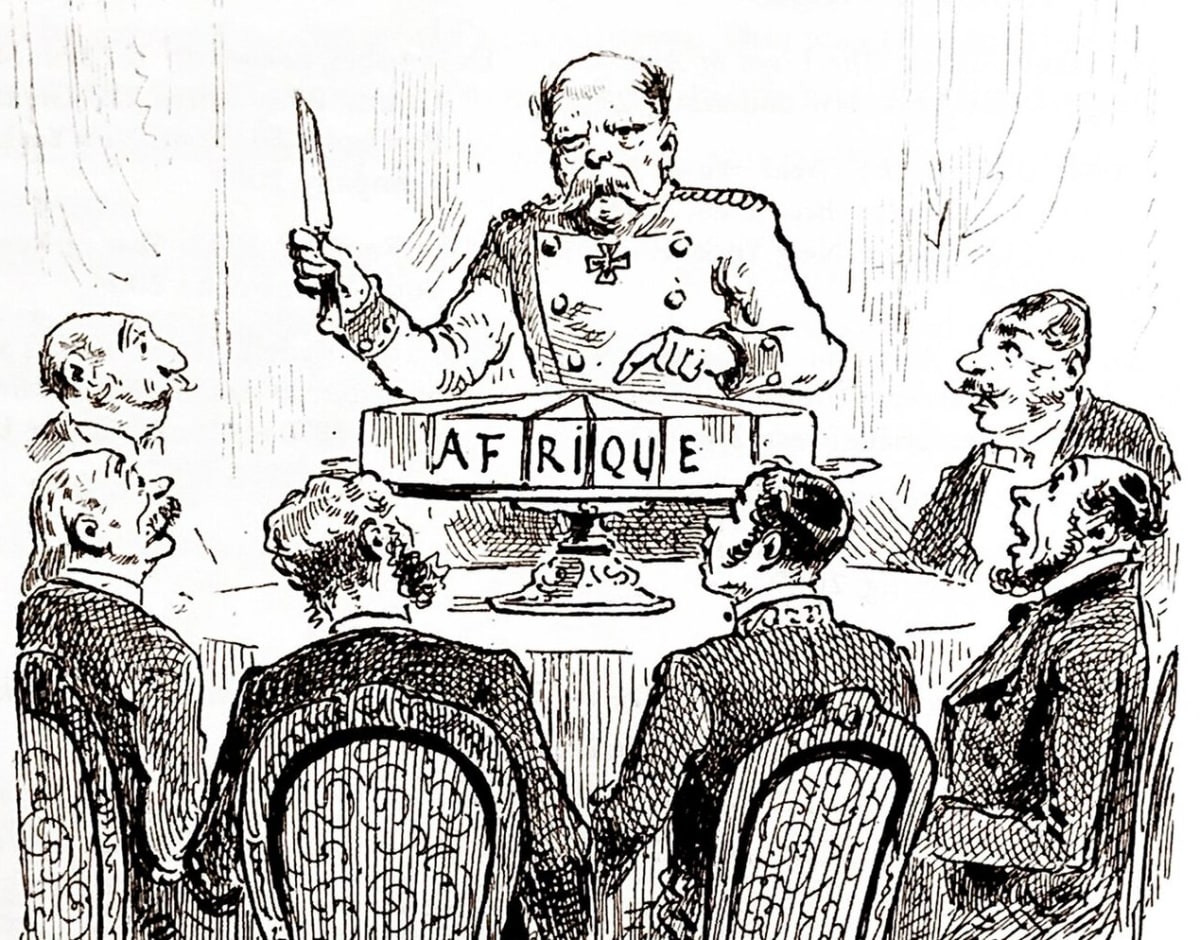
The cartoon titled, "The cutting of Africa at the Berlin Conference' shows the imperialistic ambitions of European nations. State two features of Imperialism.
Answer
Two features of Imperialism are-
- Imperialism refers to the state policy or practice by which a powerful nation establishes its control over another country, either by direct territorial acquisition or by gaining political and economic control. Once conquered, this country was claimed as a colony.
- These colonies were governed and administered by the imperial nation through its representatives or a puppet government.
What was the cause of Franco-German rivalry?
Answer
Germany defeated France and annexed the French territory of Alsace-Lorraine. The war and the subsequent annexation caused widespread resentment and a strong desire for revenge in France. This was the cause of Franco-German rivalry.
How did the Sarajevo Crisis in 1914 lead to the First World War?
Answer
Sarajevo Crisis, the immediate cause of the war was the murder of Archduke Francis Ferdinand, the heir to the Austrian throne, on June 28, 1914 by a Serbian at Sarajevo, capital of Bosnia. Austria served an ultimatum on Serbia on July 23 making eleven demands. Serbia accepted most of the demands except those that would have led to the loss of her sovereignty.
Austria declared war on Serbia on July 28, 1914. Russia started preparation for war to support Serbia. On August 1, 1914 Germany declared war on Russia and on August 3, war was declared on France. German troops marched into Belgium to press on to France on August 4 and on the same day Britain declared war on Germany. Thus, the First World War began.
Which country was blamed for the assassination of the Archduke Francis Ferdinand? Which country declared war on Serbia? Name two countries which supported it.
Answer
Serbia was blamed for the assassination of the Archduke Francis Ferdinand. Austria declared war on Serbia. Two countries which supported Austria were Germany and Turkey.
Why did Britain declare war on Germany in 1914?
Answer
Great Britain declared war on Germany on 4th August, when the German army invaded Belgium whose neutrality had been guaranteed by England.
Name the five major powers who got involved in the hostilities in 1914.
Answer
The five major powers that got involved in the hostilities in 1914 were Austria, Germany, Russia, France and Britain.
Why is the war fought between 1914 and 1918 called the First World War?
Answer
The war fought between 1914 and 1918 is called the First World War because of the following reasons-
- The War was fought on the land and in the air, on the sea and under it. In the War were mobilised all methods of destruction, such as tanks, submarines, gunfire and bombardments.
- The War began in Europe, but very soon it spread to continents of Asia and Africa as well.
Which country withdrew from the First World War and why?
Answer
Russia withdrew from the First World War after the October Revolution. The Russian Empire had suffered serious reverses in the War. Over 600,000 Russian soldiers were killed. The day after the Bolshevik Government came to power under the leadership of Lenin, it issued the Decree on Peace with proposals to end the War without any annexations and indemnities.
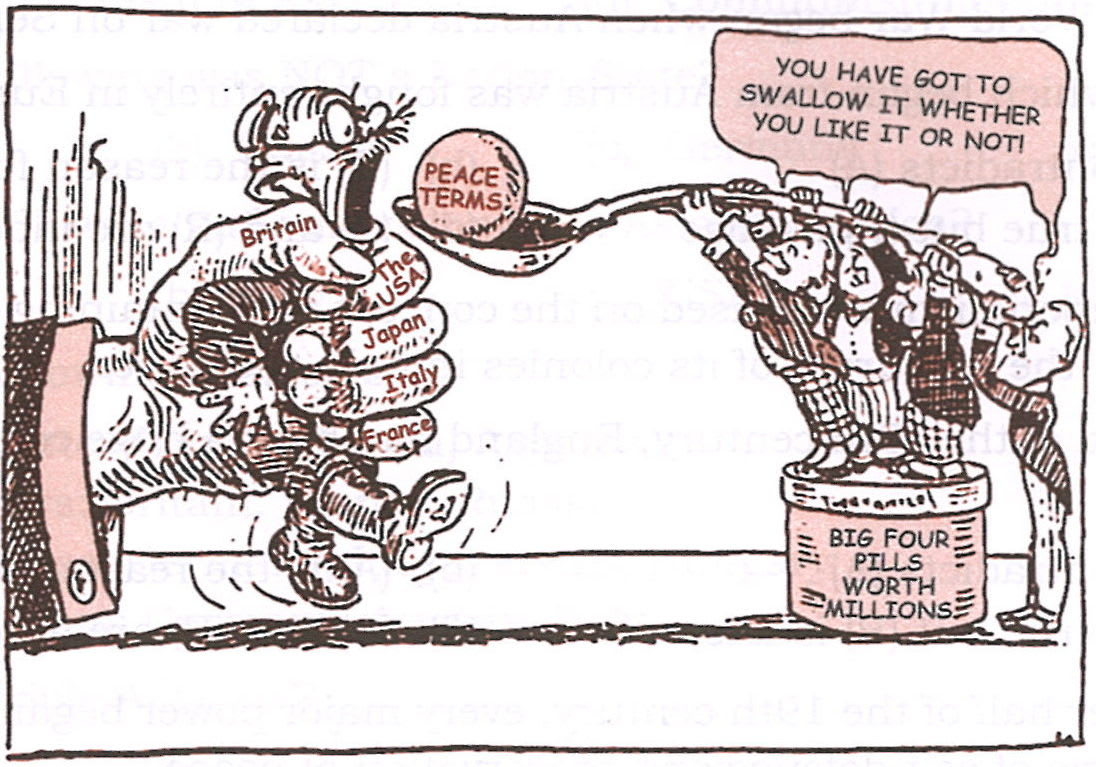
The Peace Terms of which Treaty is being referred to in the cartoon given below? Who had to swallow the bitter pills and why?
Answer
The Peace terms of the Treaty of Versailles (June 28, 1919) are being referred to in the given cartoon picture. Germany had to swallow the bitter pills.
The Treaty of Versailles aimed to prevent Germany from going to war again by limiting its military strength, taking away territories, imposing war guilt, and enforcing heavy reparations. These terms crippled Germany militarily and economically.
Explain briefly the Treaty of Versailles?
Answer
The victorious powers or the Allies, met in a conference first in Versailles, a suburb of Paris, and later in Paris, between January and June 1919.
As a result of the discussions at the Paris Conference, on June 28, 1919, the Treaty of Versailles was signed. It ended the War. The basis of the treaty's negotiations was the American President Wilson's Fourteen Points. The treaty was designed to prevent Germany from going to war again.
Name the country which emerged as a world power after the War. What happened to the Austrian Empire after the First World War?
Answer
The United States of America emerged as a world power after the War.
After the First World War, the ruling dynasty of Hapsburg in Austria-Hungary was destroyed and Austria and Hungary became separate independent states.
What was the effect of the First World War on the colonial possessions of industrialised countries?
Answer
France got back Alsace-Lorraine which she had lost in the Franco-Prussian War (1870-1871). France was given full ownership of the rich coal mines in the Saar basin for a period of 15 years. The fate of Schleswig was determined by a plebiscite. Germany had to surrender the areas of Eupen and Malmedy to Belgium. The city of Memel went to Lithuiana. The newly created State of Poland got back all the territories she had lost in the War.
Besides territorial losses in Europe, Germany lost all her colonies and overseas possessions. Togoland and the Cameroon were partitioned between Britain and France and German East Africa was shared between Britain and Belgium. Palestine and Mesopotamia (present-day Iraq) were also held by Britain under a Mandate from the League of Nations.
How was Denmark affected by the Treaty of Versailles?
Answer
According to the terms of the Treaty of Versailles, SchLeswig-HoLstein was restored to Denmark.
When and why was the League of Nations formed?
Answer
The League of Nations was created as a world organisation of all independent States in 1920.
The horrors of War convinced the leaders of the world that there must be a mechanism to prevent war and promote international cooperation. This culminated in the setting up of the League of Nations.
Name the two major countries which were not allowed to become the members of the League of Nations.
Answer
The two major countries which were not allowed to become the members of the League of Nations were Germany and the Soviet Union.
The First World War was unique in history. In this context, answer the following:
(a) Any three causes that led to the war.
(b) The extent and methods used in this war.
(c) Economic consequences of this war.
Answer
(a) Three causes that led to the war were as follows-
Race for Armaments — Germany had acquired colonies in Africa and a few islands in the Pacific. In order to protect her colonies Germany began to build a powerful navy. The Germans dug the Kiel Canal deeper so that battle ships could find shelter in its waters. There was an arms race and the peculiar feature of such a race is that if one country increases its armaments, other countries are compelled to do the same. Such a race for armaments could end only in a war.
Division of Europe into two armed camps — In 1879, Germany and Austria-Hungary had signed a Treaty to help each other in case of enemy attack. Three years later Italy joined the Pact, which came to be known as the Triple Alliance. As opposed to the Triple Alliance emerged the Triple Entente comprising Britain, France and Russia in 1907 to control German expansionism. Thus, Europe was divided into two major camps. The suspicions, fears, rivalry and enmity between the two camps was a major step towards World War I.
Sarajevo Crisis — The immediate cause of the war was the murder of Archduke Francis Ferdinand, the heir to the Austrian throne, on June 28, 1914 by a Serbian at Sarajevo, capital of Bosnia. The assassination was organised by a secret society called 'Black Hand' or 'Union of Death' formed by extremist Serbian nationalists.
(b) The First World War was fought in many different areas called fronts.
- War on the Western Front — The war began when the German armies swept across Belgium and entered southern France. The French army along with the British army met the German forces in the Battle of Marne (after the river near which the battle was fought) some 15 miles from Paris. The European countries made use of the troops recruited from their colonies in the war.
- Trench Warfare — The opposing armies dug a series of trenches to defend themselves and to launch attacks. Living conditions in these trenches were pathetic.
- War on the Eastern Front — The fighting began with the invasion of Russia by Austria-Hungary. Germany and Austria succeeded in repulsing the Russian attack and capturing parts of the Russian empire. They were also successful against Romania, Serbia and Italy. Outside Europe, Japan occupied German possessions in East Asia, and Britain and France seized most of the German colonies in Africa.
- Policy of Blockade — The war involved total mobilisation of all the resources of the warring parties with all economic activities subordinated to the needs of the war. It also required that no goods including food, raw materials and war materials should be allowed to enter the enemy territory from anywhere.
- Entry of USA in the War — In 1915, the German U-Boats had sunk a British ship Lusitania. The Americans were generally sympathetic to Britain, and this incident further roused anti-German feelings in the USA. On 6 April, 1917, the United States of America declared war on Germany.
- Exit of Russia from the War — Another major development that took place in 1917 was the withdrawal of Russia from the War after the October Revolution.
(c) As a result of the War, the economy of many countries was shattered.
The global economic depression of 1929-30 is attributed to this War.
It gave rise to many serious social problems.
According to some estimates the expenditure on the Allied side was nearly forty-one thousand million pounds and that on the German side over fifteen thousand million pounds.
With reference to the First World War, answer the following questions:
(a) State any three consequences of the war.
(b) Mention three points under the Treaty of Versailles, which affected Germany.
(c) What were the objectives of the League of Nations? Name the organisation formed in October 1945 with objectives similar to those of the League of Nations.
Answer
(a) Three consequences of the First World war were as follows:
- Treaty of Versailles was signed between the Allies and Germany on June 28, 1919.
- Territorial rearrangements — it changed the political map of the world by giving a serious blow to monarchy and developed democracy in Europe. The treaty not only affected substantial territorial changes but also reduced the military strength of Germany.
- The war led to the formation of the League of Nations.
(b) Three points under the Treaty of Versailles, which affected Germany were-
- The area of the Rhine Valley was to be demilitarised and the German territory west of Rhine was to be occupied by the Allied Troops for 15 years.
- Germany lost Alsace Lorraine to France; Eupen-et-Malmedy to Belgium, Schleswig to Denmark. Danzig became a Free Port in the Polish territory.
- Germany ceded parts of her pre-War territory to Denmark, Belgium, Poland, Czechoslovakia and France.
(c) The objectives of the League of Nations were —
- All the States of the world were prohibited from entering into any secret treaties and alliances.
- The member-States were not supposed to maintain huge armies, warships and destructive armaments.
- All States were to respect each other's independence.
- All States were to refer their mutual disputes, if any, to the League of Nations for a peaceful settlement.
- The member-States were to take necessary action as directed by the League against any State which tried to disturb world peace and order.
- Apart from political functions, the League of Nations was supposed to promote cultural, social and economic cooperation among the member-States.
The United Nations was formed in October 1945 with objectives similar to those of the League of Nations.
Look at the newspaper clipping given on the next page and answer the questions that follow:

(a) What was the immediate impact of the incident mentioned in newspaper clipping? Who organised the assassination? What was the objectives behind the assassination?
(b) Besides the incident mentioned in the newspaper, state three other reasons that led to a turning point in the history of the world.
(c) Name the treaty that was designed to prevent Germany from going to war again. State any three clauses of this treaty.
Answer
(a) The immediate impact of the incident mentioned in the newspaper above was beginning of the First World War.
The assassination was organised by a secret society called 'Black Hand' or 'Union of Death’ formed by extremist Serbian nationalists whose aim was to unite all Serbians into a single Serbian State. The political objective behind the assassination was to free Bosnia and Herzegovina from Austria-Hungarian rule and establish a common South Slav state.
(b) Three other reasons that led to a turning point in the history of the world were:
- Nationalism, Aggressive nationalism and Imperialism — In the latter half of the 19th century, the Nationalism turned into extreme pride, which made the people of many countries believe that their country is superior to the other countries. This led to the development of aggressive nationalism in Europe. The aggressive nationalism also led to the rise of imperialism. Imperialism refers to the state policy or practice by which a powerful nation establishes its control over another country, either by direct territorial acquisition or by gaining political and economic control.
- Race for Armaments — The mad race for armaments which began soon after the Franco-Prussian War (1870) was one of the reasons which led to the First World War. Every major power began stockpiling armaments in the name of self-defence and preservation of peace.
- Division of Europe into Two Hostile Groups — There were two kinds of States in Europe in the early 20th century. On the one hand there were single Nation-States like France, Holland and Germany whose national identities were based on their common language and traditions. On the other, there were imperial States like the Austria-Hungarian Empire and the Russian Empire. The rivalry happened for colonies, trade and trade routes.
(c) The Treaty of Versailles was designed to prevent Germany from going to war again. The three clauses of this treaty were:
- The Treaty declared Germany guilty of aggression.
- Germany was required to pay for the loss and damages suffered by the allies during the war. The amount of reparations was fixed at 33 billion dollars. Germany had to cede her merchant ships to the allies as compensation and had to supply huge quantities of coal to France, Italy and Belgium for ten years.
- The area of the Rhine Valley was to be demilitarised and the German territory west of Rhine was to be occupied by the Allied troops for 15 years.
Look at the newspaper excerpt given on the right and answer the questions that follow:
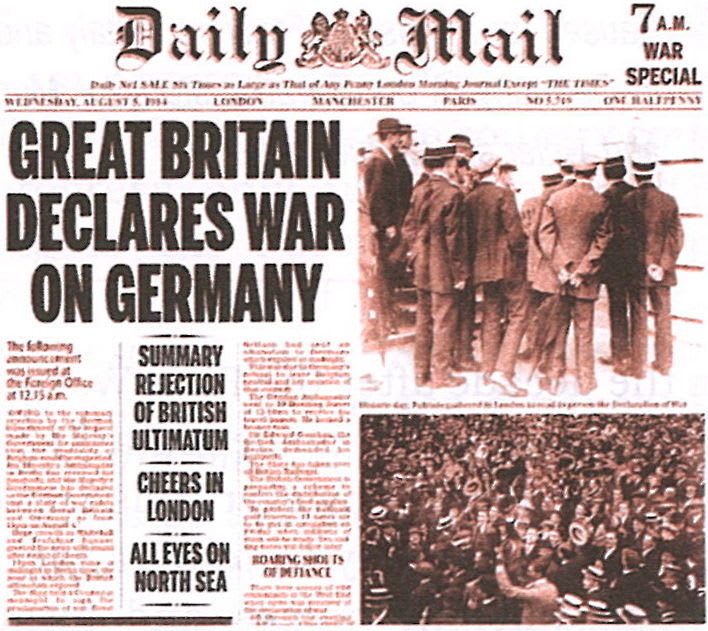
(a) Who summarily rejected British ultimatum? Why?
(b) Why did Great Britain declare war on Germany?
(c) What was the final outcome of the war that began after Great Britain declared war on Germany? How did it affect both the countries?
Answer
(a) Germany summarily rejected the British ultimatum, which had demanded that Germany withdraw its forces from Belgium.
This is because Germany had invaded Belgium as part of its military strategy to attack France.
(b) Great Britain declared war on Germany because Germany violated Belgium's neutrality, which Britain had pledged to protect through a treaty. This invasion was viewed by the British as an unprovoked act of aggression. When Germany ignored Britain's ultimatum to withdraw its forces from Belgium, Britain responded by declaring war on Germany. Additionally, Britain was increasingly concerned about Germany’s growing military and naval power, which threatened the balance of power in Europe.
(c) The First World War ended on November 11, 1918, when Germany agreed to an armistice. The Allied Powers— which included Great Britain, France, and later the United States—won the war. The Central Powers, led by Germany, were defeated.
Effects on Germany —
- Germany was held responsible for the war and made to pay $33 billion in reparations and sign the Treaty of Versailles.
- Germany lost Alsace-Lorraine to France and other territories to Belgium, Poland, Denmark, etc.
- Saar coal mines were given to France for 15 years and Rhineland demilitarised.
- It lost all overseas colonies to the Allies.
- Japan took over German territories in China and the Pacific.
- German Army and navy size were severely restricted. Air force and submarines were banned.
Effects on Great Britain —
- Britain suffered heavy loss of life and resources despite being on the winning side.
- The war weakened Britain economically, and it lost its status as the foremost economic power.
- Rise of the USA and Japan challenged British dominance.
- British control over colonies declined, leading to nationalist movements especially in India.
More than national pride, it was the greed to acquire colonies and thereby, more money and resources that led to the First World War. Explain.
Answer
By the end of the 19th century, England and France had built up a huge colonial empire in Asia and Africa. Some other countries of the world like Germany, Italy, Russia and Japan also wanted to increase their sphere of influence and create their colonies in Asia and Africa. These colonies were essential for their progress as they could provide raw materials for their industries and markets for their finished products. Besides, acquiring colonies would add to the power and prestige of these countries. This led to a clash of interest among these countries. They began to scramble for colonies which resulted in rivalries and wars. Thus, we can say that the greed to acquire colonies and thereby, more money and resources led to the First World War more than the national pride.
Do you think the First World War could have been avoided? Give reasons to support your answer.
Answer
Yes, the First World War could have been avoided if the leaders of Russia and Germany would have shown some restraint. Franz Ferdinand was the strongest spokesman for peace in Austria-Hungary. He believed that a war with Russia would lead to the downfall of both empires. His assassination removed this brake on going to war. On the contrary, it became the immediate cause of the war.
Had Russia not declared war on Austria-Hungary, then Germany would have not declared war on Russia and the First World War could have been avoided at that moment. If Russia had exercised greater diplomacy and Germany had not given unconditional support to Austria-Hungary, the war could have been prevented.