
Rain is falling vertically with a speed of 30 ms-1. A woman on a bicycle is travelling with a speed of 10 ms-1 in the north to south direction. In what direction should she hold her umbrella in order to protect herself from rain?
With what speed does the rain strike the umbrella?
Answer
Given,
- Speed of the rain (vertically downward), vr = 30 m s-1
- Speed of the woman (north to south), vw = 10 m s-1
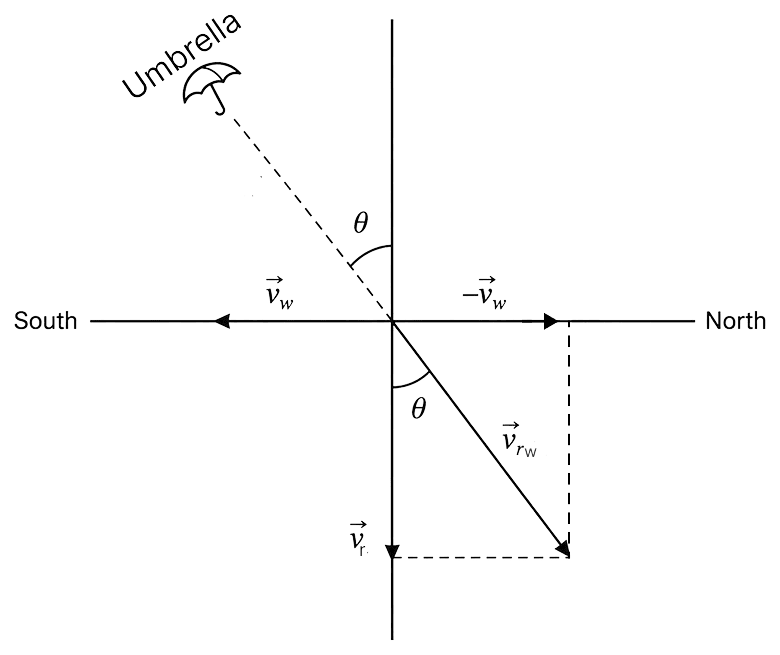
To protect herself from the rain, the woman must hold her umbrella along the direction of the relative velocity of the rain with respect to herself,
Since is vertically downward and is horizontal (from south to north), the two are mutually perpendicular. If θ is the angle made by with the vertical,
The magnitude of the relative velocity is
Hence, the woman should hold her umbrella at about 18.4° with the vertical, tilted towards the south, that is, towards her direction of motion, and the rain strikes the umbrella with a speed of 31.6 m s-1.
A man can swim with a speed of 4 kmh-1 in still water. How long does he take to cross a river 1 km wide if the river flows steadily at 3 kmh-1 and he takes his strokes normal to the river current? How far down the river does he go, when he reaches the other bank?
Answer
Given,
- Speed of the man in still water, vm = 4 km h-1
- Speed of the river current, vr = 3 km h-1
- Width of the river, d = 1 km
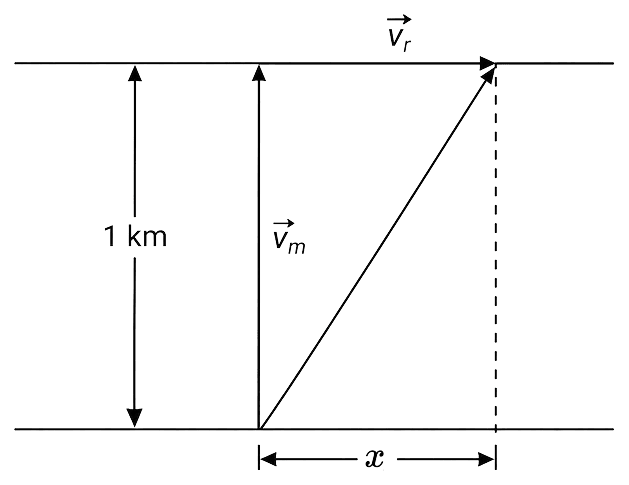
Since the man takes his strokes normal to the current, his full swimming speed is used in crossing the river. The horizontal motion (along the current) and the motion across the river are independent of each other. Hence the time taken to cross the river is
During this time the current carries him downstream through a distance
Hence, the man takes 15 min to cross the river and is carried 750 m down the river.
A fighter plane flying horizontally at an altitude of 1.5 km at a constant speed of 720 km/h passes directly overhead an anti-aircraft gun. At what angle from the vertical should the gun be fired for the shell with muzzle speed 600 ms-1 to hit the plane? At what minimum altitude should the pilot fly the plane to avoid being hit? (g = 10 ms-2)
Answer
Given,
- Speed of the plane, v = 720 km h-1 = = 200 m s-1
- Muzzle speed of the shell, u = 600 m s-1
- Acceleration due to gravity, g = 10 m s-2
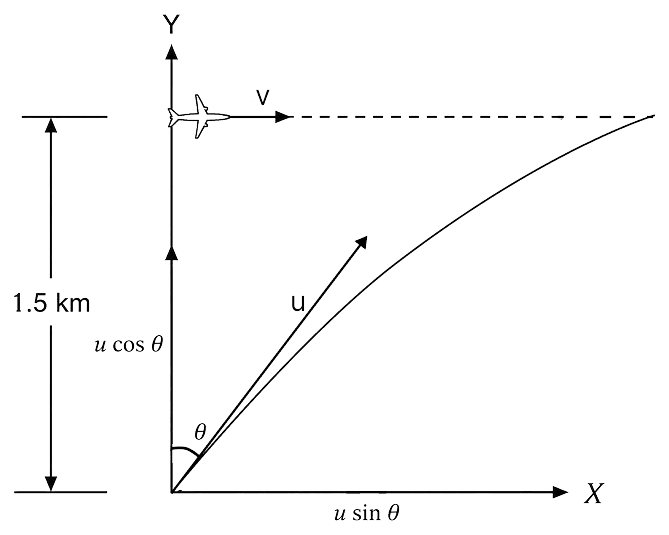
Let the gun be fired at an angle θ from the vertical. For the shell to hit the plane, the horizontal component of the velocity of the shell must be equal to the speed of the plane, so that both cover the same horizontal distance in the same time. Therefore,
Hence,
The vertical component of the muzzle velocity is
The maximum height reached by the shell is
Hence, the gun should be fired at 19.5° from the vertical, and the pilot must fly the plane at a minimum altitude of 16 km to avoid being hit.
In a harbour, wind is blowing at the speed of 72 km h-1 and the flag on the mast of a boat anchored in the harbour flutters along the N-E direction. If the boat starts moving at a speed of 51 km h-1 to the north, what is the direction of the flag on the mast of the boat?
Answer
Given,
- Speed of the wind, vw = 72 km h-1 along the north-east direction
- Speed of the boat, vB = 51 km h-1 towards the north
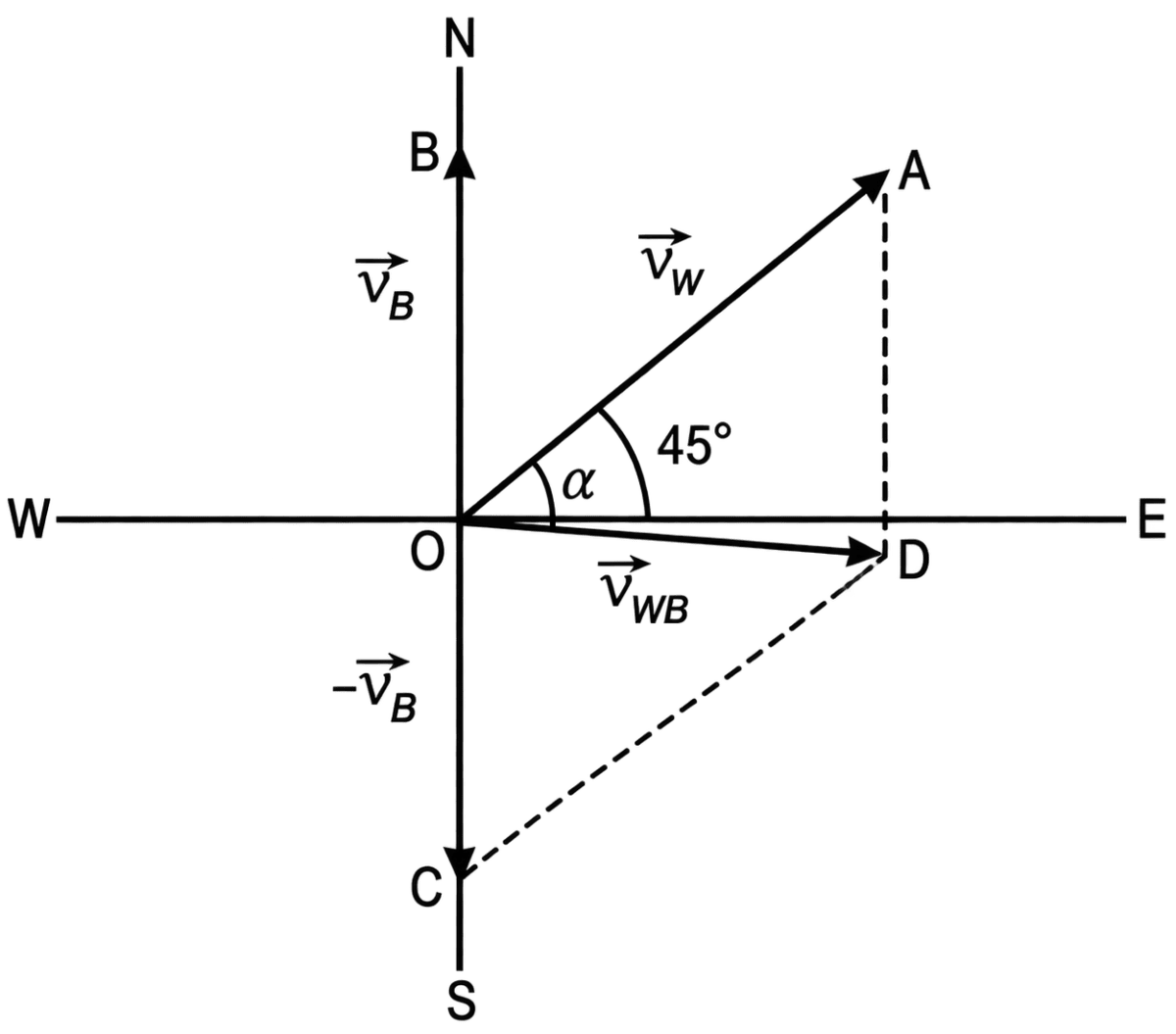
When the boat is anchored, the flag flutters along the direction of the wind, that is, along the north-east direction. Resolving the velocity of the wind along the east and the north directions,
When the boat moves, the flag flutters along the direction of the relative velocity of the wind with respect to the boat,
Its components are
The north component is almost zero, while the east component is 50.9 km h-1. Hence the relative velocity of the wind with respect to the boat is directed very nearly along the east.
Hence, the flag on the mast of the moving boat flutters almost exactly along the east direction.
A cyclist is riding with a speed of 27 km/h. As he approaches a circular turn on the road of radius 80 m, he applies brakes and reduces his speed at a constant rate of 0.5 ms-1 every second. What is the magnitude and direction of the net acceleration of the cyclist on the circular turn ?
Answer
Given,
- Speed of the cyclist, v = 27 km h-1 = = 7.5 m s-1
- Radius of the circular turn, r = 80 m
- Tangential retardation, aT = 0.5 m s-2
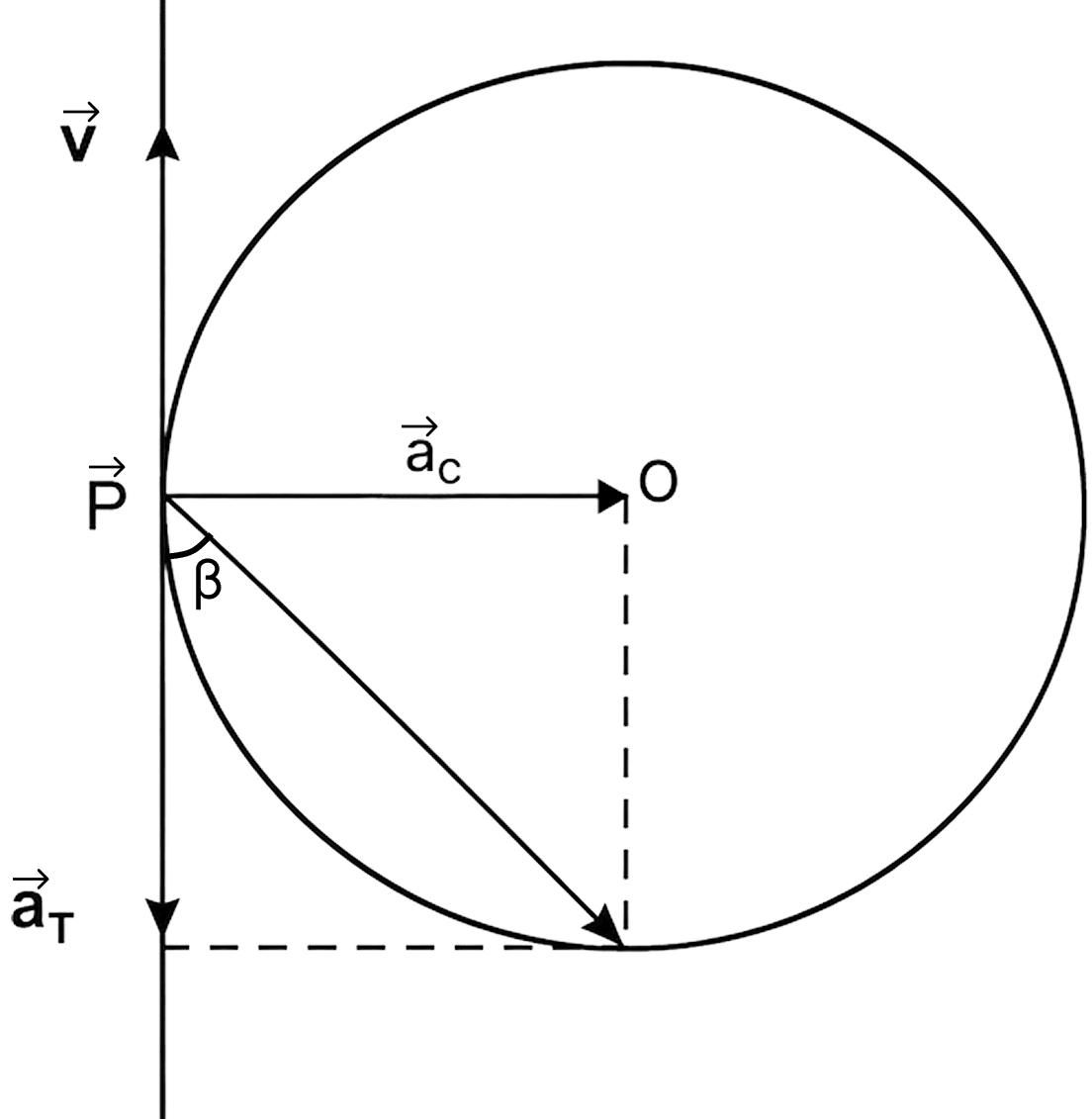
The centripetal acceleration, directed along the radius towards the centre, is
The tangential acceleration, directed along the tangent opposite to the motion, is aT = 0.5 m s-2. Since the two are mutually perpendicular, the magnitude of the net acceleration is
If β is the angle made by the net acceleration with the direction of the tangential acceleration,
Hence, the net acceleration of the cyclist is 0.86 m s-2, making an angle of 54.5° with the direction of the tangential acceleration.