
A vector quantity is represented as:
- a physical quantity with direction only
- a physical quantity with magnitude only
- a quantity with both magnitude and direction, following vector addition rules
- a physical quantity with both magnitude and direction.
Answer
a quantity with both magnitude and direction, following vector addition rules
Reason — The quantities which have both magnitude and direction and obey the laws of vector addition are called vector quantities. Merely having a magnitude and a direction is not enough, and this is why option 4 is incomplete. For example, electric current has both magnitude and direction but it is a scalar quantity, since it does not obey the laws of vector addition (the triangle or parallelogram law).
The result of subtracting two vectors is:
- scalar
- zero
- another vector
- undefined.
Answer
another vector
Reason — The subtraction of a vector from a vector means the addition of to , that is, . Since the sum of two vectors is again a vector, the difference of two vectors is also a vector. It becomes a zero vector only in the special case when the two vectors are equal.
A unit vector has a magnitude of:
- zero
- one
- infinite
- none of these.
Answer
one
Reason — A unit vector is a vector that has a magnitude of exactly one unit. It is obtained by dividing a vector by its own magnitude, , and it retains the direction of the original vector while scaling its magnitude to one. It is used to indicate direction without regard to magnitude.
Which one is not a zero vector?
- Position vector of origin
- Acceleration vector of a body moving with constant velocity
- Sum of two equal vectors
- Difference of two equal vectors.
Answer
Sum of two equal vectors
Reason — The position vector of the origin itself is a zero vector, since its initial and terminal points coincide. The acceleration vector of a body moving with constant velocity is a zero vector, since the velocity does not change. The difference of two equal vectors is a zero vector, because if . But the sum of two equal vectors is , which has twice the magnitude of and is therefore not a zero vector.
A free vector can be moved parallel to itself :
- anywhere
- only in one direction
- to the origin
- along a curve.
Answer
anywhere
Reason — A free vector is a vector that can be moved anywhere in space without changing its properties, that is, its magnitude and direction remain unchanged. It is not tied to a specific point. For example, a wind blowing with a velocity of 10 m s-1 to the north is the same free vector at every location in a field.
Which of the following is a bound vector?
- Force
- Displacement
- Velocity
- All of these.
Answer
Force
Reason — Bound vectors are associated with a specific point in space, that is, they are functions of the cartesian coordinates of the point of application. A force acts at a definite point of a body and its effect changes if it is shifted to another point, so it is a bound vector. Displacement and velocity are not tied to a particular point and can be drawn anywhere without changing their meaning.
The multiplication of a vector by a scalar result in:
- a scalar
- a vector
- a zero vector
- a unit vector.
Answer
a vector
Reason — On multiplying a vector by a scalar k, a vector is obtained whose magnitude is k times the magnitude of and whose direction is the same as that of (opposite if k is negative). A vector scaled by a scalar therefore remains a vector. For example, multiplying velocity by mass m gives the vector quantity momentum .
When a vector is multiplied by zero, the result is:
- the same vector
- a zero vector
- a unit vector
- infinite vector.
Answer
a zero vector
Reason — One of the properties of the zero vector is that the multiplication of a finite vector by zero is equal to the zero vector, that is, . The resulting vector has zero magnitude and no specific direction, and its initial and terminal points are coincident.
In projectile motion, the path followed by the projectile is:
- circular
- straight line
- parabolic
- elliptical.
Answer
parabolic
Reason — For a body projected with velocity u at an angle θ0 with the horizontal, the equation of the trajectory is
This equation is quadratic in x and linear in y, so it represents a parabola. Hence the path of a projectile, called its trajectory, is parabolic.
The horizontal component of a projectile's velocity:
- increases
- decreases
- remains constant
- becomes zero at the highest point.
Answer
remains constant
Reason — The horizontal and the vertical motions of a projectile take place independent of each other. No force acts on the projectile along the horizontal direction (air resistance being neglected), and the force of gravity is vertical, so it changes only the vertical component of velocity. Hence the horizontal component ux = u cos θ remains unchanged throughout the flight, including at the highest point.
The angle of projection for maximum range is:
- 30°
- 45°
- 60°
- 90°.
Answer
45°
Reason — The horizontal range of a projectile is
For a given speed of projection u, the range is maximum when sin 2θ0 is maximum, that is, when sin 2θ0 = 1 or 2θ0 = 90°, giving θ0 = 45°. This is why a long-jumper takes his jump at an angle of about 45°.
The range of a projectile depends on:
- only the angle of projection
- only the initial velocity
- both initial velocity and angle of projection
- only gravity.
Answer
both initial velocity and angle of projection
Reason — The horizontal range is given by . A higher initial velocity allows the projectile to cover a greater distance, and the angle of projection decides the trajectory and hence how long the projectile stays in the air and how far it travels horizontally. The range also depends on g, but not on g alone.
The maximum height of a projectile is directly proportional to:
- initial velocity
- horizontal velocity
- square of the initial velocity
- the angle of projection.
Answer
square of the initial velocity
Reason — The maximum height attained by a projectile is
For a fixed angle of projection, h ∝ u2. The greatest height for a given speed is obtained by putting θ0 = 90°, which gives , again directly proportional to the square of the velocity of projection.
The projectile launched from a height follows a:
- straight path
- hyperbolic path
- parabolic path
- circular path.
Answer
parabolic path
Reason — When a projectile is launched from a height, its initial velocity is resolved into a horizontal component and a vertical component. The horizontal motion is uniform because no horizontal force acts on it, while the vertical motion is uniformly accelerated due to gravity. The combination of a uniform horizontal motion and a uniformly accelerated vertical motion produces a parabolic trajectory, whatever the launch height may be.
If two vectors are perpendicular to each other, their dot product is:
- positive
- negative
- zero
- infinite.
Answer
zero
Reason — The scalar product of two vectors is . If the two vectors are perpendicular, θ = 90° and cos 90° = 0, so
Thus the scalar product of two mutually perpendicular vectors is zero even though neither of them is a null vector. For example, the work done is zero when the force is perpendicular to the displacement.
The velocity of a car A is . The velocity of another car B is . What is the relative velocity of car B with respect to car A?
- .
Answer
Reason — The relative velocity of a body B with respect to a body A is
Substituting the values,
Note: The textbook’s printed answer key gives option 2, which represents only the velocity of car A. However, book's own solution hint correctly calculates the relative velocity as . Therefore, the solution given above is correct.
A plane is flying at 200 m/s due north. A wind is blowing due east at 50 m/s. What is the magnitude of the plane's velocity relative to the ground?
- 250 m/s
- 150 m/s
- 206 m/s
- 220 m/s.
Answer
206 m/s
Reason — The velocity of the plane relative to the ground is the vector sum of the velocity of the plane and the velocity of the wind. Since the two are mutually perpendicular,
A car is negotiating a curve of radius 50 m at a speed of 20 m/s. What is the minimum coefficient of friction required to prevent sliding on a flat road?
- 0.1
- 0.2
- 0.4
- 0.8.
Answer
0.8
Reason — On a flat curved road the necessary centripetal force is provided entirely by the force of friction between the tyres and the road. Hence
Substituting the values,
A motorcycle rounds a curve of radius 30 m at a speed of 15 m/s. What is the centripetal acceleration?
- 0.5 m/s2
- 2.5 m/s2
- 7.5 m/s2
- 10 m/s2.
Answer
7.5 m/s2
Reason — The centripetal acceleration of a body moving on a circular path of radius r with speed v is
Substituting the values,
Note: The textbook’s printed answer key gives option 2, which is . However, the book's own solution hint correctly calculates the acceleration as . Therefore, the solution given above is correct.
If the magnitude of vector A is 5 units and vector B is 10 units, and the angle between them is 60°, the magnitude of the resultant vector is:
- 5 units
- 10 units
- 125 units
- 13 units.
Answer
13 units
Reason — By the parallelogram law of vector addition, the magnitude of the resultant is
Substituting the values,
A vector has components . The magnitude of this vector is:
- 5
- 7
- 4
- 3
Answer
5
Reason — If a vector is written in terms of its rectangular components as , then its magnitude is
Substituting the values,
If vector is and vector is , the dot product of and is:
- 5
- 8
- 6
- 11
Answer
5
Reason — The scalar product of two vectors is equal to the sum of the products of their corresponding x-, y- and z-components,
Substituting the values,
The time of flight of a projectile depends on:
- only horizontal velocity
- only vertical velocity
- both horizontal and vertical components
- none of the above.
Answer
only vertical velocity
Reason — The time taken by a projectile to reach the highest point is obtained from v = u − gt by putting v = 0 and u = u sin θ0, which gives . Hence the time of flight is
Only the vertical component u sin θ0 appears in this expression, so the time of flight depends on the vertical component of velocity alone.
At the highest point of the trajectory, the vertical and horizontal components of the velocity of a projectile will be, respectively:
- .
Answer
Reason — At the highest point of the trajectory the projectile stops rising, so the vertical component of its velocity becomes zero. The horizontal component is unaffected by gravity and remains unaltered at v0 cos θ throughout the flight. Hence at the peak the vertical and horizontal components are 0 and v0 cos θ respectively.
Why does a cyclist lean inward while negotiating a turn on a flat curved road?
- To balance the gravitational force acting on him.
- To balance the centrifugal force acting outward.
- To increase his speed around the curve.
- To reduce friction between the tyres and the road.
Answer
To balance the centrifugal force acting outward.
Reason — When a cyclist takes a turn, an outward centrifugal force acts on him due to his inertia. By leaning inward he counteracts this force, so that the combined effect of the gravitational force and the normal reaction points towards the centre of the curve and supplies the necessary centripetal force. This keeps him in balance while negotiating the turn.
Why does a car moving on a flat curved road require friction between the tyres and the road?
- To balance the gravitational force.
- To provide centripetal force for circular motion.
- To increase the car's speed on curves.
- To prevent the car from tipping over.
Answer
To provide centripetal force for circular motion.
Reason — A body moving on a circular path needs a net inward force directed towards the centre. On a flat curved road this centripetal force is provided entirely by the friction between the tyres and the road. In the absence of this force the car would continue to move along a straight line because of its inertia, and would not be able to follow the curve.
Why does an object moving in a circular path experience a centrifugal force in a non-inertial frame of reference?
- Because of the object's inertia resisting the centripetal force.
- Because there is an actual force acting outward on the object.
- Because the object is accelerating toward the center.
- Because the gravitational force is balanced by centrifugal force.
Answer
Because of the object's inertia resisting the centripetal force.
Reason — In a non-inertial frame, such as the rotating frame of an observer moving with the object, an outward force appears to act on the object. This centrifugal force is not a real force; it arises from the inertia of the object, which resists the centripetal acceleration directed towards the centre. It is therefore called a pseudo force and has no existence in an inertial frame.
The magnitude of centripetal force depends on:
- velocity and mass
- velocity and radius
- mass and radius
- All of these.
Answer
All of these.
Reason — The centripetal force required to keep a body of mass m moving with speed v on a circular path of radius r is
The expression contains the mass, the velocity as well as the radius, so the magnitude of the centripetal force depends on all three of them.
The main purpose of banking a road is to:
- increase the speed limit
- decrease fuel consumption
- provide additional centripetal force
- make the road more aesthetically pleasing.
Answer
provide additional centripetal force
Reason — When a road is banked, the outer edge is raised above the inner edge so that the normal reaction becomes inclined to the vertical. Its horizontal component then acts towards the centre of the circular path and supplies an additional centripetal force. The vehicle can therefore take the turn safely without depending on friction alone.
A vehicle moving in a circular path on a flat road requires:
- only friction to maintain circular motion
- only the banking angle to maintain circular motion
- a combination of friction and banking
- no forces at all.
Answer
only friction to maintain circular motion
Reason — A flat road has no banking, so the normal reaction is vertical and has no component towards the centre of the circular path. The whole of the centripetal force needed for the circular motion must therefore be supplied by the friction between the tyres and the road.
When a four-wheeler moves on a curved banked road at the designed speed, the role of friction is:
- to provide centripetal force
- to balance the forces completely
- to assist only when speed is less than designed speed
- to help in acceleration.
Answer
to balance the forces completely
Reason — At the designed (optimum) speed the horizontal component of the normal reaction by itself provides exactly the centripetal force required for the circular motion. Friction is then not needed for turning, and it only serves to balance the remaining forces, coming into play to correct any excess whenever the speed departs from the designed value.
If a vehicle goes too fast on a banked curve, it will:
- slide inward
- slide outward
- maintain its path
- stop completely.
Answer
slide outward
Reason — If the speed exceeds the designed speed for the given banking angle, the centripetal force required becomes greater than that supplied by the horizontal component of the normal reaction. The friction available is then not enough to counteract the outward centrifugal effect, and the vehicle slides outward, away from the centre of the curve.
In the case of a vehicle on a flat road, if the speed is doubled, the required frictional force will:
- remain the same
- increase by four times
- increase by twice
- decrease by half.
Answer
increase by four times
Reason — On a flat road the friction supplies the whole centripetal force,
so F ∝ v2 for a given mass and radius. If the speed is doubled, the required force becomes
that is, four times the original frictional force.
If a vehicle moves on a banked road at a speed lower than the design speed, the frictional force will:
- act up the slope
- act down the slope
- be zero
- act perpendicular to the slope.
Answer
act up the slope
Reason — At a speed lower than the designed speed, the horizontal component of the normal reaction is greater than the centripetal force actually required, so the vehicle tends to slide down the banked surface towards the inner edge. Friction opposes this tendency and therefore acts up the slope, keeping the vehicle moving on its circular path.
When a vehicle is travelling on a curved path, which of the following statements is true?
- Only gravity acts on the vehicle.
- Centripetal force is directed outward.
- The vehicle must have a net inward force to maintain circular motion.
- The vehicle will never slide if it has enough speed.
Answer
The vehicle must have a net inward force to maintain circular motion.
Reason — For circular motion a net inward force, that is, a centripetal force directed towards the centre of the curve, is always required. It can be provided by friction, by the banking of the road, or by both together. Without such an inward force the vehicle would move along a straight line because of its inertia.
The magnitude of cross product of two parallel vectors is:
- zero
- maximum
- minimum
- equal to the dot product.
Answer
zero
Reason — The magnitude of the vector product of two vectors is . When the two vectors are parallel the angle between them is 0° (or 180°), and sin 0° = 0, so
Thus the vector product of two parallel vectors is a null vector.
A body projected at an angle θ has the same range as when projected at (90° − θ). This property is known as:
- symmetry of motion
- complementary angles
- principle of invariance
- none of the above.
Answer
complementary angles
Reason — Substituting (90° − θ0) in place of θ0 in the expression for the range,
which is the same as the range for θ0. Hence the horizontal range is the same for two complementary angles of projection, and a football kicked at 30° or at 60° strikes the ground at the same place.
A vector lies in the XY-plane. Which of its components is necessarily zero?
- X-component
- Y-component
- Z-component
- None of these.
Answer
Z-component
Reason — A vector lying in the XY-plane can be written in terms of its rectangular components as . Since the vector has no extension along the Z-direction, its component along the Z-axis is necessarily zero, that is, Az = 0. The X- and Y-components may have any values.
If a projectile's horizontal range is R and the maximum height is H, the ratio of R to H for an angle of 45° is:
- 2
- 4
- 1
- ∞.
Answer
4
Reason — For a projectile,
Therefore,
Putting θ = 45°,
A vector A makes an angle of 45° with both X and Y-axes. The angle it makes with the Z-axis is:
- 90°
- 45°
- 60°
- None of these.
Answer
90°
Reason — If α, β and γ are the angles made by a vector with the X-, Y- and Z-axes, the direction cosines satisfy
Putting α = β = 45°,
Thus the vector lies in the XY-plane and is perpendicular to the Z-axis.
The unit vector perpendicular to both and is given by:
- None of these.
Answer
Reason — The vector product gives a vector perpendicular to the plane containing and . Here both vectors lie in the XY-plane, so their cross product must be along the Z-axis,
The unit vector perpendicular to both is therefore (directed along the Z-axis).
The angle of projection for which horizontal range and maximum height are equal is:
- 30°
- 45°
- 60°
- 76°.
Answer
76°
Reason — Equating the horizontal range and the maximum height,
so that
Since tan 76° = 4, the angle of projection is θ ≈ 76°.
A boat moving with a velocity of 10 m/s with respect to the still water crosses a river flowing at 5 m/s. If the boat needs to move directly across the river, in which direction should it head?
- At an angle of 45° downstream
- At an angle of 30° upstream
- At an angle of 60° upstream
- At an angle of 30° downstream.
Answer
At an angle of 60° upstream
Reason — For the boat to move directly across the river, the component of its velocity along the flow must exactly cancel the velocity of the river. If θ is the angle made by the heading of the boat with the line joining the two banks (that is, with the direction straight across),
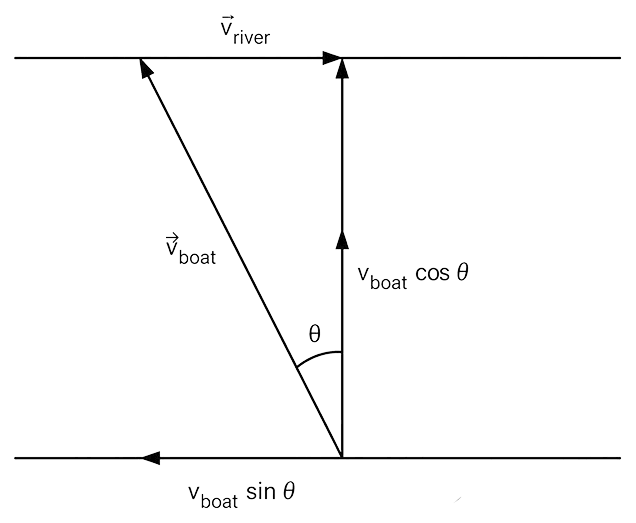
So the boat must head 30° upstream of the line straight across, which is the same as making an angle of 60° with the upstream bank. Measured from the bank, the required heading is therefore 60° upstream.
The horizontal displacement of a projectile after 2 s is 40 m. What is the horizontal velocity?
- 10 m/s
- 20 m/s
- 40 m/s
- 30 m/s.
Answer
20 m/s
Reason — The horizontal component of the velocity of a projectile remains constant, so the horizontal motion is uniform. Hence
Substituting the values,
A river flows east to west at a speed 5 m/min. A man capable of swimming 10 m/min in still water is standing on the south bank of the river. He wants to swim across the river in the shortest time possible. Which of the following path should he choose?
- Due North
- Due North-East
- Due North-East with double the speed of the river
- None of the above.
Answer
Due North
Reason — The time taken to cross the river depends only on the component of the swimmer's velocity perpendicular to the banks. This component is greatest when the man swims directly due north, since then his full speed of 10 m min-1 is used in crossing. The current will carry him some distance to the west, but the drift does not affect the time of crossing, so the time taken is the shortest.
Note: The textbook’s printed answer key gives option 2. However, the book's own solution hint correctly states that the man should swim directly towards the north. Therefore, the solution given above is correct.
Assertion (A): Minimum number of non-equal vectors in a plane to give zero resultant is three.
Reason (R): If then they must lie in one plane.
- If both assertion and reason are true and reason is the correct explanation of assertion.
- If both assertion and reason are true but reason is not the correct explanation of assertion.
- If assertion is false but reason is true.
- If both assertion and reason are false.
Answer
If both assertion and reason are true but reason is not the correct explanation of assertion.
Explanation
Assertion (A) is correct: For a zero resultant it must be possible to represent the given vectors by the sides of a closed polygon taken in the same order. Since two vectors of different magnitudes cannot be added to get a zero resultant, and the minimum number of sides of a closed polygon is three, at least three unequal vectors are needed in a plane to give a zero resultant.
Reason (R) is also correct: If , the three vectors form a closed triangle, and a triangle always lies in one plane. Hence the three vectors must be coplanar.
However, the Reason only states that three such vectors are coplanar. It does not explain why the minimum number required is three.
Therefore, both assertion and reason are true but reason is not the correct explanation of assertion.
Assertion (A): is perpendicular to both as well as .
Reason (R): as well as lie in the plane containing and but lies perpendicular to the plane containing and .
- If both assertion and reason are true and reason is the correct explanation of assertion.
- If both assertion and reason are true but reason is not the correct explanation of assertion.
- If assertion is false but reason is true.
- If both assertion and reason are false.
Answer
If both assertion and reason are true and reason is the correct explanation of assertion.
Explanation
Assertion (A) is correct: The vector product is perpendicular to both the sum and the difference of and .
Reason (R) is also correct: The vector product of two vectors has the direction perpendicular to the plane containing the two vectors, its sense being given by the right-hand screw rule. Both and are obtained by the laws of vector addition from and , so they lie in the same plane as and . A vector perpendicular to this plane is therefore perpendicular to every vector lying in it.
Therefore, both assertion and reason are true and reason is the correct explanation of assertion.
Assertion (A): Angle between and is 45°.
Reason (R): is equally inclined to both and and angle between and is 90°.
- If both assertion and reason are true and reason is the correct explanation of assertion.
- If both assertion and reason are true but reason is not the correct explanation of assertion.
- If assertion is false but reason is true.
- If both assertion and reason are false.
Answer
If both assertion and reason are true and reason is the correct explanation of assertion.
Explanation
Assertion (A) is correct: Taking the scalar product,
so that θ = 45°.
Reason (R) is also correct: Since and are unit vectors of equal magnitude, their sum lies along the diagonal of the square formed by them and is therefore equally inclined to both. As the angle between and is 90°, this diagonal bisects it, giving an angle of with each. This is exactly why the angle in the Assertion is 45°.
Therefore, both assertion and reason are true and reason is the correct explanation of assertion.
Assertion (A): A vector is perpendicular to both vectors and , so it will be parallel to .
Reason (R): Cross product of two vectors is perpendicular to the plane containing those vectors.
- If both assertion and reason are true and reason is the correct explanation of assertion.
- If both assertion and reason are true but reason is not the correct explanation of assertion.
- If assertion is false but reason is true.
- If both assertion and reason are false.
Answer
If both assertion and reason are true and reason is the correct explanation of assertion.
Explanation
Assertion (A) is correct: A vector which is perpendicular to both and must lie along the normal to the plane containing them, and so must be parallel (or antiparallel) to .
Reason (R) is also correct: By definition, the vector product of two vectors has the direction perpendicular to the plane containing the two vectors, its sense being decided by the right-hand screw rule. Since there is only one direction normal to a given plane, any vector perpendicular to both and must be along that normal, which is the direction of .
Therefore, both assertion and reason are true and reason is the correct explanation of assertion.
Assertion (A): In javelin throw, the athlete throws the projectile at an angle slightly more than 45°.
Reason (R): The maximum range does not depend upon angle of projection.
- If both assertion and reason are true and reason is the correct explanation of assertion.
- If both assertion and reason are true but reason is not the correct explanation of assertion.
- If assertion is false but reason is true.
- If both assertion and reason are false.
Answer
If both assertion and reason are false.
Explanation
Assertion (A) is false: In javelin throw and discus throw the projectile is released from a place above the surface of the earth, and for such a projection the maximum range is obtained for an angle of projection slightly less than 45°, not more than 45°. Hence the player throws the projectile at an angle slightly less than 45° to the horizontal.
Reason (R) is also false: The horizontal range clearly depends on the angle of projection, and it becomes maximum only for a particular angle of projection (45° for projection from the ground). Hence the maximum range does depend upon the angle of projection.
Therefore, both assertion and reason are false.
Assertion (A): The projectile has only vertical component of velocity at the highest point of trajectory.
Reason (R): At the highest point only one component of velocity is present.
- If both assertion and reason are true and reason is the correct explanation of assertion.
- If both assertion and reason are true but reason is not the correct explanation of assertion.
- If assertion is false but reason is true.
- If both assertion and reason are false.
Answer
If assertion is false but reason is true.
Explanation
Assertion (A) is false: At the highest point of the trajectory it is the vertical component of velocity that becomes zero, while the horizontal component u cos θ0 remains unaltered. Hence the projectile has only the horizontal component of velocity there, not the vertical component.
Reason (R) is correct: At the highest point only one component of velocity, namely the horizontal component, is present, since the vertical component has been reduced to zero by gravity.
Therefore, assertion is false but reason is true.
Select scalar and vector quantities from the following:
(i) mass, displacement, pressure, work, acceleration.
(ii) momentum, energy, impulse, density, temperature, speed.
(iii) moment of a force, surface tension, momentum and temperature.
(iv) is pressure a vector or a scalar quantity?
Answer
(i) Scalars : mass, pressure, work. Vectors : displacement, acceleration.
(ii) Scalars : energy, density, temperature, speed. Vectors : momentum, impulse.
(iii) Scalars : surface tension, temperature. Vectors : moment of a force, momentum.
(iv) Pressure is a scalar quantity, since it is completely specified by its magnitude alone and does not obey the laws of vector addition.
The magnitude of vector is 2.5 m and it is directed towards north. What will be the magnitudes and directions of the followings?
(a)
(b)
(c)
(d)
Answer
If the direction of a vector is reversed, the sign of the vector is reversed, and on multiplying a vector by a scalar k the magnitude becomes k times while the direction remains the same (opposite if k is negative).
(a) : magnitude 2.5 m, directed towards south.
(b) : magnitude 1.25 m, directed towards north.
(c) : magnitude 6.25 m, directed towards south.
(d) : magnitude 10 m, directed towards north.
Can a scalar quantity be added to a vector quantity? Is their product possible ?
Answer
No, a scalar quantity cannot be added to a vector quantity, because a scalar has only magnitude whereas a vector has magnitude as well as direction. Even if the two have the same dimensions, they cannot be added.
Yes, their product is possible. On multiplying a vector by a scalar k, a vector is obtained whose magnitude is k times that of . For example, multiplying the velocity by the mass m gives the momentum .
Is the magnitude of same as that of ?
Answer
Yes. The addition of vectors is commutative, that is,
The two sums are represented by vectors which are parallel and of equal length, so their magnitudes as well as their directions are the same.
Is the magnitude of same as that of ?
Answer
Yes, the magnitudes are the same, but the directions are opposite. Since
the two difference vectors are parallel and equal in length, but they point in opposite directions.
When is the sum of two vectors maximum and when minimum ?
Answer
The magnitude of the sum of two vectors is
The sum is maximum when the two vectors are in the same direction, that is, θ = 0°, and then R = A + B.
The sum is minimum when the two vectors are in opposite directions, that is, θ = 180°, and then R = A − B (or B − A, whichever is positive).
Can the magnitude of the resultant vector of two given vectors be less than the magnitude of any of the given vectors ?
Answer
Yes, this is possible when the angle between the two given vectors is more than 90°. For example, if two vectors of magnitudes 3 units and 4 units are oppositely directed (θ = 180°), the magnitude of the resultant is
which is less than the magnitude of either of the given vectors.
If a vector is multiplied by a scalar m, what will be the resultant vector ?
Answer
The resultant will be a vector whose magnitude is m times the magnitude of . Its direction is the same as that of if m is positive, and opposite to that of if m is negative. If m is a pure number, the resultant represents the same physical quantity as ; if m carries a unit, the resultant represents a new physical quantity.
Force and displacement both are vector quantities. Which type is the quantity work ?
Answer
Work is a scalar quantity. It is the scalar (dot) product of the two vectors and , and the scalar product of two vectors is always a scalar,
Can the scalar product of two vectors be negative ?
Answer
Yes. The scalar product is . When the angle between the two vectors is obtuse, that is, when 90° < θ ≤ 180°, cos θ is negative and hence the scalar product is negative. For example, the work done by the force of friction is negative because the friction acts opposite to the displacement.
Under what condition the scalar product of two vectors is maximum?
Answer
The scalar product is maximum when cos θ is maximum, that is, when θ = 0° and the two vectors are parallel (in the same direction). Its maximum value is then
In which condition, is the scalar product of two vectors numerically minimum?
Answer
The scalar product is numerically minimum, that is, zero, when the two vectors are mutually perpendicular (θ = 90°), because
Thus the scalar product vanishes even though neither of the two vectors is a null vector.
What is the angle between the directions of velocity and acceleration at the highest point of a projectile path?
Answer
90°. At the highest point of the trajectory the vertical component of the velocity is zero and only the horizontal component u cos θ0 remains, so the velocity is directed horizontally. The acceleration of the projectile is the acceleration due to gravity, which acts vertically downwards. Hence the angle between the velocity and the acceleration there is 90°.
At what point of the projectile-path the speed is minimum? At which point maximum?
Answer
The speed is minimum at the highest point of the path, since there the vertical component of velocity is zero and only the horizontal component u cos θ0 is left.
The speed is maximum at the point of projection (and again at the point where the projectile strikes the ground, since it returns to the ground with the same speed with which it was projected).
Is it important in the long jump that how much height you take for jumping?
Answer
Yes, it is important. The horizontal range of the jumper is
which is maximum for θ0 = 45°. To be projected at 45° the jumper must gain a certain height, since the height attained is . If he takes too little height the angle of projection is too small, and if he takes too much height the angle is too large; in both cases the range becomes less than the maximum.
Two bombs of 5 and 10 kg are thrown from a cannon with the same velocity in the same direction. Which bomb will reach the ground first? If the bombs are thrown in the same direction with different velocities, then?
Answer
Both bombs will reach the ground at the same time. The time of flight is
which does not contain the mass of the projectile. Since both bombs are thrown with the same velocity in the same direction, their time of flight is the same, whatever their masses.
If the bombs are thrown in the same direction but with different velocities, their vertical components of velocity are different. The bomb having the greater vertical component u sin θ0 will have the longer time of flight, so the bomb thrown with the smaller velocity will reach the ground first.
There are two displacement vectors, one of magnitude 3 m and the other of 4 m. How should the two vectors be added so that the magnitude of the resultant vector be :
(a) 7 m
(b) 1 m and
(c) 5 m ?
Answer
The magnitude of the resultant of two vectors is , with A = 3 m and B = 4 m.
(a) For R = 7 m, the resultant is maximum, so the two vectors must be added in the same direction, that is, θ = 0°.
(b) For R = 1 m, the resultant is minimum, so the two vectors must be added in opposite directions, that is, θ = 180°.
(c) For R = 5 m,
So the two vectors must be added at right angles to each other.
Can two vector quantities of different magnitudes be added in such a way that their resultant be zero ?
Answer
No. The minimum magnitude of the sum of two vectors is (A − B), which is obtained when they are oppositely directed. This is zero only if A = B. Hence two vectors of different magnitudes cannot be added to get a zero resultant.
Can three vector quantities be added in such a way that their resultant be zero ?
Answer
Yes. If three vectors can be represented in magnitude and direction by the three sides of a triangle taken in the same (cyclic) order, they themselves complete a closed figure and their sum-vector cannot be drawn. This means that the sum of these three vectors is zero.
If the magnitudes of two vectors are kept unchanged and angle between them is changed then what will be the effect on their resultant vector ?
Answer
Both the magnitude and the direction of the resultant will change. Since
the magnitude of the resultant decreases from its maximum value (A + B) at θ = 0° to its minimum value (A − B) at θ = 180°, and for other angles it lies between these two values. The angle α made by the resultant with also changes.
Which statement is true?
(a) or
(b) ?
Answer
Statement (a) is true. The scalar product of two vectors is commutative, since
(It is the vector product that is not commutative, for which .)
Two non-zero vectors and are such that (a) , (b) . What information do we get about and in each case?
Answer
(a) Since and neither vector is a null vector, cos θ = 0, so θ = 90°. Hence the two vectors are mutually perpendicular.
(b) Since , we get cos θ = 1, so θ = 0°. Hence the two vectors are parallel, that is, they are in the same direction.
If , then are A and B always equal ?
Answer
No. From the given relation,
This is satisfied either when , or when is perpendicular to . Hence and need not always be equal.
Under what condition the sum and difference of two vectors will be equal in magnitude ?
Answer
Equating the magnitudes,
which gives 4AB cos θ = 0, so cos θ = 0 and θ = 90°.
Hence the sum and the difference of two vectors are equal in magnitude when the two vectors are mutually perpendicular.
Under what condition the directions of sum and difference of two vectors will be the same ?
Answer
The sum and the difference can point in the same direction only when lies along the same line as , that is, when the two vectors are collinear (θ = 0° or θ = 180°).
If θ = 0°, the sum has magnitude A + B and the difference has magnitude A − B, both directed along provided A > B.
If θ = 180°, the sum has magnitude A − B and the difference has magnitude A + B, and again both are directed along provided A > B.
In either case, if A < B the difference reverses relative to the sum.
Hence the directions of the sum and the difference are the same when the two vectors are collinear, that is θ = 0° or θ = 180°, and the magnitude of the vector being subtracted is the smaller of the two, that is A > B.
Give two examples of scalar product of two vectors.
Answer
(i) Work is the scalar product of force and displacement, .
(ii) Power is the scalar product of force and velocity, .
Give two examples of the vector product of two vectors.
Answer
(i) Torque is the vector product of the position vector and the force, , and its magnitude is τ = rF sin θ.
(ii) Angular momentum is the vector product of the position vector and the linear momentum, , and its magnitude is L = rp sin θ.
A force displaces a stationary body by a distance . Show this happening with vector notation.
Answer
The work done by the force is the scalar product of the force and the displacement,
where θ is the angle between the directions of and .
A body is so projected in air that the horizontal range covered by the body is equal to the vertical height attained by the body. Find the angle of projection. (tan 76° = 4)
Answer
Given,
- Horizontal range = maximum height, that is, R = h
Equating the two,
so that
Since tan 76° = 4,
Hence, the angle of projection is 76°.
Though force and displacement are vector quantities, yet work W is a scalar quantity, why ? If and are not zero, yet it is possible that the value of W is zero, why ?
Answer
Work is the scalar product of force and displacement,
The scalar product of two vectors is always a scalar, because the product Fs cos θ has magnitude only and no direction is associated with it. This is why work is a scalar even though both force and displacement are vectors.
If and are both non-zero, the work can still be zero when θ = 90°, since cos 90° = 0. Thus when the force acting on a body is perpendicular to its displacement, the work done by that force is zero. For example, the centripetal force does no work on a body in circular motion, since it is always perpendicular to the displacement.
Can the vector product of two vectors be negative?
Answer
No. The vector product of two vectors is itself a vector, and a vector cannot be called positive or negative. Its magnitude AB sin θ is non-negative, since sin θ is never negative for any angle from 0° to 180°. Only the direction of the vector product is reversed when the order of the vectors is reversed, because
The horizontal range (R) of a projectile is given by , where u is the velocity of projection and θ is the angle of projection with respect to the horizontal. Find out with the help of this formula, the angle of projection for the maximum range of the projectile.
Answer
For a given velocity of projection u, the range
is maximum when sin 2θ has its greatest value, that is, when
Hence, the range is maximum for an angle of projection of 45°, and then .
At what angle with the horizontal should a player throw a ball so that it may go to a maximum distance?
Answer
The player should throw the ball at an angle of 45° with the horizontal. For a given speed of projection the horizontal range is maximum when sin 2θ0 = 1, that is, when θ0 = 45°. This is also the reason why a long-jumper takes his jump at an angle of about 45°.
What is the difference between the following two data?
(i) 5 (6 km/h, west).
(ii) (5 h) (6 km/h, west).
Answer
(i) Here the vector (6 km/h, west) is multiplied by the pure number 5. Since a pure number has no unit, the product represents the same physical quantity, that is, a velocity,
(ii) Here the vector is multiplied by the scalar quantity 5 h, which carries a unit. The product therefore represents a new physical quantity, that is, a displacement,
Hence, the first is a velocity of 30 km h-1 towards the west, while the second is a displacement of 30 km towards the west.
Can the magnitude of the resultant vector of two given vectors be less than the magnitude of any of the given vectors? Explain with examples.
Answer
Yes, this happens when the angle between the two given vectors is more than 90°, because then the term 2AB cos θ in
is negative and it reduces the magnitude of the resultant.
For example, let A = 3 units and B = 4 units.
If θ = 180°, the magnitude of the resultant is
which is less than the magnitude of either of the given vectors.
Again, if θ = 120°,
which is less than 4 units, the magnitude of the larger vector.
Two forces of equal magnitude of 3 N act on a body making angle θ. If the resultant force of these two forces is also 3 N, then what will be the value of θ ?
Answer
Given,
- Magnitude of each force, A = B = 3 N
- Magnitude of the resultant, R = 3 N
By the parallelogram law of vector addition,
Substituting the values,
Therefore,
Hence, the angle between the two forces is 120°.
A ball is thrown horizontally and at the same time another ball is dropped down from the top of a tower.
(a) Will both the balls reach the ground at the same time?
(b) Will both strike the ground with the same velocity?
Answer
(a) Yes. The horizontal and vertical motions of a projectile are independent of each other. The initial vertical velocity of both the balls is zero, and both fall through the same height under the same vertical acceleration g. Since the time of fall is , which does not depend on the horizontal velocity, both balls reach the ground at the same time.
(b) No. On striking the ground the vertical components of the velocities of the two balls are equal, but the ball thrown horizontally also has a horizontal component of velocity which remains unchanged throughout. Hence its resultant velocity is greater in magnitude and is inclined to the vertical, whereas the dropped ball strikes the ground vertically.
"The path of a projectile projected from earth is a parabola. The velocity of the projectile will be minimum at the highest point." Explain whether this statement is true or false?
Answer
The statement is true.
The equation of the trajectory of a projectile is
which is quadratic in x and linear in y, and therefore represents a parabola. Hence the path of a projectile is parabolic.
The horizontal component of the velocity u cos θ0 remains constant throughout the flight, while the vertical component goes on decreasing as the projectile rises and becomes zero at the highest point. Hence at the highest point only the horizontal component is left, and the speed there,
is the least value of the speed anywhere on the path.
Answer the following questions with reasons :
(i) The velocity of a body is continuously changing. Can its speed remain constant ? If speed is changing, can the velocity remain constant ?
(ii) Is it possible for a body to have a constant speed in an accelerated motion ?
(iii) A particle is moving with a uniform speed on a circular path. State, with reason, whether it has an acceleration or not.
(iv) Can a body move on a curved path without having acceleration?
(v) A particle is moving in a straight line. What can you say about its acceleration?
(vi) A body is moving on a curved path with a constant speed. What is the nature of its acceleration?
(vii) The speed of a body is constant. Can it have a path other than a circular or straight-line path?
(viii) If both the speed of a body and the radius of its circular path are doubled, what will happen to the centripetal force?
(ix) A body is moving with a constant speed in a horizontal circle. Which quantity among its velocity, acceleration and kinetic energy remains unchanged?
Answer
(i) Yes, the speed can remain constant while the velocity changes, since the velocity may change on account of a change of direction alone, as in uniform circular motion. No, if the speed is changing the velocity cannot remain constant, because the speed is the magnitude of the velocity.
(ii) Yes. It is possible if the body is moving on a curved path. Then the direction of the velocity is changing and the motion is accelerated, although the magnitude of the velocity remains constant, as in uniform circular motion.
(iii) Yes, it has an acceleration. Although its speed is constant, the direction of its velocity changes continuously, so its velocity is changing. This gives rise to the centripetal acceleration , directed along the radius towards the centre.
(iv) No. A curved path means that the direction of the velocity is continuously changing, and a change of velocity necessarily means acceleration.
(v) The acceleration is either zero, when the body moves with a uniform velocity, or its direction is always along the line of motion, when the speed is changing. There can be no component of acceleration perpendicular to the path.
(vi) The acceleration is perpendicular to the direction of motion, that is, it is directed along the radius towards the centre of curvature. It changes only the direction of the velocity and not its magnitude, and is therefore called centripetal acceleration.
(vii) Yes, all curved paths are possible. If the acceleration is zero the body moves with constant speed along a straight line; if the magnitude of the acceleration is constant and its direction remains perpendicular to the motion, the body moves with constant speed on a circle; and if the magnitude of the perpendicular acceleration changes, the body moves with constant speed along some other curved path.
(viii) The centripetal force is . On doubling both v and r,
so the centripetal force becomes twice its original value.
(ix) The kinetic energy remains unchanged, since the speed is constant. The velocity and the acceleration both change continuously, as their directions keep changing.
Write the formula of the scalar product of two vectors, explaining the symbols used.
Answer
The scalar product (or dot product) of two vectors and is
where,
- A is the magnitude of the vector
- B is the magnitude of the vector
- θ is the angle between the directions of and
The product AB cos θ is a scalar, so the scalar product of two vectors is always a scalar quantity.
In terms of the rectangular components of the two vectors, the same product is written as
Write the formula of the vector product of two vectors with an example.
Answer
The vector product (or cross product) of two vectors and is
where,
- A and B are the magnitudes of and
- θ is the angle between the two vectors
- is a unit vector perpendicular to the plane containing and , its sense being decided by the right-hand screw rule
Example : The torque acting on a particle about the origin O is the vector product of the position vector and the force ,
whose magnitude is τ = rF sin θ and whose direction is perpendicular to the plane containing and .
Write down the units and dimensional formula of angular velocity.
Answer
The angular velocity is the time rate of change of angular displacement,
S.I. unit : radian per second (rad s-1)
Dimensional formula : Since the angular displacement is a dimensionless quantity,
Write down the relationship between linear velocity and angular velocity of a particle moving on a circular path.
Answer
If a particle moves on a circular path of radius r with angular velocity ω, its linear velocity is
In vector form the relation is written as
Thus, for a given angular velocity the linear velocity of the particle is directly proportional to its distance from the centre; the greater the distance of the particle from the centre, the greater is its linear velocity.
Write the formula of centripetal acceleration of a particle moving on a circular path in terms of the angular velocity.
Answer
The centripetal acceleration of a particle moving on a circular path of radius r is
Substituting v = rω,
Hence, in terms of the angular velocity the centripetal acceleration is a = ω2r, directed along the radius towards the centre of the circular path.
A body is moving with a uniform speed on a circular path of radius r. If n is the frequency of circulation, then write down the centripetal acceleration in terms of n and r.
Answer
The angular velocity is related to the frequency n by
The centripetal acceleration is
Substituting the value of ω,
Hence, the centripetal acceleration in terms of n and r is a = 4π2n2r.
The vertical component of a force inclined at 30° from the horizontal is 200 N. Find the magnitude of the force.
Answer
Given,
- Angle of the force with the horizontal, θ = 30°
- Vertical component of the force, Fy = 200 N
If a force F makes an angle θ with the horizontal, its vertical component is
Substituting the values,
Hence, the magnitude of the force is 400 N.
The cross product of two vectors and is written as follows :
Expand the right hand side of the equation.
Answer
Expanding the determinant along the first row,
which may also be written as
Explain when the resultant of two equal vectors (i) will be zero, (ii) will be equal to each ?
Answer
The magnitude of the resultant of two vectors and is
Here the two vectors are equal in magnitude, so B = A and
(i) For R = 0 :
Hence the resultant is zero when the two vectors are oppositely directed.
(ii) For R = A :
Hence the resultant is equal in magnitude to each of them when the angle between the two vectors is 120°.
Find the condition under which .
Answer
The scalar product of the two vectors is . Therefore,
Putting this equal to a2b2,
Hence, the given condition holds when the two vectors are parallel or antiparallel, that is, when they are collinear.
If and , prove that .
Answer
The vector product of two parallel vectors is a null vector, since
Given that and neither is a null vector, is parallel to .
Given that , similarly is parallel to .
Since is parallel to and is parallel to , the vectors and must also be parallel to each other. Hence the angle between them is 0° (or 180°), and
Hence proved.
Prove that :
Answer
Let θ be the angle between the two vectors. Then
Squaring and adding,
Hence proved.
A body is projected such that the vertical height attained by it and the horizontal range are equal. Find the angle of projection with the horizontal. (tan 76° = 4).
Answer
Given,
- Maximum height = horizontal range, that is, h = R
Equating the two,
so that
Since tan 76° = 4,
Hence, the angle of projection with the horizontal is 76°.
Compute the angular velocity of a geostationary satellite.
Answer
A geostationary satellite always remains above the same point of the earth's surface, so its period of revolution around the earth is equal to the period of the axial rotation of the earth.
Given,
- Time period, T = 24 h = 24 × 3600 = 86400 s
The angular velocity is
Substituting the value,
Hence, the angular velocity of a geostationary satellite is 7.27 × 10⁻⁵ rad s-1, which is the same as rad h-1.
Teacher explains the topic 'Motion in a Plane' and to evaluate the understanding of the students, he asks some questions. State whether the responses of the students, in each case are correct or incorrect. Give the reason for your answers.
(i) TEACHER : Can three vector quantities be added in such a way that their resultant be zero?
STUDENT : Yes, if these can be represented in magnitude and direction by the sides of a triangle taken in cyclic order.
(ii) TEACHER : Can you associate vectors with the volume of a sphere?
STUDENT : No, a vector cannot be associated with a sphere, because the direction of the normal drawn outwards on the surface of the sphere is changing at every point.
(iii) TEACHER : What is a scalar product?
STUDENT : The scalar product of two vectors is defined as a scalar quantity equal to the product of their magnitudes and sine of the angle between the given vectors.
Answer
(i) Correct. If three vectors are represented in magnitude and direction by the three sides of a triangle taken in the same (cyclic) order, they complete a closed figure. Their sum-vector cannot then be drawn, which means that their resultant is zero.
(ii) Correct. The volume of a sphere is a scalar quantity and no unique direction can be associated with it, because the outward normal to the surface of the sphere points in a different direction at every point of the surface.
(iii) Incorrect. The scalar product of two vectors is equal to the product of their magnitudes and the cosine of the angle between them, that is,
The sine of the angle occurs in the magnitude of the vector product, .
Vectors have both magnitude and direction, they cannot be added by ordinary algebra. A vector can be represented by an arrow. The length of the arrow represents the magnitude and the arrow-head represents the direction. If two vectors are represented in magnitude and direction by two sides of a triangle taken in the same order, then their resultant is represented by the third side of the triangle taken in the opposite order.
(i) The magnitude of resultant of two vectors is equal to each of them. Find the angle between the vectors.
(ii) If two forces 6 N and 8 N act at a point at an angle of 90° with each other. Determine the magnitude of the resultant force.
(iii) Give a few examples of vector quantities.
Answer
(i) The magnitude of the resultant of two vectors is
Here R = A = B, so
Therefore,
Hence, the angle between the two vectors is 120°.
(ii) Given,
- Forces A = 6 N and B = 8 N, with θ = 90°
The magnitude of the resultant force is
Hence, the magnitude of the resultant force is 10 N.
(iii) A few examples of vector quantities are displacement, velocity, acceleration, force, weight, momentum, impulse, electric field and magnetic field.
The multiplication of two vectors quantities cannot be done by simple algebraic method. The product of two vectors may be a scalar as well as a vector. The scalar product of two vectors is equal to the product of their magnitudes and the cosine of the angle between them. The scalar product is commutative as well as distributive. The scalar product of two perpendicular vectors is zero.
(i) Show that vectors and are perpendicular to each other.
(ii) If the magnitudes of two vectors and are 6 and 8 respectively, and their scalar product be 24, then find out the angle θ between the two vectors.
(iii) If and , then find .
Answer
(i) The scalar product of the two vectors is
Since neither vector is a null vector and their scalar product is zero, cos θ = 0 and θ = 90°.
Hence, the two vectors are perpendicular to each other.
(ii) Given,
- A = 6, B = 8 and = 24
Using ,
Therefore,
Hence, the angle between the two vectors is 60°.
(iii) The scalar product is the sum of the products of the corresponding components,
Hence, .
A vector is a quantity that has both magnitude, directions and obeys vector law of addition.
Let and be two vectors in a plane (Fig. a) then their vector sum is shown in given Fig. b.
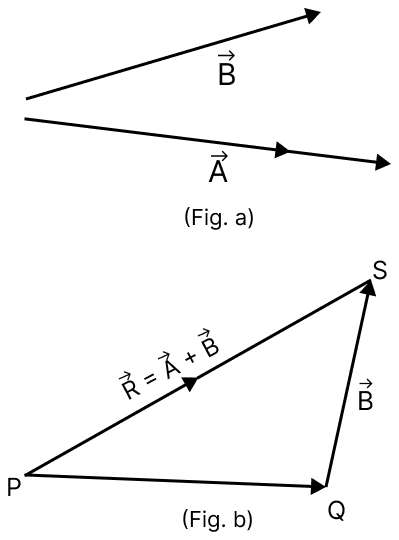
The vector sum of two vectors is also known as their resultant vector . Since in the procedure of vector addition shown, vectors are arranged head to tail method. Since, the two vectors and their resultant form three sides of a triangle, this method is also known as triangle method of vector addition.
(i) Pick the correct expression for magnitude of resultant of the two vectors and in terms of their magnitude and angle θ between them.
(ii) Under what condition the magnitude of sum of two vectors is equal to sum of magnitudes of these vectors?
- When the two vectors are in the same direction.
- When they are acting in opposite directions.
- When they are perpendicular to each other.
- When two vectors are inclined in any direction, that is, independent of direction.
(iii) What is the angle between the two vectors and when ?
- θ = 90°
- θ = 0°
- θ = 120°
- θ = 180°
(iv) If three vectors , and are represented by three sides of a triangle taken in the same order, then which of the following is correct?
- None of these
(v) Two vectors both equal in magnitude have their resultant equal in magnitude of either. The angle between these vectors :
- 30°
- 90°
- 60°
- 120°
Answer
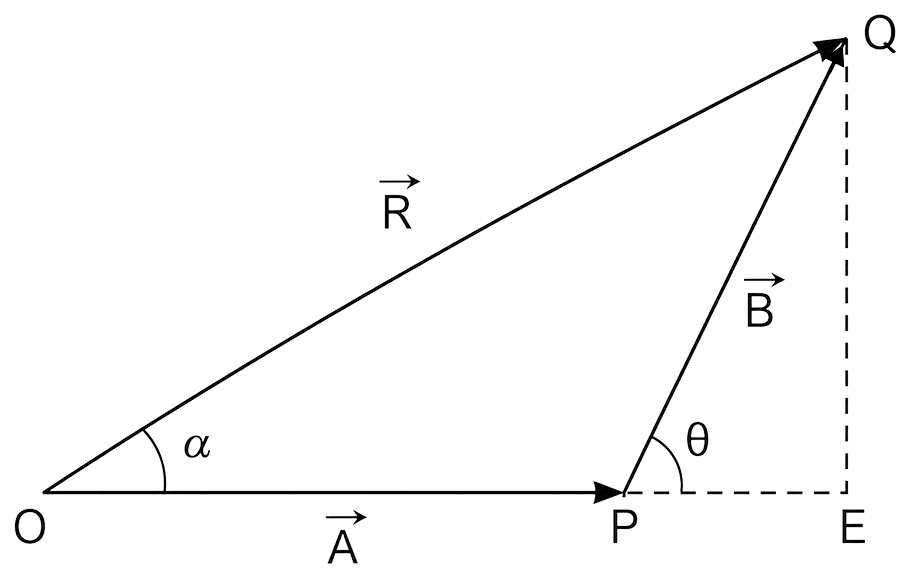
(i)
Reason — By the triangle (or parallelogram) law of vector addition, the magnitude of the resultant of two vectors inclined at an angle θ is , and the direction of the resultant is given by .
(ii) When the two vectors are in the same direction.
Reason — Putting θ = 0° in the expression for the resultant,
which is the sum of the magnitudes. This is also the maximum possible value of the resultant.
(iii) θ = 90°
Reason — Equating the two magnitudes,
(iv)
Reason — If three vectors are represented by the three sides of a triangle taken in the same order, they complete a closed figure. Their sum-vector cannot be drawn, which means that their resultant is a null vector.
(v) 120°
Reason — With A = B and R = A,
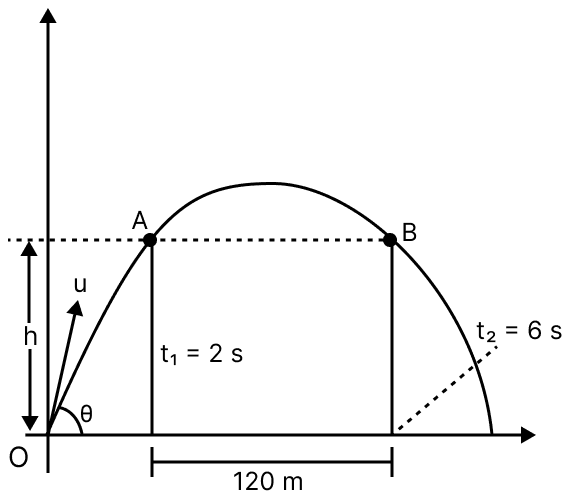
A projectile is projected from a point O on the ground with an initial velocity u at an angle θ from horizontal see the figure. It just crosses two wall A and B of same height situated symmetrically (about the highest point of the projectile's trajectory) at t1 = 2s and t2 = 6s respectively. The horizontal distance between the two walls d = 120 m (take g = 10 ms-2)
(i) The projectile motion is an example of :
- one dimensional motion
- two dimensional motion
- Three dimensional motion
- cannot say, precisely
(ii) The total time of flight of the projectile is :
- 8s
- 10s
- 4s
- 12s
(iii) The value of angle of projection of the projectile is :
(iv) The velocity of projection u of the projectile is :
- 30 ms-1
- 40 ms-1
- 50 ms-1
- ms-1
(v) The height h of either of two walls is :
- 120 m
- 30 m
- 15 m
- 60 m
Answer
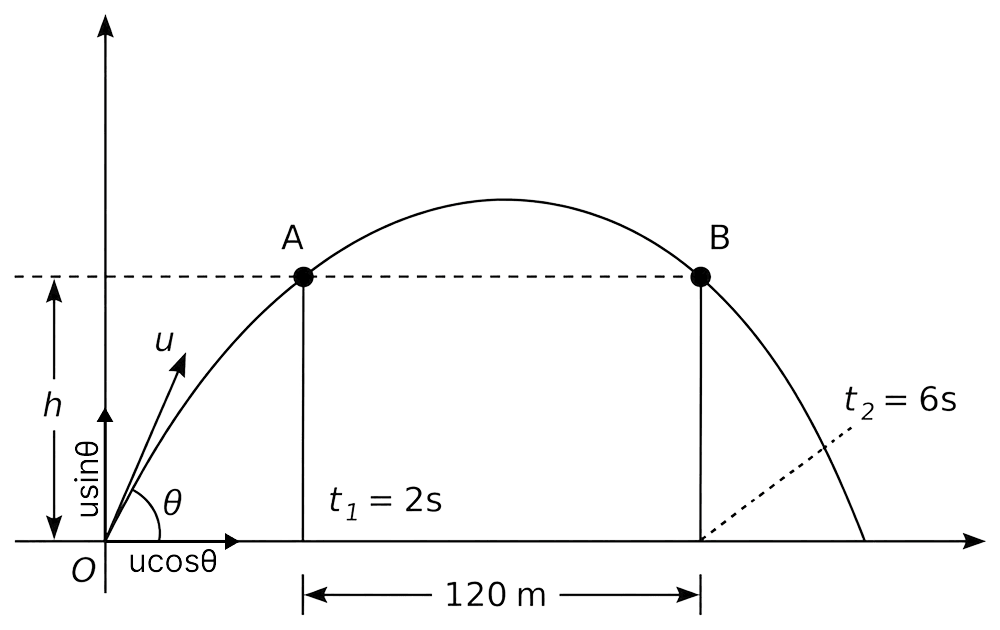
(i) two dimensional motion
Reason — The motion of a projectile takes place in a plane, since the projectile moves simultaneously along the horizontal and the vertical directions. It is therefore a two-dimensional motion, and by the principle of physical independence of motions the two component motions can be treated separately.
(ii) 8s
Reason — The two walls are of the same height and are situated symmetrically about the highest point of the trajectory. Hence the projectile is above the level of the walls between t1 and t2, and the total time of flight is
(iii)
Reason — From the time of flight,
The horizontal distance between the walls is covered in (t2 − t1) = 4 s with the constant horizontal velocity,
Therefore,
(iv) 50 ms-1
Reason — Squaring and adding the two components obtained above,
(v) 60 m
Reason — Considering the vertical motion up to t1 = 2 s,
When an object follows a circular path at a constant speed, the motion is called uniform circular motion. The word uniform refers to the speed which remains uniform throughout the motion. However, since the direction of motion is continuously changing, its velocity is changing so as acceleration. For an object moving with a constant speed v along a circle of radius r, the acceleration and is directed along the radius towards the centre of the circle. Due to this reason, the acceleration is known as centripetal acceleration.
(i) The direction of velocity vector of a particle in UCM is :
- along the tangent to a point on circular path.
- directed along the radius towards the centre.
- directed along the radius away from the centre.
- None of the above
(ii) The direction of centripetal acceleration is :
- along the radius towards the centre.
- along the radius away from the centre.
- along the tangent to the circular path
- None of the above
(iii) An aircraft executes a horizontal loop of radius 1.5 km with a steady speed of 900 km h-1. The centripetal acceleration of the aircraft is :
- 30.25 ms-2
- 37.21 ms-2
- 25.27 ms-2
- 41.67 ms-2
(iv) A particle goes round a circle of radius 10 cm at 120 revolutions per minute. The acceleration of the particle is :
- 160 π2 cm s-2
- 80 π2 cm s-2
- 40 π2 cm s-2
- 320 cm s-2
(v) In uniform circular motion the angle between velocity vector and centripetal acceleration vector is always :
- 0°
- 90°
- 180°
- 45°
Answer
(i) along the tangent to a point on circular path.
Reason — In uniform circular motion the velocity vector acts along the tangent to the circular path at any point. Its magnitude remains constant but its direction changes continuously as the particle moves round the circle.
(ii) along the radius towards the centre.
Reason — The acceleration in uniform circular motion is always directed along the radius towards the centre of the circular path, and is therefore called centripetal acceleration. It is responsible only for the change in the direction of the velocity and not for a change in its magnitude.
(iii) 41.67 ms-2
Reason — Given r = 1.5 km = 1500 m and v = 900 km h-1 = = 250 m s-1. Therefore,
(iv) 160 π2 cm s-2
Reason — Given r = 10 cm and n = 120 rev per minute = 2 rev s-1. The angular velocity is
Therefore,
(v) 90°
Reason — In uniform circular motion the velocity vector is always tangential to the circular path while the centripetal acceleration is always directed along the radius towards the centre. Since the radius is perpendicular to the tangent at every point, the angle between the two vectors is always 90°.
What do you mean by scalar and vector quantities? Explain with example.
Answer
The physical quantities are of two types : scalar and vector.
Scalar quantity : A scalar quantity is one which is described solely by its magnitude (size) and does not have any associated direction. A scalar quantity can be completely defined by a number together with a unit. For example, when we say that the mass of a truck is 200 kg, or that my college is at a distance of 2 km, the statement gives complete information about the quantity. The summation, subtraction, multiplication and division of scalar quantities can be done by ordinary algebra.
Examples of scalars : mass, distance, time, speed, volume, density, pressure, work, energy, power, charge, electric current, temperature, potential, specific heat and frequency.
Vector quantity : The quantities which have both magnitude and direction and obey the laws of vector addition are called vector quantities. To express a vector quantity completely, the direction must also be specified along with the magnitude. If we say that a college is 2 km away from the railway station, the statement is incomplete, since the college cannot be located until we also say that it is 2 km towards the north of the station. Thus position is a vector quantity.
Examples of vectors : position, displacement, velocity, acceleration, force, weight, momentum, impulse, electric field, magnetic field and current density.
It should be noted that a quantity having magnitude and direction is not necessarily a vector. For example, electric current has both magnitude and direction, but it is a scalar because it does not obey the laws of vector addition.
What do you understand by the scalar product of two vectors? Write the formula, explaining the symbols used.
Answer
Scalar product : The scalar product (or dot product) of two vectors is a scalar quantity equal to the product of the magnitudes of the two vectors and the cosine of the angle between them. It is written by placing a dot between the two vectors, and hence the name dot product.
The formula for the scalar product of two vectors and is
where,
- A is the magnitude of the vector
- B is the magnitude of the vector
- θ is the angle between the directions of and
Properties of the scalar product :
(i) The scalar product is commutative, that is, .
(ii) The scalar product is distributive, that is, .
(iii) The scalar product of two mutually perpendicular vectors is zero, since cos 90° = 0.
(iv) The scalar product of two parallel vectors is equal to the product of their magnitudes, since cos 0° = 1.
(v) The self-product of a vector is the square of its magnitude, .
In terms of the rectangular components of the two vectors,
Example : The work done by a force producing a displacement is the scalar product .
If θ is the angle between vector and vector , then prove that :
Answer
By definition, the scalar product of the two vectors is
Writing the two vectors in terms of their rectangular components and taking their scalar product,
Using the relations for the unit orthogonal vectors,
we get
The magnitudes of the two vectors are
Comparing equations (1) and (2),
Substituting the magnitudes from equation (3),
Hence proved.
If a projectile is projected at an angle θ from the horizontal with velocity u in the gravitational field, prove that the path of the projectile will be a parabola. Can path of projectile be rectilinear?
Answer
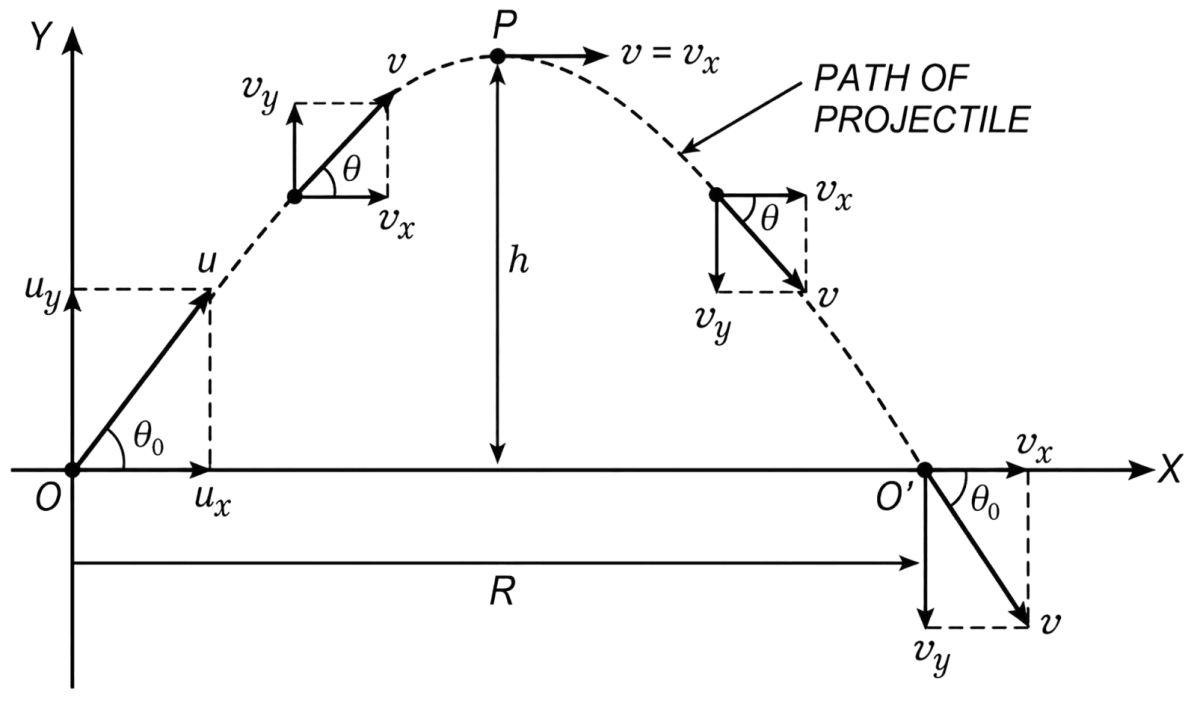
Let a body be projected from the point O with an initial velocity u in a direction making an angle θ with the horizontal. Let OX and OY be the horizontal and the vertical axes. Resolving u into its rectangular components,
The body moves under a constant gravitational acceleration g acting vertically downwards. By the principle of physical independence of motions, the horizontal velocity ux remains unchanged throughout the motion (air resistance being negligible), while the vertical velocity uy changes continuously.
Horizontal motion : The horizontal displacement after time t is
Vertical motion : Using , the vertical displacement after time t is
Substituting the value of t from equation (1) in equation (2),
For a given u and θ, the quantities tan θ and are constants. Hence the equation is of the form
which is quadratic in x and linear in y, and therefore represents a parabola.
Hence, the path of the projectile is parabolic.
Can the path be rectilinear? Yes. The path of a projectile is parabolic only when the direction of the acceleration is different from the direction of the velocity of the projectile. If the body is projected vertically upward (θ = 90°) or vertically downward, the velocity and the acceleration are along the same line, so there is no horizontal motion and the path becomes a straight line.
If h be the maximum height of a projectile moving under the gravitational field of earth, then prove that its velocity of projection will be , where θ is the angle of projection.
Answer
Let a body be projected with velocity u at an angle θ with the horizontal. Resolving the velocity of projection,
At the highest point of the trajectory the vertical component of the velocity becomes zero. Applying the equation to the vertical motion, with v = 0 and u = u sin θ,
so that
Taking the square root,
Hence proved.
A projectile is thrown at an angle θ from the horizontal with velocity u under the gravitational field of the earth. Find its time of flight, maximum height attained and the range.
Answer
Let the body be projected from O with velocity u at an angle θ with the horizontal. Resolving the velocity of projection,
The horizontal component remains unchanged, while the vertical component changes under the constant acceleration g acting vertically downwards.
(a) Time of flight : Let the body take time t to reach the highest point P, where the vertical velocity is zero. Using v = u − gt with v = 0 and u = u sin θ,
The body takes the same time in coming down from P to the ground. Hence the time of flight is
(b) Maximum height : Let h be the vertical height of the highest point P, where the vertical velocity is zero. Using v2 = u2 − 2gh with v = 0 and u = u sin θ,
(c) Horizontal range : The horizontal distance covered during the flight is the product of the constant horizontal velocity and the time of flight,
Hence, the time of flight is , the maximum height attained is and the horizontal range is .
Show that the horizontal range of a projectile with initial speed u and angle of projection θ is . At what angle of projection is the horizontal range maximum for a given initial speed of the projectile? What is this maximum range?
Answer
Let a body be projected from O with speed u at an angle θ with the horizontal. Resolving the speed of projection,
The vertical velocity becomes zero at the highest point, so the time taken to reach it is obtained from v = u − gt as , and the time of flight is
Since the horizontal component of the velocity remains constant, the horizontal range is
Hence proved.
Angle for maximum range : For a given initial speed u, the range is maximum when sin 2θ has its greatest value, that is,
Maximum range : Substituting θ = 45° in the expression for the range,
Hence, the range is maximum for an angle of projection of 45°, and its maximum value is . This is why a long-jumper takes his jump at an angle of about 45°.
The magnitudes of two mutually perpendicular vectors and are 5 and 7 respectively. Draw a labelled vector diagram showing the magnitude and direction of and .
Answer
Given,
- P = 5, Q = 7 and the angle between them, θ = 90°
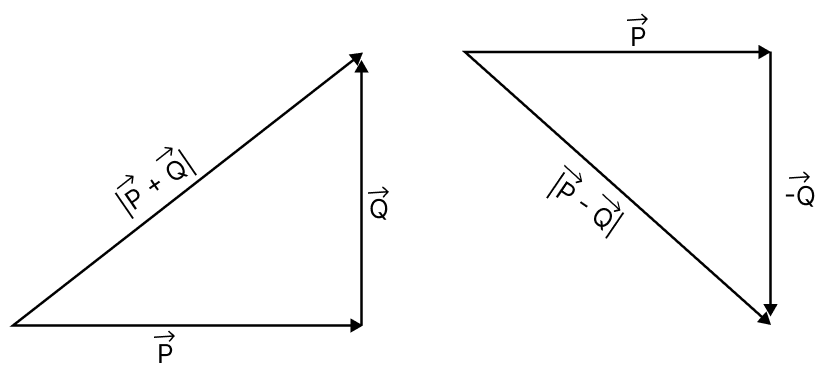
For : Draw and then, starting from its arrow-head, draw perpendicular to it. The vector joining the initial point of to the arrow-head of is the sum. Its magnitude is
and it makes an angle α with given by
For : Reverse to get and add it to . Its magnitude is
and it makes an angle of 54.5° with on the other side.
Hence, the magnitude of each is 8.6, but their directions are different.
A car is going towards north with a velocity 20 m/s. After sometime it starts to go towards south with velocity 20 m/s. Determine change in the velocity of the car.
Answer
Given,
- Initial velocity, v1 = 20 m s-1 towards north
- Final velocity, v2 = 20 m s-1 towards south
The change in velocity is
Taking the northward direction as positive,
Hence, the change in the velocity of the car is 40 m s-1 directed towards the south.
Two forces of 6 N and 8 N act at a point at an angle of 90° with each other. Determine the magnitude and direction of the resultant force by drawing a vector diagram.
Answer
Given,
- A = 6 N, B = 8 N and θ = 90°
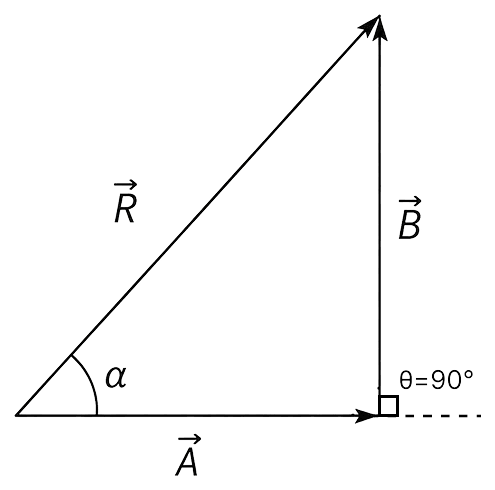
By the parallelogram law of vector addition, the magnitude of the resultant is
If α is the angle made by the resultant with the 6 N force,
so that
Hence, the resultant force is 10 N, making an angle of 53.1° with the 6 N force.
A force of 500 N is acting towards east and another of 600 N towards north. Subtract the first force from the second by drawing a vector diagram.
Answer
Given,
- = 500 N towards east
- = 600 N towards north
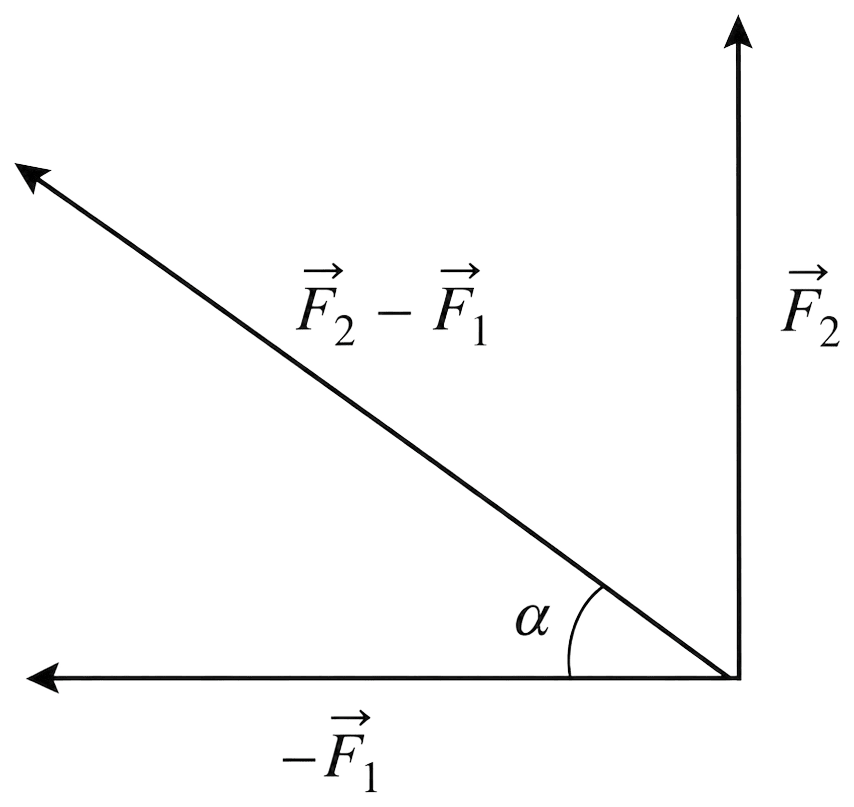
To subtract from , we reverse to get 500 N towards the west and add it to . Since the two are mutually perpendicular, the magnitude of the difference is
If α is the angle made by this resultant with the north direction,
Hence, the difference is a force of 781 N directed at 39.8° west of north.
The handle of a grass-roller is pulled by a force of 50 N. If the handle makes an angle of 30° with the horizontal, calculate the magnitudes of the horizontal and the vertical components of the force by a vector diagram.
Answer
Given,
- Force applied, F = 50 N
- Angle with the horizontal, θ = 30°
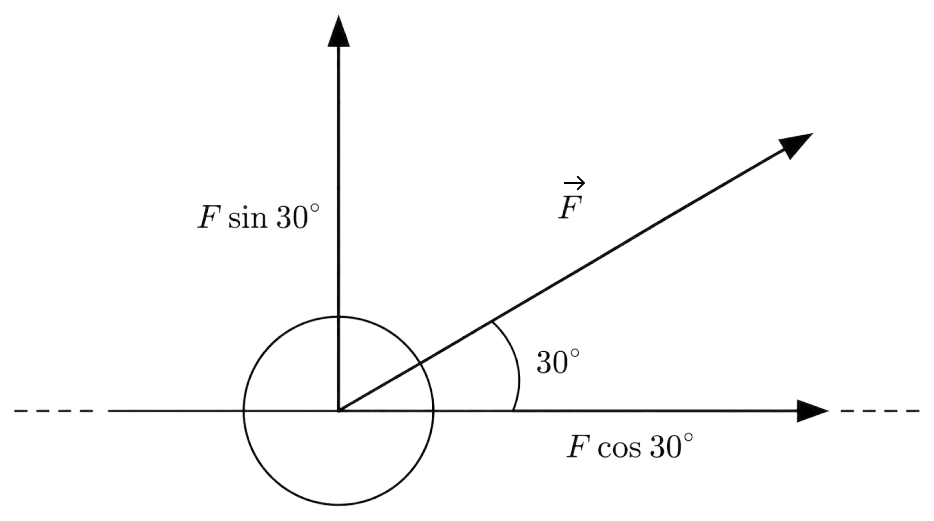
Resolving the force into its rectangular components,
Horizontal component :
Vertical component :
Hence, the horizontal component is 43.3 N and the vertical component is 25 N.
When a force of 150 N is applied to a body, it is displaced by 15 m making an angle of 60° with the force. Find out the work done by the force.
Answer
Given,
- Force, F = 150 N
- Displacement, s = 15 m
- Angle between the force and the displacement, θ = 60°
The work done is the scalar product of the force and the displacement,
Substituting the values,
Hence, the work done by the force is 1125 J.
In displacing a body 5 m by a force of 50 N the work done is 125 J. Find out the angle between the directions of force and displacement.
Answer
Given,
- Force, F = 50 N
- Displacement, s = 5 m
- Work done, W = 125 J
Using W = Fs cos θ,
Therefore,
Hence, the angle between the directions of the force and the displacement is 60°.
If vector , then find out the magnitude A of vector .
Answer
The magnitude of a vector in terms of its rectangular components is
Substituting the values,
Hence, the magnitude of is = 6.16.
Find the unit vector of .
Answer
The unit vector in the direction of a vector is
The magnitude of is
Therefore,
Hence, the unit vector of is .
If and , then find the magnitudes of and .
Answer
Adding the corresponding components,
Its magnitude is
Subtracting the corresponding components,
Its magnitude is
Hence, the magnitudes are 5 and = 5.39 respectively.
The sum and difference of two vectors and are and . Find the magnitude of each vector and their scalar product .
Answer Given,
Adding the two given relations,
so that
Subtracting the two given relations,
so that
The magnitudes are
The scalar product is
Hence, , and .
and , where is unit vector in the direction of X-axis and is unit vector in the direction of Y-axis. Write down the scalar product of and .
Answer
The scalar product is equal to the sum of the products of the corresponding components,
Substituting the values,
Hence, the scalar product of and is 18.
If and , then determine:
(i) the magnitude of
(ii) the value of .
Answer
(i) The magnitude of is
(ii) The scalar product is
Hence, the magnitude of is 7 and .
Calculate the values of (i) and (ii) .
Answer
Using the relations for the unit orthogonal vectors,
(i)
(ii)
Hence, the values are −3 and 6 respectively.
Calculate the angle between the vectors and .
Answer
The scalar product of the two vectors is
The magnitudes are
Using ,
Therefore,
Hence, the angle between the two vectors is 79°.
When a force of newton works on a body, a displacement of m is produced. Calculate the work done by the force on the body.
Answer
The work done is the scalar product of the force and the displacement,
Substituting the values,
Hence, the work done by the force on the body is 113 J.
If vectors and , then find the value of .
Answer
Writing the vector product as a determinant,
Expanding along the first row,
Hence, .
If and , then find (i) , (ii) .
Answer
(i) Writing the vector product as a determinant,
Expanding along the first row,
(ii) The magnitude is
Hence, and its magnitude is = 20.4.
The displacement vector of a point with respect to origin is m. A force vector N is acting at this point. Calculate its vector moment and moment of force.
Answer
Given,
- Displacement (position) vector of the point, m
- Force acting at this point, N
The vector moment of the force about the origin and the moment of force have to be calculated.
The moment of a force about a point, also called the torque, is the vector product of the position vector of the point of application and the force,
Its magnitude is τ = rF sin θ and its direction is perpendicular to the plane containing and , the sense being given by the right-hand screw rule.
Writing the vector product as a determinant,
Expanding along the first row,
The moment of the force is the magnitude of this vector,
Hence, the vector moment is N m and the moment of the force is = 22.2 N m.
If vectors and vectors . Then find the value of and .
Answer
Given,
- , so Ax = 2, Ay = 2 and Az = −2
- , so Bx = 7, By = −5 and Bz = 2
The scalar product and the vector product have to be calculated.
Scalar product : In terms of the rectangular components of the two vectors, the scalar product is equal to the sum of the products of their corresponding components,
Substituting the values,
Since and neither vector is a null vector, cos θ = 0, so θ = 90°. Thus the two vectors are mutually perpendicular.
Vector product : Writing the vector product as a determinant,
Expanding along the first row,
Hence, and .
A cricket ball is thrown with velocity 30 m/s. Calculate the maximum horizontal range and also find the two directions in which the ball may be thrown so as to give a range of 45 m. (g = 10 m/s2)
Answer
Given,
- Velocity of projection, u = 30 m s-1
- Acceleration due to gravity, g = 10 m s-2
The maximum horizontal range is obtained for θ = 45°,
For a range of 45 m,
Therefore,
Hence, the maximum horizontal range is 90 m, and a range of 45 m is obtained for angles of projection of 15° and 75°, which are complementary angles.
A ball is thrown with a velocity of 15 m/s at an angle of 30° with the horizontal. Determine
(i) the time of flight of the ball,
(ii) the maximum height attained by the ball. (g = 10 m/s2)
Answer
Given,
- Velocity of projection, u = 15 m s-1
- Angle of projection, θ = 30°
- Acceleration due to gravity, g = 10 m s-2
(i) The time of flight is
(ii) The maximum height attained is
Hence, the time of flight is 1.5 s and the maximum height attained is 2.8 m.
A cannon is to fire up to 500 m horizontally. What should be the angle of projection, if the shells are fired with a velocity of 100 m/s? (g = 10 m/s2)
Answer
Given,
- Horizontal range, R = 500 m
- Velocity of projection, u = 100 m s-1
- Acceleration due to gravity, g = 10 m s-2
Using the expression for the horizontal range,
Substituting the values,
Therefore,
Hence, the angle of projection should be 15° or 75°.
The velocity of a particle moving on a circular path is 5 cm/s towards north at any instant. After traversing one-fourth of the path its velocity is 5 cm/s towards east. Indicate the change in velocity in a vector diagram.
Answer
Given,
- Initial velocity, v1 = 5 cm s-1 towards north
- Final velocity, v2 = 5 cm s-1 towards east
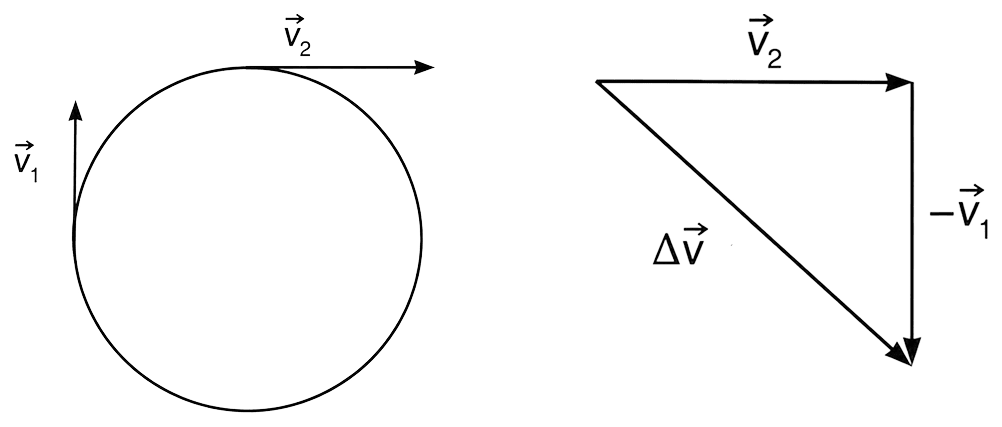
The change in velocity is
Here is towards the east and is towards the south, and the two are mutually perpendicular. Hence
Since the two components are equal, the change in velocity makes an angle of 45° with each of them.
Hence, the change in velocity is 7.1 cm s-1, directed 45° south of east.
The velocity of a body is 100 km/h, 30° west of south. Find the north and east components by drawing vector diagram.
Answer
Given,
- Velocity of the body, v = 100 km h-1, directed 30° west of south
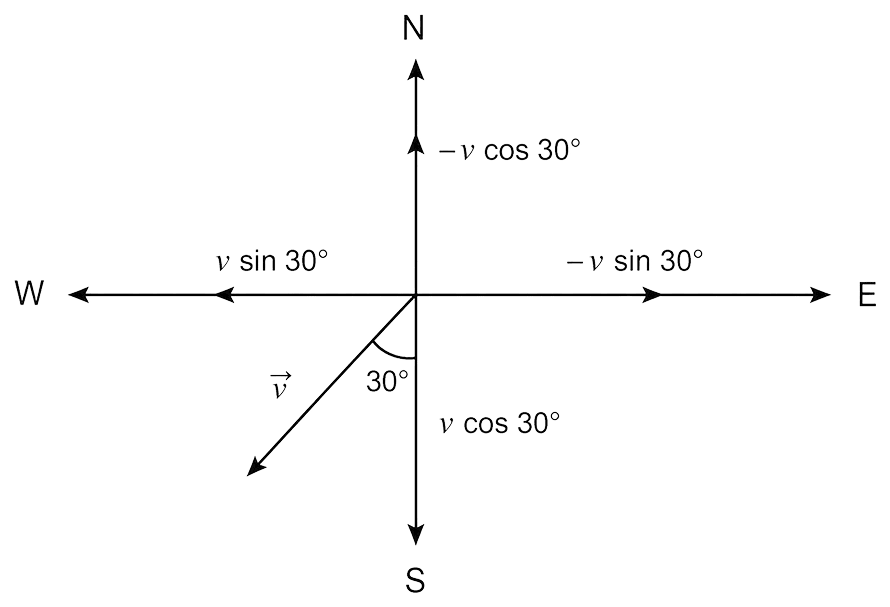
Resolving the velocity along the north-south and east-west directions,
Component along the south direction :
Component along the west direction :
Since the north direction is opposite to the south and the east is opposite to the west,
Hence, the north component is −86.6 km h-1 and the east component is −50 km h-1, the negative signs showing that the components are actually directed towards the south and the west respectively.
If , then determine the angle between and .
Answer
The given relation can be rewritten as
Taking the magnitude of the difference of two vectors inclined at an angle θ,
where θ is the angle between and . Solving for cos θ,
Therefore,
Hence, the angle between and is .
If the magnitudes of two vectors and be 3 and 4, and their scalar product be 6, then find out the angle θ between the two vectors. When will the scalar product be zero ?
Answer
Given,
- A = 3, B = 4 and = 6
Using ,
Therefore,
The scalar product will be zero when cos θ = 0, that is, when θ = 90°.
Hence, the angle between the two vectors is 60°, and the scalar product becomes zero when the two vectors are mutually perpendicular (θ = 90°).
Under a force of newton a body of mass 5 kg is displaced from the position m to the position metre. Calculate the work done.
Answer
Given,
- Force, N
- Initial position, m
- Final position, m
The displacement is the difference between the final and the initial position vectors,
The work done is
Hence, the work done is 121 J.
If and , find out
(i) ,
(ii) ,
(iii) .
Answer
(i) Writing the vector product as a determinant,
Expanding along the first row,
(ii) Since the vector product is not commutative,
(iii) Expanding the product using the distributive law,
Since , and ,
Hence, the three results are , and respectively.
Two bullets are fired with horizontal velocities of 50 m/s and 100 m/s from two guns at a height of 19.6 m.
(i) Will both the bullets strike the ground?
(ii) If yes; then after how much time and which bullet will strike first?
(iii) What would be the path of the bullets? (g = 9.8 m/s2)
Answer
Given,
- Height of projection, h = 19.6 m
- Horizontal velocities, u1 = 50 m s-1 and u2 = 100 m s-1
- Acceleration due to gravity, g = 9.8 m s-2
(i) Yes, both the bullets will strike the ground, since both are projected horizontally from a height and gravity acts on both of them.
(ii) For a body projected horizontally, the initial vertical velocity is zero, so the time of flight is
Substituting the values,
The time of flight is independent of the velocity of projection and depends only on the height. Hence both the bullets strike the ground together, after 2.0 s.
(iii) The horizontal motion is uniform and the vertical motion is uniformly accelerated. Their combined effect gives an equation of the form y = kx2, so the path of each bullet is a parabola. The bullet fired with the greater velocity travels a longer horizontal range and therefore describes a wider parabola.
An arrow is thrown in the air. Its time of flight is 5 s and the range is 200 m. Determine :
(i) the vertical component of the velocity of projection,
(ii) the horizontal component,
(iii) maximum height
(iv) the angle made with the horizontal. (g = 9.8 m/s2)
Answer
Given,
- Time of flight, T = 5 s
- Horizontal range, R = 200 m
- Acceleration due to gravity, g = 9.8 m s-2
(i) The time of flight is , so the vertical component is
(ii) Since the horizontal velocity remains constant, R = (u cos θ)T, so the horizontal component is
(iii) The maximum height attained is
(iv) The angle of projection is given by
Hence, the vertical component is 24.5 m s-1, the horizontal component is 40 m s-1, the maximum height is 30.6 m and the angle of projection is 31.5° with the horizontal.
A stone is thrown from a bridge at an angle of 30° down with the horizontal with a velocity of 25 m/s. If the stone strikes the water after 2.5 seconds then calculate the height of the bridge from the water surface. (g = 9.8 m/s2)
Answer
Given,
- Velocity of projection, u = 25 m s-1, directed 30° below the horizontal
- Time taken, t = 2.5 s
- Acceleration due to gravity, g = 9.8 m s-2
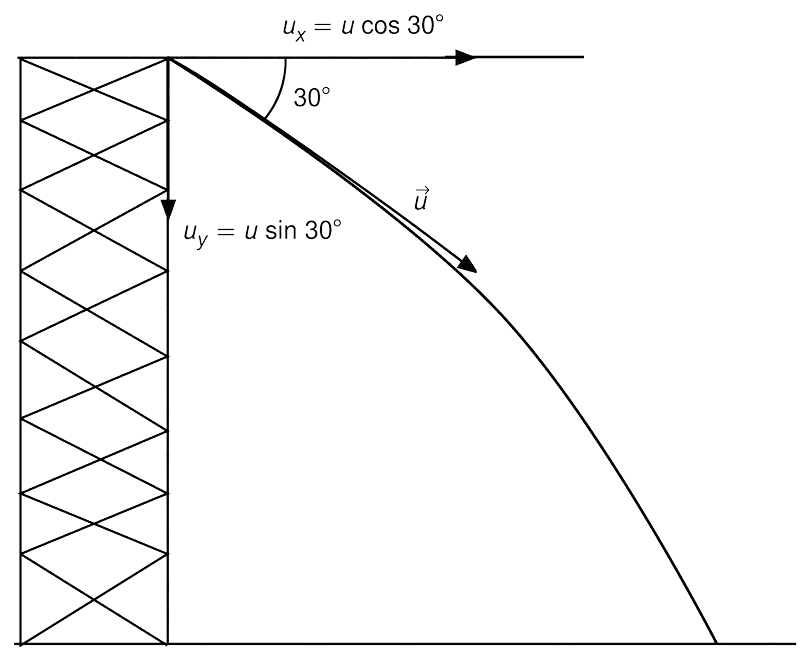
The vertical component of the velocity of projection, directed downwards, is
Considering the vertical motion downwards and using ,
Hence, the height of the bridge from the water surface is 61.9 m.
If vector and vector are perpendicular, then calculate the value of c.
Answer
Given,
- , so Ax = 1, Ay = c and Az = 5
- , so Bx = 2, By = 1 and Bz = −1
- The two vectors are perpendicular to each other, that is, θ = 90°
The value of c has to be calculated.
The scalar product of two vectors is . For perpendicular vectors θ = 90° and cos 90° = 0, so their scalar product is zero,
Substituting the values,
Hence, the value of c is 3.
Show that vectors and are mutually perpendicular. Give an example of scalar product of two vectors.
Answer
Given,
- , so Ax = 2, Ay = 2 and Az = −2
- , so Bx = 7, By = −5 and Bz = 2
It has to be shown that the two vectors are mutually perpendicular.
Two non-zero vectors are mutually perpendicular if the angle between them is 90°. Since the scalar product is and cos 90° = 0, the condition for perpendicularity is that the scalar product of the two vectors must vanish.
Taking the scalar product in terms of the rectangular components,
Substituting the values,
Since and neither of the vectors is a null vector, that is, A ≠ 0 and B ≠ 0,
Hence, the two vectors are mutually perpendicular.
Example of a scalar product : The work done by a force producing a displacement is the scalar product of the two vectors,
where θ is the angle between the directions of the force and the displacement. Although both and are vectors, the work done is a scalar quantity.
Prove that and are parallel to each other.
Answer
Given,
- , so Ax = 4, Ay = 3 and Az = 1
- , so Bx = 12, By = 9 and Bz = 3
It has to be proved that the two vectors are parallel to each other.
Two vectors are parallel if one of them can be obtained by multiplying the other by a positive scalar, since on multiplying a vector by a positive scalar only the magnitude changes while the direction remains unaltered.
Comparing the corresponding components of the two vectors,
Since all the three ratios are equal,
Here the scalar 3 is positive, so has the same direction as and its magnitude is 3 times that of .
This can also be verified by taking the vector product, since the vector product of two parallel vectors is a null vector,
Expanding along the first row,
Since and neither vector is a null vector, sin θ = 0, so θ = 0°. The result confirms that the two vectors are parallel.
Hence proved.
A bomb is fired horizontally with a velocity of 20 m/s from the top of a tower 40 m high. After how much time and at what horizontal distance from the tower will the bomb strike the ground? (g = 9.8 m/s2)
Answer
Given,
- Horizontal velocity of projection, u = 20 m s-1
- Height of the tower, h = 40 m
- Acceleration due to gravity, g = 9.8 m s-2
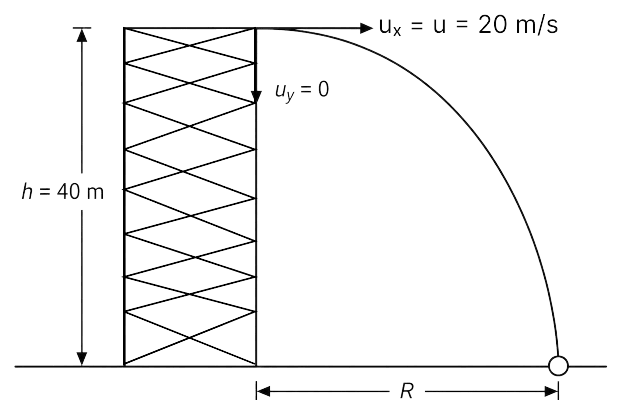
For a body projected horizontally, the initial vertical velocity is zero, so the time of flight is
Substituting the values,
Since the horizontal velocity remains constant, the horizontal range is
Hence, the bomb strikes the ground after 2.86 s at a horizontal distance of 57.2 m from the tower.
A stone is thrown from the top of a tower at an angle of 30° up with the horizontal with a velocity of 16 m/s. After 4 seconds of flight it strikes the ground. Calculate the height of the tower from the ground and the horizontal range of the stone. (g = 9.8 m/s2)
Answer
Given,
- Velocity of projection, u = 16 m s-1, at 30° above the horizontal
- Time of flight, t = 4 s
- Acceleration due to gravity, g = 9.8 m s-2
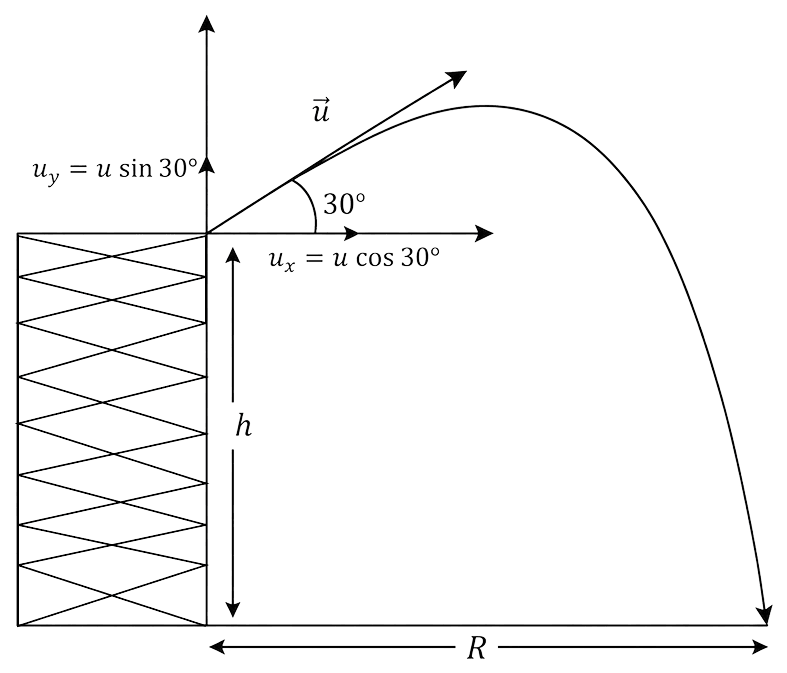
Resolving the velocity of projection,
Taking the downward direction as positive for the vertical motion, the vertical component of the velocity of projection is uy = −8 m s-1. Using ,
The horizontal range is
Hence, the height of the tower is 46.4 m and the horizontal range of the stone is 55.4 m.
A player throws a ball at an angle of 30° up with the horizontal with a velocity of 14 m/s. If the point of projection is at a height of 12 m from the ground, then calculate the distance up to which the ball is thrown by the player. (g = 10 m/s2)
Answer
Given,
- Velocity of projection, u = 14 m s-1, at 30° above the horizontal
- Height of the point of projection, h = 12 m
- Acceleration due to gravity, g = 10 m s-2
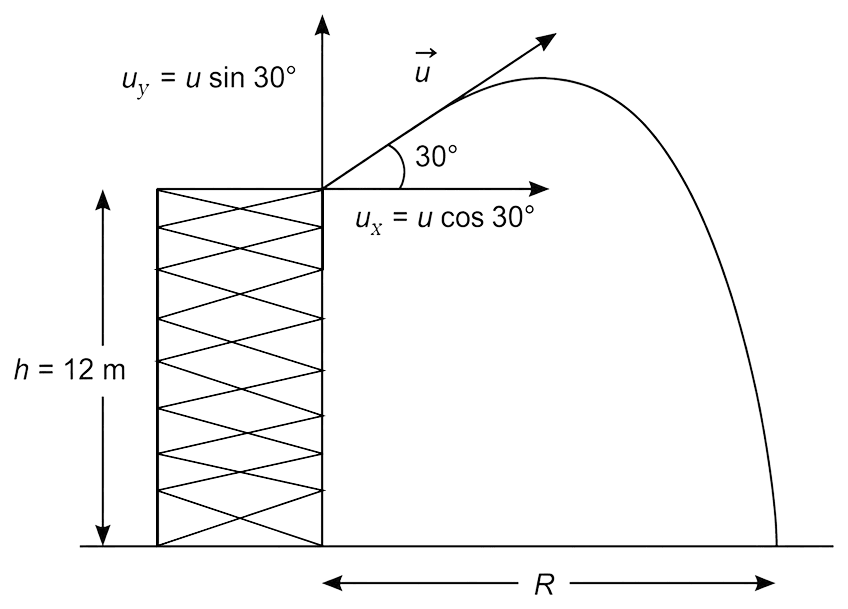
Resolving the velocity of projection,
Taking the downward direction as positive for the vertical motion and using ,
Solving this quadratic equation in t,
Taking the positive value, t = 2.4 s.
The horizontal distance covered is
Hence, the ball is thrown up to a distance of 29.1 m.