KnowledgeBoat Logo
|
OPEN IN APP

Chapter 3

Motion in a Plane — Competition Zone

Class 11 - Nootan Physics


Competition Zone — MCQ (One Correct Option)

Question 1

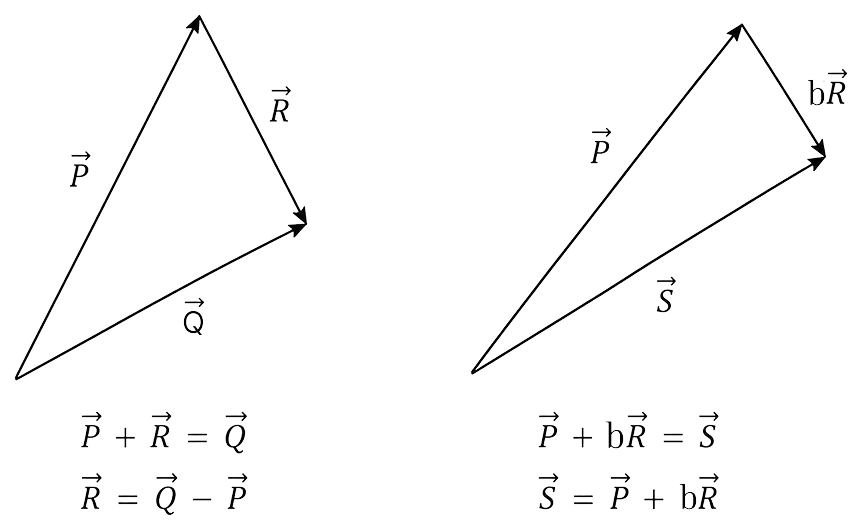
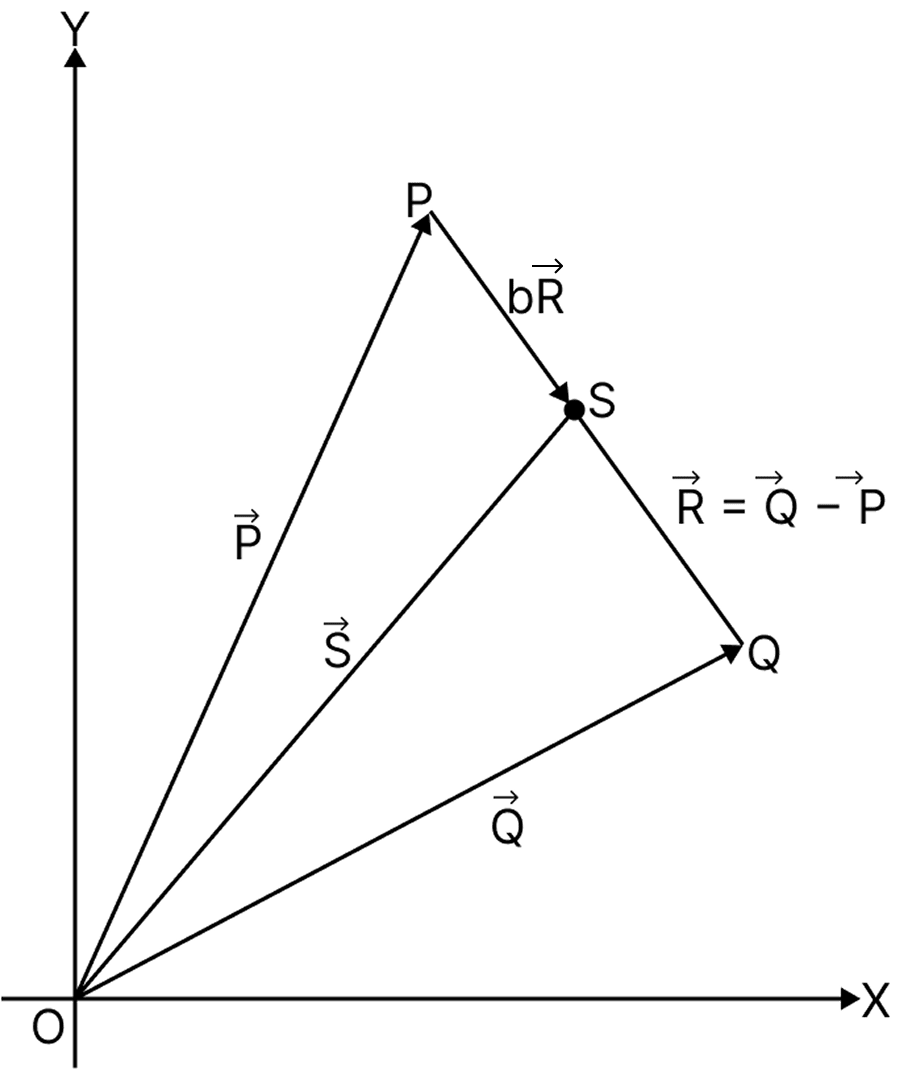
Three vectors P\vec{P}, Q \vec{Q} \spaceand R \vec{R} \spaceare shown in the figure. Let S be any point on the vector R\vec{R}. The displacement between the points P and S is bRb\vec{R}. The general relation among vectors P\vec{P}, Q \vec{Q} \spaceand S \vec{S} \spaceis :

Three vectors vecP, vecQ and vecR are shown in the figure. Let S be any point on the vector vecR. The displacement between the points P and S is b vecR. The general relation among vectors vecP, vecQ and vecS is:. Motion in a Plane, Solutions for Class 11 ISC Nootan Physics Kumar Mittal Nageen Prakashan
  1. S=(1b)P+bQ\vec{S} = (1 - b)\vec{P} + b\vec{Q}
  2. S=(b1)P+bQ\vec{S} = (b - 1)\vec{P} + b\vec{Q}
  3. S=(1b)P+b2Q\vec{S} = (1 - b)\vec{P} + b^2\vec{Q}
  4. S=(1b2)P+bQ\vec{S} = (1 - b^2)\vec{P} + b\vec{Q}

Answer

S=(1b)P+bQ\vec{S} = (1 - b)\vec{P} + b\vec{Q}

Reason

Three vectors vecP, vecQ and vecR are shown in the figure. Let S be any point on the vector vecR. The displacement between the points P and S is b vecR. The general relation among vectors vecP, vecQ and vecS is:. Motion in a Plane, Solutions for Class 11 ISC Nootan Physics Kumar Mittal Nageen Prakashan

From the figure, the vector \vec{\text{{R }}}joins the tip of \vec{\text{{P }}}to the tip of Q\vec{\text Q}, so by the triangle law of vector addition,

R=QP\vec{\text R} = \vec{\text Q} - \vec{\text P}

Since S lies on \vec{\text{R }}and the displacement from P to S is b\text b\vec{\text {R }}, the position vector of S is

S=P+bR=P+b(QP)=(1b)P+bQ\vec{\text S} = \vec{\text P} + \text b\vec{\text R} \\[1em] = \vec{\text P} + \text b(\vec{\text Q} - \vec{\text P}) \\[1em] = (1 - \text b)\vec{\text P} + \text b\vec{\text Q}

Question 2

The moment of the force, F=4i^+5j^6k^\vec{F} = 4\hat{i} + 5\hat{j} - 6\hat{k} at (2, 0, −3), about the point (2, −2, −2), is given by :

  1. 8i^4j^7k^-8\hat{i} - 4\hat{j} - 7\hat{k}
  2. 7i^4j^8k^-7\hat{i} - 4\hat{j} - 8\hat{k}
  3. 7i^8j^4k^-7\hat{i} - 8\hat{j} - 4\hat{k}
  4. 4i^j^8k^-4\hat{i} - \hat{j} - 8\hat{k}

Answer

7i^4j^8k^-7\hat{i} - 4\hat{j} - 8\hat{k}

Reason

Given,

  • Force, F=4i^+5j^6k^\vec{\text F} = 4\hat{i} + 5\hat{j} - 6\hat{k}
  • Point of application of the force, P(2, 0, −3)
  • Point about which the moment is taken, Q(2, −2, −2)

The moment of a force about a point is the vector product of the position vector of the point of application with respect to that point and the force,

τ=r×F\vec{\tau} = \vec{\text r} \times \vec{\text F}

The position vector of P with respect to Q is

r=(xPxQ)i^+(yPyQ)j^+(zPzQ)k^=(22)i^+[0(2)]j^+[3(2)]k^=0i^+2j^k^\vec{\text r} = (\text x_P - \text x_Q)\hat{i} + (\text y_P - \text y_Q)\hat{j} + (\text z_P - \text z_Q)\hat{k} \\[1em] = (2 - 2)\hat{i} + [0 - (-2)]\hat{j} + [-3 - (-2)]\hat{k} \\[1em] = 0\hat{i} + 2\hat{j} - \hat{k}

Writing the vector product as a determinant,

τ=i^j^k^021456\vec{\tau} = \begin{vmatrix} \hat{i} & \hat{j} & \hat{k} \\ 0 & 2 & -1 \\ 4 & 5 & -6 \end{vmatrix}

Expanding along the first row,

τ=i^[(2)(6)(1)(5)]j^[(0)(6)(1)(4)]+k^[(0)(5)(2)(4)]=i^(12+5)j^(0+4)+k^(08)=7i^4j^8k^\vec{\tau} = \hat{i}[(2)(-6) - (-1)(5)] - \hat{j}[(0)(-6) - (-1)(4)] + \hat{k}[(0)(5) - (2)(4)] \\[1em] = \hat{i}(-12 + 5) - \hat{j}(0 + 4) + \hat{k}(0 - 8) \\[1em] = -7\hat{i} - 4\hat{j} - 8\hat{k}

Question 3

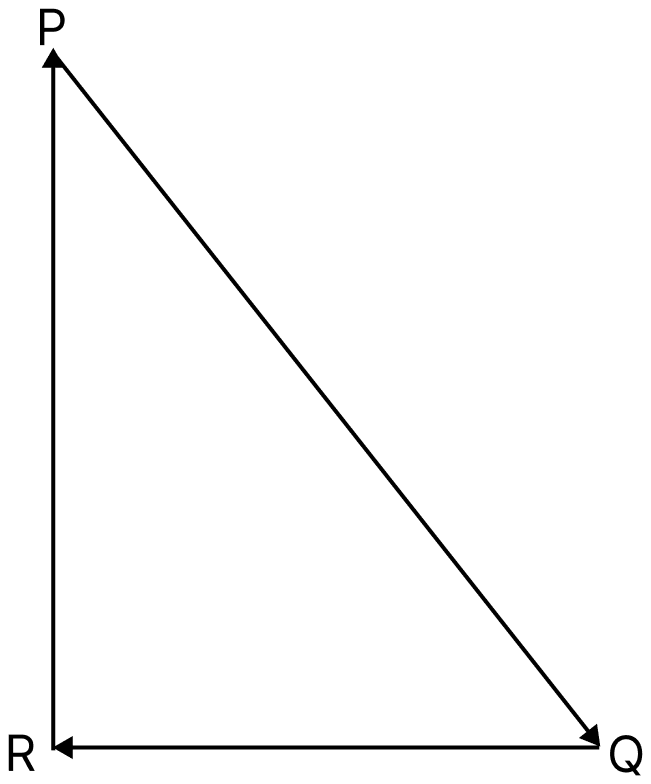
A particle moving with velocity v \vec{v} \spaceis acted by three forces shown by the vector triangle PQR. The velocity of the particle will :

A particle moving with velocity vecv is acted by three forces shown by the vector triangle PQR. The velocity of the particle will:. Motion in a Plane, Solutions for Class 11 ISC Nootan Physics Kumar Mittal Nageen Prakashan
  1. decrease
  2. remain constant
  3. change according to the smallest force QR\vec{QR}
  4. increase.

Answer

remain constant

Reason

A particle moving with velocity vecv is acted by three forces shown by the vector triangle PQR. The velocity of the particle will:. Motion in a Plane, Solutions for Class 11 ISC Nootan Physics Kumar Mittal Nageen Prakashan

The three forces are represented in magnitude and direction by the three sides of the triangle PQR taken in the same order. Such vectors complete a closed figure, so their sum-vector cannot be drawn, which means that their resultant is a null vector.

Fnet=PQ+QR+RP=0\vec{\text F}_{net} = \vec{\text{PQ}} + \vec{\text{QR}} + \vec{\text{RP}} = 0

By Newton's second law, the acceleration produced in the particle is

a=Fnetm=0m=0\vec{\text a} = \dfrac{\vec{\text F}_{net}}{\text m} = \dfrac{0}{\text m} = 0

Since no net force acts on the particle, its acceleration is zero and hence its velocity remains constant in both magnitude and direction.

Question 4

Let A1=3|\vec{A_1}| = 3, A2=5|\vec{A_2}| = 5 and A1+A2=5|\vec{A_1} + \vec{A_2}| = 5. The value of (2A1+3A2)(3A12A2)(2\vec{A_1} + 3\vec{A_2}) \cdot (3\vec{A_1} - 2\vec{A_2}) is :

  1. −112.5
  2. −106.5
  3. −118.5
  4. −99.5.

Answer

−118.5

Reason

Given,

  • A1|\vec{\text A}_1| = 3, so A12\text A_1^2 = 9
  • A2|\vec{\text A}_2| = 5, so A22\text A_2^2 = 25
  • A1+A2|\vec{\text A}_1 + \vec{\text A}_2| = 5

Taking the self-product of the sum of the two vectors,

A1+A22=(A1+A2)(A1+A2)=A12+A22+2A1A2|\vec{\text A}_1 + \vec{\text A}_2|^2 = (\vec{\text A}_1 + \vec{\text A}_2) \cdot (\vec{\text A}_1 + \vec{\text A}_2) \\[1em] = \text A_1^2 + \text A_2^2 + 2\vec{\text A}_1 \cdot \vec{\text A}_2

Substituting the values,

(5)2=(3)2+(5)2+2A1A225=9+25+2A1A22A1A2=2534=9A1A2=92=4.5(5)^2 = (3)^2 + (5)^2 + 2\vec{\text A}_1 \cdot \vec{\text A}_2 \\[1em] 25 = 9 + 25 + 2\vec{\text A}_1 \cdot \vec{\text A}_2 \\[1em] 2\vec{\text A}_1 \cdot \vec{\text A}_2 = 25 - 34 = -9 \\[1em] \vec{\text A}_1 \cdot \vec{\text A}_2 = -\dfrac{9}{2} = -4.5

Expanding the required product by the distributive law, and using A2A1=A1A2\vec{\text A}_2 \cdot \vec{\text A}_1 = \vec{\text A}_1 \cdot \vec{\text A}_2,

(2A1+3A2)(3A12A2)=6A1A14A1A2+9A2A16A2A2=6A12+5(A1A2)6A22(2\vec{\text A}_1 + 3\vec{\text A}_2) \cdot (3\vec{\text A}_1 - 2\vec{\text A}_2) = 6\vec{\text A}_1 \cdot \vec{\text A}_1 - 4\vec{\text A}_1 \cdot \vec{\text A}_2 + 9\vec{\text A}_2 \cdot \vec{\text A}_1 - 6\vec{\text A}_2 \cdot \vec{\text A}_2 \\[1em] = 6\text A_1^2 + 5(\vec{\text A}_1 \cdot \vec{\text A}_2) - 6\text A_2^2

Substituting the values,

=6(9)+5(4.5)6(25)=5422.5150=118.5= 6(9) + 5(-4.5) - 6(25) \\[1em] = 54 - 22.5 - 150 \\[1em] = -118.5

Question 5

Two vectors A \vec{A} \spaceand B \vec{B} \spacehave equal magnitudes. The magnitude of (A+B) (\vec{A} + \vec{B}) \spaceis 'n' times the magnitude of (AB)(\vec{A} - \vec{B}). The angle between A \vec{A} \spaceand B \vec{B} \spaceis :

  1. sin1(n21n2+1)\sin^{-1}\left(\dfrac{n^2 - 1}{n^2 + 1}\right)
  2. sin1(n1n+1)\sin^{-1}\left(\dfrac{n - 1}{n + 1}\right)
  3. cos1(n21n2+1)\cos^{-1}\left(\dfrac{n^2 - 1}{n^2 + 1}\right)
  4. cos1(n1n+1)\cos^{-1}\left(\dfrac{n - 1}{n + 1}\right)

Answer

cos1(n21n2+1)\cos^{-1}\left(\dfrac{n^2 - 1}{n^2 + 1}\right)

Reason

Given,

  • The two vectors have equal magnitudes, that is, A = B
  • A+B=nAB|\vec{\text A} + \vec{\text B}| = \text n|\vec{\text A} - \vec{\text B}|

Let θ be the angle between the two vectors. By the parallelogram law of vector addition,

A+B2=A2+B2+2ABcosθ|\vec{\text A} + \vec{\text B}|^2 = \text A^2 + \text B^2 + 2\text{AB} \cos \theta

Putting B = A,

A+B2=A2+A2+2A2cosθ=2A2(1+cosθ)|\vec{\text A} + \vec{\text B}|^2 = \text A^2 + \text A^2 + 2\text A^2 \cos \theta = 2\text A^2(1 + \cos \theta)

Similarly, replacing θ by (180° − θ) for the difference,

AB2=A2+A22A2cosθ=2A2(1cosθ)|\vec{\text A} - \vec{\text B}|^2 = \text A^2 + \text A^2 - 2\text A^2 \cos \theta = 2\text A^2(1 - \cos \theta)

Squaring both sides of the given condition,

A+B2=n2AB2|\vec{\text A} + \vec{\text B}|^2 = \text n^2|\vec{\text A} - \vec{\text B}|^2

Substituting the two expressions obtained above,

2A2(1+cosθ)=n2×2A2(1cosθ)1+cosθ=n2n2cosθcosθ+n2cosθ=n21cosθ(1+n2)=n212\text A^2(1 + \cos \theta) = \text n^2 \times 2\text A^2(1 - \cos \theta) \\[1em] 1 + \cos \theta = \text n^2 - \text n^2 \cos \theta \\[1em] \cos \theta + \text n^2 \cos \theta = \text n^2 - 1 \\[1em] \cos \theta(1 + \text n^2) = \text n^2 - 1

Therefore,

cosθ=n21n2+1θ=cos1(n21n2+1)\cos \theta = \dfrac{\text n^2 - 1}{\text n^2 + 1} \quad \Rightarrow \quad \theta = \cos^{-1}\left(\dfrac{\text n^2 - 1}{\text n^2 + 1}\right)

Question 6

A particle is moving with a velocity v=K(yi^+xj^)\vec{v} = K(y\hat{i} + x\hat{j}), where K is a constant. The general equation for its path is :

  1. y = x2 + constant
  2. y2 = x + constant
  3. xy = constant
  4. y2 = x2 + constant.

Answer

y2 = x2 + constant

Reason

Given,

  • Velocity of the particle, v=K(yi^+xj^)\vec{\text v} = \text K(\text y\hat{i} + \text x\hat{j}), where K is a constant

The velocity of a particle is the time rate of change of its position, so its rectangular components are

vx=dxdtandvy=dydt\text v_x = \dfrac{\text{dx}}{\text{dt}} \quad \text{and} \quad \text v_y = \dfrac{\text{dy}}{\text{dt}}

Comparing these with the components of the given velocity,

dxdt=Kyanddydt=Kx\dfrac{\text{dx}}{\text{dt}} = \text{Ky} \quad \text{and} \quad \dfrac{\text{dy}}{\text{dt}} = \text{Kx}

Dividing the second equation by the first, the variable t is eliminated,

dy/dtdx/dt=KxKydydx=xy\dfrac{\text{dy}/\text{dt}}{\text{dx}/\text{dt}} = \dfrac{\text{Kx}}{\text{Ky}} \\[1em] \dfrac{\text{dy}}{\text{dx}} = \dfrac{\text x}{\text y}

Separating the variables,

ydy=xdx\text y\text{dy} = \text x\text{dx}

Integrating both sides,

ydy=xdxy22=x22+C\int \text y\text{dy} = \int \text x\text{dx} \\[1em] \dfrac{\text y^2}{2} = \dfrac{\text x^2}{2} + \text C

where C is the constant of integration. Multiplying throughout by 2,

y2=x2+2Cy2=x2+constant\text y^2 = \text x^2 + 2\text C \\[1em] \text y^2 = \text x^2 + \text{constant}

Question 7

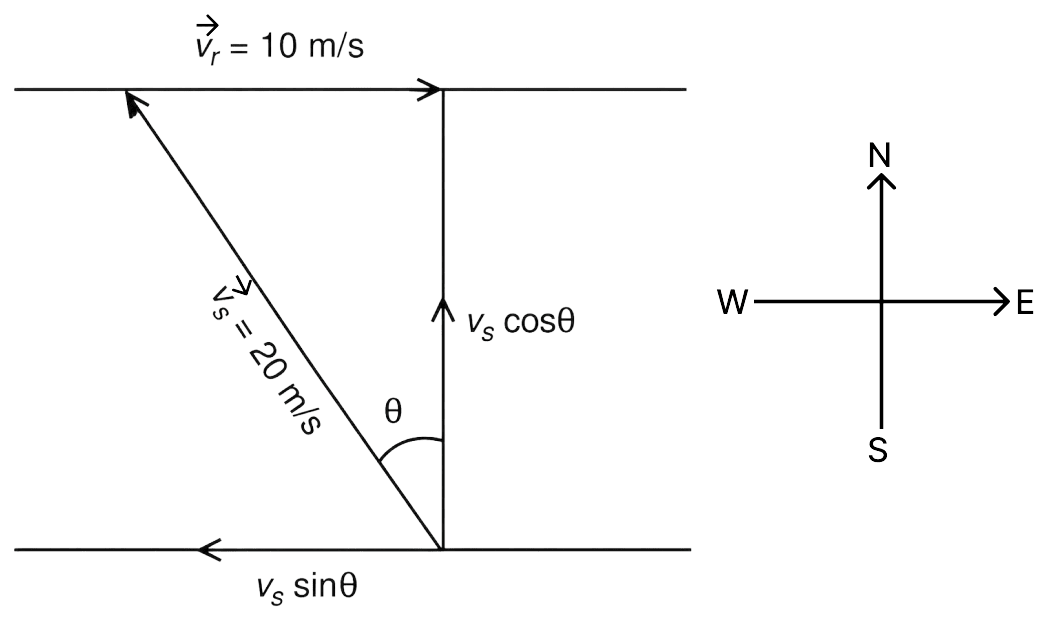
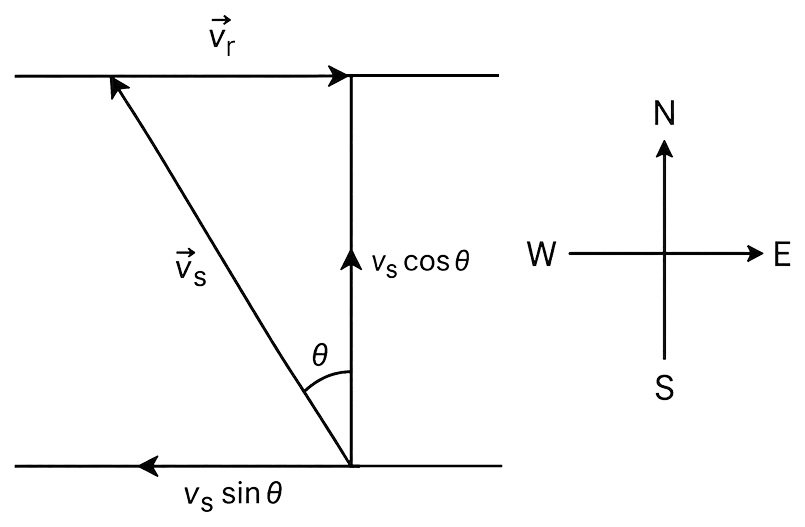
The speed of a swimmer in still water is 20 m/s. The speed of river water is 10 m/s and is flowing due east. If he is standing on the south bank and wishes to cross the river along the shortest path the angle at which he should make his strokes w.r.t. north is given by :

  1. 60° west
  2. 45° west
  3. 30° west.

Answer

30° west

Reason

Given,

  • Speed of the swimmer in still water, vs = 20 m s-1
  • Speed of the river water, vr = 10 m s-1, flowing due east
The speed of a swimmer in still water is 20 m/s. The speed of river water is 10 m/s and is flowing due east. If he is standing on the south bank and wishes to cross the river along the shortest path the angle at which he should make his strokes w.r.t. north is given by:. Motion in a Plane, Solutions for Class 11 ISC Nootan Physics Kumar Mittal Nageen Prakashan

To cross the river along the shortest path, the swimmer must move straight across, so the component of his velocity (vs sinθ) along the direction of the flow must exactly cancel the velocity of the river (vr ). If θ is the angle made by his strokes with the north,

vr=vssinθ\text v_{r} = \text v_{s} \sin \theta

Substituting the values,

10=20sinθsinθ=1020=12θ=sin1(12)=3010 = 20 \sin \theta \\[1em] \sin \theta = \dfrac{10}{20} = \dfrac{1}{2} \\[1em] \theta = \sin^{-1}\left(\dfrac{1}{2}\right) = 30^\circ

Since the river flows due east, the swimmer must head 30° west of north.

Question 8

The stream of a river is flowing with a speed of 2 km/h. A swimmer can swim at a speed of 4 km/h. What should be the direction of the swimmer with respect to the flow of the river to cross the river straight?

  1. 60°
  2. 150°
  3. 90°
  4. 120°.

Answer

120°

Reason

Given,

  • Speed of the stream of the river, vr = 2 km h-1
  • Speed of the swimmer in still water, vs = 4 km h-1

For the swimmer to cross the river straight, the component of his velocity (vs sinθ) along the flow must cancel the velocity of the river (vr). Let θ be the angle made by his heading with the direction straight across the river. Then

The stream of a river is flowing with a speed of 2 km/h. A swimmer can swim at a speed of 4 km/h. What should be the direction of the swimmer with respect to the flow of the river to cross the river straight? Motion in a Plane, Solutions for Class 11 ISC Nootan Physics Kumar Mittal Nageen Prakashan

vr=vssinθ2=4sinθsinθ=24=12θ=30\text v_{r} = \text v_{s} \sin \theta \\[1em] 2 = 4 \sin \theta \\[1em] \sin \theta = \dfrac{2}{4} = \dfrac{1}{2} \quad \Rightarrow \quad \theta = 30^\circ

The direction straight across makes an angle of 90° with the flow of the river, and the swimmer must head 30° upstream of it. Hence the angle made with the direction of the flow is

α=90+30=120\alpha = 90^\circ + 30^\circ = 120^\circ

Question 9

The trajectory of a projectile near the surface of earth is given as y = 2x − 9x2. If it was launched at an angle θ0 with speed v0, then : (take g = 10 m/s2)

  1. θ0=sin1(15)θ_0 = \sin^{-1}\left(\dfrac{1}{\sqrt{5}}\right) and v0=53v_0 = \dfrac{5}{3} m/s
  2. θ0=cos1(25)θ_0 = \cos^{-1}\left(\dfrac{2}{\sqrt{5}}\right) and v0=35v_0 = \dfrac{3}{5} m/s
  3. θ0=cos1(15)θ_0 = \cos^{-1}\left(\dfrac{1}{\sqrt{5}}\right) and v0=53v_0 = \dfrac{5}{3} m/s
  4. θ0=sin1(25)θ_0 = \sin^{-1}\left(\dfrac{2}{\sqrt{5}}\right) and v0=35v_0 = \dfrac{3}{5} m/s.

Answer

θ0=cos1(15)θ_0 = \cos^{-1}\left(\dfrac{1}{\sqrt{5}}\right) and v0=53v_0 = \dfrac{5}{3} m/s

Reason

Given,

  • Equation of the trajectory, y = 2x − 9x2
  • Acceleration due to gravity, g = 10 m s-2

The equation of the trajectory of a projectile launched with speed v0 at an angle θ0 with the horizontal is

y=xtanθ0gx22v02cos2θ0\text y = \text x \tan \theta_0 - \dfrac{\text{gx}^2}{2\text v_0^2 \cos^2 \theta_0}

Comparing the coefficients of x in this equation with those in y = 2x − 9x2,

tanθ0=2\tan \theta_0 = 2

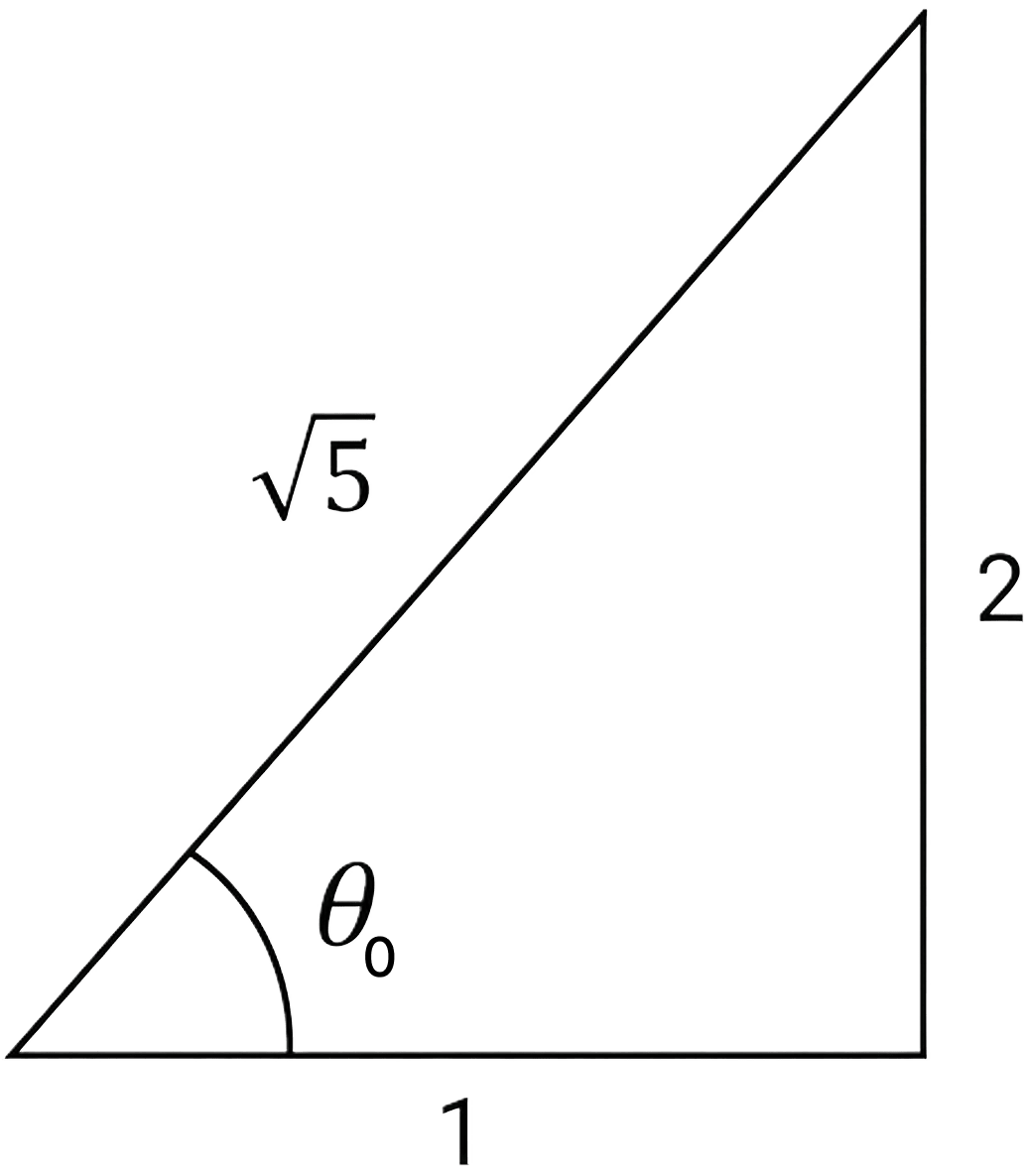
Constructing a right-angled triangle with the side opposite to θ0 equal to 2 and the adjacent side equal to 1, the hypotenuse is (2)2+(1)2=5\sqrt{(2)^2 + (1)^2} = \sqrt{5}. Therefore,

The trajectory of a projectile near the surface of earth is given as y = 2x − 9x 2. If it was launched at an angle θ 0 with speed v 0, then: (take g = 10 m/s 2 ). Motion in a Plane, Solutions for Class 11 ISC Nootan Physics Kumar Mittal Nageen Prakashan

sinθ0=25andcosθ0=15\sin \theta_0 = \dfrac{2}{\sqrt{5}} \quad \text{and} \quad \cos \theta_0 = \dfrac{1}{\sqrt{5}}

that is, θ0=cos1(15)\theta_0 = \cos^{-1}\left(\dfrac{1}{\sqrt{5}}\right).

Comparing the coefficients of x2,

g2v02cos2θ0=9\dfrac{\text g}{2\text v_0^2 \cos^2 \theta_0} = 9

Substituting g = 10 m s-2 and cos2θ0=15\cos^2 \theta_0 = \dfrac{1}{5},

102v02×15=910×52v02=925v02=9v02=259v0=53 m s1\dfrac{10}{2\text v_0^2 \times \dfrac{1}{5}} = 9 \\[1em] \dfrac{10 \times 5}{2\text v_0^2} = 9 \\[1em] \dfrac{25}{\text v_0^2} = 9 \\[1em] \text v_0^2 = \dfrac{25}{9} \quad \Rightarrow \quad \text v_0 = \dfrac{5}{3}\ \text{m s}^{-1}

Question 10

A body is projected at t = 0 with a velocity 10 m/s at an angle of 60° with the horizontal. The radius of curvature of its trajectory at t = 1 second is R. Neglecting air resistance and taking g = 10 m/s2, the value of R is :

  1. 10.3 m
  2. 2.8 m
  3. 5.1 m
  4. 2.5 m.

Answer

2.8 m

Reason

Given,

  • Velocity of projection, u = 10 m s-1
  • Angle of projection, θ = 60° with the horizontal
  • Time at which the radius of curvature is required, t = 1 s
  • Acceleration due to gravity, g = 10 m s-2

Resolving the velocity of projection,

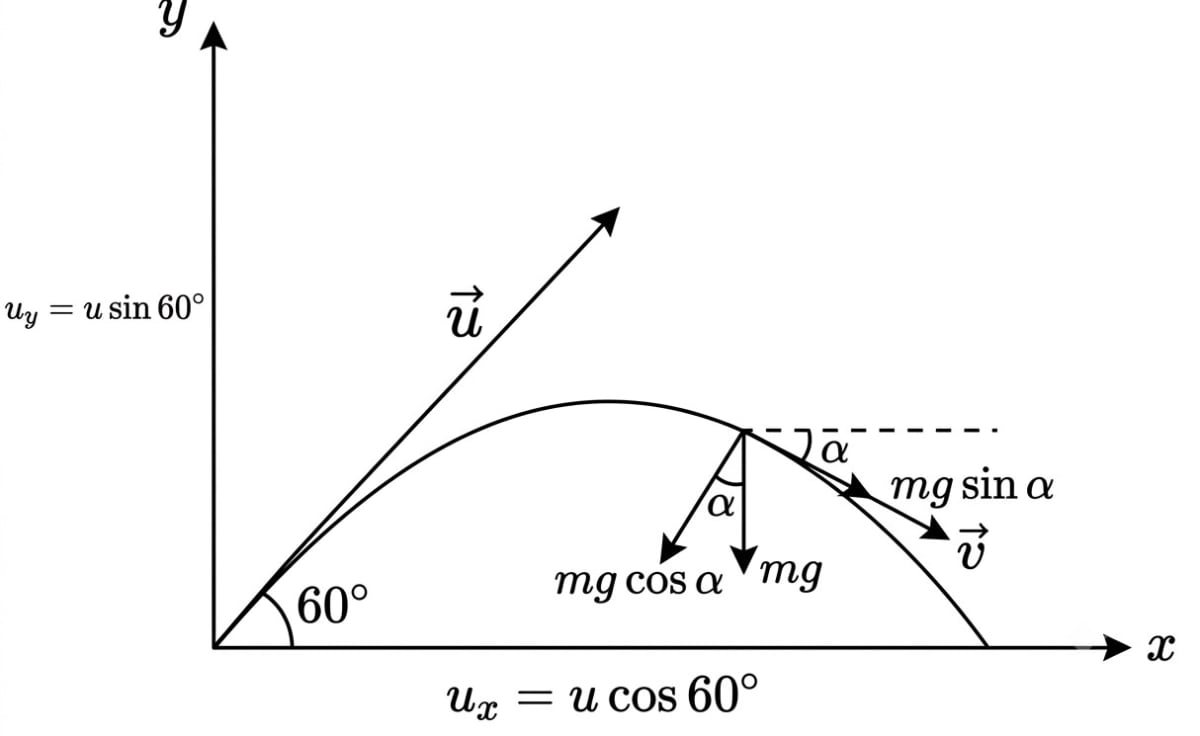
A body is projected at t = 0 with a velocity 10 m/s at an angle of 60° with the horizontal. The radius of curvature of its trajectory at t = 1 second is R. Neglecting air resistance and taking g = 10 m/s 2, the value of R is:. Motion in a Plane, Solutions for Class 11 ISC Nootan Physics Kumar Mittal Nageen Prakashan

ux=10cos60=10×12=5 m s1uy=10sin60=10×32=53 m s1\text u_x = 10 \cos 60^\circ = 10 \times \dfrac{1}{2} = 5\ \text{m s}^{-1} \\[1em] \text u_y = 10 \sin 60^\circ = 10 \times \dfrac{\sqrt{3}}{2} = 5\sqrt{3}\ \text{m s}^{-1}

At t = 1 s, the horizontal component is unchanged, that is, vx = 5 m s-1, while the vertical component is obtained from :

vy=uygt=5310×1=8.6610=1.34 m s1\text v_y = \text u_y - \text{gt} \\[1em] = 5\sqrt{3} - 10 \times 1 \\[1em] = 8.66 - 10 \\[1em] = -1.34\ \text{m s}^{-1}

The negative sign shows that the body is moving downwards at this instant. The speed at that instant is

v2=vx2+vy2=(5)2+(1.34)2=25+1.8=26.8 m2s2\text v^2 = \text v_x^2 + \text v_y^2 \\[1em] = (5)^2 + (-1.34)^2 \\[1em] = 25 + 1.8 \\[1em] = 26.8\ \text{m}^2\text{s}^{-2}

If α is the angle made by the velocity with the horizontal,

tanα=vyvx=1.345=0.268α=15\tan \alpha = \dfrac{|\text v_y|}{|\text v_x|} \\[1em] = \dfrac{1.34}{5} = 0.268 \quad \Rightarrow \quad \alpha = 15^\circ

The component of the weight mg perpendicular to the velocity supplies the centripetal force needed to keep the body on its curved path, so

mgcosα=mv2RR=v2gcosα=26.810×cos15=26.810×0.97=2.8 m{\text {mg} \cos \alpha}= \dfrac{\text {mv}^2}{\text R} \\[1em] \text R = \dfrac{\text v^2}{\text g \cos \alpha}\\[1em] = \dfrac{26.8}{10 \times \cos 15^\circ} \\[1em] = \dfrac{26.8}{10 \times 0.97} \\[1em] = 2.8\ \text m

Question 11

Two particles are projected from the same point with the same speed u such that they have the same range R, but different maximum heights, h1 and h2. Which of the following is correct?

  1. R2=h1h2R^2 = h_1 h_2
  2. R2=16h1h2R^2 = 16 h_1 h_2
  3. R2=4h1h2R^2 = 4 h_1 h_2
  4. R2=2h1h2R_2 = 2 h_1 h_2

Answer

R2=16h1h2R^2 = 16 h_1 h_2

Reason

Given,

  • Both particles are projected with the same speed u
  • Both have the same horizontal range R
  • Their maximum heights are h1 and h2

Two projectiles thrown with the same speed have the same range when their angles of projection are complementary, that is, θ and (90° − θ). Using h=u2sin2θ2g\text h = \dfrac{\text u^2 \sin^2 \theta}{2\text g} for each of them,

h1=u2sin2θ2gandh2=u2sin2(90θ)2g=u2cos2θ2g\text h_1 = \dfrac{\text u^2 \sin^2 \theta}{2\text g} \quad \text{and} \quad \text h_2 = \dfrac{\text u^2 \sin^2(90^\circ - \theta)}{2\text g} = \dfrac{\text u^2 \cos^2 \theta}{2\text g}

Multiplying the two,

h1h2=u2sin2θ2g×u2cos2θ2g=u4sin2θcos2θ4g2\text h_1\text h_2 = \dfrac{\text u^2 \sin^2 \theta}{2\text g} \times \dfrac{\text u^2 \cos^2 \theta}{2\text g} \\[1em] = \dfrac{\text u^4 \sin^2 \theta \cos^2 \theta}{4\text g^2}

Using sin 2θ = 2 sin θ cos θ, so that sin2θcos2θ=sin22θ4\sin^2 \theta \cos^2 \theta = \dfrac{\sin^2 2\theta}{4},

h1h2=u44g2×sin22θ4h1h2=u4sin22θ16g2\text h_1\text h_2 = \dfrac{\text u^4}{4\text g^2} \times \dfrac{\sin^2 2\theta}{4} \\[1em] \text h_1\text h_2= \dfrac{\text u^4 \sin^2 2\theta}{16\text g^2}

The common range is R=u2sin2θg\text R = \dfrac{\text u^2 \sin 2\theta}{\text g}, so on squaring,

R2=u4sin22θg2=1616×u4sin22θg2=16h1h2\text R^2 = \dfrac{\text u^4 \sin^2 2\theta}{\text g^2} \\[1em] = \dfrac{16}{16} \times \dfrac{\text u^4 \sin^2 2\theta}{\text g^2} \\[1em] = 16\text h_1\text h_2

Question 12

In three dimensional system, the position coordinate of a particle (in motion) are x = a cos ωt, y = a sin ωt, z = aωt. The velocity of the particle will be :

  1. 2aω\sqrt{2}aω
  2. 2aω
  3. 3aω\sqrt{3}aω

Answer

2aω\sqrt{2}aω

Reason

Given,

  • x = a cos ωt, y = a sin ωt and z = aωt, where a and ω are constants

The components of the velocity are obtained by differentiating the corresponding coordinates with respect to time.

Differentiating x with respect to t, and using the chain rule with d(ωt)dt=ω\dfrac{\text d(\omega \text t)}{\text{dt}} = \omega,

vx=dxdt=addt(cosωt)=a(sinωt)×ω=aωsinωt\text v_x = \dfrac{\text{dx}}{\text{dt}} = \text a\dfrac{\text d}{\text{dt}}(\cos \omega \text t) \\[1em] = \text a(-\sin \omega \text t) \times \omega \\[1em] = -\text a\omega \sin \omega \text t

Differentiating y with respect to t,

vy=dydt=addt(sinωt)=a(cosωt)×ω=aωcosωt\text v_y = \dfrac{\text{dy}}{\text{dt}} = \text a\dfrac{\text d}{\text{dt}}(\sin \omega \text t) \\[1em] = \text a(\cos \omega \text t) \times \omega \\[1em] = \text a\omega \cos \omega \text t

Differentiating z with respect to t,

vz=dzdt=aωdtdt=aω\text v_z = \dfrac{\text{dz}}{\text{dt}} = \text a\omega\dfrac{\text{dt}}{\text{dt}} = \text a\omega

The magnitude of the velocity is

v=vx2+vy2+vz2=a2ω2sin2ωt+a2ω2cos2ωt+a2ω2=a2ω2(sin2ωt+cos2ωt)+a2ω2\text v = \sqrt{\text v_x^2 + \text v_y^2 + \text v_z^2} \\[1em] = \sqrt{\text a^2\omega^2 \sin^2 \omega \text t + \text a^2\omega^2 \cos^2 \omega \text t + \text a^2\omega^2} \\[1em] = \sqrt{\text a^2\omega^2(\sin^2 \omega \text t + \cos^2 \omega \text t) + \text a^2\omega^2}

Using sin2 ωt + cos2 ωt = 1,

v=a2ω2+a2ω2=2a2ω2=2aω\text v = \sqrt{\text a^2\omega^2 + \text a^2\omega^2} \\[1em] = \sqrt{2\text a^2\omega^2} \\[1em] = \sqrt{2}\text a\omega

Question 13

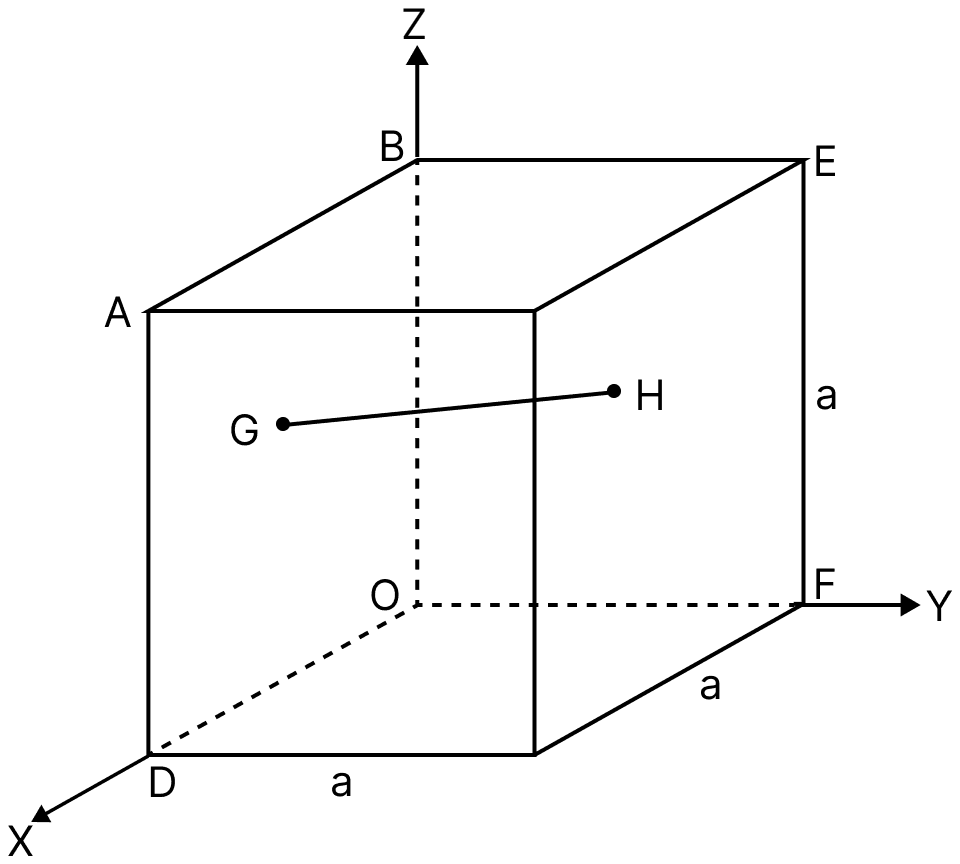
In the cube of side 'a' shown in the figure, the vector from the central point of the face ABOD to the central point of the face BEFO will be :

In the cube of side a shown in the figure, the vector from the central point of the face ABOD to the central point of the face BEFO will be:. Motion in a Plane, Solutions for Class 11 ISC Nootan Physics Kumar Mittal Nageen Prakashan
  1. 12a(i^k^)\dfrac{1}{2}a(\hat{i} - \hat{k})
  2. 12a(j^i^)\dfrac{1}{2}a(\hat{j} - \hat{i})
  3. 12a(j^k^)\dfrac{1}{2}a(\hat{j} - \hat{k})
  4. 12a(k^i^)\dfrac{1}{2}a(\hat{k} - \hat{i})

Answer

12a(j^i^)\dfrac{1}{2}a(\hat{j} - \hat{i})

Reason

Given,

  • Side of the cube = a

From the figure, the origin O is at a corner of the cube, with OD along the X-axis, OF along the Y-axis and OB along the Z-axis. Hence the coordinates of the vertices are

O(0,0,0),D(a,0,0),F(0,a,0),B(0,0,a),A(a,0,a),E(0,a,a)\text O(0, 0, 0), \quad \text D(\text a, 0, 0), \quad \text F(0, \text a, 0), \quad \text B(0, 0, \text a), \quad \text A(\text a, 0, \text a), \quad \text E(0, \text a, \text a)

The central point of a face is the mid-point of its diagonal, so its coordinates are the averages of the coordinates of the opposite corners of that face.

The face ABOD lies in the plane y = 0, and its diagonal joins A(a, 0, a) and O(0, 0, 0). Hence the coordinates of its central point G are

G(a+02, 0+02, a+02)=G(a2, 0, a2)\text G\left(\dfrac{\text a + 0}{2},\ \dfrac{0 + 0}{2},\ \dfrac{\text a + 0}{2}\right) = \text G\left(\dfrac{\text a}{2},\ 0,\ \dfrac{\text a}{2}\right)

The face BEFO lies in the plane x = 0, and its diagonal joins E(0, a, a) and O(0, 0, 0). Hence the coordinates of its central point H are

H(0+02, a+02, a+02)=H(0, a2, a2)\text H\left(\dfrac{0 + 0}{2},\ \dfrac{\text a + 0}{2},\ \dfrac{\text a + 0}{2}\right) = \text H\left(0,\ \dfrac{\text a}{2},\ \dfrac{\text a}{2}\right)

The required vector is

GH=(x2x1)i^+(y2y1)j^+(z2z1)k^=(0a2)i^+(a20)j^+(a2a2)k^=a2i^+a2j^+0k^=12a(j^i^)\vec{\text{GH}} = (\text x_2 - \text x_1)\hat{i} + (\text y_2 - \text y_1)\hat{j} + (\text z_2 - \text z_1)\hat{k} \\[1em] = \left(0 - \dfrac{\text a}{2}\right)\hat{i} + \left(\dfrac{\text a}{2} - 0\right)\hat{j} + \left(\dfrac{\text a}{2} - \dfrac{\text a}{2}\right)\hat{k} \\[1em] = -\dfrac{\text a}{2}\hat{i} + \dfrac{\text a}{2}\hat{j} + 0\hat{k} \\[1em] = \dfrac{1}{2}\text a(\hat{j} - \hat{i})

Question 14

A ball is thrown upward with an initial velocity v0 from the surface of the earth. The motion of the ball is affected by a drag force equal to mγv2mγv^2 (where m is mass of the ball, v is its instantaneous velocity and γ is a constant). Time taken by the ball to rise to its zenith is :

  1. 12γgtan1(2γgv0)\dfrac{1}{\sqrt{2γg}}\tan^{-1}\left(\sqrt{\dfrac{2γ}{g}}v_0\right)
  2. 1γgtan1(γgv0)\dfrac{1}{\sqrt{γg}}\tan^{-1}\left(\sqrt{\dfrac{γ}{g}}v_0\right)
  3. 1γgsin1(γgv0)\dfrac{1}{\sqrt{γg}}\sin^{-1}\left(\sqrt{\dfrac{γ}{g}}v_0\right)
  4. 1γgln(1+γgv0)\dfrac{1}{\sqrt{γg}}\ln\left(1 + \sqrt{\dfrac{γ}{g}}v_0\right)

Answer

1γgtan1(γgv0)\dfrac{1}{\sqrt{γg}}\tan^{-1}\left(\sqrt{\dfrac{γ}{g}}v_0\right)

Reason

Given,

  • Initial velocity of the ball, v0, directed vertically upwards
  • Drag force on the ball, F = mγv2\gamma \text v^2

Comparing it with F = ma, the retardation produced by the drag force alone is

a=Fm=mγv2m=γv2\text a = \dfrac{\text F}{\text m} = \dfrac{\text m\gamma \text v^2}{\text m} = \gamma \text v^2

While the ball rises, the drag force opposes the motion and therefore acts downwards along with the force of gravity. Hence the net retardation is

anet=dvdt=(g+γv2)\text a_{net} = \dfrac{\text{dv}}{\text{dt}} = -(\text g + \gamma \text v^2)

Separating the variables,

dt=dvg+γv2\text{dt} = -\dfrac{\text{dv}}{\text g + \gamma \text v^2}

At the zenith the ball comes to rest momentarily. Integrating from v = v0 at t = 0 to v = 0 at t = T,

0Tdt=v00dvg+γv2\int_0^{\text T} \text{dt} = -\int_{\text v_0}^{0} \dfrac{\text{dv}}{\text g + \gamma \text v^2}

Interchanging the limits of the integral on the right removes the negative sign,

T=0v0dvg+γv2\text T = \int_0^{\text v_0} \dfrac{\text{dv}}{\text g + \gamma \text v^2}

Taking γ common from the denominator,

T=1γ0v0dvgγ+v2\text T = \dfrac{1}{\gamma}\int_0^{\text v_0} \dfrac{\text{dv}}{\dfrac{\text g}{\gamma} + \text v^2}

Using the standard integral dvb2+v2=1btan1(vb)\displaystyle\int \dfrac{\text{dv}}{\text b^2 + \text v^2} = \dfrac{1}{\text b}\tan^{-1}\left(\dfrac{\text v}{\text b}\right), with b=gγ\text b = \sqrt{\dfrac{\text g}{\gamma}}

T=1γ×γg[tan1(vγg)]0v0=1γg[tan1(vγg)]0v0\text T = \dfrac{1}{\gamma} \times \sqrt{\dfrac{\gamma}{\text g}}\left[\tan^{-1}\left(\text v\sqrt{\dfrac{\gamma}{\text g}}\right)\right]_0^{\text v_0} \\[1em] = \dfrac{1}{\sqrt{\gamma \text g}}\left[\tan^{-1}\left(\text v\sqrt{\dfrac{\gamma}{\text g}}\right)\right]_0^{\text v_0}

Applying the limits, and using tan-1(0) = 0,

T=1γg[tan1(v0γg)0]=1γgtan1(γgv0)\text T = \dfrac{1}{\sqrt{\gamma \text g}}\left[\tan^{-1}\left(\text v_0\sqrt{\dfrac{\gamma}{\text g}}\right) - 0\right] \\[1em] = \dfrac{1}{\sqrt{\gamma \text g}}\tan^{-1}\left(\sqrt{\dfrac{\gamma}{\text g}}\text v_0\right)

Question 15

A particle moves from the point (2.0i^+4.0j^)(2.0\hat{i} + 4.0\hat{j}) m at t = 0 with an initial velocity (5.0i^+4.0j^)(5.0\hat{i} + 4.0\hat{j}) m/s. It is acted upon by a constant force which produces a constant acceleration (4.0i^+4.0j^)(4.0\hat{i} + 4.0\hat{j}) m/s2. What is the distance of the particle from the origin at time 2s?

  1. 5 m
  2. 20220\sqrt{2} m
  3. 10210\sqrt{2} m
  4. 15 m.

Answer

20220\sqrt{2} m

Reason

Given,

  • Initial position vector, r0=(2.0i^+4.0j^)\vec{\text r}_0 = (2.0\hat{i} + 4.0\hat{j}) m at t = 0
  • Initial velocity, u=(5.0i^+4.0j^)\vec{\text u} = (5.0\hat{i} + 4.0\hat{j}) m s-1
  • Constant acceleration, a=(4.0i^+4.0j^)\vec{\text a} = (4.0\hat{i} + 4.0\hat{j}) m s-2
  • Time, t = 2 s

Since the acceleration is constant, the equation of motion for the position vector at time t is

r=r0+ut+12at2\vec{\text r} = \vec{\text r}_0 + \vec{\text u}\text t + \dfrac{1}{2}\vec{\text a}\text t^2

Substituting the values at t = 2 s,

r=(2.0i^+4.0j^)+(5.0i^+4.0j^)(2)+12(4.0i^+4.0j^)(2)2=(2i^+4j^)+(10i^+8j^)+12(4i^+4j^)(4)=(2i^+4j^)+(10i^+8j^)+(8i^+8j^)\vec{\text r} = (2.0\hat{i} + 4.0\hat{j}) + (5.0\hat{i} + 4.0\hat{j})(2) + \dfrac{1}{2}(4.0\hat{i} + 4.0\hat{j})(2)^2 \\[1em] = (2\hat{i} + 4\hat{j}) + (10\hat{i} + 8\hat{j}) + \dfrac{1}{2}(4\hat{i} + 4\hat{j})(4) \\[1em] = (2\hat{i} + 4\hat{j}) + (10\hat{i} + 8\hat{j}) + (8\hat{i} + 8\hat{j})

Adding the corresponding components,

r=(2+10+8)i^+(4+8+8)j^=20i^+20j^\vec{\text r} = (2 + 10 + 8)\hat{i} + (4 + 8 + 8)\hat{j} \\[1em] = 20\hat{i} + 20\hat{j}

The distance from the origin is the magnitude of this position vector,

r=(20)2+(20)2=400+400=800=202 m|\vec{\text r}| = \sqrt{(20)^2 + (20)^2} \\[1em] = \sqrt{400 + 400} = \sqrt{800} \\[1em] = 20\sqrt{2}\ \text m

Question 16

Two projectiles are thrown with same initial velocity making an angle of 45° and 30° with the horizontal respectively. The ratio of their respective ranges will be :

  1. 1:21 : \sqrt{2}
  2. 2:1\sqrt{2} : 1
  3. 2:32 : \sqrt{3}
  4. 3:2\sqrt{3} : 2

Answer

2:32 : \sqrt{3}

Reason

Given,

  • Both projectiles are thrown with the same initial velocity u
  • Angles of projection, θ1 = 45° and θ2 = 30°

The horizontal range of a projectile is

R=u2sin2θg\text R = \dfrac{\text u^2 \sin 2\theta}{\text g}

For the same initial velocity u and the same g, R ∝ sin 2θ. Therefore,

R1R2=sin2θ1sin2θ2=sin(2×45)sin(2×30)=sin90sin60=132=23\dfrac{\text R_1}{\text R_2} = \dfrac{\sin 2\theta_1}{\sin 2\theta_2} = \dfrac{\sin(2 \times 45^\circ)}{\sin(2 \times 30^\circ)} \\[1em] = \dfrac{\sin 90^\circ}{\sin 60^\circ} \\[1em] = \dfrac{1}{\dfrac{\sqrt{3}}{2}} = \dfrac{2}{\sqrt{3}}

Hence the ratio of the ranges is 2:32 : \sqrt{3}.

Question 17

Two projectiles thrown at 30° and 45° with the horizontal respectively, reach the maximum height in same time. The ratio of their initial velocities is :

  1. 1:21 : \sqrt{2}
  2. 2 : 1
  3. 2:1\sqrt{2} : 1
  4. 1 : 2.

Answer

2:1\sqrt{2} : 1

Reason

Given,

  • Angles of projection, θ1 = 30° and θ2 = 45°
  • Both projectiles reach the maximum height in the same time, that is, t1 = t2

At the maximum height the vertical component of the velocity becomes zero. Using v = u sin θ − gt with v = 0, the time taken to reach the maximum height is

t=usinθg\text t = \dfrac{\text u \sin \theta}{\text g}

Since the two times are equal,

u1sin30g=u2sin45gu1sin30=u2sin45\dfrac{\text u_1 \sin 30^\circ}{\text g} = \dfrac{\text u_2 \sin 45^\circ}{\text g} \\[1em] \text u_1 \sin 30^\circ = \text u_2 \sin 45^\circ

Therefore,

u1u2=sin45sin30=1212=12×21=22=2\dfrac{\text u_1}{\text u_2} = \dfrac{\sin 45^\circ}{\sin 30^\circ} = \dfrac{\dfrac{1}{\sqrt{2}}}{\dfrac{1}{2}} \\[1em] = \dfrac{1}{\sqrt{2}} \times \dfrac{2}{1} \\[1em] = \dfrac{2}{\sqrt{2}} = \sqrt{2}

Hence the ratio of the initial velocities is 2:1\sqrt{2} : 1.

Question 18

The ratio of the distances travelled by a freely falling body in the 1st, 2nd, 3rd and 4th seconds is:

  1. 1 : 3 : 5 : 7
  2. 1 : 1 : 1 : 1
  3. 1 : 2 : 3 : 4
  4. 1 : 4 : 9 : 16.

Answer

1 : 3 : 5 : 7

Reason

Given,

  • The body falls freely from rest, so its initial velocity u = 0 and its acceleration is g

For a body falling freely from rest (u = 0), the distance covered in the nth second is

sn=u+12g(2n1)\text s_n = u+ \dfrac{1}{2}\text g(2\text n - 1)

Putting n = 1, 2, 3 and 4, and u = 0

s1=g2(2×11)=g2s2=g2(2×21)=3g2s3=g2(2×31)=5g2s4=g2(2×41)=7g2\text s_1 = \dfrac{\text g}{2}(2 \times 1 - 1) = \dfrac{\text g}{2} \\[1em] \text s_2 = \dfrac{\text g}{2}(2 \times 2 - 1) = \dfrac{3\text g}{2} \\[1em] \text s_3 = \dfrac{\text g}{2}(2 \times 3 - 1) = \dfrac{5\text g}{2} \\[1em] \text s_4 = \dfrac{\text g}{2}(2 \times 4 - 1) = \dfrac{7\text g}{2}

Taking the ratio and cancelling the common factor g2\dfrac{\text g}{2},

s1:s2:s3:s4=g2:3g2:5g2:7g2=1:3:5:7\text s_1 : \text s_2 : \text s_3 : \text s_4 = \dfrac{\text g}{2} : \dfrac{3\text g}{2} : \dfrac{5\text g}{2} : \dfrac{7\text g}{2} \\[1em] = 1 : 3 : 5 : 7

that is, the distances covered in successive seconds are in the ratio of the odd numbers.

Question 19

A ball is projected with a velocity, 10 ms-1 at an angle of 60° with the vertical direction. Its speed at the highest point of its trajectory will be :

  1. 5 ms-1
  2. 10 ms-1
  3. zero
  4. 535\sqrt{3} ms-1.

Answer

535\sqrt{3} ms-1

Reason

Given,

  • Velocity of projection, u = 10 m s-1
  • Angle of projection with the vertical direction = 60°

Since the angle of projection is measured from the vertical, the angle made with the horizontal is

θ=9060=30\theta = 90^\circ - 60^\circ = 30^\circ

The horizontal and the vertical motions of a projectile are independent of each other. No force acts along the horizontal direction, so the horizontal component of the velocity remains unaltered throughout the flight, while the vertical component becomes zero at the highest point.

Hence at the highest point only the horizontal component remains,

v=ucos30=10×32=53 m s1\text v = \text u \cos 30^\circ \\[1em] = 10 \times \dfrac{\sqrt{3}}{2} \\[1em] = 5\sqrt{3}\ \text{m s}^{-1}

Question 20

Two particles A and B are moving in uniform circular motion in concentric circles of radii rA and rB with speeds vA and vB respectively. Their time period of rotation is the same. The ratio of angular speed of A to that of B will be :

  1. vA : vB
  2. rB : rA
  3. 1 : 1
  4. rA : rB.

Answer

1 : 1

Reason

Given,

  • Radii of the concentric circular paths, rA and rB
  • Speeds of the two particles, vA and vB
  • The time periods of rotation are the same, that is, TA = TB

In one complete revolution a particle turns through an angle 2π in time T, so the angular velocity is related to the time period by

ω=2πT\omega = \dfrac{2\pi}{\text T}

Since the time periods of the two particles are equal, TA = TB, and therefore

ωAωB=2π/TA2π/TB=TBTA=1\dfrac{\omega_A}{\omega_B} = \dfrac{2\pi / \text T_A}{2\pi / \text T_B} = \dfrac{\text T_B}{\text T_A} = 1

Thus the ratio of their angular speeds is 1 : 1, whatever the radii of their paths may be. This agrees with the fact that the angular speed does not change with radius, although the linear speed does, since v = rω.

Question 21

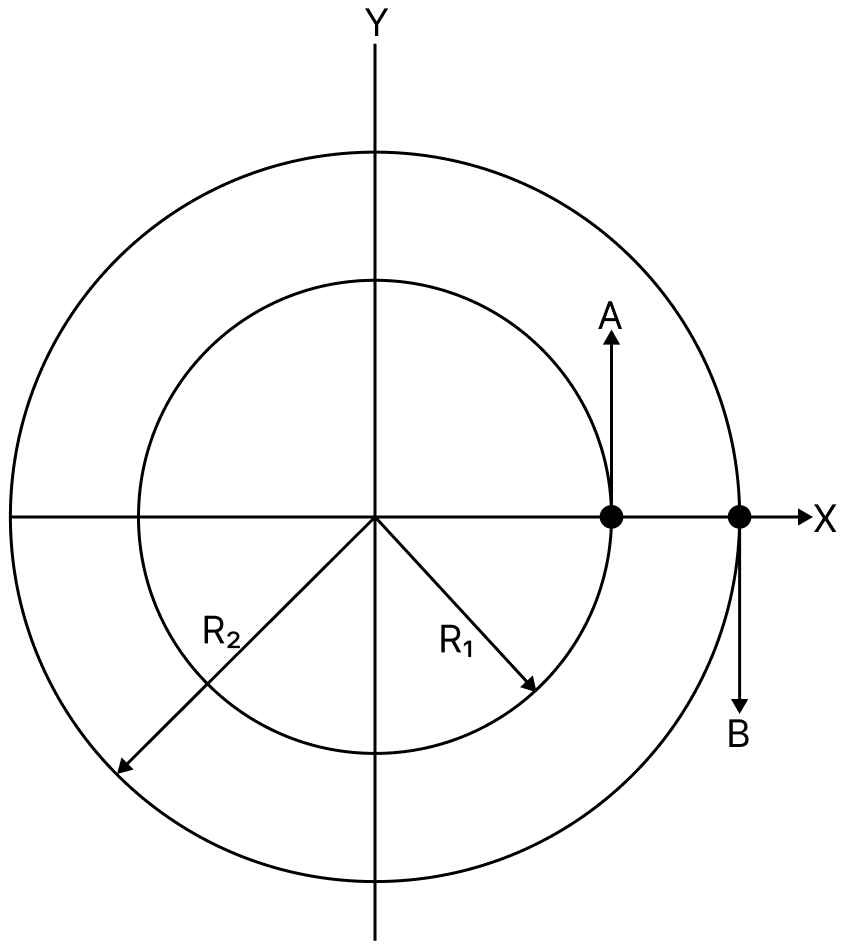
Two particles A and B are moving on two concentric circles of radii R1 and R2 with equal angular speed ω. At t = 0, their positions and direction of motion are shown in the figure. The relative velocity vAvBv_A - v_B at t=π2ωt = \dfrac{π}{2ω} is given by :

Two particles A and B are moving on two concentric circles of radii R 1 and R 2 with equal angular speed ω. At t = 0, their positions and direction of motion are shown in the figure. The relative velocity v_A - v_B at t = π/2ω is given by:. Motion in a Plane, Solutions for Class 11 ISC Nootan Physics Kumar Mittal Nageen Prakashan
  1. ω(R1+R2)i^ω(R_1 + R_2)\hat{i}
  2. ω(R1+R2)i^-ω(R_1 + R_2)\hat{i}
  3. ω(R1R2)i^ω(R_1 - R_2)\hat{i}
  4. ω(R2R1)i^ω(R_2 - R_1)\hat{i}

Answer

ω(R2R1)i^ω(R_2 - R_1)\hat{i}

Reason

Given,

  • Radii of the two concentric circles, R1 (inner) and R2 (outer)
  • Both particles have the same angular speed ω
  • Time at which the relative velocity is required, t=π2ω\text t = \dfrac{\pi}{2\omega}
Two particles A and B are moving on two concentric circles of radii R 1 and R 2 with equal angular speed ω. At t = 0, their positions and direction of motion are shown in the figure. The relative velocity v_A - v_B at t = π/2ω is given by:. Motion in a Plane, Solutions for Class 11 ISC Nootan Physics Kumar Mittal Nageen Prakashan

From the figure, at t = 0 the particle A is on the inner circle at (R1, 0) moving along the positive Y-direction, so it moves anticlockwise; and the particle B is on the outer circle at (R2, 0) moving along the negative Y-direction, so it moves clockwise.

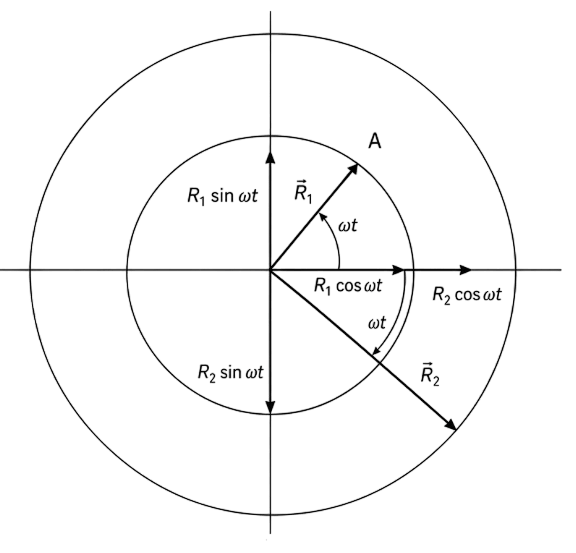
Writing the position vectors at time t, the angle turned through in time t being ωt,

rA=R1cosωi^+R1sinωj^rB=R2cosωi^R2sinωj^\vec{\text r}_A = \text R_1 \cos \omega \text t\ \hat{i} + \text R_1 \sin \omega \text t\ \hat{j} \\[1em] \vec{\text r}_B = \text R_2 \cos \omega \text t\ \hat{i} - \text R_2 \sin \omega \text t\ \hat{j}

The negative sign in the second relation appears because B turns clockwise.

Differentiating each position vector with respect to time, and using the chain rule with d(ωt)dt=ω\dfrac{\text d(\omega \text t)}{\text{dt}} = \omega,

vA=drAdt=R1ωsinωi^+R1ωcosωj^vB=drBdt=R2ωsinωi^R2ωcosωj^\vec{\text v}_A = \dfrac{\text d\vec{\text r}_A}{\text{dt}} = -\text R_1\omega \sin \omega \text t\ \hat{i} + \text R_1\omega \cos \omega \text t\ \hat{j} \\[1em] \vec{\text v}_B = \dfrac{\text d\vec{\text r}_B}{\text{dt}} = -\text R_2\omega \sin \omega \text t\ \hat{i} - \text R_2\omega \cos \omega \text t\ \hat{j}

At t=π2ω\text t = \dfrac{\pi}{2\omega} that is ωt = 90°, we have sin ωt = 1 and cos ωt = 0. Therefore,

vA=R1ω i^andvB=R2ω i^\vec{\text v}_A = -\text R_1\omega\ \hat{i} \quad \text{and} \quad \vec{\text v}_B = -\text R_2\omega\ \hat{i}

Hence the relative velocity is

vAvB=R1ω i^(R2ω i^)=R1ω i^+R2ω i^=ω(R2R1)i^\vec{\text v}_A - \vec{\text v}_B = -\text R_1\omega\ \hat{i} - (-\text R_2\omega\ \hat{i}) \\[1em] = -\text R_1\omega\ \hat{i} + \text R_2\omega\ \hat{i} \\[1em] = \omega(\text R_2 - \text R_1)\hat{i}

Question 22

A particle is moving along a circular path with a constant speed of 10 m/s. What is the magnitude of the change in velocity of the particle, when it moves through an angle of 60° around the centre of the circle?

  1. 10210\sqrt{2} m/s
  2. 10 m/s
  3. 10310\sqrt{3} m/s
  4. Zero.

Answer

10 m/s

Reason

Given,

  • Constant speed of the particle, v = 10 m s-1
  • Angle turned through around the centre of the circle = 60°

The velocity of a particle in circular motion is always tangential to the path. When the particle turns through 60° around the centre, its velocity vector also turns through 60°, so the angle between v1\vec{\text v}_1 and v2\vec{\text v}_2 is 60°.

The change in velocity is Δv=v2v1=v2+(v1)\Delta \vec{\text v} = \vec{\text v}_2 - \vec{\text v}_1 = \vec{\text v}_2 + (-\vec{\text v}_1). The two velocity vectors are equal in magnitude (v = 10 m s-1) and the angle between v2\vec{\text v}_2 and (v1)(-\vec{\text v}_1) is (180° − 60°) = 120°. Therefore,

Δv2=v2+v2+2v2cos120=2v2+2v2(12)=2v2v2=v2|\Delta \vec{\text v}|^2 = \text v^2 + \text v^2 + 2\text v^2 \cos 120^\circ \\[1em] = 2\text v^2 + 2\text v^2\left(-\dfrac{1}{2}\right) \\[1em] = 2\text v^2 - \text v^2 \\[1em] = \text v^2

Hence

Δv=v=10 m s1|\Delta \vec{\text v}| = \text v = 10\ \text{m s}^{-1}

Question 23

A particle is moving with uniform speed in a circular path maintains :

  1. constant velocity
  2. constant acceleration
  3. constant velocity but varying acceleration
  4. varying velocity and varying acceleration.

Answer

varying velocity and varying acceleration.

Reason — In uniform circular motion the speed remains constant, but the direction of the velocity changes continuously as the velocity is always tangential to the path. Hence the velocity is varying. The centripetal acceleration a=v2r\text a = \dfrac{\text v^2}{\text r} is constant in magnitude but is always directed along the radius towards the centre, so its direction also changes continuously. Since both are vectors, and a vector changes if either its magnitude or its direction changes, both the velocity and the acceleration are varying.

Question 24

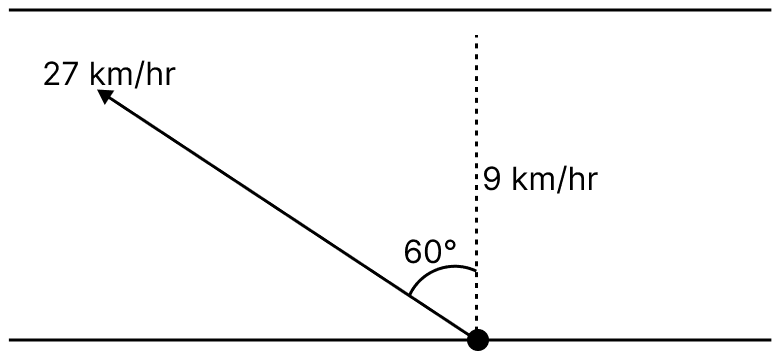
A river is flowing from west to east direction with speed of 9 km h-1. If a boat capable of moving at a maximum speed of 27 km h-1 in still water, crosses the river in half a minute, while moving with maximum speed at an angle of 150° to direction of river flow, then the width of the river is :

A river is flowing from west to east direction with speed of 9 km h -1. If a boat capable of moving at a maximum speed of 27 km h -1 in still water, crosses the river in half a minute, while moving with maximum speed at an angle of 150° to direction of river flow, then the width of the river is:. Motion in a Plane, Solutions for Class 11 ISC Nootan Physics Kumar Mittal Nageen Prakashan
  1. 300 m
  2. 112.5 m
  3. 75 m
  4. 112.5×3112.5 \times \sqrt{3} m.

Answer

112.5 m

Reason

Given,

  • Speed of the river, vr = 9 km h-1, from west to east
  • Maximum speed of the boat in still water, vb = 27 km h-1
  • Angle of the boat's heading with the direction of the river flow = 150°
  • Time taken to cross the river, t = half a minute = 30 s
A river is flowing from west to east direction with speed of 9 km h -1. If a boat capable of moving at a maximum speed of 27 km h -1 in still water, crosses the river in half a minute, while moving with maximum speed at an angle of 150° to direction of river flow, then the width of the river is:. Motion in a Plane, Solutions for Class 11 ISC Nootan Physics Kumar Mittal Nageen Prakashan

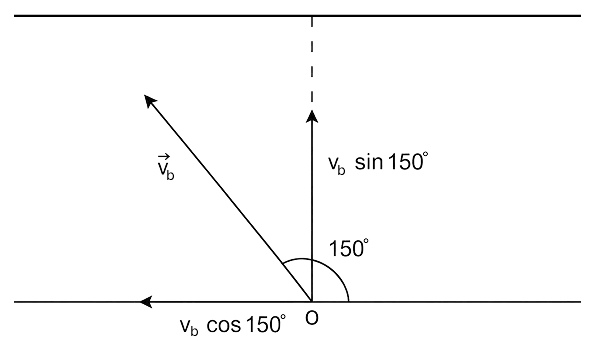
The boat moves at an angle of 150° to the direction of the river flow, so the component of the boat's velocity perpendicular to the banks is

v=vbsin150=27×12=13.5 km h1\text v_\perp = \text v_b \sin 150^\circ = 27 \times \dfrac{1}{2} \\[1em] = 13.5\ \text{km h}^{-1}

The velocity of the river is along the banks and therefore does not help in crossing; it only carries the boat downstream. Converting into m s-1,

v=13.5×518=3.75 m s1\text v_\perp = 13.5 \times \dfrac{5}{18} \\[1em] = 3.75\ \text{m s}^{-1}

The time taken to cross is 30 s, so the width of the river is

d=v×t=3.75×30=112.5 m\text d = \text v_\perp \times \text t \\[1em] = 3.75 \times 30 \\[1em] = 112.5\ \text m

Competition Zone — MCQ (More Than One Correct Options)

Question 1

Select the correct alternative(s). The coordinates of a particle moving in a plane are given by x = a cos pt and y = b sin pt, where a, b (< a) and p are positive constants of appropriate dimensions. Then :

  1. the path of the particle is an ellipse
  2. the velocity and acceleration of the particle are normal to each other at t = π / 2p
  3. the acceleration of the particle is always directed towards a focus
  4. the distance travelled by the particle in time interval t = 0 to t = π / 2p is a.

Answer

  1. the path of the particle is an ellipse
  2. the velocity and acceleration of the particle are normal to each other at t = π / 2p

Reason

Given,

  • x = a cos pt and y = b sin pt, where a, b (< a) and p are positive constants

Option 1 : From the given coordinates,

xa=cosptandyb=sinpt\dfrac{\text x}{\text a} = \cos \text{pt} \quad \text{and} \quad \dfrac{\text y}{\text b} = \sin \text{pt}

Squaring and adding, and using sin2 pt + cos2 pt = 1,

x2a2+y2b2=cos2pt+sin2ptx2a2+y2b2=1\dfrac{\text x^2}{\text a^2} + \dfrac{\text y^2}{\text b^2} = \cos^2 \text{pt} + \sin^2 \text{pt} \\[1em] \dfrac{\text x^2}{\text a^2} + \dfrac{\text y^2}{\text b^2} = 1

which is the equation of an ellipse with semi-axes a and b. Hence option 1 is correct.

Option 2 : Differentiating the coordinates with respect to time, and using the chain rule with d(pt)dt=p\dfrac{\text d(\text{pt})}{\text{dt}} = \text p,

vx=dxdt=a(sinpt)×p=apsinptvy=dydt=b(cospt)×p=bpcospt\text v_x = \dfrac{\text{dx}}{\text{dt}} = \text a(-\sin \text{pt}) \times \text p = -\text{ap} \sin \text{pt} \\[1em] \text v_y = \dfrac{\text{dy}}{\text{dt}} = \text b(\cos \text{pt}) \times \text p = \text{bp} \cos \text{pt}

so that

v=apsinpt i^+bpcospt j^\vec{\text v} = -\text{ap} \sin \text{pt}\ \hat{i} + \text{bp} \cos \text{pt}\ \hat{j}

Differentiating the velocity components once more,

ax=dvxdt=ap(cospt)×p=ap2cosptay=dvydt=bp(sinpt)×p=bp2sinpt\text a_x = \dfrac{\text{dv}_x}{\text{dt}} = -\text{ap}(\cos \text{pt}) \times \text p = -\text{ap}^2 \cos \text{pt} \\[1em] \text a_y = \dfrac{\text{dv}_y}{\text{dt}} = \text{bp}(-\sin \text{pt}) \times \text p = -\text{bp}^2 \sin \text{pt}

so that

a=ap2cospt i^bp2sinpt j^\vec{\text a} = -\text{ap}^2 \cos \text{pt}\ \hat{i} - \text{bp}^2 \sin \text{pt}\ \hat{j}

At t=π2p\text t = \dfrac{\pi}{2\text p}, that is pt = 90°, we have sin pt = 1 and cos pt = 0. Therefore,

v=ap i^anda=bp2 j^{\vec{\text v}} = -\text{ap}\ \hat{i} \quad \text{and} \quad \vec{\text a} = -\text{bp}^2\ \hat{j}

Taking their scalar product,

va=(ap)(0)+(0)(bp2)=0\vec{\text v} \cdot \vec{\text a} = (-\text{ap})(0) + (0)(-\text{bp}^2) = 0

Since the scalar product is zero and neither vector is a null vector, the two are normal to each other. Hence option 2 is correct.

Option 3 : The acceleration can be written as

a=p2(acospt i^+bsinpt j^)=p2(xi^+yj^)=p2r\vec{\text a} = -\text p^2(\text a \cos \text{pt}\ \hat{i} + \text b \sin \text{pt}\ \hat{j}) \\[1em] = -\text p^2(\text x\hat{i} + \text y\hat{j}) = -\text p^2\vec{\text r}

The negative sign shows that the acceleration is always directed opposite to the position vector, that is, towards the centre of the ellipse and not towards a focus. Hence option 3 is incorrect.

Option 4 : In the interval t = 0 to t=π2p\text t = \dfrac{\pi}{2\text p} the particle moves from the point (a, 0) to the point (0, b) along a quarter of the elliptical path. The distance travelled is the length of this arc, which is greater than a and is not equal to a. Hence option 4 is incorrect.

Competition Zone — Numericals

Question 1

Two vectors A \vec{A} \spaceand B \vec{B} \spaceare defined as A=ai^\vec{A} = a\hat{i} and B=a(cosωti^+sinωtj^)\vec{B} = a(\cos ωt\hat{i} + \sin ωt\hat{j}), where a is a constant and ω=π6ω = \dfrac{π}{6} rad s-1. If A+B=3AB|\vec{A} + \vec{B}| = \sqrt{3}|\vec{A} - \vec{B}| at time t = τ for the first time, the value of τ, in seconds, is ........... . Round off your answer up to second decimal place.

Answer

Given,

  • A=ai^\vec{\text A} = \text a\hat{i} and B=a(cosωi^+sinωj^)\vec{\text B} = \text a(\cos \omega \text t\ \hat{i} + \sin \omega \text t\ \hat{j})
  • ω=π6\omega = \dfrac{\pi}{6} rad s-1

Both vectors have the same magnitude a, and the angle between them is ωt. Therefore,

A+B2=a2+a2+2a2cosωt=2a2(1+cosωt)AB2=a2+a22a2cosωt=2a2(1cosωt)|\vec{\text A} + \vec{\text B}|^2 = \text a^2 + \text a^2 + 2\text a^2 \cos \omega \text t = 2\text a^2(1 + \cos \omega \text t) \\[1em] |\vec{\text A} - \vec{\text B}|^2 = \text a^2 + \text a^2 - 2\text a^2 \cos \omega \text t = 2\text a^2(1 - \cos \omega \text t)

Given that A+B=3AB|\vec{\text A} + \vec{\text B}| = \sqrt{3}|\vec{\text A} - \vec{\text B}|, squaring both sides,

2a2(1+cosωt)=3×2a2(1cosωt)1+cosωt=33cosωt4cosωt=2cosωt=122\text a^2(1 + \cos \omega \text t) = 3 \times 2\text a^2(1 - \cos \omega \text t) \\[1em] 1 + \cos \omega \text t = 3 - 3\cos \omega \text t \\[1em] 4\cos \omega \text t = 2 \quad \Rightarrow \quad \cos \omega \text t = \dfrac{1}{2}

For the first time this happens when

ωt=π3\omega \text t = \dfrac{\pi}{3}

Substituting ω=π6\omega = \dfrac{\pi}{6},

π6τ=π3τ=2 s\dfrac{\pi}{6}\tau = \dfrac{\pi}{3} \quad \Rightarrow \quad \tau = 2\ \text s

Hence, the value of τ is 2.00 s.

Question 2

A ball is projected from the ground at an angle of 45° with the horizontal surface. It reaches a maximum height of 120 m and returns to the ground. Upon hitting the ground for the first time, it loses half of its kinetic energy. Immediately after the bounce, the velocity of the ball makes an angle of 30° with the horizontal surface. The maximum height it reaches after the bounce, in metres, is ......... . Calculate upto second decimal place.

Answer

Given,

  • Angle of projection, θ1 = 45°
  • Maximum height before the bounce, h1 = 120 m
  • Angle after the bounce, θ2 = 30°
  • Kinetic energy after the bounce = half the kinetic energy before the bounce

Before the bounce, the maximum height is

h1=u2sin2452g=u24g=120u2=480 g\text h_1 = \dfrac{\text u^2 \sin^2 45^\circ}{2\text g} = \dfrac{\text u^2}{4\text g} = 120 \quad \Rightarrow \quad \text u^2 = 480\ \text g

The ball returns to the ground with the same speed u. Since it loses half of its kinetic energy on hitting the ground,

12mv2=12(12mu2)v2=u22=240 g\dfrac{1}{2}\text{mv}^2 = \dfrac{1}{2}\left(\dfrac{1}{2}\text{mu}^2\right) \quad \Rightarrow \quad \text v^2 = \dfrac{\text u^2}{2} = 240\ \text g

The maximum height reached after the bounce is

h2=v2sin2302g=240g×142g=602=30 m\text h_2 = \dfrac{\text v^2 \sin^2 30^\circ}{2\text g} = \dfrac{240\text g \times \dfrac{1}{4}}{2\text g} \\[1em] = \dfrac{60}{2} \\[1em] = 30\ \text m

Hence, the maximum height reached after the bounce is 30.00 m.

Question 3

If A=(2i^+3j^k^)\vec{A} = (2\hat{i} + 3\hat{j} - \hat{k}) m and B=(i^+2j^+2k^)\vec{B} = (\hat{i} + 2\hat{j} + 2\hat{k}) m. The magnitude of component of vector A \vec{A} \spacealong vector B \vec{B} \spacewill be ............ m.

Answer

Given,

  • A=(2i^+3j^k^)\vec{\text A} = (2\hat{i} + 3\hat{j} - \hat{k}) m
  • B=(i^+2j^+2k^)\vec{\text B} = (\hat{i} + 2\hat{j} + 2\hat{k}) m

The magnitude of the component of A \vec{\text A} \spacealong B \vec{\text B} \spacehas to be calculated.

If θ is the angle between the two vectors, the component (projection) of A \vec{\text A} \spacealong B \vec{\text B} \spaceis A cos θ. Since AB=ABcosθ\vec{\text A} \cdot \vec{\text B} = \text{AB} \cos \theta,

Acosθ=ABB=ABB\text A \cos \theta = \dfrac{\vec{\text A} \cdot \vec{\text B}}{\text B} = \dfrac{\vec{\text A} \cdot \vec{\text B}}{|\vec{\text B}|}

The scalar product is equal to the sum of the products of the corresponding components,

AB=(2)(1)+(3)(2)+(1)(2)=2+62=6 m2\vec{\text A} \cdot \vec{\text B} = (2)(1) + (3)(2) + (-1)(2) \\[1em] = 2 + 6 - 2 \\[1em] = 6\ \text m^2

The magnitude of B \vec{\text B} \spaceis

B=(1)2+(2)2+(2)2=1+4+4=9=3 m|\vec{\text B}| = \sqrt{(1)^2 + (2)^2 + (2)^2} \\[1em] = \sqrt{1 + 4 + 4} = \sqrt{9} \\[1em] = 3\ \text m

Substituting these values,

Acosθ=63=2 m\text A \cos \theta = \dfrac{6}{3} \\[1em] = 2\ \text m

Hence, the magnitude of the component of A \vec{\text A} \spacealong B \vec{\text B} \spaceis 2 m.

Question 4

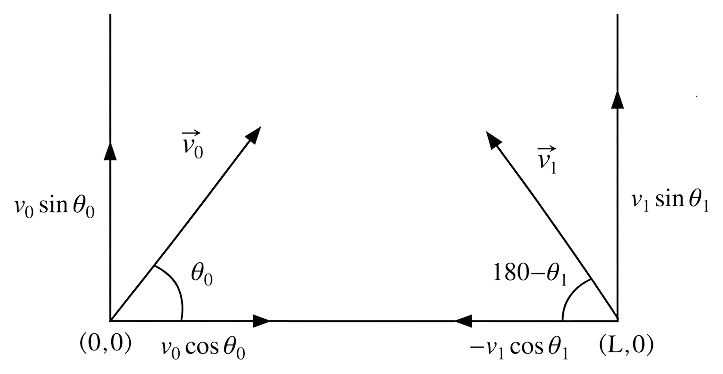
A ball is thrown from the location (x0, y0) = (0, 0) of a horizontal playground with an initial speed v0 at an angle θ0 from the x-direction. The ball is to be hit by a stone, which is thrown at the same time from the location (x1, y1) = (L, 0). The stone is thrown at an angle (180° − θ) from the x-axis (direction) with a suitable initial speed. For a fixed v0 when (θ0, θ1) = (45°, 45°), the stone hits the ball after time t1 and when (θ0, θ) = (60°, 30°) it hits the ball after time T2. In such a case (T1T2)2\left(\dfrac{T_1}{T_2}\right)^2 is ...

Answer

Given,

  • The ball is thrown from (0, 0) with speed v0 at an angle θ0 with the x-direction
  • The stone is thrown from (L, 0) with speed v1 at an angle (180° − θ1) with the x-direction
  • Case (i) : (θ0, θ1) = (45°, 45°), time of collision T1
  • Case (ii) : (θ0, θ1) = (60°, 30°), time of collision T2

The value of (T1T2)2\left(\dfrac{\text T_1}{\text T_2}\right)^2 has to be calculated.

Both the ball and the stone move under the same acceleration due to gravity, so their relative acceleration is zero and the relative motion between them is uniform along a straight line.

A ball is thrown from the location (x 0, y 0 ) = (0, 0) of a horizontal playground with an initial speed v 0 at an angle θ 0 from the x-direction. The ball is to be hit by a stone, which is thrown at the same time from the location (x 1, y 1 ) = (L, 0). The stone is thrown at an angle (180° − θ) from the x-axis (direction) with a suitable initial speed. For a fixed v 0 when (θ 0, θ 1 ) = (45°, 45°), the stone hits the ball after time t 1 and when (θ 0, θ) = (60°, 30°) it hits the ball after time T 2. In such a case (T_1/T_2 )^2 is... Motion in a Plane, Solutions for Class 11 ISC Nootan Physics Kumar Mittal Nageen Prakashan

Resolving the velocities of the two bodies, the ball has components (v0 cos θ0, v0 sin θ0) and the stone, thrown at (180° − θ1), has components (−v1 cos θ1, v1 sin θ1).

Since the two must meet, their vertical displacements must be equal at the instant of collision,

v0sinθ0T12gT2=v1sinθ1T12gT2\text v_0 \sin \theta_0\text T - \dfrac{1}{2}\text{gT}^2 = \text v_1 \sin \theta_1\text T - \dfrac{1}{2}\text{gT}^2

The terms containing g cancel, giving

v0sinθ0=v1sinθ1...............(1)\text v_0 \sin \theta_0 = \text v_1 \sin \theta_1 \quad \text{...............(1)}

Along the horizontal direction the two bodies approach each other, so the separation L is closed by the sum of the horizontal components of the two velocities,

(v0cosθ0+v1cosθ1)T=LT=Lv0cosθ0+v1cosθ1...............(2)(\text v_0 \cos \theta_0 + \text v_1 \cos \theta_1)\text T = \text L \\[1em] \text T = \dfrac{\text L}{\text v_0 \cos \theta_0 + \text v_1 \cos \theta_1} \quad \text{...............(2)}

Case (i) : (θ0, θ1) = (45°, 45°)

From equation (1),

v0sin45=v1sin45v1=v0\text v_0 \sin 45^\circ = \text v_1 \sin 45^\circ \quad \Rightarrow \quad \text v_1 = \text v_0

Substituting in equation (2),

T1=Lv0cos45+v0cos45=Lv0×12+v0×12=L2v02=L2v0\text T_1 = \dfrac{\text L}{\text v_0 \cos 45^\circ + \text v_0 \cos 45^\circ} \\[1em] = \dfrac{\text L}{\text v_0 \times \dfrac{1}{\sqrt{2}} + \text v_0 \times \dfrac{1}{\sqrt{2}}} \\[1em] = \dfrac{\text L}{\dfrac{2\text v_0}{\sqrt{2}}} = \dfrac{\text L}{\sqrt{2}\text v_0}

Case (ii) : (θ0, θ1) = (60°, 30°)

From equation (1),

v0sin60=v1sin30v0×32=v1×12v1=3v0\text v_0 \sin 60^\circ = \text v_1 \sin 30^\circ \\[1em] \text v_0 \times \dfrac{\sqrt{3}}{2} = \text v_1 \times \dfrac{1}{2} \\[1em] \text v_1 = \sqrt{3}\text v_0

Substituting in equation (2),

T2=Lv0cos60+3v0cos30=Lv0×12+3v0×32=Lv02+3v02=L2v0\text T_2 = \dfrac{\text L}{\text v_0 \cos 60^\circ + \sqrt{3}\text v_0 \cos 30^\circ} \\[1em] = \dfrac{\text L}{\text v_0 \times \dfrac{1}{2} + \sqrt{3}\text v_0 \times \dfrac{\sqrt{3}}{2}} \\[1em] = \dfrac{\text L}{\dfrac{\text v_0}{2} + \dfrac{3\text v_0}{2}} = \dfrac{\text L}{2\text v_0}

Taking the ratio of the two times,

T1T2=L2v0×2v0L=22=2\dfrac{\text T_1}{\text T_2} = \dfrac{\text L}{\sqrt{2}\text v_0} \times \dfrac{2\text v_0}{\text L} \\[1em] = \dfrac{2}{\sqrt{2}} = \sqrt{2}

Therefore,

(T1T2)2=(2)2=2\left(\dfrac{\text T_1}{\text T_2}\right)^2 = (\sqrt{2})^2 \\[1em] = 2

Hence, the value of (T1T2)2\left(\dfrac{\text T_1}{\text T_2}\right)^2 is 2.

Note: In the question, both t1t_1 and T1T_1 are used to represent the same time, while both θ\theta and θ1\theta_1 are used to represent the same angle. To avoid confusion and keep the notation consistent, the solution uses T1T_1 for time and θ1\theta_1 for the angle throughout.

Question 5

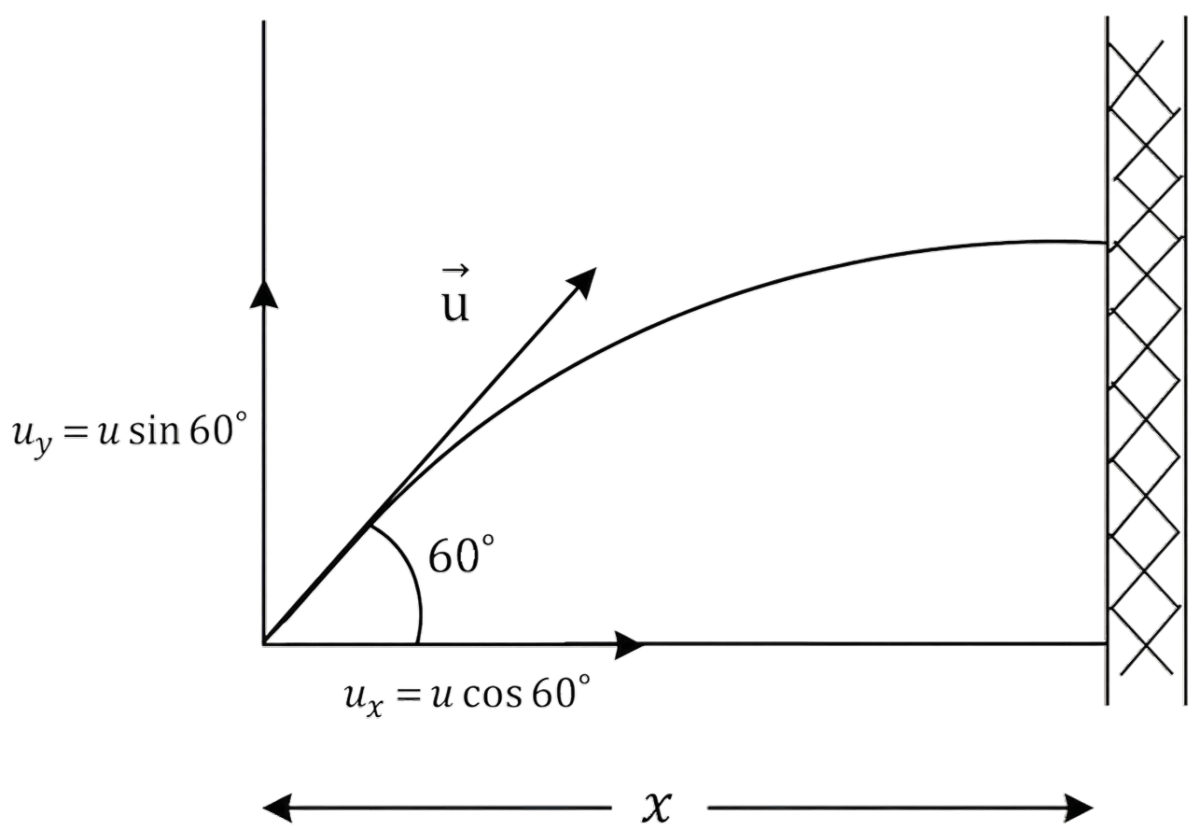
A projectile of mass 200 g is launched in a viscous medium at an angle 60° with the horizontal, with an initial velocity of 270 m/s. It experiences a viscous drag force FCv \vec{F} - C\vec{v} \spacewhere the drag coefficient C = 0.1 kg/s and v \vec{v} \spaceis the instantaneous velocity of the projectile. The projectile hits a vertical wall after 2 s. Taking e = 2.7, the horizontal distance of the wall from the point of projection (in m) is ......... .

Answer

Given,

  • Mass of the projectile, m = 200 g = 0.2 kg
  • Initial velocity, u = 270 m s-1 at 60° with the horizontal
  • Drag coefficient, C = 0.1 kg s-1
  • Time of flight up to the wall, t = 2 s
  • e = 2.7
A projectile of mass 200 g is launched in a viscous medium at an angle 60° with the horizontal, with an initial velocity of 270 m/s. It experiences a viscous drag force vecF - C vecv where the drag coefficient C = 0.1 kg/s and vecv is the instantaneous velocity of the projectile. The projectile hits a vertical wall after 2 s. Taking e = 2.7, the horizontal distance of the wall from the point of projection (in m) is Motion in a Plane, Solutions for Class 11 ISC Nootan Physics Kumar Mittal Nageen Prakashan

The horizontal distance of the wall from the point of projection has to be calculated.

The horizontal component of the velocity of projection is

ux=ucos60=270×12=135 m s1\text u_x = \text u \cos 60^\circ = 270 \times \dfrac{1}{2} \\[1em] = 135\ \text{m s}^{-1}

Along the horizontal direction the only force acting is the viscous drag, which opposes the motion. Applying Newton's second law,

mdvdt=Cv\text m\dfrac{\text{dv}}{\text{dt}} = -\text{Cv}

Separating the variables,

dvv=Cmdt\dfrac{\text{dv}}{\text v} = -\dfrac{\text C}{\text m}\text{dt}

Integrating from v = ux at t = 0 to v = vx at time t,

uxvxdvv=Cm0tdt[lnv]uxvx=Cm[t]0tln(vxux)=Ctm\int_{\text u_x}^{\text v_x} \dfrac{\text{dv}}{\text v} = -\dfrac{\text C}{\text m}\int_0^{\text t} \text{dt} \\[1em] \left[\ln \text v\right]_{\text u_x}^{\text v_x} = -\dfrac{\text C}{\text m}\left[\text t\right]_0^{\text t} \\[1em] \ln\left(\dfrac{\text v_x}{\text u_x}\right) = -\dfrac{\text{Ct}}{\text m}

Taking the antilogarithm,

vx=uxeCt/m\text v_x = \text u_x\text e^{-\text{Ct}/\text m}

Here Cm=0.10.2=0.5\dfrac{\text C}{\text m} = \dfrac{0.1}{0.2} = 0.5 s-1, so vx = ux e-0.5t. The horizontal distance covered in time t is obtained by integrating the velocity,

x=0tvxdt=0tuxe0.5tdt=ux[e0.5t0.5]0t=ux0.5(e0.5te0)=ux0.5(1e0.5t)\text x = \int_0^{\text t} \text v_x\text{dt} = \int_0^{\text t} \text u_x\text e^{-0.5\text t}\text{dt} \\[1em] = \text u_x\left[\dfrac{\text e^{-0.5\text t}}{-0.5}\right]_0^{\text t} \\[1em] = -\dfrac{\text u_x}{0.5}\left(\text e^{-0.5\text t} - \text e^{0}\right) \\[1em] = \dfrac{\text u_x}{0.5}\left(1 - \text e^{-0.5\text t}\right)

Substituting ux = 135 m s-1 and t = 2 s,

x=1350.5(1e0.5×2)=270(1e1)=270(112.7)=270×2.712.7=270×1.72.7=170 m\text x = \dfrac{135}{0.5}\left(1 - \text e^{-0.5 \times 2}\right) \\[1em] = 270\left(1 - \text e^{-1}\right) \\[1em] = 270\left(1 - \dfrac{1}{2.7}\right) \\[1em] = 270 \times \dfrac{2.7 - 1}{2.7} \\[1em] = 270 \times \dfrac{1.7}{2.7} \\[1em] = 170\ \text m

Hence, the horizontal distance of the wall from the point of projection is 170 m.

Note: In the question, the drag force is incorrectly printed as FCv\vec{F} - C\vec{v}. The correct formula is F=Cv\vec{F} = -C\vec{v}, where the negative sign shows that the drag force acts in the direction opposite to the velocity. Therefore, the correct formula has been used in the solution.

PrevNext