
Give the magnitude and direction of the net force acting on :
(a) a raindrop falling down with constant speed.
(b) a cork of mass 10 g floating on water.
(c) a kite skillfully held stationary in the sky.
(d) a car moving with a constant velocity of 30 km/h on a rough road.
(e) a high-speed electron in space far from all material objects and free of electric and magnetic fields.
Answer
In each of the five cases the net force acting on the body is zero.
(a) The raindrop is falling with a constant speed along a constant direction, so its acceleration is zero. Hence, by Newton's second law, the net force F (= ma) on the drop is zero. Its weight is balanced by the viscous drag of air and the buoyant force.
(b) The cork is floating on water, so its weight is balanced by the upward buoyant force due to water. Hence, the net force on the cork is zero.
(c) The kite is maintained at rest in the sky. Hence, as required by Newton's first (or second) law, the net force on it is zero.
(d) The car is moving on the rough road with a constant velocity, that is, with zero acceleration. Hence, the net force F (= ma) on it is zero. The force exerted by the accelerator is balanced by the force of friction between the tyres and the rough road.
(e) No field — gravitational, electric or magnetic — is acting on the electron, and it is far away from all material objects. Hence, the net force on it is zero.
A pebble of mass 0.05 kg is thrown vertically upwards. Give the direction and magnitude of the net force on the pebble (a) during its upward motion, (b) during its downward motion, (c) at the highest point where it is momentarily at rest. Do your answers change if the pebble was thrown at an angle of 45° with the horizontal direction? Ignore air resistance.
Answer
Given,
- Mass of the pebble, m = 0.05 kg
- Acceleration due to gravity, g = 9.8 m s-2
The magnitude and the direction of the net force in each case has to be found.
Air resistance is ignored, so the only force acting on the pebble at every point of its motion is the gravity force. It always acts vertically downwards, towards the centre of the earth, and its magnitude is
(a) During the upward motion, the net force is 0.49 N, directed vertically downwards.
(b) During the downward motion, the net force is again 0.49 N, directed vertically downwards.
(c) At the highest point the velocity of the pebble is momentarily zero, but its acceleration is not zero. The net force is still 0.49 N, directed vertically downwards.
No, the answers do not change if the pebble is thrown at an angle of 45° with the horizontal. Ignoring air resistance, gravity is the only force acting on it, and it is 0.49 N vertically downwards at every point of the trajectory. At the highest point of this trajectory only the vertical component of velocity becomes zero; the horizontal component remains constant.
Give the magnitude and direction of the net force acting on a stone of mass 0.1 kg :
(a) just after it is dropped from the window of a stationary train.
(b) just after it is dropped from the window of a train running at a constant velocity of 36 km/h.
(c) just after it is dropped from the window of a train accelerating with 1 ms-2.
(d) lying on the floor of a train accelerating with 1 ms-2, the stone being at rest relative to the train.
Neglect air resistance throughout and take g = 9.8 ms-2.
Answer
Given,
- Mass of the stone, m = 0.1 kg
- Acceleration due to gravity, g = 9.8 m s-2
Air resistance is neglected, so once the stone is dropped the only force acting on it is the gravity force,
(a) By Newton's second law, the net force on the stone is F = ma, where a = g = 9.8 m s-2. Hence, the net force is 0.98 N, directed vertically downwards.
(b) The motion of the train with a constant velocity exerts no force on the stone. Hence, the net force is the same as in case (a), that is, 0.98 N, directed vertically downwards.
(c) While the stone is being carried by the accelerating train, an additional force
acts on it along the direction of motion of the train. But as soon as the stone is dropped, the force F' no longer acts on it. Hence, the net force on the stone is again 0.98 N, directed vertically downwards.
(d) The stone lying on the floor is at rest relative to the train, so the gravity force mg on it is balanced by the normal reaction of the floor. The stone is, however, accelerated along with the train. Hence, the net force acting on it is
directed horizontally, along the direction of motion of the train. This force is provided by the force of friction between the stone and the floor of the train.
One end of a string of length l is connected to a particle of mass m and the other to a small peg on a smooth horizontal table. If the particle moves in a circle with speed v, the net force on the particle (directed towards the centre) is : (i) T, (ii) , (iii) , (iv) 0, T is the tension in the string. [Choose the correct alternative].
Answer
(i) T
Reason — On a smooth horizontal table the particle describes a horizontal circle, so the gravity force mg on the particle and the normal reaction of the table balance each other and have no component towards the centre. The net force on the particle directed towards the centre is therefore the centripetal force required to keep it in circular motion, and this force is provided entirely by the tension in the string (there is neither friction nor any other horizontal force). Hence,
A constant retarding force of 50 N is applied to a body of mass 20 kg moving initially with a speed of 15 ms-1. How long does the body take to stop?
Answer
Given,
- Retarding force, F = −50 N
- Mass of the body, m = 20 kg
- Initial speed, u = 15 m s-1
- Final speed, v = 0 (the body stops)
The time t taken by the body to stop has to be calculated.
By Newton's second law of motion, the acceleration produced in the body is
Substituting the values,
The negative sign shows that it is a retardation. Now, from the first equation of motion,
Hence, the body takes 6 s to stop.
A constant force acting on a body of mass 3.0 kg changes its speed from 2.0 m s-1 to 3.5 m s-1 in 25 s. The direction of the motion of the body remains unchanged. What is the magnitude and direction of the force?
Answer
Given,
- Mass of the body, m = 3.0 kg
- Initial speed, u = 2.0 m s-1
- Final speed, v = 3.5 m s-1
- Time interval, t = 25 s
The magnitude and the direction of the force have to be calculated.
From the first equation of motion, the acceleration produced in the body is
Substituting the values,
By Newton's second law of motion, the force acting upon the body is
Since the force increases the speed of the body without changing the direction of motion, it acts along the direction of motion.
Hence, the force is 0.18 N, acting along the direction of motion of the body.
A body of mass 5 kg is acted upon by two perpendicular forces of 8 N and 6 N. Give the magnitude and direction of the acceleration of the body.
Answer
Given,
- Mass of the body, m = 5 kg
- Two mutually perpendicular forces, F1 = 8 N and F2 = 6 N
The magnitude and the direction of the acceleration have to be calculated.
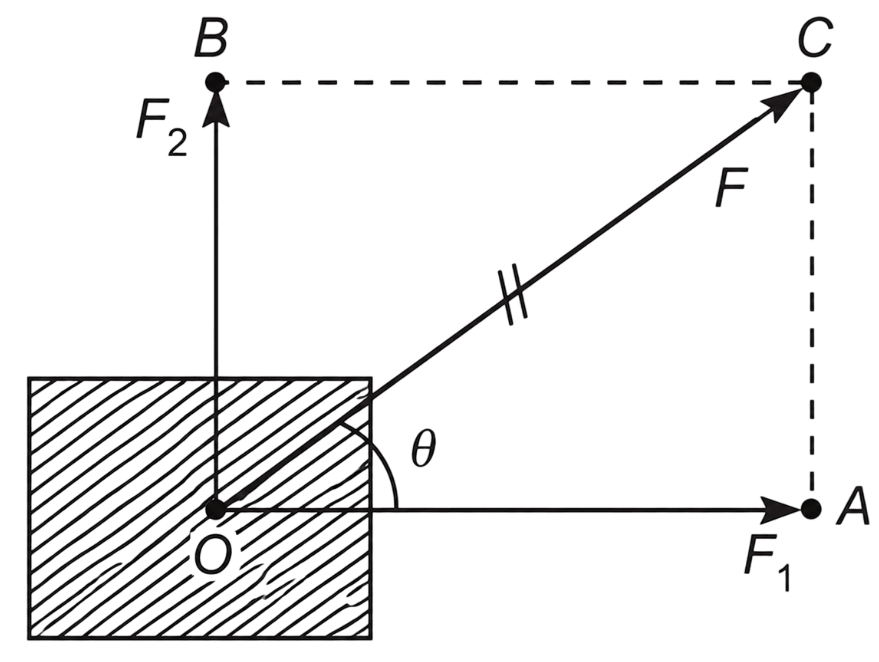
The two forces act at right angles to each other, so by the parallelogram law of vector addition the magnitude of their resultant is
Substituting the values,
By Newton's second law of motion, the magnitude of the acceleration produced is
If the resultant force makes an angle θ with the 8 N force, then
Hence, the acceleration produced is 2 m s-2, directed at nearly 37° with the direction of the 8 N force.
The driver of a three-wheeler moving with a speed of 36 km/h sees a child standing in the middle of a road and brings his vehicle to rest in 4 s just in time to save the child. What is the average retarding force on the vehicle? The mass of the vehicle is 400 kg and that of the driver is 65 kg.
Answer
Given,
- Initial speed, u = 36 km/h = = 10 m s-1
- Final speed, v = 0
- Time taken to stop, t = 4 s
- Mass of the vehicle = 400 kg and mass of the driver = 65 kg
The average retarding force on the vehicle has to be calculated.
The total mass which is retarded is
From the first equation of motion, v = u + at, the retardation produced is
By Newton's second law of motion, the retarding force applied on the three-wheeler is
The negative sign shows that the force is opposite to the direction of motion.
Hence, the average retarding force on the vehicle is 1162.5 N, acting opposite to the direction of motion.
A rocket with a lift-off mass 20,000 kg is blasted upwards with an initial acceleration of 5.0 ms-2. Find the initial thrust (force) of the blast. Take g = 9.8 ms-2.
Answer
Given,
- Lift-off mass of the rocket, m = 20,000 kg
- Initial upward acceleration, a = 5.0 m s-2
- Acceleration due to gravity, g = 9.8 m s-2
The initial thrust (force) of the blast has to be calculated.
The rocket moves up against gravity. Hence, the blast has to produce an acceleration which is the sum of the acceleration due to gravity and the observed upward acceleration,
By Newton's second law of motion, the initial thrust of the blast is
Substituting the values,
Hence, the initial thrust of the blast is 2.96 × 10⁵ N, directed vertically upwards.
A body of mass 0.40 kg moving initially with a constant speed of 10 ms-1 to the north is subject to a constant force of 8.0 N directed towards the south for 30 s. Take the instant the force is applied to be t = 0, the position of the body at that time to be x = 0, and predict its position at t = −5s, 25s, 100s.
Answer
Given,
- Mass of the body, m = 0.40 kg
- Initial velocity, u = +10 m s-1 (towards the north, taken as the positive direction)
- Force, F = −8.0 N (towards the south)
- The force acts from t = 0 to t = 30 s, and x = 0 at t = 0
The position of the body at t = −5 s, 25 s and 100 s has to be predicted.
By Newton's second law of motion, the acceleration produced during 0 < t < 30 s is
At t = −5 s : The force has not yet been applied, so the body moves uniformly with the speed of 10 m s-1. Going backwards from x = 0 at t = 0,
At t = 25 s : This instant lies within the interval during which the force acts, so the motion is uniformly accelerated. Using ,
At t = 100 s : The motion has to be considered in two parts.
From t = 0 to t = 30 s (accelerated motion) :
The velocity at t = 30 s is
From t = 30 s to t = 100 s (uniform motion, since the force no longer acts) : here Δt = 70 s, so
Therefore, the total displacement from t = 0 to t = 100 s is
Hence, the position of the body is 50 m to the south of the origin at t = −5 s, 6 km to the south at t = 25 s and 50 km to the south at t = 100 s.
A truck starts from rest and accelerates uniformly with 2.0 m s-2. At t = 10 s, a stone is dropped by a person standing on the top of the truck (6.0 m high from the ground). Find the (a) velocity and (b) acceleration of the stone at t = 11 s. Neglect air resistance and take g = 9.8 ms-2.
Answer
Given,
- Acceleration of the truck, a = 2.0 m s-2, starting from rest (u = 0)
- The stone is dropped at t = 10 s from a height of 6.0 m
- Acceleration due to gravity, g = 9.8 m s-2
The velocity and the acceleration of the stone at t = 11 s have to be calculated.
Horizontal motion : At the instant of dropping, the stone shares the horizontal velocity of the truck. From v = u + at,
After the stone is dropped no horizontal force acts on it (air resistance is neglected), so this horizontal velocity remains unchanged. Hence, at t = 11 s,
Vertical motion : At the instant of dropping the vertical velocity of the stone is zero, and it falls freely for a time
Using v = u + gt',
(a) The two components are mutually perpendicular, so the magnitude of the resultant velocity is
If θ is the angle made by this velocity with the horizontal, then
(b) After the stone is dropped, the only force acting on it is the gravity force. Hence, its acceleration is 9.8 m s-2, directed vertically downwards.
Hence, the velocity of the stone at t = 11 s is 22.3 m s-1 at 26.1° below the horizontal, and its acceleration is 9.8 m s-2 vertically downwards.
A bob of mass 0.1 kg hung from the ceiling of a room by a string 2 m long is set into oscillation. The speed of the bob at the mean position is 1 ms-1. What is the trajectory of the bob if the string is cut when the bob is (a) at one of its extreme positions, (b) at its mean position?
Answer
Given,
- Mass of the bob, m = 0.1 kg
- Length of the string, l = 2 m
- Speed of the bob at the mean position, v = 1 m s-1
The trajectory of the bob after the string is cut has to be described in each case.
As soon as the string is cut, the tension vanishes and the only force acting on the bob is the gravity force, acting vertically downwards. The subsequent path therefore depends entirely on the velocity the bob possesses at that instant.
(a) At an extreme position : The bob is momentarily at rest at an extreme position, so its velocity is zero. Under the gravity force alone, it therefore falls vertically downwards along a straight line.
(b) At the mean position : At the mean position the velocity of the bob is 1 m s-1, directed horizontally along the tangent to the arc. The bob thus has a horizontal velocity and a vertical acceleration g, which is exactly the condition of a horizontal projection. Hence, it describes a parabolic path and finally strikes the floor.
A man of mass 70 kg stands on a weighing machine in a lift, which is moving : (a) upwards with a uniform speed of 10 ms-1; (b) downwards with a uniform acceleration of 5 ms-2; (c) upwards with uniform acceleration of 5.0 ms-2. What would be the readings on the scale in each case? (d) What would be the reading if the lift mechanism failed and it hurtled down freely under gravity? (g = 9.8 ms-2)
Answer
Given,
- Mass of the man, m = 70 kg
- Acceleration due to gravity, g = 9.8 m s-2
The reading of the weighing machine, which is the normal reaction R exerted by the machine on the man, has to be calculated in each case.
(a) The lift is moving upwards with a uniform speed, so its acceleration is zero and the man is in equilibrium. Hence,
(b) The lift is moving downwards with an acceleration a = 5 m s-2. The net downward force on the man is mg − R, so
(c) The lift is moving upwards with an acceleration a = 5.0 m s-2. The net upward force on the man is R − mg, so
(d) If the lift mechanism fails, the lift and the man both fall freely with the acceleration due to gravity, that is, a = g. Hence,
Hence, the readings are 686 N, 336 N, 1036 N and zero respectively. In the last case the man is in the state of weightlessness.
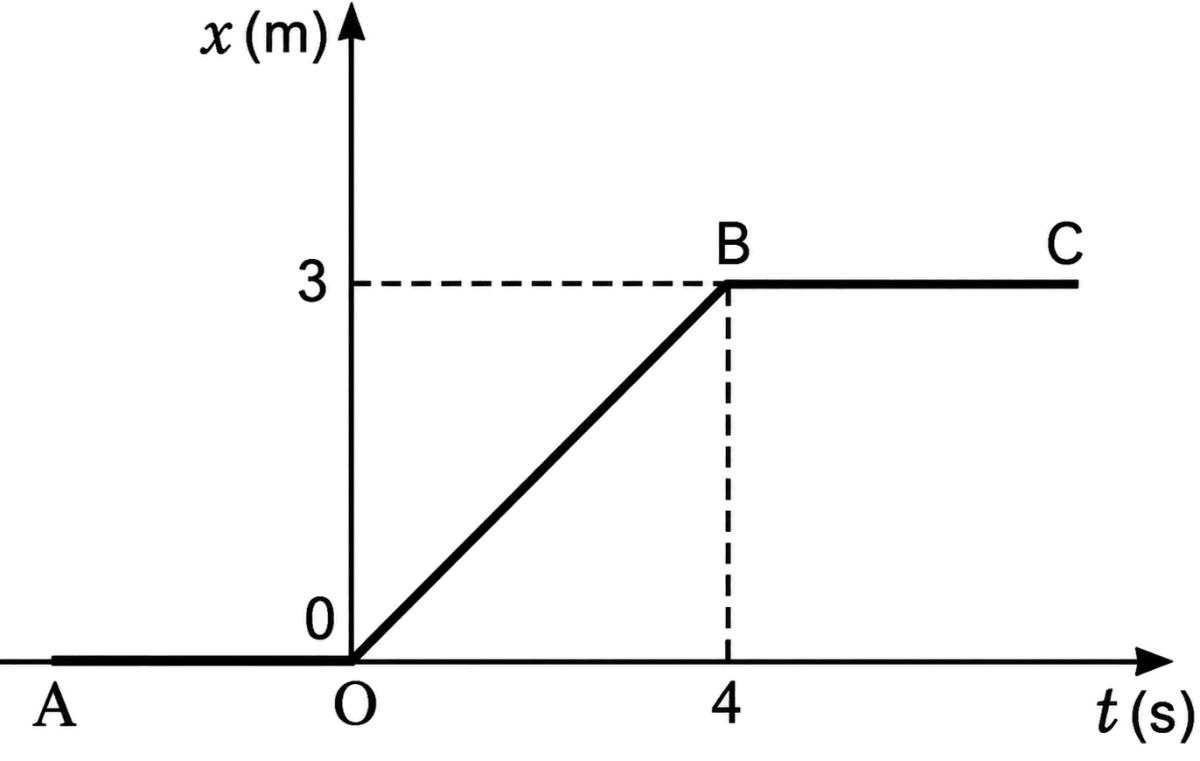
The figure shows the position-time (x − t) graph of a particle of mass 4 kg. (a) What is the force on the particle for t < 0, 0 < t < 4s and t > 4s? (b) Find the impulses imparted to the particle at t = 0 and at t = 4 s. Consider one-dimensional motion only.
Answer
Given,
- Mass of the particle, m = 4 kg
- The position-time graph is as shown
(a) For t < 0 : The graph lies along the time axis, showing that the particle remains at rest at x = 0. Since there is no acceleration, by Newton's second law the force on the particle is zero.
For 0 < t < 4 s : The graph is a straight line of constant slope, so the particle moves with a constant velocity
As the velocity is constant, the acceleration is zero and hence the force on the particle is zero.
For t > 4 s : The graph is again parallel to the time axis, showing that the position of the particle does not change with time, that is, the particle is at rest. Hence, the force on the particle is zero.
(b) Impulse is equal to the change in momentum produced.
Impulse at t = 0 : Just before t = 0 the particle is at rest (u = 0) and just after t = 0 it has a constant velocity v = 0.75 m s-1. Therefore,
Impulse at t = 4 s : Just before t = 4 s the particle moves with u = 0.75 m s-1 and just after t = 4 s it is at rest (v = 0). Therefore,
Hence, the force on the particle is zero in all the three intervals, and the impulses imparted at t = 0 and at t = 4 s are 3 kg m s-1 and −3 kg m s-1 respectively.
Two bodies of masses 10 kg and 20 kg respectively kept on a smooth, horizontal surface are tied to the ends of a light string. A horizontal force F = 600 N is applied to (i) A, (ii) B along the direction of string. What is the tension in the string in each case?
Answer
Given,
- Mass of body A, m1 = 10 kg
- Mass of body B, m2 = 20 kg
- Applied horizontal force, F = 600 N
- The horizontal surface is smooth
The tension in the string in each case has to be calculated.
Since the two bodies are tied by a light string, they move together with a common acceleration a, and the tension is the same throughout the string.
(i) When F is applied to A : The net force on A is F − T and the net force on B is T. By Newton's second law,
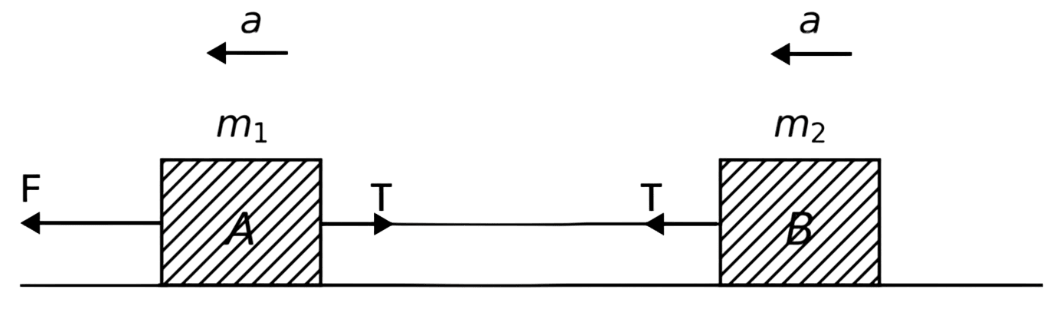
Adding the two equations,
Substituting this in equation (2),
(ii) When F is applied to B : Now the net force on B is F − T' and the net force on A is T'. Proceeding in the same way,
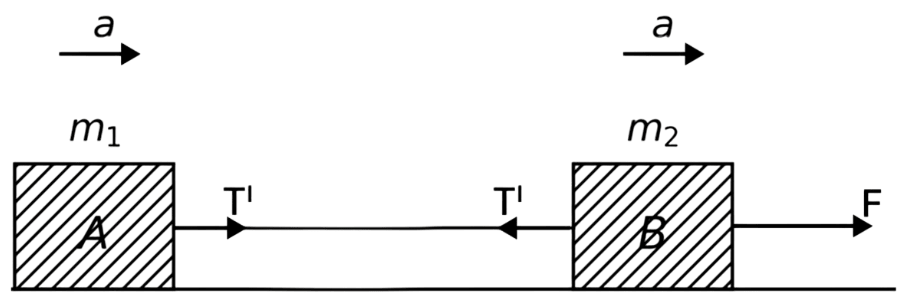
Hence, the tension in the string is 400 N when the force is applied to A and 200 N when it is applied to B.
Two masses m1 = 12 kg and m2 = 8 kg are connected at the two ends of a light, inextensible string passing over a light, frictionless pulley. Find the acceleration of the masses and the tension in the string when the masses are released.
Answer
Given,
- Masses, m1 = 12 kg and m2 = 8 kg
- Acceleration due to gravity, g = 9.8 m s-2
The acceleration of the masses and the tension in the string have to be calculated.
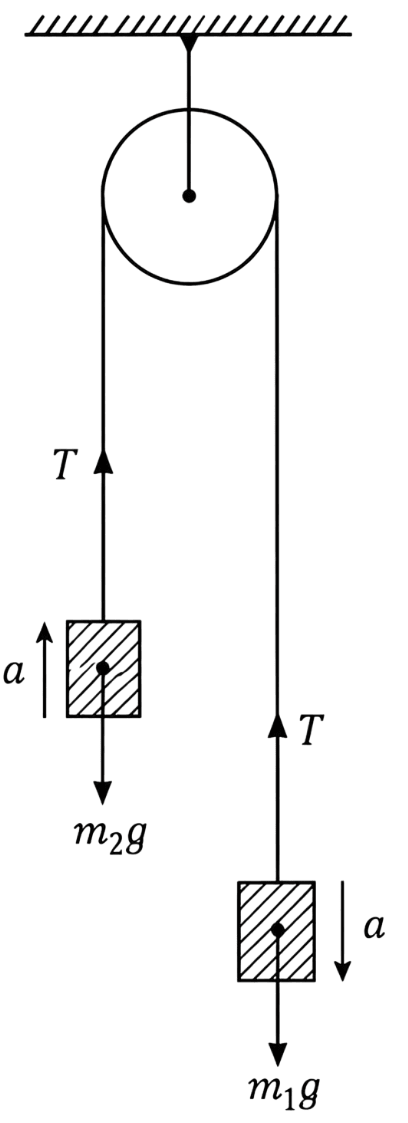
Since the string is light and inextensible, the tension T is the same throughout and the two masses have accelerations of the same magnitude a. As m1 is heavier, it moves downwards and m2 moves upwards.
For m1, the net downward force is m1g − T. By Newton's second law,
For m2, the net upward force is T − m2g. Again by Newton's second law,
Adding equations (1) and (2),
Substituting the values,
Substituting this value of a in equation (1),
Hence, the acceleration of the masses is 1.96 m s-2 and the tension in the string is nearly 94 N.
A nucleus is at rest in the laboratory frame of reference. It disintegrates into two smaller nuclei. Show that the products must move in opposite directions.
Answer
Let m1 and m2 be the masses of the two products of disintegration and and their respective velocities.
Before disintegration the nucleus is at rest in the laboratory frame of reference, so the total linear momentum of the system is zero,
After disintegration, the total linear momentum of the system is
The disintegration is caused by internal forces only, so no external force acts on the system. Hence, by the principle of conservation of linear momentum,
The masses m1 and m2 are positive quantities, so the negative sign shows that and are oppositely directed.
Hence, the two products of disintegration must move in opposite directions.
Two billiard balls each of mass 0.05 kg moving in opposite directions each with a speed of 6 ms-1 collide and rebound with the same speed. Find the impulse imparted to each ball due to the other.
Answer
Given,
- Mass of each ball, m = 0.05 kg
- Speed of each ball before collision = 6 m s-1
- Speed of each ball after collision = 6 m s-1, the direction being reversed
The impulse imparted to each ball due to the other has to be calculated.
Let the two balls be A and B, and let the direction of motion of A before the collision be taken as positive.
For ball A,
By the impulse-momentum theorem, the impulse imparted to ball A by ball B is equal to the change in its momentum,
By Newton's third law of motion, an equal and opposite impulse of +0.6 kg m s-1 is imparted to ball B by ball A.
Hence, the impulse imparted to each ball is 0.6 kg m s-1 in magnitude, the two impulses being oppositely directed.
A shell of mass 0.020 kg is fired by a gun of mass 100 kg. If the muzzle speed of the shell is 80 m s-1, what is the recoil speed of the gun?
Answer
Given,
- Mass of the shell, m1 = 0.020 kg
- Mass of the gun, m2 = 100 kg
- Muzzle speed of the shell, v1 = 80 m s-1
The recoil speed of the gun has to be calculated.
Initially both the gun and the shell are at rest, so the initial linear momentum of the system is zero. No external force acts on the system, so by the principle of conservation of linear momentum,
Substituting the values,
The negative sign shows that the gun moves in a direction opposite to that of the shell.
Hence, the recoil speed of the gun is 0.016 m s-1.
A batsman deflects a ball by an angle of 45° without changing its initial speed, which is equal to 54 km/h. What is the impulse imparted to the ball? (Mass of the ball is 0.15 kg.)
Answer
Given,
- Mass of the ball, m = 0.15 kg
- Speed of the ball, u = 54 km/h = = 15 m s-1, unchanged by the deflection
- Angle of deflection = 45°
The impulse imparted to the ball has to be calculated.
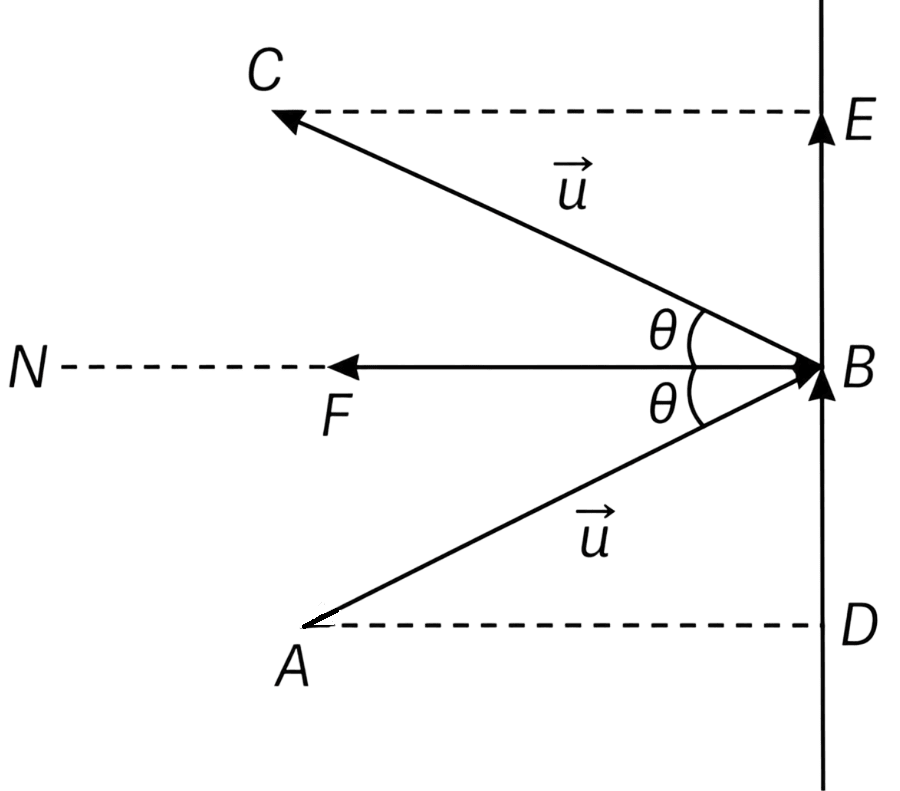
Suppose the ball moving along AB with a speed u strikes the bat at B and is deflected along BC with the same speed. The angle by which the ball is deflected is ∠ABC = 2θ = 45°, so θ = 22.5°.
Resolving the initial and the final velocities into components parallel and normal to the bat :
The components along the bat are each u sin θ and they are in the same direction. Hence, the change in momentum along the bat is
The components normal to the bat are just reversed. Therefore,
By the impulse-momentum theorem, the impulse imparted to the ball by the bat is the change in this normal momentum,
Substituting the values,
Hence, the impulse imparted to the ball is nearly 4.2 kg m s-1, directed normal to the bat.
A stone of mass 0.25 kg tied to the end of a string in a horizontal plane is whirled round in a circle of radius 1.5 m with a speed of 40 rev/min. What is the tension in the string? What is the maximum speed with which the stone can be whirled around if the string can withstand a maximum tension of 200 N?
Answer
Given,
- Mass of the stone, m = 0.25 kg
- Radius of the circle, r = 1.5 m
- Number of revolutions, n = 40 in t = 1 min = 60 s
- Maximum tension the string can withstand, Tmax = 200 N
The tension in the string and the maximum permissible speed have to be calculated.
The stone is whirled in a horizontal plane, so gravity has no effect on the motion. The necessary centripetal force is obtained wholly from the tension in the string,
where ω is the angular speed of the stone. Now,
Substituting the values,
Let vmax be the maximum speed at which the tension just becomes 200 N. Then,
Substituting the values,
Hence, the tension in the string is 6.6 N and the maximum permissible speed is nearly 34.6 m s-1.
If, in Exercise 21, the speed of the stone is increased beyond the maximum permissible value and the string breaks suddenly, which of the following correctly describes the trajectory of the stone after the string breaks:
(a) the stone moves radially outwards,
(b) the stone flies off tangentially from the instant the string breaks,
(c) the stone flies off at an angle with the tangent whose magnitude depends on the speed of the particle?
Answer
(b) the stone flies off tangentially from the instant the string breaks.
Reason — While the stone is being whirled round, the tension in the string supplies the centripetal force which continuously changes the direction of the velocity of the stone. At every instant the velocity of the stone is directed along the tangent to the circle at that point.
The moment the string breaks, the tension and hence the centripetal force vanishes instantly, so no net force acts on the stone towards the centre. By Newton's first law of motion the stone must then continue to move along the direction of its instantaneous velocity. Hence, it flies off along the tangent to the circular path at the point where the string breaks.
Alternative (a) is wrong because a radially outward motion would require a radially outward force, which does not exist, and alternative (c) is wrong because the direction of the instantaneous velocity is tangential whatever the speed of the stone may be.
Explain why :
(a) a horse cannot pull a cart and run in empty space.
(b) passengers are thrown forward from their seats when a speeding bus stops suddenly.
(c) it is easier to pull a lawn mower than to push it.
(d) a cricketer moves his hands backward while holding a catch.
Answer
(a) A horse cannot pull a cart and run in empty space. In order to pull the cart, the horse presses the ground obliquely backwards with its feet. By Newton's third law of motion the ground exerts an equal and opposite reaction on the horse, and it is the horizontal component of this reaction that pushes the horse-cart system forward. In empty space there is no ground, so no such frictional reaction is available and no external force acts on the horse-cart system. Hence, the system cannot move.
(b) Passengers are thrown forward when a speeding bus stops suddenly. When the bus stops suddenly, the lower part of the body of a passenger, which is in contact with the bus, comes to rest along with it. The upper part of the body, however, continues to remain in motion due to the inertia of motion. Hence, the passenger is thrown forward from the seat.
(c) It is easier to pull a lawn mower than to push it. When the mower is pulled by a force F applied at an angle θ to the vertical, the vertical component F cos θ acts opposite to the weight, so the normal reaction becomes R1 = mg − F cos θ. When it is pushed, this component acts along the weight, so the normal reaction becomes R2 = mg + F cos θ. Since the force of friction is directly proportional to the normal reaction, the friction in pushing is greater than that in pulling. Hence, it is easier to pull the mower than to push it.
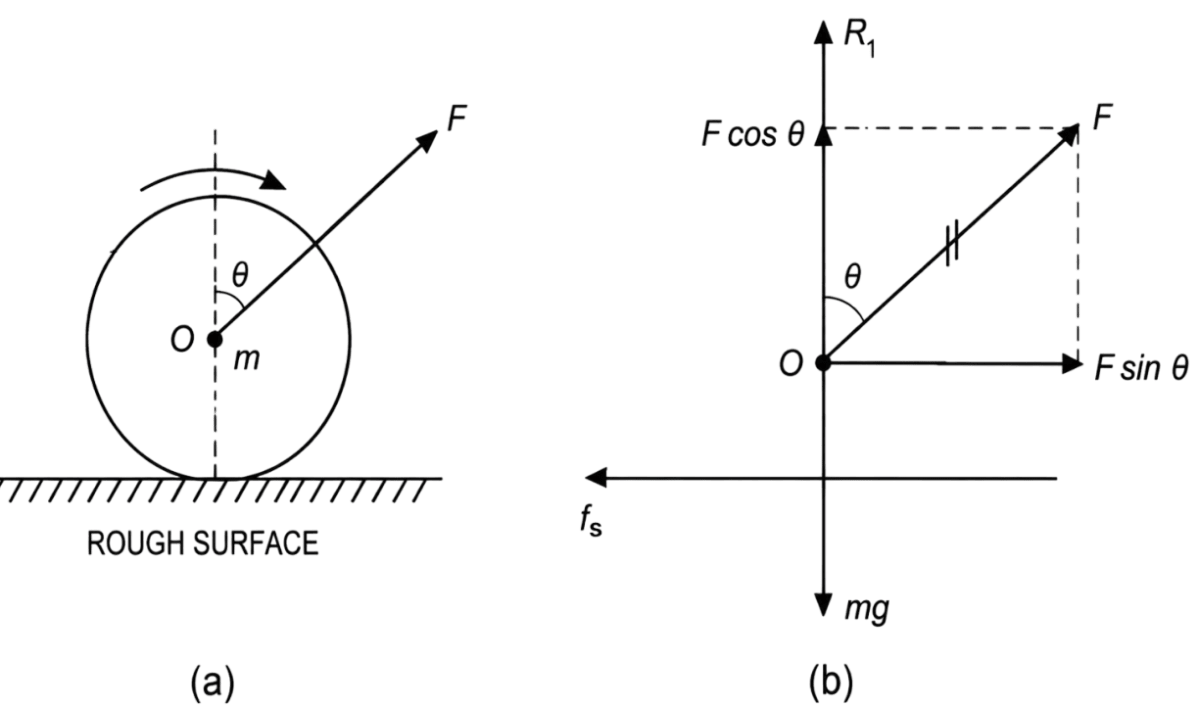
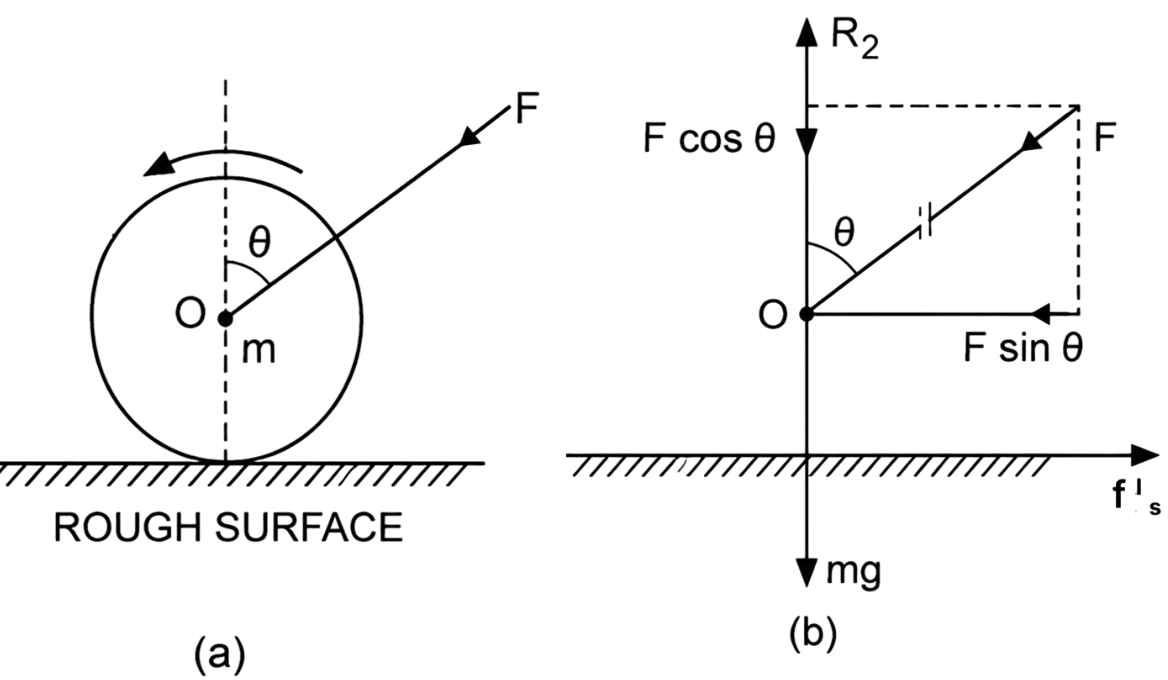
(d) A cricketer moves his hands backward while holding a catch. By moving his hands backward the cricketer increases the time in which the momentum of the ball is reduced to zero. From Newton's second law the force is equal to the rate of change of momentum,
The change in momentum Δp is fixed, so increasing Δt reduces the force exerted on his hands. Hence, his hands are not injured.