
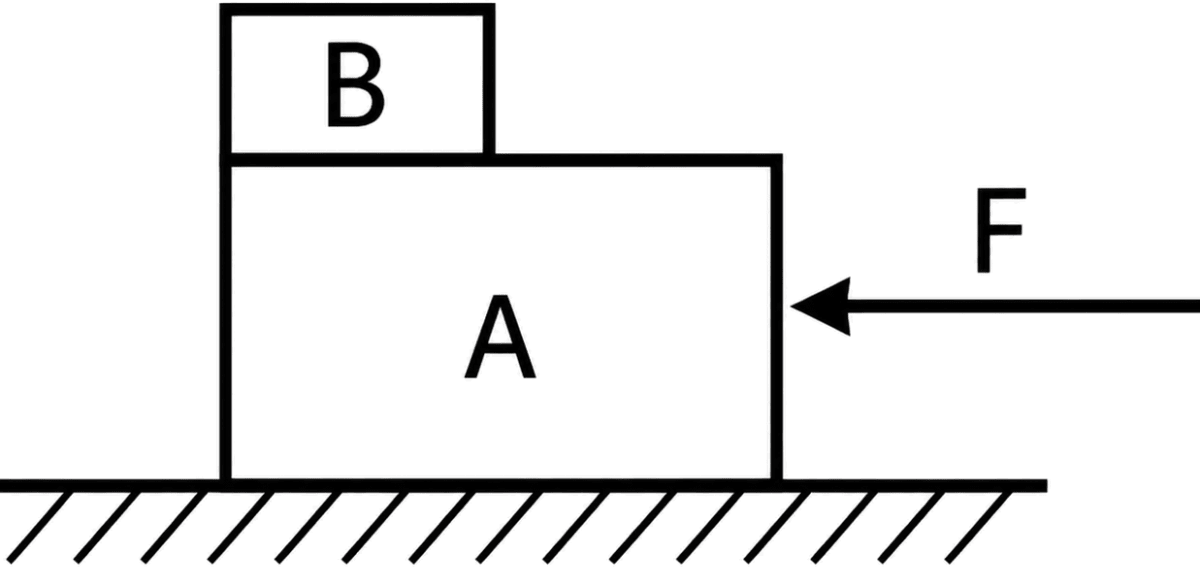
A small block B of mass m = 0.5 kg is placed at one end of a block A of mass M = 10 kg and length l = 50 cm. A force F = 50 N is applied at the other end of the block as shown in Fig. Find the time elapsed before the block B falls down. Assume all the surfaces are frictionless and neglect the dimension of block B.
Answer
Given,
- Mass of block B, m = 0.5 kg
- Mass of block A, M = 10 kg
- Length of block A, l = 50 cm = 0.5 m
- Applied force, F = 50 N
- All the surfaces are frictionless
The time elapsed before block B falls down has to be calculated.
Since all the surfaces are frictionless, no horizontal force is transmitted from A to B. By Newton's second law, the acceleration of block A is
For block B there is no horizontal force at all, so
Therefore, the acceleration of A relative to B is
Block B falls off when A has slipped through its whole length relative to B, that is, when the relative displacement is l = 0.5 m. Both start from rest, so using with u = 0,
Substituting the values,
Hence, block B falls down after 0.45 s.
Given fig. shows two blocks of masses m1 = 5 kg and m2 = 5 kg arranged by means of two massless inextensible strings and two light and smooth pulleys P1 and P2. The block m2 is placed on a smooth platform. Find;
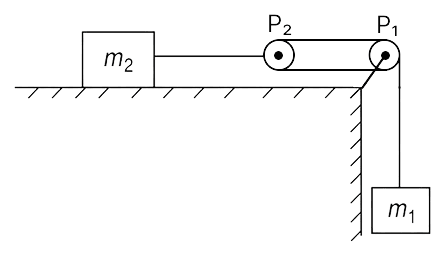
(a) the acceleration of two blocks.
(b) tension in the string connecting the block m2 to pulley P2.
(c) the force exerted by the clamp on the pulley P1 that is pressure force, (not force per unit area) on axle of pulley P1 (g = 10 ms-2).
Answer
Given,
- Masses, m1 = 5 kg and m2 = 5 kg
- The platform, the pulleys and the strings are smooth and light
- Acceleration due to gravity, g = 10 m s-2
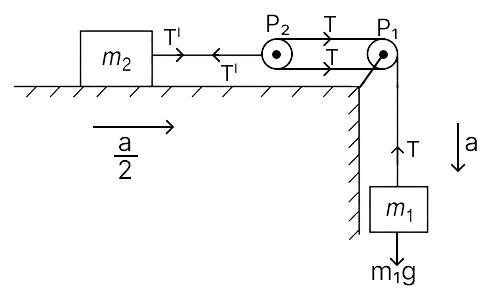
The string carrying the tension T passes over the fixed pulley P1 and then round the movable pulley P2, so if a is the acceleration of the block m1, the pulley P2 and hence the block m2 move with an acceleration . Let T' be the tension in the string joining m2 to the pulley P2.
The platform is smooth, so the vertical forces on m2 have no role to play. For the block m2, by Newton's second law,
The pulley P2 is light, so the net force on it must be zero,
For the hanging block m1,
(a) Multiplying equation (3) by 2,
Adding equations (1), (2) and (4),
Here m1 = m2 = m = 5 kg, so
Substituting g = 10 m s-2,
Hence, the block m1 moves with an acceleration of 8 m s-2 and the block m2 with an acceleration of 4 m s-2.
(b) Substituting this value of a in equation (1),
Hence, the tension in the string connecting m2 to the pulley P2 is 20 N.
(c) From equation (2), the tension in the string passing over P1 is
The two segments of this string at the pulley P1 are mutually perpendicular, one horizontal and the other vertical, and each pulls the pulley with a force T. Hence, the resultant force exerted on the axle of the pulley by the clamp is
Substituting the value of T,
Hence, the force exerted by the clamp on the pulley P1 is 14.14 N.
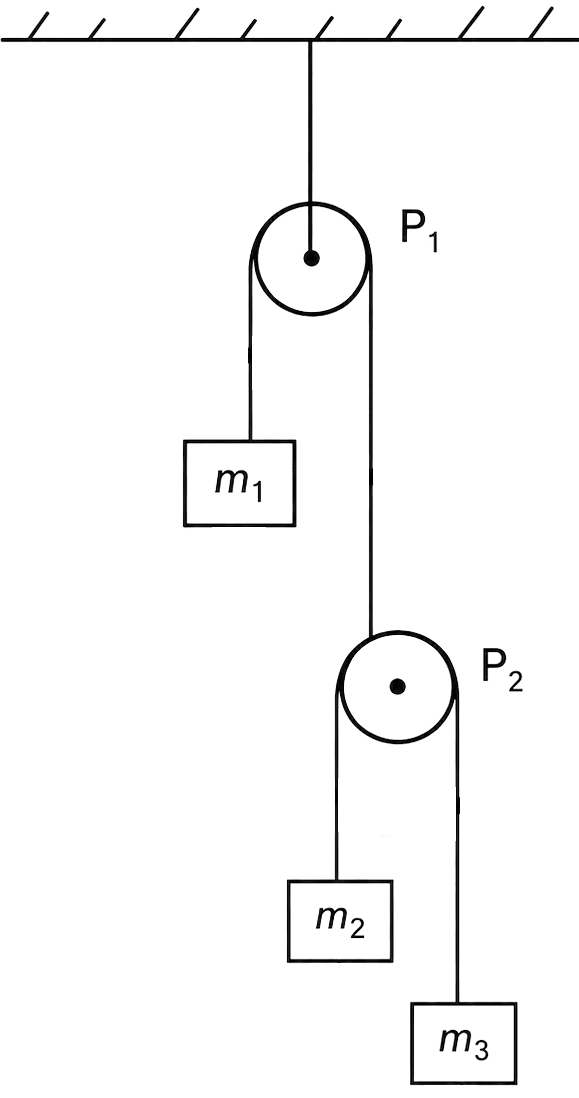
Figure shows three blocks of masses m1 = 1 kg, m2 = 2 kg and m3 = 4 kg arranged by two light, inextensible strings and two light, frictionless pulleys P1 and P2 as shown in the figure. Find the acceleration of the blocks and tension in the strings.
Answer
Given,
- Masses, m1 = 1 kg, m2 = 2 kg and m3 = 4 kg
- The strings are light and inextensible, and the pulleys are light and frictionless
- Acceleration due to gravity, g = 10 m s-2
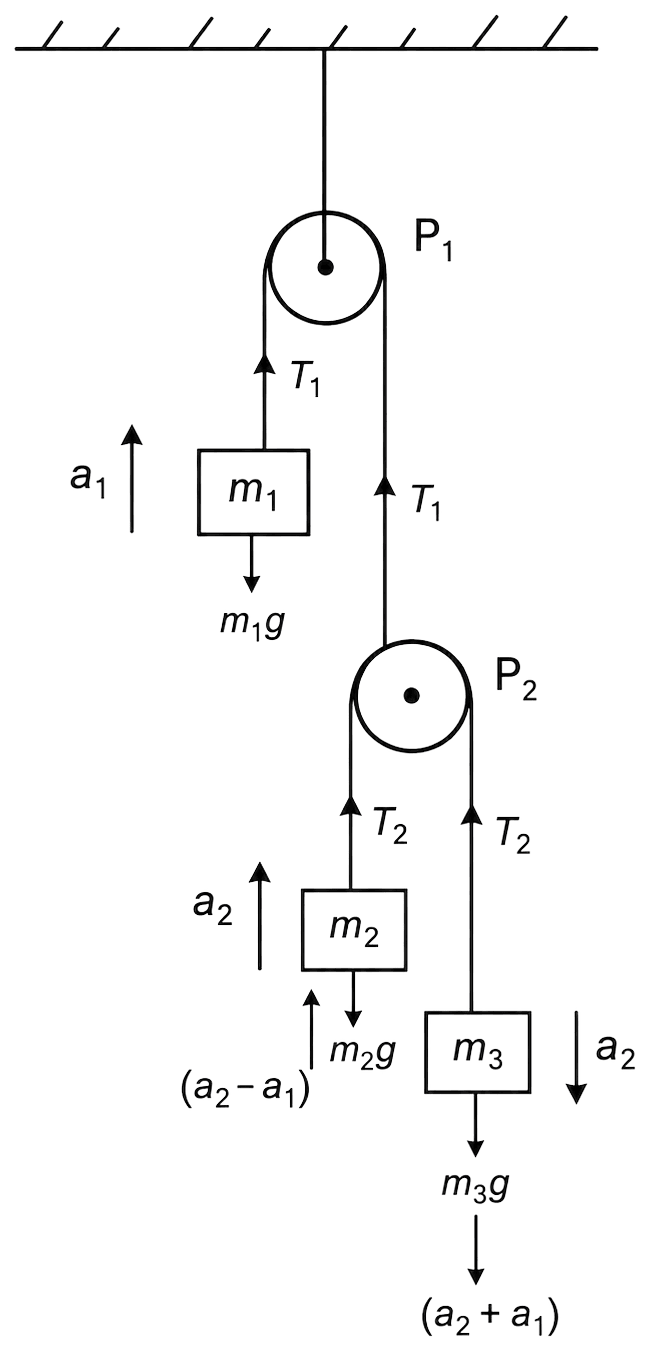
The block m1 hangs from one side of the fixed pulley P1, and the movable pulley P2 hangs from the other side. The blocks m2 and m3 hang from the two sides of P2.
Let a1 be the absolute acceleration of m1 (upwards), so that the pulley P2 descends with the same acceleration a1. Let a2 be the acceleration of m2 and m3 relative to P2. Then m2 has an absolute upward acceleration (a2 − a1) and m3 has an absolute downward acceleration (a2 + a1).
Let T1 be the tension in the string over P1 and T2 that in the string over P2. Applying Newton's second law,
Since the pulley P2 is weightless,
Adding equations (2) and (3),
Substituting m2 = 2 kg and m3 = 4 kg,
Substituting T1 from equation (4) in equation (1),
Adding equation (6) and equation (3) multiplied by 2,
Substituting m1 = 1 kg and m3 = 4 kg,
From equation (5), a1 = g − 3a2. Substituting this in equation (7),
Substituting g = 10 m s-2,
From equation (5),
Therefore, the absolute accelerations of the blocks are
From equation (1),
From equation (4),
Hence, the tensions in the two strings are 16.84 N and 8.42 N respectively.
Note: The question states m3 = 4 kg, but the solution printed in the textbook substitutes m3 = 3 kg and therefore obtains a2 = 0.69 m s-2, a1 = 6.6 m s-2, T1 = 16.6 N and T2 = 8.3 N. The above solution used the value of m3 given in the question.
A person of mass 50 kg is standing inside a box of mass 25 kg by keeping a massless inextensible string. The other end of the strong string is passing over a light frictionless pulley P as shown in the diagram. The person manages to remain stationary in the box. What force is applied by him on the rope downwards?
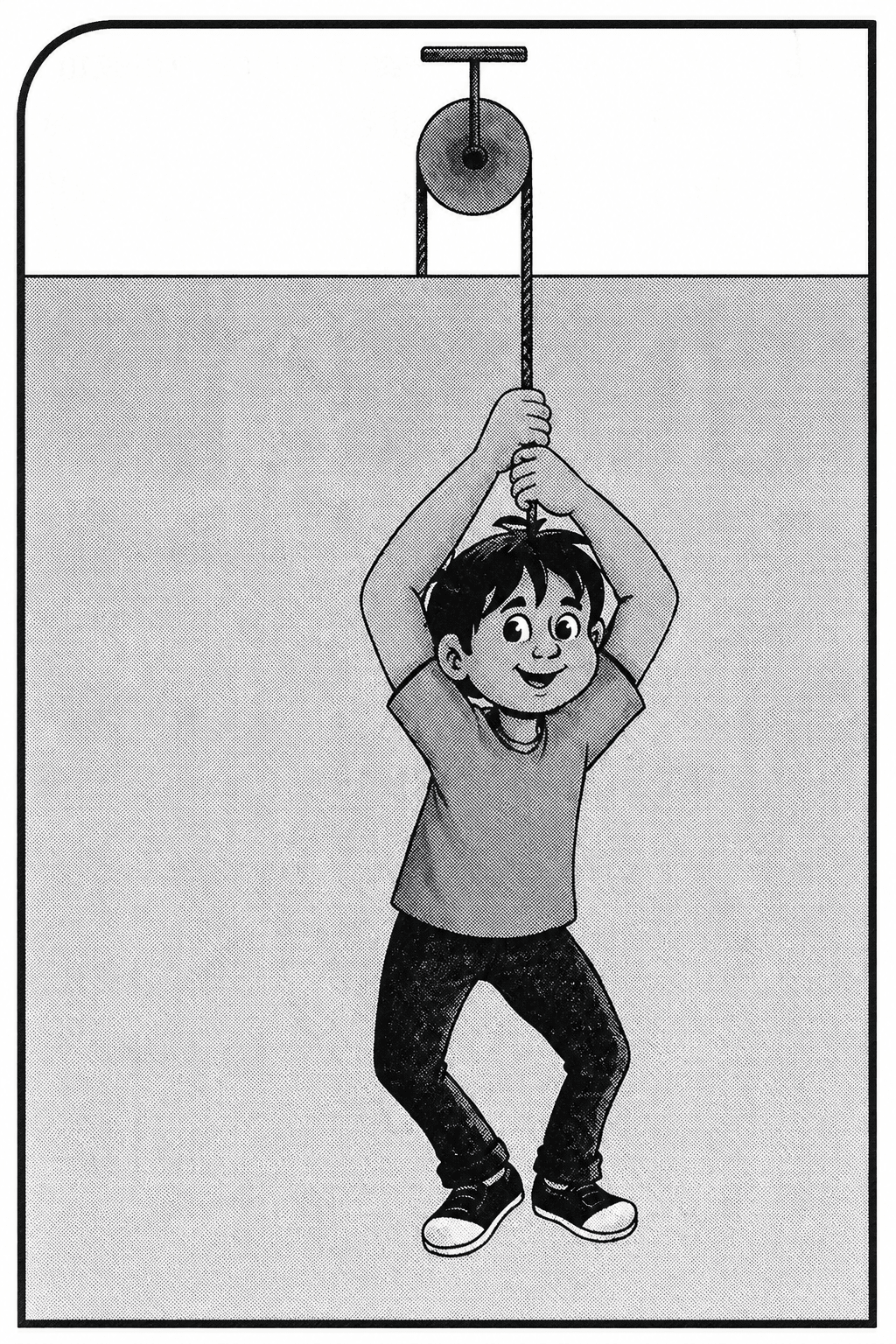
Answer
Given,
- Mass of the person, m1 = 50 kg
- Mass of the box, m2 = 25 kg
- The string is massless and inextensible, and the pulley is light and frictionless
- The person and the box remain stationary
The force applied by the person on the rope has to be calculated.
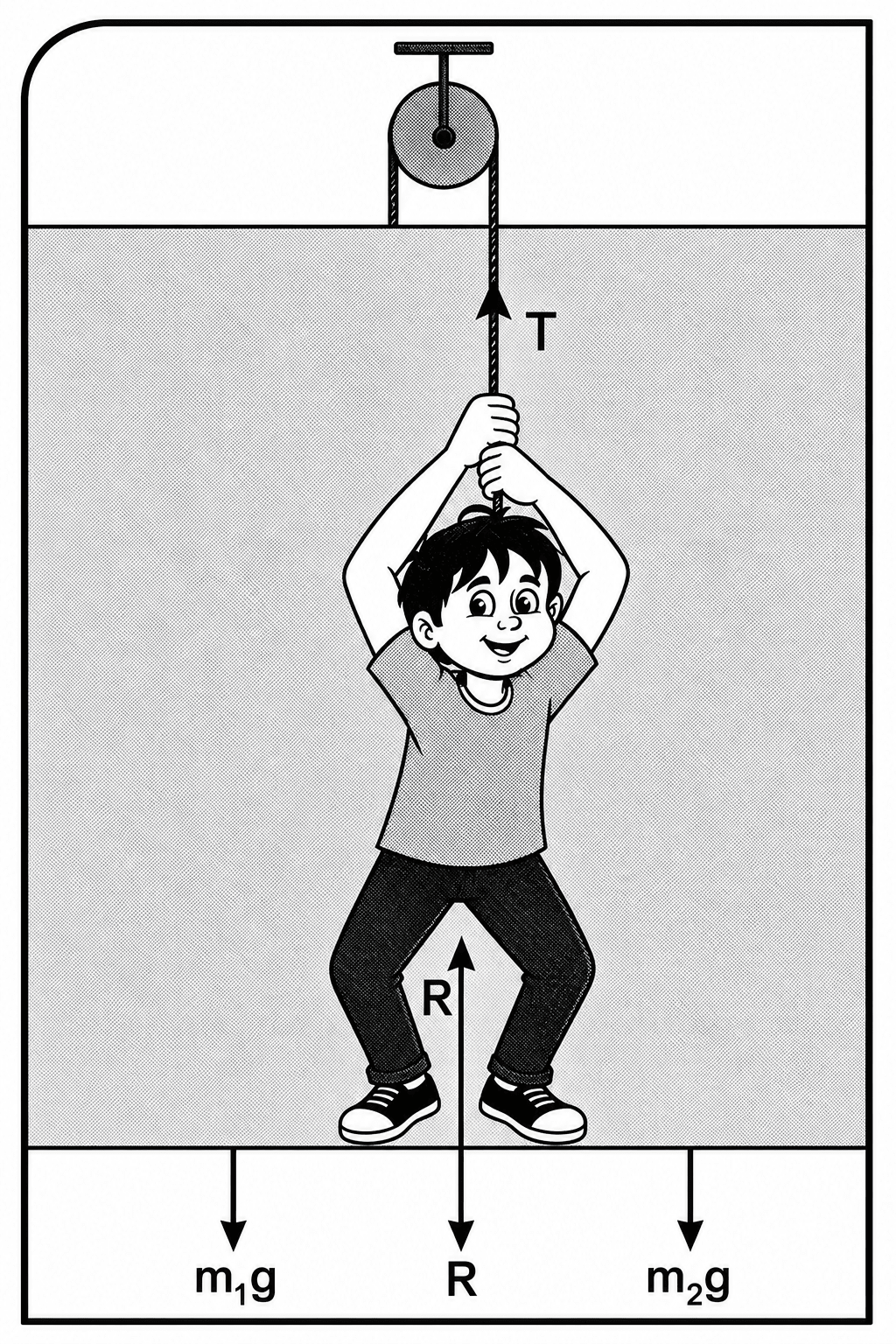
Let T be the tension in the rope and R the normal reaction between the floor of the box and the person. By Newton's third law of motion, the person presses the floor with a force R downwards and the floor pushes the person up with the same force R.
Since the person and the box are both stationary, the net force on each is zero.
For the box, the upward forces are the tension T and the reaction R exerted by the person on the floor acts downwards. Hence,
For the person, the upward forces are the tension T (he pulls the rope downwards, so the rope pulls him upwards) and the normal reaction R of the floor. Hence,
Adding equations (1) and (2),
Substituting the values with g = 9.8 m s-2,
By Newton's third law of motion, the force applied by the person on the rope downwards is equal in magnitude to the tension in the rope.
Hence, the person applies a force of 367.5 N on the rope in the downward direction.
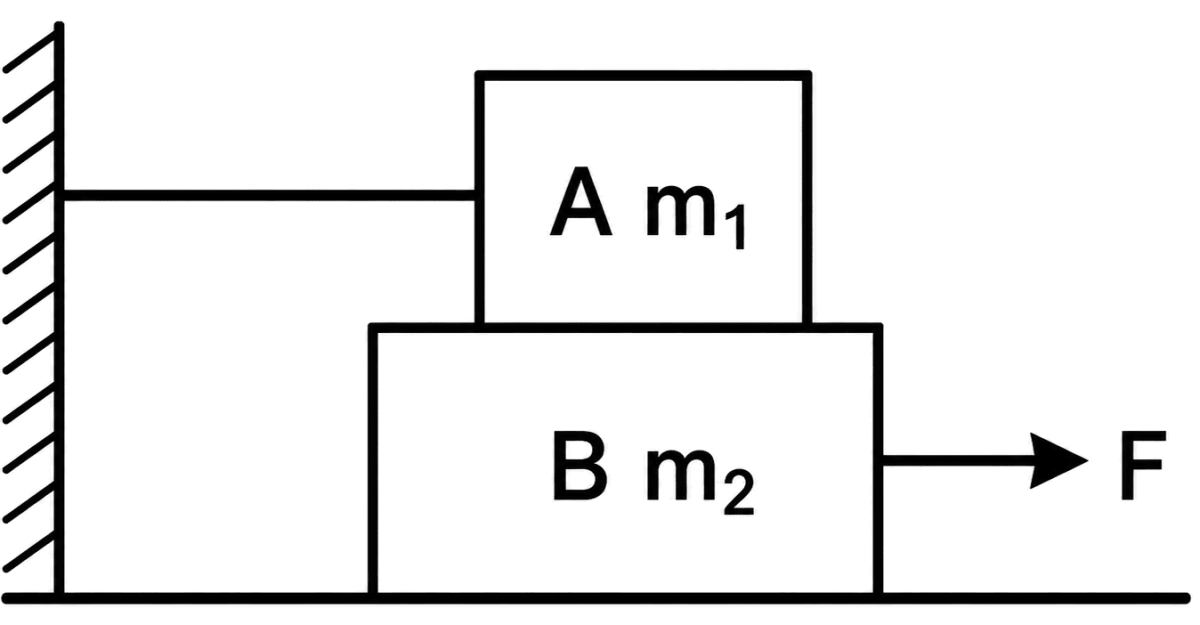
A block A of mass m1 = 100 kg rests on a block B of mass m2 = 150 kg. A is tied with a horizontal string to a wall. Coefficient of friction between A and B is 0.25 and that between B and floor is 0.2. Draw the free body diagram of block A and B and calculate what horizontal force F is needed to move the block B? (Take g = 10 ms-2).
Answer
Given,
- Mass of block A, m1 = 100 kg
- Mass of block B, m2 = 150 kg
- Coefficient of friction between A and B, μ1 = 0.25
- Coefficient of friction between B and the floor, μ2 = 0.2
- Acceleration due to gravity, g = 10 m s-2
The horizontal force F needed to move block B has to be calculated.
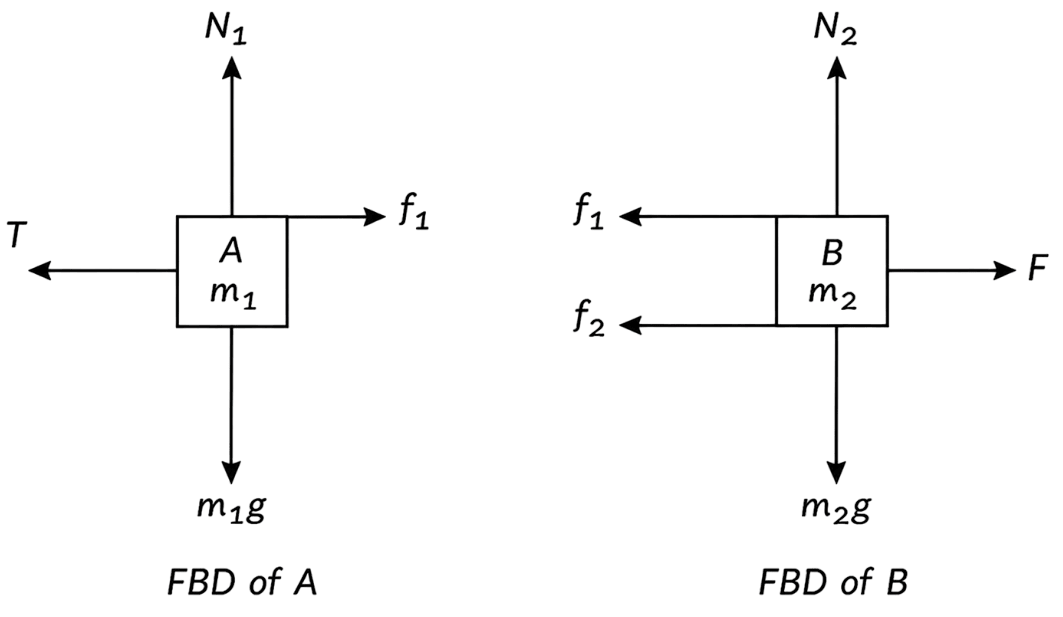
Free body diagram of block A : The forces are the weight m1g downwards, the normal reaction N1 of B upwards, the tension T of the string and the frictional force f1 exerted by B.
Free body diagram of block B : The forces are the weight m2g downwards, the normal reaction N1 of A pressing down on it, the normal reaction N2 of the floor upwards, the applied force F, and the frictional forces f1 (due to A) and f2 (due to the floor).
For the vertical equilibrium of block A, there is no vertical motion, so
For the vertical equilibrium of block B,
Block B is just made to move, so the frictional forces have their limiting values. For the horizontal equilibrium of block B,
Substituting the values,
Hence, a horizontal force of 750 N is needed to move the block B.
A heavy uniform ladder is in equilibrium with one end resting on the ground and the other end resting against a rough wall. If μ1 and μ2 be the coefficients of friction between the ladder and the ground and between the ladder and the wall respectively, show that the minimum angle of inclination of the ladder to the horizontal is
Answer
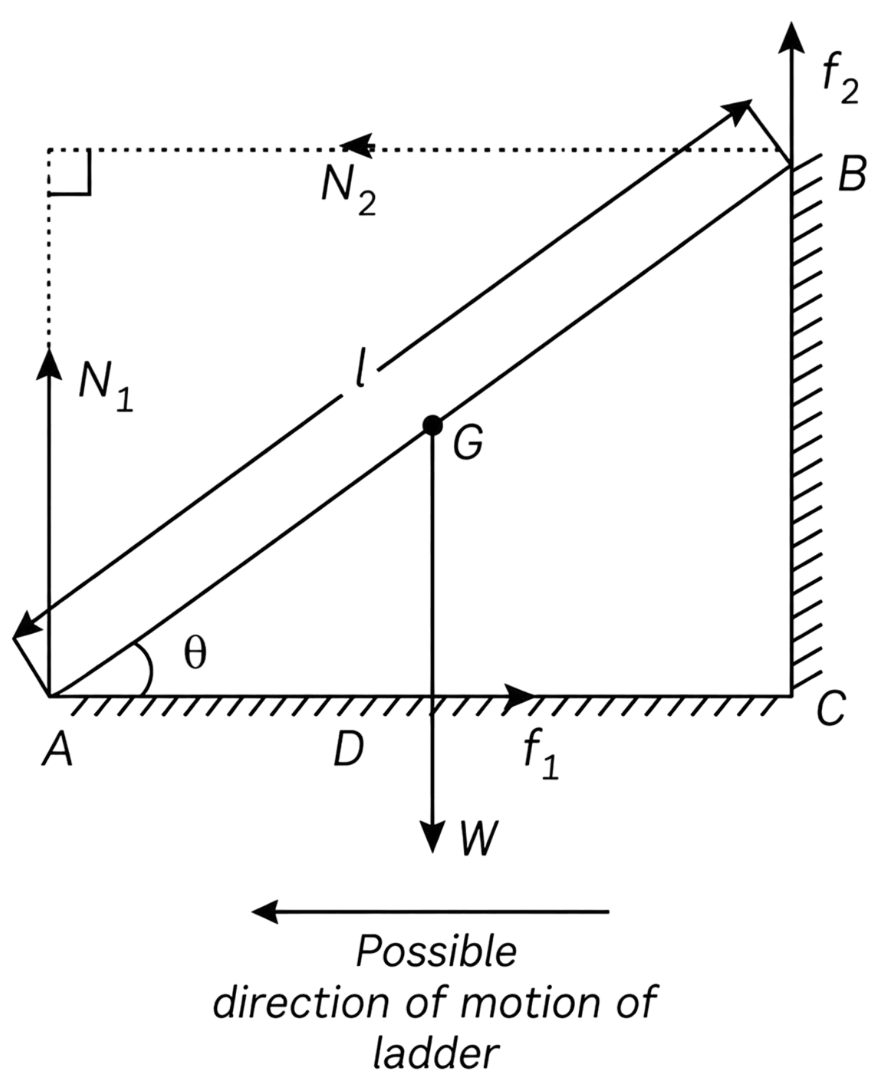
Let the ladder AB of weight W and length l rest with its lower end A on the ground and its upper end B against the wall, making an angle θ with the horizontal. Since the ladder is uniform, its weight W acts vertically downwards at its mid-point, where its centre of gravity is situated.
Let N1 and N2 be the normal contact forces at A and B, and f1 and f2 the frictional forces at A and B respectively. At the minimum angle of inclination the ladder is just about to slip, so the frictional forces have their limiting values,
Vertical equilibrium : The upward forces are N1 and f2, and the downward force is W,
Horizontal equilibrium : The wall pushes the ladder with N2 and the friction at the ground opposes it,
Substituting N2 from equation (2) in equation (1),
From equation (2),
Rotational equilibrium : Taking moments of all the forces about the lower end A. The forces N1 and f1 act at A itself, so their moments about A are zero. The weight W tends to rotate the ladder clockwise, while N2 and f2 tend to rotate it anticlockwise. The perpendicular distances are for W, sin θ for N2 and l cos θ for f2. Hence, by the principle of moments,
Substituting N2 from equation (4) and dividing throughout by ,
Dividing throughout by W and rearranging,
Therefore,
Hence proved.
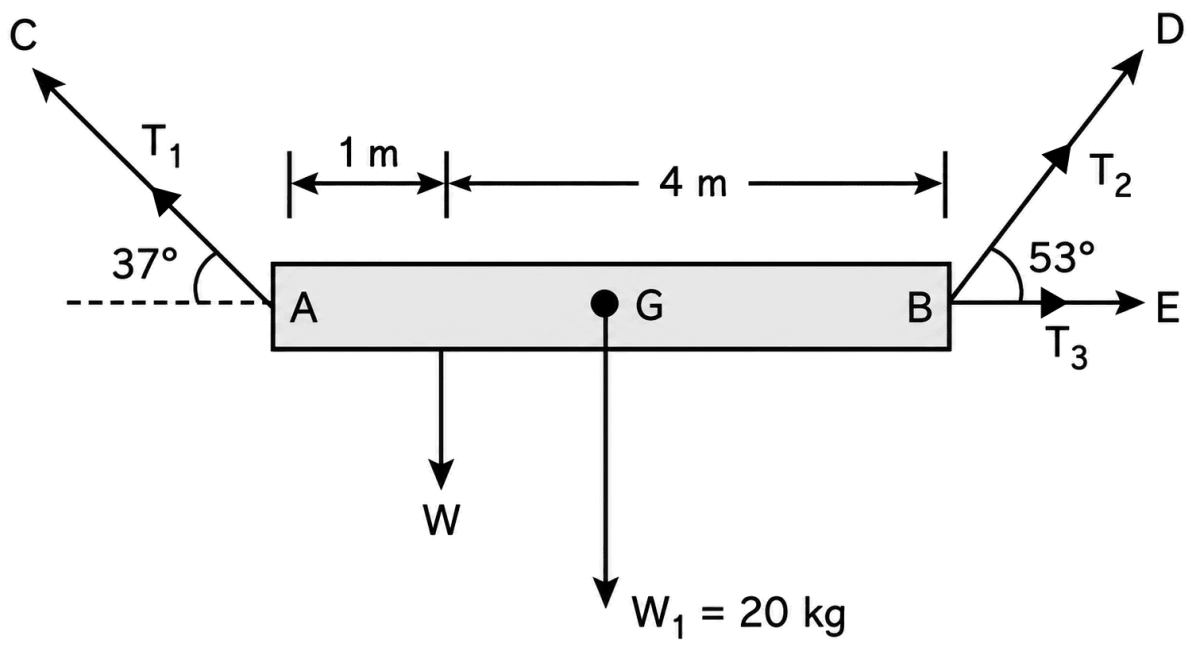
In given Fig. a uniform beam AB (= 5m long) of weight 20 kg is supported by three cables AC, BD and BE and are capable of holding a tension of 50 kg each. As the magnitude of W acting at 1 m length from A is slowly increased, which rope will break first and at what value of W?
Answer
Given,
- Length of the beam AB, l = 5 m
- Weight of the beam, W1 = 20 kg, acting at its mid-point G (2.5 m from A)
- W acts at 1 m from A
- Each cable can hold a maximum tension of 50 kg
- The cable AC makes 37° and the cable BD makes 53° with the beam, BE being along the beam
Which cable breaks first, and the value of W at which it breaks, has to be found.
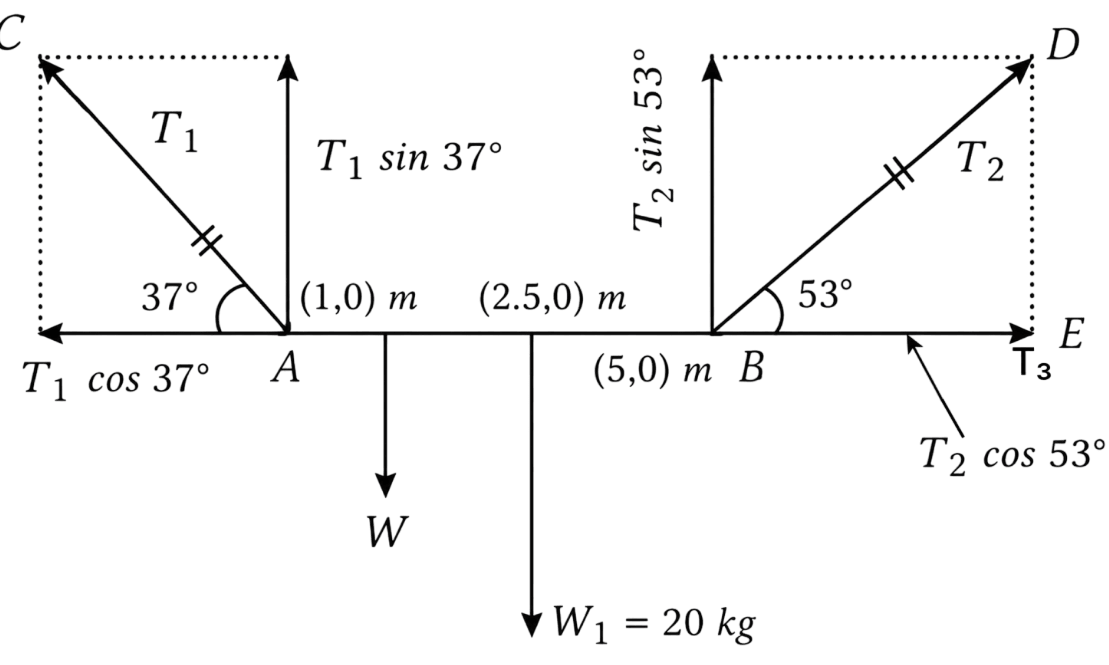
The components T1 cos 37° of T1, T2 cos 53° of T2 and the tension T3 along BE are all parallel to the length of the beam, so they do not test the strength of the cables AC and BD. Only the vertical components T1 sin 37° and T2 sin 53° enter the moment equations.
Taking moments of the forces about A : The weights W and W1 rotate the beam clockwise while T2 sin 53° rotates it anticlockwise. Hence,
Taking moments of the forces about B :
Comparing equations (1) and (2), the numerator of T1 increases four times as fast with W as that of T2, and sin 37° is smaller than sin 53°. Hence, as W is slowly increased, T1 increases much more rapidly than T2, and so the cable AC breaks first.
Putting T1 = 50 kg in equation (2) and taking sin 37° = 0.6018,
Hence, the cable AC will break first, and it will break when W becomes nearly 25 kg-wt.
A stream of water flowing horizontally with a speed of 15 m s-1 gushes out of a tube of cross-sectional area 10-2 m2 and hits a nearby vertical wall. Find the force exerted on the wall by the impact of water. Assume that water does not rebound from the wall. Take density of water to be 1.0 × 10³ kg m-3.
Answer
Given,
- Speed of the water, v = 15 m s-1
- Area of cross-section of the tube, A = 10-2 m2
- Density of water, ρ = 1.0 × 10³ kg m-3
- The water does not rebound from the wall
The force exerted on the wall has to be calculated.
The volume of water striking the wall per second is Av, so the mass of water striking the wall per second is
Substituting the values,
The momentum carried to the wall per second is
Since the water does not rebound from the wall, the momentum of the water after the impact is zero. Hence, the rate of change of momentum is 2250 kg m s-2. By Newton's second law of motion, the force is equal to the rate of change of momentum,
Hence, the force exerted on the wall by the impact of water is 2250 N.
Ten one-rupee coins are put on the top of one another on a table. Each coin has a mass of m kg. Give the magnitude and direction of (a) the force on the 7th coin (counted from the bottom) due to all the coins on its top, (b) the force on the 7th coin by the 8th coin, (c) reaction of the 6th coin on the 7th coin.
Answer
Given,
- Ten one-rupee coins are placed one above the other
- Mass of each coin = m kg
The magnitude and the direction of the force in each case has to be found.
(a) Above the 7th coin (counted from the bottom) there are three coins, namely the 8th, the 9th and the 10th. The force on the 7th coin due to all the coins on its top is the sum of their weights,
This force acts vertically downwards.
(b) The 8th coin already supports the weights of the two coins above it (the 9th and the 10th) and has its own weight as well. Hence, the force exerted on the 7th coin by the 8th coin is the sum of these three weights,
This force also acts vertically downwards.
(c) The 6th coin experiences a downward force due to the weights of the four coins above it, that is, the 7th, 8th, 9th and 10th coins,
By Newton's third law of motion, the reaction of the 6th coin on the 7th coin is
The negative sign shows that this reaction is directed vertically upwards.
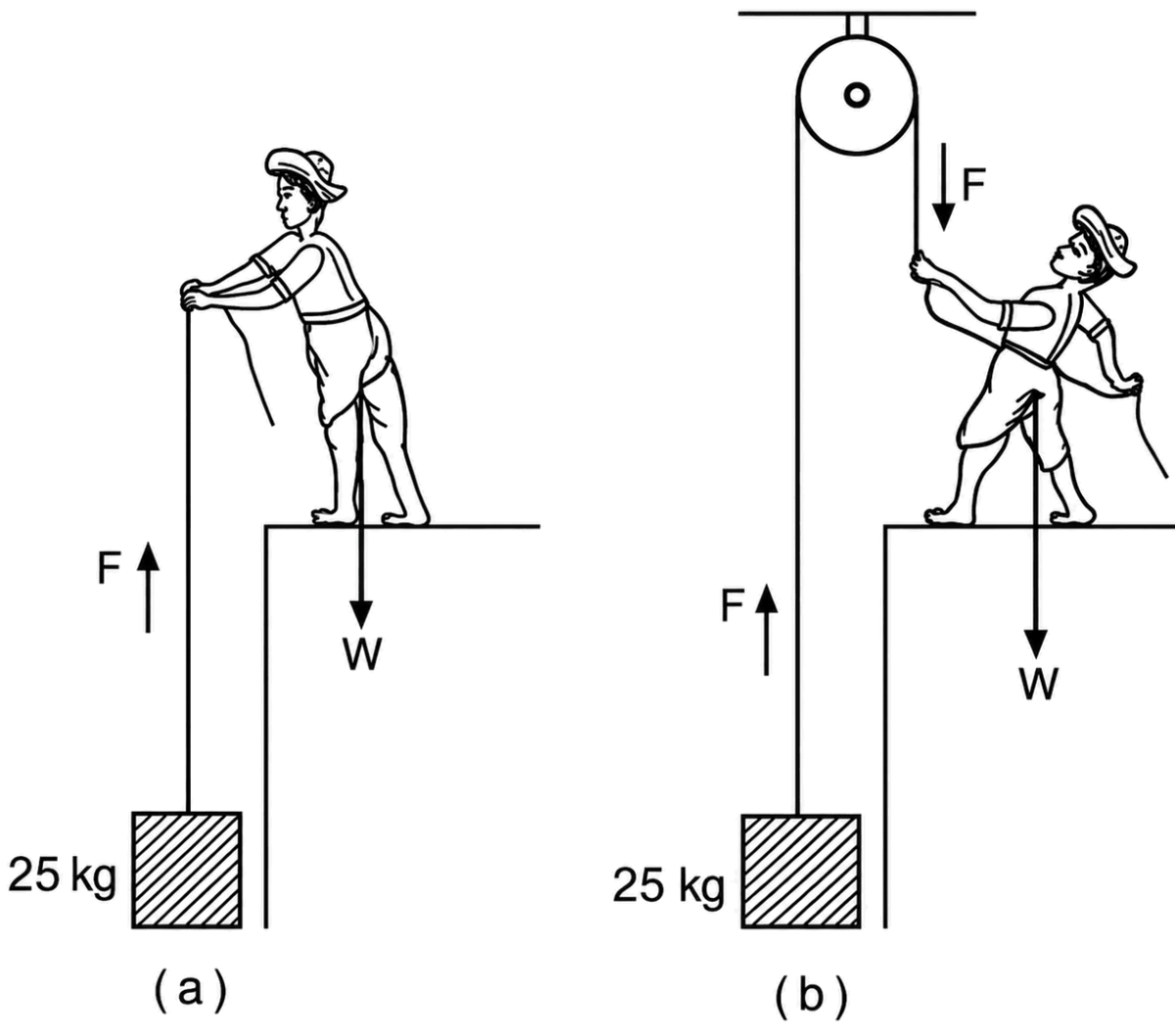
A 25 kg block is raised by a 50 kg man in two different ways, as shown. What is the action on the floor by the man in the two cases? If the floor yields to a normal force of 700 N, which mode should the man adopt to lift the block without yielding of the floor? (g = 9.8 ms-2)
Answer
Given,
- Mass of the block, m = 25 kg
- Mass of the man, M = 50 kg
- Acceleration due to gravity, g = 9.8 m s-2
- The floor yields to a normal force of 700 N
The action on the floor by the man in the two cases has to be calculated.
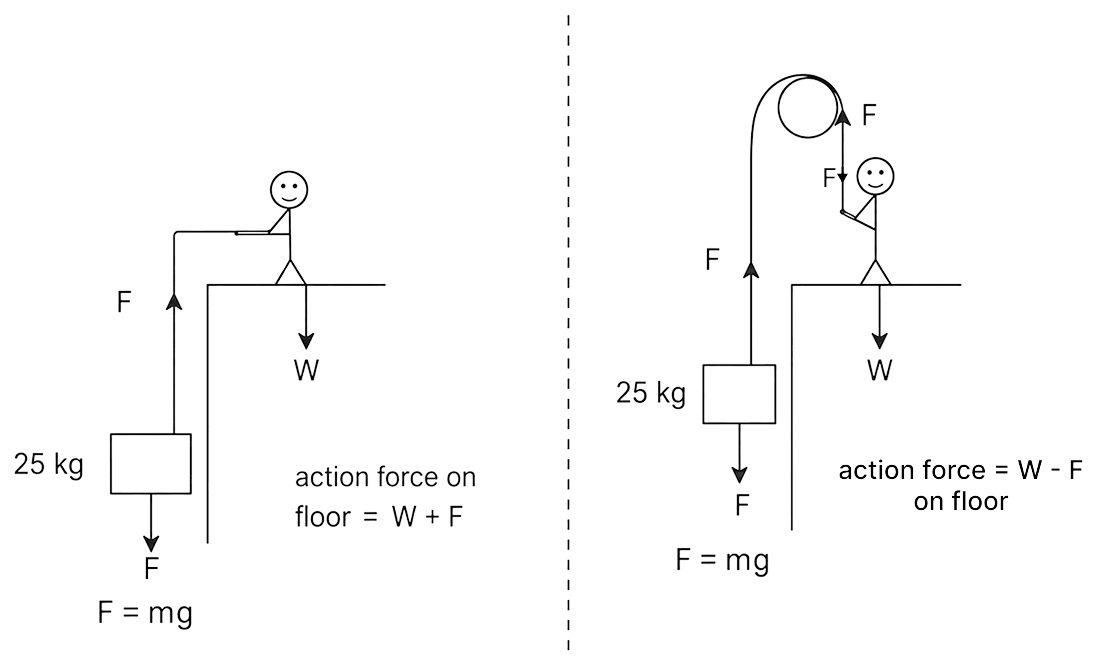
The force required to lift the block is its weight,
and the weight of the man himself is
Case (a) : Here the man pulls the rope upwards, so he exerts the force in a direction opposite to his weight. He has to overcome his own weight and also exert the force to raise the block. Hence, the action on the floor is
Case (b) : Here the man pulls the rope in the direction of his weight, that is, his weight helps him in exerting the force. Hence, the action on the floor is
Since the floor yields to a normal force of 700 N, the action of 735 N in case (a) would make the floor yield, whereas the action of 245 N in case (b) would not.
Hence, the man should adopt mode (b) to lift the block without yielding of the floor.
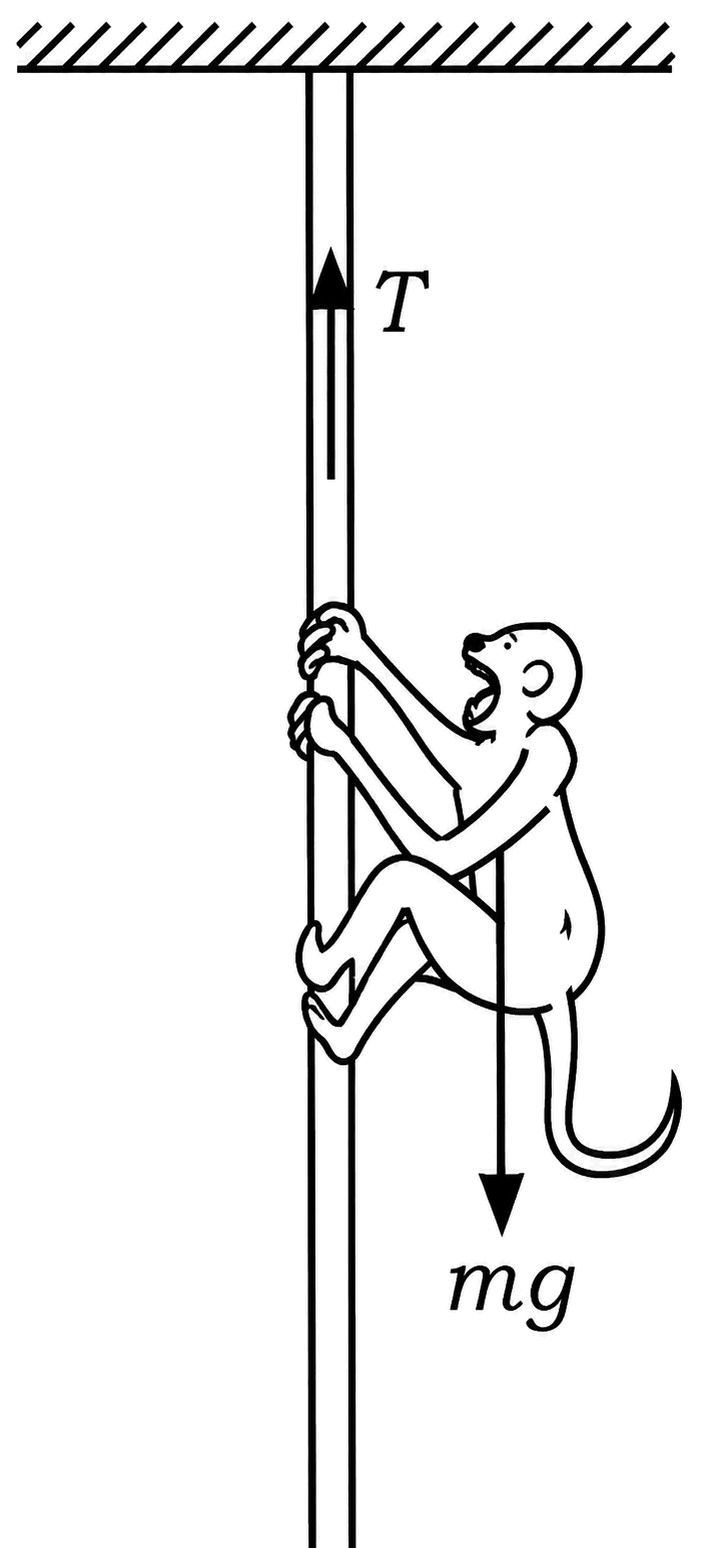
A monkey of mass 40 kg climbs on a rope which can withstand a maximum tension of 600 N. In which case will the rope break? The monkey (a) climbs up with an acceleration of 6 ms-2, (b) climbs down with an acceleration of 4 ms-2, (c) climbs up with uniform speed of 5 ms-1, (d) falls down the rope nearly freely under gravity? (Take g = 10 ms-2, ignore mass of the rope.)
Answer
Given,
- Mass of the monkey, m = 40 kg
- Maximum tension the rope can withstand = 600 N
- Acceleration due to gravity, g = 10 m s-2
- The mass of the rope is ignored
The case in which the rope breaks has to be found.
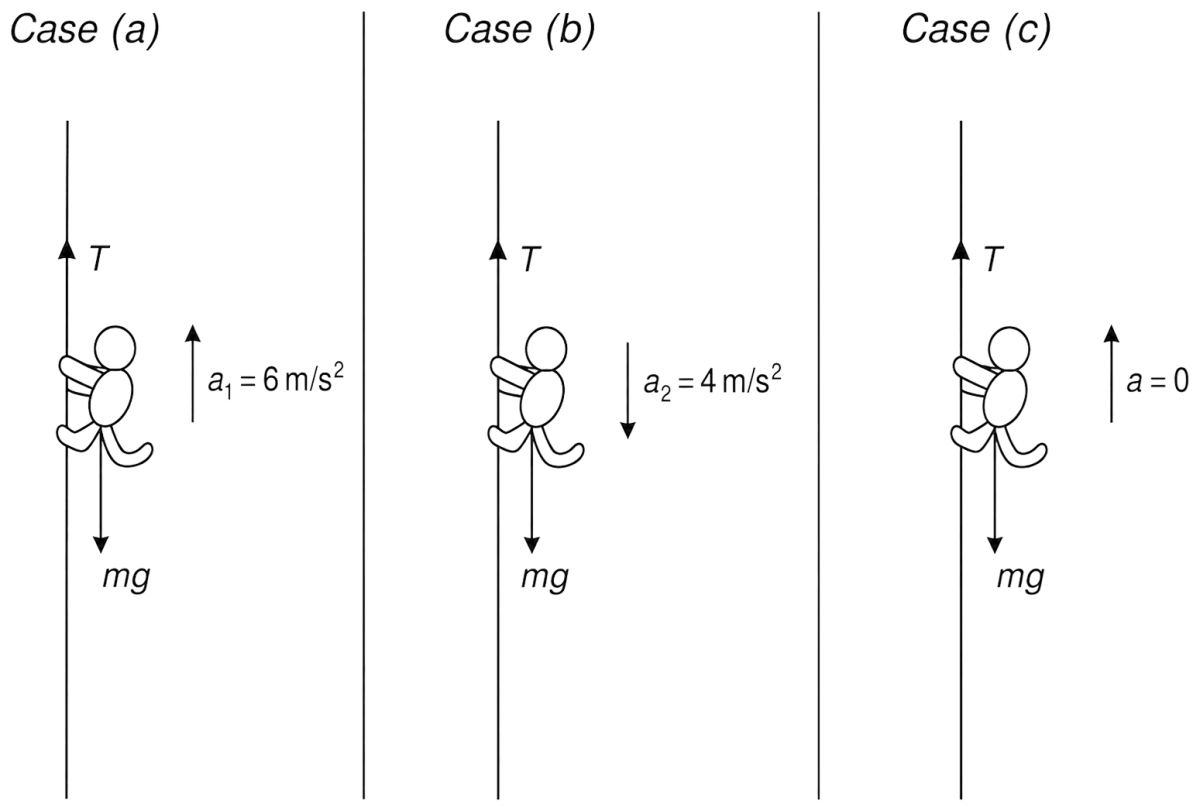
Let T be the tension in the rope, acting upwards, and mg the gravity force on the monkey, acting downwards.
(a) Climbing up with an acceleration of 6 m s-2 : The net force on the monkey must be upwards,
(b) Climbing down with an acceleration of 4 m s-2 : The net force on the monkey must be downwards,
(c) Climbing up with a uniform speed of 5 m s-1 : The acceleration is zero, so
(d) Falling down nearly freely under gravity : Here a = g, so
The rope breaks only when the tension exceeds 600 N, and this happens only in case (a), where the tension is 640 N.
Hence, the rope will break in case (a), that is, when the monkey climbs up with an acceleration of 6 m s-2.
A man of mass 65 kg is standing stationary with respect to a horizontal conveyor belt which is moving with an acceleration of 1.0 ms-2, as shown. (a) Find the net force on the man. (b) If the coefficient of static friction between the shoes of the man and the belt is 0.2, up to what acceleration of the belt can the man continue to remain stationary relative to the belt? (g = 9.8 ms-2)
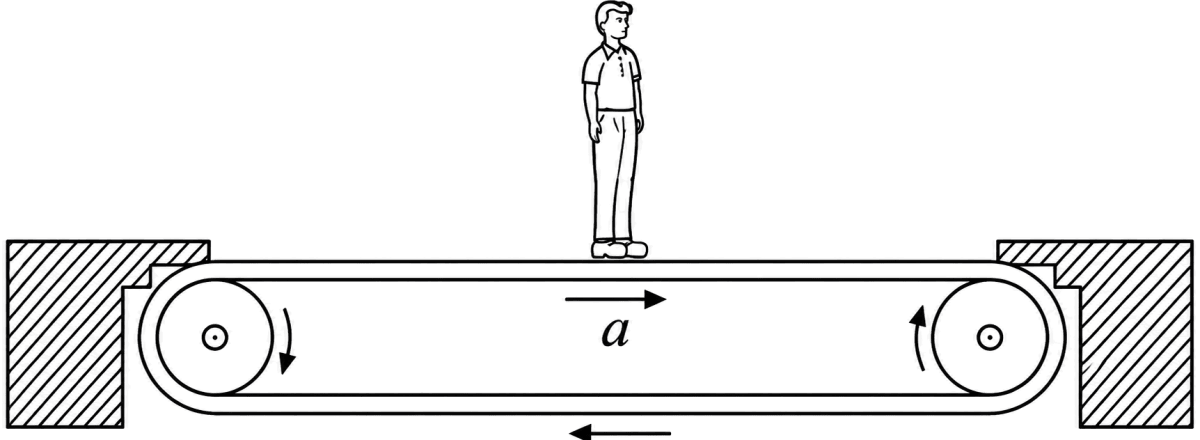
Answer
Given,
- Mass of the man, m = 65 kg
- Acceleration of the belt, a = 1.0 m s-2
- Coefficient of static friction, μs = 0.2
- Acceleration due to gravity, g = 9.8 m s-2
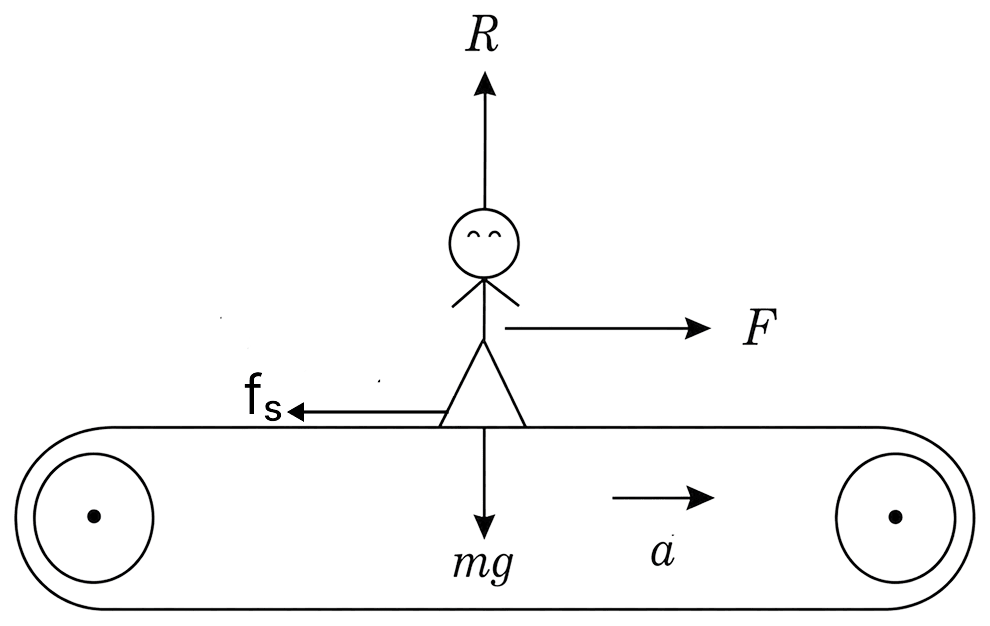
(a) The man is stationary relative to the belt, so his acceleration is the same as that of the belt. The gravity force mg on him is balanced by the equal and opposite normal reaction R of the belt. Hence, the net force on the man is only due to his acceleration,
Hence, the net force on the man is 65 N, directed along the direction of motion of the belt. This force is provided by the force of friction between his shoes and the belt.
(b) The limiting frictional force between the man's shoes and the belt is
The man can continue to remain stationary relative to the belt only so long as the force needed to accelerate him does not exceed this limiting friction. At the maximum acceleration amax,
Hence, the man can remain stationary relative to the belt up to an acceleration of 1.96 m s-2.
Two bodies A and B of respective masses 5 kg and 10 kg in contact with each other rest on a table against a rigid partition, as shown. The coefficient of friction between the bodies and the table is 0.15. A force F of 200 N is applied horizontally at A. Find (a) the reaction of the partition, (b) the action-reaction forces on A and B. What would happen if the partition be removed? Does the answer to (b) change, when the bodies are in motion? Ignore difference between μs and μk and take g = 9.8 ms-2.
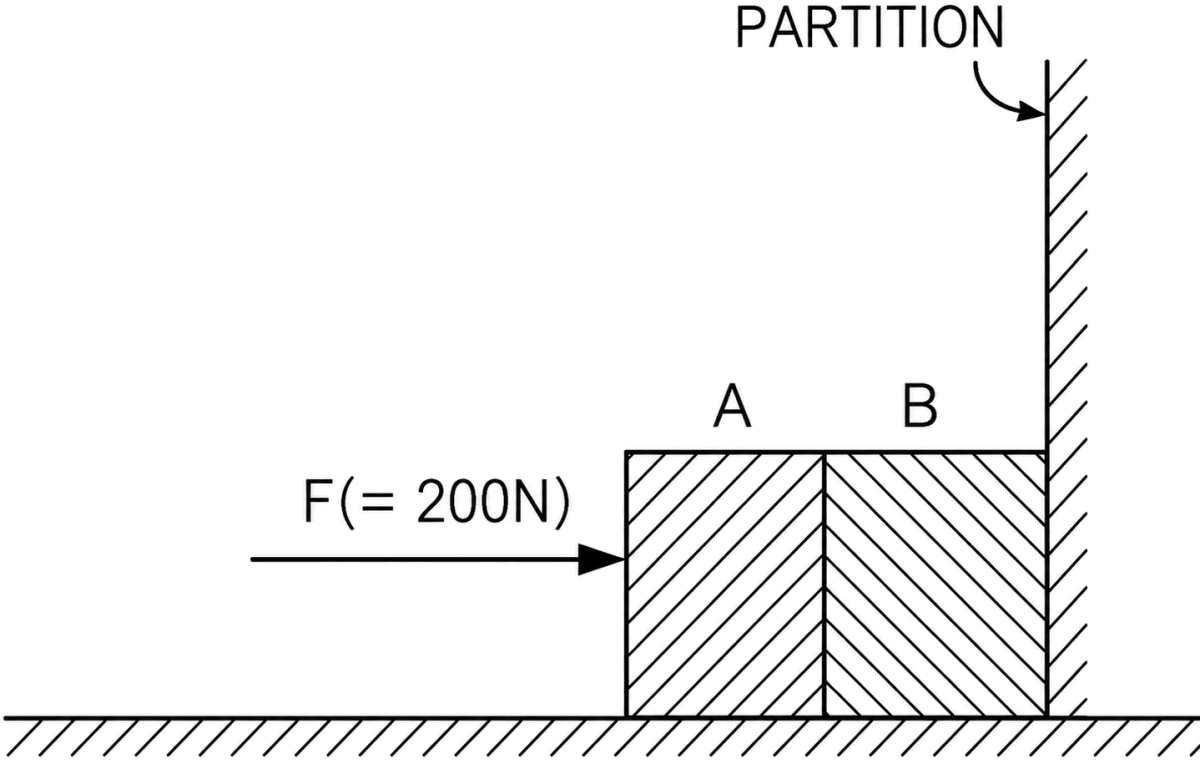
Answer
Given,
- Mass of body A, m1 = 5 kg and mass of body B, m2 = 10 kg
- Coefficient of friction between the bodies and the table, μs = 0.15
- Applied force, F = 200 N, horizontally at A
- Acceleration due to gravity, g = 9.8 m s-2
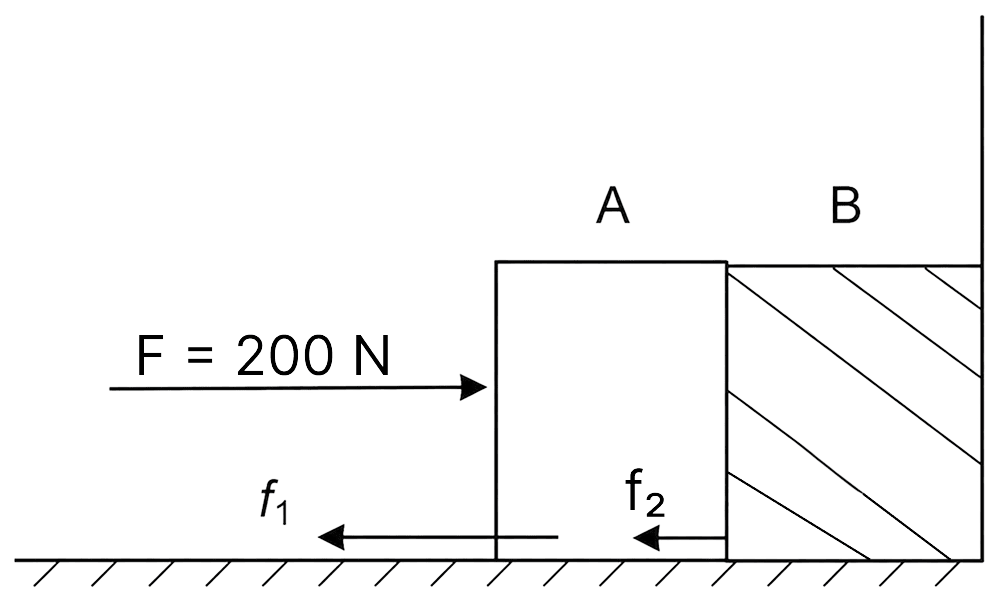
(a) When the force F is applied at A towards the right, the limiting frictional force on the two bodies together, directed towards the left, is
Hence, the net force exerted on the partition is
By Newton's third law of motion, the reaction of the partition is 178 N, directed towards the left.
(b) The force of limiting friction on body A alone is
Hence, the net force exerted by body A on body B is
By Newton's third law of motion, the reaction of body B on body A is 192.65 N, directed towards the left.
If the partition is removed : The two bodies move together towards the right under the net force F' = 178 N, with an acceleration
The force producing this motion in A alone is
Hence, the net force now exerted by A on B is
and the reaction of B on A is 133.15 N towards the left.
Hence, the answer to part (b) does change when the bodies are in motion.
A block of mass 15 kg is placed on a long trolley. The coefficient of friction between the block and the trolley is 0.18. The trolley accelerates from rest with 0.5 ms-2 for 20 s and then moves with uniform velocity. Discuss the motion of the block as viewed by (a) a stationary observer on the ground, (b) an observer moving with the trolley (g = 9.8 ms-2).
Answer
Given,
- Mass of the block, m = 15 kg
- Coefficient of friction between the block and the trolley, μs = 0.18
- Acceleration of the trolley, a = 0.5 m s-2 for 20 s, and uniform velocity thereafter
- Acceleration due to gravity, g = 9.8 m s-2
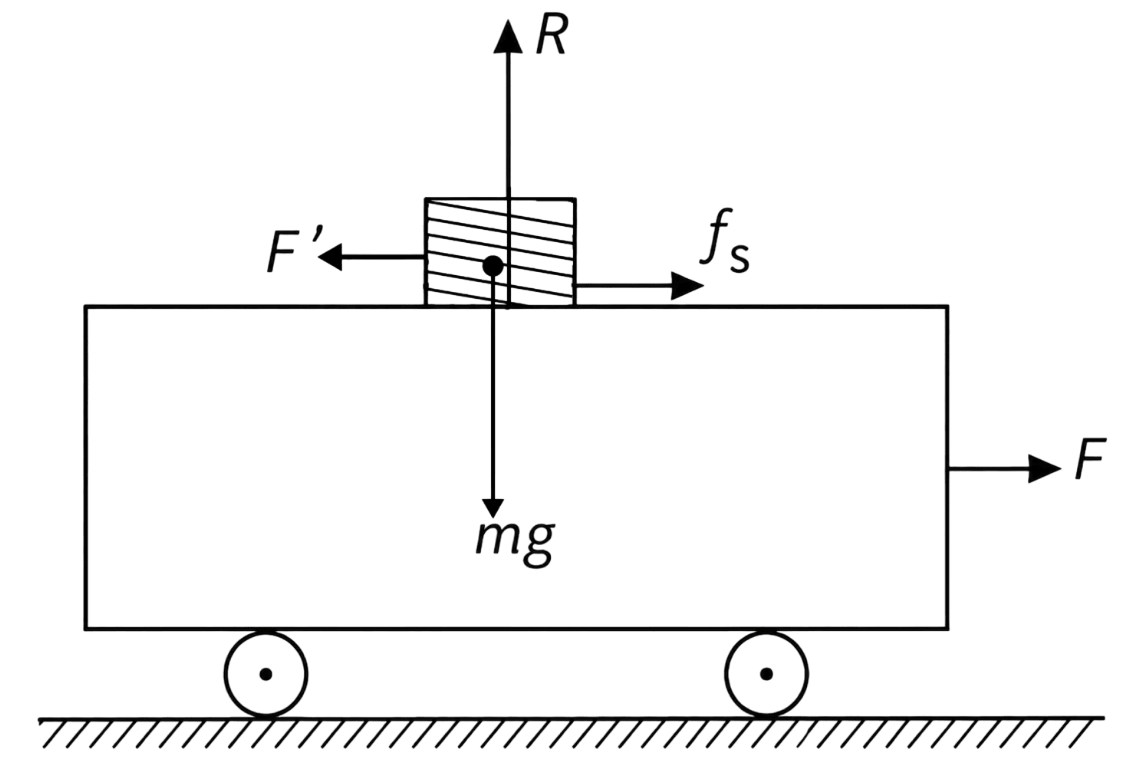
The force required to give the block the same acceleration as the trolley is
The weight mg of the block is balanced by the normal reaction R of the trolley. The limiting frictional force between the block and the trolley is
(a) As viewed by a stationary observer on the ground : As the trolley accelerates forward it exerts a reactionary force F' (= F = 7.5 N) on the block in the backward direction. As the block tends to move under this force, the force of friction comes into play opposite to F'. Since the limiting friction (26.5 N) is much larger than 7.5 N, the frictional force, being self-adjusting, simply adjusts itself to 7.5 N in the direction of motion of the trolley, and the block does not slide. Hence, during the accelerated motion of the trolley the block moves along with the trolley with the same acceleration of 0.5 m s-2, appearing to be at rest relative to the trolley.
When the trolley later moves with a uniform velocity, no force F is needed, and the block shows no tendency to move relative to the trolley. Hence, the force of friction does not come into play at all, and the block moves along with the trolley with the same uniform velocity.
(b) As viewed by an observer moving with the trolley : During the first 20 s this observer has an accelerated motion, so his is a non-inertial frame in which the law of inertia is not valid. To him the block appears stationary, and he explains this by invoking a pseudo force of 7.5 N acting backwards on the block, which is balanced by the frictional force of 7.5 N acting forwards. Once the trolley moves with a uniform velocity, the observer becomes an inertial observer and the block still appears to him to be at rest, with no force acting on it.
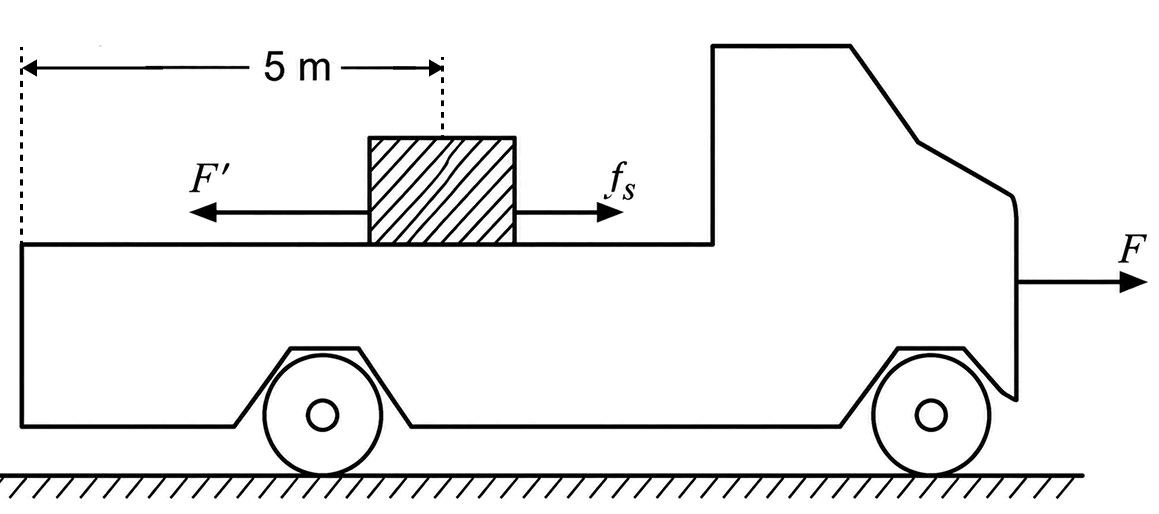
The rear side of a truck is open and a box of 40 kg mass is placed 5 m away from the open end, as shown. The coefficient of friction between the box and the surface below it is 0.15. On a straight road, the truck starts from rest and accelerates with 2 m s-2. At what distance from the starting point does the box fall off the truck? (Ignore the size of the box and take g = 9.8 ms-2).
Answer
Given,
- Mass of the box, m = 40 kg
- Distance of the box from the open end, s = 5 m
- Coefficient of friction, μs = 0.15
- Acceleration of the truck, a = 2 m s-2, starting from rest
- Acceleration due to gravity, g = 9.8 m s-2
The distance from the starting point at which the box falls off the truck has to be calculated.
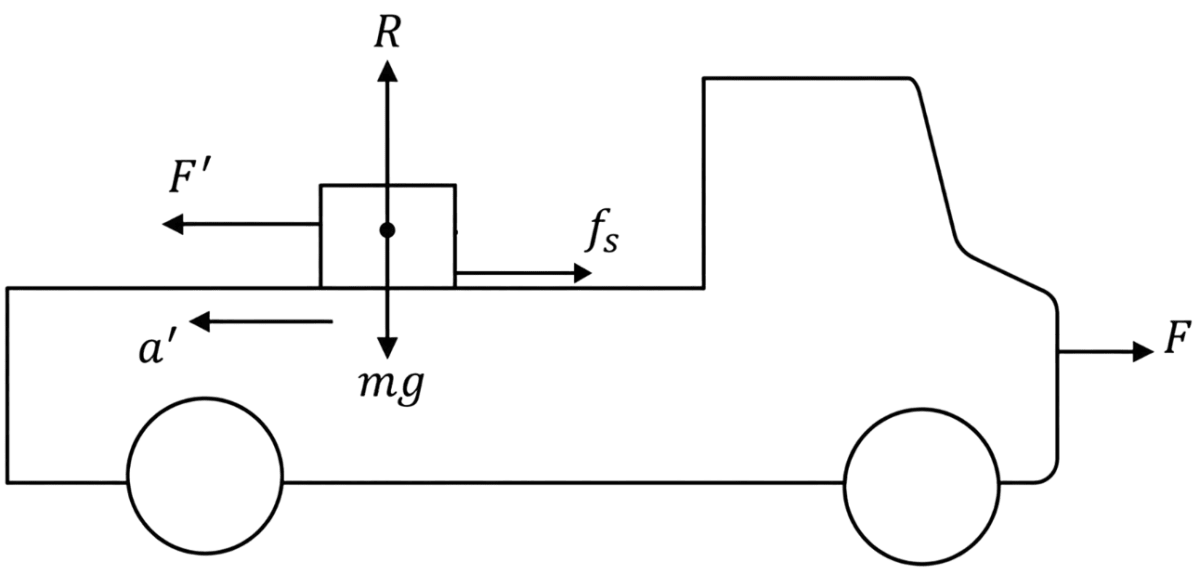
The force on the box due to the accelerated motion of the truck is
As the truck accelerates in the forward direction, a reactionary force F' (= F = 80 N) acts on the box in the backward direction. As the box tends to move under this force, the force of friction comes into play in the forward direction. The limiting frictional force between the box and the surface below it is
Since F' is greater than fs, the box slides backwards. The net force acting on the box in the backward direction is
The acceleration produced in the box relative to the truck, in the backward direction, is
If t is the time in which the box slides through 5 m relative to the truck and falls off, then using with u = 0,
The distance covered by the truck from the starting point in this time is
Hence, the box falls off the truck at a distance of 18.8 m from the starting point.
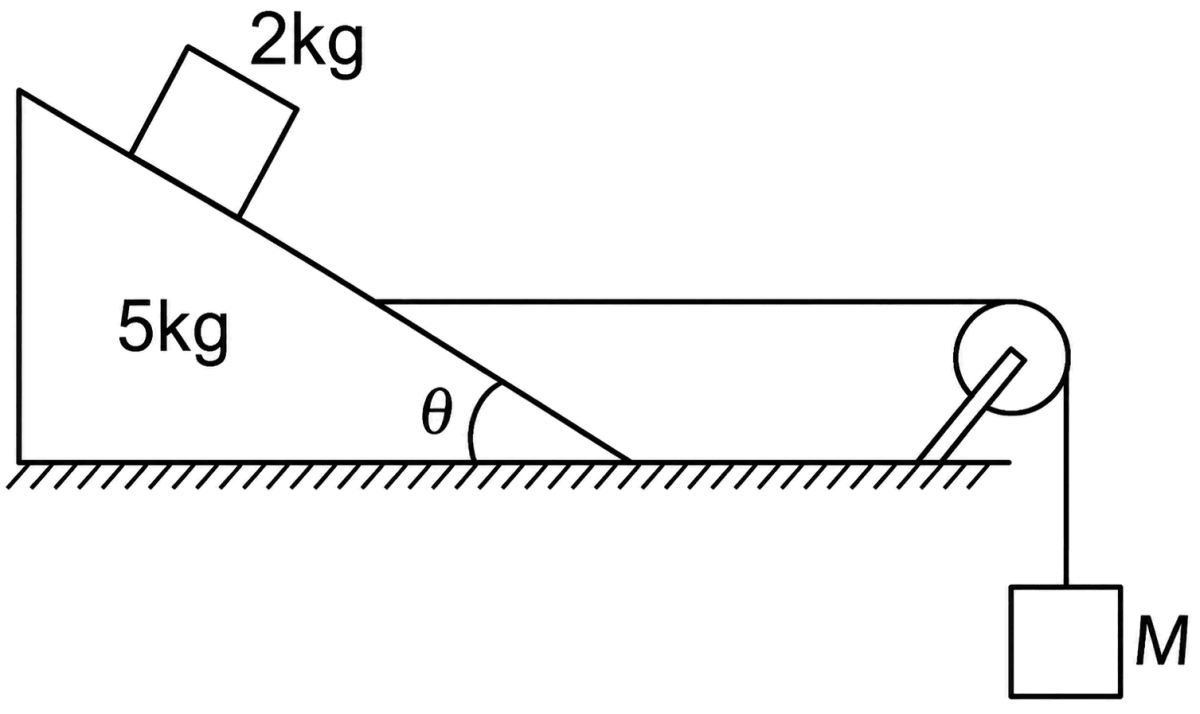
Find the mass M of the hanging block in the figure which will prevent the smaller block from slipping over the triangular block. All the surfaces are frictionless and the strings and the pulleys are light. (θ = 30°)
Answer
Given,
- Mass of the smaller block, m = 2 kg
- Mass of the triangular block, M' = 5 kg
- Angle of the triangular block, θ = 30°
- All the surfaces are frictionless, and the strings and the pulleys are light
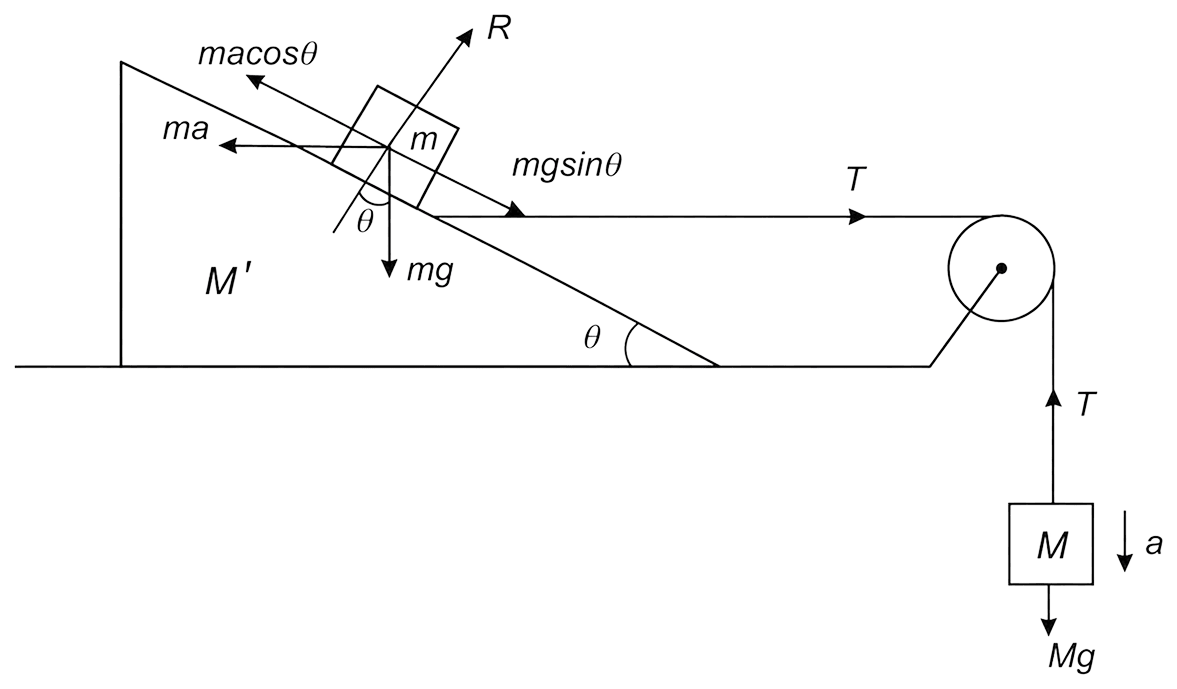
The mass M of the hanging block has to be calculated.
Let the hanging block M descend with an acceleration a. Since the string is light and inextensible and passes over a light pulley, the triangular block together with the smaller block placed on it moves horizontally with the same acceleration a, and the smaller block moves along with the triangular block without slipping.
Condition that the smaller block does not slip : In the frame of the accelerating triangular block, a pseudo force ma acts on the smaller block in the backward direction. Resolving the pseudo force and the gravity force along the inclined surface, the smaller block does not slip when these components balance,
Dividing throughout by m cos θ,
Substituting θ = 30°,
For the hanging block M : Let T be the tension in the string. The net downward force on M is Mg − T, so by Newton's second law,
For the triangular block together with the smaller block : This combination, of total mass (M' + m), is pulled horizontally by the tension T alone, the floor being frictionless. Hence,
Substituting the values,
Adding equations (2) and (3),
Comparing equations (1) and (4),
Cancelling g and cross-multiplying,
Rationalising the denominator,
Substituting ,
Hence, the mass of the hanging block must be kg, that is, nearly 9.56 kg.
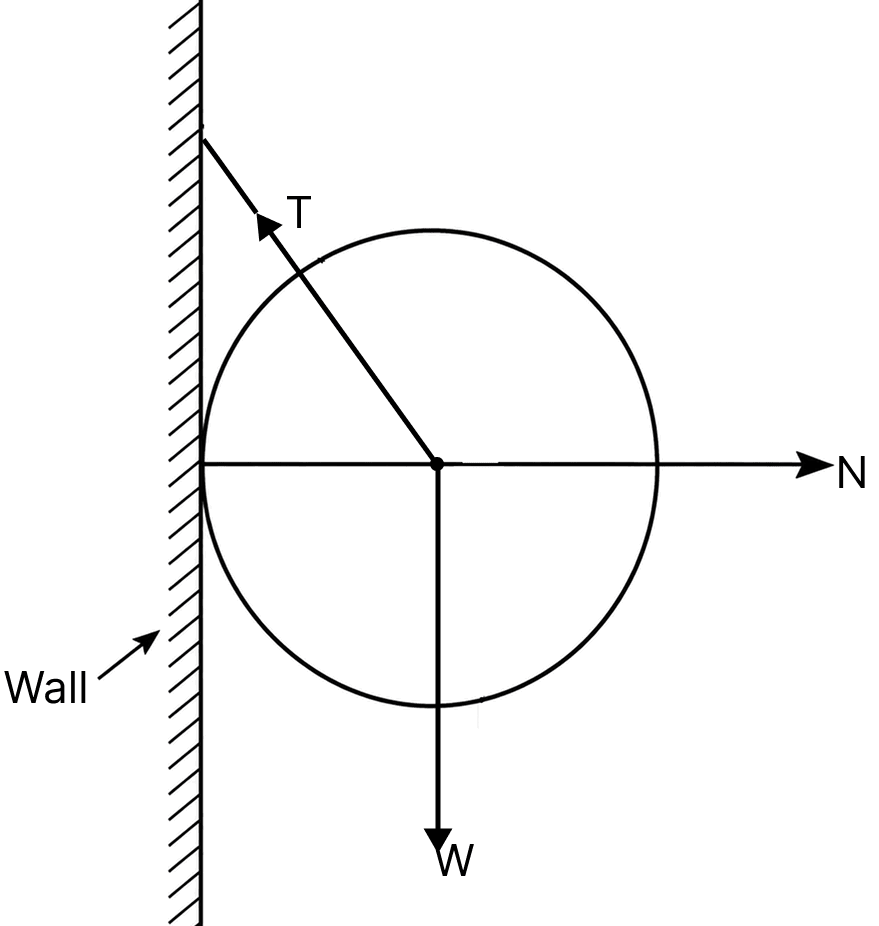
A uniform sphere of weight W and radius 3 m is being held by a string of length 5 m attached to a frictionless wall as shown in the figure. Find tension in the string and normal reaction N of the wall in terms of weight W.
Answer
Given,
- Weight of the sphere = W
- Radius of the sphere, r = 3 m
- Length of the string, BO = 5 m
- The wall is frictionless
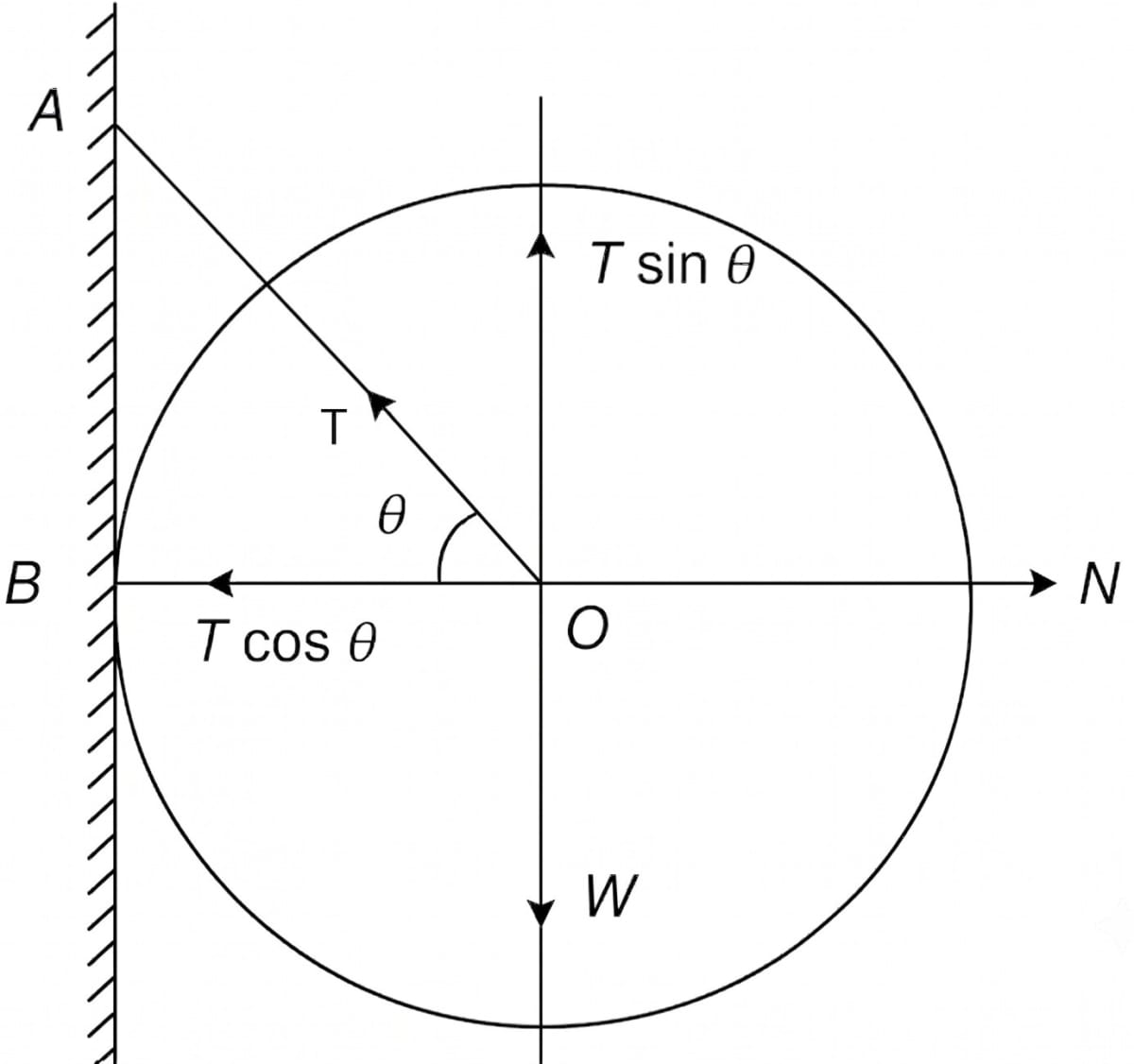
The tension in the string and the normal reaction of the wall have to be found in terms of W.
The forces acting on the sphere are its weight W, acting vertically downwards at the centre O, the tension T along the string, and the normal reaction N of the wall, acting horizontally. The wall is frictionless, so N has no vertical component.
The sphere is uniform and rests in equilibrium under these three forces, so their lines of action must be concurrent. Hence, the line of the string passes through the centre O of the sphere.
Let A be the point at which the sphere touches the wall and B the point on the wall at which the string is attached. Since the radius drawn to the point of contact is perpendicular to the wall, AO is horizontal and
while AB lies along the wall and is therefore vertical. Thus, the triangle ABO is right-angled at A, and
Let θ be the angle which the string makes with the horizontal at O. From the triangle ABO,
Resolving the tension into its vertical and horizontal components, for the equilibrium of the sphere,
From equation (1),
Substituting this value in equation (2),
Hence, the tension in the string is and the normal reaction of the wall is .
A block of mass 15 kg hangs from three light chords A, B and C and is in equilibrium. What are the tensions in the chord A and B? Give your answer in kg-wt.
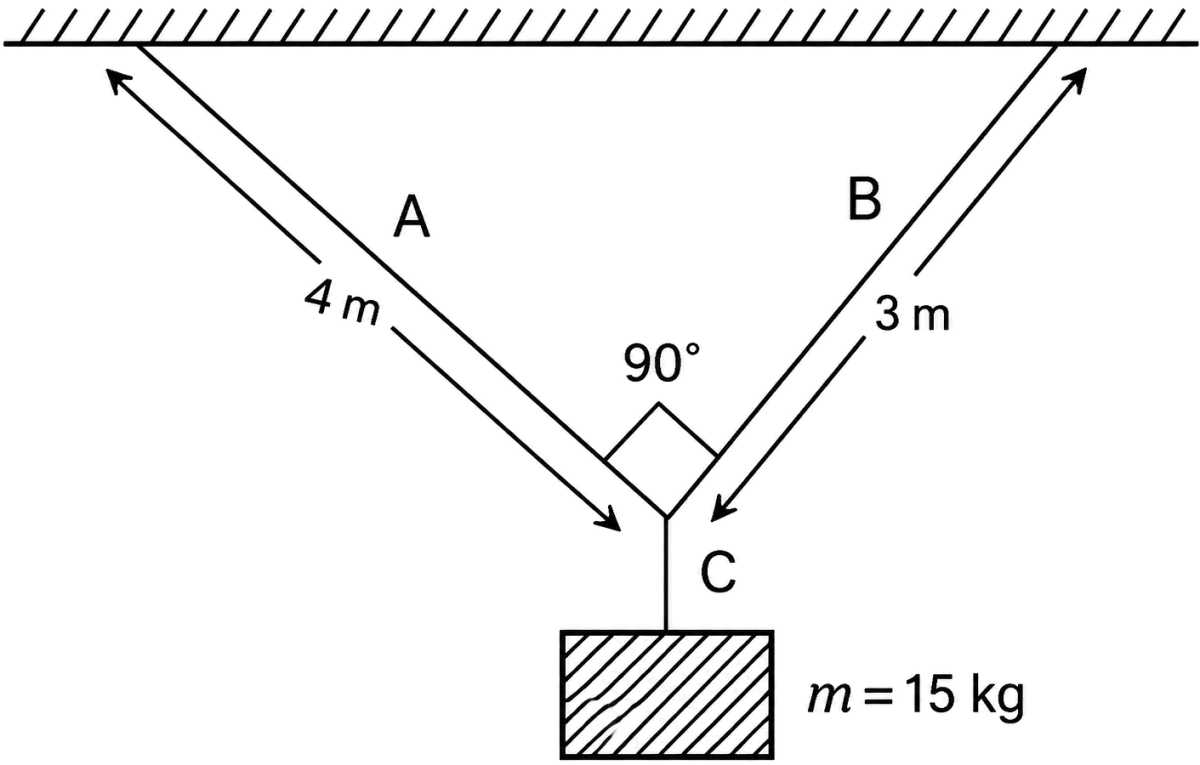
Answer
Given,
- Mass of the block, m = 15 kg, so its weight W = 15 kg-wt
- Length of the chord A = 4 m and length of the chord B = 3 m
- The angle between the chords A and B at their meeting point is 90°
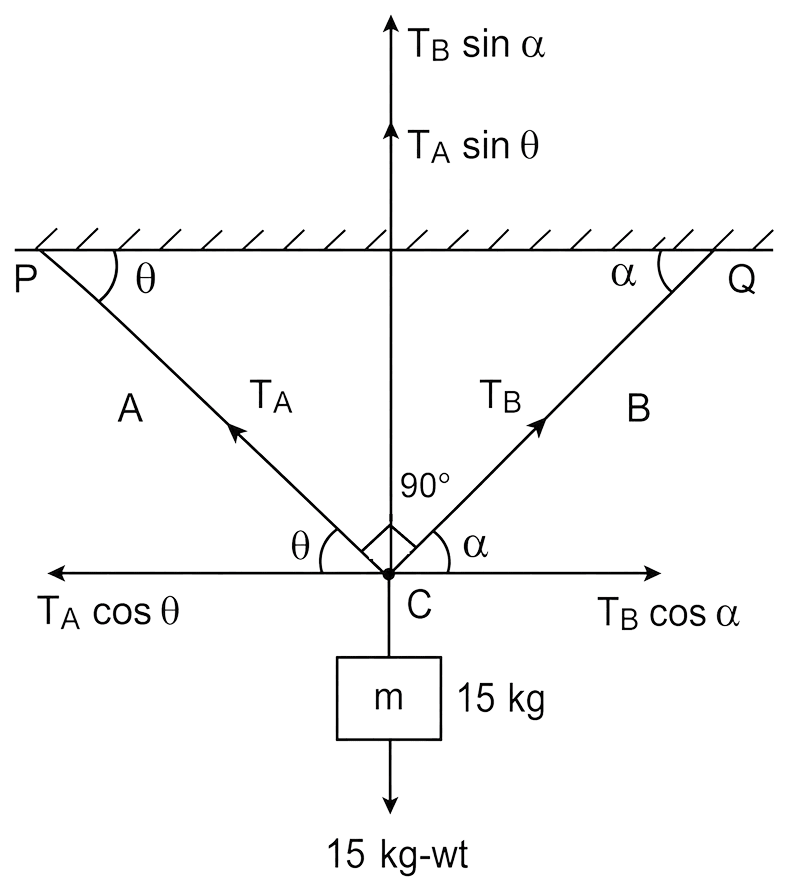
The tensions in the chords A and B have to be calculated.
The chord C carries the whole weight of the block, so the tension in it is 15 kg-wt, acting vertically downwards at the point where the three chords meet.
Let P and Q be the points at which the chords A and B are fixed to the horizontal ceiling, and let C be the point at which the three chords meet. Then
Since the triangle PQC is right-angled at C,
PQ lies along the ceiling and is therefore horizontal. Let θ = ∠QPC be the angle which the chord A makes with the horizontal, and α = ∠PQC the angle which the chord B makes with the horizontal. From the right-angled triangle PQC,
The point C is in equilibrium under the three tensions. Resolving the tensions TA and TB into horizontal and vertical components,
Horizontal components :
Vertical components :
Substituting the values in equation (1),
Substituting this in equation (2),
Therefore,
Hence, the tension in the chord A is 9 kg-wt and that in the chord B is 12 kg-wt.
The result may be checked by noting that the chords A and B are at right angles to each other, so the resultant of the two tensions is
which is exactly the weight of the block, as required for equilibrium.