
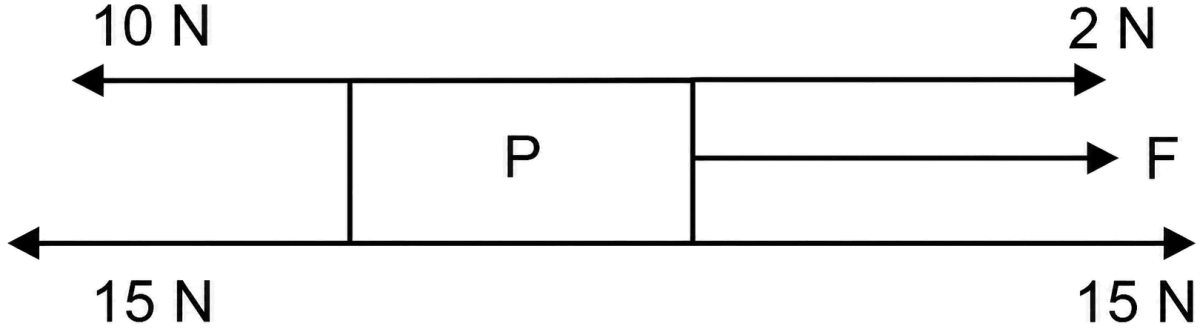
If the block P shown in figure were to be at rest, the magnitude of force F will be :
- 5 N
- 6N
- 8N
- 10 N
Answer
8N
Reason — For the block P to be at rest, the net force acting on it must be zero. Taking the forces along the vertical line and giving the upward forces the positive sign,
A particle moves in x-y plane under the action of force such that the value of its linear momentum at any instant px = 2cos t and py = 2 sin t. The angle θ between and will be :
- 0°
- 90°
- 180°
- 30°
Answer
90°
Reason — The magnitude of the linear momentum is
which is a constant. Differentiating the components with respect to time, the components of the force are
Taking the scalar product,
Since the scalar product is zero and neither vector is a null vector, cos θ = 0 and hence θ = 90°. This is expected, because the magnitude of the momentum is constant and only its direction changes.
A force of 90 N is applied on a body to accelerate it at a rate of 2.6 ms-2. The mass of the body is :
- 44.6 kg
- 34.6 kg
- 54.6 kg
- None of these
Answer
34.6 kg
Reason — By Newton's second law of motion, F = ma, so
An aircraft executes a horizontal loop at a speed of 720 km h-1 with its wings banked at 15°. The radius of the loop executed by aircraft is :
- 15 km
- 23.567 m
- 12.781 m
- 14 km
Answer
15 km
Reason — For an aircraft executing a horizontal loop with its wings banked at an angle θ,
Here v = 720 km h-1 = = 200 m s-1,
tan 15° = 0.27 and
g = 10 m s-2.
Substituting the values,
A car rounds a curve of radius 50 m at a speed of 10 ms-1. The centripetal acceleration of the car is :
- 0.2 ms-2
- 2 ms-2
- 5 ms-2
- 10 ms-2
Answer
2 ms-2
Reason — The centripetal acceleration is
A cyclist moving in a circular track of radius 30 m completes one revolution in 20 s. What is the centripetal acceleration of the cyclist?
- 1.48 ms-2
- 2.92 ms-2
- 3.71 ms-2
- 4.94 ms-2
Answer
2.92 ms-2
Reason — The cyclist completes one revolution in T = 20 s, so the linear speed is
Therefore, the centripetal acceleration is
which is closest to the value given in this option.
Note: The exact value is 2.96 m s-2, while the option printed in the textbook reads 2.92 m s-2. The nearest available alternative has been chosen.
A car of mass 1500 kg is moving at a speed of 25 ms-1 around a curve of radius 50 m. The centripetal force acting on the car is :
- 7500 N
- 15000 N
- 18750 N
- 37500 N
Answer
18750 N
Reason — The centripetal force acting on the car is
A satellite is orbiting the earth at a height where the acceleration due to gravity is 4.9 ms-2. If the radius of earth is 6.4 × 10⁶ m, what is the speed of the satellite in its orbit?
- 5600 ms-1
- 7000 ms-1
- 8000 ms-1
- 9000 ms-1
Answer
5600 ms-1
Reason — For a satellite in a circular orbit, the gravitational force provides the necessary centripetal force. Hence, if g' is the acceleration due to gravity at that place and R the radius of the orbit,
Substituting g' = 4.9 m s-2 and R = 6.4 × 10⁶ m,
A passenger standing in a moving train suddenly falls forward when the train comes to a stop. The force causes the passenger to fall is :
- gravitational force
- frictional force between feet and floor
- inertial force due to change in velocity
- none of the above
Answer
inertial force due to change in velocity
Reason — When the train comes to a stop, the lower part of the body of the passenger, being in contact with the floor, comes to rest along with the train. The upper part of his body, however, continues to remain in motion due to the inertia of motion, and so he falls forward. In the accelerated (non-inertial) frame of the train this effect is described by an inertial (pseudo) force arising from the change in velocity of the train.
Newton's second law and third law lead to the conservation of :
- energy
- charge
- linear momentum
- none of these
Answer
linear momentum
Reason — Consider two bodies which exert forces on each other. By Newton's third law of motion the force exerted by the first on the second is equal and opposite to the force exerted by the second on the first,
By Newton's second law in its alternative form, each force equals the rate of change of momentum of the body on which it acts,
Hence, the total linear momentum of the system remains constant, which is the law of conservation of linear momentum.
If the force applied on an object is doubled and mass is reduced to half of its initial value, the ratio of its acceleration is :
- 1 : 2
- 2 : 1
- 1 : 4
- 1 : 1
Answer
1 : 4
Reason — By Newton's second law of motion, the initial acceleration is
When the force is doubled and the mass is reduced to half,
Therefore,
Forces acting for a short duration are known as :
- gravitational forces
- weak forces
- exchange forces
- impulsive forces
Answer
impulsive forces
Reason — A large force which acts on a body for a very short duration of time is called an impulsive force. Examples are the force exerted by a bat on a ball, or the force between two colliding billiard balls. Such a force cannot be measured easily at every instant, so its effect is measured by the impulse, which is equal to the change in momentum produced.
Friction is a :
- contact force
- non-contact force
- nuclear origin force
- none of these
Answer
contact force
Reason — Friction comes into play only when the surfaces of two bodies are in actual contact with each other, and it acts parallel to the surfaces in contact. Hence, it is a contact force. On the modern theory it arises from the strong adhesive forces between the molecules of the two surfaces at the points of actual contact.
Which one is not an example of conservative force?
- Gravitational force
- Electrostatic force
- Frictional force
- Nuclear force
Answer
Frictional force
Reason — Friction is a non-conservative force. The work done against friction is not recoverable, since it is dissipated as heat and noise, and the work done depends on the path followed. The gravitational, electrostatic and nuclear forces are conservative, because the work done by them in taking a body from one point to another does not depend on the path followed.
Which of the following factors do not affect the frictional force between two surfaces?
- The nature of the surfaces in contact
- The contact area between the surfaces
- The normal force
- The relative speed of the surfaces in motion
Answer
The contact area between the surfaces
Reason — By the third law of limiting friction, the limiting frictional force is independent of the apparent area of contact between the two surfaces. It depends only on the normal reaction and on the nature of the materials in contact. The modern theory explains this by noting that with an increase in the contact area the adhesive force also increases in the same ratio, so that the adhesive pressure responsible for friction remains constant. The other three factors listed do affect the frictional force.
Static friction is usually :
- less than kinetic friction
- greater than kinetic friction
- equal to kinetic friction
- not related to kinetic friction
Answer
greater than kinetic friction
Reason — The limiting friction, which is the maximum value of static friction, is greater than the kinetic friction between the same pair of surfaces, so that μs > μk. This is why a larger force is required to set a body in motion than to keep it moving once the motion has started.
An object moving in a circular path with constant speed is experiencing :
- no acceleration
- linear acceleration
- centripetal acceleration
- centrifugal acceleration
Answer
centripetal acceleration
Reason — In uniform circular motion the magnitude of the velocity remains constant, but its direction changes continuously. A change in the direction of velocity is itself a change in velocity, so the body is accelerated. This acceleration is directed radially inwards, towards the centre of the circular path, and is called centripetal acceleration. Its magnitude is .
The centripetal force acting on a body moving in a circular path is directed :
- away from the centre
- towards the centre
- tangent to the circle
- perpendicular to the velocity of the body
Answer
towards the centre
Reason — The centripetal force is the force which is required to keep a body moving in a circular path, and it is always directed along the radius towards the centre of the circular path. It is therefore perpendicular to the instantaneous velocity of the body, and so it changes only the direction of the velocity and not its magnitude.
If the radius of circular path is doubled while keeping the velocity constant, the centripetal force required will be :
- halved
- doubled
- quadrupled
- remains unchanged
Answer
halved
Reason — The centripetal force required is
For a constant velocity, . Hence, if the radius is doubled, the centripetal force required becomes half of its initial value.
The dimensions of action are :
- ML-1T-1
- ML T-2
- M2LT-2
- M2L2T-2
Answer
ML T-2
Reason — In Newton's third law of motion, action and reaction are the two forces which two bodies exert on each other. Hence, action is a force, and its dimensions are the dimensions of force,
The linear momentum p of a body moving in one dimension varies with time t according to the equation p = a + bt2, where a and b are positive constants. The net force acting on the body is :
- a constant
- proportional to t2
- inversely proportional to t
- proportional to t
Answer
proportional to t
Reason — By Newton's second law of motion in its alternative form, the net force is the rate of change of momentum,
Differentiating p = a + bt2 with respect to time, and remembering that a and b are constants,
Since 2b is a constant, F ∝ t.
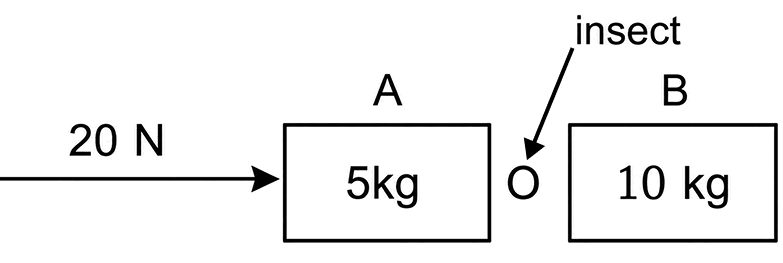
An insect is trapped between the two blocks A and B of masses 5 kg and 10 kg respectively, placed a smooth platform. The 5 kg block is pushed by a horizontal force of 20 N as shown in fig. The force experienced by the insect is :
- N
- N
- N
- None of these
Answer
N
Reason — The two blocks are in contact on a smooth platform, so they move together with a common acceleration. By Newton's second law,
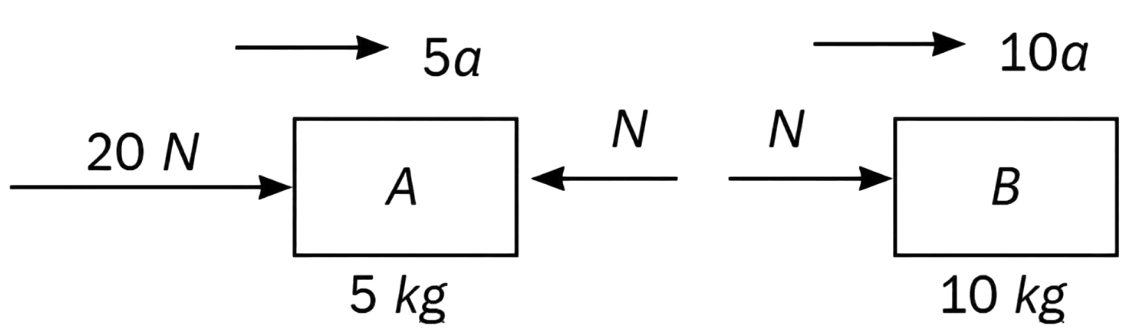
The insect is trapped between the two blocks, so the force it experiences is the contact force N between them. Considering the 10 kg block, this contact force alone accelerates it,
Newton's first law is also known as :
- law of inertia
- law of displacement
- law of momentum
- none of these
Answer
law of inertia
Reason — Newton's first law states that a body continues in its state of rest or of uniform motion in a straight line unless it is compelled by an external force to change that state. This is precisely the property of inertia, by virtue of which a body is unable to change its state of rest or of uniform motion by itself. Hence, the first law is also called the law of inertia.
Three forces , and acting on a body to keep it in equilibrium, then is :
Answer
Reason — For a body to be in equilibrium under the action of three concurrent forces, their vector sum must be zero,
Adding the corresponding components,
Therefore,
If two forces are acting at a point such that the magnitude of each force is 2N and the magnitude of their resultant is also 2N, then the angle between the forces is :
- 120°
- 30°
- 45°
- 60°
Answer
120°
Reason — By the parallelogram law of vector addition, the magnitude of the resultant of two forces A and B inclined at an angle θ is
Here A = B = R = 2 N. Squaring both sides and substituting,
Therefore, θ = 120°.
A bullet of mass m moving with a speed v strikes a wooden block of mass M and gets embedded into it. The final speed is :
Answer
Reason — The bullet gets embedded in the block, so the two move together after the impact. No external force acts on the system, so by the principle of conservation of linear momentum,
A graph is drawn with a force along y-axis and time along X-axis. The area under the graph represents :
- momentum
- couple
- moment of force
- impulse
Answer
impulse
Reason — The area under a force-time graph is the product of force and the time interval for which it acts. By definition, this product is the impulse of the force,
For a variable force, the impulse is obtained by integration, , which again is the area enclosed by the force-time graph.
Assertion (A): A passenger in a bus feels a backward push when the bus suddenly starts moving forward.
Reason (R): The inertia of the passenger's body resists the change in motion.
- If both assertion and reason are true and reason is the correct explanation of assertion.
- If both assertion and reason are true but reason is not the correct explanation of assertion.
- If assertion is true but reason is false.
- If assertion is false but reason is true.
Answer
If both assertion and reason are true and reason is the correct explanation of assertion.
Explanation
Assertion (A) is correct: When the bus suddenly starts moving forward, the lower part of the passenger's body, being in contact with the bus, moves along with it, while the upper part tends to remain at rest. Hence, he feels a backward push and leans backwards.
Reason (R) is also correct: By Newton's first law of motion, a body continues in its state of rest unless compelled by an external force to change that state. It is this inertia of rest of the passenger's body that resists the change in motion.
Therefore, both assertion and reason are true and reason is the correct explanation of assertion.
Assertion (A): An object will continue to move with a uniform velocity unless acted upon by an external force.
Reason (R): According to Newton's second law, the acceleration of an object is directly proportional to the net force acting on it.
- If both assertion and reason are true and reason is the correct explanation of assertion.
- If both assertion and reason are true but reason is not the correct explanation of assertion.
- If assertion is true but reason is false.
- If assertion is false but reason is true.
Answer
If both assertion and reason are true but reason is not the correct explanation of assertion.
Explanation
Assertion (A) is correct: This is a statement of Newton's first law of motion, which says that a body continues in its state of rest or of uniform motion in a straight line unless an external force compels it to change that state.
Reason (R) is also correct: By Newton's second law of motion, F = ma, so for a given mass the acceleration produced is directly proportional to the net force acting on the body.
However, the Reason is a statement of the second law, while the Assertion is a statement of the first law. It states the relation between force and acceleration but does not by itself explain why a body continues to move with a uniform velocity.
Therefore, both assertion and reason are true but reason is not the correct explanation of assertion.
Assertion (A): If no net force acts on an object, it will remain at rest or in uniform motion.
Reason (R): Every action has an equal and opposite reaction.
- If both assertion and reason are true and reason is the correct explanation of assertion.
- If both assertion and reason are true but reason is not the correct explanation of assertion.
- If assertion is true but reason is false.
- If assertion is false but reason is true.
Answer
If both assertion and reason are true but reason is not the correct explanation of assertion.
Explanation
Assertion (A) is correct: This is a statement of Newton's first law of motion. If the net external force on a body is zero, its acceleration is zero, so it remains at rest or continues to move with a uniform velocity in a straight line.
Reason (R) is also correct: This is a statement of Newton's third law of motion, according to which to every action there is an equal and opposite reaction.
However, the third law deals with the pair of forces which two bodies exert on each other, whereas the Assertion concerns the motion of a single body under zero net force. Hence, the Reason does not explain the Assertion.
Therefore, both assertion and reason are true but reason is not the correct explanation of assertion.
Assertion (A): The coefficient of static friction is always greater than the coefficient of kinetic friction for the same surfaces.
Reason (R): It is easier to keep an object moving than to start moving it from rest.
- If both assertion and reason are true and reason is the correct explanation of assertion.
- If both assertion and reason are true but reason is not the correct explanation of assertion.
- If assertion is true but reason is false.
- If assertion is false but reason is true.
Answer
If both assertion and reason are true and reason is the correct explanation of assertion.
Explanation
Assertion (A) is correct: For the same pair of surfaces, the coefficient of static friction is greater than the coefficient of kinetic friction, that is, μs > μk. The limiting friction, which is the maximum value of the static friction, is therefore greater than the kinetic friction.
Reason (R) is also correct: Since a larger force is needed to overcome the limiting friction and start the motion than to overcome the kinetic friction and maintain it, it is easier to keep an object moving than to start it moving from rest.
This everyday observation is exactly the consequence of μs being greater than μk, so the Reason correctly explains the Assertion.
Therefore, both assertion and reason are true and reason is the correct explanation of assertion.
Assertion (A): Frictional force depends on the area of contact between two surfaces.
Reason (R): Frictional force is directly proportional to the normal force.
- If both assertion and reason are true and reason is the correct explanation of assertion.
- If both assertion and reason are true but reason is not the correct explanation of assertion.
- If assertion is true but reason is false.
- If assertion is false but reason is true.
Answer
If assertion is false but reason is true.
Explanation
Assertion (A) is false: By the third law of limiting friction, the frictional force is independent of the apparent area of contact between the two surfaces. It depends only on the normal reaction and on the nature of the materials in contact.
Reason (R) is correct: The limiting frictional force is directly proportional to the normal reaction, fs = μsR, which is the first law of limiting friction.
Therefore, assertion is false but reason is true.
Assertion (A): An object moving in a circular path with constant speed has zero acceleration.
Reason (R): An object moving in a circular path with constant speed has a centripetal acceleration directed towards the centre of the circle.
- If both assertion and reason are true and reason is the correct explanation of assertion.
- If both assertion and reason are true but reason is not the correct explanation of assertion.
- If assertion is true but reason is false.
- If assertion is false but reason is true.
Answer
If assertion is false but reason is true.
Explanation
Assertion (A) is false: An object moving in a circular path with a constant speed does have an acceleration. Although the magnitude of its velocity is constant, the direction of the velocity changes continuously, and a change in direction is itself a change in velocity.
Reason (R) is correct: This changing direction of velocity gives rise to the centripetal acceleration, of magnitude , which is directed radially inwards towards the centre of the circle.
Therefore, assertion is false but reason is true.
Assertion (A): A car moving in a circular path at constant speed experiences acceleration.
Reason (R): The direction of velocity of the car changes continuously.
- If both assertion and reason are true and reason is the correct explanation of assertion.
- If both assertion and reason are true but reason is not the correct explanation of assertion.
- If assertion is true but reason is false.
- If assertion is false but reason is true.
Answer
If both assertion and reason are true and reason is the correct explanation of assertion.
Explanation
Assertion (A) is correct: A car moving in a circular path at a constant speed is accelerated, because its velocity, being a vector, changes continuously in direction.
Reason (R) is also correct: In circular motion the velocity is always along the tangent to the path, so its direction changes from point to point. This continuous change of direction is precisely what produces the centripetal acceleration.
Therefore, both assertion and reason are true and reason is the correct explanation of assertion.
Assertion (A): The tension in the string of a vertically moving pendulum is maximum at the lowest point of its swing.
Reason (R): At the lowest point, both the gravitational force and the centripetal force act in the same direction.
- If both assertion and reason are true and reason is the correct explanation of assertion.
- If both assertion and reason are true but reason is not the correct explanation of assertion.
- If assertion is true but reason is false.
- If assertion is false but reason is true.
Answer
If assertion is true but reason is false.
Explanation
Assertion (A) is correct: At the lowest point of the swing the tension in the string has to balance the weight of the bob and, in addition, to provide the centripetal force required for the circular motion, so that . Since the speed is also greatest there, the tension is maximum at the lowest point.
Reason (R) is incorrect: At the lowest point, the gravitational force acts vertically downwards. However, the centripetal force (the net force required to keep the bob in a circular path) is directed towards the center of the circle, which is vertically upwards. Therefore, they act in opposite directions, not the same direction.
Therefore, assertion is true but reason is false
Note: The answer key is incorrect. The assertion is true, but the reason is false because gravity acts away from the centre at the lowest point. Hence, option 3 is correct.
Assertion (A): When a car suddenly stops, passengers tend to lurch forward.
Reason (R): The inertia of the passengers resists the change in their state of motion.
- If both assertion and reason are true and reason is the correct explanation of assertion.
- If both assertion and reason are true but reason is not the correct explanation of assertion.
- If assertion is true but reason is false.
- If assertion is false but reason is true.
Answer
If both assertion and reason are true and reason is the correct explanation of assertion.
Explanation
Assertion (A) is correct: When a car suddenly stops, the lower part of the body of a passenger comes to rest along with the car, while the upper part continues to move forward. Hence, the passengers lurch forward.
Reason (R) is also correct: By virtue of the inertia of motion, the body of a passenger resists any change in its state of motion, and this is exactly why the passengers are thrown forward.
Therefore, both assertion and reason are true and reason is the correct explanation of assertion.
Assertion (A): A satellite in orbit around Earth is in free fall.
Reason (R): The gravitational force acting on the satellite provides the centripetal force necessary for circular motion.
- If both assertion and reason are true and reason is the correct explanation of assertion.
- If both assertion and reason are true but reason is not the correct explanation of assertion.
- If assertion is true but reason is false.
- If assertion is false but reason is true.
Answer
If both assertion and reason are true and reason is the correct explanation of assertion.
Explanation
Assertion (A) is correct: A satellite orbiting the earth is in a continuous state of free fall towards the earth. It does not strike the earth only because its tangential velocity carries it forward at just the rate at which it falls, so that it keeps moving in its orbit.
Reason (R) is also correct: The gravitational force exerted by the earth on the satellite provides exactly the centripetal force needed for the circular motion. Since gravity is the only force acting on it, the satellite is in free fall.
Therefore, both assertion and reason are true and reason is the correct explanation of assertion.
Assertion (A): An object moving in a circular path with a constant speed has zero net force acting on it.
Reason (R): An object in circular motion is accelerating towards the centre of the circle.
- If both assertion and reason are true and reason is the correct explanation of assertion.
- If both assertion and reason are true but reason is not the correct explanation of assertion.
- If assertion is true but reason is false.
- If assertion is false but reason is true.
Answer
If assertion is false but reason is true.
Explanation
Assertion (A) is false: An object moving in a circular path with a constant speed has a centripetal force acting on it, directed towards the centre of the circle. Hence, the net force on it is not zero.
Reason (R) is correct: The object in circular motion is accelerating towards the centre of the circle, the centripetal acceleration being . By Newton's second law, a non-zero acceleration means a non-zero net force.
Therefore, assertion is false but reason is true.
Assertion (A): A car moving on a banked road can negotiate a curve without relying on friction.
Reason (R): The banking of the road provides a component of the normal force that acts as the centripetal force.
- If both assertion and reason are true and reason is the correct explanation of assertion.
- If both assertion and reason are true but reason is not the correct explanation of assertion.
- If assertion is true but reason is false.
- If assertion is false but reason is true.
Answer
If both assertion and reason are true and reason is the correct explanation of assertion.
Explanation
Assertion (A) is correct: On a banked road the outer edge is raised above the inner edge. If the road is banked at the correct angle for a given speed, the vehicle can negotiate the curve even if the road is perfectly smooth, that is, without relying on friction at all. The condition is .
Reason (R) is also correct: When the road is banked, the normal reaction N is no longer vertical. Its horizontal component N sin θ is directed towards the centre of the curve and provides the necessary centripetal force, while the vertical component N cos θ balances the weight.
Therefore, both assertion and reason are true and reason is the correct explanation of assertion.
Assertion (A): The force of friction always acts in the direction opposite to the direction of motion of an object.
Reason (R): Frictional force is a resistive force that opposes the relative motion between two surfaces in contact.
- If both assertion and reason are true and reason is the correct explanation of assertion.
- If both assertion and reason are true but reason is not the correct explanation of assertion.
- If assertion is true but reason is false.
- If assertion is false but reason is true.
Answer
If both assertion and reason are true and reason is the correct explanation of assertion.
Explanation
Assertion (A) is correct: The frictional force on a body always acts in a direction opposite to the direction in which the body moves, or tends to move, relative to the other surface.
Reason (R) is also correct: Friction is a resistive force which, by its very nature, opposes the relative motion between two surfaces in contact. This is exactly why it acts opposite to the direction of motion.
Therefore, both assertion and reason are true and reason is the correct explanation of assertion.
Assertion (A): Kinetic friction is dependent on the velocity of the moving object.
Reason (R): Frictional force is directly proportional to the normal force acting between two surfaces.
- If both assertion and reason are true and reason is the correct explanation of assertion.
- If both assertion and reason are true but reason is not the correct explanation of assertion.
- If assertion is true but reason is false.
- If assertion is false but reason is true.
Answer
If assertion is false but reason is true.
Explanation
Assertion (A) is false: By the third law of kinetic friction, the kinetic frictional force is relatively independent of the relative speed of the surfaces, at least within a certain range of speeds. For most practical purposes the kinetic friction is taken to be constant regardless of speed.
Reason (R) is correct: The frictional force is directly proportional to the normal reaction between the two surfaces, fk = μkR.
Therefore, assertion is false but reason is true.
Note: The answer key printed in the textbook marks this question as "assertion is true but reason is false". The textbook's own Hints, however, state that kinetic friction is independent of velocity and that the frictional force is proportional to the normal force, which supports the choice made above.
Assertion (A): The direction of centripetal force is always perpendicular to the direction of motion of the object in circular motion.
Reason (R): The centripetal force causes the object to change its direction without changing its speed.
- If both assertion and reason are true and reason is the correct explanation of assertion.
- If both assertion and reason are true but reason is not the correct explanation of assertion.
- If assertion is true but reason is false.
- If assertion is false but reason is true.
Answer
If both assertion and reason are true and reason is the correct explanation of assertion.
Explanation
Assertion (A) is correct: In circular motion the velocity of the object is always along the tangent to the path, while the centripetal force is always directed along the radius towards the centre. The radius is perpendicular to the tangent, so the centripetal force is always perpendicular to the direction of motion.
Reason (R) is also correct: Because the force is perpendicular to the velocity, it has no component along the direction of motion and therefore cannot change the speed. It only changes the direction of the velocity, which is exactly why it must remain perpendicular to the motion.
Therefore, both assertion and reason are true and reason is the correct explanation of assertion.
Assertion (A): An astronaut in a space station orbiting Earth feels weightless.
Reason (R): The gravitational force acting on the astronaut is balanced by the centrifugal force.
- If both assertion and reason are true and reason is the correct explanation of assertion.
- If both assertion and reason are true but reason is not the correct explanation of assertion.
- If assertion is true but reason is false.
- If assertion is false but reason is true.
Answer
If assertion is true but reason is false.
Explanation
Assertion (A) is correct: An astronaut in a space station orbiting the earth does feel weightless, because both the astronaut and the station are in free fall, accelerating towards the earth at the same rate. Hence, there is no normal reaction between the astronaut and the floor of the station.
Reason (R) is false: Centrifugal force is not a real force at all; it is a pseudo force which appears only in a rotating (non-inertial) frame of reference. The weightlessness is due to the free fall of the astronaut along with the station, and not due to any balancing of gravity by a centrifugal force.
Therefore, assertion is true but reason is false.
Assertion (A): A box pushed with a constant force on a rough horizontal surface moves with constant velocity.
Reason (R): The net force acting on the box is zero.
- If both assertion and reason are true and reason is the correct explanation of assertion.
- If both assertion and reason are true but reason is not the correct explanation of assertion.
- If assertion is true but reason is false.
- If assertion is false but reason is true.
Answer
If both assertion and reason are true and reason is the correct explanation of assertion.
Explanation
Assertion (A) is correct: When a box is pushed with a constant force on a rough horizontal surface and the applied force is just equal to the kinetic frictional force, the box moves with a constant velocity.
Reason (R) is also correct: In this situation the applied force is balanced by the frictional force, so the net force on the box is zero. By Newton's first law, the box then continues to move with a uniform velocity.
Therefore, both assertion and reason are true and reason is the correct explanation of assertion.
Assertion (A): When a car takes a sharp turn at high speed, passengers tend to slide outward.
Reason (R): This is due to the lack of centripetal force acting on the passengers.
- If both assertion and reason are true and reason is the correct explanation of assertion.
- If both assertion and reason are true but reason is not the correct explanation of assertion.
- If assertion is true but reason is false.
- If assertion is false but reason is true.
Answer
If both assertion and reason are true and reason is the correct explanation of assertion.
Explanation
Assertion (A) is correct: When a car takes a sharp turn at high speed, the passengers do tend to slide outward, away from the centre of the turn.
Reason (R) is also correct: The passengers require a centripetal force to move along the circular path. If the friction between the passengers and the seat is not sufficient to provide this force, their bodies continue to move along the straight line by inertia while the car turns inwards, and so they appear to slide outward.
Therefore, both assertion and reason are true and reason is the correct explanation of assertion.
Assertion (A): The kinetic energy of an object moving in a circular path remains constant.
Reason (R): The speed of the object remains constant.
- If both assertion and reason are true and reason is the correct explanation of assertion.
- If both assertion and reason are true but reason is not the correct explanation of assertion.
- If assertion is true but reason is false.
- If assertion is false but reason is true.
Answer
If both assertion and reason are true and reason is the correct explanation of assertion.
Explanation
Assertion (A) is correct: In uniform circular motion the kinetic energy of the object, , remains constant, since the centripetal force is perpendicular to the velocity and therefore does no work.
Reason (R) is also correct: The kinetic energy depends only on the mass and the speed of the object. The speed remains constant in uniform circular motion, so the kinetic energy also remains constant.
Therefore, both assertion and reason are true and reason is the correct explanation of assertion.
Assertion (A): A cyclist moving in a circular track experiences no frictional force.
Reason (R): Frictional force is required only to start the motion, not to maintain it.
- If both assertion and reason are true and reason is the correct explanation of assertion.
- If both assertion and reason are true but reason is not the correct explanation of assertion.
- If assertion is true but reason is false.
- If assertion is false but reason is true.
Answer
If assertion is false but reason is true.
Explanation
Assertion (A) is false: A cyclist moving in a circular track does experience a frictional force. On a level circular track it is precisely the friction between the tyres and the road that provides the necessary centripetal force, without which the cyclist could not take the turn at all.
Reason (R) as stated is also not correct in this context: Friction is needed not only to start the motion but also to maintain the circular motion, since it supplies the centripetal force at every instant.
Since the given alternatives do not include an option in which both the assertion and the reason are false, the alternative in which the assertion is false has to be chosen.
Therefore, the assertion is false.
Note: Both the assertion and the reason are false. However, no option for “both are false” is given. Therefore, the options need to be corrected.
Assertion (A): Angle of repose is equal to angle of friction.
Reason (R): When the body is at the point of motion, the force of friction at this stage is called limiting friction.
- If both assertion and reason are true and reason is the correct explanation of assertion.
- If both assertion and reason are true but reason is not the correct explanation of assertion.
- If assertion is true but reason is false.
- If assertion is false but reason is true.
Answer
If both assertion and reason are true but reason is not the correct explanation of assertion.
Explanation
Assertion (A) is correct: The angle of friction θs is the angle which the resultant of the normal reaction and the limiting friction makes with the normal reaction, and it satisfies tan θs = μs. The angle of repose is the minimum angle of inclination of a plane at which a body placed on it just begins to slide down, and it also satisfies tan θs = μs. Hence, the two angles are equal.
Reason (R) is also correct: When a body is just at the point of motion, the force of friction acting on it has its maximum value, and this maximum value of static friction is called limiting friction.
However, the Reason merely defines limiting friction. It does not explain why the angle of repose should be equal to the angle of friction.
Therefore, both assertion and reason are true but reason is not the correct explanation of assertion.
Why does the electric fan continue to rotate for sometime after the current is switched off?
Answer
The fan continues to rotate due to the inertia of motion. When the current is switched off, no driving force acts on the blades, but by virtue of their inertia they tend to continue rotating. The friction in the bearings and the friction of air gradually oppose this motion and finally bring the fan to rest.
Why do we call Newton's first law as law of inertia? Explain.
Answer
Newton's first law states that a body continues in its state of rest or of uniform motion in a straight line unless it is compelled by an external force to change that state.
This is exactly the property of inertia, by virtue of which a body is unable, by itself, to change its state of rest or of uniform motion in a straight line. Since the first law simply states this property of matter, it is also called the law of inertia.
Which law of motion does give the measure of force?
Answer
The second law of motion gives the measure of force. It states that the force acting on a body is the product of its mass and the acceleration produced, F = ma, which enables force to be measured quantitatively. The first law only gives a qualitative definition of force.
A body is acted upon by four external forces. Can it remain at rest?
Answer
Yes. A body acted upon by four external forces can remain at rest provided the vector sum of all the four forces is zero, so that the net force on it is zero. By Newton's first law, the body then continues in its state of rest.
Is a train moving on a circular track, an inertial frame of reference?
Answer
No. A train moving on a circular track is continuously accelerated, since the direction of its velocity changes at every instant. A frame of reference which is accelerated is a non-inertial frame, so the train moving on a circular track is not an inertial frame of reference.
An astronaut accidently gets thrown out of his spaceship accelerating in interstellar space at a constant rate of 200 ms-2. What is the acceleration of the astronaut just after he is outside the spaceship?
Answer
The moment the astronaut is thrown out of the spaceship, no external force acts on him, since he is in interstellar space far from all material objects. Hence, by Newton's first (or second) law, the acceleration of the astronaut is zero and he continues to move with the velocity he had at that instant.
A body is moving on a frictionless horizontal surface. Is any force acting on it when moving with (a) uniform velocity, (b) uniform speed but taking a turn?
Answer
(a) No. When the body moves with a uniform velocity, its acceleration is zero, so by Newton's second law the net force acting on it is zero.
(b) Yes. When the body takes a turn with a uniform speed, the direction of its velocity changes continuously. Hence, it is accelerated, and a force must be acting on it. This is the centripetal force, directed towards the centre of the turn.
A trolley of mass 300 kg carrying a sand bag of 25 kg is moving at a uniform speed of 27 kmh-1 on a smooth track. After a while, sand begins to leak out of a hole on the trolley's floor at a rate of 0.05 kgs-1. What is the speed of the trolley after the entire sand bag is empty?
Answer
Given,
- Mass of the trolley = 300 kg, mass of the sand bag = 25 kg
- Uniform speed, v = 27 km h-1
- The track is smooth, and the sand leaks out at 0.05 kg s-1
The trolley is moving uniformly, that is, without acceleration, on a smooth track, so no external force acts on the trolley-bag system. The sand leaks out vertically through a hole in the floor and carries away with it exactly the horizontal velocity it already had, so it exerts no horizontal force on the trolley.
Hence, the speed of the trolley remains 27 km h-1 even after the entire sand bag is empty.
Give answers to the following questions :
(i) The distance travelled by a moving body is directly proportional to time. Is any external force acting on it?
(ii) Can a body remain in rest position when external forces are acting on it?
(iii) If the net force acting on a body be zero then will the body remain necessarily in rest position?
(iv) If a body is not in rest position then the net external force acting on it cannot be zero. Is this statement true, or false?
(v) If force is acting on a moving body perpendicular to the direction of motion, then what will be its effect on the speed and direction of the body?
(vi) A person sitting in the compartment of a train moving with uniform speed throws a ball in the upward direction. What path of the ball will appear to him? What to a person standing outside?
(vii) Write the second law of motion in vector form.
Answer
(i) If the distance travelled is directly proportional to time, the body moves with a uniform velocity. Its acceleration is zero, so the net external force acting on it is zero.
(ii) Yes. A body can remain at rest when external forces act on it, provided there is more than one external force and their vector sum is zero.
(iii) No. If the net force on a body is zero, the body need not be at rest. It may also be moving with a constant velocity in a straight line.
(iv) False. It is quite possible for a body to be moving with a constant velocity while the net external force acting on it is zero.
(v) If the force acts perpendicular to the direction of motion, it has no component along the direction of motion. Hence, there is no change in the speed of the body, but its direction of motion changes.
(vi) To the person sitting in the compartment, the ball appears to go vertically straight up and come straight back, because he and the ball share the same uniform horizontal velocity. To a person standing outside, the ball has a constant horizontal velocity in addition to its vertical motion, so it appears to describe a parabolic path.
(vii) In vector form, the second law of motion is written as
The two ends of a spring-balance are pulled each by a force of 10 kg-wt. What will be the reading of the balance?
Answer
The reading of the balance will be 10 kg-wt.
A spring balance reads the tension in its spring. When the two ends are pulled by forces of 10 kg-wt each in opposite directions, the balance is in equilibrium and the tension in the spring is 10 kg-wt, not the sum of the two forces. The second force merely holds the other end of the balance in position, exactly as a fixed support would.
The length of an ideal spring increases by 0.1 cm when a body of 1 kg is suspended from it. If this spring is laid on a frictionless horizontal table and bodies of 1 kg each are suspended from its ends, then what will be the increase in its length?
Answer
The increase in length will be 0.1 cm.
When a 1 kg body is suspended from the spring, the upper end is held by the support, which exerts an equal and opposite force on the spring. Thus, the spring is already being stretched by equal and opposite forces of 1 kg-wt at its two ends. When it is laid on a frictionless table and 1 kg bodies are suspended from each end, the situation is exactly the same, since the tension in the spring is again 1 kg-wt. Hence, the increase in length remains 0.1 cm.
A person left on a frictionless surface wants to get away from it. How can he do so?
Answer
He can get away from the frictionless surface by throwing some heavy object, or by blowing air out of his mouth, in the direction opposite to that in which he wants to move.
By the principle of conservation of linear momentum, the momentum given to the object (or to the air) in one direction gives him an equal momentum in the opposite direction, and he starts moving.
A person is standing on ice at a place A in a freezed pond. He has a pistol and two bullets. How can he move from the place A to another distant place B, and stop there?
Answer
He should first fire a bullet in the direction opposite to the line joining A to B. By the principle of conservation of linear momentum he himself recoils, that is, he begins to move towards B along the frictionless ice.
On reaching B, he should fire the second bullet in the direction of the line joining A to B. The recoil now acts in the backward direction and brings him to rest at B.
Air is thrown on a sail attached to a boat from an electric fan placed on the boat. Will the boat start moving?
Answer
No, the boat will not start moving.
When the fan throws air on the sail, the air pushes the sail forward, but at the same time the air pushes the fan backward with an equal and opposite force, by Newton's third law. Since the fan is itself a part of the boat, these are internal forces of the boat-fan-air system, and their vector sum is zero. Hence, the boat cannot move. It would move only under a reaction from some external agency.
A soda-water bottle is falling freely. Will the bubbles of the gas rise in the water of the bottle?
Answer
No, the bubbles will not rise in the water.
The water in the freely falling bottle is in a state of weightlessness. Hence, the pressure in the water does not increase with depth, and no upthrust acts on the bubbles of gas. In the absence of any upthrust, the bubbles do not rise up.
A bird is sitting on the floor of a wire cage and the cage is in the hand of a boy. The bird starts flying in the cage. Will the boy experience any change in the weight of the cage?
Answer
Yes, the cage will appear lighter than before.
The cage is made of wire, so the air inside the cage is not bound with the cage but is in contact with the atmospheric air outside. When the bird starts flying inside the cage, the reaction of the air pushed down by its wings is not transmitted to the cage. Hence, the weight of the bird is no longer experienced and the cage appears lighter.
A bird is sitting on the floor of a closed glass cage and the cage is in the hand of a boy. Will the boy experience any change in the weight of the cage : (i) when the bird starts flying in the cage with a constant velocity, (ii) flies upward with acceleration, (iii) flies downward with acceleration?
Answer
In a closed glass cage the air inside is bound with the cage, so the reaction of the air pushed down by the wings of the bird is transmitted to the cage.
(i) When the bird flies with a constant velocity, the downward push on the air just balances the weight of the bird. Hence, there is no change in the weight of the cage.
(ii) When the bird flies upward with acceleration, it pushes the air down with a force greater than its weight. Hence, the cage feels heavier than before.
(iii) When the bird flies downward with acceleration, it pushes the air down with a force less than its weight. Hence, the cage feels lighter than before.
For ordinary terrestrial experiments, which of the following observers are inertial and which are non-inertial?
(a) A child revolving in a "giant wheel".
(b) A driver in a car moving with a constant speed on a straight road.
(c) A pilot in an aircraft which is taking-off.
(d) A cyclist negotiating a sharp turn.
(e) A guard on a train which is slowing down to a stop.
Answer
An observer whose frame of reference is unaccelerated is an inertial observer, and one whose frame is accelerated is a non-inertial observer.
(a) A child revolving in a "giant wheel" is in circular motion and is therefore accelerated. He is a non-inertial observer.
(b) The driver in a car moving with a constant speed on a straight road has unaccelerated motion. He is an inertial observer.
(c) A pilot in an aircraft which is taking off is accelerated. He is a non-inertial observer.
(d) A cyclist negotiating a sharp turn is accelerated, since the direction of his velocity changes. He is a non-inertial observer.
(e) A guard on a train which is slowing down to a stop is under retardation, that is, he is accelerated. He is a non-inertial observer.
Two boys having the same mass are standing on ice skates at some distance apart on a frictionless surface. A rope is fastened around the body of a boy, the other end of which is in the hand of the second boy. What would happen if the second boy pulls the rope?
Answer
When the second boy pulls the rope, he exerts a force on the first boy through the rope, and by Newton's third law the first boy exerts an equal and opposite force on him.
The surface is frictionless, so no external horizontal force acts on the system and the total linear momentum, which was initially zero, must remain zero. Since the two boys have the same mass, both of them move towards each other with the same speed and meet at the mid-point of the initial distance between them.
Which one is greatest : static friction, limiting friction or kinetic friction?
Answer
Limiting friction is the greatest.
The static friction is a self-adjusting force whose value increases with the applied force up to a maximum, and this maximum value of static friction is called limiting friction. Once the motion begins, the friction falls to the value of kinetic friction. Thus,
What happens to limiting friction when a wooden block is moved with increasing speed on a horizontal surface?
Answer
There is practically no change in the limiting friction.
By the third law of kinetic friction, the frictional force is reasonably independent of the relative speed of the two surfaces in contact, at least within a certain range of speeds. Hence, moving the wooden block faster does not appreciably alter the frictional force.
What type of friction arises when an axle rotates in a sleeve?
Answer
Sliding (or kinetic) friction arises when an axle rotates in a sleeve, since the surface of the axle slides over the surface of the sleeve. It is to convert this sliding friction into the much smaller rolling friction that ball bearings are used.
How does force of friction depend on the area of contact of two surfaces?
Answer
The force of friction is independent of the area of contact of the two surfaces, within wide limits. It depends only on the normal reaction and on the nature of the materials in contact. On the modern theory this is so because, with an increase in the contact area, the adhesive force also increases in the same ratio, so that the adhesive pressure responsible for friction remains constant.
What are the factors on which coefficient of friction between two surfaces depends?
Answer
The coefficient of friction depends on
- the nature of the materials of both the surfaces in contact, including their roughness,
- the cleanliness of the surfaces,
- the surface treatment, that is, whether the surfaces are polished or lubricated, and
- the temperature and the humidity.
It does not depend on the area of contact or on the normal reaction.
When the weight of a body placed on a surface is doubled, how does the coefficient of friction change?
Answer
There is no change in the coefficient of friction.
The coefficient of friction depends only on the nature of the two surfaces in contact and not on the weight of the body. However, since
the force of limiting friction becomes doubled when the weight is doubled.
Sand is thrown on tracks covered with snow in hilly areas. Why?
Answer
Sand is thrown on the tracks covered with snow in order to increase the force of friction between the tyres of the vehicles and the road. Snow is very smooth and the friction between the tyres and the snow is very small, so the tyres are likely to slip. The rough sand raises the coefficient of friction and the vehicles can move safely.
Carts with rubber tyres are easier to ply than those with iron wheels. Why?
Answer
This is because the coefficient of friction between rubber tyres and the road is much smaller than that between iron wheels and the road. Hence, a smaller force of friction has to be overcome in the case of rubber tyres, and the carts are easier to ply.
It is difficult to move a cycle with its brakes on. Why?
Answer
When the brakes are on, the wheels cannot rotate freely and can only skid over the road. In this way the rolling friction is converted into sliding friction, which is comparatively much larger. Hence, a much greater force has to be applied and it becomes difficult to move the cycle.
Is a large brake on a bicycle more effective than a small one?
Answer
No, a large brake is not more effective than a small one.
The force of friction does not depend on the surface area of contact. It depends only on the normal reaction and on the nature of the materials in contact. Hence, increasing the size of the brake does not by itself increase the braking force.
Why are wheels circular?
Answer
Wheels are made circular so that, when a vehicle moves, the wheels roll over the road instead of sliding over it. In this way the sliding friction is converted into the much smaller rolling friction, and the effort needed to move the vehicle is greatly reduced.
It is easier to roll a barrel than to slide it on the road. Why?
Answer
When a barrel is rolled, only rolling friction has to be overcome, whereas when it is slid, sliding friction has to be overcome. Since rolling friction is much smaller than sliding friction, much less effort is needed and it is easier to roll the barrel than to slide it.
Why is it difficult to walk on ice?
Answer
In order to walk, we press the ground backward with our feet, and the horizontal component of the reaction of the ground pushes us forward. This horizontal component is the force of friction.
On ice the friction between our feet and the ice is very small, so the horizontal reaction available is very small and we are unable to push ourselves forward. Hence, it is difficult to walk on ice.
Can we jump off a frictionless horizontal surface?
Answer
No, we cannot jump off a frictionless horizontal surface.
To jump, we must press the surface with our feet and obtain a reaction from it. A frictionless surface cannot offer the horizontal component of the reaction which is needed to propel the body, so no jump is possible.
Why do automobile tyres have irregular projections over their surfaces?
Answer
The irregular projections on the surfaces of automobile tyres increase the frictional grip between the tyres and the road. This larger friction supplies the centripetal force needed at turns and prevents the wheels from slipping at high speeds and on wet roads.
Why are lubricants used in machines?
Answer
Lubricants are used in machines to reduce friction between the moving parts. By reducing friction, they reduce the wear and tear of the machine parts, prevent overheating and save a part of the fuel or energy which would otherwise be spent in overcoming friction.
How does lubricant help in minimising friction?
Answer
When a lubricant such as oil or grease is introduced between two surfaces in contact, it forms a thin layer between them so that the two surfaces are no longer in direct contact. In this way the sliding friction between the solid surfaces is replaced by the liquid friction between the layers of the lubricant, which is much smaller in magnitude.
Fast moving vehicles are given streamline shape. Why?
Answer
Fast moving vehicles are given a streamline shape, that is, sharp in front, in order to reduce the friction due to air considerably. If the shape were blunt, the air would offer a much larger resistance at high speed, and more fuel would be consumed in overcoming it. Aircraft, jet planes and fast cars are all streamlined for this reason.
What is the angle between the frictional force and the instantaneous velocity of a vehicle plying (moving forth and back) on a rough road?
Answer
The angle is 180°.
The force of friction always opposes the relative motion between the surfaces in contact, so it acts in a direction exactly opposite to the instantaneous velocity of the vehicle. When the vehicle moves forth and back, the direction of the frictional force also reverses, and it always remains antiparallel to the instantaneous velocity.
From where the necessary centripetal force is obtained in the following events?
(i) In turning a car, (ii) in revolving a ball tied to a string in a circle, (iii) in earth's revolution around the sun, (iv) in the revolution of electron around the nucleus.
Answer
(i) In turning a car : from the force of friction between the tyres and the road.
(ii) In revolving a ball tied to a string in a circle : from the tension in the string.
(iii) In the earth's revolution around the sun : from the gravitational force of attraction exerted on the earth by the sun.
(iv) In the revolution of an electron around the nucleus : from the electrostatic force of attraction between the negatively-charged electron and the positively-charged nucleus.
In rain, generally, the scooter slips at the turning of a road, why?
Answer
On a wet road the friction between the tyres and the road is greatly reduced. The centripetal force required to take the turn is supplied by this friction, so when the friction becomes too small to provide the necessary centripetal force, the scooter slips instead of taking the turn.
A small smooth ball is placed on a smooth circular disc. When the disc is rotated, the ball falls down. Why?
Answer
The centripetal force needed to keep the ball moving in a circle along with the rotating disc can only be provided by the force of friction between the ball and the disc. Since both the ball and the disc are smooth, this friction is absent, so the necessary centripetal force is not provided to the ball and it falls down.
For uniform circular motion, does the direction of the centripetal force depend on the sense of rotation (that is, clockwise or anticlockwise)?
Answer
No. The direction of the centripetal force does not depend on the sense of rotation.
The centripetal acceleration, and hence the centripetal force, is always directed radially inwards, towards the centre of the circular path, whether the body revolves clockwise or anticlockwise.
A heavy stone is suspended by means of a thread. As the stone was put to oscillations like a simple pendulum, the string broke down. Why?
Answer
While the stone oscillates, the tension in the string is greatest when it passes through the mean position. At that position the tension has not only to balance the weight of the stone but also to provide the centripetal force required for the circular motion,
Since T is much greater than the weight mg of the stone, the string is unable to bear this large tension and breaks.
Define 1 newton.
Answer
One newton is that force which, when acting on a body of mass 1 kilogram, produces in it an acceleration of 1 metre per second squared.
Give an example of a non-inertial frame of reference.
Answer
A frame of reference which is accelerated is a non-inertial frame. Examples are a train moving on a circular track, a lift which is accelerating upwards or downwards, a merry-go-round, and a car taking a sharp turn.
Give the C.G.S. equivalent of 1 N.
Answer
This follows because 1 N = 1 kg × 1 m s-2 = 103 g × 102 cm s-2 = 105 g cm s-2 = 105 dyne.
What is the relation between coefficient of friction and angle of repose?
Answer
The coefficient of limiting friction is equal to the tangent of the angle of repose,
where θs is the angle of repose, that is, the minimum angle of inclination of a plane with the horizontal at which a body placed on it just begins to slide down.
When a body of weight W is suspended turn by turn from two weightless springs A and B then the length of each spring increases by 5 cm. If the spring B along with the weight w be suspended from the spring A, then what will be the increase in each spring? If now the weight W be removed, then through what distance the lower end of the spring B will rise?
Answer
Given,
- A body of weight W stretches each of the springs A and B by 5 cm
Each spring is stretched by 5 cm under a tension W, so the force constant of each spring corresponds to an extension of 5 cm per weight W.
When the spring B, together with the weight W, is suspended from the spring A, the tension in the spring B is W (due to the weight hanging from it) and the tension in the spring A is also W (since the springs are weightless). Hence, each spring is stretched by 5 cm.
If now the weight W is removed, the spring B loses its extension of 5 cm and the spring A also loses its extension of 5 cm. The lower end of the spring B therefore rises through the sum of the two contractions,
Hence, the increase in each spring is 5 cm, and on removing W the lower end of the spring B rises through 10 cm.
A body is dropped from the ceiling of a transparent cabin falling freely towards the earth. Describe the motion of the body as observed by an observer : (a) sitting in the cabin, (b) standing on earth.
Answer
(a) To the observer sitting in the cabin : The cabin and the body both fall freely with the same acceleration g, so there is no relative acceleration between them. Hence, the body appears to remain stationary in air in front of the observer.
(b) To the observer standing on the earth : He is in an inertial frame and sees the body under the action of the gravity force. Hence, the body appears to fall with the acceleration due to gravity g.
A particle is being revolved uniformly along a circle on a smooth table by means of a string connected to it. The string is suddenly cut. Does angular momentum of the particle change?
Answer
No, the angular momentum of the particle does not change.
At any instant the velocity of the particle is directed along the tangent to the circle. When the string is cut, the centripetal force acting on the particle vanishes, so by inertia the particle flies away tangentially in a straight line. Since no external torque acts on it about the axis of revolution, its angular momentum about that axis, mvr, continues to remain constant.
Answer the following questions :
(i) A 5 kg body is suspended from a spring-balance and an identical body is balanced on a pan of a physical balance. If both the balances are kept in an elevator then what would happen in each case when the elevator is moving with an upward acceleration? then?
(ii) A lift is accelerated upward. Will the apparent weight of a person inside the lift increase, decrease or remain the same relative to its real weight? If the lift is going with uniform speed, then?
(iii) A thief jumps from the roof of a house with a box of weight W on his head. What will be the weight of the box as experienced by the thief during jump?
(iv) A ball of 0.5 kg mass moving with a speed of 10 m/s rebounds after striking normally a perfectly elastic wall. Find the change in momentum of the ball.
Answer
(i) In the spring balance the reading depends on the apparent weight of the body, so when the elevator moves with an upward acceleration the reading of the spring balance increases. In the physical balance the two pans are affected in exactly the same way, so there is no effect on the equilibrium of the physical balance.
(ii) When the lift is accelerated upward, the apparent weight is R = m(g + a), which is greater than the real weight mg. Hence, the apparent weight increases. If the lift goes up with a uniform speed, the acceleration is zero and the apparent weight remains the same as the real weight.
(iii) During the jump the thief and the box both fall freely with the acceleration due to gravity, so there is no reaction between the box and his head. Hence, the weight of the box as experienced by the thief is zero, that is, the box is in the state of weightlessness.
(iv) Given, m = 0.5 kg and u = 10 m s-1. The wall is perfectly elastic, so the ball rebounds with the same speed, v = −10 m s-1. The change in momentum is
Hence, the change in momentum of the ball is 10 kg m s-1, directed opposite to the initial direction of motion.
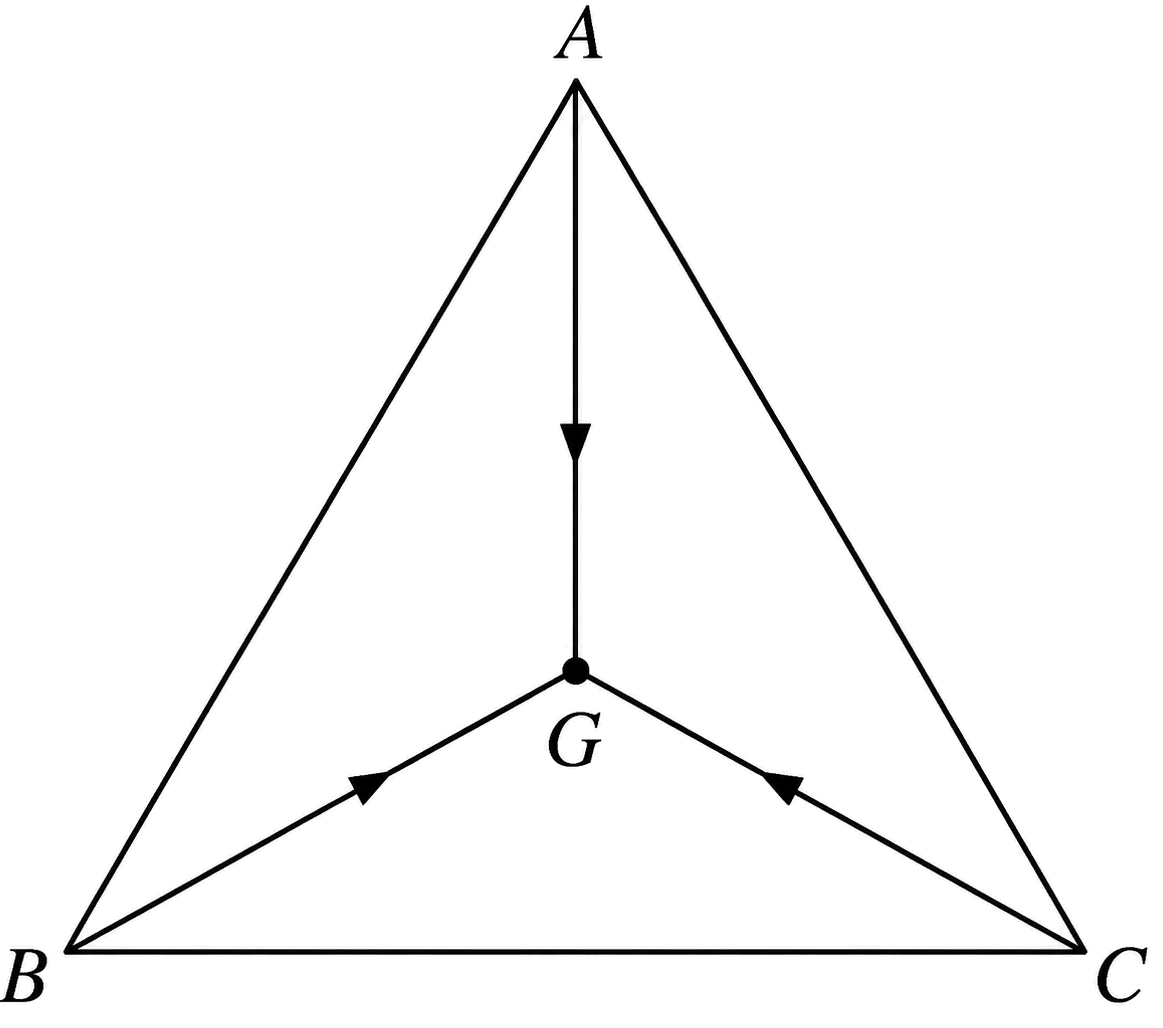
Three particles A , B and C of equal masses move with equal speeds v along the medians of an equilateral triangle as shown in Fig. They collide at the centroid G of the triangle. After the collision, A comes to rest and B retraces its path with the same speed v. What is the velocity of C?
Answer
Given,
- Three particles A, B and C of equal mass m move with equal speeds v along the medians of an equilateral triangle
- After the collision, A comes to rest and B retraces its path with the same speed v
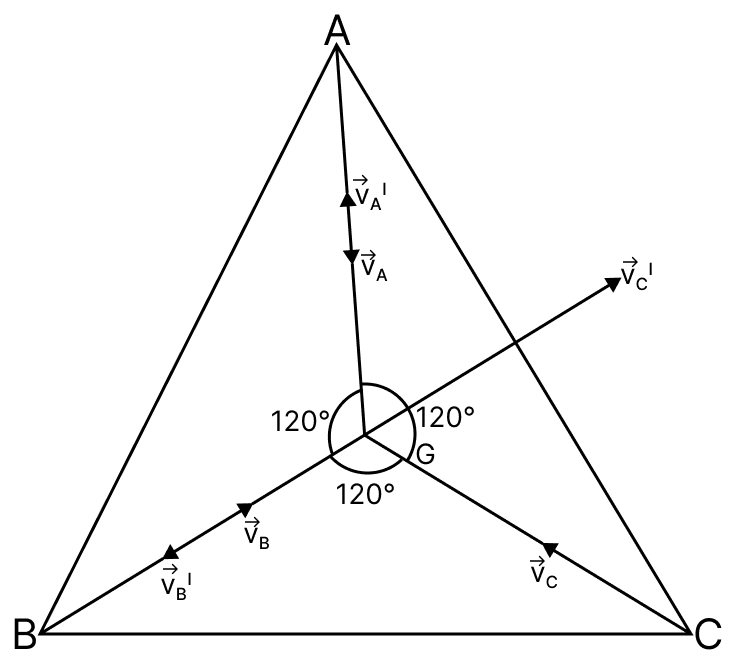
The velocity of C after the collision has to be found.
The three particles move along the medians towards the centroid G, so their three velocities are inclined to one another at 120°. Since the three momenta are equal in magnitude (mv) and are inclined at 120°, their vector sum is zero. Hence, the total linear momentum of the system before the collision is
No external force acts on the system during the collision, so by the principle of conservation of linear momentum the total momentum after the collision must also be zero,
After the collision A comes to rest, so , and B retraces its path with the same speed, so . Therefore,
But was directed towards G, whereas B now moves away from G. Hence, the velocity of C after the collision has the magnitude v and is directed opposite to the direction along which B returns.
Hence, the velocity of C is v, directed opposite to the direction of return of B.
A body of 2 kg is suspended on a spring-balance hung vertically in a lift. If the lift is falling downward under acceleration due to gravity g, then what will be the reading of the balance? If going upward with the same acceleration then?
Answer
Given,
- Mass of the body, m = 2 kg
The reading of the spring balance is the apparent weight of the body.
When the lift falls downward with the acceleration due to gravity g : Here a = g, so
Hence, the reading of the balance is zero, that is, the body is in the state of weightlessness.
When the lift goes upward with the same acceleration g : Here the apparent weight is
Hence, the reading of the balance is 4 kg-wt.
What is the relation between coefficient of static friction and the angle of friction?
Answer
The coefficient of static friction is equal to the tangent of the angle of friction,
where θs is the angle of friction, that is, the angle which the resultant of the normal reaction and the limiting friction makes with the normal reaction, in the state of limiting friction.
What is the angle of friction between two surfaces in contact having coefficient of friction ?
Answer
Given,
- Coefficient of friction,
The angle of friction has to be calculated.
The angle of friction θs is related to the coefficient of friction by
Substituting the given value,
Hence, the angle of friction is 30°.
What is meant by law of inertia?
Answer
The law of inertia is another name for Newton's first law of motion. It states that a body continues in its state of rest, or of uniform motion in a straight line, unless it is compelled by an external force to change that state.
Inertia is that property of a body by virtue of which it is unable, by itself, to change its state of rest or of uniform motion. It is of two kinds, the inertia of rest and the inertia of motion. For example, a passenger standing in a bus leans backwards when the bus suddenly starts, because of the inertia of rest, and leans forward when the bus suddenly stops, because of the inertia of motion.
What is meant by weightlessness?
Answer
Weightlessness is the state in which a body experiences no reaction from its support, so that its apparent weight becomes zero, although the gravity force on it continues to act.
It occurs when the body and its support are both falling freely with the same acceleration, that is, with the acceleration due to gravity. For example, if the rope of a lift breaks, the lift and a man standing in it both fall with the acceleration g. The reaction of the floor on the man is then
so that the man feels weightless. An astronaut in a satellite orbiting the earth is weightless for the same reason.
How is inertia related to mass of a body?
Answer
Inertia is directly proportional to the mass of a body.
The greater the mass of a body, the greater is the force required to produce a given change in its state of rest or of uniform motion. For example, it is far more difficult to set a loaded truck in motion, or to stop it, than a bicycle. It is for this reason that mass is taken as the quantitative measure of inertia, and mass is often called the measure of inertia of a body.
Explain how Newton's first law of motion follows from the second law.
Answer
By Newton's second law of motion, the force acting on a body of mass m producing an acceleration a in it is
If no external force acts on the body, then
The mass m of a body can never be zero. Hence,
Thus, in the absence of an external force, the velocity of the body remains constant, that is, the body continues in its state of rest (if v = 0) or of uniform motion in a straight line. This is precisely Newton's first law of motion.
Hence, the first law of motion follows from the second law.
A ball is suspended by a cord from the ceiling of a car. What will be the effect on the position of the ball (i) the car is moving with uniform velocity, (ii) the car moving with accelerated motion, (iii) the car is turning towards right?
Answer
(i) When the car moves with a uniform velocity : There is no acceleration, so no pseudo force acts on the ball. The ball remains suspended vertically in its usual position.
(ii) When the car moves with accelerated motion : In the accelerated frame of the car a pseudo force ma acts on the ball in the backward direction. Hence, the ball moves backward, and the cord makes an angle θ with the vertical given by tan θ = a/g.
(iii) When the car is turning towards the right : The ball needs a centripetal force towards the centre of the turn, which lies on the right. By virtue of its inertia the ball tends to continue in a straight line, so the ball moves towards the left.
Static friction is a self adjusting force. Comment.
Answer
Static friction is a self-adjusting force.
When a small horizontal force F is applied to a body lying on a rough surface, the body does not move. This is because the force of static friction fs comes into play and adjusts itself to be exactly equal and opposite to the applied force, so that fs = F. As the applied force is gradually increased, the static friction also increases, always remaining equal to the applied force.
This adjustment continues only up to a limit. The maximum value which the static frictional force can take is called the limiting friction, given by
Once the applied force exceeds this limiting value, the friction can no longer increase and the body begins to move. Hence, in general fs ≤ μsR, and it is in this sense that static friction is described as a self-adjusting force.
What is the cause of rolling friction?
Answer
Rolling friction comes into play when a body such as a wheel, a disc or a cylinder rolls over the surface of another body.
It arises mainly due to the weight of the rolling body, which causes some flattening of that part of the wheel which is in contact with the ground and some denting of the ground itself. The wheel thus has to be continually lifted out of the small depression it creates, and work has to be done in doing so.
The effect is small if both the rim of the wheel and the ground are hard, which is why motor tyres wear out more quickly if they are not kept at the correct pressure. The force of rolling friction is directly proportional to the normal reaction R and inversely proportional to the radius r of the wheel,
How do we save petrol by keeping the rubber tyres of our vehicle fully inflated?
Answer
The weight of the vehicle and its load causes some flattening of that part of the wheel which is in contact with the ground, and some denting of the ground. Hence, work has to be done in lifting the wheel out of the dent formed on the ground, and this work is done at the cost of the fuel.
If the rubber tyres are kept fully inflated, they are hard and are flattened much less. Less work is therefore done against rolling friction, so less fuel is consumed per unit distance covered and petrol is saved.
A horse has to pull a cart harder in the initial stage of his motion. Why?
Answer
In order to start pulling the cart, the horse has to exert a force sufficient to overcome the limiting friction, which is the maximum value of the static friction.
Once the motion has started, the friction opposing the motion is the kinetic friction, which is smaller than the limiting friction. Hence, a smaller force is now sufficient, and the horse has to pull less hard than in the initial stage.
Give reasons for the followings :
(i) Mud-guards are provided to the wheels of vehicles.
(ii) For heavy vehicles moving on a circular turning of a highway, the road bed is banked (sloped) at an angle corresponding to a particular speed.
(iii) Outer rail line is slightly higher at the turning point.
(iv) On the hills, the roads are made slopping downwards towards the hill.
(v) The wings of aeroplane are leant inwards while taking a turn.
(vi) In the well of death the rider does not fall while driving the motorcycle on the wall.
(vii) A small smooth ball is placed on a smooth circular disc. When the disc is rotated, the ball falls down?
(viii) When a bucket filled with water is revolved fast in a vertical circle, the water does not fall even when the bucket is inverted.
(ix) Why does an electron revolving around the nucleus not fly away from the atom?
Answer
(i) Mud-guards on the wheels of vehicles : The mud particles sticking to the tyres move along a circular path with the wheel. When the centripetal force needed is not available, they fly off along the tangent to the wheel. Mud-guards are fixed so as to intercept the mud thrown off tangentially.
(ii) Banking of the road bed at a circular turning : On a banked road the normal reaction is inclined, and its horizontal component N sin θ provides a part of the centripetal force needed for the turn. Thus, the reliance on friction alone is reduced, and heavy vehicles can negotiate the turn safely at the speed for which the banking angle has been designed, tan θ = v2/rg.
(iii) The outer rail is slightly higher at the turning point : Raising the outer rail banks the track, so that the horizontal component of the normal reaction supplies the necessary centripetal force to the train. The wheel flanges then do not press on the rails, and the wear and tear of the rails and the wheels is reduced.
(iv) On the hills, the roads are made sloping downwards towards the hill : The road is thus banked with its outer edge, which is on the valley side, raised. The horizontal component of the normal reaction then acts towards the centre of the turn and supplies the centripetal force, so that the vehicle does not skid outwards towards the valley.
(v) The wings of an aeroplane are leant inwards while taking a turn : When the aeroplane banks its wings, the lift force becomes inclined. Its horizontal component is directed towards the centre of the turn and provides the necessary centripetal force, while its vertical component balances the weight of the aeroplane.
(vi) In the well of death the rider does not fall : The rider drives on the vertical wall, so the normal reaction of the wall is horizontal and directed towards the centre, supplying the centripetal force. The weight of the rider is balanced by the vertical force of friction between the tyres and the wall. Hence, he does not fall.
(vii) A small smooth ball placed on a smooth rotating circular disc falls down : The centripetal force required to keep the ball moving in a circle with the disc can be provided only by friction between the ball and the disc. Since both are smooth, this friction is absent and the necessary centripetal force is not provided to the ball. Hence, it falls down.
(viii) Water does not fall from an inverted bucket revolved fast in a vertical circle : At the highest point, the weight of the water and the reaction of the bucket together provide the centripetal force needed. If the speed is large enough, the whole of the weight is used up in providing this centripetal force, so there is no force left to make the water fall out of the bucket.
(ix) An electron revolving round the nucleus does not fly away : The electron is acted upon by a centripetal force directed towards the nucleus, which is provided by the electrostatic force of attraction between the negatively-charged electron and the positively-charged nucleus. Hence, it continues to revolve in its orbit.
Explain the reason of separation of cream from milk.
Answer
Cream is lighter than the rest of the milk. When milk is rotated at high speed in a cream separator, every part of it needs a centripetal force to keep moving in a circle. The heavier (denser) milk experiences a larger outward centrifugal tendency and moves away from the axis of rotation, while the lighter cream, being pushed inwards by the heavier milk, collects near the axis. The cream is then drawn off from the centre.
Explain the following events :
(i) If, standing on a revolving merry-go-round, we do not hold its string, we fall outwards.
(ii) When a car suddenly takes turn towards right, the head of a person sitting in it strikes with the left wall of the car. How will this event be described by a person standing outside? How by a person sitting in the car?
(iii) When a bucket filled with water is revolved fast in a vertical circle, the water does not fall even when the bucket is inverted.
Answer
(i) Falling outwards on a revolving merry-go-round : To move in a circle along with the merry-go-round, we need a centripetal force directed towards the centre. When we hold the strings, they pull our body inwards and provide this force. If we do not hold the strings, no such force is available, and by virtue of inertia our body tends to continue in a straight line. In the rotating frame of the merry-go-round this appears as a centrifugal force acting outwards, and we fall outwards.
(ii) The head striking the left wall when the car turns right :
As described by a person standing outside : He is in an inertial frame. To him, the car turns towards the right, while the body of the person sitting inside continues to move along the straight line by virtue of its inertia. Hence, the left wall of the car comes up against the person's head, and no real outward force acts on him.
As described by the person sitting in the car : He is in a rotating, that is, a non-inertial frame. To him, a centrifugal force acts on his body radially outwards, that is, towards the left, and it is this force which pushes his head against the left wall. This centrifugal force is a pseudo force.
(iii) Water not falling from an inverted bucket revolved fast in a vertical circle : At the highest point of the vertical circle, the weight mg of the water and the reaction R of the bucket both act vertically downwards, towards the centre, and together provide the centripetal force,
If the bucket is revolved fast enough, the whole of the weight of the water is used up in providing the necessary centripetal force. There is then no force left to make the water fall out, and hence the water does not fall even when the bucket is inverted.
A block of mass M is suspended by a light cord C from the ceiling and another stronger cord D is attached to the bottom of the block as shown in figure. The cord D is pulled down by a force T. What will be the tension in the cord C? If the tension T in D is increased steadily, the cord C breaks; why? If, however, a sudden jerk is given to D, then D breaks rather C; why?
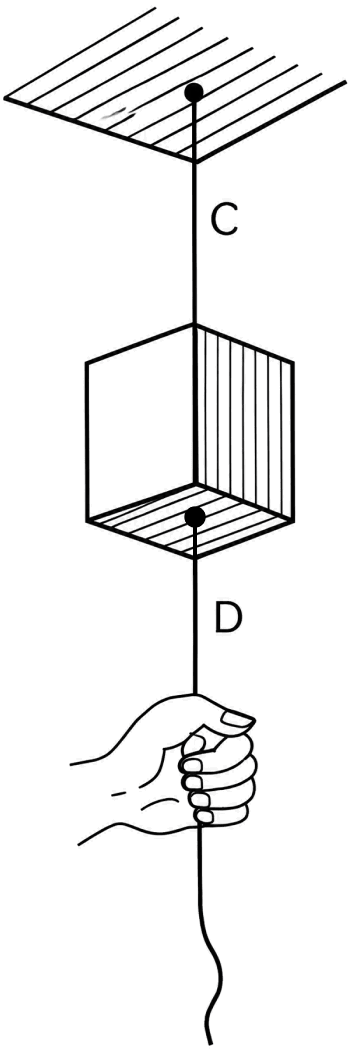
Answer
The cord C supports the block and is, in addition, pulled by the force applied through the cord D. Hence, the tension in the cord C is
Why C breaks when T is increased steadily : When the force T in the cord D is increased slowly, the block has time to remain in equilibrium at every stage, so the tension in C is always greater than that in D by the weight Mg of the block. Hence, as T is steadily increased, the tension in C reaches the breaking value first, and the cord C breaks even though it is the weaker cord.
Why D breaks on a sudden jerk : When a sudden jerk is given to D, the force acts for a very short interval of time. Owing to its inertia, the block does not move appreciably in this short interval, so the extra tension is not transmitted to the cord C. The whole of the sudden large force is therefore borne by the cord D itself, and hence D breaks rather than C.
Distinguish between sliding friction and rolling friction.
Answer
| Sliding friction | Rolling friction |
|---|---|
| It comes into play when the surface of one body slides over the surface of another body. | It comes into play when a body such as a wheel, a disc or a cylinder rolls over the surface of another body. |
| The two surfaces in contact remain the same throughout the motion. | Only a very small portion of the rolling body is in contact with the surface at any instant, and this portion is momentarily at rest. |
| It is comparatively large in magnitude. | It is very much smaller than the sliding friction. |
| It does not depend on the radius of the body. | It is inversely proportional to the radius r of the wheel, . |
| The coefficient of sliding friction μk is a dimensionless quantity. | The coefficient of rolling friction μr has the dimensions of length. |
The two are related to the coefficient of static friction by μr < μk < μs. It is because rolling friction is so much smaller than sliding friction that vehicles are fitted with wheels and that ball bearings are used in machines.
When a bicycle moves, what is the direction of the friction force exerted by the earth on the rear wheel?
Answer
As the rear wheel rolls forward, the part of the wheel which is in contact with the road tends to slide backwards over the road. The force of friction always opposes this relative motion.
Hence, the force of friction exerted by the earth on the rear wheel acts in the forward direction, along the tangent to the surface of the road at the point of contact. It is this forward frictional force that drives the bicycle. On the front wheel, which is not driven, the frictional force acts in the backward direction.
A retarding force is applied to stop a motor car. If the speed of the motor car is doubled, how much more distance will it cover before stopping under the same retarding force?
Answer
Let the retarding force F produce a retardation a in the motor car of mass m, so that
Since the car finally stops, v = 0. Using the equation of motion ,
The retarding force, and hence the retardation a, is the same in both the cases. Therefore,
If the initial speed is doubled, that is, u' = 2u, then
Hence, the car will cover four times the original distance before stopping, that is, three times more distance than before.
Three identical blocks, each having a mass M, are pushed by a force F on a frictionless table as shown in Fig. What is the acceleration of the blocks? What is the net force on the block A? What forces does A apply on B? What on B + C? Show action-reaction pairs on the contact surfaces of the blocks.
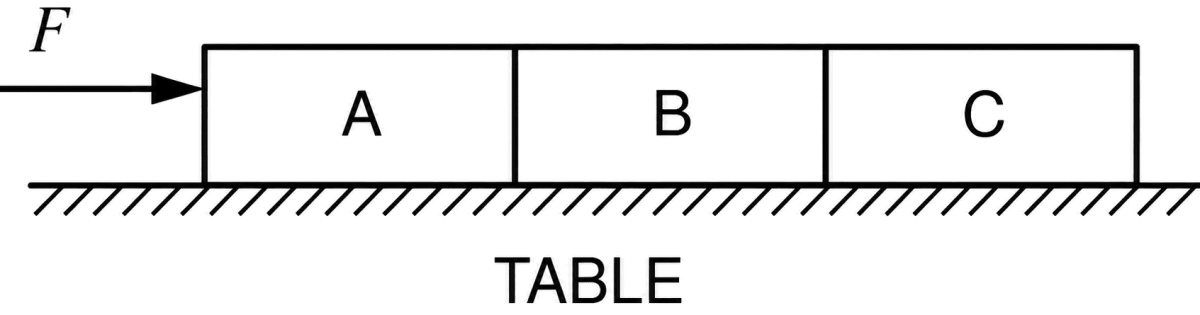
Answer
Given,
- Three identical blocks A, B and C, each of mass M
- A force F is applied on the frictionless table
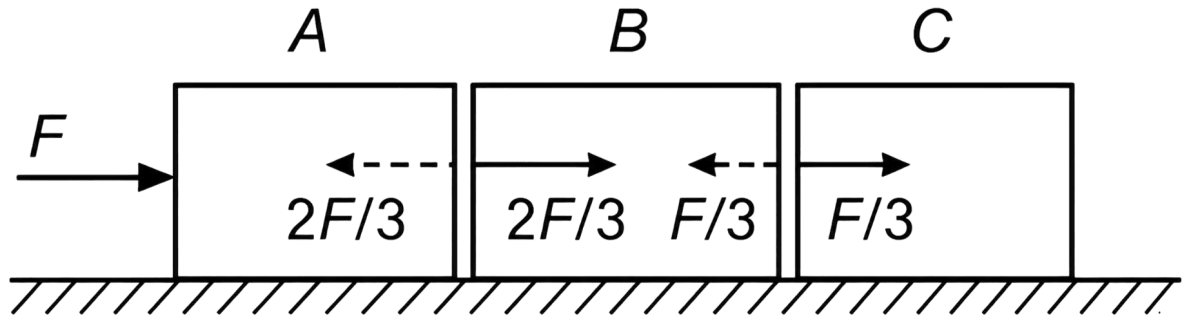
Acceleration of the blocks : The three blocks move together as a system of total mass 3M. By Newton's second law,
Net force on the block A : Block A alone has mass M and moves with the same acceleration a. Hence,
Force which A applies on B : The blocks B and C together, of mass 2M, are pushed forward only by the contact force exerted on B by A. Hence,
Force which B applies on C : The block C alone, of mass M, is pushed forward by the contact force exerted on it by B. Hence,
Action-reaction pairs : At the contact surface between A and B, A pushes B forward with and B pushes A backward with . At the contact surface between B and C, B pushes C forward with and C pushes B backward with .
In a circus, a motorcyclist drives in vertical loops inside a 'death-well'. Explain, why the motorcyclist does not drop down when he is at the uppermost point, with no support from below. What is the minimum speed required to perform a vertical loop if the radius of the chamber is 25 m?
Answer
Given,
- Radius of the chamber, r = 25 m
- Acceleration due to gravity, g = 9.8 m s-2
Why the motorcyclist does not drop down at the uppermost point : At the uppermost point the motorcyclist is expected to drop down under his own weight, but this does not happen. While driving in vertical loops he experiences a centrifugal force, equal and opposite to the centripetal force. At the uppermost point this centrifugal force is directed vertically upwards, while his weight mg acts vertically downwards. The resultant force keeps the motorcyclist pressed against the wall of the death-well, and so he does not drop down even though there is no support from below.
Minimum speed : At the uppermost point the minimum condition is that the whole of the weight is just used up in providing the necessary centripetal force,
Substituting the values,
Hence, the minimum speed required to perform the vertical loop is 15.65 m s-1.
The kinetic energy K of a particle moving along a circle of radius R depends on the distance covered s according to K = a s2. Determine the force acting on the particle.
Answer
Given,
- Kinetic energy of the particle, K = as2
- Radius of the circle = R
Let m be the mass of the particle and v its linear velocity. Then its kinetic energy is
Tangential force : Differentiating equation (1) with respect to time t,
But , so dividing both sides by v,
This is the tangential force, which is the product of the mass and the tangential acceleration,
Centripetal force : From equation (1),
Therefore, the centripetal force on the particle is
Resultant force : The tangential force and the centripetal force are mutually perpendicular, so the resultant force on the particle is
Hence, the force acting on the particle is .
Polishing a surface beyond a certain limit may increase friction. Why?
Answer
Friction arises from the adhesive (molecular) forces between the molecules of the two surfaces in contact. When a surface is polished, its irregularities are removed and the actual area of contact between the two surfaces increases. Beyond a certain limit of polishing, the molecules of the two surfaces come very close to each other, so the intermolecular adhesive forces increase considerably. As a result, the friction increases instead of decreasing.
Two balls of the same mass are tied to strings of lengths l1 and l2 (where l1 > l2) and rotated in horizontal circles with speeds respectively. If centripetal force is the same, then prove that v1 > v2.
Answer
Given,
- Two balls of the same mass m
- Lengths of the strings, l1 and l2, with l1 > l2
- The centripetal force is the same in the two cases
The centripetal force required for a ball of mass m moving in a horizontal circle of radius l with a speed v is
Since the centripetal force is the same for the two balls,
The masses are equal, so cancelling m,
It is given that l1 > l2, so and therefore .
Hence, v1 > v2.
"A particle moving uniformly along a circle experiences a force directed towards the centre (centripetal force) and an equal and opposite force directed away from the centre (centrifugal force). The two forces keep the particle in equilibrium". Comment on this statement.
Answer
This statement is wrong.
A particle moving uniformly along a circle is not in equilibrium. Its velocity changes continuously in direction, so it has a centripetal acceleration and hence a net force acting radially inwards. No outward force balances this force.
The centrifugal force is not a real force. It is a pseudo force introduced only by an observer in the rotating (non-inertial) frame, in which the particle appears to be at rest. In an inertial frame no such force exists. Hence, the centripetal and centrifugal forces do not act in the same frame of reference and cannot be treated as a pair of balancing forces.
Motion under gravity is the best example of a uniformly accelerated motion. When a body is thrown straight up, its velocity decreases due to gravity and becomes zero when it reaches the maximum height. Conversely, if it is allowed to fall freely, its initial velocity is taken zero, and it increases uniformly over time, reaching a maximum just before striking the ground. To calculate the velocity of a body thrown straight up after time t, we use the equation of kinematics v = u − gt and for a body dropped from a height, we use equation v = gt to determine its velocity after time t. If necessary, other equations of kinematics can be similarly modified and used.
It should be carefully noted here that for heights around 500 m, the change in the value of acceleration due to gravity g is very small and therefore, variation in its value can be ignored.
The momentum of a system is determined by both mass and velocity, hence for calculating the linear momentum of a moving body, the equation p = mv is used. Since, linear momentum is a vector quantity therefore, while using the equation p = mv for calculations, it is essential to consider its directional property also. According to the principle of conservation of momentum, the net momentum before a collision is equal to the net momentum after the collision provided, that there is no net external force acting on the system.
A bullet of mass 20 g is fired from the foot of a tower 100 m high with a muzzle velocity of 100 ms-1. At the same time a wooden block of same mass (20 g) is dropped from the top of the tower along the same line. The bullet after hitting the block gets embedded into it and the combined system start moving in the direction of motion of bullet and reaches to its maximum height.
(i) The bullet and the block meet after :
- 2 s
- 1 s
- 3 s
- 4 s
(ii) The bullet and the block meet at a height (measure height from the ground) :
- 5 m
- 10 m
- 95 m
- 100 m
(iii) The velocity of the block just before the impact is :
- 100 ms-1
- 10 ms-1
- 5 ms-1
- 95 ms-1
(iv) The velocity of the bullet just before the impact is :
- 100 ms-1
- 10 ms-1
- 5 ms-1
- 90 ms-1
(v) The bullet and the block system will attain a maximum height from the point of impact is :
- 100 m
- 75 m
- 80 m
- 95 m
Answer
Given,
- Mass of the bullet = mass of the block = 20 g = 0.02 kg
- Height of the tower = 100 m
- Muzzle velocity of the bullet, u = 100 m s-1 (upwards)
- Initial velocity of the block = 0
- Acceleration due to gravity, g = 10 m s-2
Let the bullet and the block meet after a time t, at a height h below the top of the tower. In this time the bullet must cover (100 − h) upwards while the block covers h downwards.
For the bullet, using ,
For the block, starting from rest,
Adding equations (1) and (2),
(i) 1 s
Substituting t = 1 s in equation (2),
So they meet 5 m below the top of the tower, that is, at a height of (100 − 5) = 95 m from the ground.
(ii) 95 m
Using v = u + gt for the block, with u = 0,
(iii) 10 ms-1
Using v = u − gt for the bullet,
(iv) 90 ms-1
The bullet gets embedded in the block, so by the principle of conservation of linear momentum, taking the upward direction as positive,
Both masses are equal, so
The maximum height reached by the combined system above the point of impact is obtained from , with the final velocity zero (v = 0),
(v) 80 m
When two bodies come into contact, each one experiences a force from the other. The part of this contact force that is parallel to the surfaces in contact resists any impending or actual relative motion between the two bodies. This resistance is due to static friction, which prevents motion and kinetic friction, which opposes motion that has already started. Additionally, there is another type of friction known as rolling friction, which resists the rolling motion of one body over the surface of another.
Although we often think of friction as something undesirable, it is essential in many practical situations.
(i) In what direction the frictional force acts?
- Friction always acts tangential to the surfaces in contact.
- Friction acts normal to the surface.
- Its direction is decided by the direction of weight of the body.
- None of the above.
(ii) Pick the wrong statement about friction :
- Friction is self-adjusting in nature.
- Frictional force is independent of area contact as long as normal reaction remains same.
- Static friction is smaller than sliding friction.
- Limiting friction is the maximum value of static friction.
(iii) A car is moving on horizontal road with a speed v. If the coefficient of friction between the tyres and the road is μ, the shortest distance in which the car can be stopped is :
(iv) What will be the maximum acceleration of the train in which a box lying on the floor will remain stationary? Given that coefficient of friction between the box and train's floor is 0.15. Take acceleration due to gravity = 9.8 m/s2.
- 2 ms-2
- 2.5 ms-2
- 1 ms-2
- 1.5 ms-2
(v) In the given Fig., the masses of blocks A and B are 10 kg and 5 kg respectively. Calculate the minimum mass of C which may stop A from slipping. The coefficient of friction between block A and the table is 0.2.
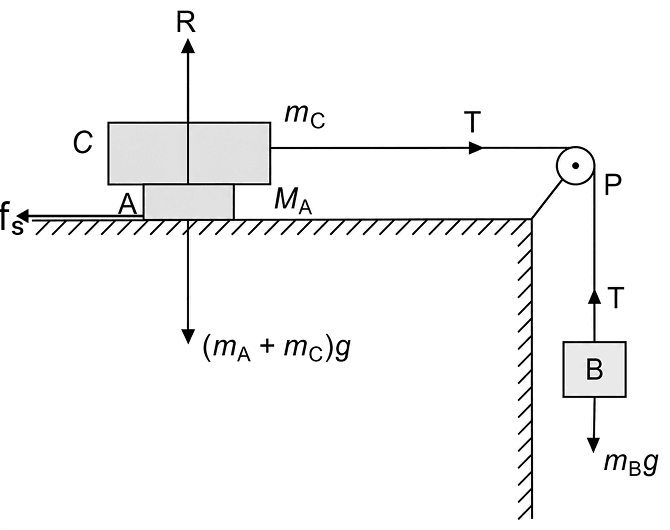
- 5 kg
- 15 kg
- 25 kg
- 35 kg
Answer
(i) Friction always acts tangential to the surfaces in contact.
Reason — When two bodies come into contact, the contact force can be resolved into a component normal to the surfaces, which is the normal reaction, and a component parallel to the surfaces. It is this parallel component that resists the impending or actual relative motion, and it is called friction. Hence, friction always acts tangential to the surfaces in contact and opposite to the relative motion.
(ii) Static friction is smaller than sliding friction.
Reason — This is the wrong statement. The limiting friction, which is the maximum value of the static friction, is greater than the sliding (kinetic) friction, so that μs > μk. This is why more force is needed to start a body moving than to keep it moving. The other three statements are correct.
(iii)
Reason — When the brakes are applied, the retardation is produced by the frictional force,
Using with the final velocity zero and u = v,
(iv) 1.5 ms-2
Reason — The box remains stationary on the floor of the train so long as the force required to accelerate it does not exceed the limiting friction,
Substituting μs = 0.15 and g = 9.8 m s-2,
(v) 15 kg
Reason — Let the mass of block C be mC. The block B hangs from the string, so the tension is T = mBg. For block A the normal reaction is
To just stop A from slipping, the tension must not exceed the limiting friction,
Substituting mA = 10 kg, mB = 5 kg and μ = 0.2,
The maximum permissible speed for a vehicle to negotiate a turn on a level circular road without slipping depends on the coefficient of friction between the tyres and the road. However, this limiting speed is often quite low for sharp turns, especially in hilly areas where the tyres are very sharp.
To allow vehicles to travel at reasonable speeds around sharp turns without skidding, the road is often banked. Banking the road means inclining the outer road surface at an angle with respect to inner one. This banking process provides the necessary centripetal force needed for the vehicle to make sharp turns at higher speeds without skidding.
(i) Force responsible for the circular motion of a body is called :
- Centripetal force
- Centrifugal force
- Normal force
- None of these
(ii) The maximum safe speed of a car negotiating a circular turn of radius r on a negligible friction banked track with banking angle θ is :
(iii) If coefficient of friction between the road and the tyres is 0.1, then the maximum safe speed of the car in a circular road of radius 3m is : (Take g = 10 ms-2)
- 1.43 ms-1
- 1.73 ms-1
- 1.63 ms-1
- 1.53 ms-1
(iv) A car sometimes overturns (topples) especially when it negotiates a flat curve road. The wheel of the car leaves the ground first is :
- the inner wheel
- the outer wheel
- both the wheels simultaneously
- either of the two wheels
(v) Which one is correct about the banking of roads or super elevation?
- Reduced wear and tear
- Higher speed limits on turns
- Improves safety
- All of them
Answer
(i) Centripetal force
Reason — A body moving along a circular path is continuously accelerated towards the centre, since the direction of its velocity changes at every instant. The force which produces this radially inward acceleration, and which is therefore responsible for the circular motion, is called the centripetal force. Its magnitude is .
(ii)
Reason — On a banked track of negligible friction, the normal reaction N is inclined at θ to the vertical. Its vertical component balances the weight and its horizontal component supplies the centripetal force,
Dividing the second equation by the first,
(iii) 1.73 ms-1
Reason — On a level circular road the centripetal force is provided entirely by friction, so the maximum safe speed is
Substituting μ = 0.1, r = 3 m and g = 10 m s-2,
(iv) the inner wheel
Reason — When a car negotiates a flat curved road, the centrifugal effect in the frame of the car acts outwards at the centre of gravity, which is above the road. This forms a couple which tends to overturn the car outwards. As a result, the reaction on the inner wheel is reduced while that on the outer wheel is increased. Hence, it is the inner wheel that leaves the ground first.
(v) All of them
Reason — On a banked road the horizontal component of the normal reaction supplies a part of the centripetal force, so the reliance on friction alone is reduced. This allows higher speed limits on turns, reduces the wear and tear of the tyres and of the moving parts of the vehicle, and makes the turn safer. Hence, all the three benefits listed are correct.
State and explain Newton's second law of motion. Prove that the second law is the real law.
Answer
Newton's second law of motion : The rate of change of momentum of a body is directly proportional to the applied force, and this change takes place in the direction of the applied force.
Explanation : Let a force act on a body of mass m and change its momentum. Then, by the law,
where k is a constant of proportionality. The units of force are so defined that the value of k becomes 1. Hence,
Since and the mass of the body is constant,
This is the familiar form of the second law, and it gives the quantitative measure of force. In terms of the rectangular components,
The second law is the real law of motion : The second law contains within itself the other two laws, and so it is called the real law.
(a) The first law follows from the second law. If no external force acts on the body, then
Since the mass of a body can never be zero, , that is, the velocity of the body remains constant. Hence, the body continues in its state of rest or of uniform motion in a straight line, which is Newton's first law.
(b) The third law follows from the second law. Consider two bodies A and B which interact with each other and on which no external force acts. Then the total force on the system is zero,
But is the force exerted on A by B, and is the force exerted on B by A. Hence,
that is, action and reaction are equal and opposite, which is Newton's third law.
Hence, the second law is the real law of motion.
Write the law of conservation of momentum. Derive it from Newton's third law of motion.
Answer
Law of conservation of momentum : If no external force acts on a system of bodies, the total linear momentum of the system remains constant, however the bodies may interact among themselves.
Derivation from Newton's third law of motion :
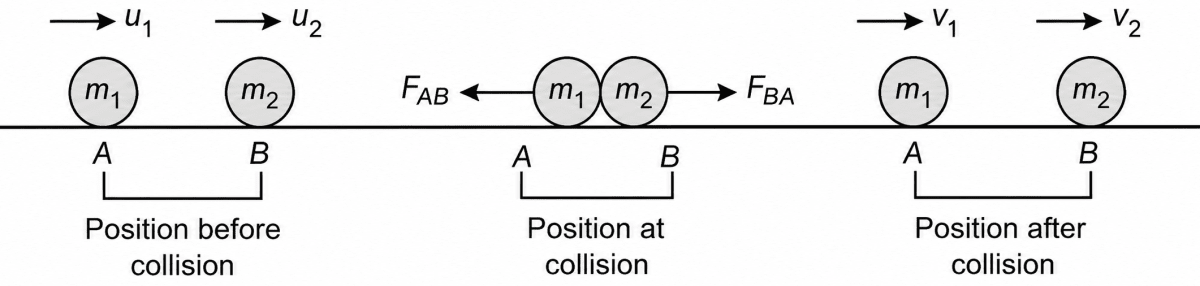
Consider two bodies A and B of masses m1 and m2, moving along a straight line with velocities and respectively, where u1 > u2, so that A overtakes B and they collide. Let the collision last for a time t, and let their velocities after the collision be and .
During the collision, let A exert a force on B, and let B exert a force on A. By Newton's third law of motion, these are equal and opposite,
By Newton's second law in its alternative form, each force is the rate of change of momentum of the body on which it acts,
Substituting these in equation (1),
Multiplying throughout by t,
Rearranging the terms,
That is,
Hence, in the absence of an external force, the total linear momentum of the system is conserved.
State Newton's second law of motion and prove that impulse is equal to the change in momentum produced.
Answer
Newton's second law of motion : The rate of change of momentum of a body is directly proportional to the applied force, and this change takes place in the direction of the applied force. Mathematically,
Impulse : When a large force acts on a body for a very short interval of time, the force is called an impulsive force, and the product of the force and the time interval for which it acts is called the impulse of the force,
Proof that impulse is equal to the change in momentum :
Let a force act on a body of mass m for a time interval from t1 to t2, changing its momentum from to . By Newton's second law,
Integrating both sides over the interval during which the force acts,
Evaluating the integral on the right,
The left-hand side is, by definition, the impulse of the force. Hence,
If the force is constant during the interval Δt = t2 − t1, it can be taken outside the integral and
Hence, the impulse of a force is equal to the change in momentum produced by it. This is known as the impulse-momentum theorem. Graphically, the impulse is the area enclosed by the force-time graph.
Explain what is meant by coefficient of friction and angle of friction. Establish relation between them. Explain the terms static friction and kinetic friction.
Answer
Static friction : When a body lying on a surface is acted upon by a small force which is not sufficient to move it, the frictional force which comes into play is called static friction. It is a self-adjusting force, always equal and opposite to the applied force, so that
Its maximum value, which comes into play when the body is just about to slide, is called the limiting friction.
Kinetic friction : Once the body actually begins to slide over the surface, the frictional force acting on it is called kinetic friction. It acts in a direction opposite to the relative motion of the surfaces, and is given by
Kinetic friction is smaller than limiting friction, so that μk < μs. It is reasonably independent of the relative speed of the surfaces and of the apparent area of contact.
Coefficient of friction : By the first law of limiting friction, the limiting frictional force fs is directly proportional to the normal reaction R,
The constant of proportionality μs is called the coefficient of static friction. It is the ratio of the limiting friction to the normal reaction,
It has no unit and no dimensions, and it depends on the nature of the two surfaces in contact.
Angle of friction : In the state of limiting friction, the resultant P of the normal reaction R and the limiting friction fs makes an angle with the normal reaction. This angle is called the angle of friction, and is denoted by θs.
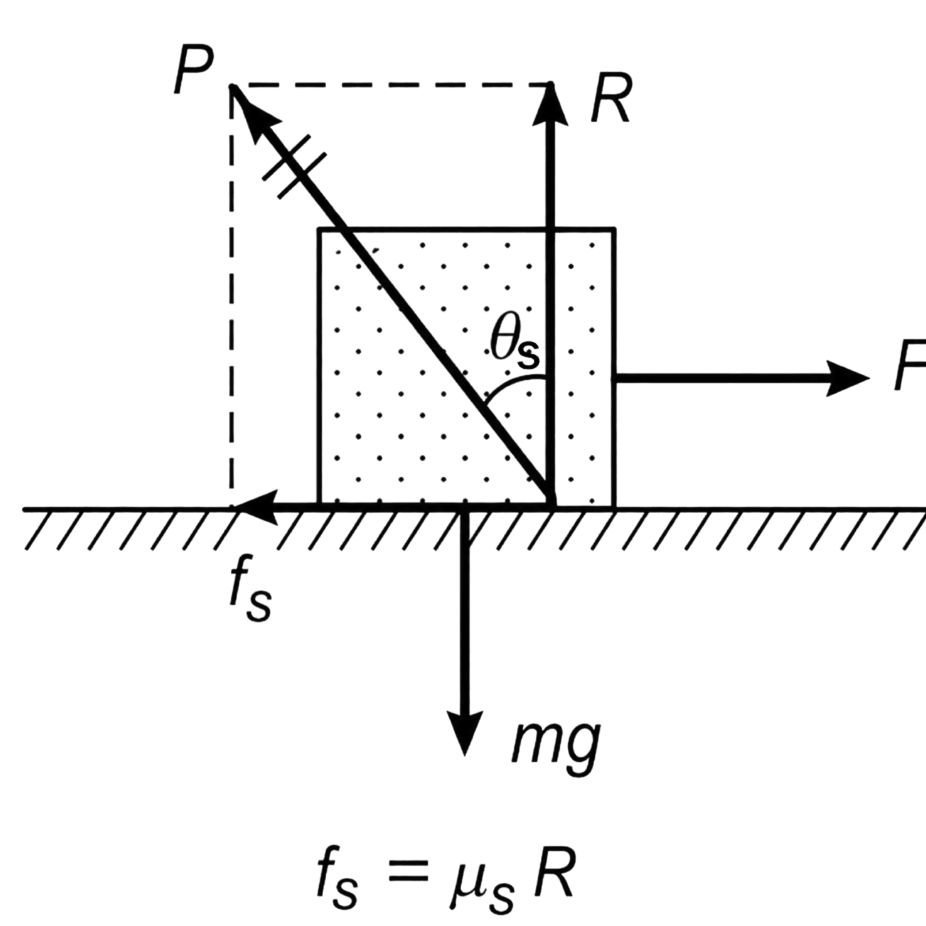
Relation between them : Resolving the resultant P, the component along the surface is the limiting friction fs and the component normal to the surface is the normal reaction R. Hence, from the geometry of the figure,
But fs = μsR, so
Hence, the coefficient of static friction is equal to the tangent of the angle of friction.
What do you understand by centripetal force? A particle of mass m is moving in a circular orbit of radius r with a uniform speed v. Find : (i) the acceleration of the particle towards the centre of the circular path, (ii) the centripetal force acting on the particle.
Answer
Centripetal force : When a body moves along a circular path with a uniform speed, the direction of its velocity changes continuously. Hence, the body is accelerated, and by Newton's second law a force must act on it. The force which is required to keep a body moving in a circular path, and which is always directed along the radius towards the centre of the circular path, is called the centripetal force.
It is always perpendicular to the instantaneous velocity of the body, so it changes only the direction of the velocity and not its magnitude. It is not a new kind of force but is supplied in different situations by different agencies, such as the tension in a string, the force of friction between the tyres and the road, or the gravitational force of attraction.
(i) Acceleration of the particle towards the centre :
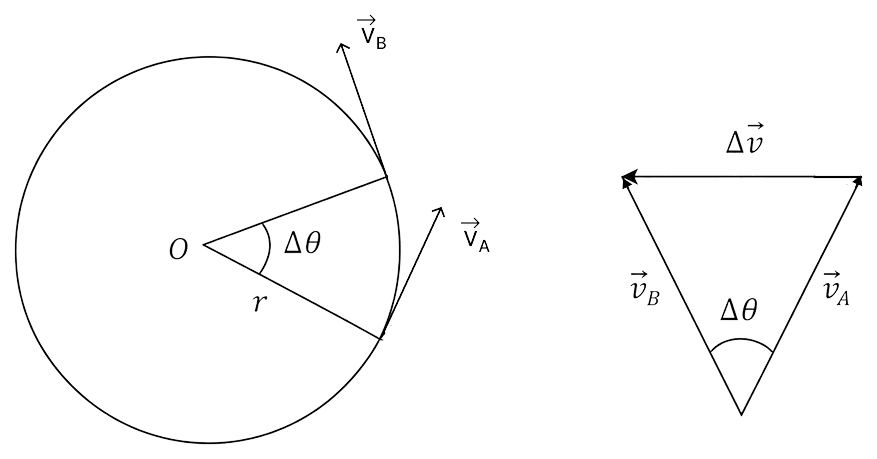
Let a particle of mass m move along a circle of radius r with a uniform speed v, and let it move from a point A to a nearby point B in a small time interval Δt, the radius turning through a small angle Δθ. The velocities at A and B have the same magnitude v but different directions.
The change in velocity is . For a small angle Δθ, the magnitude of this change is
Hence, the magnitude of the acceleration is
where ω is the angular speed. Since v = rω,
As Δθ tends to zero, the direction of becomes perpendicular to the velocity, that is, it points along the radius towards the centre. Hence, the acceleration of the particle is
(ii) Centripetal force acting on the particle :
By Newton's second law of motion, the force is the product of the mass and the acceleration,
Hence, the centripetal acceleration is and the centripetal force is , both directed towards the centre of the circular path.
What are inertial and non-inertial frames? Explain with the help of examples.
Answer
Inertial frame of reference : A frame of reference in which Newton's first law of motion is valid is called an inertial frame of reference. In such a frame a body continues in its state of rest or of uniform motion in a straight line so long as no external force acts on it. An inertial frame is one which is either at rest or is moving with a constant velocity, that is, it is unaccelerated.
Examples :
- A frame fixed to the earth, for ordinary terrestrial experiments, since the acceleration of the earth is very small.
- A car moving with a constant speed on a straight road. A passenger in it finds that a ball placed on the seat stays at rest, exactly as Newton's first law requires.
- A spaceship moving with a constant velocity in interstellar space, far from all material objects.
Non-inertial frame of reference : A frame of reference in which Newton's first law of motion is not valid is called a non-inertial frame of reference. Such a frame is accelerated. In a non-inertial frame a body may appear to be accelerated even when no real force acts on it, and to apply Newton's laws in such a frame one has to introduce a pseudo force (or inertial force), which is not due to any physical interaction.
Examples :
- A lift which is accelerating upwards or downwards. To a person inside, his apparent weight changes although the gravity force on him is unaltered.
- A car taking a sharp turn, or a train moving on a circular track, since the direction of the velocity changes continuously.
- A merry-go-round or any rotating platform. A person standing on it feels an outward centrifugal force, which is a pseudo force.
- An aircraft which is taking off.
What is frictional force? What is it due to? What do you understand by the term 'limiting friction'? State the laws of limiting friction.
Answer
Frictional force : When the surface of one body slides, or tends to slide, over the surface of another body, each body exerts on the other a force parallel to the surfaces in contact which opposes this relative motion. This force is called the frictional force. The frictional force on each body is opposite to the direction of its motion relative to the other.
Cause of friction : On the modern theory, friction between two surfaces is due to the strong atomic or molecular forces at the points of actual contact. The area of actual contact is much smaller than the apparent area of contact, so the adhesive pressure at the points of contact becomes very large and the molecules there form cold welds. To move one body over the other, these cold welds have to be broken, and the external force required for this purpose is a measure of the friction between the two surfaces.
This theory also explains why friction is independent of the apparent area of contact, since with an increase in the contact area the adhesive force increases in the same ratio and the adhesive pressure remains constant. It further explains why friction increases when two surfaces are made smooth beyond a certain limit, since the molecules then come closer and the adhesive force increases.
Limiting friction : As the applied force F is gradually increased, the force of static friction fs also increases, always remaining equal to F. But after a certain limit fs cannot increase any further. The maximum value of the static frictional force, which comes into play when a body just begins to slide over the surface of another body, is called the limiting frictional force. It is equal to the force required to start the motion.
Laws of limiting friction :
(i) First law : The limiting friction fs is directly proportional to the normal reaction R,
where μs is the coefficient of static friction. In general, fs ≤ μsR.
(ii) Second law : The direction of the limiting frictional force is always opposite to the direction in which one body tends to move relative to the other body.
(iii) Third law : The limiting frictional force is independent of the apparent area of contact between the two surfaces. It depends only on the normal force and on the nature of the material in contact, and not on the contact area.
(iv) Fourth law : The value of the coefficient of limiting friction depends on the nature of the surfaces in contact, such as their roughness, their material composition, and any surface treatment or lubricant present.
Why does a bicycle-rider lean inwards while taking a turn, decreases his velocity, and adopts such a path whose radius be large?
Answer
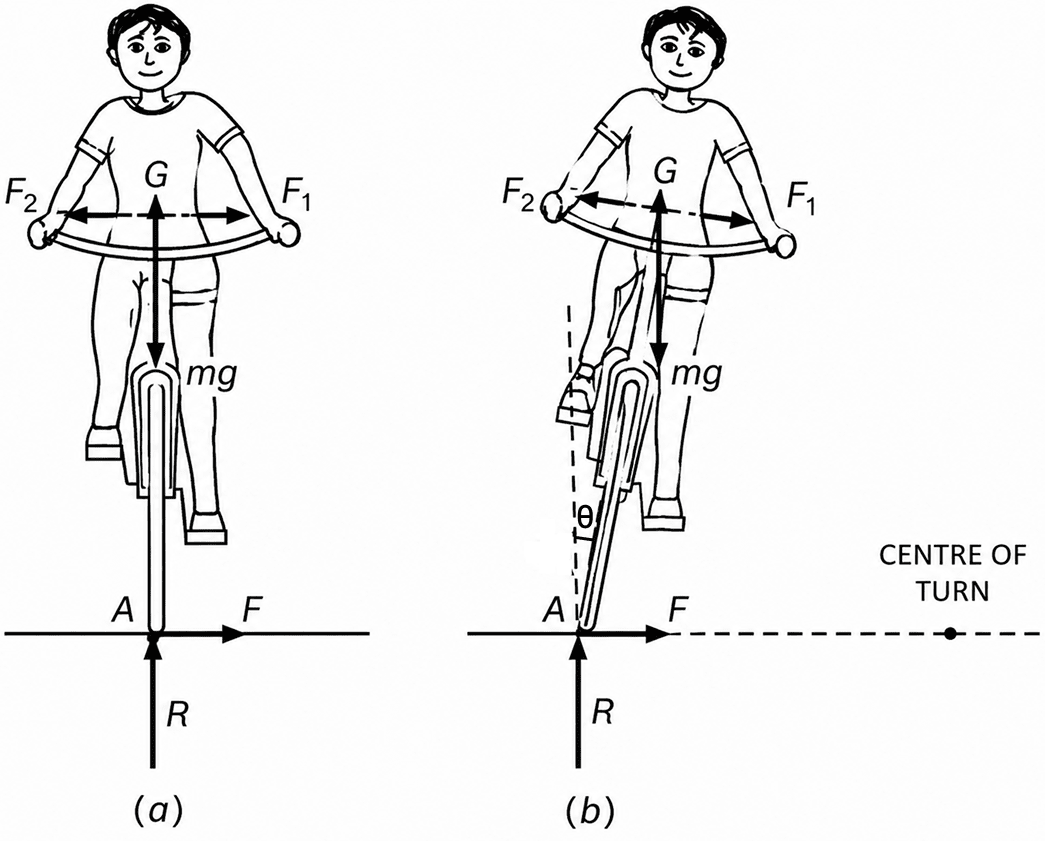
Let m be the combined mass of the rider and the bicycle, v the speed of the bicycle and r the radius of the circular turn.
Why the rider leans inwards : The centripetal force necessary to take the turn is provided by the friction between the tyres and the road. Hence, when the bicycle is turned, a frictional force F acting towards the centre of the turn is exerted at the point A where the tyres touch the road.
Now imagine two equal and opposite forces F1 and F2, each equal and parallel to F, acting at the centre of gravity G of the rider and the bicycle. Since they are equal and opposite and act at the same point, their resultant is zero and their imaginary existence does not affect the rider. The force F acting at A can now be replaced by the force F1 acting at G, together with the anticlockwise couple formed by F and F2.
If the rider were to remain straight while turning, his weight mg acting vertically downwards at G and the normal reaction R (= mg) acting vertically upwards at A would cancel each other, and the anticlockwise couple would overturn the bicycle outwards. If, however, the rider leans inwards towards the centre of the turn, then mg and R form a clockwise couple which balances the anticlockwise couple. Hence, he moves round the turn without any risk of overturning.
If θ is the angle through which the rider leans from the vertical, then equating the moments of the two couples,
Substituting ,
Why he decreases his velocity and takes a path of large radius : Since the centripetal force is provided by the frictional force, its value must not exceed the limiting frictional force μsR, otherwise the bicycle would slip. Hence,
The rider therefore slows down, so that is reduced, and follows a path of larger radius r, which reduces the required centripetal force still further. During the rainy season the frictional force decreases appreciably and may fail to provide the necessary centripetal force, which is why bicycle-riders usually slip on the roads while taking a turn in the rains.
What is meant by centrifugal force? Why is it called pseudo force?
Answer
Centrifugal force : Centrifugal force is an apparent force which appears to act radially outwards on a body when the body is observed from a rotating frame of reference. Its magnitude is
where m is the mass of the body, r the radius of the circular path and v its speed.
Explanation : Consider a body of mass m placed on a smooth circular table which is rotating with a uniform angular velocity about a nail passing through its centre, the body being tied to the nail by a string.
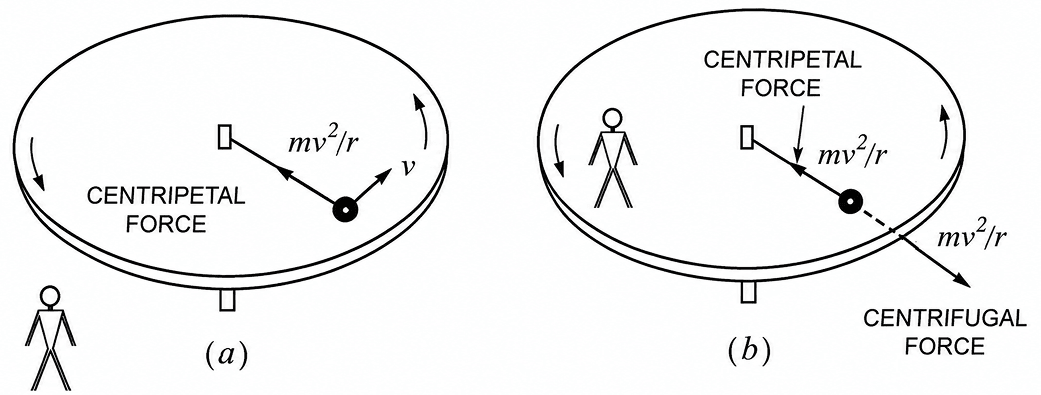
A man standing on the earth, looking at the rotating table, sees the body rotating around the nail and finds a centripetal force acting on it. This force is provided by the tension in the string, and is a real force.
To another man who is standing on the table itself, the body appears to be at rest, because its position does not change with respect to him. From his point of view there should be no net force acting on the body. But the body is actually acted upon by an inward force . Hence, according to the man standing on the table, a force of magnitude must also be acting outwards, so that the net force on the body is zero. This apparent outward force is called the centrifugal force.
Why it is called a pseudo force :
- It is not a real force, since it does not arise from any physical interaction between two bodies. There is no body which exerts it, and it has no reaction, so it does not obey Newton's third law.
- It appears only in a non-inertial (rotating) frame of reference. To an observer in an inertial frame no such force exists; to him the body simply moves along the tangent by inertia when the string is cut.
- It arises from the inertia of the body, which tends to maintain its straight line motion while the frame of reference accelerates towards the centre.
For these reasons the centrifugal force is called a pseudo force, or a fictitious force. Its effects are nevertheless clearly observed by an observer in the rotating frame, as when a person standing on a merry-go-round falls outwards if he does not hold its strings.
Why are the roads banked at sharp turns?
Answer
When a vehicle negotiates a flat curved road, the necessary centripetal force is provided entirely by the frictional force between the tyres and the road. The maximum safe speed is then
Frictional forces, however, are never reliable. They keep varying from time to time, because roads become slippery during the rainy season and tyres lose their tread and become smooth over time due to wear and tear. In both these situations the coefficient of friction gets reduced, and the maximum safe speed becomes quite low, especially at sharp turns.
Banking refers to the process in which the road surface at the bend is tilted inwards, that is, the outer side of the road is raised above its inner side.
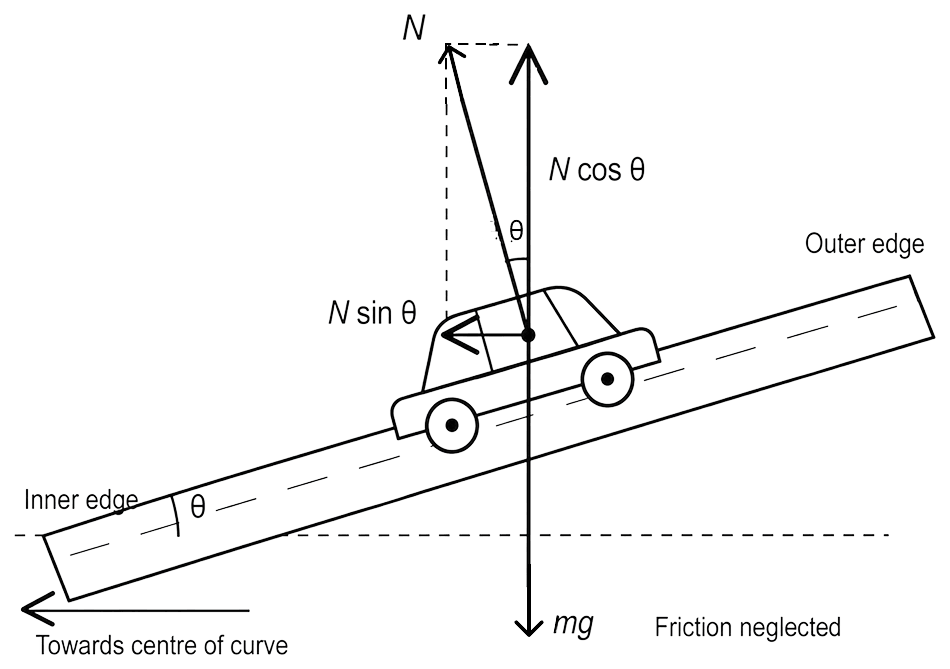
On a banked road the normal reaction N is no longer vertical. Its horizontal component N sin θ is directed towards the centre of the curve and provides a part of the necessary centripetal force, while its vertical component N cos θ balances the weight. For a road banked at the angle θ with friction neglected,
Dividing,
Hence, roads are banked at sharp turns because :
- the banking creates a component of the normal force directed towards the centre of the curve, which provides additional centripetal force;
- this reduces the reliance on friction alone, making the turn safer, especially at higher speeds;
- it protects the moving parts of the vehicle from unwanted wear and tear due to friction;
- it thus enhances safety, comfort, efficiency and longevity, contributing to better road transportation.
Why the outer rail line is slightly higher at the turning point?
Answer
When a train negotiates a curve on the railway line, it requires a centripetal force directed towards the centre of the curve. If the track were perfectly level, this force could be supplied only by the sideways push of the rails on the flanges of the wheels. This would cause severe wear and tear of the rails and of the wheel flanges, and there would also be a danger of the train overturning outwards.
To avoid this, the outer rail is raised slightly above the inner rail, so that the track is banked at an angle θ with the horizontal. The normal reaction N of the rails on the train is then perpendicular to the inclined track, and can be resolved into two components.
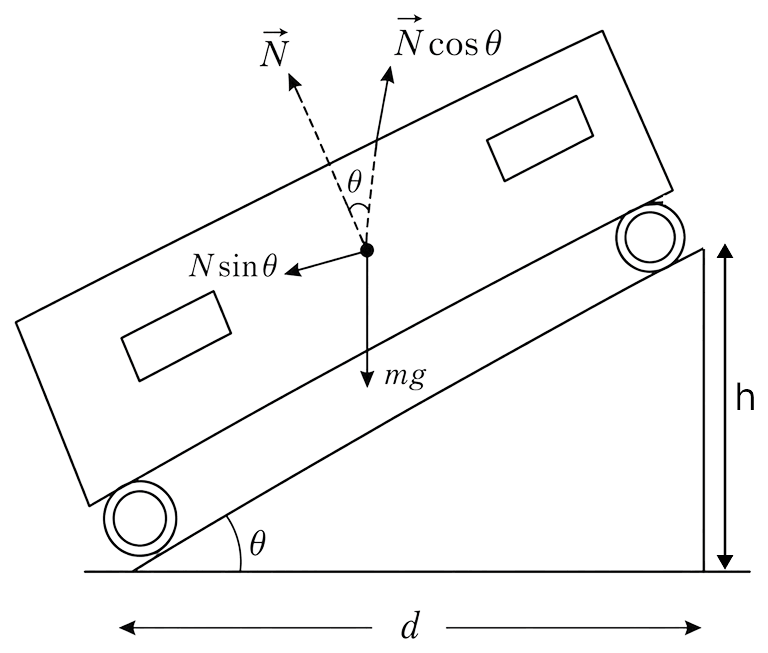
The vertical component balances the weight of the train,
and the horizontal component provides the necessary centripetal force,
Dividing the second equation by the first,
If h is the height by which the outer rail is raised and d the distance between the rails, then for a small angle θ,
Hence, the outer rail is raised so that the horizontal component of the normal reaction supplies the centripetal force needed by the train, the wheel flanges do not press against the rails, and the train can negotiate the turn safely without wear and tear or risk of overturning.
What are concurrent forces? Prove that under the action of three concurrent forces , and a body will be in equilibrium, when .
Answer
Concurrent forces : Forces whose lines of action pass through a single common point are called concurrent forces. Since all the forces act at the same point, they can be added by the laws of vector addition.
Condition of equilibrium : A body acted upon by concurrent forces is said to be in equilibrium when it either remains at rest or continues to move with a uniform velocity, that is, when its acceleration is zero.
Proof :
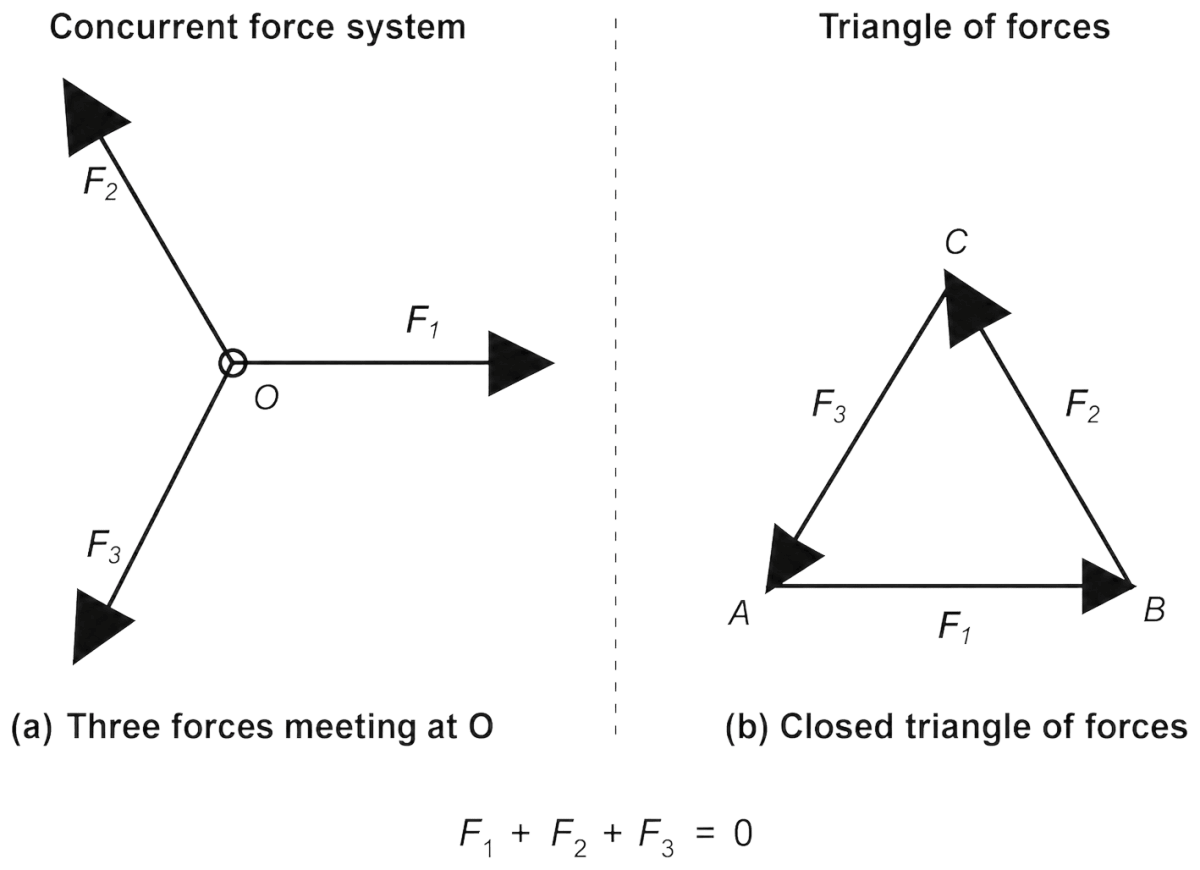
Let three concurrent forces , and act at a point on a body of mass m. Being concurrent, they can be added vectorially, so the net force acting on the body is
By Newton's second law of motion, this net force produces an acceleration in the body,
If the body is in equilibrium, its acceleration is zero, that is, . Therefore,
Conversely, if , then
The mass m of a body can never be zero, so . Hence, the body has no acceleration and is in equilibrium.
Hence, a body acted upon by three concurrent forces is in equilibrium if and only if .
In terms of the rectangular components, this condition means that the sums of the components of all the forces along each of the three axes must separately be zero,
Geometrically, three concurrent forces in equilibrium can be represented in magnitude and direction by the three sides of a triangle taken in the same order.
State and explain impulse-momentum theorem.
Answer
Impulse-momentum theorem : The impulse of a force acting on a body is equal to the change in momentum produced in the body.
Explanation : When a large force acts on a body for a very short interval of time, the force is called an impulsive force. Such a force cannot be measured conveniently at every instant, and neither can the very short time interval always be measured. What can be measured is the total effect of the force, which is the change in momentum it produces. This total effect is called the impulse.
Proof : By Newton's second law of motion in its alternative form,
Integrating both sides over the interval from t1 to t2, during which the momentum changes from to ,
The left-hand side is the impulse of the force. If the force is constant during the interval, it can be taken outside the integral, giving
Hence proved.
Unit and dimensions : The SI unit of impulse is the newton second (N s), which is the same as kg m s-1, and its dimensions are MLT-1, the same as those of momentum.
Applications : The theorem explains why a cricketer moves his hands backward while holding a catch, and why vehicles are provided with shock absorbers. In each case the change in momentum is fixed, so by increasing the time interval Δt the force experienced is reduced. Graphically, the impulse is equal to the area enclosed by the force-time graph.
'Friction is a necessary evil.' Comment.
Answer
Friction is a necessary evil. This means that friction is harmful in many ways, and yet life as we know it would be impossible without it.
Friction as an evil :
- Friction is a non-conservative force which always opposes the motion of one body over another, and it dissipates energy into non-recoverable forms such as heat and noise.
- The excessive heat produced in machines due to friction may cause damage to them.
- Friction causes wear and tear of the parts of machinery which are in mutual contact.
- A considerable part of the fuel consumed in machines, engines and vehicles is spent merely in overcoming friction, so the efficiency is reduced.
Friction as a necessity :
- If friction were totally absent, we could not walk on a road, since we walk only by pressing the ground backward and using the horizontal component of the reaction.
- Vehicles could not run on the ground, and if somehow set in motion, they could not be stopped, because the brakes would not function.
- Nuts and bolts could not hold the parts of machinery together, and nails could not be fixed in a wall.
- Writing on paper would not be possible, adhesives would not work, a match-stick could not be lighted by rubbing, and the threads of a rope could not be held together.
Conclusion : Friction cannot be totally eliminated; it can only be reduced, by polishing the surfaces, by lubrication with oil or grease, by the proper selection of materials, by the use of ball bearings, and by streamlining. Since its harmful effects can never be entirely removed and yet our day-to-day life would be impossible without it, friction is rightly described as a necessary evil.
Distinguish between centrifugal and centripetal forces. Give examples.
Answer
| Centripetal force | Centrifugal force |
|---|---|
| It is a real force which arises from an actual physical interaction between two bodies. | It is an apparent or pseudo force which does not arise from any physical interaction. |
| It is always directed radially inwards, towards the centre of the circular path. | It appears to act radially outwards, away from the centre of rotation. |
| It appears in an inertial frame of reference. | It appears only in a rotating, that is, a non-inertial frame of reference. |
| It obeys Newton's third law, since it has a reaction. | It does not obey Newton's third law, since it has no reaction. |
| It is the force which actually keeps the body moving in a circle. | It is invoked only to make the net force zero in the rotating frame, in which the body appears to be at rest. |
The magnitude of each is , but they do not act on the same body in the same frame of reference and therefore cannot be treated as a pair of balancing forces.
Examples of centripetal force :
- The tension in a string when a stone tied to it is whirled in a circle.
- The force of friction between the tyres and the road when a car takes a turn.
- The gravitational force of attraction of the sun on the earth, which keeps the earth in its orbit.
- The electrostatic force of attraction between the nucleus and an electron revolving around it.
Examples of centrifugal force :
- A person standing on a rotating merry-go-round falls outwards if he does not hold its strings.
- A passenger sitting in a car which suddenly turns to the right is pushed against the left-hand wall of the car.
- The separation of cream from milk in a centrifuge, in which the heavier milk particles move towards the circumference and the lighter cream particles collect near the centre.
A ship of mass 3 × 10⁷ kg and initially at rest, can be pulled through a distance of 3 m by means of a force 5 × 10⁴ N. The water-resistance is negligible. Find the speed attained by the ship.
Answer
Given,
- Mass of the ship, m = 3 × 10⁷ kg
- Initial velocity, u = 0
- Force applied, F = 5 × 10⁴ N
- Distance covered, s = 3 m
The speed attained by the ship has to be calculated.
By Newton's second law of motion, the acceleration produced is
Substituting the values,
Using the equation of motion with u = 0,
Hence, the speed attained by the ship is 0.1 m s-1.
Determine, in the given diagram, the acceleration a of the system and the tensions T1 and T2 in the strings. Assume that the table and the pulleys are frictionless and the strings are massless (g = 9.8 m/s2).
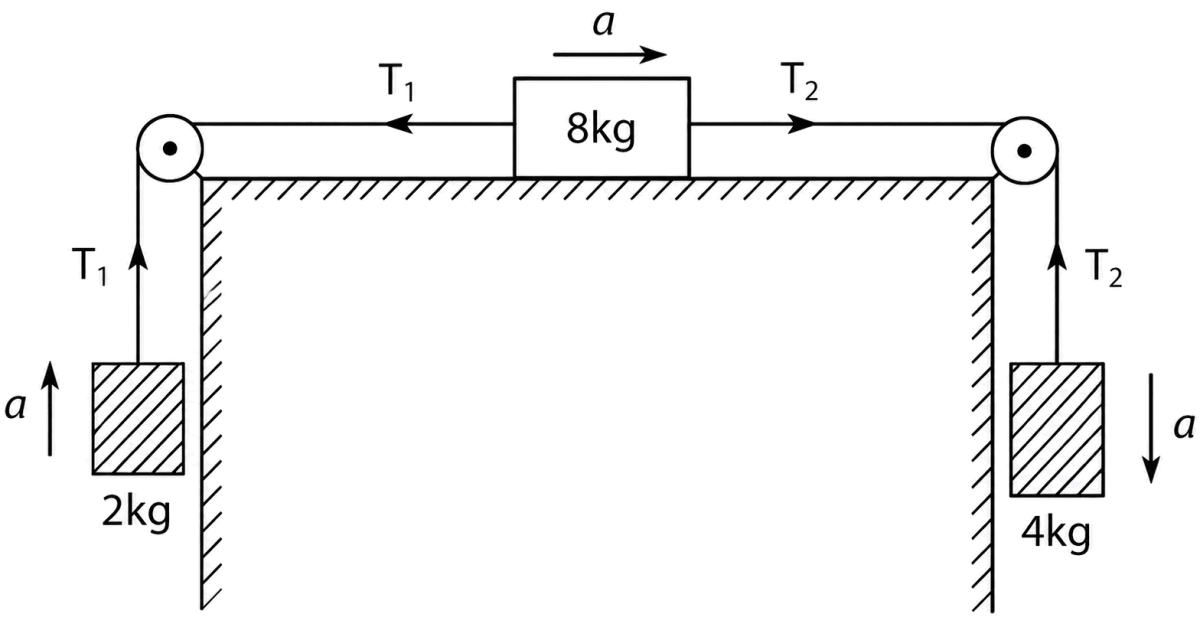
Answer
Given,
- Mass on the table, m = 8 kg
- Hanging masses, m1 = 2 kg and m2 = 4 kg
- The table and the pulleys are frictionless and the strings are massless
- Acceleration due to gravity, g = 9.8 m s-2
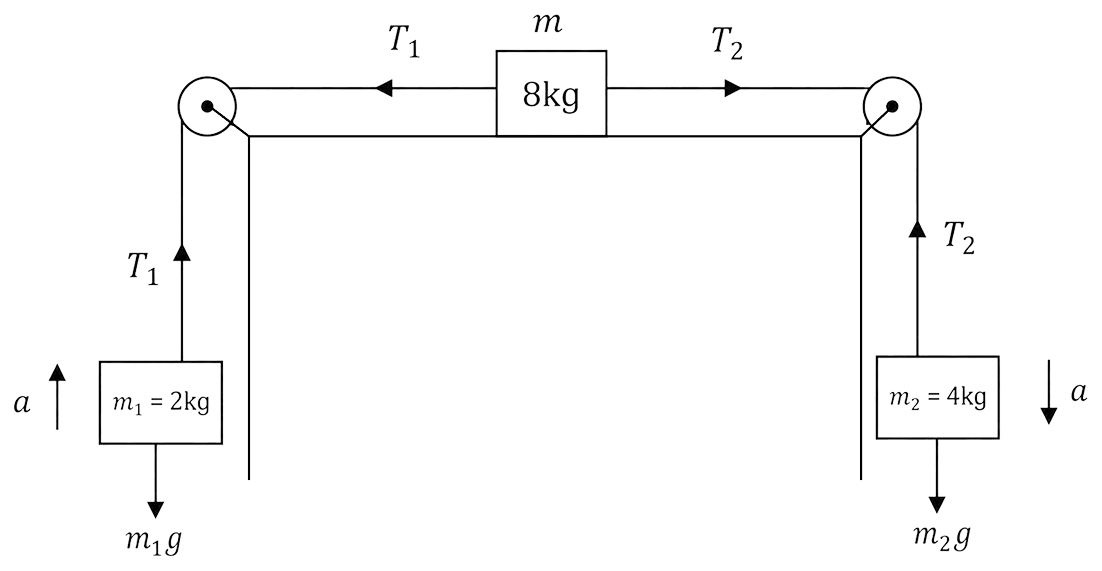
Since m2 is heavier than m1, the 4 kg block moves down, the 8 kg block moves towards the right and the 2 kg block moves up, all with the same acceleration a.
For the 2 kg block, moving up,
For the 8 kg block on the smooth table,
For the 4 kg block, moving down,
Adding equations (1), (2) and (3),
Substituting the values,
From equation (1),
From equation (3),
Hence, the acceleration of the system is 1.4 m s-2, and the tensions in the two strings are 22.4 N and 33.6 N.
The strings of a parachute can bear a maximum tension of 72 kg-weight. By what minimum acceleration can a person of 96 kg descend by means of this parachute?
Answer
Given,
- Maximum tension the strings can bear, T = 72 kg-weight
- Mass of the person, m = 96 kg
- Acceleration due to gravity, g = 9.8 m s-2
The minimum acceleration with which the person can descend has to be calculated.
While descending with an acceleration a, the net downward force on the person is
Expressing the maximum tension in newton, T = 72g N, and substituting,
Substituting the values,
If the acceleration were smaller than this, the tension in the strings would exceed 72 kg-weight and the strings would break.
Hence, the person must descend with a minimum acceleration of 2.45 m s-2.
A lift of mass 400 kg is hung by a wire. Calculate the tension in the wire when the lift is (a) at rest, (b) moving upward with a constant velocity of 1.0 m/s, (c) moving upward with an acceleration of 2.0 m/s2 and (d) moving downward with an acceleration of 2.0 m/s2.
Answer
Given,
- Mass of the lift, m = 400 kg
- Acceleration due to gravity, g = 9.8 m s-2
The tension in the wire has to be calculated in each case.
(a) At rest : The acceleration is zero, so
(b) Moving upward with a constant velocity of 1.0 m s-1 : The acceleration is again zero, so
(c) Moving upward with an acceleration of 2.0 m s-2 : The net upward force is T − mg, so
(d) Moving downward with an acceleration of 2.0 m s-2 : The net downward force is mg − T, so
Hence, the tensions in the wire are 3920 N, 3920 N, 4720 N and 3120 N respectively.
A body of mass 10 kg is hung by a spring-balance in a lift. What would be the reading of the balance when (i) the lift is ascending with an acceleration of 2 m/s2, (ii) descending with the same acceleration, (iii) descending with a constant velocity of 2 m/s? (g = 10 m/s2)
Answer
Given,
- Mass of the body, m = 10 kg
- Acceleration of the lift, a = 2 m s-2
- Acceleration due to gravity, g = 10 m s-2
The reading of the spring balance, which is the apparent weight of the body, has to be calculated.
(i) Lift ascending with an acceleration of 2 m s-2 :
(ii) Lift descending with the same acceleration :
(iii) Lift descending with a constant velocity of 2 m s-1 : Here the acceleration is zero, so
Hence, the readings of the balance are 12 kg-wt, 8 kg-wt and 10 kg-wt respectively.
A body rolled on a surface with a speed of 10 ms-1 comes to rest after covering a distance of 50 m. Find the coefficient of friction. (Take g = 10 ms-2.)
Answer
Given,
- Initial speed, u = 10 m s-1
- Final speed, v = 0
- Distance covered, s = 50 m
- Acceleration due to gravity, g = 10 m s-2
The coefficient of friction has to be calculated.
The body is brought to rest by the frictional force alone. By Newton's second law,
Using the equation of motion with v = 0,
Substituting the values,
Hence, the coefficient of friction is 0.1.
The distance between the rails of a railway line is 1 m. How much should the outer rail be raised relative to the inner one so that a train may cross over a turn of radius 400 m with a speed of 20 m/s without friction? g = 10 m/s2.
Answer
Given,
- Distance between the rails, d = 1 m
- Radius of the turn, r = 400 m
- Speed of the train, v = 20 m s-1
- Acceleration due to gravity, g = 10 m s-2
The height by which the outer rail should be raised has to be calculated.
For the train to cross the turn without friction, the track must be banked at an angle θ such that the horizontal component of the normal reaction provides the necessary centripetal force,
If h is the height by which the outer rail is raised above the inner rail, then for a small angle of banking
Comparing the two expressions,
Substituting the values,
Hence, the outer rail should be raised through 10 cm relative to the inner rail.
The radius of the turn of a road is 500 m. The width of the road is 10 m. Its outer edge is 0.15 m higher than the inner edge. For which speed of the vehicle running over the road this banking is ideal? (g = 10 m/s2)
Answer
Given,
- Radius of the turn, r = 500 m
- Width of the road, d = 10 m
- Height of the outer edge above the inner edge, h = 0.15 m
- Acceleration due to gravity, g = 10 m s-2
The speed for which this banking is ideal has to be calculated.
The angle of banking θ is given by
For the ideal speed, the whole of the centripetal force is provided by the horizontal component of the normal reaction, so that
Substituting the values,
Hence, the banking is ideal for a speed of 8.66 m s-1.
A force produces an acceleration of 16 m/s2 in a body of mass 0.5 kg and an acceleration of 4.0 m/s2 in another body. If both the bodies are fastened together then how much acceleration will be produced by this force?
Answer
Given,
- Mass of the first body, m1 = 0.5 kg, with acceleration a1 = 16 m s-2
- Acceleration produced in the second body, a2 = 4.0 m s-2
- The same force acts in both the cases
The acceleration produced when both the bodies are fastened together has to be calculated.
By Newton's second law of motion, the force is
The same force produces an acceleration of 4.0 m s-2 in the second body, so its mass is
When the two bodies are fastened together, the total mass is
Hence, the acceleration produced by the same force is
Hence, the acceleration produced is 3.2 m s-2.
A boy pulls a toy having two carriages placed on a frictionless table by applying a force of 1.5 N at 30° in a vertical plane. Calculate (i) the acceleration of the 40 g carriage, (ii) the acceleration of the 20 g carriage and (iii) the tension in the string fastened between the two carriages. Show in the figure the forces acting on both separately.
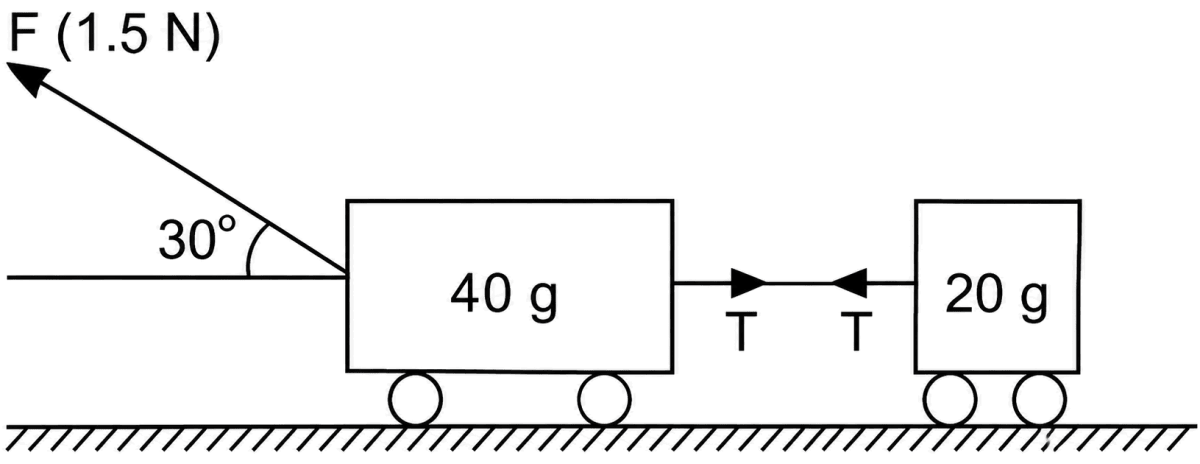
Answer
Given,
- Applied force, F = 1.5 N at 30° with the horizontal, in a vertical plane
- Masses of the carriages, m1 = 40 g = 0.04 kg and m2 = 20 g = 0.02 kg
- The table is frictionless
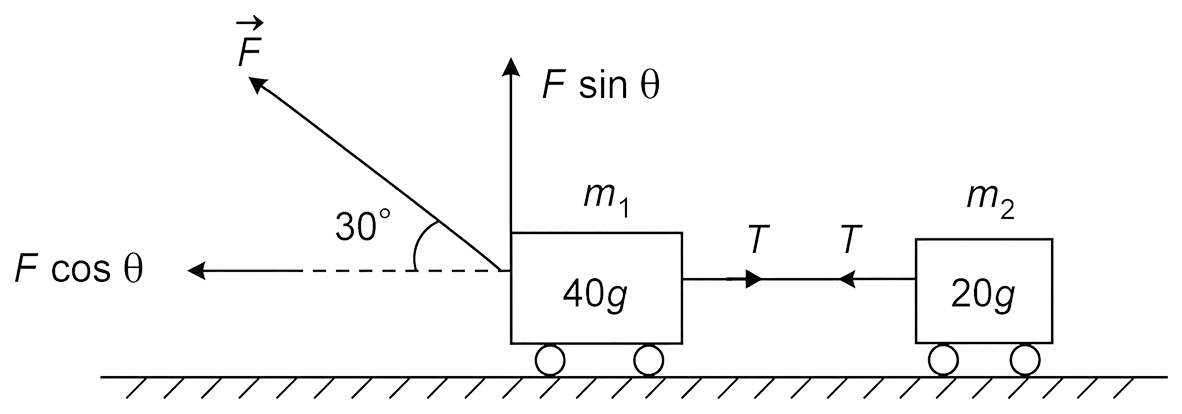
Only the horizontal component of the applied force produces the motion, since the vertical component is balanced by the normal reaction of the table. The horizontal component is
(i) and (ii) The two carriages are connected by a string, so they move together as a system of total mass
Hence, the acceleration of each carriage is
(iii) The 20 g carriage is pulled forward only by the tension in the string joining the two carriages. Hence,
Hence, the acceleration of each carriage is 21.6 m s-2 and the tension in the string is 0.43 N.
The forces acting on the two carriages separately are shown in the figure.
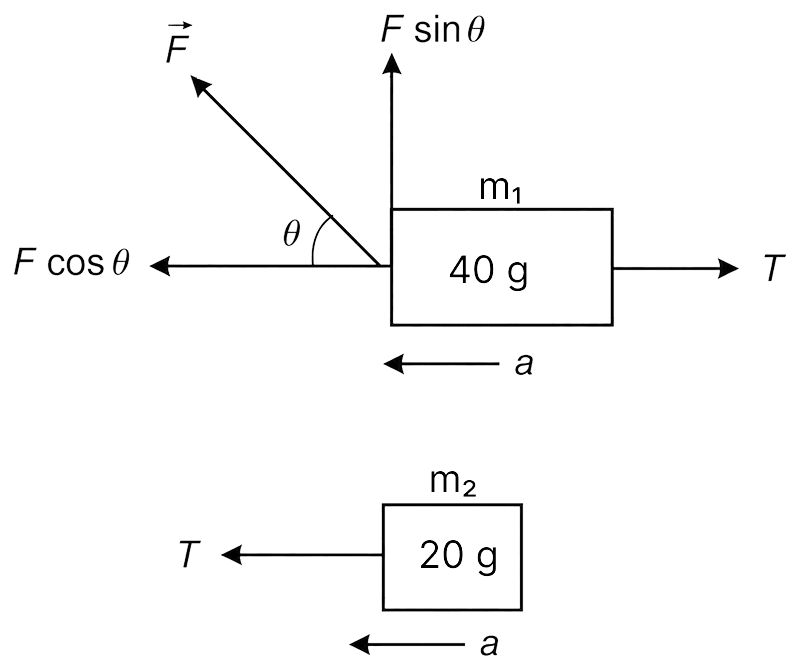
The figure shows a massless, frictionless pulley hanging by a spring-balance. The free ends of a cord passing over the pulley carry 1 kg and 5 kg weights which move under the action of gravity. Will the spring-balance read 6 kg-wt or less than 6 kg-wt or more than 6 kg-wt during the motion of the weights?
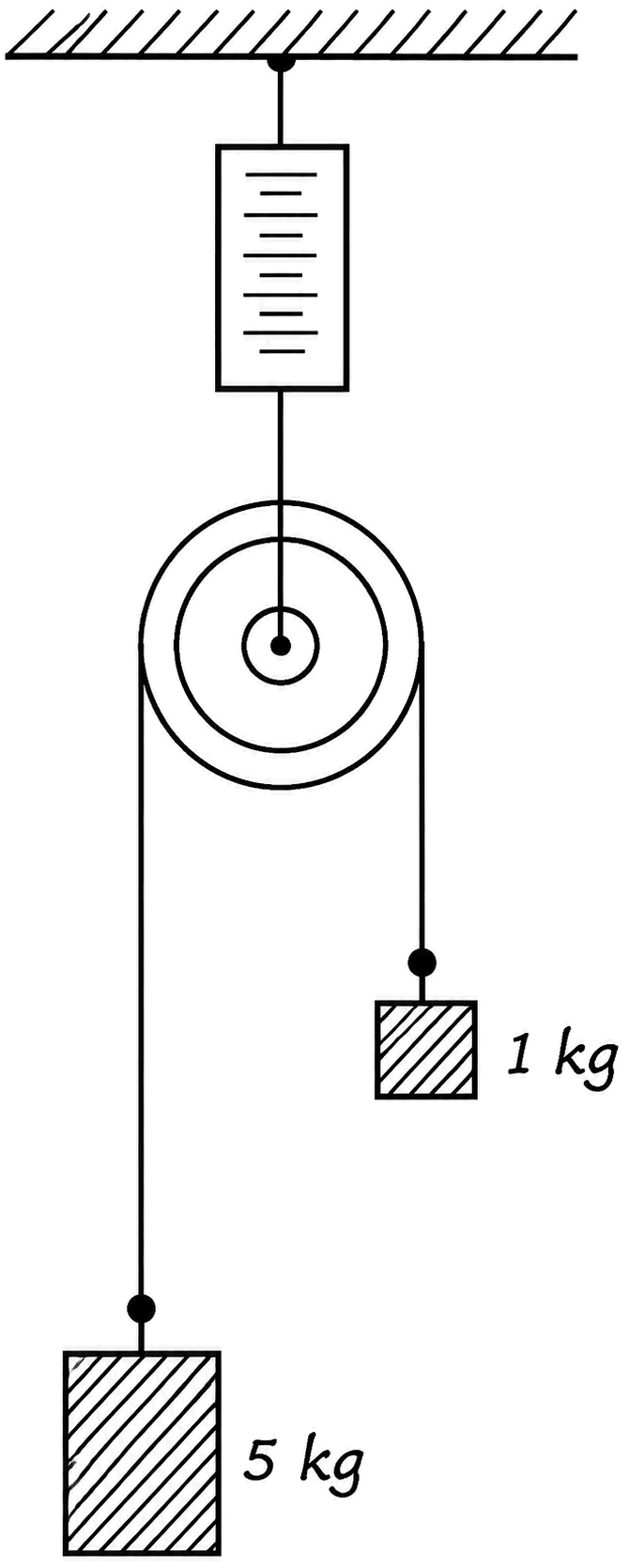
Answer
Given,
- Masses hanging from the two ends of the cord, m1 = 1 kg and m2 = 5 kg
- The pulley is massless and frictionless
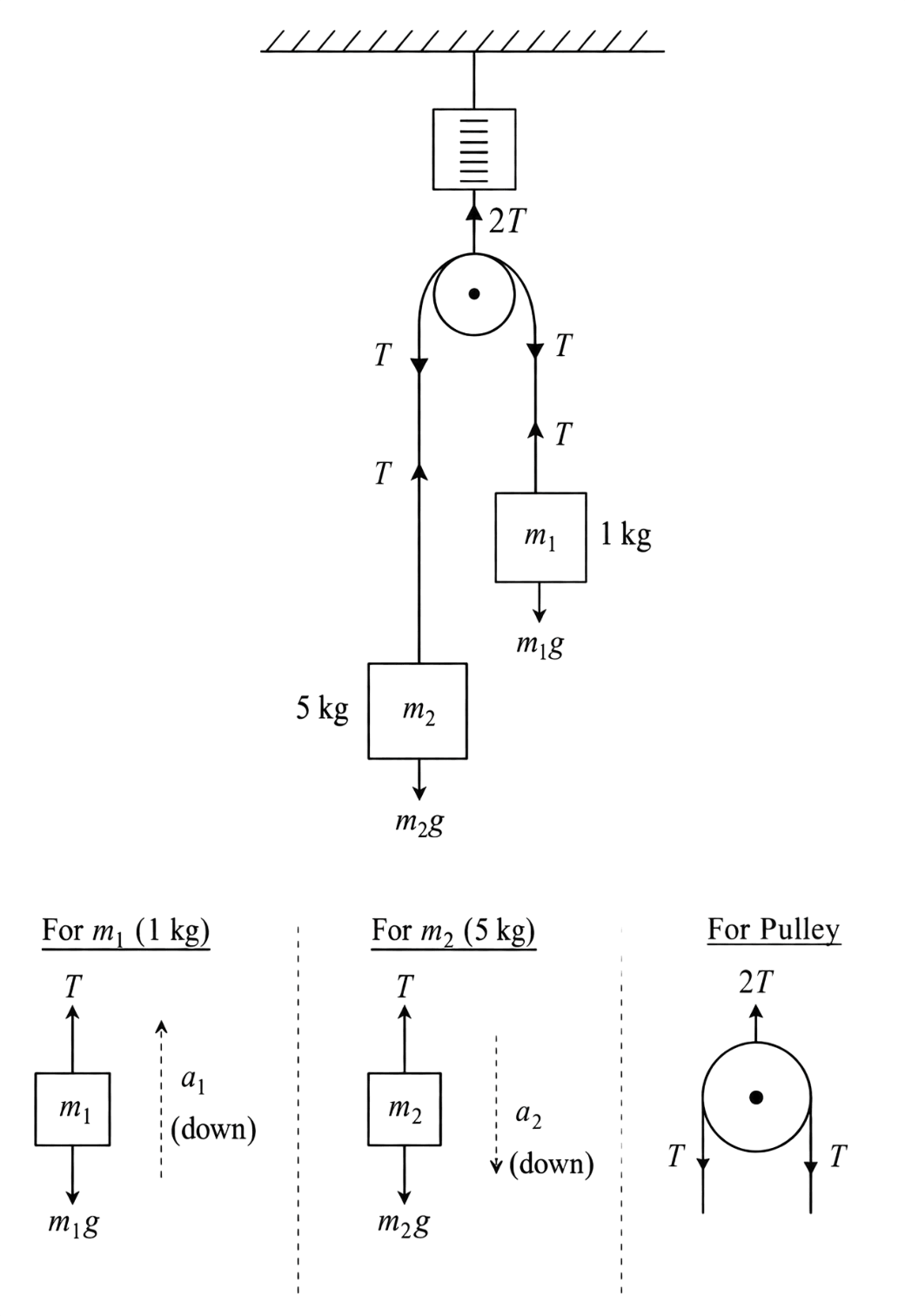
The reading of the spring balance is the total downward pull on the pulley, which is twice the tension in the cord.
If the weights were held at rest, the tension in the cord on either side would be equal to the corresponding weight and the balance would read (1 + 5) = 6 kg-wt. But the weights move under the action of gravity, so the tension has to be calculated for the accelerated motion.
The acceleration of the system is
The tension in the cord is
Hence, the reading of the spring balance is
Hence, the spring balance will read less than 6 kg-wt, its reading being 3.33 kg-wt during the motion of the weights.
A 70 kg person in sea is being lifted by a helicopter with the help of a rope which can bear a maximum tension of 100 kg-weight as shown in the figure. With what maximum acceleration the helicopter should rise so that the rope may not break?
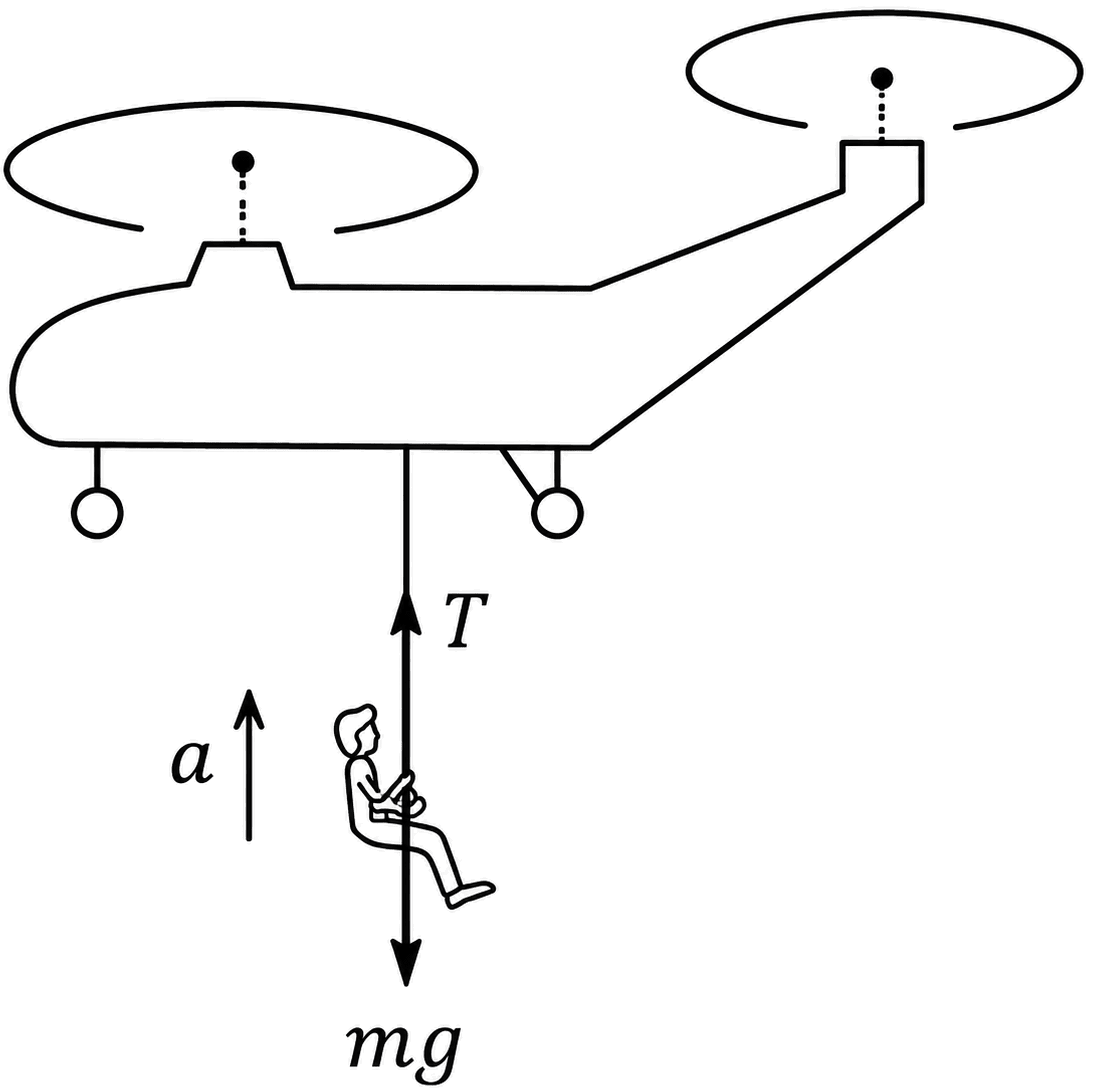
Answer
Given,
- Mass of the person, m = 70 kg
- Maximum tension the rope can bear, T = 100 kg-weight
- Acceleration due to gravity, g = 9.8 m s-2
The maximum acceleration with which the helicopter should rise has to be calculated.
While the person is being lifted with an acceleration a, the net upward force on him is
Expressing the maximum tension in newton, T = 100g N, and substituting,
Substituting the values,
Hence, the helicopter should rise with a maximum acceleration of 4.2 m s-2 so that the rope may not break.
A lift is going upwards with an acceleration of 4.9 ms-2. What will be the apparent weight of a 60 kg man in the lift? What when the lift rises up with a uniform velocity of 4.9 ms-1? If the rope of the lift is broken, then?
Answer
Given,
- Mass of the man, m = 60 kg
- Upward acceleration of the lift, a = 4.9 m s-2
- Acceleration due to gravity, g = 9.8 m s-2
Lift going upwards with an acceleration of 4.9 m s-2 : The apparent weight is
Lift rising with a uniform velocity of 4.9 m s-1 : The acceleration is zero, so
If the rope of the lift is broken : The lift and the man both fall freely with the acceleration due to gravity, so a = g and
Hence, the apparent weight of the man is 90 kg-wt in the first case, 60 kg-wt in the second case, and zero if the rope is broken, when he is in the state of weightlessness.
A machine gun of mass 5 kg fires 30 bullets, each of mass 50 g, per minute at a speed of 400 m s-1. What force must be exerted to keep the machine gun in position?
Answer
Given,
- Mass of the machine gun, M = 5 kg
- Mass of each bullet, m = 50 g = 0.05 kg
- Number of bullets fired, n = 30 per minute, that is, in t = 60 s
- Speed of each bullet, v = 400 m s-1
The force required to keep the machine gun in position has to be calculated.
The momentum carried away by the bullets in one minute is
By Newton's second law of motion, the force is equal to the rate of change of momentum,
By Newton's third law of motion, an equal and opposite force acts on the gun, and this must be balanced to keep the gun in position.
Hence, a force of 10 N must be exerted to keep the machine gun in position.
A 10 g moving body is acted upon by a force of 10 N for 3 μs. Compute the impulse and the change in velocity of the body.
Answer
Given,
- Mass of the body, m = 10 g = 0.01 kg
- Force, F = 10 N
- Time for which the force acts, t = 3 μs = 3 × 10⁻⁶ s
The impulse and the change in velocity have to be calculated.
The impulse of a constant force is the product of the force and the time interval for which it acts,
Substituting the values,
By the impulse-momentum theorem, the impulse is equal to the change in momentum,
Substituting the values,
Hence, the impulse is 3 × 10⁻⁵ N s and the change in velocity of the body is 3 × 10⁻³ m s-1.
A hammer weighing 1.5 kg and moving at a speed of 10 ms-1 strikes a nail, driving it into a wooden block. The duration of the impact is 0.005 s. Find the average impact force and the distance of penetration of the nail into the block.
Answer
Given,
- Mass of the hammer, m = 1.5 kg
- Initial speed, u = 10 m s-1
- Final speed, v = 0
- Duration of the impact, t = 0.005 s
The average impact force and the distance of penetration have to be calculated.
By Newton's second law of motion, the average force is the rate of change of momentum,
Substituting the values,
The retardation produced is
Using the equation of motion with v = 0, the distance of penetration is
Hence, the average impact force is 3000 N and the nail penetrates through 2.5 cm into the block.
A child suspends a steel disc in a vertical plane by means of a thread. Then he shoots bullets on the disc by a toy gun. If the mass of each bullet be 2.0 g and the bullet striking the disc with a velocity of 11 m/s is returning with the same velocity, then what average force is being exerted on the disc? The child is firing 3 bullets per second.
Answer
Given,
- Mass of each bullet, m = 2.0 g = 0.002 kg
- Speed of each bullet before striking, u = 11 m s-1
- Speed of each bullet after striking, v = −11 m s-1 (it returns with the same speed)
- Number of bullets fired, n = 3 per second
The average force exerted on the disc has to be calculated.
The change in momentum of one bullet is
By Newton's third law of motion, an equal and opposite change of momentum, of magnitude 0.044 kg m s-1, is imparted to the disc by each bullet. Since 3 bullets strike the disc in one second, the average force is the total rate of change of momentum,
Hence, the average force exerted on the disc is 0.132 N.
The velocities of two bodies (masses 5 kg and 10 kg) in the +x and +y directions are 4 m/s and 2 m/s respectively. They collide and stick together. What is the final velocity?
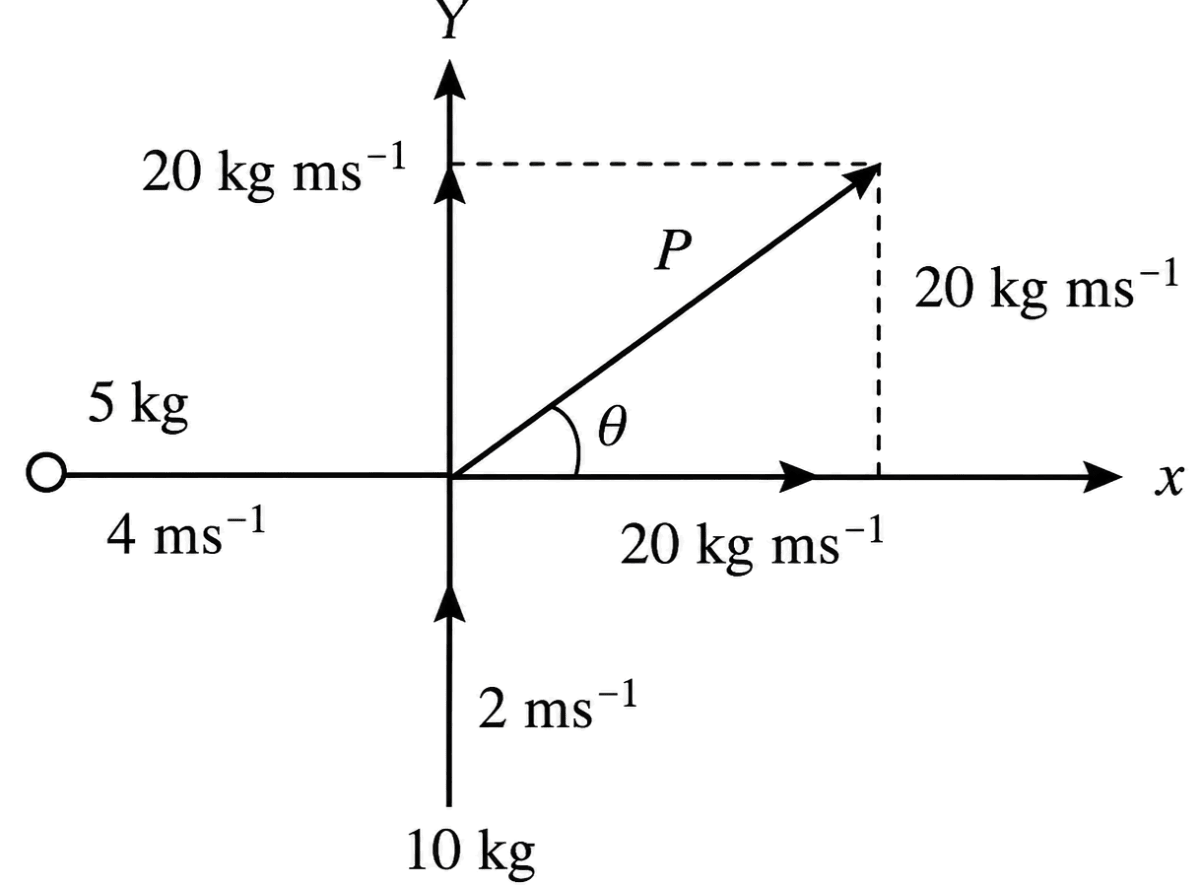
Answer
Given,
- Mass of the first body, m1 = 5 kg, moving along +x with v1 = 4 m s-1
- Mass of the second body, m2 = 10 kg, moving along +y with v2 = 2 m s-1
- They collide and stick together
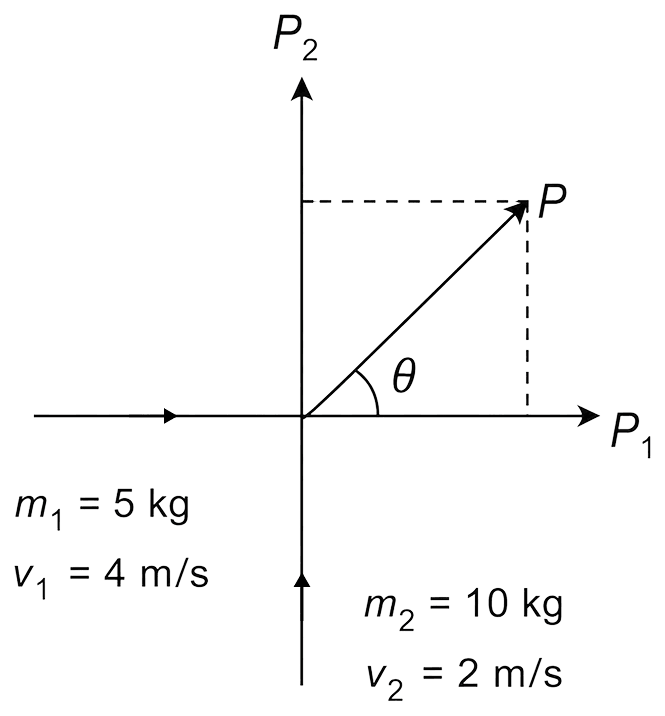
The final velocity has to be calculated.
The momentum of the first body, along the +x direction, is
The momentum of the second body, along the +y direction, is
The two momenta are mutually perpendicular, so the magnitude of their resultant is
No external force acts on the system, so by the principle of conservation of linear momentum this is also the momentum of the combined body after the collision. The combined mass is
Therefore, the final velocity is
If θ is the angle made by the resultant with the +x direction, then
Hence, the final velocity is 1.88 m s-1, directed at an angle of 45° with the +x direction.
A body of weight 200 N is suspended from a ceiling by two ropes as shown in figure. Find the tensions T1 and T2 in the two ropes.
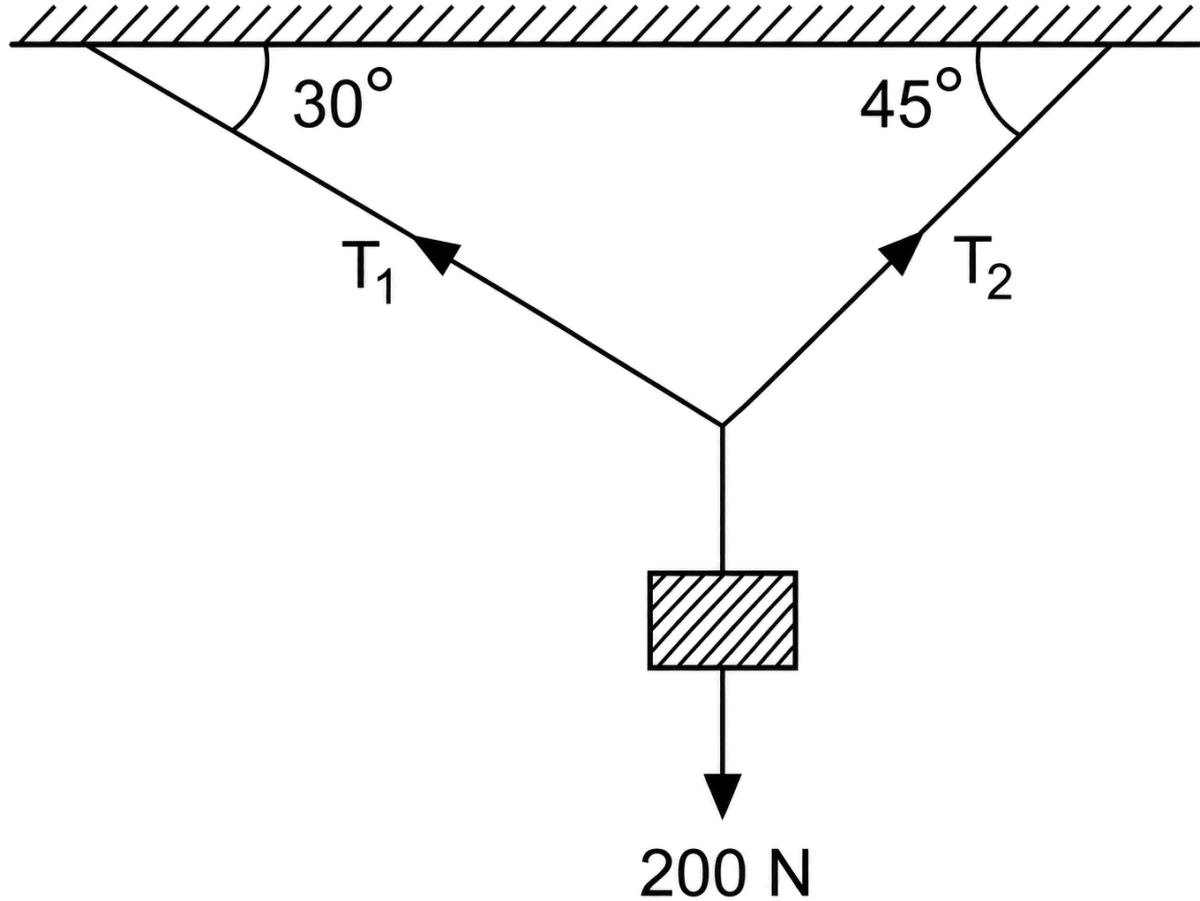
Answer
Given,
- Weight of the body, W = 200 N
- The rope carrying T1 makes 30° and the rope carrying T2 makes 45° with the horizontal, as shown
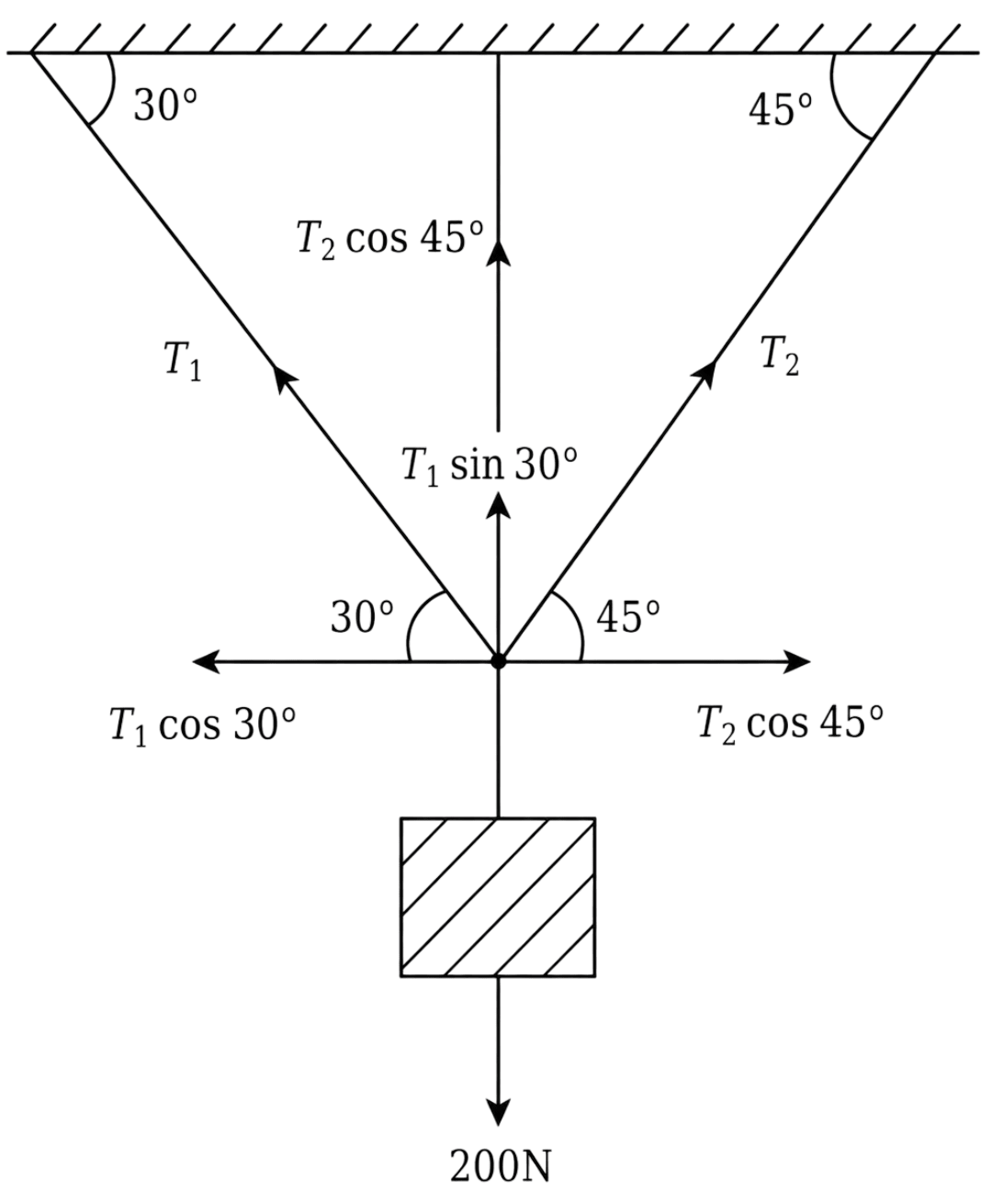
The tensions T1 and T2 have to be calculated.
The point at which the ropes meet is in equilibrium under the two tensions and the weight of the body. Resolving the tensions into horizontal and vertical components,
Vertical components :
Horizontal components :
From equation (2),
Substituting this in equation (1),
Therefore,
Hence, the tensions in the two ropes are 146.4 N and 179.3 N.
A block of mass 1.5 kg placed on a rough horizontal surface is pulled by a constant horizontal force of 1.2 kg-f. The coefficient of friction between the block and the surface is 0.3. Find the acceleration produced in terms of g.
Answer
Given,
- Mass of the block, m = 1.5 kg
- Applied horizontal force, F = 1.2 kg-f = 1.2 × 9.8 = 11.76 N
- Coefficient of friction, μ = 0.3
- Acceleration due to gravity, g = 9.8 m s-2
The acceleration produced has to be calculated in terms of g.
The block rests on a horizontal surface, so the normal reaction is
The force of friction opposing the motion is
Hence, the net force acting on the block is
By Newton's second law of motion, the acceleration produced is
Since g = 9.8 m s-2,
Hence, the acceleration produced in the block is .
Two blocks, each of mass 3.0 kg, are connected by a light cord and placed on a rough horizontal surface. When a horizontal force of 20 N is applied on a block, an acceleration of 0.50 ms-2 is produced in each block. Find the tension in the string and the frictional force which is same on the two blocks.
Answer
Given,
- Mass of each block, m = 3.0 kg
- Applied horizontal force, F = 20 N
- Acceleration produced in each block, a = 0.50 m s-2
- The frictional force f is the same on the two blocks
The tension in the string and the frictional force have to be calculated.
For the two blocks taken together : The total mass is 2m = 6.0 kg and the total frictional force is 2f. By Newton's second law,
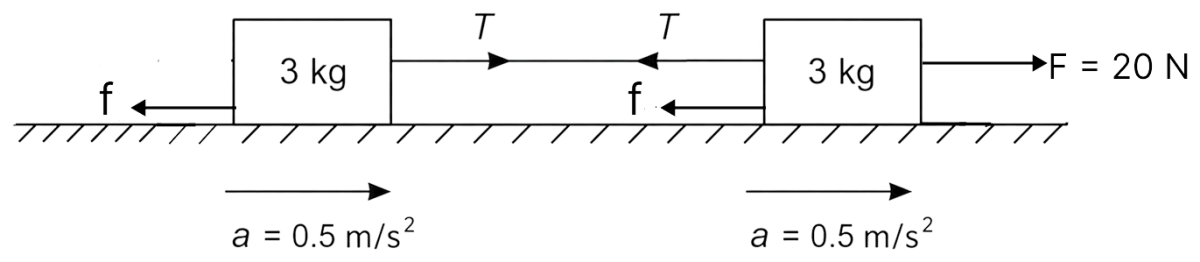
Substituting the values,
For the rear block, which is pulled only by the string : The forces on it are the tension T in the forward direction and the frictional force f in the backward direction. By Newton's second law,
Substituting the values,
Hence, the tension in the string is 10 N and the frictional force on each block is 8.5 N.
A block placed on a rough inclined plane of length 4.0 m just begins to slide down when the upper end of the plane is 1.0 m high from the ground. Calculate the coefficient of static friction.
Answer
Given,
- Length of the inclined plane, l = 4.0 m
- Height of the upper end, h = 1.0 m
- The block just begins to slide down
The coefficient of static friction has to be calculated.
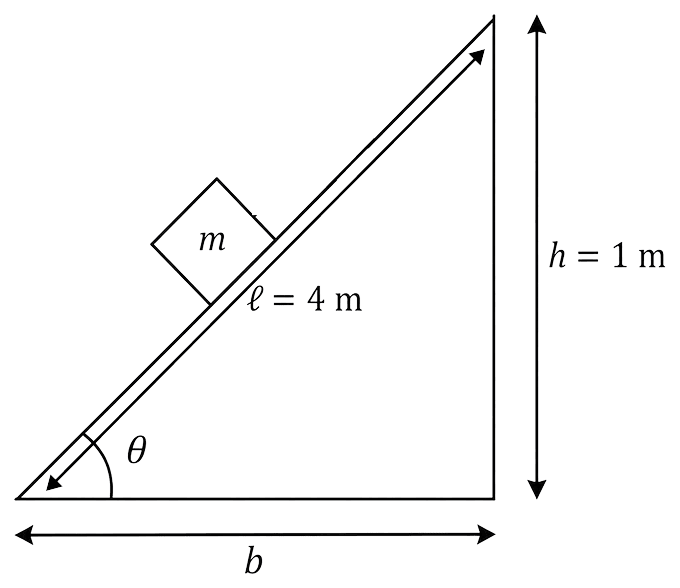
The block just begins to slide down, so the angle of inclination is equal to the angle of repose, and
From the geometry of the inclined plane,
The base of the inclined plane is
Therefore,
Hence, the coefficient of static friction is 0.258.
A body is in limiting equilibrium on a rough plane inclined at 30° with the horizontal. When the inclination is increased to 45°, the body slides down with acceleration. Find this acceleration. Take g = 9.8 ms-2.
Answer
Given,
- The body is in limiting equilibrium at an inclination of 30°
- The inclination is then increased to 45°
- Acceleration due to gravity, g = 9.8 m s-2
The acceleration with which the body slides down at 45° has to be calculated.
At 30° the body is in limiting equilibrium, so the angle of repose is 30° and
When the plane is inclined at θ = 45°, the body slides down. Resolving the gravity force into components parallel and perpendicular to the plane, the normal reaction is R = mg cos θ and the kinetic frictional force is μmg cos θ. By Newton's second law,
Substituting the values, with sin 45° = cos 45° = 0.7071,
Hence, the body slides down with an acceleration of 2.93 m s-2.
A body of mass 1 kg tied to one end of a string is revolved at a rate of 3 rev/s in a circle of radius 10 cm. Calculate the linear velocity and acceleration of the body, and the tension in the string. What will happen if the string breaks?
Answer
Given,
- Mass of the body, m = 1 kg
- Rate of revolution, n = 3 rev/s
- Radius of the circle, r = 10 cm = 0.1 m
The linear velocity, the acceleration and the tension have to be calculated.
In one revolution the body covers the circumference of the circle, so the linear velocity is
Substituting the values,
The acceleration of the body is the centripetal acceleration,
The necessary centripetal force is provided by the tension in the string,
Hence, the linear velocity is 1.88 m s-1, the acceleration is 35.3 m s-2 and the tension in the string is 35.3 N.
If the string breaks : The centripetal force vanishes instantly, so no force acts on the body towards the centre. By Newton's first law of motion the body then flies off along the tangent to the circular path at the point where the string breaks.
A string can bear a maximum tension of 3.16 kg-wt. What maximum number of revolutions per second can be made by a stone of mass 49 g tied to one end of a 1 m long piece of this string so that the string may not break? (π = 22/7)
Answer
Given,
- Maximum tension the string can bear, T = 3.16 kg-wt = 3.16 × 9.8 = 30.97 N
- Mass of the stone, m = 49 g = 0.049 kg
- Length of the string, r = 1 m
The maximum number of revolutions per second has to be calculated.
The necessary centripetal force is provided by the tension in the string. If n is the number of revolutions per second, the angular speed is ω = 2πn, and
Therefore,
Substituting the values,
Hence, the stone can be made to complete a maximum of 4 revolutions per second without breaking the string.
A motor-cyclist driving with a speed of 0.6 km/min goes over a turn of radius of curvature 50 m. Calculate his centripetal acceleration and his slope with the vertical (g = 10 m/s2).
Answer
Given,
- Speed of the motor-cyclist, v = 0.6 km/min = = 10 m s-1
- Radius of curvature, r = 50 m
- Acceleration due to gravity, g = 10 m s-2
The centripetal acceleration and the slope with the vertical have to be calculated.
The centripetal acceleration is
While taking the turn the motor-cyclist leans inwards through an angle θ from the vertical, given by
Substituting the values,
Hence, the centripetal acceleration is 2.0 m s-2 and the motor-cyclist leans through an angle of tan-1(0.2) with the vertical.
Find the maximum speed at which a car can turn round a curve of 100 m radius on a level road if the coefficient of friction between the tyres and the road is 0.4. (Take g = 10 m/s2.)
Answer
Given,
- Radius of the curve, r = 100 m
- Coefficient of friction, μ = 0.4
- Acceleration due to gravity, g = 10 m s-2
The maximum speed at which the car can turn has to be calculated.
On a level road the necessary centripetal force is provided entirely by the force of friction between the tyres and the road. For the car not to skid,
Hence, the maximum speed is
Substituting the values,
Hence, the maximum speed at which the car can turn round the curve is 20 m s-1.
A 1000-kg car is moving with a uniform speed of 30 m/s on a circular path of radius 200 m. How much frictional force is needed to provide the necessary centripetal force to the car? If the coefficient of friction is 0.8, then what can be the maximum speed of the car? (g = 9.8 m/s2)
Answer
Given,
- Mass of the car, m = 1000 kg
- Speed of the car, v = 30 m s-1
- Radius of the circular path, r = 200 m
- Coefficient of friction, μ = 0.8
- Acceleration due to gravity, g = 9.8 m s-2
The frictional force required and the maximum speed have to be calculated.
The frictional force must supply the whole of the necessary centripetal force,
Substituting the values,
For the car not to skid, this force must not exceed the limiting friction μmg. Hence, the maximum speed is
Substituting the values,
Hence, a frictional force of 4500 N is needed, and the maximum speed of the car can be 39.6 m s-1.
On a smooth table are placed two blocks in contact. (i) A horizontal force of 5.0 N is applied on the 20 kg block as shown in the figure. State by what force this block presses the 10 kg block. (ii) If the above force is applied on the other side of the 10 kg block then by what force the 20 kg block will press the 10 kg block?
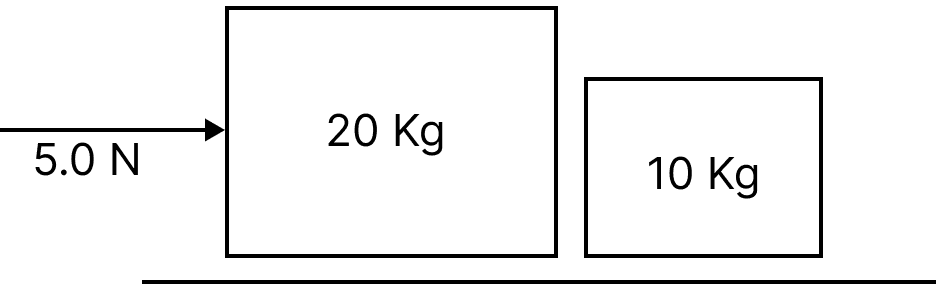
Answer
Given,
- Masses of the two blocks, 20 kg and 10 kg, placed in contact
- Applied horizontal force, F = 5.0 N
- The table is smooth
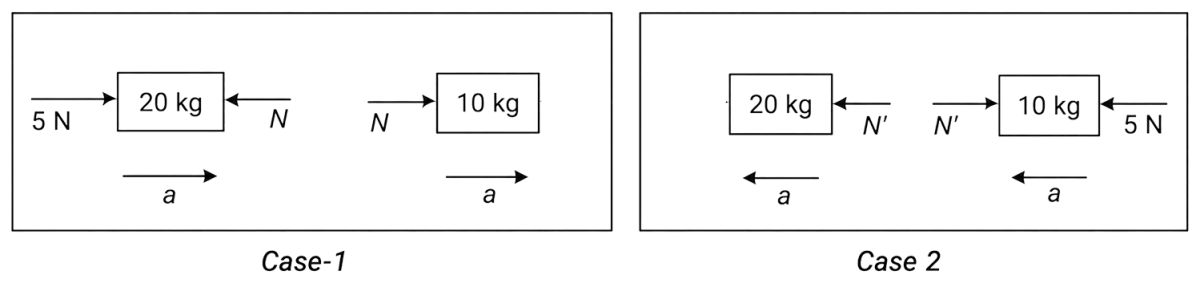
The two blocks are in contact, so they move together with a common acceleration. By Newton's second law,
(i) When the force is applied on the 20 kg block : The 10 kg block is accelerated only by the contact force N exerted on it by the 20 kg block. Hence,
Hence, the 20 kg block presses the 10 kg block with a force of N towards the right.
(ii) When the force is applied on the other side of the 10 kg block : Now the 20 kg block is accelerated only by the contact force N' exerted on it by the 10 kg block. Hence,
By Newton's third law of motion the 20 kg block presses the 10 kg block with an equal force.
Hence, the 20 kg block will press the 10 kg block with a force of N towards the right.
In the figure, three blocks are connected by strings. Masses of blocks are m, 3m and 5m respectively and they are pulled by a force F on a frictionless horizontal surface. The tension P in the first string is 16 N. Calculate : (i) acceleration of blocks, (ii) tension Q in the second string, (iii) force F.

Answer
Given,
- Masses of the three blocks, m, 3m and 5m
- Tension in the first string, P = 16 N
- The horizontal surface is frictionless
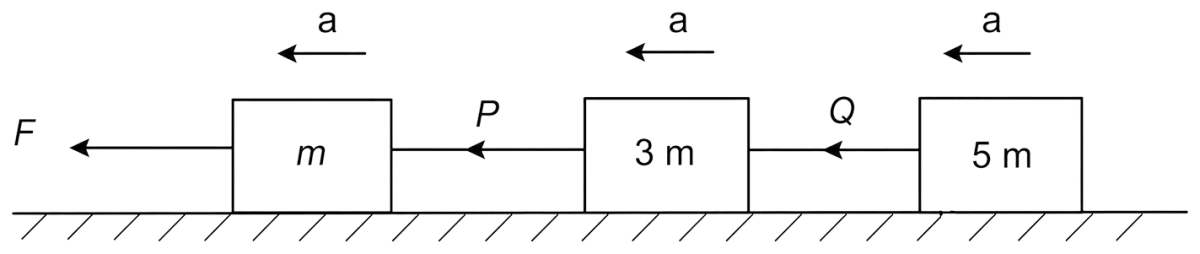
The force F pulls all the three blocks, the tension P pulls the blocks 3m and 5m, and the tension Q pulls only the block 5m.
(i) Considering the blocks 3m and 5m, which are pulled by the tension P,
Substituting P = 16 N,
(ii) The block 5m is pulled only by the tension Q, so
(iii) The force F pulls all the three blocks, of total mass 9m, so
Hence, the acceleration of the blocks is m s-2, the tension Q in the second string is 10 N and the force F is 18 N.
Two blocks are connected by a string as shown in the figure. The upper block is hung by another string. (i) What will be the tension in the upper string due to the two blocks suspended in rest position? (ii) What force F will have to be applied on the upper string to produce an acceleration of 2 m/s2 in the upward direction in both blocks? (iii) Then, what will be the tension in the string between the two blocks?
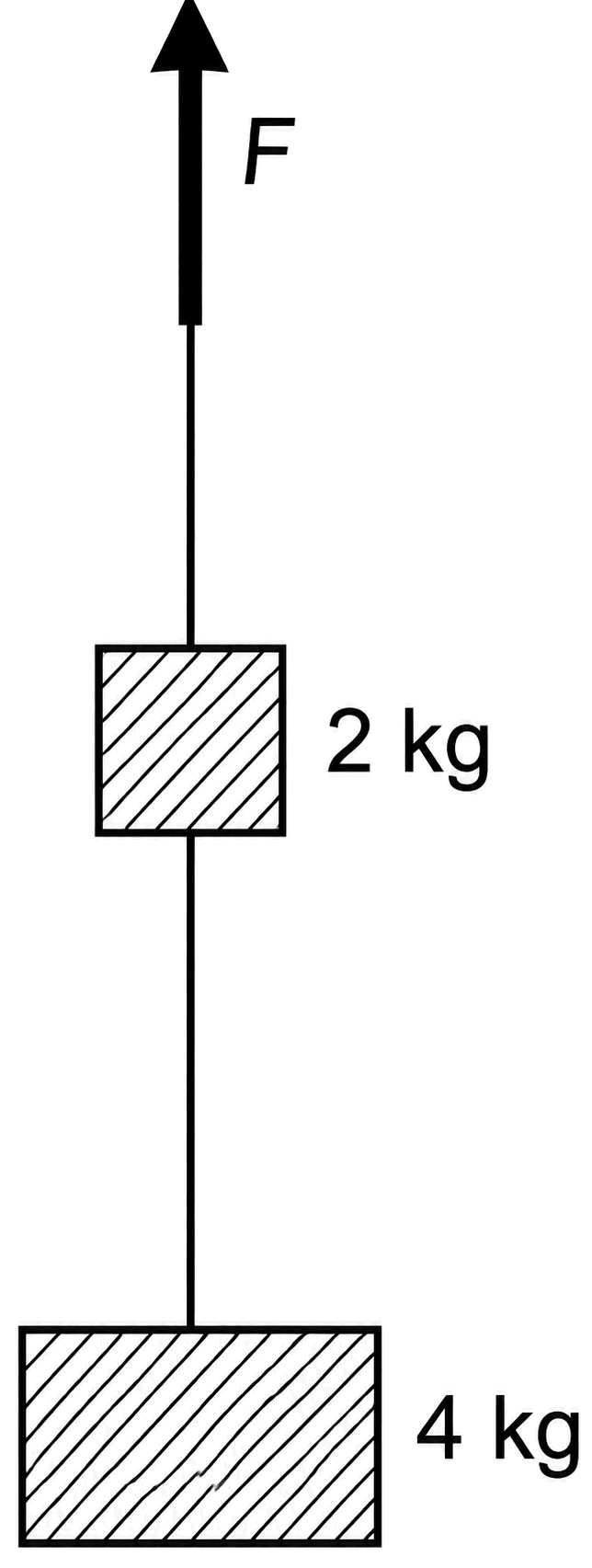
Answer
Given,
- Mass of the upper block, m1 = 2 kg
- Mass of the lower block, m2 = 4 kg
- Upward acceleration required, a = 2 m s-2
- Acceleration due to gravity, g = 9.8 m s-2
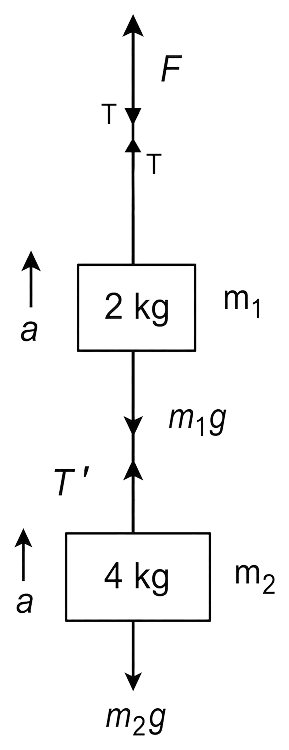
(i) Tension in the upper string in the rest position : The upper string supports the whole of the two blocks, so
(ii) Force F required for an upward acceleration of 2 m s-2 : The net upward force on the two blocks must be (m1 + m2)a, so
Substituting the values,
(iii) Tension in the string between the two blocks : This string carries only the lower block of mass m2, which also moves upwards with the acceleration a. Hence,
Hence, the tension in the upper string in the rest position is 58.8 N, the force F required is 70.8 N, and the tension in the string between the two blocks is then 47.2 N.
A proton (mass 1.67 × 10⁻²⁷ kg) on striking a neutron (mass nearly equal to the proton) forms a deutron. What would be the velocity of the deutron if it is formed by a proton moving left with a velocity of 7.0 × 10⁶ m/s and a neutron moving right with a velocity of 4.0 × 10⁶ m/s?
Answer
Given,
- Mass of the proton, m = 1.67 × 10⁻²⁷ kg, moving left with u1 = 7.0 × 10⁶ m s-1
- Mass of the neutron is nearly equal to that of the proton, moving right with u2 = 4.0 × 10⁶ m s-1
- They combine to form a deutron of mass 2m
The velocity of the deutron has to be calculated.
Taking the leftward direction as positive, the total linear momentum before the combination is
Substituting the values,
No external force acts on the system, so by the principle of conservation of linear momentum this momentum is carried by the deutron of mass 2m,
The positive sign shows that the deutron moves in the direction in which the proton was moving.
Hence, the velocity of the deutron is 1.5 × 10⁶ m s-1, directed towards the left.
A ball moving with a momentum of 15 kg ms-1 strikes against a wall at 60° angle and is reflected at the same angle with its initial speed. Find the impulse.
Answer
Given,
- Momentum of the ball, p = 15 kg m s-1
- Angle with the normal to the wall, θ = 60°, both before and after reflection
- The speed is unchanged
The impulse has to be calculated.
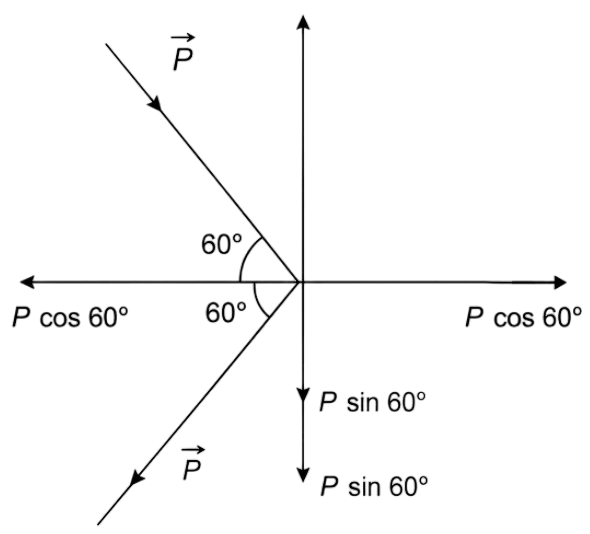
Resolving the momentum of the ball into components parallel and normal to the wall :
The components parallel to the wall are each p sin θ and they are in the same direction, so the change in momentum along the wall is
The components normal to the wall are just reversed. Hence, the change in the normal momentum is
By the impulse-momentum theorem, this change in momentum is the impulse imparted to the ball,
Substituting the values,
Hence, the impulse is 15 kg m s-1, directed normal to the wall.
A shell of mass 0.02 kg is fired by a gun of mass 100 kg. The muzzle speed of the shell is 80 ms-1. Find the recoil speed of the gun.
Answer
Given,
- Mass of the shell, m1 = 0.02 kg
- Mass of the gun, m2 = 100 kg
- Muzzle speed of the shell, v1 = 80 m s-1
The recoil speed of the gun has to be calculated.
Before firing, both the gun and the shell are at rest, so the total linear momentum of the system is zero. No external force acts on the system, so by the principle of conservation of linear momentum,
Substituting the values,
The negative sign shows that the gun moves opposite to the direction of the shell.
Hence, the recoil speed of the gun is 0.016 m s-1.
Determine the magnitude and the direction of the combined momentum of the moving spheres shown in the figure by drawing a vector-diagram. m1 = 2 kg, m2 = 3 kg, v1 = 6 m/s, v2 = 4 m/s.
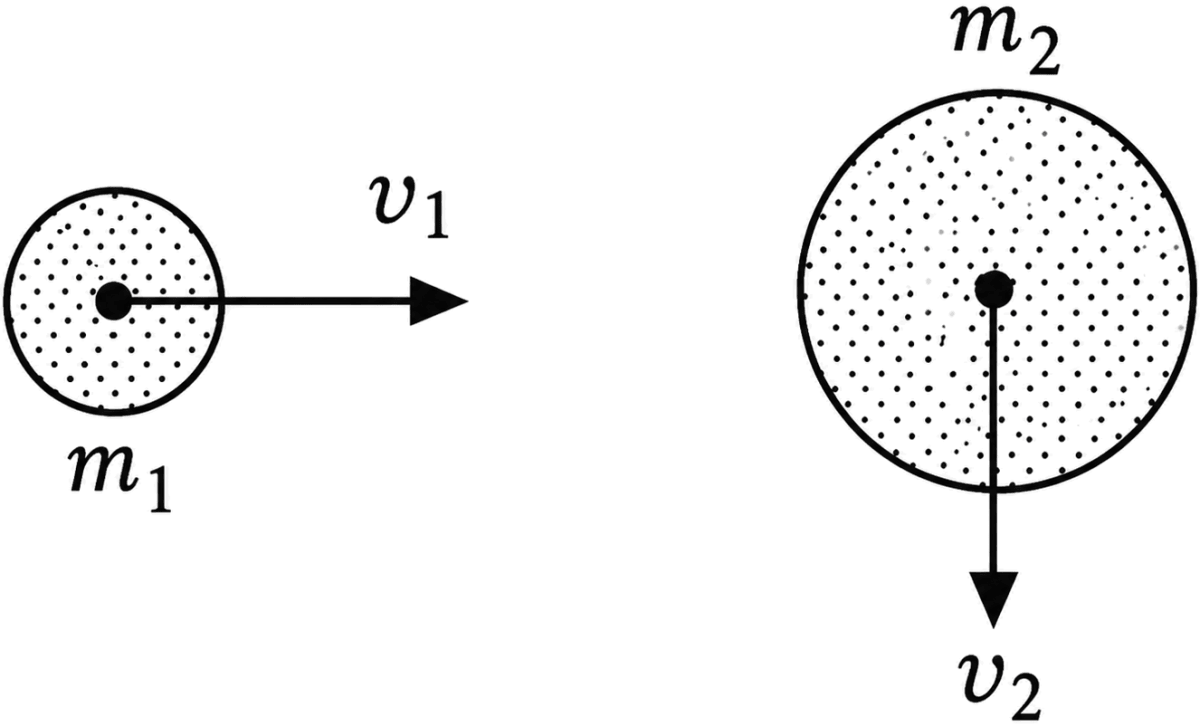
Answer
Given,
- m1 = 2 kg with v1 = 6 m/s, directed horizontally
- m2 = 3 kg with v2 = 4 m/s, directed vertically downwards
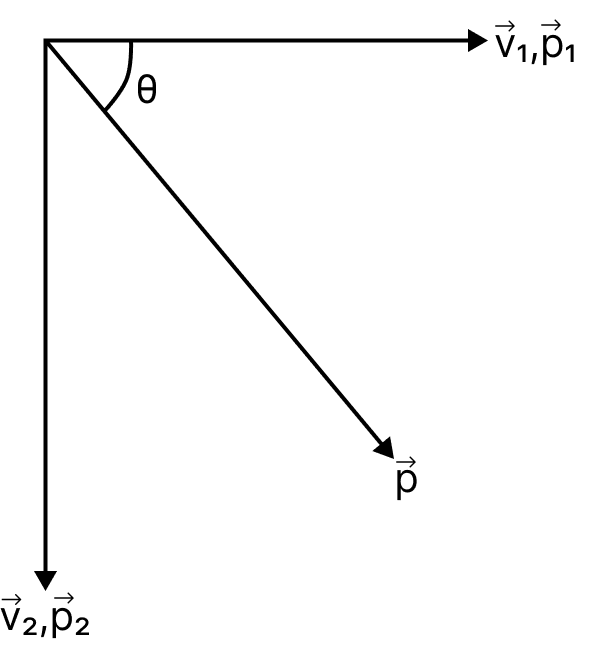
The magnitude and the direction of the combined momentum have to be determined.
The momentum of the first sphere is
The momentum of the second sphere is
The two momenta are mutually perpendicular, so by the parallelogram law of vector addition the magnitude of their resultant is
If θ is the angle made by the resultant with the horizontal, then
Hence, the combined momentum is nearly 17 kg m s-1, directed at an angle of 45° with the horizontal.
A car going at a speed of 7 ms-1 can be stopped by applying brakes in a shortest distance of 10 m. Show that the total frictional force opposing the motion, when brakes are applied, is 1/4 th of the weight of the car. (g = 9.8 ms-2)
Answer
Given,
- Initial speed of the car, u = 7 m s-1
- Final speed, v = 0
- Shortest stopping distance, s = 10 m
- Acceleration due to gravity, g = 9.8 m s-2
Let m be the mass of the car and a the retardation produced by the total frictional force. Using the equation of motion with v = 0,
Substituting the values,
By Newton's second law of motion, the total frictional force opposing the motion is
The weight of the car is
Therefore,
Hence, the total frictional force opposing the motion is one-fourth of the weight of the car.
A train is moving with a speed of 72 km/h on a curved railway line of 400 m radius. A spring balance loaded with a block of weight of 5 kg is suspended from the roof of the train (see figure). What would be the reading of the balance? (g = 10 m/s2).
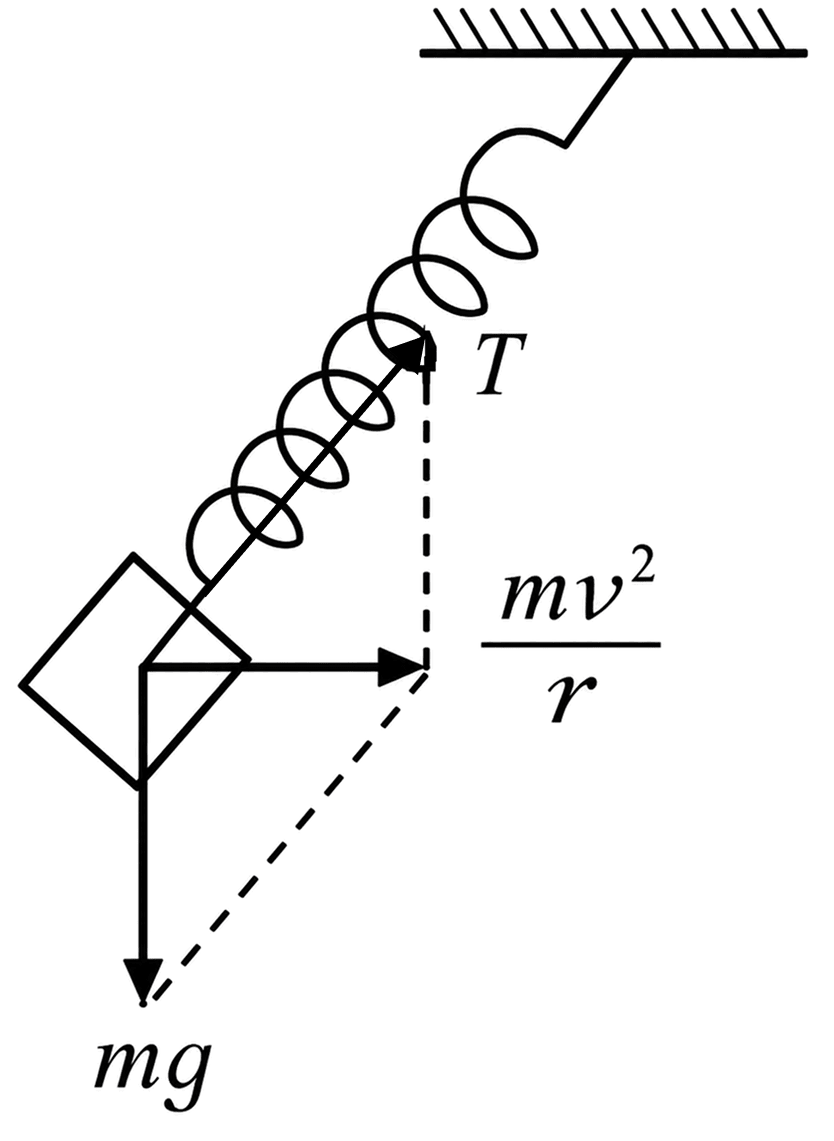
Answer
Given,
- Speed of the train, v = 72 km/h = = 20 m s-1
- Radius of the curve, r = 400 m
- Weight of the block, mg = 5 kg-wt, so m = 5 kg
- Acceleration due to gravity, g = 10 m s-2
The reading of the spring balance has to be calculated.
The forces acting on the suspended block are its weight mg, acting vertically downwards, and the spring-tension T along the string. Their resultant must provide the necessary centripetal force , which is horizontal and directed towards the centre of the curve.
Since the weight is vertical and the centripetal force is horizontal, these two are mutually perpendicular, and
Substituting the values,
Therefore,
Hence, the reading of the balance is 5.025 kg-wt.
A body slides down from rest from the top of a 6.4 m long rough plane inclined at 30° with the horizontal. Find the time taken by the block in reaching the bottom of the plane. Take μk = 0.2 and g = 9.8 ms-2.
Answer
Given,
- Length of the inclined plane, l = 6.4 m
- Angle of inclination, θ = 30°
- Coefficient of kinetic friction, μk = 0.2
- Initial velocity, u = 0
- Acceleration due to gravity, g = 9.8 m s-2
The time taken by the block to reach the bottom has to be calculated.
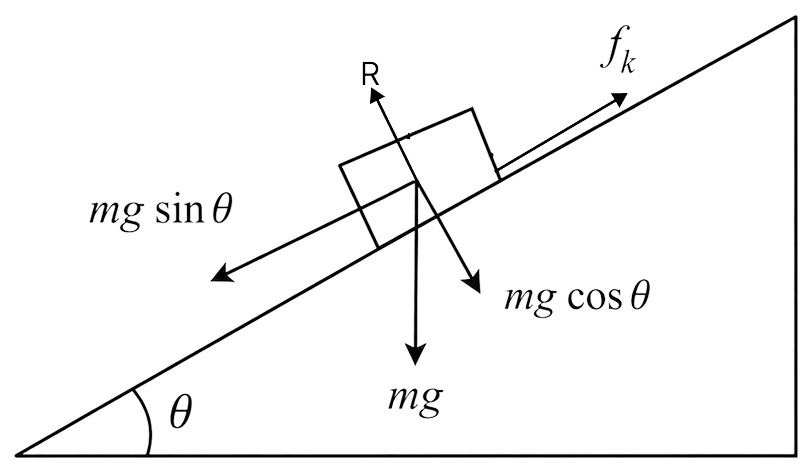
Resolving the gravity force into components parallel and perpendicular to the plane, the normal reaction is R = mg cos θ and the kinetic frictional force is μkmg cos θ, acting up the plane. By Newton's second law,
Substituting the values, with sin 30° = 0.5 and cos 30° = 0.866,
Using with u = 0 and s = l,
Substituting the values,
Hence, the block takes 2 s to reach the bottom of the plane.
A body of mass m is released from the top of a rough inclined plane as shown. If the frictional force be fk, then prove that the body will reach the bottom with a velocity given by
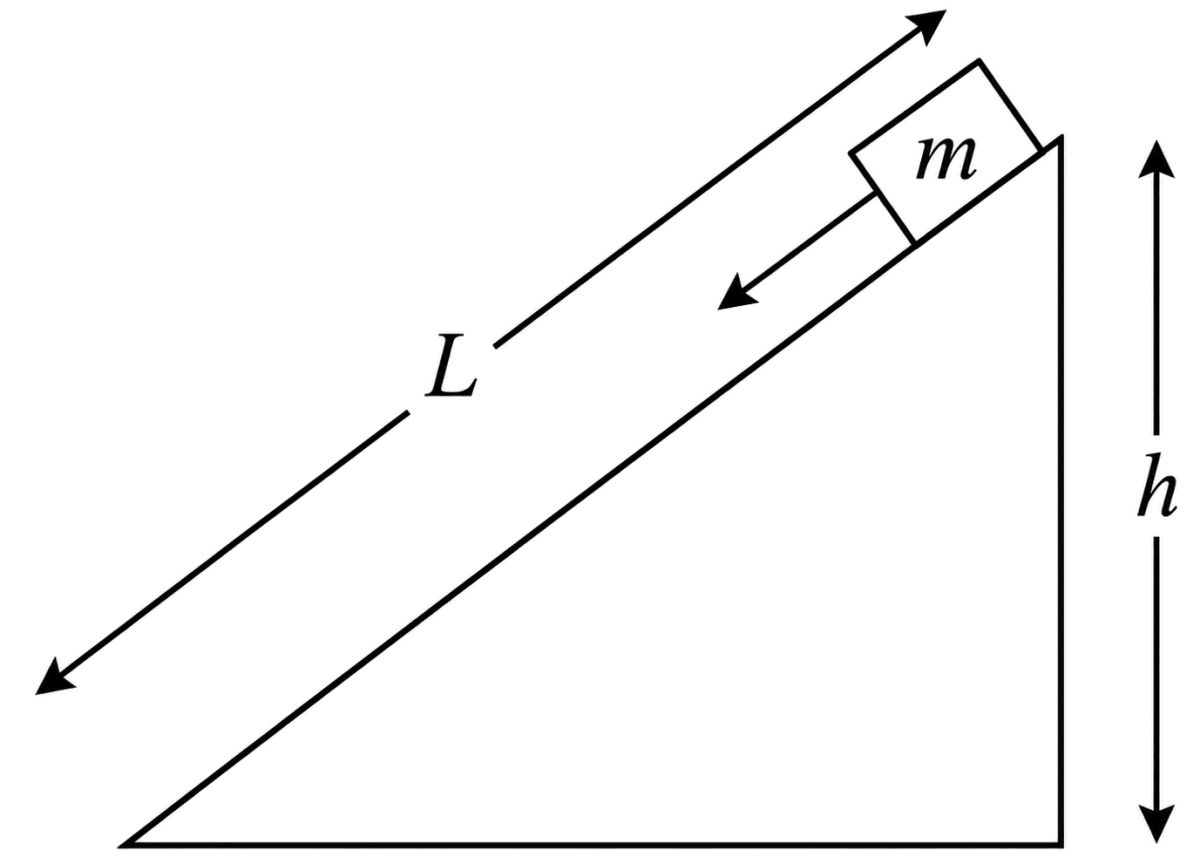
Answer
Given,
- Mass of the body = m, released from rest at the top
- Length of the inclined plane = L, height of the top above the bottom = h
- Frictional force = fk
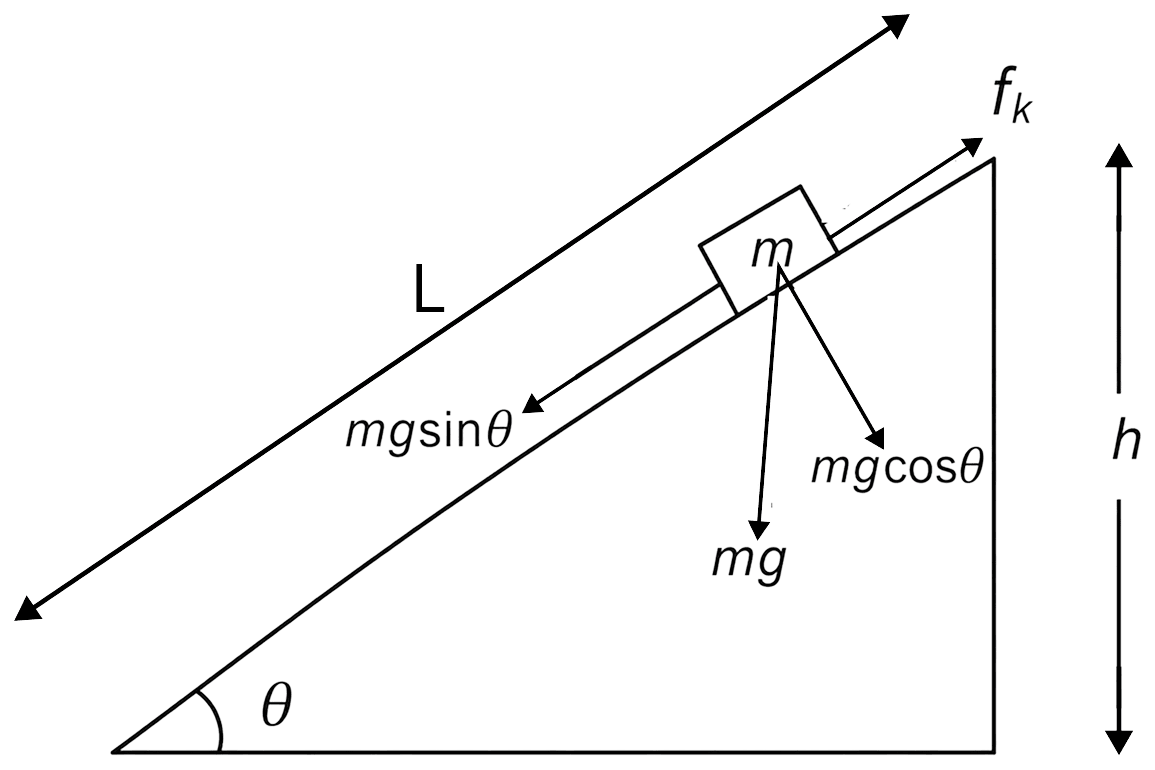
Let θ be the angle of inclination of the plane, so that
Resolving the gravity force into components, the component along the plane, directed down the plane, is mg sin θ, and the frictional force fk acts up the plane, opposing the motion. Hence, the net force along the plane is
By Newton's second law of motion, the acceleration of the body down the plane is
Substituting
The body starts from rest and covers the whole length L of the plane. Using the equation of motion with u = 0 and s = L,
Taking the square root,
Hence proved.
The minimum force required to move a body up an inclined plane is three times the minimum force required to prevent it from sliding down the plane. If coefficient of friction between the body and inclined plane is , find the angle of inclination of the plane.
Answer
Given,
- The minimum force required to move the body up the plane is three times the minimum force required to prevent it from sliding down
- Coefficient of friction,
The angle of inclination of the plane has to be calculated.
Let θ be the angle of inclination and m the mass of the body. The normal reaction is R = mg cos θ, so the limiting frictional force is μmg cos θ.
Force required to move the body up the plane : Here the friction acts down the plane, so
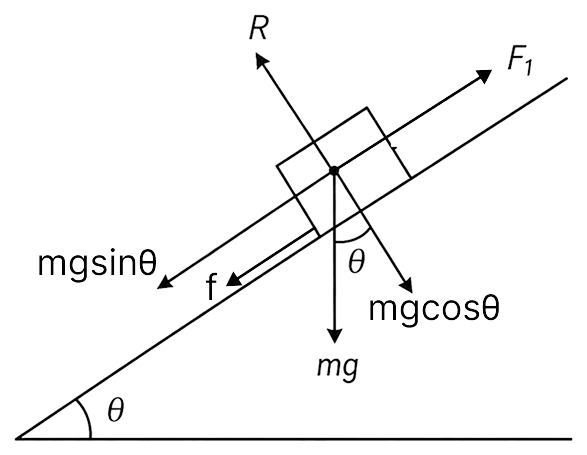
Force required to prevent the body from sliding down : Here the friction acts up the plane, so
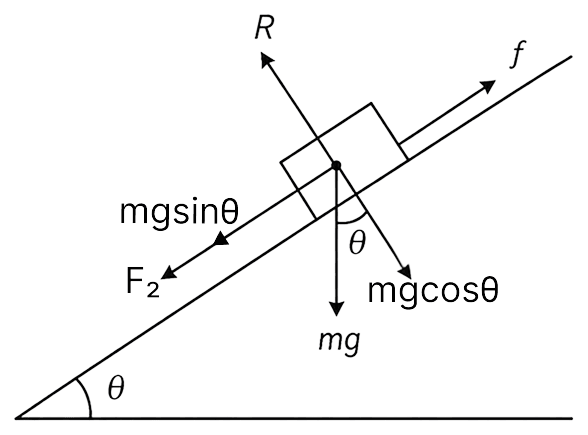
It is given that F1 = 3F2. Therefore,
Dividing throughout by mg,
Substituting the given value of μ,
Hence, the angle of inclination of the plane is 30°.
A body is sliding down an inclined plane having coefficient of friction 0.5. If the normal reaction is twice that of the resultant downward force along the incline, find the angle between the inclined plane and the horizontal.
Answer
Given,
- Coefficient of friction, μ = 0.5
- The normal reaction is twice the resultant downward force along the incline
The angle between the inclined plane and the horizontal has to be calculated.
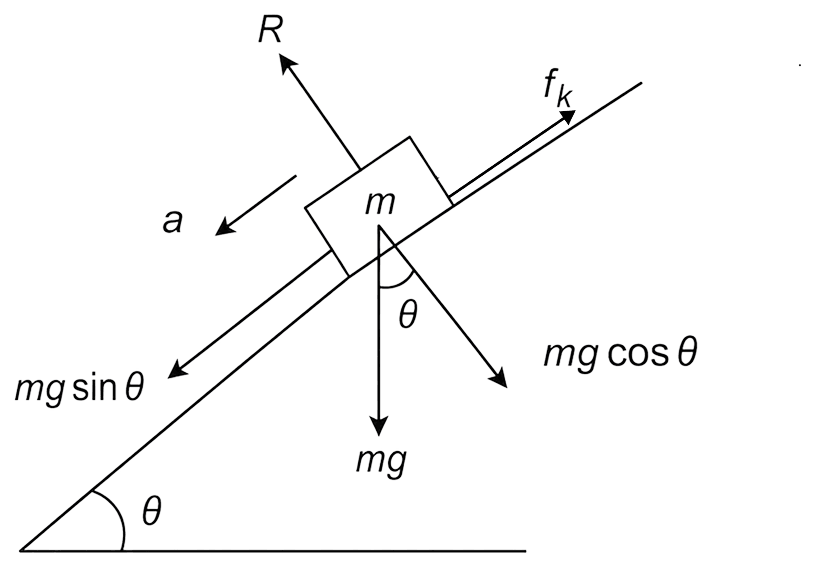
Let θ be the angle of inclination and m the mass of the body. The normal reaction is
The body is sliding down, so the frictional force μmg cos θ acts up the plane. Hence, the resultant downward force along the incline is
It is given that R = 2F. Therefore,
Dividing throughout by mg,
Substituting μ = 0.5,
Hence, the angle between the inclined plane and the horizontal is 45°.