
A balloon with mass m is descending down with an acceleration a (where a < g). How much mass should be removed from it so that is starts moving up with an acceleration a?
Answer
Reason — Let F be the upthrust on the balloon, which remains unchanged.
While descending with an acceleration a : The net downward force is mg − F, so
After a mass m' is removed, ascending with an acceleration a : The remaining mass is (m − m'), and the net upward force is F − (m − m')g, so
Equating (1) and (2),
A bullet of mass 20 g has an initial speed of 1 m/s, just before it starts penetrating a mud wall of thickness 20 cm. If the wall offers a mean resistance of 2.5 × 10⁻² N, the speed of the bullet after emerging from the outer side of the wall is close to :
- 3.3 m/s
- 0.4 m/s
- 0.1 m/s
- 0.7 m/s
Answer
0.7 m/s
Reason — Given, m = 20 g = 0.02 kg, u = 1 m/s, s = 20 cm = 0.2 m and F = 2.5 × 10⁻² N.
The retardation produced is
Using ,
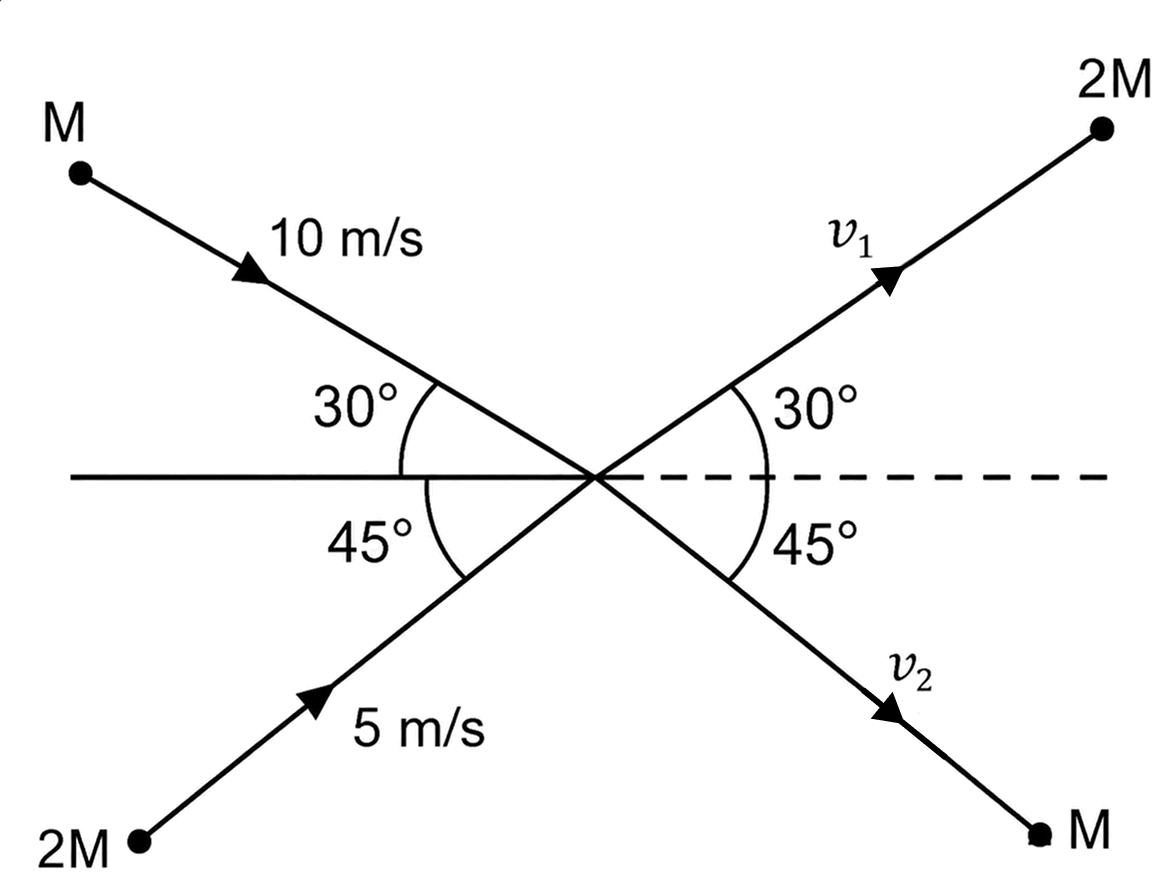
Two particles of masses M and 2M, moving as shown in the figure, with speeds of 10 m/s and 5 m/s, collide elastically at the origin. After the collision, they move along the indicated directions with speeds v1 and v2, respectively. The values of v1 and v2 are nearly :
- 3.2 m/s and 12.6 m/s
- 3.2 m/s and 6.3 m/s
- 6.5 m/s and 6.3 m/s
- 6.5 m/s and 3.2 m/s
Answer
6.5 m/s and 6.3 m/s
Reason — Let the horizontal direction towards the right be the x-axis and the vertical direction upwards be the y-axis, the origin being the point of collision.
Momenta before the collision :
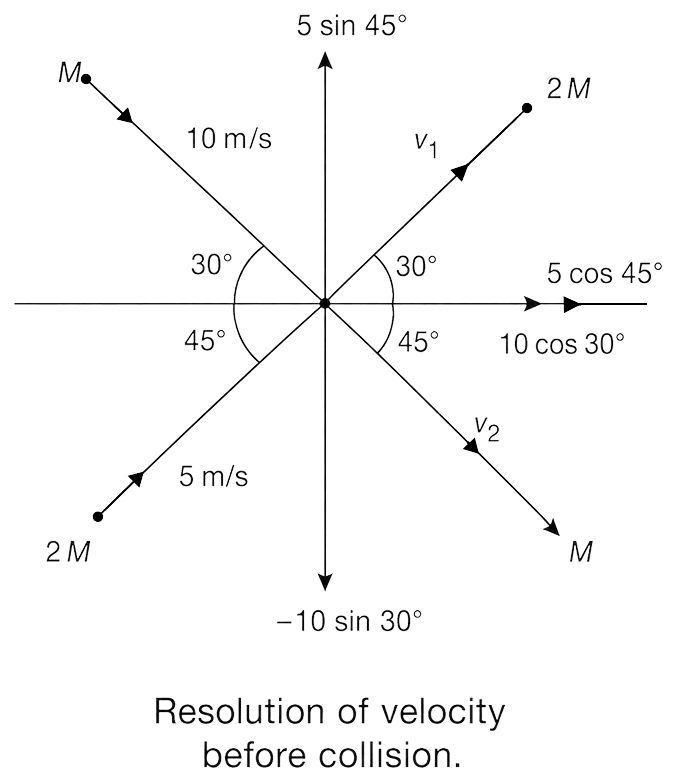
The particle of mass M moves with a speed of 10 m/s, directed at 30° below the horizontal. Resolving it into components,
The particle of mass 2M moves with a speed of 5 m/s, directed at 45° above the horizontal. Resolving it into components,
Hence, the components of the total momentum before the collision are
Momenta after the collision :
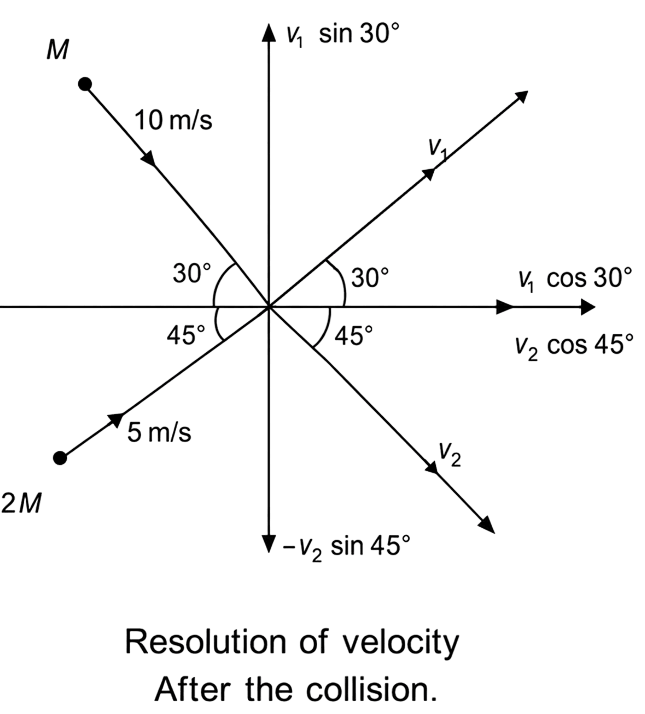
The particle of mass 2M moves with the speed v1 at 30° above the horizontal, and the particle of mass M moves with the speed v2 at 45° below the horizontal. Hence, the components of the total momentum after the collision are
Applying the principle of conservation of linear momentum :
No external force acts on the system during the collision, so the momentum is conserved separately along each axis. Cancelling M throughout,
Adding equations (1) and (2), the terms in v2 cancel,
Substituting this value of v1 in equation (2),
Hence, v1 is nearly 6.5 m s-1 and v2 is nearly 6.3 m s-1.
A particle of mass 'M' is moving with speed '2v' and collides with a mass '2M' moving with speed 'v' in the same direction. After collision, the first mass is stopped completely while the second one splits into two particles each of mass 'M', which move at angle 45° with respect to the original direction. The speed of each of the moving particle will be :
Answer
Reason — By the principle of conservation of linear momentum along the original direction of motion,
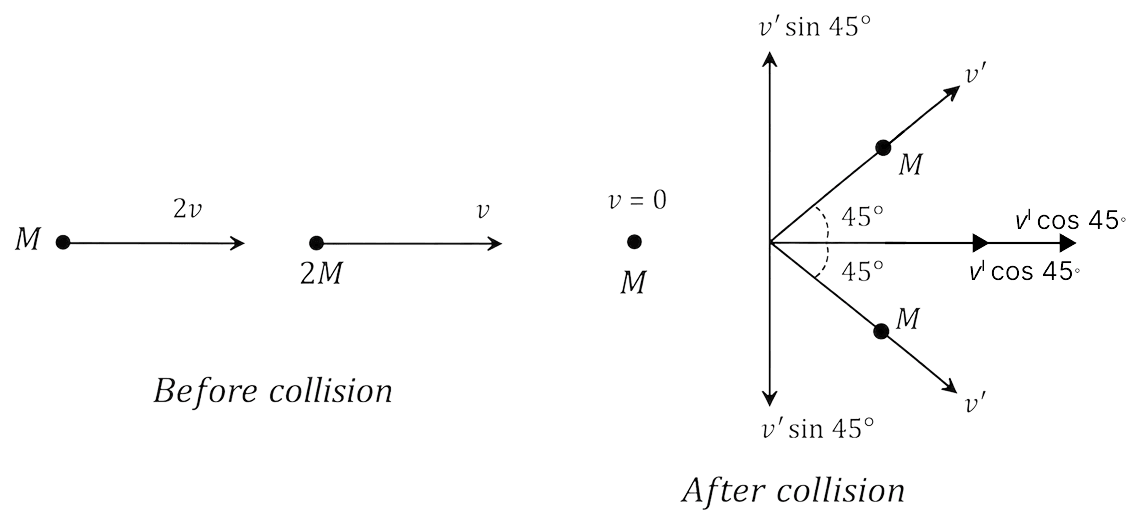
where v' is the speed of each of the two particles of mass M moving at 45° to the original direction. Substituting ,
The components perpendicular to the original direction are equal and opposite, so they cancel out.
A mass of 10 kg is suspended vertically by a rope from the roof. When a horizontal force is applied on the mass, the rope is deviated at an angle of 45° at the roof point. If the suspended mass is at equilibrium, the magnitude of the force applied is : (take g = 10 ms-2)
- 70 N
- 200 N
- 100 N
- 140 N
Answer
100 N
Reason — The mass is in equilibrium under three forces : its weight mg vertically downwards, the applied horizontal force F, and the tension T along the rope, which makes 45° with the vertical.
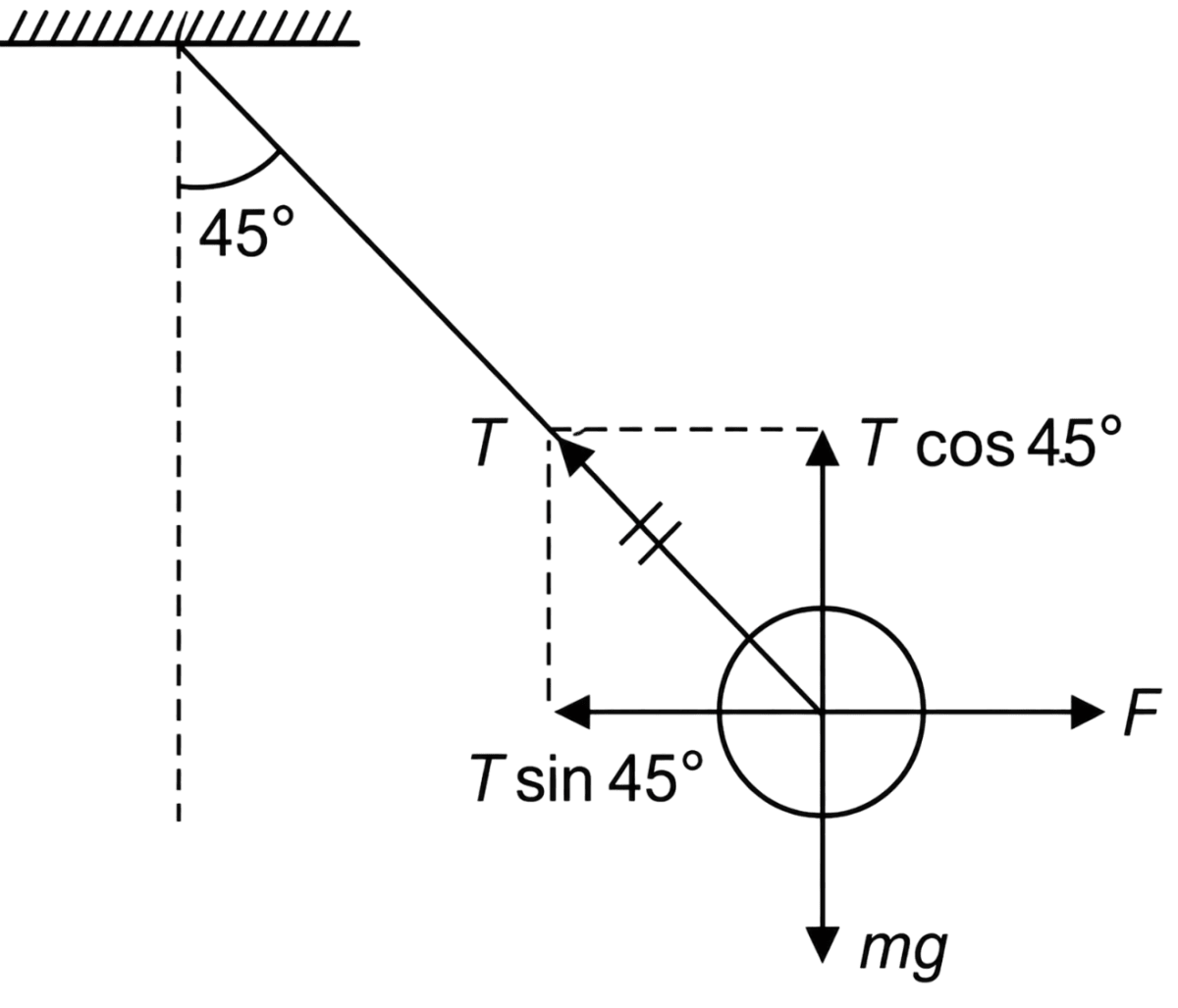
Resolving the tension into components,
Dividing the second equation by the first,
Substituting m = 10 kg, g = 10 m s-2 and tan 45° = 1,
A ball of mass 0.15 kg hits the wall with its initial speed of 12 ms-1 and bounces back without changing its initial speed. If the force applied by the wall on the ball during the contact is 100 N, calculate the time duration of the contact of ball with the wall :
- 0.018 s
- 0.036 s
- 0.009 s
- 0.072 s
Answer
0.036 s
Reason — The ball bounces back with the same speed, so the change in momentum is
Substituting m = 0.15 kg and v = 12 m s-1,
By the impulse-momentum theorem, F × t = Δp, so
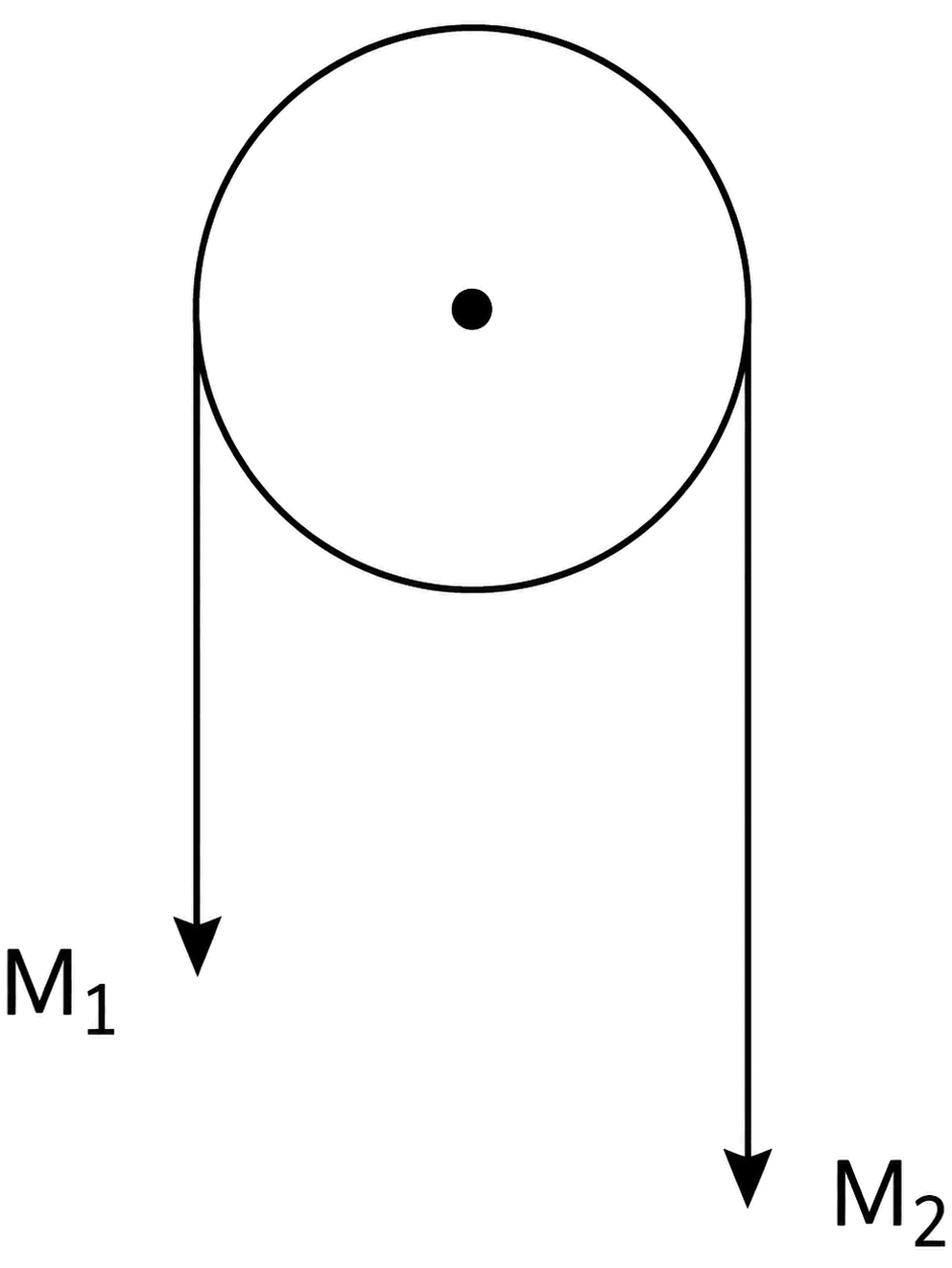
Two masses M1 and M2 are tied together at the two ends of a light inextensible string that passes over a frictionless pulley as shown in the figure. When the mass M2 is twice that of M1, the acceleration of the system is a1. When the mass M2 is thrice that of M1, the acceleration of the system is a2. The ratio will be :
Answer
Reason — For two masses connected over a frictionless pulley, the acceleration of the system is
When M2 = 2M1 :
When M2 = 3M1 :
Therefore,
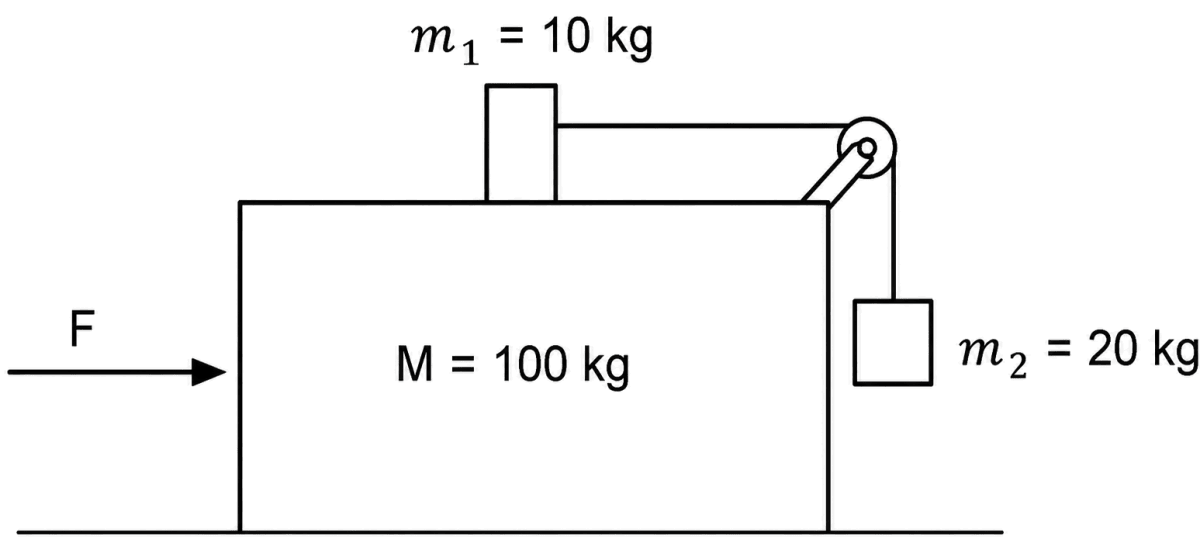
Three masses M = 100 kg, m1 = 10 kg and m2 = 20 kg are arranged in a system as shown in figure. All the surfaces are frictionless and strings are inextensible and weightless. The pulleys are also weightless and frictionless. A force F is applied on the system so that the mass m2 moves upward with an acceleration of 2 ms-2. The value of F is : (Take g = 10 ms-2)
- 3360 N
- 3380 N
- 3120 N
- 3240 N
Answer
3360 N
Reason — Let a be the acceleration of the block M in the horizontal direction, towards the right, and let T be the tension in the string.
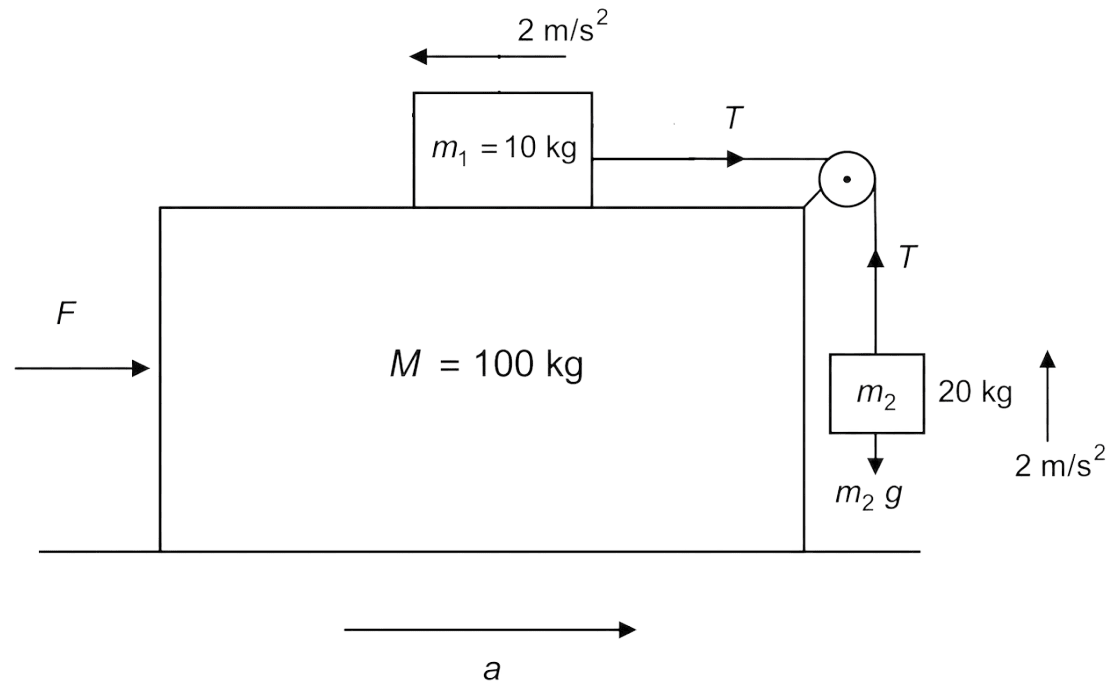
Constraint relation : The string is inextensible, so the sum of the lengths of its horizontal and vertical portions is constant. The mass m2 rises through 2 m s-2, so the vertical portion shortens at this rate and the horizontal portion lengthens at the same rate. Hence, m1 moves backward relative to M with an acceleration of 2 m s-2, and its acceleration with respect to the ground is
The mass m2 is pressed against the vertical face of M, so it shares the horizontal acceleration a of the block, while it also rises with an acceleration of 2 m s-2.
Vertical motion of m2 : The forces on it are the tension T upwards and its weight m2g downwards. By Newton's second law,
Substituting the values,
Horizontal motion of m1 : The upper surface of M is frictionless, so the only horizontal force on m1 is the tension T, which pulls it towards the pulley. By Newton's second law,
Substituting the values,
Motion of the whole system : The floor is frictionless and the tensions and the normal contact forces are all internal to the system. Hence, F is the only external force in the horizontal direction, and it must produce the horizontal accelerations of all the three masses,
Substituting the values,
A monkey of mass 50 kg climbs on a rope which can withstand the tension (T) of 350 N. If monkey initially climbs down with an acceleration of 4 m/s2 and then climbs up with an acceleration of 5 m/s2, choose the correct option : (g = 10 m/s2).
- T = 700 N while climbing upward
- T = 350 N while going downward
- Rope will break while climbing upward
- Rope will break while going downward
Answer
Rope will break while climbing upward
Reason — Given, m = 50 kg, g = 10 m s-2 and the rope can withstand a tension of 350 N.
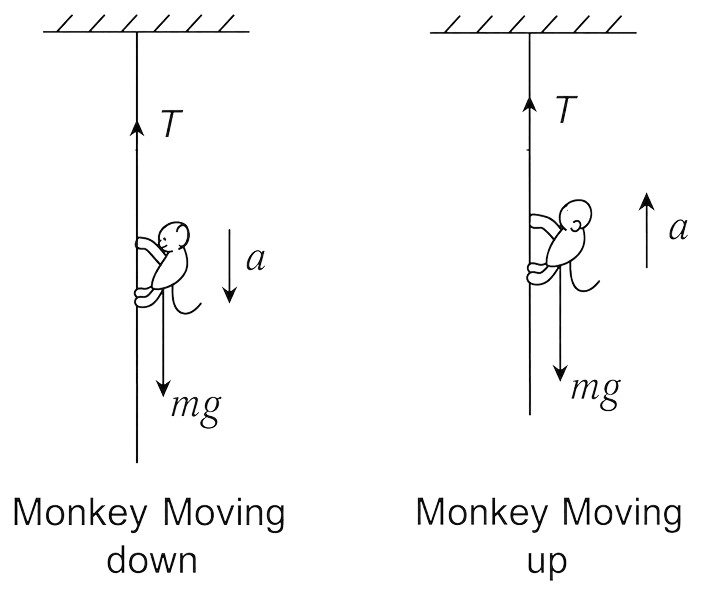
While climbing down with an acceleration of 4 m s-2 :
This is less than 350 N, so the rope does not break.
While climbing up with an acceleration of 5 m s-2 :
This exceeds 350 N, so the rope breaks while the monkey is climbing upward.
A shell of mass m is at rest initially. It explodes into three fragments having mass in the ratio 2 : 2 : 1. If the fragments having equal mass fly off along mutually perpendicular directions with speed v, the speed of the third (lighter) fragment is :
Answer
Reason — Let the masses of the three fragments be 2k, 2k and k, so that the total mass is m = 5k.
The two fragments of equal mass 2k fly off along mutually perpendicular directions with the same speed v, so each has a momentum 2kv, and these two momenta are perpendicular. The magnitude of their resultant is
The shell was initially at rest, so the total momentum must remain zero. Hence, the third fragment of mass k must carry an equal and opposite momentum,
A body of mass 1000 kg is moving horizontally with a velocity 6 ms-1. If 200 kg extra mass is added, the final velocity (in ms-1) is :
- 6
- 2
- 3
- 5
Answer
5
Reason — No external horizontal force acts on the system, so by the principle of conservation of linear momentum,
Substituting m1 = 1000 kg, v1 = 6 m s-1 and m2 = 200 kg,
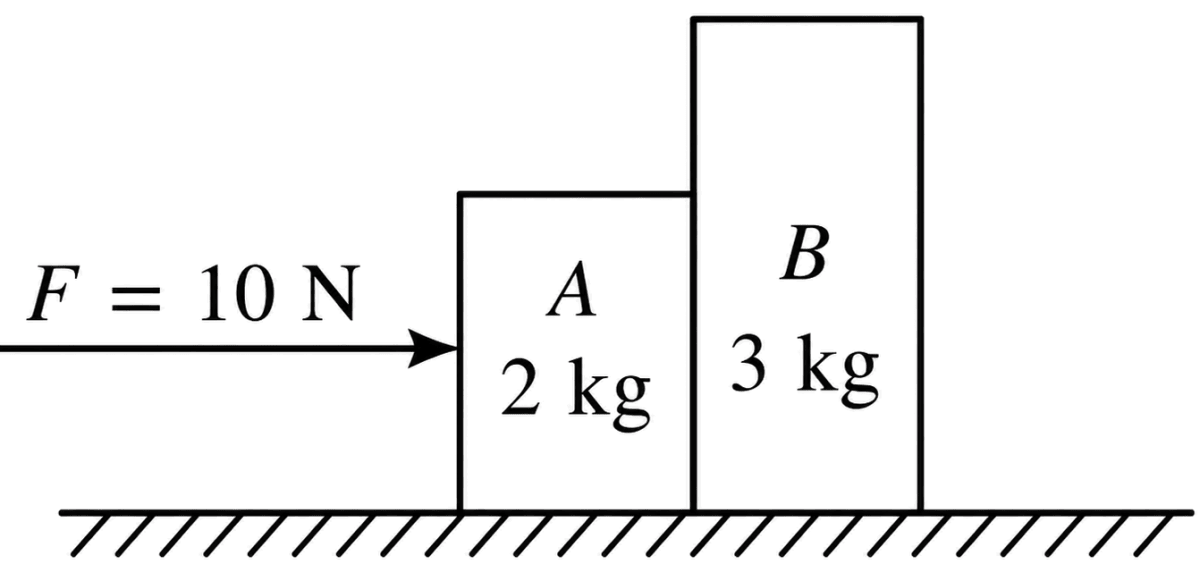
A horizontal force 10 N is applied to a block A as shown in the figure. The mass of blocks A and B are 2 kg and 3 kg respectively. The blocks slide over a frictionless surface. The force exerted by block A on block B is :
- zero
- 4 N
- 6 N
- 10 N
Answer
6 N
Reason — The two blocks slide together over the frictionless surface, so they have a common acceleration. By Newton's second law,
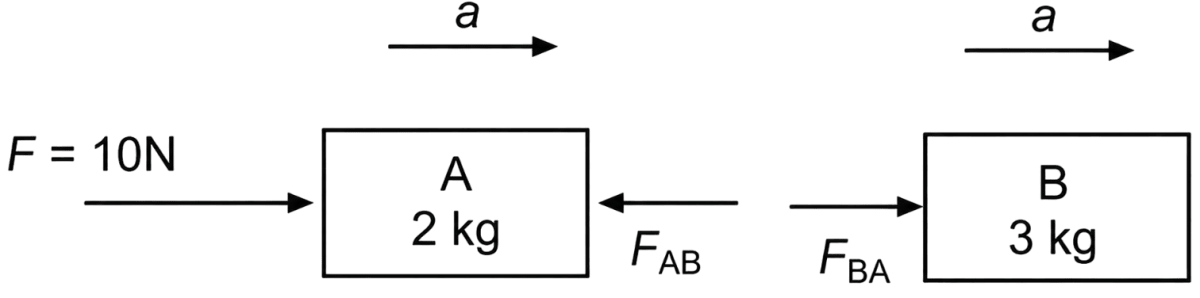
The block B is accelerated only by the contact force (FBA) exerted on it by the block A. Hence,
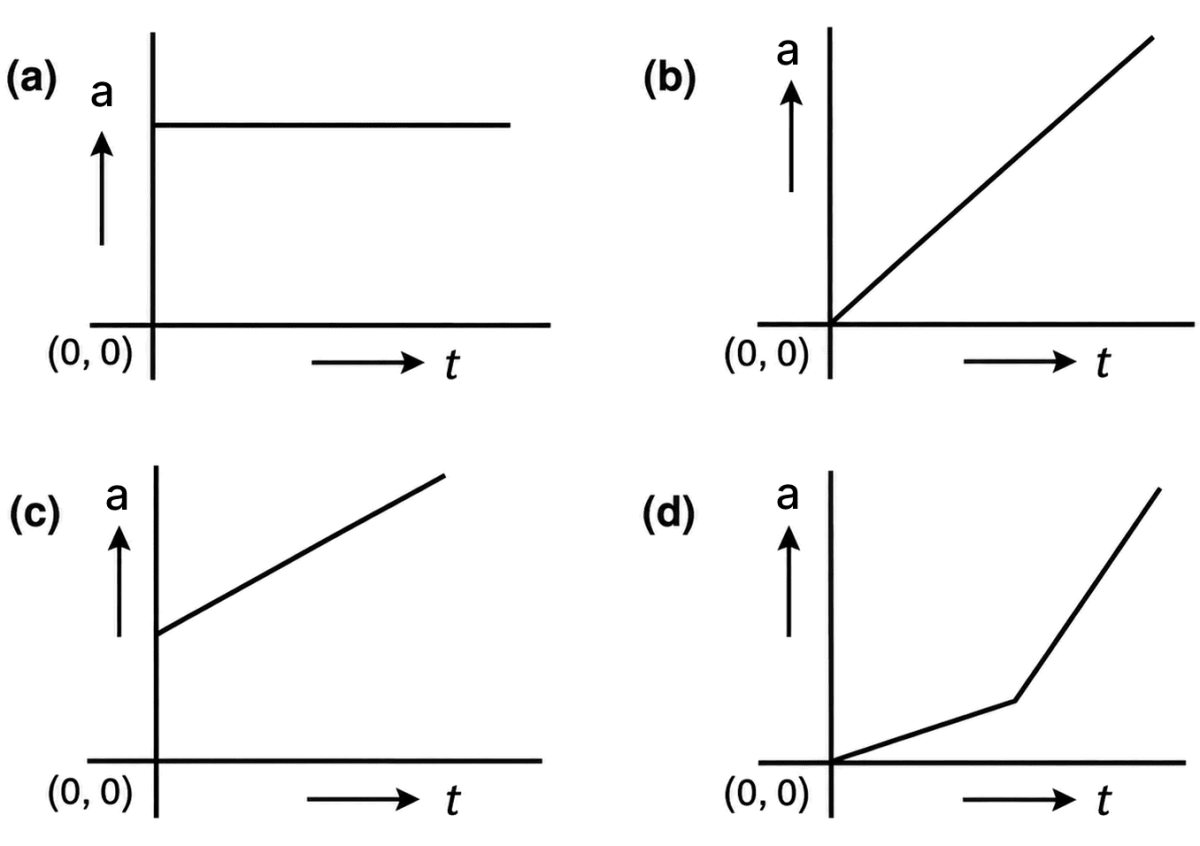
A wooden block initially at rest on the ground is pushed by a force which increases linearly with time t. Which of the following curve best describes acceleration of the block with time?
Answer
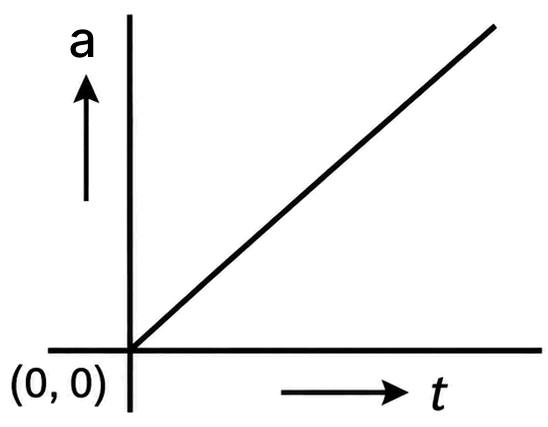
The curve in which the acceleration remains zero for an initial interval and thereafter increases linearly with time.
Reason — The block is initially at rest on the ground, so the force of static friction opposes the applied force. As the applied force F increases linearly with time, the static friction, being self-adjusting, increases with it and the block does not move. Hence, the acceleration remains zero during this period.
Once the applied force exceeds the limiting friction, the block begins to move. The friction then becomes the constant kinetic friction fk, and the acceleration is
Since F increases linearly with time, the acceleration also increases linearly with time thereafter.
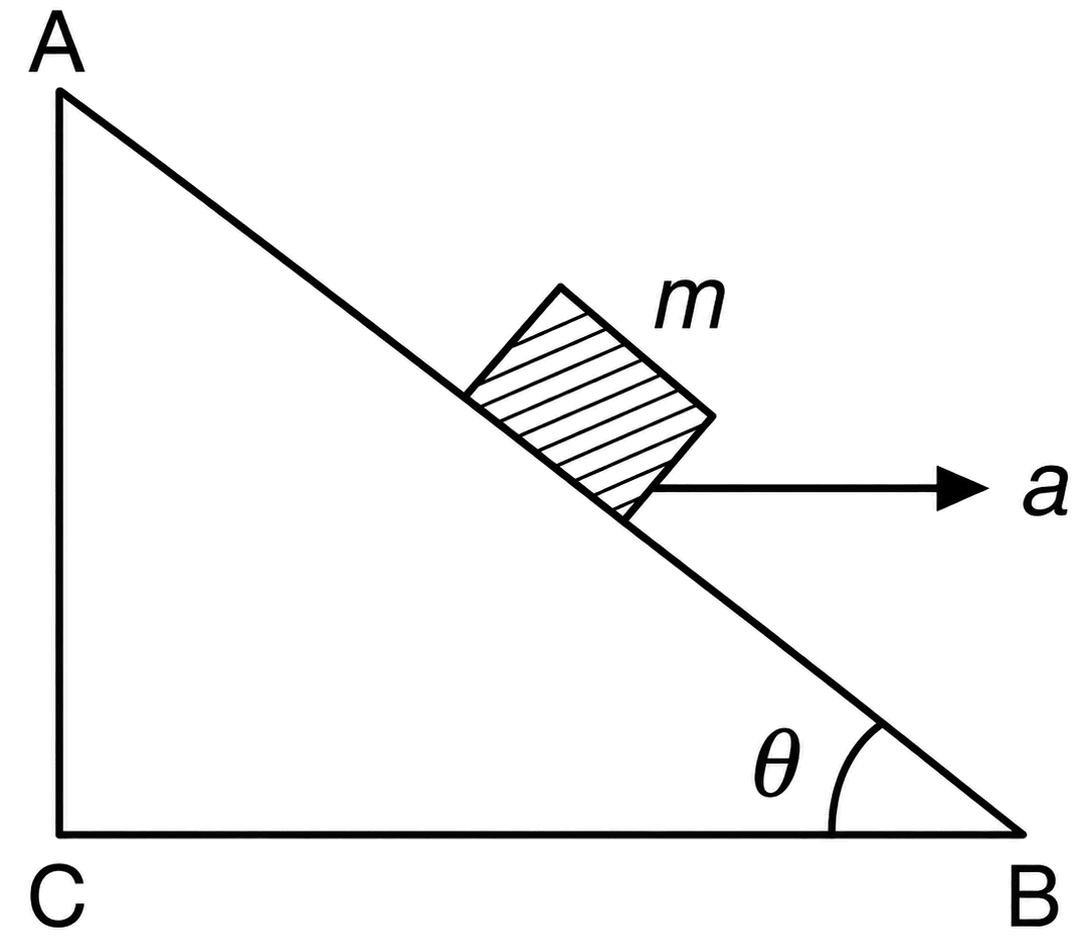
A block of mass m is placed on a smooth inclined wedge ABC of inclination θ as shown in the figure. The wedge is given an acceleration 'a' towards the right. The relation between a and θ for the block to remain stationary on the wedge is :
Answer
Reason — In the frame of the accelerating wedge, a pseudo force ma acts on the block in the direction opposite to the acceleration, that is, towards the left. The surface of the wedge is smooth, so for the block to remain stationary on the wedge the components along the inclined surface must balance,
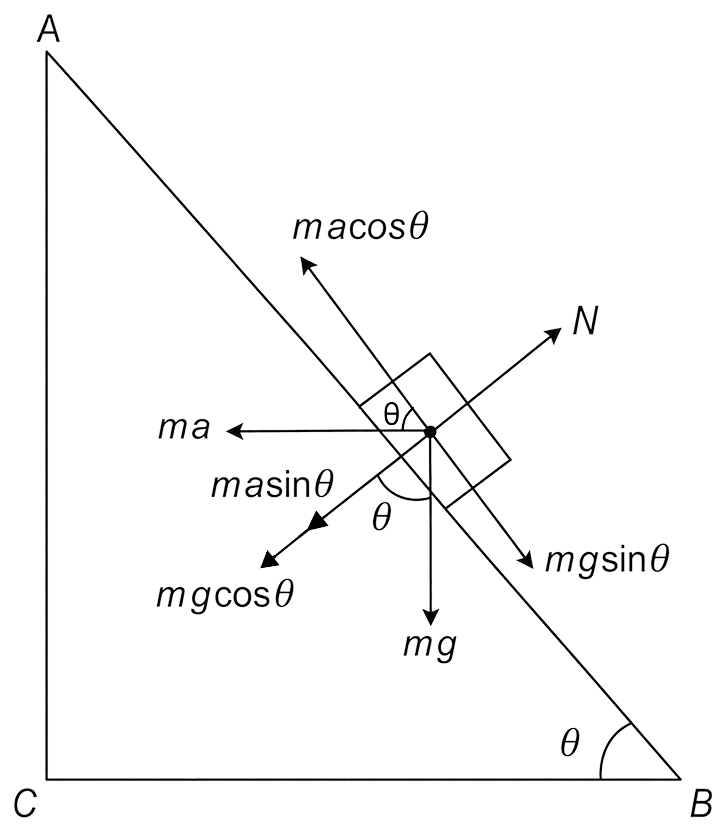
Dividing throughout by m cos θ,
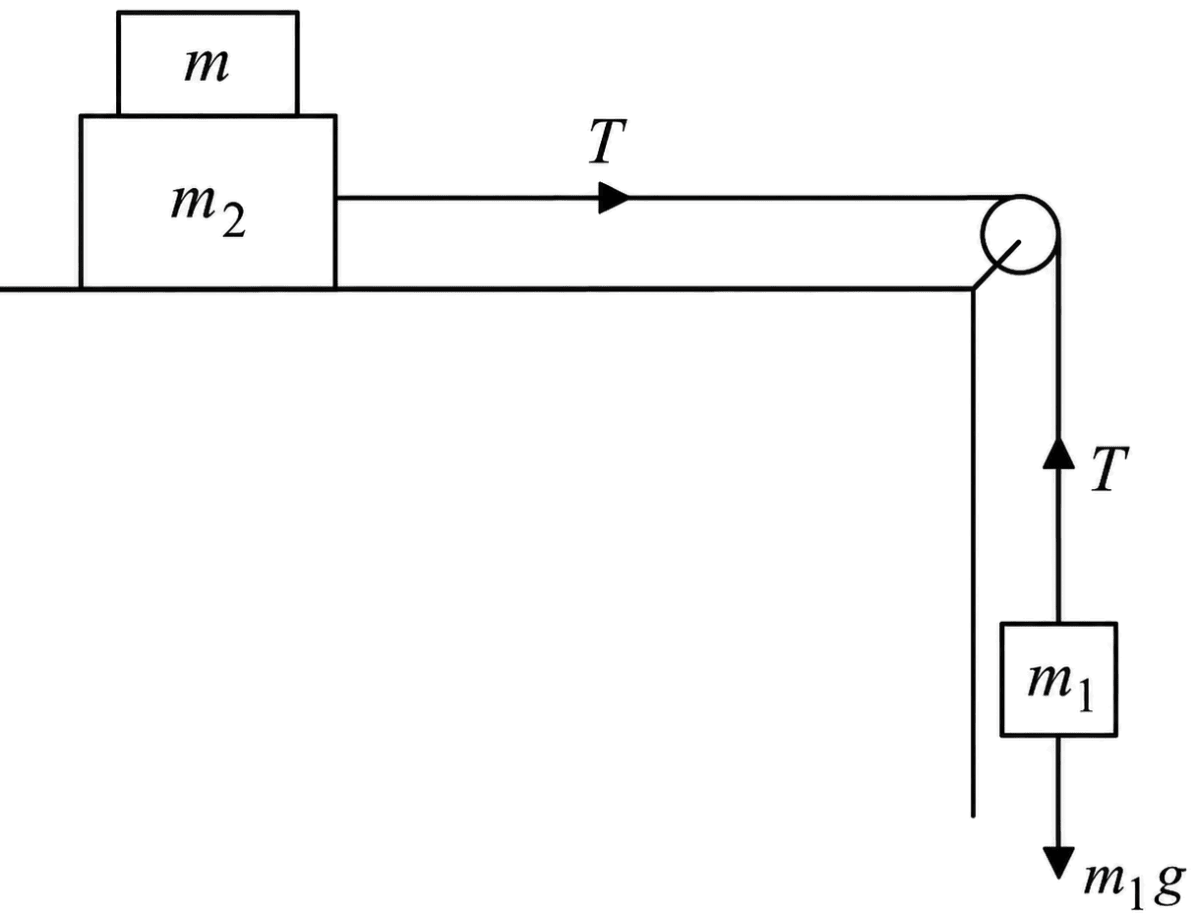
Two masses m1 = 5 kg and m2 = 10 kg connected by an inextensible string over a frictionless pulley are moving as shown in the figure. The coefficient of friction of horizontal surface is 0.15. The minimum weight m that should be put on top of m2 to stop the motion is :
- 43.3 kg
- 10.3 kg
- 18.3 kg
- 27.3 kg
Answer
27.3 kg
Reason — For the motion to stop, the pull of the hanging mass m1 must not exceed the limiting frictional force on the mass m2 together with the added mass m,
Substituting m1 = 5 kg, m2 = 10 kg and μ = 0.15,
Note: The above solution gives 23.3 kg, whereas the answer printed in the textbook (and in the original examination key) is 27.3 kg. The nearest given alternative has been marked as the answer.
Two blocks A and B of masses mA = 1 kg and mB = 3 kg are kept on the table as shown in figure. The coefficient of friction between A and B is 0.2 and between B and the surface of the table is also 0.2. The maximum force F that can be applied on B horizontally, so that the block A does not slide over the block B is : [Take g = 10 m/s2]
![Two blocks A and B of masses m A = 1 kg and m B = 3 kg are kept on the table as shown in figure. The coefficient of friction between A and B is 0.2 and between B and the surface of the table is also 0.2. The maximum force F that can be applied on B horizontally, so that the block A does not slide over the block B is: [Take g = 10 m/s 2 ]. Laws of Motion, Solutions for Class 11 ISC Nootan Physics Kumar Mittal Nageen Prakashan](https://cdn1.knowledgeboat.com/img/np11/q16-competition-zone-mcq-one-1-nootan-physics-icse-class-11-chapter-4-202609031319-1200x798.png)
- 12 N
- 16 N
- 8 N
- 40 N
Answer
16 N
Reason — The block A rests on the block B, and the force F is applied on B alone. The block A can therefore be set in motion only by the force of friction exerted on it by B. So long as A does not slide over B, the two blocks move together with a common acceleration a.
![Two blocks A and B of masses m A = 1 kg and m B = 3 kg are kept on the table as shown in figure. The coefficient of friction between A and B is 0.2 and between B and the surface of the table is also 0.2. The maximum force F that can be applied on B horizontally, so that the block A does not slide over the block B is: [Take g = 10 m/s 2 ]. Laws of Motion, Solutions for Class 11 ISC Nootan Physics Kumar Mittal Nageen Prakashan](https://cdn1.knowledgeboat.com/img/np11/q16-competition-zone-mcq-one-ans-1-nootan-physics-icse-class-11-chapter-4-202609031319-651x383.png)
Maximum acceleration of the block A : The normal reaction between A and B is
Hence, the limiting frictional force between A and B is
This friction is the only horizontal force acting on A. By Newton's second law, the acceleration it can produce in A is
If the acceleration exceeded this value, the friction available would be insufficient to carry A along, and A would slide over B.
Friction between B and the table : The table supports the weight of both the blocks, so the normal reaction of the table on B is
Hence, the frictional force exerted by the table is
For the two blocks taken together : The friction f1 between A and B is internal to this system, so the external horizontal forces are the applied force F and the friction f2 of the table. By Newton's second law,
Substituting the maximum permissible acceleration,
A block kept on a rough inclined plane, as shown in the figure, remains at rest upto a maximum force 2 N down the inclined plane. The maximum external force up to the inclined plane that does not move the block is 10 N. The coefficient of static friction between the block and the plane is : [Take g = 10 m/s2]
![A block kept on a rough inclined plane, as shown in the figure, remains at rest upto a maximum force 2 N down the inclined plane. The maximum external force up to the inclined plane that does not move the block is 10 N. The coefficient of static friction between the block and the plane is: [Take g = 10 m/s 2 ]. Laws of Motion, Solutions for Class 11 ISC Nootan Physics Kumar Mittal Nageen Prakashan](https://cdn1.knowledgeboat.com/img/np11/q17-competition-zone-mcq-one-1-nootan-physics-icse-class-11-chapter-4-202609031319-1200x671.png)
Answer
Reason — Let m be the mass of the block and θ = 30° the angle of inclination, so that the normal reaction is R = mg cos θ and the limiting friction is μR.
![A block kept on a rough inclined plane, as shown in the figure, remains at rest upto a maximum force 2 N down the inclined plane. The maximum external force up to the inclined plane that does not move the block is 10 N. The coefficient of static friction between the block and the plane is: [Take g = 10 m/s 2 ]. Laws of Motion, Solutions for Class 11 ISC Nootan Physics Kumar Mittal Nageen Prakashan](https://cdn1.knowledgeboat.com/img/np11/q17-competition-zone-mcq-one-ans-1-nootan-physics-icse-class-11-chapter-4-202609031319-575x1000.png)
When a force of 2 N is applied down the plane and the block is just about to slide down :
When a force of 10 N is applied up the plane and the block is just about to slide up :
Substituting μR from equation (1) into equation (2),
From equation (1),
Since R = mg cos θ,
A block of mass 10 kg is kept on a rough inclined plane as shown in the figure. A force of 3 N is applied on the block. The coefficient of static friction between the plane and the block is 0.6. What should be the minimum value of force F, such that the block does not move downward? [Take g = 10 m/s2]
![A block of mass 10 kg is kept on a rough inclined plane as shown in the figure. A force of 3 N is applied on the block. The coefficient of static friction between the plane and the block is 0.6. What should be the minimum value of force F, such that the block does not move downward? [Take g = 10 m/s 2 ]. Laws of Motion, Solutions for Class 11 ISC Nootan Physics Kumar Mittal Nageen Prakashan](https://cdn1.knowledgeboat.com/img/np11/q18-competition-zone-mcq-one-1-nootan-physics-icse-class-11-chapter-4-202609031319-1200x915.png)
- 32 N
- 25 N
- 23 N
- 18 N
Answer
32 N
Reason — Given, m = 10 kg, θ = 45°, μs = 0.6, g = 10 m s-2, and a force of 3 N acting down the incline.
![A block of mass 10 kg is kept on a rough inclined plane as shown in the figure. A force of 3 N is applied on the block. The coefficient of static friction between the plane and the block is 0.6. What should be the minimum value of force F, such that the block does not move downward? [Take g = 10 m/s 2 ]. Laws of Motion, Solutions for Class 11 ISC Nootan Physics Kumar Mittal Nageen Prakashan](https://cdn1.knowledgeboat.com/img/np11/q18-competition-zone-mcq-one-ans-1-nootan-physics-icse-class-11-chapter-4-202609031319-748x615.png)
The normal reaction is
The limiting frictional force, which acts up the plane when the block tends to slide down, is
The total force acting down the incline is
For the block not to move downward, the force F applied up the incline together with the limiting friction must balance this,
Hence, the minimum value of F is nearly 32 N.
One end of a string of length l is connected to a particle of mass m and the other end is connected to a small peg on a smooth horizontal table. If the particle moves in a circle with speed v and the tension in the string is T, then the net force on the particle (directed towards the centre of the circle) is :
Answer
Reason — The particle moves in a horizontal circle on a smooth table, so the weight of the particle and the normal reaction of the table balance each other and have no component towards the centre. The net force on the particle directed towards the centre is therefore the centripetal force, which is provided entirely by the tension in the string,
A particle is moving with a uniform speed in a circular orbit of radius R in which a central force is inversely proportional to the nth power of R. If the period of rotation of the particle is T, then :
- for any n
Answer
Reason — The central force is inversely proportional to the nth power of R, so
This force provides the necessary centripetal force,
The period of rotation is
Two particles A and B are moving in uniform circular motion in concentric circles of radii rA and rB with speeds vA and vB respectively. Their time period of rotation is the same. The ratio of angular speed of A to that of B will be :
- vA : vB
- rB : rA
- 1 : 1
- rA : rB
Answer
1 : 1
Reason — The angular speed is related to the time period by
Since the time periods of rotation of A and B are the same, TA = TB. Therefore,
Hence, the ratio of the angular speeds is 1 : 1, whatever the radii or the linear speeds may be.
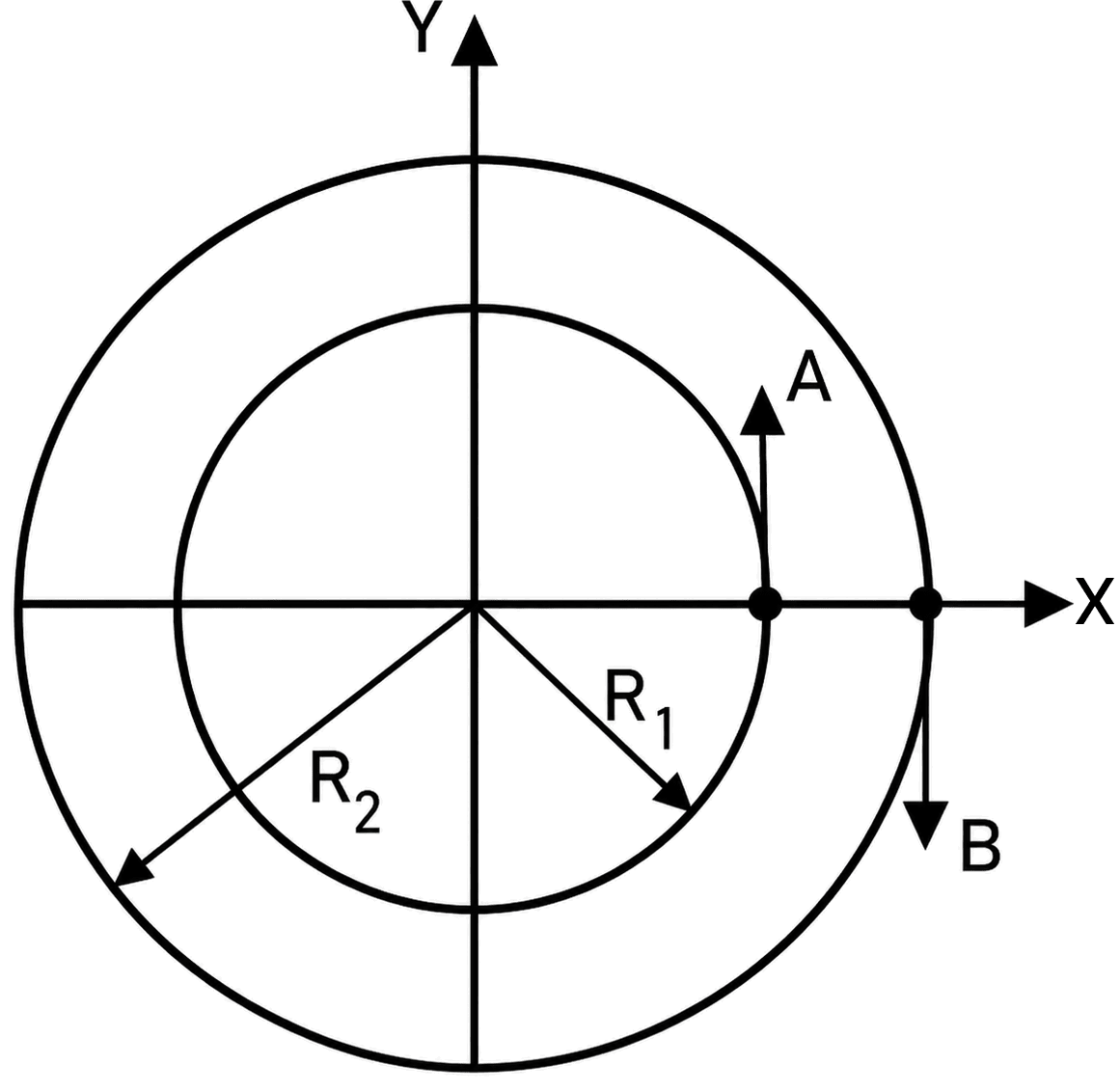
Two particles A and B are moving on two concentric circles of radii R1 and R2 with equal angular speed ω. At t = 0, their positions and direction of motion are shown in the figure. The relative velocity at is given by :
Answer
Reason —
Given,
- Radii of the two concentric circles, R1 (inner) and R2 (outer)
- Both particles have the same angular speed ω
- Time at which the relative velocity is required,
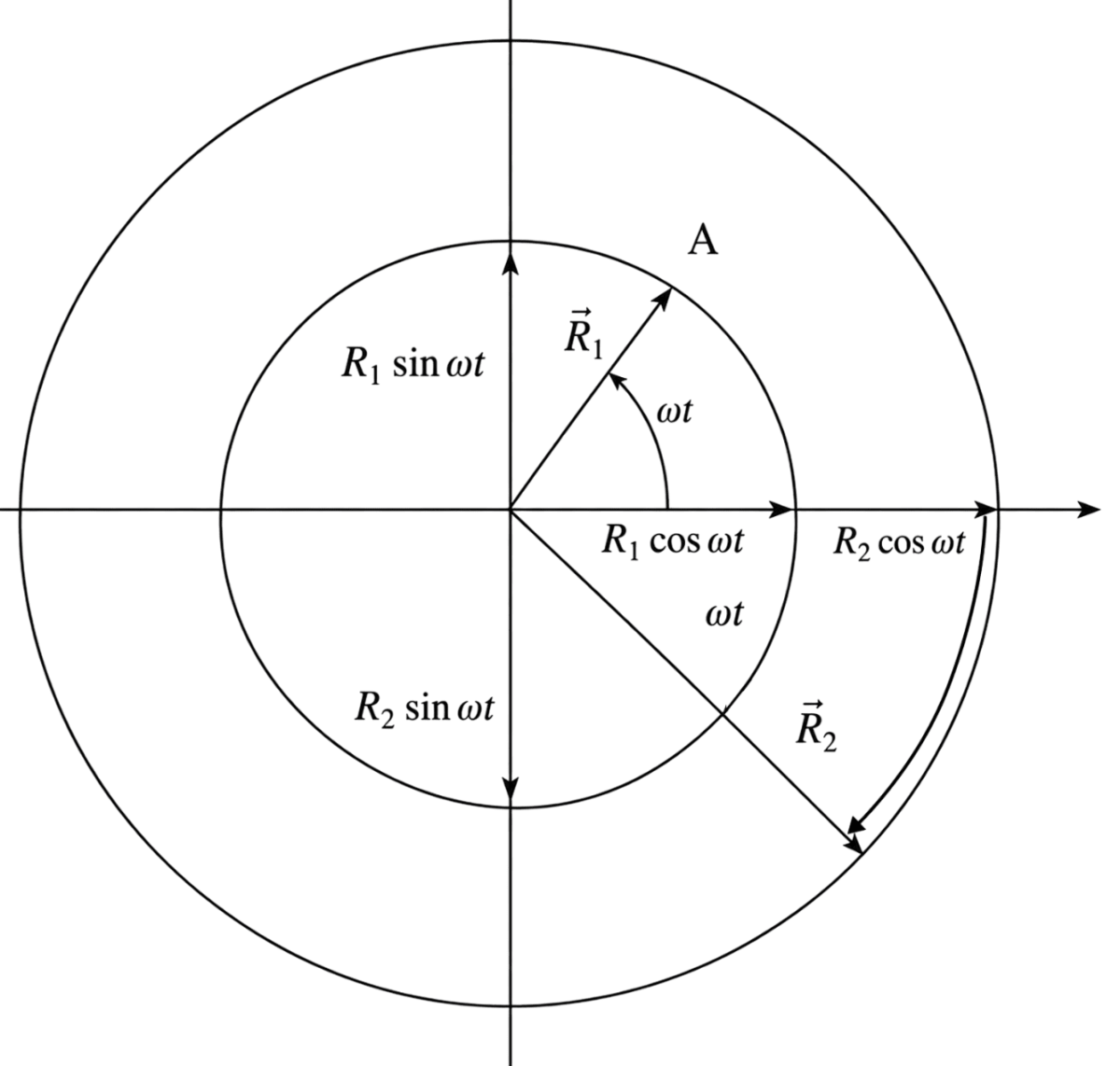
From the figure, at t = 0 the particle A is on the inner circle at (R1, 0) moving along the positive Y-direction, so it moves anticlockwise; and the particle B is on the outer circle at (R2, 0) moving along the negative Y-direction, so it moves clockwise.
Writing the position vectors at time t, the angle turned through in time t being ωt,
The negative sign in the second relation appears because B turns clockwise.
Differentiating each position vector with respect to time, and using the chain rule with ,
At that is ωt = 90°, we have sin ωt = 1 and cos ωt = 0. Therefore,
Hence the relative velocity is
A train is moving with a speed of 12 ms-1 on rails which are 1.5 m apart. To negotiate a curve of radius 400 m, the height by which the outer rail should be raised with respect to the inner rail is : (given g = 10 ms-2)
- 6.0 cm
- 5.4 cm
- 4.8 cm
- 4.2 cm
Answer
5.4 cm
Reason — For the train to negotiate the curve, the track is banked so that
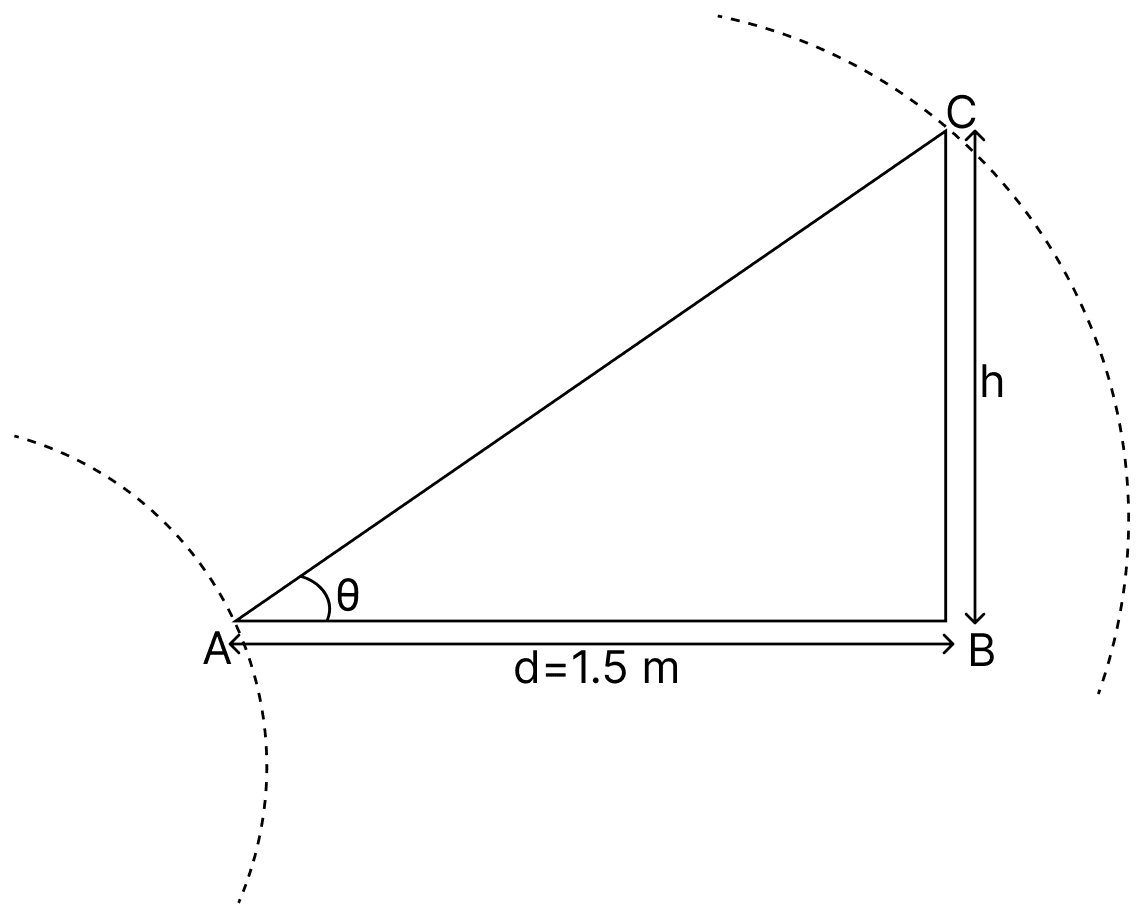
Hence,
Substituting d = 1.5 m, v = 12 m s-1, r = 400 m and g = 10 m s-2,
There are two inclined surfaces of equal length (L) and same angle of inclination 45° with the horizontal. One of them is rough and the other is perfectly smooth. A given body takes 2 times as much time to slide down on rough surface than on the smooth surface. The coefficient of kinetic friction (μk) between the object and the rough surface is close to :
- 0.25
- 0.40
- 0.5
- 0.75
Answer
0.75
Reason — Let m be the mass of the body and θ = 45° the angle of inclination of each surface. The body starts from rest and slides down the whole length L in both the cases.
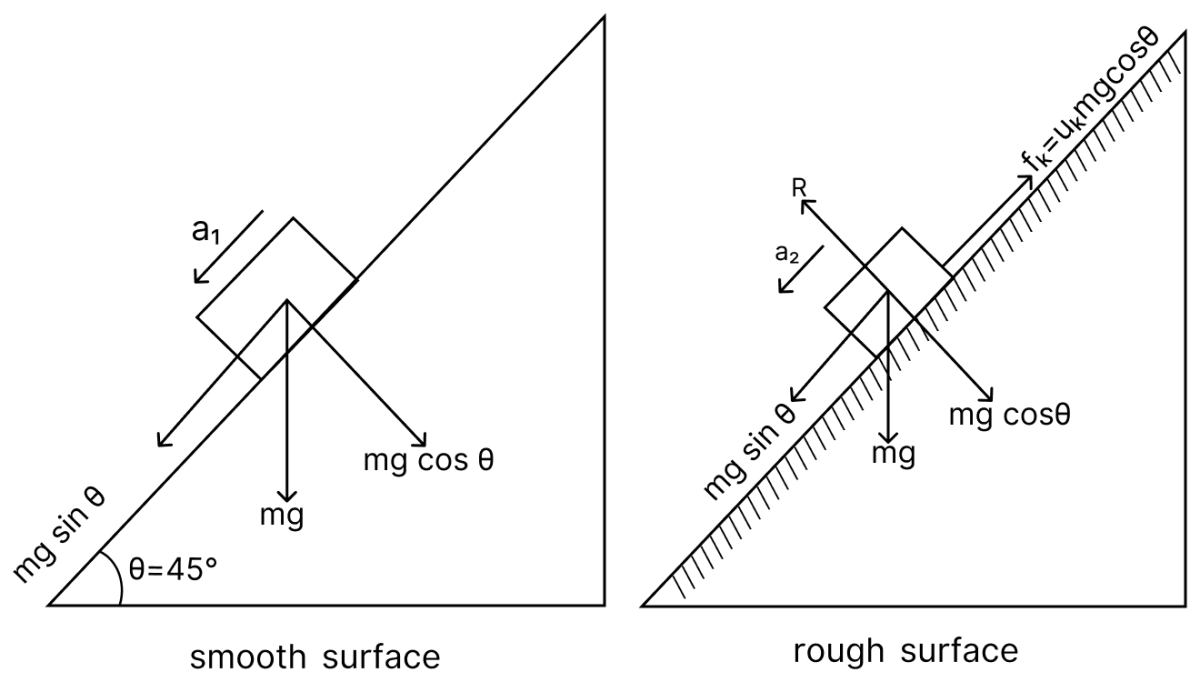
Acceleration on the smooth surface : The surface is perfectly smooth, so no frictional force acts on the body. Resolving the weight of the body into components along and perpendicular to the inclined surface, the component along the surface is mg sin θ. By Newton's second law,
Acceleration on the rough surface : The normal reaction is R = mg cos θ, so the kinetic frictional force μkmg cos θ acts up the plane, opposing the motion. By Newton's second law,
Since θ = 45°, sin θ = cos θ, and so
Relation between the times taken : The body starts from rest, so u = 0, and it covers the same length L in each case. Using ,
Since L is the same for both the surfaces,
It is given that the time taken on the rough surface is twice that on the smooth surface, that is, t2 = 2t1. Therefore,
Squaring both sides,
Substituting the values of a1 and a2 from equations (1) and (2) in equation (3),
Cancelling g sin θ from the numerator and the denominator,
A ball of mass 0.5 kg is dropped from a height of 40 m. The ball hits the ground and rises to a height of 10 m. The impulse imparted to the ball during its collision with the ground is (Take g = 9.8 m/s2) :
- 21 Ns
- 7 Ns
- 0
- 84 Ns
Answer
21 Ns
Reason — The speed with which the ball strikes the ground, after falling from a height of 40 m, is
The speed with which it leaves the ground, so as to rise to a height of 10 m, is
Taking the upward direction as positive, the impulse imparted to the ball is the change in its momentum,
A uniform rod of mass 20 kg and length 5 m leans against a smooth vertical wall making an angle of 60° with it. The other end rests on a rough horizontal floor. The friction force that the floor exerts on the rod is (Take g = 10 m/s2) :
- 100 N
- N
- 200 N
- N
Answer
N
Reason — The rod makes 60° with the wall, so it makes 30° with the horizontal floor. The wall is smooth, so the reaction N1 of the wall is horizontal, while the floor exerts a normal reaction N2 and a frictional force f.
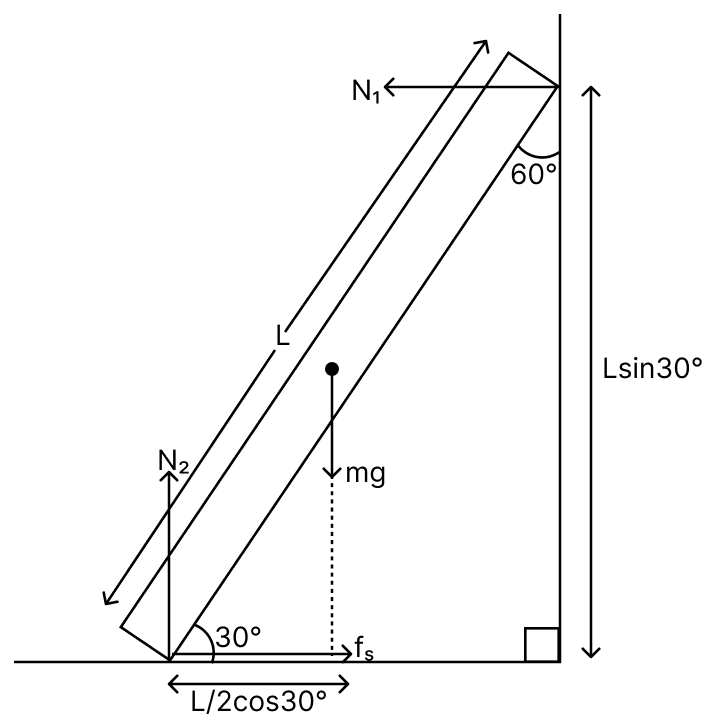
Vertical equilibrium :
Horizontal equilibrium :
Taking moments about the lower end : The weight W acts at the mid-point of the rod, so
Cancelling L and substituting the values,
Hence, the friction force exerted by the floor is
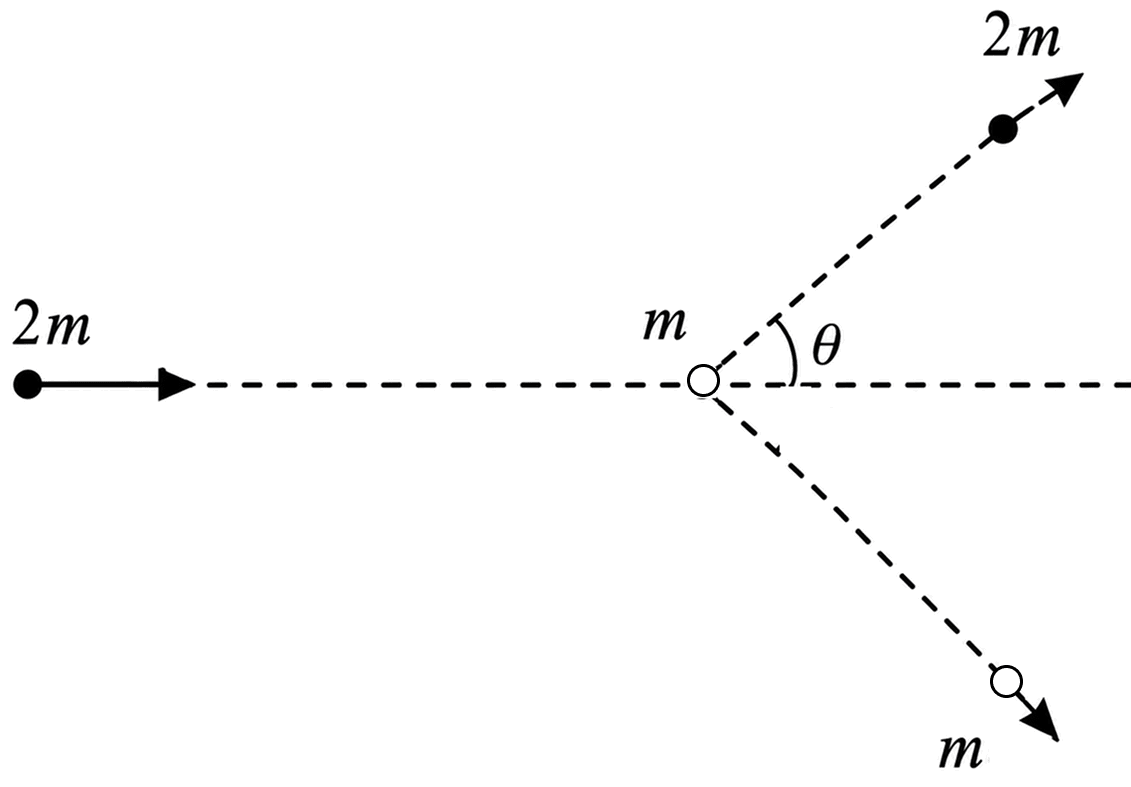
In a scattering experiment, a particle of mass 2m collides with another particle of mass m, which is initially at rest. Assuming the collision to be perfectly elastic, the maximum angular deviation θ of the heavier particle, as shown in the figure, in radians is :
Answer
Reason —
In an elastic collision between a heavier particle of mass m1 and a lighter particle of mass m2 which is initially at rest, the heavier particle cannot be deviated through more than a certain maximum angle, given by
Here the heavier particle has mass 2m and the lighter one has mass m, so
A solid horizontal surface is covered with a thin layer of oil. A rectangular block of mass m = 0.4 kg is at rest on this surface. An impulse of 1.0 N s is applied to the block at time t = 0 so that it starts moving along the x-axis with a velocity v(t) = v0e-t/τ, where v0 is a constant and τ = 4s. The displacement of the block, in metres, at t = τ is ...... . Take e-1 = 0.37. Enter the correct numerical value up to second decimal place.
Answer
Given,
- Mass of the block, m = 0.4 kg
- Impulse applied at t = 0, J = 1.0 N s
- Velocity, v(t) = v0e-t/τ, with τ = 4 s
- e-1 = 0.37
The displacement of the block at t = τ has to be calculated.
By the impulse-momentum theorem, the impulse gives the block its initial velocity v0,
Substituting the values,
The displacement is obtained by integrating the velocity with respect to time from t = 0 to t = τ,
Taking the constant v0 outside the integral,
Integrating,
Applying the limits,
Substituting the values,
Hence, the displacement of the block at t = τ is 6.30 m.
A particle of mass 1 kg is subjected to a force which depends on the position as kg ms-2 with k = 1 kg s-2. At time t = 0, the particle's position m and its velocity ms-1. Let vx and vy denote the x and the y components of the particle's velocity, respectively. Ignore gravity. When z = 0.5 m, the value of (xvy − yvx) is ...... m2s-1.
Answer
Given,
- Mass of the particle, m = 1 kg
- Force, with k = 1 kg s-2
- At t = 0, m and m s-1
- Gravity is ignored
The value of (xvy − yvx) when z = 0.5 m has to be calculated.
Motion along the z-direction : The force has no z-component, so by Newton's second law the acceleration along z is zero and vz remains constant at m s-1. Hence,
When z = 0.5 m,
Motion in the x-y plane :
From the definition of angular momentum:
Write
and
Therefore,
On expanding,
Hence, the -component of angular momentum is
The rate of change of angular momentum is equal to torque:
Here,
Therefore,
Substituting and , we get
Thus,
and consequently,
Therefore, the required quantity has the same value at every instant, and it may be evaluated at t = 0.
Substituting the initial values,
Hence, the value of (xvy − yvx) is 3 m2 s-1.
A projectile of mass 200 g is launched in a viscous medium at an angle 60° with the horizontal, with an initial velocity of 270 m/s. It experiences a viscous drag force where the drag coefficient C = 0.1 kg/s and is the instantaneous velocity of the projectile. The projectile hits a vertical wall after 2 s. Taking e = 2.7, the horizontal distance of the wall from the point of projection (in m) is ......... .
Answer
Given,
- Mass of the projectile, m = 200 g = 0.2 kg
- Initial velocity, u = 270 m s-1 at 60° with the horizontal
- Drag coefficient, C = 0.1 kg s-1
- Time of flight up to the wall, t = 2 s
- e = 2.7
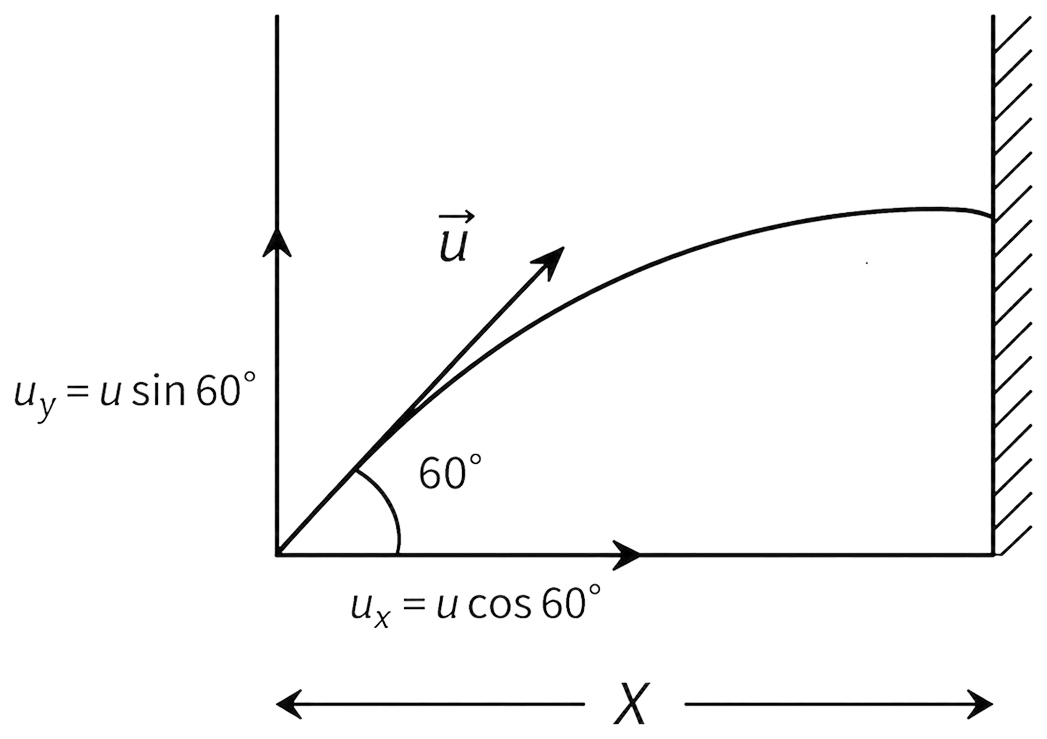
The horizontal distance of the wall from the point of projection has to be calculated.
The horizontal component of the velocity of projection is
Along the horizontal direction the only force acting is the viscous drag, which opposes the motion. Applying Newton's second law,
Separating the variables,
Integrating from v = ux at t = 0 to v = vx at time t,
Taking the antilogarithm,
Here s-1, so vx = ux e-0.5t. The horizontal distance covered in time t is obtained by integrating the velocity,
Substituting ux = 135 m s-1 and t = 2 s,
Hence, the horizontal distance of the wall from the point of projection is 170 m.