
A 10 kg boy standing in a 40 kg boat floating on water is 20 m from the shore of the river. If he moves 8 m on the boat towards the shore, then how far is he now from the shore? Assume no friction between boat and water.
Answer
Given,
- Mass of the boy, m1 = 10 kg
- Mass of the boat, m2 = 40 kg
- Initial distance of the boy from the shore = 20 m
- Distance moved by the boy on the boat = 8 m
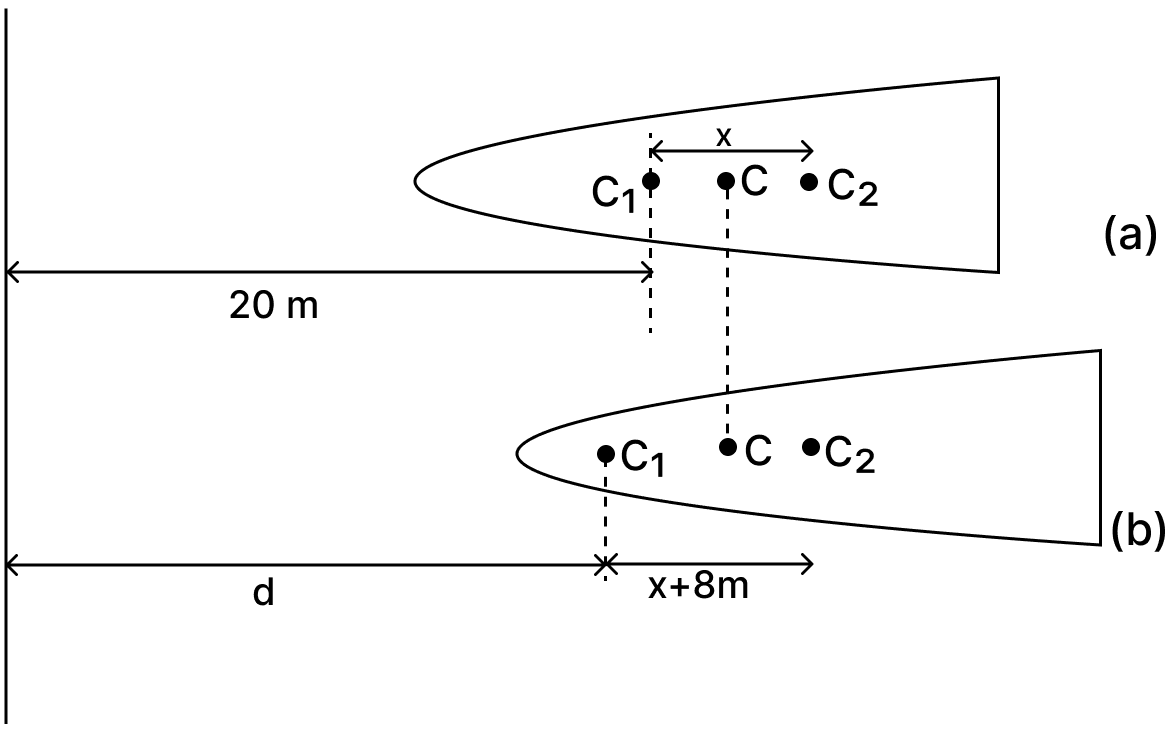
Let C1 be the centre of mass of the boy and C2 that of the boat, separated by a distance x. Initially the boy is 20 m from the shore, so the boat's centre is at (20 + x) m.
The centre of mass of the system (boy + boat) is initially
When the boy moves 8 m towards the shore, let his new distance from the shore be d. The separation between C1 and C2 becomes (x + 8), so the boat's centre is now at (d + x + 8).
There is no friction between the boat and the water, so no external force acts on the system. Hence the centre of mass of the system remains at rest, that is,
Hence, the boy is now 13.6 m from the shore.
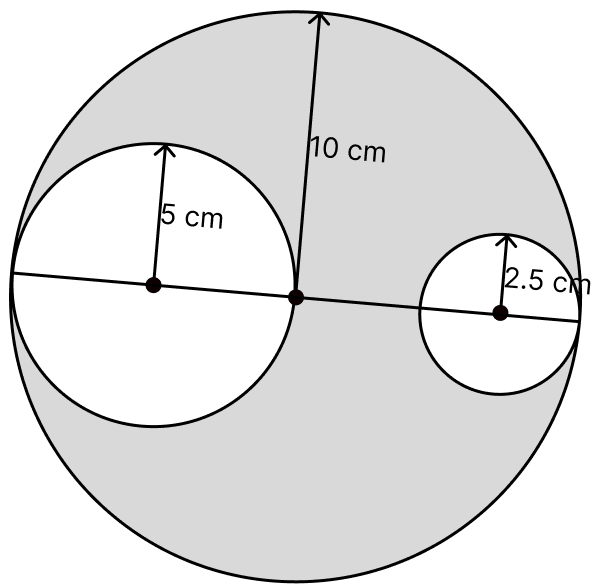
In a circular disc of uniform metal sheet of radius 10 cm two circular holes of radii 5 cm and 2.5 cm are as shown in figure. Find the C.G. (C.M.) of the punched discs.
Answer
Given,
- Radius of the original disc = 10 cm
- Radii of the two punched holes = 5 cm and 2.5 cm
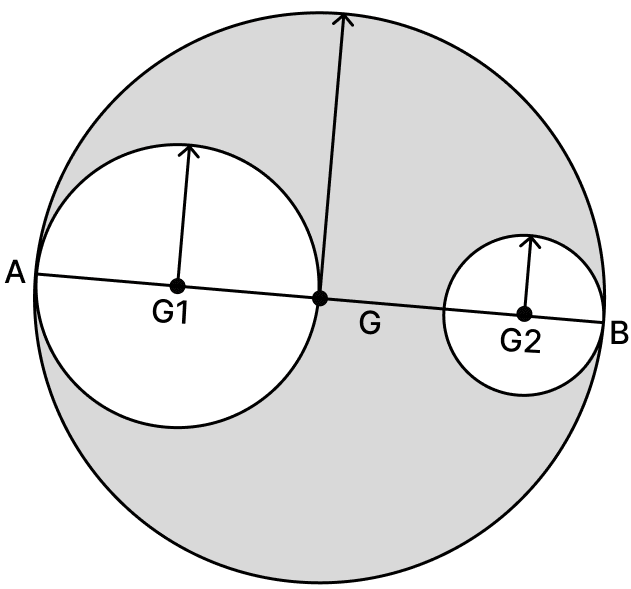
Let AB be the diameter along which the centres of all three circular portions lie, and let A be taken as the reference point.
Since the metal sheet is uniform, the weights are proportional to the areas, and so the areas may be used in place of the masses.
- Area of the original disc = π(10)2 = 100π cm2
- Area of the punched portion of radius 5 cm = π(5)2 = 25π cm2
- Area of the punched portion of radius 2.5 cm = π(2.5)2 = 6.25π cm2
Their distances from A are :
- Centroid G of the original disc = 10 cm
- Centroid G1 of the hole of radius 5 cm = 5 cm
- Centroid G2 of the hole of radius 2.5 cm = 20 − 2.5 = 17.5 cm
The punched portions are treated as negative areas. If x is the distance of the centre of gravity of the remaining portion from A, then
Hence, the centre of gravity of the punched disc lies on the diameter AB at a distance of 11.14 cm from A, that is, 1.14 cm away from the larger hole.
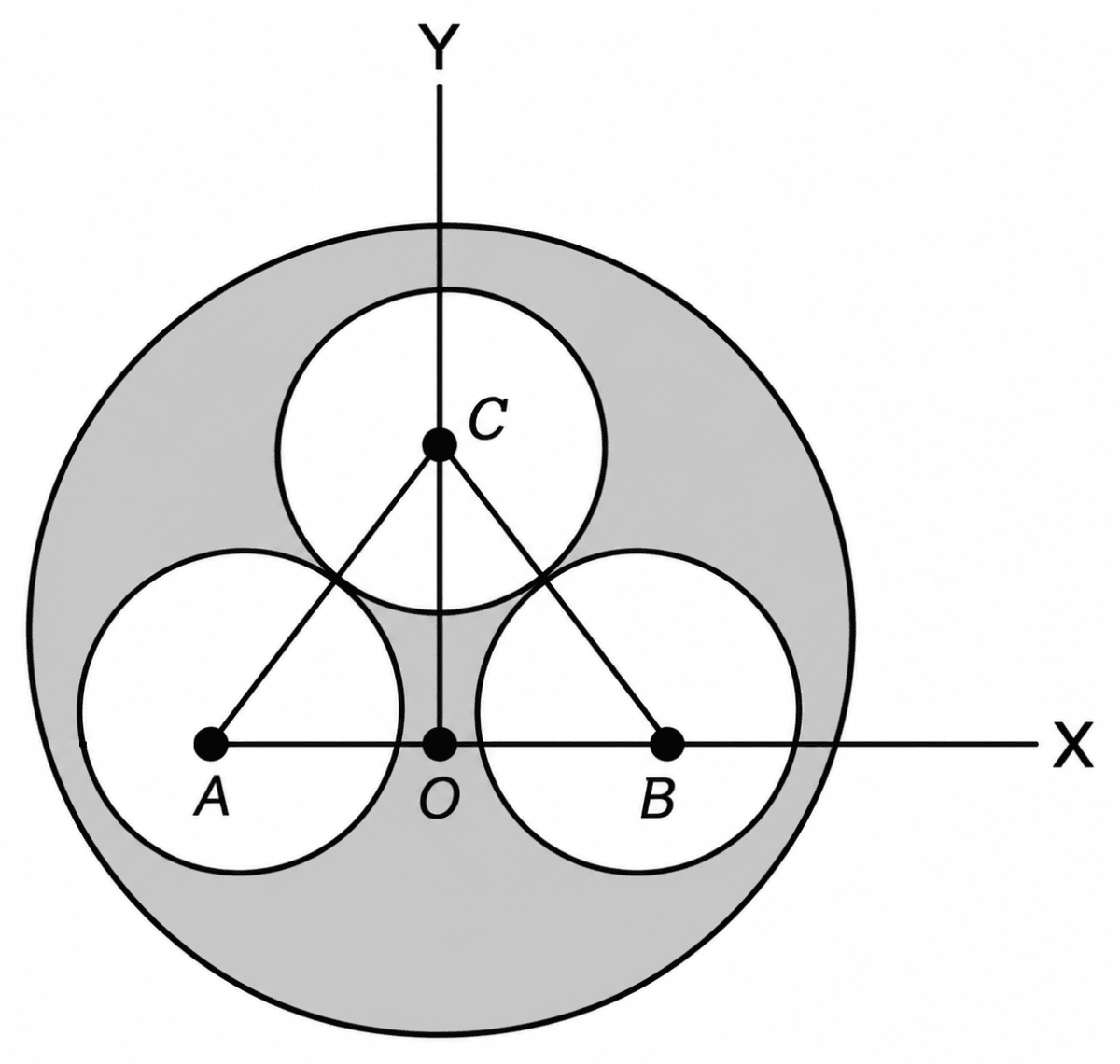
From a circle of radius 15 cm, three circles each of radius 5 cm are cut as shown in figure. Find the C.G. (c.m.) of the remaining portion. (Given, AB = 12 cm).
Answer
Given,
- Radius of the original circle = 15 cm
- Radius of each of the three cut circles = 5 cm
- AB = 12 cm
Let O be the centre of the original circle, taken as the origin, with AB along the X-axis and the third circle centred at C on the Y-axis. Since O is the mid-point of AB,
From the figure the circle at C touches those at A and B, so AC = BC = 5 + 5 = 10 cm. If C = (0, c), then
The sheet is uniform, so areas may be used in place of masses.
- Area of the original circle = π(15)2 = 225π cm2
- Area of each cut circle = π(5)2 = 25π cm2
- Area of the remaining portion = 225π − 3(25π) = 150π cm2
The three cut portions are treated as negative areas.
x-coordinate : The arrangement is symmetrical about the Y-axis, hence
y-coordinate : The centres A and B lie on the X-axis (y = 0) and C is at y = 8 cm,
Hence, the centre of gravity of the remaining portion lies on the Y-axis at a distance of 1.33 cm from O, on the side opposite to the circle cut at C.
Note: The height of C is not stated in the question and has been obtained from the figure by taking the circle at C to touch those at A and B. If the figure shows a different position for C, the value of ycm changes accordingly.
A particle of mass m is projected with a speed 'u' at an angle θ to the horizontal at time t = 0. Find the angular momentum about the point of projection O at time t, vectorially. Assume the horizontal and vertical lines through O as the X and Y axis respectively.
Answer
Given,
- Mass of the particle = m
- Speed of projection = u
- Angle of projection with the horizontal = θ
- Time = t
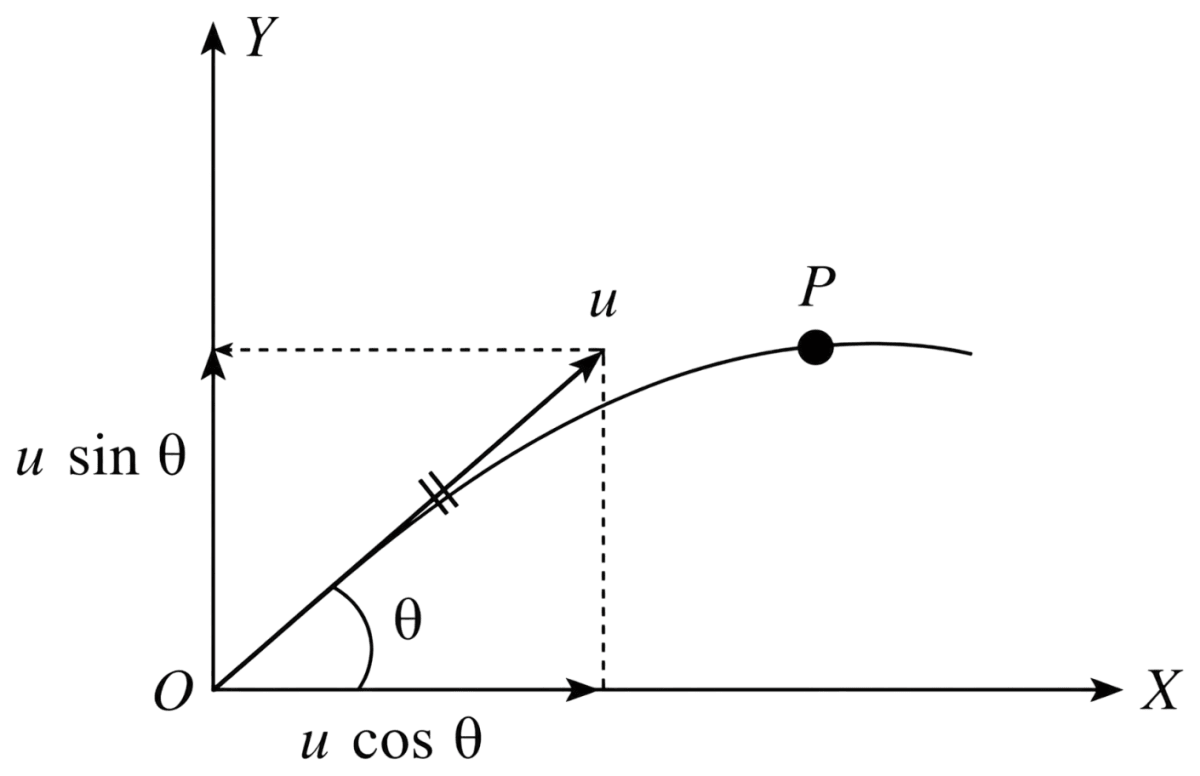
Taking the point of projection O as the origin, with the horizontal as the X-axis and the vertical as the Y-axis, the coordinates of the particle at time t are
The components of velocity at time t are
The angular momentum of the particle about O is the moment of its linear momentum,
Since the motion is confined to the X-Y plane, the angular momentum has only a z-component,
Substituting the values,
Expanding the two products,
The first and the third terms cancel, leaving
Hence, the angular momentum of the particle about the point of projection at time t is , of magnitude and directed perpendicular to the plane of motion, into the plane.
Four spheres of radius R and mass M each are placed at the four corners of a skelton square of side L. Calculate the M.I. of the system about an axis passing through any one of the sides.
Answer
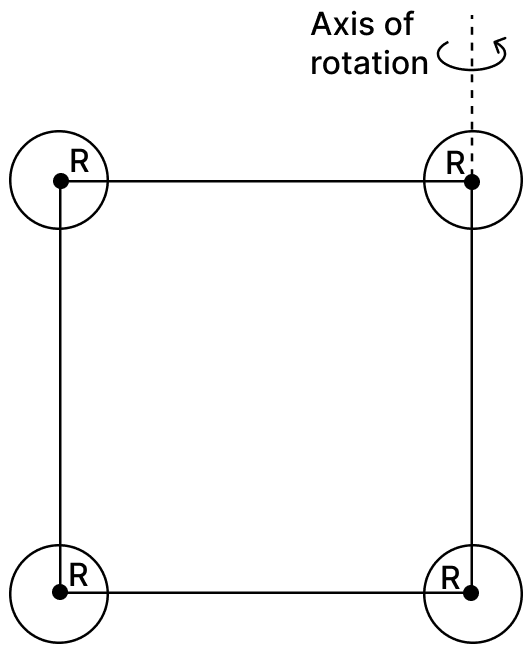
Given,
- Radius of each sphere = R
- Mass of each sphere = M
- Side of the square = L
The axis of rotation passes along one of the sides of the square. Hence two spheres lie on the axis itself and the other two are at a perpendicular distance L from it.
The moment of inertia of a solid sphere about an axis through its centre is .
For each of the two spheres lying on the axis : the axis passes through their centres, so
For each of the two spheres at a distance L : by the theorem of parallel axes,
The total moment of inertia of the system is the sum of the moments of inertia of the four spheres,
Hence, the moment of inertia of the system about an axis passing through any one of the sides is .
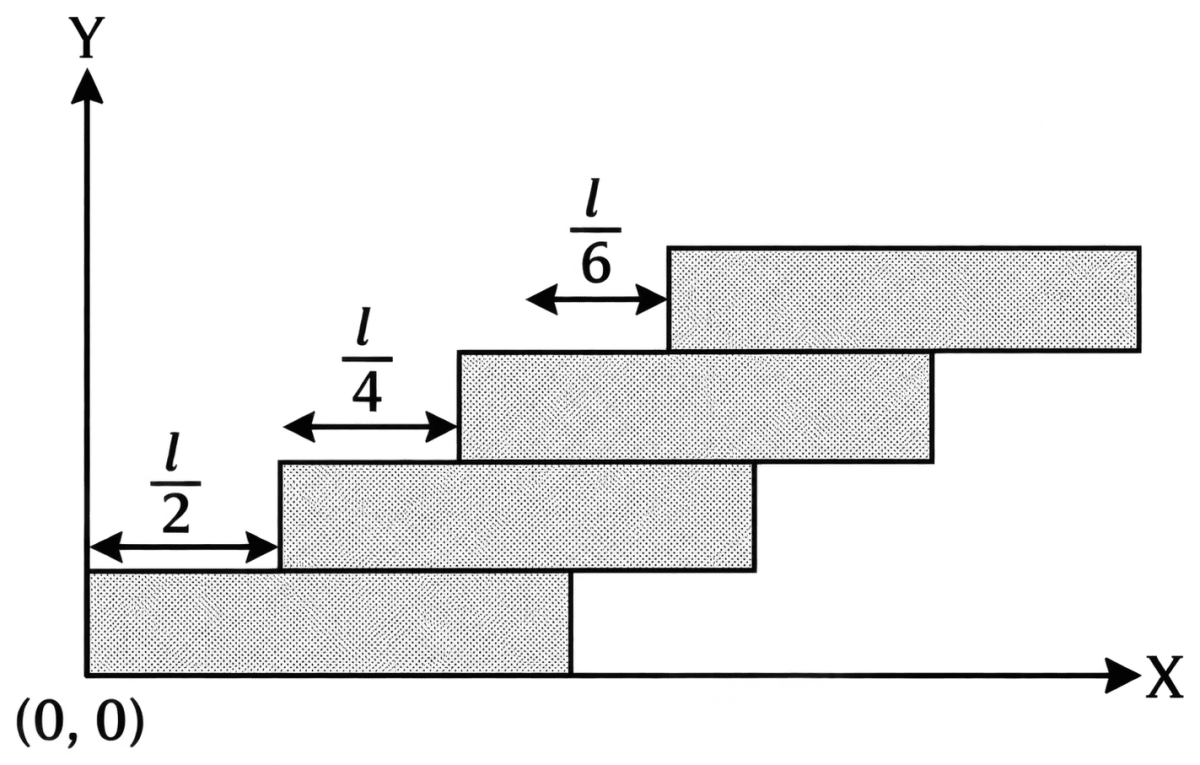
Find the x-coordinates of centre of mass of the identical bricks shown in the figure.
Answer
Let each brick be of length L and mass m, and let the left edge of the lowest brick be at the origin. From the figure, each brick is displaced towards the right relative to the one below it by L/2, L/4 and L/6 respectively.
The positions of the left edges of the four bricks are therefore
Since the bricks are identical and uniform, the centre of mass of each lies at its own mid-point, that is, at a distance L/2 from its left edge. Hence the x-coordinates of the centres of mass of the four bricks are
All four bricks are identical, so the centre of mass of the system is the simple average of these coordinates,
Taking the L.C.M. as 12,
Hence, the x-coordinate of the centre of mass of the identical bricks is from the left edge of the lowest brick.
A uniform bar of length 6a and mass 8m lies on a smooth horizontal table (where a = 1 m and m = 1 kg). Two point masses of m and 2m moving in the same horizontal plane with the speeds 2v and v respectively (where v = 1 ms-1), strike the bar at distances 2a and a from its centre respectively and stick to the bar after collision.
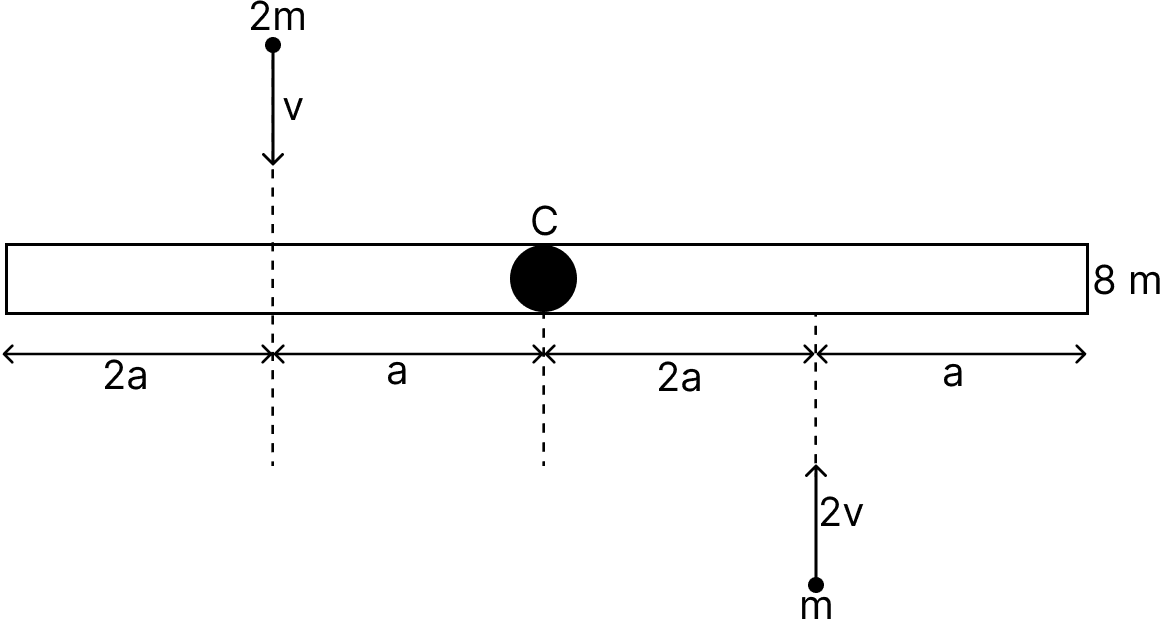
Find :
(i) The point about which the rotation will take place.
(ii) The velocity of centre of mass after collision.
(iii) Angular velocity of rotation.
(iv) Total kinetic energy of the system.
Answer
Given,
- Length of the bar = 6a, where a = 1 m
- Mass of the bar = 8m, where m = 1 kg
- Point mass 2m strikes at a distance a from the centre with speed v
- Point mass m strikes at a distance 2a from the centre with speed 2v, in the opposite direction
- v = 1 m s-1
- The table is smooth and both point masses stick to the bar after collision
Take the centre C of the bar as the origin, with the bar along the X-axis. The mass 2m strikes at x = − a and the mass m at x = + 2a, their velocities being perpendicular to the bar and oppositely directed.
The table is smooth, so no external force and no external torque acts on the system in the horizontal plane. Hence both the linear momentum and the angular momentum of the system are conserved during the collision.
(i) The point about which the rotation will take place
The rotation takes place about the centre of mass of the combined system. The total mass is 8m + 2m + m = 11m, and
Hence, the rotation takes place about C, the centre of the bar itself, because the moments of the two point masses about C are equal and opposite.
(ii) Velocity of the centre of mass after collision
The momenta of the two point masses perpendicular to the bar are
These are equal in magnitude but opposite in direction, so by the conservation of linear momentum the total momentum of the system is
Hence, the velocity of the centre of mass after collision is zero, that is, the system does not translate at all and only rotates about C.
(iii) Angular velocity of rotation
The angular momentum of the system about C just before the collision is the sum of the moments of the linear momenta of the two point masses. Both turn the bar in the same sense, since they strike on opposite sides of C moving in opposite directions,
The moment of inertia of the system about C after the collision is that of the bar together with the two embedded point masses,
By the conservation of angular momentum,
Substituting v = 1 m s-1 and a = 1 m,
(iv) Total kinetic energy of the system
Since the velocity of the centre of mass is zero, the system possesses only rotational kinetic energy,
Substituting m = 1 kg and v = 1 m s-1,
Hence, the rotation takes place about the centre C of the bar, the velocity of the centre of mass is zero, the angular velocity is 0.2 rad s-1 and the total kinetic energy of the system is 0.6 J.
Note: The book gives the length of the bar as a, which is not correct. A bar of length a reaches only on each side of C, so the masses could not strike it at a and 2a. The correct length is 6a, as the figure itself shows, since 2a + a + 2a + a = 6a.
A binary star consists of two stars A (mass 2.2 Ms) and B (mass 11 Ms), where Ms is the mass of the sun. They are separated by distance d and are rotating about their centre of mass, which is stationary. Find out the ratio of the total angular momentum of the binary star to the angular momentum of star B about the centre of mass.
Answer
Given,
- Mass of star A, mA = 2.2 Ms
- Mass of star B, mB = 11 Ms
- Separation between the stars = d
Both the stars rotate about their common centre of mass with the same angular velocity ω. Let rA and rB be their distances from the centre of mass. By the definition of the centre of mass,
Therefore,
The angular momentum of each star about the centre of mass is L = mr2ω. Hence
So LA = 5 LB. The total angular momentum of the binary star is
Hence, the ratio of the total angular momentum of the binary star to the angular momentum of star B about the centre of mass is 6 : 1.
A body is pushing a ring of mass 2 kg and radius 0.5 m with a stick as shown in the figure. The stick applies a force of 2 N on the ring and rolls it without slipping with an acceleration of 0.3 m/s2. The coefficient of friction between the ground and the ring is large enough that rolling always occurs and the coefficient of friction between the stick and the ring is (P/10). Find the value of P.

Answer
Given,
- Mass of the ring, m = 2 kg
- Radius of the ring, R = 0.5 m
- Force applied by the stick, N = 2 N
- Acceleration of the ring, a = 0.3 m s-2
- Coefficient of friction between the stick and the ring,
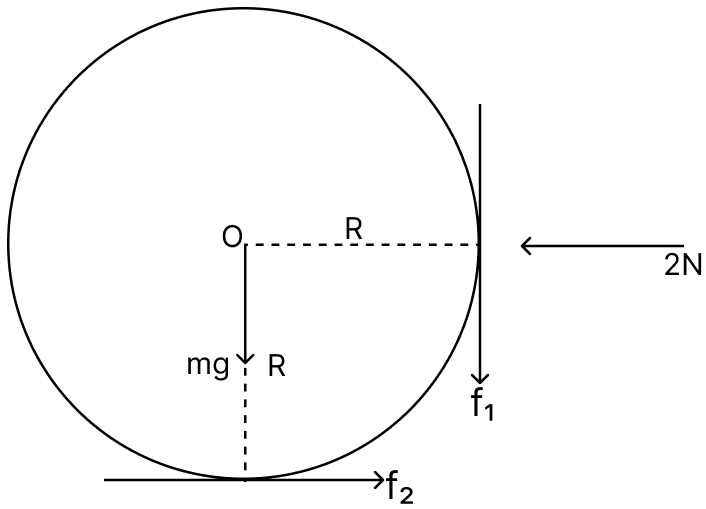
From the figure the stick is vertical and touches the ring at its side, that is, at the end of the horizontal diameter, level with the centre O. This fixes the direction of every force acting on the ring,
- the normal force N applied by the stick is horizontal, and its line of action passes through the centre O, so it exerts no torque about O,
- the force of friction f1 between the stick and the ring acts vertically downwards along the stick, at a perpendicular distance R from O. As the ring rolls forward its surface at the stick sweeps upwards, and friction opposes this,
- the force of friction f2 from the ground acts horizontally backwards at the point of contact, at a perpendicular distance R from O.
The moment of inertia of a ring about its own axis is I = mR2, and for rolling without slipping the angular acceleration is .
Equation of translational motion
Taking the direction of motion as positive, the stick pushes the ring forward while the ground friction retards it,
Equation of rotational motion
Taking moments about the centre O, and taking the sense in which the ring rolls as positive,
- N gives no moment, since its line of action passes through O,
- f2 acts backwards at the bottom of the ring, so its moment f2R is in the same sense as the rolling,
- f1 acts downwards at the side of the ring, so its moment f1R is in the opposite sense.
Therefore,
Dividing throughout by R,
Solving the two equations
Adding equations (i) and (ii), the unknown ground friction f2 cancels out,
Substituting the values,
The friction at the stick is limiting, so f1 = μN,
Hence, the value of P is 4.
Four solid spheres each of diameter cm and mass 0.5 kg are placed with the centres at the corners of a square of side 4 cm. The moment of inertia of the system about the diagonal of the square is N × 10-4 kg-m2, then find the value of N.
Answer
Given,
- Diameter of each sphere = cm, so radius cm and cm2
- Mass of each sphere, M = 0.5 kg
- Side of the square, L = 4 cm
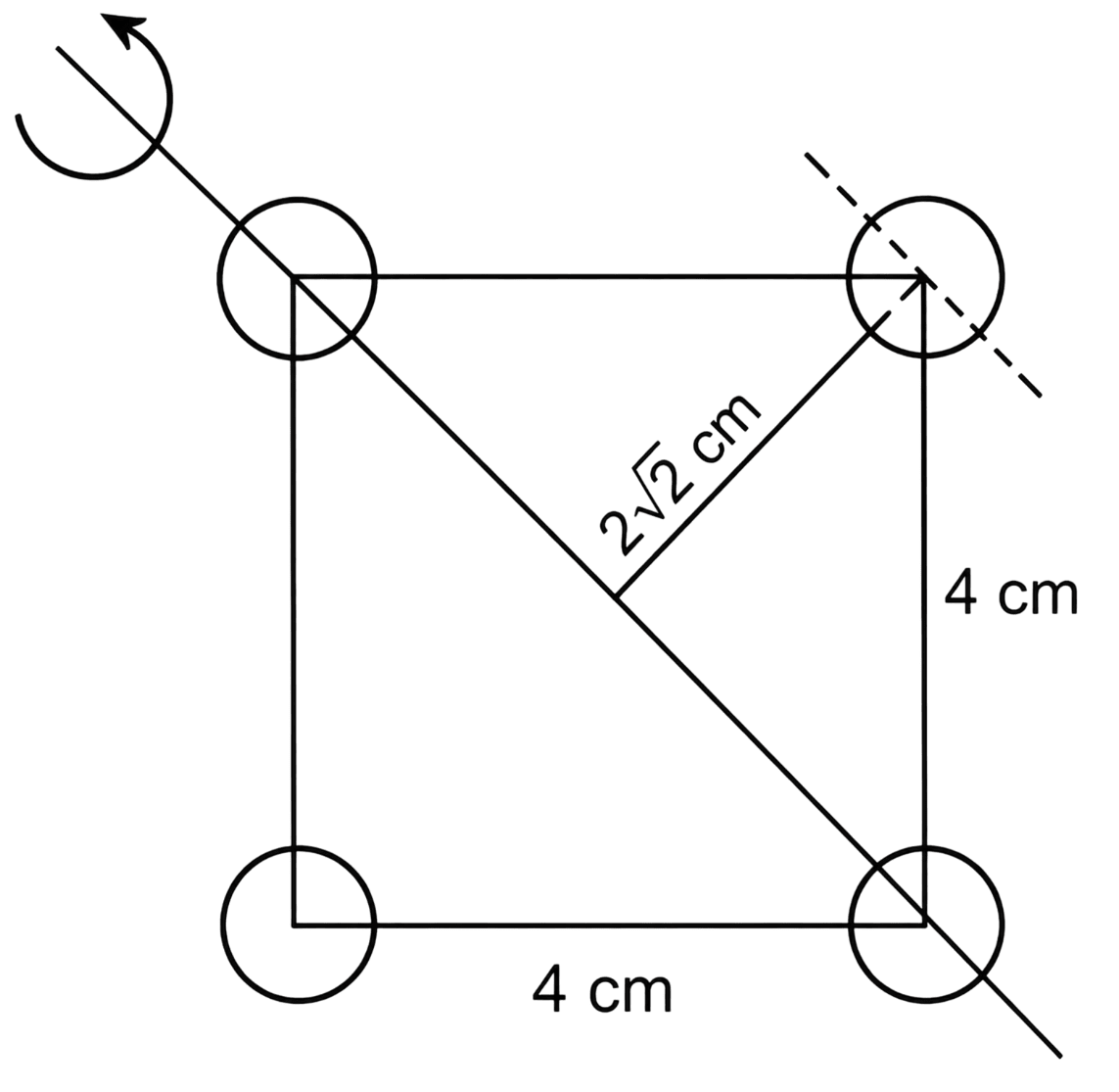
The axis of rotation is a diagonal of the square. Two spheres have their centres on this diagonal and the other two lie at a perpendicular distance equal to half the diagonal from it,
For the two spheres on the diagonal :
For the two spheres off the diagonal : by the theorem of parallel axes,
The total moment of inertia of the system about the diagonal is
Converting to S.I. units, 1 cm2 = 10-4 m2,
Comparing with I = N × 10-4 kg m2,
Hence, the value of N is 9.
A lamina is made by removing a small disc of diameter 2R from a bigger disc of uniform mass density and radius 2R, as shown in the figure. The moment of inertia of this lamina about the axes passing through O and P is IO and IP, respectively. Both these axes are perpendicular to the plane of the lamina.
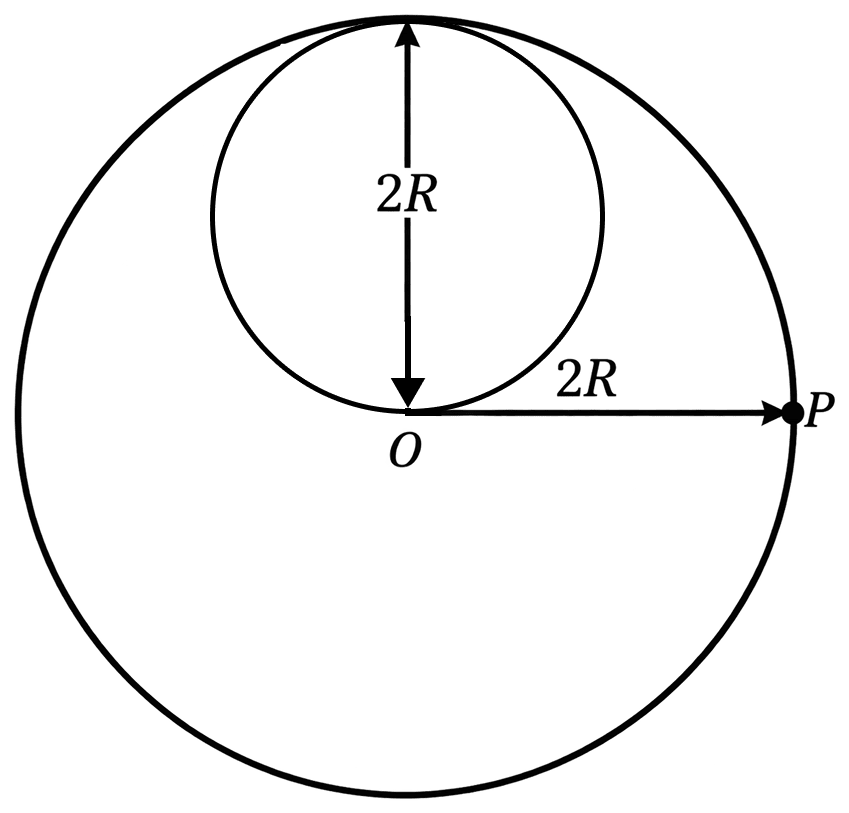
Find the ratio to the nearest integer.
Answer
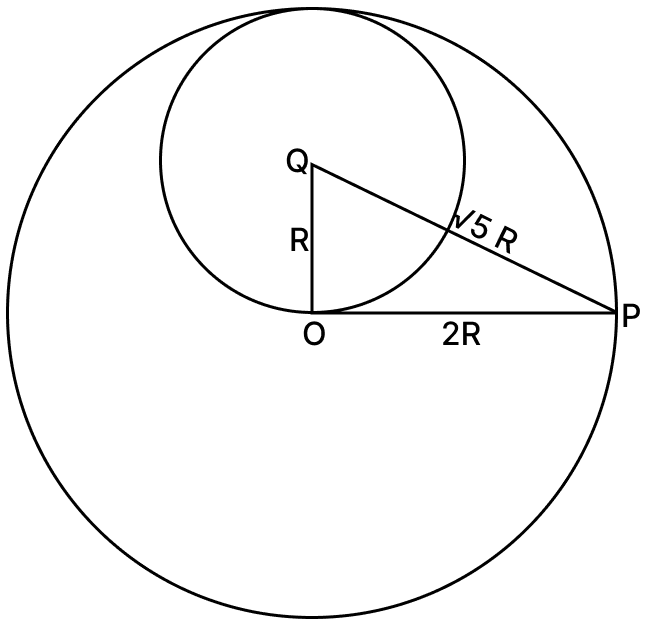
Let σ be the mass per unit area of the lamina. The bigger disc has radius 2R and the disc removed has diameter 2R, that is, radius R.
- Mass of the bigger disc,
- Mass of the removed disc,
From the figure, the centre of the removed disc is at a distance R from O, and P lies on the rim of the bigger disc at a distance 2R from O, along a perpendicular direction.
Moment of inertia about the axis through O : The removed disc is treated as a negative mass. Using the theorem of parallel axes for it,
Moment of inertia about the axis through P : The distance of the centre of the removed disc from P is
Therefore,
Therefore the required ratio is
Hence, the ratio to the nearest integer is 3.
A uniform circular disc of mass 50 kg and radius 0.4 m is rotating with an angular velocity of 10 rad s-1 about its own axis, which is vertical. Two uniform circular rings, each of mass 6.25 kg and radius 0.2 m, are gently placed symmetrically on the disc in such a manner that they are touching each other along the axis of the disc and are horizontal. Assume that the friction is large enough such that the rings are at rest relative to the disc and the system rotates about the original axis. What is the new angular velocity (in rad s-1) of the system?
Answer
Given,
- Mass of the disc, M = 50 kg
- Radius of the disc, R = 0.4 m
- Initial angular velocity of the disc, ω1 = 10 rad s-1
- Mass of each ring, m = 6.25 kg
- Radius of each ring, r = 0.2 m
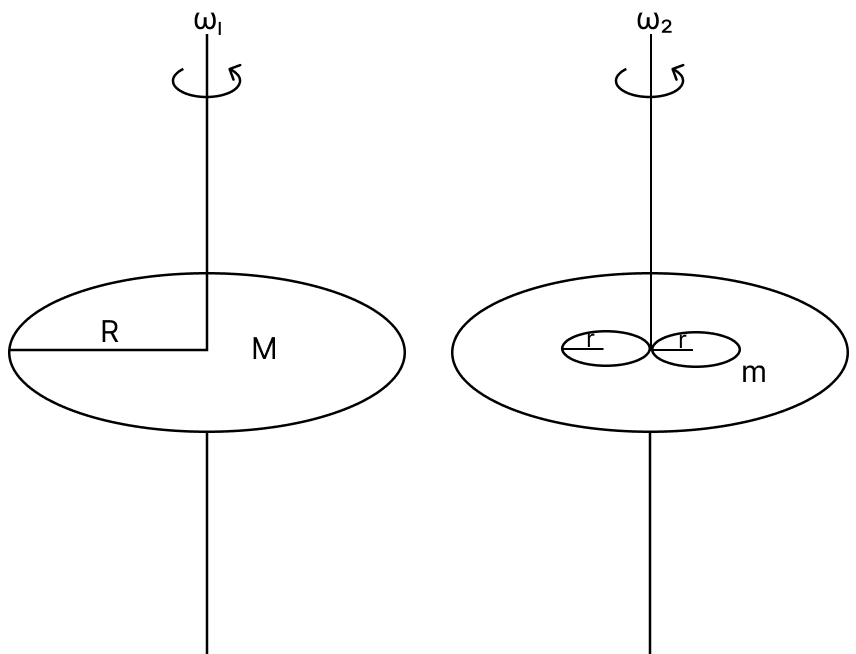
Moment of inertia of the disc about its own axis :
Moment of inertia of each ring about the axis of the disc : The two rings touch each other along the axis of the disc, so the centre of each ring is at a distance r = 0.2 m from that axis. The rings are horizontal, so the axis of the disc is perpendicular to the plane of each ring. By the theorem of parallel axes,
Hence for the two rings together, the moment of inertia is 2 × 0.5 = 1 kg m2.
Total moment of inertia of the system :
The rings are placed gently, so no external torque acts about the axis and the angular momentum is conserved,
Hence, the new angular velocity of the system is 8 rad s-1.
A horizontal circular platform of radius 0.5 m and mass 0.45 kg is free to rotate about its axis. Two massless spring toy-guns, each carrying a steel ball of mass 0.05 kg are attached to the platform at a distance 0.25 m from the centre on its either sides along its diameter (see figure). Each gun simultaneously fires the balls horizontally and perpendicular to the diameter in opposite directions. After leaving the platform, the balls have horizontal speed of 9 ms-1 with respect to the ground. Find the rotational speed of the platform in rad s-1 after the balls leave the platform.

Answer
Given,
- Radius of the platform, R = 0.5 m
- Mass of the platform, M = 0.45 kg
- Mass of each ball, m = 0.05 kg
- Distance of each gun from the centre, r = 0.25 m
- Speed of each ball with respect to the ground, v = 9 m s-1
Moment of inertia of the platform about its axis :
The balls are fired horizontally and perpendicular to the diameter, in opposite directions from the two ends. Hence the angular momentum carried away by each ball is in the same sense, and their total angular momentum about the axis is
No external torque acts about the vertical axis, so the angular momentum of the whole system is conserved. Initially the system is at rest, so the platform must acquire an equal and opposite angular momentum,
Hence, the rotational speed of the platform after the balls leave it is 4 rad s-1.
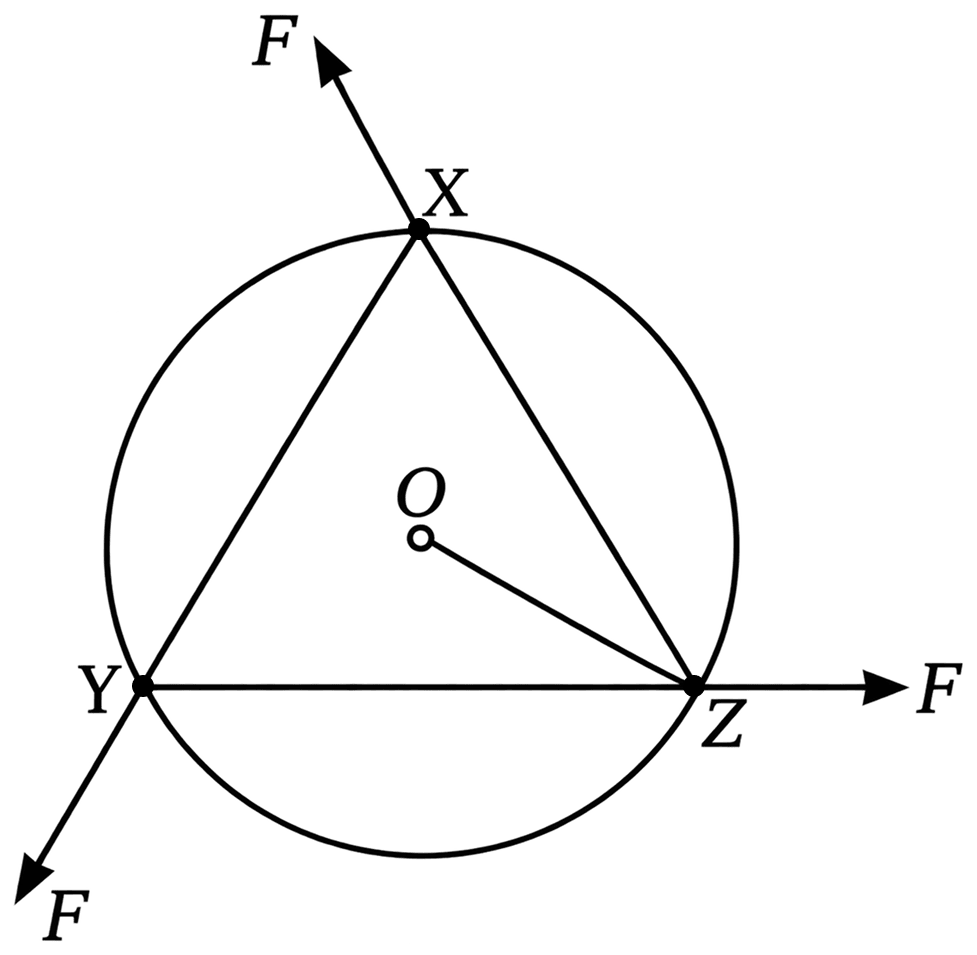
A uniform circular disc of mass 1.5 kg and radius 0.5 m is initially at rest on a horizontal frictionless surface. Three forces of equal magnitude F = 0.5 N are applied simultaneously along the three sides of an equilateral triangle XYZ with its vertices on the perimeter of the disc (see figure). One second after applying the forces, what will be the angular speed of the disc in rad s-1?
Answer
Given,
- Mass of the disc, M = 1.5 kg
- Radius of the disc, r = 0.5 m
- Magnitude of each force, F = 0.5 N
- Time, t = 1 s
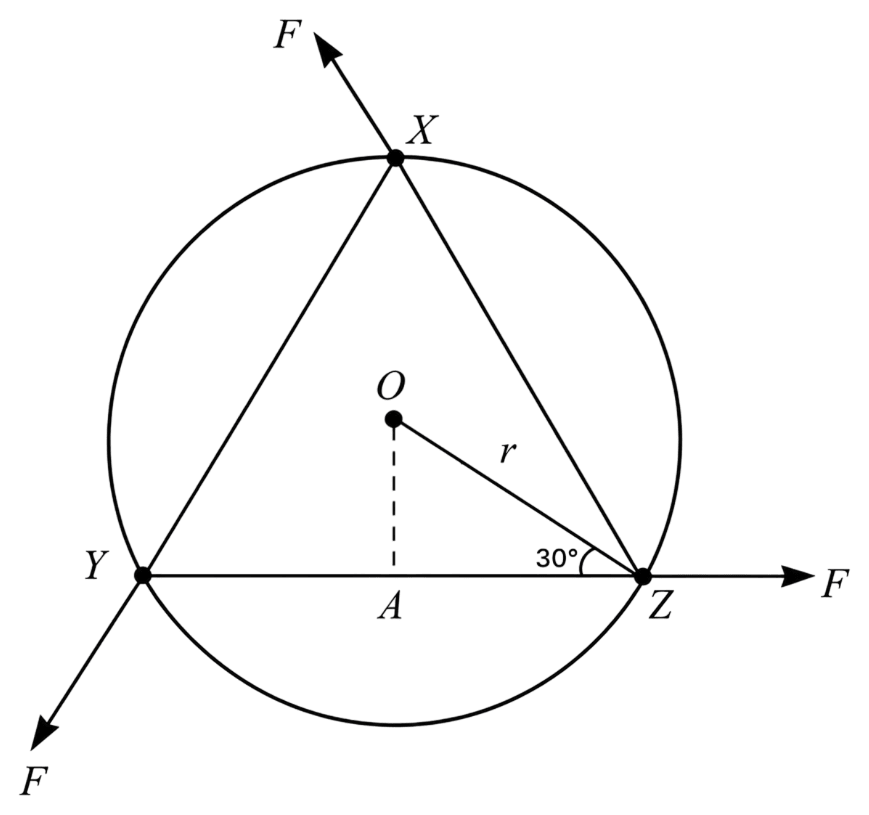
The three forces act along the sides of an equilateral triangle XYZ whose vertices lie on the rim of the disc. The perpendicular distance of each side from the centre of the disc is the apothem (AO) of the equilateral triangle inscribed in a circle of radius r,
All three forces tend to turn the disc in the same sense, so the total torque about the centre is
The moment of inertia of the disc about its own axis is
The angular acceleration produced is
The disc is initially at rest, so ω0 = 0. Using the equation of rotational kinematics,
Hence, one second after applying the forces, the angular speed of the disc is 2 rad s-1.
The densities of two solid spheres A and B of the same radii R vary with radial distance r as and , respectively, where k is a constant. The moments of inertia of the individual spheres about axes passing through their centres are IA and IB, respectively. If , find the value of n.
Answer
Given,
- and
- Both spheres have the same radius R
Consider a thin spherical shell of radius r and thickness dr. Its volume is 4πr2dr, so its mass is
The moment of inertia of a thin spherical shell about a diameter is . Hence for the whole sphere,
For sphere A :
For sphere B :
Therefore,
Comparing with ,
Hence, the value of n is 6.
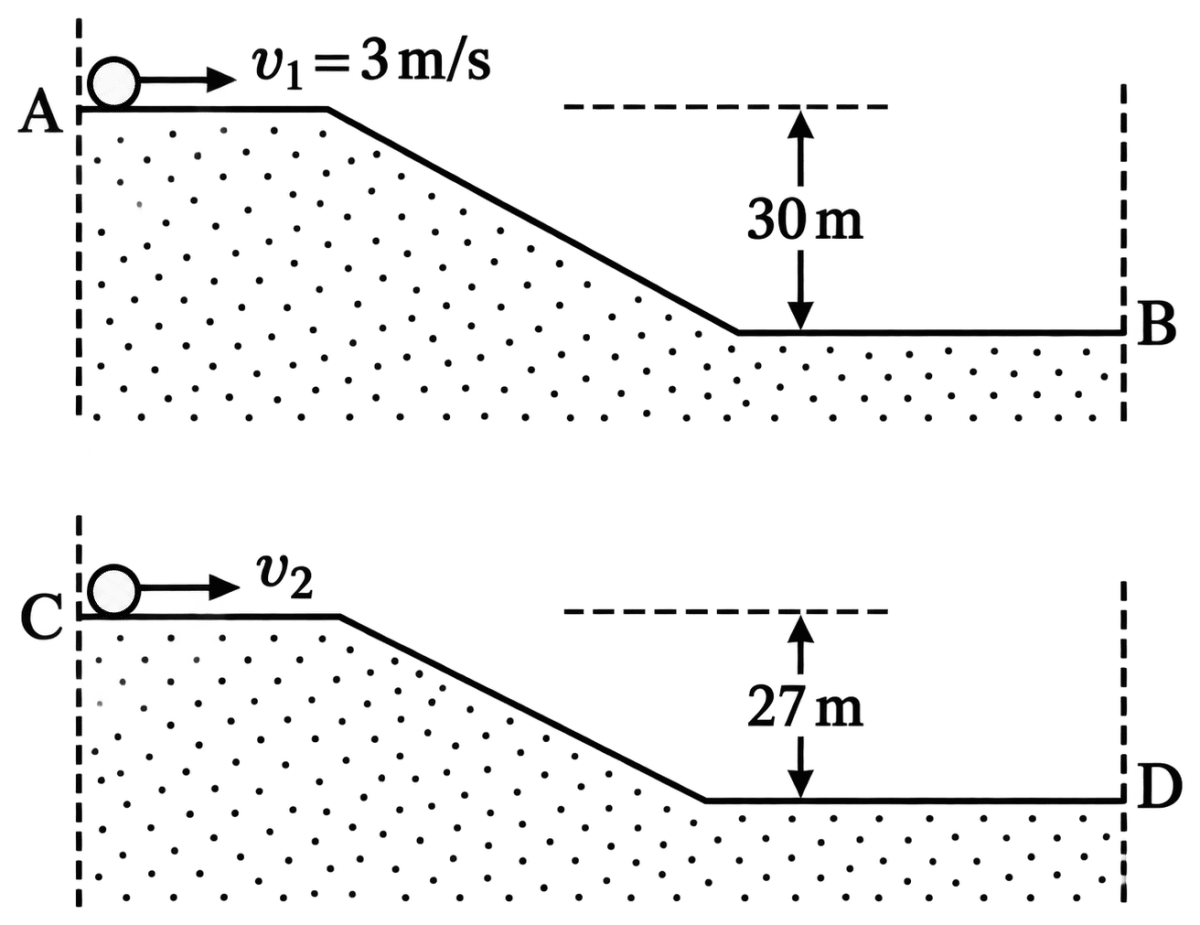
Two identical uniform discs roll without slipping on two different surfaces AB and CD (see figure) starting at A and C with linear speeds v1 and v2, respectively, and always remain in contact with the surfaces. If they reach B and D with the same linear speed v1 = 3 m/s, then calculate v2 in m/s (g = 10 m/s2).
Answer
Given,
- Linear speed at A, v1 = 3 m/s
- Drop along AB, h1 = 30 m
- Drop along CD, h2 = 27 m
- g = 10 m/s2
The discs roll without slipping, so the total kinetic energy of each disc is
Applying the conservation of mechanical energy to each disc, and noting that both reach the bottom with the same final speed v,
For the disc on AB :
For the disc on CD :
Equating the two left-hand sides and cancelling m,
Substituting the values,
Hence, the linear speed v2 is 7 m/s.
A ring and a disc are initially at rest, side by side, at the top of an inclined plane which makes an angle 60° with the horizontal. They start to roll without slipping at the same instant of time along the shortest path. If the time difference between their reaching the ground is s, then the height of the top of the inclined plane, in metres, is ............... . Take g = 10 ms-2. Round off your answer up to second decimal place.
Answer
Given,
- Angle of the inclined plane, θ = 60°
- Time difference, s
- g = 10 m s-2
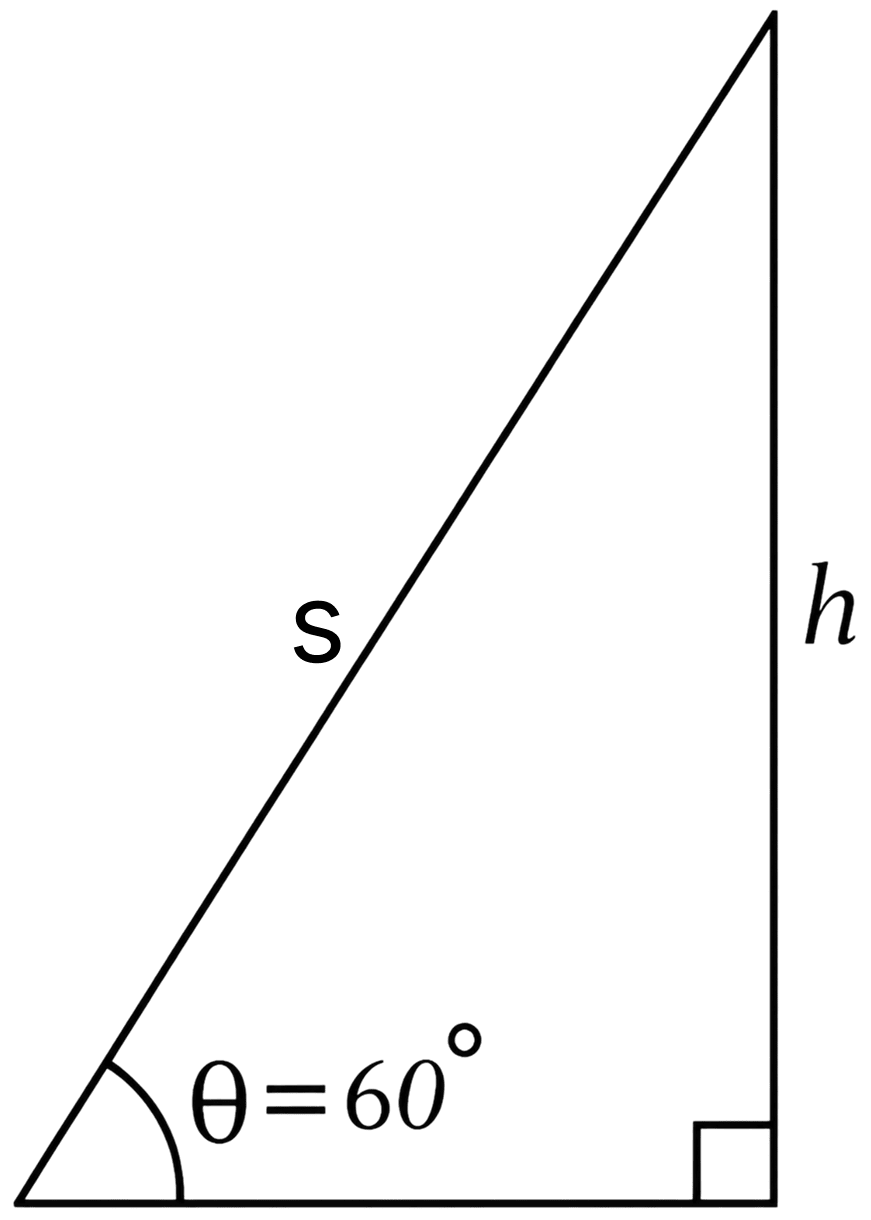
For a body rolling without slipping down an incline, the acceleration of the centre of mass is
For a ring, , so .
For a disc, , so .
If h is the height of the top of the plane, the length of the incline is . Both start from rest, so from ,
For the ring :
For the disc :
Therefore the time difference is
Equating this to the given value and putting ,
Squaring both sides,
Hence, the height of the top of the inclined plane is 0.75 m.
The length of an inclined plane at 30° is 20 m. A sphere of mass 5 kg starts rolling from rest from the top of the plane. If there is 20% loss of kinetic energy due to friction etc., then calculate the velocity of the sphere at the bottom of the plane. (g = 9.8 m/s2)
Answer
Given,
- Angle of the inclined plane, θ = 30°
- Length of the inclined plane, s = 20 m
- Mass of the sphere, m = 5 kg
- Loss of kinetic energy due to friction = 20%
- g = 9.8 m/s2
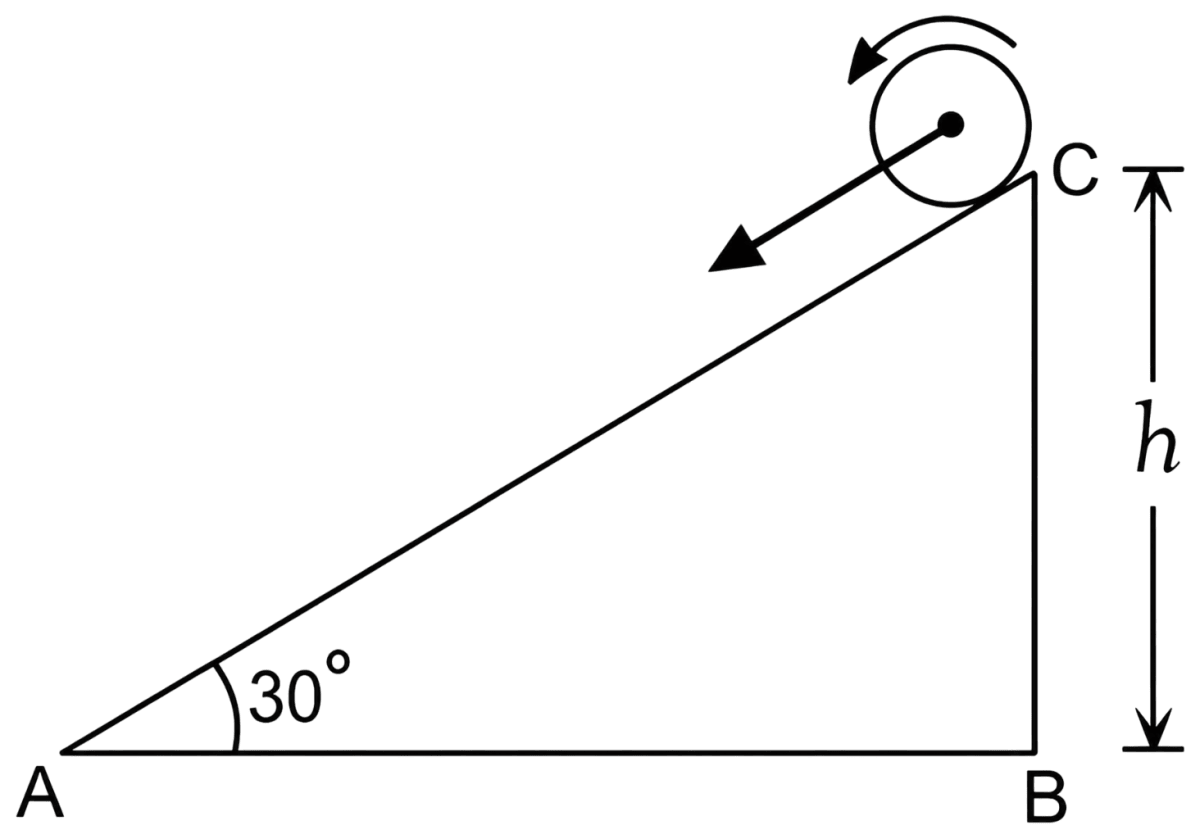
The vertical height through which the sphere descends is
The loss in potential energy of the sphere is
Since 20% of the kinetic energy is lost due to friction, only 80% of this energy appears as the kinetic energy of the sphere at the bottom,
For a solid sphere rolling without slipping, , and the total kinetic energy is
Therefore,
Hence, the velocity of the sphere at the bottom of the plane is 10.58 m/s.
A cord is wound around the circumference of a wheel of radius 0.5 m. A 2 kg mass is tied to the free end of the cord and is allowed to fall from rest. The axle of the wheel is horizontal and the wheel rotates in a vertical plane. The mass falls 4.0 m in 10 s. Find the angular acceleration produced and the moment of inertia of the wheel about the axle (axis of rotation). Take g = 9.8 m s-2.
Answer
Given,
- Radius of the wheel, R = 0.5 m
- Mass tied to the cord, m = 2 kg
- Distance fallen, s = 4.0 m
- Time taken, t = 10 s
- g = 9.8 m s-2
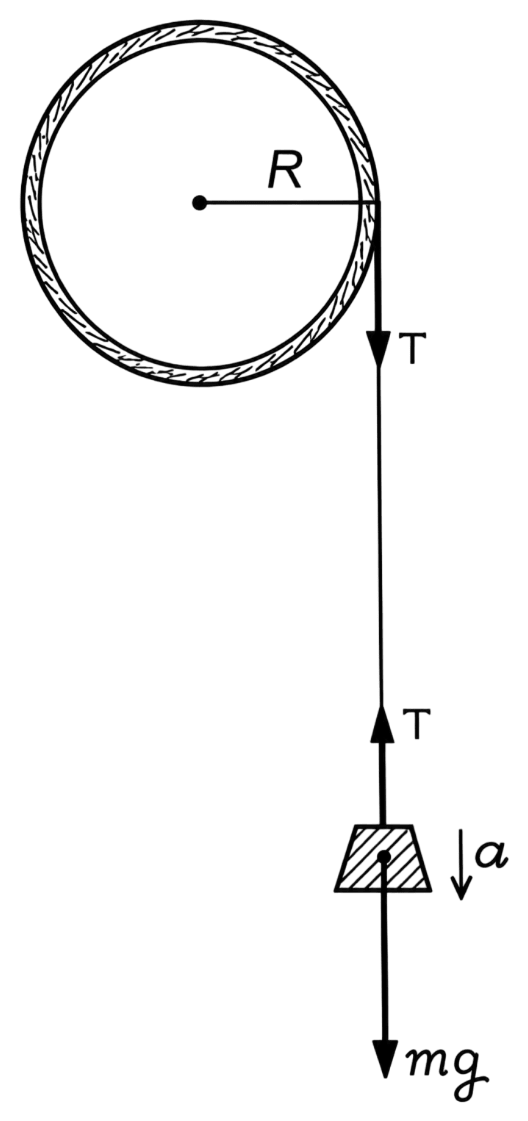
The mass falls from rest, so u = 0. Using ,
Angular acceleration of the wheel : The cord does not slip on the rim, so
Moment of inertia of the wheel : For the falling mass, applying Newton's second law,
The tension acts tangentially at the rim, so the torque on the wheel is
Using τ = Iα,
Hence, the angular acceleration produced is 0.16 rad s-2 and the moment of inertia of the wheel about the axle is 60.75 kg m2.
Point-masses M1 and M2 are placed at the ends of a rigid rod of length l and negligible mass. The rod is to be set rotating about an axis perpendicular to its length. Locate a point on the rod through which the axis of rotation should pass in order that the work required to set the rod rotating with angular velocity ω is minimum.
Answer
Given,
- Point masses M1 and M2 at the ends of a rod of length l and negligible mass
- Angular velocity to be produced = ω
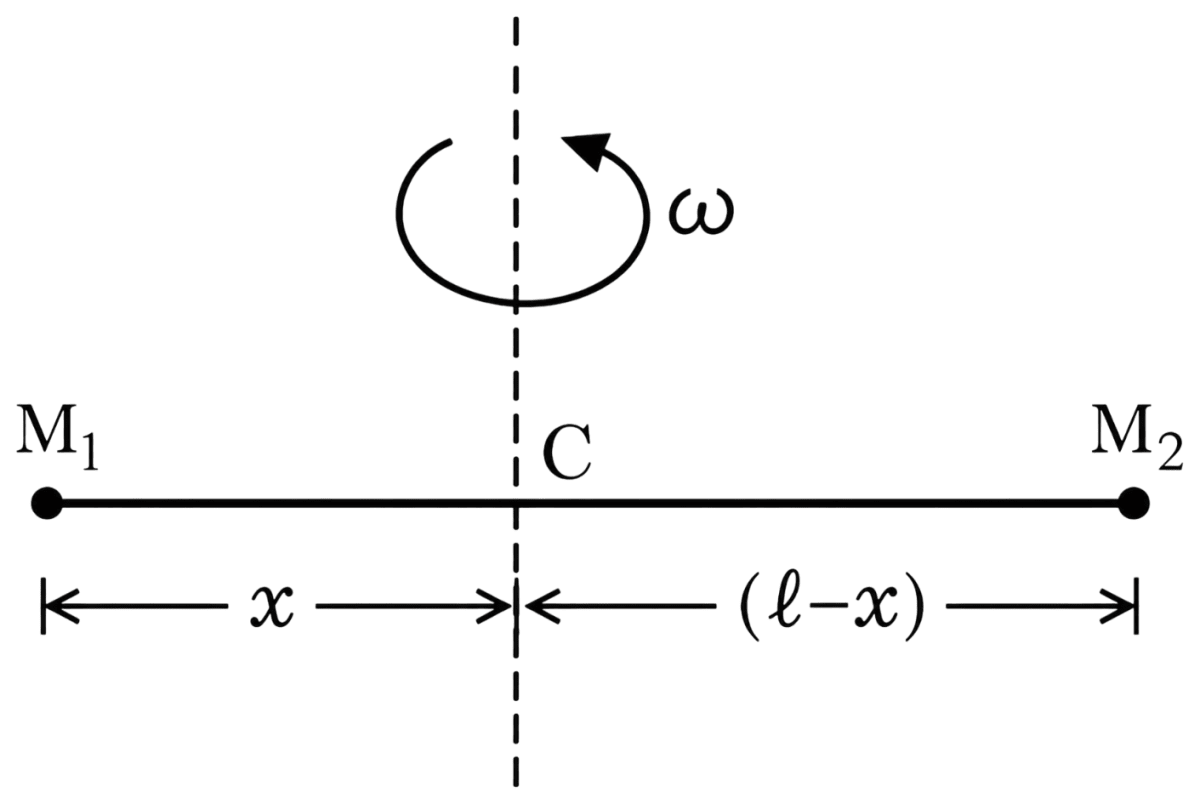
Let the axis of rotation pass through a point at a distance x from M1, so that its distance from M2 is (l − x). The moment of inertia of the system about this axis is
The work required to set the rod rotating with angular velocity ω is equal to its kinetic energy of rotation,
For a given ω, the work W is minimum when the moment of inertia I is minimum. Differentiating I with respect to x,
For I to be minimum, ,
Differentiating once more, , which is positive, confirming that I is minimum at this value of x.
Hence, the axis of rotation should pass through a point at a distance from M1. This is precisely the centre of mass of the system, so the work required is minimum when the axis passes through the centre of mass.
A solid sphere rolls down two different inclined planes of the same heights but different angles of inclination.
(a) Will it reach the bottom with the same speed in each case?
(b) Will it take longer to roll down one plane than the other?
(c) If so, which one and why?
Answer
(a) Yes, the sphere reaches the bottom with the same speed in each case.
Applying the conservation of mechanical energy to a body rolling without slipping down an incline of height h,
For a solid sphere , so . This depends only on the height h and not on the angle of inclination. Since both planes are of the same height, the sphere reaches the bottom with the same speed in each case.
(b) Yes, it will take longer to roll down one plane than the other.
The acceleration of the centre of mass is
and the length of the incline is . From ,
(c) The sphere takes longer on the plane of smaller inclination.
As θ decreases, sin θ decreases, so the time of descent t increases. Physically, the plane of smaller inclination is longer and gives a smaller acceleration, so the sphere takes more time to roll down it.
A solid cylinder rolls up an inclined plane of angle of inclination 30°. At the bottom of the inclined plane the centre of mass of the cylinder has a speed of 5 m s-1.
(a) How far will the cylinder go up the plane?
(b) How long will it take to return to the bottom?
Answer
Given,
- Angle of inclination, θ = 30°
- Speed of the centre of mass at the bottom, v = 5 m s-1
- g = 9.8 m s-2
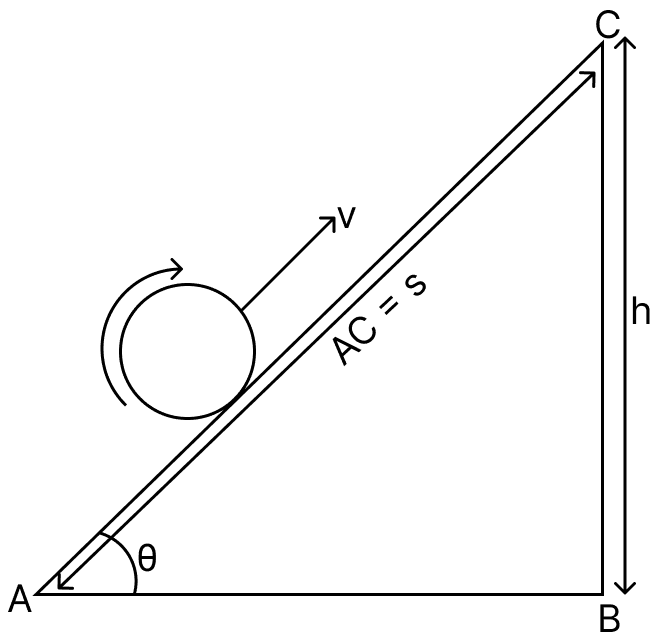
(a) Distance travelled up the plane : For a solid cylinder rolling without slipping, , so the total kinetic energy at the bottom is
At the highest point reached, all this kinetic energy is converted into potential energy,
The distance travelled along the plane is
Hence, the cylinder goes 3.83 m up the plane.
(b) Time taken to return to the bottom : The retardation while going up is
The time taken to come to rest while going up is
The cylinder rolls back down the same distance with the same magnitude of acceleration, so it takes an equal time to return.
treturn = 2tup = 2 × 1.53 = 3.06 s
Hence, the cylinder takes 3.06 s to return to the bottom.
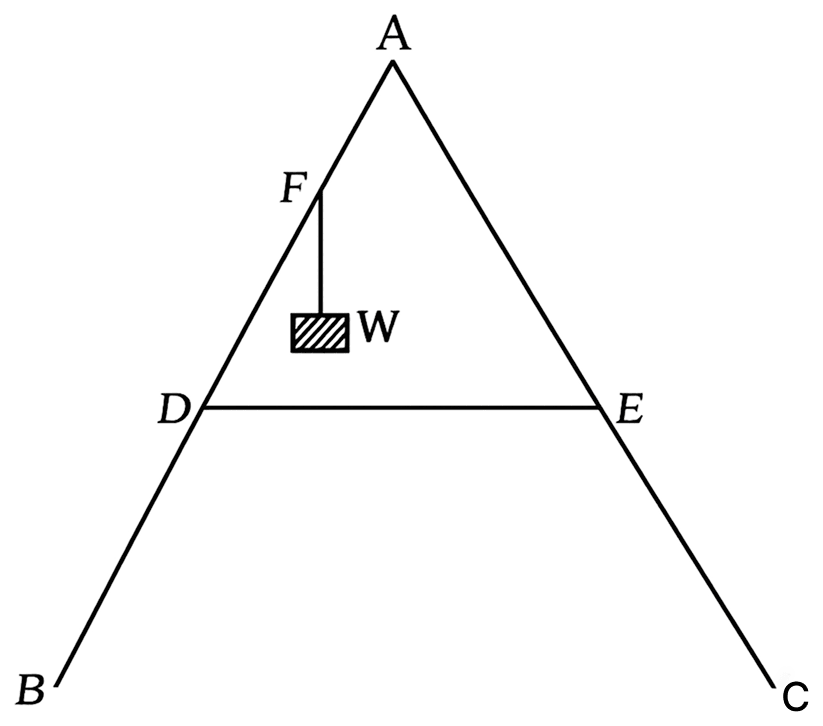
As shown in figure the two sides of a step ladder BA and CA are 1.6 m long and hinged at A. A rope DE, 0.5 m is tied half way up. A weight 40 kg is suspended from a point F, 1.2 m from B along the ladder BA. Assuming the floor to be frictionless and neglecting the weight of ladder, find the tension in the rope and forces exerted by the floor on the ladder. (Take g = 9.8 m s-2).
Answer
Given,
- Length of each side of the ladder, AB = AC = 1.6 m
- Length of the rope, DE = 0.5 m, tied half way up
- Suspended weight = 40 kg
- Distance of F from B along BA, BF = 1.2 m
- The floor is frictionless and the weight of the ladder is neglected
- g = 9.8 m s-2
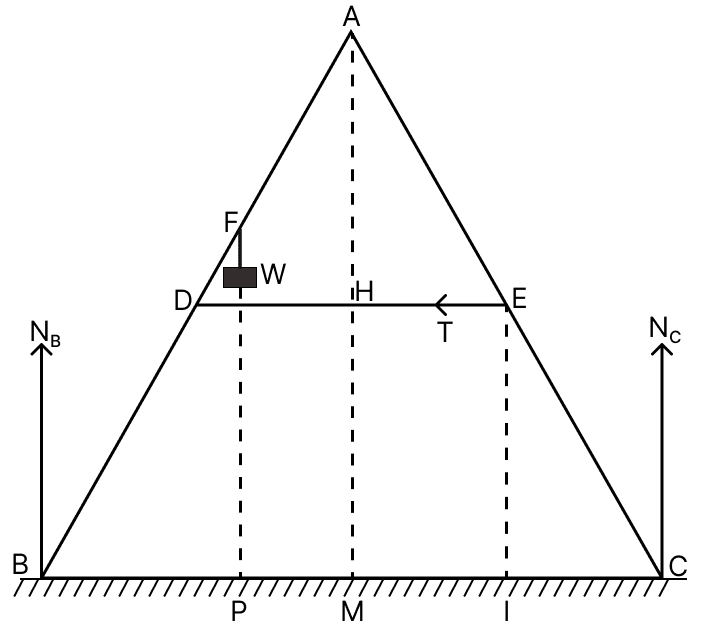
The weight suspended at F is
Geometry of the ladder
The rope is tied half way up, so D and E are the mid-points of AB and AC,
In triangles ADE and ABC the angle at A is common and
so the two triangles are similar in the ratio 1 : 2. Hence
Let M be the mid-point of BC. Since AB = AC, the perpendicular from A meets BC at M, so
From the right-angled triangle ABM, the height of A above the floor is
Since E is the mid-point of AC, it lies at half this height, so the vertical depth of E below A is AH =
The point F divides BA in the ratio 1.2 : 1.6, so by similar triangles BPF and BMA, its horizontal distance from B is
Forces exerted by the floor
The floor is frictionless, so the reactions NB and NC at B and C are purely vertical, having no horizontal component.
Applying the condition of translational equilibrium to the whole ladder,
Applying the condition of rotational equilibrium, and taking moments of all the forces about B for the whole ladder, the rope tension is internal to the system and contributes nothing,
Substituting this value in equation (i),
Tension in the rope
Consider the side AC alone, which carries no suspended load. The forces acting on it are the reaction NC at C, the horizontal pull T of the rope at E directed towards D, and the reaction at the hinge A.
Taking moments about A for this side, the hinge reaction passes through A and so exerts no moment,
Hence, the tension in the rope is 96.7 N, and the forces exerted by the floor on the ladder are 245 N at B and 147 N at C, both acting vertically upwards.
The reaction at B is the larger of the two because the weight hangs from the side BA, so its line of action lies nearer to B than to C. Note also that the tension can be found only by isolating one side of the ladder, since for the ladder as a whole the rope tension is an internal force and cancels out.
A man stands on a rotating platform with his arms stretched horizontally holding a 5 kg weight in each hand. The angular speed of the platform is 30 revolutions per minute. The man then brings his arms close to his body with the distance of each weight from the axis changing from 90 cm to 20 cm. The moment of inertia of the man together with the platform may be taken to be constant and equal to 7.6 kg m2.
(a) What is the new angular speed (neglect friction)?
(b) Is kinetic energy conserved in this process? If not, from where does the change come about.
Answer
Given,
- Mass held in each hand, m = 5 kg
- Initial angular speed, ω1 = 30 rev/min
- Initial distance of each weight from the axis, r1 = 90 cm = 0.9 m
- Final distance of each weight from the axis, r2 = 20 cm = 0.2 m
- Moment of inertia of the man with the platform, I0 = 7.6 kg m2
(a) New angular speed : The initial moment of inertia of the whole system is
The final moment of inertia is
Friction is neglected, so no external torque acts and the angular momentum is conserved,
Hence, the new angular speed is 58.88 rev/min.
(b) No, kinetic energy is not conserved in this process.
The kinetic energy of rotation has almost doubled. The increase comes from the work done by the man, who has to pull the weights inwards against the centrifugal effect. This work is done at the expense of his own internal (chemical) energy and appears as the additional kinetic energy of rotation.
A bullet of mass 10 g and speed 500 m/s is fired into a door and gets embedded exactly at the centre of the door. The door is 1.0 m wide and weighs 12 kg. It is hinged at one end and rotates about a vertical axis practically without any friction. Find the angular speed of the door just after the bullet embeds into it.
Answer
Given,
- Mass of the bullet, m = 10 g = 0.01 kg
- Speed of the bullet, v = 500 m/s
- Width of the door, L = 1.0 m
- Mass of the door, M = 12 kg
The bullet strikes the door at its centre, so its perpendicular distance from the hinge is
Angular momentum of the bullet about the hinge before impact :
Moment of inertia after the bullet embeds : The door rotates about a vertical axis at one end, so
The embedded bullet contributes
The hinge exerts no torque about the axis of rotation, so the angular momentum is conserved,
Hence, the angular speed of the door just after the bullet embeds into it is 0.625 rad s-1.
Two discs of moments of inertia I1 and I2 about their respective axes (normal to the disc and passing through the centre), and rotating with angular speeds ω1 and ω2 are brought into contact face to face with their axes of rotation coincident.
(a) What is the angular speed of the two-disc system?
(b) Show that the kinetic energy of the combined system is less than the sum of the initial kinetic energies of the two discs. How do you account for this loss in energy? Take ω1 ≠ ω2.
Answer
Given,
- Moments of inertia of the two discs = I1 and I2
- Their angular speeds = ω1 and ω2, with ω1 ≠ ω2
(a) Angular speed of the two-disc system : When the discs are brought into contact face to face with their axes coincident, the frictional forces between them are internal to the system and no external torque acts about the common axis. Hence the angular momentum is conserved,
(b) Comparison of the kinetic energies : The initial kinetic energy of the two discs is
The final kinetic energy of the combined system is
Therefore the change in kinetic energy is
Taking the L.C.M. and simplifying the numerator,
Since I1, I2 and (ω1 − ω2)2 are all positive quantities and ω1 ≠ ω2, this expression is positive.
Hence, the kinetic energy of the combined system is less than the sum of the initial kinetic energies of the two discs.
Accounting for the loss : When the two discs are brought into contact, their surfaces initially move with different angular speeds, so there is relative sliding between them. Work is done against the force of friction at the contact surfaces, and this energy is dissipated as heat. This accounts for the loss in kinetic energy, while the angular momentum, being unaffected by the internal forces, remains conserved.
A disc rotating about its axis with angular speed ω0 is placed lightly, without any translational push, on a perfectly frictionless table, as shown. The radius of the disc is R.
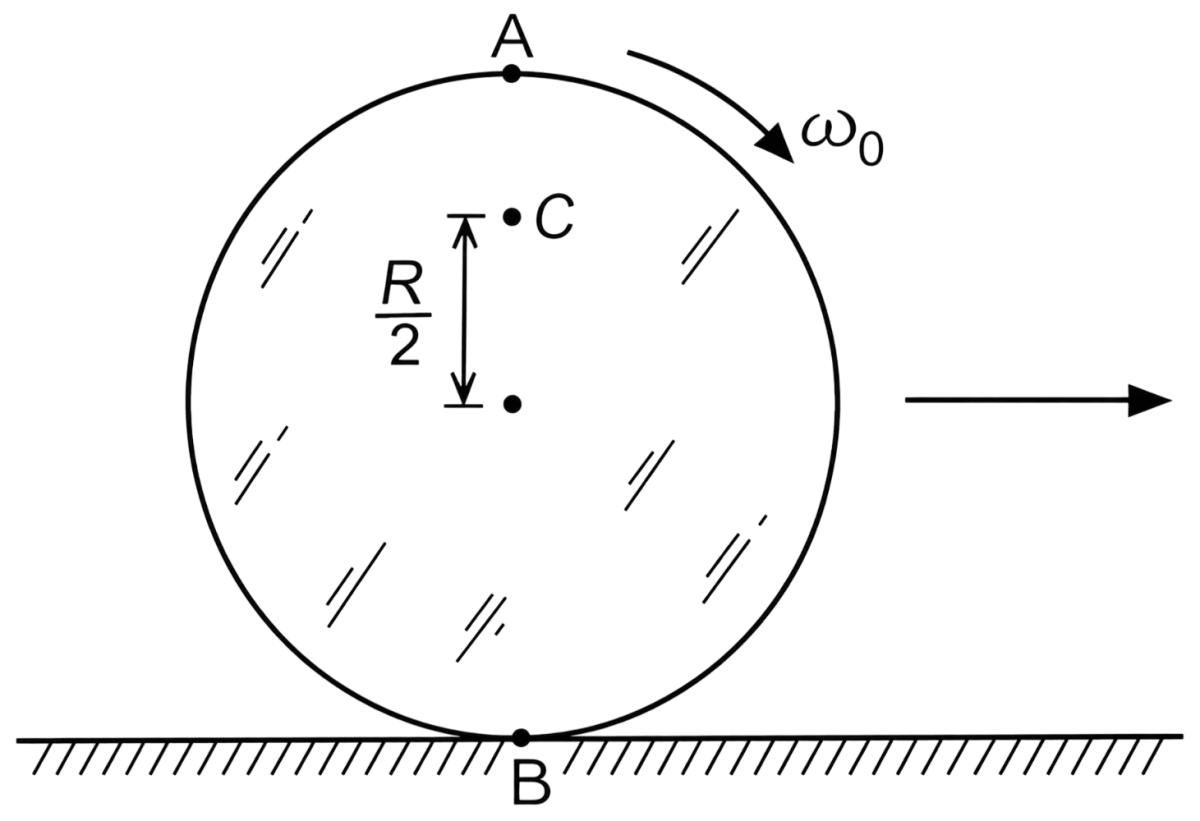
(a) What are the linear velocities of the points A, B and C on the disc?
(b) Will the disc roll in the direction indicated?
(c) Why is friction necessary for the disc to roll in the direction indicated?
(d) If the surface of the table is not frictionless, then what will be the direction of the frictional force at B, and the sense of frictional torque, before perfect rolling begins?
(e) What is the force of friction after perfect rolling begins?
Answer
Given,
- Angular speed of the disc = ω0
- Radius of the disc = R
- The table is perfectly frictionless
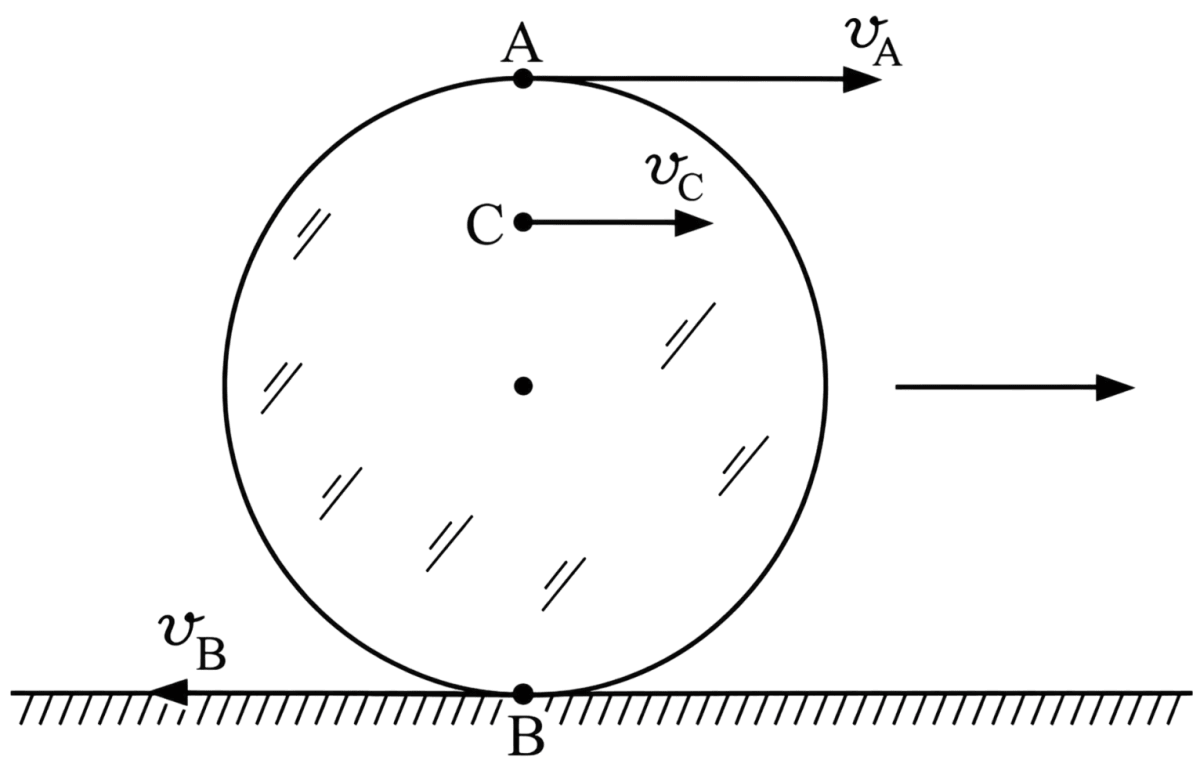
(a) Linear velocities of A, B and C : The disc is placed without any translational push, so the velocity of its centre of mass is zero and every point has only the tangential velocity due to rotation, vt = rω0.
From the figure, A is at the top of the rim, B at the bottom of the rim and C is at a distance R/2 from the centre. Therefore
The velocities at A and B are equal in magnitude but opposite in direction, since A and B lie at the two ends of a diameter. The velocity at C is in the same direction as that at A.
(b) No, the disc will not roll in the direction indicated. Rolling requires the centre of mass to move forward. Since the table is frictionless, no horizontal force acts on the disc, so its centre of mass remains at rest and the disc merely spins about its own axis.
(c) Friction is necessary because it is the only external horizontal force that can act on the disc at the point of contact. This force produces the linear acceleration of the centre of mass, converting the pure spinning into rolling motion. Without friction there is no external force, so the centre of mass cannot be accelerated.
(d) At B the surface of the disc moves backward relative to the table, so the force of friction acts forward, that is, in the direction of the indicated rolling. This frictional force acts at the point of contact and exerts a torque about the centre which is opposite in sense to ω0, so it decreases the angular speed while increasing the linear speed of the centre of mass.
(e) The force of friction after perfect rolling begins is zero. Once vcm = ω R, the point of contact is instantaneously at rest relative to the surface, so there is no relative sliding and hence no force of friction is required to maintain the rolling.
A solid disc and a ring, both of radius 10 cm are placed on a horizontal table simultaneously, with initial angular speed equal to 10 π rad s-1. Which of the two will start to roll earlier? The co-efficient of kinetic friction is μk = 0.2.
Answer
Given,
- Radius of both the disc and the ring, R = 10 cm = 0.1 m
- Initial angular speed, ω0 = 10 π rad s-1
- Coefficient of kinetic friction, μk = 0.2
- g = 9.8 m s-2
The initial situation
Each body is placed on the table spinning about its own axis but without any translational push, so initially
The centre of mass is at rest while the body spins, so the point of contact is not at rest relative to the table. Its velocity is ω0R directed backwards, and the body therefore slides on the table. Since there is relative sliding, the friction acting is kinetic friction, and it acts forwards, opposing the backward slipping of the point of contact.
Effect of friction on the translational motion
The force of kinetic friction is
Applying Newton's second law to the centre of mass,
The body starts from rest translationally, so at any time t its linear speed is
Effect of friction on the rotational motion
The same frictional force acts at the point of contact, at a perpendicular distance R from the centre, and exerts a torque about the centre which opposes the rotation,
If I = mk2 is the moment of inertia about the central axis, the angular retardation produced is
Hence the angular speed decreases with time as
Thus friction does two things at the same time, it increases the linear speed of the centre of mass and decreases the angular speed of the body.
Condition for rolling to begin
Rolling without slipping begins at the instant the point of contact comes momentarily to rest, that is, when
Substituting from equations (i) and (ii),
Collecting the terms containing t on the left hand side,
The mass m cancels out, so the time taken does not depend upon the mass of the body.
For the solid disc
For a disc , so and . Substituting in equation (iii),
Substituting the values,
For the ring
For a ring I = mR2, so and . Substituting in equation (iii),
Substituting the values,
Hence, the solid disc will start to roll earlier, taking 0.53 s as against 0.80 s for the ring.
A cylinder of mass 10 kg and radius 15 cm is rolling perfectly on a plane of inclination 30°. The co-efficient of static friction μs = 0.25.
(a) How much is the force of friction acting on the cylinder?
(b) What is the work done against friction during rolling?
(c) If the inclination θ of the plane is increased, at what value of θ does the cylinder begin to skid, and not roll perfectly?
Answer
Given,
- Mass of the cylinder, M = 10 kg
- Radius of the cylinder, R = 15 cm = 0.15 m
- Angle of inclination, θ = 30°
- Coefficient of static friction, μs = 0.25
- g = 9.8 m s-2
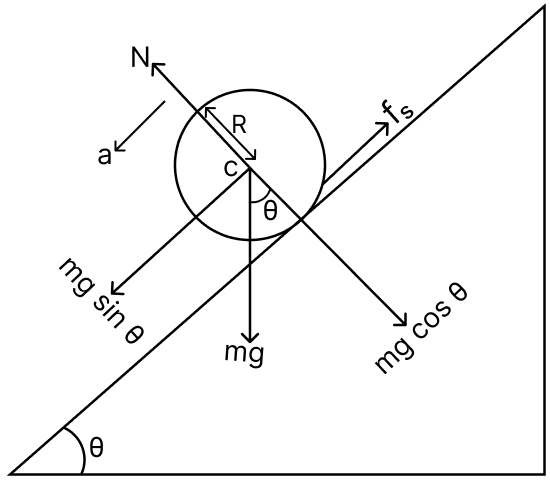
(a) Force of friction acting on the cylinder
The cylinder rolls down the plane without slipping. The forces acting on it are its weight Mg, the normal reaction N and the force of static friction fs acting up the plane at the point of contact.
Resolving the weight along and perpendicular to the plane, and applying Newton's second law along the plane,
Perpendicular to the plane there is no acceleration, so
The weight acts at the centre of mass and the normal reaction passes through it, so neither exerts a torque about the centre. The torque is due to the frictional force alone, acting at a perpendicular distance R,
For a solid cylinder , and for rolling without slipping . Therefore
Substituting this value of fs in equation (i),
Putting this value of a back in equation (iii),
Substituting the given values,
Hence, the force of friction acting on the cylinder is 16.33 N, directed up the plane.
(b) Work done against friction during rolling
In rolling without slipping the point of contact of the cylinder is momentarily at rest relative to the surface, so there is no relative motion between the body and the plane at the point of contact.
The frictional force acts at this point of contact, and since its point of application undergoes no displacement relative to the surface, the force of friction does no work,
Hence, the work done against friction during rolling is zero, and no mechanical energy is dissipated as heat. This is why the whole of the loss in potential energy appears as the kinetic energy of the rolling cylinder.
(c) Value of θ at which the cylinder begins to skid
The force of static friction cannot exceed its limiting value,
Substituting from part (a) and N = Mg cos θ from equation (ii),
Cancelling Mg from both sides and dividing throughout by cos θ,
The cylinder begins to skid when this becomes an equality,
Hence, the cylinder begins to skid, and no longer rolls perfectly, when the inclination exceeds 36.87°.
As a check, at the given inclination of 30° the limiting friction available is
which is greater than the 16.33 N actually required, so perfect rolling is indeed possible at 30°.