
Which of the following statements about the centre of mass is correct?
- The centre of mass of an object must always lie within the material of the object.
- The centre of mass of a system of particles is the point where the entire mass of the system can be considered to be concentrated for the purpose of linear motion.
- The centre of mass of an object moves in a straight line if only external forces act on the system.
- The centre of mass of a system is always located at the geometric centre of the system.
Answer
The centre of mass of a system of particles is the point where the entire mass of the system can be considered to be concentrated for the purpose of linear motion.
Reason — Under an external force, a composite body behaves as if its entire mass were concentrated at a single point, the centre of mass. It need not lie within the material of the body, it moves uniformly only when no external force acts, and it coincides with the geometric centre only for a symmetric body of uniform density.
If a system of particles is in motion, which of the following statements is true about its centre of mass?
- The centre of mass remains stationary.
- The centre of mass follows a parabolic path.
- The centre of mass moves in a straight line if no external forces act on the system.
- The centre of mass moves in a circular path if the system is rotating.
Answer
The centre of mass moves in a straight line if no external forces act on the system.
Reason — If no external force acts on the system, then and
The velocity of the centre of mass is constant in both magnitude and direction, so it moves in a straight line. This follows from the conservation of linear momentum.
Which of the following best describes the centre of mass of a two-particle system with different masses?
- The centre of mass is closer to the more massive particle.
- The centre of mass is equidistant from both particles.
- The centre of mass is closer to the less massive particle.
- The centre of mass is always at the midpoint between the two particles.
Answer
The centre of mass is closer to the more massive particle.
Reason — For two particles, the position of the centre of mass is
This is a weighted average of the positions of the particles, the weights being their masses. The particle with the greater mass contributes more to the average, so the centre of mass lies nearer to it. The centre of mass is at the mid-point only when the two masses are equal.
In which of the following situations does the centre of mass of a system not change its position?
- A rocket accelerates in space by ejecting exhaust gases.
- Two ice skaters push off each other on a frictionless ice surface.
- A ball falls freely under gravity.
- A car accelerates on a straight road.
Answer
Two ice skaters push off each other on a frictionless ice surface.
Reason — When two skaters push off each other on a frictionless surface, the forces between them are internal forces of the system. Internal forces always occur in equal and opposite pairs and cancel out, so no external force acts on the system. Hence the centre of mass of the system formed by the two skaters does not change its position. In each of the other cases an external force acts on the system, so the centre of mass is displaced.
What happens to the centre of mass of a system of particles if the masses of the particles remain the same but their positions change?
- The centre of mass remains the same.
- The centre of mass changes position according to the new positions of the particles.
- The centre of mass moves to the position of the heaviest particle.
- The centre of mass becomes undefined.
Answer
The centre of mass changes position according to the new positions of the particles.
Reason — The position of the centre of mass depends on both the masses of the particles and their positions,
If the masses remain the same but the position vectors change, the weighted average also changes. Hence the centre of mass shifts to a new position determined by the new positions of the particles.
Which of the following is true about the centre of mass in a uniform gravitational field?
- The centre of mass moves with constant acceleration equal to g.
- The centre of mass remains stationary.
- The centre of mass moves with a variable acceleration.
- The centre of mass does not experience any acceleration.
Answer
The centre of mass moves with constant acceleration equal to g.
Reason — In a uniform gravitational field the only external force on the system is its total weight Mg, acting at the centre of gravity, which in a uniform field coincides with the centre of mass. Therefore
The centre of mass thus moves with a constant acceleration equal to g, independent of the mass of the system.
For an irregularly shaped object, the centre of mass:
- Can only be found using calculus.
- Is always located at the geometric centre of the object.
- Can be determined experimentally by finding the balance point.
- Is always located at the point with the maximum mass concentration.
Answer
Can be determined experimentally by finding the balance point.
Reason — The centre of mass is the point at which an object can be perfectly balanced if supported at that point, since the distribution of the object's weight is even on all sides of it. Hence for an irregularly shaped object the centre of mass can be located experimentally by finding this balance point. It is not necessarily at the geometric centre, nor at the point of maximum mass concentration, and calculus is not the only means of finding it.
The centre of mass of a system of particles will move as if:
- All external forces are acting on a single particle of mass equal to the total mass of the system located at the centre of mass.
- Each particle is moving independently of the others.
- The system has no external forces acting on it.
- The centre of mass does not move at all.
Answer
All external forces are acting on a single particle of mass equal to the total mass of the system located at the centre of mass.
Reason — Every physical system has associated with it a certain point whose motion characterises the motion of the whole system. When the system moves under an external force, this point moves as if the entire mass of the system were concentrated at it and the external force were applied at that point. This point is the centre of mass, and
In the case of a collision between two bodies, the centre of mass of the system:
- Moves according to the individual momenta of the colliding bodies.
- Remains unaffected by the collision.
- Moves in a straight line if no external forces act on the system.
- Moves randomly depending on the nature of the collision.
Answer
Moves in a straight line if no external forces act on the system.
Reason — In a collision the forces exerted by the colliding bodies on each other are internal forces of the system. Internal forces cancel in pairs and do not affect the motion of the centre of mass. Hence, if no external force acts, the linear momentum of the system is conserved and the centre of mass continues to move in a straight line with constant velocity, both before and after the collision.
The position of centre of mass of a body :
- Depends on the axis of reference
- Depends upon the orientation
- It is always fixed
- May change if the body is taken to a different place.
Answer
It is always fixed
Reason — The centre of mass is a geometric property of the body, determined entirely by the distribution of its mass. For a given body its position relative to the material of the body is therefore fixed. It does not depend on the axis of reference, on the orientation of the body, or on the place to which the body is taken. Only the coordinates assigned to it change when a different coordinate system is chosen, not its actual position in the body.
The moment of inertia of a body is analogous to what quantity in linear motion?
- Force
- Mass
- Velocity
- Acceleration
Answer
Mass
Reason — In translational motion the mass of a body measures its inertia, that is, its resistance to a change in its state of motion. In rotational motion the corresponding role is played by the moment of inertia. This is clear from a comparison of the two forms of Newton's second law,
The moment of inertia I replaces the mass m, which is its physical significance.
The moment of inertia of a body depends on:
- Its shape only
- Its mass only
- The distribution of its mass
- The volume of the body
Answer
The distribution of its mass
Reason — Unlike translatory motion, where inertia is measured solely by the mass of the body, rotational inertia depends more on the distribution of mass with respect to the axis of rotation,
Bodies of the same mass and radius, such as a solid sphere, a solid cylinder and a hollow cylinder, have different moments of inertia because their masses are distributed differently about the axis.
If the moment of inertia of a body is higher, it means:
- The body will rotate faster.
- The body will rotate slower.
- The body is more resistant to changes in its rotational motion.
- The body is less resistant to changes in its rotational motion.
Answer
The body is more resistant to changes in its rotational motion.
Reason — The moment of inertia is a measure of the resistance a body offers to a change in its rotational motion. From τ = Iα, for a given torque a larger I gives a smaller angular acceleration α. Hence a body with a higher moment of inertia is harder to set into rotation and harder to stop, that is, it is more resistant to changes in its rotational motion.
According to the parallel axis theorem, the moment of inertia about any axis parallel to the centre of mass axis is:
- Always greater than the moment of inertia about the centre of mass axis.
- Equal to the moment of inertia about the centre of mass axis.
- Always less than the moment of inertia about the centre of mass axis.
- Independent of the distance between the axes.
Answer
Always greater than the moment of inertia about the centre of mass axis.
Reason — By the theorem of parallel axes,
where a is the perpendicular distance between the two parallel axes. Since M and a2 are always positive, the term Ma2 is always positive. Hence I is always greater than Icm, and the moment of inertia of a body is minimum about an axis passing through its centre of mass.
The perpendicular axis theorem is applicable to:
- Any body of arbitrary shape.
- Only symmetric bodies.
- Planar bodies.
- Three-dimensional bodies.
Answer
Planar bodies.
Reason — The theorem of perpendicular axes states that the moment of inertia of a uniform plane lamina about an axis perpendicular to its plane is equal to the sum of its moments of inertia about any two mutually perpendicular axes in its plane intersecting on the first axis, Iz = Ix + Iy. Its proof uses the relation r2 = x2 + y2, which holds only for a two-dimensional body. It therefore cannot be applied to three-dimensional objects such as spheres, cylinders and cones.
If the torque applied to a rigid body is doubled, the angular acceleration will:
- Double
- Halve
- Remain the same
- Quadruple.
Answer
Double
Reason — From the relation between torque, moment of inertia and angular acceleration,
For a rigid body rotating about a given axis, the moment of inertia I is constant. Hence α is directly proportional to τ, and doubling the applied torque doubles the angular acceleration.
A torque acting on a body tends to produce:
- Translational motion
- Rotational motion
- Vibrational motion
- Rectilinear motion.
Answer
Rotational motion
Reason — A force not only causes linear motion but also has the tendency to rotate a body about an axis, and this rotational tendency is expressed in terms of the moment of force or torque. Torque is the measure of the rotational capability of a force about a fixed line or axis, τ = rF sin θ, and so it tends to produce rotational motion in the body.
For a rotating body, if the net external torque acting on it is zero, its angular momentum:
- Increases linearly with time.
- Remains constant.
- Decreases linearly with time.
- Becomes zero.
Answer
Remains constant.
Reason — From the rotational form of Newton's second law,
If the net external torque is zero, then , so L is a constant. This is the law of conservation of angular momentum, which states that the total angular momentum of a system remains constant if no external torque acts on the system.
If the angular velocity of a rotating body is doubled, its rotational kinetic energy will:
- Double
- Halve
- Quadruple
- Remain the same.
Answer
Quadruple
Reason — The kinetic energy of rotation is
so for a given moment of inertia K is directly proportional to ω2. If the angular velocity is doubled,
Which of the following factors does not affect the rotational kinetic energy of a body?
- Moment of inertia
- Angular velocity
- Radius of rotation
- Mass
Answer
Radius of rotation
Reason — The rotational kinetic energy is , which depends only on the moment of inertia and the angular velocity. The mass and the radius of rotation affect K only indirectly, through their contribution to the moment of inertia I = Σmr2. Since the expression for K contains no radius term of its own, the radius of rotation does not directly affect the rotational kinetic energy.
Angular momentum is conserved when:
- No external force acts on the system
- No external torque acts on the system
- Only gravitational force acts on the system
- Only electromagnetic force acts on the system.
Answer
No external torque acts on the system
Reason — Angular momentum is conserved only in the absence of an external torque, not merely an external force, because
An external force acting along the line passing through the axis of rotation exerts no torque, and in that case angular momentum is still conserved even though a force acts. The nature of the force, whether gravitational or electromagnetic, is irrelevant.
The angular momentum of a particle moving in a straight line is:
- Always zero
- Always constant
- Zero unless the particle is rotating
- Perpendicular to the velocity vector.
Answer
Perpendicular to the velocity vector
Reason — The angular momentum of a particle about a point O is defined as the moment of its linear momentum about that point,
Being a vector product, is always perpendicular to the plane containing and , and hence perpendicular to the velocity vector. This holds whatever the path of the particle, so it is true for a particle moving in a straight line as well.
A figure skater pulling in her arms while spinning exemplifies :
- Conservation of linear momentum
- Conservation of energy
- Conservation of angular momentum
- Conservation of mass.
Answer
Conservation of angular momentum
Reason — When a figure skater spinning with her arms extended pulls them in, she brings more mass closer to the axis of rotation, so her moment of inertia decreases from I1 to I2. No external torque acts on her, so the angular momentum is conserved,
Since I decreases, ω increases and she spins faster. This is a standard illustration of the conservation of angular momentum.
If two particles of masses m1 and m2 are separated by a distance d, the position of the centre of mass from m1 is given by:
Answer
Reason — Taking m1 at the origin, x1 = 0 and x2 = d. Then
The distance measured from m1 is therefore proportional to the other mass m2, which correctly places the centre of mass nearer to the heavier particle.
The moment of inertia of a disc about an axis perpendicular to its plane and passing through its centre is I. According to the perpendicular axis theorem, moment of inertia of the disc about any diameter is:
I
2I
Answer
Reason — Let Ix and Iy be the moments of inertia about two mutually perpendicular diameters of the disc. By the theorem of perpendicular axes,
By symmetry the disc has the same moment of inertia about every diameter, so Ix = Iy. Therefore
The moment of inertia of a thin uniform rod of mass m and length l about an axis perpendicular to it and passing through its centre is I. The moment of inertia about a parallel axis passing through one end is:
- 2I
- 4I
- I
- None of these
Answer
4I
Reason — For a thin uniform rod, the moment of inertia about an axis through its centre and perpendicular to its length is
By the theorem of parallel axes, about a parallel axis through one end the distance between the axes is l/2,
For a solid sphere of mass M and radius R, the moment of inertia about an axis through its centre is:
Answer
Reason — For a solid sphere of mass M and radius R, the moment of inertia about an axis of symmetry, that is, about any diameter passing through its centre, is
and the corresponding radius of gyration is . The value belongs to a thin-walled hollow sphere and to a solid cylinder or disc.
The moment of inertia of a thin rod of length L and mass M about an axis perpendicular to the rod and passing through its centre is:
Answer
Reason — For a thin uniform rod of mass M and length L, taking an element of length dx at a distance x from the centre, dm = (M/L)dx, and
The value is the moment of inertia about an axis through one end of the rod.
Torque is given by:
- Force times distance
- Moment of inertia times angular acceleration
- Mass times acceleration
- Force divided by distance.
Answer
Moment of inertia times angular acceleration
Reason — Although torque may also be written as the product of force and the perpendicular distance, τ = Fr⊥, the relation that expresses torque in terms of the rotational properties of the body is
This is the rotational analogue of F = ma and defines torque and angular acceleration as cause and effect. Note that torque is force times the perpendicular distance, not simply force times distance, so the first option as stated is not correct.
The unit of torque is:
- Joule
- Newton-metre
- Watt
- Pascal
Answer
Newton-metre
Reason — Torque is the product of force and the perpendicular distance of its line of action from the axis of rotation, so its unit is newton × metre, that is, the newton-metre (N m). Although the joule is also dimensionally newton-metre, the joule is reserved for work and energy, which are scalars, whereas torque is a vector defined only for rotatable systems.
Which of the following has the highest moment of inertia about its central axis?
- Solid sphere
- Hollow sphere
- Solid cylinder
- Thin ring
Answer
Thin ring.
Reason — For bodies of the same mass M and radius R, the moments of inertia about their central axes are
Comparing the coefficients, 0.4, 0.67, 0.5 and 1, the thin ring has the largest moment of inertia. This is because the entire mass of the ring lies at the maximum distance R from the axis, whereas in the other bodies the mass is spread over smaller distances as well.
Assertion (A): The centre of mass of a system of particles does not change if no external force acts on the system.
Reason (R): The centre of mass is the average position of all the particles in the system, weighted by their masses.
- If both assertion and reason are true and reason is the correct explanation of assertion.
- If both assertion and reason are true but reason is not the correct explanation of assertion.
- If assertion is true but reason is false.
- If assertion is false and reason is true.
Answer
If assertion is false and reason is true.
Explanation
Assertion (A) is incorrect: In the absence of external force, the centre of mass has zero acceleration, but its position does not necessarily remain unchanged. It moves with constant velocity if it was already in motion.
If , then . Hence, the centre of mass moves with constant velocity ()
Reason (R) is also correct: The centre of mass is indeed the average position of all the particles in the system, weighted according to their masses,
Therefore, assertion is false and reason is true.
Note: The book's answer key (Option 2) is incorrect. Assertion (A) is false because if no external force acts on a system, the velocity of the center of mass remains constant, not its position (it will keep changing if already in motion). The correct answer is 4.
Assertion (A): The centre of mass of a uniform circular disc lies at its geometric centre.
Reason (R): A uniform disc has mass distributed symmetrically about its centre.
- If both assertion and reason are true and reason is the correct explanation of assertion.
- If both assertion and reason are true but reason is not the correct explanation of assertion.
- If assertion is true but reason is false.
- If assertion is false and reason is true.
Answer
If both assertion and reason are true and reason is the correct explanation of assertion.
Explanation
Assertion (A) is correct: For rigid bodies of regular geometrical shape having a uniform distribution of mass, the centre of mass lies at the geometric centre. Hence for a uniform circular disc the centre of mass is at its geometric centre.
Reason (R) is also correct: In a uniform disc the mass is distributed symmetrically about the centre, so for every mass element on one side there is an identical element diametrically opposite it.
Because of this symmetry the weighted average position of all the mass elements falls exactly at the centre. The Reason therefore explains the Assertion.
Therefore, both assertion and reason are true and reason is the correct explanation of assertion.
Assertion (A): The centre of mass of a two-particle system lies closer to the particle with the greater mass.
Reason (R): The centre of mass is the point where the weighted relative position of the distributed mass sums to zero.
- If both assertion and reason are true and reason is the correct explanation of assertion.
- If both assertion and reason are true but reason is not the correct explanation of assertion.
- If assertion is true but reason is false.
- If assertion is false and reason is true.
Answer
If both assertion and reason are true and reason is the correct explanation of assertion.
Explanation
Assertion (A) is correct: For a two-particle system,
The particle of greater mass carries more weight in this average, so the centre of mass lies nearer to it.
Reason (R) is also correct: The centre of mass is the point about which the sum of the moments of the masses of the system vanishes, that is, when the origin is taken at the centre of mass.
For this sum to vanish, the heavier particle must have the smaller distance from the centre of mass. The Reason therefore explains the Assertion.
Therefore, both assertion and reason are true and reason is the correct explanation of assertion.
Assertion (A): For an isolated system, the centre of mass moves with a constant velocity.
Reason (R): In an isolated system, the net external force acting on the system is zero.
- If both assertion and reason are true and reason is the correct explanation of assertion.
- If both assertion and reason are true but reason is not the correct explanation of assertion.
- If assertion is true but reason is false.
- If assertion is false and reason is true.
Answer
If both assertion and reason are true and reason is the correct explanation of assertion.
Explanation
Assertion (A) is correct: For an isolated system the centre of mass moves with a constant velocity, since
Reason (R) is also correct: An isolated system is one on which no net external force acts. The internal forces occur in equal and opposite pairs in compliance with Newton's third law and cancel out.
Since the acceleration of the centre of mass is produced only by the external force, a zero external force means zero acceleration and hence a constant velocity. The Reason therefore explains the Assertion.
Therefore, both assertion and reason are true and reason is the correct explanation of assertion.
Assertion (A): The centre of mass of a system of particles can be outside the physical body of the system.
Reason (R): The centre of mass depends on the distribution of mass and not necessarily on the physical boundaries of the body.
- If both assertion and reason are true and reason is the correct explanation of assertion.
- If both assertion and reason are true but reason is not the correct explanation of assertion.
- If assertion is true but reason is false.
- If assertion is false and reason is true.
Answer
If both assertion and reason are true and reason is the correct explanation of assertion.
Explanation
Assertion (A) is correct: The centre of mass may lie outside the physical body of the system, as in the case of a ring, a hollow sphere or a boomerang, where there is no matter at the location of the centre of mass.
Reason (R) is also correct: The centre of mass is a geometric property determined by the distribution of mass and not by the physical boundaries of the body.
Since the position of the centre of mass is fixed purely by the weighted average of the mass distribution, there is no requirement for matter to be actually present at that point. The Reason therefore explains the Assertion.
Therefore, both assertion and reason are true and reason is the correct explanation of assertion.
Assertion (A): The motion of the centre of mass of a system of particles is influenced by internal forces.
Reason (R): Internal forces always occur in equal and opposite pairs and cancel each other out.
- If both assertion and reason are true and reason is the correct explanation of assertion.
- If both assertion and reason are true but reason is not the correct explanation of assertion.
- If assertion is true but reason is false.
- If assertion is false and reason is true.
Answer
If assertion is false and reason is true.
Explanation
Assertion (A) is false: The motion of the centre of mass of a system of particles is not influenced by internal forces. Only the external force determines the acceleration of the centre of mass,
Reason (R) is correct: By Newton's third law of motion, internal forces always occur in equal and opposite pairs, so their vector sum over the whole system is zero and they cancel each other out.
It is precisely because the internal forces cancel that they cannot affect the motion of the centre of mass, which is why the Assertion is false.
Therefore, assertion is false and reason is true.
Assertion (A): The centre of mass of a rigid body always follows a parabolic path when it is projected in the air.
Reason (R): The only force acting on the centre of mass of a rigid body in free fall is gravity.
- If both assertion and reason are true and reason is the correct explanation of assertion.
- If both assertion and reason are true but reason is not the correct explanation of assertion.
- If assertion is true but reason is false.
- If assertion is false and reason is true.
Answer
If both assertion and reason are true and reason is the correct explanation of assertion.
Explanation
Assertion (A) is correct: When a rigid body is projected in the air, its centre of mass follows a parabolic path, which is the trajectory of a projectile moving under a constant acceleration.
Reason (R) is also correct: In free fall, neglecting air resistance, the only external force acting on the body is gravity, and it acts on the centre of mass.
Since the centre of mass moves as if the entire mass were concentrated there and the external force were applied there, a constant downward force produces motion under uniform acceleration, whose path is a parabola. The Reason therefore explains the Assertion.
Therefore, both assertion and reason are true and reason is the correct explanation of assertion.
Assertion (A): If two bodies collide and stick together, their centre of mass will move with a velocity equal to the velocity of the centre of mass before the collision.
Reason (R): Momentum is conserved in an isolated system.
- If both assertion and reason are true and reason is the correct explanation of assertion.
- If both assertion and reason are true but reason is not the correct explanation of assertion.
- If assertion is true but reason is false.
- If assertion is false and reason is true.
Answer
If both assertion and reason are true and reason is the correct explanation of assertion.
Explanation
Assertion (A) is correct: In a collision the forces between the two bodies are internal to the system. Hence the velocity of the centre of mass after the bodies stick together is the same as it was before the collision.
Reason (R) is also correct: Momentum is conserved in an isolated system, since no external force acts on it.
From , if the total momentum is unchanged and the total mass is unchanged, the velocity of the centre of mass must also be unchanged. The Reason therefore explains the Assertion.
Therefore, both assertion and reason are true and reason is the correct explanation of assertion.
Assertion (A): The centre of mass of a uniform rod lying along the x-axis is at its midpoint.
Reason (R): The mass distribution of a uniform rod is symmetrical about its midpoint.
- If both assertion and reason are true and reason is the correct explanation of assertion.
- If both assertion and reason are true but reason is not the correct explanation of assertion.
- If assertion is true but reason is false.
- If assertion is false and reason is true.
Answer
If both assertion and reason are true and reason is the correct explanation of assertion.
Explanation
Assertion (A) is correct: The centre of mass of a uniform rod lies at its mid-point. This follows from integration,
Reason (R) is also correct: The mass of a uniform rod is distributed symmetrically about its mid-point, each half being identical to the other.
Because of this symmetry, the weighted average position of the mass elements falls exactly at the mid-point. The Reason therefore explains the Assertion.
Therefore, both assertion and reason are true and reason is the correct explanation of assertion.
Assertion (A): The centre of mass of a projectile in motion can change its path if acted upon by an external force.
Reason (R): External forces can alter the momentum of the system.
- If both assertion and reason are true and reason is the correct explanation of assertion.
- If both assertion and reason are true but reason is not the correct explanation of assertion.
- If assertion is true but reason is false.
- If assertion is false and reason is true.
Answer
If both assertion and reason are true and reason is the correct explanation of assertion.
Explanation
Assertion (A) is correct: An external force acting on a projectile can change the path of its centre of mass, so that it no longer follows the original parabola.
Reason (R) is also correct: External forces alter the momentum of the system, since
Because the momentum of the system is , a change in momentum means a change in the velocity of the centre of mass, and hence a change in its path. The Reason therefore explains the Assertion.
Therefore, both assertion and reason are true and reason is the correct explanation of assertion.
Assertion (A): The moment of inertia of a body depends on the distribution of mass about the axis of rotation.
Reason (R): Moment of inertia is directly proportional to the mass of the body.
- If both assertion and reason are true and reason is the correct explanation of assertion.
- If both assertion and reason are true but reason is not the correct explanation of assertion.
- If assertion is true but reason is false.
- If assertion is false and reason is true.
Answer
If both assertion and reason are true but reason is not the correct explanation of assertion.
Explanation
Assertion (A) is correct: The moment of inertia depends on the distribution of mass about the axis of rotation, since
Each mass element is weighted by the square of its distance from the axis.
Reason (R) is also correct: For a given distribution of mass, the moment of inertia is directly proportional to the mass of the body, as I contains mi to the first power.
However, the proportionality to mass explains the dependence of I on mass, not on its distribution. The distribution dependence arises from the factor ri2, which the Reason does not mention. Hence the Reason does not explain the Assertion.
Therefore, both assertion and reason are true but reason is not the correct explanation of assertion.
Assertion (A): The radius of gyration is the distance from the axis at which the entire mass of the body can be assumed to be concentrated.
Reason (R): Radius of gyration is used to simplify the calculation of moment of inertia.
- If both assertion and reason are true and reason is the correct explanation of assertion.
- If both assertion and reason are true but reason is not the correct explanation of assertion.
- If assertion is true but reason is false.
- If assertion is false and reason is true.
Answer
If both assertion and reason are true and reason is the correct explanation of assertion.
Explanation
Assertion (A) is correct: The radius of gyration K of a body about a given axis is the distance from that axis at which the entire mass of the body can be imagined to be concentrated without changing its moment of inertia, so that
Reason (R) is also correct: The radius of gyration is used to simplify the calculation of the moment of inertia, replacing a complicated mass distribution by a single equivalent point mass.
It is exactly because the whole mass may be treated as concentrated at this one distance that the calculation is simplified. The Reason therefore explains the Assertion.
Therefore, both assertion and reason are true and reason is the correct explanation of assertion.
Assertion (A): For a given mass and shape, the moment of inertia about the centre of mass is always the smallest.
Reason (R): The moment of inertia depends on the choice of axis.
- If both assertion and reason are true and reason is the correct explanation of assertion.
- If both assertion and reason are true but reason is not the correct explanation of assertion.
- If assertion is true but reason is false.
- If assertion is false and reason is true.
Answer
If both assertion and reason are true and reason is the correct explanation of assertion.
Explanation
Assertion (A) is correct: By the theorem of parallel axes,
Since Ma2 is always positive, I is always greater than Icm. Hence for a given mass and shape the moment of inertia about the centre of mass is the smallest.
Reason (R) is also correct: The moment of inertia depends on the choice of the axis, because the distances ri of the mass elements change when the axis is changed.
Since the moment of inertia varies with the axis, there must be an axis for which it is least, and the parallel axis theorem shows this to be the axis through the centre of mass. The Reason therefore explains the Assertion.
Therefore, both assertion and reason are true and reason is the correct explanation of assertion.
Assertion (A): The moment of inertia of a thin rod about its centre is less than about one of its ends.
Reason (R): The distribution of mass is more symmetrical about the centre.
- If both assertion and reason are true and reason is the correct explanation of assertion.
- If both assertion and reason are true but reason is not the correct explanation of assertion.
- If assertion is true but reason is false.
- If assertion is false and reason is true.
Answer
If both assertion and reason are true and reason is the correct explanation of assertion.
Explanation
Assertion (A) is correct: For a thin rod of mass M and length L,
Clearly Icentre < Iend.
Reason (R) is also correct: About the centre the mass is distributed symmetrically, half of it on each side, so no part of the rod lies farther than L/2 from the axis. About one end, parts of the rod are as far as L from the axis.
Because the moment of inertia weights each element by r2, a more symmetrical distribution about the axis keeps the distances smaller and gives a smaller moment of inertia. The Reason therefore explains the Assertion.
Therefore, both assertion and reason are true and reason is the correct explanation of assertion.
Assertion (A): A solid sphere and a hollow sphere of the same mass and radius have the same moment of inertia about their respective centres.
Reason (R): Moment of inertia depends on the mass distribution.
- If both assertion and reason are true and reason is the correct explanation of assertion.
- If both assertion and reason are true but reason is not the correct explanation of assertion.
- If assertion is true but reason is false.
- If assertion is false and reason is true.
Answer
If assertion is false and reason is true.
Explanation
Assertion (A) is false: A solid sphere and a hollow sphere of the same mass and radius do not have the same moment of inertia,
Reason (R) is correct: The moment of inertia depends on the mass distribution, since I = Σmiri2.
In a hollow sphere the entire mass lies at the surface, at the maximum distance R from the centre, whereas in a solid sphere the mass is spread throughout the volume, at distances ranging from 0 to R. Hence their moments of inertia differ, which is why the Assertion is false.
Therefore, assertion is false and reason is true.
Assertion (A): The parallel axis theorem helps in finding the moment of inertia of a body about any axis parallel to the axis through the centre of mass.
Reason (R): The moment of inertia about any axis is the sum of the moment of inertia about the centre of mass and the product of the mass and the square of the distance between the axes.
- If both assertion and reason are true and reason is the correct explanation of assertion.
- If both assertion and reason are true but reason is not the correct explanation of assertion.
- If assertion is true but reason is false.
- If assertion is false and reason is true.
Answer
If both assertion and reason are true and reason is the correct explanation of assertion.
Explanation
Assertion (A) is correct: The theorem of parallel axes enables the moment of inertia about any axis to be found, provided the moment of inertia about a parallel axis through the centre of mass is known.
Reason (R) is also correct: The theorem states that
that is, the moment of inertia about any axis is the sum of the moment of inertia about the parallel axis through the centre of mass and the product of the mass and the square of the distance between the axes.
The Reason is the exact statement of the theorem referred to in the Assertion, and so explains it.
Therefore, both assertion and reason are true and reason is the correct explanation of assertion.
Assertion (A): The perpendicular axis theorem is applicable only to planar bodies.
Reason (R): It states that the moment of inertia about an axis perpendicular to the plane is the sum of the moments of inertia about two perpendicular axes in the plane.
- If both assertion and reason are true and reason is the correct explanation of assertion.
- If both assertion and reason are true but reason is not the correct explanation of assertion.
- If assertion is true but reason is false.
- If assertion is false and reason is true.
Answer
If both assertion and reason are true and reason is the correct explanation of assertion.
Explanation
Assertion (A) is correct: The theorem of perpendicular axes applies only to planar, that is, two-dimensional bodies such as thin discs, rings and plane laminas.
Reason (R) is also correct: The theorem states that the moment of inertia about an axis perpendicular to the plane of the lamina is the sum of the moments of inertia about two mutually perpendicular axes lying in that plane, Iz = Ix + Iy.
The proof of this relation rests on r2 = x2 + y2, which holds only when every mass element lies in a single plane. For a three-dimensional body a z-coordinate also appears and the relation fails. The Reason therefore explains the Assertion.
Therefore, both assertion and reason are true and reason is the correct explanation of assertion.
Assertion (A): Torque is required to change the rotational state of a body.
Reason (R): Torque is the rotational equivalent of force.
- If both assertion and reason are true and reason is the correct explanation of assertion.
- If both assertion and reason are true but reason is not the correct explanation of assertion.
- If assertion is true but reason is false.
- If assertion is false and reason is true.
Answer
If both assertion and reason are true and reason is the correct explanation of assertion.
Explanation
Assertion (A) is correct: A torque is required to change the rotational state of a body, since
Without a torque there is no angular acceleration and the angular velocity remains unchanged.
Reason (R) is also correct: Torque is the rotational equivalent of force, as is clear from comparing τ = Iα with F = ma.
Just as a force is needed to change the translational state of a body, its rotational counterpart, the torque, is needed to change the rotational state. The Reason therefore explains the Assertion.
Therefore, both assertion and reason are true and reason is the correct explanation of assertion.
Assertion (A): A higher moment of inertia means the body is easier to rotate.
Reason (R): Moment of inertia is a measure of an object's resistance to changes in its rotational motion.
- If both assertion and reason are true and reason is the correct explanation of assertion.
- If both assertion and reason are true but reason is not the correct explanation of assertion.
- If assertion is true but reason is false.
- If assertion is false and reason is true.
Answer
If assertion is false and reason is true.
Explanation
Assertion (A) is false: A higher moment of inertia makes a body harder, not easier, to rotate. From τ = Iα, for a given torque a larger I produces a smaller angular acceleration.
Reason (R) is correct: The moment of inertia is indeed a measure of an object's resistance to changes in its rotational motion, playing the same role in rotational motion that mass plays in translational motion.
Since a larger moment of inertia means greater resistance to being set into rotation, the body becomes more difficult to rotate, which is why the Assertion is false.
Therefore, assertion is false and reason is true.
Assertion (A): Angular momentum is conserved in an isolated system with no external torque.
Reason (R): Conservation laws are fundamental principles in physics.
- If both assertion and reason are true and reason is the correct explanation of assertion.
- If both assertion and reason are true but reason is not the correct explanation of assertion.
- If assertion is true but reason is false.
- If assertion is false and reason is true.
Answer
If both assertion and reason are true and reason is the correct explanation of assertion.
Explanation
Assertion (A) is correct: In an isolated system with no external torque,
This is the law of conservation of angular momentum.
Reason (R) is also correct: Conservation laws are fundamental principles of physics, and the conservation of angular momentum is one such principle applying to isolated systems and to individual objects within a system, provided there is no external influence altering their rotational motion.
The Assertion is precisely a statement of the conservation principle referred to in the Reason, and so the Reason explains it.
Therefore, both assertion and reason are true and reason is the correct explanation of assertion.
Assertion (A): The angular momentum of a rotating body is always constant.
Reason (R): Angular momentum depends on both the moment of inertia and angular velocity.
- If both assertion and reason are true and reason is the correct explanation of assertion.
- If both assertion and reason are true but reason is not the correct explanation of assertion.
- If assertion is true but reason is false.
- If assertion is false and reason is true.
Answer
If assertion is false and reason is true.
Explanation
Assertion (A) is false: The angular momentum of a rotating body is not always constant. It remains constant only when no external torque acts on the body. If an external torque acts, then
and the angular momentum changes.
Reason (R) is correct: The angular momentum does depend on both the moment of inertia and the angular velocity, L = Iω.
Since either I or ω, or both, may be changed, for instance when a skater pulls in her arms, the angular momentum is not a fixed quantity in general, which is why the Assertion is false.
Therefore, assertion is false and reason is true.
Assertion (A): In pure rolling motion, there is no relative motion between the point of contact and the surface.
Reason (R): The point of contact has zero velocity relative to the surface.
- If both assertion and reason are true and reason is the correct explanation of assertion.
- If both assertion and reason are true but reason is not the correct explanation of assertion.
- If assertion is true but reason is false.
- If assertion is false and reason is true.
Answer
If both assertion and reason are true and reason is the correct explanation of assertion.
Explanation
Assertion (A) is correct: In pure rolling motion there is no relative motion between the point of contact and the surface, the point of contact being momentarily at rest relative to the surface.
Reason (R) is also correct: At the point of contact the velocity of the centre of mass and the tangential velocity due to rotation are equal in magnitude but opposite in direction,
Because these two velocities cancel exactly, the net velocity of the contact point is zero, which is the same as saying there is no relative motion there. The Reason therefore explains the Assertion.
Therefore, both assertion and reason are true and reason is the correct explanation of assertion.
Assertion (A): A rolling object always has both translational and rotational kinetic energy.
Reason (R): Rolling motion is a combination of translation and rotation.
- If both assertion and reason are true and reason is the correct explanation of assertion.
- If both assertion and reason are true but reason is not the correct explanation of assertion.
- If assertion is true but reason is false.
- If assertion is false and reason is true.
Answer
If both assertion and reason are true and reason is the correct explanation of assertion.
Explanation
Assertion (A) is correct: A rolling object possesses both translational and rotational kinetic energy,
Reason (R) is also correct: Rolling motion is a combination of pure translation of the centre of mass and pure rotation about the centre of mass.
Since the motion consists of these two parts, the total kinetic energy is the sum of the kinetic energies associated with each. The Reason therefore explains the Assertion.
Therefore, both assertion and reason are true and reason is the correct explanation of assertion.
Assertion (A): A cylinder rolling down an inclined plane accelerates faster than a cylinder sliding down the plane.
Reason (R): Rolling friction is generally less than sliding friction.
- If both assertion and reason are true and reason is the correct explanation of assertion.
- If both assertion and reason are true but reason is not the correct explanation of assertion.
- If assertion is true but reason is false.
- If assertion is false and reason is true.
Answer
If assertion is false and reason is true.
Explanation
Assertion (A) is false: A cylinder rolling down an inclined plane accelerates more slowly than one sliding down. For a rolling solid cylinder,
which is less than g sin θ, the acceleration of a cylinder sliding down a smooth plane. This is because part of the potential energy is converted into rotational kinetic energy.
Reason (R) is correct: Rolling friction is generally less than sliding friction.
Even though rolling friction is smaller, the rotational inertia of the rolling body reduces its acceleration below that of a sliding body, which is why the Assertion is false.
Therefore, assertion is false and reason is true.
Assertion (A): The velocity of the centre of mass of a rolling cylinder on an inclined plane depends only on the height of the plane.
Reason (R): Energy conservation principles state that potential energy is converted to kinetic energy.
- If both assertion and reason are true and reason is the correct explanation of assertion.
- If both assertion and reason are true but reason is not the correct explanation of assertion.
- If assertion is true but reason is false.
- If assertion is false and reason is true.
Answer
If both assertion and reason are true and reason is the correct explanation of assertion.
Explanation
Assertion (A) is correct: Applying the conservation of energy to a cylinder rolling down an incline of height h,
This depends only on h and not on the angle of inclination or the length of the plane.
Reason (R) is also correct: By the principle of conservation of energy, the potential energy lost is converted into kinetic energy.
Since the potential energy lost depends only on the height, the kinetic energy gained, and hence the velocity, also depends only on the height. The Reason therefore explains the Assertion.
Therefore, both assertion and reason are true and reason is the correct explanation of assertion.
Assertion (A): Rotational kinetic energy is given by the expression .
Reason (R): Here I and ω are the rotational analogues of mass m and linear velocity v in translational motion.
- If both assertion and reason are true and reason is the correct explanation of assertion.
- If both assertion and reason are true but reason is not the correct explanation of assertion.
- If assertion is true but reason is false.
- If assertion is false and reason is true.
Answer
If both assertion and reason are true and reason is the correct explanation of assertion.
Explanation
Assertion (A) is correct: The kinetic energy of rotation of a body rotating about an axis is
obtained by summing the kinetic energies of all its constituent particles.
Reason (R) is also correct: In this expression I and ω are the rotational analogues of the mass m and the linear velocity v of translational motion.
Comparing with , replacing m by I and v by ω gives exactly the rotational formula, which is why the expression takes this form. The Reason therefore explains the Assertion.
Therefore, both assertion and reason are true and reason is the correct explanation of assertion.
Assertion (A): For a rotating body, if the moment of inertia increases, the rotational kinetic energy decreases, assuming constant angular velocity.
Reason (R): Rotational kinetic energy is directly proportional to the moment of inertia.
- If both assertion and reason are true and reason is the correct explanation of assertion.
- If both assertion and reason are true but reason is not the correct explanation of assertion.
- If assertion is true but reason is false.
- If assertion is false and reason is true.
Answer
If assertion is false and reason is true.
Explanation
Assertion (A) is false: For a rotating body at constant angular velocity, the rotational kinetic energy increases, not decreases, when the moment of inertia increases, since K is directly proportional to I.
Reason (R) is correct: The rotational kinetic energy is indeed directly proportional to the moment of inertia at a constant angular velocity.
Direct proportionality means the two quantities increase together, so an increase in I must increase K. This is exactly why the Assertion, which claims a decrease, is false.
Therefore, assertion is false and reason is true.
Assertion (A): For a rigid body in rotational equilibrium, the net external torque acting on it is zero.
Reason (R): A body in rotational equilibrium does not undergo angular acceleration.
- If both assertion and reason are true and reason is the correct explanation of assertion.
- If both assertion and reason are true but reason is not the correct explanation of assertion.
- If assertion is true but reason is false.
- If assertion is false and reason is true.
Answer
If both assertion and reason are true and reason is the correct explanation of assertion.
Explanation
Assertion (A) is correct: A rigid body is in rotational equilibrium when the net external torque acting on it about any axis is zero,
Reason (R) is also correct: A body in rotational equilibrium does not undergo angular acceleration, since from Στ = Iα, α = 0 and the angular velocity, and hence the angular momentum, stays constant.
The vanishing of the net torque is precisely what makes the angular acceleration zero. The Reason therefore explains the Assertion.
Therefore, both assertion and reason are true and reason is the correct explanation of assertion.
Assertion (A): The radius of gyration of a uniform circular disc about an axis perpendicular to the plane and passing through its centre is .
Reason (R): The radius of gyration of a disc is obtained from the relation, .
- If both assertion and reason are true and reason is the correct explanation of assertion.
- If both assertion and reason are true but reason is not the correct explanation of assertion.
- If assertion is true but reason is false.
- If assertion is false and reason is true.
Answer
If both assertion and reason are true and reason is the correct explanation of assertion.
Explanation
Assertion (A) is correct: For a uniform circular disc about an axis perpendicular to its plane and passing through its centre, the radius of gyration is .
Reason (R) is also correct: The radius of gyration is obtained from the relation .
Solving this relation,
which is exactly the value stated in the Assertion. The Reason therefore explains the Assertion.
Therefore, both assertion and reason are true and reason is the correct explanation of assertion.
Assertion (A): In the absence of external torques, the angular velocity of a rotating body remains constant.
Reason (R): Angular momentum is conserved in such systems.
- If both assertion and reason are true and reason is the correct explanation of assertion.
- If both assertion and reason are true but reason is not the correct explanation of assertion.
- If assertion is true but reason is false.
- If assertion is false and reason is true.
Answer
If assertion is false and reason is true.
Explanation
Assertion (A) is incorrect: If there is no external torque, angular momentum () remains constant, but angular velocity () does not have to. Since (where is the moment of inertia), if the body changes its shape or mass distribution (like a spinning ice skater pulling their arms in), changes. This causes to change in order to keep constant. Therefore, the angular velocity does not always remain constant.
Reason (R) is also correct: Angular momentum is conserved in such systems, since .
here L = constant.
Therefore, assertion is false and reason is true.
Note: The book's answer key (Option 1) is incorrect. Assertion (A) is false because in the absence of external torque, only angular momentum () is conserved. If the body's moment of inertia () changes (like a diver folding their body), its angular velocity () will change. The correct answer is 4.
Assertion (A): For a disc rolling without slipping, the frictional force acts in the direction of rolling.
Reason (R): Frictional force prevents slipping and provides necessary torque.
- If both assertion and reason are true and reason is the correct explanation of assertion.
- If both assertion and reason are true but reason is not the correct explanation of assertion.
- If assertion is true but reason is false.
- If assertion is false and reason is true.
Answer
If assertion is false and reason is true.
Explanation
Assertion (A) is false: For a disc rolling without slipping, the frictional force does not act in the direction of rolling. It acts opposite to the tendency of slipping at the point of contact.
Reason (R) is correct: The frictional force prevents slipping and provides the necessary torque for rolling.
By opposing the relative motion at the contact point, friction ensures that the point of contact does not slide and converts potential slipping into smooth rolling. Since it acts opposite to the tendency of slipping, the Assertion is false.
Therefore, assertion is false and reason is true.
Assertion (A): A hoop and a solid disc of the same mass and radius released from the same height will reach the bottom of an inclined plane at the same time.
Reason (R): Both have the same potential energy at the top.
- If both assertion and reason are true and reason is the correct explanation of assertion.
- If both assertion and reason are true but reason is not the correct explanation of assertion.
- If assertion is true but reason is false.
- If assertion is false and reason is true.
Answer
If assertion is false and reason is true.
Explanation
Assertion (A) is false: A hoop and a solid disc released from the same height do not reach the bottom at the same time. Their accelerations differ,
The disc, having the smaller moment of inertia, has the greater acceleration and reaches the bottom first.
Reason (R) is correct: Both do have the same potential energy at the top, since they have the same mass and are at the same height.
However, the hoop converts a larger share of this energy into rotational kinetic energy, so its centre of mass moves more slowly. Equal potential energy therefore does not imply equal time, which is why the Assertion is false.
Therefore, assertion is false and reason is true.
Assertion (A): A spinning ice skater can increase their spin rate by pulling their arms in.
Reason (R): Decreasing the moment of inertia increases angular velocity if angular momentum is conserved.
- If both assertion and reason are true and reason is the correct explanation of assertion.
- If both assertion and reason are true but reason is not the correct explanation of assertion.
- If assertion is true but reason is false.
- If assertion is false and reason is true.
Answer
If both assertion and reason are true and reason is the correct explanation of assertion.
Explanation
Assertion (A) is correct: A spinning ice skater increases her spin rate by pulling her arms in.
Reason (R) is also correct: Pulling the arms in brings mass closer to the axis, decreasing the moment of inertia. Since no external torque acts, the angular momentum is conserved,
As I decreases, ω must increase to keep the product constant, which is exactly why the skater spins faster. The Reason therefore explains the Assertion.
Therefore, both assertion and reason are true and reason is the correct explanation of assertion.
Assertion (A): The kinetic energy of a rolling object is less than that of a sliding object for the same mass and speed.
Reason (R): Rolling objects have both rotational and translational kinetic energy.
- If both assertion and reason are true and reason is the correct explanation of assertion.
- If both assertion and reason are true but reason is not the correct explanation of assertion.
- If assertion is true but reason is false.
- If assertion is false and reason is true.
Answer
If assertion is false and reason is true.
Explanation
Assertion (A) is false: For the same mass and speed, a rolling object has more total kinetic energy than a sliding object, not less,
Reason (R) is correct: Rolling objects do possess both rotational and translational kinetic energy.
It is precisely the additional rotational term that makes the total kinetic energy of the rolling body greater, which is why the Assertion is false.
Therefore, assertion is false and reason is true.
Assertion (A): The moment of inertia of a body about an axis depends on its shape and size.
Reason (R): The mass distribution with respect to the axis determines the moment of inertia.
- If both assertion and reason are true and reason is the correct explanation of assertion.
- If both assertion and reason are true but reason is not the correct explanation of assertion.
- If assertion is true but reason is false.
- If assertion is false and reason is true.
Answer
If both assertion and reason are true and reason is the correct explanation of assertion.
Explanation
Assertion (A) is correct: The moment of inertia of a body about an axis depends on its shape and size, which is why a solid sphere, a solid cylinder and a hollow cylinder of the same mass and radius have different moments of inertia.
Reason (R) is also correct: The mass distribution with respect to the axis determines the moment of inertia, since I = Σmiri2.
The shape and size of a body are precisely what fix how its mass is distributed relative to the axis, and hence its moment of inertia. The Reason therefore explains the Assertion.
Therefore, both assertion and reason are true and reason is the correct explanation of assertion.
Assertion (A): The angular velocity of a point on a rotating rigid body is the same as that of the whole body.
Reason (R): Angular velocity is a property of the entire rigid body.
- If both assertion and reason are true and reason is the correct explanation of assertion.
- If both assertion and reason are true but reason is not the correct explanation of assertion.
- If assertion is true but reason is false.
- If assertion is false and reason is true.
Answer
If both assertion and reason are true and reason is the correct explanation of assertion.
Explanation
Assertion (A) is correct: Although the particles of a rotating rigid body have different linear velocities depending on their distance from the axis, all of them rotate with the same angular velocity ω.
Reason (R) is also correct: The angular velocity is a property of the entire rigid body, not of an individual particle.
Since a rigid body does not deform, every particle sweeps out the same angle Δθ in the same time Δt, so the angular velocity is common to all points on the body. The Reason therefore explains the Assertion.
Therefore, both assertion and reason are true and reason is the correct explanation of assertion.
Assertion (A): In a rolling motion, static friction does no work.
Reason (R): The point of contact in pure rolling is instantaneously at rest.
- If both assertion and reason are true and reason is the correct explanation of assertion.
- If both assertion and reason are true but reason is not the correct explanation of assertion.
- If assertion is true but reason is false.
- If assertion is false and reason is true.
Answer
If both assertion and reason are true and reason is the correct explanation of assertion.
Explanation
Assertion (A) is correct: In rolling motion the static friction does no work.
Reason (R) is also correct: The point of contact in pure rolling is instantaneously at rest relative to the surface.
Work requires a displacement of the point of application of the force. Since the contact point has zero velocity relative to the surface, there is no relative displacement there and hence no work is done or energy dissipated against friction. The Reason therefore explains the Assertion.
Therefore, both assertion and reason are true and reason is the correct explanation of assertion.
Assertion (A): In the absence of external forces, the centre of mass of a system moves with constant velocity.
Reason (R): The centre of mass is a point where the total mass of the system can be considered to be concentrated.
- If both assertion and reason are true and reason is the correct explanation of assertion.
- If both assertion and reason are true but reason is not the correct explanation of assertion.
- If assertion is true but reason is false.
- If assertion is false and reason is true.
Answer
If both assertion and reason are true and reason is the correct explanation of assertion.
Explanation
Assertion (A) is correct: In the absence of external forces the centre of mass of a system moves with a constant velocity, since .
Reason (R) is also correct: The centre of mass is the point at which the total mass of the system can be considered to be concentrated, and the external force may be considered to act there.
Because the whole system may be replaced by a single particle of mass M at the centre of mass acted upon by the external force, a zero external force gives zero acceleration and hence constant velocity. The Reason therefore explains the Assertion.
Therefore, both assertion and reason are true and reason is the correct explanation of assertion.
Assertion (A): A ring and a solid disc of the same mass and radius will have different moments of inertia about their respective centres.
Reason (R): The mass distribution in the ring is farther from the centre compared to the disc.
- If both assertion and reason are true and reason is the correct explanation of assertion.
- If both assertion and reason are true but reason is not the correct explanation of assertion.
- If assertion is true but reason is false.
- If assertion is false and reason is true.
Answer
If both assertion and reason are true and reason is the correct explanation of assertion.
Explanation
Assertion (A) is correct: A ring and a solid disc of the same mass and radius have different moments of inertia about their centres,
Reason (R) is also correct: The mass distribution in the ring is farther from the centre compared to the disc, the whole of it lying at the distance R.
Since each mass element is weighted by r2, mass placed farther from the axis contributes more, giving the ring a larger moment of inertia. The Reason therefore explains the Assertion.
Therefore, both assertion and reason are true and reason is the correct explanation of assertion.
Assertion (A): In the rolling motion of a cylinder down an inclined plane, the linear acceleration depends on the radius of the cylinder.
Reason (R): The moment of inertia of the cylinder influences the linear acceleration.
- If both assertion and reason are true and reason is the correct explanation of assertion.
- If both assertion and reason are true but reason is not the correct explanation of assertion.
- If assertion is true but reason is false.
- If assertion is false and reason is true.
Answer
If assertion is false and reason is true.
Explanation
Assertion (A) is false: In the rolling of a cylinder down an inclined plane the linear acceleration does not depend on the radius,
The radius cancels, since is a fixed number for a given shape.
Reason (R) is correct: The moment of inertia of the cylinder does influence the linear acceleration, through the factor .
However, it does so only through the shape of the body and not through its radius, which is why the Assertion is false.
Therefore, assertion is false and reason is true.
Assertion (A): The angular momentum of a particle of mass m moving in a circle of radius r with speed v is, L = mvr.
Reason (R): Angular momentum is moment of linear momentum.
- If both assertion and reason are true and reason is the correct explanation of assertion.
- If both assertion and reason are true but reason is not the correct explanation of assertion.
- If assertion is true but reason is false.
- If assertion is false and reason is true.
Answer
If both assertion and reason are true and reason is the correct explanation of assertion.
Explanation
Assertion (A) is correct: For a particle of mass m moving in a circle of radius r with speed v, the position vector and the linear momentum are mutually perpendicular, so θ = 90° and
Reason (R) is also correct: Angular momentum is defined as the moment of linear momentum, .
Taking the moment of the linear momentum mv about the centre, that is, multiplying it by the perpendicular distance r, gives exactly L = mvr. The Reason therefore explains the Assertion.
Therefore, both assertion and reason are true and reason is the correct explanation of assertion.
Assertion (A): The rotational kinetic energy of a body can be converted into translational kinetic energy.
Reason (R): Energy can be transformed from one form to another while being conserved.
- If both assertion and reason are true and reason is the correct explanation of assertion.
- If both assertion and reason are true but reason is not the correct explanation of assertion.
- If assertion is true but reason is false.
- If assertion is false and reason is true.
Answer
If both assertion and reason are true and reason is the correct explanation of assertion.
Explanation
Assertion (A) is correct: The rotational kinetic energy of a body can be converted into translational kinetic energy, as happens when a rotating disc placed on a rough surface gradually begins to roll, its angular speed decreasing while the speed of its centre of mass increases.
Reason (R) is also correct: Energy can be transformed from one form to another while the total energy is conserved.
Since kinetic energy of rotation and of translation are two forms of mechanical energy, the general principle of transformation of energy permits the conversion described in the Assertion. The Reason therefore explains the Assertion.
Therefore, both assertion and reason are true and reason is the correct explanation of assertion.
Assertion (A): A body with a higher moment of inertia will have a higher angular velocity for the same torque applied.
Reason (R): Angular velocity is inversely proportional to the moment of inertia.
- If both assertion and reason are true and reason is the correct explanation of assertion.
- If both assertion and reason are true but reason is not the correct explanation of assertion.
- If assertion is true but reason is false.
- If assertion is false and reason is true.
Answer
If assertion is false and reason is true.
Explanation
Assertion (A) is false: For the same applied torque, a body with a higher moment of inertia acquires a lower angular velocity, not a higher one. From τ = Iα,
A larger I gives a smaller α, and hence a smaller angular velocity in a given time.
Reason (R) is correct: For a given torque the angular acceleration, and hence the angular velocity acquired in a given time, is inversely proportional to the moment of inertia.
This inverse relationship is exactly what makes the Assertion false.
Therefore, assertion is false and reason is true.
What is the location of the centre of mass of a uniform triangular lamina?
Answer
The centre of mass of a uniform triangular lamina lies at the point of intersection of its three medians, that is, at the centroid of the triangle.
This is because the lamina can be subdivided into narrow strips parallel to any one side. The centre of mass of each strip lies at its mid-point, and the mid-points of all such strips lie on the median drawn to that side. Applying the same reasoning to all three sides, the centre of mass must lie on all three medians, hence at their point of intersection.
Is centre of mass always a reality?
Answer
No, the centre of mass is not always a reality.
In many cases there is no matter at all at the location of the centre of mass, so it is only a mathematical point. For example, the centre of mass of a ring lies at its centre, where there is no material. Similarly, after the explosion of a fire-cracker in the sky, the centre of mass of all the fragments continues to move along the original parabolic path, although there is nothing physically present at that point.
Do internal forces affect the motion of a system acted upon by some external force?
Answer
No, the internal forces do not affect the motion of the system.
The internal forces of a system always occur in equal and opposite pairs, in compliance with Newton's third law of motion, and so they mutually cancel in pairs. Their vector sum over the whole system is zero. Hence the acceleration of the centre of mass is determined by the external force alone,
How does the centre of mass of an isolated system move?
Answer
The centre of mass of an isolated system moves with a constant velocity.
An isolated system is one on which no net external force acts. Hence
so that is constant in both magnitude and direction. If the centre of mass was initially at rest, it continues to remain at rest.
Newton's law of motion is applicable to the individual particles of a system. Still we can describe the motion of the system in terms of Newton's law. Explain.
Answer
Although Newton's laws apply to the individual particles of a system, we may concentrate the entire mass of the system at its centre of mass and imagine all the external forces to be applied at that point.
The motion of this single point of mass M under the external force is then governed by
which is Newton's second law written for the system as a whole. This is possible because the internal forces cancel in pairs and do not influence the motion of the centre of mass. Hence the motion of the centre of mass describes the motion of the whole system.
(i) A person sits near the edge of a circular platform revolving with a uniform angular speed. What will be the change in the motion of the platform?
(ii) What if the person starts moving from the edge towards the centre of the platform?
Answer
(i) When the person sits near the edge, no external torque acts on the system, so the angular momentum L = Iω remains constant. The person's presence at the edge, far from the axis, gives the system a larger moment of inertia. Hence the angular velocity of the platform will decrease.
(ii) When the person starts moving from the edge towards the centre, the distance of his mass from the axis of rotation decreases, so the moment of inertia of the system decreases. Since Iω must remain constant, the angular velocity will again start increasing.
Mention some applications of the principle of conservation of angular momentum.
Answer
Some applications of the principle of conservation of angular momentum are :
(i) A figure skater or a ballet dancer increases the speed of spin by pulling in the arms and legs, which decreases the moment of inertia.
(ii) A diver jumping into water from a height pulls his arms and legs towards the centre of his body, decreasing his moment of inertia so that he can rotate faster in the air.
(iii) A man on a rotating table holding heavy dumb-bells spins faster when he pulls in his arms, since the distance of the dumb-bells from the axis decreases.
(iv) Planetary motion — a planet moves faster when it is nearer the sun and slower when it is farther away, which is Kepler's second law of planetary motion.
Why are there two propellers in a helicopter?
Answer
If there were only one propeller in a helicopter, then by the conservation of angular momentum the body of the helicopter itself would have turned in the direction opposite to that of the propeller.
The second, smaller propeller at the tail provides the necessary counter-torque, so that the total angular momentum of the system remains conserved and the body of the helicopter does not spin about the vertical axis.
On what factors does the moment of inertia of a body about an axis depend?
Answer
The moment of inertia of a body about an axis depends upon :
(i) The mass of the body.
(ii) The shape and size of the body, which determine how its mass is distributed.
(iii) The position of the axis of rotation.
These are combined in the relation I = Σmiri2, where each mass element is weighted by the square of its distance from the axis.
A ring and a circular disc of different materials have equal masses and equal radii. Which one will have a larger moment of inertia about an axis passing through its centre of mass and perpendicular to its plane?
Answer
The ring will have the larger moment of inertia.
In a ring the entire mass lies on the circumference, that is, at a distance R from the axis passing through the centre of mass and perpendicular to its plane, so Iring = MR2. In a disc the mass is spread over the whole area, at distances ranging from 0 to R, so its average distance from the axis is smaller and .
What is an isolated system?
Answer
An isolated system is a system on which no net external force is acting.
For such a system the linear momentum is conserved, and the velocity of its centre of mass remains constant.
Write the relation between torque and moment of inertia.
Answer
The relation between torque and moment of inertia is
where τ is the torque, I the moment of inertia about the axis of rotation and α the angular acceleration produced. This is the rotational analogue of F = ma.
Write down the formula for the work done in rotatory motion.
Answer
The work done in rotatory motion is
where τ is the torque acting on the body and θ is the angular displacement, measured in radian, through which the body turns.
Write down unit and dimensions of angular momentum.
Answer
Unit : kg m2 s-1 (also written as J s)
Dimensions : [ML2T-1]
State the relation between angular momentum and torque.
Answer
The torque acting on a body is equal to the rate of change of its angular momentum,
This is the rotational analogue of Newton's second law of motion for linear motion, .
What physical quantities are expressed by the followings:
(i) moment of linear momentum,
(ii) rate of change of angular momentum,
(iii) product of moment of inertia and angular velocity?
Answer
(i) Moment of linear momentum — angular momentum.
(ii) Rate of change of angular momentum — torque.
(iii) Product of moment of inertia and angular velocity — angular momentum.
What is radius of gyration? Write its value for a ring of radius R about an axis through the centre and normal to the plane of the ring.
Answer
Radius of gyration : The radius of gyration K of a body about a given axis is the distance from the axis of rotation, the square of which, when multiplied by the total mass of the body, gives the moment of inertia of the body about that axis,
Calculate the radius of gyration of a cylindrical rod of mass M and length L about an axis of rotation perpendicular to its length and passing through its centre.
Hint : The moment of inertia of a body of mass M about any axis is I = M k2, where k is the radius of gyration of the body about that axis.
Answer
Given,
- Mass of the cylindrical rod = M
- Length of the rod = L
- The axis is perpendicular to the length and passes through the centre
The moment of inertia of a rod about an axis passing through its centre and perpendicular to its length is
If K is the radius of gyration about this axis, then by definition I = MK2. Therefore
Hence, the radius of gyration of the cylindrical rod about the given axis is .
The moment of inertia of a rod of mass M and length l about an axis perpendicular to its length and passing through its centre of mass is . Find its moment of inertia about an axis passing through its one end.
Answer
Given,
- Moment of inertia about an axis through the centre of mass,
The axis through one end is parallel to the axis through the centre of mass, and the distance between them is . By the theorem of parallel axes,
Substituting the values,
Taking the L.C.M. as 12,
Hence, the moment of inertia of the rod about an axis passing through one of its ends is .
The moment of inertia of a ring about a diameter is . What will be its moment of inertia about a tangent to the circle of the ring?
Answer
Given,
- Moment of inertia of the ring about a diameter,
A tangent to the circle of the ring, drawn in the plane of the ring, is parallel to a diameter, and the distance between them is R. By the theorem of parallel axes,
Substituting the values,
Hence, the moment of inertia of the ring about a tangent to its circle is .
The moment of inertia of a disc about an axis perpendicular to it and passing through its centre is . What is its moment of inertia about a diameter?
Answer
Given,
- Moment of inertia of the disc about an axis perpendicular to it and through its centre,
Let Id be the moment of inertia about a diameter. Take two mutually perpendicular diameters lying in the plane of the disc and intersecting at its centre. By the theorem of perpendicular axes,
By symmetry the disc has the same moment of inertia about every diameter, so
Hence, the moment of inertia of the disc about a diameter is .
Define centre of mass of any system.
Answer
Centre of mass : The centre of mass of a system of particles is a point in the system which moves in the same way as a single particle of mass equal to the total mass of the system would move when subjected to the same external forces as applied to the system.
For a system of n particles of masses m1, m2, ..., mn with position vectors , the position vector of the centre of mass is
where M is the total mass of the system. Qualitatively, it represents the geometric point located at the "average" position of the particles weighted in proportion to their masses.
Give three examples of the centre of mass motion.
Answer
Three examples of the centre of mass motion are :
(i) Explosion of a fire-cracker in the sky : A fire-cracker projected from the earth moves along a parabolic path and explodes in mid-air into many fragments, which fly off along their own parabolic paths. Since the explosion is caused by internal forces alone, the centre of mass of all the fragments continues to move along the same initial parabolic path that the unexploded cracker would have followed.
(ii) Motion of the earth-moon system around the sun : The earth and the moon both revolve in circular orbits about their common centre of mass, remaining always on opposite sides of it, while the centre of mass describes an elliptic orbit around the sun. The mutual gravitational forces between the earth and the moon are internal, whereas the sun's attraction is the external force on the centre of mass.
(iii) Radioactive decay : In the spontaneous decay of a radioactive nucleus no external forces are involved. If the parent nucleus is initially at rest, the centre of mass of the two fragments continues to be at rest, and the heavier and the lighter fragments fly off in opposite directions with speeds inversely proportional to their masses.
State the law of conservation of angular momentum.
Answer
Law of conservation of angular momentum : The total angular momentum of a system remains constant if no external torque acts on the system.
Since the torque is the rate of change of angular momentum,
if τ = 0, then , which gives
A solid sphere of radius R has mass M. Write the formula of moment of inertia of this sphere about one of its diameters.
Answer
The moment of inertia of a solid sphere of mass M and radius R about one of its diameters, that is, about its axis of symmetry, is
and the corresponding radius of gyration is
What is the position vector of the centre of mass of two particles of equal masses of position vectors and ?
Answer
For a two-particle system the position vector of the centre of mass is
For particles of equal masses, m1 = m2 = m, so
Hence, the position vector of the centre of mass of two particles of equal masses is the average of the position vectors of the particles.
What is the moment of inertia of a uniform circular disc of radius R and mass M about an axis (i) passing through the centre and normal to the disc, (ii) passing through a point on its edge and normal to the disc? The moment of inertia of the disc about any of its diameters is given to be .
Answer
Given,
- Moment of inertia of the disc about any of its diameters,
Let us take two mutually perpendicular diameters along the X- and Y-axes lying in the plane of the disc.
(i) About an axis passing through the centre and normal to the disc : By the theorem of perpendicular axes,
(ii) About an axis passing through a point on its edge and normal to the disc : This axis is parallel to the axis in part (i), and the distance between them is R. By the theorem of parallel axes,
Show that the velocity of the centre of mass of a moving isolated system remains constant.
Answer
Consider an isolated system of n particles of masses m1, m2, ..., mn moving with velocities . The velocity of the centre of mass is defined by
Multiplying both sides by the total mass M,
where is the total linear momentum of the system. Differentiating with respect to time,
For an isolated system no net external force acts, so . Since M ≠ 0,
Hence, the velocity of the centre of mass of a moving isolated system remains constant.
Explain that torque is only due to transverse component of force, radial component has nothing to do with torque.
Answer
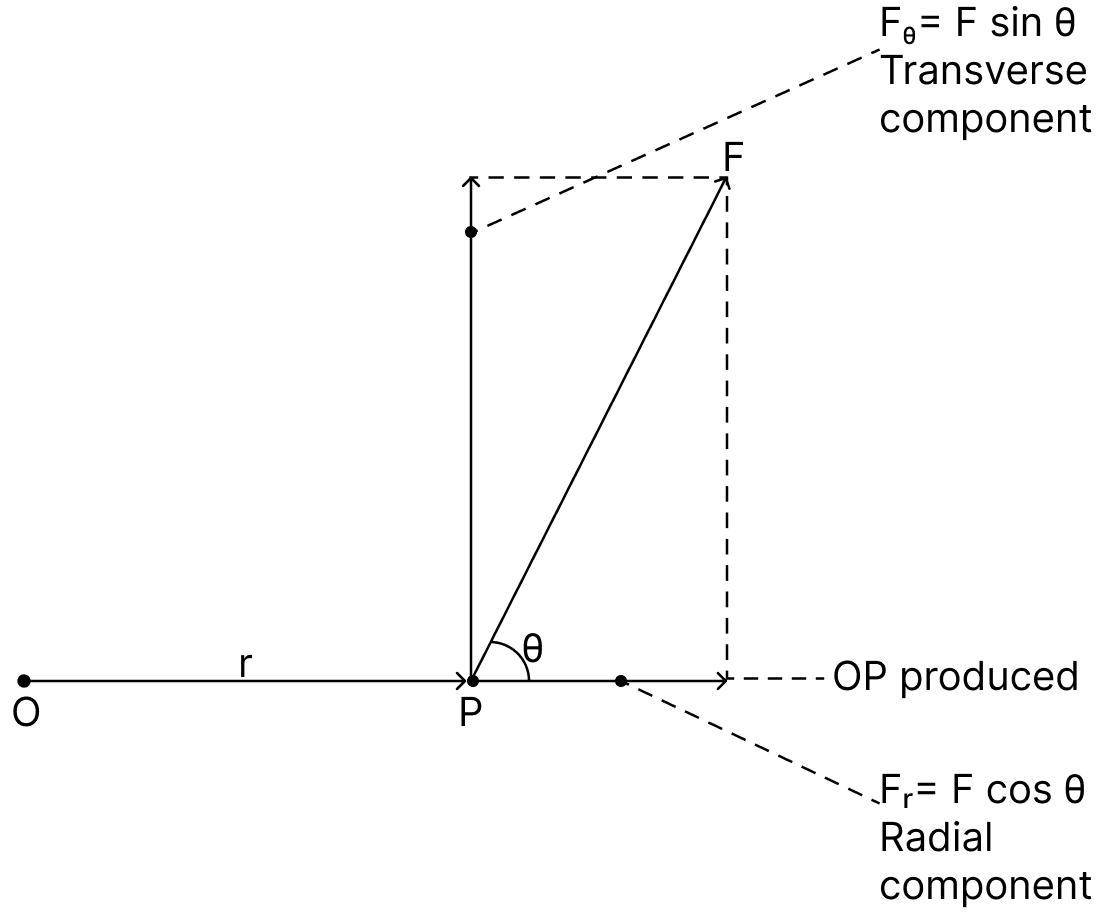
Let Fr and Fθ be the components of a force in the direction of increasing r and θ respectively. These are called the radial and the transverse (angular) components of the force. If θ is the angle between and the position vector , then
The magnitude of the torque about the axis of rotation is
This expression contains only the transverse component Fθ; the radial component Fr does not appear in it at all. The reason is that the radial component acts along the position vector, that is, along the line joining the point of application to the axis, so its perpendicular distance from the axis is zero.
Hence, the torque is due to the transverse component of the force only, and the radial component does not contribute to the torque. For this reason the gravitational force of the sun on the earth, being purely radial, produces no torque about the sun.
Explain the concept of torque. Write its unit and dimensions.
Answer
Concept of torque : The moment of a force is a vector quantity, and when expressed vectorially it gives the torque. It is the measure of the rotational tendency, or capability, of a force about a fixed line or axis, and is expressed as the product of the magnitude of the force and the perpendicular distance of the axis of rotation from the line of action of the force.
If a force acts at a point whose position vector with respect to the axis is , then
and its magnitude is
where θ is the angle between and . Torque is an axial vector, its direction being perpendicular to the plane containing and , given by the right hand thumb rule. An anticlockwise moment is taken positive and a clockwise moment negative.
Unit : newton-metre (N m)
Dimensions : [ML2T-2]
Define angular acceleration. Establish a relation between angular acceleration and linear acceleration.
Answer
Angular acceleration : The rate of change of angular velocity of a body rotating about an axis is called its angular acceleration,
Its unit is rad s-2 and its dimensions are [T-2].
Relation between angular acceleration and linear acceleration : For a particle at a perpendicular distance r from the axis of rotation, the linear velocity and the angular velocity are related by
Differentiating both sides with respect to time, r being constant for a rigid body,
But is the linear acceleration and is the angular acceleration. Therefore
Hence, the linear acceleration of a particle is the product of its distance from the axis of rotation and the angular acceleration of the body.
Two circular discs A and B of same mass and same thickness are made of two different metals whose densities are dA and dB (dA > dB). Their moments of inertia about the axes passing through their centres of gravity and perpendicular to their planes are IA and IB. Which is greater, IA or IB?
Answer
IB is greater, that is, the moment of inertia of the disc made of the lighter metal is greater.
Both discs have the same mass m and the same thickness t. Their moments of inertia about the given axes are
Since the mass of each disc is the product of its volume and its density,
Substituting in equation (i),
It is given that dA > dB, so < 1, which gives
Hence, IB is greater. Physically, the disc of the lighter metal must have a larger radius to have the same mass, so its material particles lie on the average at a greater distance from the axis of rotation.
The moments of inertia of two rotating bodies A and B are IA and IB (IB > IA) and their angular momenta are equal. Which one has a greater kinetic energy?
Answer
The body A, having the smaller moment of inertia, has the greater kinetic energy.
The kinetic energy of rotation and the angular momentum of a rotating body are
Eliminating ω between them,
The angular momenta of A and B are equal, say L. Therefore
It is given that IB > IA, so > 1, that is,
For equal angular momenta the kinetic energy is inversely proportional to the moment of inertia.
The angular momenta of two rotating bodies A and B are equal. The moment of inertia of A is half that of B. Find the ratio of the kinetic energies of A and B.
Answer
Given,
- Angular momenta are equal, LA = LB = L
- Moment of inertia of A is half that of B,
For a rotating body the kinetic energy in terms of the angular momentum is
Therefore,
Substituting ,
Hence, the ratio of the kinetic energies of A and B is KA : KB = 2 : 1.
What is meant by 'moment of inertia'? Write its unit in MKS system.
Answer
Moment of inertia : The moment of inertia of a particle about an axis of rotation is the product of the mass of the particle and the square of its distance from the axis of rotation, I = mr2.
For a rigid body composed of a large number of particles of masses m1, m2, ..., mn at perpendicular distances r1, r2, ..., rn from the axis, the moment of inertia is the sum of the moments of inertia of all the constituent particles,
Unit in the MKS system : kg m2
In the equation , if τ is torque, then what will be the unit of L?
Answer
In the given equation,
L is the angular momentum of the body. Rearranging,
Hence the unit of L is the unit of torque multiplied by the unit of time,
Hence, the unit of L is kg m2 s-1, which is also written as J s.
In physics, the centre of mass of a system of particles is the point that moves as if all the system's mass were concentrated there and all external forces were applied there. For a uniform, symmetric object, the centre of mass coincides with the geometric centre, but for irregular or non-uniform objects, it may lie outside the material body. The terms "centre of mass" and "centre of gravity" are often used interchangeably, but they have distinct meanings in physics. The centre of gravity is the point where the total weight of the body acts. It is the point at which the force of gravity can be considered to act. For practical purposes, in a uniform gravitational field, the centre of gravity coincides with the centre of mass. But in a non-uniform gravitational field, such as in the case of large structures or objects in space where gravitational strength varies significantly across the object, the centre of gravity and centre of mass may not coincide. The centre of mass is crucial in analyzing both the translational and rotational motion of objects.
(i) The centre of mass of an object:
- Must always lie within the object.
- Can be outside the material body.
- Is always at the geometric centre.
- Is always at the origin of the coordinate system.
(ii) If the centre of mass of a system of particles is at rest, what can be said about the motion of the particles in the system?
- All particles are at rest.
- All particles are moving.
- The system's total linear momentum is zero.
- The system's total kinetic energy is zero.
(iii) In a projectile motion, the centre of mass of the projectile follows a:
- Circular path
- Parabolic path
- Straight line path
- Elliptical path
(iv) In a two-particle system, the centre of mass lies closer to the particle with:
- Higher velocity
- Greater mass
- Larger acceleration
- Smaller mass
(v) In the case of a mountain and an ocean, the positions of the centre of gravity and the centre of mass are such that:
- The centre of mass is above the centre of gravity
- The centre of mass is below the centre of gravity
- Both are at the same point
- None of the above.
Answer
(i) Can be outside the material body.
The centre of mass is a geometric property of the body, determined by the distribution of its mass and not by its physical boundaries. Hence for an irregular or non-uniform object there need be no matter at the location of the centre of mass. For a ring, for instance, the centre of mass lies at the centre, where there is no material at all.
(ii) The system's total linear momentum is zero.
The total linear momentum of a system is related to the velocity of its centre of mass by
If the centre of mass is at rest, and hence . This does not mean that the individual particles are at rest; they may be moving in such a way that their momenta cancel out.
(iii) Parabolic path.
In projectile motion the only external force acting on the body is gravity, which is constant. Since the centre of mass moves as if the whole mass were concentrated there and the external force applied there, it moves under a uniform acceleration. The horizontal component of the velocity remains constant while the vertical component changes uniformly, and the resulting path is a parabola.
(iv) Greater mass.
For a two-particle system,
This is a weighted average in which each position is weighted by its own mass. The heavier particle exerts a stronger influence on the average, so the centre of mass lies closer to it.
(v) The centre of mass is above the centre of gravity
In the case of a mountain the gravitational field is stronger closer to the earth's surface. The lower portions of the mountain therefore contribute more weight than they contribute mass, and this shifts the centre of gravity slightly downward compared with the centre of mass. Hence the centre of mass lies above the centre of gravity.
Moment of inertia is a measure of an object's resistance to rotational motion about an axis. It depends not only on the object's mass but also on the distribution of that mass relative to the axis of rotation. For simple geometries, the moment of inertia can be calculated using standard formulas, but for complex shapes, it may require integration. This design principle is a brilliant example of how the concept of moment of inertia is applied to optimize the performance and efficiency of mechanical systems in everyday life. A well-known application of moment of inertia is evident in the design of bicycles and flywheels, where the mass is intentionally concentrated near the rim, far from the axis of rotation. This strategic distribution of mass significantly increases the moment of inertia, which is crucial for smoothing out fluctuations in angular velocity. In flywheels, this helps to counteract the intermittent power delivery from engine pistons, ensuring a more consistent rotational speed. Similarly, in bicycles, the enhanced moment of inertia from the rim helps to stabilize the motion and maintain a steady pace, even when the pedaling force varies.
(i) Why is a flywheel designed with a large moment of inertia?
- To increase the engine's power.
- To reduce friction in the engine.
- To store more rotational energy and smooth out fluctuations in angular velocity.
- To make the engine easier to start.
(ii) If a flywheel's moment of inertia is doubled while keeping the same angular velocity, how does the stored energy change?
- It stays the same
- It doubles
- It halves
- It quadruples
(iii) What would be the effect on engine smoothness if a flywheel with less moment of inertia is used?
- The engine will run smoother
- It will have more fluctuations in angular velocity
- It will produce more power
- The engine's fuel efficiency will increase.
(iv) Suppose you spin a bicycle wheel by holding it at the axle and giving it a push at the rim. Which part of the wheel contributes most to its moment of inertia?
- The spokes
- The tyre
- The axle
- All parts contribute equally
(v) In the above question, if you want to make the wheel spin faster with the same push, what could you do?
- Reduce the mass of the tyre
- Increase the mass of the tyre
- Decrease the size of the wheel
- Increase the size of the wheel
Answer
(i) To store more rotational energy and smooth out fluctuations in angular velocity.
The torque rotating the shaft of an engine changes periodically, so the shaft cannot rotate uniformly. A flywheel of large moment of inertia is attached to the shaft, and because of this large moment of inertia the flywheel continues to rotate almost uniformly in spite of the changing torque. This counteracts the intermittent power delivery from the engine pistons and keeps the rotational speed steady.
(ii) It doubles.
The rotational kinetic energy stored in a flywheel is
If the moment of inertia is doubled while ω is kept the same,
(iii) It will have more fluctuations in angular velocity
A flywheel with a smaller moment of inertia stores less rotational energy, so it is less able to carry the shaft through the parts of the cycle in which the driving torque is small. The angular velocity therefore fluctuates more during the engine's cycle, making the engine run less smoothly.
(iv) The tyre
The moment of inertia depends on both the mass and the square of its distance from the axis of rotation. The tyre is farthest from the axle and also carries a significant part of the mass of the wheel, so it contributes most to the moment of inertia. The spokes are distributed over smaller distances and the axle lies on the axis itself, where r = 0.
(v) Reduce the mass of the tyre
The moment of inertia of a wheel may be written as I = kmr2. Reducing the mass of the tyre decreases I, and from τ = Iα a smaller moment of inertia gives a greater angular acceleration for the same applied torque, so the wheel spins faster with the same push. Decreasing the size of the wheel would also reduce I, but in practice this is often not feasible since it would require altering the entire frame and gear system of the vehicle.
In physics, the concept of the centre of mass plays a crucial role in understanding the motion of extended bodies. The centre of mass is the point where the entire mass of a body can be considered to be concentrated for the purpose of analyzing translational motion. For a symmetrical object of uniform density, the centre of mass coincides with the geometric centre, but for irregular objects, it may lie outside the material body.
The moment of inertia, on the other hand, is a measure of an object's resistance to rotational motion about a given axis. It depends on the distribution of mass relative to the axis of rotation. The moment of inertia is mathematically expressed as where, mi the mass of the particle and ith particle and ri is its perpendicular distance from the axis of rotation. This concept is vital for understanding rotational dynamics and is directly related to the angular momentum of a rotating body. The radius of gyration K is defined such that I = MK2, where I is the moment of inertia and M is the mass of the body. It represents the effective distance from the axis of rotation where the entire mass can be assumed to be concentrated to produce the same moment of inertia.
Conservation of momentum, both linear and angular, is a fundamental principle in physics. Linear momentum is conserved in an isolated system where no external forces act, and similarly, angular momentum is conserved in the absence of external torques. This conservation leads to predictable outcomes in collisions and other interactions.
Rolling motion combines both translational and rotational motion, as seen in objects like wheels and cylinders. For pure rolling motion without slipping, the point of contact with the surface is momentarily at rest relative to the surface. The condition for rolling without slipping is v = rω, where v is the linear velocity of the centre of mass, r is the radius, and ω is the angular velocity.
Understanding these concepts provides insight into the mechanics of everyday objects and phenomena, from the rotation of the Earth to the motion of a rolling ball.
(i) The centre of mass of a system of particles:
- Always lies within the material of the body
- Can lie outside the material body.
- Is always at the origin of the coordinate system
- Is always at the centre of gravity.
(ii) Which of the following statements is true for a rolling object?
- The linear velocity of the centre of mass is equal to the product of angular velocity and radius.
- The linear velocity of the centre of mass is twice the product of angular velocity and radius.
- The angular velocity is always greater than the linear velocity.
- The linear velocity is independent of angular velocity.
(iii) A solid sphere and a hollow sphere of the same mass and radius are rolling without slipping. Which one reaches the bottom of an inclined plane first?
- Solid sphere.
- Hollow sphere.
- Both reach at the same time.
- It depends on the height of the plane.
(iv) If a figure skater pulls her arms in while spinning, which of the following best describes what happens to her moment of inertia and her radius of gyration?
- Both the moment of inertia and the radius of gyration decrease.
- The moment of inertia decreases, but the radius of gyration increases.
- The moment of inertia decreases, and the radius of gyration decreases.
- The moment of inertia and the radius of gyration remain constant.
(v) A gymnast tucks in her body while performing a somersault. What is the effect on her rotational speed and why?
- Her rotational speed decreases because her angular momentum is reduced.
- Her rotational speed increases because her moment of inertia decreases.
- Her rotational speed remains the same because her moment of inertia remains unchanged.
- Her rotational speed increases because her angular momentum increases.
Answer
(i) Can lie outside the material body.
The centre of mass depends solely on the distribution of mass and the positions of the masses, and not on the physical boundaries of any component of the system. Hence for irregular objects, such as a ring or an L-shaped body, the centre of mass may lie in the empty space near the structure rather than within the material itself.
(ii) The linear velocity of the centre of mass is equal to the product of angular velocity and radius.
For pure rolling motion without slipping, in one complete rotation the body travels a distance s = 2πR in a time . Therefore
This is precisely the condition for rolling without slipping, which ensures that the point of contact is momentarily at rest relative to the surface.
(iii) Solid sphere.
For a body rolling down an incline the acceleration of the centre of mass is
For a solid sphere , giving , while for a hollow sphere , giving . Since , the solid sphere has the greater acceleration and reaches the bottom first.
(iv) The moment of inertia decreases, and the radius of gyration decreases.
By pulling her arms in, the skater brings more mass closer to the axis of rotation, so the moment of inertia decreases. Since I = MK2 and the mass M is unchanged, a decrease in I means a decrease in K as well. Both the moment of inertia and the radius of gyration therefore decrease.
*Note: Options 1 and 3 are conceptually identical. Both are technically correct, though the source book lists Option 3.
(v) Her rotational speed increases because her moment of inertia decreases.
By tucking in her body the gymnast brings her mass closer to the axis of rotation, reducing her moment of inertia. No external torque acts on her while she is in the air, so her angular momentum L = Iω is conserved. Since I decreases, ω must increase in order to keep the product constant, and she spins faster.
What is meant by 'centre of mass' of a system? Obtain expressions for the centre of mass of a system consisting of two particles. What is the physical significance of the centre of mass of a system?
Answer
Centre of mass : Every physical system has associated with it a certain point whose motion characterises the motion of the whole system. When the system moves under some external force, this point moves as if the entire mass of the system were concentrated at this point and also the external force were applied at this point. This point is called the centre of mass of the system.
Expression for the centre of mass of a system of two particles :
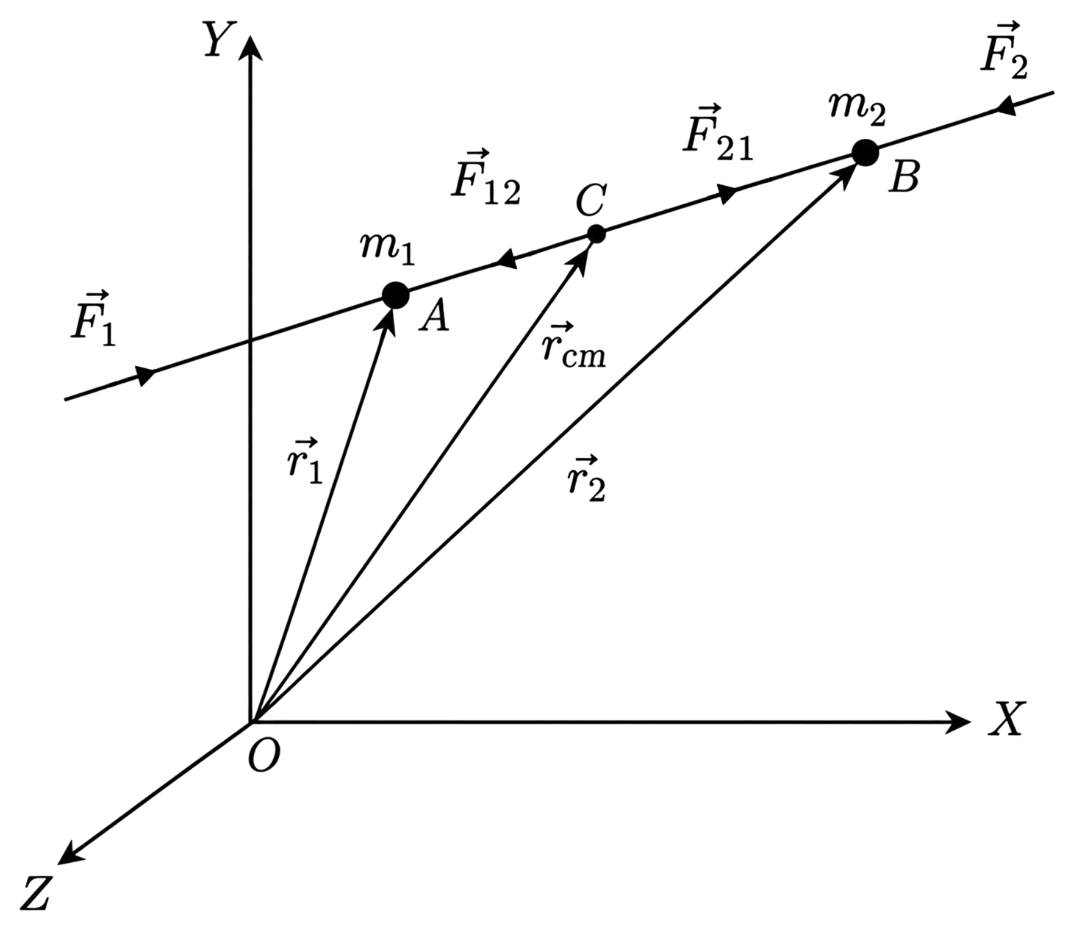
Consider a system of two particles A and B of masses m1 and m2, with position vectors and with respect to an origin O. Let and be the external forces on them and , the internal forces.
Since the internal forces obey Newton's third law of motion,
The net force acting on the system is
Applying Newton's second law to each particle,
Adding these and using equations (i) and (ii),
Multiplying and dividing the right hand side by (m1 + m2),
Now if a point of mass (m1 + m2) situated at C with position vector is acted upon by the net force , then by Newton's second law,
Comparing equations (iii) and (iv),
In Cartesian components, comparing the coefficients of and ,
Physical significance of the centre of mass : The centre of mass allows the overall translatory motion of a composite body to be described without bothering about each individual particle of the body. The entire mass may be replaced by a single point mass located at the centre of mass, and the usual laws of particle kinematics can then be applied. The motion of the system is thus described completely in terms of the motion of its centre of mass, since the internal forces cancel in pairs and only the external force determines its acceleration.
Prove that the total linear momentum of a system of particles is equal to the product of the total mass of the system and the velocity of its centre of mass.
Answer
Consider a system of n particles of masses m1, m2, ..., mn moving with velocities respectively.
The total linear momentum of the system is the vector sum of the momenta of the individual particles,
By the definition of the velocity of the centre of mass of a system,
where M is the total mass of the system.
Multiplying both sides of equation (ii) by M,
Comparing equations (i) and (iii),
Hence, the total linear momentum of a system of particles is equal to the product of the total mass of the system and the velocity of its centre of mass.
Consequence : Differentiating this result with respect to time,
If no external force acts on the system, , so is constant. This shows that the linear momentum of the centre of mass remains constant in the absence of an external force.
Establish the relation between torque and moment of inertia in rotational motion and define from it moment of inertia.
Answer
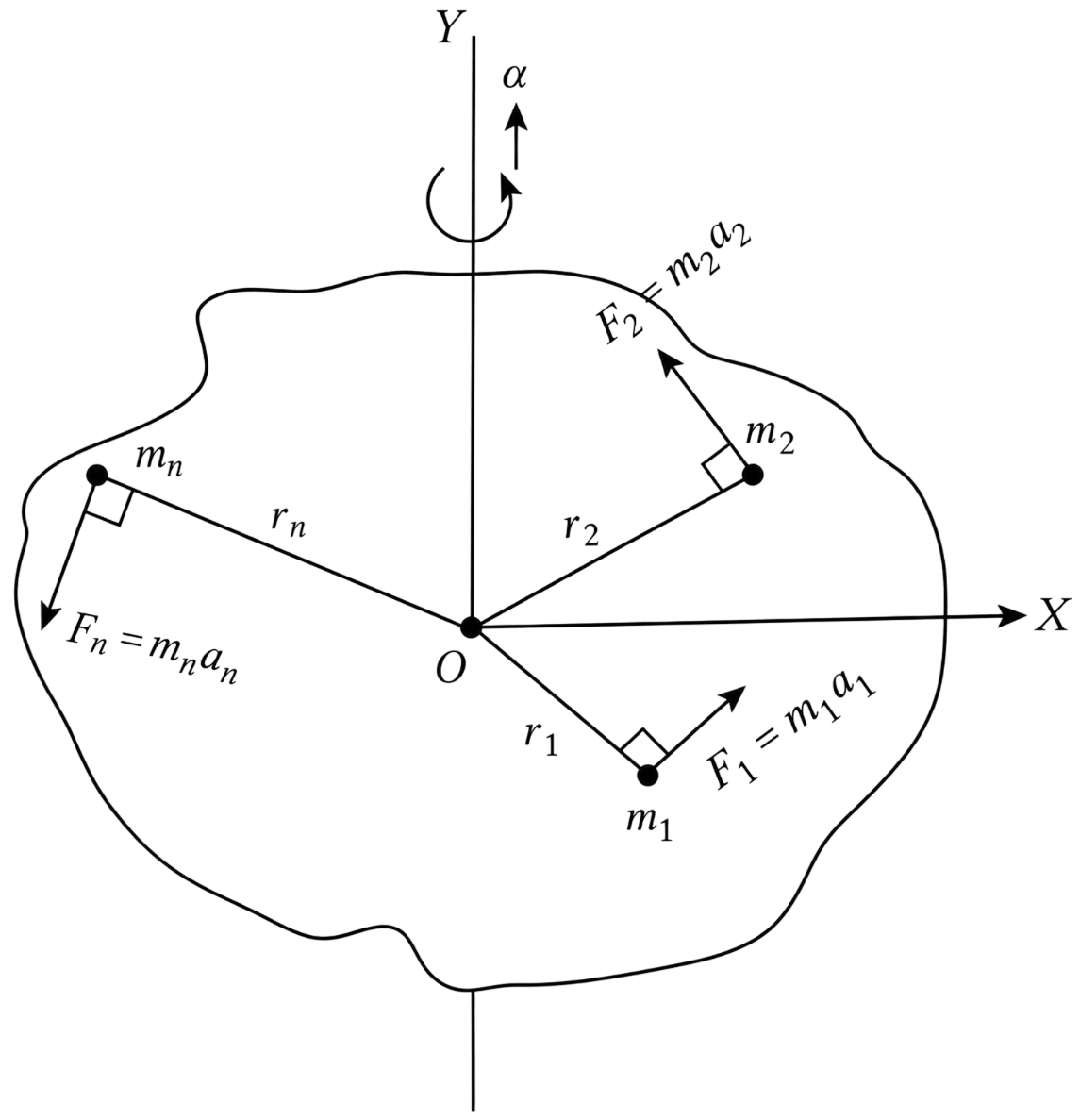
Consider a rigid body rotating with a constant angular acceleration α about an axis OY perpendicular to the plane of the paper. Let the body consist of n particles of masses m1, m2, ..., mn at perpendicular distances r1, r2, ..., rn from the axis of rotation.
As the body rotates, all these particles perform circular motion with the same angular acceleration α, but with different linear accelerations,
The forces experienced by these particles are
These forces are tangential, so their respective perpendicular distances from the axis are r1, r2, ..., rn. The torque experienced by the first particle is
Similarly, , and so on. Since the rotation is restricted to a single plane, the directions of all these torques are the same and along the axis of rotation. Hence the magnitude of the resultant torque is
But
is the moment of inertia of the body about the axis of rotation. Therefore
Definition of moment of inertia from this relation : From τ = Iα,
Putting α = 1 rad s-2 gives I = τ. Hence, the moment of inertia of a particle or a rigid body about an axis of rotation is numerically equal to the torque capable of producing unit angular acceleration in the body about the same axis of rotation.
A body is rotating with a uniform angular velocity ω about an axis. Establish the formula for its kinetic energy of rotation. Define moment of inertia of the body with respect to the axis of rotation on this basis.
Answer
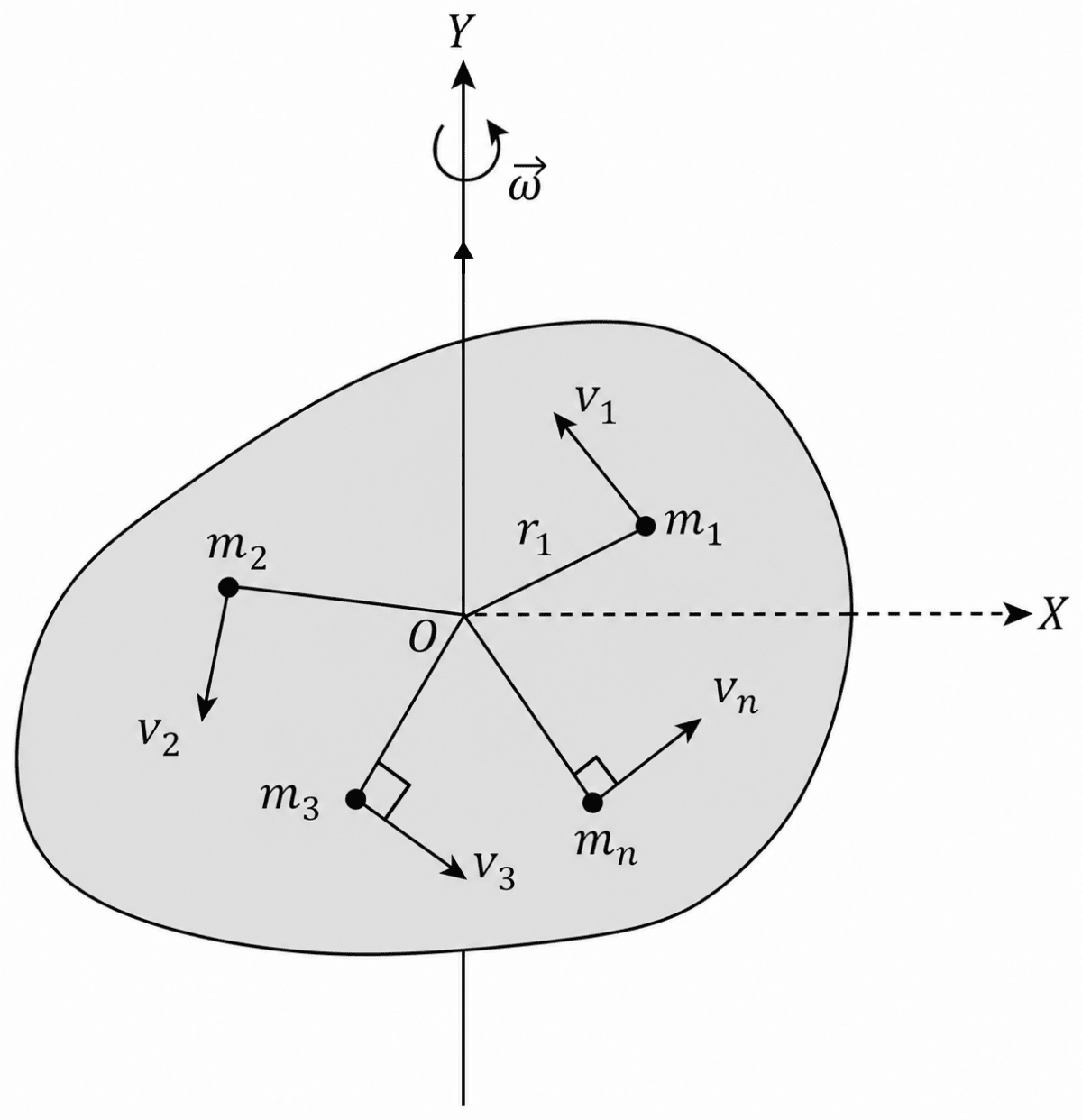
Consider a rigid body rotating about an axis with a uniform angular velocity ω. Let the body consist of particles of masses m1, m2, ..., mn at perpendicular distances r1, r2, ..., rn from the axis of rotation.
The angular velocity of all the particles is the same, but their linear velocities are different. Since the linear velocity of a particle is the product of its angular velocity and its distance from the axis of rotation, for the first particle
The kinetic energy of this particle is
Similarly, the kinetic energies of the other particles are , , and so on.
The kinetic energy K of the whole body is the sum of the kinetic energies of all its particles,
But is the moment of inertia I of the body about the axis of rotation. Therefore
This is the formula for the kinetic energy of uniform rotation. Just as the kinetic energy of linear motion is half the product of the mass and the square of the linear velocity, the kinetic energy of rotation is half the product of the moment of inertia and the square of the angular velocity.
Definition of moment of inertia on this basis : From the above formula,
If ω = 1 rad s-1, then I = 2K. Hence, the moment of inertia of a body rotating about an axis with unit angular velocity is equal to twice its kinetic energy of rotation about that axis.
Define angular momentum. If the moment of inertia of a body about an axis of rotation be I and the angular velocity be ω, then write the expressions for the angular momentum and the kinetic energy of rotation.
Answer
Angular momentum : The quantity in rotational mechanics analogous to linear momentum is called angular momentum. It is also defined as the moment of linear momentum, which is similar to the torque being the moment of a force.
If is the instantaneous linear momentum of a particle executing circular motion and its position vector, then
and its magnitude is
Its S.I. unit is kg m2 s-1 and its dimensional formula is [ML2T-1].
Expression for the angular momentum : For a body of moment of inertia I rotating with angular velocity ω about an axis, consider a particle of mass m1 at a distance r1 from the axis. Its linear velocity is v1 = r1ω and its linear momentum is p1 = m1v1. The moment of this momentum about the axis is
Summing over all the particles of the body,
Expression for the kinetic energy of rotation :
The two are related by .
Write down the three equations of rotational motion corresponding to the three equations of linear motion.
Answer
In rotational motion the angular displacement θ, the angular velocity ω and the angular acceleration α are the analogues of the linear displacement s, the linear velocity v and the linear acceleration a respectively.
Let a body rotate about an axis with an initial angular velocity ω0 under a constant angular acceleration α, and let it be displaced through an angle θ in time t, acquiring a final angular velocity ω. The three equations of rotational motion, corresponding to the three equations of linear motion, are :
| Linear motion | Rotational motion |
|---|---|
| v = u + at | ω = ω0 + αt |
| v2 = u2 + 2as | ω2 = ω02 + 2αθ |
(i) First equation : By the definition of angular acceleration, , so dω = α dt. Integrating between the limits ω0 at t = 0 and ω at time t,
(ii) Second equation : Since , we have dθ = ω dt = (ω0 + αt)dt. Integrating,
(iii) Third equation : Eliminating t between the first two equations, , and substituting in the second,
State the theorem of perpendicular axes pertaining to moment of inertia.
Answer
Theorem of perpendicular axes : The moment of inertia of a uniform plane lamina about an axis perpendicular to its plane is equal to the sum of its moments of inertia about any two mutually perpendicular axes in its plane intersecting on the first axis.
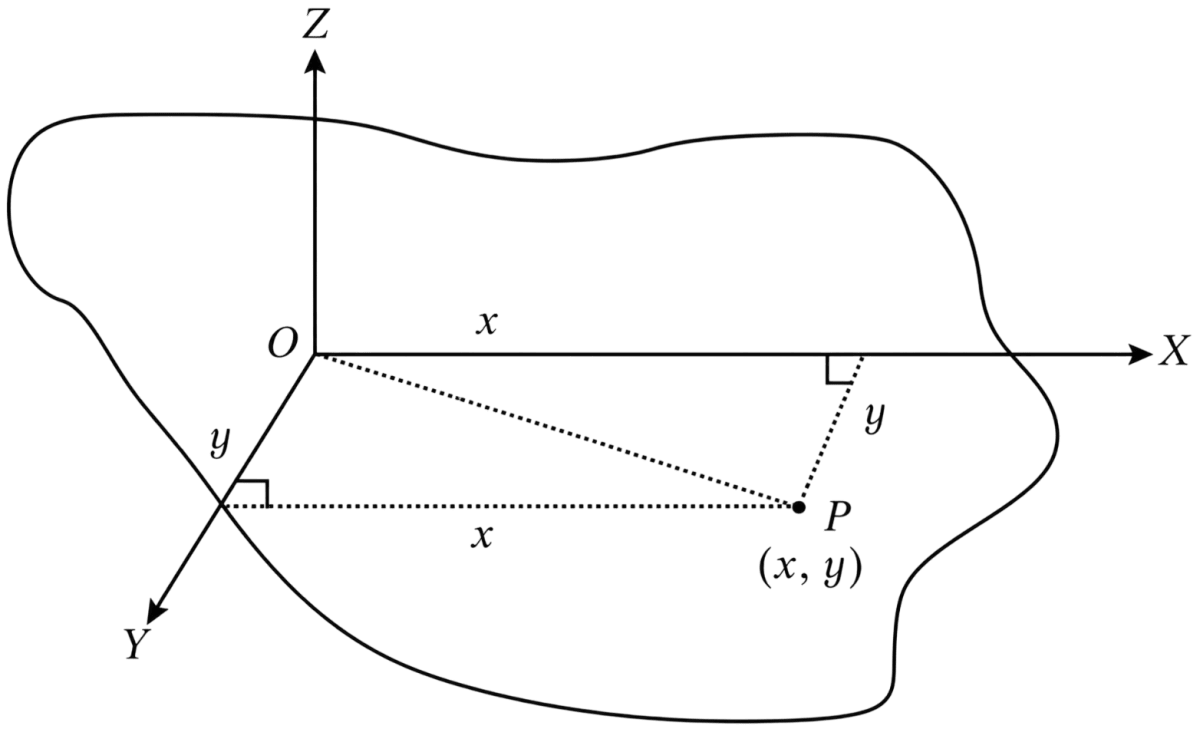
Proof : Let OZ be the axis perpendicular to the plane of the lamina about which the moment of inertia is to be taken. Let OX and OY be two mutually perpendicular axes in the plane of the lamina, intersecting on OZ.
Consider a particle P of mass m at a distance r from OZ. The moment of inertia of this particle about OZ is mr2. Therefore the moment of inertia of the whole lamina about OZ is
If x and y are the distances of P from OY and OX respectively, then
Substituting this value,
But is the moment of inertia Iy of the lamina about OY, and is the moment of inertia Ix of the lamina about OX. Therefore
Applicability : The theorem holds only for planar (two-dimensional) objects such as thin discs, rings and triangular plates, because its proof requires every mass element to lie in a single plane. It cannot be applied to three-dimensional objects like spheres, cylinders and cones, whose mass is distributed in all three dimensions.
Define angular momentum. Obtain the relation between the angular momentum and the moment of inertia of a body.
Answer
Angular momentum : The quantity in rotational mechanics analogous to linear momentum is called angular momentum. It is defined as the moment of linear momentum, that is, the product of the linear momentum of a particle and its perpendicular distance from the axis of rotation.
In vector form,
whose magnitude is L = pr sin θ, where θ is the angle between and . Angular momentum is an axial vector, its direction being given by the right hand thumb rule.
Relation between angular momentum and moment of inertia : Let a body be rotating about an axis with angular velocity ω. All the particles of the body have the same angular velocity, but their linear velocities are different.
Consider a particle of mass m1 at a perpendicular distance r1 from the axis of rotation. Its linear velocity is
so its linear momentum is p1 = m1v1. The moment of this linear momentum about the axis of rotation is
Similarly, for the other particles of masses m2, m3, ..., mn at distances r2, r3, ..., rn, the moments of their linear momenta are , , ..., .
The angular momentum of the body is the sum of the moments of the linear momenta of all its particles,
But is the moment of inertia I of the body about the axis of rotation. Hence
Just as the linear momentum of a body is the product of its mass and its linear velocity, the angular momentum of a body about an axis is the product of its moment of inertia and its angular velocity about that axis.
Derive the relation between torque and angular momentum and establish from it the principle of conservation of angular momentum.
Answer
Relation between torque and angular momentum :
Let a rigid body be rotating about an axis under the action of a torque τ, producing an angular acceleration about the same axis. Let its moment of inertia about the given axis be I.
Then,
The angular momentum of the body about the same axis is
Differentiating equation (ii) with respect to time, the moment of inertia I being constant,
Comparing this with equation (i),
Hence, the rate of change of angular momentum is equal to the torque acting on the body. This is similar to , which is Newton's second law for linear motion, and so it is Newton's second law for rotational dynamics.
Principle of conservation of angular momentum :
In the above relation, if the external torque acting on the body is zero, that is, τ = 0, then
which gives
Since L = Iω, in the absence of an external torque
Statement : The total angular momentum of a system remains constant if no external torque acts on the system.
Illustration : When a figure skater spinning with her arms extended pulls her arms in, her moment of inertia decreases from I1 to I2. To conserve angular momentum her angular velocity increases from ω1 to ω2 such that I1ω1 = I2ω2, and she spins faster with her arms pulled in.
State the conditions of equilibrium of a rigid body. Apply these conditions to discuss the equilibrium of a uniform leaning ladder against a smooth wall and rough floor.
Answer
Conditions of equilibrium of a rigid body : A rigid body can execute translational as well as rotational motion, or both at the same time. Therefore, for a rigid body to be in static equilibrium, it must satisfy the conditions of both translational and rotational equilibrium simultaneously.
(i) Condition of translational equilibrium : The net force acting on the body must be zero,
If all the forces lie in the X-Y plane, this gives the two scalar equations
Under this condition the body is either at rest or its centre of mass moves with a constant velocity.
(ii) Condition of rotational equilibrium : The net torque on the body about any axis must be zero,
that is, the sum of the anticlockwise moments about any axis must equal the sum of the clockwise moments about that axis. Since , this gives , so the angular velocity ω, and hence the angular momentum L = Iω, remains constant.
Equilibrium of a uniform leaning ladder :
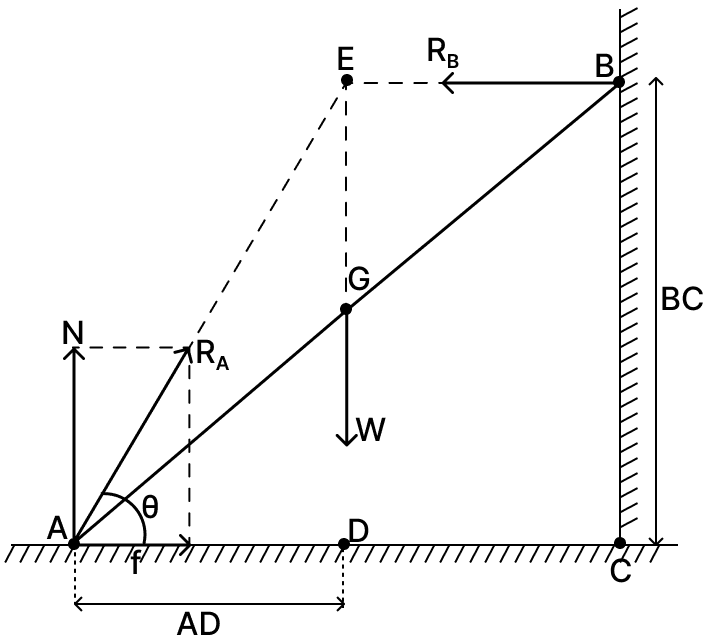
Let a uniform ladder AB lean against a smooth vertical wall and rest on a rough horizontal floor. Since the ladder is uniform, its centre of gravity G is exactly at its middle, where its weight W acts vertically downwards.
The wall is smooth, so the reaction RB exerted by the wall on the ladder is horizontal and normal to the wall. The reaction RA exerted by the ground is the vector sum of a normal force N and the force of friction f. The force of friction acts towards the wall, since the tendency of motion of the point A of the ladder is away from the wall.
If RA makes an angle θ with the floor, then
Applying the condition of translational equilibrium, ΣFx = 0 and ΣFy = 0,
Applying the condition of rotational equilibrium, Στ = 0, and taking moments of the forces about the point A,
where AD is the horizontal distance of the centre of gravity from A and BC is the height of the point of contact B above the floor. Solving these equations, the unknown quantities RA, RB, N, f and θ can be obtained.
State the theorem of parallel axes pertaining to moment of inertia. About what axis is the moment of inertia of a body minimum?
Hint : It is minimum about the axis passing through the centre of mass of the body.
Answer
Theorem of parallel axes : The moment of inertia I of a body about any axis is equal to its moment of inertia Icm about a parallel axis through its centre of mass, plus the product of the mass M of the body and the square of the perpendicular distance a between the two axes,
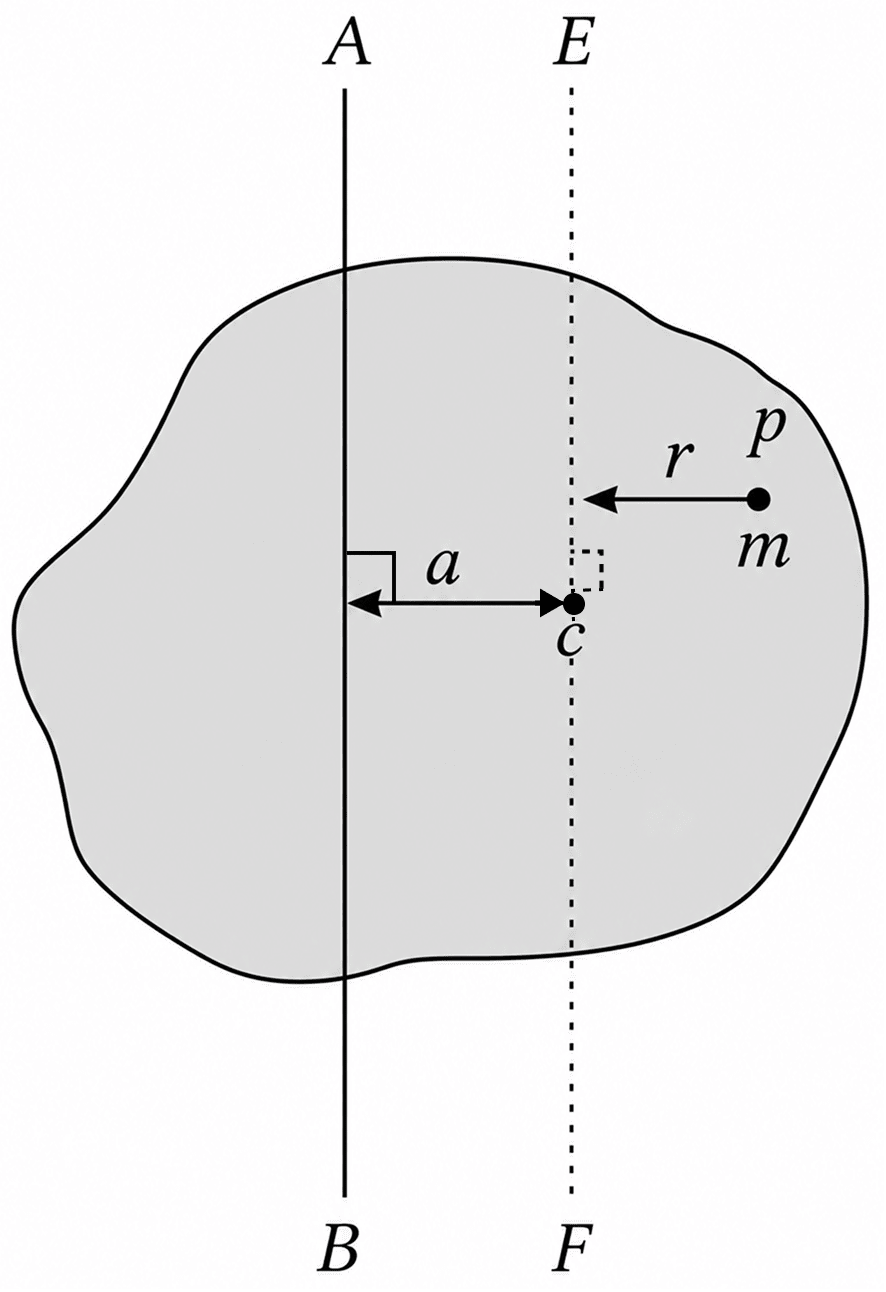
Proof : Let C be the centre of mass of a plane lamina. Let I be its moment of inertia about an axis AB in its plane, and Icm its moment of inertia about a parallel axis EF passing through C. Let the distance between EF and AB be a.
Consider a particle P of mass m at a distance r from EF. Its distance from AB is (r + a), so its moment of inertia about AB is m(r + a)2. Therefore the moment of inertia of the whole lamina about AB is
Since a is a constant, it can be taken outside the summation,
Now,
- , the moment of inertia of the lamina about EF
- , where M is the total mass of the lamina
- , because the sum of the moments of all the mass-particles of a body about an axis through the centre of mass is zero
Making these substitutions in equation (i),
Axis about which the moment of inertia is minimum : Since M and a2 are always positive quantities, the term Ma2 is always positive, so I is always greater than Icm. The moment of inertia is least when a = 0, that is, when the axis passes through the centre of mass.
Hence, the moment of inertia of a body is minimum about an axis passing through its centre of mass.
Three point-masses of 1 g, 2 g and 3 g lie in the X-Y plane at respective points (1, 2), (0, -1) and (2, -3). Find the co-ordinates of the centre of mass of the system.
Answer
Given,
- m1 = 1 g at (1, 2)
- m2 = 2 g at (0, − 1)
- m3 = 3 g at (2, − 3)
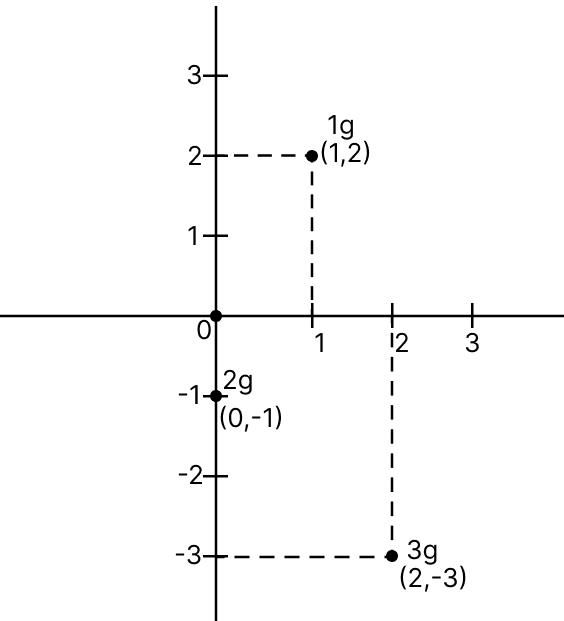
The coordinates of the centre of mass of a system of particles are
x-coordinate :
y-coordinate :
Hence, the co-ordinates of the centre of mass of the system are .
Three point-masses of 2 g, 3 g and 4 g are placed at the vertices of an equilateral triangle of side 1 m. Find the centre of mass of the system.
Answer
Given,
- m1 = 2 g, m2 = 3 g and m3 = 4 g at the vertices of an equilateral triangle
- Side of the triangle = 1 m
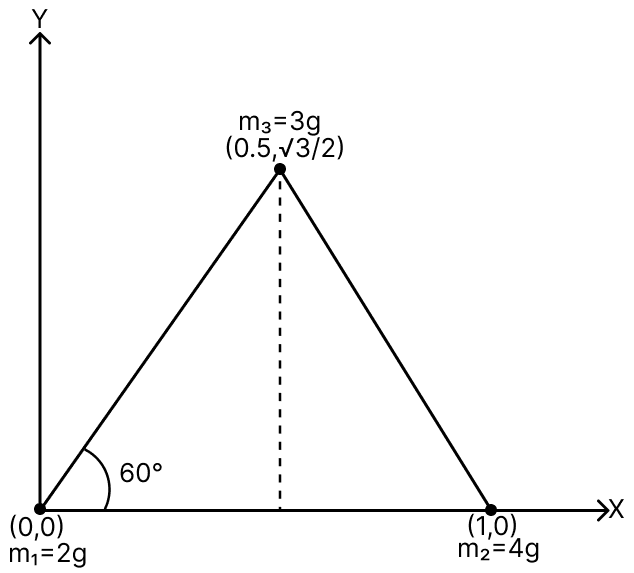
Let the triangle lie in the X-Y plane with m1 at the origin and the side m1m2 along the X-axis. Then the coordinates of the three masses are
since the height of an equilateral triangle of side 1 m is m.
x-coordinate of the centre of mass :
y-coordinate of the centre of mass :
Hence, the centre of mass of the system is at .
Particles of masses m1 = 2 g, m2 = 2 g, m3 = 1 g and m4 = 1 g are placed at the corners of a square of side L, as shown. Find the centre of mass of the system with respect to m1.
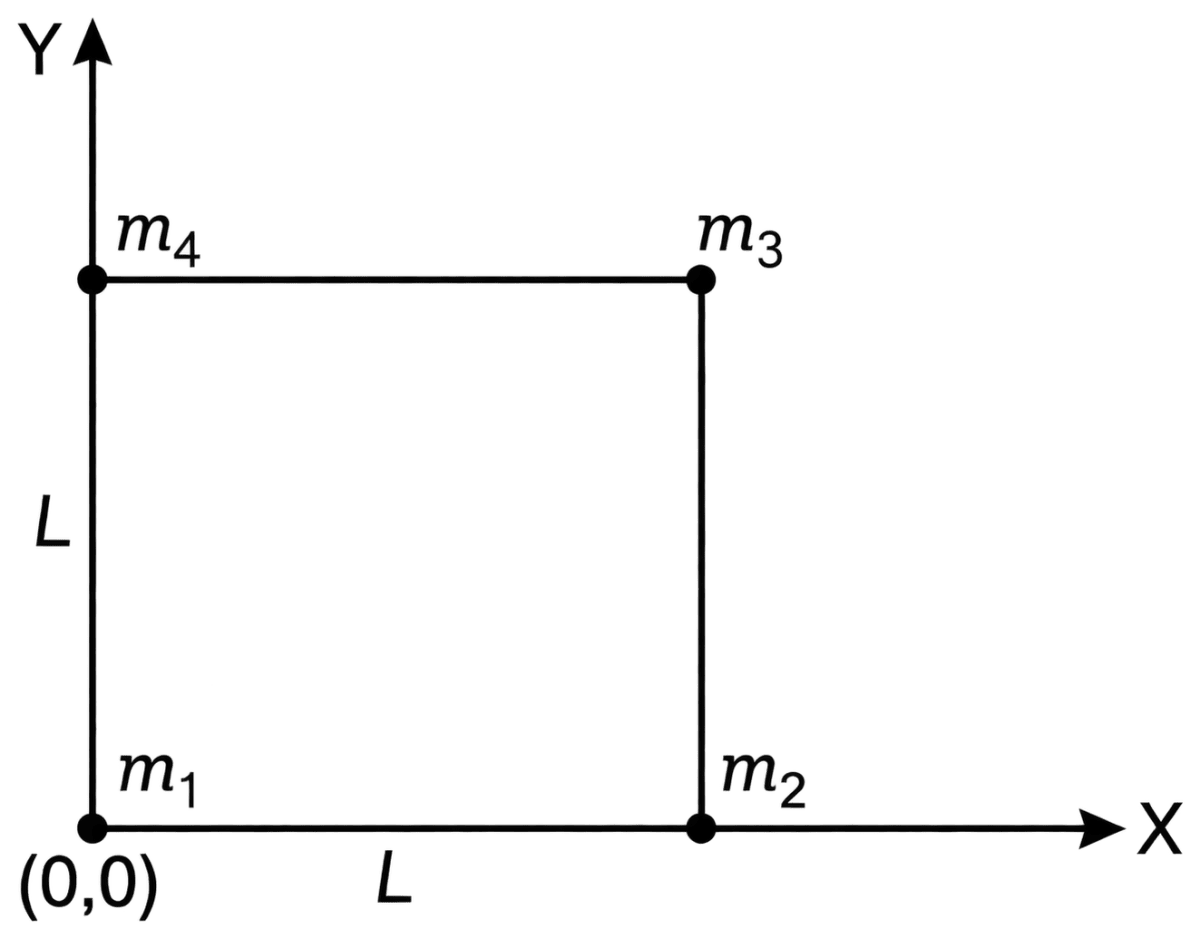
Answer
Given,
- m1 = 2 g, m2 = 2 g, m3 = 1 g, m4 = 1 g
- Side of the square = L
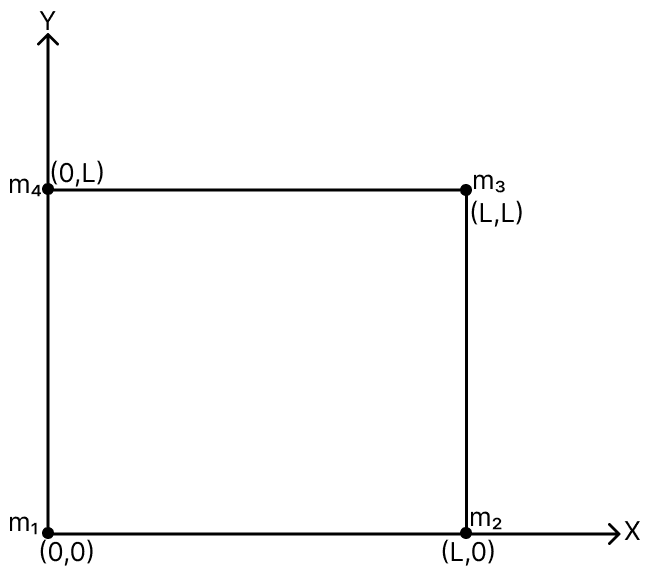
Taking m1 at the origin, with the sides of the square along the X- and Y-axes, the coordinates of the four masses are
x-coordinate of the centre of mass :
y-coordinate of the centre of mass :
Hence, the centre of mass of the system with respect to m1 is at .
The moment of inertia of a ring is 0.40 kg m2. If it is rotating at a rate of 2100 revolutions per minute, calculate the torque required to stop it in 2.0 s. What will be the work done?
Answer
Given,
- Moment of inertia of the ring, I = 0.40 kg m2
- Initial rate of rotation = 2100 revolutions per minute
- Time to stop, t = 2.0 s
- Final angular velocity, ω = 0
The initial angular velocity is
Angular retardation : From ω = ω0 + αt,
Torque required :
The negative sign shows that the torque is opposite to the direction of rotation.
Work done : The work done is equal to the change in the kinetic energy of rotation. Since the ring finally comes to rest,
Hence, the torque required to stop the ring is 44 N m and the work done is 9680 J (nearly), the negative sign indicating that the work is done against the rotation.
Moment of inertia of a ring is 3 kg m2. It is rotated for 20 s from its rest position by a torque of 6 N-m. Calculate the work done.
Answer
Given,
- Moment of inertia of the ring, I = 3 kg m2
- Torque applied, τ = 6 N m
- Time, t = 20 s
- Initial angular velocity, ω0 = 0 (starts from rest)
The angular acceleration produced is
The angular displacement in 20 s is
The work done by a torque in rotatory motion is
Hence, the work done is 2400 J.
A disc of diameter 0.4 m and of mass 5 kg is rotating about its axis at the rate of 28 rev/s. Find (i) angular momentum and (ii) rotational kinetic energy of the disc.
Answer
Given,
- Diameter of the disc = 0.4 m, so radius R = 0.2 m
- Mass of the disc, M = 5 kg
- Rate of rotation, n = 28 rev/s
The moment of inertia of a disc about its own axis is
The angular velocity is
(i) Angular momentum :
(ii) Rotational kinetic energy :
Hence, the angular momentum of the disc is 17.6 kg m2 s-1 and its rotational kinetic energy is 1548.8 J.
Note: The textbook answer key gives 70.4 kg m2 s-1 and 6195.2 J, which are exactly four times these values. Those figures correspond to taking 0.4 m as the radius of the disc rather than its diameter, which does not agree with the data stated in the question.
A wheel is rotating at a rate of 1000 rotations/minute and its kinetic energy of rotation is 106 J. Determine the moment of inertia of the wheel about the axis of rotation.
Answer
Given,
- Rate of rotation = 1000 rotations/minute
- Kinetic energy of rotation, K = 106 J
The angular velocity of the wheel is
The kinetic energy of rotation is
Rearranging for the moment of inertia,
Substituting the values,
Hence, the moment of inertia of the wheel about the axis of rotation is 182 kg m2.
A body of mass 50 g is revolving about an axis in a circular path. The distance of the centre of mass of the body from the axis of rotation is 50 cm. Find the moment of inertia of the body.
Answer
Given,
- Mass of the body, m = 50 g = 0.05 kg
- Distance of the centre of mass from the axis of rotation, r = 50 cm = 0.5 m
The body revolves in a circular path, so it may be treated as a point mass at a distance r from the axis of rotation. The moment of inertia of a point mass about an axis is
Substituting the values,
Hence, the moment of inertia of the body is 1.25 × 10⁻² kg m2.
Two masses of 3.0 kg and 5.0 kg are placed at 20 cm and 70 cm marks respectively on a light wooden meter scale. What will be the moment of inertia of this system about an axis passing through (i) 0 cm, (ii) 100 cm marks and perpendicular to the meter scale?

Answer
Given,
- m1 = 3.0 kg at the 20 cm mark
- m2 = 5.0 kg at the 70 cm mark
- The metre scale is light, so its own mass may be neglected
The moment of inertia of a system of point masses about an axis is I = Σmiri2.
(i) About an axis through the 0 cm mark : The distances of the two masses from this axis are
(ii) About an axis through the 100 cm mark : The distances of the two masses from this axis are
Hence, the moment of inertia is 2.57 kg m2 about the 0 cm mark and 2.37 kg m2 about the 100 cm mark.
The moment of inertia of a flywheel is 4 kg-m2. What angular acceleration will be produced in it by applying a torque of 10 N-m on it?
Answer
Given,
- Moment of inertia of the flywheel, I = 4 kg m2
- Torque applied, τ = 10 N m
From the relation between torque, moment of inertia and angular acceleration,
Rearranging,
Substituting the values,
Hence, the angular acceleration produced in the flywheel is 2.5 rad s-2.
Three identical spheres A, B and C, each of radius R, are placed touching one another on a horizontal table. Where is the centre of mass of the system located relative to A (say)?
Answer
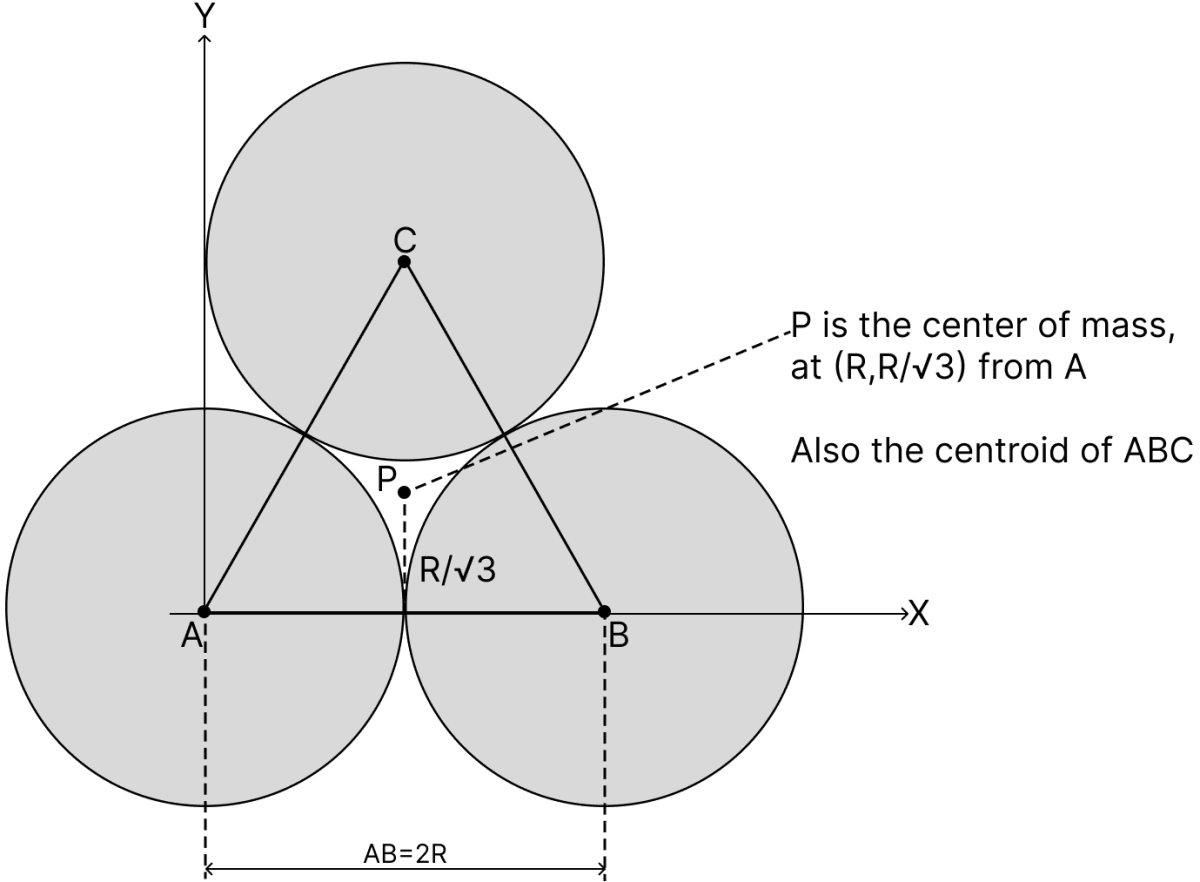
Given,
- Three identical spheres, each of radius R, placed touching one another on a horizontal table
The centre of mass of each sphere is at its own centre. Since the spheres touch one another, the distance between the centres of any two of them is 2R. Hence the problem reduces to finding the centre of mass of three equal masses m placed at the corners A, B and C of an equilateral triangle of side 2R.
Taking A as the origin and AB along the X-axis, the coordinates of the three centres are
since the height of an equilateral triangle of side 2R is .
x-coordinate of the centre of mass :
y-coordinate of the centre of mass :
Hence, the centre of mass of the system is located at relative to A. Since the three masses are equal, this point is the centroid of the equilateral triangle formed by the three centres.
The angular momentum of a body is 31.4 J s and its rate of revolution is 10 cycles per second. Calculate the moment of inertia of the body about the axis of rotation.
Answer
Given,
- Angular momentum of the body, L = 31.4 J s
- Rate of revolution, n = 10 cycles per second
The angular velocity of the body is
The angular momentum of a body rotating about an axis is
Rearranging for the moment of inertia,
Substituting the values,
Hence, the moment of inertia of the body about the axis of rotation is 0.5 kg m2.
A body of mass 1 kg is revolved in a horizontal circle by attaching to one end of 1 m long string. If the frequency of revolution is 20 rev/s, find about the axis of rotation (i) moment of inertia, (ii) angular momentum, (iii) rotational kinetic energy of the body and (iv) centripetal force acting on the body.
Answer
Given,
- Mass of the body, m = 1 kg
- Radius of the circle (length of the string), r = 1 m
- Frequency of revolution, n = 20 rev/s
The angular velocity of the body is
(i) Moment of inertia : The body may be treated as a point mass at a distance r from the axis,
(ii) Angular momentum :
(iii) Rotational kinetic energy :
(iv) Centripetal force :
Hence, the moment of inertia is 1 kg m2, the angular momentum is 40π kg m2 s-1, the rotational kinetic energy is 800π2 J and the centripetal force is 1600π2 N.
Find the moment of inertia of the hydrogen molecule about an axis passing through its centre of mass and perpendicular to the inter-nuclear axis. Given : mass of the hydrogen atom = 1.7 × 10⁻²⁷ kg, inter-atomic distance = 4 × 10⁻¹⁰ m.
Hint : In hydrogen molecule there are two atoms. Distance between them is an inter-atomic distance.
Answer
Given,
- Mass of each hydrogen atom, m = 1.7 × 10⁻²⁷ kg
- Inter-atomic distance, d = 4 × 10⁻¹⁰ m
In a hydrogen molecule there are two atoms of equal mass, and the distance between them is the inter-atomic distance d. Since the two atoms are identical, the centre of mass of the molecule lies exactly midway between them. Hence the distance of each atom from the axis passing through the centre of mass is
The moment of inertia of the molecule about this axis is the sum of the moments of inertia of the two atoms,
Substituting the values,
Hence, the moment of inertia of the hydrogen molecule about the given axis is 13.6 × 10-47 kg m2.
Three particles (each of mass 10 g) are situated at the three corners of an equilateral triangle of side 5 cm. Determine the moment of inertia of this system about an axis passing through one corner of the triangle and perpendicular to the plane of the triangle.
Answer
Given,
- Mass of each particle, m = 10 g = 0.01 kg
- Side of the equilateral triangle, a = 5 cm = 0.05 m
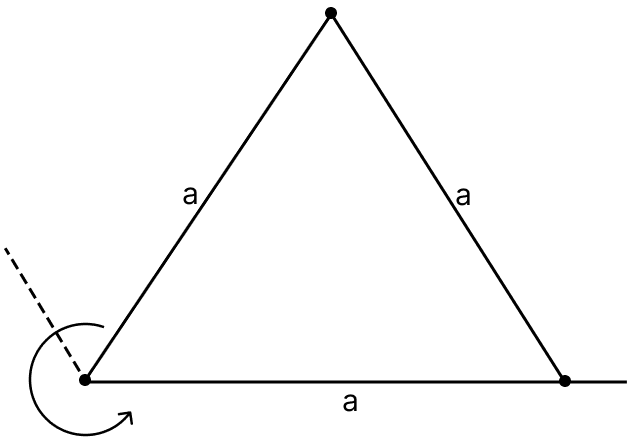
The axis passes through one corner of the triangle and is perpendicular to its plane. Therefore
- The particle at that corner lies on the axis, so its distance from the axis is zero.
- The other two particles are each at a distance equal to the side of the triangle, that is, a = 0.05 m.
The moment of inertia of the system is
Substituting the values,
Hence, the moment of inertia of the system about the given axis is 5 × 10⁻⁵ kg m2.
A person taking in his hands spheres each of mass 2 kg is standing on a table revolving with an angular velocity of 10 rad/s. His arms are extended and each sphere is at a distance of 1 m from the axis of rotation. If the moment of inertia of the person and the table about the axis of rotation be 1 kg m2 then what will be the kinetic energy of rotation of the whole system? If the person pulls in his arms so that each sphere is now at a distance of 0.3 m from the axis of rotation, then what would be the new kinetic energy? Explain this difference.
Answer
Given,
- Mass of each sphere, m = 2 kg
- Initial angular velocity, ω1 = 10 rad/s
- Initial distance of each sphere from the axis, r1 = 1 m
- Final distance of each sphere from the axis, r2 = 0.3 m
- Moment of inertia of the person and the table, I0 = 1 kg m2
Initial moment of inertia of the whole system :
Initial kinetic energy of rotation :
Final moment of inertia of the system :
No external torque acts on the system, so the angular momentum is conserved,
Final kinetic energy of rotation :
Hence, the initial kinetic energy is 250 J and the new kinetic energy is 919 J.
Explanation of the difference : The angular momentum is conserved, but the kinetic energy is not. To pull the spheres inwards the person must do work against the centrifugal effect. This work is done at the expense of the chemical energy stored in his muscles, and it appears as the increase in the kinetic energy of rotation of the system.
A ball tied to a string takes 4 s in one complete revolution in a horizontal circle. If, by pulling the cord, the radius of the circle is reduced to half of the previous value, then how much time the ball will now take in one revolution?
Hint : By conservation of angular momentum I1 ω1 = I2 ω2, where I1 = m r2, , and .
Answer
Given,
- Time for one complete revolution initially, T1 = 4 s
- Final radius, , where r is the initial radius
The ball is treated as a point mass, so its moments of inertia before and after are
The angular velocities are
The cord is pulled inwards along the radius, so it exerts no torque about the axis. Hence the angular momentum is conserved,
Substituting the values,
Cancelling mr2 and 2π from both sides,
Hence, the ball will now take 1 s to complete one revolution.
A uniform ladder of weight 20 kg is 3 m long, leans on a frictionless wall and rests on a rough horizontal floor. Its feet rests on the floor 1 m away from the wall. Find the reaction forces on the wall and the floor. g = 9.8 N/kg.
Answer
Given,
- Weight of the ladder, W = 20 kg-wt = 20 × 9.8 = 196 N
- Length of the ladder, AB = 3 m
- Distance of the feet from the wall = 1 m
- The wall is frictionless and the floor is rough
- g = 9.8 N/kg
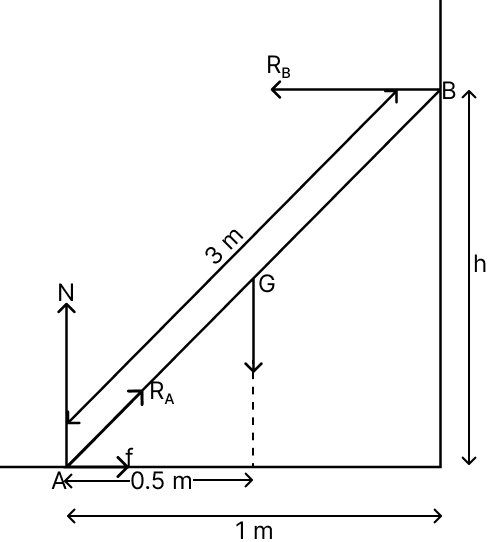
Let the ladder rest with its foot at A on the floor and its top at B against the wall. The height at which the ladder touches the wall is
The ladder is uniform, so its weight W acts at its mid-point G, whose horizontal distance from A is
The wall is frictionless, so the reaction RB exerted by it is horizontal. The reaction at the floor has a normal component N and a frictional component f.
Condition of translational equilibrium :
Condition of rotational equilibrium : Taking moments of all the forces about the foot A,
Hence the frictional force at the floor is also f = 34.6 N.
Total reaction at the floor :
Hence, the reaction force on the wall is 34.6 N and the reaction force on the floor is 199.0 N.