KnowledgeBoat Logo
|
OPEN IN APP

Chapter 6

System of Particles & Rotational Motion — Competition Zone

Class 11 - Nootan Physics


Competition Zone — MCQ (One Correct Option)

Question 1

A uniform rectangular thin sheet ABCD of mass M has length a and breadth b as shown in figure. If the shaded portion HBGO is cut-off, the co-ordinates of the centre of mass of the remaining portion will be :
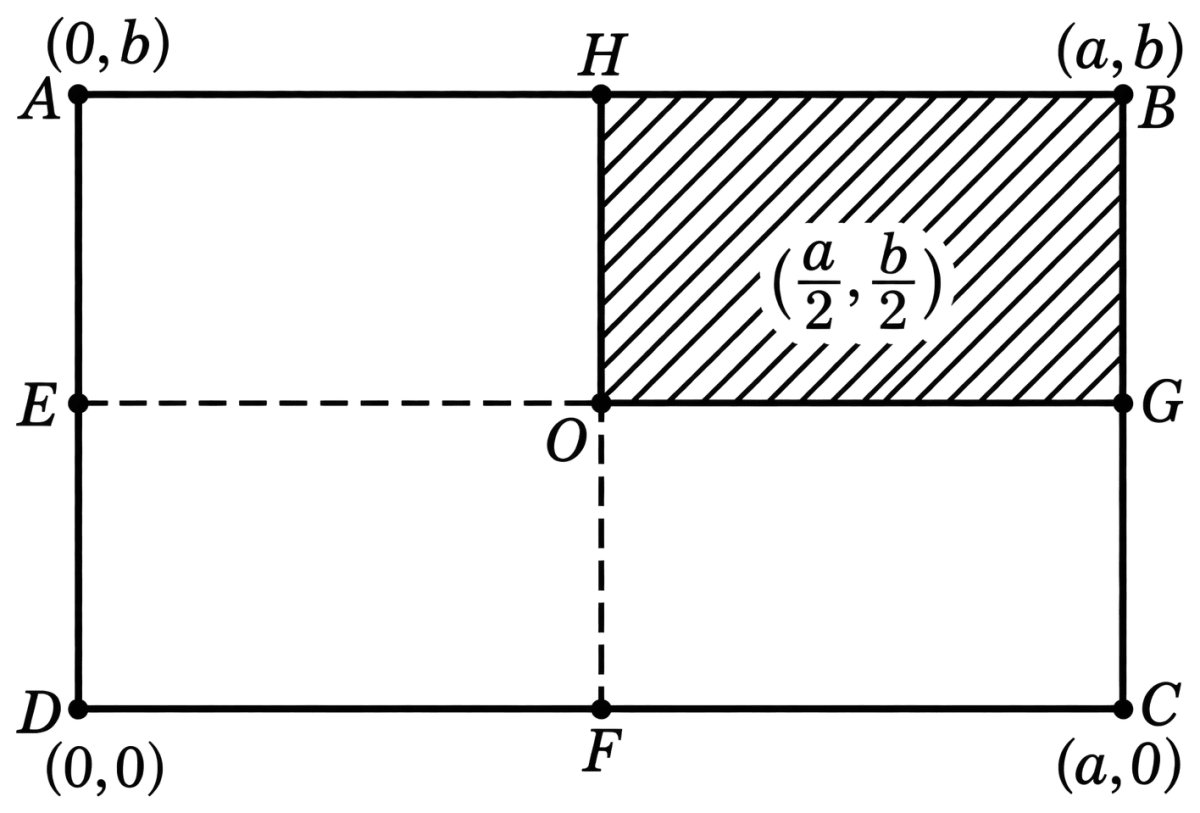
A uniform rectangular thin sheet ABCD of mass M has length a and breadth b as shown in figure. If the shaded portion HBGO is cut-off, the co-ordinates of the centre of mass of the remaining portion will be:. System of Particles & Rotational Motion, Solutions for Class 11 ISC Nootan Physics Kumar Mittal Nageen Prakashan
  1. (2a3,2b3)\left(\dfrac{2\text a}{3}, \dfrac{2\text b}{3}\right)

  2. (5a12,5b12)\left(\dfrac{5\text a}{12}, \dfrac{5\text b}{12}\right)

  3. (3a4,3b4)\left(\dfrac{3\text a}{4}, \dfrac{3\text b}{4}\right)

  4. (5a3,5b3)\left(\dfrac{5\text a}{3}, \dfrac{5\text b}{3}\right).

Answer

(5a12,5b12)\left(\dfrac{5\text a}{12}, \dfrac{5\text b}{12}\right)

Reason

Given, the sheet ABCD has mass M, length a and breadth b. The shaded portion HBGO is one quarter of the sheet, so its mass is M4\dfrac{\text M}{4}.

The centre of mass of the complete lamina is at its geometric centre,

(x1, y1)=(a2, b2)(\text x_1,\ \text y_1) = \left(\dfrac{\text a}{2},\ \dfrac{\text b}{2}\right)

and that of the shaded quarter is at

(x2, y2)=(3a4, 3b4)(\text x_2,\ \text y_2) = \left(\dfrac{3\text a}{4},\ \dfrac{3\text b}{4}\right)

Treating the removed portion as a negative mass,

Xcm=M(a2)M4(3a4)MM4=a23a1634=5a1634=5a12\text X_{cm} = \dfrac{\text M\left(\dfrac{\text a}{2}\right) - \dfrac{\text M}{4}\left(\dfrac{3\text a}{4}\right)}{\text M - \dfrac{\text M}{4}} = \dfrac{\dfrac{\text a}{2} - \dfrac{3\text a}{16}}{\dfrac{3}{4}} = \dfrac{\dfrac{5\text a}{16}}{\dfrac{3}{4}} = \dfrac{5\text a}{12}

Similarly, by symmetry,

Ycm=5b12\text Y_{cm} = \dfrac{5\text b}{12}

Question 2

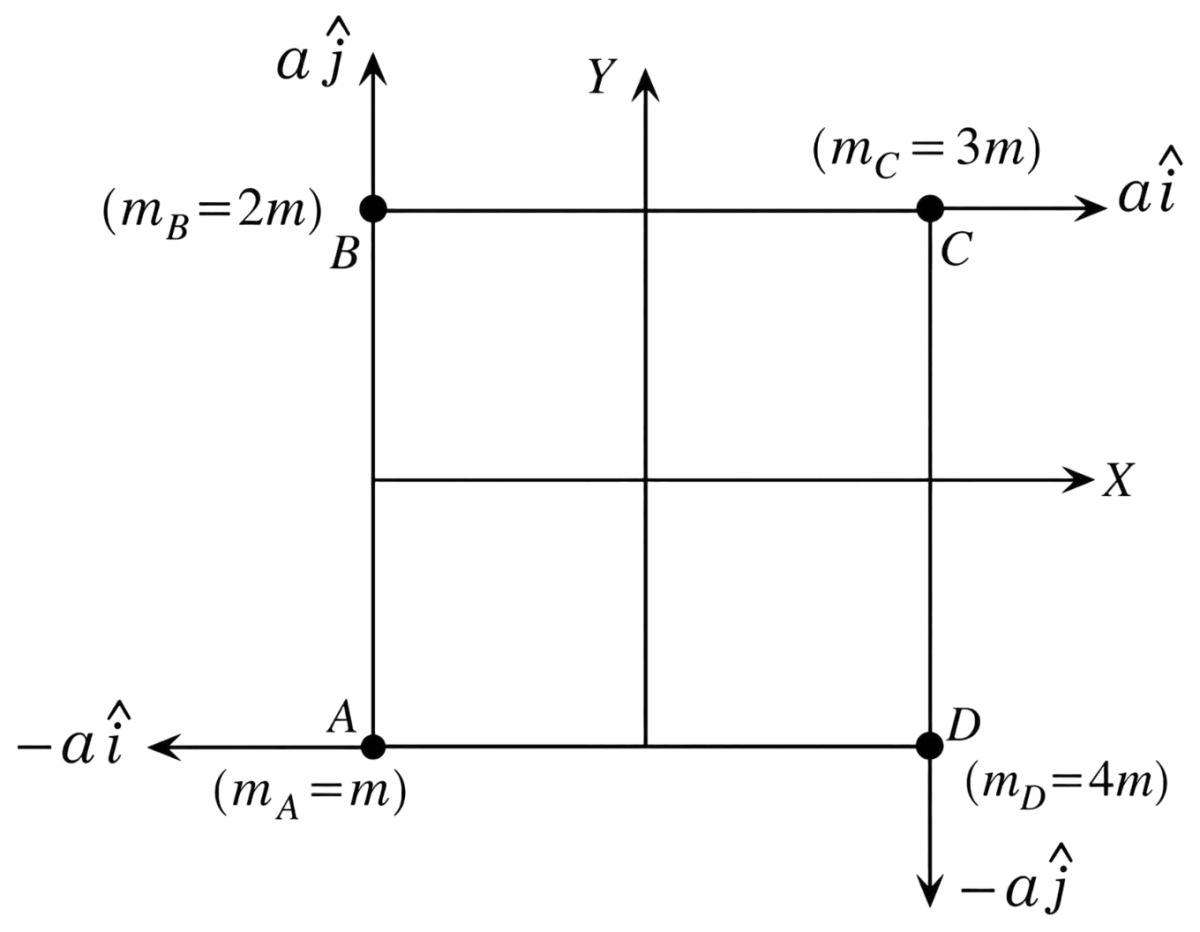
Four particles A, B, C and D with masses mA = m, mB = 2m, mC = 3m and mD = 4m are at the corners of a square. They have accelerations of equal magnitude with directions as shown. The acceleration of the centre of mass of the particles (in m/s2) is :
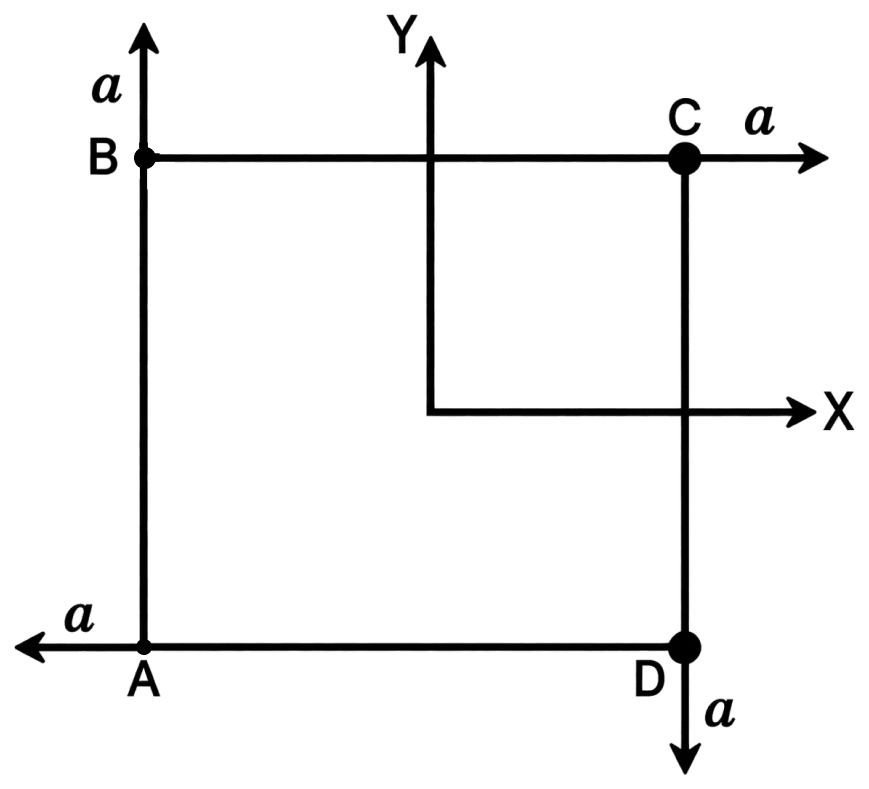
Four particles A, B, C and D with masses m A = m, m B = 2m, m C = 3m and m D = 4m are at the corners of a square. They have accelerations of equal magnitude with directions as shown. The acceleration of the centre of mass of the particles (in m/s 2 ) is:. System of Particles & Rotational Motion, Solutions for Class 11 ISC Nootan Physics Kumar Mittal Nageen Prakashan
  1. a5(i^j^)\dfrac{\text a}{5}(\hat{i} - \hat{j})

  2. a(i^+j^)\text a(\hat{i} + \hat{j})

  3. zero

  4. a5(i^+j^)\dfrac{\text a}{5}(\hat{i} + \hat{j})

Answer

a5(i^j^)\dfrac{\text a}{5}(\hat{i} - \hat{j})

Reason

Four particles A, B, C and D with masses m A = m, m B = 2m, m C = 3m and m D = 4m are at the corners of a square. They have accelerations of equal magnitude with directions as shown. The acceleration of the centre of mass of the particles (in m/s 2 ) is:. System of Particles & Rotational Motion, Solutions for Class 11 ISC Nootan Physics Kumar Mittal Nageen Prakashan

Given, mA = m, mB = 2m, mC = 3m and mD = 4m, each having an acceleration of magnitude a in the directions shown.

From the figure the accelerations are ai^-\text a\hat{i} for A, +aj^+\text a\hat{j} for B, +ai^+\text a\hat{i} for C and aj^-\text a\hat{j} for D.

The acceleration of the centre of mass is

acm=mAaA+mBaB+mCaC+mDaDmA+mB+mC+mD\vec{\text a}_{cm} = \dfrac{\text m_A \vec{\text a}_A + \text m_B \vec{\text a}_B + \text m_C \vec{\text a}_C + \text m_D \vec{\text a}_D}{\text m_A + \text m_B + \text m_C + \text m_D}

Substituting the values,

=m(ai^)+2m(aj^)+3m(ai^)+4m(aj^)m+2m+3m+4m= \dfrac{\text m(-\text a\hat{i}) + 2\text m(\text a\hat{j}) + 3\text m(\text a\hat{i}) + 4\text m(-\text a\hat{j})}{\text m + 2\text m + 3\text m + 4\text m}

=mai^+2maj^+3mai^4maj^10m=2mai^2maj^10m= \dfrac{-\text{ma}\hat{i} + 2\text{ma}\hat{j} + 3\text{ma}\hat{i} - 4\text{ma}\hat{j}}{10\text m} = \dfrac{2\text{ma}\hat{i} - 2\text{ma}\hat{j}}{10\text m}

acm=a5(i^j^)\vec{\text a}_{cm} = \dfrac{\text a}{5}(\hat{i} - \hat{j})

Question 3

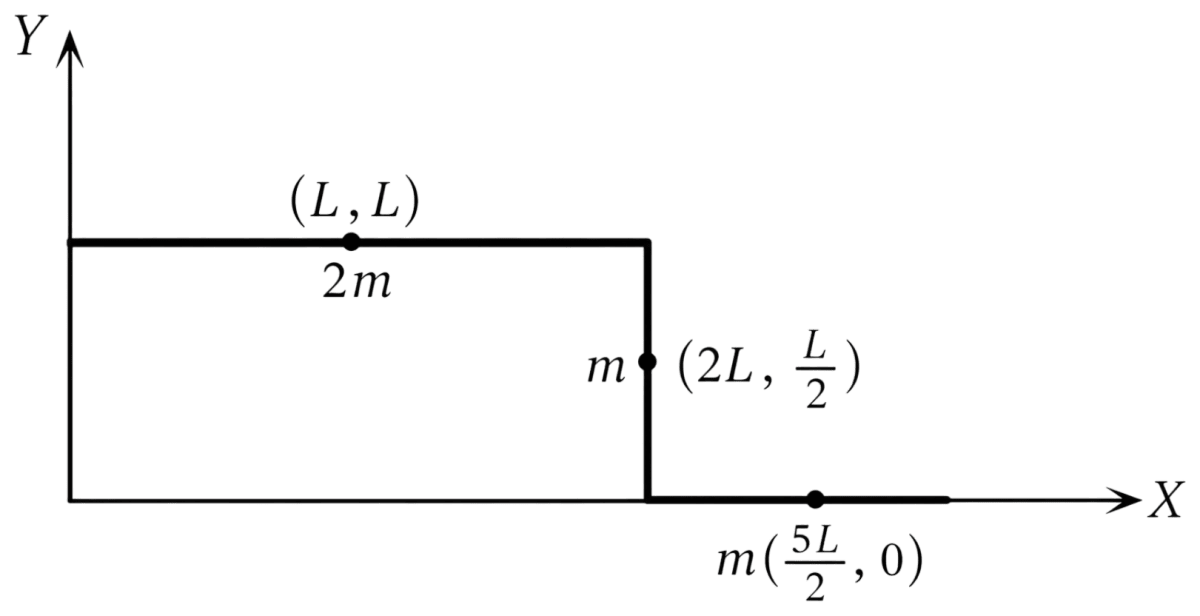
The position vector of the centre of mass rcm\vec{\text r}_{cm} of an asymmetric uniform bar of negligible area of cross-section as shown in figure is :
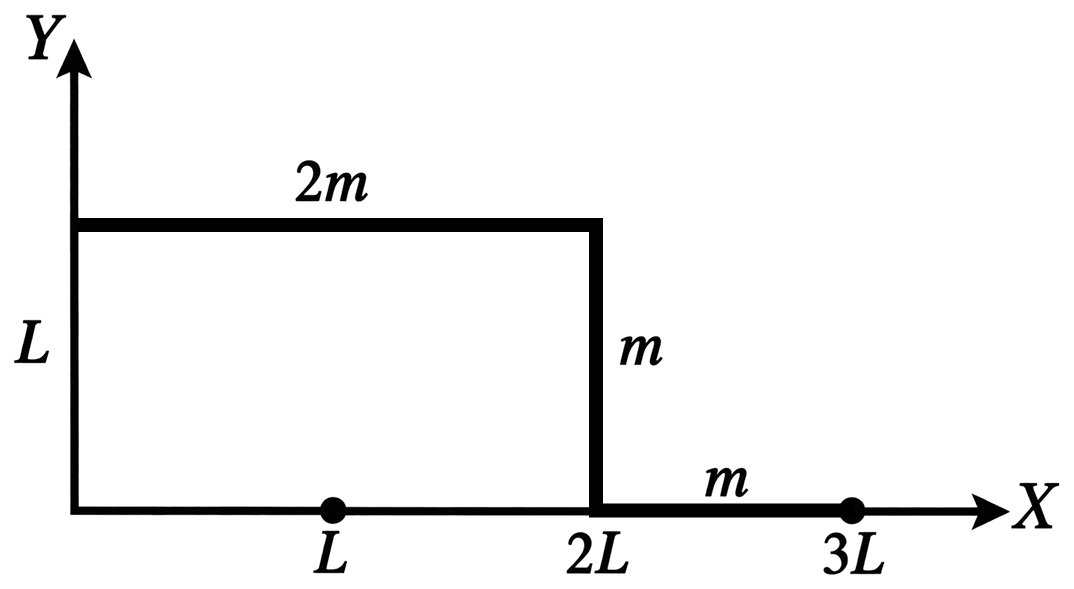
The position vector of the centre of mass vec text r_cm of an asymmetric uniform bar of negligible area of cross-section as shown in figure is:. System of Particles & Rotational Motion, Solutions for Class 11 ISC Nootan Physics Kumar Mittal Nageen Prakashan
  1. r=138Lx^+58Ly^\vec{\text r} = \dfrac{13}{8}\text L \hat{x} + \dfrac{5}{8}\text L \hat{y}

  2. r=118Lx^+38Ly^\vec{\text r} = \dfrac{11}{8}\text L \hat{x} + \dfrac{3}{8}\text L \hat{y}

  3. r=38Lx^+118Ly^\vec{\text r} = \dfrac{3}{8}\text L \hat{x} + \dfrac{11}{8}\text L \hat{y}

  4. r=58Lx^+138Ly^\vec{\text r} = \dfrac{5}{8}\text L \hat{x} + \dfrac{13}{8}\text L \hat{y}

Answer

r=138Lx^+58Ly^\vec{\text r} = \dfrac{13}{8}\text L \hat{x} + \dfrac{5}{8}\text L \hat{y}

Reason

The position vector of the centre of mass vec text r_cm of an asymmetric uniform bar of negligible area of cross-section as shown in figure is:. System of Particles & Rotational Motion, Solutions for Class 11 ISC Nootan Physics Kumar Mittal Nageen Prakashan

From the figure the bar consists of three uniform segments. Taking the mass per unit length as uniform, the horizontal segment of length 2L has mass 2m, and the two segments of length L have mass m each, giving a total mass of 4m.

x-coordinate : The three segments have their own centres of mass at x = L, x = 2L and x=5L2\text x = \dfrac{5\text L}{2} respectively,

Xcm=2m(L)+m(2L)+m(5L2)2m+m+m\text X_{cm} = \dfrac{2\text m(\text L) + \text m(2\text L) + \text m\left(\dfrac{5\text L}{2}\right)}{2\text m + \text m + \text m}

=2mL+2mL+2.5mL4m=6.5mL4m=138L= \dfrac{2\text{mL} + 2\text{mL} + 2.5\text{mL}}{4\text m} = \dfrac{6.5\text{mL}}{4\text m} = \dfrac{13}{8}\text L

y-coordinate : Working in the same way for the vertical positions of the three segments gives

y-coordinate : The three segments have their own centres of mass at y = L, y = L2\dfrac{\text L}{2} and y = 0 respectively,

Ycm=2m(L)+m(L2)+m(0)2m+m+m=2mL+12mL4m=52mL4mYcm=58L\text Y_{cm} = \dfrac{2\text m(\text L) + \text m\left(\dfrac{\text L}{2}\right) + \text m(0)}{2\text m + \text m + \text m} \\[1em] = \dfrac{2\text{mL} + \dfrac{1}{2}\text{mL}}{4\text m} \\[1em] = \dfrac{\dfrac{5}{2}\text{mL}}{4\text m} \\[1em] \text Y_{cm} = \dfrac{5}{8}\text L

So,

rcm=138Lx^+58Ly^\vec{\text r}_{cm} = \dfrac{13}{8}\text L\hat{x} + \dfrac{5}{8}\text L\hat{y}

Question 4

Three particles of masses 50 g, 100 g and 150 g are placed at the vertices of an equilateral triangle of side 1 m (as shown in the figure). The (x, y) coordinates of the centre of mass will be :
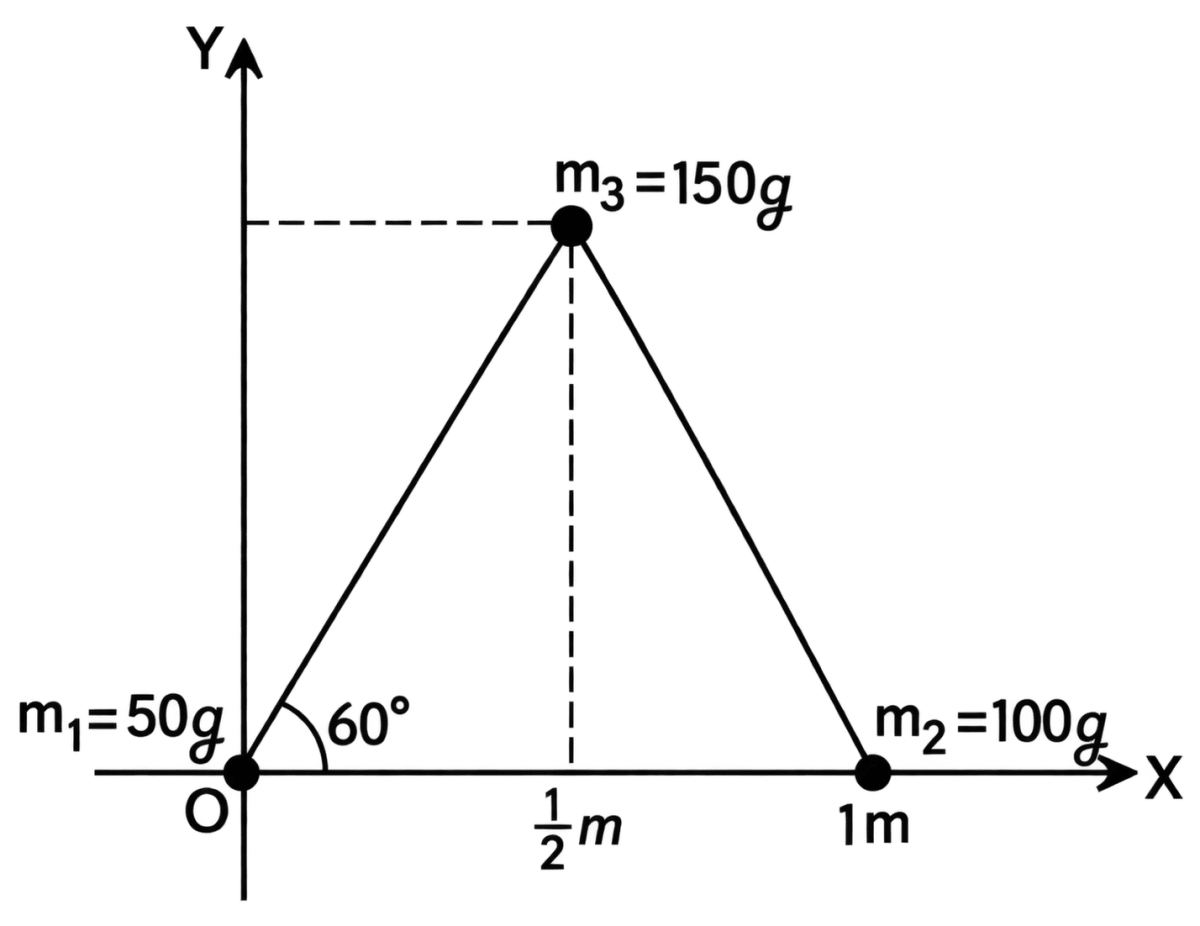
Three particles of masses 50 g, 100 g and 150 g are placed at the vertices of an equilateral triangle of side 1 m (as shown in the figure). The (x, y) coordinates of the centre of mass will be:. System of Particles & Rotational Motion, Solutions for Class 11 ISC Nootan Physics Kumar Mittal Nageen Prakashan
  1. (38 m,712 m)\left(\dfrac{\sqrt{3}}{8}\text{ m}, \dfrac{7}{12}\text{ m}\right)

  2. (34 m,512 m)\left(\dfrac{\sqrt{3}}{4}\text{ m}, \dfrac{5}{12}\text{ m}\right)

  3. (712 m,38 m)\left(\dfrac{7}{12}\text{ m}, \dfrac{\sqrt{3}}{8}\text{ m}\right)

  4. (712 m,34 m)\left(\dfrac{7}{12}\text{ m}, \dfrac{\sqrt{3}}{4}\text{ m}\right)

Answer

(712 m,34 m)\left(\dfrac{7}{12}\text{ m}, \dfrac{\sqrt{3}}{4}\text{ m}\right)

Reason

Given, m1 = 50 g, m2 = 100 g and m3 = 150 g at the vertices of an equilateral triangle of side 1 m.

From the figure, m1 is at the origin, m2 at (1, 0) and m3 at the apex, whose coordinates are

(12, 32)\left(\dfrac{1}{2},\ \dfrac{\sqrt{3}}{2}\right)

x-coordinate of the centre of mass :

xcm=50(0)+100(1)+150(12)50+100+150=0+100+75300=175300=712 m\text x_{cm} = \dfrac{50(0) + 100(1) + 150\left(\dfrac{1}{2}\right)}{50 + 100 + 150} = \dfrac{0 + 100 + 75}{300} = \dfrac{175}{300} = \dfrac{7}{12}\ \text m

y-coordinate of the centre of mass :

ycm=50(0)+100(0)+150(32)300=753300=34 m\text y_{cm} = \dfrac{50(0) + 100(0) + 150\left(\dfrac{\sqrt{3}}{2}\right)}{300} = \dfrac{75\sqrt{3}}{300} = \dfrac{\sqrt{3}}{4}\ \text m

Question 5

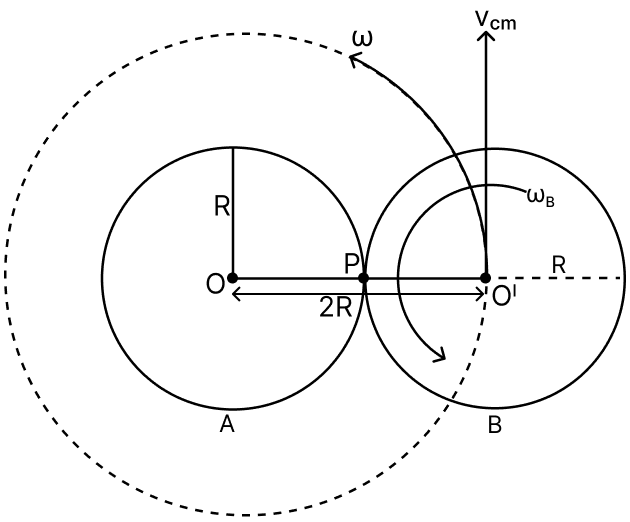
A flat surface of a thin uniform disk A of radius R is glued to a horizontal table. Another thin uniform disk B of mass M and with the same radius R rolls without slipping on the circumference of A, as shown in the figure. A flat surface of B also lies on the plane of the table. The centre of mass of B has fixed angular speed ω about the vertical axis passing through the centre of A. The angular momentum of B is nMωR2 with respect to the centre of A. Which of the following is the value of n?
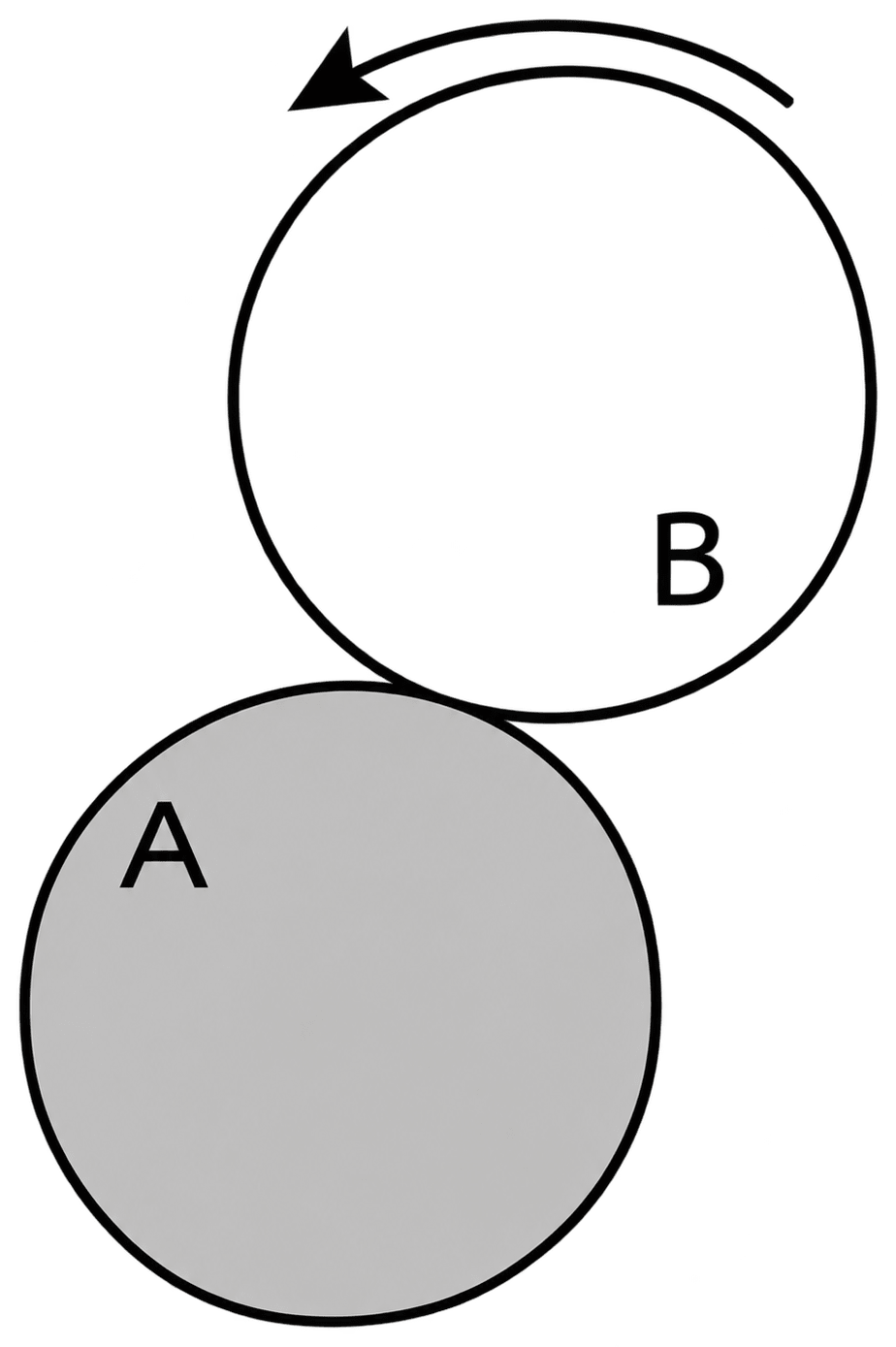
A flat surface of a thin uniform disk A of radius R is glued to a horizontal table. Another thin uniform disk B of mass M and with the same radius R rolls without slipping on the circumference of A, as shown in the figure. A flat surface of B also lies on the plane of the table. The centre of mass of B has fixed angular speed ω about the vertical axis passing through the centre of A. The angular momentum of B is nMωR 2 with respect to the centre of A. Which of the following is the value of n? System of Particles & Rotational Motion, Solutions for Class 11 ISC Nootan Physics Kumar Mittal Nageen Prakashan
  1. 2

  2. 5

  3. 72\dfrac{7}{2}

  4. 92\dfrac{9}{2}

Answer

5

Reason

A flat surface of a thin uniform disk A of radius R is glued to a horizontal table. Another thin uniform disk B of mass M and with the same radius R rolls without slipping on the circumference of A, as shown in the figure. A flat surface of B also lies on the plane of the table. The centre of mass of B has fixed angular speed ω about the vertical axis passing through the centre of A. The angular momentum of B is nMωR 2 with respect to the centre of A. Which of the following is the value of n? System of Particles & Rotational Motion, Solutions for Class 11 ISC Nootan Physics Kumar Mittal Nageen Prakashan

Given, disc B of mass M and radius R rolls without slipping on the circumference of the fixed disc A of radius R.

The centre of B moves in a circle of radius 2R about the centre of A with angular speed ω, so the speed of its centre of mass is

vcm=ω(2R)\text v_{cm} = \omega(2\text R)

Since B rolls without slipping, its own angular speed ωB about its centre satisfies vcm = ωBR, which gives ωB = 2ω.

The angular momentum of B about the centre of A is the sum of the orbital part and the spin part,

L=Mvcm(2R)+IcmωB\text L = \text M \text v_{cm}(2\text R) + \text I_{cm}\omega_B

=M(2ωR)(2R)+12MR2(2ω)= \text M(2\omega \text R)(2\text R) + \dfrac{1}{2}\text{MR}^2(2\omega)

=4MωR2+MωR2=5MωR2= 4\text M\omega \text R^2 + \text M\omega \text R^2 = 5\text M\omega \text R^2

Comparing with L = nMωR2, we get n = 5.

Question 6

Two objects of mass 10 kg and 20 kg respectively are connected to the two ends of a rigid rod of length 10 m with negligible mass. The distance of the centre of mass of the system from the 10 kg mass is :

  1. 10 m

  2. 5 m

  3. 103\dfrac{10}{3} m

  4. 203\dfrac{20}{3} m

Answer

203\dfrac{20}{3} m

Reason — Given, m1 = 10 kg and m2 = 20 kg at the two ends of a rod of length d = 10 m of negligible mass.

Taking the 10 kg mass at the origin, x1 = 0 and x2 = 10 m. The distance of the centre of mass from the 10 kg mass is
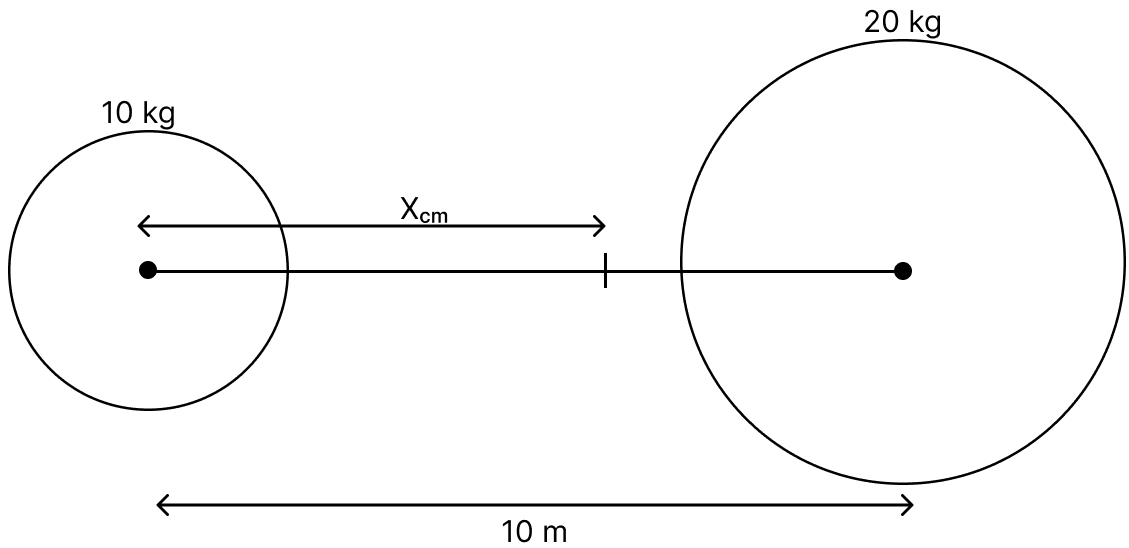
Two objects of mass 10 kg and 20 kg respectively are connected to the two ends of a rigid rod of length 10 m with negligible mass. The distance of the centre of mass of the system from the 10 kg mass is:. System of Particles & Rotational Motion, Solutions for Class 11 ISC Nootan Physics Kumar Mittal Nageen Prakashan

xcm=m1x1+m2x2m1+m2\text x_{cm} = \dfrac{\text m_1 \text x_1 + \text m_2 \text x_2}{\text m_1 + \text m_2}

Substituting the values,

xcm=(10×0)+(20×10)10+20=20030\text x_{cm} = \dfrac{(10 \times 0) + (20 \times 10)}{10 + 20} = \dfrac{200}{30}

xcm=203 m\text x_{cm} = \dfrac{20}{3}\ \text m

The centre of mass lies nearer to the heavier 20 kg mass, as expected.

Question 7

A solid sphere of mass M and radius R is divided into two unequal parts. The first part has a mass of 7M8\dfrac{7\text M}{8} and is converted into a uniform disc of radius 2R. The second part is converted into a uniform solid sphere. Let I1 be the moment of inertia of the disc about its axis and I2 be the moment of inertia of the new sphere about its axis, then ratio I1I2\dfrac{\text I_1}{\text I_2} is given by :

  1. 285
  2. 185
  3. 65
  4. 140

Answer

140

Reason — Given, a solid sphere of mass M and radius R is divided into two parts.

First part : mass 7M8\dfrac{7\text M}{8}, converted into a uniform disc of radius 2R,

I1=12(7M8)(2R)2=12×7M8×4R2=74MR2\text I_1 = \dfrac{1}{2}\left(\dfrac{7\text M}{8}\right)(2\text R)^2 = \dfrac{1}{2} \times \dfrac{7\text M}{8} \times 4\text R^2 = \dfrac{7}{4}\text{MR}^2

Second part : mass M7M8=M8\text M - \dfrac{7\text M}{8} = \dfrac{\text M}{8}, converted into a uniform solid sphere. Since the density is unchanged, the volume is 18\dfrac{1}{8} of the original, so its radius is

r=R2\text r = \dfrac{\text R}{2}

I2=25(M8)(R2)2=25×M8×R24=MR280\text I_2 = \dfrac{2}{5}\left(\dfrac{\text M}{8}\right)\left(\dfrac{\text R}{2}\right)^2 = \dfrac{2}{5} \times \dfrac{\text M}{8} \times \dfrac{\text R^2}{4} = \dfrac{\text{MR}^2}{80}

Therefore,

I1I2=74MR2180MR2=74×80=140\dfrac{\text I_1}{\text I_2} = \dfrac{\dfrac{7}{4}\text{MR}^2}{\dfrac{1}{80}\text{MR}^2} = \dfrac{7}{4} \times 80 = 140

Question 8

A stationary horizontal disc is free to rotate about its axis. When a torque is applied on it, its K.E. as a function of θ (where θ is the angle by which it has rotated) is given as Kθ2. If the moment of inertia is I, then the angular acceleration of the disc is :
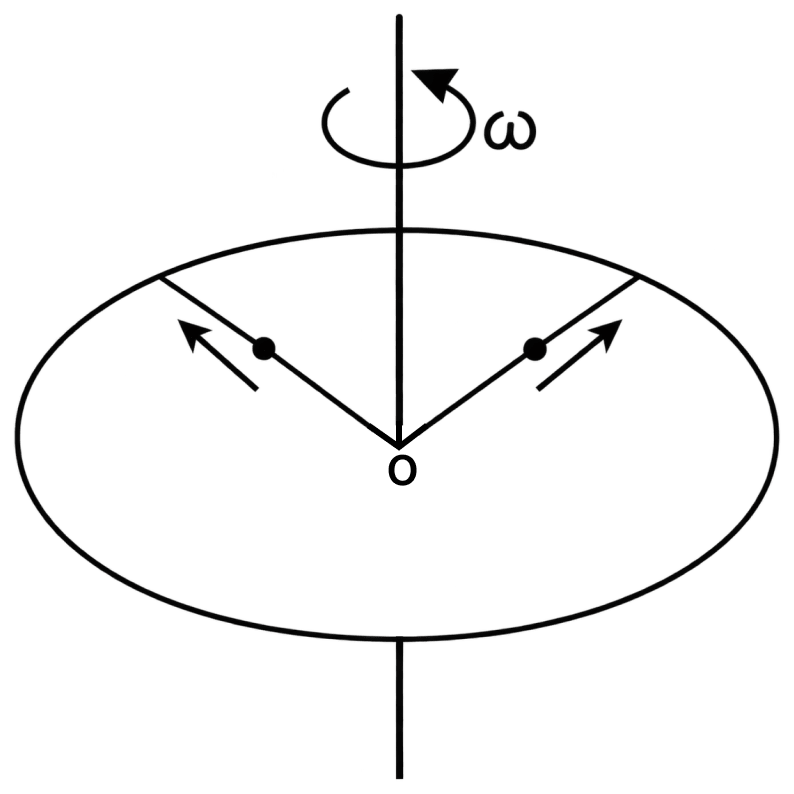
A stationary horizontal disc is free to rotate about its axis. When a torque is applied on it, its K.E. as a function of θ (where θ is the angle by which it has rotated) is given as Kθ 2. If the moment of inertia is I, then the angular acceleration of the disc is:. System of Particles & Rotational Motion, Solutions for Class 11 ISC Nootan Physics Kumar Mittal Nageen Prakashan
  1. K2Iθ\dfrac{\text K}{2\text I}\theta

  2. KIθ\dfrac{\text K}{\text I}\theta

  3. K4Iθ\dfrac{\text K}{4\text I}\theta

  4. 2KIθ\dfrac{2\text K}{\text I}\theta

Answer

2KIθ\dfrac{2\text K}{\text I}\theta

Reason

Given, the kinetic energy of the disc as a function of θ is K = Kθ2, and its moment of inertia is I.

The kinetic energy of rotation is

12Iω2=Kθ2\dfrac{1}{2}\text I \omega^2 = \text K\theta^2

ω2=2Kθ2I\omega^2 = \dfrac{2\text K\theta^2}{\text I}

Differentiating both sides with respect to time,

2ωdωdt=2KI×2θdθdt2\omega\dfrac{\text d\omega}{\text{dt}} = \dfrac{2\text K}{\text I} \times 2\theta\dfrac{\text d\theta}{\text{dt}}

But dωdt=α\dfrac{\text d\omega}{\text{dt}} = \alpha and dθdt=ω\dfrac{\text d\theta}{\text{dt}} = \omega. Therefore

2ωα=4KIθω2\omega \alpha = \dfrac{4\text K}{\text I}\theta \omega

Cancelling ω from both sides,

α=2KIθ\alpha = \dfrac{2\text K}{\text I}\theta

Question 9

Let the moment of inertia of a hollow cylinder of length 30 cm (inner radius 10 cm and outer radius 20 cm) about its axis be I. The radius of a thin cylinder of same mass such that its moment of inertia about its axis is also I, is :

  1. 16 cm
  2. 14 cm
  3. 12 cm
  4. 18 cm

Answer

16 cm

Reason — Given,

  • Inner radius of the hollow cylinder, R1 = 10 cm
  • Outer radius of the hollow cylinder, R2 = 20 cm

The moment of inertia of a hollow cylinder about its own axis is

I=12M(R12+R22)\text I = \dfrac{1}{2}\text M(\text R_1^2 + \text R_2^2)

Substituting the values,

I=12M[(10)2+(20)2]=12M(100+400)=250M\text I = \dfrac{1}{2}\text M\left[(10)^2 + (20)^2\right] = \dfrac{1}{2}\text M(100 + 400) = 250\text M

For a thin cylinder of the same mass M and radius R, the moment of inertia about its axis is I = MR2. Equating the two,

MR2=250MR2=250\text{MR}^2 = 250\text M \quad \Rightarrow \quad \text R^2 = 250

R=250=15.816 cm\text R = \sqrt{250} = 15.8 \approx 16\ \text{cm}

Question 10

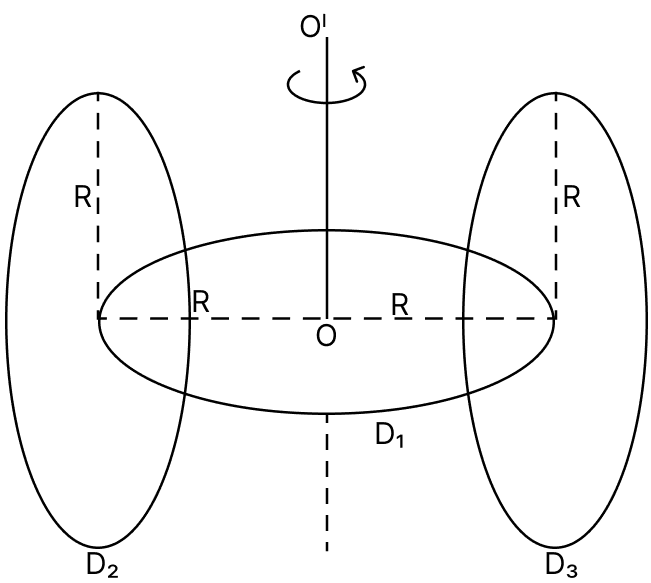
A circular disc of mass M and radius R has two identical discs D2 and D3 of same mass M and radius R attached rigidly at its opposite ends. The moment of inertia of the system about the axis OO′ passing through the centre of D1 (as shown in fig.) will be :
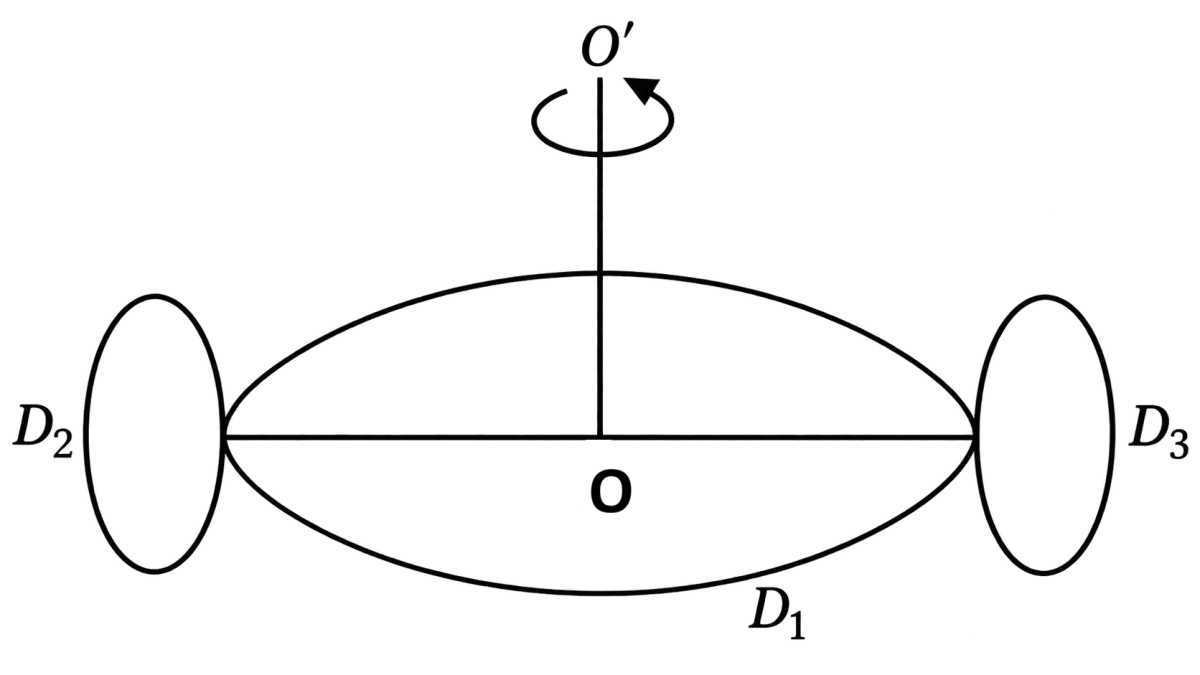
A circular disc of mass M and radius R has two identical discs D 2 and D 3 of same mass M and radius R attached rigidly at its opposite ends. The moment of inertia of the system about the axis OO′ passing through the centre of D 1 (as shown in fig.) will be:. System of Particles & Rotational Motion, Solutions for Class 11 ISC Nootan Physics Kumar Mittal Nageen Prakashan
  1. 23MR2\dfrac{2}{3}\text{MR}^2

  2. 45MR2\dfrac{4}{5}\text{MR}^2

  3. 3MR2

  4. MR2.

Answer

3MR2

Reason

A circular disc of mass M and radius R has two identical discs D 2 and D 3 of same mass M and radius R attached rigidly at its opposite ends. The moment of inertia of the system about the axis OO′ passing through the centre of D 1 (as shown in fig.) will be:. System of Particles & Rotational Motion, Solutions for Class 11 ISC Nootan Physics Kumar Mittal Nageen Prakashan

Given, the central disc D1 of mass M and radius R carries two identical discs D2 and D3, each of mass M and radius R, attached rigidly at the opposite ends of one of its diameters.

From the figure the axis OO′ passes through the centre of D1 and is perpendicular to the plane of D1. The discs D2 and D3 stand in planes containing this axis, with their centres on the rim of D1, that is, at a perpendicular distance R from OO′.

For the central disc D1 : the axis is perpendicular to its plane and passes through its centre,

I1=12MR2\text I_1 = \dfrac{1}{2}\text{MR}^2

For each of the discs D2 and D3 : the axis OO′ lies in the plane of the disc, parallel to a diameter through its centre and at a perpendicular distance R from it. Since the moment of inertia of a disc about a diameter is 14MR2\dfrac{1}{4}\text{MR}^2, the theorem of parallel axes gives

I2=I3=14MR2+MR2=54MR2\text I_2 = \text I_3 = \dfrac{1}{4}\text{MR}^2 + \text{MR}^2 = \dfrac{5}{4}\text{MR}^2

That is, each of them is turning about a tangent lying in its own plane.

By the additive theorem of moment of inertia, the total moment of inertia of the system about OO′ is

I=I1+I2+I3=12MR2+54MR2+54MR2\text I = \text I_1 + \text I_2 + \text I_3 = \dfrac{1}{2}\text{MR}^2 + \dfrac{5}{4}\text{MR}^2 + \dfrac{5}{4}\text{MR}^2

=2MR2+5MR2+5MR24=124MR2= \dfrac{2\text{MR}^2 + 5\text{MR}^2 + 5\text{MR}^2}{4} = \dfrac{12}{4}\text{MR}^2

I=3MR2\text I = 3\text{MR}^2

Question 11

A particle of mass 20 g is released with an initial velocity 5 m/s along the curve from the point A, as shown in the figure. The point A is at height h from point B. The particle slides along the frictionless surface. When the particle reaches point B, its angular momentum about O will be : (Take g = 10 m/s2)
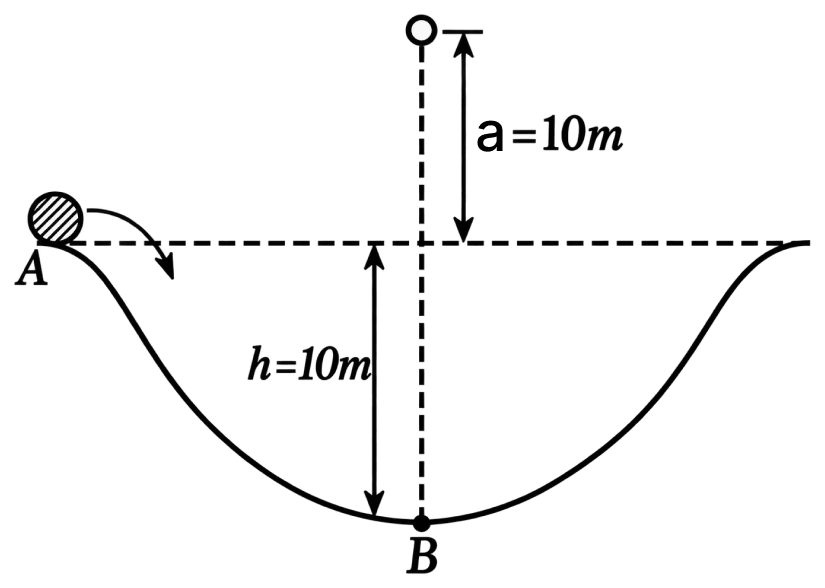
A particle of mass 20 g is released with an initial velocity 5 m/s along the curve from the point A, as shown in the figure. The point A is at height h from point B. The particle slides along the frictionless surface. When the particle reaches point B, its angular momentum about O will be: (Take g = 10 m/s 2 ). System of Particles & Rotational Motion, Solutions for Class 11 ISC Nootan Physics Kumar Mittal Nageen Prakashan
  1. 8 kg-m2/s
  2. 3 kg-m2/s
  3. 2 kg-m2/s
  4. 6 kg-m2/s

Answer

6 kg-m2/s

Reason

Given,

  • Mass of the particle, m = 20 g = 0.02 kg
  • Initial velocity at A, u = 5 m/s
  • Height of A above B, h = 10 m
  • Distance a = 10 m
  • g = 10 m/s2

The surface is frictionless, so the mechanical energy is conserved between A and B,

12mu2+mgh=12mv2\dfrac{1}{2}\text{mu}^2 + \text{mgh} = \dfrac{1}{2}\text{mv}^2

Cancelling m and substituting the values,

v2=u2+2gh=(5)2+2(10)(10)=25+200=225\text v^2 = \text u^2 + 2\text{gh} = (5)^2 + 2(10)(10) = 25 + 200 = 225

v=15 m/s\text v = 15\ \text{m/s}

At B the particle moves horizontally, and the perpendicular distance of its line of motion from O is a = 10 m. Hence the angular momentum about O is

L=mv(a+h)=0.02×15×20=6 kg-m2/s\text L = \text{mv}(\text a + \text h) = 0.02 \times 15 \times 20 = 6\ \text{kg-m}^2/\text s

Question 12

A metal coin of mass 5 g and radius 1 cm is fixed to a thin stick AB of negligible mass as shown in the figure. The system is initially at rest. The constant torque, that will make the system rotate about AB at 25 rotations per second in 5 s, is close to :
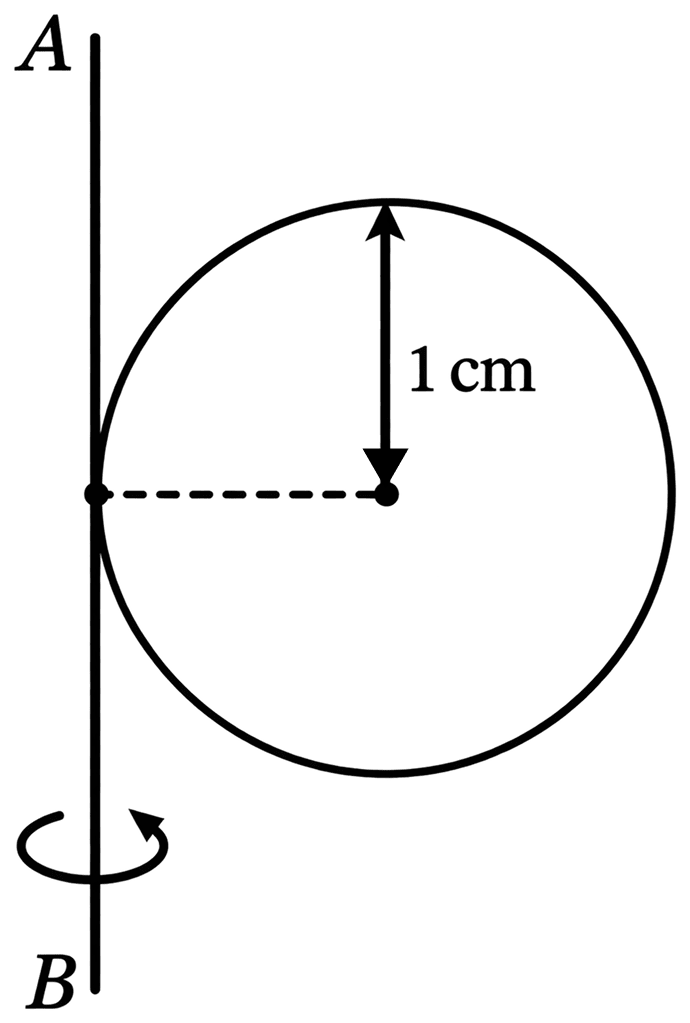
A metal coin of mass 5 g and radius 1 cm is fixed to a thin stick AB of negligible mass as shown in the figure. The system is initially at rest. The constant torque, that will make the system rotate about AB at 25 rotations per second in 5 s, is close to:. System of Particles & Rotational Motion, Solutions for Class 11 ISC Nootan Physics Kumar Mittal Nageen Prakashan
  1. 7.9 × 10⁻⁶ Nm
  2. 4.0 × 10⁻⁶ Nm
  3. 2.0 × 10⁻⁵ Nm
  4. 1.6 × 10⁻⁵ Nm

Answer

2.0 × 10⁻⁵ Nm

Reason

Given,

  • Mass of the coin, m = 5 g = 5 × 10⁻³ kg
  • Radius of the coin, r = 1 cm = 10-2 m
  • Final rate of rotation, n = 25 rotations per second
  • Time, t = 5 s

From the figure the stick AB is tangential to the coin, so the axis of rotation lies along a tangent to the disc in its own plane. The moment of inertia about such an axis is

I=54mr2=54×(5×103)×(102)2\text I = \dfrac{5}{4}\text{mr}^2 = \dfrac{5}{4} \times (5 \times 10^{-3}) \times (10^{-2})^2

=54×5×107=6.25×10⁷ kg m2= \dfrac{5}{4} \times 5 \times 10^{-7} = 6.25 \times 10^{-7}\ \text{kg m}^2

The final angular velocity is

ω=2πn=2π×25=50π rad s1\omega = 2\pi \text n = 2\pi \times 25 = 50\pi\ \text{rad s}^{-1}

The system starts from rest, so the angular acceleration is

α=ωω0t=50π5=10π rad s2\alpha = \dfrac{\omega - \omega_0}{\text t} = \dfrac{50\pi}{5} = 10\pi\ \text{rad s}^{-2}

Therefore the required torque is

τ=Iα=(6.25×10⁷)(10π)=6.25×10×3.14×107=1.96×10⁵\tau = \text I \alpha = (6.25 \times 10^{-7})(10\pi) \\[1em] = 6.25 \times 10 \times 3.14 \times 10^{-7} = 1.96 \times 10^{-5}

τ2.0×10⁵ Nm\tau \approx 2.0 \times 10^{-5}\ \text{Nm}

Question 13

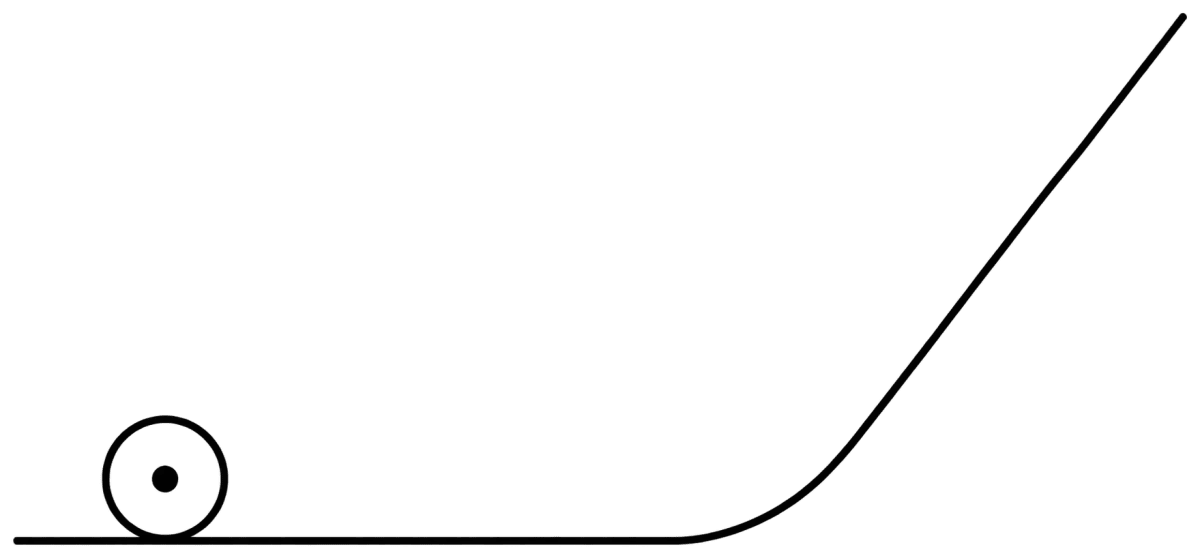
A solid sphere and solid cylinder of identical radii approach an incline with the same linear velocity (see figure). Both roll without slipping all throughout. The two climb maximum heights hsph and hcyl on the incline. The ratio hsphhcyl\dfrac{\text h_{sph}}{\text h_{cyl}} is given by :

A solid sphere and solid cylinder of identical radii approach an incline with the same linear velocity (see figure). Both roll without slipping all throughout. The two climb maximum heights h sph and h cyl on the incline. The ratio dfrac text h_sph text h_cyl is given by:. System of Particles & Rotational Motion, Solutions for Class 11 ISC Nootan Physics Kumar Mittal Nageen Prakashan
  1. 1415\dfrac{14}{15}

  2. 45\dfrac{4}{5}

  3. 1

  4. 25\dfrac{2}{\sqrt{5}}

Answer

1415\dfrac{14}{15}

Reason

Given, a solid sphere and a solid cylinder of identical radii approach the incline with the same linear velocity v and roll without slipping.

The total kinetic energy of a rolling body is converted into potential energy at the maximum height,

12mv2(1+k2R2)=mgh\dfrac{1}{2}\text{mv}^2\left(1 + \dfrac{\text k^2}{\text R^2}\right) = \text{mgh}

h=v22g(1+k2R2)\text h = \dfrac{\text v^2}{2\text g}\left(1 + \dfrac{\text k^2}{\text R^2}\right)

For the solid sphere, k2R2=25\dfrac{\text k^2}{\text R^2} = \dfrac{2}{5},

hsph=v22g(1+25)=7v210g\text h_{sph} = \dfrac{\text v^2}{2\text g}\left(1 + \dfrac{2}{5}\right) = \dfrac{7\text v^2}{10\text g}

For the solid cylinder, k2R2=12\dfrac{\text k^2}{\text R^2} = \dfrac{1}{2},

hcyl=v22g(1+12)=3v24g\text h_{cyl} = \dfrac{\text v^2}{2\text g}\left(1 + \dfrac{1}{2}\right) = \dfrac{3\text v^2}{4\text g}

Therefore,

hsphhcyl=7/103/4=710×43=1415\dfrac{\text h_{sph}}{\text h_{cyl}} = \dfrac{7/10}{3/4} = \dfrac{7}{10} \times \dfrac{4}{3} = \dfrac{14}{15}

Question 14

Two particles A and B are moving in uniform circular motion in concentric circles of radii rA and rB with speed vA and vB respectively. Their time period of rotation is the same. The ratio of angular speed of A to that of B will be :

  1. vA : vB
  2. rB : rA
  3. 1 : 1
  4. rA : rB

Answer

1 : 1

Reason — Given, two particles A and B move in concentric circles of radii rA and rB with the same time period of rotation T.

The angular speed of a particle in uniform circular motion is

ω=2πT\omega = \dfrac{2\pi}{\text T}

This expression depends only on the time period and not on the radius of the circle or the linear speed. Since both particles have the same time period T,

ωAωB=2π/T2π/T=1\dfrac{\omega_A}{\omega_B} = \dfrac{2\pi/\text T}{2\pi/\text T} = 1

ωA:ωB=1:1\omega_A : \omega_B = 1 : 1

Their linear speeds v = rω do differ, being proportional to their radii, but their angular speeds are equal.

Question 15

A disc of radius 2 m and mass 100 kg rolls on a horizontal floor. Its centre of mass has speed of 20 cm/s. How much work is needed to stop it?

  1. 30 kJ
  2. 2 J
  3. 1 J
  4. 3 J

Answer

3 J

Reason — Given,

  • Radius of the disc, R = 2 m
  • Mass of the disc, M = 100 kg
  • Speed of the centre of mass, v = 20 cm/s = 0.2 m/s

The disc rolls on a horizontal floor, so it possesses both translational and rotational kinetic energy. For a disc k2R2=12\dfrac{\text k^2}{\text R^2} = \dfrac{1}{2}, so the total kinetic energy is

E=12Mv2(1+k2R2)=12Mv2(1+12)=34Mv2\text E = \dfrac{1}{2}\text{Mv}^2\left(1 + \dfrac{\text k^2}{\text R^2}\right) = \dfrac{1}{2}\text{Mv}^2\left(1 + \dfrac{1}{2}\right) = \dfrac{3}{4}\text{Mv}^2

Substituting the values,

E=34×100×(0.2)2=34×100×0.04\text E = \dfrac{3}{4} \times 100 \times (0.2)^2 = \dfrac{3}{4} \times 100 \times 0.04

E=3 J\text E = 3\ \text J

The work needed to stop the disc is equal to its total kinetic energy, that is, 3 J.

Question 16

Moment of inertia of a body about a given axis is 1.5 kg m2. Initially the body is at rest. In order to produce a rotational kinetic energy of 1200 J, the angular acceleration of 20 rad/s2 must be applied about the axis for a duration of :

  1. 2 s
  2. 5 s
  3. 2.5 s
  4. 3 s

Answer

2 s

Reason — Given,

  • Moment of inertia, I = 1.5 kg m2
  • Rotational kinetic energy to be produced, K = 1200 J
  • Angular acceleration, α = 20 rad/s2
  • Initial angular velocity, ω0 = 0 (body initially at rest)

From the kinetic energy of rotation,

K=12Iω2\text K = \dfrac{1}{2}\text I \omega^2

ω2=2KI=2×12001.5=1600\omega^2 = \dfrac{2\text K}{\text I} = \dfrac{2 \times 1200}{1.5} = 1600

ω=40 rad/s\omega = 40\ \text{rad/s}

Using the first equation of rotational motion,

ω=ω0+αt\omega = \omega_0 + \alpha \text t

40=0+20tt=2 s40 = 0 + 20\text t \quad \Rightarrow \quad \text t = 2\ \text s

Question 17

The ratio of the radius of gyration of a thin uniform disc about an axis passing through its centre and normal to its plane to the radius of gyration of the disc about its diameter is :

  1. 4 : 1
  2. 1 : 2\sqrt{2}
  3. 2 : 1
  4. 2\sqrt{2} : 1

Answer

2\sqrt{2} : 1

Reason — For a thin uniform disc of mass M and radius R :

About an axis through the centre and normal to its plane,

I1=12MR2=MK12K1=R2\text I_1 = \dfrac{1}{2}\text{MR}^2 = \text{MK}_1^2 \quad \Rightarrow \quad \text K_1 = \dfrac{\text R}{\sqrt{2}}

About a diameter, by the theorem of perpendicular axes,

I2=14MR2=MK22K2=R2\text I_2 = \dfrac{1}{4}\text{MR}^2 = \text{MK}_2^2 \quad \Rightarrow \quad \text K_2 = \dfrac{\text R}{2}

Therefore the required ratio is

K1K2=R/2R/2=22=2\dfrac{\text K_1}{\text K_2} = \dfrac{\text R/\sqrt{2}}{\text R/2} = \dfrac{2}{\sqrt{2}} = \sqrt{2}

K1:K2=2:1\text K_1 : \text K_2 = \sqrt{2} : 1

Question 18

The angular speed of a fly wheel moving with uniform angular acceleration changes from 1200 rpm to 3120 rpm in 16 seconds. The angular acceleration in rad/s2 is :

  1. 12 π
  2. 104 π
  3. 2 π
  4. 4 π

Answer

4 π

Reason — Given,

  • Initial angular speed, ω0 = 1200 rpm
  • Final angular speed, ω = 3120 rpm
  • Time, t = 16 s

Converting the angular speeds into rad/s,

ω0=2π×120060=40π rad/s\omega_0 = \dfrac{2\pi \times 1200}{60} = 40\pi\ \text{rad/s}

ω=2π×312060=104π rad/s\omega = \dfrac{2\pi \times 3120}{60} = 104\pi\ \text{rad/s}

Using the first equation of rotational motion,

ω=ω0+αt\omega = \omega_0 + \alpha \text t

104π=40π+α(16)104\pi = 40\pi + \alpha(16)

16α=64πα=4π rad/s216\alpha = 64\pi \quad \Rightarrow \quad \alpha = 4\pi\ \text{rad/s}^2

Question 19

The moment of inertia I of a thin rod about an axis passing through its mid-point and perpendicular to the rod is 2400 g cm2. The length of 400 g rod is nearly :
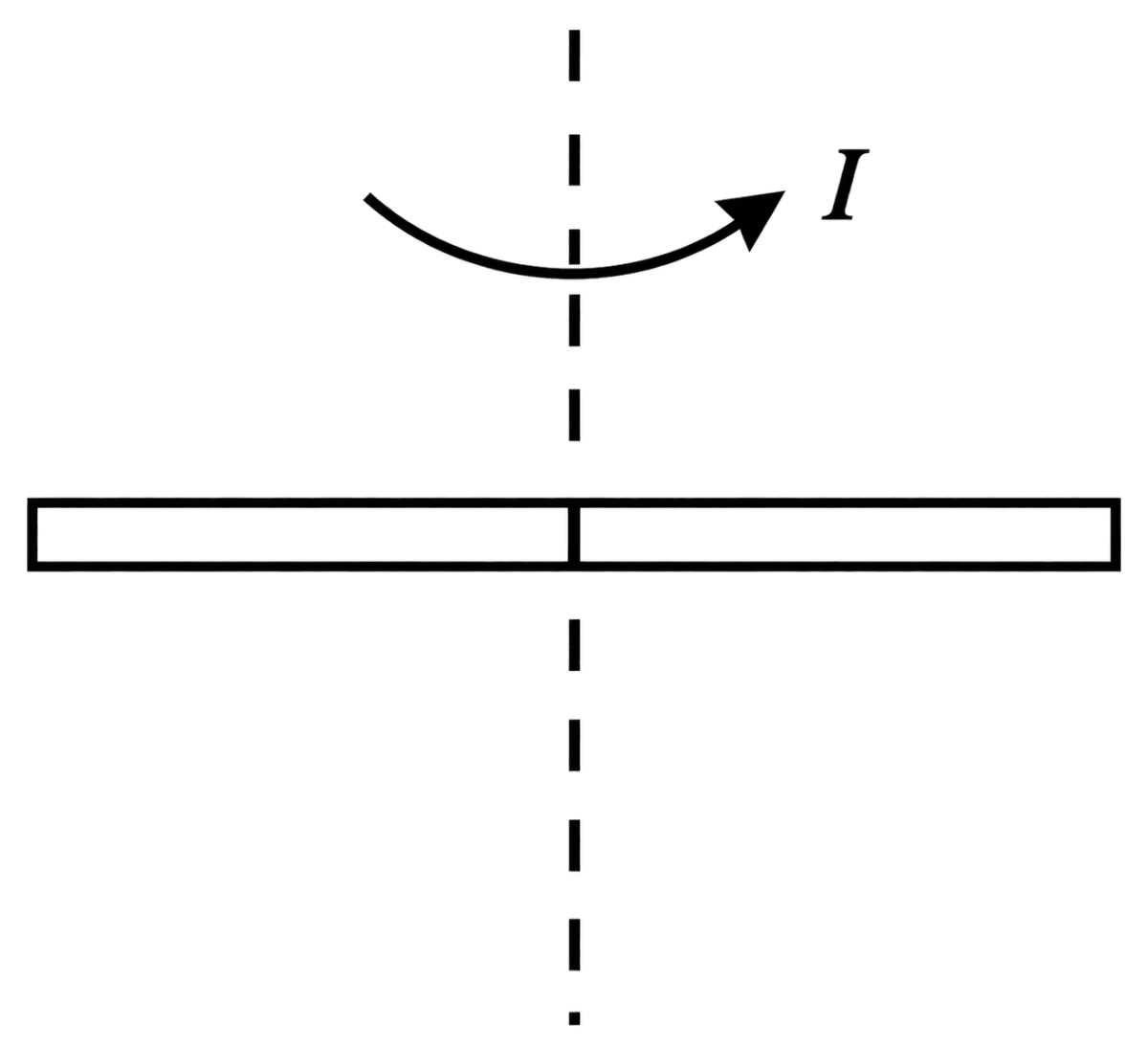
The moment of inertia I of a thin rod about an axis passing through its mid-point and perpendicular to the rod is 2400 g cm 2. The length of 400 g rod is nearly:. System of Particles & Rotational Motion, Solutions for Class 11 ISC Nootan Physics Kumar Mittal Nageen Prakashan
  1. 8.5 cm
  2. 17.5 cm
  3. 20.7 cm
  4. 72.0 cm

Answer

8.5 cm

Reason

Given,

  • Moment of inertia, I = 2400 g cm2
  • Mass of the rod, M = 400 g
  • The axis passes through the mid-point and is perpendicular to the rod

For a thin uniform rod about an axis through its centre and perpendicular to its length,

I=112ML2\text I = \dfrac{1}{12}\text{ML}^2

Rearranging for L,

L2=12IM\text L^2 = \dfrac{12\text I}{\text M}

Substituting the values,

L2=12×2400400=28800400=72\text L^2 = \dfrac{12 \times 2400}{400} = \dfrac{28800}{400} = 72

L=72=8.498.5 cm\text L = \sqrt{72} = 8.49 \approx 8.5\ \text{cm}

Question 20

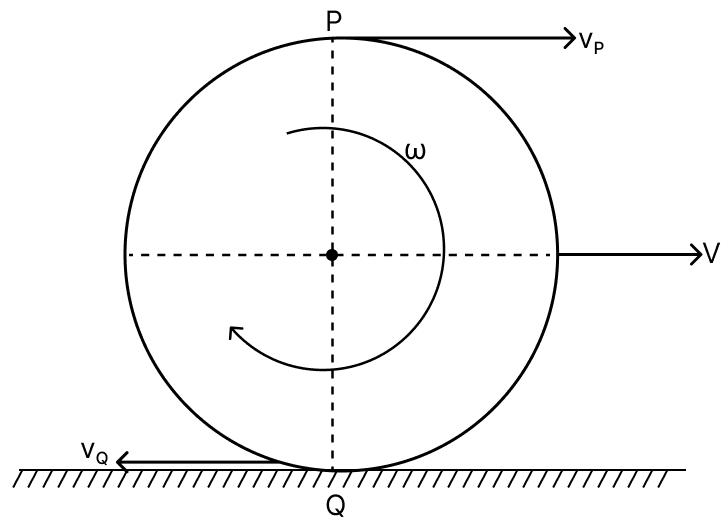
A wheel of a bullock cart is rolling on a level road as shown in the figure. If its linear velocity is v in the direction shown. Which one of the following options is correct (P and Q are the highest and lowest points on the wheel respectively)?
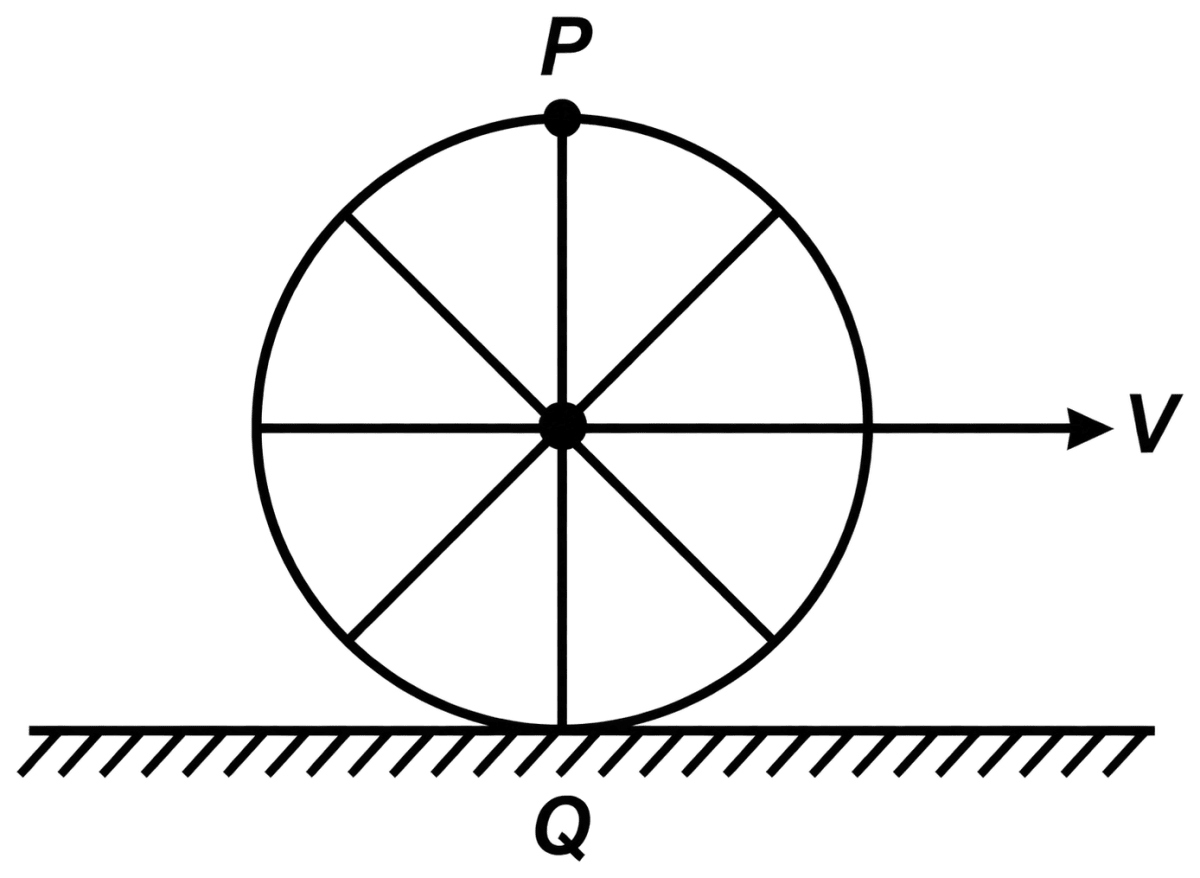
A wheel of a bullock cart is rolling on a level road as shown in the figure. If its linear velocity is v in the direction shown. Which one of the following options is correct (P and Q are the highest and lowest points on the wheel respectively)? System of Particles & Rotational Motion, Solutions for Class 11 ISC Nootan Physics Kumar Mittal Nageen Prakashan
  1. Point P moves slower than Q
  2. Point P moves faster than Q
  3. Both points P and Q move with equal speed
  4. Point P has zero speed.

Answer

Point P moves faster than Q

Reason

A wheel of a bullock cart is rolling on a level road as shown in the figure. If its linear velocity is v in the direction shown. Which one of the following options is correct (P and Q are the highest and lowest points on the wheel respectively)? System of Particles & Rotational Motion, Solutions for Class 11 ISC Nootan Physics Kumar Mittal Nageen Prakashan

In rolling motion the velocity of any point on the wheel is the vector sum of the velocity of the centre of mass and the tangential velocity due to rotation.

At the highest point P : the tangential velocity and the velocity of the centre of mass are in the same direction,

vP=vcm+ωR=v+v=2v\text v_P = \text v_{cm} + \omega \text R = \text v + \text v = 2\text v

At the lowest point Q : the tangential velocity is opposite to the velocity of the centre of mass,

vQ=vcmωR=vv=0\text v_Q = \text v_{cm} - \omega \text R = \text v - \text v = 0

The point of contact Q is therefore momentarily at rest relative to the ground, while the topmost point P moves with twice the speed of the centre of mass. Hence point P moves faster than Q.

Question 21

A cord of negligible mass is wound around the rim of a wheel supported by spokes with negligible mass. The mass of wheel is 10 kg and radius is 10 cm and it can freely rotate without any friction. Initially the wheel is at rest. If a steady pull of 20 N is applied on the cord, the angular velocity of the wheel, after the cord is unwound by 1 m, would be:
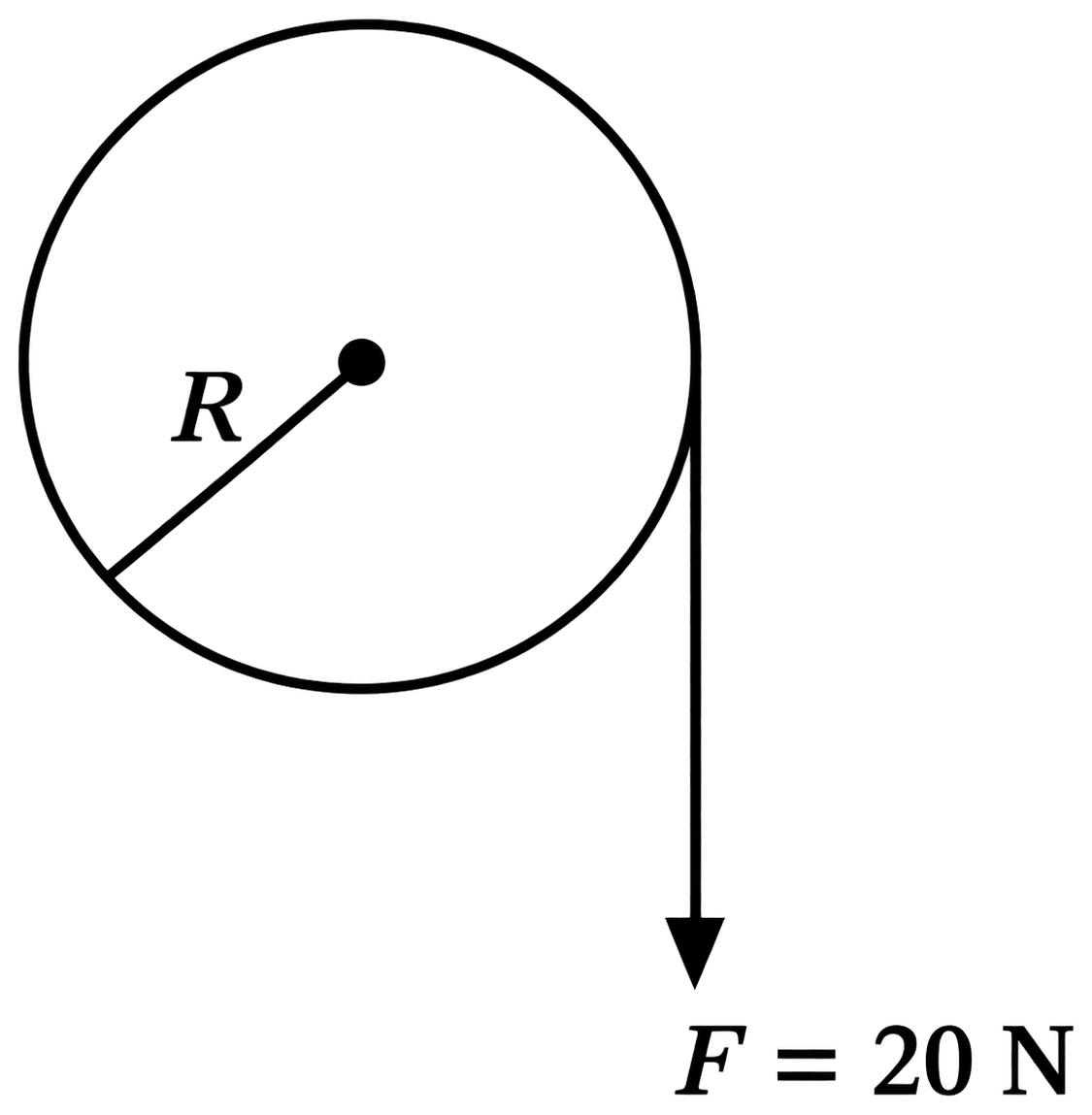
A cord of negligible mass is wound around the rim of a wheel supported by spokes with negligible mass. The mass of wheel is 10 kg and radius is 10 cm and it can freely rotate without any friction. Initially the wheel is at rest. If a steady pull of 20 N is applied on the cord, the angular velocity of the wheel, after the cord is unwound by 1 m, would be:. System of Particles & Rotational Motion, Solutions for Class 11 ISC Nootan Physics Kumar Mittal Nageen Prakashan
  1. 20 rad/s
  2. 30 rad/s
  3. 10 rad/s
  4. 0 rad/s

Answer

20 rad/s

Reason

Given,

  • Mass of the wheel, M = 10 kg
  • Radius of the wheel, R = 10 cm = 0.1 m
  • Steady pull on the cord, F = 20 N
  • Length of cord unwound, s = 1 m

The wheel is supported by spokes of negligible mass, so its entire mass lies on the rim and its moment of inertia is

I=MR2=10×(0.1)2=0.1 kg m2\text I = \text{MR}^2 = 10 \times (0.1)^2 = 0.1\ \text{kg m}^2

The work done by the steady pull in unwinding 1 m of cord is

W=Fs=20×1=20 J\text W = \text{Fs} = 20 \times 1 = 20\ \text J

The wheel rotates without friction and is initially at rest, so all this work appears as its kinetic energy of rotation,

W=12Iω2\text W = \dfrac{1}{2}\text I \omega^2

20=12×0.1×ω2=0.05ω220 = \dfrac{1}{2} \times 0.1 \times \omega^2 = 0.05\omega^2

ω2=200.05=400ω=20 rad/s\omega^2 = \dfrac{20}{0.05} = 400 \quad \Rightarrow \quad \omega = 20\ \text{rad/s}

Question 22

A square lamina OABC of length 10 cm is pivoted at 'O'. Forces act at lamina as shown in figure. If Lamina remains stationary, then the magnitude of F is:
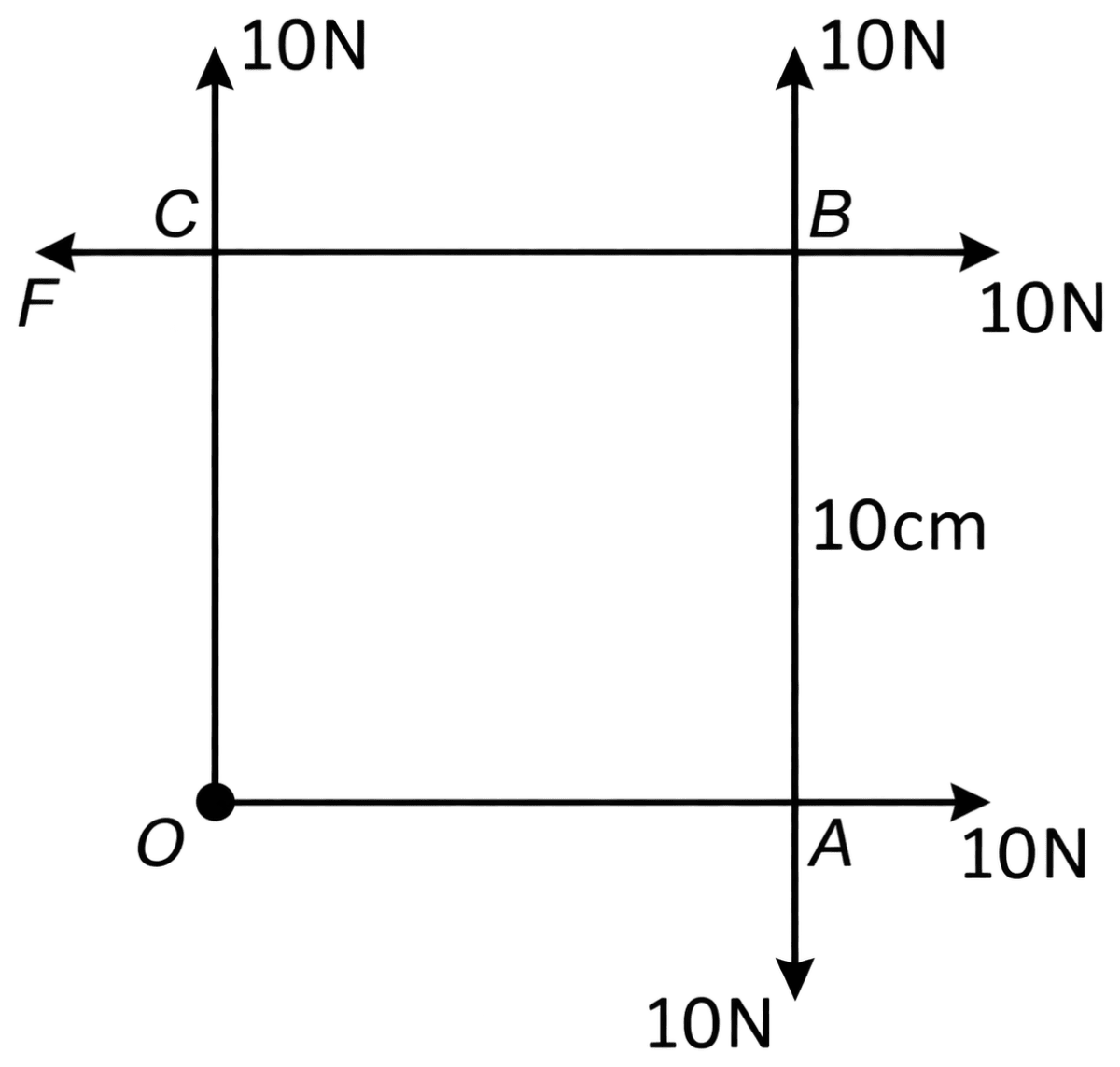
A square lamina OABC of length 10 cm is pivoted at O. Forces act at lamina as shown in figure. If Lamina remains stationary, then the magnitude of F is:. System of Particles & Rotational Motion, Solutions for Class 11 ISC Nootan Physics Kumar Mittal Nageen Prakashan
  1. 20 N
  2. 0 (zero)
  3. 10 N
  4. 102 N

Answer

10 N

Reason

Given, the square lamina OABC has length 10 cm and is pivoted at O. Forces of 10 N act on the lamina as shown, together with the unknown force F.

For the lamina to remain stationary it must be in rotational equilibrium, so the net torque about the pivot O must be zero,

τO=0\sum \tau_O = 0

From the figure, the 10 N forces acting at the sides of the square exert moments about O. Taking the side of the square as the moment arm wherever the force acts perpendicular to a side through the far edge, and equating the sum of the anticlockwise moments to the sum of the clockwise moments,

F×0.10=10×0.10\text F \times 0.10 = 10 \times 0.10

F=10 N\text F = 10\ \text N

The forces whose lines of action pass through the pivot O contribute no moment, since for them the perpendicular distance from the axis of rotation is zero.

Question 23

Moment of inertia of a rod of mass 'M' and length 'L' about an axis passing through its centre and normal to its length is 'α'. Now the rod is cut into two equal parts and these parts are joined symmetrically to form a cross shape. Moment of inertia of cross about an axis passing through its centre and normal to plane containing cross is:

  1. α
  2. α/4
  3. α/8
  4. α/2

Answer

α/4

Reason — Given, the moment of inertia of a rod of mass M and length L about an axis through its centre and normal to its length is

α=112ML2\alpha = \dfrac{1}{12}\text{ML}^2

The rod is cut into two equal parts, so each part has

  • mass M2\dfrac{\text M}{2}
  • length L2\dfrac{\text L}{2}

These two parts are joined symmetrically at their centres to form a cross. The axis passes through the centre of the cross and is normal to the plane containing it. For each part this axis passes through its own centre and is perpendicular to its length, so

I1=112(M2)(L2)2=112×M2×L24=ML296\text I_1 = \dfrac{1}{12}\left(\dfrac{\text M}{2}\right)\left(\dfrac{\text L}{2}\right)^2 = \dfrac{1}{12} \times \dfrac{\text M}{2} \times \dfrac{\text L^2}{4} = \dfrac{\text{ML}^2}{96}

The moment of inertia of the cross is the sum of the moments of inertia of the two parts,

I=2×ML296=ML248\text I = 2 \times \dfrac{\text{ML}^2}{96} = \dfrac{\text{ML}^2}{48}

Expressing this in terms of α,

I=ML248=14(ML212)=α4\text I = \dfrac{\text{ML}^2}{48} = \dfrac{1}{4}\left(\dfrac{\text{ML}^2}{12}\right) = \dfrac{\alpha}{4}

Question 24

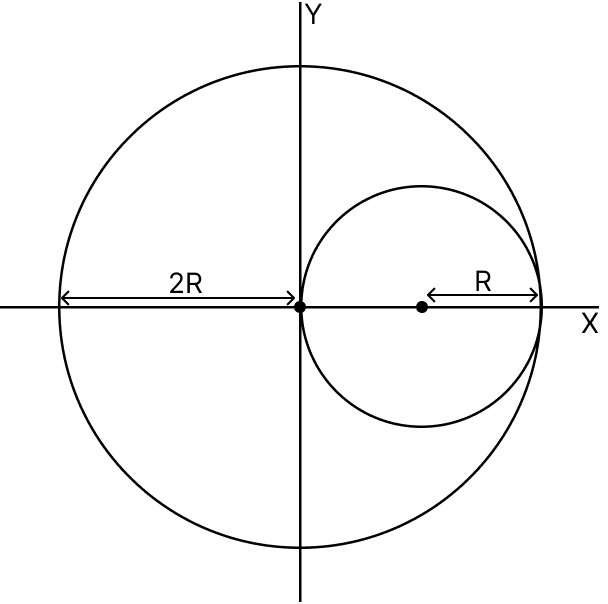
A sphere of radius R is cut from a larger solid sphere or radius 2R as shown in the figure. The ratio of the moment of inertia of the smaller sphere to that of the rest part of the sphere about the Y-axis is:
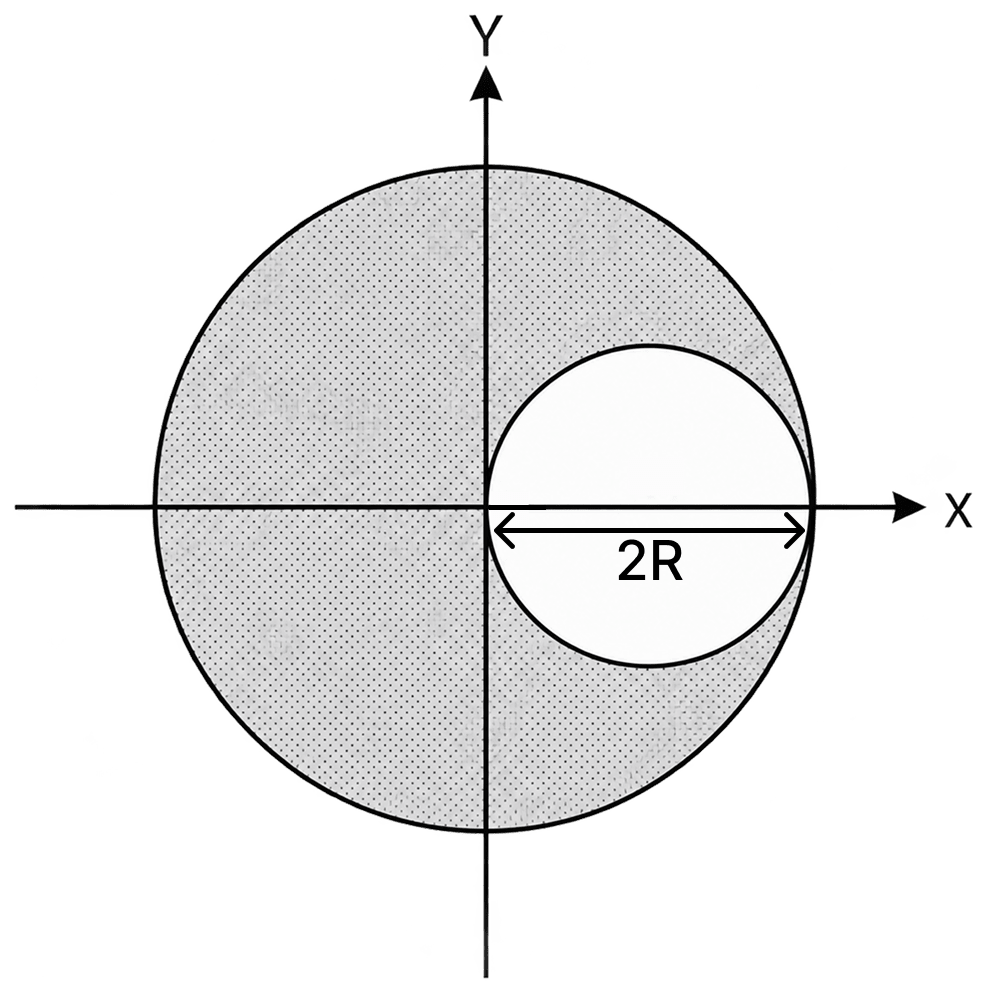
A sphere of radius R is cut from a larger solid sphere or radius 2R as shown in the figure. The ratio of the moment of inertia of the smaller sphere to that of the rest part of the sphere about the Y-axis is:. System of Particles & Rotational Motion, Solutions for Class 11 ISC Nootan Physics Kumar Mittal Nageen Prakashan
  1. 7/8
  2. 7/40
  3. 7/57
  4. 7/64

Answer

7/57

Reason

A sphere of radius R is cut from a larger solid sphere or radius 2R as shown in the figure. The ratio of the moment of inertia of the smaller sphere to that of the rest part of the sphere about the Y-axis is:. System of Particles & Rotational Motion, Solutions for Class 11 ISC Nootan Physics Kumar Mittal Nageen Prakashan

Given, a sphere of radius R is cut from a larger solid sphere of radius 2R, as shown, and the moments of inertia are to be taken about the Y-axis.

Let ρ be the density of the material.

  • Mass of the larger sphere, M=43π(2R)3ρ=8m\text M = \dfrac{4}{3}\pi(2\text R)^3 \rho = 8\text m
  • Mass of the smaller sphere, m=43πR3ρ\text m = \dfrac{4}{3}\pi \text R^3 \rho

From the figure the centre of the smaller sphere is at a distance R from the centre of the larger sphere, along the X-axis.

Moment of inertia of the smaller sphere about the Y-axis : by the theorem of parallel axes,

Is=25mR2+mR2=75mR2\text I_s = \dfrac{2}{5}\text{mR}^2 + \text{mR}^2 = \dfrac{7}{5}\text{mR}^2

Moment of inertia of the larger sphere about the Y-axis :

IL=25(8m)(2R)2=25×8m×4R2=645mR2\text I_L = \dfrac{2}{5}(8\text m)(2\text R)^2 = \dfrac{2}{5} \times 8\text m \times 4\text R^2 = \dfrac{64}{5}\text{mR}^2

Moment of inertia of the rest of the sphere :

Ir=ILIs=645mR275mR2=575mR2\text I_r = \text I_L - \text I_s = \dfrac{64}{5}\text{mR}^2 - \dfrac{7}{5}\text{mR}^2 = \dfrac{57}{5}\text{mR}^2

Therefore,

IsIr=75mR2575mR2=757\dfrac{\text I_s}{\text I_r} = \dfrac{\dfrac{7}{5}\text{mR}^2}{\dfrac{57}{5}\text{mR}^2} = \dfrac{7}{57}

Question 25

The Sun rotates around its centre once in 27 days. What will be the period of revolution if the Sun were to expand to twice its present radius without any external influence? Assume the Sun to be a sphere of uniform density.

  1. 100 days
  2. 105 days
  3. 115 days
  4. 108 days

Answer

108 days

Reason — Given,

  • Present period of rotation of the Sun, T1 = 27 days
  • New radius, R2 = 2R1

The Sun is assumed to be a sphere of uniform density, so its moment of inertia about its own axis is

I=25MR2\text I = \dfrac{2}{5}\text{MR}^2

The expansion takes place without any external influence, so no external torque acts and the angular momentum is conserved,

I1ω1=I2ω2\text I_1 \omega_1 = \text I_2 \omega_2

Since ω=2πT\omega = \dfrac{2\pi}{\text T},

25MR12×2πT1=25MR22×2πT2\dfrac{2}{5}\text{MR}_1^2 \times \dfrac{2\pi}{\text T_1} = \dfrac{2}{5}\text{MR}_2^2 \times \dfrac{2\pi}{\text T_2}

Cancelling the common factors,

R12T1=R22T2T2=T1(R2R1)2\dfrac{\text R_1^2}{\text T_1} = \dfrac{\text R_2^2}{\text T_2} \quad \Rightarrow \quad \text T_2 = \text T_1\left(\dfrac{\text R_2}{\text R_1}\right)^2

Substituting R2 = 2R1,

T2=27×(2)2=27×4=108 days\text T_2 = 27 \times (2)^2 = 27 \times 4 = 108\ \text{days}

Competition Zone — MCQ (More Than One Correct Options)

Question 1

The potential energy of a particle of mass m at a distance r from a fixed point O is given by U(r)=kr22\text U_{(\text r)} = \dfrac{\text k \text r^2}{2}, where k is a positive constant of appropriate dimensions. This particle is moving in a cirular orbit of radius R about the point O. If v is the speed of the particle and J is the magnitude of its angular momentum about O, which of the following statements is (are) true?

  1. v=k2mR\text v = \sqrt{\dfrac{\text k}{2\text m}}\text R

  2. v=kmR\text v = \sqrt{\dfrac{\text k}{\text m}}\text R

  3. J=mkR2\text J = \sqrt{\text{mk}}\text R^2

  4. J=mk2R2\text J = \sqrt{\dfrac{\text{mk}}{2}}\text R^2

Answer

v=kmR\text v = \sqrt{\dfrac{\text k}{\text m}}\text R and J=mkR2\text J = \sqrt{\text{mk}}\text R^2

Reason — Given, the potential energy of the particle is U(r)=kr22\text U_{(\text r)} = \dfrac{\text{kr}^2}{2}.

The force acting on the particle is obtained from the potential energy,

F=dUdr=ddr(kr22)=kr\text F = -\dfrac{\text{dU}}{\text{dr}} = -\dfrac{\text d}{\text{dr}}\left(\dfrac{\text{kr}^2}{2}\right) = -\text{kr}

The magnitude of this force is kr, and it is directed towards O, so it provides the centripetal force for the circular orbit of radius R,

mv2R=kR\dfrac{\text{mv}^2}{\text R} = \text{kR}

v2=kR2mv=kmR\text v^2 = \dfrac{\text{kR}^2}{\text m} \quad \Rightarrow \quad \text v = \sqrt{\dfrac{\text k}{\text m}}\text R

The magnitude of the angular momentum about O is

J=mvR=mkmR×R\text J = \text{mvR} = \text m\sqrt{\dfrac{\text k}{\text m}}\text R \times \text R

J=mkR2\text J = \sqrt{\text{mk}}\text R^2

Hence the second and the third statements are true.

Question 2

Consider a body of mass 1.0 kg at rest at the origin at time t = 0. A force F=(αti^+βj^)\vec{\text F} = (\alpha \text t \hat{i} + \beta \hat{j}) is applied on the body, where α = 1.0 Ns-1 and β = 1.0 N. The torque acting on the body about the origin at time t = 1.0 s is τ\vec{\tau}. Which of the following statements is (are) true?

  1. τ=13|\vec{\tau}| = \dfrac{1}{3} Nm

  2. The torque τ \vec{\tau} \spaceis in the direction of the unit vector +k^+ \hat{k}

  3. The velocity of the body at t = 1 s is v=12(i^+2j^)\vec{\text v} = \dfrac{1}{2}(\hat{i} + 2\hat{j}) ms-1

  4. The magnitude of displacement of the body at t = 1 s is 16\dfrac{1}{6} m

Answer

τ=13|\vec{\tau}| = \dfrac{1}{3} Nm and the velocity of the body at t = 1 s is v=12(i^+2j^)\vec{\text v} = \dfrac{1}{2}(\hat{i} + 2\hat{j}) ms-1

Reason — Given,

  • Mass of the body, m = 1.0 kg, at rest at the origin at t = 0
  • Force, F=(αti^+βj^)\vec{\text F} = (\alpha \text t\hat{i} + \beta \hat{j}) with α = 1.0 Ns-1 and β = 1.0 N

So F=(ti^+j^)\vec{\text F} = (\text t\hat{i} + \hat{j}) N.

Velocity at t = 1 s : Since m = 1 kg, the acceleration is a=(ti^+j^)\vec{\text a} = (\text t\hat{i} + \hat{j}). Integrating from rest,

v=0t(ti^+j^)dt=t22i^+tj^\vec{\text v} = \int_0^{\text t}(\text t\hat{i} + \hat{j})\text{dt} = \dfrac{\text t^2}{2}\hat{i} + \text t\hat{j}

At t = 1 s,

v=12i^+j^=12(i^+2j^) ms1\vec{\text v} = \dfrac{1}{2}\hat{i} + \hat{j} = \dfrac{1}{2}(\hat{i} + 2\hat{j})\ \text{ms}^{-1}

Position at t = 1 s : Integrating once more,

r=0t(t22i^+tj^)dt=t36i^+t22j^\vec{\text r} = \int_0^{\text t}\left(\dfrac{\text t^2}{2}\hat{i} + \text t\hat{j}\right)\text{dt} = \dfrac{\text t^3}{6}\hat{i} + \dfrac{\text t^2}{2}\hat{j}

At t = 1 s, r=16i^+12j^\vec{\text r} = \dfrac{1}{6}\hat{i} + \dfrac{1}{2}\hat{j}.

Torque at t = 1 s :

τ=r×F=(16i^+12j^)×(i^+j^)\vec{\tau} = \vec{\text r} \times \vec{\text F} = \left(\dfrac{1}{6}\hat{i} + \dfrac{1}{2}\hat{j}\right) \times (\hat{i} + \hat{j})

=16(i^×j^)+12(j^×i^)=16k^12k^=13k^= \dfrac{1}{6}(\hat{i} \times \hat{j}) + \dfrac{1}{2}(\hat{j} \times \hat{i}) = \dfrac{1}{6}\hat{k} - \dfrac{1}{2}\hat{k} = -\dfrac{1}{3}\hat{k}

τ=13 Nm|\vec{\tau}| = \dfrac{1}{3}\ \text{Nm}

The torque is along k^-\hat{k}, so the second statement is false. The magnitude of the displacement at t = 1 s is (16)2+(12)216\sqrt{\left(\dfrac{1}{6}\right)^2 + \left(\dfrac{1}{2}\right)^2} \ne \dfrac{1}{6} m, so the fourth statement is also false. Hence the first and the third statements are true.

Competition Zone — Numericals

Question 1

The radius of gyration of a cylindrical rod about an axis of rotation perpendicular to its length and passing through the centre will be ............... m.

Given, the length of the rod is 10310\sqrt{3} m.

Answer

Given,

  • Length of the cylindrical rod, L=103\text L = 10\sqrt{3} m
  • The axis is perpendicular to the length and passes through the centre

The moment of inertia of a rod about an axis passing through its centre and perpendicular to its length is

I=112ML2\text I = \dfrac{1}{12}\text{ML}^2

If K is the radius of gyration about this axis, then by definition

I=MK2\text I = \text{MK}^2

Equating the two expressions,

MK2=112ML2K=L23\text{MK}^2 = \dfrac{1}{12}\text{ML}^2 \quad \Rightarrow \quad \text K = \dfrac{\text L}{2\sqrt{3}}

Substituting L=103\text L = 10\sqrt{3} m,

K=10323=5 m\text K = \dfrac{10\sqrt{3}}{2\sqrt{3}} = 5\ \text m

Hence, the radius of gyration of the rod is 5 m.

Question 2

A disc of mass 1 kg and radius R is free to rotate about a horizontal axis passing through its centre and perpendicular to the plane of disc. A body of same mass as that of disc of fixed at the highest point of the disc. Now the system is released, when the body comes to the lowest position, it angular speed will be 4x3R4\sqrt{\dfrac{\text x}{3\text R}} rad s-1 where x = ............... . (g = 10 ms-2)

Answer

Given,

  • Mass of the disc = 1 kg, radius = R
  • Mass of the body fixed at the highest point = 1 kg
  • g = 10 m s-2

The disc rotates about a horizontal axis through its centre, and the body of equal mass m is fixed at the highest point of the disc, at a distance R from the axis.

Moment of inertia of the system :

I=12mR2+mR2=32mR2\text I = \dfrac{1}{2}\text{mR}^2 + \text{mR}^2 = \dfrac{3}{2}\text{mR}^2

When the system is released, the body descends from the highest point to the lowest point, that is, through a vertical height 2R. Applying the conservation of mechanical energy,

mg(2R)=12Iω2\text{mg}(2\text R) = \dfrac{1}{2}\text I \omega^2

Substituting the value of I,

2mgR=12×32mR2×ω2=34mR2ω22\text{mgR} = \dfrac{1}{2} \times \dfrac{3}{2}\text{mR}^2 \times \omega^2 = \dfrac{3}{4}\text{mR}^2 \omega^2

ω2=8g3Rω=8g3R\omega^2 = \dfrac{8\text g}{3\text R} \quad \Rightarrow \quad \omega = \sqrt{\dfrac{8\text g}{3\text R}}

Substituting g = 10 m s-2,

ω=803R=453R\omega = \sqrt{\dfrac{80}{3\text R}} = 4\sqrt{\dfrac{5}{3\text R}}

Comparing with the given form ω=4x3R\omega = 4\sqrt{\dfrac{\text x}{3\text R}},

x=5\text x = 5

Hence, the value of x is 5.

Question 3

At time t = 0, a disc of radius 1 m starts to roll without slipping on a horizontal plane with an angular acceleration of α=23\alpha = \dfrac{2}{3} rad s-2. A small stone is stuck to the disk. At t = 0, it is at the contact point of the disc and the plane. Later, at time t=π\text t = \sqrt{\pi} s, the stone detaches itself and flies off tangentially from the disc. The maximum height (in m) reached by the stone measured from the plane is 12+x10\dfrac{1}{2} + \dfrac{\text x}{10}. The value of x is ............... . [Take g = 10 ms-2.]

Answer

Given,

  • Radius of the disc, R = 1 m
  • Angular acceleration, α=23\alpha = \dfrac{2}{3} rad s-2
  • Time at which the stone detaches, t=π\text t = \sqrt{\pi} s
  • The disc starts from rest and rolls without slipping
  • g = 10 m s-2
At time t = 0, a disc of radius 1 m starts to roll without slipping on a horizontal plane with an angular acceleration of alpha = 2/3 rad s -2. A small stone is stuck to the disk. At t = 0, it is at the contact point of the disc and the plane. Later, at time text t = √( pi) s, the stone detaches itself and flies off tangentially from the disc. The maximum height (in m) reached by the stone measured from the plane is 1/2 + text x/10. The value of x is................ [Take g = 10 ms -2.]. System of Particles & Rotational Motion, Solutions for Class 11 ISC Nootan Physics Kumar Mittal Nageen Prakashan

Angular velocity and angular displacement at the instant of detachment

The disc starts from rest, so ω0 = 0. Using the equations of rotational kinematics,

ω=ω0+αt=0+23π=23π rad s1\omega = \omega_0 + \alpha \text t = 0 + \dfrac{2}{3}\sqrt{\pi} = \dfrac{2}{3}\sqrt{\pi}\ \text{rad s}^{-1}

θ=ω0t+12αt2=0+12×23×(π)2\theta = \omega_0 \text t + \dfrac{1}{2}\alpha \text t^2 = 0 + \dfrac{1}{2} \times \dfrac{2}{3} \times (\sqrt{\pi})^2

θ=π3 rad\theta = \dfrac{\pi}{3}\ \text{rad}

Position of the stone at the instant of detachment

At t = 0 the stone is at the point of contact, that is, at the lowest point of the disc, directly below the centre. As the disc turns through an angle θ, the stone is carried round the rim through the same angle θ.

The centre of the disc always stays at a height R above the plane. Taking the centre as reference, the stone is at a depth R cos θ below it. Hence the height of the stone above the plane at the moment of detachment is

h1=RRcosθ=R(1cosθ)\text h_1 = \text R - \text R\cos \theta = \text R(1 - \cos \theta)

Substituting the values,

h1=1(1cosπ3)=1(112)\text h_1 = 1\left(1 - \cos \dfrac{\pi}{3}\right) = 1\left(1 - \dfrac{1}{2}\right)

h1=12 m\text h_1 = \dfrac{1}{2}\ \text m

Velocity of the stone at the instant of detachment

In rolling motion the velocity of any point on the rim is the vector sum of the velocity of the centre of mass and the tangential velocity due to rotation, each of magnitude ωR.

Resolving these two into horizontal and vertical components for a point that has turned through an angle θ from the contact point, the components of the velocity of the stone are vx and vy

Only the vertical component determines the further rise of the stone. Substituting the values,

vy=ωRsinθvy=23π×1×sinπ3vy=23π×32vy=3π3\text v_y = \omega \text R \text{sin} \theta \\[1em] \text v_y= \dfrac{2}{3}\sqrt{\pi} \times 1 \times \sin \dfrac{\pi}{3} \\[1em] \text v_y= \dfrac{2}{3}\sqrt{\pi} \times \dfrac{\sqrt{3}}{2}\\[1em] \text v_y = \dfrac{\sqrt{3\pi}}{3}

Squaring both sides,

vy2=3π9=π3\text v_y^2 = \dfrac{3\pi}{9} = \dfrac{\pi}{3}

Further rise of the stone after detachment

After leaving the disc the stone moves as a projectile under gravity. At the highest point its vertical velocity becomes zero, so using v2 = u2 + 2as in the vertical direction,

0=vy22gh2h2=vy22g0 = \text v_y^2 - 2\text{gh}_2 \quad \Rightarrow \quad \text h_2 = \dfrac{\text v_y^2}{2\text g}

Substituting the values,

h2=π/32×10=π60 m\text h_2 = \dfrac{\pi/3}{2 \times 10} = \dfrac{\pi}{60}\ \text m

Maximum height above the plane

h=h1+h2=12+π60\text h = \text h_1 + \text h_2 = \dfrac{1}{2} + \dfrac{\pi}{60}

Rewriting the second term so as to compare it with the given form,

π60=110×π6\dfrac{\pi}{60} = \dfrac{1}{10} \times \dfrac{\pi}{6}

h=12+π/610\text h = \dfrac{1}{2} + \dfrac{\pi/6}{10}

Comparing with h=12+x10\text h = \dfrac{1}{2} + \dfrac{\text x}{10},

x=π6=3.141596=0.5236\text x = \dfrac{\pi}{6} = \dfrac{3.14159}{6} = 0.5236

x=0.52\text x = 0.52

Hence, the value of x is 0.52.

Question 4

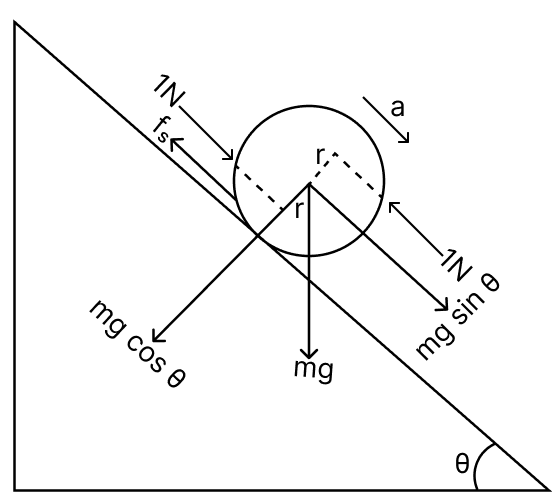
A solid sphere of mass 1 kg and radius 1m rolls without slipping on a fixed inclined plane with an angle of inclination θ = 30° from the horizontal. Two forces of magnitude 1 N each, parallel to the incline, act on the sphere, both at distance r = 0.5 m from the centre of the sphere, as shown in the figure. The acceleration of the sphere down the plane is ............... ms-2. (Take g = 10 ms-2.)
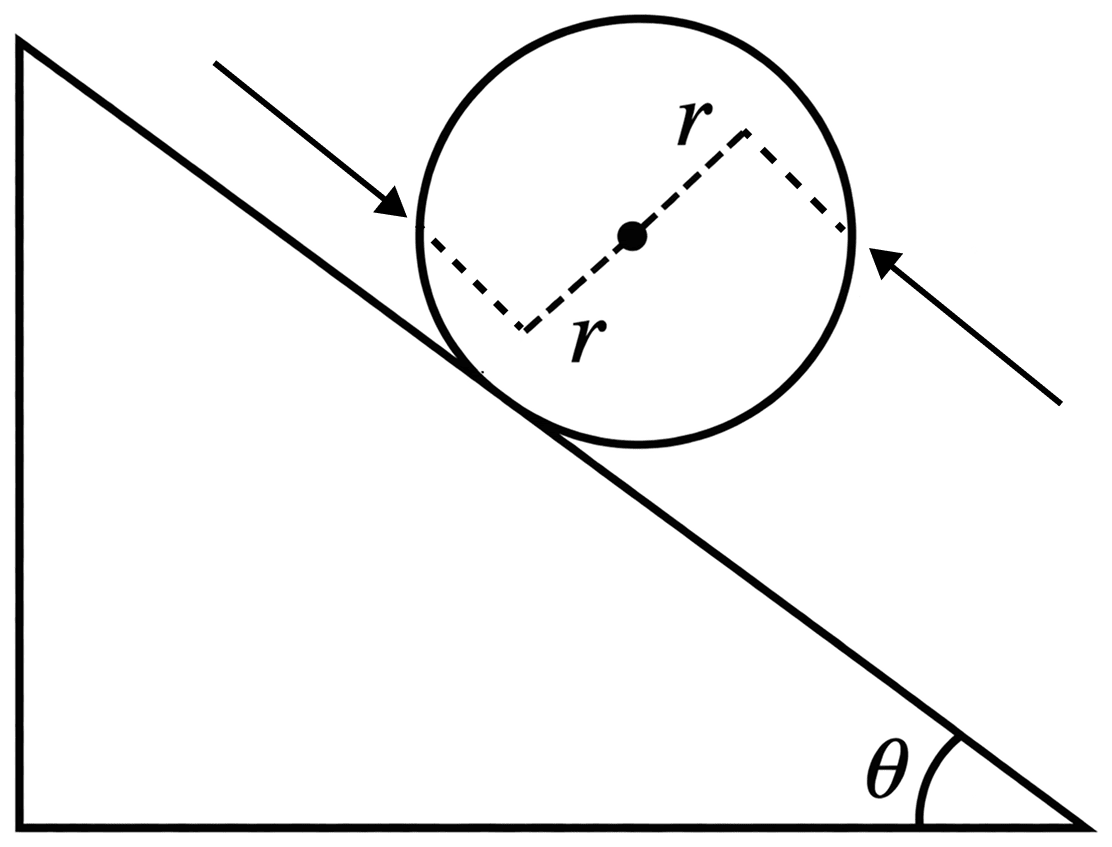
A solid sphere of mass 1 kg and radius 1m rolls without slipping on a fixed inclined plane with an angle of inclination θ = 30° from the horizontal. Two forces of magnitude 1 N each, parallel to the incline, act on the sphere, both at distance r = 0.5 m from the centre of the sphere, as shown in the figure. The acceleration of the sphere down the plane is............... ms -2. (Take g = 10 ms -2.). System of Particles & Rotational Motion, Solutions for Class 11 ISC Nootan Physics Kumar Mittal Nageen Prakashan

Answer

Given,

  • Mass of the solid sphere, M = 1 kg
  • Radius of the sphere, R = 1 m
  • Angle of inclination, θ = 30°
  • Two forces of magnitude 1 N each, parallel to the incline, acting at r = 0.5 m from the centre
  • g = 10 m s-2
A solid sphere of mass 1 kg and radius 1m rolls without slipping on a fixed inclined plane with an angle of inclination θ = 30° from the horizontal. Two forces of magnitude 1 N each, parallel to the incline, act on the sphere, both at distance r = 0.5 m from the centre of the sphere, as shown in the figure. The acceleration of the sphere down the plane is............... ms -2. (Take g = 10 ms -2.). System of Particles & Rotational Motion, Solutions for Class 11 ISC Nootan Physics Kumar Mittal Nageen Prakashan

The moment of inertia of a solid sphere about its own axis is

I=25MR2\text I = \dfrac{2}{5}\text{MR}^2

From the figure the two forces of 1 N each act on opposite sides of the centre, both parallel to the incline. Their translational effects cancel, since they are equal and opposite, but they form a couple whose moment about the centre is

τF=F×2r=1×2×0.5=1 N m\tau_F = \text F \times 2\text r = 1 \times 2 \times 0.5 = 1\ \text{N m}

Equation of translational motion along the incline :

Mgsinθfs=Ma(i)\text{Mg}\sin \theta - \text f_s = \text{Ma} \qquad \dots(\text i)

Equation of rotational motion about the centre : The frictional force and the couple both exert torques,

fsRτF=Iα=25MR2×aR=25MRa\text f_s \text R - \tau_F = \text I \alpha = \dfrac{2}{5}\text{MR}^2 \times \dfrac{\text a}{\text R} = \dfrac{2}{5}\text{MRa}

fs=25Ma+τFR(ii)\text f_s = \dfrac{2}{5}\text{Ma} + \dfrac{\tau_F}{\text R} \qquad \dots(\text{ii})

Substituting equation (ii) in equation (i),

Mgsinθ25MaτFR=Ma\text{Mg}\sin \theta - \dfrac{2}{5}\text{Ma} - \dfrac{\tau_F}{\text R} = \text{Ma}

MgsinθτFR=75Ma\text{Mg}\sin \theta - \dfrac{\tau_F}{\text R} = \dfrac{7}{5}\text{Ma}

Substituting the values,

(1)(10)(0.5)11=75(1)a(1)(10)(0.5) - \dfrac{1}{1} = \dfrac{7}{5}(1)\text a

51=1.4aa=41.4=2.86 m s25 - 1 = 1.4\text a \quad \Rightarrow \quad \text a = \dfrac{4}{1.4} = 2.86\ \text{m s}^{-2}

Hence, the acceleration of the sphere down the plane is 2.86 m s-2.

Question 5

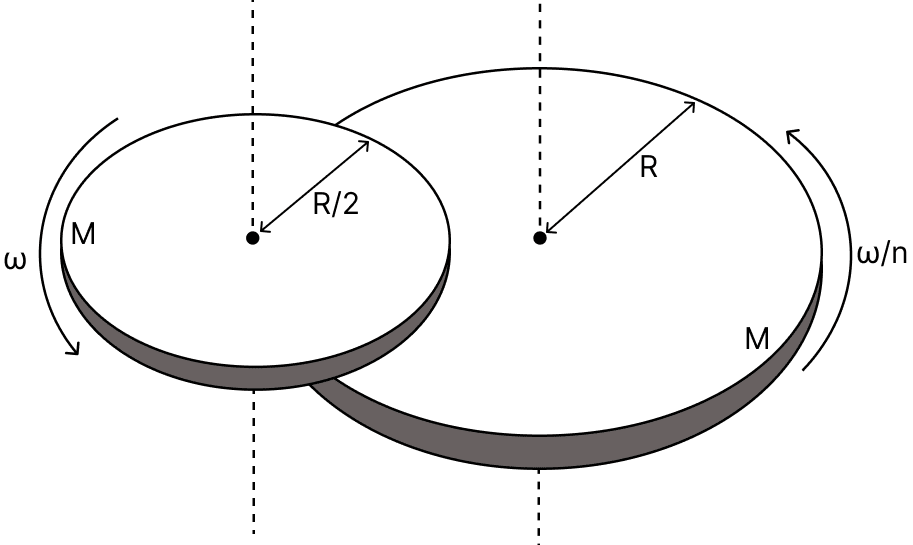
A disc of mass M and radius R is free to rotate about its vertical axis as shown in the figure. A battery-operated motor of negligible mass is fixed to this disc at a point on its circumference. Another disc of the same mass M and radius R/2 is fixed to the motor's thin shaft. Initially, both the discs are at rest. The motor is switched on so that the smaller disc rotates at a uniform angular speed ω. If the angular speed at which the large disc rotates is ω/n, then the value of n is ............... .
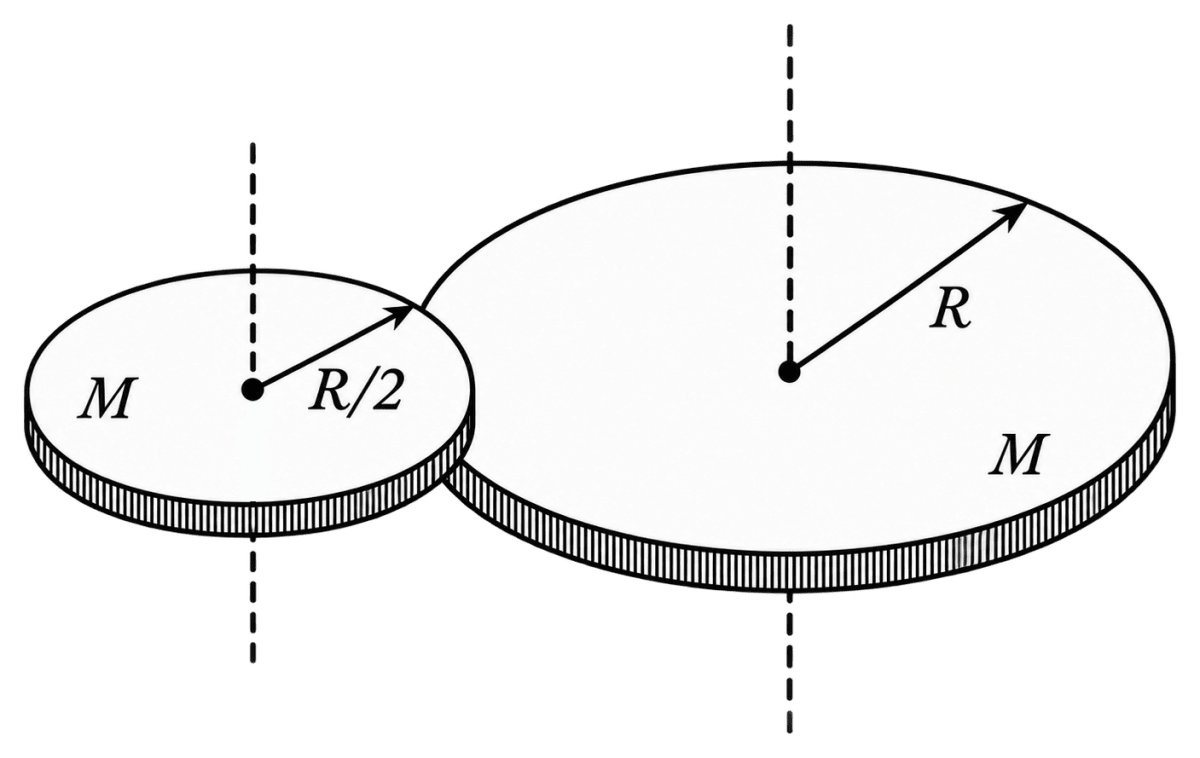
A disc of mass M and radius R is free to rotate about its vertical axis as shown in the figure. A battery-operated motor of negligible mass is fixed to this disc at a point on its circumference. Another disc of the same mass M and radius R/2 is fixed to the motors thin shaft. Initially, both the discs are at rest. The motor is switched on so that the smaller disc rotates at a uniform angular speed ω. If the angular speed at which the large disc rotates is ω/n, then the value of n is................ System of Particles & Rotational Motion, Solutions for Class 11 ISC Nootan Physics Kumar Mittal Nageen Prakashan

Answer

Given,

  • Large disc of mass M and radius R, free to rotate about its own vertical axis
  • Small disc of mass M and radius R2\dfrac{\text R}{2}, fixed to the motor's shaft
  • The motor is of negligible mass and is fixed at a point on the circumference of the large disc
  • Angular speed of the small disc = ω
  • Angular speed of the large disc = ωn\dfrac{\omega}{\text n}
A disc of mass M and radius R is free to rotate about its vertical axis as shown in the figure. A battery-operated motor of negligible mass is fixed to this disc at a point on its circumference. Another disc of the same mass M and radius R/2 is fixed to the motors thin shaft. Initially, both the discs are at rest. The motor is switched on so that the smaller disc rotates at a uniform angular speed ω. If the angular speed at which the large disc rotates is ω/n, then the value of n is................ System of Particles & Rotational Motion, Solutions for Class 11 ISC Nootan Physics Kumar Mittal Nageen Prakashan

The motor exerts equal and opposite torques on the small disc and on the large disc, so these torques are internal to the system. No external torque acts about the vertical axis of the large disc, hence the angular momentum of the whole system about that axis is conserved. Both discs are initially at rest, so this angular momentum stays zero throughout.

Let the large disc turn with angular speed Ω=ωn\Omega = \dfrac{\omega}{\text n} in the sense opposite to that of the small disc.

Angular momentum of the large disc

It rotates about its own central axis, so

L1=12MR2Ω\text L_1 = \dfrac{1}{2}\text{MR}^2 \Omega

Angular momentum of the small disc

The small disc is mounted at the rim of the large disc, so its centre lies at a distance R from the axis of rotation. Its angular momentum about that axis therefore has two parts,

(i) the spin of the small disc about its own centre,

Lspin=12M(R2)2ω=18MR2ω\text L_{spin} = \dfrac{1}{2}\text M\left(\dfrac{\text R}{2}\right)^2 \omega = \dfrac{1}{8}\text{MR}^2 \omega

(ii) the orbital angular momentum of its centre of mass, which is carried round the axis by the large disc,

Lorbital=MR2Ω\text L_{orbital} = \text{MR}^2 \Omega

Applying the conservation of angular momentum

Taking the sense of the small disc's spin as positive, the sum of all three contributions must vanish,

12MR2Ω+MR2Ω+18MR2ω=0\dfrac{1}{2}\text{MR}^2 \Omega + \text{MR}^2 \Omega + \dfrac{1}{8}\text{MR}^2 \omega = 0

Cancelling MR2 throughout,

12Ω+Ω+18ω=0\dfrac{1}{2}\Omega + \Omega + \dfrac{1}{8}\omega = 0

32Ω=18ω\dfrac{3}{2}\Omega = -\dfrac{1}{8}\omega

Ω=18×23ω=ω12\Omega = -\dfrac{1}{8} \times \dfrac{2}{3}\omega = -\dfrac{\omega}{12}

The negative sign only shows that the large disc turns in the sense opposite to the small disc. Comparing the magnitude with ωn\dfrac{\omega}{\text n}

n=12\text n = 12

Hence, the value of n is 12.

Question 6

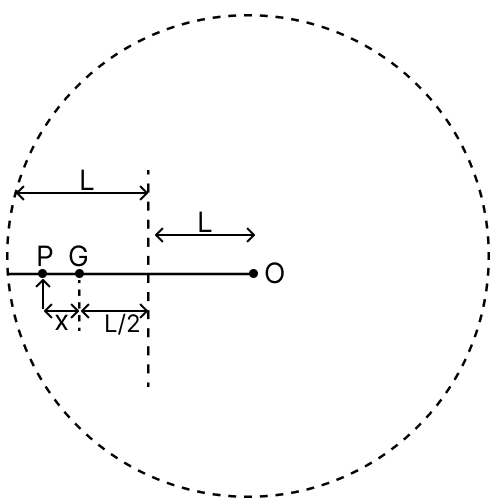
A thin uniform rod of length L and certain mass is kept on a frictionless horizontal table with a massless string of length L fixed to one end (top view is shown in the figure). The other end of the string is pivoted to a point O. If a horizontal impulse P is imparted to the rod at a distance x = L/n from the mid-point of the rod (see figure), then the rod and string revolve together around the point O, with the rod remaining aligned with the string. In such a case, the value of n is ............... .
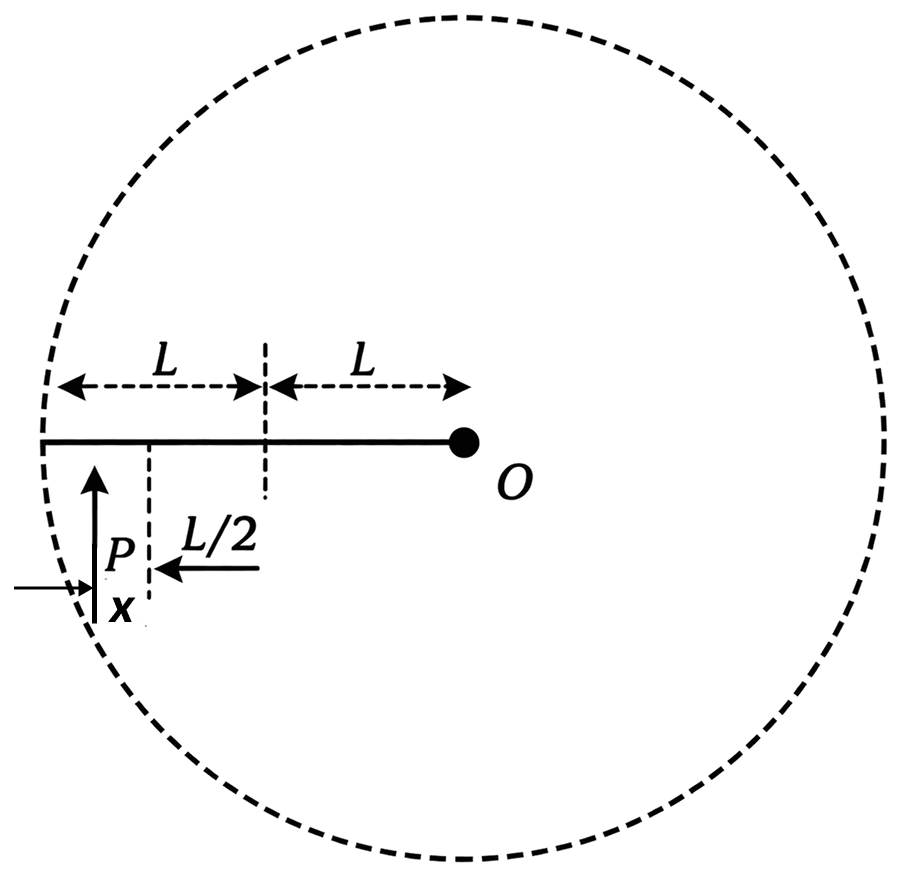
A thin uniform rod of length L and certain mass is kept on a frictionless horizontal table with a massless string of length L fixed to one end (top view is shown in the figure). The other end of the string is pivoted to a point O. If a horizontal impulse P is imparted to the rod at a distance x = L/n from the mid-point of the rod (see figure), then the rod and string revolve together around the point O, with the rod remaining aligned with the string. In such a case, the value of n is................ System of Particles & Rotational Motion, Solutions for Class 11 ISC Nootan Physics Kumar Mittal Nageen Prakashan

Answer

Given,

  • Length of the rod = L, mass of the rod = m
  • Length of the massless string = L, pivoted at O
  • Horizontal impulse P applied at a distance x=Ln\text x = \dfrac{\text L}{\text n} from the mid-point of the rod
  • The table is frictionless
A thin uniform rod of length L and certain mass is kept on a frictionless horizontal table with a massless string of length L fixed to one end (top view is shown in the figure). The other end of the string is pivoted to a point O. If a horizontal impulse P is imparted to the rod at a distance x = L/n from the mid-point of the rod (see figure), then the rod and string revolve together around the point O, with the rod remaining aligned with the string. In such a case, the value of n is................ System of Particles & Rotational Motion, Solutions for Class 11 ISC Nootan Physics Kumar Mittal Nageen Prakashan

Position of the rod

The rod remains aligned with the string, so the string and the rod together form a single straight line from O. Measuring along this line, the near end of the rod is at a distance L from O and the far end at 2L, so the centre of mass of the rod is at

OG=L+L2=3L2\text{OG} = \text L + \dfrac{\text L}{2} = \dfrac{3\text L}{2}

Key property of the string

The string is massless and perfectly flexible, so it can exert only a tension along its own length. The impulsive tension developed in it during the blow is therefore directed along the string, that is, radially towards O. This has two consequences,

  • it has no transverse component, so it does not contribute to the linear impulse of the rod perpendicular to the rod, and
  • its line of action passes through the centre of the rod, so it exerts no moment about the centre of mass of the rod.

Motion just after the impulse

The rod and string revolve together about O with an angular velocity ω. Since the rod stays aligned with the string, the rod itself turns about its own centre of mass at the same rate ω.

The velocity of the centre of mass of the rod is therefore

vcm=ω×OG=3L2ω\text v_{cm} = \omega \times \text{OG} = \dfrac{3\text L}{2}\omega

Applying the impulse-momentum theorem in the transverse direction

The only transverse impulse acting on the rod is P, since the string tension is purely radial. Hence

P=mvcm=m×3L2ωP=32mLω(i)\text P = \text m\text v_{cm} = \text m \times \dfrac{3\text L}{2}\omega \\[1em] \text P = \dfrac{3}{2}\text{mL}\omega \qquad \dots(\text i)

Applying the angular impulse-momentum theorem about the centre of mass of the rod

The string tension exerts no moment about the centre of mass, so the only angular impulse about G is that of P, acting at a distance x from G,

Px=Icmω=mL212ω(ii)\text{Px} = \text I_{cm}\omega = \dfrac{\text{mL}^2}{12}\omega \qquad \dots(\text{ii})

Solving for x

Dividing equation (ii) by equation (i),

PxP=mL212ω32mLω\dfrac{\text{Px}}{\text P} = \dfrac{\dfrac{\text{mL}^2}{12}\omega}{\dfrac{3}{2}\text{mL}\omega}

The quantities m, ω and P cancel out,

x=L212×23L=2L36=L18\text x = \dfrac{\text L^2}{12} \times \dfrac{2}{3\text L} = \dfrac{2\text L}{36} = \dfrac{\text L}{18}

Comparing with x=Ln\text x = \dfrac{\text L}{\text n},

n=18\text n = 18

Hence, the value of n is 18.

Question 7

A solid sphere and a hollow cylinder roll up without slipping on same inclined plane with same initial speed v. The sphere and the cylinder reach up to maximum heights h1 and h2, respectively, above the initial level. The ratio h1:h2=n10\text h_1 : \text h_2 = \dfrac{\text n}{10}. The value of n is ............... .

Answer

Given,

  • A solid sphere and a hollow cylinder roll up the same inclined plane
  • Both start with the same initial speed v
  • Maximum heights reached are h1 and h2 respectively

For a body rolling without slipping, the total kinetic energy at the bottom is completely converted into potential energy at the maximum height,

12mv2(1+k2R2)=mgh\dfrac{1}{2}\text{mv}^2\left(1 + \dfrac{\text k^2}{\text R^2}\right) = \text{mgh}

h=v22g(1+k2R2)\text h = \dfrac{\text v^2}{2\text g}\left(1 + \dfrac{\text k^2}{\text R^2}\right)

For the solid sphere, k2R2=25\dfrac{\text k^2}{\text R^2} = \dfrac{2}{5},

h1=v22g(1+25)=v22g×75\text h_1 = \dfrac{\text v^2}{2\text g}\left(1 + \dfrac{2}{5}\right) = \dfrac{\text v^2}{2\text g} \times \dfrac{7}{5}

For the hollow cylinder, k2R2=1\dfrac{\text k^2}{\text R^2} = 1,

h2=v22g(1+1)=v22g×2\text h_2 = \dfrac{\text v^2}{2\text g}(1 + 1) = \dfrac{\text v^2}{2\text g} \times 2

Therefore the required ratio is

h1h2=7/52=710\dfrac{\text h_1}{\text h_2} = \dfrac{7/5}{2} = \dfrac{7}{10}

Comparing with h1h2=n10\dfrac{\text h_1}{\text h_2} = \dfrac{\text n}{10},

n=7\text n = 7

Hence, the value of n is 7.

Question 8

Four particles each of mass 1 kg are placed at four corners of a square of side 2 m. Moment of inertia of system about an axis perpendicular to its plane and passing through one of its vertices is ............... kg m2.

Answer

Given,

  • Four particles, each of mass m = 1 kg
  • Side of the square, a = 2 m
  • The axis is perpendicular to the plane of the square and passes through one of its vertices

Let the axis pass through the vertex A. The distances of the four particles from this axis are :

  • The particle at A lies on the axis, so its distance is 0.
  • The two particles at the adjacent vertices are each at a distance equal to the side, a = 2 m.
  • The particle at the opposite vertex is at a distance equal to the diagonal,
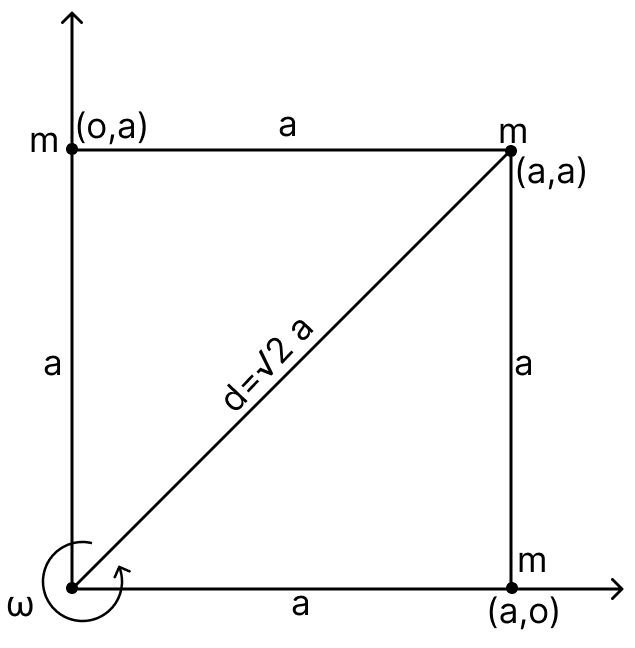
Four particles each of mass 1 kg are placed at four corners of a square of side 2 m. Moment of inertia of system about an axis perpendicular to its plane and passing through one of its vertices is............... kg m 2. System of Particles & Rotational Motion, Solutions for Class 11 ISC Nootan Physics Kumar Mittal Nageen Prakashan

d=a2=22 m\text d = \text a\sqrt{2} = 2\sqrt{2}\ \text m

The moment of inertia of the system is

I=m(0)2+ma2+ma2+md2\text I = \text m(0)^2 + \text{ma}^2 + \text{ma}^2 + \text{md}^2

Substituting the values,

I=0+1(2)2+1(2)2+1(22)2\text I = 0 + 1(2)^2 + 1(2)^2 + 1(2\sqrt{2})^2

=0+4+4+8=16 kg m2= 0 + 4 + 4 + 8 = 16\ \text{kg m}^2

Hence, the moment of inertia of the system about the given axis is 16 kg m2.

PrevNext