
(a) You can shield a charge from electrical forces by putting it inside a hollow conductor. Can you shield a body from gravitational influence of nearby matter by putting it inside a hollow sphere or by some other means?
(b) An astronaut inside a small spaceship orbiting around the earth cannot detect gravity. If the space station orbiting around earth has a large size, can he hope to detect gravity?
(c) If you compare the gravitational force on the earth due to the sun to that due to the moon, you would find that the Sun's pull is greater than the moon's pull. (you can check this yourself using the data available in the succeeding exercises). However, the tidal effect of the moon's pull is greater than the tidal effect of sun. Why?
Answer
(a) No. A body cannot be shielded from the gravitational influence of nearby matter by any means. Electrical shielding is possible because charges are of two kinds and the induced charges on a hollow conductor cancel the external field inside it. Gravitational mass, however, is of only one kind and gravitation is completely independent of the presence of other bodies and of the properties of the intervening medium. Hence no arrangement of matter can cancel the gravitational field inside it.
(b) Yes. The gravitational pull of the earth on the spaceship provides the centripetal force needed to keep it in orbit, so the astronaut and the spaceship both fall freely together and the astronaut feels weightless with respect to the earth. He can, however, detect the gravitational field of the spaceship itself. If the space station is small its own gravitational force is negligible, but if it is massive or of large size, the astronaut will experience its gravity and will be able to detect it.
(c) The tidal effect is produced not by the gravitational force itself but by the variation of that force across the diameter of the earth. The gravitational force varies inversely as the square of the distance, whereas the tidal force varies inversely as the cube of the distance. The moon is very much nearer to the earth than the sun is, so although the sun's pull on the earth is much greater than the moon's pull, the moon's pull changes far more sharply from the near face of the earth to the far face. This larger difference in pull stretches the oceans more effectively, and therefore the tidal effect of the moon's pull is greater than that of the sun.
Choose the correct alternative in each one of the followings :
(a) Acceleration due to gravity increases / decreases with increasing altitude.
(b) Acceleration due to gravity increases / decreases with increasing depth (assume the earth to be a sphere of uniform density).
(c) Acceleration due to gravity is independent of the mass of the earth/mass of the body.
(d) The formula is more/less accurate than the formula m g (r2 − r1) for the difference of potential energy between two points r2 and r1 distances away from the centre of the earth.
Answer
(a) Decreases. As we go above the surface of the earth the distance from the centre increases, and
so that g' < g.
(b) Decreases. At a depth h below the surface, only the inner solid sphere of radius (Re − h) attracts the body, and
so that g' < g.
(c) Mass of the body. Since , the expression is free from the mass of the body. Hence the earth attracts all bodies with the same acceleration, whatever their masses be.
(d) More. The formula is exact for all separations, while m g (r2 − r1) assumes that g has the same value at r1 and at r2. Since g is not the same at the two distances, the first formula is more accurate.
Suppose there existed a planet that went around the Sun twice as fast as the earth. What would be its orbital size as compared to that of the earth?
Answer
Given,
- Period of the planet, (it goes round the sun twice as fast)
By Kepler's law of periods, the square of the period of revolution of a planet is directly proportional to the cube of its mean distance from the sun,
Applying this to the planet and the earth,
Substituting ,
Hence, the orbital size of the planet is about 0.63 times that of the earth.
If one of the satellites of Jupiter, has an orbital period of 1.769 days, and the radius of the orbit is 4.22 × 10⁸ m, show that the mass of Jupiter is about one-thousandth that of the sun.
Answer
Given,
- Orbital period of the satellite, T = 1.769 days = 1.769 × 24 × 60 × 60 = 1.528 × 10⁵ s
- Radius of the orbit, r = 4.22 × 10⁸ m
- G = 6.67 × 10⁻¹¹ N m2 kg-2
- Mass of the sun, Ms = 1.99 × 1030 kg
The gravitational pull of Jupiter on its satellite supplies the necessary centripetal force. Hence the period of revolution of a satellite in an orbit of radius r around Jupiter (mass MJ) is
Substituting the values,
Comparing this with the mass of the sun,
Hence, the mass of Jupiter is about one-thousandth that of the sun.
Let us assume that our galaxy consists of 2.5 × 10¹¹ stars each of one solar mass. How long will a star at a distance of 50,000 ly from the galactic centre take to complete one revolution? Take the diameter of the Milky Way to be 105 ly.
Answer
Given,
- Number of stars in the galaxy = 2.5 × 10¹¹
- Mass of one star (one solar mass) = 1.99 × 1030 kg
- Distance of the star from the galactic centre, r = 50,000 ly
- Diameter of the Milky Way = 105 ly
- 1 ly = 9.46 × 10¹⁵ m
The total mass of the galaxy is
The diameter of the galaxy is 105 ly, which is twice the distance of the star from the centre. Hence the star lies at the very edge of the galactic disk, and by Newton's shell theorem the whole mass of the galaxy enclosed within its orbit acts as if concentrated at the centre.
The radius of the star's path is
The gravitational pull of the galaxy provides the centripetal force, so the period of revolution is
Substituting the values,
Expressing this in years (1 year = 3.156 × 10⁷ s),
Hence, the star takes about 3.55 × 10⁸ years to complete one revolution.
(a) Choose the correct alternative : If the potential energy at infinity is assumed to be zero, the total energy of an orbiting satellite is negative of its kinetic / potential energy.
(b) The energy required to launch an orbiting satellite out of earth's gravitational field is more / less than the energy required to project a stationary object at the same height (as the satellite) out of earth's field.
Answer
(a) Kinetic energy. For a satellite revolving round the earth in a circular orbit of radius r, the gravitational potential energy and the kinetic energy are
so that the total energy is
Hence the total energy of an orbiting satellite is negative of its kinetic energy.
(b) Less. An orbiting satellite already possesses kinetic energy , and only the additional energy needed to raise its total energy to zero has to be supplied. The energy required to launch the orbiting satellite out of earth's gravitational field is
whereas a stationary object at the same height has no kinetic energy, and the energy required to project it out of earth's field is
Hence, the energy required to launch an orbiting satellite is less, in fact half, of that required for a stationary object at the same height.
Does the escape velocity of a body from the earth depend on (a) mass of the body, (b) the location from where it is projected, (c) the direction of projection, (d) the height of the location from where the body is launched?
Answer
The escape velocity of a body from the earth is
(a) No. The expression is free from the mass m of the body, so the escape velocity is independent of the mass of the body.
(b) Yes. The escape velocity depends upon the gravitational potential at the point of projection, and this potential varies slightly with the latitude of the place. Hence it depends slightly on the location from where the body is projected.
(c) No. The escape velocity is the minimum speed required to leave the gravitational field, and it is independent of the angle, that is, the direction of projection.
(d) Yes. The escape velocity depends upon the distance of the body from the centre of the earth. At a height h the escape velocity becomes , which decreases as h increases.
Hence, the escape velocity is independent of the mass of the body and the direction of projection, but depends on the location and the height of the point of projection.
A comet orbits the sun in a highly elliptical orbit. Does the comet have a constant (a) linear speed, (b) angular speed, (c) angular momentum, (d) kinetic energy, (e) potential energy, (f) total energy throughout its orbit? Neglect any mass loss of the comet when it comes very close to the Sun.
Answer
(a) No. The comet moves fastest when it is nearest the sun (perihelion) and slowest when it is farthest (aphelion), so the linear speed is not constant.
(b) No. By Kepler's law of areas the comet sweeps out equal areas in equal times. When it is near the sun the radius vector is short, so it must sweep through a larger angle in a given time. Hence the angular speed is greater near the sun and smaller far from it.
(c) Yes. The gravitational force on the comet is a central force directed towards the sun, so it exerts no torque about the sun. Hence the angular momentum of the comet remains constant throughout the orbit.
(d) No. The kinetic energy depends on the speed, and since the speed varies along the orbit, the kinetic energy also varies.
(e) No. The potential energy depends on the distance r from the sun. At perihelion r is least and U is most negative, while at aphelion r is largest and U is less negative.
(f) Yes. Gravitation is a conservative force, so the total mechanical energy E = K + U remains constant throughout the orbit. For a bound elliptical orbit this constant total energy is negative.
Which of the following symptoms is likely to afflict an astronaut in space : (a) swollen feet, (b) swollen face, (c) headache, (d) orientational problem?
Answer
(b), (c) and (d).
Inside an orbiting satellite the astronaut is in a state of weightlessness, since the gravitational pull provides exactly the centripetal force and the reaction of the floor on him becomes zero.
Because of this weightlessness the blood and other body fluids no longer collect in the lower part of the body but are redistributed towards the upper part. This causes the swollen face and the headache. The absence of any 'up' and 'down' direction also produces the orientational problem.
Swollen feet, however, are caused by the pooling of blood in the feet under the action of gravity, which does not occur in the state of weightlessness.
Hence, the astronaut is likely to be afflicted by swollen face, headache and orientational problem, but not by swollen feet.
In the following two exercises, choose the correct answer from among the given ones: The gravitational intensity at the centre of a hemispherical shell of uniform mass density has the direction indicated by the arrow (see Fig.) (i) a, (ii) b, (iii) c, (iv) 0.
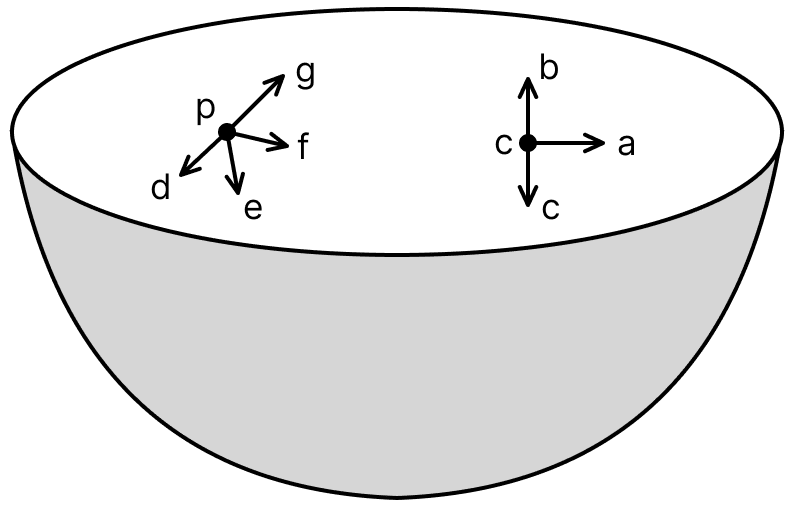
Answer
(iii) c
Consider the mass elements of the hemispherical shell. Because of the symmetry of the shell about its axis, the horizontal components of the gravitational intensity due to all the mass elements cancel out in pairs.
The vertical components, however, due to every element of the curved hemispherical surface, all point in the same direction and add up. The resultant gravitational intensity at the centre C of the flat face is therefore directed vertically downwards, perpendicular to the flat face, into the shell along the axis of symmetry.
Hence, the direction of the gravitational intensity at the centre is that of the arrow c.
For the above problem, the direction of the gravitational intensity at an arbitrary point P is indicated by the arrow (i) d, (ii) e, (iii) f, (iv) g.
Answer
(ii) e
The point P is not on the axis of symmetry of the hemispherical shell, so the horizontal components of the gravitational intensity due to the mass elements no longer cancel completely.
The resultant intensity at P is therefore directed towards the mass distribution of the curved hemispherical surface, that is, it points inward and is also tilted towards the shell instead of being vertically downward. The arrow e represents exactly this direction, being inclined inward and slightly to the side.
Hence, the direction of the gravitational intensity at the arbitrary point P is that of the arrow e.
A rocket is fired from the earth towards the sun. At what distance from the earth's centre is the gravitational force on the rocket zero? Mass of the sun = 2 × 1030 kg, mass of the earth = 6 × 1024 kg. Neglect the effect of other planets, etc. (orbital radius = 1.5 × 10¹¹ m).
Answer
Given,
- Mass of the sun, Ms = 2 × 1030 kg
- Mass of the earth, Me = 6 × 1024 kg
- Distance between the earth and the sun, D = 1.5 × 10¹¹ m
Let the gravitational force on the rocket be zero at a distance x from the centre of the earth, so that its distance from the sun is (D − x). At this point the pull of the earth on the rocket is balanced by the pull of the sun.
The gravitational force on the rocket (mass m) due to the earth is
and that due to the sun is
For the net force on the rocket to be zero, the two forces must be equal,
Substituting the values,
Hence, the gravitational force on the rocket is zero at a distance of 2.59 × 10⁸ m from the earth's centre.
How will you 'weigh the sun', that is estimate its mass? The mean orbital radius of the earth around the sun is 1.5 × 10⁸ km.
Answer
Given,
- Mean orbital radius of the earth, r = 1.5 × 10⁸ km = 1.5 × 10¹¹ m
- Period of revolution of the earth, T = 1 year = 3.15 × 10⁷ s
- G = 6.67 × 10⁻¹¹ N m2 kg-2
The earth completes one revolution of the sun in one year, and the gravitational force exerted by the sun on the earth provides the necessary centripetal force for this revolution. Therefore,
Cancelling Me and rearranging, the mass of the sun is
Substituting the values,
Hence, the mass of the sun is 2.0 × 1030 kg. This is how the sun is 'weighed'.
A Saturn year is 29.5 times the earth year. How far is the Saturn from the sun if the earth is 1.50 × 10⁸ km away from the sun?
Answer
Given,
- Period of Saturn, T2 = 29.5 times the earth year, that is, T2 = 29.5 years
- Period of the earth, T1 = 1 year
- Distance of the earth from the sun, r1 = 1.50 × 10⁸ km
By Kepler's third law, T2 = K r3, where T is the period of a planet and r is its distance from the sun. For the earth and Saturn,
Substituting the values,
Hence, Saturn is 1.43 × 10⁹ km away from the sun.
A body weighs 63 N on the surface of the earth. What is the gravitational force on it due to the earth at a height equal to half the radius of the earth?
Answer
Given,
- Weight of the body on the earth's surface, mg = 63 N
- Height above the surface,
The acceleration due to gravity at a height h above the earth's surface is
Hence the weight of the body of mass m at this height is
Putting ,
Substituting mg = 63 N,
Hence, the gravitational force on the body at that height is 28 N.
Assuming the earth to be a sphere of uniform mass density, how much would a body weigh half way down to the centre of the earth if it weighed 250 N on the surface?
Answer
Given,
- Weight of the body on the earth's surface, W = mg = 250 N
- Depth below the surface,
The acceleration due to gravity at a depth h below the earth's surface varies as
Putting in equation (i),
The weight of the body at this depth is
Hence, the body would weigh 125 N half way down to the centre of the earth.
A rocket is fired vertically with a speed of 5 km s-1 from the earth's surface. How far from the earth does the rocket go before returning to the earth? Mass of the earth = 6.0 × 1024 kg, mean radius of the earth = 6.4 × 10⁶ m, G = 6.67 × 10⁻¹¹ N m2 kg-2.
Answer
Given,
- Speed of projection, v = 5 km s-1 = 5 × 10³ m s-1
- Mass of the earth, Me = 6.0 × 1024 kg
- Radius of the earth, Re = 6.4 × 10⁶ m
- G = 6.67 × 10⁻¹¹ N m2 kg-2
The gravitational potential energies of the rocket (mass m) at the surface of the earth and at a height h from the surface are
Therefore the increase in gravitational potential energy is
This increase is obtained from the initial kinetic energy given to the rocket. Hence
Substituting the values,
Hence, the rocket goes to a height of 1.6 × 10⁶ m from the earth's surface before returning.
The escape velocity of a projectile on the earth's surface is 11.2 km s-1. A body is projected out with thrice this speed. What will be the speed of the body far away from the earth, that is, at infinity? Ignore the presence of sun and other planets.
Answer
Given,
- Escape velocity of the projectile, ve = 11.2 km s-1
- Initial speed of projection, vi = 3ve
Let m be the mass of the projectile and vf its final speed at infinity. The initial kinetic energy is and the initial gravitational potential energy on the earth's surface is . At infinity the potential energy is zero and the kinetic energy is .
By the conservation of energy,
The escape velocity ve of the projectile is given by
Making this substitution in equation (i),
Now vi = 3ve, therefore
Hence, the speed of the body at infinity is 31.7 km s-1.
A satellite orbits the earth at a height of 400 km above the surface. How much energy must be expended to rocket the satellite out of the earth's gravitational influence? Mass of the satellite = 200 kg, mass of the earth = 6.0 × 1024 kg, radius of the earth = 6.4 × 10⁶ m and G = 6.67 × 10⁻¹¹ N m2 kg-2.
Answer
Given,
- Mass of the satellite, m = 200 kg
- Height of the orbit, h = 400 km = 0.4 × 10⁶ m
- Mass of the earth, Me = 6.0 × 1024 kg
- Radius of the earth, Re = 6.4 × 10⁶ m
- G = 6.67 × 10⁻¹¹ N m2 kg-2
The total energy of a satellite of mass m orbiting the earth in a circle of radius r is
For a satellite at a height h above the surface, r = Re + h, so that
Here,
Substituting the values,
To send the satellite out of the earth's gravitational field its total energy must be raised to zero. Hence the energy to be expended is
Hence, 5.89 × 10⁹ J of energy must be expended to rocket the satellite out of the earth's gravitational influence.
Two stars, each of 1 solar mass (= 2 × 1030 kg) and radius 104 km are approaching each other for a head-on collision. When they are at a distance 109 km apart, their speeds are negligible. Find the speed with which they collide. Take G = 6.67 × 10⁻¹¹ N m2 kg-2.
Answer
Given,
- Mass of each star, M = 1 solar mass = 2 × 1030 kg
- Radius of each star, R = 104 km = 107 m
- Initial separation, r = 109 km = 1012 m
- G = 6.67 × 10⁻¹¹ N m2 kg-2
The initial gravitational potential energy of the star-system is
Since their speeds at this separation are negligible, the initial kinetic energy is zero and the initial total energy is
When the stars collide, the separation between their centres is 2R, so the final potential energy is
If v be the speed of each star at collision, the kinetic energy acquired by the system is
By the conservation of energy, Ei = Ef,
Hence, the stars collide with a speed of 2.58 × 10⁶ m s-1 each.
Two heavy spheres each of mass 100 kg and radius 0.10 m are placed 1.0 m apart on a horizontal table. What is the gravitational field and potential at the mid-point of the line joining the centres of the spheres ? (Take G = 6.67 × 10⁻¹¹ N m2 kg-2) Is an object placed at that point in equilibrium? If so, is the equilibrium stable or unstable?
Answer
Given,
- Mass of each sphere, M = 100 kg
- Radius of each sphere = 0.10 m
- Distance between the centres = 1.0 m
- G = 6.67 × 10⁻¹¹ N m2 kg-2
Since the spheres are uniform, their masses may be taken to be concentrated at their centres. The distance of the mid-point from the centre of either sphere is
Gravitational field : The gravitational field intensities at the mid-point due to the two spheres are each of magnitude but are directed opposite to each other, since the mid-point lies between the two spheres. Hence the resultant gravitational field at the mid-point is zero.
Gravitational potential : The potential at the mid-point due to each sphere is . Potential is a scalar quantity, so the two potentials are added algebraically,
Equilibrium : An object placed at the mid-point is attracted equally by the two spheres in opposite directions, so the net force on it is zero and it is in equilibrium.
This equilibrium is, however, unstable. If the object is displaced slightly towards either sphere, it comes nearer to that sphere and farther from the other, so the attraction towards the nearer sphere becomes greater. The net force then pulls it further towards that sphere and it does not return to its original position.
Hence, the gravitational field at the mid-point is zero, the potential is −2.67 × 10⁻⁸ J kg-1, and an object placed there is in unstable equilibrium.