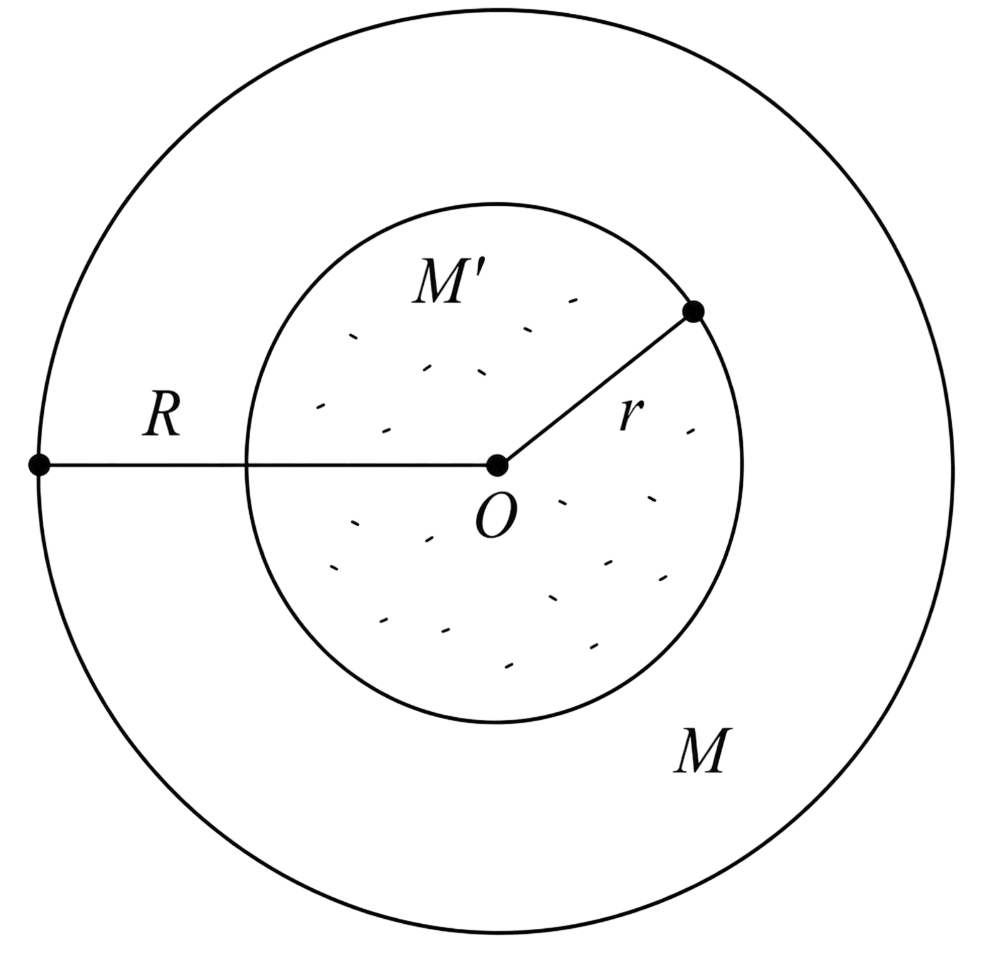
Gravitational acceleration on the surface of a planet is 116g, where g is the gravitational acceleration on the surface of the earth. The average mass density of the planet is 2/3 times that of the earth. If the escape speed on the surface of the earth is taken to be 11 kms-1, find the escape speed on the surface of the planet in kms-1.
Answer
Given,
Acceleration due to gravity on the planet, gp=116g
Average mass density of the planet, ρp=32ρe
Escape speed on the earth, ve = 11 km s-1
The acceleration due to gravity on a body of mass M and radius R is
g=R2GM=R2G×34πR3ρ=34πGRρ
that is, g ∝ R ρ. Applying this to the planet and the earth,
ggp=ReρeRpρp⇒ReRp=ggp×ρpρe
Substituting the given values,
ReRp=116×23=2236
The escape speed from the surface of a planet is ve=2gR, therefore
Hence, the escape speed on the surface of the planet is 3 km s-1.
Question 2
A bullet is fired vertically upwards with velocity v from the surface of a spherical planet. When it reaches its maximum height, its acceleration due to the planet's gravity is 1/4th of its value at the surface of the planet. If the escape velocity from the planet is ve=vN, then find the value of N (ignore energy loss due to atmosphere).
Answer
Given,
Velocity of projection of the bullet = v
Acceleration due to gravity at the maximum height =41 of its value at the surface
Escape velocity from the planet, ve=vN
Let R be the radius of the planet and h the maximum height reached by the bullet. The acceleration due to gravity at a height h is
g′=(R+h)2GMand at the surfaceg=R2GM
Since g′=4g,
(R+h)2R2=41⇒R+h=2R⇒h=R
Applying the conservation of energy between the surface and the highest point, where the bullet is momentarily at rest,
21mv2−RGMm=0−R+hGMm
Putting h = R,
21mv2=RGMm−2RGMm=2RGMm
v2=RGM⇒v=RGM
The escape velocity from the planet is
ve=R2GM=2×RGM=v2
Comparing this with the given relation ve=vN,
N=2
Hence, the value of N is 2.
Question 3
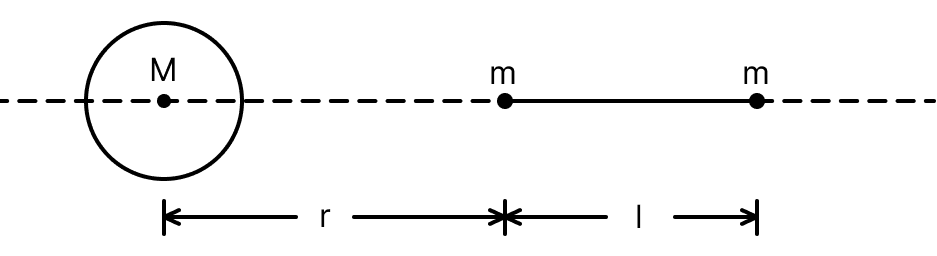
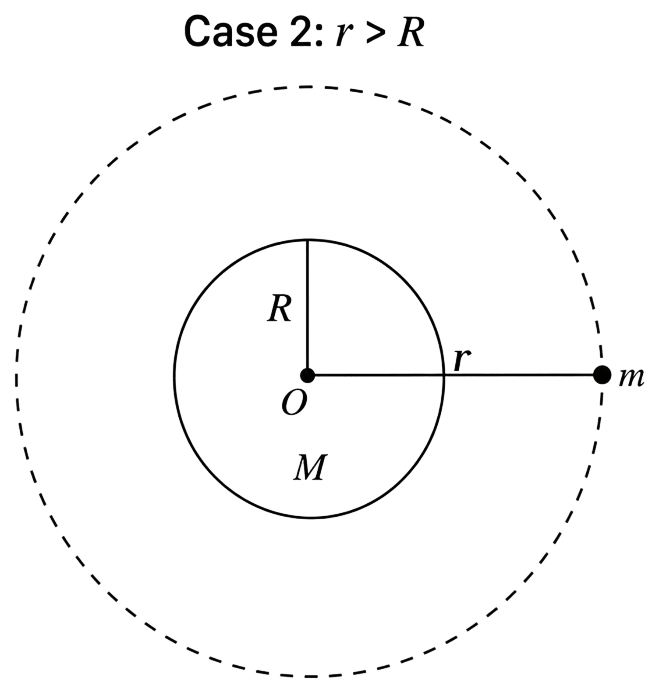
A large spherical mass M is fixed at one position and two identical point masses m are kept on a line passing through the centre of M (see figure). The point masses are connected by a rigid massless rod of length l and this assembly is free to move along the line connecting them. All three masses interact only through their mutual gravitational interaction. When the point mass nearer to M is at a distance r = 3 l from M, the tension in the rod is zero for m=k(288M). Find the value of k.
Answer
Given,
Large fixed spherical mass = M
Two identical point masses, each = m, joined by a rigid rod of length l
Distance of the nearer point mass from M, r = 3l
Tension in the rod is zero when m=k(288M)
Since the rod is rigid, both the point masses move with the same acceleration a. When the tension in the rod is zero, each point mass is acted upon only by the gravitational forces due to M and due to the other point mass.
For the point mass at r = 3l : It is attracted towards M and away from M by the farther point mass, so
(3l)2GMm−l2Gm2=ma...(i)
For the point mass at r = 4l : It is attracted towards M both by M and by the nearer point mass, so
(4l)2GMm+l2Gm2=ma...(ii)
Equating the right-hand sides of equations (i) and (ii),
9l2GM−l2Gm=16l2GM+l2Gm
Cancelling l2G throughout,
9M−16M=2mM(14416−9)=2m
1447M=2m⇒m=2887M=7(288M)
Comparing this with m=k(288M),
k=7
Hence, the value of k is 7.
Question 4
The mass of a spaceship is 1000 kg. It is to be launched from the earth's surface out into free space. The value of 'g' and 'R' (radius of earth) are 10 m/s2 and 6400 km respectively. The required energy for this work will be :
6.4 × 10¹¹ J
6.4 × 10⁸ J
6.4 × 10⁹ J
6.4 × 10¹⁰ J
Answer
6.4 × 10¹⁰ J.
Reason — Given,
Mass of the spaceship, m = 1000 kg
Acceleration due to gravity, g = 10 m s-2
Radius of the earth, R = 6400 km = 6.4 × 10⁶ m
To launch the spaceship from the earth's surface out into free space, energy equal to its binding energy must be supplied. The gravitational potential energy of the spaceship on the earth's surface is
U=−RGMem=−mgR(∵GMe=gR2)
In free space the potential energy is zero, so the energy required is
E=0−U=mgR
Substituting the values,
E=1000×10×(6.4×106)=6.4×10¹⁰J
Question 5
The height at which the acceleration due to gravity becomes g/9 (where g = acceleration due to gravity on the surface of the earth) in terms of R, the radius of the earth is :
2R
2 R
2R
2R
Answer
2 R
Reason — Given,
Acceleration due to gravity at the height h, g′=9g
Radius of the earth = R
The acceleration due to gravity at a height h above the earth's surface is
g′=(1+Rh)2g
Putting g′=9g,
9g=(1+Rh)2g⇒(1+Rh)2=9
1+Rh=3⇒Rh=2
h=2R
Question 6
A particle of mass 10 g is kept on the surface of a uniform sphere of mass 100 kg and radius 10 cm. Find the work to be done against the gravitational force between them to take the particle far away from the sphere. (G = 6.67 × 10⁻¹¹ N m2 / kg2)
6.67 × 10⁻⁹ J
6.67 × 10⁻¹⁰ J
13.34 × 10⁻¹⁰ J
3.33 × 10⁻¹⁰ J
Answer
6.67 × 10⁻¹⁰ J
Reason — Given,
Mass of the particle, m = 10 g = 10 × 10-3 kg
Mass of the sphere, M = 100 kg
Radius of the sphere, R = 10 cm = 10 × 10-2 m
G = 6.67 × 10⁻¹¹ N m2 kg-2
The particle rests on the surface of the sphere, so its distance from the centre is R. The gravitational potential energy of the particle at the surface is
U=−RGMm
When the particle is taken far away from the sphere its potential energy becomes zero. Hence the work to be done against the gravitational force is
A spherically symmetric gravitational system of particles has a mass density
ρ={ρ00for r≤Rfor r>R,
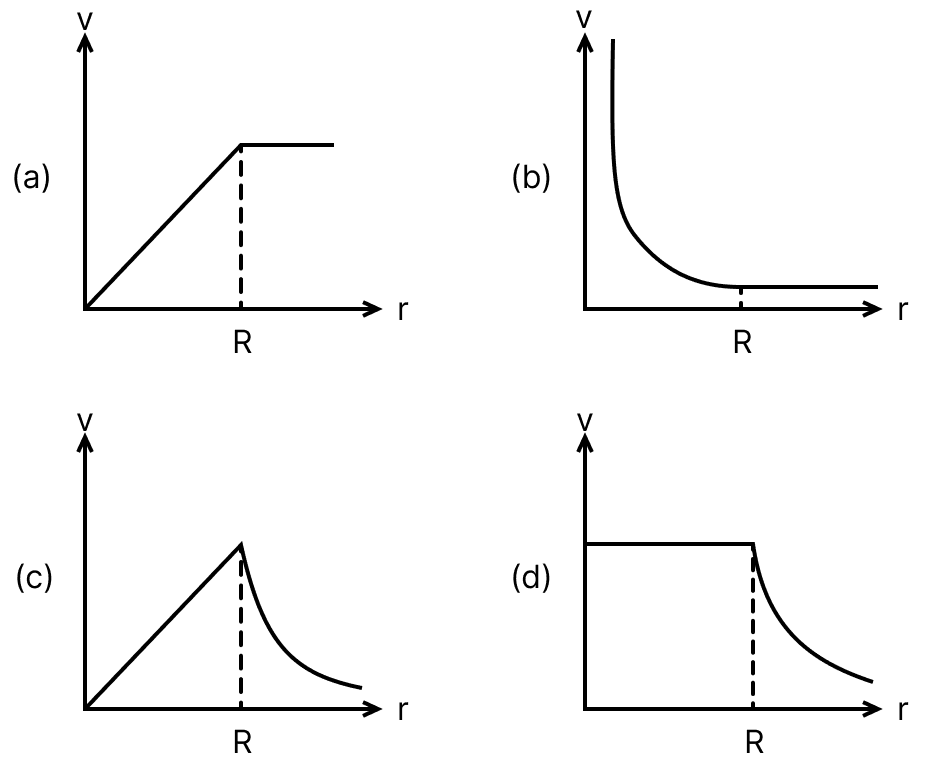
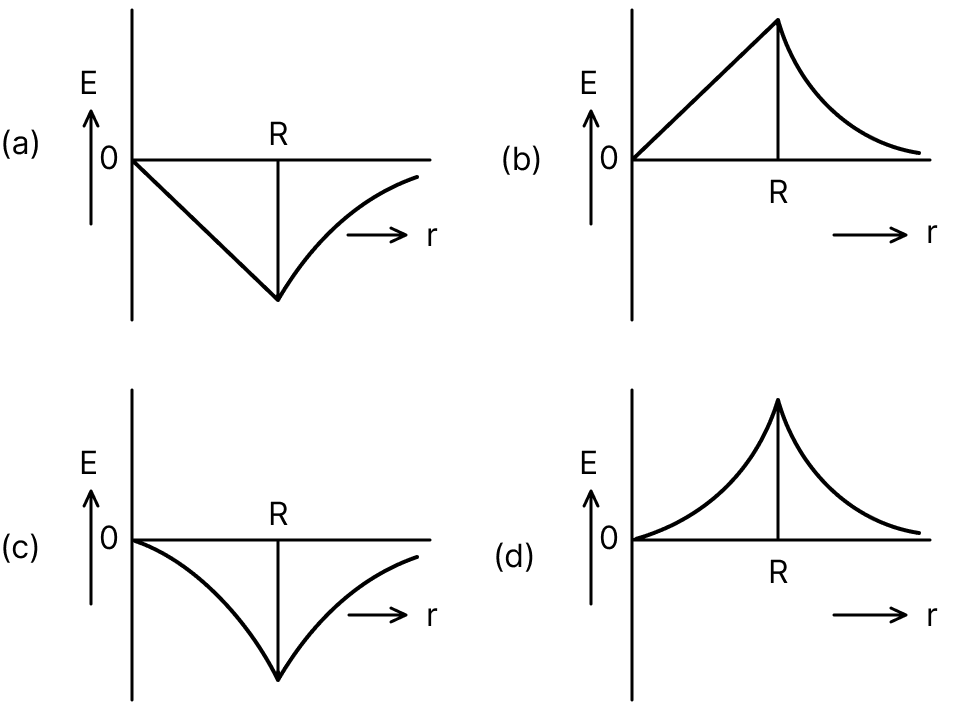
where ρ0 is a constant. A test mass can undergo circular motion under the influence of the gravitational field of particles. Its speed v as a function of distance r (0 < r < ∞) from the centre of the system is represented by :
Answer
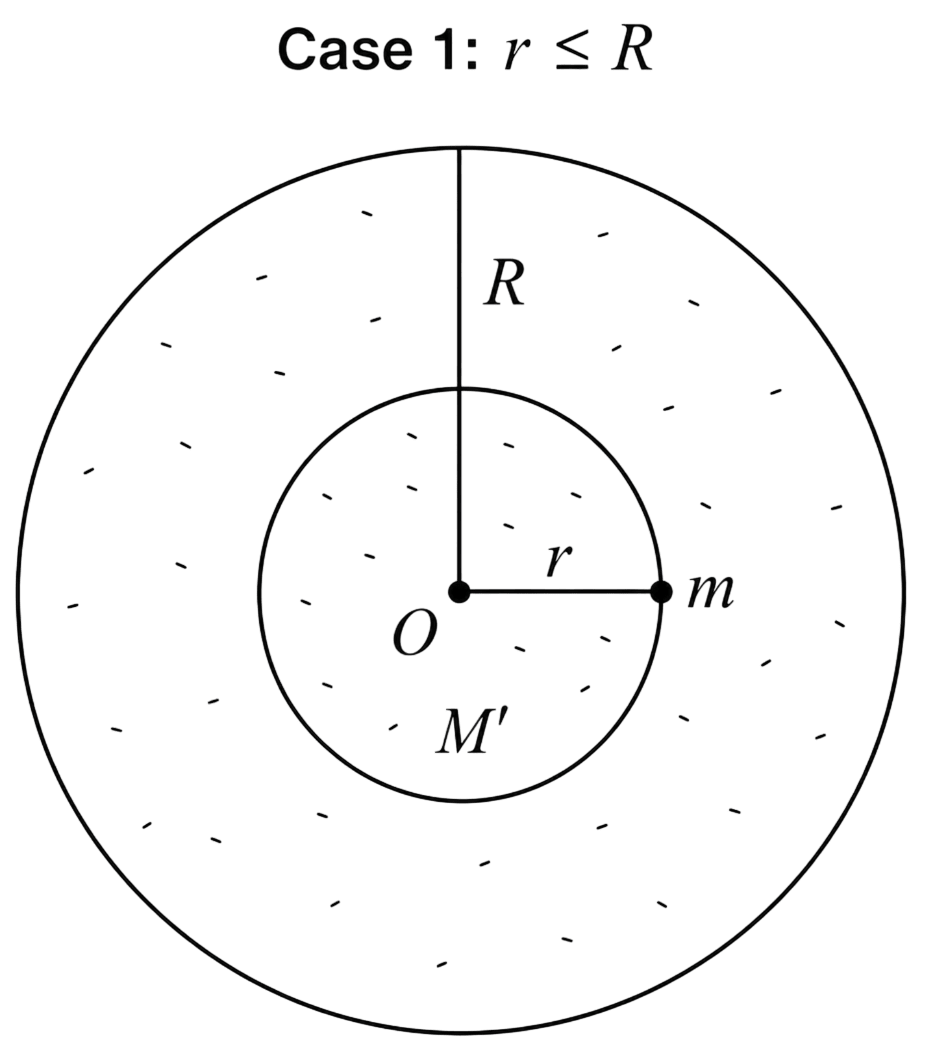
Reason — The gravitational pull of the enclosed mass supplies the centripetal force needed by the test mass for its circular motion, so at a distance r,
r2GM′m=rmv2⇒v=rGM′
where M' is the mass enclosed within the radius r.
For r ≤ R : The mass enclosed within radius r is
M′=34πr3ρ0
Therefore,
v=rG×34πr3ρ0=34πGρ0r⇒v∝r
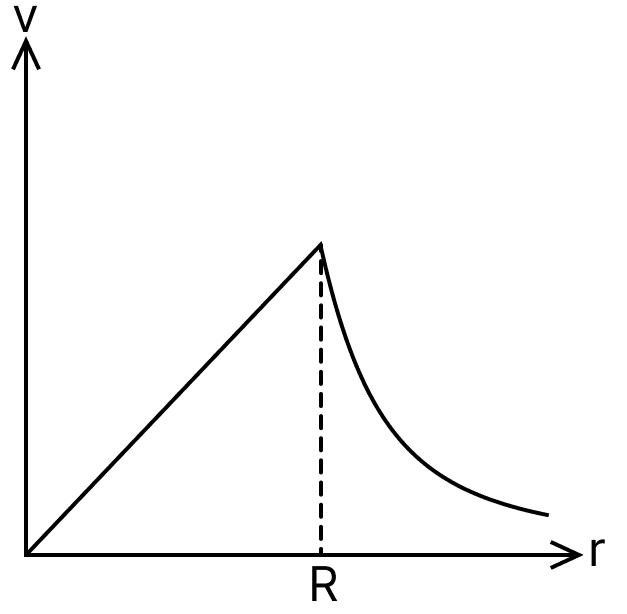
Thus the speed increases linearly with r up to r = R.
For r > R : The total mass enclosed within radius r is M, So
v=rGM⇒v∝r1
Thus beyond R the speed falls off as r1.
The graph must therefore rise linearly from the centre up to r = R and then decrease gradually, which is the variation shown in option (c).
Question 8
Dependence of intensity of gravitational field (E) of earth with distance (r) from centre of earth is correctly represented by :
Answer
Reason — The intensity of the gravitational field of the earth at a distance r from its centre is obtained from the mass enclosed within that distance.
Inside the earth (r < R) : By Newton's shell theorem only the inner sphere of radius r attracts the body, and its mass is 34πr3ρ. Hence
E=r2G×34πr3ρ=34πGρr⇒E∝r
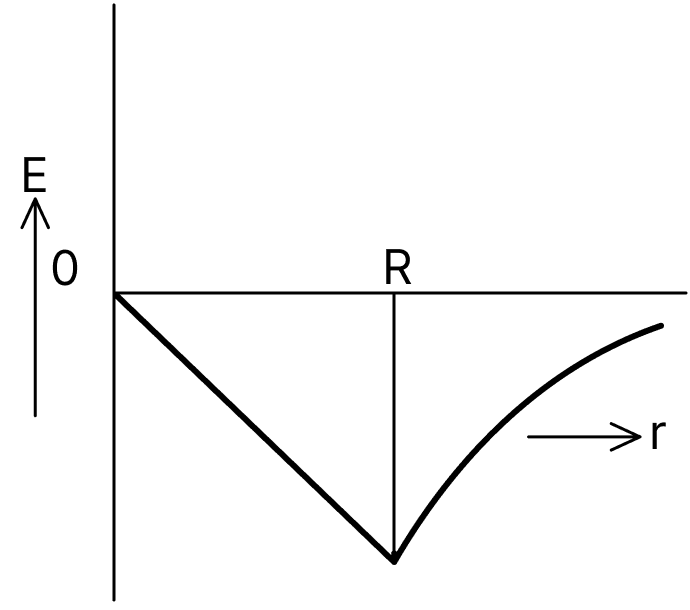
So E is zero at the centre and increases linearly with r, becoming maximum at the surface.
Outside the earth (r > R) : The whole mass Me of the earth acts as if concentrated at the centre, so
E=r2GMe⇒E∝r21
So beyond the surface E decreases sharply as r21 and tends to zero as r → ∞.
The correct graph is therefore the one that rises linearly up to r = R and then falls off as r21, which is option (a).
Question 9
A geostationary satellite revolves around the earth in a circular orbit of radius 36000 km. Then, a spy satellite revolving in a circular orbit at a few hundred km height from the surface of the earth, has the time-period nearly:
21 h
1 h
2 h
4 h
Answer
2 h
Reason — Given,
Radius of the orbit of the geostationary satellite, r = 36000 km
Period of the geostationary satellite, T = 24 h
The spy satellite revolves at a few hundred km above the earth's surface, so its orbital radius is r' ≈ 6400 km (radius of the earth)
By Kepler's third law, T2 ∝ r3. Therefore for the two satellites,
(TT′)2=(rr′)3⇒T′=T(rr′)3/2
Substituting the values,
T′=24×(360006400)3/2=24×(0.178)3/2=24×0.075=1.8h
This is nearest to 2 h.
Question 10
Two bodies of masses m and 4m are placed at a distance r. The gravitational potential at a point on the line joining them where the gravitational field is zero is :
−r9Gm
zero
−r4Gm
−r6Gm
Answer
−r9Gm
Reason — Given,
Masses of the two bodies = m and 4m
Distance between them = r
Let the gravitational field be zero at a point P on the line joining them, at a distance x from the mass m. Then its distance from the mass 4m is (r − x). At P the two field intensities are equal and opposite,
x2Gm=(r−x)2G(4m)⇒(xr−x)2=4
xr−x=2⇒r=3x⇒x=3r
The distance of P from the mass 4m is therefore
r−x=r−3r=32r
Gravitational potential is a scalar quantity, so the potentials due to the two masses are added algebraically,
V=−r/3Gm−2r/3G(4m)=−r3Gm−r6Gm
V=−r9Gm
Question 11
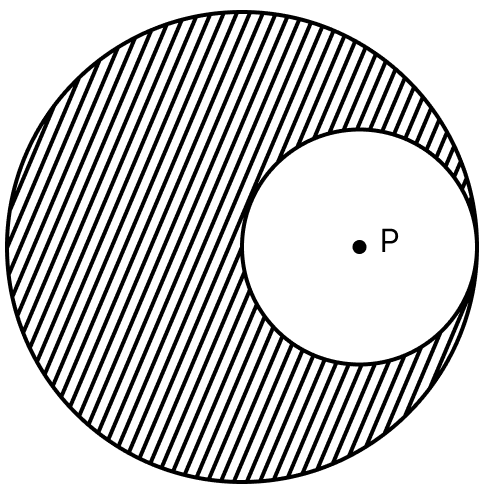
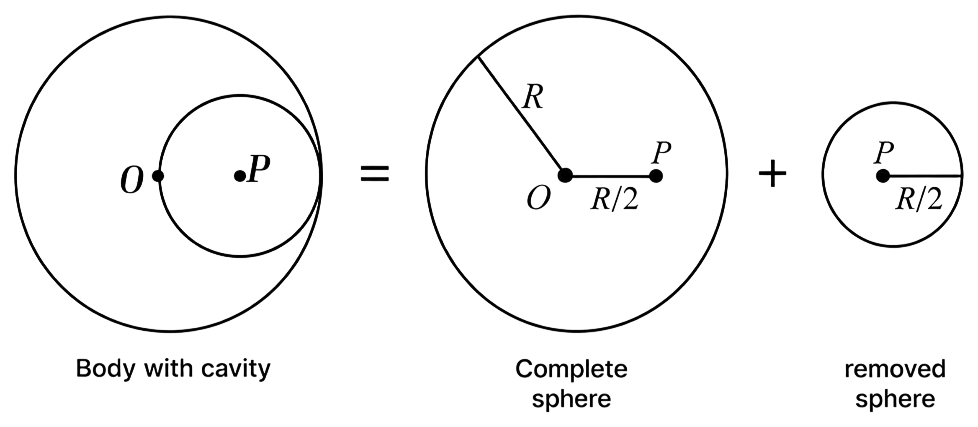
From a solid sphere of mass M and radius R, a spherical portion of radius R/2 is removed, as shown in the figure. Taking gravitational potential V = 0 at r = ∞, the potential at the centre of the cavity thus formed is : (G = gravitational constant)
2R−GM
R−GM
3R−2GM
R−2GM
Answer
R−GM
Reason — Given,
Mass of the solid sphere = M, radius = R
Radius of the spherical portion removed =2R
Gravitational potential V = 0 at r = ∞
The potential at the point P is obtained by treating the given body as the complete solid sphere together with a sphere of negative mass filling the cavity.
Potential inside a uniform solid sphere : At a point distant r from the centre, only the mass enclosed within the radius r contributes to the field. Since the density is uniform,
M′=M×34πR334πr3=R3Mr3
so the field intensity inside the sphere is
I=r2GM′=r2G×R3Mr3=R3GMr...(i)
while outside the sphere the whole mass acts as if concentrated at the centre,
I=r2GM...(ii)
Integrating the field from infinity up to the surface, using equation (ii), and taking V(∞) = 0,
V(R)=∫∞Rx2GMdx=GM[−x1]∞R=−RGM...(iii)
Continuing inward from the surface to the point r, now using equation (i),
Substituting V(R) from equation (iii) and taking 2R3GM common,
V(r)=−RGM+2R3GM(r2−R2)=2R3GM(−2R2+r2−R2)
V(r)=−GM(2R33R2−r2)...(iv)
Potential at P due to the complete solid sphere : The centre of the cavity lies at a distance r=2R from the centre of the sphere. Substituting this in equation (iv),
V1=−GM2R33R2−(2R)2
Simplifying the numerator,
3R2−4R2=412R2−R2=411R2
Therefore,
V1=−GM×4×2R311R2=−811RGM
Potential at P due to the removed sphere : The mass of the removed portion of radius 2R is
M′′=M×34πR334π(2R)3=8M
The point P is at the centre of this removed sphere. Putting r = 0 in equation (iv), the potential at the centre of a uniform sphere of mass M'' and radius 2R is
V=−GM′′2(2R)33(2R)2=−23(2R)GM′′
Since this mass has been removed, it is taken as negative,
V2=−23×2RG(−8M)=23×8GM×R2=83RGM
Resultant potential at the centre of the cavity : Potential is a scalar quantity, so the two are added algebraically,
V=V1+V2=−811RGM+83RGM=−88RGM=−RGM
Question 12
A rocket is fired 'vertically' from the surface of Mars with a speed of 2 km s-1. If 20% of its initial energy is lost due to Martian atmospheric resistance, how far will the rocket go from the surface of Mars before returning to it? Mass of Mars = 6.4 × 10²³ kg, radius of Mars = 3395 km, G = 6.67 × 10⁻¹¹ N m2 kg-2.
Answer
Given,
Speed of projection, v = 2 km s-1 = 2 × 10³ m s-1
Energy lost to atmospheric resistance = 20% of the initial energy
Mass of Mars, M = 6.4 × 10²³ kg
Radius of Mars, R = 3395 km = 3.395 × 10⁶ m
G = 6.67 × 10⁻¹¹ N m2 kg-2
The gravitational potential energies of the rocket (mass m) on the surface of Mars and at a distance r from the centre of Mars are
UR=−RGMmandUr=−rGMm
Therefore the increase in the potential energy of the rocket is
Ur−UR=GMm(R1−r1)
Only 80% of the initial kinetic energy is available for this increase, since 20% is lost against atmospheric resistance. Hence