
Which of the following statements is true regarding Newton's law of universal gravitation?
- The gravitational force between two masses is inversely proportional to the product of their masses.
- The gravitational force between two masses is directly proportional to the square of the distance between them.
- The gravitational force between two masses is directly proportional to the product of their masses.
- The gravitational force between two masses is independent of the distance between them.
Answer
The gravitational force between two masses is directly proportional to the product of their masses.
Reason — Newton's universal law of gravitation states that the gravitational force of attraction between any two material particles is directly proportional to the product of the masses of the particles and inversely proportional to the square of the distance between them, acting along the line joining them. Thus
Options 1, 2 and 4 contradict this relation, since the force is not inversely proportional to the product of the masses, not directly proportional to the square of the distance, and certainly not independent of the distance.
If the distance between two masses is doubled, the gravitational force between them becomes:
- four times greater
- four times smaller
- twice as large
- half as large
Answer
four times smaller
Reason — By Newton's law of gravitation . If the distance is doubled, r becomes 2r, so
Hence the force is reduced to one-fourth of its original value, that is, it becomes four times smaller. This is why the force-distance relationship is called the inverse-square law.
The value of the gravitational constant 'G' does vary with:
- distance
- mass
- distance and mass
- None of these
Answer
None of these
Reason — The gravitational constant G is the constant of proportionality in . Its value is the same for all pairs of bodies, at all places, at all distances of separation, and it is also independent of the presence of other bodies or of the properties of the intervening medium. For this reason G is called a 'universal constant', and it does not vary with distance or with mass.
The force-distance relationship in Newton's Law of Universal Gravitation is also referred to as the:
- inverse-exponent law
- exponential-decay law
- inverse-cube law
- inverse-square law
Answer
inverse-square law
Reason — Since the gravitational force varies as , doubling the distance between two objects results in a force which is four times smaller. A relationship of this kind is termed the 'inverse-square law'. An inverse-cube law would give , which is not the case for gravitation.
At which location is the acceleration due to gravity the least?
- Equator
- Poles
- Centre of the Earth
- Tropics
Answer
Centre of the Earth
Reason — At a depth h below the earth's surface the acceleration due to gravity varies as
At the centre of the earth h = Re, so that
Thus the acceleration due to gravity is exactly zero at the centre of the earth, which is the least value it can have anywhere.
Among the three locations on the surface, g is least at the equator (about 9.78 m s-2) and greatest at the poles (about 9.83 m s-2), the tropics lying in between. This is because the earth is an oblate spheroid, so that gives a smaller value where the radius is larger, and because the rotation of the earth reduces g by the term Reω2cos2λ, which is maximum at the equator and zero at the poles. Even the smallest of these surface values, however, is far greater than zero.
Note: The printed answer key marks option 1, considering only locations on the earth's surface. However, since g = 0 at the centre of the earth, option 3 is the correct answer as given.
The value of acceleration due to gravity decreases with:
- increase in altitude
- decrease in altitude
- decrease in latitude
- increase in the core temperature of the Earth
Answer
increase in altitude
Reason — The acceleration due to gravity at a height h above the earth's surface is
so that g' < g. As we go above the surface of the earth, the acceleration due to gravity goes on decreasing. The value of g in fact increases with increasing latitude, and it does not depend on the core temperature of the earth at all.
The gravitational field emanating from any material object:
- is always infinite
- exists only in the presence of any external body
- is zero at an infinite distance from the source object
- is always finite and independent of the presence of any external body
Answer
is always finite and independent of the presence of any external body
Reason — The gravitational field due to a mass is the region of space around it in which any other mass experiences an attractive gravitational force. Theoretically this field extends up to an infinite distance, but at large distances its strength becomes negligibly small, though never exactly zero. The field of an object exists whether or not another object is nearby; the presence of an external body is required only for the gravitational force to be exerted, not for the field to exist.
Which of the following is true of two objects of different masses falling freely near the surface of the moon?
- They both have different accelerations.
- They have the same velocities at any instant.
- They experience forces of the same magnitude.
- They change their inertia
Answer
They have the same velocities at any instant.
Reason — The acceleration due to gravity at the surface of the moon,
is free from the mass of the falling body. Hence two bodies of different masses fall with the same acceleration, and since the moon has no atmosphere there is no buoyancy or viscous drag to disturb this. Starting together from rest, both therefore have the same velocity at any instant and reach the surface simultaneously.
The forces on them are not the same, since F = mgm is proportional to the mass, so the heavier body experiences the greater gravitational force. Their inertia also does not change, inertia being a constant property of a body.
The Earth's atmosphere is held by the:
- Wind
- Clouds
- Earth's magnetic field
- Gravity
Answer
Gravity
Reason — The molecules of the atmosphere are held to the earth by the earth's gravitational attraction. Because the escape velocity at the earth's surface (11.2 km s-1) is much greater than the average thermal speed of the atmospheric molecules, these molecules are generally unable to reach the speed necessary to escape into space, and the earth is able to retain a thick atmosphere. The moon, whose escape velocity is only about 2.4 km s-1, cannot retain an atmosphere for this reason.
Which of the following factors does the acceleration due to gravity on the Earth depend upon?
- Mass of the body.
- Mass of the Earth.
- The volume of the body
- Shape and size of the body
Answer
Mass of the Earth.
Reason — The acceleration due to gravity at the earth's surface is
This expression contains the mass Me and the radius Re of the earth, but is free from the mass of the body. Hence g depends on the mass of the earth and not upon the mass, volume, shape or size of the body placed on it.
Gravitational force on a particle of mass m inside a spherical shell of mass M and radius R is:
Zero
Answer
Zero
Reason — By Newton's shell theorem, a spherically symmetric shell of mass exerts no net gravitational force on a particle located anywhere inside the shell. Every small mass element of the shell pulls the particle in one direction, but there is always a corresponding arrangement of mass elements on the opposite side pulling it the other way, and because of the symmetry of the shell these contributions cancel out exactly. Hence the gravitational force on a particle inside a spherical shell is zero, whatever its position inside.
Note: Options 1 and 3 are printed identically as in the textbook. This does not affect the answer, since the correct option is 4.
A satellite is in a circular orbit at a certain distance from the Earth. If its speed is increased slightly, it will:
- move to a higher orbit.
- move to a lower orbit.
- continue in the same orbit.
- escape from earth's gravity.
Answer
move to a higher orbit.
Reason — When the speed of the satellite is increased slightly, its kinetic energy increases and the balance between the gravitational force and the centripetal force required for the circular orbit is disturbed. The satellite therefore no longer moves in a circular orbit but enters an elliptical orbit, moving away from the earth to a higher altitude at its apogee while coming closer to the earth at its perigee. In this way the new orbit has a greater average distance from the earth than the original circular orbit.
An artificial satellite is in an orbit where it is experiencing atmospheric drag. What happens to the satellite's orbit over time?
- The satellite will gradually spiral inwards towards the Earth.
- The satellite's orbit will remain stable.
- The satellite's speed will increase.
- The satellite will gradually spiral outwards away from the Earth.
Answer
The satellite will gradually spiral inwards towards the Earth.
Reason — Atmospheric drag is a resistive force which acts opposite to the direction of motion of the satellite and therefore does negative work on it. This causes the satellite to lose energy continuously. As its total energy decreases (becomes more negative), the radius of its orbit becomes smaller, resulting in a gradual decrease in altitude. The satellite therefore spirals inward towards the earth.
Which of the following is true about geostationary satellites?
- They rotate around the Earth twice in 24 h.
- They appear stationary relative to a fixed point on Earth.
- They orbit the Earth in a highly elliptical path.
- They have the same orbital speed as low Earth orbit satellites.
Answer
They appear stationary relative to a fixed point on Earth.
Reason — A geostationary satellite is placed in an orbit such that its period of revolution is exactly equal to the period of the axial motion of the earth, that is, 24 h, and its direction of rotation is the same as that of the earth, in an orbital plane coplanar with the equatorial plane. Being synchronous with the earth's spin, it appears stationary over a fixed point on the earth's equator. Its orbit is circular, not highly elliptical, and its orbital speed (about 3.1 km s-1) is much smaller than that of a low earth orbit satellite (about 8 km s-1).
Which of the following is not a characteristic of geostationary satellites?
- They orbit the Earth in 24 h.
- They are positioned above the equator.
- They can cover the entire Earth's surface.
- They have a circular orbit.
Answer
They can cover the entire Earth's surface.
Reason — A geostationary satellite remains fixed over one point on the equator and therefore provides continuous coverage of the same geographical region only. It has limited effectiveness near the poles, which is why polar regions rely on polar-orbiting satellites. Covering the entire earth's surface is a characteristic of polar satellites, which sweep over the whole globe as the earth rotates beneath their orbit. Orbiting in 24 h, being positioned above the equator, and having a circular orbit are all genuine characteristics of geostationary satellites.
For a satellite to be in a geostationary orbit, it must:
- be positioned above the equator
- have an orbital period of 12 h
- be at an altitude of 100 km
- travel in a polar orbit
Answer
be positioned above the equator
Reason — The conditions for a satellite to be geostationary are that its period of revolution (or angular velocity) should be the same as that of the earth, that its direction of rotation should be the same as that of the earth from west to east, and that its orbital plane should be coplanar with the equatorial plane of the earth. Hence it must be positioned above the equator. Its period must be 24 h and not 12 h, its altitude must be about 35,830 km and not 100 km, and a polar orbit would not keep it stationary over any point.
A satellite in orbit around Earth is kept in orbit by:
- the centripetal force provided by earth's gravitational pull.
- the satellite's engines.
- a balance between the satellite's speed and the atmospheric drag.
- a tether to Earth (a connection to Earth/tied to Earth).
Answer
the centripetal force provided by earth's gravitational pull.
Reason — When a satellite revolves in a circular orbit around the earth, the gravitational force of attraction between the earth and the satellite provides exactly the centripetal force required for its circular motion,
No engine, tether or atmospheric drag is involved; this is why a satellite continues to revolve in its orbit without using any fuel.
Weightlessness experienced in an orbiting satellite is due to:
- absence of gravity.
- zero orbital velocity.
- free fall of the satellite and its occupants.
- lack of atmosphere.
Answer
free fall of the satellite and its occupants.
Reason — Inside an orbiting satellite the gravitational force on a spaceman supplies exactly the centripetal force needed for his circular motion, so the reactionary force R of the base of the satellite on him becomes zero,
Since weight is felt only through this reaction, he feels his weight to be zero. Gravity is certainly present at that height, and the satellite has a large orbital velocity; the weightlessness is entirely due to the satellite and its occupants being in a state of free fall.
The total energy of a satellite in a stable orbit is:
- positive
- zero
- negative
- infinity
Answer
negative
Reason — For a satellite revolving close to the earth's surface, the potential energy and the kinetic energy are
so the total energy is
The kinetic energy is less in magnitude than the potential energy, so the total energy is negative. This negative total energy indicates that the satellite is bound to its orbit, and additional energy must be supplied to free it.
Which of the following correctly expresses the condition for a stable orbit?
- The satellite's speed is equal to the escape velocity
- The centrifugal force is less than the gravitational force.
- The centripetal force is equal to the gravitational force.
- The satellite has zero angular momentum.
Answer
The centripetal force is equal to the gravitational force.
Reason — A satellite remains in a stable circular orbit only when the gravitational force of the earth on it supplies precisely the centripetal force needed for that orbit,
If the satellite's speed were equal to the escape velocity it would leave the orbit altogether, and a satellite moving in an orbit certainly does not have zero angular momentum.
Which of the following best describes Kepler's first law?
- The square of the orbital period of a planet is proportional to the cube of the semi-major axis.
- The orbit of a planet is an ellipse with the Sun at one focus.
- The speed of a planet is fastest at perihelion.
- The orbit of a planet is a perfect circle.
Answer
The orbit of a planet is an ellipse with the Sun at one focus.
Reason — Kepler's first law is the law of orbits, which states that all planets move around the sun in elliptical orbits having the sun at one focus of the orbit. Option 1 is the statement of Kepler's third law (the law of periods) and option 3 is a consequence of the second law (the law of areas). A perfect circle is only a special case, and is not what the first law asserts.
According to Kepler's second law, the line joining a planet and the Sun sweeps out equal areas in:
- equal time intervals
- varying time intervals
- equal distances
- varying distances
Answer
equal time intervals
Reason — Kepler's second law is the law of areas, according to which a line joining any planet to the sun sweeps out equal areas in equal times, that is, the areal velocity of the planet remains constant. As a consequence the planet's velocity is maximum when it is nearest the sun and minimum when it is farthest from the sun.
The ratio of the square of the period of revolution to the cube of the semi-major axis is:
- a constant.
- varying with time.
- varying with distance from the Sun.
- proportional to the orbital velocity.
Answer
a constant.
Reason — By Kepler's law of periods, the square of the period of revolution of a planet is directly proportional to the cube of its mean distance from the sun,
so that . The constant K is the same for all the planets and does not change with time, with distance from the sun, or with orbital velocity.
In a satellite, the astronauts experience weightlessness because:
- The gravitational force of Earth is balanced by that of the Sun.
- The satellite is moving in a vacuum.
- The satellite is in free fall towards Earth.
- There is no gravitational force acting on them.
Answer
The satellite is in free fall towards Earth.
Reason — The satellite and everything inside it are in a state of free fall towards the earth, since the gravitational force is entirely used up in providing the centripetal force for the circular orbit. The reactionary force of the floor of the satellite on the astronaut therefore becomes zero, and he feels weightless. If he stands on a spring balance, the balance will read zero.
Which of the following conditions best describes weightlessness?
- No gravitational forces are acting.
- Gravitational forces are present, but there is no normal force.
- The net force is equal to the weight.
- The object is stationary in space.
Answer
Gravitational forces are present, but there is no normal force.
Reason — The weight of a body is felt due to the reactionary force applied on the body by some other body in contact with it. When this reaction, that is the normal force, becomes zero, we feel as if our weight has also become zero, and this is called the state of weightlessness. Gravitational forces continue to act throughout; it is only the absence of the normal reaction that produces the sensation of weightlessness.
Which situation would result in a condition closest to weightlessness on Earth?
- Jumping off a tall building.
- Skydiving before deploying a parachute.
- Standing on a high mountain.
- Swimming underwater.
Answer
Skydiving before deploying a parachute.
Reason — Before the parachute is deployed, the skydiver is falling freely under gravity with no upward reaction acting on him, and this free fall is the condition closest to weightlessness. Jumping off a tall building would also produce free fall, but only very briefly and it is not a controlled situation. Standing on a high mountain and swimming underwater both involve a normal or buoyant reaction acting on the body, so weight continues to be felt.
The time period of a satellite in a circular orbit around the Earth depends on:
- its mass.
- the radius of the orbit.
- the speed of the satellite.
- the mass of the Earth.
Answer
the radius of the orbit.
Reason — The period of revolution of a satellite in an orbit of radius r = Re + h is
This expression is free from the mass of the satellite. It shows that the period depends only upon the height of the satellite above the earth's surface, that is, on the radius of its orbit. Two satellites of different masses revolving in the same orbit therefore have the same period.
The escape velocity on the Moon compared to that on Earth is:
- higher because the moon is smaller.
- lower because the moon's gravitational pull is weaker.
- the same as earth's due to the same gravitational constant.
- dependent on the satellite's mass.
Answer
lower because the moon's gravitational pull is weaker.
Reason — The escape velocity from the surface of a body of mass M and radius R is
which depends only on the mass and radius of that body, not on the mass of the escaping object. The moon has a much smaller mass than the earth, so its gravitational pull is weaker and its escape velocity is only about 2.4 km s-1, against 11.2 km s-1 for the earth.
If g is the acceleration due to gravity at Earth's surface and Re is the radius of Earth, the acceleration due to gravity g' at a height h above the Earth's surface is given by:
Answer
Reason — If g is the acceleration due to gravity at the earth's surface, then at a height h above the surface
Dividing the second by the first,
A planet's orbital period is 8 years. What is the semi-major axis of its orbit? (Assume the Sun as the central body and T2 = kr3).
- 2 AU
- 4 AU
- 8 AU
- 16 AU
Answer
4 AU
Reason — By Kepler's third law, T2 = k r3. Comparing the planet with the earth, for which Te = 1 year and re = 1 AU,
Substituting Tp = 8 years,
Assuming the mass of Saturn to be constant, if its radius were to increase, then the acceleration due to gravity at its surface would:
- increase
- decrease
- remain unchanged
- first increase and then stay constant beyond a certain size
Answer
decrease
Reason — The acceleration due to gravity at the surface of a planet is
Here G and the mass M of Saturn are constants, so . As the radius r increases, the acceleration due to gravity at its surface falls off with the square of the radius, and therefore decreases.
For which of the following does the graph denote the variation of force of gravity 'F' along a distance 'r'?
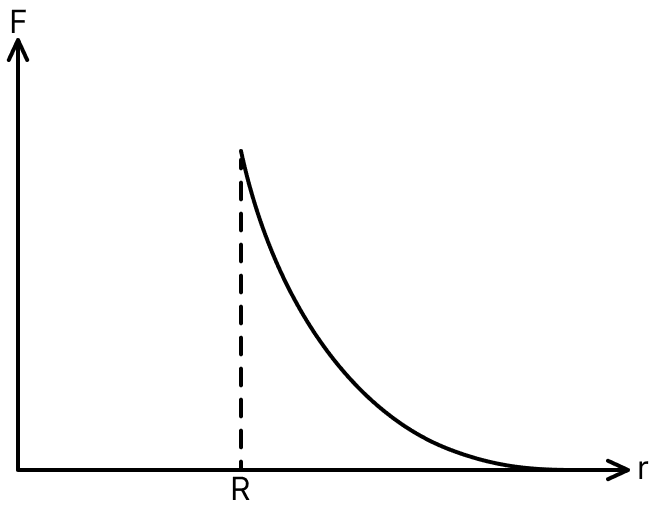
- Solid sphere
- Spherical shell
- Plate
- Point
Answer
Spherical shell
Reason — The graph shows that the force of gravity is zero up to a distance R and then falls off as beyond R.
By Newton's shell theorem, a spherically symmetric shell of mass exerts no net gravitational force on a particle located anywhere inside it, so F = 0 for r < R. For a point outside the shell, the shell behaves like a point mass located at its centre, so
This is exactly the variation shown, so the graph is that of a spherical shell.
For which of the following does the graph denote the variation of force of gravity 'F' along a distance 'r'?
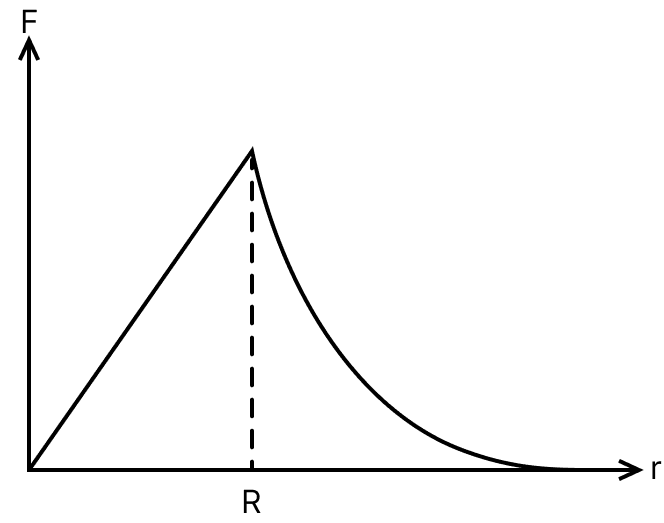
- Solid sphere
- Spherical shell
- Plate
- Point
Answer
Solid sphere
Reason — The graph shows that the force of gravity increases linearly with r up to r = R and then decreases as .
For a point inside a solid sphere of uniform density, only the mass enclosed within the radius r contributes to the force, and
so the force is zero at the centre and rises linearly to a maximum at the surface. For a point outside, the whole mass acts as if concentrated at the centre and
This is the variation shown, so the graph is that of a solid sphere.
A satellite is moving in a stable orbit around Earth. If the satellite's velocity is suddenly increased by a small amount in the direction of its motion, which of the following occurs?
- The satellite will enter an elliptical orbit with apogee at the point where velocity was increased.
- The satellite will escape Earth's gravity.
- The satellite will spiral outwards in a circular path.
- The satellite's orbital period will decrease.
Answer
The satellite will enter an elliptical orbit with apogee at the point where velocity was increased.
Reason — Increasing the satellite's velocity slightly increases its kinetic energy and hence its total energy, disturbing the balance required for a circular orbit. The satellite therefore changes its path to an elliptical orbit. The point at which the velocity was increased becomes the apogee of the new orbit, since the satellite begins to move away from the earth from that point. The increase being small, the satellite does not attain the escape velocity and so it does not escape earth's gravity.
Dimensional formula for gravitational intensity is :
- [LT-1]
- [LT-2]
- [MLT-1]
- [MLT-2]
Answer
[LT-2]
Reason — The gravitational field intensity is the force experienced by a unit mass placed at a point in the field,
Its dimensional formula is therefore
which is the same as that of acceleration, as it should be, since the gravitational field intensity of the earth is numerically equal to g.
The time period of a satellite orbiting close to Earth is:
- 24 h
- About 84 min
- 12 h
- 30 min
Answer
About 84 min
Reason — For a satellite orbiting very close to the earth's surface (h << Re), the period of revolution is
Substituting Re = 6.37 × 10⁶ m and g = 9.8 m s-2,
The total energy (E = K + U) of a satellite orbiting at a distance r from the centre of Earth is:
Answer
Reason — For a satellite of mass m revolving close to the earth in an orbit of radius Re, the potential energy and the kinetic energy are
Hence the total energy of the satellite is
Note: Options 1 and 4 are printed identically as in the textbook, and the answer key marks option 1.
Two satellites, X and Y, have identical masses but different orbital radii around the Earth. If satellite X has an orbital radius twice that of Satellite Y, the ratio of their orbital speeds, vx : vy is:
- 1 : 2
- 1 :
- : 1
- 2 : 1
Answer
1 :
Reason — The orbital speed of a satellite in an orbit of radius r is
which is independent of the mass of the satellite. Given that rx = 2ry,
The ratio of the radius of a planet A to that of a planet B is 'r'. The ratio of acceleration due to gravity on the planets is 'p'. The ratio of escape velocities of the two planets is:
Answer
Reason — The escape velocity from the surface of a planet of radius R on which the acceleration due to gravity is g is
For the two planets A and B,
Given and ,
If the gravitational constant G were to suddenly increase by 10%, the escape velocity from Earth would:
- increase by about 10%
- increase by about 5%
- increase by about 20%
- remain the same.
Answer
increase by about 5%
Reason — The escape velocity from the earth's surface is
If G is increased by 10%, the new value is G' = 1.10 G, so the new escape velocity is
The percentage increase in the escape velocity is therefore
If the radius of the Earth were to shrink by 1%, keeping its mass constant, the gravitational acceleration on its surface would:
- increase by approximately 2%
- decrease by approximately 2%
- remain unchanged
- decrease by approximately 1%.
Answer
increase by approximately 2%
Reason — The acceleration due to gravity at the earth's surface is
Taking the fractional change on both sides, since the mass is kept constant,
The radius shrinks by 1%, that is , so
Hence g increases by approximately 2%.
Assertion (A): The gravitational force between two masses is inversely proportional to the square of the distance between them.
Reason (R): Gravitational force follows an inverse-square law as per Newton's law of universal gravitation.
- If both assertion and reason are true and reason is the correct explanation of assertion.
- If both assertion and reason are true but reason is not the correct explanation of assertion.
- If assertion is true but reason is false.
- If both assertion and reason are false.
Answer
If both assertion and reason are true and reason is the correct explanation of assertion.
Explanation
Assertion (A) is correct: By Newton's universal law of gravitation, the force of attraction between two material particles is inversely proportional to the square of the distance between them, .
Reason (R) is also correct: This dependence on is precisely what is termed the inverse-square law, and it is a part of the statement of Newton's law of universal gravitation.
Since the inverse-square dependence stated in the Reason is the very relation asserted in (A), the Reason correctly explains the Assertion.
Therefore, both assertion and reason are true and reason is the correct explanation of assertion.
Assertion (A): Gravitational force is a conservative force.
Reason (R): The work done by the gravitational force on a moving object is path-independent.
- If both assertion and reason are true and reason is the correct explanation of assertion.
- If both assertion and reason are true but reason is not the correct explanation of assertion.
- If assertion is true but reason is false.
- If both assertion and reason are false.
Answer
If both assertion and reason are true and reason is the correct explanation of assertion.
Explanation
Assertion (A) is correct: Gravitational force is a central force, that is, it acts along the line joining the centres of two bodies, and central forces are conservative in nature. Hence gravitational force is an example of a conservative force.
Reason (R) is also correct: A conservative force is one for which the work done in moving a body from one position to another depends only on the initial and the final positions and not on the path followed, that is, the work done is path-independent.
Path-independence of the work done is the defining property of a conservative force, so the Reason correctly explains the Assertion.
Therefore, both assertion and reason are true and reason is the correct explanation of assertion.
Assertion (A): The gravitational force between two objects is independent of the medium between them.
Reason (R): Gravitational force depends only on the masses of the objects and the distance between them.
- If both assertion and reason are true and reason is the correct explanation of assertion.
- If both assertion and reason are true but reason is not the correct explanation of assertion.
- If assertion is true but reason is false.
- If both assertion and reason are false.
Answer
If both assertion and reason are true and reason is the correct explanation of assertion.
Explanation
Assertion (A) is correct: The gravitational forces between two bodies are completely independent of the presence of other bodies and of the properties of the intervening medium. If the force of attraction between two bodies in air is F, it remains the same when they are placed in water, the separation being unchanged.
Reason (R) is also correct: By Newton's law of gravitation, , the force depends only on the masses of the two bodies and on the distance between them.
Since the expression for the force contains only the masses and the separation, and no term for the medium, the Reason correctly explains the Assertion.
Therefore, both assertion and reason are true and reason is the correct explanation of assertion.
Assertion (A): The gravitational force between two particles in a vacuum is zero.
Reason (R): The gravitational force acts along the line joining the masses.
- If both assertion and reason are true and reason is the correct explanation of assertion.
- If both assertion and reason are true but reason is not the correct explanation of assertion.
- If assertion is true but reason is false.
- If both assertion and reason are false.
Answer
If both assertion and reason are false.
Explanation
Assertion (A) is false: Gravitational force exists even in a vacuum and does not require any medium to act. Two particles placed in vacuum attract each other with the force , which is certainly not zero.
Reason (R) is correct as a statement of fact: Gravitational force is a central force, that is, it acts along the line joining the centres of the two masses.
Therefore, both assertion and reason are false.
Note: The answer key is incorrect. The assertion is false, but the reason is true. Therefore, none of the given options is correct.
Assertion (A): The acceleration due to gravity decreases with height above the Earth's surface.
Reason (R): The value of g is inversely proportional to the square of the distance from the centre of the Earth.
- If both assertion and reason are true and reason is the correct explanation of assertion.
- If both assertion and reason are true but reason is not the correct explanation of assertion.
- If assertion is true but reason is false.
- If both assertion and reason are false.
Answer
If both assertion and reason are true and reason is the correct explanation of assertion.
Explanation
Assertion (A) is correct: As we go above the surface of the earth, the acceleration due to gravity goes on decreasing, since , which is less than g.
Reason (R) is also correct: At a height h the distance from the earth's centre becomes (Re + h), and , so that .
As the height increases the distance from the earth's centre increases, and by the inverse-square dependence the value of g must fall. The Reason therefore explains the Assertion.
Therefore, both assertion and reason are true and reason is the correct explanation of assertion.
Assertion (A): If earth stops rotating about its axis, the value of g is the same at all points on the Earth's surface.
Reason (R): The Earth is a perfect sphere.
- If both assertion and reason are true and reason is the correct explanation of assertion.
- If both assertion and reason are true but reason is not the correct explanation of assertion.
- If assertion is true but reason is false.
- If both assertion and reason are false.
Answer
If both assertion and reason are false.
Explanation
Assertion (A) is false: The variation of g over the earth's surface arises from two separate causes, the rotation of the earth and its oblate shape. Stopping the rotation removes only the term Reω2cos2λ. The earth would still be an oblate spheroid, and since , that is , the value of g would still be greater at the poles, where the radius is smaller, than at the equator. Hence g would not be the same at all points on the surface.
Reason (R) is false: The earth is not a perfect sphere. It is an oblate spheroid, slightly flattened at the poles and bulging at the equator, its equatorial diameter being about 21 km greater than the polar diameter.
Therefore, both assertion and reason are false.
Note: The textbook’s explanation shows that variations in g are caused by both the earth’s rotation and its flattened shape. Since some variation would remain even if the earth stopped rotating, the assertion is false. Therefore, option 4 is correct as the options stand.
Assertion (A): The value of g decreases as we move from the equator to the poles.
Reason (R): The radius of the Earth is greater at the pole than at the equator.
- If both assertion and reason are true and reason is the correct explanation of assertion.
- If both assertion and reason are true but reason is not the correct explanation of assertion.
- If assertion is true but reason is false.
- If both assertion and reason are false.
Answer
If both assertion and reason are false.
Explanation
Assertion (A) is false: The value of g actually increases as we move from the equator to the poles, both because the distance from the earth's centre decreases and because the centrifugal effect of rotation, , becomes smaller as the latitude increases.
Reason (R) is also false: The radius of the earth is greater at the equator than at the poles, the equatorial radius being about 6378 km against the polar radius of about 6357 km.
Therefore, both assertion and reason are false.
Assertion (A): The value of g decreases inside the Earth as we move towards the centre.
Reason (R): The gravitational force inside the Earth decreases linearly with distance from the Earth's centre.
- If both assertion and reason are true and reason is the correct explanation of assertion.
- If both assertion and reason are true but reason is not the correct explanation of assertion.
- If assertion is true but reason is false.
- If both assertion and reason are false.
Answer
If both assertion and reason are true and reason is the correct explanation of assertion.
Explanation
Assertion (A) is correct: At a depth h below the surface, , so that g' < g. As we go below the surface of the earth the acceleration due to gravity goes on decreasing, and it becomes zero at the centre.
Reason (R) is also correct: At a depth h, by Newton's shell theorem the outer spherical shell exerts no force, and only the inner solid sphere of radius (Re − h) attracts the body. Hence the mass contributing to the gravitational pull decreases as we go deeper, and the force varies linearly with the distance from the centre.
Because the effective attracting mass decreases linearly with the distance from the centre, the value of g must also decrease as we move inward. The Reason therefore explains the Assertion.
Therefore, both assertion and reason are true and reason is the correct explanation of assertion.
Assertion (A): The value of g at a height h above the Earth is greater than that at the Earth's surface.
Reason (R): The gravitational force is directly proportional to the height above the Earth's surface.
- If both assertion and reason are true and reason is the correct explanation of assertion.
- If both assertion and reason are true but reason is not the correct explanation of assertion.
- If assertion is true but reason is false.
- If both assertion and reason are false.
Answer
If both assertion and reason are false.
Explanation
Assertion (A) is false: The value of g at a height h above the earth is less than that at the earth's surface, since is smaller than g.
Reason (R) is also false: The gravitational force is inversely proportional to the square of the distance from the earth's centre, and is not directly proportional to the height above the earth's surface.
Therefore, both assertion and reason are false.
Assertion (A): The value of g at the poles is slightly higher than at the equator.
Reason (R): The Earth's polar radius is smaller than the equatorial radius.
- If both assertion and reason are true and reason is the correct explanation of assertion.
- If both assertion and reason are true but reason is not the correct explanation of assertion.
- If assertion is true but reason is false.
- If both assertion and reason are false.
Answer
If both assertion and reason are true and reason is the correct explanation of assertion.
Explanation
Assertion (A) is correct: The value of g is about 9.83 m s-2 at the poles and about 9.78 m s-2 at the equator, so g is slightly higher at the poles.
Reason (R) is also correct: The earth is an oblate spheroid, so its polar radius is smaller than its equatorial radius.
Since , that is , a smaller radius at the poles gives a larger value of g there. The Reason therefore explains the Assertion.
Therefore, both assertion and reason are true and reason is the correct explanation of assertion.
Assertion (A): Orbital velocity of a satellite depends on its mass.
Reason (R): Orbital velocity is derived from balancing gravitational force and centripetal force, which both depend on the mass of the satellite.
- If both assertion and reason are true and reason is the correct explanation of assertion.
- If both assertion and reason are true but reason is not the correct explanation of assertion.
- If assertion is true but reason is false.
- If both assertion and reason are false.
Answer
If both assertion and reason are false.
Explanation
Assertion (A) is false: The orbital velocity of a satellite, , is free from the mass of the satellite. Hence it does not depend on the satellite's mass.
Reason (R) is also false: Although the orbital velocity is obtained by balancing the gravitational force against the required centripetal force, the mass m of the satellite appears on both sides of and cancels out. The result therefore depends only on the mass of the central body and the radius of the orbit.
Therefore, both assertion and reason are false.
Assertion (A): The orbital velocity of a satellite is higher for orbits closer to the Earth.
Reason (R): Gravitational force is stronger at lower altitudes.
- If both assertion and reason are true and reason is the correct explanation of assertion.
- If both assertion and reason are true but reason is not the correct explanation of assertion.
- If assertion is true but reason is false.
- If both assertion and reason are false.
Answer
If both assertion and reason are true and reason is the correct explanation of assertion.
Explanation
Assertion (A) is correct: The orbital velocity varies as , so a satellite in an orbit closer to the earth (smaller r) has a higher orbital velocity.
Reason (R) is also correct: The gravitational force is stronger at lower altitudes, since the distance from the earth's centre is smaller.
A stronger gravitational pull at a lower altitude demands a larger centripetal force, and hence a higher orbital velocity, to maintain the orbit. The Reason therefore explains the Assertion.
Therefore, both assertion and reason are true and reason is the correct explanation of assertion.
Assertion (A): The orbital velocity of a satellite decreases with the height of its orbit.
Reason (R): The gravitational force decreases as the distance from the Earth increases.
- If both assertion and reason are true and reason is the correct explanation of assertion.
- If both assertion and reason are true but reason is not the correct explanation of assertion.
- If assertion is true but reason is false.
- If both assertion and reason are false.
Answer
If both assertion and reason are true and reason is the correct explanation of assertion.
Explanation
Assertion (A) is correct: Since , the orbital velocity decreases as the height h of the orbit increases.
Reason (R) is also correct: The gravitational force varies inversely as the square of the distance, so it decreases as the distance from the earth increases.
At higher altitudes the weaker gravitational pull requires a smaller centripetal force, so a lower orbital velocity is sufficient to maintain the orbit. The Reason therefore explains the Assertion.
Therefore, both assertion and reason are true and reason is the correct explanation of assertion.
Assertion (A): Satellites in geostationary orbit have the highest orbital velocity among all satellites.
Reason (R): Geostationary satellites orbit close to the Earth's surface.
- If both assertion and reason are true and reason is the correct explanation of assertion.
- If both assertion and reason are true but reason is not the correct explanation of assertion.
- If assertion is true but reason is false.
- If both assertion and reason are false.
Answer
If both assertion and reason are false.
Explanation
Assertion (A) is false: Geostationary satellites are in high orbits, at a height of about 35,830 km, and have a comparatively low orbital velocity of about 3.1 km s-1, against about 8 km s-1 for satellites in low earth orbits.
Reason (R) is also false: Geostationary satellites do not orbit close to the earth's surface; they are placed far above it in the parking orbit above the equator.
Therefore, both assertion and reason are false.
Assertion (A): Orbital velocity is independent of the mass of the satellite.
Reason (R): Orbital velocity depends only on the mass of the central body (around which, the satellite revolves) and the radius of the orbit.
- If both assertion and reason are true and reason is the correct explanation of assertion.
- If both assertion and reason are true but reason is not the correct explanation of assertion.
- If assertion is true but reason is false.
- If both assertion and reason are false.
Answer
If both assertion and reason are true and reason is the correct explanation of assertion.
Explanation
Assertion (A) is correct: The mass m of the satellite cancels out in , giving , which is independent of the satellite's mass.
Reason (R) is also correct: The resulting expression contains only the mass Me of the central body around which the satellite revolves and the radius r of the orbit.
Because the orbital velocity is determined entirely by the central mass and the orbital radius, it cannot depend on the mass of the satellite. This is why two satellites of different masses revolving in the same orbit have the same speed. The Reason therefore explains the Assertion.
Therefore, both assertion and reason are true and reason is the correct explanation of assertion.
Assertion (A): Escape velocity is the speed needed to break free from the Earth's gravitational pull.
Reason (R): Escape velocity from the Earth is dependent on the direction of projection.
- If both assertion and reason are true and reason is the correct explanation of assertion.
- If both assertion and reason are true but reason is not the correct explanation of assertion.
- If assertion is true but reason is false.
- If both assertion and reason are false.
Answer
If assertion is true but reason is false.
Explanation
Assertion (A) is correct: Escape velocity is the minimum velocity that an object needs in order to escape the gravitational pull of a celestial body without any further propulsion.
Reason (R) is false: The escape velocity, , is independent of the angle, that is the direction, of projection. It depends only on the mass and radius of the earth.
Therefore, assertion is true but reason is false.
Assertion (A): The escape velocity from a planet is greater than the orbital velocity for a satellite around the same planet.
Reason (R): Escape velocity is the minimum speed required to leave the gravitational field without further propulsion.
- If both assertion and reason are true and reason is the correct explanation of assertion.
- If both assertion and reason are true but reason is not the correct explanation of assertion.
- If assertion is true but reason is false.
- If both assertion and reason are false.
Answer
If both assertion and reason are true and reason is the correct explanation of assertion.
Explanation
Assertion (A) is correct: For a body near the earth's surface, and , so that . The escape velocity is therefore greater than the orbital velocity.
Reason (R) is also correct: Escape velocity is the minimum speed required to leave the gravitational field of the planet without further propulsion, whereas the orbital velocity is only the speed needed to remain bound in a circular orbit.
Since escaping the field altogether demands more energy than merely remaining in a bound orbit, the escape velocity must exceed the orbital velocity. The Reason therefore explains the Assertion.
Therefore, both assertion and reason are true and reason is the correct explanation of assertion.
Assertion (A): Gravitational pull is stronger for more massive planets.
Reason (R): Escape velocity decreases with an increase in the mass of the planet.
- If both assertion and reason are true and reason is the correct explanation of assertion.
- If both assertion and reason are true but reason is not the correct explanation of assertion.
- If assertion is true but reason is false.
- If both assertion and reason are false.
Answer
If assertion is true but reason is false.
Explanation
Assertion (A) is correct: By Newton's law of gravitation the force of attraction is directly proportional to the mass of the attracting body, so a more massive planet exerts a stronger gravitational pull.
Reason (R) is false: Since , the escape velocity increases with the mass of the planet, because a stronger gravitational pull requires a higher speed to escape.
Therefore, assertion is true but reason is false.
Assertion (A): The escape velocity from the Earth is higher at the poles than at the equator.
Reason (R): The Earth's radius is smaller at the poles than at the equator.
- If both assertion and reason are true and reason is the correct explanation of assertion.
- If both assertion and reason are true but reason is not the correct explanation of assertion.
- If assertion is true but reason is false.
- If both assertion and reason are false.
Answer
If both assertion and reason are true and reason is the correct explanation of assertion.
Explanation
Assertion (A) is correct: The escape velocity varies as , so it is higher at the poles, where the radius is smaller.
Reason (R) is also correct: The earth is an oblate spheroid, so its radius is smaller at the poles than at the equator.
A smaller radius at the poles gives a larger value of and hence a higher escape velocity there. The Reason therefore explains the Assertion.
Therefore, both assertion and reason are true and reason is the correct explanation of assertion.
Assertion (A): The escape velocity from the surface of the Moon is less than that from the Earth.
Reason (R): The Moon has less mass and a smaller radius than the Earth.
- If both assertion and reason are true and reason is the correct explanation of assertion.
- If both assertion and reason are true but reason is not the correct explanation of assertion.
- If assertion is true but reason is false.
- If both assertion and reason are false.
Answer
If both assertion and reason are true and reason is the correct explanation of assertion.
Explanation
Assertion (A) is correct: The escape velocity from the moon's surface is about 2.4 km s-1, which is much less than the 11.2 km s-1 required at the earth's surface.
Reason (R) is also correct: The moon has a considerably smaller mass and a smaller radius than the earth.
With a much smaller mass, the moon's gravitational pull is weaker, and works out smaller for the moon in spite of its smaller radius. The Reason therefore explains the Assertion.
Therefore, both assertion and reason are true and reason is the correct explanation of assertion.
Assertion (A): Geosynchronous satellites appear stationary with respect to an observer on Earth.
Reason (R): These satellites complete one orbit around the Earth in 24 h.
- If both assertion and reason are true and reason is the correct explanation of assertion.
- If both assertion and reason are true but reason is not the correct explanation of assertion.
- If assertion is true but reason is false.
- If both assertion and reason are false.
Answer
If both assertion and reason are true and reason is the correct explanation of assertion.
Explanation
Assertion (A) is correct: A geosynchronous satellite is synchronous with the earth's spin, so it appears stationary with respect to an observer on the earth.
Reason (R) is also correct: These satellites have a period of revolution exactly equal to the period of the axial motion of the earth, that is, 24 h.
Because the satellite completes one orbit in exactly the time the earth takes to complete one rotation, it stays above the same point and appears stationary. The Reason therefore explains the Assertion.
Therefore, both assertion and reason are true and reason is the correct explanation of assertion.
Assertion (A): A geostationary satellite must orbit the Earth at an altitude of approximately 35,786 km.
Reason (R): At this altitude, the satellite's orbital period matches the Earth's rotational period.
- If both assertion and reason are true and reason is the correct explanation of assertion.
- If both assertion and reason are true but reason is not the correct explanation of assertion.
- If assertion is true but reason is false.
- If both assertion and reason are false.
Answer
If both assertion and reason are true and reason is the correct explanation of assertion.
Explanation
Assertion (A) is correct: Using with T = 24 h, the height of a geostationary satellite works out to about 35,830 km above the earth's surface.
Reason (R) is also correct: It is at exactly this altitude that the period of revolution of the satellite becomes equal to the rotational period of the earth.
The height is determined by the requirement that the satellite's period should match the earth's rotational period, so the Reason correctly explains the Assertion.
Therefore, both assertion and reason are true and reason is the correct explanation of assertion.
Assertion (A): Geostationary satellites orbit the Earth above the equator.
Reason (R): Geostationary satellites can be used for polar region communication.
- If both assertion and reason are true and reason is the correct explanation of assertion.
- If both assertion and reason are true but reason is not the correct explanation of assertion.
- If assertion is true but reason is false.
- If both assertion and reason are false.
Answer
If assertion is true but reason is false.
Explanation
Assertion (A) is correct: One of the conditions for a satellite to be geostationary is that its orbital plane should be coplanar with the equatorial plane of the earth. Hence geostationary satellites orbit above the equator.
Reason (R) is false: Precisely because they are positioned over the equator, geostationary satellites have limited effectiveness near the poles. Polar regions therefore rely on polar-orbiting satellites for communication and weather monitoring.
Therefore, assertion is true but reason is false.
Assertion (A): A satellite is geostationary if it remains fixed relative to a point on the Earth's surface.
Reason (R): All geosynchronous satellites are geostationary satellites.
- If both assertion and reason are true and reason is the correct explanation of assertion.
- If both assertion and reason are true but reason is not the correct explanation of assertion.
- If assertion is true but reason is false.
- If both assertion and reason are false.
Answer
If assertion is true but reason is false.
Explanation
Assertion (A) is correct: A satellite is called geostationary if it appears stationary over a fixed point on the earth's equator, that is, it remains fixed relative to a point on the earth's surface.
Reason (R) is false: All geostationary satellites are geosynchronous, but the converse is not true. A geosynchronous satellite need not have an equatorial orbit, and only those with an equatorial orbital plane are geostationary.
Therefore, assertion is true but reason is false.
Assertion (A): A geostationary satellite has a constant velocity relative to the Earth's surface.
Reason (R): The satellite's orbital velocity matches the rotational speed of the Earth.
- If both assertion and reason are true and reason is the correct explanation of assertion.
- If both assertion and reason are true but reason is not the correct explanation of assertion.
- If assertion is true but reason is false.
- If both assertion and reason are false.
Answer
If both assertion and reason are true and reason is the correct explanation of assertion.
Explanation
Assertion (A) is correct: Since a geostationary satellite moves exactly in step with the earth's rotation, its position relative to a point on the earth's surface does not change, so its velocity relative to that surface is constant.
Reason (R) is also correct: The satellite's angular velocity, and hence its orbital motion, matches the rotational speed of the earth.
Because the satellite's orbital motion is synchronised with the earth's rotation, it maintains a constant position, and hence a constant velocity, relative to a point on the surface. The Reason therefore explains the Assertion.
Therefore, both assertion and reason are true and reason is the correct explanation of assertion.
Assertion (A): Kepler's first law describes the shape of planetary orbits as ellipses with the Sun at one focus.
Reason (R): According to Kepler's first law, planets move in circular orbits with the Sun at the centre.
- If both assertion and reason are true and reason is the correct explanation of assertion.
- If both assertion and reason are true but reason is not the correct explanation of assertion.
- If assertion is true but reason is false.
- If both assertion and reason are false.
Answer
If assertion is true but reason is false.
Explanation
Assertion (A) is correct: Kepler's first law, the law of orbits, states that all planets move around the sun in elliptical orbits having the sun at one focus of the orbit.
Reason (R) is false: Kepler's first law asserts elliptical orbits with the sun at one focus, not circular orbits with the sun at the centre. A circle is only a special limiting case of an ellipse.
Therefore, assertion is true but reason is false.
Assertion (A): Kepler's second law states that the line joining a planet to the Sun sweeps out equal areas in equal intervals of time.
Reason (R): This law implies that a planet moves faster when it is closer to the Sun and slower when it is farther from the Sun.
- If both assertion and reason are true and reason is the correct explanation of assertion.
- If both assertion and reason are true but reason is not the correct explanation of assertion.
- If assertion is true but reason is false.
- If both assertion and reason are false.
Answer
If both assertion and reason are true and reason is the correct explanation of assertion.
Explanation
Assertion (A) is correct: Kepler's second law, the law of areas, states that a line joining any planet to the sun sweeps out equal areas in equal times, that is, the areal velocity of the planet remains constant.
Reason (R) is also correct: When the planet is nearest the sun its velocity is maximum, and when it is farthest from the sun its velocity is minimum.
For equal areas to be swept in equal times, the planet must move faster when the radius vector is short, that is near the sun, and slower when it is long. The Reason therefore explains the Assertion.
Therefore, both assertion and reason are true and reason is the correct explanation of assertion.
Assertion (A): According to Kepler's third law, the square of the orbital period of a planet is directly proportional to the cube of the semi-major axis of its orbit.
Reason (R): Kepler's third law applies to all planets orbiting the Sun and shows the relationship between the orbital period and the distance from the Sun.
- If both assertion and reason are true and reason is the correct explanation of assertion.
- If both assertion and reason are true but reason is not the correct explanation of assertion.
- If assertion is true but reason is false.
- If both assertion and reason are false.
Answer
If both assertion and reason are true and reason is the correct explanation of assertion.
Explanation
Assertion (A) is correct: Kepler's third law, the law of periods, states that the square of the period of revolution of any planet around the sun is directly proportional to the cube of its mean distance from the sun, T2 = K r3.
Reason (R) is also correct: The constant K is the same for all the planets, so the law relates the orbital period of every planet to its distance from the sun.
Since the relation T2 = K r3 holds with the same constant for all planets, it is exactly the statement made in the Assertion. The Reason therefore explains the Assertion.
Therefore, both assertion and reason are true and reason is the correct explanation of assertion.
Assertion (A): The gravitational potential energy of an object increases as it moves away from the Earth.
Reason (R): Gravitational potential energy is inversely proportional to the distance from the Earth's centre.
- If both assertion and reason are true and reason is the correct explanation of assertion.
- If both assertion and reason are true but reason is not the correct explanation of assertion.
- If assertion is true but reason is false.
- If both assertion and reason are false.
Answer
If assertion is true but reason is false.
Explanation
Assertion (A) is correct: The gravitational potential energy is . As r increases, the magnitude of U decreases, that is, U becomes less negative. Hence the potential energy increases as the object moves away from the earth.
Reason (R) is false: It is the magnitude of the potential energy that is inversely proportional to the distance from the earth's centre. Since U itself is negative, an inverse relation of the kind stated would wrongly imply that U decreases as r increases.
Therefore, assertion is true but reason is false.
Assertion (A): A satellite in a higher orbit has a longer period of revolution than one in a lower orbit.
Reason (R): The orbital period is proportional to the square of the radius of orbit.
- If both assertion and reason are true and reason is the correct explanation of assertion.
- If both assertion and reason are true but reason is not the correct explanation of assertion.
- If assertion is true but reason is false.
- If both assertion and reason are false.
Answer
If assertion is true but reason is false.
Explanation
Assertion (A) is correct: The period of revolution of a satellite is , which increases with the height of the orbit. Hence a satellite in a higher orbit has a longer period of revolution.
Reason (R) is false: By Kepler's third law the square of the orbital period is proportional to the cube of the radius of the orbit, T2 ∝ r3, and not the period to the square of the radius.
Therefore, assertion is true but reason is false.
How many times large is electrostatic force between two electrons, to gravitational force between them?
Answer
The electrostatic force between two electrons is about 1043 times the gravitational force between them.
Gravitational forces are the weakest forces existing in nature. This is why the gravitational attraction between ordinary bodies is never felt in daily life, while their electrostatic interaction is easily observed.
The mass of the moon is nearly 1% of the mass of the earth. What will be the gravitational force of the earth on the moon, in comparison to the gravitational force of the moon on the earth?
Answer
Both will be equal.
By Newton's law of gravitation the gravitational forces between two bodies form an action-reaction pair, that is, the forces exerted by two bodies on each other are equal in magnitude but oppositely directed. Hence the force of the earth on the moon and that of the moon on the earth are equal in magnitude, however different their masses may be.
For two bodies situated in vacuum, the value of G is 6.67 × 10⁻¹¹ N m2 kg-2. What will it be for bodies situated in a dense medium?
Answer
It will remain 6.67 × 10⁻¹¹ N m2 kg-2.
The gravitational constant G is a universal constant. Its value is the same for all pairs of bodies at all places and at all distances of separation, and gravitational forces are completely independent of the properties of the intervening medium. Hence the value of G is unaffected by the presence of a dense medium.
Does the value of g increase or decrease below the earth?
Answer
The value of g decreases below the earth's surface.
At a depth h below the surface only the inner solid sphere of radius (Re − h) attracts the body, the outer spherical shell exerting no force. Hence
so that g' < g, and g becomes zero at the centre of the earth, where h = Re.
The value of g on the moon is 1/6th of that on the earth. If a body is taken from the earth to the moon, then what will be the change in its (i) weight, (ii) inertial mass and (iii) gravitational mass?
Answer
(i) Weight : The weight of the body will become 1/6th of that on the earth, since W = mg and the value of g on the moon is 1/6th of that on the earth.
(ii) Inertial mass : There will be no change. Inertial mass is a measure of the inertia of the body and is a constant property of the body itself.
(iii) Gravitational mass : There will be no change. The gravitational mass is also a constant property of the body and does not depend on the place where the body is taken.
When a clock controlled by a pendulum is taken from the plane to a mountain, it becomes slow; but a wrist-watch controlled by a spring remains unaffected. Explain the reason of this difference in the behaviour of the two watches.
Answer
The time-period of a simple pendulum is , that is, .
On a mountain the value of g is less than that on the plane, because the acceleration due to gravity decreases with altitude. Hence the time-period of the pendulum increases, and the pendulum clock becomes slow.
A wrist-watch, on the other hand, is controlled by a spring, and its time-period depends upon the elastic properties of the spring and not upon the value of g. Hence it remains unaffected by the variation of g.
If the earth stops rotating about its axis, what will be the effect on the value of 'g'? Will this effect be same at all places?
Answer
If the earth stops rotating about its axis, the value of g will increase at all places except at the poles.
The apparent value of the acceleration due to gravity is
On stopping the rotation, ω becomes zero and the term Reω2cos2λ vanishes.
No, the effect will not be the same at all places. The increase depends upon the latitude λ. It will be maximum at the equator (λ = 0°) and zero at the poles (λ = 90°), since there cos λ = 0 and the rotation makes no contribution.
Why is earth flat at the poles?
Answer
The earth is flat at the poles, that is, it is an oblate spheroid, due to the rotation of the earth about its polar axis.
Because of this rotation a centrifugal effect acts outwards from the axis of rotation. This effect is greatest at the equator and zero at the poles, so over a long time the earth has bulged at the equator and become flattened at the poles. The equatorial diameter is about 21 km greater than the polar diameter.
Why is the weight of a body at the equator less than the weight of the same body at the poles?
Answer
The weight of a body is W = mg, and the value of g is smaller at the equator than at the poles.
This is due to two causes. Firstly, the earth is an oblate spheroid, so its equatorial radius is greater than its polar radius, and since , the value of g is smaller where the radius is larger. Secondly, the rotation of the earth reduces g by the term Reω2cos2λ, which is maximum at the equator and zero at the poles.
Hence the same body weighs less at the equator than at the poles.
Where from does a satellite get centripetal force for moving around its planet?
Answer
A satellite gets the necessary centripetal force from the gravitational force of attraction exerted on it by its planet.
When the satellite revolves in a circular orbit of radius r, this gravitational force supplies exactly the centripetal force required,
This is why a satellite continues to revolve in its orbit without using any fuel.
The centripetal force on a satellite revolving around the earth is F. What is the gravitational force due to earth on it? Net force?
Answer
The gravitational force due to the earth on the satellite is F, and the net force on the satellite is also F.
The gravitational force of the earth on the satellite is the only force acting on it, and this force itself provides the required centripetal force. Hence both the gravitational force and the net force on the satellite are equal to F, directed towards the centre of the earth.
The earth is acted upon by the gravitational force of attraction due to the sun. Then why does the earth not fall towards sun?
Answer
The earth does not fall towards the sun because it is revolving around the sun in a stable orbit.
The gravitational force of attraction of the sun on the earth is exactly the centripetal force needed to keep the earth moving in its orbit. This force acts along the line joining the earth and the sun, that is, perpendicular to the direction of the earth's velocity at every instant. It therefore only changes the direction of the earth's motion and does not pull the earth inward to the sun.
"Two artificial satellites revolve in a particular orbit around the earth at the same speed, irrespective of the difference between their masses". Explain this statement.
Answer
The orbital velocity of a satellite revolving in an orbit of radius r is
In deriving this, the mass m of the satellite appears on both sides of and cancels out. Hence the expression is free from the mass of the satellite and depends only on the mass of the earth and the radius of the orbit.
Therefore two artificial satellites revolving in the same orbit must have the same speed, irrespective of the difference between their masses.
If mass of the moon were twice its present value but the orbit would have been the same as at present, then would its period of revolution around the earth have been changed?
Answer
No, its period of revolution would not change.
The period of revolution of a satellite in an orbit of radius r is
This expression contains the mass Me of the earth and the radius of the orbit, but is free from the mass of the moon. Hence doubling the mass of the moon, the orbit remaining the same, would leave its period of revolution unchanged.
How much is the angular velocity, in radian per hour, of a geostationary satellite?
Answer
A geostationary satellite completes one revolution in 24 h, the same as the period of the axial motion of the earth. Hence its angular velocity is
Hence, the angular velocity of a geostationary satellite is radian per hour.
An artificial satellite is revolving around the earth at a height 100 km from the earth's surface. If a packet is released from the satellite, what will happen to it? Will it reach the earth?
Answer
No, the packet will not reach the earth. It will also continue to revolve around the earth along with the satellite.
When the packet is released, it already possesses the same orbital velocity as the satellite at that height. Since the orbital velocity is independent of the mass of the body, the packet continues to move in the same orbit with the same speed, and it therefore behaves as a satellite of the earth itself.
Can we determine the weight of a body inside an artificial satellite?
Answer
No, the weight of a body cannot be determined inside an artificial satellite.
Inside the satellite every body is in a state of weightlessness, since the artificial satellite is like a freely-falling body. The gravitational force is entirely used up in providing the centripetal force, so the reactionary force on the body becomes zero. If the body is placed on a spring balance inside the satellite, the balance will read zero.
On the planet Venus a body has − 7.5 × 10⁶ J of gravitational potential energy. Work out the energy required for the body to escape from the planet.
Answer
Given,
- Gravitational potential energy of the body on Venus, U = − 7.5 × 10⁶ J
To escape from the planet, the body must be taken to infinity, where its gravitational potential energy is zero. Hence the energy required is
Hence, the energy required for the body to escape from Venus is + 7.5 × 10⁶ J.
What is meant by escape velocity?
Answer
Escape velocity is the minimum velocity that an object needs in order to escape the gravitational pull of a celestial body, without any further propulsion.
If a body is launched from the earth's surface with this speed, it will continue moving away from the earth, overcoming the earth's gravitational pull, and will not fall back or enter an orbit. Its value at the earth's surface is
The escape velocity from earth for a piece of 1 g is 11.2 km s-1. What would it be for a piece of 10 g?
Answer
It will remain 11.2 km s-1.
The escape velocity from the earth is
This expression is free from the mass of the body. Hence the escape velocity does not depend upon the mass of the piece, and a piece of 10 g escapes with exactly the same velocity as a piece of 1 g.
What is the relationship of the orbital speed to the velocity required to send a body from the earth's surface into space, never to return?
Answer
The velocity required to send a body from the earth's surface into space, never to return, is the escape velocity ve, and the orbital speed of a satellite close to the earth is vo. Their values are
Therefore
Hence, the escape velocity is times the orbital speed.
If the kinetic energy of a satellite revolving in an orbit close to the earth happens to be doubled, will the satellite escape?
Answer
Yes, the satellite will escape.
If the kinetic energy of the satellite is doubled,
But for a satellite revolving close to the earth, the escape velocity is exactly . Hence its velocity becomes equal to the escape velocity, and the satellite will leave its orbit and escape.
The distance of a planet from sun is 40 times the distance of earth. If the masses of earth and planet be equal, then compare the gravitational forces of sun on these two planets.
Answer
Given,
- Distance of the planet from the sun = 40 times the distance of the earth from the sun
- Masses of the earth and the planet are equal
By Newton's law of gravitation the force of the sun on a body of mass m at a distance r is
since Ms and m are the same in both cases. Therefore
Hence, the gravitational forces of the sun on the earth and on the planet are in the ratio 1600 : 1.
The acceleration due to gravity on a satellite is 1.96 m s-2, while on earth it is 9.80 m s-2. If jumping from a height of 5 m is safe at the earth, then jumping from how much height will be safe at the satellite?
Answer
Given,
- Acceleration due to gravity on the satellite, gs = 1.96 m s-2
- Acceleration due to gravity on the earth, ge = 9.80 m s-2
- Safe height of jumping on the earth, he = 5 m
While jumping down from a height h, the potential energy mgh is converted into kinetic energy on landing. For the jump to be equally safe, this energy must be the same in both cases,
Substituting the values,
Hence, jumping from a height of 25 m will be safe on the satellite.
A stone dropped from a height h strikes the earth in 1 s. If the same stone be taken to the moon and dropped from the same height h, then what time will it take in striking the surface of the moon? Acceleration due to gravity at moon is 1/6th the acceleration due to gravity at earth.
Answer
Given,
- Time taken to strike the earth, te = 1 s
- Acceleration due to gravity at the moon,
- The stone is dropped from the same height h in both cases
For a body dropped from rest, , so that for the same height
Therefore,
Hence, the stone will take s to strike the surface of the moon.
The distance between two bodies A and B is r. Taking the gravitational force according to the law of inverse square of r, the acceleration of the body A is a. If the gravitational force follows an inverse fourth power law, then what will be the acceleration of the body A?
Answer
Given,
- Distance between the bodies A and B = r
- Acceleration of A under the inverse square law = a
Under the inverse square law the force on A is , so its acceleration is
If the gravitational force follows an inverse fourth power law, the force becomes , and the acceleration of A is
Hence, the acceleration of the body A would be .
If the diameter of the earth becomes twice its present value but its mass remains unchanged, then how would be the weight of an object on the surface of the earth affected?
Answer
The weight will reduce to one-fourth of its present value.
The acceleration due to gravity at the earth's surface is
The mass Me remains unchanged while the diameter, and hence the radius, becomes twice, that is Re' = 2Re. Therefore
Since W = mg, the weight of the object also becomes one-fourth.
If the diameter of the earth becomes half its present value but its average density remains unchanged, then how would be the weight of an object on the surface of the earth affected?
Answer
The weight will be halved.
Since the average density ρ remains unchanged, the acceleration due to gravity is
The diameter, and hence the radius, becomes half, so
Since W = mg, the weight of the object on the surface is also halved.
The mass and the diameter of a planet are twice those of the earth. What will be acceleration due to gravity at the planet, if acceleration due to gravity on the earth is g?
Answer
Given,
- Mass of the planet, Mp = 2Me
- Diameter of the planet = twice that of the earth, so Rp = 2Re
- Acceleration due to gravity on the earth = g
The acceleration due to gravity at the surface of a planet is
Therefore,
Hence, the acceleration due to gravity at the planet is .
The weight of a person on the earth is 600 N. The gravitational field of the moon is 1/6th of the gravitational field of the earth. (a) What will be the weight of the person on the moon? (b) If the person can jump 2 m high on the earth, how much high can he jump on the moon? (c) What is the mass of the person on the earth? On the moon? (g on earth = 10 N / kg).
Answer
Given,
- Weight of the person on the earth, We = 600 N
- Gravitational field of the moon of that of the earth
- Height of jump on the earth = 2 m
- g on earth = 10 N kg-1
(a) Weight on the moon : Since W = mg and the gravitational field of the moon is 1/6th that of the earth,
(b) Height of jump on the moon : While jumping, the same muscular energy mgh is expended, so
(c) Mass of the person : The mass of a body is a constant property and does not change with place,
Hence, the weight on the moon is 100 N, the height of the jump on the moon is 12 m, and the mass is 60 kg both on the earth and on the moon.
If a man goes from the surface of the earth to a height equal to the radius of the earth, then what will be his weight relative to that on the earth? What if he goes equally below the surface of the earth?
Answer
At a height equal to the radius of the earth : The acceleration due to gravity at a height h is
Putting h = Re,
Hence his weight will be one-fourth of that on the earth's surface.
At a depth equal to the radius of the earth : The acceleration due to gravity at a depth h is
Putting h = Re, we get g' = 0. This point is the centre of the earth, so his weight will be zero.
Calculate the distance (i) below the surface of the earth (ii) above the surface of the earth, at which the value of acceleration due to gravity becomes 1/4th the value of 'g' at the surface of the earth.
Answer
Given,
- Acceleration due to gravity at the required point
(i) Below the surface of the earth : At a depth h,
Putting ,
(ii) Above the surface of the earth : At a height h,
Putting ,
Hence, the distances are below the surface and Re above the surface.
At what depth below the surface of the earth the weight of a person will be one-fourth of his weight at the surface of the earth? Radius of the earth is 6400 km.
Answer
Given,
- Weight at the depth of the weight at the surface
- Radius of the earth, Re = 6400 km
Since W = mg, the acceleration due to gravity at that depth must be . At a depth h,
Substituting ,
Hence, at a depth of 4800 km the weight of the person will be one-fourth of his weight at the surface.
The average distance of the sun from a planet is four times in comparison to its distance from the earth. In how many years that planet will complete one revolution around the sun?
Answer
Given,
- Distance of the planet from the sun, rp = 4 re
- Period of revolution of the earth, Te = 1 year
By Kepler's law of periods, T2 ∝ r3, so that . Therefore
Hence, the planet will complete one revolution around the sun in 8 years.
A force acts upon the earth revolving in a circular path about the sun. Hence, work should be done on the earth. Give comment on this statement.
Answer
The statement is not correct. No work is done on the earth.
The gravitational force of the sun on the earth is a centripetal force, directed towards the sun along the radius of the orbit. The earth's velocity at every instant is along the tangent to its circular path, that is, perpendicular to this force. Hence the angle between the force and the displacement is 90°, and
Hence, the work done by the gravitational force of the sun on the earth is zero.
Write the various formulae for the time-period of a satellite revolving around the earth at a height h from earth's surface.
Answer
For a satellite revolving at a height h above the earth's surface, in an orbit of radius r = Re + h, the period of revolution may be written in the following equivalent forms :
where ρ is the mean density of the earth.
Write the speed and period of revolution of a satellite revolving 'near' the earth.
Answer
For a satellite revolving very close to the earth's surface (h << Re), the orbital speed and the period of revolution are
Hence, the speed is nearly 8 km s-1 and the period of revolution is about 84 min.
How many hours is the periodic time of revolution around the earth of the communication satellite INSAT II B?
Answer
The periodic time of revolution of the communication satellite INSAT II B is 24 h.
INSAT II B is a geostationary satellite. For a satellite to appear stationary over a point on the earth's equator, its period of revolution must be exactly equal to the period of the axial motion of the earth, that is, 24 h.
Write the formula for the maximum height attained by a projectile.
Answer
The maximum height attained by a projectile thrown upward from the earth's surface with a velocity v is
where Re is the radius of the earth and g is the acceleration due to gravity at its surface. This formula is used when the height h is not negligible in comparison with Re.
Write down the expression for the escape velocity of a body from the surface of the earth.
Answer
The escape velocity of a body from the surface of the earth is
where Me is the mass and Re is the radius of the earth. Since GMe = gRe2, this may also be written as
If the orbital speed of a satellite close to the earth be increased by 41.4%, prove that the satellite will leave its orbit and escape to infinity.
Answer
Given,
- Increase in the orbital speed = 41.4%
The orbital speed of a satellite close to the earth is vo. On increasing it by 41.4%, the new speed is
But for a satellite revolving close to the earth, the escape velocity is related to the orbital speed by
Hence the new speed of the satellite is exactly equal to the escape velocity.
Therefore the satellite will leave its orbit and escape to infinity.
Moon travellers tie heavy weight at their back before landing on the moon. Give reason.
Answer
Moon travellers tie heavy weights at their back because the value of g on the moon is small, being about 1/6th of its value on the earth.
Because of this small value of g, their weight W = mg on the moon is only one-sixth of their weight on the earth. The reduced weight means a reduced normal reaction and therefore reduced friction between their feet and the lunar surface, so they would tend to bounce off the surface and would find it difficult to walk steadily. Tying heavy weights increases their mass, and hence their weight on the moon, allowing them to walk normally.
State Kepler's laws of planetary motion.
Answer
Kepler gave the following three laws of planetary motion :
(i) Law of Orbits : All planets move around the sun in elliptical orbits having the sun at one focus of the orbit.
(ii) Law of Areas : A line joining any planet to the sun sweeps out equal areas in equal times, that is, the areal velocity of the planet remains constant. Consequently the velocity of a planet is maximum when it is nearest the sun and minimum when it is farthest from the sun.
(iii) Law of Periods : The square of the period of revolution of any planet around the sun is directly proportional to the cube of its mean distance from the sun,
Give the mathematical form of Kepler's third law.
Answer
Kepler's third law, the law of periods, states that if the period of a planet around the sun is T and the mean radius of its orbit is r, then
where K is a constant which is the same for all the planets and has the value 2.97 × 10⁻¹⁹ s2 m-3. If the orbit is an ellipse, then r may be replaced by the semi-major axis a of the ellipse.
Thus, larger the distance of a planet from the sun, larger will be its period of revolution around the sun.
Write down Newton's law of gravitation.
Answer
Newton's law of gravitation : The gravitational force of attraction between any two material particles is directly proportional to the product of the masses of the particles and inversely proportional to the square of the distance between them. It acts along the line joining the two particles.
If two particles of masses m1 and m2 are situated a distance r apart and F is the force of attraction between them, then
where G is the gravitational constant, whose value is the same for all pairs of particles in the universe, and is therefore called a universal constant.
The value of 'g' changes when we go above or below the surface of the earth. Write the necessary formulae.
Answer
Above the earth's surface : At a height h above the surface, the distance from the centre becomes (Re + h), so
that is, g' < g. If h is negligible compared with Re, this may be written by the binomial theorem as
Below the earth's surface : At a depth h, only the inner solid sphere of radius (Re − h) attracts the body, and
that is, g' < g. At the centre of the earth h = Re and g' becomes zero.
Hence, the value of g decreases both on going above and on going below the surface of the earth.
Kepler's second law is based on the conservation of which physical quantity?
Answer
Kepler's second law is based on the conservation of angular momentum of the planet about the sun.
The gravitational force on a planet is a central force directed towards the sun, so it exerts no torque about the sun. The angular momentum of the planet therefore remains constant, and since the areal velocity is
a constant means a constant areal velocity, which is exactly Kepler's second law.
Define 'universal gravitational constant'.
Answer
Newton's law of gravitation is .
If we put m1 = m2 = 1 and r = 1, then G = F.
Thus, the universal gravitational constant G is numerically equal to the force with which two particles, each of unit mass and placed a unit distance apart, attract each other.
Its S.I. unit is N m2 kg-2 and its value is 6.67 × 10⁻¹¹ N m2 kg-2. It is called a universal constant because its value is the same for all pairs of bodies, at all places, at all distances of separation, and it is independent of the intervening medium.
Which of the following observations point to the equivalence of inertial and gravitational masses?
(a) Two spheres of different masses dropped from the top of a long evacuated tube reach the bottom of the tube at the same time.
(b) The time-period of a simple pendulum is independent of its mass.
(c) For a man in a closed cabin that is falling freely under gravity, gravity 'disappears'.
(d) The gravitational force on a particle inside a hollow isolated sphere is zero.
(e) An astronaut inside a spaceship orbiting around the earth feels weightless.
(f) Planets orbiting around the sun obey Kepler's third law (approximately).
(g) The gravitational force on a body due to the earth is equal and opposite to the gravitational force on the earth due to the body.
Answer
The observations (a), (b), (c), (e) and (f) point to the equivalence of inertial and gravitational masses.
The equivalence of inertial and gravitational masses is established by measuring the accelerations produced in different bodies falling freely under the earth's gravitational field. In the observations (a), (b), (c), (e) and (f) the bodies are in motion and they all point to the equivalence of inertial and gravitational masses.
For a body falling freely, the gravitational force is mGg and by Newton's second law this equals mIa. Since all bodies are found to fall with the same acceleration, it follows that mG = mI.
The observations (d) and (g) do not point to this equivalence. Observation (d) is a consequence of Newton's shell theorem, and observation (g) is simply a statement of Newton's third law.
Generally the path of a projectile from the earth is parabolic but it is elliptical for projectiles going to a very great height. Why?
Answer
Up to ordinary heights the change in the distance of a projectile from the centre of the earth is negligible compared with the radius of the earth. Hence the projectile moves under a nearly uniform gravitational force which is constant in both magnitude and direction, and under such a force the path of the projectile is parabolic.
For projectiles going to a very great height, however, the gravitational force decreases in inverse proportion to the square of the distance of the projectile from the centre of the earth, and its direction also changes as the projectile moves. Under such a variable force the path of the projectile becomes elliptical.
A body is taken from the centre of the earth to the moon. What will be the changes in the weight of the body?
Answer
At the centre of the earth the weight of the body will be zero, since g = 0 there.
As the body moves from the centre to the earth's surface, the value of g increases according to , so the weight increases and becomes maximum at the surface.
On moving above the earth's surface towards the moon the value of g decreases, so the weight decreases. At one place between the earth and the moon, the gravitational forces of the earth and the moon on the body are equal and opposite, so the weight becomes zero there.
Beyond this point, on moving further towards the moon, the gravitational force of the moon on the body increases, and hence the weight goes on increasing again.
An artificial satellite revolves in its orbit around the earth without using any fuel. But an aeroplane requires fuel to fly at a certain height. Why so?
Answer
An artificial satellite revolves at a great height where the air is very much rare, so the frictional force due to air on it is nearly negligible. The gravitational force of the earth on the satellite provides exactly the centripetal force required for its circular motion, and this force does no work on the satellite since it is always perpendicular to the satellite's velocity. Hence the satellite continues to revolve in its orbit without using any fuel.
An aeroplane, on the other hand, flies at a comparatively low height where the air is dense. It therefore requires fuel continuously to do work against the frictional force due to air, and also to obtain the lift needed to stay at that height.
Is it possible to place an artificial satellite in an orbit such that it is always visible over Lucknow (or New Delhi)? Write the reason.
Answer
No, it is not possible.
For a satellite to remain always visible over a particular place, it must be a geostationary satellite, that is, it must have a period of revolution of 24 h and it must revolve in a circular orbit lying in the equatorial plane of the earth.
Lucknow (or New Delhi) is not situated on the equator, so a satellite in the equatorial plane cannot remain fixed vertically above it. Hence it is not possible to place an artificial satellite in an orbit such that it is always visible over Lucknow or New Delhi.
A missile is fired radially from the surface of earth (radius 6.4 × 10⁶ m) at a satellite, orbiting the earth. The satellite appears stationary vertically upwards from the point where the missile is launched. Its distance from the centre of the earth is 25.4 × 10⁶ m. Will the missile actually hit the satellite?
Answer
No, the missile will not hit the satellite.
A satellite appears stationary over a point on the earth's equator only when it is at such a height that its period of revolution about the earth is 24 h, the same as the period of the spin of the earth about its own axis. The satellite is therefore not actually at rest; it is moving along its orbit at the same angular rate as the earth.
The missile, after being fired towards the satellite, takes some time in covering the distance between the earth and the satellite. In this time the satellite moves along its orbit and changes its position. Hence the missile will miss the satellite.
The gravitational potential energy of a body on the surface of the earth is − 6.4 × 10⁶ J. Clarify this statement.
Answer
The gravitational potential energy of a body on the earth's surface is
which is negative because the potential energy at infinity is taken to be zero and work is obtained in bringing the body from infinity to the earth's surface.
The statement therefore means that 6.4 × 10⁶ J of energy must be supplied to the body on the surface of the earth in order to send it away, out of the gravitational field of the earth, that is, to take it to infinity where its potential energy becomes zero.
Choose the correct alternative :
(a) If the gravitational potential energy of two mass-points infinite distance apart is taken to be zero, the gravitational potential energy of a galaxy is positive/ negative / zero.
(b) The universe on the large scale is shaped by gravitational/electromagnetic forces; on the atomic scale by gravitational/electromagnetic forces; and on the nuclear scale by gravitational / electromagnetic/ strong nuclear forces.
Answer
(a) Negative.
The gravitational potential energy of a system of two mass-points is , taking the potential energy at infinite separation to be zero. Since gravitational force is always attractive, every such pair in a galaxy contributes a negative term. Hence the total gravitational potential energy of a galaxy is negative.
(b) Gravitational; electromagnetic; strong nuclear.
On the large scale the universe is shaped by gravitational forces, because these are long-range forces and act between all masses, and on this scale bodies are electrically neutral. On the atomic scale the electromagnetic forces between the charged nuclei and electrons dominate. On the nuclear scale the strong nuclear force, which is the strongest of all and acts over distances of the order of nuclear dimensions, is dominant.
Among the known types of forces in nature, the gravitational force is the weakest. Why then does it play a dominant role in motion of bodies on the terrestrial, astronomical and cosmological scale?
Answer
Nuclear forces are short-range forces which act only over distances of the order of nuclear dimensions (about 10-15 m), so they cannot act between bodies separated by large distances.
Electrical forces are long-range forces, but they act only between charged bodies. Bodies on the terrestrial, astronomical and cosmological scale, such as planets and stars, are massive but electrically neutral, so these forces play no role in their motion.
Gravitational force, though the weakest of all, is a long-range force and acts between all bodies having mass, and it can never be cancelled since it is always attractive. Hence, even though it is the weakest, only the gravitational force plays a dominant role in the motion of bodies on the earth as well as in the motion of massive bodies such as planets and stars in outer space.
The mass and the diameter of a planet are twice those of the earth. What will be the time-period of that pendulum on this planet, which is a second's pendulum on the earth?
Answer
Given,
- Mass of the planet, Mp = 2Me
- Diameter of the planet = twice that of the earth, so Rp = 2Re
- The pendulum is a second's pendulum on the earth, that is, Te = 2 s
The acceleration due to gravity at the surface of a planet is , so
Thus g is reduced to half on the planet. The time-period of a simple pendulum is
Therefore,
Hence, the time-period of the pendulum on this planet will be second.
A particle is projected vertically in upward direction from the surface of earth (radius Re). The kinetic energy of the particle is half of the minimum escape energy. How much height from the surface of earth will it gain ?
Answer
Given,
- Radius of the earth = Re
- Kinetic energy of projection of the minimum escape energy
The escape energy of a particle of mass m on the earth's surface is . Hence the kinetic energy of projection is
The gravitational potential energies of the particle at the surface and at a height h are
The particle rises until its whole kinetic energy is converted into the increase in potential energy,
Hence, the particle will gain a height equal to the radius of the earth, Re.
Three equal masses, each m, are placed at the vertices of an equilateral triangle ABC. What is the force acting on a mass 2 m placed at the centroid G of the triangle?
Answer
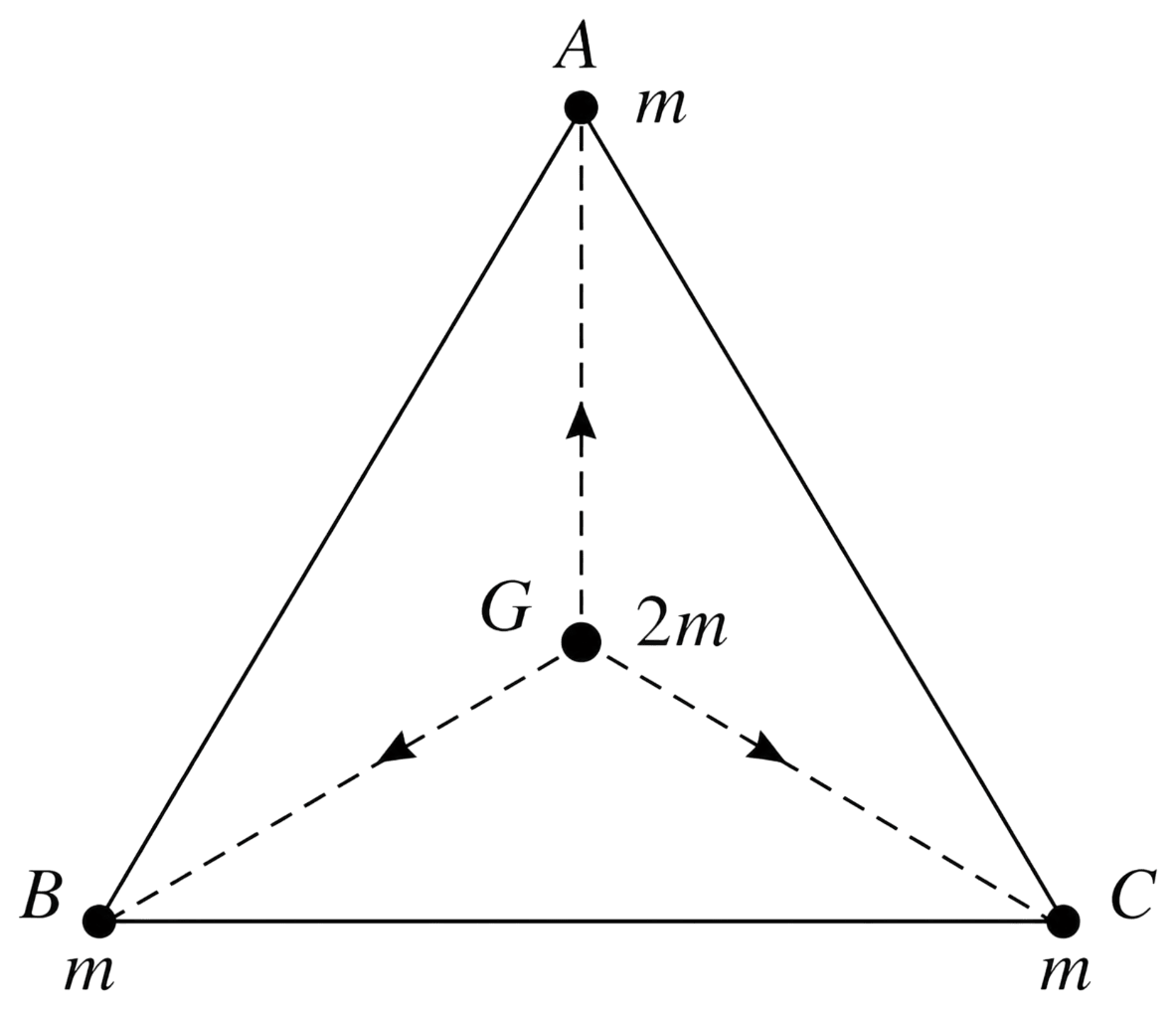
Given,
- Three equal masses, each m, at the vertices A, B and C of an equilateral triangle
- Mass placed at the centroid G = 2m
Let the distance of each vertex from the centroid be GA = GB = GC = l.
The gravitational force on the mass 2m at G due to each of the masses m at A, B and C is
The three forces are therefore equal in magnitude, and they are directed from G towards A, towards B and towards C respectively. Since ABC is an equilateral triangle and G is its centroid, these three directions are equally inclined to one another at 120°.
Three equal forces acting at a point at 120° to one another form a closed triangle, so their vector sum is zero.
Hence, by symmetry, the resultant gravitational force acting on the mass 2m placed at the centroid G is zero.
Spheres of the same material and same radius r are touching each other. Show that gravitational force between them is directly proportional to r4.
Answer
Let two spheres of the same material, each of radius r and density ρ, be touching each other. Their masses may be assumed to be concentrated at their centres.
The mass of each sphere is
Since the spheres are touching each other, the distance between their centres is
By Newton's law of gravitation, the force of attraction between them is
Since G, π and ρ are all constants,
Hence, the gravitational force between the two touching spheres of the same material is directly proportional to r4.
The gravitational force acting on a rocket at a height h from the earth surface is rd of the force acting on a body at sea level. What is the relation between h and Re (radius of the earth)?
Answer
Given,
- Gravitational force on the rocket at a height h of the force at sea level
The gravitational force on a body of mass m at sea level is
and at a height h above the surface it is
According to the question, , so
Hence, the relation between h and Re is h = 0.732 Re.
If the radii of two planets be R1 and R2 their mean densities be ρ1 and ρ2, then prove that the ratio of accelerations due to gravity on the planets will be R1 ρ1 : R2 ρ2.
Answer
Given,
- Radii of the two planets = R1 and R2
- Mean densities of the two planets = ρ1 and ρ2
Assuming a planet to be spherical, its mass may be taken to be concentrated at its centre. If M is the mass, R the radius and ρ the density of a planet, then
The gravitational force experienced by a body of mass m placed on its surface is
By Newton's second law of motion, F = mg, where g is the acceleration due to gravity on the planet. Therefore
Thus, the ratio of the accelerations due to gravity on the two given planets is
Hence, the accelerations due to gravity on the two planets are in the ratio R1ρ1 : R2ρ2.
If the period of revolution of an artificial satellite just above the earth be T and the density of earth be ρ, then show that ρ T2 is a universal constant.
Answer
Given,
- Period of revolution of the satellite just above the earth = T
- Density of the earth = ρ
The period of revolution of a satellite revolving just above the earth's surface, in an orbit of radius Re, is
If the earth be a sphere of mean density ρ, its mass is
Making this substitution and squaring both sides,
Since π and G are both constants, the quantity is a constant.
Hence, ρT2 is a universal constant.
The gravitational pull of sun on earth is greater than that of moon on earth. Yet, the tidal effect of the moon's pull is greater than that of the sun's pull. Why?
Answer
The gravitational attraction of the sun on the earth is greater than that of the moon on the earth. This is because of the very large mass of the sun, although the distance between the sun and the earth is much larger than that between the moon and the earth, and the gravitational force varies inversely as the square of the distance.
The tidal effect, however, is produced by the variation of the gravitational force across the diameter of the earth, and this tidal force varies inversely as the cube of the distance.
Therefore, although the mass of the moon is much smaller compared with the mass of the sun, its tidal effect is greater than that of the sun because of its much smaller distance from the earth.
The Sun attracts all bodies on the earth. At mid-night, when the sun is directly below, it pulls on a body in the same direction as the pull of the earth on that body; at noon, when the sun is directly above, it pulls on a body in a direction opposite to the pull of the earth. Then, will the weight of a body be greater at mid-night than at noon?
Answer
No, the weight of a body will be the same at mid-night and at noon.
The earth is itself a satellite of the sun. A body placed on the earth is also a satellite of the sun, and both the body and the earth have the same acceleration towards the sun, since the acceleration produced by the sun's gravitational field does not depend upon the mass of the body.
Hence there will be no relative gravitational acceleration between the body and the earth, that is, a body placed on the earth will experience no gravitational effect due to the sun. It will experience a gravitational force only due to the earth, and this will be the weight of the body measured on the earth, which will remain the same for all the 24 h.
'Gravitational potential is equal to the gravitational potential energy of unit mass.' Is this statement correct? If not; then what will be the correct statement?
Answer
No, the statement is not correct.
The unit of gravitational potential is J kg-1, while the unit of gravitational potential energy is J. Two quantities of different units cannot be equated, so the given statement is dimensionally incorrect.
The correct statement will be : If the gravitational potential at a place is 1 J kg-1, then the gravitational potential energy of 1 kg mass at that place will be 1 J.
A light planet is revolving around a very massive star of mass M in circular orbit of radius R with period of revolution T. Assuming the gravitational force between planet and star to be proportional to R-5/2, prove that , where G is the universal gravitational constant.
Answer
Given,
- Mass of the star = M
- Radius of the circular orbit of the planet = R
- Period of revolution = T
- Gravitational force between the planet and the star is proportional to R-5/2
Let m be the mass of the light planet. Its period of revolution in a circular orbit of radius R is
The gravitational force between the planet and the star provides the necessary centripetal force for the circular motion. Since the force is proportional to R-5/2,
From the expression for T,
Substituting the value of obtained above,
Hence proved.
Based on Newton's Law of Universal Gravitation
Newton's law of universal gravitation states that every point mass in the universe attracts every other point mass with a force directly proportional to the product of their masses and inversely proportional to the square of the distance between them. This law explains the gravitational force between two masses, which can be described by the equation: where F is the gravitational force, G is the gravitational constant, m1 and m2 are the masses, and r is the distance between their centres.
(i) According to Newton's law of universal gravitation, if the distance between two masses is doubled, the gravitational force between them:
- doubles
- halves
- becomes one-fourth
- becomes four times
(ii) If the mass of one of the objects is tripled while the distance between them remains the same, the gravitational force between the two objects:
- remains unchanged
- triples
- doubles
- becomes nine times
(iii) The value of the gravitational constant G is:
- dependent on the masses involved.
- dependent on the distance between the masses.
- a universal constant.
- variable under different conditions
(iv) Which of the following statements is true regarding Newton's law of universal gravitation?
- It only applies to objects on Earth.
- It applies universally to all objects with mass.
- It only applies to celestial bodies.
- It only applies when objects are close to each other.
(v) If the force of attraction between the two bodies placed in air is F, now, if they are completely immerged in a liquid, in which the material bodies are insoluble, keeping their separation constant. The new force of attraction will:
- remains same
- increase
- decrease
- none of these
Answer
(i) becomes one-fourth
By Newton's law of universal gravitation . If the distance is doubled, r becomes 2r, so
Hence the force is reduced to one-fourth of its original value.
(ii) triples
The gravitational force is directly proportional to the product of the masses, . If m1 is tripled and both m2 and r remain the same, the force also becomes three times its original value.
(iii) a universal constant.
The value of G is the same for all pairs of bodies, at all places, at all distances of separation, and it is independent of the presence of other bodies or of the properties of the intervening medium. Hence G is regarded as a universal constant.
(iv) It applies universally to all objects with mass.
Newton stated that his formula applies not only between the sun and the planets, but between any two bodies of the universe. The law is therefore universal and applies to all objects with mass, regardless of their location or distance.
(v) remains same
Gravitational forces are completely independent of the properties of the intervening medium. Hence, when the bodies are immersed in a liquid with their separation unchanged, the gravitational force of attraction between them remains F.
On Variation in the Value of g
The acceleration due to gravity (g) is the acceleration experienced by an object due to the Earth's gravitational pull. The value of g varies slightly depending on the location on Earth's surface, primarily due to factors like altitude, latitude, and the distribution of mass within the Earth. At sea level, g is approximately 9.8 ms-2. The value of g decreases with both height and depth. But the variation in the value of g is different for both the cases. The variation of g with height is governed by the relation and, with depth it is governed by the relation . Here, r is the distance of the point, where, the variation of g is to be studied, from the centre of the earth. The value of r = 0 at the centre and, r = Re at the surface. Similarly, g is slightly higher at the poles and slightly lower at the equator due to the Earth's rotation and its oblate shape.
(i) What happens to the value of g as you move from the equator to the poles?
- It increases
- It decreases
- It remains the same
- It becomes zero
(ii) How does the value of g change with increasing altitude?
- It increases
- It decreases
- It remains constant
- It fluctuates randomly
(iii) Which of the following factors does NOT affect the value of g?
- Altitude
- Latitude
- The mass of the object
- The distribution of Earth's mass.
(iv) Which one of the following four graphs, correctly represents the variation in the value of acceleration due to gravity with distance r, starting from the centre of the earth?
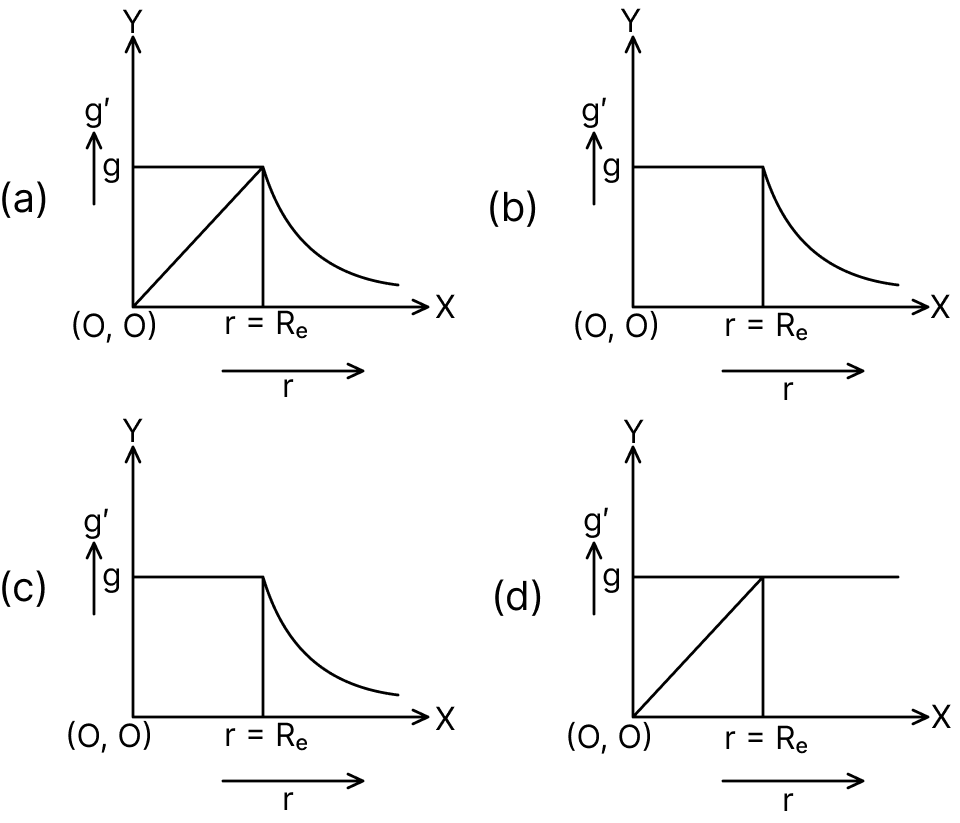
(v) If the Earth were a perfect sphere with no rotation, how would the value of g vary across the surface?
- It would be the same everywhere
- It would be higher at the poles
- It would be higher at the equator
- It would be lower at the equator.
Answer
(i) It increases
As we move from the equator to the poles, the distance from the earth's centre decreases because the earth is an oblate spheroid, and since , the value of g increases. Further, the centrifugal effect of the earth's rotation, given by the term Reω2cos2λ, decreases as the latitude λ increases, which also increases g.
(ii) It decreases
At an altitude h the distance from the earth's centre increases, and
so that g' < g. Hence the value of g decreases with increasing altitude.
(iii) The mass of the object
The acceleration due to gravity is , an expression which is free from the mass of the body. Altitude, latitude and the distribution of the earth's mass all affect g, but the mass of the object placed on the earth does not.
(iv) Graph (a)
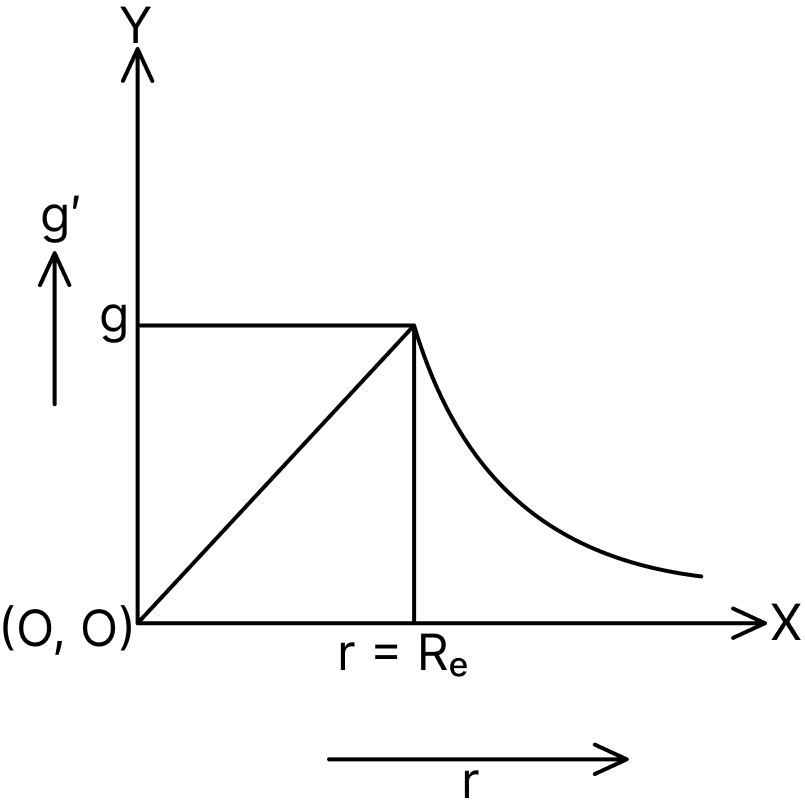
Starting from the centre of the earth, the variation with depth is governed by , so g' ∝ r. Hence g' is zero at the centre (r = 0) and increases linearly to a maximum value g at the surface (r = Re).
Beyond the surface the variation is governed by , so . Hence g' decreases sharply as a hyperbola and tends to zero as r → ∞, the X-axis being an asymptote to the curve.
Only graph (a) shows this linear rise up to r = Re followed by the hyperbolic fall.
(v) It would be the same everywhere
If the earth were a perfect sphere, the radius Re would be the same at every point on the surface, so would not vary with position. With no rotation, the term Reω2cos2λ also vanishes, so g' = g everywhere.
Note: The passage prints the variation of g with height as . The leading r is a misprint; the correct relation is , as used above.
Based on Orbital and Escape Velocity of Satellites
The orbital velocity of a satellite is the minimum velocity required to keep it in a stable orbit around the Earth. This velocity depends on the mass of the Earth and the radius of the orbit.
The orbital velocity of a satellite revolving very close to Earth's surface (Re >> h), is given by the relation, .
Escape velocity, on the other hand, is the minimum velocity required for an object to break free from the Earth's gravitational pull. It is given by the formula: . The orbital velocity and the escape velocity is connected with relation, where v0, is the orbital velocity, ve is the escape velocity, G is the gravitational constant, Me is the mass of the Earth, and Re is the radius from the centre of the Earth.
(i) If the radius of the orbit increases, the orbital velocity of the satellite:
- increases
- decreases
- remains constant
- doubles
(ii) The escape velocity from the Earth's surface is approximately:
- 7.9 kms-1
- 11.2 kms-1
- 9.8 ms-1
- 8.11 kms-1
(iii) For a satellite to remain in a stable orbit, its velocity must be:
- less than the escape velocity
- equal to the escape velocity
- greater than the escape velocity
- independent of the escape velocity
(iv) A satellite is orbiting very close to the Earth's surface. If its orbital velocity is suddenly increased by 41.4%, what would be the most likely outcome for the satellite?
- The satellite will spiral down and crash onto the Earth's surface.
- The satellite will gain enough speed to escape Earth's gravitational pull and drift into space.
- The satellite will transition to an orbit with a smaller radius.
- The satellite will continue in its new orbit at the increased velocity.
(v) If the escape velocity on Mars is less than on Earth, what does this imply?
- Mars has a larger mass than Earth
- Mars has a smaller radius than Earth
- Mars has a smaller gravitational pull than Earth
- Mars has a higher gravitational constant.
Answer
(i) decreases
The orbital velocity of a satellite in an orbit of radius r is
Hence, as the radius of the orbit increases, the orbital velocity of the satellite decreases.
(ii) 11.2 kms-1
The escape velocity from the earth's surface is
(iii) less than the escape velocity
For a satellite to remain in a stable circular orbit, the gravitational force must supply exactly the centripetal force required. Its velocity must therefore be the orbital velocity , which is less than the escape velocity. If the velocity became equal to or greater than ve, the satellite would leave its orbit and escape.
(iv) The satellite will gain enough speed to escape Earth's gravitational pull and drift into space.
On increasing the orbital velocity by 41.4%, the new velocity is
Since the new velocity is exactly the escape velocity, the satellite will leave its orbit and escape into space.
(v) Mars has a smaller gravitational pull than Earth
The escape velocity is , which depends on the mass and radius of the planet. A smaller escape velocity for Mars means a weaker gravitational pull at its surface, which is why Mars cannot retain a thick atmosphere as the earth does.
Note: The passage prints both the orbital velocity and the escape velocity as , but The correct relations are and .
Based on Chandrayaan-3
India's Chandrayaan mission is a pioneering series of lunar exploration missions launched by the Indian Space Research Organisation (ISRO). The word "Chandrayaan" is derived from Sanskrit, meaning
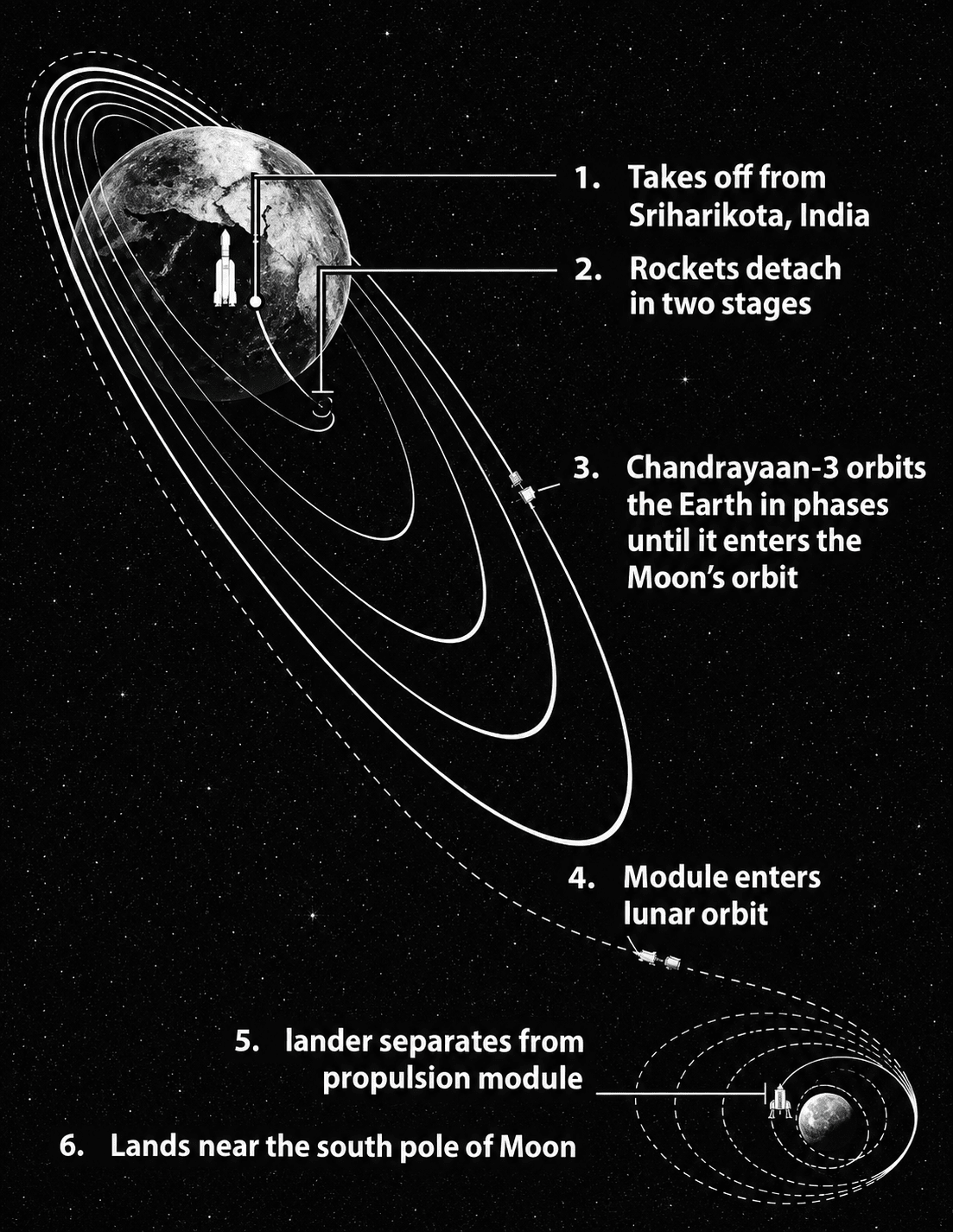
'Moon Craft,' reflecting the mission's primary objective of exploring the Moon. Chandrayaan-3 is the latest mission in the series, launched with the primary goal of successfully landing on the Moon and deploying a rover. Unlike Chandrayaan-2, Chandrayaan-3 does not include an orbiter, focusing entirely on the lander-rover module. This mission aims to enhance our understanding of the Moon's surface, including its composition and seismic activity. Following are the various physical principles and challenges involved in the Chandrayaan-3 mission, from orbital mechanics and energy conservation to the unique conditions of operating on the Moon's surface.
Gravitational Force and Orbital Mechanics: The spacecraft must escape Earth's gravity and enter the Moon's gravitational influence. This involves careful calculation of the escape velocity from Earth and the precise velocity required to achieve lunar orbit insertion. Once in lunar orbit, the spacecraft needs to adjust its speed to ensure a safe and controlled descent to the Moon's surface.
Energy Considerations: The total energy of the Chandrayaan-3 lander is a combination of kinetic and potential energy. As the spacecraft moves from Earth's orbit to the Moon's surface, there is a constant interplay between these two forms of energy. The potential energy decreases as the spacecraft descends, while kinetic energy increases. The conservation of mechanical energy is a critical principle guiding the mission's trajectory and landing.
Lunar Surface Physics: The Moon's surface presents unique challenges due to its low gravity (about 1/6th of Earth's gravity) and lack of atmosphere. This affects the behaviour of the lander during descent and the rover's mobility on the lunar surface. The lander must be designed to handle the reduced gravitational force while ensuring stability during touchdown. The rover, in turn, must navigate the lunar terrain, which includes dust, rocks, and uneven surfaces, with minimal energy expenditure.
Seismic Activity and Surface Composition: One of the goals of Chandrayaan-3 is to study the Moon's seismic activity. The lander is equipped with instruments to detect "moonquakes," which can provide insights into the Moon's internal structure. Understanding the physics of seismic waves and how they propagate through the Moon's surface is essential for interpreting this data. Additionally, analyzing the Moon's surface composition involves understanding the interaction of solar radiation with lunar soil and the scattering of light, which reveals mineralogical details.
(i) The primary challenge for the Chandrayaan-3 spacecraft in transitioning from Earth's gravitational influence to the Moon's gravitational influence is:
- achieving escape velocity from the moon.
- calculating the correct orbital insertion velocity for the moon.
- overcoming the lack of atmosphere on the moon.
- navigating the uneven lunar terrain.
(ii) As Chandrayaan-3 descends towards the Moon, what happens to its potential and kinetic energy?
- Both potential and kinetic energy increase.
- Potential energy increases, and kinetic energy decreases.
- Potential energy decreases, and kinetic energy increases.
- Both potential and kinetic energy decrease.
(iii) Why must the lander be designed to handle reduced gravitational force on the Moon?
- To ensure it can escape the Moon's gravity easily.
- To prevent it from bouncing off the surface on landing.
- To reduce the energy needed for lunar orbit insertion.
- To increase the rover's speed on the lunar surface.
(iv) Which of the following is a significant factor affecting the mobility of Chandrayaan-3's rover on the lunar surface?
- The presence of an atmosphere.
- The Moon's high gravitational force.
- The roughness and composition of the lunar terrain.
- The high temperatures on the Moon.
(v) The study of "moonquakes" by Chandrayaan-3 is important because it:
- helps determine the exact age of the moon.
- provides insights into the moon's internal structure.
- measures the gravitational pull of the moon.
- analyzes the composition of the moon's atmosphere.
Answer
(i) calculating the correct orbital insertion velocity for the moon.
The spacecraft must first escape the earth's gravity and then enter the moon's gravitational influence. The critical requirement in this transition is that its velocity must be precisely calculated so that it is captured into a stable lunar orbit, neither crashing into the moon nor passing by it.
(ii) Potential energy decreases, and kinetic energy increases.
As the spacecraft descends towards the moon its distance from the moon's centre decreases, so its gravitational potential energy becomes more negative, that is, it decreases. By the conservation of mechanical energy this lost potential energy appears as kinetic energy, so the kinetic energy increases and the spacecraft accelerates.
(iii) To prevent it from bouncing off the surface on landing.
The acceleration due to gravity on the moon is only about 1/6th of that on the earth, so the downward force holding the lander on the surface is small. Unless the lander is designed for this reduced gravitational force, it would rebound on touchdown instead of settling, and a stable, controlled landing would not be possible.
(iv) The roughness and composition of the lunar terrain.
The rover must navigate a surface consisting of dust, rocks and uneven ground, with minimal energy expenditure. There is no atmosphere on the moon, and its gravitational force is low rather than high, so the terrain is the significant factor affecting the rover's mobility.
(v) provides insights into the moon's internal structure.
The lander carries instruments to detect "moonquakes". By studying how the seismic waves generated by these quakes propagate through the moon, information can be obtained about the different layers within the moon, that is, about its internal structure.
Based on Kepler's Laws of Planetary Motion
Kepler's laws describe the motion of planets around the Sun. The first law, the law of orbits, states that planets move in elliptical orbits with the Sun at one focus. The second law, the law of areas, asserts that a line segment joining a planet and the Sun sweeps out equal areas during equal intervals of time. The third law, the law of periods, relates the orbital period of a planet to its average distance from the Sun.
(i) According to Kepler's first law, the orbit of a planet around the Sun is:
- Circular with the Sun at the centre
- Elliptical with the Sun at one focus
- Parabolic
- Elliptical with the Sun at the centre
(ii) Kepler's second law implies that a planet moves:
- Faster when it is closer to the Sun
- Slower when it is closer to the Sun
- At a constant speed
- Faster when it is farther from the Sun
(iii) Kepler's third law relates:
- The orbital period to the mass of the planet
- The orbital period to the distance from the Sun
- The orbital period to the eccentricity of the orbit
- The orbital period to the speed of the planet
(iv) A planet moves around the Sun in an elliptical orbit with the Sun at one of its foci. The physical quantity associated with the motion of the planet that remains constant with time is:
- Velocity
- centripetal force
- linear momentum
- angular momentum.
(v) Which of the following is NOT a consequence of Kepler's laws?
- The orbital speed of a planet is not constant
- Planets closer to the Sun have shorter orbital periods
- The force acting on a planet is directed towards the centre of its orbit
- All planets in the solar system follow the same elliptical path
Answer
(i) Elliptical with the Sun at one focus
This is Kepler's first law, the law of orbits, according to which all planets move around the sun in elliptical orbits having the sun at one focus of the orbit, and not at the centre.
(ii) Faster when it is closer to the Sun
By Kepler's second law the line joining a planet and the sun sweeps out equal areas in equal times. When the planet is nearer the sun the radius vector is shorter, so the planet must move faster for the area swept to remain the same. Hence its velocity is maximum when it is nearest the sun and minimum when it is farthest.
(iii) The orbital period to the distance from the Sun
Kepler's third law, the law of periods, states that
that is, it relates the square of the orbital period of a planet to the cube of its mean distance from the sun.
(iv) angular momentum.
The gravitational force on a planet is a central force, directed always towards the sun. It therefore exerts no torque about the sun, and hence the angular momentum of the planet about the sun remains constant with time. The velocity, the centripetal force and the linear momentum all change continuously along the elliptical orbit.
(v) All planets in the solar system follow the same elliptical path
Kepler's laws do imply that the orbital speed of a planet is not constant, that planets closer to the sun have shorter orbital periods, and that the force on a planet is directed towards the sun. However, each planet has its own elliptical orbit with its own size and eccentricity, so all planets certainly do not follow the same elliptical path.
Based on Geostationary and Polar Satellites
Satellites play a crucial role in communication, weather forecasting, navigation, and Earth observation. There are different types of satellites, with geostationary and polar satellites being two of the most significant categories.
Geostationary satellites orbit the Earth at an altitude of approximately 36,000 km, directly above the equator. These satellites have an orbital period equal to the Earth's rotation period (24 h), making them appear stationary relative to a point on Earth. They are primarily used for communication, broadcasting, and weather monitoring as they provide continuous coverage over a specific region.
Polar satellites orbit the Earth at much lower altitudes, typically between 600-800 km. Unlike geostationary satellites, polar satellites move in a north-south direction, passing over the poles on each orbit. As the Earth rotates beneath them, they can scan the entire Earth's surface over a series of orbits. Polar satellites are crucial for Earth observation, environmental monitoring, and exploration, as they provide comprehensive and frequent coverage of the entire planet, enabling the monitoring of dynamic changes in the Earth's environment and aiding in disaster management, climate research, and natural resource exploration.
(i) Which of the following statements is true about geostationary satellites?
- They orbit the Earth once every 12 h.
- They appear stationary relative to a specific point on Earth.
- They pass over the poles during their orbit.
- They are primarily used for reconnaissance (exploration) missions.
(ii) The primary advantage of polar satellites over geostationary satellites is:
- Continuous coverage of a specific region.
- ability to monitor weather patterns over the equator.
- coverage of the entire earth's surface over time.
- higher resolution imaging due to greater distance from Earth.
(iii) Which altitude range is typical for polar satellite orbits?
- 36000 km
- 600 – 800 km
- 1000 – 36000 km
- 6400 km
(iv) If a geostationary satellite were to be placed at a lower altitude than 36000 km, what would happen to its orbital period?
- The orbital period would increase.
- The orbital period would decrease.
- The satellite would remain stationary relative to Earth.
- The satellite would escape Earth's gravity.
(v) Polar satellites are particularly useful for which of the following purposes?
- Providing continuous television coverage.
- Monitoring polar ice caps and global weather patterns.
- Real-time communication across the globe.
- Broadcasting to a specific region continuously.
Answer
(i) They appear stationary relative to a specific point on Earth.
A geostationary satellite has a period of revolution of 24 h, exactly equal to the period of the axial motion of the earth, and it revolves in the equatorial plane in the same direction as the earth. Being synchronous with the earth's spin, it appears stationary over a fixed point on the earth's surface. It orbits once in 24 h and not in 12 h, it does not pass over the poles, and it is used mainly for communication, broadcasting and weather monitoring.
(ii) coverage of the entire earth's surface over time.
Polar satellites move in a north-south direction, passing close to the poles on each revolution. As the earth rotates beneath their orbital path, they gradually scan the entire surface of the globe in successive passes. A geostationary satellite, in contrast, provides continuous coverage of only one specific region.
(iii) 600 – 800 km
Polar satellites operate in low earth orbit, typically at altitudes ranging from about 500 km to 800 km above the earth's surface, completing one revolution in about 100 minutes.
(iv) The orbital period would decrease.
By Kepler's third law, T2 ∝ r3. If the satellite were placed at a lower altitude, the radius of its orbit would be smaller and hence its period of revolution would be shorter. It would then move faster than the earth's rotation and would no longer appear stationary over a point on the earth.
(v) Monitoring polar ice caps and global weather patterns.
Because polar satellites repeatedly scan every part of the earth's surface and operate at low altitudes, they provide comprehensive, high-resolution and frequent coverage. They are therefore used for weather forecasting, environmental monitoring such as tracking glacier retreat and snow cover, and climate studies. Continuous television coverage and real-time communication over a fixed region are the functions of geostationary satellites.
Write down Kepler's laws of planetary motion. Prove that the force acting on a planet is inversely proportional to the square of its distance from the sun.
Answer
Kepler's laws of planetary motion :
(i) Law of Orbits : All planets move around the sun in elliptical orbits having the sun at one focus of the orbit.
(ii) Law of Areas : A line joining any planet to the sun sweeps out equal areas in equal times, that is, the areal velocity of the planet remains constant.
(iii) Law of Periods : The square of the period of revolution of any planet around the sun is directly proportional to the cube of its mean distance from the sun, T2 = K r3.
Proof that the force is inversely proportional to the square of the distance :
Newton found that the orbits of most of the planets are nearly circular. Let a planet of mass m move on a circular path of radius r with a linear speed v. Since it is moving on a circular path, it is acted upon by a centripetal force directed towards the sun,
If T be the period of revolution of the planet, then
Substituting this value of v,
But according to Kepler's third law, T2 = K r3. Therefore
Since 4π2 and K are constants,
Hence, the force acting on a planet is inversely proportional to the square of its distance from the sun.
Define gravitational potential. Derive an expression for the gravitational potential energy of a body on the surface of earth.
Answer
Gravitational potential : If we bring a body from outside into a gravitational field, then the field itself will work on the body. The work done in bringing a unit mass from infinity to a point in the gravitational field is called the 'gravitational potential' at that point. This work is obtained, and not done by the agent bringing the mass.
If W joule be the work obtained in bringing a body of mass m kg from infinity to a point in the gravitational field, then the gravitational potential at that point is
Since the work W is obtained, that is, it is negative, the gravitational potential is always negative. It is a scalar quantity and its dimensions are [L2T-2].
Derivation of gravitational potential energy of a body on the surface of earth :
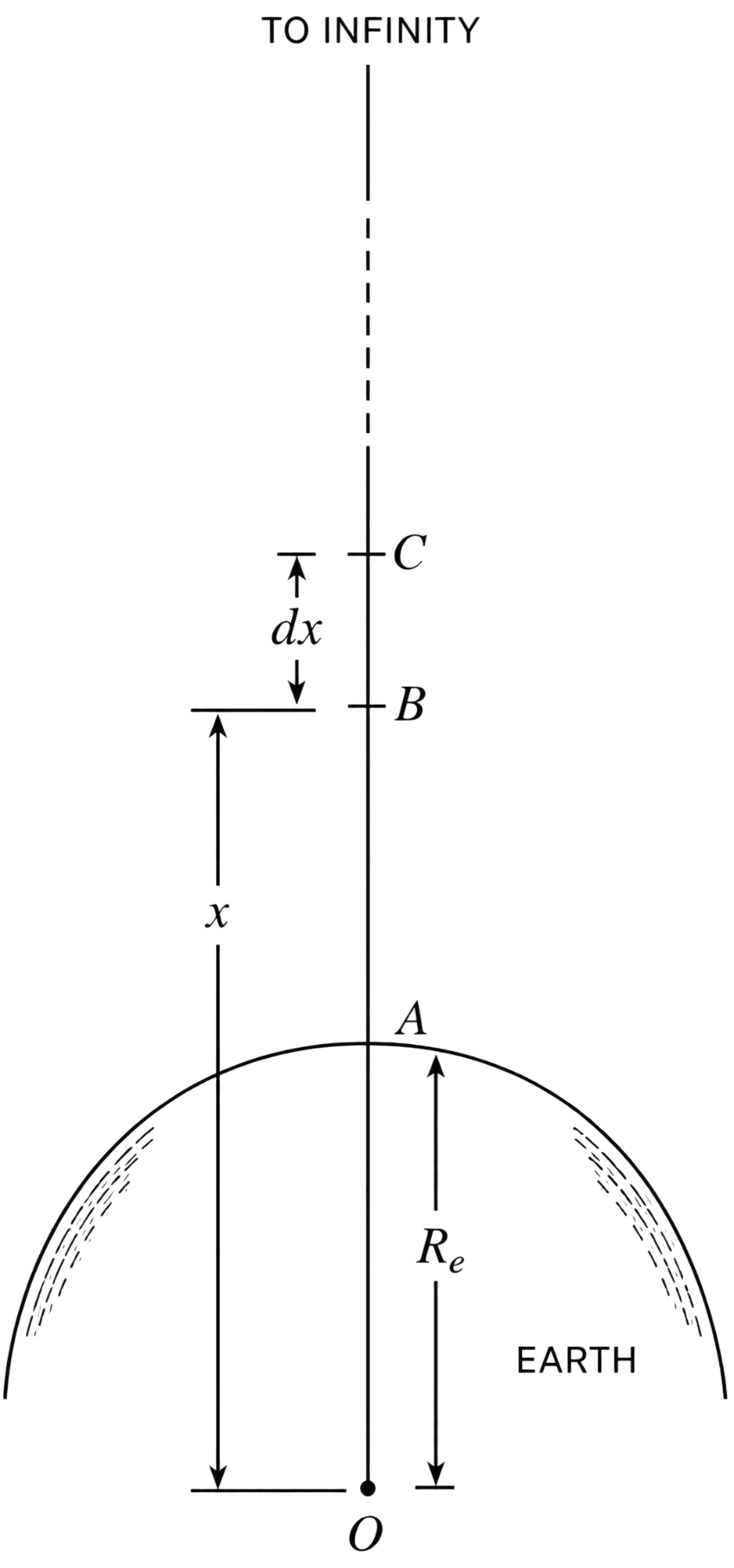
Let Me be the mass and Re the radius of the earth. Suppose a body of mass m is placed at a point B at a height x from the centre O of the earth. The gravitational force of attraction on the body is
The work done in taking the body through an infinitesimally small distance dx from C to B is
Therefore the work done in taking the body from infinity to the point A on the earth's surface is obtained by integrating between the limits x = ∞ and x = Re,
The gravitational potential energy of the body on the earth's surface is equal to this work obtained,
Since , that is GMe = gRe2, this may also be written as
Define escape velocity. Derive the formula for escape velocity of a body from the surface of earth and show that , where vo is the orbital velocity of the body near earth's surface.
Answer
Escape velocity : Escape velocity is the minimum velocity that an object needs in order to escape the gravitational pull of a celestial body, without any further propulsion. If an object is launched from the earth's surface with this speed, it will continue moving away from the earth, overcoming the earth's gravitational pull, and will not fall back or enter an orbit.
Derivation of the formula :
The work done in moving a body of mass m from the earth's surface (Re) to infinity, against the gravitational pull of the earth, is
This work is supplied by the kinetic energy given to the body. If ve is the velocity with which the body just breaks free from the gravitational pull of the earth, then
Since GMe = gRe2, equation (i) may also be written as
The expression is free from the mass m of the body, so the escape velocity is independent of the mass of the body.
Relation with the orbital velocity : The orbital velocity of a satellite revolving close to the earth's surface is
Therefore
Hence proved. If the orbital velocity of a satellite revolving close to the earth happens to increase to times, the satellite would escape.
Write the formula for the gravitational potential energy of a body on earth's surface, and hence obtain the formula for the escape velocity of a body from the earth.
Answer
Gravitational potential energy of a body on earth's surface : The work obtained in bringing a body from infinity to a point in a gravitational field is called the gravitational potential energy of the body at that point. For a body of mass m on the surface of the earth of mass Me and radius Re,
The gravitational potential energy at infinity is assumed to be zero, and since work is obtained (not done) in bringing the body from infinity into the gravitational field, the gravitational potential energy is always negative.
Derivation of the escape velocity :
The total energy of the body on the earth's surface, when it is projected with a velocity ve, is the sum of its kinetic energy and its gravitational potential energy,
For the body just to escape, it must reach infinity, where both its kinetic energy and its potential energy become zero, so that the total energy there is zero. By the conservation of energy,
Substituting g = 9.8 m s-2 and Re = 6.37 × 10⁶ m,
Hence, the escape velocity of a body from the earth is 11.2 km s-1.
State Kepler's laws of planetary motion. What conclusions were drawn by Newton from these laws?
Answer
Kepler's laws of planetary motion :
(i) Law of Orbits : All planets move around the sun in elliptical orbits having the sun at one focus of the orbit.
(ii) Law of Areas : A line joining any planet to the sun sweeps out equal areas in equal times, that is, the areal velocity of the planet remains constant. Hence the velocity of a planet is maximum when it is nearest the sun and minimum when it is farthest.
(iii) Law of Periods : The square of the period of revolution of any planet around the sun is directly proportional to the cube of its mean distance from the sun, T2 = K r3.
Newton's conclusions from Kepler's laws :
Newton found that the orbits of most of the planets are nearly circular, and that from the second law the areal speed of a planet remains constant, which for a circular orbit means that its linear speed is constant. Since the planet moves on a circular path, it must be acted upon by a centripetal force directed towards the sun. On combining this with the third law he obtained , and drew the following conclusions :
(i) A planet is acted upon by a centripetal force which is directed towards the sun.
(ii) This force is inversely proportional to the square of the distance between the planet and the sun, that is, .
(iii) This force is directly proportional to the mass of the planet (). Since the force between the planet and the sun is mutual, the force F is also proportional to the mass M of the sun ().
Since the mass of the sun is constant, the constant was replaced by GM, giving
Newton then stated that this formula applies not only between the sun and the planets, but between any two bodies of the universe. This is Newton's law of gravitation.
Explain how the knowledge of g helps us to find (i) mass of the earth and (ii) mean density of earth?
Answer
The acceleration due to gravity at the earth's surface is related to the gravitational constant by
(i) Mass of the earth : Rearranging the above relation, the mass of the earth is
Thus, by measuring g, the radius Re of the earth and the gravitational constant G, the mass of the earth can be computed. Substituting the known values g = 9.80 m s-2, Re = 6.37 × 10⁶ m and G = 6.67 × 10⁻¹¹ N m2 kg-2,
(ii) Mean density of the earth : If ρ be the average density of the earth, then its mass is
Substituting this value of Me in the expression above,
Substituting the known values,
Hence, a knowledge of g enables us to determine the mass of the earth as 6.0 × 1024 kg and its mean density as 5.5 × 10³ kg m-3.
On the basis of Kepler's law of planetary motion, establish the Newton's gravitational inverse square law.
Answer
Newton found that the orbits of most of the planets are nearly circular. According to Kepler's second law the areal speed of a planet remains constant, which means that in a circular orbit the linear speed of the planet is constant.
Let a planet of mass m move on a circular path of radius r with a linear speed v. Since it is moving on a circular path, it is being acted upon by a centripetal force directed towards the centre, that is, towards the sun,
If T be the period of revolution of the planet, then
Substituting this value of v,
But according to Kepler's third law, T2 = K r3. Substituting this in equation (i),
From this Newton concluded that the force is inversely proportional to the square of the distance between the planet and the sun and directly proportional to the mass m of the planet. Since the force between the planet and the sun is mutual, F is also proportional to the mass M of the sun. Hence
where the constant has been replaced by GM, the mass of the sun being constant.
Hence, Newton's gravitational inverse square law is established from Kepler's laws of planetary motion.
Prove that the orbital velocity vo of a satellite at a height h from the earth's surface is equal to , where Re is the radius of the earth and g is acceleration due to gravity. Find out the time-period of revolution of the satellite.
Answer
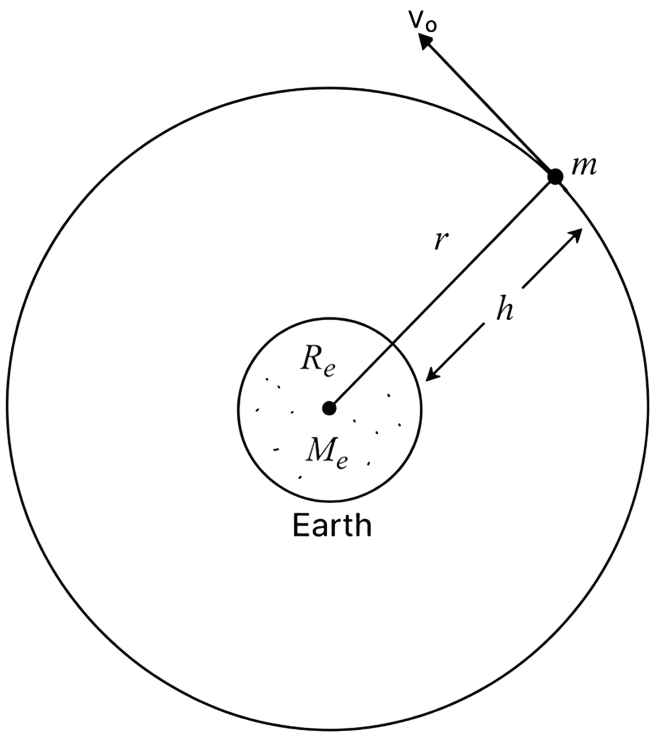
Let Me be the mass of the earth and Re its radius. A satellite of mass m revolves in a circular orbit of radius r at a height h above the earth's surface, so that
Orbital velocity : The centripetal force required for the circular motion of the satellite is , and this is provided by the gravitational force exerted by the earth on the satellite. Therefore
If g is the acceleration due to gravity on the earth's surface, then , that is GMe = gRe2. Substituting this value in equation (i),
Hence proved.
Time-period of revolution : The satellite covers the circumference 2πr of its orbit in one revolution, so
Substituting the value of vo from equation (i),
Since GMe = gRe2, this may also be written as
Show that this satellite obeys Kepler's third law, according to which, the ratio of the cube of its orbit's radius to the square of its period of revolution is constant.
Answer
The period of revolution of a satellite revolving at a height h above the earth's surface, in an orbit of radius r = Re + h, is
Squaring both sides,
Rearranging so that the orbital radius and the period appear on the same side,
In this expression G is the universal gravitational constant, Me is the mass of the earth and 4π2 is a number. All three are constants, and therefore
Hence, the ratio of the cube of the radius of the satellite's orbit to the square of its period of revolution is constant, which is exactly Kepler's third law. This shows that an artificial satellite of the earth obeys the same law that governs the motion of the planets around the sun.
Distinguish between g and G. Obtain an expression for the acceleration due to gravity in terms of gravitational constant G.
Answer
Distinction between g and G :
| Acceleration due to gravity (g) | Gravitational constant (G) |
|---|---|
| It is the acceleration produced in a body falling freely towards the earth. | It is numerically equal to the force between two particles, each of unit mass, placed a unit distance apart. |
| It is a vector quantity. | It is a scalar quantity. |
| Its S.I. unit is m s-2 or N kg-1. | Its S.I. unit is N m2 kg-2. |
| Its dimensions are [LT-2]. | Its dimensions are [M-1L3T-2]. |
| It is not a universal constant. Its value varies with altitude, depth, latitude and the shape of the earth. | It is a universal constant. Its value is the same for all pairs of bodies at all places and at all times. |
| Its value at the earth's surface is about 9.8 m s-2. | Its value is 6.67 × 10⁻¹¹ N m2 kg-2. |
Expression for g in terms of G :
Let Me be the mass and Re the radius of the earth. Assuming the earth to be spherical, its total mass may be imagined as being concentrated at a single point at its centre O.
Let a body of mass m be situated at the earth's surface. By Newton's law of gravitation, the force of attraction between the body and the earth is
The gravitational force on the body is its weight, F = mg. Its reaction is the equal and opposite gravitational force exerted by the body on Earth.
From equations (i) and (ii),
This expression is free from the mass m of the body, which shows that the value of g does not depend upon the mass of the body.
Discuss the variation of acceleration due to gravity 'g' on going above and below the surface of earth. How are g and G related?
Answer
(i) Variation of g above the surface of the earth :
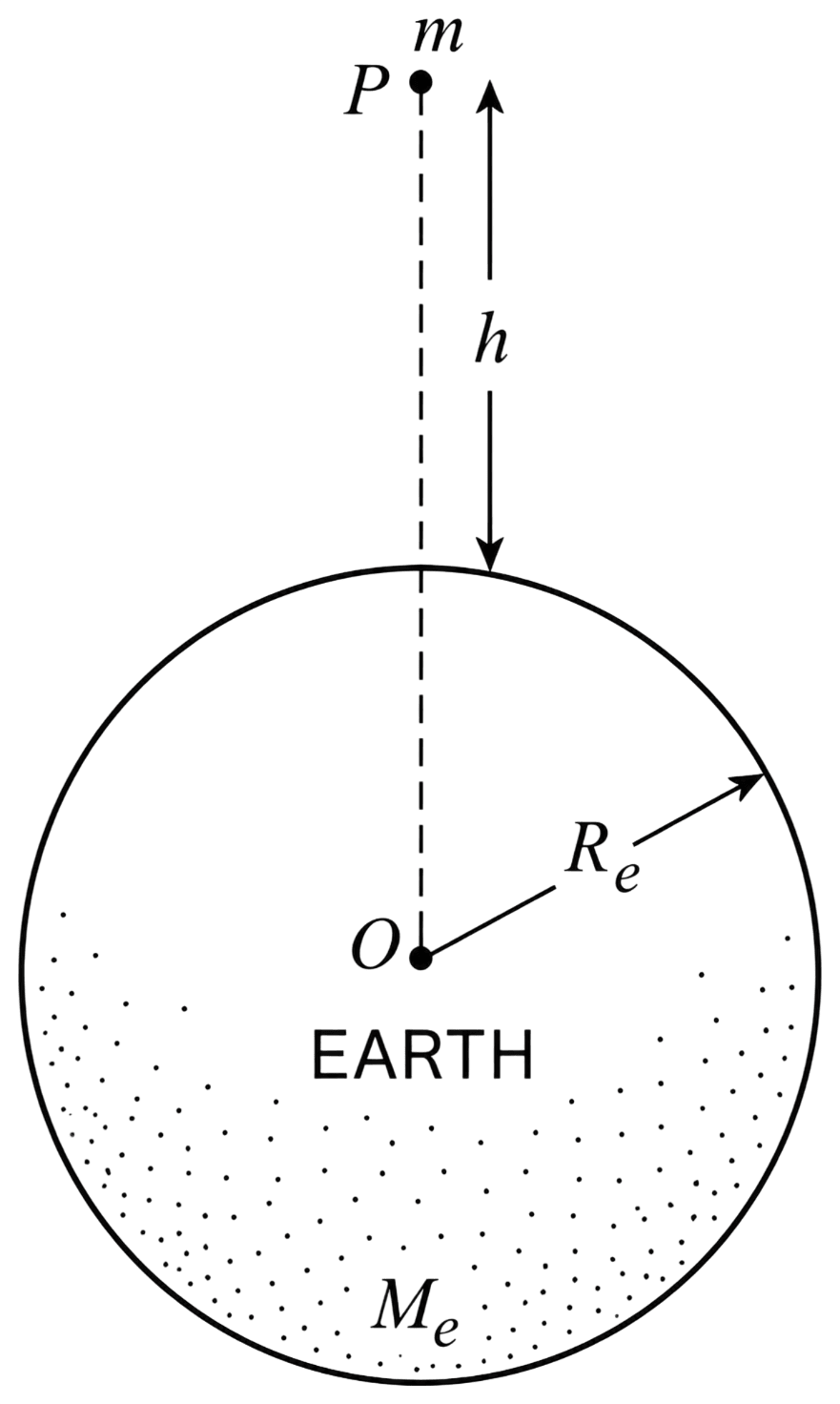
Let O be the centre of the earth, Re its radius and Me its mass. The acceleration due to gravity at the surface is
If the body is raised to a height h above the surface, its distance from the centre becomes (Re + h), and the acceleration due to gravity there is
Dividing equation (ii) by equation (i),
Thus, as we go above the surface of the earth, the acceleration due to gravity goes on decreasing. For example, at a height equal to the radius of the earth, g' = g/4.
(ii) Variation of g below the surface of the earth :
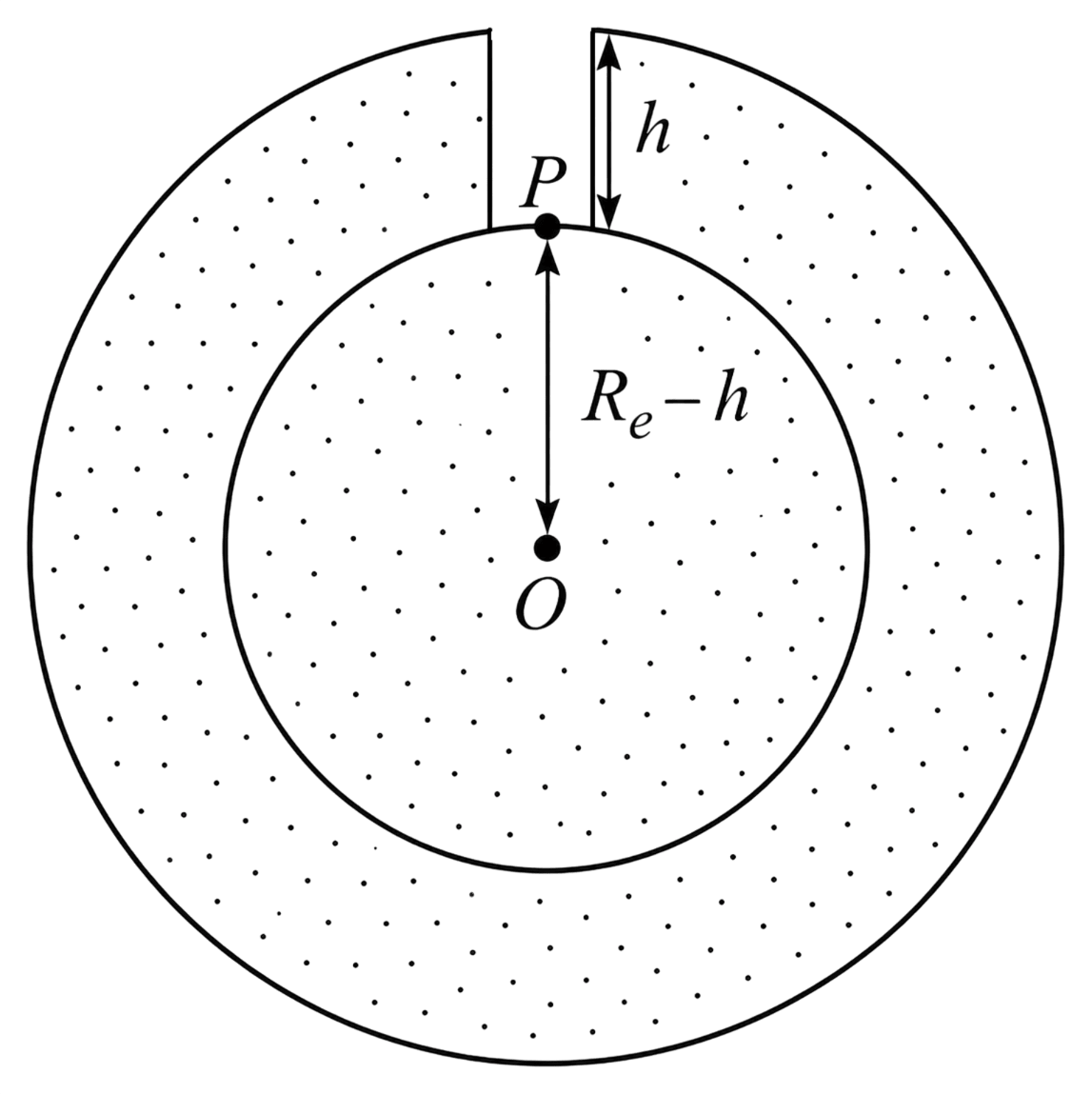
Let a body P of mass m be situated at a depth h below the earth's surface, so that its distance from the centre is (Re − h). By Newton's shell theorem the gravitational force on a body inside a spherical shell is always zero, so the body experiences attraction only due to the inner solid sphere of radius (Re − h), whose mass is
The force of attraction on the body is therefore
Similarly at the surface, where h = 0,
Dividing equation (iii) by equation (iv),
so that g' < g. Thus, as we go below the surface of the earth, the acceleration due to gravity goes on decreasing and becomes zero at the centre of the earth (where h = Re).
Relation between g and G : The two are related by
where G is a universal constant, while g is not constant and varies from place to place.
On what factors does the acceleration due to gravity g depend? Show that the value of g becomes one-fourth at a height equal to the radius of the earth from the surface of the earth.
Answer
Factors on which g depends : The acceleration due to gravity at the earth's surface is
so it depends upon the mass Me of the earth and the radius Re of the earth, but not upon the mass, shape or size of the body. Its value further changes with the following four factors :
(i) Altitude : g decreases as we go above the earth's surface.
(ii) Depth : g decreases as we go below the earth's surface and becomes zero at the centre.
(iii) Shape of the earth : Since the earth is an oblate spheroid, its equatorial radius is greater than its polar radius, so g is about 9.83 m s-2 at the poles and about 9.78 m s-2 at the equator.
(iv) Rotation of the earth : Due to the rotation, the apparent value becomes g' = g − Reω2cos2λ, which is minimum at the equator and maximum at the poles.
Value of g at a height equal to the radius of the earth :
The acceleration due to gravity at a height h above the earth's surface is
Putting h = Re,
Hence, at a height equal to the radius of the earth from the surface, the value of g becomes one-fourth of its value at the surface.
If the mass of earth is Me and its mean radius is Re, derive an expression for the orbital velocity of a satellite of mass m, revolving at a height h from the surface of the earth. On which factors does the orbital speed depend?
Answer
Given, the mass of the earth is Me and its mean radius is Re. A satellite of mass m revolves in a circular orbit at a height h above the earth's surface, so that the radius of its orbit is
When the satellite revolves in a circular orbit around the earth, a centripetal force acts between them. This force is provided by the gravitational force of attraction exerted by the earth on the satellite.
The centripetal force required for the motion of the satellite is , and the gravitational force exerted by the earth on the satellite is . Since the gravitational force provides the required centripetal force,
Cancelling m and one power of r from both sides,
Substituting r = Re + h,
If g is the acceleration due to gravity on the earth's surface, then GMe = gRe2, and equation (i) becomes
Factors on which the orbital speed depends : Equations (i) and (ii) are free from the mass m of the satellite. Hence the orbital speed depends only upon the mass of the earth, the radius of the earth and the height h of the satellite above the earth's surface. Greater the height of the satellite, smaller is its orbital speed. Since the speed does not depend upon the mass of the satellite, two satellites of different masses revolving in the same orbit around the earth have the same speed.
Derive the formula for orbital speed of a satellite and its period of revolution. Explain what is a geostationary satellite. What is the usefulness of this satellite?
Answer
Orbital speed of a satellite : When a satellite of mass m revolves in a circular orbit of radius r around the earth, the gravitational force of the earth provides the necessary centripetal force,
If h be the height of the satellite above the earth's surface, then r = Re + h, so that
Period of revolution : The satellite covers the circumference of its orbit in one revolution, so
Geostationary satellite : The period of revolution of a satellite depends upon its height above the earth's surface. If the height of an artificial satellite above the earth's surface is such that its period of revolution is exactly equal to the period of the axial motion of the earth (24 h), then the satellite would appear stationary over a point on the earth's equator. Such a satellite is known as a geostationary satellite or a geosynchronous satellite, and its orbit is called the parking orbit.
The conditions for a satellite to be geostationary are :
(i) The angular velocity, or the time period, of the satellite should be the same as that of the earth.
(ii) The direction of rotation of the satellite should be the same as that of the earth, that is, anticlockwise from west to east.
(iii) The orbital plane of the satellite should be coplanar with the equatorial plane of the earth.
Putting T = 24 h in , the height comes out to be about 35,830 km above the equator.
Usefulness : Since a geostationary satellite remains fixed relative to a specific point on the earth's surface, it provides continuous coverage of the same geographical area. It is therefore ideal for communication, broadcasting services such as television, radio and internet, and weather monitoring. This is also why a satellite dish need not be constantly realigned. Such satellites are further crucial in disaster management, since they provide real-time monitoring of weather patterns, enabling early warnings for cyclones and other natural disasters.
Derive an expression for the periodic-time of a satellite revolving around the earth. Show how it depends upon the density of the earth.
Answer
Derivation of the periodic-time : A satellite of mass m revolves around the earth in a circular orbit of radius r = Re + h. The gravitational force of the earth provides the necessary centripetal force,
The satellite covers the circumference 2πr of its orbit in one revolution, so its period of revolution is
Dependence on the density of the earth : If the earth be supposed to be a sphere of mean density ρ, then its mass is
Substituting this value of Me in equation (i),
For a satellite revolving very close to the earth's surface (h << Re), this reduces to
Hence, the period of revolution of a satellite revolving close to the earth's surface varies inversely as the square root of the mean density of the earth, and is independent of the radius of the earth and of the mass of the satellite.
What do you understand by the escape energy of a body? Prove that the escape velocity of a body is independent of its mass.
Answer
Escape energy : The gravitational potential energy of a body of mass m on the earth's surface is , and at infinity it is zero. The escape energy of a body is the minimum energy that must be supplied to it in order to take it from the surface of the earth to infinity, that is, to free it completely from the gravitational field of the earth. Its value is
Proof that escape velocity is independent of mass :
This escape energy is supplied to the body in the form of kinetic energy. If ve is the escape velocity, then
The mass m of the body appears on both sides of this equation and therefore cancels out,
The final expression contains only the mass Me and the radius Re of the earth, and no term involving the mass of the escaping body.
Hence, the escape velocity of a body is independent of its mass. This is why the escape velocity from the earth is 11.2 km s-1 for a body of 1 g as well as for a body of 1000 kg.
What do you understand by escape velocity? Derive the formula for escape velocity of a particle from a planet of mass M and radius R.
Answer
Escape velocity : Escape velocity is the minimum velocity that an object needs in order to escape the gravitational pull of a celestial body, without any further propulsion. An object launched with this speed will continue moving away, overcoming the gravitational pull, and will not fall back or enter an orbit.
Derivation for a planet of mass M and radius R :
Let a body of mass m be projected from the surface of the planet with a velocity ve. The gravitational potential energy of the body on the surface of the planet is
and its initial kinetic energy is . Hence the total energy of the body at the surface is
For the body just to escape, it must reach infinity, where its potential energy is zero and its kinetic energy is also just zero. Hence its total energy at infinity is zero.
By the conservation of energy,
If g is the acceleration due to gravity at the surface of the planet, then GM = gR2, and
The expression is free from the mass m of the body, so the escape velocity depends only upon the mass and the radius of the planet, and is different for different planets.
What do you mean by gravitational potential energy? Derive expressions for the gravitational potential energy of a body of mass 'm' placed in the gravitational field of earth at distance r(r > Re) from the centre, and on the surface of earth, where Re is the radius of earth.
Answer
Gravitational potential energy : The work obtained in bringing a body from infinity to a point in a gravitational field is called the 'gravitational potential energy' of the body at that point. The gravitational potential energy at infinity is assumed to be zero. Because work is obtained, and not done, in bringing the body from infinity into a gravitational field, the gravitational potential energy is always negative.
(i) Potential energy at a distance r (r > Re) from the centre :
If F be the gravitational force acting on the body of mass m when it is at a distance x from the centre of the earth, then
The work obtained in taking the body through an infinitesimally small distance dx is dW = F dx. Hence the total work obtained in bringing the body from infinity to a distance r is
If the body is at a height h above the earth's surface, then r = Re + h, so
(ii) Potential energy on the surface of the earth :
Putting r = Re in the above expression, the gravitational potential energy of the body on the earth's surface is
Since GMe = gRe2, this may also be written as
A rocket projected upward with a velocity v reaches a height h which is not negligible in comparison to the radius Re of the earth. Derive the expression for h in terms of v, Re and g. Calculate v when (i) h = Re and (ii) h = ∞.
Answer
Given,
- Velocity of projection = v
- Maximum height attained = h, not negligible compared with Re
Derivation of the expression for h :
The gravitational potential energies of the body of mass m on the earth's surface and at a height h are
Therefore the increase in gravitational potential energy is
Using GMe = gRe2, this becomes
As the body goes up, its whole initial kinetic energy is converted into this increase in potential energy at the maximum height. Hence
Solving equation (i) for h,
(i) When h = Re : Substituting h = Re in equation (i),
(ii) When h = ∞ : Substituting h → ∞ in equation (i), the term dominates, so
Hence, , and the velocities are for h = Re and for h = ∞. The second value is the escape velocity, as it should be.
'There cannot be atmosphere on the moon'. Why? Explain on the basis of escape velocity.
Answer
There cannot be an atmosphere on the moon because the escape velocity on the moon is very small, being only about 2.4 km s-1, against 11.2 km s-1 on the earth.
The escape velocity from the surface of a body of mass M and radius R is
The moon has a much smaller mass than the earth, so its gravitational pull is weak and its escape velocity is correspondingly small.
The molecules of a gas are in continuous random motion with a wide range of speeds, and their average speed increases with temperature. On the moon, because the escape velocity is so low, the molecules of any atmosphere would easily attain speeds greater than the escape velocity of the moon. They would therefore escape from the moon's gravitational field into outer space.
In this way any gaseous particles that might once have been present on the moon have long since escaped, leaving a barren surface with no air, no weather and extreme temperature variations between day and night.
On the earth, in contrast, the high escape velocity ensures that most atmospheric molecules, despite their thermal motion, remain bound to the earth. Only the lightest gases, such as hydrogen and helium, have velocities close to the escape velocity and can slowly escape over time.
Hence, there cannot be an atmosphere on the moon.
Compute the ratio of the gravitational force and electrostatic force between an electron (mass 9.1 × 10⁻³¹ kg) and a proton (mass 1.7 × 10⁻²⁷ kg). Given : e = 1.6 × 10⁻¹⁹ C and G = 6.67 × 10⁻¹¹ Nm2 kg-2.
Answer
Given,
- Mass of the electron, me = 9.1 × 10⁻³¹ kg
- Mass of the proton, mp = 1.7 × 10⁻²⁷ kg
- Charge, e = 1.6 × 10⁻¹⁹ C
- G = 6.67 × 10⁻¹¹ N m2 kg-2
- = 9 × 10⁹ N m2 C-2
If r be the distance between the electron and the proton, the gravitational force between them is
and the electrostatic force between them is
Taking the ratio, the distance r cancels out,
Substituting the values,
Hence, the ratio of the gravitational force to the electrostatic force is 4.5 × 10-40. This shows that gravitational forces are the weakest forces existing in nature.
Two bodies of masses 100 kg and 1000 kg are at a distance 1.00 m apart. Calculate the gravitational field intensity and the potential at the middle-point of the line joining them. (G = 6.67 × 10⁻¹¹ N m2 kg-2).
Answer
Given,
- Masses of the two bodies, M1 = 100 kg and M2 = 1000 kg
- Distance between them = 1.00 m
- G = 6.67 × 10⁻¹¹ N m2 kg-2
The distance of the middle-point from either body is
Gravitational field intensity : The intensities due to the two bodies are directed opposite to each other at the middle-point, since the point lies between them. Hence the resultant intensity is
Substituting the values,
directed towards the 1000 kg body.
Gravitational potential : Potential is a scalar quantity, so the potentials due to the two bodies are added algebraically,
Hence, the gravitational field intensity is 2.40 × 10⁻⁷ N kg-1 and the potential is −1.47 × 10⁻⁷ J kg-1.
Two bodies of masses 100 kg and 10000 kg are at a distance 1 m apart. At which point on the line joining them will the gravitational field-intensity be zero?
Answer
Given,
- Masses of the two bodies, M1 = 100 kg and M2 = 10000 kg
- Distance between them = 1 m
Let the gravitational field-intensity be zero at a point P on the line joining the two bodies, at a distance x from the smaller body of mass 100 kg. Its distance from the larger body is then (1 − x).
At this point the two field intensities are equal and opposite,
Taking the square root,
Hence, the gravitational field-intensity is zero at a point in between the two bodies, at a distance of m from the smaller body.
The moon completes one revolution around the earth in 27 days in an orbit of radius 3.8 × 10⁵ km. The earth completes one revolution around the sun in 365 days in an orbit of radius 1.5 × 10⁸ km. Compare the masses of the sun and the earth.
Answer
Given,
- Period of the moon around the earth, Tm = 27 days, radius of orbit rm = 3.8 × 10⁵ km
- Period of the earth around the sun, Te = 365 days, radius of orbit re = 1.5 × 10⁸ km
For a body revolving in a circular orbit of radius r with period T around a central mass M, the gravitational force provides the centripetal force, giving
Applying this to the earth (from the moon's motion) and to the sun (from the earth's motion),
Taking the ratio,
Substituting the values,
Hence, the mass of the sun is 3.366 × 10⁵ times the mass of the earth, that is, Ms : Me = 3.366 × 10⁵ : 1.
With what velocity must a body be thrown from earth's surface so that it may reach a height 4 Re above the earth's surface? (Radius of the earth Re = 6400 km, g = 9.8 m s-2).
Answer
Given,
- Height to be reached, h = 4Re
- Radius of the earth, Re = 6400 km = 6.4 × 10⁶ m
- g = 9.8 m s-2
The velocity required to reach a height h, when h is not negligible compared with Re, is given by
Substituting h = 4Re,
Substituting the values,
Hence, the body must be thrown with a velocity of 10 km s-1.
A body is thrown vertically upwards with a velocity 10 km s-1 from earth's surface. Up to which height will it go? Radius of the earth is 6400 km and g = 10 m s-2.
Answer
Given,
- Velocity of projection, v = 10 km s-1 = 1.0 × 10⁴ m s-1
- Radius of the earth, Re = 6400 km = 6.4 × 10⁶ m
- g = 10 m s-2
The maximum height attained by a body projected upward with a velocity v, when the height is not negligible compared with Re, is
Substituting the values,
Hence, the body will go up to a height of 2.28 × 10⁴ km.
The escape velocity of a projectile on earth's surface is 11.2 km s-1. A body is projected up with twice this speed. What will be the speed of the body at infinity? Ignore the presence of sun and other planets, etc.
Answer
Given,
- Escape velocity, ve = 11.2 km s-1
- Velocity of projection, vi = 2ve
By the conservation of energy, if vf is the speed of the body at infinity where the potential energy is zero,
Since , this becomes
Substituting vi = 2ve,
Hence, the speed of the body at infinity is 19.4 km s-1.
The orbital speed of an artificial satellite orbiting very close to the earth is 8 km s-1. What should be the increased speed of the satellite so that it may escape leaving its orbit?
Answer
Given,
- Orbital speed of the satellite, vo = 8 km s-1
For a satellite orbiting very close to the earth, the escape velocity and the orbital speed are related by
Substituting the given value,
Hence, the speed of the satellite should be increased to = 11.3 km s-1 so that it may escape leaving its orbit.
What will be the acceleration due to gravity at a planet whose mass is eight times the mass of the earth and whose radius is twice that of the earth? ('g' on earth is 10 m s-2)
Answer
Given,
- Mass of the planet, Mp = 8Me
- Radius of the planet, Rp = 2Re
- Acceleration due to gravity on the earth, ge = 10 m s-2
The acceleration due to gravity at the surface of a planet is
Taking the ratio for the planet and the earth,
Substituting the values,
Hence, the acceleration due to gravity at the planet is 20 m s-2.
The centres of two identical spheres are at a distance 1.0 m apart. If the gravitational force between the spheres be 1.0 N, then what is the mass of each sphere? (G = 6.67 × 10⁻¹¹ N m2 kg-2)
Answer
Given,
- Distance between the centres, r = 1.0 m
- Gravitational force between the spheres, F = 1.0 N
- G = 6.67 × 10⁻¹¹ N m2 kg-2
The spheres are identical, so let the mass of each be m. By Newton's law of gravitation,
Rearranging for m,
Substituting the values,
Hence, the mass of each sphere is 1.225 × 10⁵ kg.
Two bodies of masses 40 kg and 80 kg are at a distance of 0.15 m from each other. The force of gravitation between the bodies is 1.0 mg-wt. Calculate the constant of gravitation. (g = 10 m s-2)
Answer
Given,
- Masses of the two bodies, m1 = 40 kg and m2 = 80 kg
- Distance between them, r = 0.15 m
- Force of gravitation, F = 1.0 mg-wt
- g = 10 m s-2
First the force is expressed in newton. Since 1 mg = 10-6 kg,
By Newton's law of gravitation,
Substituting the values,
Hence, the constant of gravitation is 7.0 × 10⁻¹¹ N m2 kg-2.
The mass and radius of moon are 7.34 × 10²² kg and 1.75 × 10⁶ m. Find the acceleration due to gravity at the moon. (G = 6.67 × 10⁻¹¹ N m2 kg-2)
Answer
Given,
- Mass of the moon, M = 7.34 × 10²² kg
- Radius of the moon, R = 1.75 × 10⁶ m
- G = 6.67 × 10⁻¹¹ N m2 kg-2
The acceleration due to gravity at the surface of the moon is
Substituting the values,
Hence, the acceleration due to gravity at the moon is 1.6 m s-2.
If the radius of the earth be 6.37 × 10⁶ m and the acceleration due to gravity 9.81 m s-2, then calculate the mass and the density of the earth. (G = 6.67 × 10⁻¹¹ N m2 kg-2)
Answer
Given,
- Radius of the earth, Re = 6.37 × 10⁶ m
- Acceleration due to gravity, g = 9.81 m s-2
- G = 6.67 × 10⁻¹¹ N m2 kg-2
Mass of the earth : From the relation ,
Substituting the values,
Density of the earth : If ρ be the average density, then . Substituting this in the relation above,
Substituting the values,
Hence, the mass of the earth is 6.0 × 1024 kg and its density is 5.5 × 10³ kg m-3.
The acceleration due to gravity on the surface of the earth is 10 m s-2. The mass of the planet Mars as compared to earth is 1/10 and radius is 1/2. Determine the gravitational acceleration of a body on the surface of Mars.
Answer
Given,
- Acceleration due to gravity on the earth, ge = 10 m s-2
- Mass of Mars,
- Radius of Mars,
The acceleration due to gravity at the surface of a planet is . Taking the ratio for Mars and the earth,
Substituting the values,
Hence, the gravitational acceleration of a body on the surface of Mars is 4 m s-2.
A body weighs 100 kg on earth. Find its weight on Mars. The mass and radius of Mars are 1/10 and 1/2 of the mass and radius of earth.
Answer
Given,
- Weight of the body on the earth, We = 100 kg-weight
- Mass of Mars,
- Radius of Mars,
The acceleration due to gravity at the surface of a planet is , so
The mass of the body remains the same everywhere, and the weight is W = mg. Therefore
Hence, the weight of the body on Mars is 40 kg-weight.
What will be the value of the acceleration due to gravity 'g' at a height 3200 km from the earth while its value at the earth is 9.8 m s-2? Radius of the earth is 6400 km.
Answer
Given,
- Height above the earth's surface, h = 3200 km
- Acceleration due to gravity at the earth's surface, g = 9.8 m s-2
- Radius of the earth, Re = 6400 km
The acceleration due to gravity at a height h above the earth's surface is
Substituting the values,
Hence, the value of g at a height of 3200 km is 4.35 m s-2.
At what height above the earth's surface would the acceleration due to gravity be (i) half, (ii) one-fourth of its value at the earth's surface? (Radius of earth = 6400 km ).
Answer
Given,
- Radius of the earth, Re = 6400 km
The acceleration due to gravity at a height h above the earth's surface is
(i) When :
(ii) When :
Hence, the acceleration due to gravity becomes half at a height of 2650 km and one-fourth at a height of 6400 km.
A man has a weight W on the earth-surface. If he goes above the earth-surface at the height 3 times the radius of the earth, find his weight at that place.
Answer
Given,
- Weight of the man on the earth's surface = W
- Height above the earth's surface, h = 3Re
The acceleration due to gravity at a height h above the earth's surface is
Substituting h = 3Re,
The mass m of the man remains unchanged, and his weight is W = mg. Hence his weight at that height is
Hence, his weight at that place will be .
Find the intensity of gravitational field when a force of 74 N acts on a body of mass 3.7 kg in the gravitational field.
Answer
Given,
- Force acting on the body, F = 74 N
- Mass of the body, m = 3.7 kg
The intensity of the gravitational field at a point is the force experienced by a unit mass placed at that point,
Substituting the values,
Hence, the intensity of the gravitational field is 20 N kg-1.
The gravitational field intensity at a point 10000 km from the centre of the earth is 4.8 N kg-1. Calculate the gravitational potential at that point.
Answer
Given,
- Distance from the centre of the earth, r = 10000 km = 1.0 × 10⁷ m
- Gravitational field intensity, I = 4.8 N kg-1
The gravitational field intensity and the gravitational potential at a distance r from the centre of the earth are
Dividing the second by the first,
Substituting the values,
Hence, the gravitational potential at that point is −4.8 × 10⁷ J kg-1.
The radius of the earth is 6.4 × 10⁶ m and the mean density is 5.5 × 10³ kg m-3. Determine the gravitational potential at the earth's surface. (G = 6.67 × 10⁻¹¹ N m2 kg-2)
Answer
Given,
- Radius of the earth, Re = 6.4 × 10⁶ m
- Mean density of the earth, ρ = 5.5 × 10³ kg m-3
- G = 6.67 × 10⁻¹¹ N m2 kg-2
The gravitational potential at the earth's surface is
The mass of the earth in terms of its density is
Substituting this value of Me,
Substituting the values,
Hence, the gravitational potential at the earth's surface is −6.3 × 10⁷ J kg-1.
The mass of the earth is 6.0 × 1024 kg. Calculate, with sign, (i) the potential energy of a body of mass 33.5 kg and (ii) the gravitational potential at a distance of 3.35 × 10¹⁰ m from the centre of the earth (G = 6.7 × 10⁻¹¹ SI units).
Answer
Given,
- Mass of the earth, Me = 6.0 × 1024 kg
- Mass of the body, m = 33.5 kg
- Distance from the centre of the earth, r = 3.35 × 10¹⁰ m
- G = 6.7 × 10⁻¹¹ SI units
(ii) Gravitational potential : The gravitational potential at a distance r from the earth's centre is
Substituting the values,
(i) Potential energy of the body : The gravitational potential energy of a body of mass m at that point is
Hence, the potential energy of the body is −4.02 × 10⁵ J and the gravitational potential at that distance is −12 × 103 J kg-1.
The mass and radius of earth are 6.0 × 1024 kg and 6400 km. What will be the potential energy of a 200 kg body 600 km high from earth's surface? (G = 6.7 × 10⁻¹¹ SI units).
Answer
Given,
- Mass of the earth, Me = 6.0 × 1024 kg
- Radius of the earth, Re = 6400 km = 6.4 × 10⁶ m
- Mass of the body, m = 200 kg
- Height above the earth's surface, h = 600 km = 0.6 × 10⁶ m
- G = 6.7 × 10⁻¹¹ SI units
The gravitational potential energy of a body of mass m at a height h above the earth's surface is
Here,
Substituting the values,
Hence, the potential energy of the body is −1.15 × 10¹⁰ J.
The distance of the moon from the earth is 3.8 × 10⁵ km. Calculate the speed of the moon revolving around the earth. Mass of the earth = 6.1 × 1024 kg and G = 6.7 × 10⁻¹¹ N m2 kg-2.
Answer
Given,
- Distance of the moon from the earth, r = 3.8 × 10⁵ km = 3.8 × 10⁸ m
- Mass of the earth, Me = 6.1 × 1024 kg
- G = 6.7 × 10⁻¹¹ N m2 kg-2
The moon revolves around the earth in a circular orbit, and the gravitational force of the earth provides the necessary centripetal force,
Substituting the values,
Hence, the speed of the moon revolving around the earth is 1.03 km s-1.
A satellite which is at a height h from earth's surface completes one revolution of the earth in 90 min. If the radius of the earth be 6370 km and acceleration due to gravity 9.8 m s-2, then find the value of h.
Answer
Given,
- Period of revolution, T = 90 min = 90 × 60 = 5400 s
- Radius of the earth, Re = 6370 km = 6.37 × 10⁶ m
- g = 9.8 m s-2
The period of revolution of a satellite at a height h above the earth's surface is
Squaring both sides and solving for (Re + h),
Substituting the values,
Therefore,
Hence, the value of h is 280 km.
A 500 kg satellite revolves around the earth at a height of 103 km above earth's surface. Calculate, assuming circular orbit : (i) speed of satellite, (ii) angular velocity of satellite, (iii) gravitational force of the earth on the satellite. Given : radius of the earth 6.4 × 10⁶ m, g = 9.80 m s-2.
Answer
Given,
- Mass of the satellite, m = 500 kg
- Height above the earth's surface, h = 103 km = 1.0 × 10⁶ m
- Radius of the earth, Re = 6.4 × 10⁶ m
- g = 9.80 m s-2
The radius of the orbit is
(i) Speed of the satellite : The orbital speed is
(ii) Angular velocity of the satellite :
(iii) Gravitational force on the satellite : This force provides the necessary centripetal force,
Hence, the speed of the satellite is 7.36 × 10³ m s-1, its angular velocity is 9.95 × 10⁻⁴ rad s-1 and the gravitational force on it is 3.66 × 10³ N.
A satellite is revolving around the earth in a circular orbit of radius 8000 km. With what speed should this satellite be projected in the orbit? What will be its period of revolution? (g = 9.8 m s-2, radius of the earth 6400 km).
Answer
Given,
- Radius of the circular orbit, r = 8000 km = 8.0 × 10⁶ m
- Radius of the earth, Re = 6400 km = 6.4 × 10⁶ m
- g = 9.8 m s-2
Orbital speed : The speed with which the satellite must be projected in the orbit is
Substituting the values,
Period of revolution : The satellite covers the circumference of its orbit in one revolution,
Hence, the satellite should be projected with a speed of 7.08 km s-1 and its period of revolution will be 118 min.
An earth-satellite is revolving at a height of 1800 km from the earth's surface. Radius of the earth is 6300 km and acceleration due to gravity at the earth's surface is 10 ms-2. Find out : (i) orbital velocity of the satellite, (ii) radial acceleration of the satellite, (iii) period of revolution of the satellite.
Answer
Given,
- Height of the satellite, h = 1800 km = 1.8 × 10⁶ m
- Radius of the earth, Re = 6300 km = 6.3 × 10⁶ m
- g = 10 m s-2
The radius of the orbit is
(i) Orbital velocity :
(ii) Radial acceleration : This is the centripetal acceleration of the satellite,
(iii) Period of revolution :
Hence, the orbital velocity is 7 km s-1, the radial acceleration is 6 m s-2 and the period of revolution is 7267 s.
The distance between the centres of the earth and the moon is 60 times the radius of the earth. Calculate the centripetal acceleration of the moon. Acceleration due to gravity on the earth's surface = 10 m s-2.
Answer
Given,
- Distance between the centres of the earth and the moon, r = 60 Re
- Acceleration due to gravity on the earth's surface, g = 10 m s-2
The moon revolves around the earth, and the gravitational force of the earth on it provides the necessary centripetal force. The centripetal acceleration of the moon is therefore equal to the gravitational field intensity of the earth at the moon's distance,
At the earth's surface,
Dividing the first by the second,
Hence, the centripetal acceleration of the moon is m s-2.
An artificial satellite is revolving at a height of 500 km above the earth's surface in a circular orbit, completing one revolution in 98 min. Calculate the mass of the earth. Given : G = 6.67 × 10⁻¹¹ Nm2 kg-2, radius of the earth = 6.37 × 10⁶ m.
Answer
Given,
- Height of the satellite, h = 500 km = 0.5 × 10⁶ m
- Period of revolution, T = 98 min = 98 × 60 = 5880 s
- Radius of the earth, Re = 6.37 × 10⁶ m
- G = 6.67 × 10⁻¹¹ N m2 kg-2
The radius of the orbit is
The period of revolution of a satellite in an orbit of radius r is
Substituting the values,
Hence, the mass of the earth is 5.54 × 1024 kg.
Taking moon's period of revolution about the earth as 30 days (and neglecting the effect of sun and other planets on its motion), calculate its distance r from the earth. (G = 6.67 × 10⁻¹¹ N m2 kg-2, mass of the earth Me = 6 × 1024 kg).
Answer
Given,
- Period of revolution of the moon, T = 30 days = 30 × 24 × 60 × 60 = 2.592 × 10⁶ s
- Mass of the earth, Me = 6 × 1024 kg
- G = 6.67 × 10⁻¹¹ N m2 kg-2
The moon revolves around the earth in an orbit of radius r, so its period of revolution is
Squaring both sides and solving for r,
Substituting the values,
Hence, the distance of the moon from the earth is 4.08 × 10⁵ km.
The density of a planet is 8 × 10³ kg m-3. A satellite is revolving around near the surface of this planet. Determine the period of revolution of this satellite. (G = 6.67 × 10⁻¹¹ N m2 kg-2).
Answer
Given,
- Density of the planet, ρ = 8 × 10³ kg m-3
- G = 6.67 × 10⁻¹¹ N m2 kg-2
For a satellite revolving near the surface of a planet, the height h is negligible compared with the radius R of the planet. The period of revolution is then
The mass of the planet in terms of its density is
Substituting this value of M,
The radius of the planet cancels out. Substituting the values,
Hence, the period of revolution of the satellite is 4202 s.
How much energy would be needed for a 100 kg body to escape from the earth? (g = 10 m s-2 and radius of the earth Re = 6.4 × 10⁶ m.)
Answer
Given,
- Mass of the body, m = 100 kg
- g = 10 m s-2
- Radius of the earth, Re = 6.4 × 10⁶ m
The gravitational potential energy of the body on the earth's surface is
Since GMe = gRe2, this becomes
To escape from the earth, the body must be taken to infinity, where its potential energy is zero. Hence the energy needed is
Substituting the values,
Hence, 6.4 × 10⁹ J of energy would be needed for the body to escape from the earth.
If the radius of the earth be 6.38 × 10⁶ m and the acceleration due to gravity at earth be 9.8 m s-2, then calculate the escape velocity of a body from the earth's surface.
Answer
Given,
- Radius of the earth, Re = 6.38 × 10⁶ m
- Acceleration due to gravity, g = 9.8 m s-2
The escape velocity of a body from the earth's surface is
Substituting the values,
Hence, the escape velocity of a body from the earth's surface is 11.2 km s-1.
Mass of the moon is 7.34 × 10²² kg and mean radius 1.74 × 10⁶ m. If G = 6.67 × 10⁻¹¹ N m2 kg-2, then calculate the escape velocity on the moon's surface.
Answer
Given,
- Mass of the moon, M = 7.34 × 10²² kg
- Mean radius of the moon, R = 1.74 × 10⁶ m
- G = 6.67 × 10⁻¹¹ N m2 kg-2
The escape velocity from the surface of the moon is
Substituting the values,
Hence, the escape velocity on the moon's surface is 2.37 km s-1. This value is much smaller than that on the earth, which is why the moon cannot retain an atmosphere.
If the radius of the earth is 6.4 × 10⁶ m and acceleration due to gravity on earth's surface is 10 m/s2, then calculate the escape velocity of a body on earth. If the mass of the body is 5.0 kg, then what will be the escape energy?
Answer
Given,
- Radius of the earth, Re = 6.4 × 10⁶ m
- Acceleration due to gravity, g = 10 m s-2
- Mass of the body, m = 5.0 kg
Escape velocity : The escape velocity of a body from the earth's surface is
Substituting the values,
Escape energy : This is the kinetic energy that must be given to the body to project it with the escape velocity,
Hence, the escape velocity is 11.31 km s-1 and the escape energy is 3.18 × 10⁸ J.
At what depth below the surface of the earth the acceleration due to gravity will be (i) one-half, (ii) one-fourth of the acceleration due to gravity at the surface of the earth? Radius of the earth is 6400 km.
Answer
Given,
- Radius of the earth, Re = 6400 km
The acceleration due to gravity at a depth h below the earth's surface is
(i) When :
(ii) When :
Hence, the acceleration due to gravity becomes one-half at a depth of 3200 km and one-fourth at a depth of 4800 km.
Calculate the orbital velocity of a satellite revolving near the earth, if the radius of the earth is 6.4 × 10⁶ m and acceleration due to gravity 10 m s-2. What will be the orbital velocity if the satellite be at a height of 2000 km from the earth's surface?
Answer
Given,
- Radius of the earth, Re = 6.4 × 10⁶ m
- g = 10 m s-2
- Height in the second case, h = 2000 km = 2.0 × 10⁶ m
Satellite revolving near the earth : Here h is negligible compared with Re, so the orbital velocity is
Satellite at a height of 2000 km : The radius of the orbit is
The orbital velocity is
Hence, the orbital velocity is 8.0 km s-1 near the earth and 7.0 km s-1 at a height of 2000 km.
The radius of the moon's orbit around the earth is 60 times the radius of the earth. How much larger is the acceleration of a body falling freely towards the earth, compared to the centripetal acceleration of the moon directed towards the earth?
Answer
Given,
- Radius of the moon's orbit, r = 60 Re
The acceleration of a body falling freely towards the earth, at the earth's surface, is
The moon revolves around the earth, so its centripetal acceleration directed towards the earth is the gravitational field intensity of the earth at the moon's distance,
Taking the ratio,
Hence, the acceleration of a body falling freely towards the earth is 3600 times larger than the centripetal acceleration of the moon.
The radius of a planet is four times that of the moon. The value of acceleration due to gravity (gm) on the moon is g/5, where g is acceleration due to gravity on the planet. What will be the escape velocity from the planet surface, if its value from moon surface is 2.5 km s-1? = 2.36 .
Answer
Given,
- Radius of the planet, Rp = 4Rm
- Acceleration due to gravity on the moon,
- Escape velocity from the moon, ve(m) = 2.5 km s-1
- = 2.236
The escape velocity from the surface of a body is
Taking the ratio for the planet and the moon,
Substituting and ,
Hence, the escape velocity from the planet surface is 11.18 km s-1.
Note: The question prints the value as = 2.36. This is a misprint, since = 2.236. The textbook's own answer, 11.18 km s-1, is obtained only with the correct value 2.236, which we have used above.
The escape velocity from the surface of earth is 11 km/s. The radius of some other planet is twice of earth and its mass is 2.88 times larger than earth. What will be the escape velocity from this planet ?
Answer
Given,
- Escape velocity from the earth, ve = 11 km s-1
- Radius of the planet, Rp = 2Re
- Mass of the planet, Mp = 2.88 Me
The escape velocity from the surface of a body of mass M and radius R is
Taking the ratio for the planet and the earth,
Substituting the values,
Hence, the escape velocity from this planet is 13.2 km s-1.