KnowledgeBoat Logo
|
OPEN IN APP

Chapter 7

Gravitation — Competition Zone

Class 11 - Nootan Physics


Competition Zone — MCQ (One Correct Option)

Question 1

The kinetic energies of a planet in an elliptical orbit about the Sun, at positions A, B and C are KA, KB and KC respectively. AC is the major axis and SB is perpendicular to AC at the position of the Sun S as shown in the figure. Then :
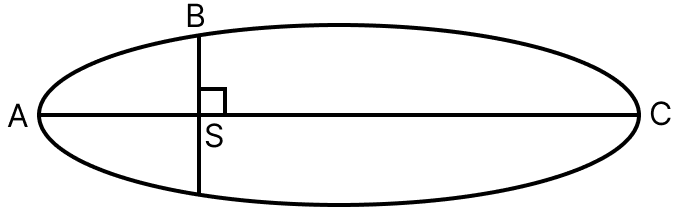
The kinetic energies of a planet in an elliptical orbit about the Sun, at positions A, B and C are K A, K B and K C respectively. AC is the major axis and SB is perpendicular to AC at the position of the Sun S as shown in the figure. Then:. Gravitation, Solutions for Class 11 ISC Nootan Physics Kumar Mittal Nageen Prakashan
  1. KA < KB < KC
  2. KB > KA > KC
  3. KB < KA < KC
  4. KA > KB > KC

Answer

KA > KB > KC

Reason

By Kepler's second law, the line joining a planet to the sun sweeps out equal areas in equal times. Hence the planet moves fastest when it is nearest the sun and slowest when it is farthest from it.

Since AC is the major axis and the sun S lies at one focus, the position A is the nearest point to the sun (perihelion) and C is the farthest point (aphelion). The point B, where SB is perpendicular to AC, lies at an intermediate distance.

Therefore the speeds are related as vA > vB > vC, and since the kinetic energy is K=12mv2\text K = \dfrac{1}{2}\text{mv}^2,

KA>KB>KC\text K_A \gt \text K_B \gt \text K_C

Question 2

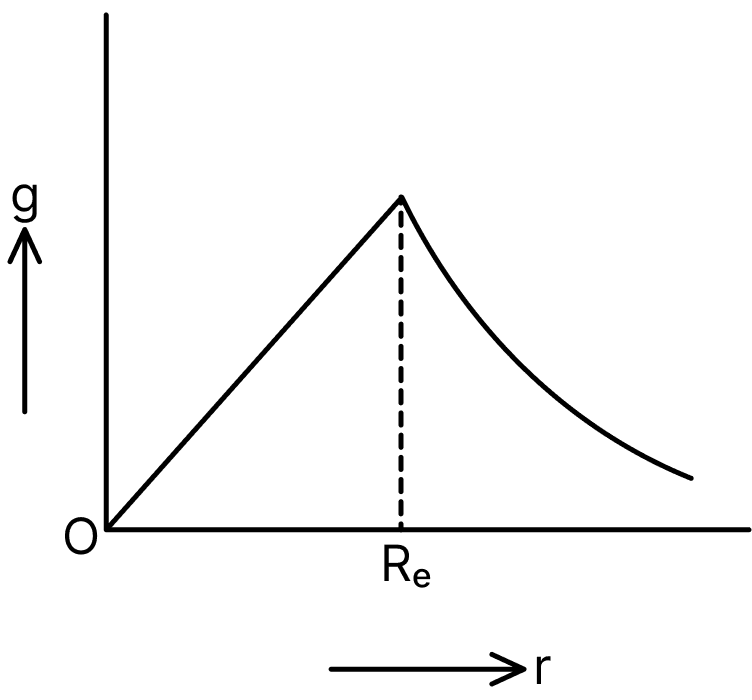
The variation of acceleration due to gravity g with distance r from centre of the earth is best represented by (R = Earth's radius) :
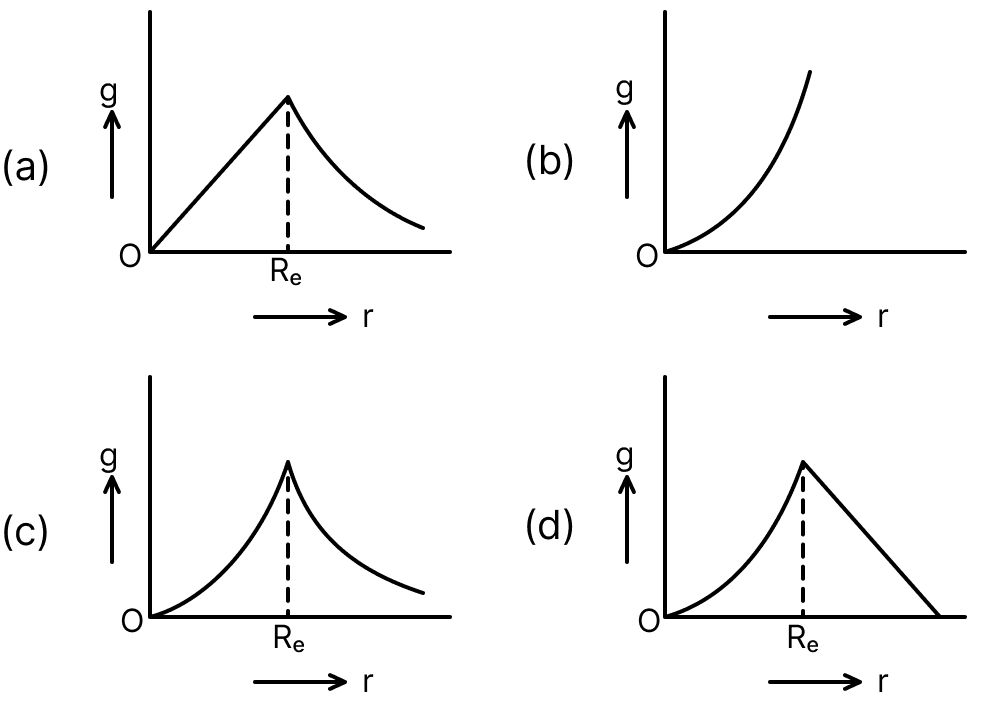
The variation of acceleration due to gravity g with distance r from centre of the earth is best represented by (R = Earths radius):. Gravitation, Solutions for Class 11 ISC Nootan Physics Kumar Mittal Nageen Prakashan

Answer

Graph (a)

Reason

The variation of acceleration due to gravity g with distance r from centre of the earth is best represented by (R = Earths radius):. Gravitation, Solutions for Class 11 ISC Nootan Physics Kumar Mittal Nageen Prakashan

Inside the earth (r < R) : By Newton's shell theorem only the inner sphere of radius r attracts the body, and

g=g(rRe)gr\text g' = \text g\left(\dfrac{\text r}{\text R_e}\right) \quad \Rightarrow \quad \text g' \propto \text r

Hence g' is zero at the centre and increases linearly with r, reaching its maximum value g at the surface.

Outside the earth (r > R) : The whole mass of the earth acts as if concentrated at the centre, so

g=g(Re2r2)g1r2\text g' = \text g\left(\dfrac{\text R_e^2}{\text r^2}\right) \quad \Rightarrow \quad \text g' \propto \dfrac{1}{\text r^2}

Hence beyond the surface g' decreases as a hyperbola and tends to zero as r → ∞.

Only graph (a) shows the linear rise up to r = Re followed by this hyperbolic fall.

Question 3

The acceleration due to gravity at a height 1 km above the earth is the same as at a depth d below the surface of earth. Then :

  1. d=12d = \dfrac{1}{2} km

  2. d = 1 km

  3. d=32d = \dfrac{3}{2} km

  4. d = 2 km

Answer

d = 2 km

Reason — Given,

  • Height above the earth's surface, h = 1 km
  • Acceleration due to gravity at the height h = that at the depth d

The value of g at a height h above the surface, for h << Re, is

g=g(12hRe)\text g' = \text g\left(1 - \dfrac{2\text h}{\text R_e}\right)

and at a depth d below the surface it is

g=g(1dRe)\text g' = \text g\left(1 - \dfrac{\text d}{\text R_e}\right)

Since the two are equal,

g(1dRe)=g(12hRe)\text g\left(1 - \dfrac{\text d}{\text R_e}\right) = \text g\left(1 - \dfrac{2\text h}{\text R_e}\right)

dRe=2hRed=2h\dfrac{\text d}{\text R_e} = \dfrac{2\text h}{\text R_e} \quad \Rightarrow \quad \text d = 2\text h

Substituting h = 1 km,

d=2×1=2 km\text d = 2 \times 1 = 2\ \text{km}

Question 4

A rocket is launched normal to the surface of the Earth, away from the Sun, along the line joining the Sun and the Earth. The Sun is 3 × 10⁵ times heavier than the Earth and is at a distance 2.5 × 10⁴ times larger than the radius of the Earth. The escape velocity from Earth's gravitational field is ve = 11.2 km s-1. The minimum initial velocity (vs) required for the rocket to be able to leave the Sun-Earth system is closest to (Ignore the rotation and revolution of the Earth and the presence of any other planet) :

  1. vs = 62 km s-1
  2. vs = 22 km s-1
  3. vs = 72 km s-1
  4. vs = 42 km s-1

Answer

vs = 42 km s-1

Reason — Given,

  • Escape velocity from the earth, ve = 11.2 km s-1
  • Mass of the sun, Ms = 3 × 10⁵ Me
  • Distance of the sun from the earth, r = 2.5 × 10⁴ Re

To leave the Sun-Earth system, the rocket must overcome the gravitational pull of both the earth and the sun. By the conservation of energy, its total energy at launch must be at least zero,

12mvs2GMemReGMsmr=0\dfrac{1}{2}\text{mv}_s^2 - \dfrac{\text{GM}_e \text m}{\text R_e} - \dfrac{\text{GM}_s \text m}{\text r} = 0

vs=2GMeRe+2GMsr\text v_s = \sqrt{\dfrac{2\text{GM}_e}{\text R_e} + \dfrac{2\text{GM}_s}{\text r}}

Taking 2GMeRe\dfrac{2\text{GM}_e}{\text R_e} common,

vs=2GMeRe(1+MsMe×Rer)\text v_s = \sqrt{\dfrac{2\text{GM}_e}{\text R_e}\left(1 + \dfrac{\text M_s}{\text M_e} \times \dfrac{\text R_e}{\text r}\right)}

Substituting the given ratios,

vs=ve1+3×1052.5×104=ve1+12=ve13\text v_s = \text v_e\sqrt{1 + \dfrac{3 \times 10^5}{2.5 \times 10^4}} = \text v_e\sqrt{1 + 12} = \text v_e\sqrt{13}

vs=11.2×3.606=40.4 km s142 km s1\text v_s = 11.2 \times 3.606 = 40.4\ \text{km s}^{-1} \approx 42\ \text{km s}^{-1}

Question 5

If the gravitational force between two particles distant r apart were proportional to 1/r (instead of 1/r2), then the orbital speed of a satellite around earth in a circle of radius r would be proportional to :

  1. 1/r2
  2. 1/r
  3. r
  4. r0

Answer

r0

Reason — If the gravitational force between two particles a distance r apart were proportional to 1r\dfrac{1}{\text r}, then the force on a satellite of mass m orbiting the earth would be

F=GMemr\text F = \dfrac{\text{GM}_e \text m}{\text r}

This force provides the necessary centripetal force for the circular orbit of radius r,

GMemr=mvo2r\dfrac{\text{GM}_e \text m}{\text r} = \dfrac{\text{mv}_o^2}{\text r}

The factor r cancels from both sides, giving

vo2=GMevo=GMe\text v_o^2 = \text{GM}_e \quad \Rightarrow \quad \text v_o = \sqrt{\text{GM}_e}

The orbital speed is therefore independent of r, that is, it is proportional to r0.

Question 6

Two astronauts are floating in gravitational free space after having lost contact with their spaceship. The two will:

  1. keep floating at the same distance between them.
  2. move towards each other
  3. move away from each other
  4. will become stationary.

Answer

move towards each other

Reason — The two astronauts are floating in gravitational free space, so they are in a state of weightlessness and no external gravitational force acts on them.

However, the astronauts themselves are two bodies possessing mass, and by Newton's universal law of gravitation every particle of matter attracts every other particle. Hence a mutual gravitational force of attraction acts between them,

F=Gm1m2r2\text F = \text G\dfrac{\text m_1 \text m_2}{\text r^2}

Since gravitational forces are always forces of attraction, this mutual pull draws the two astronauts towards each other. The force is extremely small because of the very small value of G, so the motion is exceedingly slow, but they do move towards each other.

Question 7

If the distance between the earth and the sun were half its present value, the number of days in a year would have been :

  1. 64.5
  2. 129
  3. 182.5
  4. 730

Answer

129

Reason — Given,

  • New distance between the earth and the sun =r2= \dfrac{\text r}{2}
  • Present period of revolution of the earth, T = 365 days

By Kepler's third law, the square of the period of revolution is directly proportional to the cube of the mean distance from the sun,

T2r3Tr3/2\text T^2 \propto \text r^3 \quad \Rightarrow \quad \text T \propto \text r^{3/2}

Therefore,

TT=(rr)3/2=(12)3/2\dfrac{\text T'}{\text T} = \left(\dfrac{\text r'}{\text r}\right)^{3/2} = \left(\dfrac{1}{2}\right)^{3/2}

Substituting the value,

T=365×122=365×0.3536\text T' = 365 \times \dfrac{1}{2\sqrt2} = 365 \times 0.3536

T=129 days\text T' = 129\ \text{days}

Question 8

The ratio of the weights of a body on the earth's surface, to that on the surface of a planet is 9 : 4. The mass of the planet is 19\dfrac{1}{9} th of that of the earth. If R is the radius of the earth then what is the radius of the planet? (Take the planets to have the same mass density)

  1. R3\dfrac{R}{3}

  2. R4\dfrac{R}{4}

  3. R9\dfrac{R}{9}

  4. R2\dfrac{R}{2}

Answer

R2\dfrac{R}{2}

Reason — Given,

  • Ratio of the weights, WeWp=94\dfrac{\text W_e}{\text W_p} = \dfrac{9}{4}
  • Mass of the planet, Mp=Me9\text M_p = \dfrac{\text M_e}{9}
  • Radius of the earth = R

Since the weight is W = mg for the same body, the ratio of the weights is the ratio of the accelerations due to gravity,

gegp=94\dfrac{\text g_e}{\text g_p} = \dfrac{9}{4}

The acceleration due to gravity at the surface is g=GMR2\text g = \dfrac{\text{GM}}{\text R^2}, so

gegp=GMe/R2GMp/Rp2=MeMp×Rp2R2\dfrac{\text g_e}{\text g_p} = \dfrac{\text{GM}_e / \text R^2}{\text{GM}_p / \text R_p^2} = \dfrac{\text M_e}{\text M_p} \times \dfrac{\text R_p^2}{\text R^2}

Substituting MeMp=9\dfrac{\text M_e}{\text M_p} = 9,

94=9×Rp2R2Rp2R2=14\dfrac{9}{4} = 9 \times \dfrac{\text R_p^2}{\text R^2} \quad \Rightarrow \quad \dfrac{\text R_p^2}{\text R^2} = \dfrac{1}{4}

RpR=12Rp=R2\dfrac{\text R_p}{\text R} = \dfrac{1}{2} \quad \Rightarrow \quad \text R_p = \dfrac{\text R}{2}

Question 9

The value of acceleration due to gravity at earth's surface is 9.8 m/s2. The altitude above its surface at which the acceleration due to gravity decreases to 4.9 m/s2, is close to : (Take radius of earth = 6.4 × 10⁶ m)

  1. 9.0 × 10⁶ m
  2. 2.6 × 10⁶ m
  3. 6.4 × 10⁶ m
  4. 1.6 × 10⁶ m

Answer

2.6 × 10⁶ m

Reason — Given,

  • Acceleration due to gravity at the earth's surface, g = 9.8 m s-2
  • Acceleration due to gravity at the altitude h, g' = 4.9 m s-2
  • Radius of the earth, Re = 6.4 × 10⁶ m

The acceleration due to gravity at a height h above the earth's surface is

g=g(1+hRe)2\text g' = \dfrac{\text g}{\left(1 + \dfrac{\text h}{\text R_e}\right)^2}

Substituting the values,

4.9=9.8(1+hRe)2(1+hRe)2=24.9 = \dfrac{9.8}{\left(1 + \dfrac{\text h}{\text R_e}\right)^2} \quad \Rightarrow \quad \left(1 + \dfrac{\text h}{\text R_e}\right)^2 = 2

Taking the square root,

1+hRe=2=1.414hRe=0.4141 + \dfrac{\text h}{\text R_e} = \sqrt2 = 1.414 \quad \Rightarrow \quad \dfrac{\text h}{\text R_e} = 0.414

h=0.414×(6.4×106)=2.6×10⁶ m\text h = 0.414 \times (6.4 \times 10^6) = 2.6 \times 10^6\ \text m

Question 10

A body weighs 200 N on the surface of the earth. How much will it weigh half way down to the centre of the earth?

  1. 200 N
  2. 250 N
  3. 100 N
  4. 150 N

Answer

100 N

Reason — Given,

  • Weight of the body on the earth's surface, W = 200 N
  • Depth below the surface, h=R2\text h = \dfrac{\text R}{2}

The acceleration due to gravity at a depth h below the earth's surface is

g=g(1hR)\text g' = \text g\left(1 - \dfrac{\text h}{\text R}\right)

Substituting h=R2\text h = \dfrac{\text R}{2},

g=g(1R2R)=g2\text g' = \text g\left(1 - \dfrac{\text R}{2\text R}\right) = \dfrac{\text g}{2}

The weight of the body at this depth is

W=mg=mg2=2002\text W' = \text{mg}' = \dfrac{\text{mg}}{2} = \dfrac{200}{2}

W=100 N\text W' = 100\ \text N

Question 11

A spaceship orbits around a planet at a height of 20 km from its surface. Assuming that only gravitational field of the planet acts on the spaceship. What will be the number of complete revolutions made by the spaceship in 24 h around the planet? [Take mass of planet = 8 × 10²² kg, radius of planet = 2 × 10⁶ m, G = 6.67 × 10⁻¹¹ N-m2/kg2]

  1. 11
  2. 17
  3. 13
  4. 9

Answer

11

Reason — Given,

  • Height of the spaceship, h = 20 km = 2 × 10⁴ m
  • Mass of the planet, M = 8 × 10²² kg
  • Radius of the planet, Rp = 2 × 10⁶ m
  • G = 6.67 × 10⁻¹¹ N m2 kg-2

The radius of the orbit is

r=Rp+h=(2×10⁶)+(2×10⁴)=2.02×10⁶ m\text r = \text R_p + \text h = (2 \times 10^6) + (2 \times 10^4) = 2.02 \times 10^6\ \text m

The orbital speed of the spaceship is

vo=GMRp+h=(6.67×1011)×(8×1022)2.02×106=5.336×10122.02×106=2.642×10⁶\text v_o = \sqrt{\dfrac{\text{GM}}{\text R_p + \text h}} = \sqrt{\dfrac{(6.67 \times 10^{-11}) \times (8 \times 10^{22})}{2.02 \times 10^6}} \\[1em] = \sqrt{\dfrac{5.336 \times 10^{12}}{2.02 \times 10^6}} = \sqrt{2.642 \times 10^6}

vo=1.62×10³ m s1\text v_o = 1.62 \times 10^3\ \text{m s}^{-1}

The time period of the spaceship is

T=2π(Rp+h)vo=2×3.14×(2.02×106)1.62×103=7.83×10³ s=7.83×1033600=2.172 h\text T = \dfrac{2\pi(\text R_p + \text h)}{\text v_o} = \dfrac{2 \times 3.14 \times (2.02 \times 10^6)}{1.62 \times 10^3} \\[1em] = 7.83 \times 10^3\ \text s = \dfrac{7.83 \times 10^3}{3600} = 2.172\ \text h

Therefore the number of complete revolutions made in 24 h is

n=24T=242.17211\text n = \dfrac{24}{\text T} = \dfrac{24}{2.172} \approx 11

Question 12

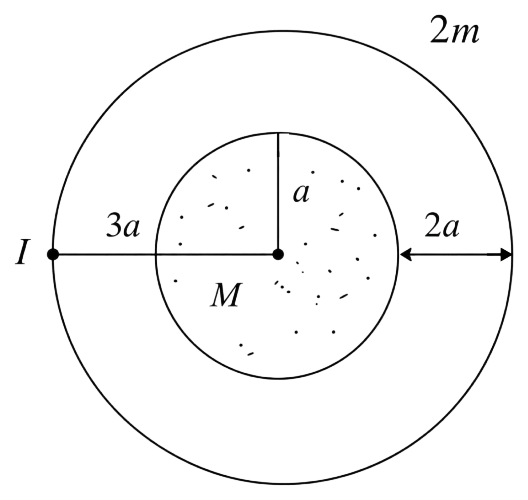
A solid sphere of mass M and radius a is surrounded by a uniform concentric spherical shell of thickness 2a and 2M. The gravitational field at distance 3a from the centre will be :

  1. GM9a2\dfrac{GM}{9a^2}

  2. 2GM9a2\dfrac{2GM}{9a^2}

  3. GM3a2\dfrac{GM}{3a^2}

  4. 2GM3a2\dfrac{2GM}{3a^2}

Answer

GM3a2\dfrac{GM}{3a^2}

Reason — Given,

  • Solid sphere of mass M and radius a
  • Concentric spherical shell of mass 2M and thickness 2a
  • Distance from the centre, r = 3a
A solid sphere of mass M and radius a is surrounded by a uniform concentric spherical shell of thickness 2a and 2M. The gravitational field at distance 3a from the centre will be:. Gravitation, Solutions for Class 11 ISC Nootan Physics Kumar Mittal Nageen Prakashan

Since the point lies outside both the solid sphere and the spherical shell, each of them behaves like a point mass concentrated at the centre.

Field due to the solid sphere :

I1=GMr2=GM(3a)2=GM9a2...(i)\text I_1 = \dfrac{\text{GM}}{\text r^2} = \dfrac{\text{GM}}{(3\text a)^2} = \dfrac{\text{GM}}{9\text a^2} \qquad \text{...(i)}

Field due to the spherical shell :

I2=G(2M)(3a)2=2GM9a2...(ii)\text I_2 = \dfrac{\text G(2\text M)}{(3\text a)^2} = \dfrac{2\text{GM}}{9\text a^2} \qquad \text{...(ii)}

Both fields are directed towards the centre, so they are added directly,

I=I1+I2=GM9a2+2GM9a2=3GM9a2\text I = \text I_1 + \text I_2 = \dfrac{\text{GM}}{9\text a^2} + \dfrac{2\text{GM}}{9\text a^2} = \dfrac{3\text{GM}}{9\text a^2}

I=GM3a2\text I = \dfrac{\text{GM}}{3\text a^2}

Question 13

A test particle is moving in a circular orbit in the gravitational field produced by mass density ρ(π)=kπ2\rho(\pi) = \dfrac{k}{\pi^2}. Identify the correct relation between the radius R of the particle's orbit and its period T :

  1. T2R3\dfrac{T^2}{R^3} is a constant

  2. TR2\dfrac{T}{R^2} is a constant

  3. TR is a constant

  4. TR\dfrac{T}{R} is a constant

Answer

TR\dfrac{T}{R} is a constant

Reason — Given,

  • Mass density of the distribution, ρ(r)=kr2\rho(\text r) = \dfrac{\text k}{\text r^2}
  • Radius of the circular orbit = R,
  • period = T

The mass enclosed within the radius R is obtained by integrating over spherical shells of thickness dr,

M=0Rρ×4πr2dr=0Rkr2×4πr2dr\text M = \int_0^{\text R} \rho \times 4\pi \text r^2\text{dr} = \int_0^{\text R} \dfrac{\text k}{\text r^2} \times 4\pi \text r^2\text{dr}

M=4πk0Rdr=4πk[r]0R=4πkR\text M = 4\pi \text k\int_0^{\text R} \text{dr} = 4\pi \text k\left[\text r\right]_0^{\text R} = 4\pi \text{kR}

The gravitational pull of this enclosed mass provides the centripetal force for the test particle,

GMmR2=mv2Rv2=GMR\dfrac{\text{GMm}}{\text R^2} = \dfrac{\text{mv}^2}{\text R} \quad \Rightarrow \quad \text v^2 = \dfrac{\text{GM}}{\text R}

Substituting M = 4πkR,

v2=G×4πkRR=4πkGv=4πkG\text v^2 = \dfrac{\text G \times 4\pi \text{kR}}{\text R} = 4\pi \text{kG} \quad \Rightarrow \quad \text v = \sqrt{4\pi \text{kG}}

The speed is therefore a constant, independent of R. The time-period of the particle is

T=2πRv=2πR4πkG\text T = \dfrac{2\pi \text R}{\text v} = \dfrac{2\pi \text R}{\sqrt{4\pi \text{kG}}}

TR=2π4πkG=πGk=constant\dfrac{\text T}{\text R} = \dfrac{2\pi}{\sqrt{4\pi \text{kG}}} = \sqrt{\dfrac{\pi}{\text{Gk}}} = \text{constant}

Note: The question as printed gives the mass density as ρ(π)=kπ2\rho(\pi) = \dfrac{\text k}{\pi^2}. Both occurrences of π are misprints for r, since a density depending on π alone would be a constant and the question would then be unanswerable. The correct form, ρ(r)=kr2\rho(\text r) = \dfrac{\text k}{\text r^2}, has been used above and is consistent with the textbook's own hint solution.

Question 14

Two satellites A and B have masses m and 2m respectively. A is in a circular orbit of radius R, and B is in a circular orbit of radius 2R around the earth. The ratio of their kinetic energies is :

  1. 12\dfrac{1}{2}

  2. 2

  3. 12\sqrt{\dfrac{1}{2}}

  4. 1

Answer

1

Reason — Given,

  • Satellite A : mass m, orbital radius R
  • Satellite B : mass 2m, orbital radius 2R

The orbital speed of a satellite in a circular orbit of radius r around the earth is

vo=GMr\text v_o = \sqrt{\dfrac{\text{GM}}{\text r}}

Kinetic energy of satellite A :

KA=12m(GMR)=GMm2R...(i)\text K_A = \dfrac{1}{2}\text m\left(\dfrac{\text{GM}}{\text R}\right) = \dfrac{\text{GMm}}{2\text R} \qquad \text{...(i)}

Kinetic energy of satellite B :

KB=12(2m)(GM2R)=GMm2R...(ii)\text K_B = \dfrac{1}{2}(2\text m)\left(\dfrac{\text{GM}}{2\text R}\right) = \dfrac{\text{GMm}}{2\text R} \qquad \text{...(ii)}

Dividing equation (i) by equation (ii),

KAKB=GMm/2RGMm/2R=1\dfrac{\text K_A}{\text K_B} = \dfrac{\text{GMm}/2\text R}{\text{GMm}/2\text R} = 1

The doubling of the mass is exactly compensated by the doubling of the orbital radius, so the ratio of the kinetic energies is 1.

Question 15

A satellite is moving with a constant speed v in a circular orbit about the earth. An object of mass m is ejected from the satellite such that it just escapes from the gravitational pull of the earth. At the time of its ejection, the kinetic energy of the object is :

  1. 12mv2\dfrac{1}{2}mv^2

  2. mv2

  3. 32mv2\dfrac{3}{2}mv^2

  4. 2mv2

Answer

mv2

Reason — Given,

  • Constant speed of the satellite in its circular orbit = v
  • Mass of the ejected object = m

For a satellite moving in a circular orbit of radius r, the gravitational force provides the centripetal force,

GMemr2=mv2rGMemr=mv2\dfrac{\text{GM}_e \text m}{\text r^2} = \dfrac{\text{mv}^2}{\text r} \quad \Rightarrow \quad \dfrac{\text{GM}_e \text m}{\text r} = \text{mv}^2

The gravitational potential energy of the object at the instant of ejection is

U=GMemr=mv2\text U = -\dfrac{\text{GM}_e \text m}{\text r} = -\text{mv}^2

For the object just to escape from the gravitational pull of the earth, its total mechanical energy must be zero,

K+U=0K=U\text K + \text U = 0 \quad \Rightarrow \quad \text K = -\text U

K=mv2\text K = \text{mv}^2

Question 16

If the angular momentum of a planet of mass m, moving around sun in a circular orbit is L about the centre of the sun, its areal velocity is :

  1. 4Lm\dfrac{4L}{m}

  2. 2Lm\dfrac{2L}{m}

  3. L2m\dfrac{L}{2m}

  4. Lm\dfrac{L}{m}

Answer

L2m\dfrac{L}{2m}

Reason — Given,

  • Mass of the planet = m
  • Angular momentum of the planet about the sun = L

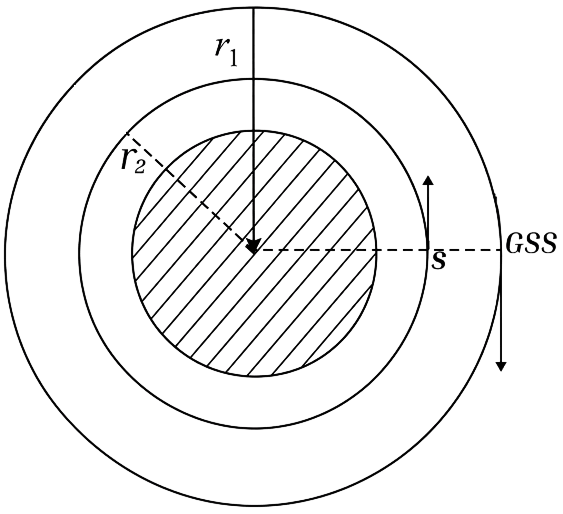
Areal velocity is the area swept out by the radius vector joining the planet to the sun, per unit time. If the radius vector r sweeps out a small angle dθ in a time dt, the area swept is
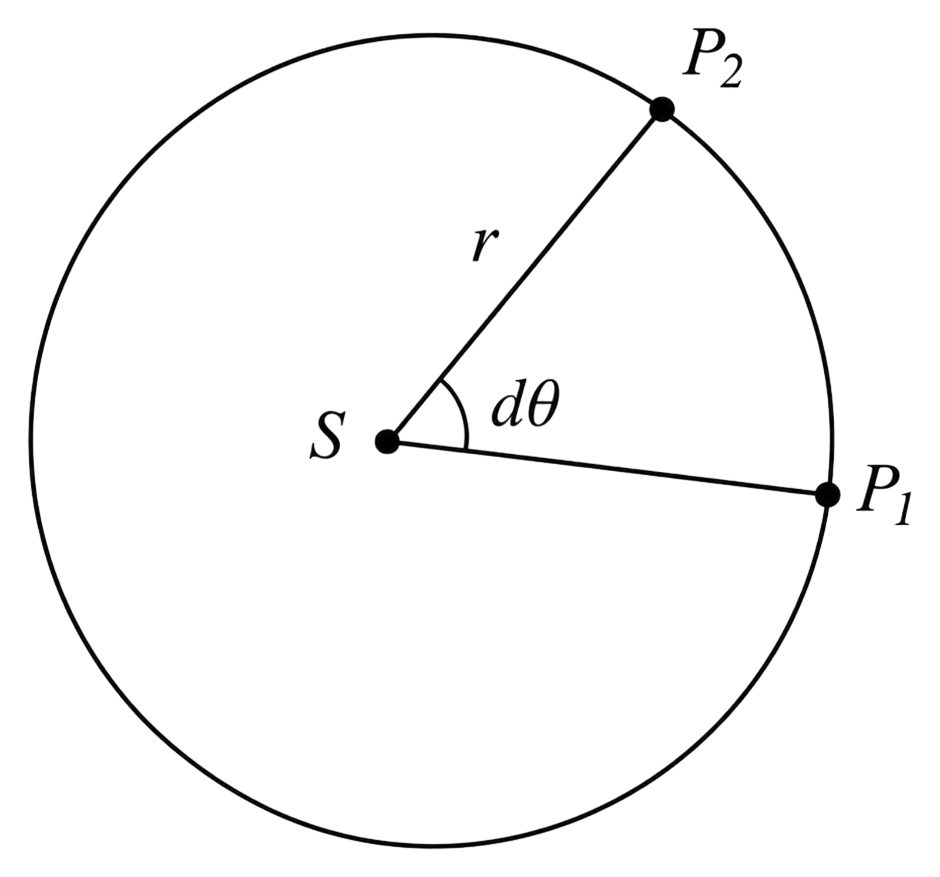
If the angular momentum of a planet of mass m, moving around sun in a circular orbit is L about the centre of the sun, its areal velocity is:. Gravitation, Solutions for Class 11 ISC Nootan Physics Kumar Mittal Nageen Prakashan

dA=dθ2π×πr2=12r2dθ\text{dA} = \dfrac{\text d\theta}{2\pi} \times \pi \text r^2 = \dfrac{1}{2}\text r^2\text d\theta

Therefore the areal velocity is

dAdt=12r2dθdt=12r2ω\dfrac{\text{dA}}{\text{dt}} = \dfrac{1}{2}\text r^2\dfrac{\text d\theta}{\text{dt}} = \dfrac{1}{2}\text r^2 \omega

For a planet moving in a circular orbit, its angular momentum about the centre of the sun is

L=mvr=m(ωr)r=mωr2ω=Lmr2\text L = \text{mvr} = \text m(\omega \text r)\text r = \text{m}\omega \text r^2 \quad \Rightarrow \quad \omega = \dfrac{\text L}{\text{mr}^2}

Substituting this value of ω,

dAdt=12r2×Lmr2=L2m\dfrac{\text{dA}}{\text{dt}} = \dfrac{1}{2}\text r^2 \times \dfrac{\text L}{\text{mr}^2} = \dfrac{\text L}{2\text m}

Since L is constant for a central force, the areal velocity is constant, which is Kepler's second law.

Question 17

A body is projected vertically upwards from the surface of earth with a velocity equal to one third of escape velocity. The maximum height attained by the body will be : (Take radius of earth = 6400 km and g = 10 ms-2)

  1. 800 km
  2. 1600 km
  3. 2133 km
  4. 4800 km

Answer

800 km

Reason — Given,

  • Velocity of projection, v=13ve=132GMeRe\text v = \dfrac{1}{3}\text v_e = \dfrac{1}{3}\sqrt{\dfrac{2\text{GM}_e}{\text R_e}}
  • Radius of the earth, Re = 6400 km
  • g = 10 m s-2

Applying the conservation of energy between the earth's surface and the maximum height h, where the body is momentarily at rest,

GMemRe+12m(132GMeRe)2=GMemRe+h-\dfrac{\text{GM}_e \text m}{\text R_e} + \dfrac{1}{2}\text m\left(\dfrac{1}{3}\sqrt{\dfrac{2\text{GM}_e}{\text R_e}}\right)^2 = -\dfrac{\text{GM}_e \text m}{\text R_e + \text h}

Simplifying the kinetic energy term,

GMemRe+12m×19×2GMeRe=GMemRe+h-\dfrac{\text{GM}_e \text m}{\text R_e} + \dfrac{1}{2}\text m \times \dfrac{1}{9} \times \dfrac{2\text{GM}_e}{\text R_e} = -\dfrac{\text{GM}_e \text m}{\text R_e + \text h}

GMemRe+GMem9Re=GMemRe+h-\dfrac{\text{GM}_e \text m}{\text R_e} + \dfrac{\text{GM}_e \text m}{9\text R_e} = -\dfrac{\text{GM}_e \text m}{\text R_e + \text h}

Cancelling GMem and combining the terms on the left,

89Re=1Re+h89Re=1Re+h-\dfrac{8}{9\text R_e} = -\dfrac{1}{\text R_e + \text h} \quad \Rightarrow \quad \dfrac{8}{9\text R_e} = \dfrac{1}{\text R_e + \text h}

8(Re+h)=9Re8h=Re8(\text R_e + \text h) = 9\text R_e \quad \Rightarrow \quad 8\text h = \text R_e

h=Re8=64008=800 km\text h = \dfrac{\text R_e}{8} = \dfrac{6400}{8} = 800\ \text{km}

Question 18

The percentage decrease in the weight of a rocket, when taken to a height of 32 km above the surface of earth will, be : (Radius of earth = 6400 km)

  1. 1%
  2. 3%
  3. 4%
  4. 0.5%

Answer

1%

Reason — Given,

  • Height above the earth's surface, h = 32 km
  • Radius of the earth, Re = 6400 km

The weight of a rocket is W = mg, and the acceleration due to gravity varies as

g=GMer2g1r2\text g = \dfrac{\text{GM}_e}{\text r^2} \quad \Rightarrow \quad \text g \propto \dfrac{1}{\text r^2}

Taking the fractional change on both sides, since h is small compared with Re,

Δgg=2Δrr=2hRe\dfrac{\Delta \text g}{\text g} = -2\dfrac{\Delta \text r}{\text r} = -2\dfrac{\text h}{\text R_e}

The magnitude of the percentage decrease in the weight is therefore

Δgg×100=2×hRe×100=2×326400×100\dfrac{\Delta \text g}{\text g} \times 100 = 2 \times \dfrac{\text h}{\text R_e} \times 100 = 2 \times \dfrac{32}{6400} \times 100

=2×0.005×100=1= 2 \times 0.005 \times 100 = 1%

Question 19

A body of mass 60 g experiences a gravitational force of 3.0 N, when placed at a particular point. The magnitude of the gravitational field intensity at that point is :

  1. 20 N/kg
  2. 180 N/kg
  3. 0.05 N/kg
  4. 50 N/kg

Answer

50 N/kg

Reason — Given,

  • Mass of the body, m = 60 g = 60 × 10-3 kg = 0.06 kg
  • Gravitational force experienced, F = 3.0 N

The gravitational field intensity at a point is the force experienced by a unit mass placed at that point,

Eg=Fm\text E_g = \dfrac{\text F}{\text m}

Substituting the values,

Eg=3.00.06\text E_g = \dfrac{3.0}{0.06}

Eg=50 N kg1\text E_g = 50\ \text{N kg}^{-1}

Question 20

A metal wire of uniform mass density having length L and mass M is bent to form a semicircular arc and a particle of mass m is placed at the centre of the arc. The gravitational force on the particle by the wire is:

  1. GMmπ2L2\dfrac{GMm\pi}{2L^2}

  2. 0

  3. GMmπ2L2\dfrac{GMm\pi^2}{L^2}

  4. 2GMmπL2\dfrac{2GMm\pi}{L^2}

Answer

2GMmπL2\dfrac{2GMm\pi}{L^2}

Reason — Given,

  • Length of the wire = L, mass of the wire = M
  • Mass of the particle at the centre of the arc = m
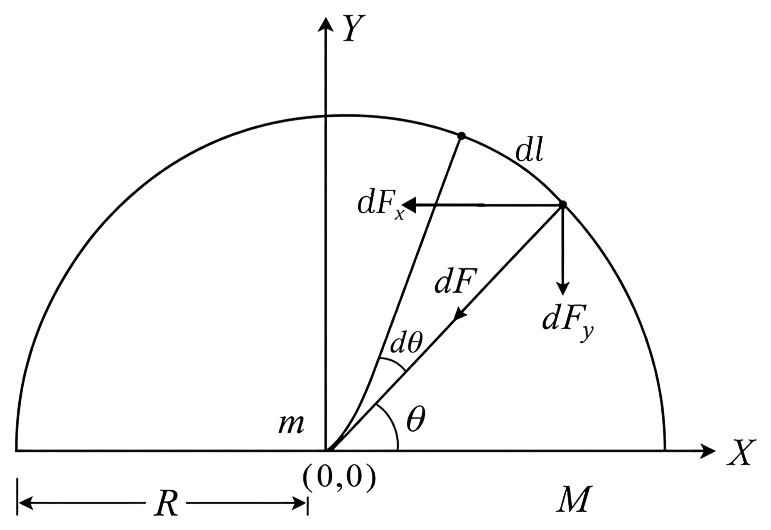
A metal wire of uniform mass density having length L and mass M is bent to form a semicircular arc and a particle of mass m is placed at the centre of the arc. The gravitational force on the particle by the wire is:. Gravitation, Solutions for Class 11 ISC Nootan Physics Kumar Mittal Nageen Prakashan

Since the wire is bent into a semicircle, its length equals the circumference of the semicircle,

L=πRR=Lπ...(i)\text L = \pi \text R \quad \Rightarrow \quad \text R = \dfrac{\text L}{\pi} \qquad \text{...(i)}

The linear mass density of the wire is

λ=ML...(ii)\lambda = \dfrac{\text M}{\text L} \qquad \text{...(ii)}

Consider a small element of the wire of length dl at an angle dθ from the centre. Its mass is dm = λ dl = λ R dθ, and the gravitational force it exerts on the particle at the centre is

dF=GdmmR2=GmλdθR...(iii)\text{dF} = \dfrac{\text G\text{dm}\text m}{\text R^2} = \dfrac{\text{Gm}\lambda\text d\theta}{\text R} \qquad \text{...(iii)}

By symmetry, for every element on one side of the semicircle there is a corresponding element on the other side, so the horizontal components cancel out. Only the vertical components add up,

dFy=GmλcosθdθR\text{dF}_y = \dfrac{\text{Gm}\lambda\cos\theta\text d\theta}{\text R}

Integrating this vertical component from θ=π2\theta = -\dfrac{\pi}{2} to θ=π2\theta = \dfrac{\pi}{2},

F=GmλRπ/2π/2cosθdθ=GmλR[sinθ]π/2π/2\text F = \dfrac{\text{Gm}\lambda}{\text R}\int_{-\pi/2}^{\pi/2}\cos\theta\text d\theta = \dfrac{\text{Gm}\lambda}{\text R}\left[\sin\theta\right]_{-\pi/2}^{\pi/2}

F=GmλR[sinπ2sin(π2)]=2GmλR\text F = \dfrac{\text{Gm}\lambda}{\text R}\left[\sin\dfrac{\pi}{2} - \sin\left(-\dfrac{\pi}{2}\right)\right] = \dfrac{2\text{Gm}\lambda}{\text R}

Substituting the values of λ and R from equations (i) and (ii),

F=2G(ML)mLπ=2GMmπL2\text F = \dfrac{2\text{G}\left(\dfrac{\text M}{\text L}\right)\text m}{\dfrac{\text L}{\pi}} = \dfrac{2\text{GMm}\pi}{\text L^2}

Question 21

The mass of a planet is 1/10th of that of Earth and its diameter is half that of Earth. The acceleration due to gravity on that planet will be:

  1. 19.6 ms-2
  2. 9.8 ms-2
  3. 4.9 ms-2
  4. 3.92 ms-2

Answer

3.92 ms-2

Reason — Given,

  • Mass of the planet, Mp=Me10\text M_p = \dfrac{\text M_e}{10}
  • Diameter of the planet =12= \dfrac{1}{2} that of the earth, so Rp=Re2\text R_p = \dfrac{\text R_e}{2}
  • Acceleration due to gravity on the earth, g = 9.8 m s-2

The acceleration due to gravity at the surface of a planet is

g=GMpRp2\text g' = \dfrac{\text{GM}_p}{\text R_p^2}

Substituting the given values,

g=G(Me10)(Re2)2=GMe10×4Re2=410×GMeRe2\text g' = \dfrac{\text G\left(\dfrac{\text M_e}{10}\right)}{\left(\dfrac{\text R_e}{2}\right)^2} = \dfrac{\text{GM}_e}{10} \times \dfrac{4}{\text R_e^2} = \dfrac{4}{10} \times \dfrac{\text{GM}_e}{\text R_e^2}

g=410×g=0.4×9.8\text g' = \dfrac{4}{10} \times \text g = 0.4 \times 9.8

g=3.92 m s2\text g' = 3.92\ \text{m s}^{-2}

Question 22

A particle of mass m is under the influence of the gravitational field of a body of mass M(>> m). The particle is moving in a circular orbit of radius r0 with time period T0 around the mass M. Then, the particle is subjected to an additional central force, corresponding to the potential energy Vc(r) = mα/r3, where α is a positive constant of suitable dimensions and r is the distance from the centre of the orbit. If the particle moves in the same circular orbit of radius r0 in the combined gravitational potential due to M and Vc(r), but with a new time period T1, then (T12 − T02)/T12, is given by [G is the gravitational constant.]

  1. 3αGMr02\dfrac{3\alpha}{GMr_0^2}

  2. α2GMr02\dfrac{\alpha}{2GMr_0^2}

  3. αGMr02\dfrac{\alpha}{GMr_0^2}

  4. 2αGMr02\dfrac{2\alpha}{GMr_0^2}

Answer

3αGMr02\dfrac{3\alpha}{GMr_0^2}

Reason — Given,

  • Radius of the circular orbit = r0, initial time period = T0
  • Additional central potential energy, Vc(r)=mαr3\text V_c(\text r) = \dfrac{\text m\alpha}{\text r^3}
  • New time period in the combined field = T1

Initial time period : Under gravity alone,

mv02r0=GMmr02v02=GMr0\dfrac{\text{mv}_0^2}{\text r_0} = \dfrac{\text{GMm}}{\text r_0^2} \quad \Rightarrow \quad \text v_0^2 = \dfrac{\text{GM}}{\text r_0}

T0=2πr0v0T02=4π2r03GM...(i)\text T_0 = \dfrac{2\pi \text r_0}{\text v_0} \quad \Rightarrow \quad \text T_0^2 = \dfrac{4\pi^2 \text r_0^3}{\text{GM}} \qquad \text{...(i)}

Additional force : The force corresponding to Vc(r) is obtained by differentiating the potential energy with respect to r,

Fc=ddr(mαr3)=mα×(3)r4=3mαr4\text F_c = \dfrac{\text d}{\text{dr}}\left(\dfrac{\text m\alpha}{\text r^3}\right) = \text m\alpha \times (-3)\text r^{-4} = -\dfrac{3\text m\alpha}{\text r^4}

so the additional central force has magnitude 3mαr4\dfrac{3\text m\alpha}{\text r^4}, directed towards the centre.

New time period : The total central force now provides the centripetal force at r = r0,

mv12r0=GMmr02+3mαr04v12=GMr0+3αr03\dfrac{\text{mv}_1^2}{\text r_0} = \dfrac{\text{GMm}}{\text r_0^2} + \dfrac{3\text m\alpha}{\text r_0^4} \quad \Rightarrow \quad \text v_1^2 = \dfrac{\text{GM}}{\text r_0} + \dfrac{3\alpha}{\text r_0^3}

T12=4π2r02v12=4π2r02GMr0+3αr03=4π2r03GM+3αr02...(ii)\text T_1^2 = \dfrac{4\pi^2 \text r_0^2}{\text v_1^2} = \dfrac{4\pi^2 \text r_0^2}{\dfrac{\text{GM}}{\text r_0} + \dfrac{3\alpha}{\text r_0^3}} = \dfrac{4\pi^2 \text r_0^3}{\text{GM} + \dfrac{3\alpha}{\text r_0^2}} \qquad \text{...(ii)}

Dividing equation (i) by equation (ii),

T02T12=GM+3αr02GM=1+3αGMr02\dfrac{\text T_0^2}{\text T_1^2} = \dfrac{\text{GM} + \dfrac{3\alpha}{\text r_0^2}}{\text{GM}} = 1 + \dfrac{3\alpha}{\text{GMr}_0^2}

Therefore,

T12T02T12=1T02T12=3αGMr02\dfrac{\text T_1^2 - \text T_0^2}{\text T_1^2} = 1 - \dfrac{\text T_0^2}{\text T_1^2} = -\dfrac{3\alpha}{\text{GMr}_0^2}

Taking the magnitude of the difference, as the options require,

T12T02T12=3αGMr02\dfrac{\text T_1^2 - \text T_0^2}{\text T_1^2} = \dfrac{3\alpha}{\text{GMr}_0^2}

The negative sign obtained above only indicates that the additional inward force increases the orbital speed, so that T1 is in fact smaller than T0.

Question 23

The radius of Martian orbit around the Sun is about 4 times the radius of the orbit of Mercury. The Martian year is 687 Earth days. Then which of the following is the length of I year on Mercury?

  1. 88 earth days
  2. 225 earth days
  3. 172 earth days
  4. 124 earth days

Answer

88 earth days

Reason — Given,

  • Radius of the Martian orbit, rMartian = 4 rMercury
  • Martian year, TMartian = 687 earth days

By Kepler's third law of planetary motion, T2 ∝ r3, so

TMercuryTMartian=(rMercuryrMartian)3/2\dfrac{\text T_{Mercury}}{\text T_{Martian}} = \left(\dfrac{\text r_{Mercury}}{\text r_{Martian}}\right)^{3/2}

Substituting rMercuryrMartian=14\dfrac{\text r_{Mercury}}{\text r_{Martian}} = \dfrac{1}{4},

TMercuryTMartian=(14)3/2=18\dfrac{\text T_{Mercury}}{\text T_{Martian}} = \left(\dfrac{1}{4}\right)^{3/2} = \dfrac{1}{8}

TMercury=6878=85.875 days\text T_{Mercury} = \dfrac{687}{8} = 85.875\ \text{days}

This is nearest to 88 earth days.

Question 24

A body weighs 48 N on the surface of the earth. The gravitational force experienced by the body due to the earth at a height equal to one-third the radius of the earth from its surface is:

  1. 16 N
  2. 27 N
  3. 32 N
  4. 36 N

Answer

27 N

Reason — Given,

  • Weight of the body on the earth's surface, W = 48 N
  • Height above the surface, h=R3\text h = \dfrac{\text R}{3}

The acceleration due to gravity at a height h above the earth's surface is

g=g(RR+h)2\text g' = \text g\left(\dfrac{\text R}{\text R + \text h}\right)^2

Hence the gravitational force experienced at that height is

W=mg=mg(RR+h)2=W(RR+h)2\text W' = \text{mg}' = \text{mg}\left(\dfrac{\text R}{\text R + \text h}\right)^2 = \text W\left(\dfrac{\text R}{\text R + \text h}\right)^2

Substituting h=R3\text h = \dfrac{\text R}{3},

W=48(RR+R3)2=48(R4R3)2=48(34)2\text W' = 48\left(\dfrac{\text R}{\text R + \dfrac{\text R}{3}}\right)^2 = 48\left(\dfrac{\text R}{\dfrac{4\text R}{3}}\right)^2 = 48\left(\dfrac{3}{4}\right)^2

W=48×916=27 N\text W' = 48 \times \dfrac{9}{16} = 27\ \text N

Question 25

Consider a star of mass m2 kg revolving in a circular orbit around another star of mass m1 kg with m1 >> m2. The heavier star slowly acquires mass from the lighter star at a constant rate of γ\gamma kg/s. In this transfer process, there is no other loss of mass. If the separation between the centers of the stars is r, then its relative rate of change 1rdrdt\dfrac{1}{r}\dfrac{dr}{dt} (in s-1) is given by:

  1. 3γ2m2-\dfrac{3\gamma}{2m_2}

  2. 2γm2-\dfrac{2\gamma}{m_2}

  3. 2γm1-\dfrac{2\gamma}{m_1}

  4. 3γ2m1-\dfrac{3\gamma}{2m_1}

Answer

2γm2-\dfrac{2\gamma}{m_2}

Reason — Given,

  • Mass of the revolving star = m2, mass of the central star = m1, with m1 >> m2
  • Rate of mass transfer from the lighter to the heavier star = γ\gamma kg/s
  • Separation between the centres of the stars = r

The gravitational pull between the stars provides the necessary centripetal force for the circular orbit,

m2ω2r=Gm1m2r2ω=Gm1r3\text m_2 \omega^2 \text r = \dfrac{\text{Gm}_1 \text m_2}{\text r^2} \quad \Rightarrow \quad \omega = \sqrt{\dfrac{\text{Gm}_1}{\text r^3}}

The angular momentum of the revolving star about the centre is

L=m2ωr2=m2r2Gm1r3=m2Gm1r\text L = \text m_2 \omega \text r^2 = \text m_2 \text r^2\sqrt{\dfrac{\text{Gm}_1}{\text r^3}} = \text m_2\sqrt{\text{Gm}_1 \text r}

Since no external torque acts on the system, L remains constant. Taking the natural logarithm of both sides,

lnL=lnm2+12lnG+12lnm1+12lnr\ln \text L = \ln \text m_2 + \dfrac{1}{2}\ln \text G + \dfrac{1}{2}\ln \text m_1 + \dfrac{1}{2}\ln \text r

Differentiating with respect to time, and noting that L and G are constants so their derivatives vanish,

0=1m2dm2dt+12m1dm1dt+12rdrdt0 = \dfrac{1}{\text m_2}\dfrac{\text{dm}_2}{\text{dt}} + \dfrac{1}{2\text m_1}\dfrac{\text{dm}_1}{\text{dt}} + \dfrac{1}{2\text r}\dfrac{\text{dr}}{\text{dt}}

Rearranging for the relative rate of change of r,

1rdrdt=2m2dm2dt1m1dm1dt\dfrac{1}{\text r}\dfrac{\text{dr}}{\text{dt}} = -\dfrac{2}{\text m_2}\dfrac{\text{dm}_2}{\text{dt}} - \dfrac{1}{\text m_1}\dfrac{\text{dm}_1}{\text{dt}}

The lighter star loses mass at the rate γ\gamma, so dm2dt=γ\dfrac{\text{dm}_2}{\text{dt}} = \gamma, while the heavier star gains it. Since m1 >> m2, the second term is negligible compared with the first,

1rdrdt2γm2\dfrac{1}{\text r}\dfrac{\text{dr}}{\text{dt}} \approx -\dfrac{2\gamma}{\text m_2}

Competition Zone — Numericals

Question 1

Two spherical stars A and B have densities ρA and ρB, respectively. A and B have the same radius, and their masses MA and MB are related by MB = 2MA. Due to an interaction process, star A loses some of its mass, so that its radius is halved, while its spherical shape is retained, and its density remains ρA. The entire mass lost by A is deposited as a thick spherical shell on B with the density of the shell being ρA. If vA and vB are the escape velocities from A and B after the interaction process, the ratio vBvA=10n151/3\dfrac{v_B}{v_A} = \sqrt{\dfrac{10n}{15^{1/3}}}. The value of n is ............... .

Answer

Given,

  • Densities of the stars A and B = ρA and ρB
  • A and B have the same radius R, and MB = 2MA
  • After the interaction the radius of A is halved, its density remaining ρA
  • The mass lost by A forms a thick shell on B, of density ρA
  • vBvA=10n151/3\dfrac{\text v_B}{\text v_A} = \sqrt{\dfrac{10\text n}{15^{1/3}}}

Star A after the interaction : Its radius becomes R2\dfrac{\text R}{2} and its density remains ρA, so its new mass is

MA=43π(R2)3ρA=MA8\text M_A' = \dfrac{4}{3}\pi\left(\dfrac{\text R}{2}\right)^3 \rho_A = \dfrac{\text M_A}{8}

The escape velocity from A is therefore

vA=2GMAR/2=2G(MA/8)R/2=2GMA4R=v02\text v_A = \sqrt{\dfrac{2\text{GM}_A'}{\text R/2}} = \sqrt{\dfrac{2\text G(\text M_A/8)}{\text R/2}} = \sqrt{\dfrac{2\text{GM}_A}{4\text R}} = \dfrac{\text v_0}{2}

where v0=2GMAR\text v_0 = \sqrt{\dfrac{2\text{GM}_A}{\text R}}.

Star B after the interaction : The mass lost by A is

ΔM=MAMA8=78MA\Delta \text M = \text M_A - \dfrac{\text M_A}{8} = \dfrac{7}{8}\text M_A

so the new mass of B is

MB=2MA+78MA=238MA\text M_B' = 2\text M_A + \dfrac{7}{8}\text M_A = \dfrac{23}{8}\text M_A

This lost mass is deposited as a shell of density ρA on B. If r is the new outer radius of B, then the volume of the shell gives

43π(r3R3)ρA=78MA=78×43πR3ρA\dfrac{4}{3}\pi(\text r^3 - \text R^3)\rho_A = \dfrac{7}{8}\text M_A = \dfrac{7}{8} \times \dfrac{4}{3}\pi \text R^3 \rho_A

r3R3=78R3r3=158R3r=(158)1/3R\text r^3 - \text R^3 = \dfrac{7}{8}\text R^3 \quad \Rightarrow \quad \text r^3 = \dfrac{15}{8}\text R^3 \quad \Rightarrow \quad \text r = \left(\dfrac{15}{8}\right)^{1/3}\text R

The escape velocity from B is therefore

vB=2GMBr=2G×238MA(158)1/3R=v0238×(15/8)1/3\text v_B = \sqrt{\dfrac{2\text{GM}_B'}{\text r}} = \sqrt{\dfrac{2\text G \times \dfrac{23}{8}\text M_A}{\left(\dfrac{15}{8}\right)^{1/3}\text R}} = \text v_0\sqrt{\dfrac{23}{8 \times (15/8)^{1/3}}}

Ratio of the escape velocities :

vBvA=v0238(15/8)1/3v02=2238(15/8)1/3=4×238(15/8)1/3\dfrac{\text v_B}{\text v_A} = \dfrac{\text v_0\sqrt{\dfrac{23}{8(15/8)^{1/3}}}}{\dfrac{\text v_0}{2}} = 2\sqrt{\dfrac{23}{8(15/8)^{1/3}}} = \sqrt{\dfrac{4 \times 23}{8(15/8)^{1/3}}}

vBvA=232×(15/8)1/3=23×21/3×22×151/3×2=23.0151/3\dfrac{\text v_B}{\text v_A} = \sqrt{\dfrac{23}{2 \times (15/8)^{1/3}}} = \sqrt{\dfrac{23 \times 2^{1/3} \times 2}{2 \times 15^{1/3} \times 2}} = \sqrt{\dfrac{23.0}{15^{1/3}}}

Comparing this with the given form 10n151/3\sqrt{\dfrac{10\text n}{15^{1/3}}},

10n=23.0n=2.3010\text n = 23.0 \quad \Rightarrow \quad \text n = 2.30

Hence, the value of n is 2.30.

Question 2

A geostationary satellite above the equator is orbiting around the earth at a fixed distance r1 from the centre of the earth. A second satellite is orbiting in the equatorial plane in the opposite direction to the earth's rotation, at a distance r2 from the centre of the earth, such that r1 = 1.21 r2. The time period of the second satellite as measured from the geostationary satellite is 24/p hours. The value of p is ............... .

Answer

Given,

  • Distance of the geostationary satellite from the centre of the earth = r1
  • Distance of the second satellite from the centre of the earth = r2, with r1 = 1.21 r2
  • The second satellite orbits in the opposite direction to the earth's rotation
  • Time period of the second satellite as measured from the geostationary satellite =24p= \dfrac{24}{\text p} hours
A geostationary satellite above the equator is orbiting around the earth at a fixed distance r 1 from the centre of the earth. A second satellite is orbiting in the equatorial plane in the opposite direction to the earths rotation, at a distance r 2 from the centre of the earth, such that r 1 = 1.21 r 2. The time period of the second satellite as measured from the geostationary satellite is 24/p hours. The value of p is................ gravitation, Solutions for Class 11 ISC Nootan Physics Kumar Mittal Nageen Prakashan

By Kepler's third law, T2 ∝ r3, so for the two satellites

T2T1=(r2r1)3/2\dfrac{\text T_2}{\text T_1} = \left(\dfrac{\text r_2}{\text r_1}\right)^{3/2}

Since ω1T\omega \propto \dfrac{1}{\text T}, this may be written in terms of the angular velocities as

ω2ω1=(r1r2)3/2=(1.21)3/2\dfrac{\omega_2}{\omega_1} = \left(\dfrac{\text r_1}{\text r_2}\right)^{3/2} = (1.21)^{3/2}

ω2=1.331 ω1...(i)\omega_2 = 1.331\ \omega_1 \qquad \text{...(i)}

The two satellites revolve in opposite directions, so their relative angular velocity is the sum of their individual angular velocities. If t0 is the time period of the second satellite as observed from the geostationary satellite, then in this time the relative angular displacement is 2π,

(ω2+ω1)t0=2π...(ii)(\omega_2 + \omega_1)\text t_0 = 2\pi \qquad \text{...(ii)}

Substituting equation (i) into equation (ii),

t0=2πω2+ω1=2π1.331ω1+ω1=2π2.331ω1\text t_0 = \dfrac{2\pi}{\omega_2 + \omega_1} = \dfrac{2\pi}{1.331\omega_1 + \omega_1} = \dfrac{2\pi}{2.331\omega_1}

Taking 1.331 as 43\dfrac{4}{3},

t0=2π(43+1)ω1=2π73ω1=6π7ω1\text t_0 = \dfrac{2\pi}{\left(\dfrac{4}{3} + 1\right)\omega_1} = \dfrac{2\pi}{\dfrac{7}{3}\omega_1} = \dfrac{6\pi}{7\omega_1}

For the geostationary satellite ω1=2πTGSS\omega_1 = \dfrac{2\pi}{\text T_{GSS}}, where TGSS = 24 hours. Therefore

t0=6π×TGSS7×2π=3×247 hours=24(7/3) hours\text t_0 = \dfrac{6\pi \times \text T_{GSS}}{7 \times 2\pi} = \dfrac{3 \times 24}{7}\ \text{hours} = \dfrac{24}{(7/3)}\ \text{hours}

Comparing this with the given form 24p\dfrac{24}{\text p} hours,

p=73=2.33\text p = \dfrac{7}{3} = 2.33

Hence, the value of p is 2.33.

Competition Zone — Matching List Type

Question 1

A planet of mass M, has two natural satellites with masses m1 and m2. The radii of their circular orbits are R1 and R2 respectively. Ignore the gravitational force between the satellites. Define v1, L1, K1 and T1 to be, respectively, the orbital speed, angular momentum, kinetic energy and time period of revolution of satellite 1; and v2, L2, K2 and T2 to be the corresponding quantities of satellite 2. Given m1/m2 = 2 and R1/R2 = 1/4.

Match the ratios in List-I to the numbers in List-II.

List-IList-II
P.v1v2\dfrac{v_1}{v_2}1.18\dfrac{1}{8}
Q.L1L2\dfrac{L_1}{L_2}2.1
R.K1K2\dfrac{K_1}{K_2}3.2
S.T1T2\dfrac{T_1}{T_2}4.8
  1. P → 4; Q → 2; R → 1; S → 3
  2. P → 3; Q → 2; R → 4; S → 1
  3. P → 2; Q → 3; R → 1; S → 4
  4. P → 2; Q → 3; R → 4; S → 1.

Answer

P → 3; Q → 2; R → 4; S → 1

Reason — Given,

  • Masses of the satellites = m1 and m2, with m1m2=2\dfrac{\text m_1}{\text m_2} = 2
  • Radii of their circular orbits = R1 and R2, with R1R2=14\dfrac{\text R_1}{\text R_2} = \dfrac{1}{4}

The gravitational pull of the planet provides the centripetal force for each satellite,

GMmR2=mv2Rv=GMR\dfrac{\text{GMm}}{\text R^2} = \dfrac{\text{mv}^2}{\text R} \quad \Rightarrow \quad \text v = \sqrt{\dfrac{\text{GM}}{\text R}}

(P) Ratio of the orbital speeds : Since v1R\text v \propto \dfrac{1}{\sqrt{\text R}},

v1v2=R2R1=41=2\dfrac{\text v_1}{\text v_2} = \sqrt{\dfrac{\text R_2}{\text R_1}} = \sqrt{\dfrac{4}{1}} = 2

Hence P → 3.

(Q) Ratio of the angular momenta : Since L = mvR,

L1L2=(m1m2)(v1v2)(R1R2)=2×2×14=1\dfrac{\text L_1}{\text L_2} = \left(\dfrac{\text m_1}{\text m_2}\right)\left(\dfrac{\text v_1}{\text v_2}\right)\left(\dfrac{\text R_1}{\text R_2}\right) = 2 \times 2 \times \dfrac{1}{4} = 1

Hence Q → 2.

(R) Ratio of the kinetic energies : Since K=12mv2\text K = \dfrac{1}{2}\text{mv}^2,

K1K2=(m1m2)(v1v2)2=2×(2)2=8\dfrac{\text K_1}{\text K_2} = \left(\dfrac{\text m_1}{\text m_2}\right)\left(\dfrac{\text v_1}{\text v_2}\right)^2 = 2 \times (2)^2 = 8

Hence R → 4.

(S) Ratio of the time periods : Since T=2πRv\text T = \dfrac{2\pi \text R}{\text v},

T1T2=(R1R2)(v2v1)=14×12=18\dfrac{\text T_1}{\text T_2} = \left(\dfrac{\text R_1}{\text R_2}\right)\left(\dfrac{\text v_2}{\text v_1}\right) = \dfrac{1}{4} \times \dfrac{1}{2} = \dfrac{1}{8}

Hence S → 1.

Question 2

Match List-I with List-II.

List-IList-II
A.Gravitational constant (G)(i)[L2T-2]
B.Gravitational potential energy(ii)[M-1L3T-2]
C.Gravitational potential(iii)[LT-1]
D.Gravitational intensity(iv)[ML2T-2]

Choose the correct answer from the options given below:

  1. A → (ii); B → (iv); C → (iii); D → (i)
  2. A → (iv); B → (ii); C → (i); D → (iii)
  3. A → (ii); B → (i); C → (iv); D → (iii)
  4. A → (ii); B → (iv); C → (i); D → (iii).

Answer

A → (ii); B → (iv); C → (i); D → (iii).

Reason — The dimensional formula of each quantity in List-I is obtained from its defining relation.

(A) Gravitational constant (G) : From F=Gm1m2r2\text F = \text G\dfrac{\text m_1 \text m_2}{\text r^2}, we have G=Fr2m1m2\text G = \dfrac{\text F\text r^2}{\text m_1 \text m_2},

[G]=[MLT2][L2][M][M]=[M1L3T2][\text G] = \dfrac{[\text{MLT}^{-2}][\text L^2]}{[\text M][\text M]} = [\text M^{-1}\text L^3\text T^{-2}]

Hence A → (ii).

(B) Gravitational potential energy : From U=GMemr\text U = -\dfrac{\text{GM}_e \text m}{\text r}, this is an energy and has the dimensions of work,

[U]=[MLT2][L]=[ML2T2][\text U] = [\text{MLT}^{-2}][\text L] = [\text{ML}^2\text T^{-2}]

Hence B → (iv).

(C) Gravitational potential : This is the potential energy per unit mass, V=Wm\text V = \dfrac{\text W}{\text m},

[V]=[ML2T2][M]=[L2T2][\text V] = \dfrac{[\text{ML}^2\text T^{-2}]}{[\text M]} = [\text L^2\text T^{-2}]

Hence C → (i).

(D) Gravitational intensity : This is the force experienced per unit mass, I=Fm\text I = \dfrac{\text F}{\text m},

[I]=[MLT2][M]=[LT2][\text I] = \dfrac{[\text{MLT}^{-2}]}{[\text M]} = [\text{LT}^{-2}]

Hence D → (iii).

Note: Gravitational intensity has the dimensional formula [LT−2]. Therefore, [LT−1] printed in option (iii) is incorrect and should be [LT−2].

PrevNext