
A steel wire of length 4.7 m and cross-sectional area 3.0 × 10⁻⁵ m2 stretches by the same amount as a copper wire of length 3.5 m and cross-sectional area 4.0 × 10⁻⁵ m2 under a given load. What is the ratio of the Young's modulus of steel to that of copper?
Answer
Given,
- Length of the steel wire, LS = 4.7 m
- Area of cross-section of the steel wire, AS = 3.0 × 10⁻⁵ m2
- Length of the copper wire, LC = 3.5 m
- Area of cross-section of the copper wire, AC = 4.0 × 10⁻⁵ m2
If a wire of length L and area of cross-section A stretches in length by ΔL under a load Mg, then the Young's modulus of the material of the wire is
The load Mg and the stretching ΔL are the same for the two wires. Hence, for the steel and the copper wires,
Substituting the given values,
Hence, the ratio of the Young's modulus of steel to that of copper is 1.79.
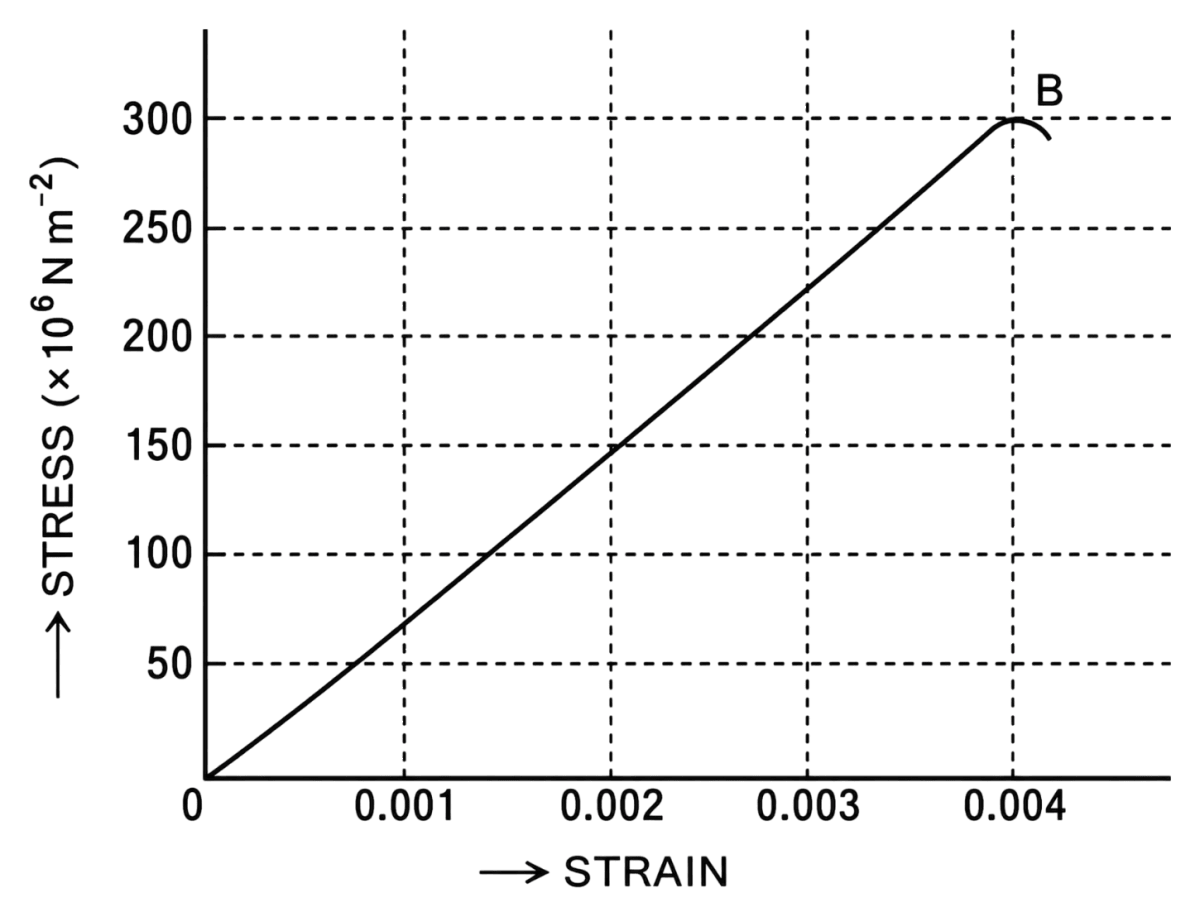
Figure shows the strain-stress curve for a given material. What are (a) Young's modulus, and (b) approximate yield strength for this material?
Answer
(a) Young's modulus : In the initial straight portion of the graph, Hooke's law is obeyed and the ratio of stress to strain is constant. From the graph, a stress of 150 × 106 N m-2 corresponds to a strain of 0.002. Therefore,
Hence, the Young's modulus of the material is 7.5 × 10¹⁰ N m-2.
(b) Yield strength : The yield point of the given graph is the point B, at which the stress is roughly 300 × 106 N m-2. The stress at the yield point is the yield strength.
Hence, the approximate yield strength of the material is 3.0 × 10⁸ N m-2.
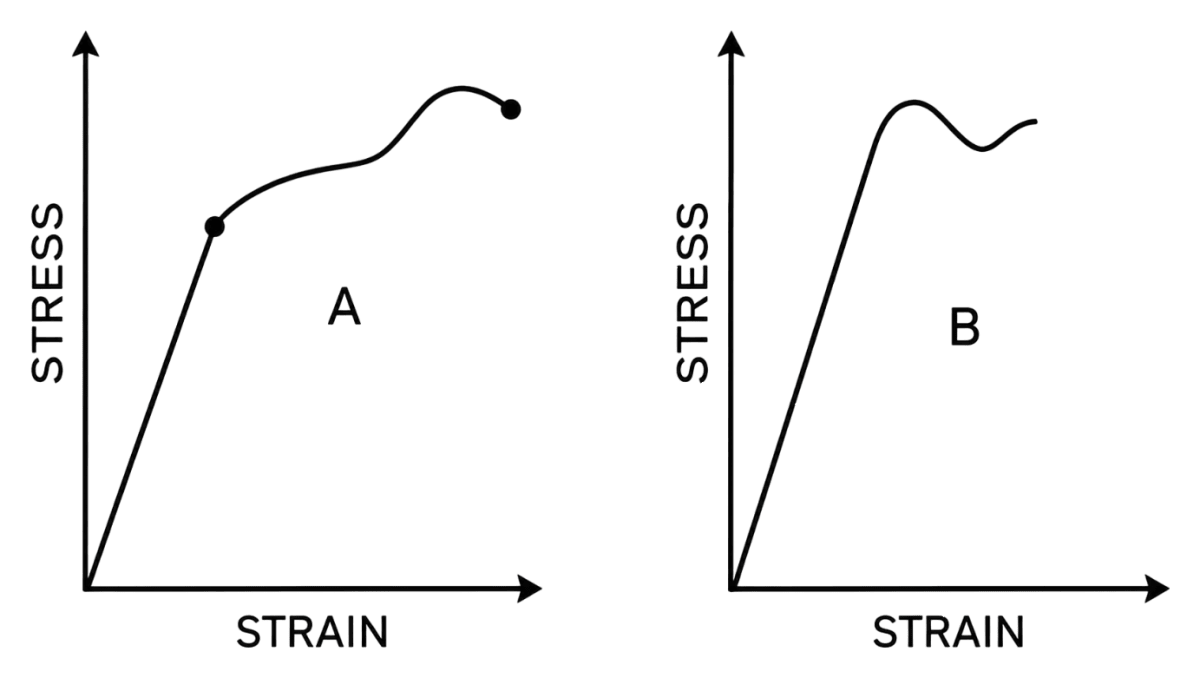
The stress-strain graphs for two materials A and B are shown in the figure. The graphs are drawn to the same scale.
(a) Which material has a greater Young's modulus?
(b) Which of the two is the stronger material?
Answer
(a) Material A has the greater Young's modulus.
The Young's modulus is the ratio of stress to strain, which is the slope of the linear portion of the stress-strain curve. The linear portion of the curve of material A is steeper than that of material B, that is, its slope is greater. Hence material A has the greater Young's modulus.
(b) Material A is the stronger material.
The strength of a material is decided by the maximum stress it can bear before it breaks, that is, by the stress at its fracture point. Material A withstands a greater stress before breaking than material B, and is therefore stronger.
Read the following two statements below carefully and state, with reasons, if it is true or false.
(a) The Young's modulus of rubber is greater than that of steel;
(b) The stretching of a coil is determined by its shear modulus.
Answer
(a) False.
The Young's modulus measures the stiffness of a material, that is, its resistance to a change in length under a longitudinal stress. Rubber is highly elastic in the everyday sense — it produces a large elongation for a small stress — so it is much less stiff. Steel, on the other hand, is very stiff, as a large stress produces only a small elongation in it. Since
a smaller strain for the same stress means a larger Y. Therefore Y of steel is very much greater than Y of rubber.
(b) True.
When a coil (spring) is stretched, the wire of the coil is not stretched along its length; it is twisted. This twisting is a shearing deformation, and the restoring force arises from the shear deformation of the material of the wire. Hence the extension of a coil is governed by the modulus of rigidity η of its material and not by the Young's modulus.
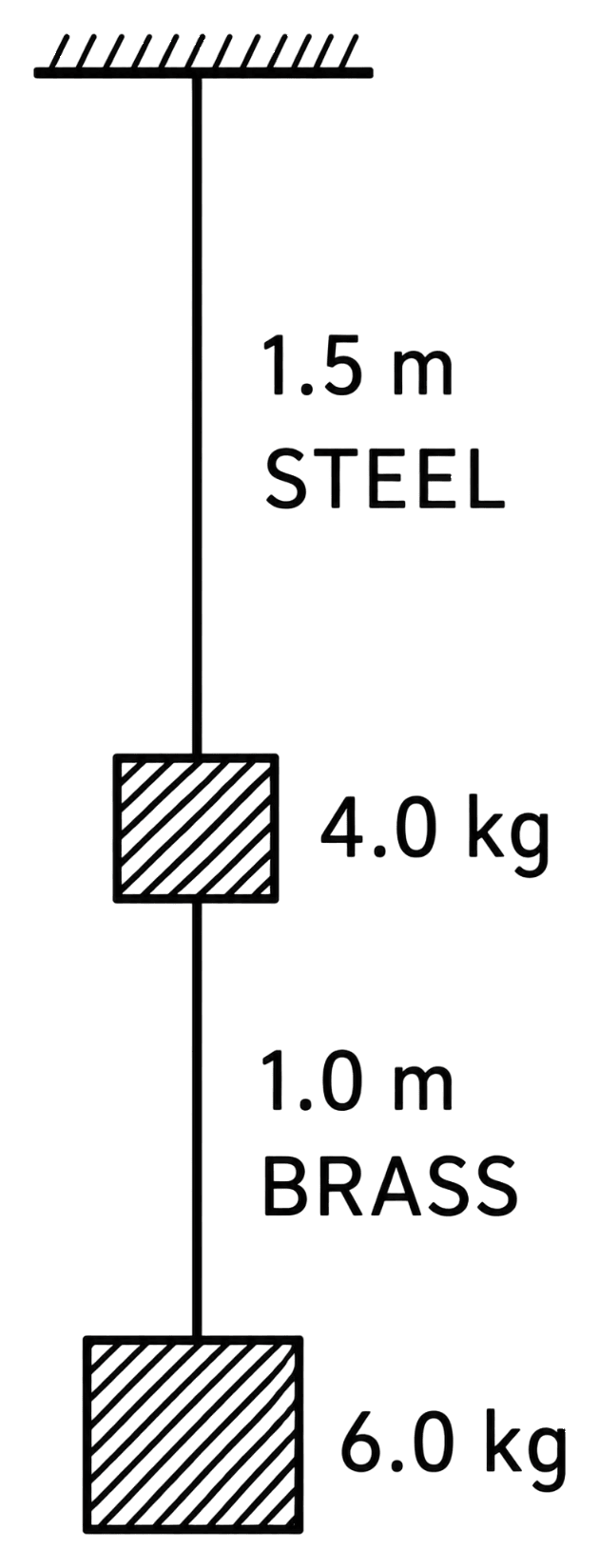
Two wires of diameter 0.25 cm, one made of steel and the other made of brass are loaded as shown in adjoining fig. The unloaded length of steel wire is 1.5 m and that of brass wire is 1.0 m. Compute the elongations of the steel and the brass wires.
Answer
Given,
- Diameter of each wire, d = 0.25 cm, so radius r = cm = 0.125 × 10⁻² m
- Unloaded length of the steel wire, LS = 1.5 m
- Unloaded length of the brass wire, LB = 1.0 m
- YS = 2.0 × 10¹¹ N m-2, YB = 0.91 × 10¹¹ N m-2
- g = 9.8 N/kg
If a wire of length L and radius r increases in length by ΔL under a suspended load Mg, then
Elongation of the steel wire : The steel wire carries both the loads hanging below it, so the suspended load is (4.0 + 6.0) kg,
Elongation of the brass wire : The brass wire carries only the lower load of 6.0 kg,
Hence, the elongation of the steel wire is 1.5 × 10⁻⁴ m and that of the brass wire is 1.3 × 10⁻⁴ m.
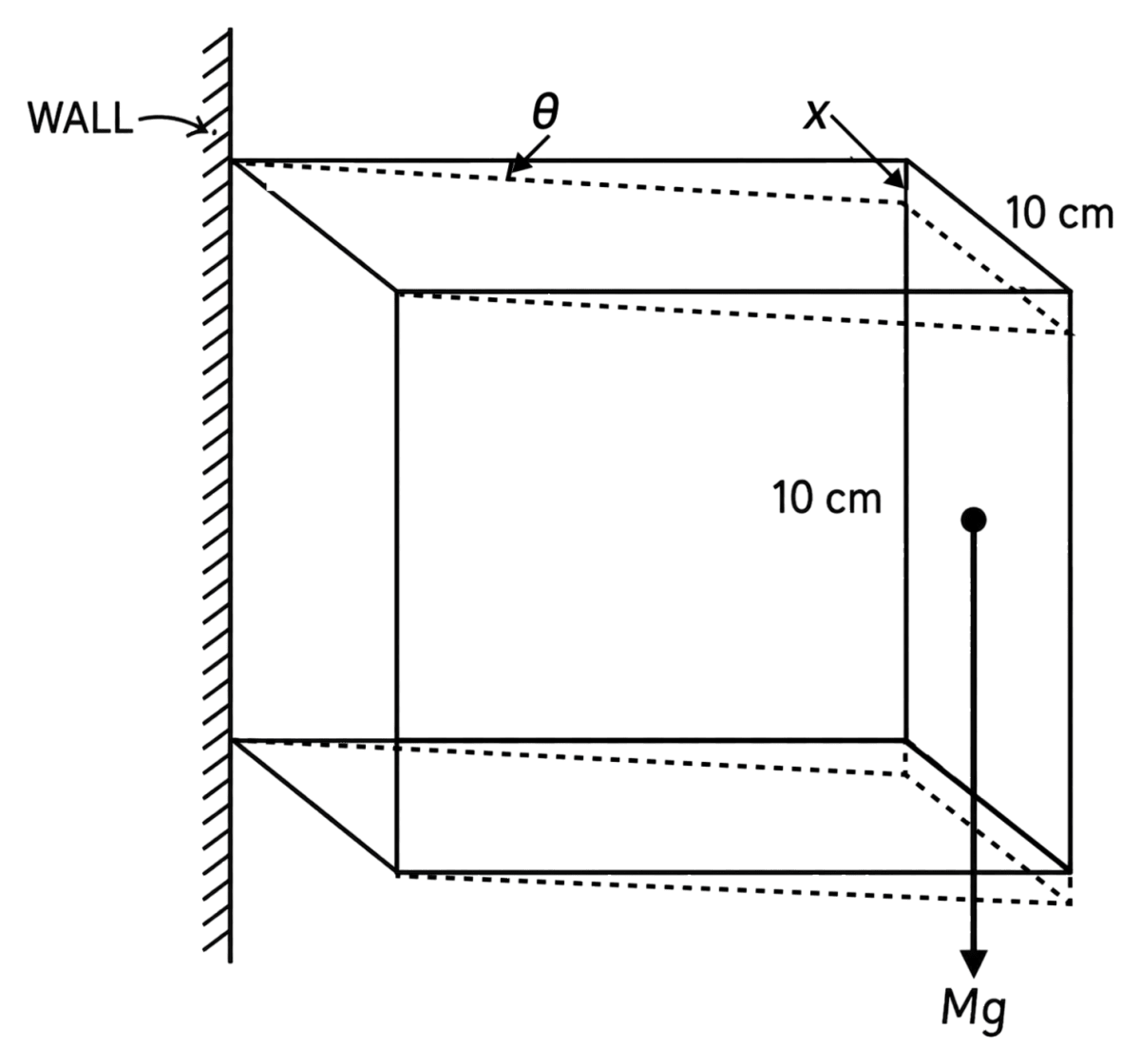
The edge of an aluminium cube is 10 cm long. One face of the cube is firmly fixed to a vertical wall. A mass of 100 kg is then attached to the opposite face of the cube. The shear modulus of aluminium is 25 GPa. What is the vertical deflection of this face?
Answer
Given,
- Edge of the cube, L = 10 cm = 0.10 m
- Mass attached, M = 100 kg
- Shear modulus of aluminium, η = 25 GPa = 25 × 109 N m-2
- g = 10 N/kg
One face of the cube is fixed to the vertical wall and the mass is attached to the opposite face, so a tangential force F = Mg acts vertically downwards along that face. Let x be the vertical deflection of the face.
The area of the face is A = L2, and the shearing strain is . The modulus of rigidity is
Substituting the given values,
Hence, the vertical deflection of the face is 4.0 × 10⁻⁷ m.
Four identical hollow cylindrical columns of steel support a big structure of mass 50,000 kg. The inner and outer radii of each column are 30 cm and 40 cm respectively. Assuming the load distribution to be uniform, calculate the compressional strain of each column. Young's modulus of steel is 2.0 × 10¹¹ Pa (or N m-2).
Answer
Given,
- Mass of the structure, M = 50,000 kg
- Inner radius of each column, r1 = 30 cm = 0.30 m
- Outer radius of each column, r2 = 40 cm = 0.40 m
- Young's modulus of steel, Y = 2.0 × 10¹¹ N m-2
- g = 9.8 N/kg
The cross-sectional area of steel in each hollow column is
The weight of the structure is
Since the load is distributed uniformly among the four columns, the compressional force on each column is
The Young's modulus of steel is
Hence, the compressional strain of each column is 2.78 × 10⁻⁶.
A piece of copper having a rectangular cross-section of 15.2 mm × 19.1 mm is pulled in tension with 44,500 N force, producing only elastic deformation. Calculate the resulting strain. (Modulus of rigidity of copper = 4.20 × 10¹⁰ Pa).
Answer
Given,
- Cross-section of the copper piece = 15.2 mm × 19.1 mm
- Force applied, F = 44,500 N
- Modulus of rigidity of copper, η = 4.20 × 10¹⁰ N m-2
The area of cross-section of the body is
The modulus of rigidity of the material of the body is
where F is the tangential force applied. Therefore the strain produced is
Substituting the given values,
Hence, the resulting strain is 3.65 × 10⁻³.
A steel cable with a radius of 1.5 cm supports a chairlift at a ski area. If the maximum stress is not to exceed 108 N m-2, what is the maximum load the cable can support?
Answer
Given,
- Radius of the steel cable, r = 1.5 cm = 1.5 × 10⁻² m
- Maximum (breaking) stress = 108 N m-2
The stress in the cable is the load per unit area of cross-section, that is,
Therefore the maximum load the cable can support is
Substituting the given values,
Hence, the maximum load the cable can support is 7.065 × 10⁴ N.
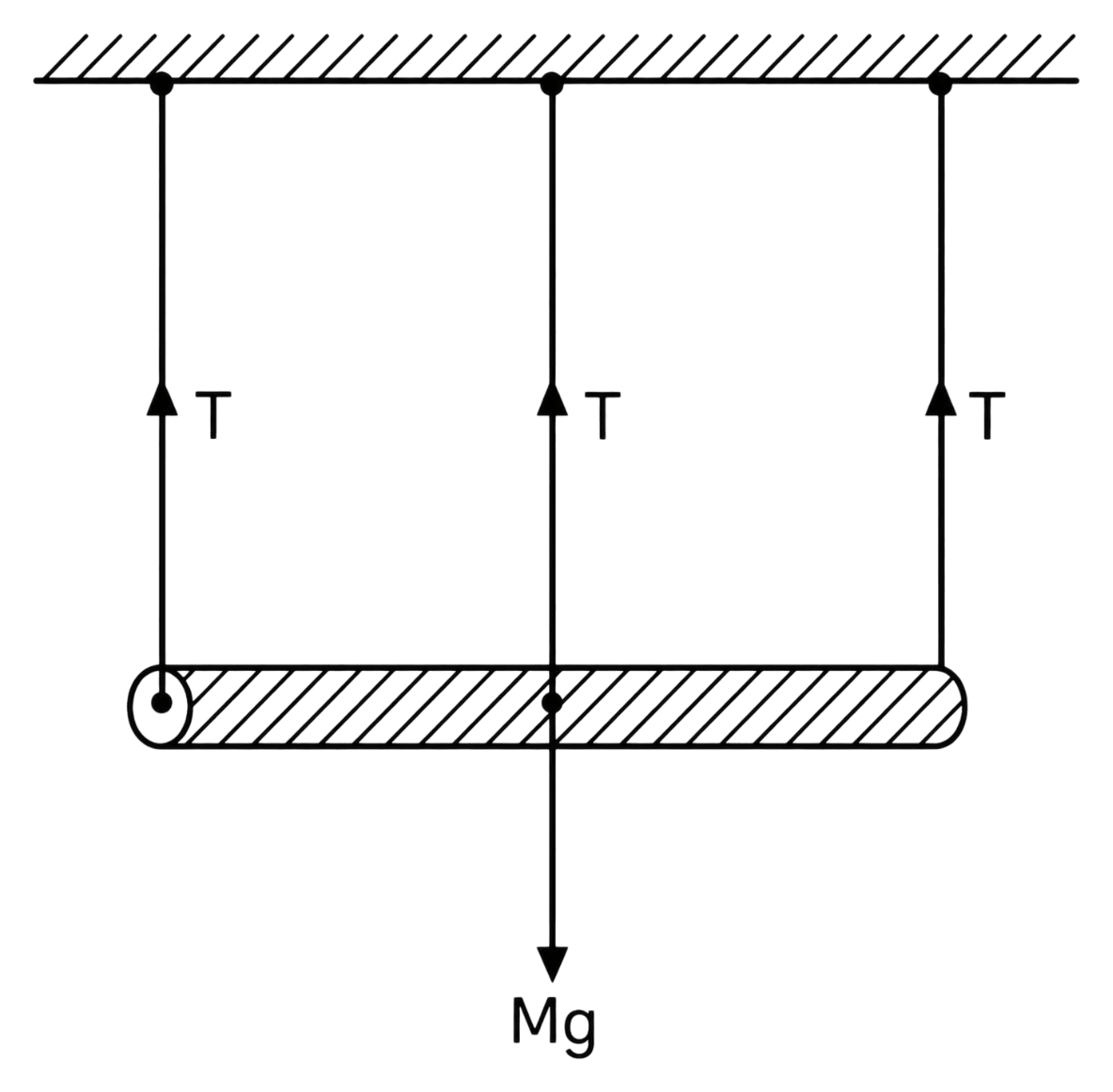
A rigid bar of mass 15 kg is supported symmetrically by three wires each 2.0 m long. Those at each end are of copper and the middle one is of iron. Determine the ratios of their diameters if each is to have the same tension.
Given : Ycopper = 1.20 × 10¹¹ N m-2, Yiron = 1.90 × 10¹¹ N m-2, g = 9.8 N/kg.
Answer
Given,
- Mass of the rigid bar, M = 15 kg
- Length of each wire, L = 2.0 m
- Ycopper = 1.20 × 10¹¹ N m-2, Yiron = 1.90 × 10¹¹ N m-2
- g = 9.8 N/kg
Since the bar is supported symmetrically by three wires and each wire is to have the same tension,
For a wire of radius r, the Young's modulus of its material is
If D be the diameter of the wire, then , and therefore
In the given case the length L, the elongation ΔL and the tension are the same for all the three wires. Hence
Therefore,
Hence, the ratio of the diameter of the copper wire to that of the iron wire is 1.258.
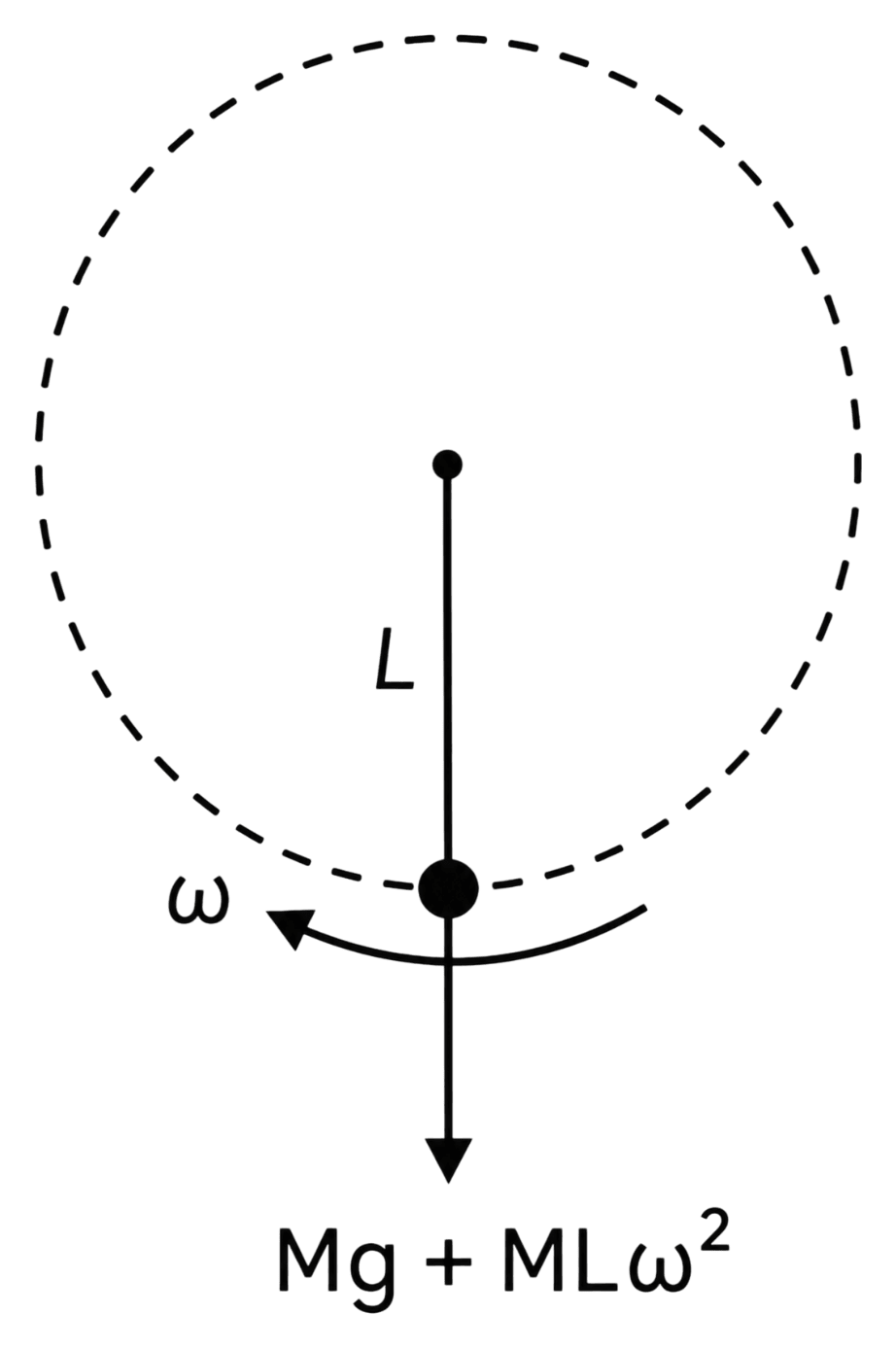
A 14.5 kg mass fastened to the end of a steel wire of unstretched length 1.0 m, is whirled in a vertical circle with an angular velocity of 2 rev/s at the bottom of the circle. The cross-sectional area of the wire is 0.065 cm2. Calculate, the elongation of the wire when the mass is at the lowest point of its path. The Young's modulus of steel is 2.0 × 10¹¹ N m-2.
Answer
Given,
- Mass fastened to the wire, M = 14.5 kg
- Unstretched length of the wire, L = 1.0 m
- Angular velocity, ω = 2 rev/s
- Area of cross-section, A = 0.065 cm2 = 0.065 × 10⁻⁴ m2
- Young's modulus of steel, Y = 2.0 × 10¹¹ N m-2
- g = 9.8 m s-2
The angular velocity must be expressed in radian per second. Since one revolution corresponds to 2π radian,
At the lowest point of the vertical circle, the effective force acting on the mass is its weight plus the centrifugal force. Thus,
Substituting the given values,
By Hooke's law, the Young's modulus of steel is
Substituting the values,
Hence, the elongation of the wire at the lowest point is 1.87 × 10⁻³ m, that is, 1.87 mm.
Note: The textbook solution substitutes ω = 2 directly into Lω2, which treats 2 rev/s as 2 rad s-1 and gives 1.539 × 10⁻⁴ m. Since 2 rev/s = 4π rad s-1 and ω occurs squared, the centripetal term is understated by a factor of 4π2. The correct elongation is 1.87 × 10⁻³ m.
Compute the bulk modulus of water from the given data : initial volume = 100.0 litre, pressure increase = 100.0 atm (1 atm = 1.013 × 10⁵ Pa), final volume = 100.5 litre. Compare the bulk modulus of water with that of air (at constant temperature). Explain in simple terms why the ratio is so large.
Answer
Given,
- Initial volume of water, V = 100.0 litre
- Final volume of water = 100.5 litre
- Increase in pressure, p = 100.0 atm
- 1 atm = 1.013 × 10⁵ Pa
The increase in pressure is
The change in volume is
The bulk modulus of a substance is the ratio of the normal stress to the volume strain,
Substituting the values,
The bulk modulus of air at S.T.P. is Kair = 1.0 × 10⁻⁴ Pa. Therefore,
Hence, the bulk modulus of water is 2.026 × 10⁹ Pa and it is about 2.026 × 10¹³ times that of air.
The ratio is very large because the intermolecular forces in air are negligible in comparison with those in water. The molecules of a gas are far apart and hardly attract one another, so a gas can be compressed easily and a small pressure produces a large volume strain in it. In water the molecules are closely packed and strongly attract one another, so the same pressure produces a very small volume strain. A small volume strain for a given normal stress means a large bulk modulus.
Note: The textbook gives the bulk modulus of water as 2.036 × 10⁹ Pa. However, the correct calculation gives 2.026 × 10⁹ Pa. Therefore, the textbook value has a small calculation error.
The density of ocean water at the surface is 1.03 × 10³ kg m-3. What is its density at a depth where the pressure is 80.0 atm ? Given : compressibility of water = 45.8 × 10⁻¹¹ Pa-1 and 1 atm = 1.013 × 10⁵ Pa.
Answer
Given,
- Density of ocean water at the surface, ρ = 1.03 × 10³ kg m-3
- Pressure at the depth, p = 80.0 atm
- Compressibility of water, B = 45.8 × 10⁻¹¹ Pa-1
- 1 atm = 1.013 × 10⁵ Pa
Compressibility is the reciprocal of the bulk modulus. Hence the bulk modulus of water is
The pressure at the given depth is
Let V and V′ be the volumes of a certain mass M of ocean water at the surface and at the depth respectively, and ρ and ρ′ the corresponding densities. Then
The decrease in volume at the depth is
Therefore the volume strain is
By definition of the bulk modulus,
From equations (i) and (ii),
Substituting the values,
Hence, the density of ocean water at that depth is 1.034 × 10³ kg m-3.
Compute the fractional change in volume of a glass slab, when subjected to a hydraulic pressure of 10 atm. (1 atm = 1.013 × 10⁵ Pa, Bulk modulus of glass = 37 × 109 Pa)
Answer
Given,
- Hydraulic pressure applied, p = 10 atm = 10 × 1.013 × 105 Pa
- Bulk modulus of glass, K = 37 × 109 Pa
The bulk modulus of a substance is
Therefore the fractional change in volume is
Substituting the values,
Hence, the fractional change in volume of the glass slab is − 2.74 × 10⁻⁵.
The negative sign shows that the volume of the slab decreases under the applied pressure.
Determine the volume contraction of a solid copper cube, 10 cm on an edge, when subjected to a hydraulic pressure of 7.0 × 10⁶ Pa. Bulk modulus of copper = 1.40 × 10¹¹ Pa.
Answer
Given,
- Edge of the copper cube = 10 cm
- Hydraulic pressure applied, p = 7.0 × 10⁶ Pa
- Bulk modulus of copper, K = 1.40 × 10¹¹ Pa
The volume strain produced in the cube is
The volume of the cube is
Therefore the volume contraction is
Hence, the volume of the copper cube contracts by 0.050 cm3.
How much should the pressure on a litre of water be changed to compress it by 0.10% ? Bulk modulus of water = 2.2 × 10⁹ Pa.
Answer
Given,
- Volume of water, V = 1 litre
- Compression required = 0.10%
- Bulk modulus of water, K = 2.2 × 10⁹ Pa
The volume strain is
The bulk modulus of water is
Substituting the values,
Hence, the pressure on the water should be increased by 2.2 × 10⁶ Pa.