KnowledgeBoat Logo
|
OPEN IN APP

Chapter 8

Mechanical Properties of Solids — HOTS Questions

Class 11 - Nootan Physics


HOTS Questions

Question 1

Steel wire of length 'L' at 40°C is suspended from the ceiling and then a mass 'm' is hung from its free end. The wire is cooled down from 40°C to 30°C to regain its original length 'L'. The coefficient of linear thermal expansion of the steel is 10-5/°C, Young's modulus of steel is 1011 N/m2 and radius of the wire is 1 mm. Assume that L >> diameter of the wire. Then, calculate the value of 'm' in kg.

Answer

Given,

  • Coefficient of linear thermal expansion of steel, α = 10-5/°C
  • Young's modulus of steel, Y = 1011 N/m2
  • Radius of the wire, r = 1 mm = 10-3 m
  • Fall in temperature, Δt = 40 − 30 = 10°C
  • g = 10 m/s2

When the mass m is hung, the wire is stretched by ΔL. On cooling through Δt, the wire contracts by the same amount and regains its original length L. Hence the longitudinal strain produced by the load is equal to the contraction strain produced by cooling,

ΔLL=αΔt\dfrac{\Delta \text L}{\text L} = \alpha\Delta \text t

By Hooke's law, the Young's modulus of the material of the wire is

Y=F/AΔL/LmgA=Y(αΔt)\text Y = \dfrac{\text F/\text A}{\Delta \text L/\text L} \quad \Rightarrow \quad \dfrac{\text{mg}}{\text A} = \text Y(\alpha\Delta \text t)

Therefore,

m=AY(αΔt)g=πr2Y(αΔt)g\text m = \dfrac{\text{AY}(\alpha\Delta \text t)}{\text g} = \dfrac{\pi \text r^2\text Y(\alpha\Delta \text t)}{\text g}

Substituting the given values,

m=π(103)2×1011×(105×10)10=π×106×1011×10410=π3\text m = \dfrac{\pi (10^{-3})^2 \times 10^{11} \times (10^{-5} \times 10)}{10} \\[1em] = \dfrac{\pi \times 10^{-6} \times 10^{11} \times 10^{-4}}{10} = \pi \approx 3

Hence, the value of m is about 3 kg.

Question 2

A 0.1 kg mass is suspended from a wire of negligible mass. The length of the wire is 1 m and its cross-sectional area is 4.9 × 10⁻⁷ m2. If the mass is pulled a little in the vertically downward direction and released, it performs simple harmonic motion of angular frequency 140 rad s-1. If the Young's modulus of the material of the wire is n × 109 Nm-2, find the value of n.

Answer

Given,

  • Mass suspended, m = 0.1 kg
  • Length of the wire, L = 1 m
  • Area of cross-section, A = 4.9 × 10⁻⁷ m2
  • Angular frequency, ω = 140 rad s-1
  • Young's modulus, Y = n × 109 N m-2

The Young's modulus of the material of the wire is

Y=F/AΔL/L=FLAΔLF=(YAL)ΔL\text Y = \dfrac{\text F/\text A}{\Delta \text L/\text L} = \dfrac{\text F\text L}{\text A\Delta \text L} \quad \Rightarrow \quad \text F = \left(\dfrac{\text{YA}}{\text L}\right)\Delta \text L

When the mass is pulled down through ΔL and released, the restoring force developed in the wire is

F=kΔL\text F = \text k\Delta \text L

Comparing the two expressions, the force constant of the wire is

k=YAL\text k = \dfrac{\text{YA}}{\text L}

The angular frequency of the resulting simple harmonic motion is

ω=km=YAmL\omega = \sqrt{\dfrac{\text k}{\text m}} = \sqrt{\dfrac{\text{YA}}{\text{mL}}}

Substituting the given values,

140=(n×109)×(4.9×107)0.1×1140=4900n=70n140 = \sqrt{\dfrac{(\text n \times 10^{9}) \times (4.9 \times 10^{-7})}{0.1 \times 1}} \\[1em] 140 = \sqrt{4900\text n} = 70\sqrt{\text n}

n=2n=4\sqrt{\text n} = 2 \quad \Rightarrow \quad \text n = 4

Hence, the value of n is 4.

Question 3

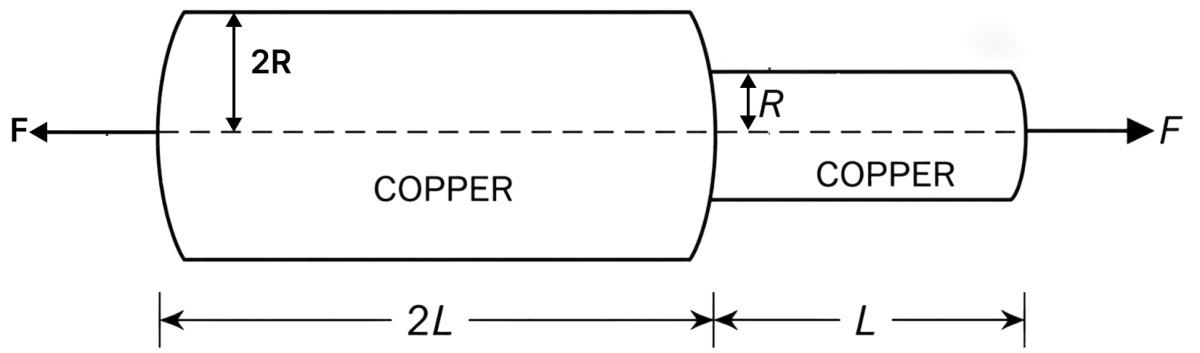
One end of a horizontal thick copper wire of length 2L and radius 2R is welded to an end of another horizontal thin copper wire of length L and radius R. When the arrangement is stretched by applying forces at two ends, the ratio of the elongation in the thin wire to that in the thick wire is :

  1. 0.25
  2. 0.50
  3. 2.00
  4. 4.00

Answer

2.00

One end of a horizontal thick copper wire of length 2L and radius 2R is welded to an end of another horizontal thin copper wire of length L and radius R. When the arrangement is stretched by applying forces at two ends, the ratio of the elongation in the thin wire to that in the thick wire is:. Mechanical Properties of Solids, Solutions for Class 11 ISC Nootan Physics Kumar Mittal Nageen Prakashan

When a force F is applied at the two ends of the composite wire, the same force is transmitted longitudinally to each part. However, the two parts have different areas of cross-section, so the stresses induced in them are different and hence their elongations are different.

Let l1 be the elongation of the thin wire (length L, radius R) and l2 that of the thick wire (length 2L, radius 2R). From the relation

Y=FLAll=FLAY\text Y = \dfrac{\text F\text L}{\text Al} \quad \Rightarrow \quad l = \dfrac{\text{FL}}{\text{AY}}

For the thin wire, A1 = πR2 and length = L,

l1=FLπR2Yl_1 = \dfrac{\text F\text L}{\pi \text R^2\text Y}

For the thick wire, A2 = π(2R)2 = 4πR2 and length = 2L,

l2=F(2L)4πR2Y=FL2πR2Yl_2 = \dfrac{\text F(2\text L)}{4\pi \text R^2\text Y} = \dfrac{\text F\text L}{2\pi \text R^2\text Y}

Therefore,

l1l2=FLπR2Y×2πR2YFL=2\dfrac{l_1}{l_2} = \dfrac{\text{FL}}{\pi \text R^2 \text Y} \times \dfrac{2\pi \text R^2 \text Y}{\text{FL}} = 2

Hence, the ratio of the elongation in the thin wire to that in the thick wire is 2.00.

Question 4

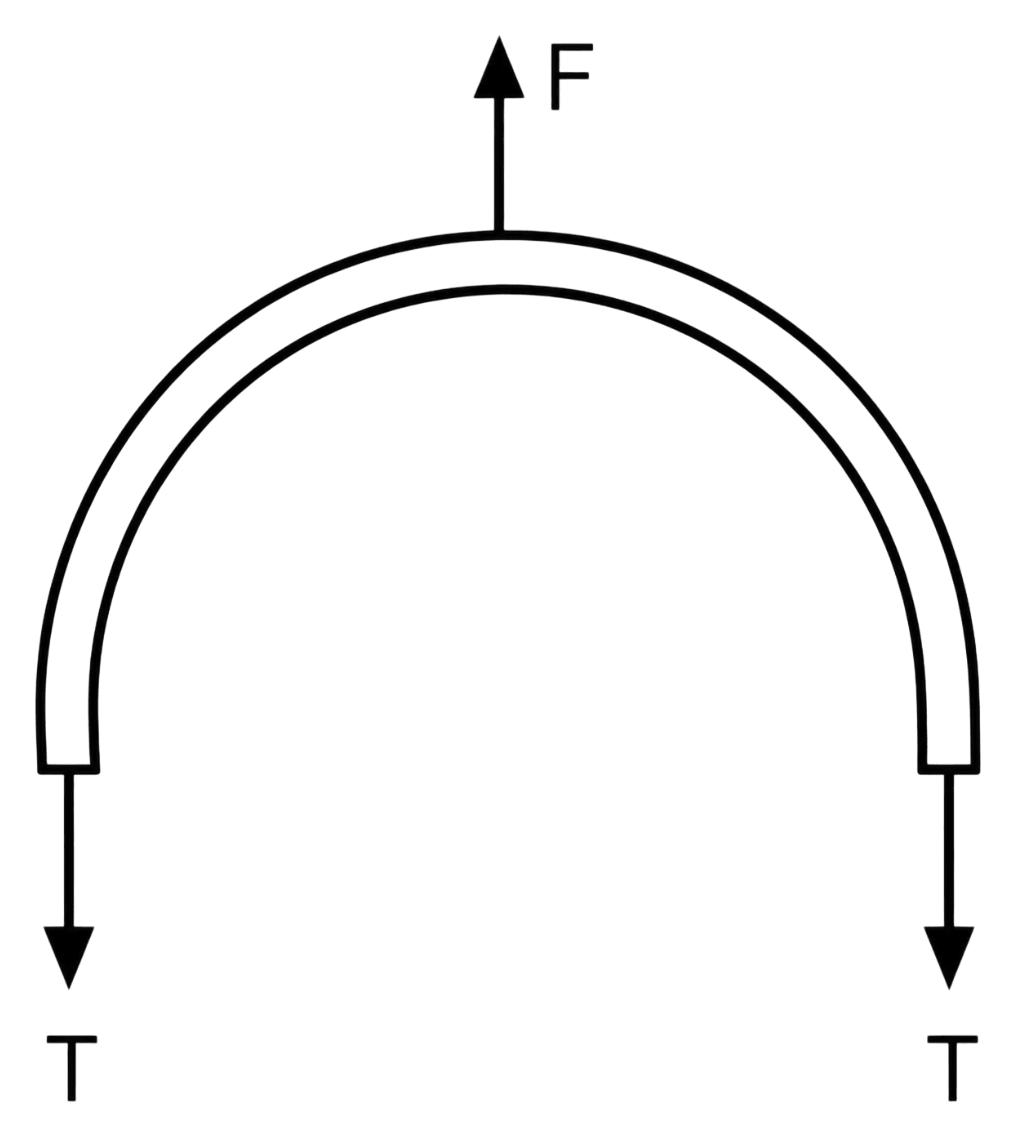
A wooden wheel of radius R is made of two semicircular parts (see figure). The two parts are held together by a ring made of a metal strip of cross-sectional area A and length L. L is slightly less than 2πR. To fit the ring on the wheel, it is heated so that its temperature rises by ΔT and it just steps over the wheel. As it cools down to surrounding temperature, it presses the semicircular parts together. If the coefficient of linear expansion of the metal is α, and its Young's modulus is Y, the force that one part of the wheel applies on the other part is :

A wooden wheel of radius R is made of two semicircular parts (see figure). The two parts are held together by a ring made of a metal strip of cross-sectional area A and length L. L is slightly less than 2πR. To fit the ring on the wheel, it is heated so that its temperature rises by ΔT and it just steps over the wheel. As it cools down to surrounding temperature, it presses the semicircular parts together. If the coefficient of linear expansion of the metal is α, and its Youngs modulus is Y, the force that one part of the wheel applies on the other part is:. Mechanical Properties of Solids, Solutions for Class 11 ISC Nootan Physics Kumar Mittal Nageen Prakashan
  1. 2π A Y α ΔT
  2. A Y α ΔT
  3. π A Y α ΔT
  4. 2 A Y α ΔT

Answer

2 A Y α ΔT

A wooden wheel of radius R is made of two semicircular parts (see figure). The two parts are held together by a ring made of a metal strip of cross-sectional area A and length L. L is slightly less than 2πR. To fit the ring on the wheel, it is heated so that its temperature rises by ΔT and it just steps over the wheel. As it cools down to surrounding temperature, it presses the semicircular parts together. If the coefficient of linear expansion of the metal is α, and its Youngs modulus is Y, the force that one part of the wheel applies on the other part is:. Mechanical Properties of Solids, Solutions for Class 11 ISC Nootan Physics Kumar Mittal Nageen Prakashan

When the ring cools down, it contracts and presses the two semicircular parts together. Let T be the tension developed in the ring. The free body diagram of one half of the wheel shows that the ring pulls it inward at two places, so the force applied by one part on the other part is 2T.

Let l be the change in the length of the ring when it is heated through ΔT. By the definition of the coefficient of linear expansion,

α=change in lengthinitial length×rise in temperature=lLΔT\alpha = \dfrac{\text{change in length}}{\text{initial length} \times \text{rise in temperature}} = \dfrac{l}{\text L\Delta \text T}

Therefore the longitudinal strain produced in the ring is

lL=αΔT\dfrac{l}{\text L} = \alpha\Delta \text T

The thermal stress developed in the ring is

PT=Y×strain=YαΔT\text P_T = \text Y \times \text{strain} = \text Y \alpha\Delta \text T

But the stress is also the tension per unit area of cross-section, that is, PT=TA\text P_T = \dfrac{\text T}{\text A}. Hence

TA=YαΔTT=YAαΔT\dfrac{\text T}{\text A} = \text Y \alpha\Delta \text T \quad \Rightarrow \quad \text T = \text{YA}\alpha\Delta \text T

Therefore the force applied by one part of the wheel on the other part is

F=T+T=2T=2AYαΔT\text F = \text T + \text T = 2\text T = 2\text{AY}\alpha\Delta \text T

Hence, the required force is 2 A Y α ΔT.

Question 5

A uniform metal rod of 2 mm2 cross-section is heated from 0°C to 20°C. The coefficient of linear expansion of the rod is 12 × 10-6 per °C. Its Young's modulus of elasticity is 1011 N/m2. The energy stored per unit volume of the rod is :

  1. 2880 J/m3
  2. 1500 J/m3
  3. 5760 J/m3
  4. 1440 J/m3

Answer

2880 J/m3

Given,

  • Rise in temperature, ΔT = 20 − 0 = 20°C
  • Coefficient of linear expansion, α = 12 × 10-6 per °C
  • Young's modulus, Y = 1011 N/m2

The elastic potential energy stored per unit volume of a stretched body is

UE=12×Young’s modulus×strain2\text U_E = \dfrac{1}{2} \times \text{Young's modulus} \times \text{strain}^2

Since the rod is prevented from expanding freely, the strain produced in it is

ΔLL=α×ΔT=α×20\dfrac{\Delta \text L}{\text L} = \alpha \times \Delta \text T = \alpha \times 20

Substituting the values,

UE=12×1011×(12×106×20)2=12×1011×(2.4×104)2\text U_E = \dfrac{1}{2} \times 10^{11} \times (12 \times 10^{-6} \times 20)^2 \\[1em] = \dfrac{1}{2} \times 10^{11} \times (2.4 \times 10^{-4})^2

=12×1011×(5.76×108)=2880 J m3= \dfrac{1}{2} \times 10^{11} \times (5.76 \times 10^{-8}) = 2880\ \text{J m}^{-3}

Hence, the energy stored per unit volume of the rod is 2880 J/m3.

Question 6

When the pressure of a medium is changed from 1.01 × 10⁵ Pa to 1.165 × 10⁵ Pa, the volume changes by 10% at constant temperature. The bulk modulus of the medium is :

  1. 1.55 × 10⁵ Pa
  2. 51.2 × 10⁵ Pa
  3. 102.4 × 10⁵ Pa
  4. 204.8 × 10⁵ Pa

Answer

1.55 × 10⁵ Pa

Given,

  • Initial pressure = 1.01 × 10⁵ Pa
  • Final pressure = 1.165 × 10⁵ Pa
  • Volume strain, dVV\dfrac{\text{dV}}{\text V} = − 10% = − 0.1

The bulk modulus of a medium is the ratio of the change in pressure to the volume strain,

B=dPdV/V\text B = -\dfrac{\text{dP}}{\text{dV}/\text V}

Substituting the values,

B=(1.1651.01)×1050.1=0.155×1050.1=1.55×10⁵ Pa\text B = -\dfrac{(1.165 - 1.01) \times 10^{5}}{-0.1} \\[1em] = \dfrac{0.155 \times 10^{5}}{0.1} = 1.55 \times 10^{5}\ \text{Pa}

Hence, the bulk modulus of the medium is 1.55 × 10⁵ Pa.

Question 7

Anvils made of single crystals of diamond, with the shape, as shown are used to investigate behaviour of materials under very high pressures. Flat faces at the narrow end of the anvil have a diameter of 0.50 mm, and the wide ends are subjected to a compressional force of 50,000 N. What is the pressure at the top of the anvil ?
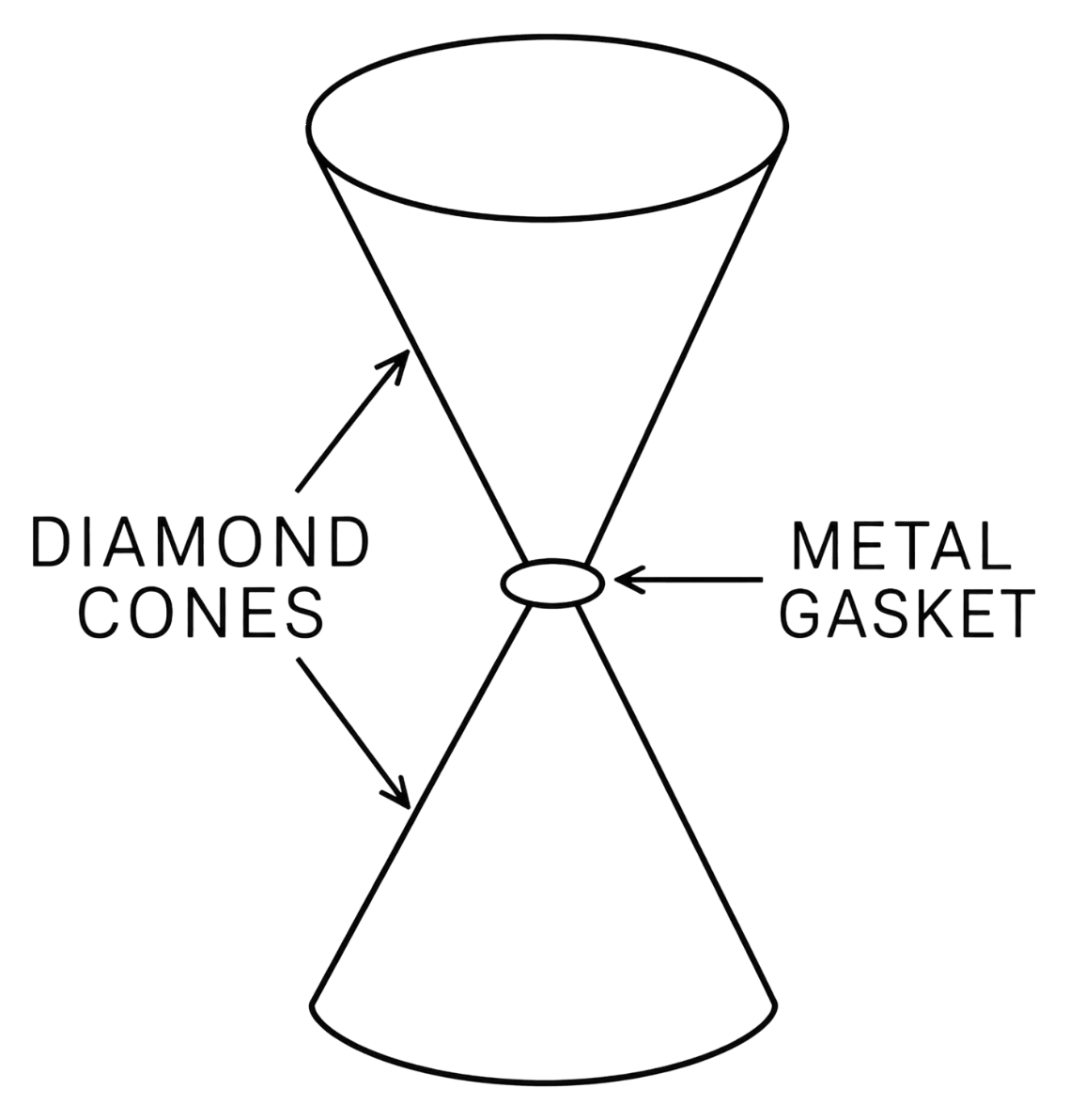
Anvils made of single crystals of diamond, with the shape, as shown are used to investigate behaviour of materials under very high pressures. Flat faces at the narrow end of the anvil have a diameter of 0.50 mm, and the wide ends are subjected to a compressional force of 50,000 N. What is the pressure at the top of the anvil? Mechanical Properties of Solids, Solutions for Class 11 ISC Nootan Physics Kumar Mittal Nageen Prakashan

Answer

Given,

  • Diameter of the flat face at the narrow end = 0.50 mm, so radius r = 0.25 × 10⁻³ m
  • Compressional force, F = 50,000 N

The compressional force at each section of the anvil is the same. The pressure at the top of the anvil is the compressional stress there, that is, the force per unit area of the narrow flat face,

pressure=compressional stress=Fπr2\text{pressure} = \text{compressional stress} = \dfrac{\text F}{\pi \text r^2}

Substituting the values,

pressure=50,0003.14×(0.25×103)2=50,0001.9625×107=2.55×10¹¹ N m2\text{pressure} = \dfrac{50{,}000}{3.14 \times (0.25 \times 10^{-3})^2} \\[1em] = \dfrac{50{,}000}{1.9625 \times 10^{-7}} = 2.55 \times 10^{11}\ \text{N m}^{-2}

Hence, the pressure at the top of the anvil is 2.55 × 10¹¹ N m-2.

Question 8

A mild steel wire of length 1.0 m and cross-sectional area 0.50 × 10⁻² cm2 is stretched, well within its elastic limit, horizontally between two pillars. A mass of 100 g is suspended from the mid-point of the wire. Calculate the depression at the mid-point.

Answer
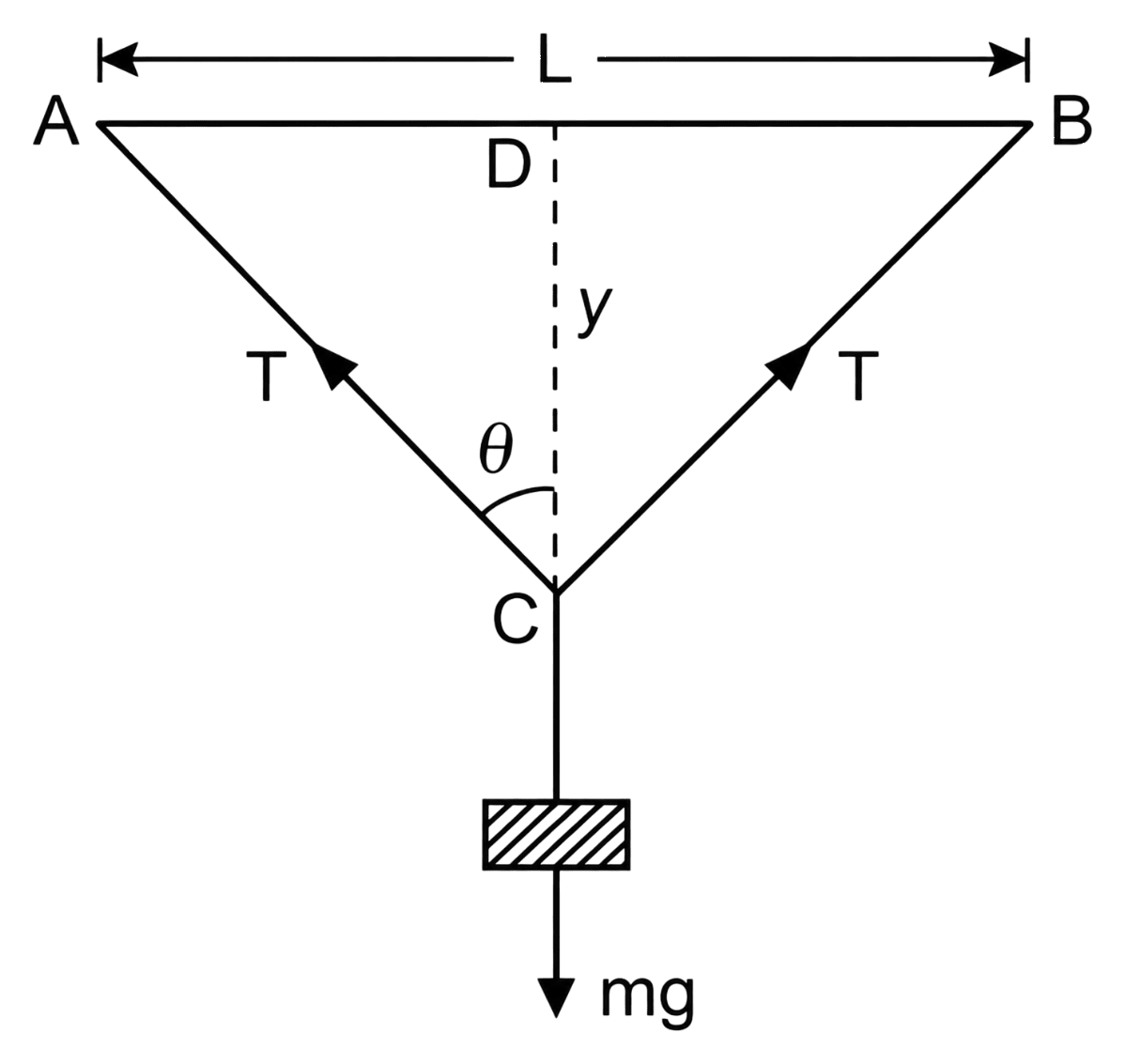
A mild steel wire of length 1.0 m and cross-sectional area 0.50 × 10 -2 cm 2 is stretched, well within its elastic limit, horizontally between two pillars. A mass of 100 g is suspended from the mid-point of the wire. Calculate the depression at the mid-point. Mechanical Properties of Solids, Solutions for Class 11 ISC Nootan Physics Kumar Mittal Nageen Prakashan

Given,

  • Length of the wire, L = 1.0 m
  • Area of cross-section, A = 0.50 × 10⁻² cm2 = 5 × 10⁻⁷ m2
  • Mass suspended, m = 100 g = 0.1 kg
  • Young's modulus of steel, Y = 2 × 10¹¹ N m-2
  • g = 9.8 m s-2

Let the wire AB be stretched between the pillars and let the mass be suspended at its mid-point C. Let y be the depression at the mid-point, so that the wire takes the shape ACB. Here

AD=BD=L2=0.50 m\text{AD} = \text{BD} = \dfrac{\text L}{2} = 0.50\ \text m

From the geometry of the figure,

AC=(AD)2+(CD)2=(L2)2+y2=L2[1+y2(L/2)2]12\text{AC} = \sqrt{(\text{AD})^2 + (\text{CD})^2} = \sqrt{\left(\dfrac{\text L}{2}\right)^2 + \text y^2} = \dfrac{\text L}{2}\left[1 + \dfrac{\text y^2}{(\text L/2)^2}\right]^{\frac{1}{2}}

Since yL2\text y \ll \dfrac{\text L}{2}, by the binomial theorem

AC=L2[1+y22×(L/2)2]\text{AC} = \dfrac{\text L}{2}\left[1 + \dfrac{\text y^2}{2 \times (\text L/2)^2}\right]

Therefore the stretched length of the wire is

ACB=2×L2[1+2y2L2]=L+2y2L\text{ACB} = 2 \times \dfrac{\text L}{2}\left[1 + \dfrac{2\text y^2}{\text L^2}\right] = \text L + \dfrac{2\text y^2}{\text L}

The increase in length is

ΔL=ACBADB=2y2L\Delta \text L = \text{ACB} - \text{ADB} = \dfrac{2\text y^2}{\text L}

so that the longitudinal strain is

ΔLL=2y2L2(i)\dfrac{\Delta \text L}{\text L} = \dfrac{2\text y^2}{\text L^2} \qquad \ldots(\text i)

For the vertical equilibrium of the point C, if T be the tension in each half of the wire and θ the angle each half makes with the vertical,

2Tcosθ=mgT=mg2cosθ(ii)2\text T\cos \theta = \text{mg} \quad \Rightarrow \quad \text T = \dfrac{\text{mg}}{2\cos \theta} \qquad \ldots(\text{ii})

Thus the stress in the wire is

TA=mg2Acosθ\dfrac{\text T}{\text A} = \dfrac{\text{mg}}{2\text A\cos \theta}

From the figure,

cosθ=CDAC=yL/2=2yL\cos \theta = \dfrac{\text{CD}}{\text{AC}} = \dfrac{\text y}{\text L/2} = \dfrac{2\text y}{\text L}

Hence the Young's modulus of the wire is

Y=stressstrain=mg/2Acosθ2y2/L2=mgL24A(2yL)y2=mgL38Ay3\text Y = \dfrac{\text{stress}}{\text{strain}} = \dfrac{\text{mg}/2\text A\cos \theta}{2\text y^2/\text L^2} = \dfrac{\text{mg}\text L^2}{4\text A\left(\dfrac{2\text y}{\text L}\right)\text y^2} = \dfrac{\text{mg}\text L^3}{8\text{Ay}^3}

y3=mgL38AY\Rightarrow \quad \text y^3 = \dfrac{\text{mg}\text L^3}{8\text A\text Y}

Substituting the given values,

y3=0.10×9.8×(1)38×(5×107)×(2×1011)=0.988×105=1.225×10⁶\text y^3 = \dfrac{0.10 \times 9.8 \times (1)^3}{8 \times (5 \times 10^{-7}) \times (2 \times 10^{11})} \\[1em] = \dfrac{0.98}{8 \times 10^{5}} = 1.225 \times 10^{-6}

y=(1.225)1/3×102=1.07×102 m\text y = (1.225)^{1/3} \times 10^{-2} = 1.07 \times 10^{-2}\ \text m

Hence, the depression at the mid-point of the wire is 1.07 × 10⁻² m.

Question 9

A rod of length 1.05 m having negligible mass is supported at its ends by two wires, of steel (wire A) and aluminium (wire B) of equal lengths as shown in fig. The cross-sectional areas of wires A and B are 1.0 mm2 and 2.0 mm2 respectively. At what point along the rod should a mass m be suspended in order to produce (a) equal stresses and (b) equal strains in both steel and aluminium wires.
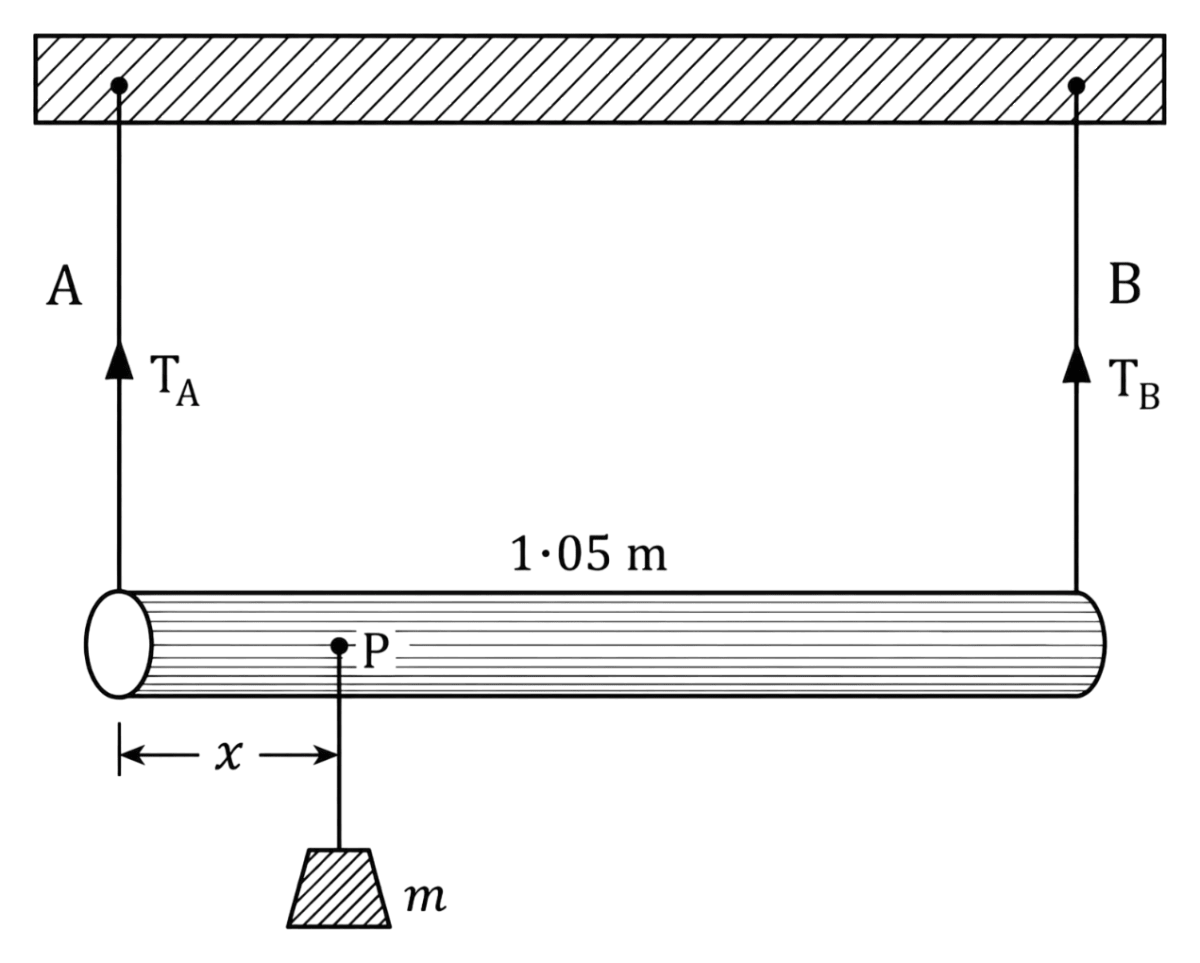
A rod of length 1.05 m having negligible mass is supported at its ends by two wires, of steel (wire A) and aluminium (wire B) of equal lengths as shown in fig. The cross-sectional areas of wires A and B are 1.0 mm 2 and 2.0 mm 2 respectively. At what point along the rod should a mass m be suspended in order to produce (a) equal stresses and (b) equal strains in both steel and aluminium wires. Mechanical Properties of Solids, Solutions for Class 11 ISC Nootan Physics Kumar Mittal Nageen Prakashan

Answer

Given,

  • Length of the rod = 1.05 m
  • Area of cross-section of the steel wire A, AA = 1.0 mm2
  • Area of cross-section of the aluminium wire B, AB = 2.0 mm2
  • YA (steel) = 2 × 10¹¹ N m-2, YB (aluminium) = 7 × 10¹⁰ N m-2

Let the tensions in the wires A and B be TA and TB respectively, and let the mass m be suspended at a point P at a distance x from the wire A.

For the rotational equilibrium of the rod, the moment of the forces about the point P must be zero,

TA×x=TB×(1.05x)(i)\text T_A \times \text x = \text T_B \times (1.05 - \text x) \qquad \ldots(\text i)

(a) For equal stresses in the two wires :

TAAA=TBABTA1.0=TB2.0TB=2TA(ii)\dfrac{\text T_A}{\text A_A} = \dfrac{\text T_B}{\text A_B} \quad \Rightarrow \quad \dfrac{\text T_A}{1.0} = \dfrac{\text T_B}{2.0} \quad \Rightarrow \quad \text T_B = 2\text T_A \qquad \ldots(\text{ii})

Substituting equation (ii) in equation (i),

TA×x=2TA(1.05x)x=2.102x3x=2.10\text T_A \times \text x = 2\text T_A(1.05 - \text x) \\[1em] \text x = 2.10 - 2\text x \quad \Rightarrow \quad 3\text x = 2.10

x=0.70 m\text x = 0.70\ \text m

Hence, for equal stresses the mass should be suspended at a distance of 0.70 m from the steel wire A.

(b) For equal strains in the two wires :

(strain)A=(strain)B(stress)AYA=(stress)BYB(\text{strain})_A = (\text{strain})_B \quad \Rightarrow \quad \dfrac{(\text{stress})_A}{\text Y_A} = \dfrac{(\text{stress})_B}{\text Y_B}

(stress)A(stress)B=YAYBTA/1.0TB/2.0=2×10117×1011\dfrac{(\text{stress})_A}{(\text{stress})_B} = \dfrac{\text Y_A}{\text Y_B} \quad \Rightarrow \quad \dfrac{\text T_A/1.0}{\text T_B/2.0} = \dfrac{2 \times 10^{11}}{7 \times 10^{11}}

TB=0.70TA\Rightarrow \quad \text T_B = 0.70\text T_A

Substituting this in equation (i),

TA×x=0.70TA(1.05x)x=0.7350.70x1.70x=0.735\text T_A \times \text x = 0.70\text T_A(1.05 - \text x) \\[1em] \text x = 0.735 - 0.70\text x \quad \Rightarrow \quad 1.70\text x = 0.735

x=0.70×1.051.70=0.43 m\text x = \dfrac{0.70 \times 1.05}{1.70} = 0.43\ \text m

Hence, for equal strains the mass should be suspended at a distance of 0.43 m from the steel wire A.

Question 10

Two strips of metal are riveted together at their ends by four rivets, each of diameter 6.0 mm. What is the maximum tension that can be exerted by the riveted strip if the shearing stress on the rivet is not to exceed 6.9 × 10⁷ Pa? Assume that each rivet is to carry one-quarter of the load.

Answer

Given,

  • Number of rivets = 4
  • Diameter of each rivet = 6.0 mm, so radius r = 3.0 × 10⁻³ m
  • Maximum shearing stress = 6.9 × 10⁷ Pa

The maximum tension which each rivet can bear is the maximum shearing stress multiplied by its area of cross-section,

tension per rivet=maximum shearing stress×πr2\text{tension per rivet} = \text{maximum shearing stress} \times \pi \text r^2

Substituting the values,

tension per rivet=(6.9×107)×3.14×(3.0×103)2=(6.9×107)×(2.826×105)=1.95×10³ N\text{tension per rivet} = (6.9 \times 10^{7}) \times 3.14 \times (3.0 \times 10^{-3})^2 \\[1em] = (6.9 \times 10^{7}) \times (2.826 \times 10^{-5}) = 1.95 \times 10^{3}\ \text N

Since each of the four rivets carries one-quarter of the load, the maximum tension that can be exerted by the riveted strip is

T=4×(1.95×103)=7.8×10³ N\text T = 4 \times (1.95 \times 10^{3}) = 7.8 \times 10^{3}\ \text N

Hence, the maximum tension that can be exerted by the riveted strip is 7.8 × 10³ N.

Question 11

The Marina trench is located in the pacific ocean, and at one place it is nearly eleven km beneath the surface of water. The water pressure at the bottom of the trench is about 1.1 × 10⁸ Pa. A steel ball of initial volume 0.32 m3 is dropped into the ocean and falls to the bottom of the trench. What is the change in the volume of the ball when it reaches the bottom ? Bulk modulus of steel is 160 GPa.

Answer

Given,

  • Initial volume of the steel ball, V = 0.32 m3
  • Water pressure at the bottom of the trench, p = 1.1 × 10⁸ Pa
  • Bulk modulus of steel, K = 160 GPa = 160 × 109 Pa

The bulk modulus of steel is

K=change in pressure (p)volume strain (ΔV/V)\text K = \dfrac{\text{change in pressure }(\text p)}{\text{volume strain }(-\Delta \text V/\text V)}

Therefore the volume strain is

ΔVV=pK=1.1×108160×109=6.875×10⁴-\dfrac{\Delta \text V}{\text V} = \dfrac{\text p}{\text K} = \dfrac{1.1 \times 10^{8}}{160 \times 10^{9}} \\[1em] = 6.875 \times 10^{-4}

The change in the volume of the ball is

ΔV=(6.875×10⁴)×V=(6.875×104)×0.32=2.2×10⁴ m3\Delta \text V = -(6.875 \times 10^{-4}) \times \text V = -(6.875 \times 10^{-4}) \times 0.32 \\[1em] = -2.2 \times 10^{-4}\ \text m^3

Hence, the volume of the ball decreases by 2.2 × 10⁻⁴ m3 when it reaches the bottom.

PrevNext