
The unit of stress in SI system is:
- N
- N/m
- N/m2
- N-m
Answer
N/m2
Reason — The restoring force acting per unit area within a body is termed as stress, that is, . In the S.I. system force is measured in newton (N) and area in metre2 (m2), so the unit of stress is N/m2, which is also called the pascal (Pa). The newton is the unit of force, N/m of force per unit length and N-m of work.
Which modulus of elasticity is relevant when a body undergoes change in length only?
- Bulk modulus
- Young's modulus
- Shear modulus
- Rigidity modulus
Answer
Young's modulus
Reason — Young's modulus deals with longitudinal stress and longitudinal strain. When a wire or a rod is stretched or compressed along one direction only its length changes, and within the elastic limit the ratio of the longitudinal stress to the longitudinal strain is the Young's modulus of the material. The bulk modulus refers to a change in volume under uniform pressure and the shear (rigidity) modulus to a change in shape under tangential stress.
Hooke's law is valid for:
- elastic limit exceeded
- plastic region
- within elastic limit
- for any material under all conditions
Answer
within elastic limit
Reason — Hooke's law states that within the elastic limit of a material, stress is directly proportional to strain. It is valid only up to the proportionality limit of the material, that is, in the linear part of the stress-strain curve. Beyond the elastic limit permanent deformation occurs and the stress is no longer proportional to the strain, so the law is no longer applicable.
Bulk modulus is defined as the ratio of:
- stress to strain (linear)
- volumetric stress to volumetric strain
- shear stress to shear strain
- longitudinal stress to strain
Answer
volumetric stress to volumetric strain
Reason — When a uniform pressure is applied all over the surface of a body, the volume of the body changes but its shape remains unchanged. Within the elastic limit, the ratio of the normal stress (pressure) to the volume strain is called the bulk modulus,
Thus bulk modulus deals with a uniform pressure change causing a change in volume.
Poisson's ratio is:
- always less than zero
- ratio of lateral strain to longitudinal strain
- ratio of stress to strain
- ratio of Young's modulus to shear modulus.
Answer
ratio of lateral strain to longitudinal strain
Reason — When a material elongates along a certain direction under a tensile stress, it contracts along the perpendicular directions. The fractional change in the direction along which the forces have been applied is the longitudinal strain, and the fractional change in a perpendicular direction is the lateral strain. The ratio of the lateral strain to the longitudinal strain is called the Poisson's ratio σ, which is a constant for the material of the body. Its value theoretically lies between − 1 and 0.5, and for most solid materials it lies between 0.25 and 0.35.
Why is steel more elastic than rubber?
- Steel is harder than rubber
- For same strain, stress is more in steel
- Steel has higher Young's modulus
- Steel is brittle
Answer
Steel has higher Young's modulus
Reason — Elasticity depends on the modulus of elasticity of a material and not on its softness or hardness. If a steel wire and a rubber wire of the same length and the same area of cross-section are taken, a much larger force has to be applied to the steel wire to produce the same elongation. Hence Ysteel > Yrubber, and due to its higher Young's modulus steel resists deformation more strongly, that is, steel is more elastic than rubber.
When a wire is stretched, strain produced in it:
- depends on its length only
- depends on both stress and original length
- depends only on stress applied
- is independent of material
Answer
depends on both stress and original length
Reason — The longitudinal strain produced in a stretched wire is
The elongation ΔL is itself produced by the stress applied, while L is the original length of the wire. Hence the strain depends on both the stress applied and the original length of the wire.
A liquid is considered incompressible if:
- its bulk modulus is very small
- its bulk modulus is very large
- its shear modulus is very small
- its shear modulus is very large
Answer
its bulk modulus is very large
Reason — The bulk modulus K quantifies a material's resistance to uniform compression, . A large bulk modulus means that even under a high pressure the change in volume is very small, which is the defining trait of an incompressible fluid. Liquids typically have a high bulk modulus compared to gases, which is why they are often treated as incompressible. A very small bulk modulus would mean the liquid compresses easily, and the shear modulus relates to a change in shape, not to compressibility.
Which of the following best explains modulus of rigidity?
- It relates normal stress and normal strain
- It relates shear stress and shear strain
- It relates pressure and volume strain
- It relates temperature change and stress
Answer
It relates shear stress and shear strain
Reason — Within the elastic limit, the ratio of the shearing stress to the shearing strain is called the modulus of rigidity of the material of the body,
Thus the modulus of rigidity quantifies a material's resistance to deformation under a shear stress, as when its layers are twisted or made to slide over one another. Option 1 relates to the Young's modulus, option 3 to the bulk modulus, and option 4 to thermal stress.
If the stress–strain curve of material A has steeper slope than material B, then:
- A is more elastic
- B is more elastic
- both are equally elastic
- elasticity cannot be compared
Answer
A is more elastic
Reason — The slope of the linear portion of the stress-strain curve is the ratio of stress to strain, which is the Young's modulus of the material. A steeper slope therefore means a higher Young's modulus. Since a higher modulus of elasticity indicates a higher resistance to elastic deformation, the material A is more elastic than B.
The stress–strain curve becomes non-linear beyond elastic limit because:
- stress vanishes
- strain vanishes
- permanent deformation begins
- material regains shape fully
Answer
permanent deformation begins
Reason — Up to the elastic limit the body regains its original length when the load is removed, and the curve is retraced back to the origin. Beyond the elastic limit the plastic region starts, in which the strain increases much more rapidly than the stress and the wire does not return to its original length, leaving a permanent set. It is this beginning of permanent deformation that makes the curve non-linear.
Two wires, A and B, are made of the same material and have the same length but different diameters. Wire A has twice the diameter of wire B. When the same force is applied to both wires, the stress in wire A compared to wire B is:
- twice
- four times
- half
- one-fourth
Answer
one-fourth
Reason — Stress is inversely proportional to the area of cross-section, since and F is the same for the two wires, so .
The area of cross-section is proportional to the square of the diameter. Since the diameter of A is twice that of B, its area is four times that of B. Hence the stress in wire A will be one-fourth of that in wire B.
A spring is stretched by applying a load to its free end. The strain produced in the spring is:
- volumetric
- shear
- longitudinal and shear
- longitudinal
Answer
longitudinal and shear
Reason — The load applied to the spring causes it to extend, leading to an increase in its length. The strain associated with this increase in length is called longitudinal strain. At the same time, as the spring stretches, the individual coils undergo a slight deformation due to the forces acting tangentially to the coils, which leads to a shear strain. Hence both longitudinal and shear strains are produced in a stretched spring.
Why are bridges provided with gaps?
- To allow vehicles to pass
- To avoid resonance
- To allow thermal expansion of material
- To reduce cost
Answer
To allow thermal expansion of material
Reason — The material of a bridge expands when heated and contracts when cooled. If no gap were left, this expansion would be prevented and a large thermal stress, F = Y A α Δt, would develop in the structure, which could cause the bridge to buckle or crack. Gaps are therefore provided so that the material can expand thermally without developing dangerous stresses.
Which statement correctly distinguishes elastic and plastic deformation?
- Elastic: temporary deformation; Plastic: permanent deformation
- Elastic: permanent deformation; Plastic: temporary deformation
- Both are permanent
- Both are temporary
Answer
Elastic: temporary deformation; Plastic: permanent deformation
Reason — Elastic deformation is reversible and temporary — when the deforming force is removed the body returns to its original shape and size. Plastic deformation, which occurs beyond the elastic limit, is irreversible — the body retains its modified form even after the load is removed and a permanent set is left in it.
A statement: "Rubber is less elastic than steel." Do you agree with this statement?
- Yes, because rubber breaks easily
- Yes, because steel has higher modulus of elasticity
- No, rubber is softer so more elastic
- No, both are equally elastic
Answer
Yes, because steel has higher modulus of elasticity
Reason — In physics, elasticity is quantified by the Young's modulus, that is, the ratio of stress to strain. Steel has a much higher Young's modulus than rubber, so it resists deformation more and returns to its original shape more precisely. Rubber stretches a great deal for a small stress, but in the technical sense this makes it less elastic, since it deforms much more under the same stress. The common belief that stretchiness equals elasticity is a misconception.
Which statement justifies : why tall buildings use reinforced steel rods?
- To increase flexibility only
- To increase load capacity using high tensile strength of steel
- To reduce cost
- To avoid heating effects.
Answer
To increase load capacity using high tensile strength of steel
Reason — Reinforced concrete combines the compressive strength of concrete with the tensile strength of steel. Tall buildings face large vertical and lateral loads arising from gravity, wind and seismic forces, and steel rods help resist the tensile stresses that concrete alone cannot handle. Thus the reinforcement increases the load-carrying capacity of the structure.
In stress–strain curve, which region should be avoided in engineering use?
- Elastic region
- Plastic region
- Proportional region
- Hooke's law region.
Answer
Plastic region
Reason — The plastic region represents permanent deformation — once a material enters this zone, it will not return to its original shape even after the load is removed. In engineering design, materials are used within the elastic region, especially the proportional and Hooke's law regions, where stress and strain are linearly related and the deformation is reversible.
A steel wire of length 2 m and area 2 mm2 is stretched by a force of 200 N. If Young's modulus Y = 2 × 10¹¹ N/m2, find elongation.
- 0.1 mm
- 0.2 mm
- 0.5 mm
- 1.0 mm
Answer
1.0 mm
Reason — Given,
- Length of the wire, L = 2 m
- Area of cross-section, A = 2 mm2 = 2 × 10⁻⁶ m2
- Force applied, F = 200 N
- Young's modulus, Y = 2 × 10¹¹ N/m2
The elongation produced in a stretched wire is
Substituting the values,
Note: The textbook answer key gives 0.1 mm. However, the correct calculation gives 1.0 × 10⁻³ m, or 1 mm. Therefore, the answer key has a small calculation error.
A 1 m brass wire is stretched by 1mm under 20 N load. What load will produce 2 mm extension?
- 10 N
- 20 N
- 30 N
- 40 N
Answer
40 N
Reason — For a wire of given length, area of cross-section and material,
For the same wire, L, A and Y are constant, so ΔL ∝ W, that is, the extension is directly proportional to the load. Doubling the extension from 1 mm to 2 mm therefore requires the load to be doubled, from 20 N to 40 N.
A wire of length 2 m, breaks when stretched by 0.2 cm. Strain at breaking is:
- 1 × 10⁻³
- 1 × 10⁻⁴
- 1 × 10⁻⁵
- 2 × 10⁻⁴
Answer
1 × 10⁻³
Reason — Given,
- Original length of the wire, L = 2 m
- Extension at breaking, ΔL = 0.2 cm = 0.002 m
The longitudinal strain is the ratio of the change in length to the original length,
Note: The textbook answer key gives 1 × 10⁻⁴. However, 0.002 ÷ 2 = 1 × 10⁻³. Therefore, the answer key has a small calculation error.
A rod of length 2 m is heated in such a way that its temperature is raised by 50°C. If coefficient of linear expansion α = 1.2 × 10⁻⁵/°C, increase in its length would be:
- 1.2 mm
- 0.6 mm
- 2.0 mm
- 1.0 mm
Answer
1.2 mm
Reason — Given,
- Length of the rod, L = 2 m
- Rise in temperature, ΔT = 50°C
- Coefficient of linear expansion, α = 1.2 × 10⁻⁵/°C
The increase in length on heating is
Copper and steel wires of same length and area are subjected to same load. Which will elongate more?
- Copper
- Steel
- Both equally
- Cannot be predicted
Answer
Copper
Reason — The elongation of a loaded wire is . In the given condition F, L and A are the same for both wires, so . Copper has a smaller Young's modulus than steel, and therefore copper elongates more.
Two rods, same length and material, but different cross-sectional area are stretched by same force. Which elongates more?
- Thicker rod
- Thinner rod
- Both equally
- Depends on force
Answer
Thinner rod
Reason — The elongation of a stretched rod is . Here F, L and Y are the same for both rods, so , that is, a smaller area of cross-section produces a larger elongation. Hence the thinner rod elongates more.
You are designing a rope for mountain climbing. Which combination is best?
- High elasticity + low breaking stress
- Low elasticity + high brittleness
- Moderate elasticity + high breaking stress
- High plasticity + low density
Answer
Moderate elasticity + high breaking stress
Reason — In mountain climbing, the rope is designed with moderate elasticity so that it can stretch a little and absorb the shock if a climber falls, preventing a sudden jerk that could cause injury. At the same time it must have a high breaking stress so that it can bear very large forces without breaking. Together, these two properties make the rope both safe and reliable.
stress in the wire is expected to:
- remain the same
- increase three-fold
- increase six-fold
- decrease to one-third
Answer
increase three-fold
Reason — Stress is the force per unit area. When the wire is stretched to three times its original length, the volume of the wire remains the same, so its area of cross-section becomes one-third of the original.
For the two states,
Since the volume is conserved, A1l1 = A2l2, so
Therefore (stress)2 = 3 × (stress)1, that is, the stress increases three-fold.
Note: The question is incomplete because the information that the wire is stretched to three times its original length is missing. The solution above follows the textbook’s explanation and gives a three-fold increase. However, the printed answer key gives a six-fold increase.
You are tasked with selecting a material for the hull of a deep-sea submarine that must withstand extreme hydrostatic pressure while minimising weight and cost. Which of the following considerations best explains why a material with a high bulk modulus is preferred over one with a high Young's modulus?
- Bulk modulus reflects resistance to uniform compression, which dominates in deep-sea environments, whereas Young's modulus relates to uniaxial stress.
- Young's modulus ensures stiffness, but bulk modulus ensures ductility, which is more critical underwater.
- Bulk modulus is always higher than Young's modulus, so it guarantees better mechanical performance.
- Materials with high bulk modulus are typically lighter and cheaper than those with high Young's modulus.
Answer
Bulk modulus reflects resistance to uniform compression, which dominates in deep-sea environments, whereas Young's modulus relates to uniaxial stress.
Reason — A submarine deep underwater is subjected to hydrostatic pressure acting equally in all directions, which is a volumetric (bulk) stress. The bulk modulus measures how incompressible a material is when pressure is applied uniformly from all directions, and is therefore the key property in such conditions. The Young's modulus, while important for structural stiffness under tension or compression along one axis, does not describe the volumetric compressibility that dominates in submerged environments.
Assertion (A): Elastic limit is the maximum extent to which a solid can be stretched without permanent deformation.
Reason (R): Beyond the elastic limit, the material does not obey Hooke's law.
- If both assertion and reason are true and reason is the correct explanation of assertion.
- If both assertion and reason are true but reason is not the correct explanation of assertion.
- If assertion is true but reason is false.
- If assertion is false but reason is true.
Answer
If both assertion and reason are true and reason is the correct explanation of assertion.
Explanation
Assertion (A) is correct: The maximum deforming force upto which a body retains its property of elasticity is called the limit of elasticity. Upto this limit the body returns to its original state when the deforming force is removed, so it is indeed the maximum extent to which a solid can be stretched without permanent deformation.
Reason (R) is also correct: Beyond the elastic limit the material will not return to its original shape and Hooke's law is no longer applicable, since the strain increases much more rapidly than the stress.
The failure of Hooke's law beyond this point is exactly what marks the onset of permanent deformation, so the Reason explains the Assertion.
Therefore, both assertion and reason are true and reason is the correct explanation of assertion.
Assertion (A): Young's modulus is a measure of the stiffness of a material.
Reason (R): A material with a higher Young's modulus will deform more under a given load.
- If both assertion and reason are true and reason is the correct explanation of assertion.
- If both assertion and reason are true but reason is not the correct explanation of assertion.
- If assertion is true but reason is false.
- If assertion is false but reason is true.
Answer
If assertion is true but reason is false.
Explanation
Assertion (A) is correct: Young's modulus is the ratio of the longitudinal stress to the longitudinal strain within the elastic limit, and a high value of Y means a small elastic strain for a given stress. It is therefore a measure of the stiffness of the material.
Reason (R) is false: A material with a higher Young's modulus is stiffer and deforms less under a given load, not more. For example, steel has a much higher Y than rubber and stretches far less under the same stress.
Therefore, assertion is true but reason is false.
Assertion (A): Stress is directly proportional to strain within the elastic limit.
Reason (R): The constant of proportionality is called Poisson's ratio.
- If both assertion and reason are true and reason is the correct explanation of assertion.
- If both assertion and reason are true but reason is not the correct explanation of assertion.
- If assertion is true but reason is false.
- If assertion is false but reason is true.
Answer
If assertion is true but reason is false.
Explanation
Assertion (A) is correct: This is the statement of Hooke's law — within the elastic limit of a material, stress is directly proportional to strain.
Reason (R) is false: The constant of proportionality between stress and strain within the elastic limit is called the modulus of elasticity (for a stretched wire, the Young's modulus), not the Poisson's ratio. The Poisson's ratio is the ratio of the lateral strain to the longitudinal strain.
Therefore, assertion is true but reason is false.
Assertion (A): Bulk modulus is a measure of a material's resistance to uniform compression.
Reason (R): The reciprocal of the bulk modulus is known as compressibility.
- If both assertion and reason are true and reason is the correct explanation of assertion.
- If both assertion and reason are true but reason is not the correct explanation of assertion.
- If assertion is true but reason is false.
- If assertion is false but reason is true.
Answer
If both assertion and reason are true and reason is the correct explanation of assertion.
Explanation
Assertion (A) is correct: When a uniform pressure is applied all over the surface of a body, its volume changes while its shape remains unchanged. The bulk modulus is the ratio of the normal stress to the volume strain, and so measures the resistance of the material to uniform compression.
Reason (R) is also correct: The reciprocal of the bulk modulus of the material of a body is called the compressibility of that material, .
Since compressibility is the reciprocal of K, a large bulk modulus means a small compressibility, that is, a high resistance to uniform compression. The Reason therefore explains the Assertion.
Therefore, both assertion and reason are true and reason is the correct explanation of assertion.
Assertion (A): Shear modulus is the ratio of shear stress to the corresponding shear strain.
Reason (R): Shear stress involves the change in length per unit area.
- If both assertion and reason are true and reason is the correct explanation of assertion.
- If both assertion and reason are true but reason is not the correct explanation of assertion.
- If assertion is true but reason is false.
- If assertion is false but reason is true.
Answer
If assertion is true but reason is false.
Explanation
Assertion (A) is correct: Within the elastic limit, the ratio of the shearing stress to the shearing strain is called the modulus of rigidity or shear modulus of the material of the body, .
Reason (R) is false: Shear stress involves the force applied parallel (tangential) to a surface area, not a change in length per unit area. The tangential force acting per unit area of the surface is the shearing stress, and it produces a change in shape without any change in volume.
Therefore, assertion is true but reason is false.
Assertion (A): Hooke's law is valid only within the elastic limit of a material.
Reason (R): Beyond the elastic limit, the material behaves plastically and does not return to its original shape.
- If both assertion and reason are true and reason is the correct explanation of assertion.
- If both assertion and reason are true but reason is not the correct explanation of assertion.
- If assertion is true but reason is false.
- If assertion is false but reason is true.
Answer
If assertion is false but reason is true.
Explanation
Assertion (A) is false: Hooke's law is obeyed only so long as stress remains directly proportional to strain, that is, only in the straight-line portion OA of the stress-strain curve (Fig. 3). The point A is the limit of proportionality and it lies below the elastic limit B. In the region AB the wire is still elastic, since it regains its original length completely when the load is removed, but the graph is already curved and stress is no longer proportional to strain. Hooke's law therefore fails inside the elastic region itself, and the elastic limit is not the limit up to which the law is valid.
Reason (R) is correct: Beyond the elastic limit the deformation becomes permanent. The material behaves plastically and does not return to its original shape when the deforming load is removed.
Therefore, assertion is false but reason is true.
Note: The printed answer key gives option (a). Option (a) requires the limit of proportionality and the elastic limit to be the same point, whereas the textbook's own Fig. 3 marks A as the Proportional Limit and B as the Elastic Limit, and the Hot Info box on the same page states that Hooke's law is valid up to the proportionality limit, that is, in the linear part of the stress-strain curve.
Assertion (A): A material with high elasticity will always have a high breaking stress.
Reason (R): Breaking stress is the maximum stress that a material can withstand before breaking.
- If both assertion and reason are true and reason is the correct explanation of assertion.
- If both assertion and reason are true but reason is not the correct explanation of assertion.
- If assertion is true but reason is false.
- If assertion is false but reason is true.
Answer
If assertion is false but reason is true.
Explanation
Assertion (A) is false: High elasticity does not necessarily mean a high breaking stress; these are different properties. Elasticity is measured by the modulus of elasticity, which describes how stiffly a material resists deformation, whereas the breaking stress describes how much stress it can bear before it fractures. Glass, for example, has a high Young's modulus but breaks easily.
Reason (R) is correct: The breaking stress is indeed the maximum stress that a material can withstand before breaking, and corresponds to the fracture point of the stress-strain curve.
Therefore, assertion is false but reason is true.
Assertion (A): For a given material, Young's modulus is always greater than shear modulus.
Reason (R): Young's modulus and shear modulus are independent of each other.
- If both assertion and reason are true and reason is the correct explanation of assertion.
- If both assertion and reason are true but reason is not the correct explanation of assertion.
- If assertion is true but reason is false.
- If assertion is false but reason is true.
Answer
If assertion is true but reason is false.
Explanation
Assertion (A) is correct: For a given material the Young's modulus is greater than the modulus of rigidity, since a material offers greater resistance to a change in length than to a change in shape.
Reason (R) is false: The Young's modulus and the shear modulus are not independent of each other; they are related through the Poisson's ratio of the material.
Therefore, assertion is true but reason is false.
Note: The textbook's printed answer key marks option 2 for this question, but its own Hints section states that the Young's modulus and the shear modulus are related by the Poisson's ratio, which makes the Reason false. The answer above follows the textbook's explanation.
Assertion (A): The modulus of elasticity is a measure of a material's ability to deform elastically.
Reason (R): Higher modulus of elasticity indicates lower resistance to elastic deformation.
- If both assertion and reason are true and reason is the correct explanation of assertion.
- If both assertion and reason are true but reason is not the correct explanation of assertion.
- If assertion is true but reason is false.
- If assertion is false but reason is true.
Answer
If assertion is true but reason is false.
Explanation
Assertion (A) is correct: The modulus of elasticity is the ratio of stress to the corresponding strain within the elastic limit, and therefore describes how a material deforms elastically under a given stress.
Reason (R) is false: A higher modulus of elasticity indicates a higher resistance to elastic deformation, not a lower one, since a larger stress is then needed to produce a given strain.
Therefore, assertion is true but reason is false.
Assertion (A): In a tensile test, ductile materials exhibit significant plastic deformation before fracture.
Reason (R): Ductile materials have a high modulus of elasticity.
- If both assertion and reason are true and reason is the correct explanation of assertion.
- If both assertion and reason are true but reason is not the correct explanation of assertion.
- If assertion is true but reason is false.
- If assertion is false but reason is true.
Answer
If assertion is true but reason is false.
Explanation
Assertion (A) is correct: Ductile materials such as copper, aluminium, silver and iron have a large plastic range of extension, so in a tensile test their yield point and fracture point are well separated and a large plastic deformation occurs before fracture.
Reason (R) is false: Ductility is related to the ability of a material to undergo plastic deformation, and not necessarily to its modulus of elasticity. A material may have a high modulus of elasticity and yet be brittle.
Therefore, assertion is true but reason is false.
Assertion (A): When a wire is stretched by a force, the stress in the wire is inversely proportional to its length.
Reason (R): Stress is defined as force per unit area.
- If both assertion and reason are true and reason is the correct explanation of assertion.
- If both assertion and reason are true but reason is not the correct explanation of assertion.
- If assertion is true but reason is false.
- If assertion is false but reason is true.
Answer
If assertion is false but reason is true.
Explanation
Assertion (A) is false: Stress depends on the force applied and on the area of cross-section of the wire, and not on the length of the wire. Hence the stress is not inversely proportional to the length.
Reason (R) is correct: Stress is indeed defined as the restoring force acting per unit area, .
Therefore, assertion is false but reason is true.
Assertion (A): For two identical rods made of the same material, the thicker rod will experience less elongation under the same applied force.
Reason (R): Elongation is inversely proportional to the cross-sectional area.
- If both assertion and reason are true and reason is the correct explanation of assertion.
- If both assertion and reason are true but reason is not the correct explanation of assertion.
- If assertion is true but reason is false.
- If assertion is false but reason is true.
Answer
If both assertion and reason are true and reason is the correct explanation of assertion.
Explanation
Assertion (A) is correct: The thicker rod has a larger area of cross-section, leading to less elongation under the same applied force.
Reason (R) is also correct: The elongation of a loaded rod is , so for the same F, L and Y the elongation is inversely proportional to the area of cross-section.
Since a greater thickness means a greater area of cross-section, and the elongation varies inversely as the area, the Reason explains the Assertion.
Therefore, both assertion and reason are true and reason is the correct explanation of assertion.
Assertion (A): The work done in stretching a spring is equal to the strain energy stored in it.
Reason (R): The strain energy stored in a spring is given by kx2 where k is the spring constant and x is the extension.
- If both assertion and reason are true and reason is the correct explanation of assertion.
- If both assertion and reason are true but reason is not the correct explanation of assertion.
- If assertion is true but reason is false.
- If assertion is false but reason is true.
Answer
If both assertion and reason are true and reason is the correct explanation of assertion.
Explanation
Assertion (A) is correct: When a spring is stretched, work has to be done against the restoring force. This work is stored in the spring as its strain (elastic potential) energy, so the two are equal.
Reason (R) is also correct: The strain energy stored in a spring stretched through x is indeed , where k is the spring constant.
Since the work done in stretching the spring through x works out to exactly , the Reason explains the Assertion.
Therefore, both assertion and reason are true and reason is the correct explanation of assertion.
Assertion (A): A material with high Young's modulus will require a small amount of force to stretch it significantly.
Reason (R): Young's modulus is directly related to the stiffness of a material.
- If both assertion and reason are true and reason is the correct explanation of assertion.
- If both assertion and reason are true but reason is not the correct explanation of assertion.
- If assertion is true but reason is false.
- If assertion is false but reason is true.
Answer
If assertion is false but reason is true.
Explanation
Assertion (A) is false: A material with a high Young's modulus is stiff, and therefore requires a large force for a significant stretching, not a small one.
Reason (R) is correct: The Young's modulus is directly related to the stiffness of a material — the greater the value of Y, the stiffer the material.
Therefore, assertion is false but reason is true.
Assertion (A): The modulus of rigidity (shear modulus) is always less than the Young's modulus for a given material.
Reason (R): The modulus of rigidity and Young's modulus are directly related by a material's Poisson's ratio.
- If both assertion and reason are true and reason is the correct explanation of assertion.
- If both assertion and reason are true but reason is not the correct explanation of assertion.
- If assertion is true but reason is false.
- If assertion is false but reason is true.
Answer
If both assertion and reason are true and reason is the correct explanation of assertion.
Explanation
Assertion (A) is correct: For a given material the modulus of rigidity is indeed less than the Young's modulus, since a material resists a change in shape less strongly than a change in length.
Reason (R) is also correct: The modulus of rigidity and the Young's modulus of a material are related to each other through its Poisson's ratio.
It is this relation, involving the Poisson's ratio, that fixes the modulus of rigidity at a value smaller than the Young's modulus. The Reason therefore explains the Assertion.
Therefore, both assertion and reason are true and reason is the correct explanation of assertion.
Assertion (A): Poisson's ratio is the ratio of lateral strain to longitudinal strain in a stretched material.
Reason (R): A material with a high Poisson's ratio will exhibit more lateral expansion when stretched.
- If both assertion and reason are true and reason is the correct explanation of assertion.
- If both assertion and reason are true but reason is not the correct explanation of assertion.
- If assertion is true but reason is false.
- If assertion is false but reason is true.
Answer
If both assertion and reason are true and reason is the correct explanation of assertion.
Explanation
Assertion (A) is correct: The ratio of the lateral strain to the longitudinal strain is called the Poisson's ratio of the material of the body, and it is a constant for that material.
Reason (R) is also correct: Poisson's ratio defines how much a material changes laterally when it is stretched longitudinally, so a high value of σ means a larger lateral change for the same longitudinal strain.
Since σ is defined as the ratio of the two strains, a large σ directly implies a larger lateral change accompanying a given longitudinal strain. The Reason therefore explains the Assertion.
Therefore, both assertion and reason are true and reason is the correct explanation of assertion.
Assertion (A): The thermal expansion coefficient is a measure of how much a material expands when heated.
Reason (R): Materials with a higher thermal expansion coefficient will contract more when cooled.
- If both assertion and reason are true and reason is the correct explanation of assertion.
- If both assertion and reason are true but reason is not the correct explanation of assertion.
- If assertion is true but reason is false.
- If assertion is false but reason is true.
Answer
If both assertion and reason are true and reason is the correct explanation of assertion.
Explanation
Assertion (A) is correct: The coefficient of linear expansion is defined as the change in length per unit original length per degree rise in temperature, and therefore measures how much a material expands when heated.
Reason (R) is also correct: Materials expand when heated and contract when cooled, and in both cases the amount of expansion or contraction depends on the thermal expansion coefficient. A material with a higher coefficient contracts more when cooled.
Since the same coefficient governs both the expansion and the contraction, the Reason explains the Assertion.
Therefore, both assertion and reason are true and reason is the correct explanation of assertion.
Assertion (A): In the elastic region of a stress-strain curve, the slope represents Young's modulus.
Reason (R): Young's modulus is defined as the ratio of stress to strain in the elastic region.
- If both assertion and reason are true and reason is the correct explanation of assertion.
- If both assertion and reason are true but reason is not the correct explanation of assertion.
- If assertion is true but reason is false.
- If assertion is false but reason is true.
Answer
If assertion is false but reason is true.
Explanation
Assertion (A) is false: The elastic region extends from the origin O up to the elastic limit B (Fig. 3). Only the portion OA, up to the limit of proportionality, is a straight line. Between A and B the material is still elastic, since it recovers fully when the load is removed, but the graph is curved. The slope there changes from point to point and does not represent the Young's modulus. Hence the slope represents the Young's modulus only in the linear portion OA, not throughout the elastic region.
Reason (R) is correct: The Young's modulus is defined as the ratio of the longitudinal stress to the corresponding longitudinal strain within the elastic limit.
Therefore, assertion is false but reason is true.
Note: The printed answer key gives option (a). Option (a) would require the whole elastic region to be a straight line, which contradicts Fig. 3, where the curve departs from the straight line at A while remaining elastic up to B.
Assertion (A): A brittle material fractures without significant plastic deformation.
Reason (R): Brittle materials have a low breaking stress.
- If both assertion and reason are true and reason is the correct explanation of assertion.
- If both assertion and reason are true but reason is not the correct explanation of assertion.
- If assertion is true but reason is false.
- If assertion is false but reason is true.
Answer
If assertion is true but reason is false.
Explanation
Assertion (A) is correct: In a brittle material such as cast iron, glass or ceramic, the yield point and the fracture point are very close together, so it breaks suddenly with little or no noticeable plastic deformation.
Reason (R) is false: Brittle materials fracture with little plastic deformation, but this is not necessarily due to a low breaking stress. Many brittle materials can withstand a high stress before breaking; what they lack is the plastic range, not the strength.
Therefore, assertion is true but reason is false.
Assertion (A): An increase in temperature generally decreases the elastic modulus of a material.
Reason (R): Higher temperatures increase the internal energy of atoms, allowing them to move more freely.
- If both assertion and reason are true and reason is the correct explanation of assertion.
- If both assertion and reason are true but reason is not the correct explanation of assertion.
- If assertion is true but reason is false.
- If assertion is false but reason is true.
Answer
If both assertion and reason are true and reason is the correct explanation of assertion.
Explanation
Assertion (A) is correct: For most metals, increasing the temperature decreases the modulus of elasticity, which is why metals become softer on heating and are easier to forge and shape.
Reason (R) is also correct: At higher temperatures the atoms vibrate more vigorously, that is, their internal energy increases and they can move more freely.
Since the more vigorous atomic vibrations make the interatomic bonds less effective in resisting deformation, the material offers less resistance and its elastic modulus falls. The Reason therefore explains the Assertion.
Therefore, both assertion and reason are true and reason is the correct explanation of assertion.
What is meant by stress?
Answer
When a body is acted upon by an external (deforming) force, the intermolecular separation is affected and internal forces arise which tend to restore the body to its original shape and size. These forces are called restoring forces.
The restoring force acting per unit area within a body is termed as stress.
Its S.I. unit is the pascal (Pa) and its dimensional formula is [M L-1 T-2].
What do you mean by breaking stress?
Answer
The maximum stress that a material can withstand before it breaks is called its breaking stress.
It corresponds to the fracture point of the stress-strain curve, and is also known as the ultimate tensile strength of the material. If the stress in a wire exceeds this value, the wire snaps.
State Hooke's law related to elasticity.
Answer
Hooke's law states that within the elastic limit of a material, stress is directly proportional to strain.
where E is a constant of proportionality called the modulus of elasticity of the material. Hooke's law is valid only upto the proportionality limit, that is, in the linear part of the stress-strain curve.
State the formula for the work done in stretching a wire, in terms of force-constant k and increase in length x .
Answer
The work done in stretching a wire through a length x, in terms of the force-constant k, is
This work remains stored in the wire in the form of elastic potential energy.
Define shearing stress and shearing strain.
Answer
Shearing stress : When two equal and opposite forces act along the tangents to the surfaces of two opposite faces of a body, the tangential force acting per unit area of the surface is called the shearing stress.
Shearing strain : The angular deformation produced when a body is subjected to a tangential stress, that is, the angle θ through which a face of the body originally perpendicular to the fixed face is turned, is called the shearing strain.
Define modulus of rigidity and write its unit.
Answer
Within the elastic limit upto which Hooke's law is applicable, the ratio of the shearing stress to the shearing strain is called the modulus of rigidity of the material of the body. It is denoted by η.
Its S.I. unit is newton/metre2 (N m-2) or pascal (Pa).
Define bulk modulus of elasticity and write its unit.
Answer
Within the elastic limit upto which Hooke's law is applicable, the ratio of the normal stress to the volume strain is called the bulk modulus of the material of the body. It is denoted by K.
Its S.I. unit is newton/metre2 (N m-2) or pascal (Pa).
Obtain the units of Young's modulus of elasticity.
Answer
The Young's modulus of elasticity is
The longitudinal strain is a ratio of two lengths and is therefore a pure number having no unit. Hence the unit of Y is the same as the unit of stress, that is, the unit of force divided by the unit of area,
Hence, the S.I. unit of Young's modulus is newton/metre2 (N m-2) or pascal (Pa).
Why do we have to do work in stretching a metal wire? What will happen to the energy given to the wire by this work?
Answer
In stretching a metal wire the interatomic separation is increased, so work has to be done against the inter-atomic forces of attraction between the atoms of the wire.
This work is not lost. It remains stored in the stretched wire in the form of elastic potential energy, which is recovered when the deforming force is removed and the wire returns to its original length.
Young's modulus of the material of a wire is Y. On pulling the wire by a force F, the increase in its length is x. What will be the potential energy of the stretched wire?
Answer
The elastic potential energy stored in a stretched wire is equal to the work done in stretching it. Since the stretching force increases uniformly from zero to F as the extension increases from zero to x, the average force is , and therefore
Hence, the potential energy of the stretched wire is F x.
What is called reciprocal of bulk modulus of elasticity?
Answer
The reciprocal of the bulk modulus of the material of a body is called the compressibility of that material.
Its S.I. unit is metre2/newton.
In solid, liquid and gas which one is most compressible?
Answer
Gas is the most compressible.
The compressibility of gases is large, while that of liquids and solids is comparatively very small. This is because the molecules of a gas are far apart and the intermolecular forces between them are negligible, so a given pressure produces a large volume strain in a gas.
Why are springs made of steel and not of copper?
Answer
A steel spring is stretched to a smaller extent than a copper spring under the same deforming force, because the Young's modulus of steel is greater than that of copper. Moreover, steel recovers its original state quicker than copper after the deforming force is removed.
Hence, springs are made of steel and not of copper.
What is the value of Young's modulus for a perfectly rigid body?
Answer
The Young's modulus of a perfectly rigid body is infinite.
In a perfectly rigid body there is no change in shape or size on applying an external force, so the strain produced is zero. Since , a zero strain makes Y infinitely large.
How does Young's modulus change with rise in temperature?
Answer
The Young's modulus of a material decreases with a rise in temperature.
At a higher temperature the atoms vibrate more vigorously and the interatomic bonds become less effective in resisting deformation. Consequently the material becomes easier to stretch or compress, that is, its modulus of elasticity falls. This is why metals become softer on heating.
The ratio stress/strain remains constant for small deformation. What will be the effect on this ratio when the deformation made is very large?
Answer
The ratio stress/strain will decrease.
When the deforming force is applied beyond the elastic limit, the amount of strain produced is more than that observed within the elastic limit for the same stress. Since the strain in the denominator becomes larger, the ratio of stress to strain decreases.
The breaking force for a wire is F. What will be the breaking forces for (i) two parallel wires of this size, (ii) for a single wire of double thickness?
Answer
The breaking force is the breaking stress multiplied by the area of cross-section, so for a given material the breaking force is directly proportional to the area of cross-section.
(i) Two parallel wires of this size : The total area of cross-section becomes twice that of a single wire, so the breaking force is 2 F.
(ii) A single wire of double thickness : If the thickness (diameter) is doubled, the area of cross-section becomes four times, so the breaking force is 4 F.
Two wires are made of the same metal. The length of the first wire is half that of the second wire and its diameter is double that of the second wire. If equal loads are applied on the wires, find the ratio of increase in their lengths.
Answer
Given,
- and D1 = 2D2
- Equal loads Mg are applied on both the wires and the metal is the same, so Y is the same
The increase in length of a loaded wire is
Since Mg and Y are the same for both wires,
Hence, the ratio of the increase in their lengths is 1 : 8.
The forces required to produce same longitudinal strain in aluminium, brass, copper and steel wires having same cross-sectional area are 690 N, 900 N, 1100 N and 2000 N respectively. Write these materials in the order of increasing elasticity.
Answer
For wires of the same area of cross-section producing the same longitudinal strain,
Hence the material requiring a greater force is more elastic. Arranging the given forces in increasing order — 690 N, 900 N, 1100 N and 2000 N — the corresponding materials are aluminium, brass, copper and steel.
Hence, in the order of increasing elasticity the materials are aluminium, brass, copper, steel.
Young's modulus of steel and copper are 2.0 × 10¹¹ and 1.2 × 10¹¹ N/m2 respectively. (i) Steel and copper wires of the same length and the same cross-section are pulled by the same weight. Compare the increase in lengths in them. (ii) If the wires are of different lengths but increase in their lengths is same, then compare their initial lengths.
Answer
Given,
- Y1 (steel) = 2.0 × 10¹¹ N/m2
- Y2 (copper) = 1.2 × 10¹¹ N/m2
The increase in length of a loaded wire is .
(i) Here Mg, L and A are the same for both wires, so ,
Hence, the increase in lengths of steel and copper wires are in the ratio 3 : 5.
(ii) Here Mg, A and ΔL are the same for both wires, so L ∝ Y,
Hence, the initial lengths of steel and copper wires are in the ratio 5 : 3.
The length of a wire is cut to half. (i) What will be the effect on the increase in its length under a given load? (ii) What will be the effect on the maximum load which it can bear?
Answer
The increase in length of a loaded wire is , and the maximum load it can bear is (breaking stress × A).
(i) For a given load, ΔL ∝ L. When the length is cut to half, the increase in length is also halved.
Hence, the increase in length will be reduced to half.
(ii) The maximum load depends on the breaking stress of the material and on the area of cross-section, neither of which changes on cutting the wire.
Hence, there will be no effect on the maximum load which the wire can bear.
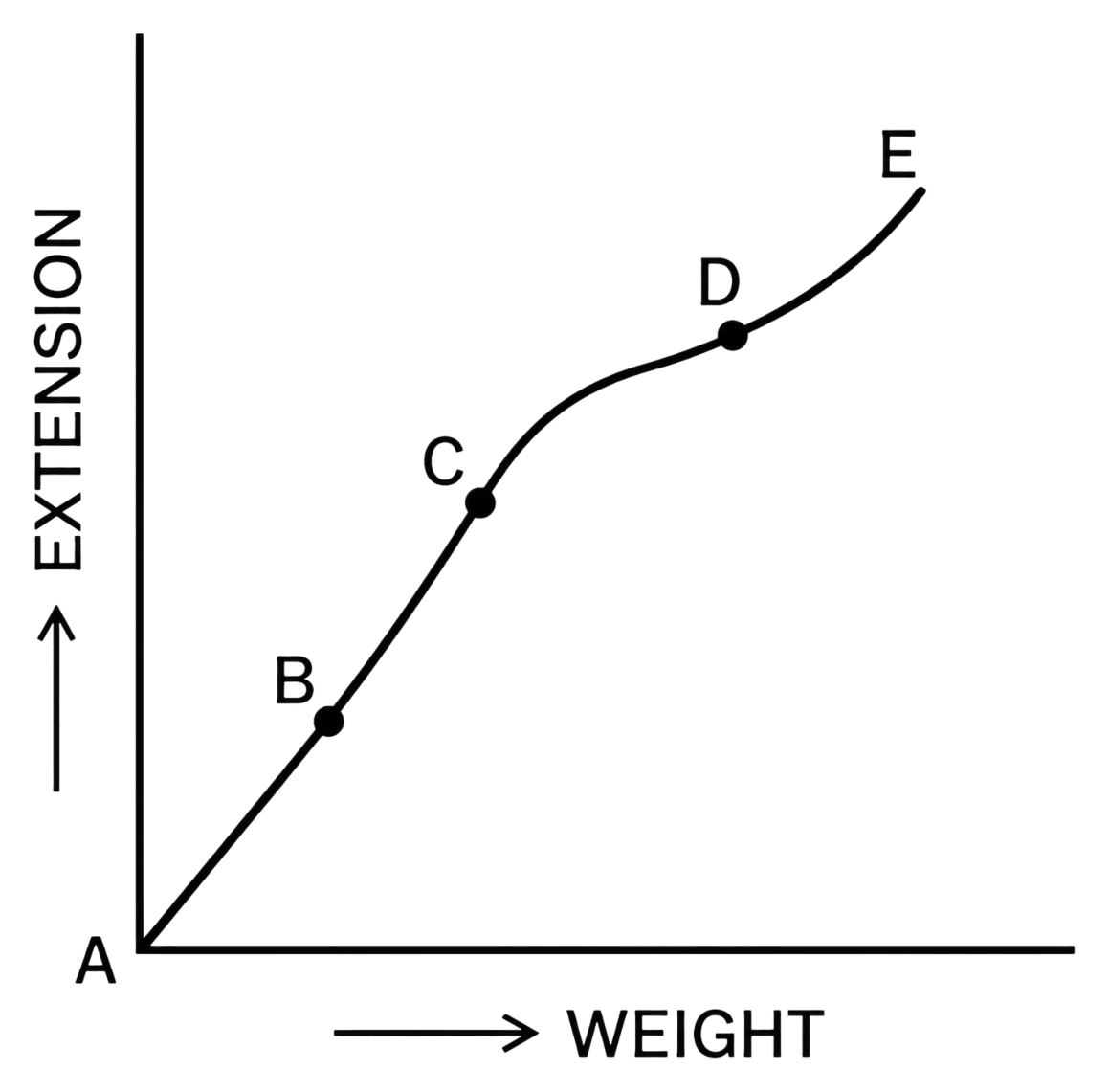
The relationship between the load suspended from a metallic wire and the extension produced in it is shown in the graph. Which part of the graph does indicate extension beyond the elastic limit of the wire? State reason for your answer.
Answer
The part CDE of the graph indicates the extension beyond the elastic limit of the wire.
Upto the point C the graph is a straight line, showing that Hooke's law is obeyed and the extension is proportional to the load. Beyond C the graph becomes curved, which shows that the extension is no longer proportional to the load, that is, Hooke's law is not obeyed. This curvature of CDE is the evidence that the wire has been extended beyond its elastic limit and has entered the plastic region.
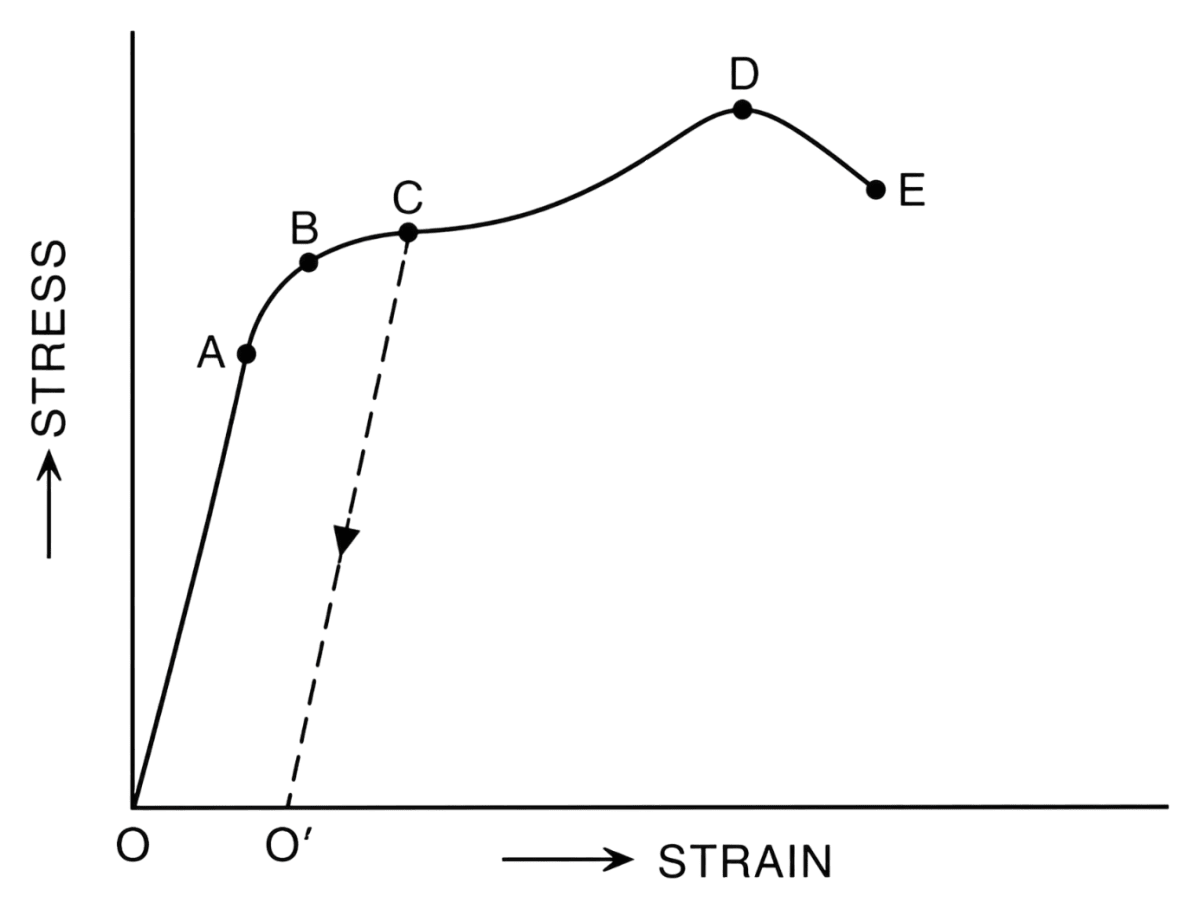
One end of an elastic wire is suspended by a rigid support and the other end is loaded with gradually increasing weight, and the corresponding strain is measured. A graph between stress and strain is shown in the figure. Explain the points A, B and C shown in the given figure.
Answer
Point A — limit of proportionality : Upto the point A the graph is a straight line, so the stress is directly proportional to the strain and Hooke's law is obeyed. A is therefore called the limit of proportionality.
Point B — elastic limit : Between A and B the curve deviates from the straight line, so the stress is no longer exactly proportional to the strain, but the wire still regains its original length when the load is removed. B is therefore the elastic limit of the wire.
Point C — yield point : Beyond B the wire enters the plastic region. On removing the load at C, the wire does not return to its original length and a permanent extension is left in it. C is therefore called the yield point.
Identical springs of steel and copper are equally stretched. On which more work will have to be done?
Answer
The work done in stretching a wire through x is
The springs are identical, so A and L are equal, and they are equally stretched, so x is the same. Hence W ∝ Y.
Since the Young's modulus of steel is greater than that of copper, more work has to be done on the steel spring.
Hence, more work will have to be done on the steel spring.
Young's modulus of a material is 2.5 × 10¹² N/m2. How much force will be required to double 1 metre length of a wire of this material?
Answer
Given,
- Young's modulus of the material, Y = 2.5 × 10¹² N/m2
- Original length of the wire, L = 1 m
- Final length = 2 m, so the increase in length ΔL = 1 m
To double the length of the wire, the longitudinal strain required is
From the definition of the Young's modulus,
Hence, the force required is (2.5 × 10¹²) × A newton, where A is the area of cross-section of the wire.
The Young's modulus of elasticity of a material is 20 × 1012 N/m2. How much force is required to double the length of a cube of side one metre of this material?
Answer
Given,
- Young's modulus of the material, Y = 20 × 1012 N/m2
- Side of the cube, L = 1 m, so the area of cross-section A = L2 = 1 m2
- To double the length, ΔL = 1 m
The longitudinal strain required is
Therefore the force required is
Hence, the force required is 20 × 1012 N.
The length of a wire increases by 1% when a load of 1.5 kg is suspended. Calculate the linear strain produced in the wire.
Answer
Given,
- Increase in the length of the wire = 1% of its original length
The linear (longitudinal) strain is the ratio of the change in length to the original length,
Hence, the linear strain produced in the wire is 0.01.
The length of a wire increases by 8 mm when a load of 1 kg is hanged through it. What is the change in length of the wire if its radius is doubled, keeping other conditions unchanged?
Answer
Given,
- Increase in length with the original wire, ΔL1 = 8 mm
- The radius is doubled, so r2 = 2r1
The increase in length of a loaded wire is
Since Mg, L and Y remain unchanged, . Therefore
Hence, the change in length of the wire will be 2 mm.
The lengths of two wires made of same material having equal cross-sectional areas are L and 2 L. These are stretched by applying equal forces F, F along the length. What will be the ratio of tensions developed in the wires?
Answer
The ratio of the tensions developed in the two wires is 1 : 1.
The tension developed in a stretched wire is equal to the force applied along its length. Since equal forces F, F are applied on both the wires, the tensions developed in them are also equal, irrespective of their lengths.
Two wires of same material have lengths L, 2L and radii 2 r, r. Equal weights are applied on them. Find the ratio of elongation produced in two wires.
Answer
Given,
- First wire : length L, radius 2r
- Second wire : length 2L, radius r
- Equal weights Mg are applied and the material is the same, so Y is the same
The Young's modulus of the material of a wire is
Therefore, for the two wires,
Hence, the ratio of the elongations produced in the two wires is 1 : 8.
The value of Young's modulus of brass is half than that of iron. The length of a brass wire is equal to the length of an iron wire. Equal stress is applied on both wires. Calculate the ratio of increase in lengths of these two wires.
Answer
Given,
- The lengths of the two wires are equal and equal stress is applied on both
For a given stress and a given length,
that is, . Therefore
Hence, the ratio of the increase in lengths of the brass and the iron wires is 2 : 1.
Young's modulus of steel and copper are 2.0 × 10¹¹ and 1.2 × 10¹¹ N/m2 respectively. (i) Steel and copper wires of the same length and the same cross-section are pulled by the same weight. Compare the increase in lengths in them. (ii) If the wires are of different lengths but increase in their lengths is same, then compare their initial lengths.
Answer
Given,
- Y1 (steel) = 2.0 × 10¹¹ N/m2
- Y2 (copper) = 1.2 × 10¹¹ N/m2
The increase in length of a loaded wire is .
(i) Here Mg, L and A are the same, so ,
Hence, the increase in lengths of the steel and the copper wires are in the ratio 3 : 5.
(ii) Here Mg, A and ΔL are the same, so L ∝ Y,
Hence, the initial lengths of the steel and the copper wires are in the ratio 5 : 3.
Explain elasticity with the help of molecular model of solid.
Answer
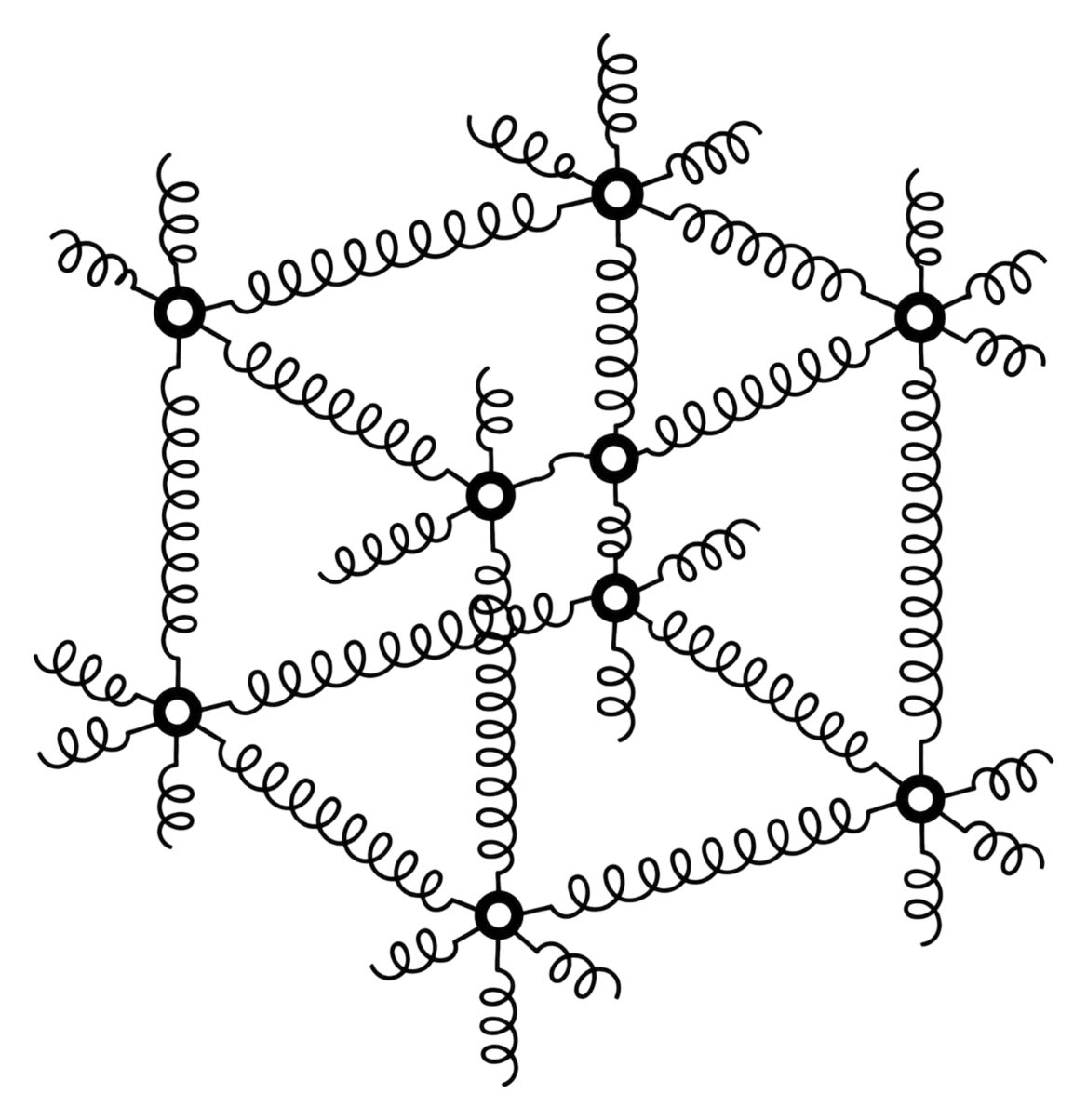
The atoms of a solid are held together in a regular array by electric forces, in a way as if they were connected by springs. Under these forces the solid remains in its natural equilibrium state, in which the distribution of positive and negative atomic charges is such that there is no net force between the atoms. The intermolecular separation corresponding to this state is called the equilibrium distance r0.
When the solid is compressed : The distance between the atoms decreases and the distribution of charges changes in such a way that a net force of repulsion begins to act between them. This is called the interatomic force. When the external force is removed, this force pushes the atoms back to their initial positions so that the solid returns to its original size.
When the solid is stretched : The interatomic space increases and the distribution of charges changes so that there is a net force of attraction between the atoms. When the external force is removed, this force of attraction brings the atoms close to each other, back to their initial positions.
Thus the property of elasticity arises from the interatomic forces which tend to restore the equilibrium distance between the atoms. If the applied force is very large, the atoms move so far apart that the force of attraction between them becomes negligible; there is then a permanent dislocation of the atoms and, on removing the force, the solid does not return to its original size.
A thick rope of density ρ and length L is hung from a rigid support. The Young's modulus of the material of rope is Y. What is the increase in length of the rope due to its own weight?
Answer
Let A be the area of cross-section of the rope. The weight of the rope is
This weight acts at the centre of gravity of the rope, which lies at a distance from the rigid support. Hence the effective length over which the extension is produced is .
The Young's modulus of the material of the rope is
Substituting F = ALρg,
Hence, the increase in length of the rope due to its own weight is .
Figure shows a cylindrical rod of area of cross-section A. Its lower end is fixed while upper end is free. Force 'F' acts on free surface at angle 'θ' with the vertical. Find :
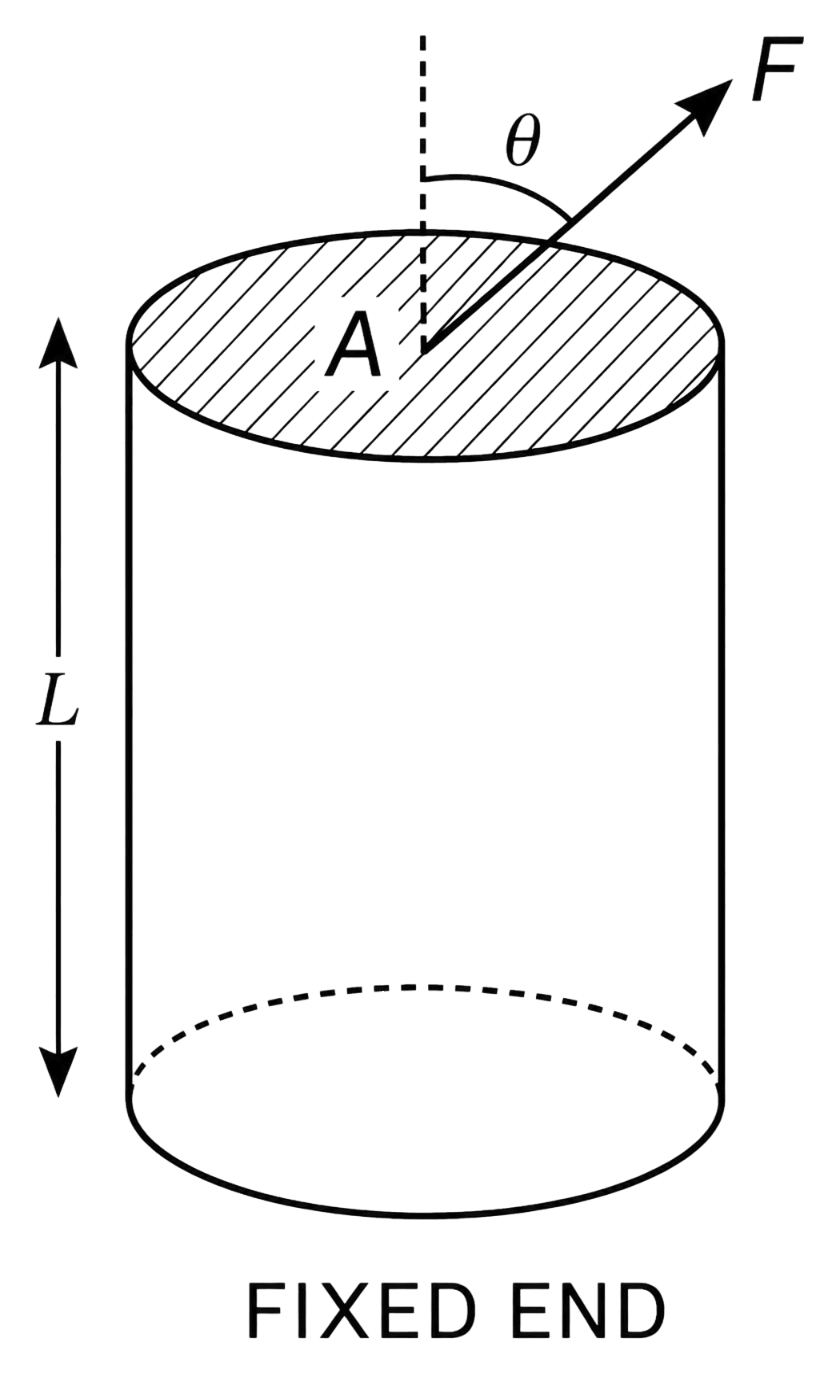
(i) longitudinal stress across free surface.
(ii) shear stress across free surface.
Answer
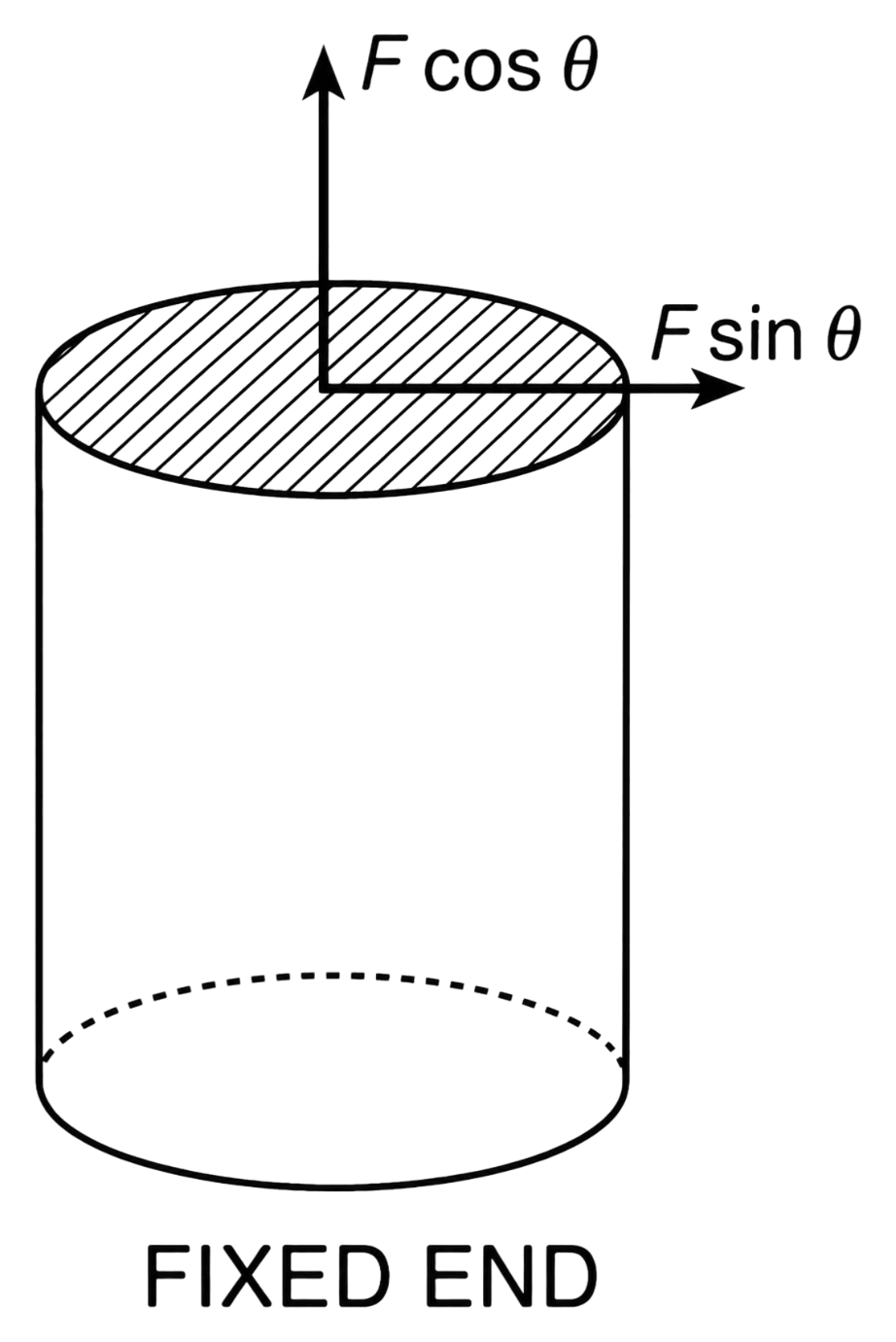
The force F acting on the free surface makes an angle θ with the vertical. It is resolved into two components — a component F cos θ normal to the free surface and a component F sin θ along (tangential to) the free surface.
(i) Longitudinal stress : This is produced by the normal component of the force,
(ii) Shear stress : This is produced by the tangential component of the force,
Two springs of spring constants k1 and k2 are stretched : (i) by equal force and (ii) by equal distance. On which spring will the work done be more?
Answer
The work done in stretching a spring through x is
(i) Stretched by equal force : Putting ,
For an equal value of the force, .
Hence, for equal forces a greater amount of work will be done in stretching the spring of smaller force constant.
(ii) Stretched by equal distance : For an equal value of x, W ∝ k.
Hence, for equal extensions more work will be done in stretching the spring of larger force constant.
Write copper, steel, glass and rubber in decreasing order of their modulus of elasticity.
Answer
In the decreasing order of their modulus of elasticity the materials are : steel, copper, glass, rubber.
Steel has the highest Young's modulus of the four and therefore resists deformation most strongly, while rubber has the lowest and stretches a great deal even under a small stress.
The length of a wire is cut to half. (i) What will be the effect on the increase in its length under a given load? (ii) What will be the effect on the maximum load which it can bear?
Answer
(i) For a given load, the increase in length of a wire is , that is, ΔL ∝ L. On cutting the wire to half its length, the increase in length is also halved.
Hence, the increase in length will be reduced to half.
(ii) The maximum load a wire can bear is (breaking stress × area of cross-section). Cutting the wire changes neither the breaking stress of the material nor the area of cross-section.
Hence, there will be no effect on the maximum load which the wire can bear.
A wire is replaced by another wire of the same length and material but of twice diameter. (i) What will be the effect on the increase in its length under a given load? (ii) What will be the effect on the maximum load which it can bear?
Answer
(i) On suspending the same load on wires of the same length and the same material,
If the diameter is doubled, the radius becomes 2r and
Hence, the increase in length will be reduced to one-fourth.
(ii) The maximum load is proportional to the area of cross-section. Since the diameter is doubled, the area becomes four times,
Hence, the maximum bearable load will become four times.
What do you understand by Poisson's ratio?
Answer
When a material elongates along a certain direction under a tensile stress, it contracts along the perpendicular directions. The fractional change in the direction along which the forces have been applied is called the longitudinal strain, while the fractional change in a perpendicular direction is called the lateral strain.
The ratio of the lateral strain to the longitudinal strain is called the Poisson's ratio. It is a constant for the material of the body and is denoted by σ.
For a wire of original length L and diameter D,
Poisson's ratio has no unit and no dimensions. Theoretically its value lies between − 1 and 0.5, but for most solid materials it lies between 0.25 and 0.35.
Two different types of rubber are found to have the stress-strain curves, as shown.
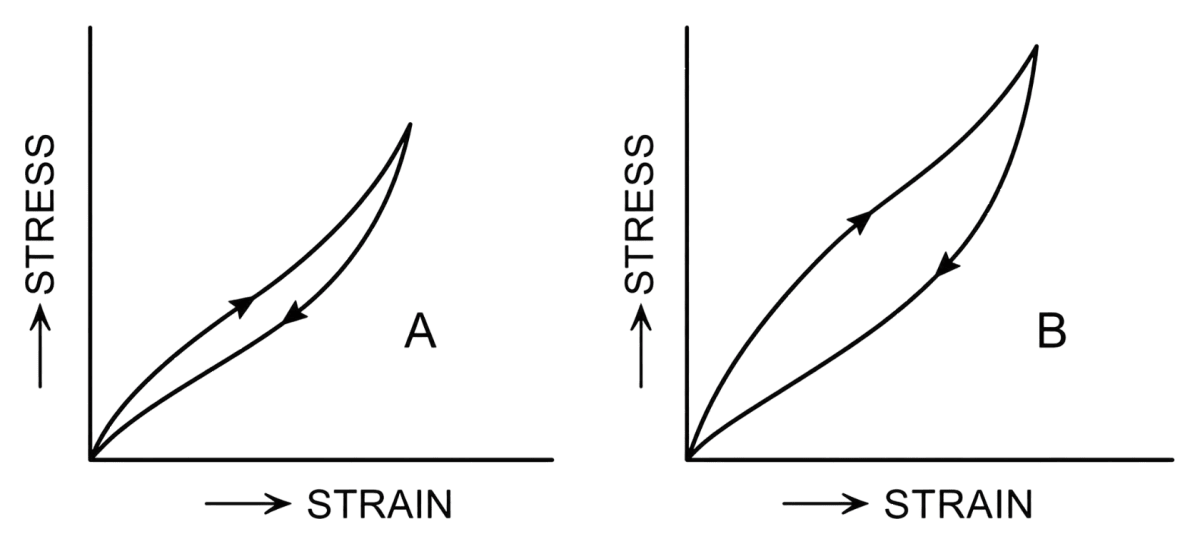
(a) In what respects do these curves differ from the corresponding curve of a metal?
(b) Which of the two rubbers A and B would you prefer to use as shock-absorber sheets to be placed between a heavy machine and the floor?
(c) Which of the two rubbers A and B would you choose for a car tyre?
Answer
(a) The curves of the two rubbers differ from the corresponding curve of a metal in the following respects :
(i) Hooke's law is not obeyed even for small stresses, so there is no initial straight portion in the curve.
(ii) There is no permanent strain even for large stresses, that is, the rubber returns to its original length.
(iii) The same curve is not retraced during unloading, so a closed loop is formed. This is the presence of elastic hysteresis.
(b) Rubber B should be used as the shock-absorber sheet. The area of the hysteresis loop for rubber B is larger than that for A. This means that rubber B dissipates a larger amount of energy as heat in each cycle of loading and unloading, and so it will dissipate a larger amount of the vibrational energy of the machine.
(c) Rubber A should be used for making a car tyre. Since the area of its hysteresis loop is smaller, it will dissipate a smaller amount of kinetic energy as heat and will not get heated too much. This will decrease the wear and tear of the tyre.
A wire of length L and cross-sectional area A is made of material of Young's modulus Y. What is the work done in stretching the wire by an amount x?
Answer
The work done in stretching the wire is equal to the elastic potential energy stored in it,
Here the strain is and the volume of the wire is AL. Substituting these,
Hence, the work done in stretching the wire by an amount x is .
A metallic wire is suspended by attaching some weight to it. If α is the longitudinal strain and Y is Young's modulus then find the ratio between elastic potential energy and the energy density.
Answer
The elastic potential energy stored in the stretched wire is
Since stress = Y × strain = Yα, we have
The energy density is the elastic potential energy per unit volume of the wire,
Therefore,
Hence, the ratio of the elastic potential energy to the energy density is equal to the volume of the wire.
If identical springs of steel and copper are pulled by applying equal forces, then, on which spring more work will have to be done ?
Answer
The work done in stretching a spring by applying a force F is
For identical springs pulled by equal forces, .
Since the Young's modulus of steel is greater than that of copper, the steel spring will be stretched to a smaller extent and less work will be done on it.
Hence, more work will have to be done on the copper spring.
Taking the example of a cylinder, show that for a perfectly incompressible body, σ = 0.5.
Answer
Let the original length and diameter of the cylinder be L and D respectively. When it is subjected to a force, let its length increase to L + l and its diameter decrease from D to D − d.
Since the body is perfectly incompressible, its volume remains unchanged. Equating the initial and the final volumes,
or
or
Expanding and neglecting the square of the small quantity ,
Now, since is the product of two very small quantities, it can be neglected. Therefore
But is the ratio of the lateral strain to the longitudinal strain, which is the Poisson's ratio σ.
Hence, for a perfectly incompressible body the Poisson's ratio is 0.5.
Bridge Construction and Material Selection
During the construction of a suspension bridge, engineers must carefully select materials that can withstand the various forces acting on the structure. The bridge's cables, made of high-tensile steel, experience significant tension due to the weight of the bridge and the traffic it carries. This tension creates stress within the cables, leading to elongation. To ensure the cables do not permanently deform, the material's elasticity is crucial. Engineers calculate the Young's modulus of the steel to assess its stiffness. Additionally, the bulk modulus of the concrete used in the bridge's pillars is evaluated to understand how it will compress under the weight of the bridge and environmental factors. The modulus of rigidity is also considered when evaluating the materials used in the bridge's deck to resist shear forces. Lastly, engineers take into account Poisson's ratio to predict the lateral contraction that occurs when materials are stretched or compressed. Understanding these properties ensures the bridge remains safe and functional under various loads.
(i) What does Young's modulus indicate about the bridge's cables?
- The ability to withstand shear forces.
- The material's elasticity under compressive stress.
- The stiffness of the material under tensile stress.
- The material's resistance to volume change under pressure.
(ii) Why is the bulk modulus important in the context of the bridge's pillars?
- It determines the pillars' resistance to tensile stress.
- It indicates how much the pillars will compress under load.
- It measures the pillars' resistance to shear forces.
- It calculates the deformation of the pillars due to torsion.
(iii) How does the modulus of rigidity apply to the bridge's deck?
- It indicates the deck's ability to resist tensile stress.
- It determines the deck's resistance to compressive forces.
- It affects the deck's response to shear forces.
- It calculates the deck's resistance to volume change under pressure.
(iv) Poisson's ratio is relevant to the bridge's materials because it predicts:
- the resistance to compressive stress.
- the change in volume under pressure.
- the material's ability to resist shear stress.
- the lateral contraction or expansion when stretched or compressed.
(v) What role does elastic hysteresis play in the performance of the bridge's materials?
- It indicates the materials stiffness under tensile stress.
- It determines the energy lost in the material during cyclic loading.
- It measures the materials resistance to volume change.
- It calculates the materials ability to return to its original shape after deformation.
Answer
(i) The stiffness of the material under tensile stress.
Young's modulus measures the stiffness of a material when it is subjected to tensile stress. For the bridge's cables, a higher Young's modulus indicates less elongation under tension, which ensures the structural integrity of the bridge.
(ii) It indicates how much the pillars will compress under load.
The bulk modulus measures a material's resistance to uniform compression. For the concrete pillars it is important because it tells engineers how much the pillars will compress under the weight of the bridge and other forces.
(iii) It affects the deck's response to shear forces.
The modulus of rigidity, or shear modulus, measures how a material responds to shear stress. For the bridge's deck this modulus ensures that it can resist shear forces without significant deformation, maintaining the integrity of the deck.
(iv) the lateral contraction or expansion when stretched or compressed.
Poisson's ratio is the ratio of the lateral strain to the longitudinal strain. It is important for predicting how much a material will contract or expand laterally when it is stretched or compressed, which is critical in ensuring that the materials perform as expected under load.
(v) It determines the energy lost in the material during cyclic loading.
Elastic hysteresis refers to the energy loss that occurs when a material is subjected to repeated cycles of loading and unloading. A material with low hysteresis will better maintain its shape and strength over time, which is important for the long-term durability of the bridge.
Aircraft Design and Material Behaviour
In the design of modern aircraft, engineers must consider the mechanical properties of materials to ensure safety and performance. The fuselage, typically made from aluminum alloys, experiences stress and strain due to pressurisation and aerodynamic forces during flight. The Young's modulus of the alloy is a critical factor in determining how much the fuselage will deform under these stresses. The modulus of rigidity is particularly important for the wings, which must resist twisting and bending during maneuvers. Engineers also evaluate the bulk modulus to ensure that the materials can withstand the pressure changes without excessive volume change. The aircraft's structural components are designed to have an optimal Poisson's ratio to balance the lateral and axial deformations. Additionally, the elastic potential energy stored in the aircraft's components during flight must be managed to prevent failure. Understanding these properties helps engineers design aircraft that are both lightweight and robust, capable of enduring the rigors of flight.
(i) Why is Young's modulus important for the aircraft's fuselage?
- It determines the fuselage's resistance to shear stress.
- It indicates the material's compressibility.
- It measures the stiffness of the fuselage under tensile stress.
- It affects the energy stored in the fuselage during deformation.
(ii) How does the modulus of rigidity affect the aircraft's wings?
- It determines the wings' resistance to bending and twisting.
- It measures the wings' compressibility under load.
- It affects the wings' ability to resist tensile stress.
- It indicates the wings' ability to store elastic potential energy.
(iii) What role does the bulk modulus play in aircraft design?
- It predicts how the material will behave under tensile stress.
- It determines the material's resistance to shear forces.
- It measures the materials resistance to volume change under pressure.
- It calculates the energy lost during cyclic loading.
(iv) Poisson's ratio is considered in aircraft design because it:
- measures the stiffness under tensile stress.
- predicts lateral and axial deformations under stress.
- indicates the resistance to volume change.
- calculates the energy stored in materials during deformation.
(v) How does elastic potential energy impact the aircraft's safety?
- It determines the materials resistance to tensile stress.
- It measures the materials ability to resist shear forces.
- It indicates the energy stored in materials during deformation.
- It predicts the materials behaviour under compressive stress.
Answer
(i) It measures the stiffness of the fuselage under tensile stress.
Young's modulus is crucial for determining how much the fuselage will deform under the tensile stress arising from pressurisation and aerodynamic forces. A high Young's modulus ensures that the fuselage remains stiff and maintains its shape.
(ii) It determines the wings' resistance to bending and twisting.
The modulus of rigidity, or shear modulus, is crucial for the wings because it measures their resistance to shear forces, such as those encountered during flight manoeuvres. This ensures that the wings do not deform excessively, maintaining the stability of the aircraft.
(iii) It measures the materials resistance to volume change under pressure.
The bulk modulus indicates how much a material will compress under pressure. For an aircraft, a high bulk modulus ensures that the materials can withstand pressure changes without significant volume changes, which is critical for maintaining the structural integrity of the aircraft.
(iv) predicts lateral and axial deformations under stress.
Poisson's ratio is used to predict the relationship between the lateral and the axial deformations in materials. This is important in aircraft design to ensure that the materials behave predictably under stress, maintaining the structural integrity and performance of the aircraft.
(v) It indicates the energy stored in materials during deformation.
Elastic potential energy is the energy stored in a material when it is deformed. Managing this energy is crucial to prevent sudden failures in the material, which could compromise the safety of the aircraft during flight.
When deforming force is applied on a body, its size or shape or both change. On removal of the deforming force, the body recovers its original size or shape. This property of material is called elasticity. If small solid balls of different materials are dropped from the same height on a hard floor, then after striking the floor different balls will rise to different heights. The substance of the balls rising to the greatest height will be most elastic.
(i) Define limit of elasticity.
(ii) Explain why steel is more elastic than rubber.
(iii) Three small solid balls of equal radii of ivory, rubber and wet-clay are dropped from the same height on a hard floor. On striking the floor which ball will rise to the greatest height and which one to a smaller height?
Answer
(i) Limit of elasticity : Elastic bodies recover their original state when the deforming forces are removed, but they show this property only upto a certain value of the deforming force. The maximum deforming force upto which a body retains its property of elasticity is called the limit of elasticity of the material of the body.
(ii) Suppose two wires of the same length and the same radius, one of steel and the other of rubber, are suspended from a rigid support and equal weights are attached to their lower ends. The force required to produce a given change in length is more for steel than for rubber, that is,
and experimentally ΔLR > ΔLS, so YS > YR. Greater is the force required to produce a given change in the size or shape of a body, the more elastic the body is said to be.
Hence, steel is more elastic than rubber.
(iii) Ivory is more elastic than rubber, while wet-clay is almost plastic.
Hence, the ivory ball will rise to the greatest height and the wet-clay ball will rise to a smaller height.
Explain fully the terms stress, strain and define Young's modulus of elasticity.
Answer
Stress : When a body is acted upon by an external (deforming) force, the intermolecular separation corresponding to the equilibrium distance is affected and internal forces arise which tend to restore the body to its original shape and size. These are called restoring forces. The restoring force acting per unit area within a body is termed as stress.
Its S.I. unit is the pascal (Pa) and its dimensional formula is [M L-1 T-2]. Stress is classified as follows :
(a) Normal stress, produced when the applied force is perpendicular to the cross-section of the material. It is further divided into tensile stress, which occurs when equal and opposite forces are applied at the two ends of a material tending to elongate it, and compressive stress, which occurs when equal and opposite forces are applied towards each other, tending to shorten it.
(b) Tangential or shearing stress, produced when two equal and opposite forces act along the tangents to the surfaces of two opposite faces of an object, so that one face gets displaced relative to the other.
(c) Volumetric or bulk stress, produced when a body is subjected to uniform pressure from all directions, so that its volume changes without any change in shape.
Strain : Strain is a measure of how much a body has changed compared to its original size. It is the fraction of change, and not the actual change. Strain has no unit, being a pure number. It is classified as follows :
(a) Longitudinal strain : the ratio of the change in length to the initial length of a body under a tensile or compressive stress,
(b) Volumetric strain : the ratio of the change in volume to the original volume when a body is subjected to uniform pressure from all sides,
(c) Shearing strain : the angle θ through which a face of a body originally perpendicular to the fixed face is turned when it is under a shearing stress.
Young's modulus of elasticity : When a body whose length is very large as compared to its breadth and thickness is acted upon by two equal and opposite forces along the direction of its length, the length of the body changes. The change in length per unit length is called the longitudinal strain and the force applied per unit area of cross-section is called the longitudinal stress.
Within the elastic limit upto which Hooke's law is applicable, the ratio of the longitudinal stress to the corresponding longitudinal strain is called the Young's modulus of the material of the body. It is denoted by Y.
Its S.I. unit is newton/metre2 (N m-2) or pascal (Pa) and its dimensional formula is [M L-1 T-2]. Y can be determined only for solids and is a characteristic of the material of a solid.
What do you understand by the term limit of elasticity? State Hooke's law.
Answer
Limit of elasticity : Elastic bodies recover their original state when the deforming forces are removed, but they show this property only upto a certain value of the deforming force. If we go on increasing the deforming force, a stage will be reached when on removing the force the body will not return to its original state.
For example, if a small load is applied at the lower end of a wire suspended vertically from a rigid support, the length of the wire is increased; when the load is removed, the wire acquires its original length. If we increase the load step by step, a stage is reached when on removing the load the wire does not recover its original length but its length is permanently increased. Thus its property of elasticity is destroyed.
The maximum deforming force upto which a body retains its property of elasticity is called the 'limit of elasticity' of the material of the body.
Hooke's law : When a material is stretched, compressed, twisted or otherwise deformed slightly, it resists that deformation. Hooke's law describes the relationship between the stress and the strain so produced.
Statement : Within the elastic limit of a material, stress is directly proportional to strain.
Here E is a constant of proportionality called the modulus of elasticity, that is, the ratio of stress to the corresponding strain within the elastic limits. Its S.I. unit is the pascal (N m-2) and its dimensional formula is [M L-1 T-2].
The modulus of elasticity E is a constant for a given material, though it differs from one material to another. It is independent of the dimensions of the body — such as its length, area of cross-section or volume. For example, two iron wires, one 1 cm long and the other 1 km long, will have the same modulus of elasticity.
Define longitudinal strain, stress and Young's modulus.
Answer
Longitudinal stress : When a body whose length is very large compared to its breadth and thickness is acted upon by two equal and opposite forces along the direction of its length, the force applied per unit area of cross-section of the body is called the longitudinal stress.
Longitudinal strain : The change in length per unit length of the body is called the longitudinal strain.
Being a ratio of two lengths, it is a pure number and has no unit.
Young's modulus : Within the elastic limit upto which Hooke's law is applicable, the ratio of the longitudinal stress to the corresponding longitudinal strain is called the Young's modulus of the material of the body. It is denoted by Y.
Its S.I. unit is newton/metre2 (N m-2) or pascal (Pa).
Explain the terms stress and strain. Write their types and compare elasticity with inertia.
Answer
Stress : When a body is acted upon by an external deforming force, internal restoring forces arise within it which tend to restore it to its original shape and size. The restoring force acting per unit area within a body is termed as stress, that is, . Its S.I. unit is the pascal (Pa).
Types of stress :
(a) Normal stress, in which the applied force is perpendicular to the cross-section. It is of two kinds — tensile stress, which tends to elongate the body, and compressive stress, which tends to shorten it.
(b) Tangential or shearing stress, which is the ratio of the force acting along the tangent to a surface to the area of that surface. It causes sliding between adjacent layers of the material without changing the overall volume.
(c) Volumetric or bulk stress, which is the change in pressure acting uniformly on a body per unit area over which it acts. It compresses the material equally from all sides.
Strain : Strain tells how much a body has changed compared to its original size. Strain is about the fraction of change, and not the actual change. It has no unit.
Types of strain :
(a) Longitudinal strain, — the fractional change in length under a tensile or compressive stress.
(b) Volumetric strain, — the fractional change in volume under uniform pressure from all sides.
(c) Shearing strain, θ — the angular deformation produced when a body is subjected to a tangential stress.
Comparison of elasticity with inertia :
| Elasticity | Inertia |
|---|---|
| It is the property by which a body opposes any change in its shape or size caused by an external force. | It is the property by which a body opposes any change in its state of rest or of uniform motion. |
| It is measured by the modulus of elasticity of the material. | It is measured by the mass of the body. |
| It depends on the nature of the material of the body. | It depends only on the mass of the body and not on its material. |
| The body regains its original configuration when the deforming force is removed. | The body continues in its state of rest or of uniform motion unless an external force acts on it. |
Draw a graph between the load suspended from a wire and the extension produced in the length of the wire. Mark the elastic limit on the graph. Which part of the graph is related to the Young's modulus of the material of the wire?
Answer
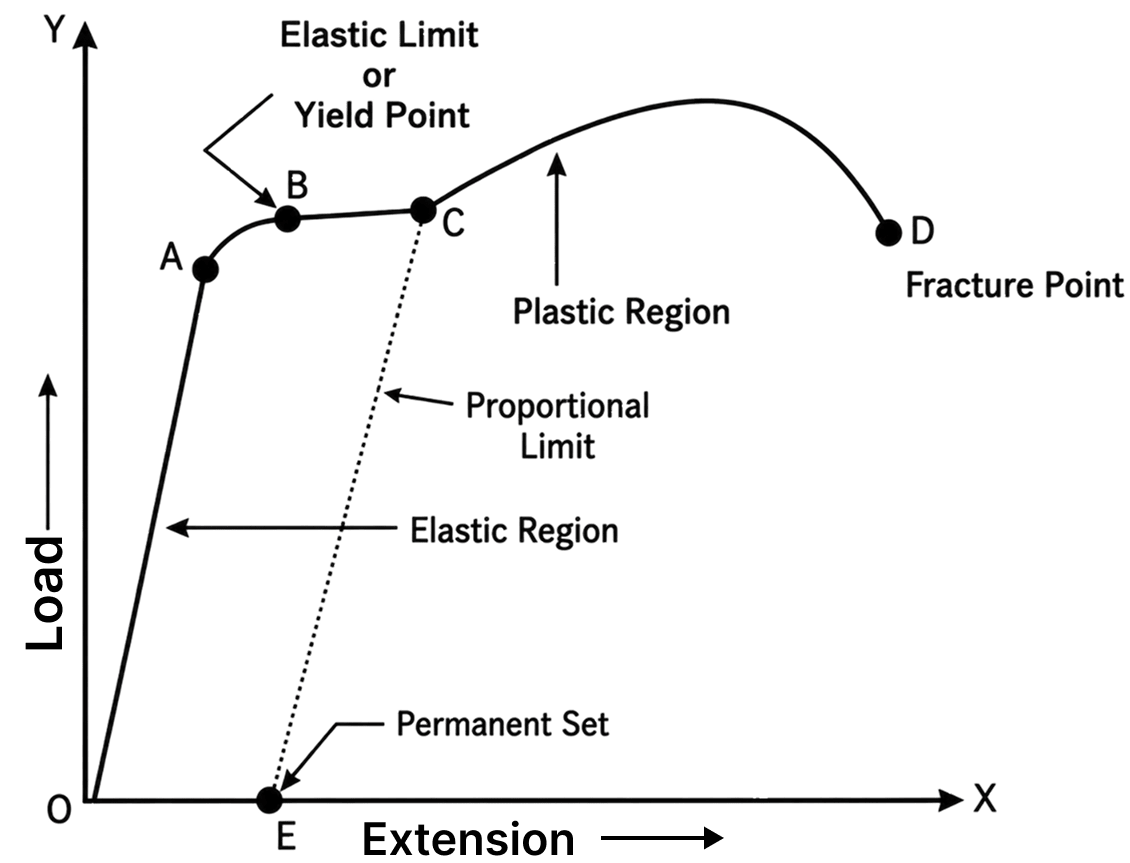
When a wire is subjected to a gradually increasing load, its extension changes in a characteristic manner, which is represented by the graph shown above.
Region OA : In this initial stage the graph is a straight line, showing that the stress is directly proportional to the strain. This is the region where Hooke's law is obeyed, and the point A is called the limit of proportionality.
Point B — elastic limit : Beyond A the curve deviates from the straight line, indicating that the stress is no longer exactly proportional to the strain. However, if the load is removed anywhere between O and B, the wire regains its original length and the curve is retraced back to the origin. The point B is therefore the elastic limit or yield point, and is marked on the graph.
Region BC : Here the strain increases more rapidly than the stress. If the load is removed within this region the wire does not return to its original length, leaving a permanent extension. This marks the start of plastic deformation.
Point D : As the load increases beyond C, local constrictions called necks develop in the wire and it finally breaks at D, the fracture point.
The straight part OA of the graph is related to the Young's modulus of the material of the wire, since it is only in this linear region that stress is proportional to strain, and the slope of this part gives the Young's modulus.
Prove that on stretching a wire, the elastic potential energy per unit volume stored in the wire is × stress × strain.
or
Prove that the work done per unit volume in increasing the length of a wire by applying an external force is equal to ( × stress × strain).
Answer
When a wire is stretched, work is done against the inter-atomic forces. This work is stored in the wire in the form of elastic potential energy.
Suppose the length of a wire is L and its area of cross-section is A. Suppose that on applying a force F along the length of the wire, its length increases by x. Then
The Young's modulus of the material of the wire is
Thus the force necessary to increase the length of the wire by x is
Now, if the wire is further increased by an infinitesimally small length dx, then the work done is
Therefore, in increasing the original length L to L + l, that is, from x = 0 to x = l, the total work done is obtained by integration,
This may be rewritten as
since Y × strain = stress and AL is the volume of the wire.
This work remains stored in the wire in the form of elastic potential energy U. Thus,
Therefore the elastic potential energy per unit volume of the wire is
Hence, the elastic potential energy per unit volume stored in a stretched wire is × stress × strain.
Further, since stress = Young's modulus × strain,
Length, area of cross-section and modulus of elasticity of a wire are L, A and Y respectively. The length of the wire increases by x on stretching the wire by applying a force along the wire. Calculate the work done on the wire. What happens to this work done?
Answer
Given,
- Length of the wire = L
- Area of cross-section = A
- Modulus of elasticity = Y
- Increase in length = x
The force necessary to increase the length of the wire by x is
The work done in a further infinitesimal increase dx is dW = F dx. Hence the total work done in increasing the length from 0 to x is
Hence, the work done on the wire is .
In stretching the wire this work is done against the inter-atomic forces between the atoms of the wire. It is not lost, but remains stored in the stretched wire in the form of elastic potential energy, which is recovered when the deforming force is removed.
A weight of 1.0 kg is suspended from the lower end of a wire of cross-section 10 sq. mm. Find the stress produced in it. (g = 9.8 m/s2).
Answer
Given,
- Mass suspended, M = 1.0 kg
- Area of cross-section, A = 10 mm2 = 10 × 10-6 m2 = 10-5 m2
- g = 9.8 m/s2
The longitudinal stress produced in the wire is the force per unit area of cross-section,
Substituting the values,
Hence, the stress produced in the wire is 9.8 × 10⁵ N/m2.
In order to produce a longitudinal strain of 2 × 10⁻⁴, a stress of 2.4 × 10⁷ N/m2 is produced in a wire. Calculate the Young's modulus of the material of the wire.
Answer
Given,
- Longitudinal strain = 2 × 10⁻⁴
- Longitudinal stress = 2.4 × 10⁷ N/m2
The Young's modulus of the material of the wire is
Substituting the values,
Hence, the Young's modulus of the material of the wire is 1.2 × 10¹¹ N/m2.
A 4.0 m long wire has 1.2 cm2 cross-sectional area. It is stretched by a force of 4.8 × 10³ N. Calculate the stress and increase in length of wire. Given Y = 1.2 × 10¹¹ N/m2.
Answer
Given,
- Length of the wire, L = 4.0 m
- Area of cross-section, A = 1.2 cm2 = 1.2 × 10⁻⁴ m2
- Force applied, F = 4.8 × 10³ N
- Young's modulus, Y = 1.2 × 10¹¹ N/m2
Stress : The stress produced in the wire is
Increase in length : From the definition of the Young's modulus,
Substituting the values,
Hence, the stress produced is 4 × 10⁷ N/m2 and the increase in length of the wire is 13.3 × 10⁻⁴ m.
If Young's modulus for steel is 2.0 × 10¹¹ N/m2 , then how much weight be suspended from a steel wire of length 2.0 m and diameter 1.0 mm so that the length of the wire be increased by 1.0 mm ? (g = 9.8 m/s2).
Answer
Given,
- Young's modulus of steel, Y = 2.0 × 10¹¹ N/m2
- Length of the wire, L = 2.0 m
- Diameter of the wire = 1.0 mm, so radius r = 0.5 × 10⁻³ m
- Increase in length, ΔL = 1.0 mm = 1.0 × 10⁻³ m
- g = 9.8 m/s2
The area of cross-section of the wire is
The Young's modulus of the material of the wire is
Substituting the values,
Therefore the mass to be suspended is
Hence, a weight of 8.0 kg should be suspended from the steel wire.
Calculate the increase in energy of a brass bar of length 0.5 m and cross-sectional area 1.0 cm2, when compressed with a load of 5 kg weight along its length. (Y for brass = 1.0 × 10¹¹ N/m2, g = 10 m/s2)
Answer
Given,
- Length of the brass bar, L = 0.5 m
- Area of cross-section, A = 1.0 cm2 = 1.0 × 10⁻⁴ m2
- Compressing load, Mg = 5 × 10 = 50 N
- Young's modulus of brass, Y = 1.0 × 10¹¹ N/m2
The elastic potential energy of the compressed bar is
The stress in the bar is
The strain in the bar is
The volume of the bar is
Substituting these values,
Hence, the increase in energy of the brass bar is 6.25 × 10⁻⁵ J.
The area of cross-section and length of a wire are 0.5 mm2 and 4.0 m respectively. How much work will be done to increase its length by 1.0 mm ? Young's modulus of elasticity of the material of the wire is 2.0 × 10¹¹ N/m2.
Answer
Given,
- Area of cross-section, A = 0.5 mm2 = 0.5 × 10⁻⁶ m2
- Length of the wire, L = 4.0 m
- Increase in length, ΔL = 1.0 mm = 1.0 × 10⁻³ m
- Young's modulus, Y = 2.0 × 10¹¹ N/m2
The work done in stretching a wire is
The strain produced is
The volume of the wire is
Substituting these values,
Hence, the work done to increase the length of the wire is 1.25 × 10⁻² J.
The length of a metal wire is 1.0 m and its area of cross-section is 2.5 mm2. It is stretched by 1.0 mm by applying a force. Calculate the elastic potential energy stored in the wire in the stretched condition. Young's modulus of metal is 2.0 × 10¹¹ N-m-2.
Answer
Given,
- Length of the wire, L = 1.0 m
- Area of cross-section, A = 2.5 mm2 = 2.5 × 10⁻⁶ m2
- Increase in length, ΔL = 1.0 mm = 1.0 × 10⁻³ m
- Young's modulus, Y = 2.0 × 10¹¹ N m-2
The elastic potential energy stored in a stretched wire is
The strain produced is
The volume of the wire is
Substituting these values,
Hence, the elastic potential energy stored in the wire is 0.25 J.
The length of a wire is 3.0 m. The cross-sectional area is 1.0 mm2 . How much work have to be done in stretching its length by 0.2 mm ? Young's modulus of the material of the wire is 2.0 × 10¹¹ N/m2.
Answer
Given,
- Length of the wire, L = 3.0 m
- Area of cross-section, A = 1.0 mm2 = 1.0 × 10⁻⁶ m2
- Increase in length, ΔL = 0.2 mm = 0.2 × 10⁻³ m
- Young's modulus, Y = 2.0 × 10¹¹ N/m2
The work done in stretching the wire is
The strain produced is
The volume of the wire is
Substituting these values,
Hence, the work to be done in stretching the wire is 1.33 × 10⁻³ J.
The area of cross-section of a steel wire is 0.5 cm2. What is the necessary force to increase its length to (i) 1.1 times, (ii) twice the initial value ? (Young's modulus for steel = 2.0 × 10¹¹ N/m2)
Answer
Given,
- Area of cross-section, A = 0.5 cm2 = 0.5 × 10⁻⁴ m2
- Young's modulus for steel, Y = 2.0 × 10¹¹ N/m2
From the definition of the Young's modulus,
(i) Length increased to 1.1 times : Here the final length is 1.1 L, so ΔL = 0.1 L and the strain is
(ii) Length increased to twice the initial value : Here the final length is 2 L, so ΔL = L and the strain is
Hence, the necessary force is (i) 1.0 × 10⁶ N and (ii) 1.0 × 10⁷ N.
The Young's modulus of copper is 1.25 × 10¹¹ N/m2. A wire of this material has 1 mm diameter. How much kg-weight should be suspended to produce 0.1 % increase in the length of the wire? (g = 9.8 m/s2)
Answer
Given,
- Young's modulus of copper, Y = 1.25 × 10¹¹ N/m2
- Diameter of the wire = 1 mm, so radius r = 0.5 × 10⁻³ m
- Increase in length = 0.1%
- g = 9.8 m/s2
The strain to be produced is
The area of cross-section of the wire is
From the definition of the Young's modulus,
Substituting the values,
Therefore the weight to be suspended is
Hence, a weight of 10 kg-wt should be suspended from the wire.
A weight of 20 kg is suspended from a wire. The area of cross-section of the wire is 1 mm2 and, when stretched, the length is exactly 6 m. When the weight is removed, the length reduces to 5.995 m. Calculate the Young's modulus (Y) of the material of the wire.
Answer
Given,
- Weight suspended, Mg = 20 × 9.8 = 196 N
- Area of cross-section, A = 1 mm2 = 1 × 10⁻⁶ m2
- Stretched length = 6 m, unstretched length L = 5.995 m
The increase in the length of the wire is
The Young's modulus of the material of the wire is
Substituting the values,
Hence, the Young's modulus of the material of the wire is 2.35 × 10¹¹ N/m2.
The length of a rubber cord increases to 60 cm under a weight of 100 g suspended from it, and to 70 cm under a weight of 120 g. Find the initial length of the cord. Also calculate the weight under which the length of the cord will become 74 cm.
Answer
Given,
- Under a weight of 100 g the length becomes 60 cm
- Under a weight of 120 g the length becomes 70 cm
Let the initial (unstretched) length of the cord be L0. The extension produced is directly proportional to the weight suspended, since
Therefore,
Cross-multiplying,
Hence, the initial length of the cord is 10 cm.
Weight for a length of 74 cm : Under a weight of 100 g the extension is 60 − 10 = 50 cm. For a length of 74 cm the extension required is 74 − 10 = 64 cm. Since the extension is proportional to the weight,
Hence, the length of the cord will become 74 cm under a weight of 128 g.
The length of a wire is 1 m and area of cross-section is 0.5 mm2 . If in increasing its length by 0.1 mm, the work done is 5 × 10⁻⁴ J, then calculate the Young's modulus of the material of the wire.
Answer
Given,
- Length of the wire, L = 1 m
- Area of cross-section, A = 0.5 mm2 = 0.5 × 10⁻⁶ m2
- Increase in length, ΔL = 0.1 mm = 1 × 10⁻⁴ m
- Work done, W = 5 × 10⁻⁴ J
The work done in stretching a wire is
Therefore the Young's modulus of the material is
Substituting the values,
Hence, the Young's modulus of the material of the wire is 2.0 × 10¹¹ N/m2.
The pressure on a fluid having volume 3.0 × 10⁻³ m3 is increased by 6.0 × 10⁶ Nm-2. The volume of the fluid is diminished by 5.0 × 10⁻⁷ m3. Find the coefficient of bulk modulus of the fluid.
Answer
Given,
- Original volume of the fluid, V = 3.0 × 10⁻³ m3
- Increase in pressure, p = 6.0 × 10⁶ N m-2
- Decrease in volume, ΔV = 5.0 × 10⁻⁷ m3
The bulk modulus of the fluid is the ratio of the normal stress to the volume strain,
Substituting the values,
Hence, the bulk modulus of the fluid is 3.6 × 10¹⁰ N/m2.
1.0 m3 of water is taken from the surface of a lake to a depth of 200 m inside the lake. What will be the change in its volume if the bulk modulus of elasticity of water is 22000 atmospheres ? (Density of water = 1.0 × 10³ kg/m3, atmospheric pressure = 105 N/m2 and g = 10 m/s2).
Answer
Given,
- Volume of water, V = 1.0 m3
- Depth inside the lake, h = 200 m
- Bulk modulus of water, K = 22000 atmospheres
- Density of water, ρ = 1.0 × 10³ kg/m3
- 1 atmosphere = 105 N/m2, g = 10 m/s2
The increase in pressure on going to a depth h inside the lake is
The bulk modulus of water is
The bulk modulus of elasticity is
Substituting the values,
Hence, the volume of the water decreases by 9.1 × 10⁻⁴ m3.
A piece of metal of 2 kg-wt is suspended from one end of a vertical wire whose other end is fixed and the piece is fully immersed in an oil of density 0.7 × 10³ kg/m3. The length of the wire increases by 1 mm. If the diameter of the wire is 0.6 mm, Young's modulus is 2.0 × 10¹¹ N/m2 and the volume of the metal-piece is 800 cm3, then calculate the initial length of the wire.
Answer
Given,
- Weight of the metal piece = 2 kg-wt = 2 × 9.8 = 19.6 N
- Density of the oil, ρ = 0.7 × 10³ kg/m3
- Increase in length of the wire, ΔL = 1 mm = 1 × 10⁻³ m
- Diameter of the wire = 0.6 mm, so radius r = 0.3 × 10⁻³ m
- Young's modulus, Y = 2.0 × 10¹¹ N/m2
- Volume of the metal piece, V = 800 cm3 = 8 × 10⁻⁴ m3
Since the metal piece is fully immersed in the oil, an upthrust acts on it equal to the weight of the oil displaced,
Therefore the effective stretching force acting on the wire is
The area of cross-section of the wire is
The Young's modulus of the material of the wire is
Substituting the values,
Hence, the initial length of the wire is 4.0 m.
A substance breaks down by a stress of 109 N/m2. If the density of the substance be 3 × 10³ kg/m3 , find that length of the wire made of the same substance, by which it will break under its own weight when suspended. (g = 9.8 m/s2)
Answer
Given,
- Breaking stress = 109 N/m2
- Density of the substance, ρ = 3 × 10³ kg/m3
- g = 9.8 m/s2
Let L be the length of the wire and A its area of cross-section. The weight of the wire is
The stress due to this weight at the point of suspension is
The wire will break under its own weight when this stress becomes equal to the breaking stress,
Substituting the values,
Hence, a wire of length 3.4 × 10⁴ m will break under its own weight when suspended.
If a stress of 1 kg-wt/mm2 is applied on a wire, then what will be the percentage increase in the length of the wire ? (Y = 1.0 × 10¹¹ N/m2 and 1 kg-wt = 9.8 N).
Answer
Given,
- Stress applied = 1 kg-wt/mm2
- Young's modulus, Y = 1.0 × 10¹¹ N/m2
- 1 kg-wt = 9.8 N
Expressing the stress in S.I. units,
The longitudinal strain produced is
Therefore the percentage increase in the length of the wire is
Hence, the percentage increase in the length of the wire is 0.0098%.