
Two wires are made of the same material and have the same volume. However wire-1 has cross-sectional area A and wire-2 has cross-sectional area 3 A. If the length of wire-1 increases by Δx on applying force F, how much force is needed to stretch wire-2 by the same amount?
- F
- 4 F
- 6 F
- 9 F
Answer
9 F
Reason — Given,
- Area of cross-section of wire-1, A1 = A, and of wire-2, A2 = 3A
- Both wires are of the same material (same Y) and of the same volume
- Elongation of wire-1 = Δx under a force F
Since the two wires have the same volume,
From the definition of the Young's modulus,
For wire-1,
For wire-2, let the required force be F′. For the same elongation Δx,
Equating the two expressions for Δx,
A man grows into a giant such that his linear dimensions increase by a factor of 9. Assuming that his density remains same, the stress in the leg will change by factor of :
9
81
Answer
9
Reason — The stress in the leg is the weight of the body per unit area of cross-section of the leg,
If the original linear dimension is L, then the volume is proportional to L3 and the area of cross-section to L2. When the linear dimensions increase by a factor of 9, the new linear dimension is 9L, so
Since the density ρ remains the same, the stress is directly proportional to the linear dimension. Hence the stress in the leg becomes 9 times its original value.
The bulk modulus of a spherical object is 'B'. If it is subjected to uniform pressure 'p', the fractional decrease in radius is:
Answer
Reason — The bulk modulus of the object is
For a sphere of radius r, the volume is
Taking the fractional change on both sides, the volume strain is three times the linear strain,
Therefore,
A solid sphere of radius r made of a soft material of bulk modulus K is surrounded by a liquid in a cylindrical container. A massless piston of area a floats on the surface of the liquid, covering entire cross-section of cylindrical container. When a mass m is placed on the surface of the piston to compress the liquid, the fractional decrement in the radius of the sphere, is :
Answer
Reason — When a mass m is placed on the massless piston of area a, the increase in the pressure transmitted to the liquid, and hence to the sphere, is
The bulk modulus of the material of the sphere is
For the solid sphere of radius r, , so that
Therefore,
The negative sign indicates the decrease in the radius, so the fractional decrement in the radius is .
An external pressure P is applied on a cube at 0°C so that it is equally compressed from all sides. K is the bulk modulus of the material of the cube and α is its coefficient of linear expansion. Suppose we want to bring the cube to its original size by heating. The temperature should be raised by :
3PKα
Answer
Reason — When the external pressure P is applied, the cube is compressed and the volume strain produced is given by
To bring the cube back to its original size, the same volume must be regained by heating. On heating through Δθ, the volume increases according to
since the coefficient of volume expansion γ = 3α.
Equating the volume strain produced by the pressure to that produced by the heating,
The elastic limit of brass is 379 MPa. What should be the minimum diameter of a brass rod, if it is to support a 400 N load without exceeding its elastic limit?
- 0.90 mm
- 1.00 mm
- 1.16 mm
- 1.36 mm
Answer
1.16 mm
Reason — Given,
- Elastic limit of brass = 379 MPa = 379 × 106 N/m2
- Load to be supported, F = 400 N
Let Dmin be the minimum diameter of the brass rod. The stress in the rod is
For the rod not to exceed its elastic limit, the stress must not exceed 379 × 106 N/m2. Taking the limiting case,
Young's moduli of two wires A and B are in the ratio 7 : 4. Wire A is 2 m long and has radius R. Wire B is 1.5 m long and has radius 2 mm. If the two wires stretch by the same length for a given load, then the value of R is close to :
- 1.3 mm
- 1.5 mm
- 1.9 mm
- 1.7 mm
Answer
1.7 mm
Reason — Given,
- LA = 2 m, radius of A = R
- LB = 1.5 m, radius of B = 2 mm = 2 × 10⁻³ m
- The two wires stretch by the same length l for the same load F
The Young's modulus of each wire is
Dividing,
Substituting the values,
A boy's catapult is made of rubber cord which is 42 cm long with 6 mm diameter of cross-section and of negligible mass. The boy keeps a stone weighing 0.02 kg on it and stretches the cord by 20 cm by applying a constant force. When released the stone flies off with a velocity of 20 m/s. Neglect the change in the area of cross-section of the rod while stretched. The Young's modulus of rubber is closest to :
- 106 N/m2
- 104 N/m2
- 108 N/m2
- 103 N/m2
Answer
106 N/m2
Reason — Given,
- Length of the rubber cord, L = 42 cm = 0.42 m
- Extension of the cord, l = 20 cm = 0.2 m
- Diameter of cross-section, D = 6 mm, so radius r = 3 × 10⁻³ m
- Mass of the stone, m = 0.02 kg
- Velocity of the stone, v = 20 m/s
The work done in stretching the rubber cord is stored in it in the form of elastic potential energy, and on release this energy is given to the stone as its kinetic energy. Therefore,
The area of cross-section of the cord is
Substituting the values,
So the closest value of Y among the given options is 106 N/m2.
A load of mass M kg is suspended from a steel wire of length 2 m and radius 1.0 mm in Searle's apparatus experiment. The increase in length produced in the wire is 4.0 mm. Now, the load is fully immersed in a liquid of relative density 2. The relative density of the material of load is 8. The new value of increase in length of the steel wire is :
- zero
- 5.0 mm
- 4.0 mm
- 3.0 mm
Answer
3.0 mm
Reason — Given,
- Increase in length in air, l1 = 4.0 mm
- Relative density of the liquid, ρl = 2
- Relative density of the material of the load, ρb = 8
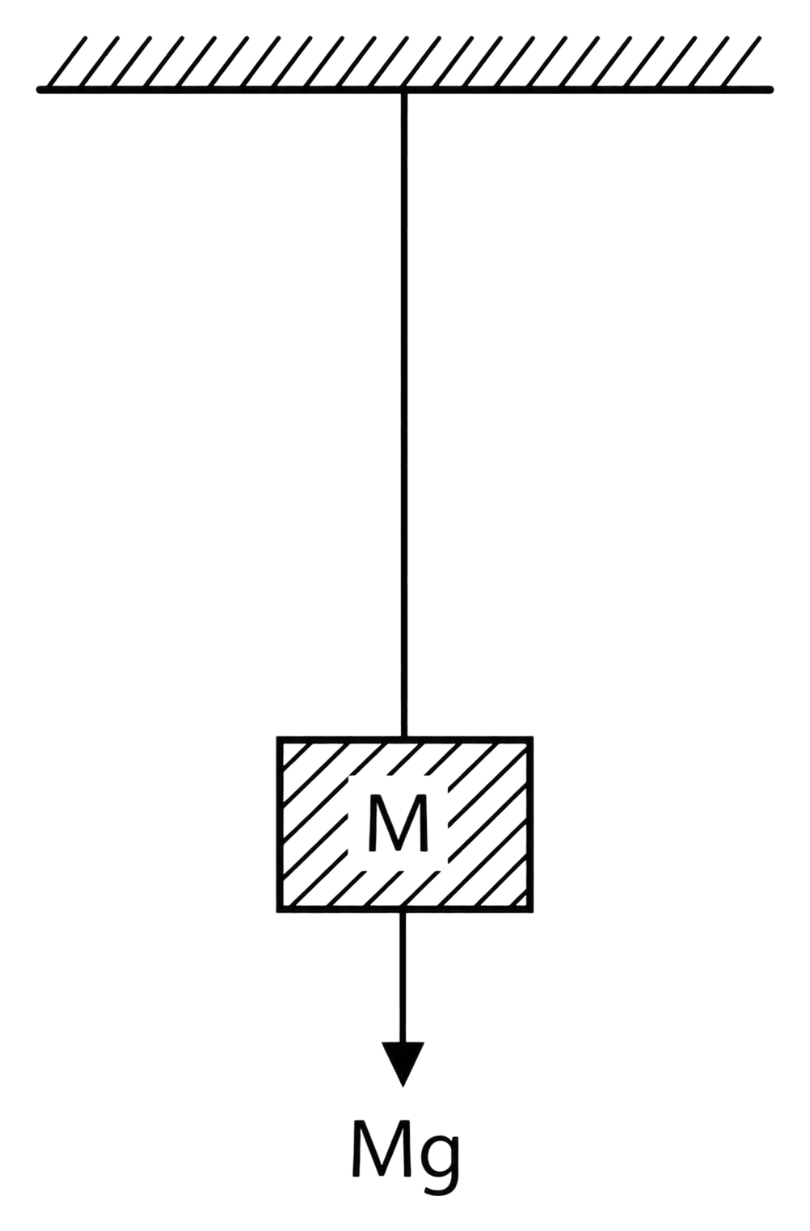
When the load of mass M is suspended in air, the extension of the wire is
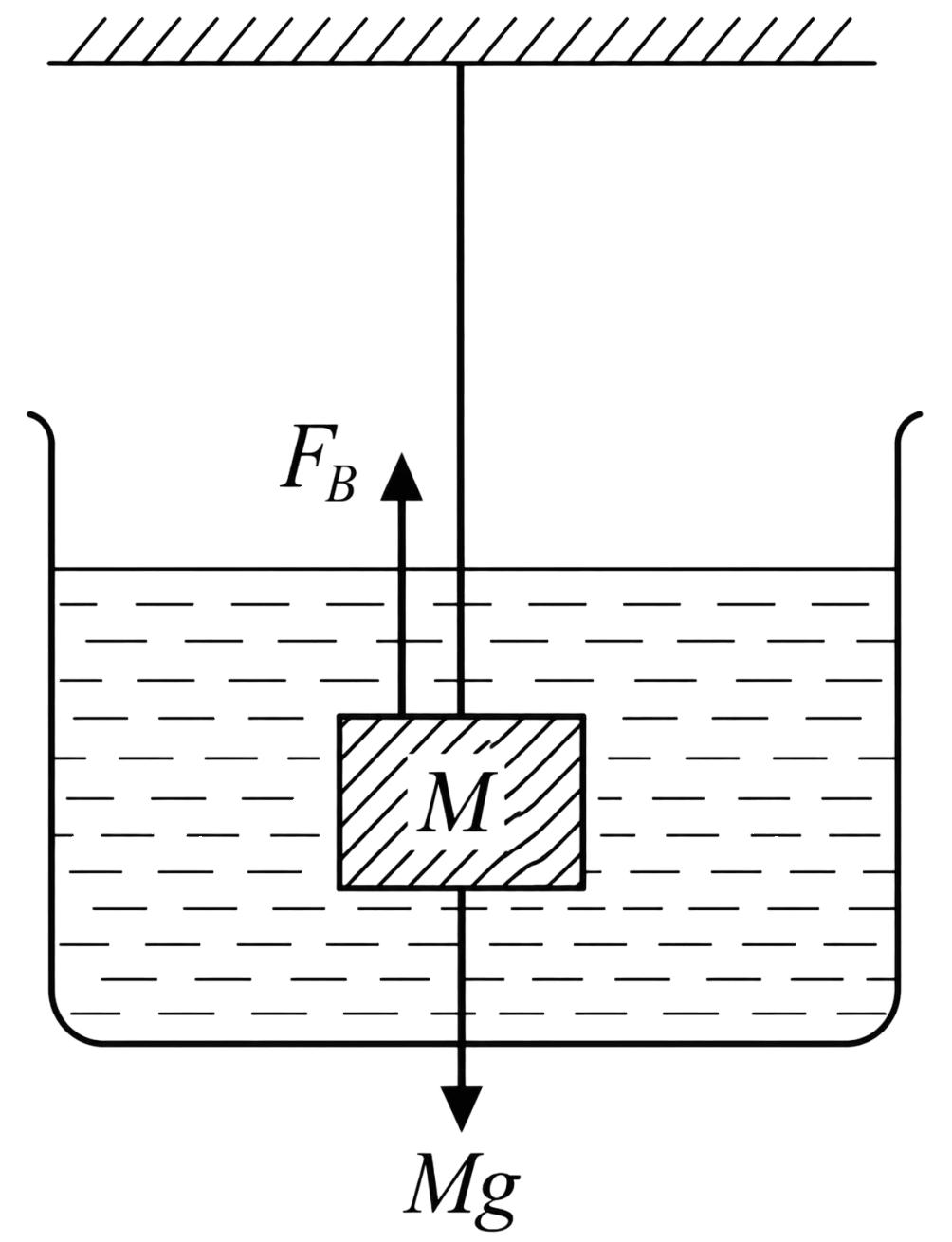
When the load is fully immersed in the liquid, an upthrust FB acts on it, so the stretching force becomes (Mg − FB) and
The buoyant force is the weight of the liquid displaced,
Given that , we get . Substituting this in equation (ii),
Dividing this by equation (i),
A rod of length L at room temperature and uniform area of cross-section A, is made of a metal having co-efficient of linear expansion α per°C. It is observed that an external compressive force F, is applied on each of its ends, prevents any change in the length of the rod, when its temperature rises by ΔT K. Young's modulus Y for this metal is :
Answer
Reason — When the temperature of the rod is increased by ΔT, the increase in its length would be
When the rod is subjected to the compressive force F, its Young's modulus is given by
Since it is given that the length of the rod does not change, the contraction produced by the force must exactly balance the expansion produced by the heating. Hence from equations (i) and (ii),
A uniform cylindrical rod of length L and radius r, is made from a material whose Young's modulus of elasticity equals Y. When this rod is heated by temperature T and simultaneously subjected to a net longitudinal compressional force F, its length remains unchanged. The coefficient of volume expansion, of the material of the rod, is (nearly) equal to :
- 3F/(πr2YT)
- 6F/(πr2YT)
- F/(3πr2YT)
- 9F/(πr2YT)
Answer
3F/(πr2YT)
Reason — The Young's modulus of the material of the rod is
Therefore the contraction produced by the compressional force is
The change in length when the rod is heated through a temperature T is
Since the length of the rod remains unchanged, the two changes must be equal,
The coefficient of volume expansion is γ = 3α, so
A steel wire having a radius of 2.0 mm, carrying a load of 4 kg, is hanging from a ceiling. Given that g = 3.1 π m s-2, what will be the tensile stress that would be developed in the wire?
- 4.8 × 10⁶ N m-2
- 5.2 × 10⁶ N m-2
- 6.2 × 10⁶ N m-2
- 3.1 × 10⁶ N m-2
Answer
3.1 × 10⁶ N m-2
Reason — Given,
- Radius of the steel wire, r = 2.0 mm = 2.0 × 10⁻³ m
- Load carried, m = 4 kg
- g = 3.1 π m s-2
The wire is stretched along its length by the weight of the load hanging from it. The tensile stress is the tensile force acting per unit area of cross-section of the wire,
Substituting the values,
When a block of mass M is suspended by a long wire of length L, the length of the wire becomes (L + l). The elastic potential energy stored in the extended wire is :
MgL
Mgl
MgL
Mgl
Answer
Mgl
Reason —
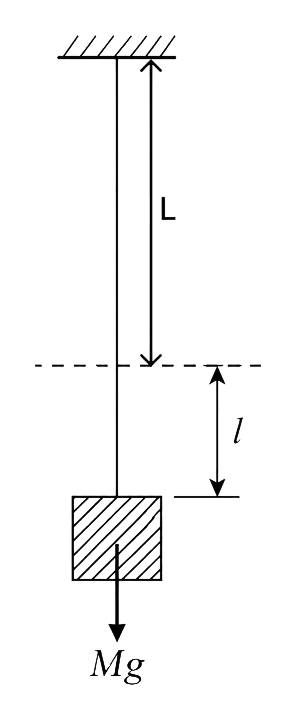
When the block of mass M is suspended, the wire is extended through l. The stretching force increases uniformly from zero to Mg as the extension grows from zero to l, so the average force acting during the extension is .
The elastic potential energy stored in the wire is therefore
that is, the elastic potential energy stored is half the work done by gravity in lowering the block through l.
The maximum elongation of steel wire of 1m length, if the elastic limit of steel and its Young's modulus, respectively, are 8 × 10⁸ Nm-2 and 2 × 10¹¹ Nm-2.
- 4 mm
- 0.4 mm
- 40 mm
- 8 mm
Answer
4 mm
Reason — Given,
- Length of the steel wire, L = 1 m
- Elastic limit of steel, = 8 × 10⁸ N m-2
- Young's modulus of steel, Y = 2 × 10¹¹ N m-2
For a wire of length L and area of cross-section A subjected to a force F, the change in its length l is given by
The maximum elongation occurs when the stress equals the elastic limit. Substituting the values,
A steel wire of diameter 0.5 mm and Young's modulus 2 × 10¹¹ N m-2 carries a load of mass M. The length of the wire with the load is 1.0 m. A vernier scale with 10 divisions is attached to the end of this wire. Next to the steel wire is a reference wire to which a main scale, of least count 1.0 mm, is attached. The 10 divisions of the vernier scale correspond to 9 divisions of the main scale. Initially, the zero of vernier scale coincides with the zero of main scale. If the load on the steel wire is increased by 1.2 kg, the vernier scale division which coincides with a main scale division is ............... . Take g = 10 ms-2 and π = 3.2. Calculate up to second decimal place.
Answer
Given,
- Diameter of the steel wire, d = 0.5 mm = 5 × 10⁻⁴ m
- Young's modulus, Y = 2 × 10¹¹ N m-2
- Length of the wire, L = 1.0 m
- Increase in load, M = 1.2 kg
- Least count of the main scale = 1.0 mm, g = 10 m s-2, π = 3.2
The Young's modulus of the material of the wire is
Substituting the values,
The vernier constant (least count of the vernier scale) is
Therefore the number of the vernier scale division that coincides with a main scale division is
Hence, the 3rd division of the vernier scale will coincide with a main scale division.
A uniform heavy rod of mass 20 kg, cross-sectional area 0.4 m2 and length 20 m is hanging from a fixed support. Neglecting the lateral contraction, the elongation in the rod due to its own weight is x × 10-9 m. The value of x is ............... .
(Given : Young's modulus Y = 2 × 10¹¹ Nm-2 and g = 10 ms-2)
Answer
Given,
- Mass of the rod, M = 20 kg
- Area of cross-section, A = 0.4 m2
- Length of the rod, L = 20 m
- Young's modulus, Y = 2 × 10¹¹ N m-2, g = 10 m s-2
The weight of the rod acts at its centre of gravity, which lies at the middle of the rod. Hence the average tension in the rod is
The Young's modulus of the material of the rod is
Substituting the values,
Hence, the value of x is 25.
In an experiment to determine the Young's modulus of wire of a length is exactly 1 m, the extension in the length of the wire is measured as 0.4 mm with an uncertainty of ± 0.02 mm when a load of 1 kg is applied. The diameter of the wire is measured as 0.4 mm with an uncertainty of ± 0.01 mm. The error in the measurement of Young's modulus (ΔY) is found to be x × 1010 Nm-2. The value of x is ............... .
(Take g = 10 ms-2)
Answer
Given,
- Length of the wire, L = 1 m (exact)
- Extension, l = 0.4 mm with Δl = ± 0.02 mm
- Diameter, D = 0.4 mm with ΔD = ± 0.01 mm
- Load applied = 1 kg, so F = 1 × 10 = 10 N
- g = 10 m s-2
The Young's modulus of the material of the wire is
Since Y is inversely proportional to D2 and to l, the maximum relative error in Y is
Substituting the values,
The value of the Young's modulus is
Therefore the error in the measurement of the Young's modulus is
Hence, the value of x is 2.
If average depth of an ocean is 4000 m and the bulk modulus of water is 2 × 10⁹ Nm-2, then fractional compression of water at the bottom of ocean is α × 10-2. The value of α is ............... .
(Given, g = 10 ms-2, ρ = 1000 kg m-3)
Answer
Given,
- Average depth of the ocean, h = 4000 m
- Bulk modulus of water, K = 2 × 10⁹ N m-2
- Density of water, ρ = 1000 kg m-3, g = 10 m s-2
The pressure at the bottom of the ocean is obtained from the hydrostatic pressure formula,
The bulk modulus of water is
Substituting the values,
Comparing this with α × 10-2,
Hence, the value of α is 2.
A steel wire of length 2 m and Young's modulus 2.0 × 10¹¹ Nm-2 is stretched by a force. If Poisson ratio and transverse strain for the wire are 0.2 and 10-3 respectively, then the elastic potential energy density of the wire is ......... × 105 (in SI units).
Answer
Given,
- Length of the wire, l = 2 m
- Young's modulus, Y = 2.0 × 10¹¹ N m-2
- Poisson's ratio, σ = 0.2
- Transverse (lateral) strain, = 10-3
The Poisson's ratio is the ratio of the lateral strain to the longitudinal strain,
Substituting the values,
The elastic potential energy density of a stretched wire is
Substituting the values,
Hence, the elastic potential energy density of the wire is 25 × 105 J m-3.