
Explain why:
(a) The blood pressure in human is greater at the feet than that at the brain.
(b) The atmospheric pressure at a height of about 6 km decreases to nearly half its value at the sea-level, though the 'height' of the atmosphere is more than 100 km.
(c) Hydrostatic pressure is a scalar quantity even though pressure is force divided by area and force is a vector.
Answer
(a) The pressure exerted by a liquid column of height h is given by P = hρg, so it increases with the vertical depth of the point. Measured from the brain, the height of the blood column standing above the feet is much greater than that above the brain. Hence, the blood pressure in human is greater at the feet than that at the brain.
(b) The density of air is maximum near the surface of the earth and decreases rapidly with height. At a height of about 6 km the air density falls to nearly half its sea-level value, and since the atmospheric pressure is produced by the weight of the air column above, the pressure at 6 km also falls to nearly half its sea-level value. Beyond 6 km the density of air decreases only slowly, so the atmosphere continues to exist up to several hundred kilometres height.
(c) Pressure is defined as the normal force exerted per unit area, , where F is only the component of the force acting normal to the surface. Since the direction of this force is always perpendicular to the surface, it is already fixed by the surface itself and pressure carries no direction of its own; it gives only the magnitude of the normal force per unit area. Hence, hydrostatic pressure is a scalar quantity.
Explain why:
(a) The angle of contact of mercury with glass is obtuse, while that of water with glass is acute.
(b) Water on a clean glass surface tends to spread out while mercury on the same surface tends to form drops. Put differently, water wets glass while mercury does not.
(c) Surface tension of a liquid is independent of the area of a surface.
(d) Water with detergent dissolved in it should have small angle of contact.
(e) A drop of liquid under no external forces is always spherical in shape.
Answer
(a) For a molecule lying on the liquid surface near the wall of the tube, two forces of attraction act — the adhesive force P due to the solid and the cohesive force Q due to the neighbouring liquid molecules. The liquid surface always sets itself perpendicular to the resultant R of these two forces.
For water and glass, the adhesive force is greater than the cohesive force, so the resultant R is directed outwards from the liquid and the water surface becomes concave. Hence the angle of contact of water with glass is acute (nearly 0° for pure water and clean glass).
For mercury and glass, the cohesive force between mercury molecules is far greater than the adhesive force, so R is directed into the interior of the mercury and the surface becomes convex. Hence the angle of contact of mercury with glass is obtuse (about 135°).
(b) The adhesive force between water molecules and glass molecules is greater than the cohesive force between the water molecules themselves. Hence the water molecules cling to the glass molecules and the glass surface is wetted, so water spreads out on it. In the case of mercury the cohesive force between mercury molecules is much greater than the adhesive force between mercury and glass, so mercury molecules do not cling to the glass. Hence, water wets glass while mercury does not and mercury tends to form drops.
(c) Surface tension is defined as the force per unit length acting at right angles on either side of an imaginary line drawn in the liquid surface, T = F/l. Since it is a force per unit length and not per unit area, its value depends only upon the nature of the liquid and the medium on the other side of the surface. Hence, the surface tension of a liquid is independent of the area of the free surface.
(d) The rise of a liquid in a capillary is , so h is proportional to cos θ. Cloth has narrow pores which act as fine capillaries. If the angle of contact θ is small, cos θ is large and the detergent solution penetrates more deeply into the pores of the cloth and cleans it better. Hence, water with detergent dissolved in it should have a small angle of contact.
(e) When no external force acts, the shape of the drop is decided by surface tension alone. Surface tension makes the liquid surface contract to the minimum possible area, and for a given volume a sphere has the minimum surface area. This also corresponds to minimum potential energy, which is the condition of stable equilibrium. Hence, a drop of liquid under no external forces is always spherical in shape.
Fill in the blanks using the word(s) from the list appended with each statement:
(a) Surface tension of liquids generally ............... with temperatures. (increases / decreases)
(b) Viscosity of gases ............... with temperature, whereas viscosity of liquids ............... with temperature. (increases / decreases)
(c) For solids with elastic modulus of rigidity, the shearing force is proportional to ..............., while for fluids it is proportional to ............... . (shear strain / rate of shear strain)
(d) For a fluid in a steady flow, the increase in flow speed at a constriction follows ............... . (conservation of mass / Bernoulli's principle)
(e) For the model of a plane in a wind tunnel, turbulence occurs at a ............... speed for turbulence for an actual plane. (greater / smaller)
Answer
(a) decreases
(b) increases, decreases
(c) shear strain, rate of shear strain
(d) conservation of mass
(e) greater
Reason —
(a) The surface tension of a liquid decreases with a rise in temperature and becomes zero at the critical temperature. On heating, the molecules gain kinetic energy and the cohesive forces between them are weakened, so the surface tension falls.
(b) In a liquid, viscosity is due mainly to intermolecular cohesion. A rise in temperature weakens this cohesion and so the viscosity of liquids decreases. In a gas, viscosity is due to the transfer of momentum between layers. At a higher temperature the molecules move faster and collide more frequently, so the viscosity of gases increases.
(c) A solid can sustain a shear stress, so once the deformation is produced it remains, and the shearing force depends on the amount of shear strain. A fluid cannot sustain a shear stress and goes on deforming as long as the force acts, so by Newton's law of viscosity the force depends on the velocity gradient, that is, on the rate of shear strain.
(d) By the equation of continuity, A × v = constant, which is derived from the conservation of mass. When the area of cross-section decreases at a constriction, the velocity must increase so that the same mass crosses every section per second.
(e) Turbulence sets in at the same value of Reynold's number, . The model in the wind tunnel has a smaller characteristic length L, so to reach the same Reynold's number the speed must be greater than that for the actual plane.
Explain why:
(a) To keep a piece of paper horizontal, one should blow over it and not under it.
(b) When we try to close a water tap with our fingers, fast jets of water gush through the openings between our fingers.
(c) The size of the needle of a syringe controls flow rate better than the thumb pressure exerted by a doctor while administering an injection.
(d) A fluid flowing out of a small hole in a vessel results in a backward thrust on the vessel.
(e) A spinning cricket ball in air does not follow a parabolic trajectory.
Answer
(a) When we blow over the paper, the velocity of air above the upper surface becomes larger than that below it. By Bernoulli's theorem, where the velocity of a flowing fluid is large the pressure is small, so the pressure above the paper is lowered while that below it remains atmospheric. This excess pressure from below keeps the paper horizontal. If we blow under it, the pressure below would be lowered and the paper would fall.
(b) When the tap is closed with the fingers, the area of cross-section of the outlet is reduced appreciably. By the principle of continuity, A1v1 = A2v2, so the velocity of water increases enormously as the area decreases. Hence, fast jets of water gush through the openings between the fingers.
(c) By Bernoulli's theorem , the total energy of the medicine flowing through the needle depends on the first power of the pressure but on the second power of the velocity. The flow therefore depends much more on velocity, which is decided by the bore of the needle. Hence, the doctor controls the flow rate by choosing a needle of proper size rather than by exerting thumb pressure.
(d) By Torricelli's theorem the liquid flows out of the hole with velocity , so the emerging liquid carries momentum in the outward direction. By the principle of conservation of momentum the vessel acquires an equal momentum in the opposite direction. Hence, the vessel experiences a backward thrust.
(e) When the ball spins, the layer of air near its surface is dragged round with it. On one side the velocity of this layer adds to the velocity of the air streaming past the ball and on the other side it subtracts from it. By Bernoulli's theorem the pressure is smaller on the side where the velocity is larger, so a sideways force acts on the ball. This is the Magnus effect, on account of which a spinning cricket ball follows a curved path and not a parabolic trajectory.
A 50 kg girl wearing high heel shoes balances on a single heel. The heel is circular with a diameter 1.0 cm. What is the pressure exerted by the heel on the horizontal floor ? (g = 9.8 N /kg)
Answer
Given,
- Mass of the girl, m = 50 kg
- Diameter of the heel, d = 1.0 cm
- g = 9.8 N/kg
The radius of the heel is
Pressure is the normal force exerted per unit area, and the normal force here is the weight of the girl. Therefore,
Substituting the values,
Hence, the pressure exerted by the heel on the horizontal floor is 6.2 × 10⁶ N m-2.
Toricelli's barometer used mercury. Pascal duplicated it using French wine of density 984 kg m-3. Determine the height of the wine column for normal atmospheric pressure 1.013 × 10⁵ N m-2. Take g = 9.8 m s-2 or 9.8 N/kg.
Answer
Given,
- Density of the wine, ρ = 984 kg m-3
- Normal atmospheric pressure, P = 1.013 × 10⁵ N m-2
- g = 9.8 N kg-1
In a barometer the weight of the liquid column balances the atmospheric pressure acting on the surface of the liquid in the container. If h is the height of the wine column, the pressure exerted by it is h ρ g, and this must equal the atmospheric pressure,
Substituting the values,
Hence, the height of the wine column is 10.5 m.
As wine is much lighter than mercury, the column required is very long, which is why mercury is preferred in a barometer.
A vertical off-shore structure is built to withstand a maximum stress of 109 Pa. Is the structure suitable for putting up on top of an oil well in ocean ? Take the depth of the ocean to be roughly 3 km, and density of water 103 kg m-3. Ignore ocean currents.
Answer
Given,
- Maximum stress the structure can bear = 109 Pa
- Depth of the ocean, h = 3 km = 3 × 10³ m
- Density of water, ρ = 103 kg m-3
- g = 9.8 N kg-1
The structure will be suitable provided the pressure exerted on it by the ocean water is less than the maximum stress it can bear. The pressure due to a liquid column of height h is
Substituting the values,
Since 2.94 × 10⁷ Pa is much less than the maximum stress of 109 Pa,
Hence, the structure is suitable for putting up on the top of an oil well in the ocean.
A hydraulic automobile lift is designed to lift cars with a maximum mass of 3,000 kg. The area of cross-section of the piston carrying the load is 425 cm2. What maximum pressure would the smaller piston have to bear ? Take g = 9.8 m s-2.
Answer
Given,
- Maximum mass to be lifted, m = 3000 kg
- Area of cross-section of the larger piston, A = 425 cm2 = 425 × 10-4 m2
- g = 9.8 m s-2
The pressure exerted on the larger piston by the load is
Substituting the values,
By Pascal's law this pressure is transmitted unchanged through the liquid to the piston of smaller cross-section.
Hence, the smaller piston would have to bear a maximum pressure of 6.92 × 10⁵ Pa.
A U-tube contains water and methylated spirit separated by mercury. The mercury columns in the two arms are in level with 10.0 cm of water in one arm and 12.5 cm of spirit in the other. Calculate the relative density of the spirit.
Answer
Given,
- Height of the water column, hw = 10.0 cm
- Height of the spirit column, hs = 12.5 cm
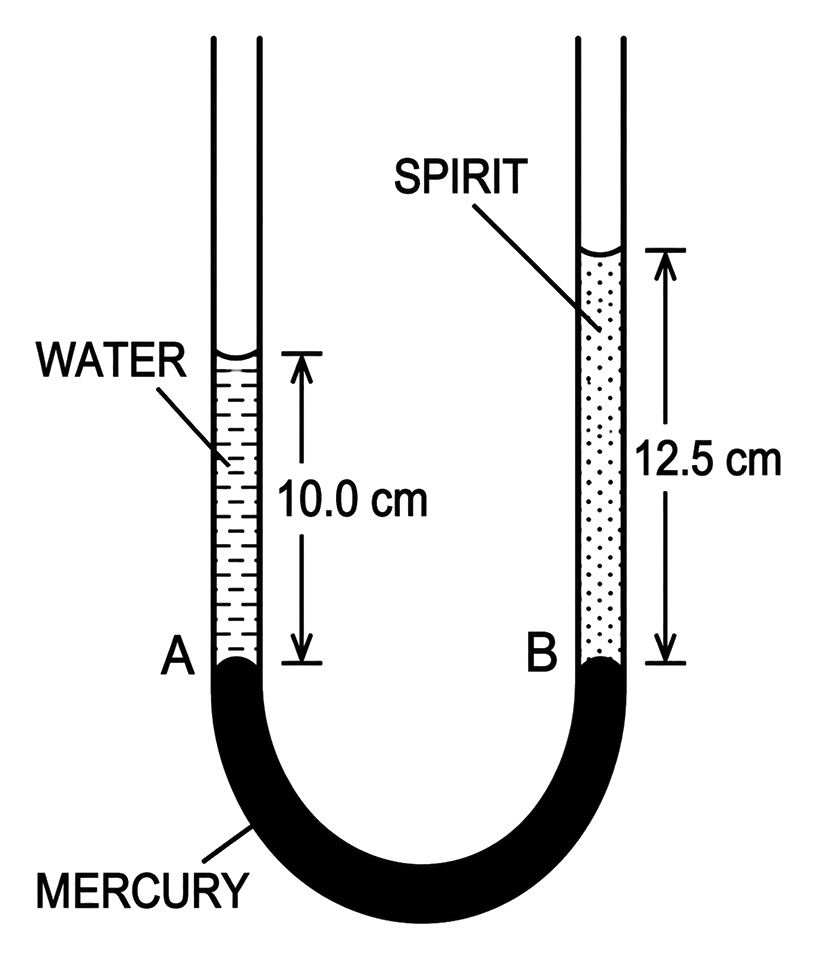
The mercury levels in the two arms are in the same horizontal line. In the presence of gravity, the pressure is the same at all points at the same level inside a liquid. Therefore, the pressure at A due to the water column is equal to the pressure at B due to the spirit column,
where the subscripts w and s refer to water and spirit respectively. Hence, the relative density of spirit is
Hence, the relative density of the spirit is 0.800.
In previous problem if 15.0 cm of water and spirit each are further poured into the respective arms of the U-tube, what will be the difference in the levels of mercury in the two arms ? The relative density/specific gravity of mercury is 13.6.
Answer
Given,
- New height of the water column = 10.0 + 15.0 = 25.0 cm
- New height of the spirit column = 12.5 + 15.0 = 27.5 cm
- Relative density of spirit, (from the previous question)
- Relative density of mercury,
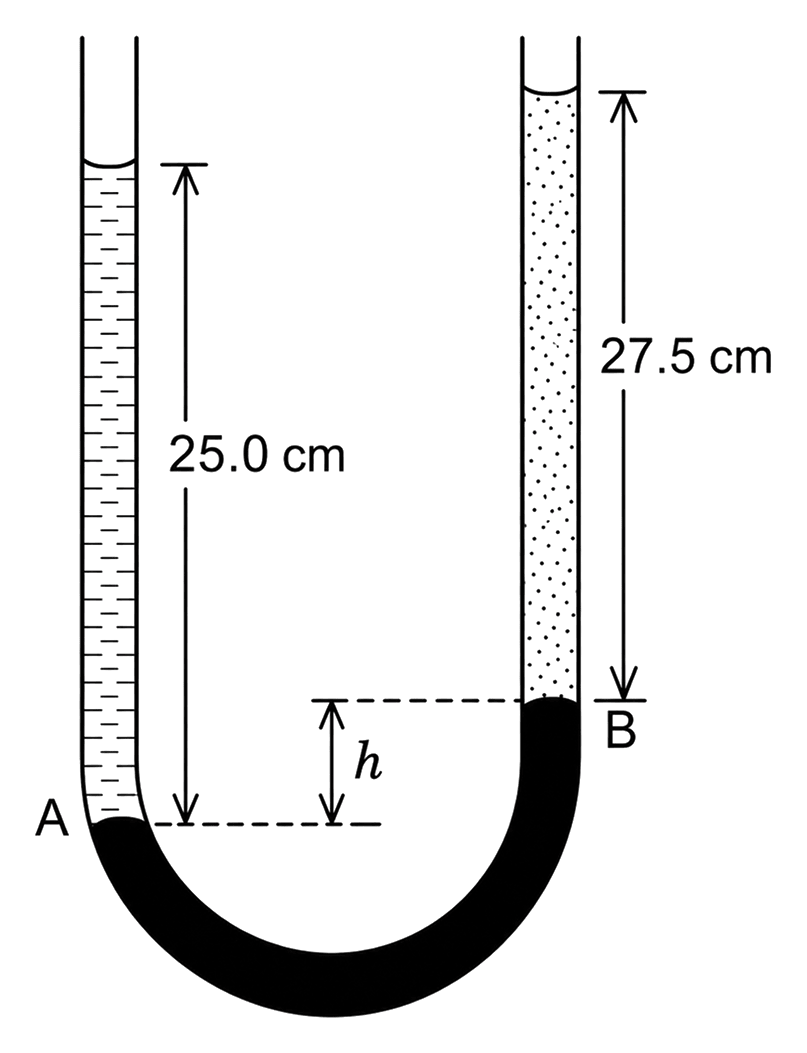
On pouring the liquids, mercury falls in the arm containing water and rises in the other, because water is heavier than spirit. Let h be the difference in the mercury levels in the two arms and ρ the density of mercury. Equating the pressures at the lower common level,
pressure of the water column at A = pressure of the spirit column at B + pressure of h cm of mercury column
Dividing throughout by ρw g,
Substituting the values,
Hence, the difference in the levels of mercury in the two arms is 0.221 cm.
Can Bernoulli's equation be used to describe the flow of water through a rapid in a river? Explain.
Answer
No, Bernoulli's equation cannot strictly be used to describe such a flow.
Bernoulli's theorem holds for an incompressible and non-viscous liquid flowing in stream-lined motion. In a river rapid the flow is highly turbulent — eddies are formed and a significant amount of energy is lost against viscous forces. Since the total energy per unit volume no longer remains constant along the flow, the conditions under which Bernoulli's theorem is derived are not satisfied.
It may, however, be applied only approximately, by considering an average flow and neglecting the turbulence.
Does it matter if one uses gauge pressure instead of absolute pressure in applying Bernoulli's equation ? Explain.
Answer
No, it does not matter, provided the atmospheric pressure at the two points is the same.
Let P1 and P2 be the absolute pressures at the two points at which Bernoulli's equation is applied. For a horizontal flow,
Gauge pressure is the pressure measured relative to the atmospheric pressure, that is, Pgauge = Pabsolute − Patmospheric. If P is the atmospheric pressure at the two points, then
Subtracting,
Since only the pressure difference enters Bernoulli's equation, and this difference is the same whether gauge or absolute pressures are used, the result is unaffected.
Glycerine flows steadily through a horizontal tube of length 1.5 m and radius 1.0 cm. If the amount of glycerine collected per second at one end is 4.0 × 10⁻³ kg s-1, what is the pressure difference between the two ends of the tube ? (Density of glycerine = 1.3 × 10³ kg m-3 and viscosity of glycerine = 0.83 Pa s)
Answer
Given,
- Length of the horizontal tube, l = 1.5 m
- Radius of the tube, r = 1.0 cm = 0.01 m
- Mass flowing per second, m/t = 4.0 × 10⁻³ kg s-1
- Density of glycerine, ρ = 1.3 × 10³ kg m-3
- Coefficient of viscosity of glycerine, η = 0.83 Pa s
The volume of glycerine flowing per second, that is, the rate of discharge, is
According to Poiseuille's formula, the rate of discharge through a pipe is
where p is the pressure difference between the two ends. Therefore,
Substituting the values,
Hence, the pressure difference between the two ends of the tube is 9.8 × 10² Pa.
In a test experiment on a model aeroplane in a wind tunnel, the flow speeds on the upper and lower surfaces of the wing are 70 m s-1 and 63 m s-1 respectively. What is the lift on the wing if its area is 2.5 m2? Take the density of air to be 1.3 kg m-3.
Answer
Given,
- Speed of air over the upper surface, v1 = 70 m s-1
- Speed of air over the lower surface, v2 = 63 m s-1
- Area of the wing, A = 2.5 m2
- Density of air, ρ = 1.3 kg m-3
Let P1 and P2 be the air pressures at the upper and the lower surfaces of the wing. By Bernoulli's theorem, for the horizontal flow of air,
Therefore, the excess of pressure on the lower surface is
Substituting the values,
The force of dynamic lift on the wing is the pressure difference multiplied by the surface area of the wing,
Hence, the lift on the wing is 1.5 × 10³ N.
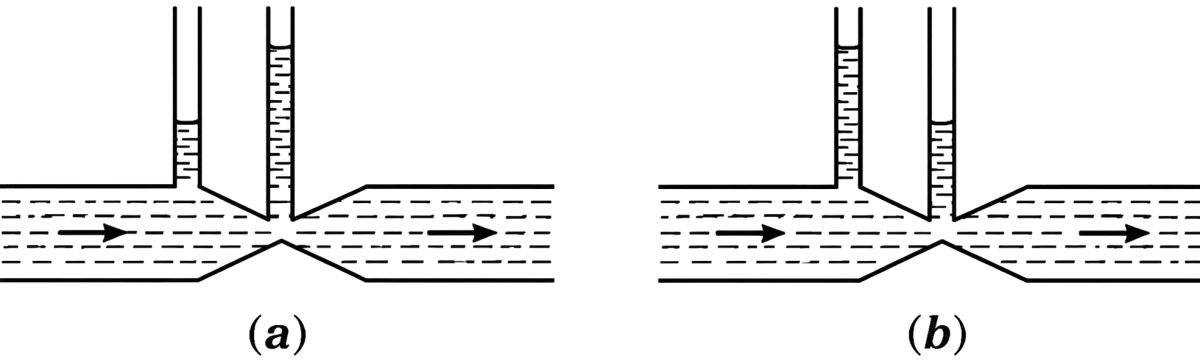
Fig. (a) and (b) below refer to the steady flow of a (non-viscous) liquid. Which of the two figures is incorrect and why ?
Answer
Fig. (a) is incorrect.
At the throat of the tube the area of cross-section is the least. By the principle of continuity, A v = constant, so the velocity of the liquid is greatest at the throat.
By Bernoulli's theorem for a horizontal flow, , wherever the velocity is greater the pressure must be smaller. Hence the height of the liquid column in the vertical tube fitted at the throat should be the shortest.
In Fig. (a) the liquid column in the manometer at the throat is shown to be the longest, which would mean a larger pressure where the velocity is largest. Hence, Fig. (a) is incorrect.
The cylindrical tube of a spray pump has a cross-section of 8.0 cm2, one end of which has 40 fine holes each of diameter 1.0 mm. If the liquid-flow inside the tube is 1.5 m per minute, what is the speed of ejection of the liquid through the holes?
Answer
Given,
- Area of cross-section of the tube, A1 = 8.0 cm2 = 8.0 × 10⁻⁴ m2
- Number of holes, n = 40
- Diameter of each hole = 1.0 mm, so radius r = 0.5 × 10⁻³ m
- Speed of flow inside the tube, v1 = 1.5 m min-1
The speed of flow inside the tube in SI units is
The total area of cross-section of all the 40 holes is
By the principle of continuity,
Substituting the values,
Hence, the speed of ejection of the liquid through the holes is 0.637 m s-1.
A U-shaped wire is dipped in a soap solution and removed. The thin soap film formed between the wire and a light slider supports a weight of 1.5 × 10⁻² N (which includes the small weight of the slider). The length of the slider is 30 cm. What is the surface tension of the film?
Answer
Given,
- Weight supported by the film, Mg = 1.5 × 10⁻² N
- Length of the slider, l = 30 cm = 30 × 10-2 m
A soap film has two free surfaces, so the force acting on the slider of length l due to the surface tension of the film is
In equilibrium this force is equal to the weight supported,
Substituting the values,
Hence, the surface tension of the film is 0.025 N m-1.
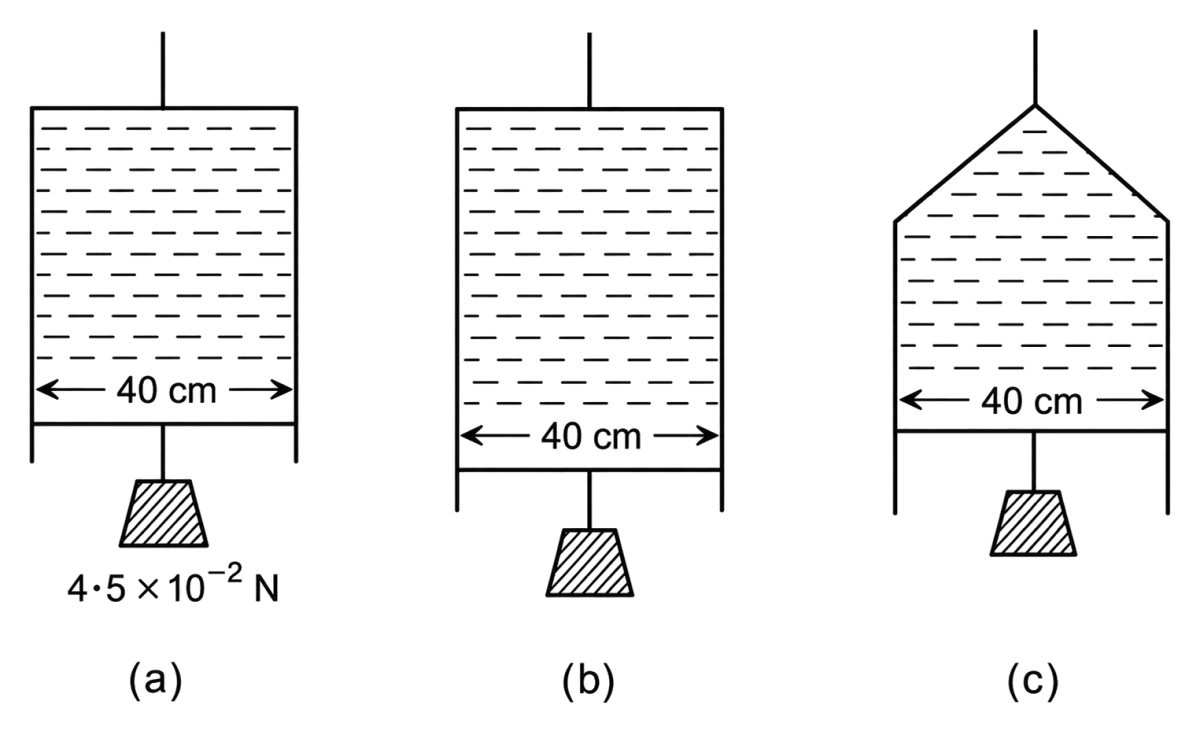
The figure (a) shows a thin soap-water film supporting a small weight of 4.5 × 10⁻² N. What is the weight supported by a film of the same liquid at the same temperature in Fig. (b) and (c)? Explain.
Answer
The weight supported in Fig. (b) and Fig. (c) is also 4.5 × 10⁻² N, the same as in Fig. (a).
The weight supported by a liquid film of surface tension T on a sliding wire of length l is
the factor 2 appearing because the film has two free surfaces.
Here the liquid is the same and the temperature is the same, so T is unchanged; and the length l of the sliding wire is 40 cm in all three figures. Since both T and l are the same, the weight supported must be the same in each case.
Hence, the weight supported in each of the figures (b) and (c) is 4.5 × 10⁻² N.
The weight supported does not depend upon the shape of the frame or the area of the film, because surface tension is a force per unit length and is independent of the surface area.
What is the pressure inside the drop of mercury of radius 3.00 mm at room temperature? Surface tension of mercury at that temperature (20°C) is 4.65 × 10⁻¹ N m-1. The atmospheric pressure is 1.01 × 10⁵ Pa. Also give the excess pressure inside the drop.
Answer
Given,
- Radius of the mercury drop, R = 3.00 mm = 3.00 × 10⁻³ m
- Surface tension of mercury, T = 4.65 × 10⁻¹ N m-1
- Atmospheric pressure, P = 1.01 × 10⁵ Pa
A liquid drop has only one free surface, so the excess pressure inside the drop is
Substituting the values,
The total pressure inside the drop is the atmospheric pressure plus this excess pressure,
Since the data are given up to three significant figures, this is written as 1.01 × 10⁵ Pa.
Hence, the excess pressure inside the drop is 310 Pa and the total pressure inside the drop is 1.01 × 10⁵ Pa.
What is the excess pressure inside a bubble of soap solution of radius 5.00 mm, given that the surface tension of soap solution at the temperature (20°C) is 2.50 × 10⁻² N m-1? If an air bubble of the same dimension were formed at depth of 40.0 cm inside a container containing the soap solution (of relative density 1.20), what would be the pressure inside the bubble? (1 atmospheric pressure is 1.01 × 10⁵ Pa).
Answer
Given,
- Radius of the bubble, R = 5.00 mm = 5.00 × 10⁻³ m
- Surface tension of soap solution, T = 2.50 × 10⁻² N m-1
- Depth of the air bubble, h = 40.0 cm = 40.0 × 10⁻² m
- Relative density of soap solution = 1.20, so ρ = 1.20 × 10³ kg m-3
- Atmospheric pressure, P = 1.01 × 10⁵ Pa
- g = 9.8 N kg-1
(i) Excess pressure inside the soap bubble : A soap bubble has two free surfaces, so
(ii) Pressure inside the air bubble : An air bubble formed inside the liquid has only one free surface, so its excess pressure is
The pressure outside the air bubble at a depth h in the soap solution is
Therefore the total pressure inside the air bubble is
Hence, the excess pressure inside the soap bubble is 20.0 Pa and the pressure inside the air bubble is 1.06 × 10⁵ Pa, up to three significant figures.