
A uniform cylinder of length L and mass M having cross-sectional area A is suspended, with its length vertical, from a fixed point by a massless spring, such that it is half submerged in a liquid of density σ at equilibrium position. The extension x0 of the spring when it is in equilibrium is:
(Here k is spring constant)
Answer
Reason — Given,
- Length of the cylinder = L
- Mass of the cylinder = M
- Area of cross-section = A
- Density of the liquid = σ
- Spring constant = k
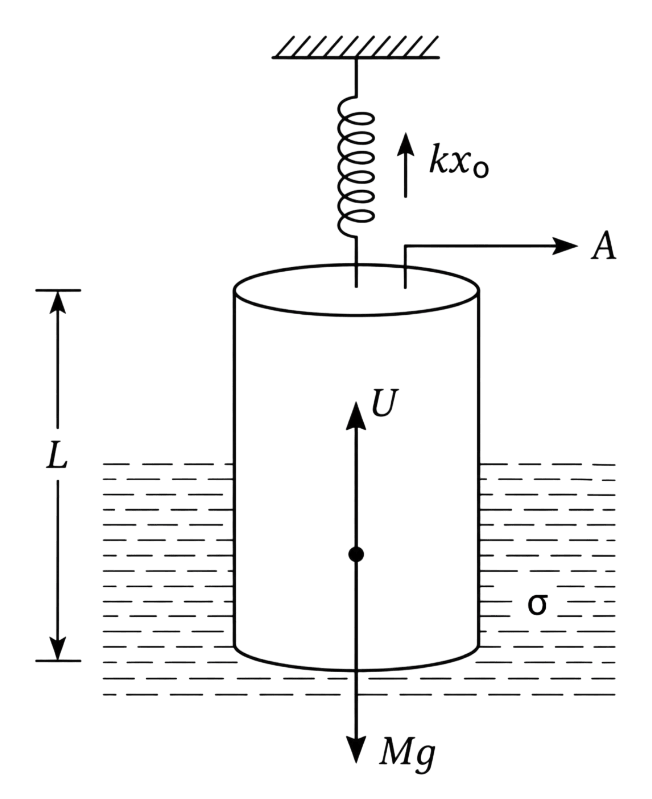
Three forces act on the cylinder in equilibrium — the weight Mg acting vertically downwards, the upthrust U acting vertically upwards and the spring force k x0 acting vertically upwards.
For equilibrium,
By Archimedes' principle, the upthrust is equal to the weight of the liquid displaced. Since the cylinder is half submerged, the volume of liquid displaced is , so
Substituting this in equation (i),
A thin uniform cylindrical shell, closed at both ends; is partially filled with water. It is floating vertically in water in half-submerged state. If ρc is the relative density of the material of the shell with respect to water, then the correct statement is that the shell is:
- more than half-filled if ρc is less than 0.5
- more than half-filled if ρc is more than 1.0
- half-filled if ρc is more than 0.5
- less than half-filled if ρc is less than 0.5.
Answer
more than half-filled if ρc is less than 0.5
Reason — Since ρc is the relative density of the material of the shell with respect to water, the relative density of water is 1.
Let V0 be the outer volume of the shell, Vi the inner volume and V the volume of water filled inside the shell. The shell floats half-submerged, so the volume of water displaced is .
By the law of floatation, the total weight of the shell together with the water inside it equals the weight of the water displaced,
If ρc = 0.5 : substituting and simplifying gives , that is, the shell is exactly half-filled.
If ρc > 0.5 : , that is, the shell is less than half-filled.
If ρc < 0.5 : , that is, the shell is more than half-filled with water.
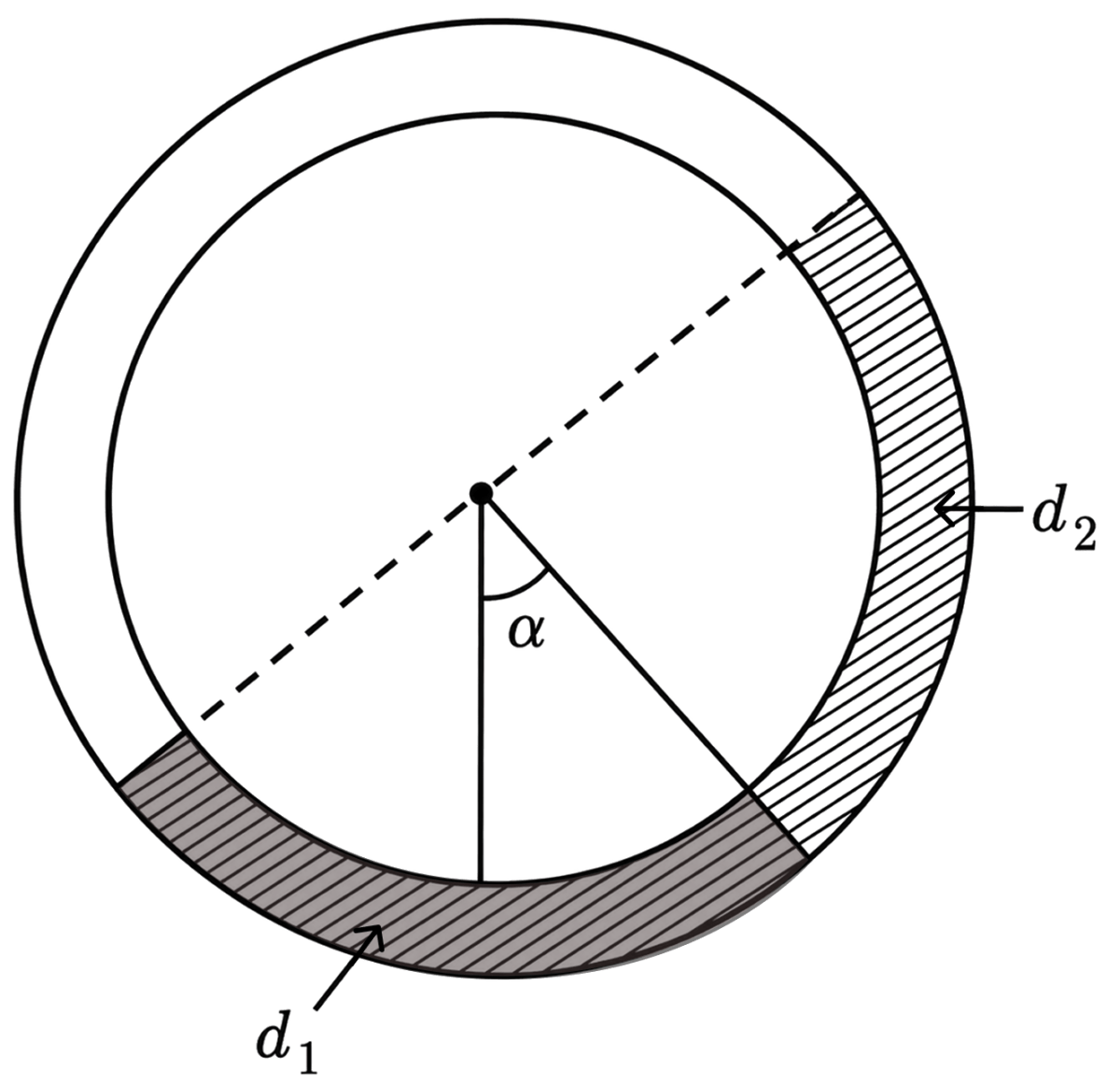
There is a circular tube in a vertical plane. Two liquids which do not mix and of densities d1 and d2 are filled in the tube. Each liquid substands 90° angle at centre. Radius joining their interface makes an angle α with vertical. Ratio d1/d2 is:
Answer
Reason — Let R be the radius of the circular tube. The two liquids meet at the point A, and the radius joining the interface makes an angle α with the vertical.
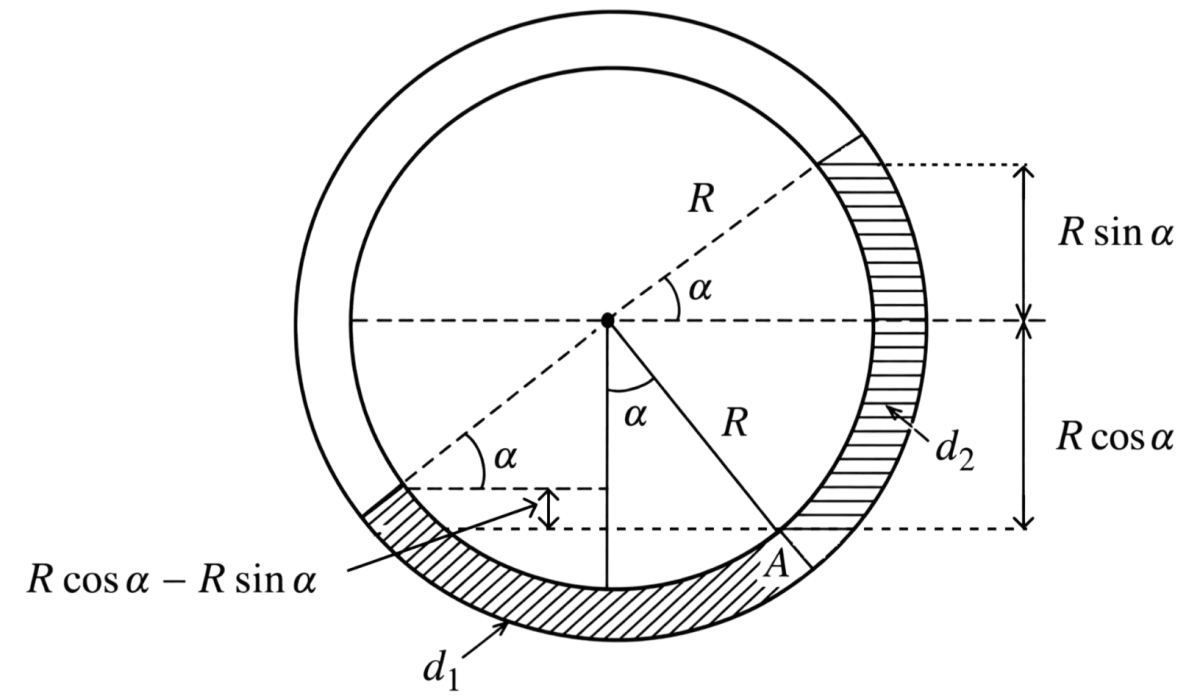
From the geometry of the figure, the vertical height of the column of the liquid of density d1 above the level of A is (R cos α + R sin α), while the vertical height of the column of the liquid of density d2 is (R cos α − R sin α).
In equilibrium, the pressures at the point A due to the two liquid columns must be equal,
Therefore,
Dividing the numerator and the denominator by R cos α,
Consider two solid spheres P and Q each of density 8 gm cm-3 and diameters 1 cm and 0.5 cm, respectively. Sphere P is dropped into a liquid of density 0.8 gm cm-3 and viscosity η = 3 poiseuilles. Sphere Q is dropped into a liquid of density 1.6 gm cm-3 and viscosity η = 2 poiseuilles. Find the ratio of the terminal velocities of P and Q.
Answer
Given,
For sphere P :
- Radius, rP = 0.5 cm
- Density of sphere, ρP = 8 gm cm-3
- Density of liquid, σ1 = 0.8 gm cm-3
- Coefficient of viscosity, η1 = 3 poiseuille
For sphere Q :
- Radius, rQ = 0.25 cm
- Density of sphere, ρQ = 8 gm cm-3
- Density of liquid, σ2 = 1.6 gm cm-3
- Coefficient of viscosity, η2 = 2 poiseuille
By Stokes' law, the terminal velocity of a sphere of radius r and density ρ falling through a liquid of density σ and coefficient of viscosity η is
Therefore, the ratio of the terminal velocities of the two spheres is
Substituting the values,
Hence, the ratio of the terminal velocities of P and Q is 3 : 1.
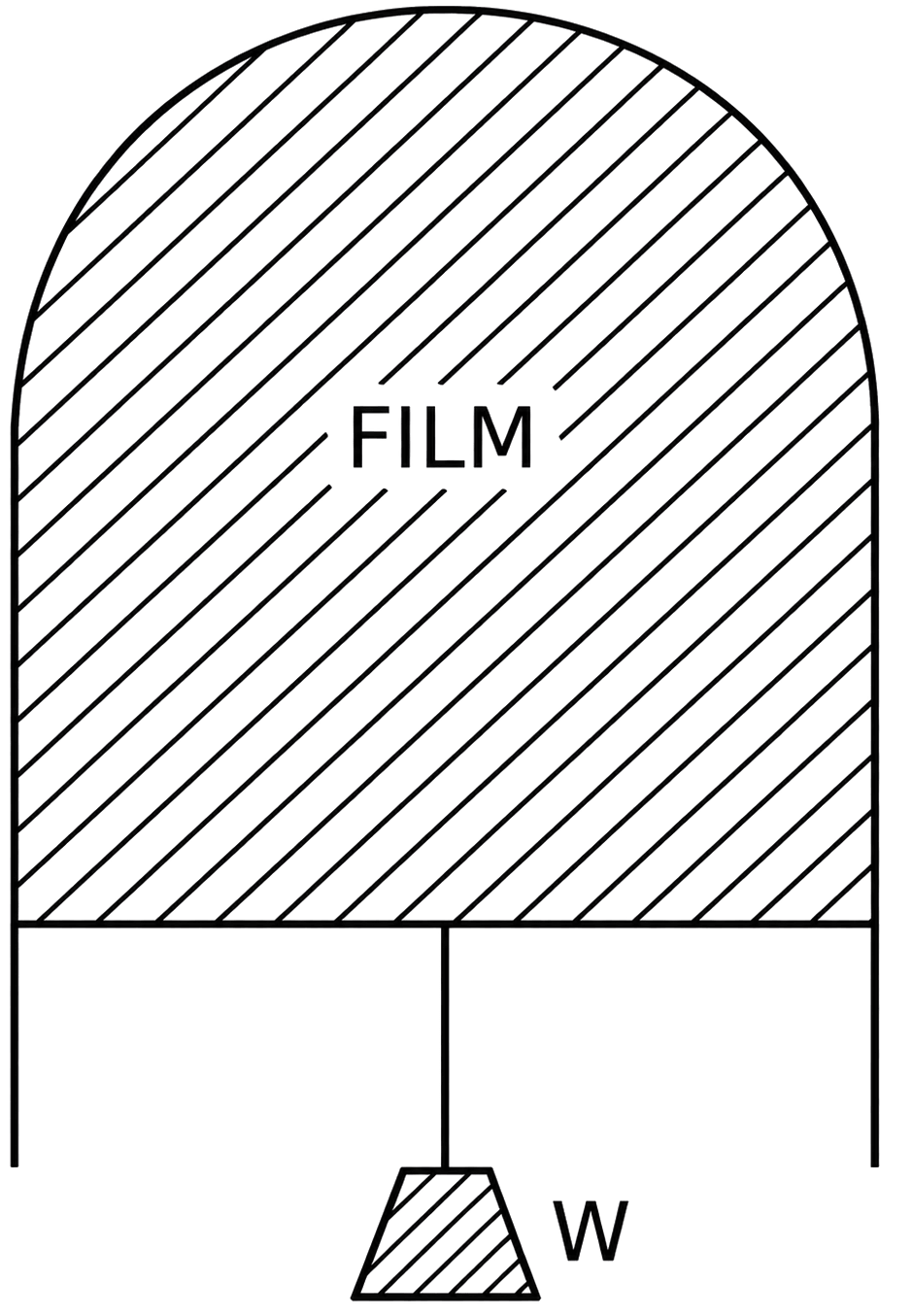
A thin liquid film formed between a U-shaped wire and a light slider supports a weight of 1.5 × 10⁻² N (see figure). The length of the slider is 30 cm and its weight is negligible. The surface tension of the liquid film is:
- 0.0125 Nm-1
- 0.1 Nm-1
- 0.05 Nm-1
- 0.025 Nm-1.
Answer
0.025 Nm-1
Reason — Given,
- Weight supported, mg = 1.5 × 10⁻² N
- Length of the slider, L = 30 cm = 30 × 10-2 m
A liquid film has two free surfaces, so the upward force on the slider due to surface tension is T × 2L.
In equilibrium this force balances the weight supported,
Substituting the values,
Assume that a drop of liquid evaporates by decrease in its surface energy, so that its temperature remains unchanged. What should be the minimum radius of the drop for this to be possible? The surface tension is T, density of liquid is ρ and L is its latent heat of vaporization.
Answer
Reason — Let the radius of the drop be x and let a layer of thickness dx evaporate from its surface.
The mass of the liquid that evaporates is
The energy required for this evaporation is
The change in the surface area of the drop when its radius decreases from x to (x − dx) is
Neglecting the square of the small quantity dx,
The energy released by this decrease in surface area is
Since the temperature remains unchanged, the energy released must supply the energy required. Equating (i) and (ii),
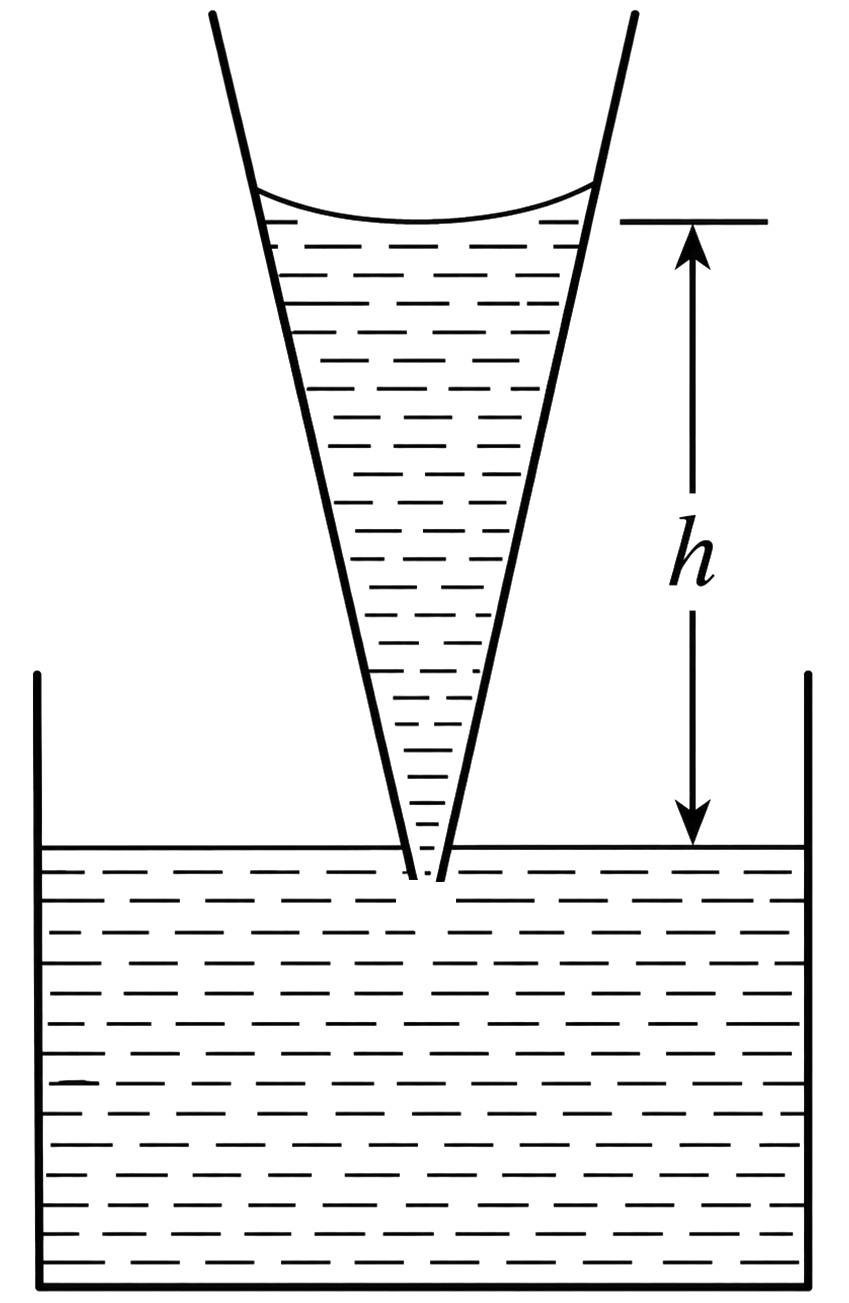
A glass capillary tube is of the shape of a truncated cone with an apex angle α so that its two ends have cross-sections of different radii. When dipped in water vertically, water rises in it to a height h, where the radius of its cross-section is b. If the surface tension of water is T, its density is ρ, and its contact angle with glass is θ, the value of h will be: (g is the acceleration due to gravity)
.
Answer
Reason — Since the tube is a truncated cone of apex angle α, its wall makes an angle with the vertical. Hence the tangent to the liquid surface makes an angle with the vertical, and not θ as in a uniform tube.
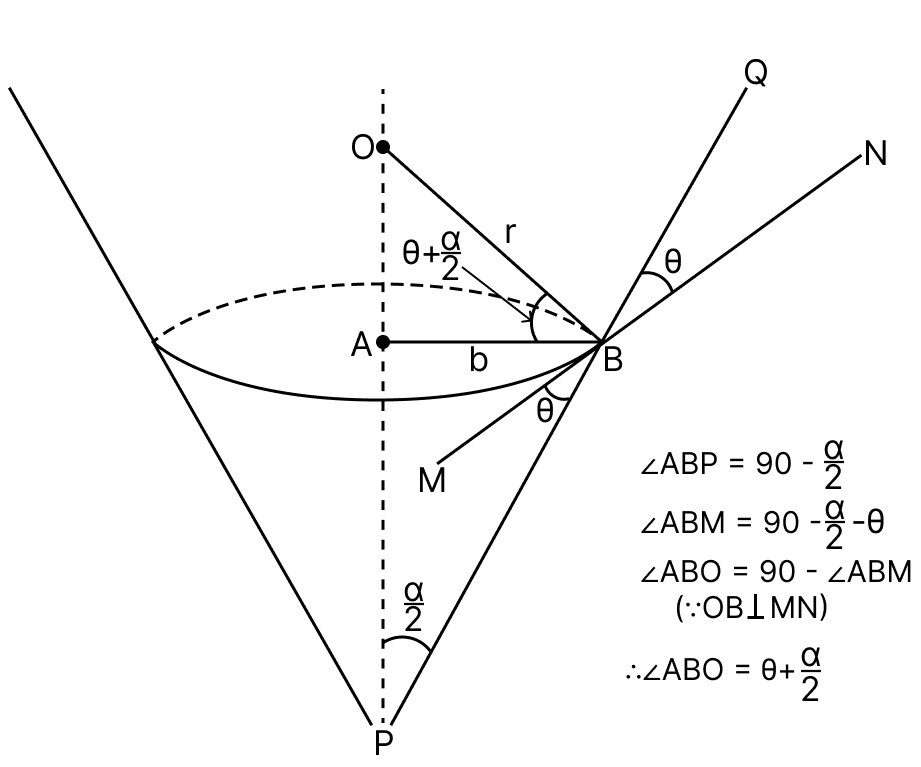
Let r be the radius of curvature of the meniscus at the height h, where the radius of the tube is b. From the geometry of the figure,
The excess pressure on the concave side of the meniscus is
This excess pressure supports the liquid column of height h, so
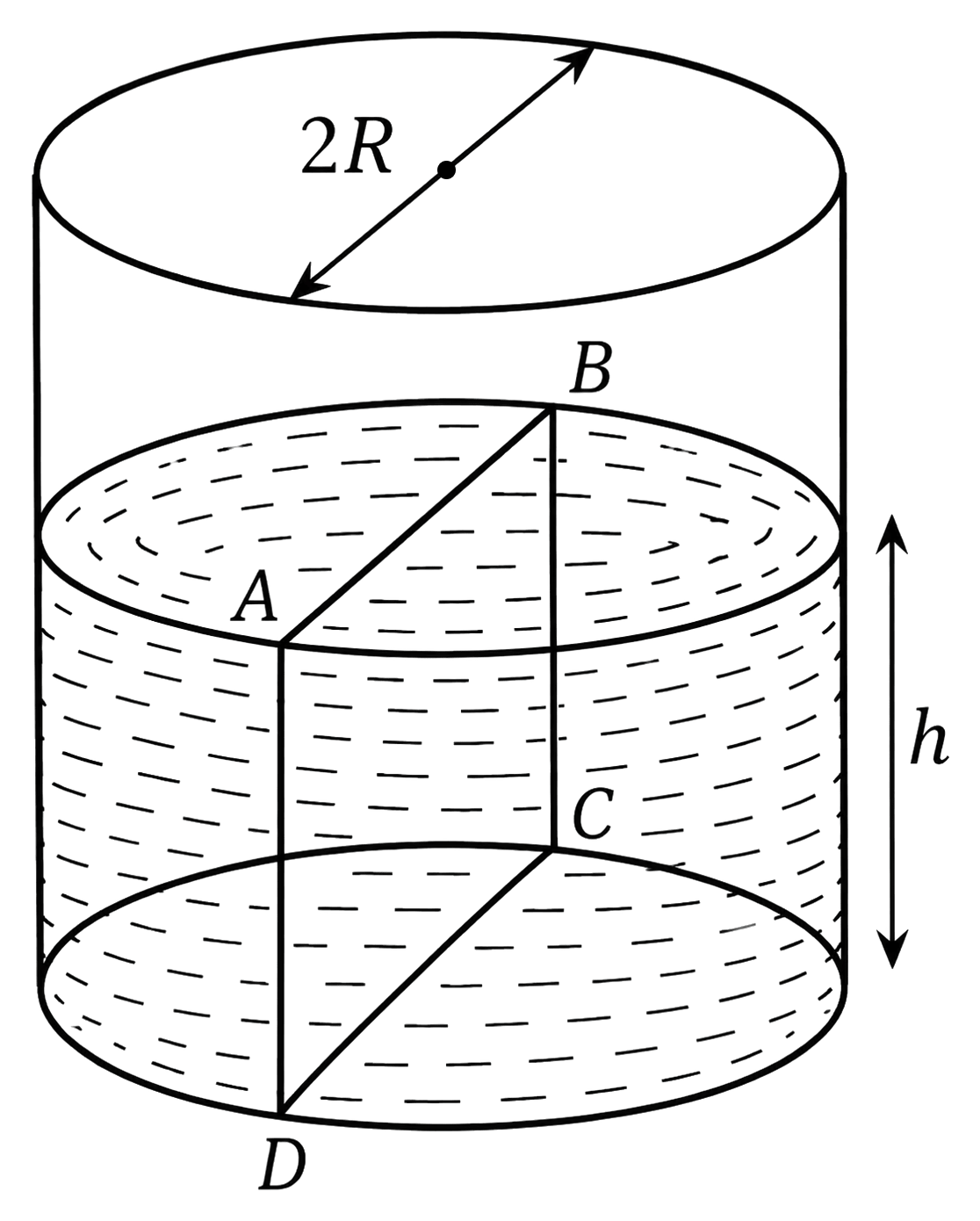
Water is filled up to a height h in a beaker of radius R, as shown in the figure. The density of water is ρ, the surface tension of water is T and the atmospheric pressure is P0. Consider a vertical section ABCD of the water column through a diameter of the beaker. The force on water on one side of this section by water on the other side of this section has magnitude:
- 2P0Rh + πR2ρgh − 2RT
- 2P0Rh + Rρgh2 − 2RT
- P0πR2 + Rρgh2 − 2RT
- P0πR2 + Rρgh2 + 2RT.
Answer
2P0Rh + Rρgh2 − 2RT
Reason — Consider the vertical section ABCD, whose width is the diameter 2R of the beaker and whose height is h.
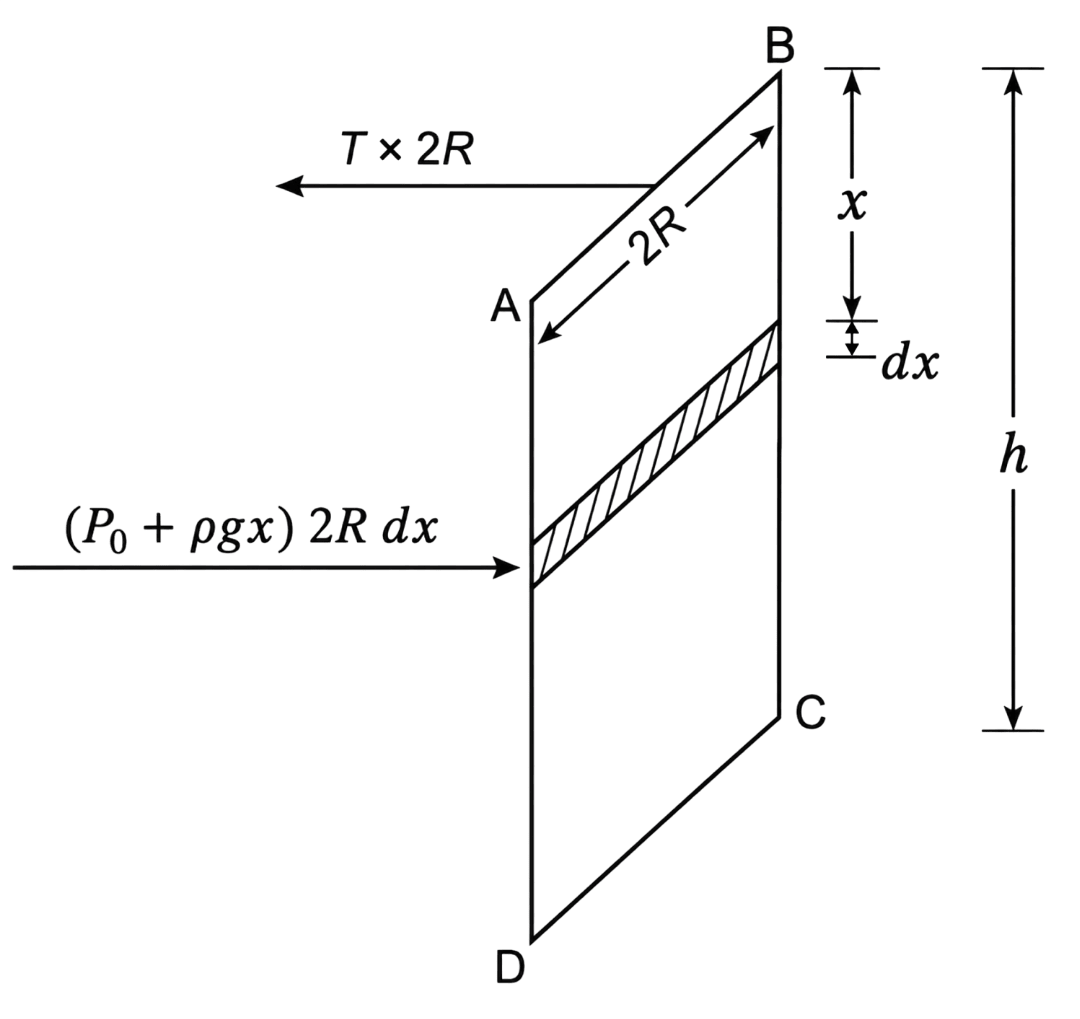
Take a thin horizontal strip of thickness dx at a depth x below the free surface. The pressure at this depth is (P0 + ρgx) and the area of the strip is 2R dx. Hence the force on the strip is (P0 + ρgx) × 2R dx.
The total force on the section due to the water on one side is obtained by integrating from x = 0 to x = h,
Integrating,
The surface tension acts along the line AB of length 2R at the free surface, pulling the two halves together. This force is
Since this force is directed opposite to the pressure force, the net force on the section is
On heating water, bubbles being formed at the bottom of the vessel detatch and rise. Take the bubbles to be spheres of radius R and making a circular contact of radius r with the bottom of the vessel. If r << R, and the surface tension of water is T, value of r just before bubbles detatch is: (density of water is ρw)
.
Answer
Reason — Let θ be the angle which the radius drawn to the edge of the circular contact makes with the vertical.
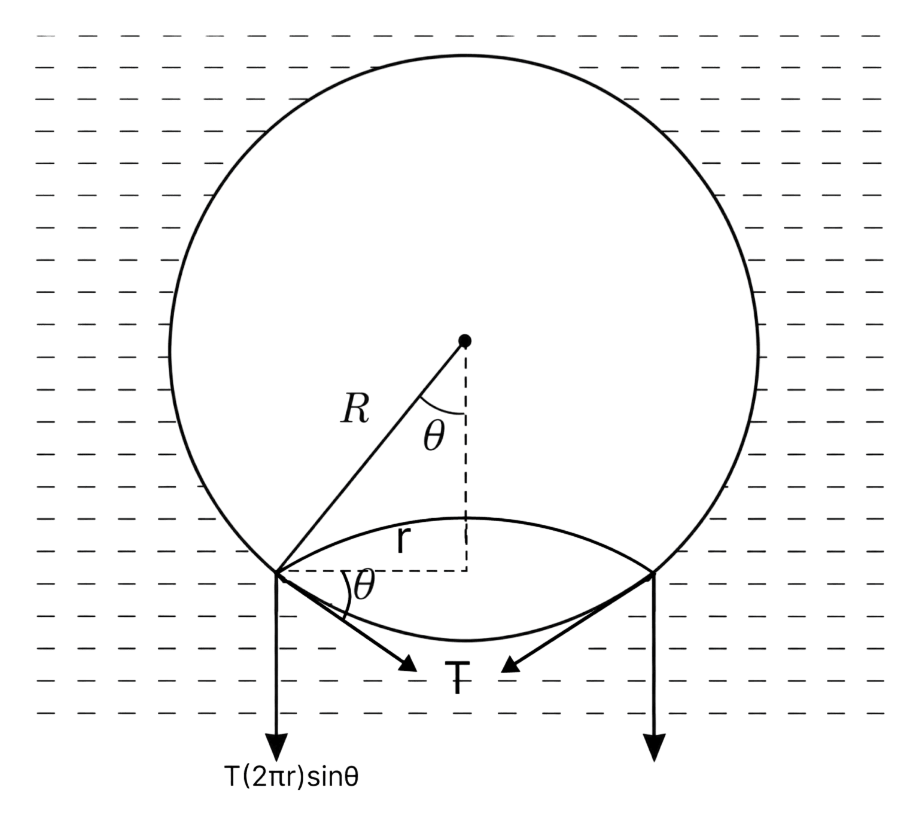
From the geometry of the figure,
The bubble is held down at the bottom by the vertical component of the force of surface tension acting along the circle of contact of circumference 2πr, which is
The bubble is pushed up by the buoyant force, which by Archimedes' principle is the weight of the water displaced,
The bubble will just detach when the buoyant force becomes greater than the force of surface tension,
Solving for r2,
Value of r just before bubbles detatch is
A tank with a square base of area 1.0 m2 is divided by a vertical partition in the middle. The bottom of the partition has a small hinged door of area 20 cm2. The tank is filled with water in one compartment and an acid (of relative density 1.7) in the other, both to a height of 4.0 m. Calculate the force necessary to keep the door closed g = 9.8 m s-2.
Answer
Given,
- Area of the hinged door, A = 20 cm2 = 20 × 10-4 m2
- Height of both the liquid columns, h = 4.0 m
- Density of water, ρw = 1.0 × 10³ kg m-3
- Relative density of acid = 1.7, so ρa = 1.7 × 10³ kg m-3
- g = 9.8 m s-2
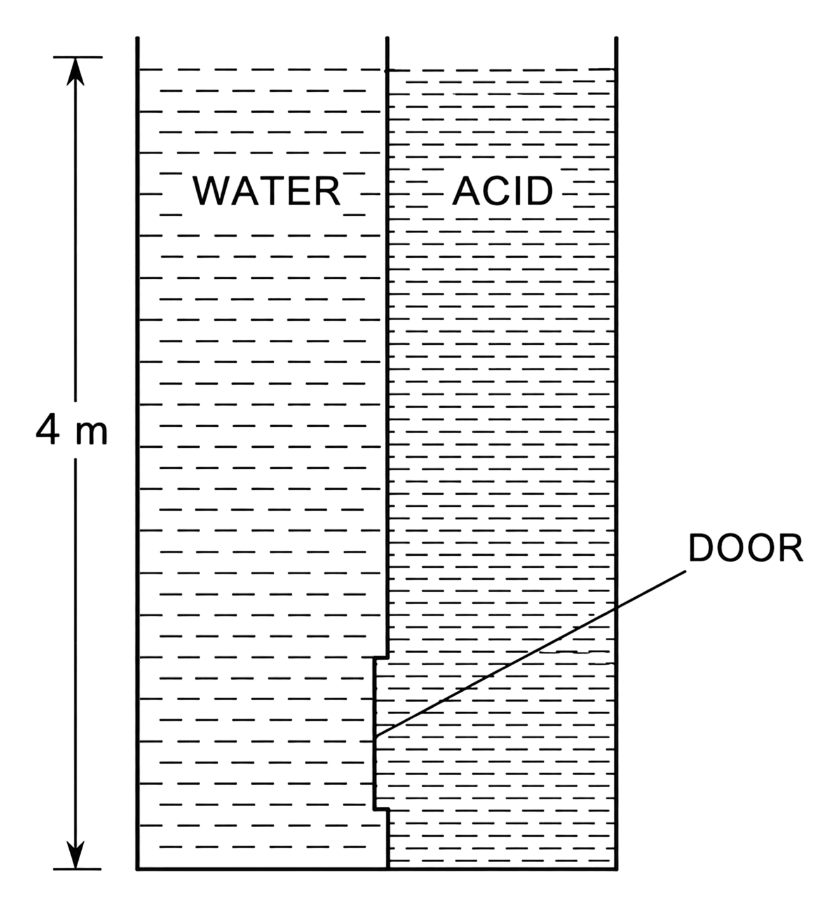
The lateral pressure exerted on the small door at the bottom by the water column is
The pressure exerted by the acid column is
The net pressure on the door is therefore
The net force on the door is
Hence, a force of 55 N must be applied horizontally on the door from the compartment containing water towards the one containing acid to keep the door closed.
The base area of the tank does not affect the answer, since the pressure at a point depends only on the depth and the density of the liquid.
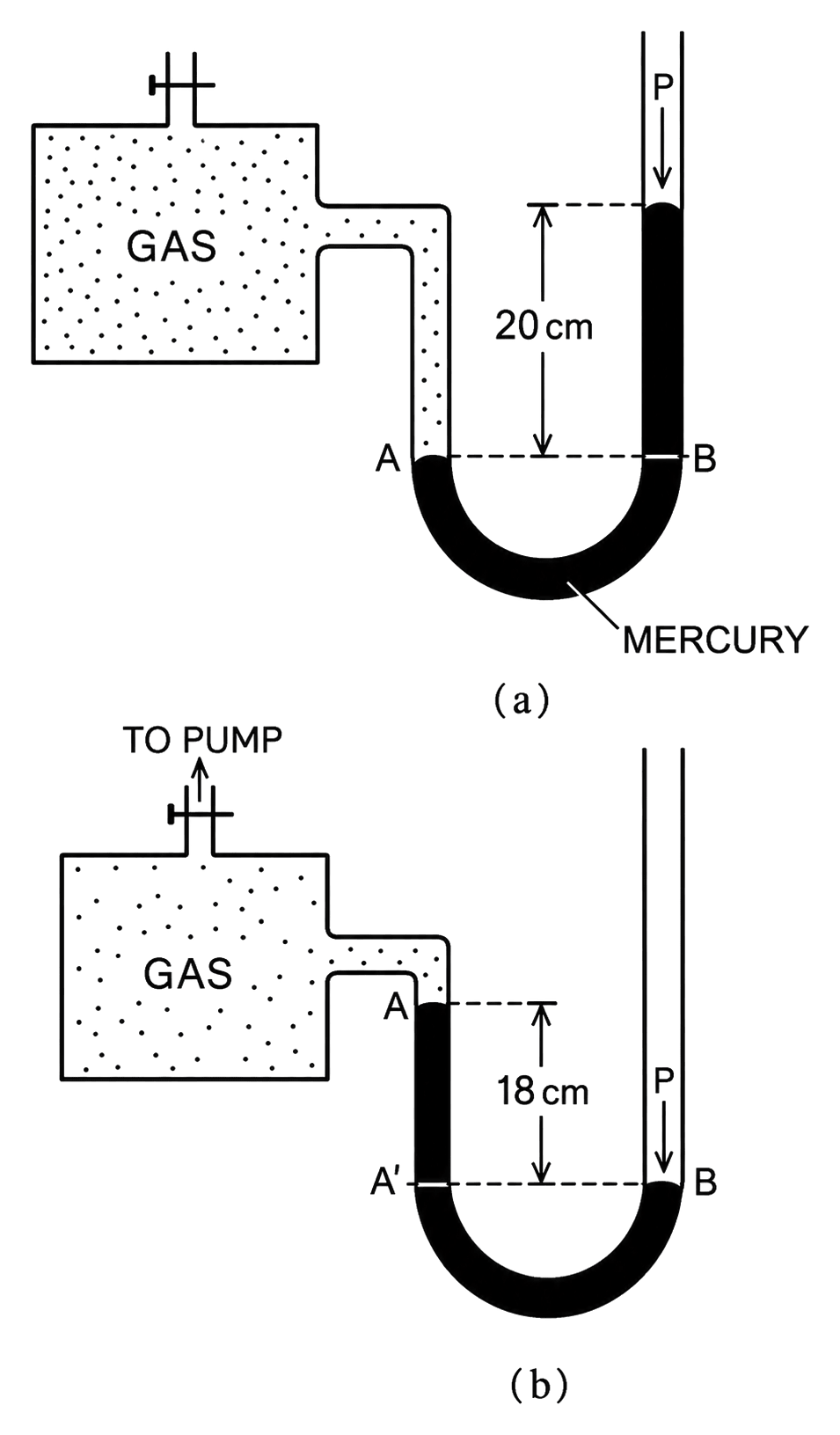
A manometer reads the pressure of a gas in an enclosure as shown in Fig. (a). When some of the gas is removed by a pump, the manometer reads as in Fig. (b). The liquid used in the manometer is mercury and atmospheric pressure is 76 cm of mercury. (i) Give the absolute and gauge pressures of the gas in the enclosure for cases (a) and (b), in units of cm of mercury. (ii) How would the levels change in (b) if 13.6 cm of water is poured into the right limb of the manometer ? (Ignore the small change in volume of the gas).
Answer
Given,
- Atmospheric pressure, P = 76 cm of mercury
- Difference of mercury levels in Fig. (a) = 20 cm
- Difference of mercury levels in Fig. (b) = 18 cm
(i) For Fig. (a) : The points A and B lie at the same horizontal level of mercury, so the pressures at A and B are equal. The mercury in the right limb stands 20 cm higher, therefore
The gauge pressure is the pressure measured relative to the atmospheric pressure,
For Fig. (b) : Here the mercury level in the right limb is 18 cm lower, so
The negative gauge pressure shows that the pressure of the gas is lower than the atmospheric pressure.
(ii) Mercury is 13.6 times heavier than water, so a water column of height 13.6 cm exerts the same pressure as a mercury column of height 1 cm.
Hence, on pouring 13.6 cm of water into the right limb, the mercury in the left limb rises by 1 cm and correspondingly the level in the right limb falls, so that
Hence, the difference in the mercury levels in the two limbs becomes 19 cm.
Two vessels have the same base area but different shapes. The first vessel takes twice the volume of water that the second vessel requires to fill up to a particular common height. (i) Is the force exerted by water on the base of the vessel the same in the two cases? (ii) If so, why do the vessels filled with water to that same height give different readings on a weighing scale?
Answer
(i) Yes, the force exerted by water on the base is the same in the two cases.
The pressure exerted by a liquid column depends only on the vertical depth of the point and the density of the liquid, p = hρg. It depends neither on the shape of the vessel nor on the amount of liquid in it. Here the height h of water and the base area A are the same for both vessels, so the force on the base, F = hρgA, is also the same. This is the familiar hydrostatic paradox.
(ii) The water also exerts force on the side walls of the vessel, and this force is always normal to the wall in contact.
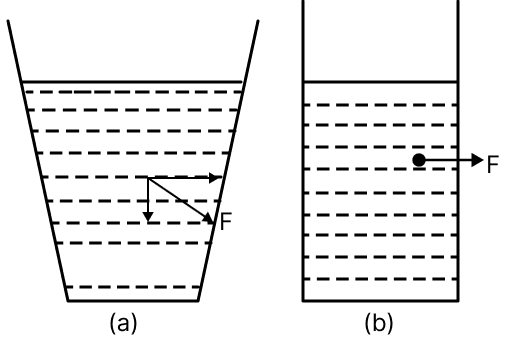
For the vessel with vertical sides, this force on the walls is horizontal and has no vertical component. But for the vessel whose sides are slanting, the force normal to the wall has a non-zero vertical downward component.
Hence, the vessel with the slanting sides presses on the pan with a larger total downward force and gives a higher reading on a weighing scale, even though the force on the base is the same in both cases.
(i) What is the largest average velocity of blood flow in an artery of radius 2 × 10⁻³ m if the flow must remain stream-lined? (ii) What is the corresponding flow rate ? (Take viscosity of blood to be 2.084 × 10⁻³ Pa s, density of blood = 1.06 × 10³ kg m-3, Reynold's number = 2000)
Answer
Given,
- Radius of the artery, r = 2 × 10⁻³ m, so diameter D = 4 × 10⁻³ m
- Coefficient of viscosity of blood, η = 2.084 × 10⁻³ Pa s
- Density of blood, ρ = 1.06 × 10³ kg m-3
- Reynold's number, Re = 2000
(i) The largest average velocity for which the flow remains stream-lined is the critical velocity, which in terms of Reynold's number is
Substituting the values,
(ii) The corresponding rate of flow of blood is
Substituting the values,
Hence, the largest average velocity of blood flow is 0.98 m s-1 and the corresponding flow rate is 1.23 × 10⁻⁵ m3 s-1.
A plane is in level flight at constant speed and each of its two wings has an area of 25 m2. If the speed of the air is 180 km/h over the lower wing and 234 km/h over the upper wing surface, determine the plane's mass. (Take air density to be 1.0 kg m-3, g = 10 m s-2.)
Answer
Given,
- Speed of air over the upper wing surface, v1 = 234 km/h
- Speed of air over the lower wing surface, v2 = 180 km/h
- Area of each wing = 25 m2, so total wing area A = 2 × 25 = 50 m2
- Density of air, ρ = 1.0 kg m-3
- g = 10 m s-2
Converting the speeds into SI units,
Let P1 and P2 be the air pressures at the upper and the lower surfaces of the wings. By Bernoulli's theorem,
so the excess of pressure over the lower surface is
In level flight, the weight of the plane is balanced by the upward force due to this excess pressure,
Substituting the values,
Hence, the mass of the plane is 4312 kg.
In Millikan's oil-drop experiment, what is the terminal speed of a drop of radius 2.0 × 10⁻⁵ m and density 1.2 × 10³ kg m-3? Viscosity of air at the temperature of the experiment is 1.8 × 10⁻⁵ Ns m-2. How much is the viscous force on the drop at that speed ? Neglect buoyancy of the drop due to air. (g = 9.8 m s-2)
Answer
Given,
- Radius of the drop, r = 2.0 × 10⁻⁵ m
- Density of the drop, ρ = 1.2 × 10³ kg m-3
- Coefficient of viscosity of air, η = 1.8 × 10⁻⁵ N s m-2
- g = 9.8 m s-2
- Buoyancy is neglected, so σ = 0
By Stokes' law, the terminal velocity of the drop is
Substituting the values,
The viscous force acting on the drop at this terminal speed is given by Stokes' law,
Substituting the values,
Hence, the terminal speed of the drop is 5.8 × 10⁻² m s-1 and the viscous force on it is 3.93 × 10⁻¹⁰ N.
Two narrow bores of diameters 3.0 mm and 6.0 mm are joined together to form a U-shaped tube open at both ends. If the U-tube contains water, what is the difference in its levels in the two limbs of the tube? Surface tension of water at the temperature of the experiment is 7.3 × 10⁻² N m-1. Take the angle of contact to be zero and the density of water to be 1.0 × 10³ kg m-3 (g = 9.8 m s-2).
Answer
Given,
- Radius of the broader limb, r1 = 3.0 mm = 3.0 × 10⁻³ m
- Radius of the narrower limb, r2 = 1.5 mm = 1.5 × 10⁻³ m
- Surface tension of water, T = 7.3 × 10⁻² N m-1
- Density of water, ρ = 1.0 × 10³ kg m-3
- Angle of contact, θ = 0
- g = 9.8 N kg-1
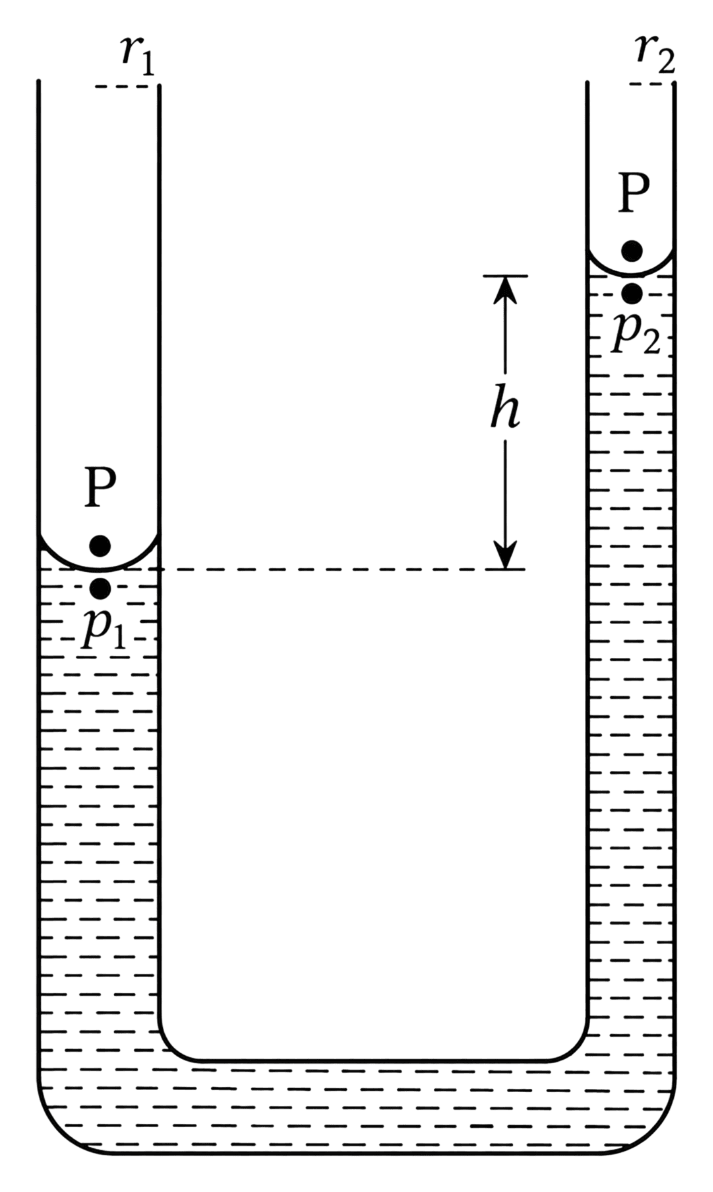
Since the angle of contact of water with glass is zero, the radii of curvature of the meniscus in the two limbs are equal to the radii r1 and r2 of the tube in those limbs. The pressure above the meniscus in both the limbs is atmospheric, P.
The pressure on the convex side of a curved liquid surface of radius R is greater than that on the concave side by . Hence the pressures just below the two menisci are
Therefore,
But this pressure difference is also equal to hρg, where h is the difference in the levels of water in the two limbs. Thus,
Substituting the values,
Hence, the difference in the water levels in the two limbs of the tube is 5.0 mm.